

IEC 60268-21:2018
(Main)Sound system equipment - Part 21: Acoustical (output-based) measurements
General Information
- Abstract
IEC 60268-21:2018 specifies an acoustical measurement method that applies to electro-acoustical transducers and passive and active sound systems, such as loudspeakers, TV-sets, multi-media devices, personal portable audio devices, automotive sound systems and professional equipment. The device under test (DUT) can be comprised of electrical components performing analogue and digital signal processing prior to the passive actuators performing a transduction of the electrical input into an acoustical output signal. This document describes only physical measurements that assess the transfer behaviour of the DUT between an arbitrary analogue or digital input signal and the acoustical output at any point in the near and far field of the system. This includes operating the DUT in both the small and large signal domains. The influence of the acoustical boundary conditions of the target application (e.g. car interior) can also be considered in the physical evaluation of the sound system. This document does not assess the perception and cognitive evaluation of the reproduced sound and the impact of perceived sound quality.
- Status
- Published
- Publication Date
- 06-Nov-2018
- Technical Committee
- TA 20 - Analogue and digital audio
- Drafting Committee
- PT 60268-21 - TC 100/TA 20/PT 60268-21
- Current Stage
- PPUB - Publication issued
- Start Date
- 07-Nov-2018
- Completion Date
- 22-Oct-2018
Buy Documents
IEC 60268-21:2018 - Sound system equipment - Part 21: Acoustical (output-based) measurements Released:11/7/2018
IEC 60268-21:2018 - Sound system equipment - Part 21: Acoustical (output-based) measurements Released:3/20/2019
Overview
IEC 60268-21:2018 defines standardized acoustical (output-based) measurements for sound system equipment. The method applies to electro-acoustical transducers and both passive and active sound systems - for example loudspeakers, TV-sets, multi‑media devices, personal portable audio devices, automotive sound systems and professional equipment. The standard specifies physical measurement procedures that assess the transfer behaviour between an arbitrary analogue or digital input and the acoustical output in the near and far field. It covers operation in both small‑signal and large‑signal domains and allows inclusion of application-specific acoustical boundary conditions (e.g., car interiors). It does not cover perceptual or cognitive evaluation of sound quality.
Key topics and technical requirements
- Measurement scope: Transfer between input signal and acoustic output at defined evaluation points (near/far field).
- Test signals: Defined signal types such as sinusoidal chirps, single‑ and two‑tone signals, multi‑tone and broadband/noise, Hann bursts and impulsive signals for different analyses.
- Acoustical environment: Procedures for free‑field, half‑space, diffuse field, simulated and target‑application conditions.
- Positioning & geometry: Reference plane, reference point/axis, evaluation distance and orientation vectors for repeatable measurements.
- Key metrics: Sound‑pressure output (SPL), rated maximum SPL, short‑ and long‑term maximum levels, SPL in frequency bands, mean SPL and frequency response of the fundamental component.
- Directional characteristics: 3D direct sound field measurements, extrapolated near/far‑field data, directivity factor/gain, directivity index and acoustic output power.
- Measurement quality: Requirements for measurement equipment, uncertainty analysis, preconditioning, mounting and rated ambient conditions (temperature, humidity).
- Additional parameters: Effective frequency range, internal latency, amplitude compression (time‑varying and at maximum input).
Applications and users
IEC 60268-21 is essential for:
- Audio manufacturers (design verification, datasheets, product comparison)
- Test laboratories and QA teams (type approval, production testing, verification of rated SPL/frequency response)
- R&D and acoustic engineers (system tuning, loudspeaker characterization, networked audio devices)
- Automotive and consumer electronics teams needing target‑application (cabin) measurements.
Typical uses include publishing verified SPL/frequency response data, quantifying directivity and acoustic output power, and validating performance under real‑world boundary conditions.
Related standards
- Part of the IEC 60268 series on sound system equipment; consult other parts of the series for electrical measurements, terminology and system‑level requirements.
- Use alongside laboratory and acoustics guides for measurement uncertainty and environment control.
Buy Documents
IEC 60268-21:2018 - Sound system equipment - Part 21: Acoustical (output-based) measurements Released:11/7/2018
IEC 60268-21:2018 - Sound system equipment - Part 21: Acoustical (output-based) measurements Released:3/20/2019
Get Certified
Connect with accredited certification bodies for this standard

ANCE
Mexican certification and testing association.

Intertek Slovenia
Intertek testing, inspection, and certification services in Slovenia.

LNE (Laboratoire National de Métrologie et d'Essais)
French national laboratory for metrology and testing.
Sponsored listings
Frequently Asked Questions
IEC 60268-21:2018 is a standard published by the International Electrotechnical Commission (IEC). Its full title is "Sound system equipment - Part 21: Acoustical (output-based) measurements". This standard covers: IEC 60268-21:2018 specifies an acoustical measurement method that applies to electro-acoustical transducers and passive and active sound systems, such as loudspeakers, TV-sets, multi-media devices, personal portable audio devices, automotive sound systems and professional equipment. The device under test (DUT) can be comprised of electrical components performing analogue and digital signal processing prior to the passive actuators performing a transduction of the electrical input into an acoustical output signal. This document describes only physical measurements that assess the transfer behaviour of the DUT between an arbitrary analogue or digital input signal and the acoustical output at any point in the near and far field of the system. This includes operating the DUT in both the small and large signal domains. The influence of the acoustical boundary conditions of the target application (e.g. car interior) can also be considered in the physical evaluation of the sound system. This document does not assess the perception and cognitive evaluation of the reproduced sound and the impact of perceived sound quality.
IEC 60268-21:2018 specifies an acoustical measurement method that applies to electro-acoustical transducers and passive and active sound systems, such as loudspeakers, TV-sets, multi-media devices, personal portable audio devices, automotive sound systems and professional equipment. The device under test (DUT) can be comprised of electrical components performing analogue and digital signal processing prior to the passive actuators performing a transduction of the electrical input into an acoustical output signal. This document describes only physical measurements that assess the transfer behaviour of the DUT between an arbitrary analogue or digital input signal and the acoustical output at any point in the near and far field of the system. This includes operating the DUT in both the small and large signal domains. The influence of the acoustical boundary conditions of the target application (e.g. car interior) can also be considered in the physical evaluation of the sound system. This document does not assess the perception and cognitive evaluation of the reproduced sound and the impact of perceived sound quality.
IEC 60268-21:2018 is classified under the following ICS (International Classification for Standards) categories: 33.160.01 - Audio, video and audiovisual systems in general. The ICS classification helps identify the subject area and facilitates finding related standards.
IEC 60268-21:2018 is available in PDF format for immediate download after purchase. The document can be added to your cart and obtained through the secure checkout process. Digital delivery ensures instant access to the complete standard document.
Standards Content (Sample)
IEC 60268-21 ®
Edition 1.0 2018-11
INTERNATIONAL
STANDARD
colour
inside
Sound system equipment –
Part 21: Acoustical (output-based) measurements
All rights reserved. Unless otherwise specified, no part of this publication may be reproduced or utilized in any form
or by any means, electronic or mechanical, including photocopying and microfilm, without permission in writing from
either IEC or IEC's member National Committee in the country of the requester. If you have any questions about IEC
copyright or have an enquiry about obtaining additional rights to this publication, please contact the address below or
your local IEC member National Committee for further information.
IEC Central Office Tel.: +41 22 919 02 11
3, rue de Varembé info@iec.ch
CH-1211 Geneva 20 www.iec.ch
Switzerland
About the IEC
The International Electrotechnical Commission (IEC) is the leading global organization that prepares and publishes
International Standards for all electrical, electronic and related technologies.
About IEC publications
The technical content of IEC publications is kept under constant review by the IEC. Please make sure that you have the
latest edition, a corrigenda or an amendment might have been published.
IEC Catalogue - webstore.iec.ch/catalogue Electropedia - www.electropedia.org
The stand-alone application for consulting the entire The world's leading online dictionary of electronic and
bibliographical information on IEC International Standards, electrical terms containing 21 000 terms and definitions in
Technical Specifications, Technical Reports and other English and French, with equivalent terms in 16 additional
documents. Available for PC, Mac OS, Android Tablets and languages. Also known as the International Electrotechnical
iPad. Vocabulary (IEV) online.
IEC publications search - webstore.iec.ch/advsearchform IEC Glossary - std.iec.ch/glossary
The advanced search enables to find IEC publications by a 67 000 electrotechnical terminology entries in English and
variety of criteria (reference number, text, technical French extracted from the Terms and Definitions clause of
committee,…). It also gives information on projects, replaced IEC publications issued since 2002. Some entries have been
and withdrawn publications. collected from earlier publications of IEC TC 37, 77, 86 and
CISPR.
IEC Just Published - webstore.iec.ch/justpublished
Stay up to date on all new IEC publications. Just Published IEC Customer Service Centre - webstore.iec.ch/csc
details all new publications released. Available online and If you wish to give us your feedback on this publication or
also once a month by email. need further assistance, please contact the Customer Service
Centre: sales@iec.ch.
IEC 60268-21 ®
Edition 1.0 2018-11
INTERNATIONAL
STANDARD
colour
inside
Sound system equipment –
Part 21: Acoustical (output-based) measurements
INTERNATIONAL
ELECTROTECHNICAL
COMMISSION
ICS 33.160.01 ISBN 978-2-8322-6176-7
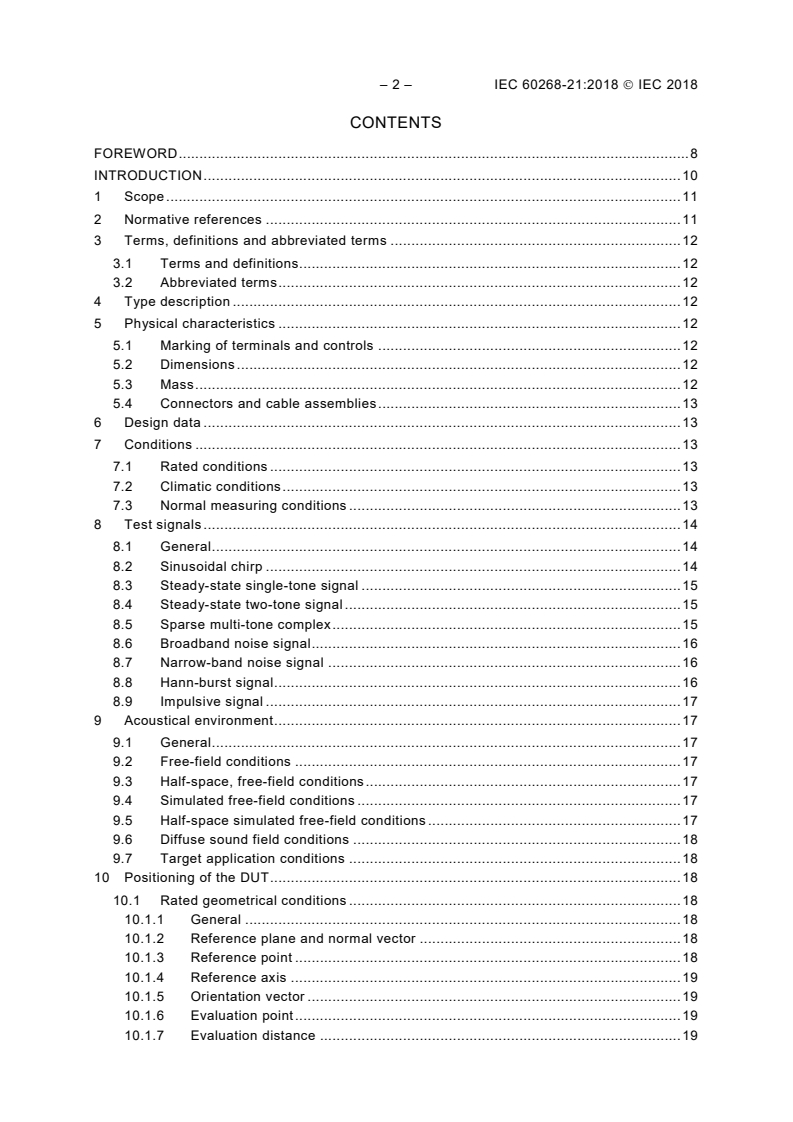
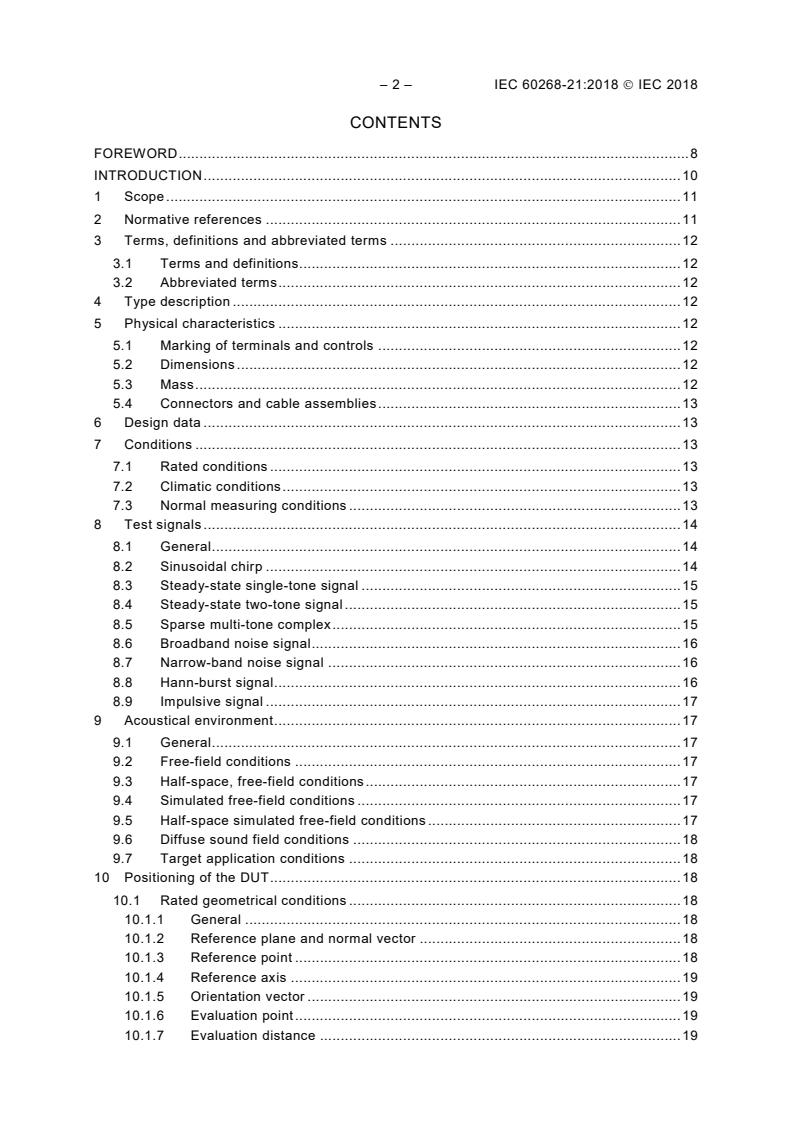
– 2 – IEC 60268-21:2018 IEC 2018
CONTENTS
FOREWORD . 8
INTRODUCTION . 10
1 Scope . 11
2 Normative references . 11
3 Terms, definitions and abbreviated terms . 12
3.1 Terms and definitions . 12
3.2 Abbreviated terms . 12
4 Type description . 12
5 Physical characteristics . 12
5.1 Marking of terminals and controls . 12
5.2 Dimensions . 12
5.3 Mass . 12
5.4 Connectors and cable assemblies . 13
6 Design data . 13
7 Conditions . 13
7.1 Rated conditions . 13
7.2 Climatic conditions . 13
7.3 Normal measuring conditions . 13
8 Test signals . 14
8.1 General . 14
8.2 Sinusoidal chirp . 14
8.3 Steady-state single-tone signal . 15
8.4 Steady-state two-tone signal . 15
8.5 Sparse multi-tone complex . 15
8.6 Broadband noise signal . 16
8.7 Narrow-band noise signal . 16
8.8 Hann-burst signal . 16
8.9 Impulsive signal . 17
9 Acoustical environment . 17
9.1 General . 17
9.2 Free-field conditions . 17
9.3 Half-space, free-field conditions . 17
9.4 Simulated free-field conditions . 17
9.5 Half-space simulated free-field conditions . 17
9.6 Diffuse sound field conditions . 18
9.7 Target application conditions . 18
10 Positioning of the DUT . 18
10.1 Rated geometrical conditions . 18
10.1.1 General . 18
10.1.2 Reference plane and normal vector . 18
10.1.3 Reference point . 18
10.1.4 Reference axis . 19
10.1.5 Orientation vector . 19
10.1.6 Evaluation point . 19
10.1.7 Evaluation distance . 19
10.2 Measuring distance between DUT and microphone . 20
10.2.1 Far-field conditions . 20
10.2.2 Near-field conditions . 20
10.2.3 Diffuse field conditions . 20
10.2.4 Target application condition . 21
11 Measurement equipment and test results . 21
12 Accuracy of the acoustical measurement . 21
12.1 General . 21
12.2 Measurement uncertainty . 21
13 Mounting of the DUT . 22
13.1 Mounting and acoustic loading of drive units . 22
13.2 Mounting and acoustic loading of an electro-acoustic system . 22
14 Preconditioning . 23
15 Rated ambient conditions . 23
15.1 Temperature ranges . 23
15.1.1 Performance limited temperature range . 23
15.1.2 Damage limited temperature range . 23
15.2 Humidity ranges . 23
15.2.1 Relative humidity range . 23
15.2.2 Damage limited humidity range . 23
16 Rated frequency range . 23
17 Input signal . 23
17.1 Rated maximum input value . 23
17.1.1 Condition to be specified . 23
17.1.2 Direct measurement . 24
17.1.3 Indirect measurement based on SPL . 25
max
17.2 Maximum input level . 25
18 Sound-pressure output . 26
18.1 Rated maximum sound pressure . 26
18.1.1 Conditions to be specified . 26
18.1.2 Direct measurement . 26
18.1.3 Indirect measurement based on maximum input value . 27
18.2 Rated maximum sound-pressure level . 27
18.3 Short term maximum sound pressure level . 27
18.3.1 Conditions to be specified . 27
18.3.2 Method of measurement . 28
18.4 Long term maximum sound pressure level . 28
18.4.1 Conditions to be specified . 28
18.4.2 Method of measurement . 29
18.5 Sound pressure in a stated frequency band . 29
18.5.1 Condition to be specified . 29
18.5.2 Method of measurement . 29
18.6 Sound-pressure level in a stated frequency band . 30
18.7 Mean sound-pressure in a stated frequency range . 30
18.7.1 Condition to be specified . 30
18.7.2 Method of measurement . 30
18.8 Mean sound-pressure level in a stated frequency range . 30
– 4 – IEC 60268-21:2018 IEC 2018
19 Frequency response of the fundamental component . 30
19.1 Transfer function . 30
19.1.1 Conditions to be specified . 30
19.1.2 Method of measurements . 30
19.2 SPL frequency response . 32
19.2.1 Conditions to be specified . 32
19.2.2 Method of measurement . 32
19.3 Time-varying amplitude compression of the fundamental component . 33
19.3.1 General . 33
19.3.2 Method of measurement . 33
19.4 Amplitude compression at maximum input . 33
19.4.1 Short term amplitude compression . 33
19.4.2 Method of measurement . 33
19.4.3 Long-term amplitude compression . 34
19.4.4 Method of measurement . 34
19.5 Corrections based on a free-field reference measurement . 34
19.5.1 General . 34
19.5.2 Correction of the measured sound pressure signal . 34
19.5.3 Correction of the amplitude response . 35
19.6 Effective frequency range . 36
19.6.1 Conditions to be specified . 36
19.6.2 Method of measurement . 36
19.7 Internal latency . 36
19.7.1 Conditions to be specified . 36
19.7.2 Methods of measurement . 36
20 Directional characteristics . 37
20.1 General . 37
20.2 Direct sound field in 3D space . 37
20.2.1 Directional transfer function . 37
20.2.2 Extrapolated far-field data . 37
20.2.3 Parameters of the holographic sound field expansion . 38
20.2.4 Extrapolated near-field data . 39
20.3 Directional far field characteristics . 39
20.3.1 Directional factor . 39
20.3.2 Directional gain . 41
20.3.3 Directivity factor. 41
20.3.4 Directivity index . 41
20.4 Acoustic output power . 42
20.4.1 Conditions to be specified . 42
20.4.2 Methods of measurement . 42
20.5 Sound power level . 44
20.6 Mean acoustic output power in a frequency band . 44
20.6.1 Conditions to be specified . 44
20.6.2 Method of measurement . 44
20.7 Radiation angle . 44
20.7.1 Conditions to be specified . 44
20.7.2 Method of measurement . 44
20.8 Coverage angle or angles . 45
20.8.1 Conditions to be specified . 45
20.8.2 Method of measurement . 45
20.9 Mean sound pressure level in an acoustical zone . 45
20.9.1 General . 45
20.9.2 Method of measurement . 45
21 Harmonic distortion. 46
21.1 General . 46
th
21.2 N -order harmonic component . 46
21.2.1 Conditions to be specified . 46
21.2.2 Method of measurement . 46
21.3 Total harmonic components . 47
21.3.1 Conditions to be specified . 47
21.3.2 Method of measurement . 47
21.4 Total harmonic distortion . 47
21.4.1 Conditions to be specified . 47
21.4.2 Method of measurement . 47
21.5 Higher-order harmonic distortion . 48
21.5.1 Conditions to be specified . 48
21.5.2 Method of measurement . 48
21.6 Maximum sound pressure level limited by total harmonic distortion . 49
21.6.1 Conditions to be specified . 49
21.6.2 Method of measurement . 49
th
21.7 N -order equivalent input harmonic distortion component . 50
21.7.1 Conditions to be specified . 50
21.7.2 Method of measurement . 50
21.8 Equivalent input total harmonic distortion . 51
21.8.1 Conditions to be specified . 51
21.8.2 Method of measurement . 51
22 Two-tone distortion . 52
22.1 Variation of excitation frequencies . 52
22.2 Modulation distortion . 52
22.2.1 Conditions to be specified . 52
22.2.2 Method of measurement . 52
22.3 Amplitude modulation distortion . 53
22.3.1 Conditions to be specified . 53
22.3.2 Method of measurement . 54
23 Multi-tone distortion . 54
23.1 Conditions to be specified . 54
23.2 Method of measurement . 55
24 Impulsive distortion . 55
24.1 Impulsive distortion level . 55
24.1.1 Conditions to be specified . 55
24.1.2 Method of measurement . 56
24.2 Maximum impulsive distortion ratio . 56
24.2.1 Conditions to be specified . 56
24.2.2 Method of measurement . 56
– 6 – IEC 60268-21:2018 IEC 2018
24.3 Mean impulsive distortion level . 57
24.3.1 Conditions to be specified . 57
24.3.2 Method of measurement . 57
24.4 Crest factor of impulsive distortion . 57
24.4.1 Conditions to be specified . 57
24.4.2 Method of measurement . 57
25 Stray magnetic fields . 58
25.1 General . 58
25.2 Static component . 58
25.2.1 Characteristic to be specified . 58
25.2.2 Method of measurement . 58
25.3 Dynamic components . 59
25.3.1 Characteristics to be specified . 59
25.3.2 Method of measurement . 59
Annex A (informative) Uncertainty analysis . 60
(normative) Transducer mounting . 62
B.1 Standard baffle . 62
B.2 Standard measuring enclosures . 64
B.2.1 General . 64
B.2.2 Type A . 64
B.2.3 Type B . 64
Annex C (normative) Simulated programme signal . 66
(informative) Rating the maximum input and output values . 68
(informative) Spherical wave expansion . 70
E.1 Coefficients of spherical wave expansion . 70
E.2 Directional factor . 70
E.3 Directivity factor . 71
E.4 Acoustic output power . 71
Annex F (informative) Non-linearity . 72
F.1 Equivalent harmonic input distortion. 72
F.2 Two-tone intermodulation . 72
F.3 Signal distortion generated in audio systems . 73
Annex G (informative) Stray magnetic field . 75
Bibliography . 76
Figure 1 – Rated conditions used to describe the position of the DUT in the coordinate
system . 18
Figure 2 – Recommended position and orientation of the DUT . 19
Figure 3 – Valid region of expansion of the sound pressure p(r) at the observation point
r at the distance r > a . 39
Figure 4 – Measurement of the distortion generated by a multi-tone stimulus . 55
Figure 5 – Measurement of impulsive distortion . 56
Figure A.1 – Relationship between tolerance limits, corresponding acceptance
intervals and the maximum permitted uncertainty of measurement, U . . 60
MAX
Figure B.1 – Standard baffle, dimensions . 62
Figure B.2 – Standard baffle with chamfer . 63
Figure B.3 – Standard baffle with sub-baffle . 63
Figure B.4 – Standard measuring enclosure type A (net volume is about 600 l) . 64
Figure B.5 – Standard measuring enclosure type B (net volume is about 450 l) . 65
Figure C.1 – Block diagram of test setup for generating the simulated noise signal
used for testing passive loudspeaker systems comprising a network filter . 66
Figure F.1 – Signal flow chart of the electro-acoustical system . 72
Figure F.2 – Variation of the frequencies of the two-tone stimulus in the
intermodulation measurement . 73
Figure F.3 – Generation of the signal distortion in audio systems . 73
Figure G.1 – Measuring apparatus for stray magnetic field . 75
Table A.1 – Example uncertainty budget – acoustical loudspeaker evaluation . 61
Table C.1 – Power spectrum of simulated programme signal in 1/3 octave bandsrated . 67
– 8 – IEC 60268-21:2018 IEC 2018
INTERNATIONAL ELECTROTECHNICAL COMMISSION
____________
SOUND SYSTEM EQUIPMENT –
Part 21: Acoustical (output-based) measurements
FOREWORD
1) The International Electrotechnical Commission (IEC) is a worldwide organization for standardization comprising
all national electrotechnical committees (IEC National Committees). The object of IEC is to promote
international co-operation on all questions concerning standardization in the electrical and electronic fields. To
this end and in addition to other activities, IEC publishes International Standards, Technical Specifications,
Technical Reports, Publicly Available Specifications (PAS) and Guides (hereafter referred to as "IEC
Publication(s)"). Their preparation is entrusted to technical committees; any IEC National Committee interested
in the subject dealt with may participate in this preparatory work. International, governmental and non-
governmental organizations liaising with the IEC also participate in this preparation. IEC collaborates closely
with the International Organization for Standardization (ISO) in accordance with conditions determined by
agreement between the two organizations.
2) The formal decisions or agreements of IEC on technical matters express, as nearly as possible, an international
consensus of opinion on the relevant subjects since each technical committee has representation from all
interested IEC National Committees.
3) IEC Publications have the form of recommendations for international use and are accepted by IEC National
Committees in that sense. While all reasonable efforts are made to ensure that the technical content of IEC
Publications is accurate, IEC cannot be held responsible for the way in which they are used or for any
misinterpretation by any end user.
4) In order to promote international uniformity, IEC National Committees undertake to apply IEC Publications
transparently to the maximum extent possible in their national and regional publications. Any divergence
between any IEC Publication and the corresponding national or regional publication shall be clearly indicated in
the latter.
5) IEC itself does not provide any attestation of conformity. Independent certification bodies provide conformity
assessment services and, in some areas, access to IEC marks of conformity. IEC is not responsible for any
services carried out by independent certification bodies.
6) All users should ensure that they have the latest edition of this publication.
7) No liability shall attach to IEC or its directors, employees, servants or agents including individual experts and
members of its technical committees and IEC National Committees for any personal injury, property damage or
other damage of any nature whatsoever, whether direct or indirect, or for costs (including legal fees) and
expenses arising out of the publication, use of, or reliance upon, this IEC Publication or any other IEC
Publications.
8) Attention is drawn to the Normative references cited in this publication. Use of the referenced publications is
indispensable for the correct application of this publication.
9) Attention is drawn to the possibility that some of the elements of this IEC Publication may be the subject of
patent rights. IEC shall not be held responsible for identifying any or all such patent rights.
International Standard IEC 60268-21 has been prepared by IEC technical committee 100:
Audio, video and multimedia systems and equipment.
The text of this standard is based on the following documents:
CDV Report on voting
100/2957/CDV 100/3019/RVC
Full information on the voting for the approval of this International Standard can be found in
the report on voting indicated in the above table.
This document has been drafted in accordance with the ISO/IEC Directives, Part 2.
A list of all parts in the IEC 60628, published under the general title Sound system equipment,
can be found on the IEC website.
The committee has decided that the contents of this document will remain unchanged until the
stability date indicated on the IEC website under "http://webstore.iec.ch" in the data related to
the specific document. At this date, the document will be
• reconfirmed,
• withdrawn,
• replaced by a revised edition, or
• amended.
A bilingual version of this publication may be issued at a later date.
IMPORTANT – The 'colour inside' logo on the cover page of this publication indicates
that it contains colours which are considered to be useful for the correct
understanding of its contents. Users should therefore print this document using a
colour printer.
– 10 – IEC 60268-21:2018 IEC 2018
INTRODUCTION
Loudspeakers, headphones and other actuators have become more versatile and, as a result,
new measurement techniques are required to evaluate these systems. The following is a list
of examples where new measurement techniques are required:
• Limited access to the electrical terminals of the transducer
The higher integration of electrical, acoustical and mechanical elements limit the access to
the electrical terminals of the transducer.
• Analogue or digital audio input signals
Audio inputs can accept analogue or digital signals in various formats.
• Latency and other kinds of distortion associated with digital signal processing
Digital signal processing is used to correct the transfer behaviour of the passive system
and to generate a desired sound output and as a result, latency and other kinds of
distortion not found in analogue equipment can be generated.
• Excessive equalization
Excessive equalization can force the transducer to operate in the large signal domain
causing thermal and nonlinear effects.
• Active protection
Active protection attenuates the input signal to prevent a mechanical and thermal overload
of the transducer and other components.
• Other transducer principles
Although most loudspeaker systems use a moving coil in an electro-dynamical transducer,
there is a need to expand the application to electro-static, electro-magnetic or any other
transduction principles.
• Other mechanical and acoustical elements
To improve sound radiation, vented enclosures, sealed enclosures, passive radiators,
horns, wave guides, flat panels, and other mechanical and acoustical elements are
implemented.
• Impulsive distortions
Defects in manufacturing (e.g. voice coil rubbing) or operating under overload conditions
can create impulsive distortions, which have a high impact on perceived sound quality but
cannot be detected by conventional measurements (e.g. total harmonic distortion).
• Directional characteristics and complex near field properties
The comprehensive evaluation of professional equipment, including directional
characteristics, can be realized by considering the complex near-field properties as a
supplement to the existing far-field measurement techniques. In addition, devices intended
for use in the near field, such as hand-held personal audio devices (e.g. laptops, tablets,
smart phones) and other portable sound systems, need to be evaluated in a manner
appropriate to their intended use.
SOUND SYSTEM EQUIPMENT –
Part 21: Acoustical (output-based) measurements
1 Scope
This part of IEC 60268 specifies an acoustical measurement method that applies to electro-
acoustical transducers and passive and active sound systems, such as loudspeakers, TV-sets,
multi-media devices, personal portable audio devices, automotive sound systems and
professional equipment. The device under test (DUT) can be comprised of electrical
components performing analogue and digital signal processing prior to the passive actuators
performing a transduction of the electrical input into an acoustical output signal. This
document describes only physical measurements that assess the transfer behaviour of the
DUT between an arbitrary analogue or digital input signal and the acoustical output at any
point in the near and far field of the system. This includes operating the DUT in both the small
and large signal domains. The influence of the acoustical boundary conditions of the target
application (e.g. car interior) can also be considered in the physical evaluation of the sound
system. This document does not assess the perception and cognitive evaluation of the
reproduced sound and the impact of perceived sound quality.
NOTE Some measurement methods defined in this document can be applied to headphones, headsets,
earphones and earsets in accordance with [1] . This document does not apply to microphones and other sensors.
This document does not require access to the state variables (voltage, current) at the electrical terminals of the
transducer. Sensitivity, electric input power and other characteristics based on the electrical impedance will be
described in a separate future standard document, IEC 60268-22, dedicated to electrical and mechanical
measurements.
2 Normative references
The following documents are referred to in the text in such a way that some or all of their
content constitutes requirements of this document. For dated references, only the edition
cited applies. For undated references, the latest edition of the referenced document (including
any amendments) applies.
IEC 60263, Scales and sizes for plotting frequency characteristics and polar diagrams
IEC 60268-1, Sound system equipment – Part 1: General
IEC 60268-2:1987, Sound system equipment – Part 2: Explanation of general terms and
calculation methods
IEC 61094-4, Measurement microphones – Part 4: Specifications for working standard
microphones
IEC 61260-1, Electroacoustics – Octave-band and fractional-octave-band filters – Part 1:
Specifications
ISO 3, Preferred numbers – Series of preferred numbers
ISO 3741:2010, Acoustics – Determination of sound power levels and sound energy levels of
noise sources using sound pressure – Precision methods for reverberation test rooms
___________
Numbers in square brackets refer to the Bibliogaphy.
– 12 – IEC 60268-21:2018 IEC 2018
ISO 3744, Acoustics – Determination of sound power levels and sound energy levels of noise
sources using sound pressure – Engineering methods for an essentially free field over a
reflecting plane
ISO 3745, Acoustics – Determination of sound power levels and sound energy levels of noise
sources using sound pressure – Precision methods for anechoic rooms and hemi-anechoic
rooms
CTA 2034-A, Standard Method of Measurement for In-Home Loudspeakers, Consumer
Technology Association (Formerly CEA), 02/01/2015
CTA 2010-B, Standard Method of Measurement for Powered Subwoofers, standard by
Consumer Technology Association (Formerly CEA), 11/28/2014
3 Terms, definitions and abbreviated terms
3.1 Terms and definitions
No terms and definitions are listed in this document.
ISO and IEC maintain terminological databases for use in standardization at the following
addresses:
• IEC Electropedia: available at http://www.electropedia.org/
• ISO Online browsing platform: available at http://www.iso.org/obp
3.2 Abbreviated terms
DUT device under test
4 Type description
The type description shall be provided by the manufacturer, including the following
information:
• type, principles and number of the transducers used in the loudspeaker system;
• acoustical loading (e.g. enclosure, horn, bass reflex, column, line array);
• power amplification;
• DSP processing (e.g. equalizer, active protection).
5 Physical characteristics
5.1 Marking of terminals and controls
The terminals and controls shall be marked in accordance with IEC 60268-1 and IEC 60268-2.
5.2 Dimensions
The outer dimensions of the DUT shall be specified.
5.3 Mass
The total mass of the DUT when ready for use shall be specified.
...
IEC 60268-21 ®
Edition 1.0 2018-11
INTERNATIONAL
STANDARD
NORME
INTERNATIONALE
colour
inside
Sound system equipment –
Part 21: Acoustical (output-based) measurements
Équipements pour systèmes électroacoustiques –
Partie 21: Mesures acoustiques (basées sur la sortie)
All rights reserved. Unless otherwise specified, no part of this publication may be reproduced or utilized in any form
or by any means, electronic or mechanical, including photocopying and microfilm, without permission in writing from
either IEC or IEC's member National Committee in the country of the requester. If you have any questions about IEC
copyright or have an enquiry about obtaining additional rights to this publication, please contact the address below or
your local IEC member National Committee for further information.
Droits de reproduction réservés. Sauf indication contraire, aucune partie de cette publication ne peut être reproduite
ni utilisée sous quelque forme que ce soit et par aucun procédé, électronique ou mécanique, y compris la photocopie
et les microfilms, sans l'accord écrit de l'IEC ou du Comité national de l'IEC du pays du demandeur. Si vous avez des
questions sur le copyright de l'IEC ou si vous désirez obtenir des droits supplémentaires sur cette publication, utilisez
les coordonnées ci-après ou contactez le Comité national de l'IEC de votre pays de résidence.
IEC Central Office Tel.: +41 22 919 02 11
3, rue de Varembé info@iec.ch
CH-1211 Geneva 20 www.iec.ch
Switzerland
About the IEC
The International Electrotechnical Commission (IEC) is the leading global organization that prepares and publishes
International Standards for all electrical, electronic and related technologies.
About IEC publications
The technical content of IEC publications is kept under constant review by the IEC. Please make sure that you have the
latest edition, a corrigendum or an amendment might have been published.
IEC publications search - webstore.iec.ch/advsearchform Electropedia - www.electropedia.org
The advanced search enables to find IEC publications by a The world's leading online dictionary on electrotechnology,
variety of criteria (reference number, text, technical containing more than 22 000 terminological entries in English
committee,…). It also gives information on projects, replaced and French, with equivalent terms in 16 additional languages.
and withdrawn publications. Also known as the International Electrotechnical Vocabulary
(IEV) online.
IEC Just Published - webstore.iec.ch/justpublished
Stay up to date on all new IEC publications. Just Published IEC Glossary - std.iec.ch/glossary
details all new publications released. Available online and 67 000 electrotechnical terminology entries in English and
once a month by email. French extracted from the Terms and Definitions clause of
IEC publications issued since 2002. Some entries have been
IEC Customer Service Centre - webstore.iec.ch/csc collected from earlier publications of IEC TC 37, 77, 86 and
If you wish to give us your feedback on this publication or CISPR.
need further assistance, please contact the Customer Service
Centre: sales@iec.ch.
A propos de l'IEC
La Commission Electrotechnique Internationale (IEC) est la première organisation mondiale qui élabore et publie des
Normes internationales pour tout ce qui a trait à l'électricité, à l'électronique et aux technologies apparentées.
A propos des publications IEC
Le contenu technique des publications IEC est constamment revu. Veuillez vous assurer que vous possédez l’édition la
plus récente, un corrigendum ou amendement peut avoir été publié.
Recherche de publications IEC - Electropedia - www.electropedia.org
webstore.iec.ch/advsearchform Le premier dictionnaire d'électrotechnologie en ligne au
La recherche avancée permet de trouver des publications IEC monde, avec plus de 22 000 articles terminologiques en
en utilisant différents critères (numéro de référence, texte, anglais et en français, ainsi que les termes équivalents dans
comité d’études,…). Elle donne aussi des informations sur les 16 langues additionnelles. Egalement appelé Vocabulaire
projets et les publications remplacées ou retirées. Electrotechnique International (IEV) en ligne.
IEC Just Published - webstore.iec.ch/justpublished Glossaire IEC - std.iec.ch/glossary
Restez informé sur les nouvelles publications IEC. Just 67 000 entrées terminologiques électrotechniques, en anglais
Published détaille les nouvelles publications parues. et en français, extraites des articles Termes et Définitions des
Disponible en ligne et une fois par mois par email. publications IEC parues depuis 2002. Plus certaines entrées
antérieures extraites des publications des CE 37, 77, 86 et
Service Clients - webstore.iec.ch/csc CISPR de l'IEC.
Si vous désirez nous donner des commentaires sur cette
publication ou si vous avez des questions contactez-nous:
sales@iec.ch.
IEC 60268-21 ®
Edition 1.0 2018-11
INTERNATIONAL
STANDARD
NORME
INTERNATIONALE
colour
inside
Sound system equipment –
Part 21: Acoustical (output-based) measurements
Équipements pour systèmes électroacoustiques –
Partie 21: Mesures acoustiques (basées sur la sortie)
INTERNATIONAL
ELECTROTECHNICAL
COMMISSION
COMMISSION
ELECTROTECHNIQUE
INTERNATIONALE
ICS 33.160.01 ISBN 978-2-8322-6657-1
– 2 – IEC 60268-21:2018 IEC 2018
CONTENTS
FOREWORD . 8
INTRODUCTION . 10
1 Scope . 11
2 Normative references . 11
3 Terms, definitions and abbreviated terms . 12
3.1 Terms and definitions . 12
3.2 Abbreviated terms . 12
4 Type description . 12
5 Physical characteristics . 12
5.1 Marking of terminals and controls . 12
5.2 Dimensions . 12
5.3 Mass . 12
5.4 Connectors and cable assemblies . 13
6 Design data . 13
7 Conditions . 13
7.1 Rated conditions . 13
7.2 Climatic conditions . 13
7.3 Normal measuring conditions . 13
8 Test signals . 14
8.1 General . 14
8.2 Sinusoidal chirp . 14
8.3 Steady-state single-tone signal . 15
8.4 Steady-state two-tone signal . 15
8.5 Sparse multi-tone complex . 15
8.6 Broadband noise signal . 16
8.7 Narrow-band noise signal . 16
8.8 Hann-burst signal . 16
8.9 Impulsive signal . 17
9 Acoustical environment . 17
9.1 General . 17
9.2 Free-field conditions . 17
9.3 Half-space, free-field conditions . 17
9.4 Simulated free-field conditions . 17
9.5 Half-space simulated free-field conditions . 17
9.6 Diffuse sound field conditions . 18
9.7 Target application conditions . 18
10 Positioning of the DUT . 18
10.1 Rated geometrical conditions . 18
10.1.1 General . 18
10.1.2 Reference plane and normal vector . 18
10.1.3 Reference point . 18
10.1.4 Reference axis . 19
10.1.5 Orientation vector . 19
10.1.6 Evaluation point . 19
10.1.7 Evaluation distance . 19
10.2 Measuring distance between DUT and microphone . 20
10.2.1 Far-field conditions . 20
10.2.2 Near-field conditions . 20
10.2.3 Diffuse field conditions . 20
10.2.4 Target application condition . 21
11 Measurement equipment and test results . 21
12 Accuracy of the acoustical measurement . 21
12.1 General . 21
12.2 Measurement uncertainty . 21
13 Mounting of the DUT . 22
13.1 Mounting and acoustic loading of drive units . 22
13.2 Mounting and acoustic loading of an electro-acoustic system . 22
14 Preconditioning . 23
15 Rated ambient conditions . 23
15.1 Temperature ranges . 23
15.1.1 Performance limited temperature range . 23
15.1.2 Damage limited temperature range . 23
15.2 Humidity ranges . 23
15.2.1 Relative humidity range . 23
15.2.2 Damage limited humidity range . 23
16 Rated frequency range . 23
17 Input signal . 23
17.1 Rated maximum input value . 23
17.1.1 Condition to be specified . 23
17.1.2 Direct measurement . 24
17.1.3 Indirect measurement based on SPL . 25
max
17.2 Maximum input level . 25
18 Sound-pressure output . 26
18.1 Rated maximum sound pressure . 26
18.1.1 Conditions to be specified . 26
18.1.2 Direct measurement . 26
18.1.3 Indirect measurement based on maximum input value . 27
18.2 Rated maximum sound-pressure level . 27
18.3 Short term maximum sound pressure level . 27
18.3.1 Conditions to be specified . 27
18.3.2 Method of measurement . 28
18.4 Long term maximum sound pressure level . 28
18.4.1 Conditions to be specified . 28
18.4.2 Method of measurement . 29
18.5 Sound pressure in a stated frequency band . 29
18.5.1 Condition to be specified . 29
18.5.2 Method of measurement . 29
18.6 Sound-pressure level in a stated frequency band . 30
18.7 Mean sound-pressure in a stated frequency range . 30
18.7.1 Condition to be specified . 30
18.7.2 Method of measurement . 30
18.8 Mean sound-pressure level in a stated frequency range . 30
– 4 – IEC 60268-21:2018 IEC 2018
19 Frequency response of the fundamental component . 30
19.1 Transfer function . 30
19.1.1 Conditions to be specified . 30
19.1.2 Method of measurements . 30
19.2 SPL frequency response . 32
19.2.1 Conditions to be specified . 32
19.2.2 Method of measurement . 32
19.3 Time-varying amplitude compression of the fundamental component . 33
19.3.1 General . 33
19.3.2 Method of measurement . 33
19.4 Amplitude compression at maximum input . 33
19.4.1 Short term amplitude compression . 33
19.4.2 Method of measurement . 33
19.4.3 Long-term amplitude compression . 34
19.4.4 Method of measurement . 34
19.5 Corrections based on a free-field reference measurement . 34
19.5.1 General . 34
19.5.2 Correction of the measured sound pressure signal . 34
19.5.3 Correction of the amplitude response . 35
19.6 Effective frequency range . 36
19.6.1 Conditions to be specified . 36
19.6.2 Method of measurement . 36
19.7 Internal latency . 36
19.7.1 Conditions to be specified . 36
19.7.2 Methods of measurement . 36
20 Directional characteristics . 37
20.1 General . 37
20.2 Direct sound field in 3D space . 37
20.2.1 Directional transfer function . 37
20.2.2 Extrapolated far-field data . 37
20.2.3 Parameters of the holographic sound field expansion . 38
20.2.4 Extrapolated near-field data . 39
20.3 Directional far field characteristics . 39
20.3.1 Directional factor . 39
20.3.2 Directional gain . 41
20.3.3 Directivity factor. 41
20.3.4 Directivity index . 41
20.4 Acoustic output power . 42
20.4.1 Conditions to be specified . 42
20.4.2 Methods of measurement . 42
20.5 Sound power level . 44
20.6 Mean acoustic output power in a frequency band . 44
20.6.1 Conditions to be specified . 44
20.6.2 Method of measurement . 44
20.7 Radiation angle . 44
20.7.1 Conditions to be specified . 44
20.7.2 Method of measurement . 44
20.8 Coverage angle or angles . 45
20.8.1 Conditions to be specified . 45
20.8.2 Method of measurement . 45
20.9 Mean sound pressure level in an acoustical zone . 45
20.9.1 General . 45
20.9.2 Method of measurement . 45
21 Harmonic distortion. 46
21.1 General . 46
th
21.2 N -order harmonic component . 46
21.2.1 Conditions to be specified . 46
21.2.2 Method of measurement . 46
21.3 Total harmonic components . 47
21.3.1 Conditions to be specified . 47
21.3.2 Method of measurement . 47
21.4 Total harmonic distortion . 47
21.4.1 Conditions to be specified . 47
21.4.2 Method of measurement . 47
21.5 Higher-order harmonic distortion . 48
21.5.1 Conditions to be specified . 48
21.5.2 Method of measurement . 48
21.6 Maximum sound pressure level limited by total harmonic distortion . 49
21.6.1 Conditions to be specified . 49
21.6.2 Method of measurement . 49
th
21.7 N -order equivalent input harmonic distortion component . 50
21.7.1 Conditions to be specified . 50
21.7.2 Method of measurement . 50
21.8 Equivalent input total harmonic distortion . 51
21.8.1 Conditions to be specified . 51
21.8.2 Method of measurement . 51
22 Two-tone distortion . 52
22.1 Variation of excitation frequencies . 52
22.2 Modulation distortion . 52
22.2.1 Conditions to be specified . 52
22.2.2 Method of measurement . 52
22.3 Amplitude modulation distortion . 53
22.3.1 Conditions to be specified . 53
22.3.2 Method of measurement . 54
23 Multi-tone distortion . 54
23.1 Conditions to be specified . 54
23.2 Method of measurement . 55
24 Impulsive distortion . 55
24.1 Impulsive distortion level . 55
24.1.1 Conditions to be specified . 55
24.1.2 Method of measurement . 56
24.2 Maximum impulsive distortion ratio . 56
24.2.1 Conditions to be specified . 56
24.2.2 Method of measurement . 56
– 6 – IEC 60268-21:2018 IEC 2018
24.3 Mean impulsive distortion level . 57
24.3.1 Conditions to be specified . 57
24.3.2 Method of measurement . 57
24.4 Crest factor of impulsive distortion . 57
24.4.1 Conditions to be specified . 57
24.4.2 Method of measurement . 57
25 Stray magnetic fields . 58
25.1 General . 58
25.2 Static component . 58
25.2.1 Characteristic to be specified . 58
25.2.2 Method of measurement . 58
25.3 Dynamic components . 59
25.3.1 Characteristics to be specified . 59
25.3.2 Method of measurement . 59
Annex A (informative) Uncertainty analysis . 60
(normative) Transducer mounting . 62
B.1 Standard baffle . 62
B.2 Standard measuring enclosures . 64
B.2.1 General . 64
B.2.2 Type A . 64
B.2.3 Type B . 64
Annex C (normative) Simulated programme signal . 66
(informative) Rating the maximum input and output values . 68
(informative) Spherical wave expansion . 70
E.1 Coefficients of spherical wave expansion . 70
E.2 Directional factor . 70
E.3 Directivity factor . 71
E.4 Acoustic output power . 71
Annex F (informative) Non-linearity . 72
F.1 Equivalent harmonic input distortion. 72
F.2 Two-tone intermodulation . 72
F.3 Signal distortion generated in audio systems . 73
Annex G (informative) Stray magnetic field . 75
Bibliography . 76
Figure 1 – Rated conditions used to describe the position of the DUT in the coordinate
system . 18
Figure 2 – Recommended position and orientation of the DUT . 19
Figure 3 – Valid region of expansion of the sound pressure p(r) at the observation point
r at the distance r > a . 39
Figure 4 – Measurement of the distortion generated by a multi-tone stimulus . 55
Figure 5 – Measurement of impulsive distortion . 56
Figure A.1 – Relationship between tolerance limits, corresponding acceptance
intervals and the maximum permitted uncertainty of measurement, U . . 60
MAX
Figure B.1 – Standard baffle, dimensions . 62
Figure B.2 – Standard baffle with chamfer . 63
Figure B.3 – Standard baffle with sub-baffle . 63
Figure B.4 – Standard measuring enclosure type A (net volume is about 600 l) . 64
Figure B.5 – Standard measuring enclosure type B (net volume is about 450 l) . 65
Figure C.1 – Block diagram of test setup for generating the simulated noise signal
used for testing passive loudspeaker systems comprising a network filter . 66
Figure F.1 – Signal flow chart of the electro-acoustical system . 72
Figure F.2 – Variation of the frequencies of the two-tone stimulus in the
intermodulation measurement . 73
Figure F.3 – Generation of the signal distortion in audio systems . 73
Figure G.1 – Measuring apparatus for stray magnetic field . 75
Table A.1 – Example uncertainty budget – acoustical loudspeaker evaluation . 61
Table C.1 – Power spectrum of simulated programme signal in 1/3 octave bandsrated . 67
– 8 – IEC 60268-21:2018 IEC 2018
INTERNATIONAL ELECTROTECHNICAL COMMISSION
____________
SOUND SYSTEM EQUIPMENT –
Part 21: Acoustical (output-based) measurements
FOREWORD
1) The International Electrotechnical Commission (IEC) is a worldwide organization for standardization comprising
all national electrotechnical committees (IEC National Committees). The object of IEC is to promote
international co-operation on all questions concerning standardization in the electrical and electronic fields. To
this end and in addition to other activities, IEC publishes International Standards, Technical Specifications,
Technical Reports, Publicly Available Specifications (PAS) and Guides (hereafter referred to as "IEC
Publication(s)"). Their preparation is entrusted to technical committees; any IEC National Committee interested
in the subject dealt with may participate in this preparatory work. International, governmental and non-
governmental organizations liaising with the IEC also participate in this preparation. IEC collaborates closely
with the International Organization for Standardization (ISO) in accordance with conditions determined by
agreement between the two organizations.
2) The formal decisions or agreements of IEC on technical matters express, as nearly as possible, an international
consensus of opinion on the relevant subjects since each technical committee has representation from all
interested IEC National Committees.
3) IEC Publications have the form of recommendations for international use and are accepted by IEC National
Committees in that sense. While all reasonable efforts are made to ensure that the technical content of IEC
Publications is accurate, IEC cannot be held responsible for the way in which they are used or for any
misinterpretation by any end user.
4) In order to promote international uniformity, IEC National Committees undertake to apply IEC Publications
transparently to the maximum extent possible in their national and regional publications. Any divergence
between any IEC Publication and the corresponding national or regional publication shall be clearly indicated in
the latter.
5) IEC itself does not provide any attestation of conformity. Independent certification bodies provide conformity
assessment services and, in some areas, access to IEC marks of conformity. IEC is not responsible for any
services carried out by independent certification bodies.
6) All users should ensure that they have the latest edition of this publication.
7) No liability shall attach to IEC or its directors, employees, servants or agents including individual experts and
members of its technical committees and IEC National Committees for any personal injury, property damage or
other damage of any nature whatsoever, whether direct or indirect, or for costs (including legal fees) and
expenses arising out of the publication, use of, or reliance upon, this IEC Publication or any other IEC
Publications.
8) Attention is drawn to the Normative references cited in this publication. Use of the referenced publications is
indispensable for the correct application of this publication.
9) Attention is drawn to the possibility that some of the elements of this IEC Publication may be the subject of
patent rights. IEC shall not be held responsible for identifying any or all such patent rights.
International Standard IEC 60268-21 has been prepared by IEC technical committee 100:
Audio, video and multimedia systems and equipment.
This bilingual version (2019-03) corresponds to the monolingual English version, published in
2018-11.
The text of this standard is based on the following documents:
CDV Report on voting
100/2957/CDV 100/3019/RVC
Full information on the voting for the approval of this International Standard can be found in
the report on voting indicated in the above table.
The French version of this standard has not been voted upon.
This document has been drafted in accordance with the ISO/IEC Directives, Part 2.
A list of all parts in the IEC 60628, published under the general title Sound system equipment,
can be found on the IEC website.
The committee has decided that the contents of this document will remain unchanged until the
stability date indicated on the IEC website under "http://webstore.iec.ch" in the data related to
the specific document. At this date, the document will be
• reconfirmed,
• withdrawn,
• replaced by a revised edition, or
• amended.
IMPORTANT – The 'colour inside' logo on the cover page of this publication indicates
that it contains colours which are considered to be useful for the correct
understanding of its contents. Users should therefore print this document using a
colour printer.
– 10 – IEC 60268-21:2018 IEC 2018
INTRODUCTION
Loudspeakers, headphones and other actuators have become more versatile and, as a result,
new measurement techniques are required to evaluate these systems. The following is a list
of examples where new measurement techniques are required:
• Limited access to the electrical terminals of the transducer
The higher integration of electrical, acoustical and mechanical elements limit the access to
the electrical terminals of the transducer.
• Analogue or digital audio input signals
Audio inputs can accept analogue or digital signals in various formats.
• Latency and other kinds of distortion associated with digital signal processing
Digital signal processing is used to correct the transfer behaviour of the passive system
and to generate a desired sound output and as a result, latency and other kinds of
distortion not found in analogue equipment can be generated.
• Excessive equalization
Excessive equalization can force the transducer to operate in the large signal domain
causing thermal and nonlinear effects.
• Active protection
Active protection attenuates the input signal to prevent a mechanical and thermal overload
of the transducer and other components.
• Other transducer principles
Although most loudspeaker systems use a moving coil in an electro-dynamical transducer,
there is a need to expand the application to electro-static, electro-magnetic or any other
transduction principles.
• Other mechanical and acoustical elements
To improve sound radiation, vented enclosures, sealed enclosures, passive radiators,
horns, wave guides, flat panels, and other mechanical and acoustical elements are
implemented.
• Impulsive distortions
Defects in manufacturing (e.g. voice coil rubbing) or operating under overload conditions
can create impulsive distortions, which have a high impact on perceived sound quality but
cannot be detected by conventional measurements (e.g. total harmonic distortion).
• Directional characteristics and complex near field properties
The comprehensive evaluation of professional equipment, including directional
characteristics, can be realized by considering the complex near-field properties as a
supplement to the existing far-field measurement techniques. In addition, devices intended
for use in the near field, such as hand-held personal audio devices (e.g. laptops, tablets,
smart phones) and other portable sound systems, need to be evaluated in a manner
appropriate to their intended use.
SOUND SYSTEM EQUIPMENT –
Part 21: Acoustical (output-based) measurements
1 Scope
This part of IEC 60268 specifies an acoustical measurement method that applies to electro-
acoustical transducers and passive and active sound systems, such as loudspeakers, TV-sets,
multi-media devices, personal portable audio devices, automotive sound systems and
professional equipment. The device under test (DUT) can be comprised of electrical
components performing analogue and digital signal processing prior to the passive actuators
performing a transduction of the electrical input into an acoustical output signal. This
document describes only physical measurements that assess the transfer behaviour of the
DUT between an arbitrary analogue or digital input signal and the acoustical output at any
point in the near and far field of the system. This includes operating the DUT in both the small
and large signal domains. The influence of the acoustical boundary conditions of the target
application (e.g. car interior) can also be considered in the physical evaluation of the sound
system. This document does not assess the perception and cognitive evaluation of the
reproduced sound and the impact of perceived sound quality.
NOTE Some measurement methods defined in this document can be applied to headphones, headsets,
earphones and earsets in accordance with [1] . This document does not apply to microphones and other sensors.
This document does not require access to the state variables (voltage, current) at the electrical terminals of the
transducer. Sensitivity, electric input power and other characteristics based on the electrical impedance will be
described in a separate future standard document, IEC 60268-22, dedicated to electrical and mechanical
measurements.
2 Normative references
The following documents are referred to in the text in such a way that some or all of their
content constitutes requirements of this document. For dated references, only the edition
cited applies. For undated references, the latest edition of the referenced document (including
any amendmen
...