


ISO/IEC 14776-153:2015
(Main)Information technology - Small computer system interface (SCSI) - Part 153: Serial attached SCSI - 2.1 (SAS-2.1)
Information technology - Small computer system interface (SCSI) - Part 153: Serial attached SCSI - 2.1 (SAS-2.1)
ISO/IEC 14776-153:2015(E) defines the physical layer of the Serial Attached SCSI (SAS) interconnect.
General Information
- Status
- Published
- Publication Date
- 23-Feb-2015
- Technical Committee
- ISO/IEC JTC 1/SC 25 - Interconnection of information technology equipment
- Current Stage
- PPUB - Publication issued
- Start Date
- 24-Feb-2015
- Completion Date
- 31-Dec-2014
Overview
ISO/IEC 14776-153:2015 - Serial Attached SCSI - 2.1 (SAS-2.1) defines the physical layer of the Serial Attached SCSI (SAS) interconnect. As part of the SCSI standards family, this IEC/ISO standard specifies electrical, mechanical and signalling characteristics required for reliable high-speed point-to-point and multi-lane SAS links. The publication focuses on the physical interconnect (phys), compliance points and test conditions needed to design, validate and certify SAS hardware.
Key topics and technical requirements
The standard covers a broad set of physical-layer topics, including:
- Physical layer overview and conventions for defining maximum limits for S-parameters and compliance points.
- Interconnect definitions: connectors, cable assemblies, backplanes and environments (external, internal, drive/backplane topologies). Includes Mini SAS, Mini SAS HD, Mini SAS 4x/4i, Micro SAS and SATA connector types referenced in the document.
- Tx/Rx connection characteristics: general electrical behaviour, passive and active cable characteristics, and requirements for trained and untrained operation at common SAS rates (1.5 Gbit/s, 3 Gbit/s and 6 Gbit/s).
- Test loads and compliance: zero-length and TCTF test loads, low-loss variants and reference transmitter test loads used for standardized measurements.
- Transmitter and receiver electrical specifications: transients, eye masks, jitter transfer behaviour (JTF), receiver sensitivity and spread spectrum clocking (SSC) considerations.
- Out-of-band (OOB) signalling and SATA port selection signalling for mixed SAS/SATA environments.
- Normative and informative annexes with jitter tolerance patterns (JTPAT), signal-performance measurement guidance, Touchstone models and power/voltage detection details for active cables.
Practical applications and target users
ISO/IEC 14776-153:2015 is essential for:
- Hardware engineers and PCB designers implementing SAS physical interfaces, connectors and backplanes.
- Cable and connector manufacturers developing passive and active SAS assemblies.
- Test engineers and compliance labs running electrical and signal-integrity tests to the standard’s compliance points and test loads.
- Storage system integrators and OEMs ensuring interoperability between SAS host controllers, enclosures, and drives.
- Data center architects and QA teams verifying signal performance and reliability in multi-drive enclosures.
Use of this standard helps ensure interoperability, predictable signal integrity, and successful certification of SAS-based storage solutions.
Related standards
ISO/IEC 14776-153 sits within the broader SCSI standards family and references connector/cable relationships with ATA/SATA in mixed environments. Implementers commonly consult adjacent SCSI and ATA physical and protocol standards when designing interoperable SAS/SATA systems.
Keywords: ISO/IEC 14776-153:2015, SAS-2.1, Serial Attached SCSI, physical layer, S-parameters, Mini SAS, connectors, backplane, cable assemblies, transmitter receiver, jitter, spread spectrum clocking, compliance testing.
Get Certified
Connect with accredited certification bodies for this standard

BSI Group
BSI (British Standards Institution) is the business standards company that helps organizations make excellence a habit.

NYCE
Mexican standards and certification body.
Sponsored listings
Frequently Asked Questions
ISO/IEC 14776-153:2015 is a standard published by the International Electrotechnical Commission (IEC). Its full title is "Information technology - Small computer system interface (SCSI) - Part 153: Serial attached SCSI - 2.1 (SAS-2.1)". This standard covers: ISO/IEC 14776-153:2015(E) defines the physical layer of the Serial Attached SCSI (SAS) interconnect.
ISO/IEC 14776-153:2015(E) defines the physical layer of the Serial Attached SCSI (SAS) interconnect.
ISO/IEC 14776-153:2015 is classified under the following ICS (International Classification for Standards) categories: 35.200 - Interface and interconnection equipment. The ICS classification helps identify the subject area and facilitates finding related standards.
ISO/IEC 14776-153:2015 is available in PDF format for immediate download after purchase. The document can be added to your cart and obtained through the secure checkout process. Digital delivery ensures instant access to the complete standard document.
Standards Content (Sample)
ISO/IEC 14776-153
Edition 1.0 2015-02
INTERNATIONAL
STANDARD
colour
inside
Information technology – Small computer system interface (SCSI) –
Part 153: Serial attached SCSI - 2.1 (SAS-2.1)
All rights reserved. Unless otherwise specified, no part of this publication may be reproduced or utilized in any form
or by any means, electronic or mechanical, including photocopying and microfilm, without permission in writing from
either IEC or IEC's member National Committee in the country of the requester. If you have any questions about
ISO/IEC copyright or have an enquiry about obtaining additional rights to this publication, please contact the address
below or your local IEC member National Committee for further information.
IEC Central Office Tel.: +41 22 919 02 11
3, rue de Varembé Fax: +41 22 919 03 00
CH-1211 Geneva 20 info@iec.ch
Switzerland www.iec.ch
About the IEC
The International Electrotechnical Commission (IEC) is the leading global organization that prepares and publishes
International Standards for all electrical, electronic and related technologies.
About IEC publications
The technical content of IEC publications is kept under constant review by the IEC. Please make sure that you have the
latest edition, a corrigenda or an amendment might have been published.
IEC Catalogue - webstore.iec.ch/catalogue Electropedia - www.electropedia.org
The stand-alone application for consulting the entire The world's leading online dictionary of electronic and
bibliographical information on IEC International Standards, electrical terms containing more than 30 000 terms and
Technical Specifications, Technical Reports and other definitions in English and French, with equivalent terms in 15
documents. Available for PC, Mac OS, Android Tablets and additional languages. Also known as the International
iPad. Electrotechnical Vocabulary (IEV) online.
IEC publications search - www.iec.ch/searchpub IEC Glossary - std.iec.ch/glossary
The advanced search enables to find IEC publications by a More than 60 000 electrotechnical terminology entries in
variety of criteria (reference number, text, technical English and French extracted from the Terms and Definitions
committee,…). It also gives information on projects, replaced clause of IEC publications issued since 2002. Some entries
and withdrawn publications. have been collected from earlier publications of IEC TC 37,
77, 86 and CISPR.
IEC Just Published - webstore.iec.ch/justpublished
Stay up to date on all new IEC publications. Just Published IEC Customer Service Centre - webstore.iec.ch/csc
details all new publications released. Available online and If you wish to give us your feedback on this publication or
also once a month by email. need further assistance, please contact the Customer Service
Centre: csc@iec.ch.
ISO/IEC 14776-153
Edition 1.0 2015-02
INTERNATIONAL
STANDARD
colour
inside
Information technology – Small computer system interface (SCSI) –
Part 153: Serial attached SCSI - 2.1 (SAS-2.1)
INTERNATIONAL
ELECTROTECHNICAL
COMMISSION
ICS 35.200 ISBN 978-2-8322-2204-1
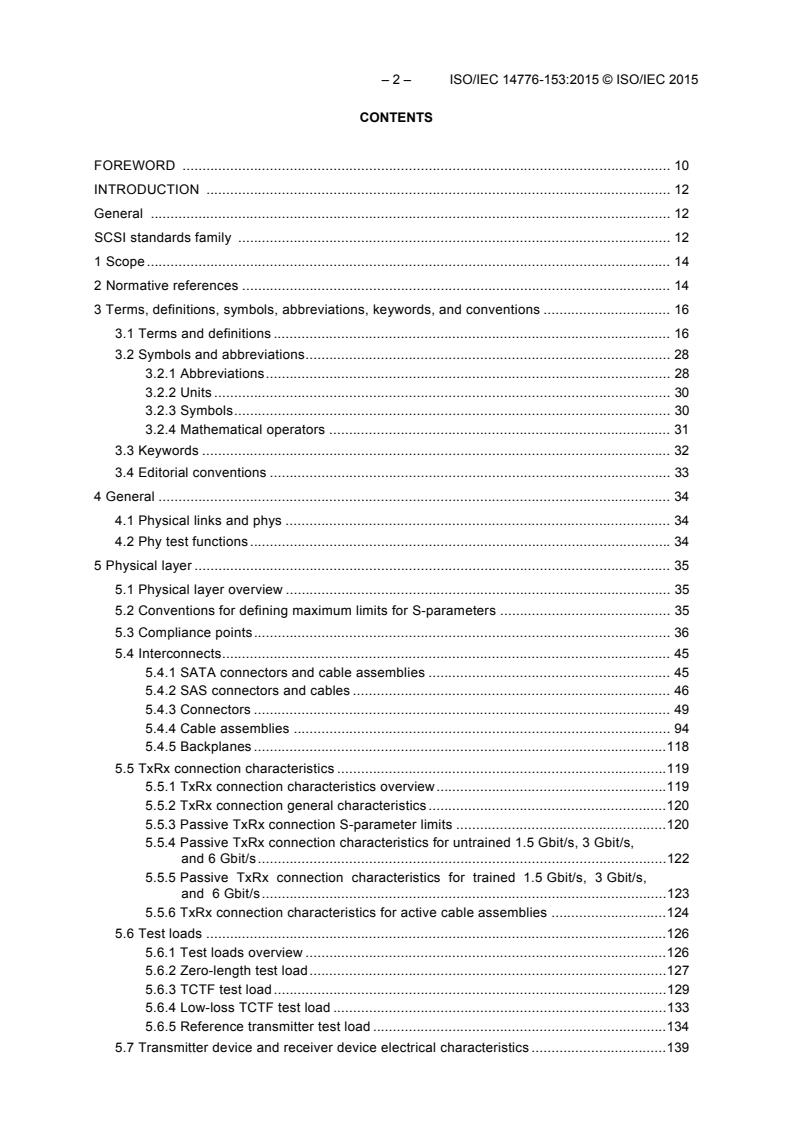
– 2 – ISO/IEC 14776-153:2015 © ISO/IEC 2015
CONTENTS
FOREWORD . 10
INTRODUCTION . 12
General . 12
SCSI standards family . 12
1 Scope. 14
2 Normative references . 14
3 Terms, definitions, symbols, abbreviations, keywords, and conventions . 16
3.1 Terms and definitions . 16
3.2 Symbols and abbreviations. 28
3.2.1 Abbreviations. 28
3.2.2 Units . 30
3.2.3 Symbols. 30
3.2.4 Mathematical operators . 31
3.3 Keywords . 32
3.4 Editorial conventions . 33
4 General . 34
4.1 Physical links and phys . 34
4.2 Phy test functions.34
5 Physical layer . 35
5.1 Physical layer overview . 35
5.2 Conventions for defining maximum limits for S-parameters . 35
5.3 Compliance points. 36
5.4 Interconnects. 45
5.4.1 SATA connectors and cable assemblies . 45
5.4.2 SAS connectors and cables . 46
5.4.3 Connectors . 49
5.4.4 Cable assemblies . 94
5.4.5 Backplanes .118
5.5 TxRx connection characteristics .119
5.5.1 TxRx connection characteristics overview.119
5.5.2 TxRx connection general characteristics.120
5.5.3 Passive TxRx connection S-parameter limits .120
5.5.4 Passive TxRx connection characteristics for untrained 1.5 Gbit/s, 3 Gbit/s,
and 6 Gbit/s.122
5.5.5 Passive TxRx connection characteristics for trained 1.5 Gbit/s, 3 Gbit/s,
and 6 Gbit/s.123
5.5.6 TxRx connection characteristics for active cable assemblies .124
5.6 Test loads .126
5.6.1 Test loads overview .126
5.6.2 Zero-length test load.127
5.6.3 TCTF test load.129
5.6.4 Low-loss TCTF test load .133
5.6.5 Reference transmitter test load .134
5.7 Transmitter device and receiver device electrical characteristics .139
5.7.1 General electrical characteristics .139
5.7.2 Transmitter device and receiver device transients.139
5.7.3 Eye masks and the jitter transfer function (JTF) .140
5.7.4 Transmitter device characteristics.144
5.7.5 Receiver device characteristics.155
5.7.6 Spread spectrum clocking (SSC) .170
5.7.7 Non-tracking clock architecture.173
5.8 READY LED signal electrical characteristics .173
5.9 Out of band (OOB) signals .175
5.9.1 OOB signals overview.175
5.9.2 Transmitting OOB signals .176
5.9.3 Receiving OOB signals .178
5.9.4 Transmitting the SATA port selection signal.179
Annex A (normative) – Jitter tolerance pattern (JTPAT) .180
Annex B (normative) – SASWDP.182
Annex C (informative) – StatEye.190
Annex D (informative) – Signal performance measurements .232
Annex E (informative) – Description of the included Touchstone models.253
Annex F (informative) – Mini SAS 4x active cable assembly power supply and voltage detection
circuitry .259
Annex G (informative) – SAS icons .260
Bibliography .262
– 4 – ISO/IEC 14776-153:2015 © ISO/IEC 2015
Figure 1 – SCSI document relationships . 12
Figure 2 – ATA document relationships . 13
Figure 3 – Physical links and phys .34
Figure 4 – Maximum limits for S-parameters definitions . 36
Figure 5 – External cable assembly CT compliance points and CR compliance points . 38
Figure 6 – Backplane with SAS Drive connector IT compliance points and IR compliance points 39
Figure 7 – Backplane with SAS Drive connector compliance points with SATA phy attached . 40
Figure 8 – SAS multilane internal cable assembly IT compliance points
and IR compliance points . 41
Figure 9 – SAS multilane internal cable assembly and backplane IT compliance points
and IR compliance points . 42
Figure 10 – SAS multilane internal cable assembly and backplane IT compliance points
and IR compliance points with SATA device attached . 43
Figure 11 – SAS Drive cable assembly IT compliance points and IR compliance points . 44
Figure 12 – SATA connectors and cables . 45
Figure 13 – SAS Drive cable environments . 46
Figure 14 – SAS Drive backplane environment . 46
Figure 15 – SAS external cable environment . 47
Figure 16 – SAS internal symmetric cable environment - controller to backplane . 47
Figure 17 – SAS internal symmetric cable environment - controller to controller . 47
Figure 18 – SAS internal controller-based fanout cable environment . 48
Figure 19 – SAS internal backplane-based fanout cable environment . 48
Figure 20 – SAS Drive plug connector . 51
Figure 21 – Single-port SAS Drive cable receptacle connector . 52
Figure 22 – Dual-port SAS Drive cable receptacle connector . 52
Figure 23 – SAS Drive backplane receptacle connector . 53
Figure 24 – Micro SAS plug connector . 55
Figure 25 – Micro SAS receptacle connector . 55
Figure 26 – SAS 4i cable receptacle connector . 57
Figure 27 – SAS 4i plug connector . 57
Figure 28 – Mini SAS 4i cable plug connector . 60
Figure 29 – Mini SAS 4i receptacle connector . 60
Figure 30 – Mini SAS HD 4i cable plug connector . 63
Figure 31 – Mini SAS HD 8i cable plug connector . 64
Figure 32 – Mini SAS HD 4i receptacle connector . 65
Figure 33 – Mini SAS HD 8i receptacle connector . 66
Figure 34 – Mini SAS 4x cable plug connector . 69
Figure 35 – Mini SAS 4x cable plug connector for untrained 1.5 Gbit/s and 3 Gbit/s that
attaches to an enclosure out port or an enclosure in port . 70
Figure 36 – Mini SAS 4x cable plug connector for untrained 1.5 Gbit/s and 3 Gbit/s that
attaches to an enclosure out port . 71
Figure 37 – Mini SAS 4x cable plug connector for untrained 1.5 Gbit/s and 3 Gbit/s that
attaches to an enclosure in port . 71
Figure 38 – Mini SAS 4x cable plug connector for trained 1.5 Gbit/s and 3 Gbit/s that
attaches to an enclosure out port or an enclosure in port . 72
Figure 39 – Mini SAS 4x cable plug connector for trained 1.5 Gbit/s, 3 Gbit/s, and 6 Gbit/s
that attaches to an enclosure out port . 72
Figure 40 – Mini SAS 4x cable plug connector for trained 1.5 Gbit/s, 3 Gbit/s, and 6 Gbit/s
that attaches to an enclosure in port . 73
Figure 41 – Mini SAS 4x active cable plug connector that attaches to an enclosure out port
or an enclosure in port . 73
Figure 42 – Mini SAS 4x active cable plug connector that attaches to an enclosure out port . 74
Figure 43 – Mini SAS 4x active cable plug connector that attaches to an enclosure in port . 74
Figure 44 – Mini SAS 4x receptacle connector . 75
Figure 45 – Mini SAS 4x receptacle connector - end device or enclosure universal port for
untrained 1.5 Gbit/s and 3 Gbit/s . 76
Figure 46 – Mini SAS 4x receptacle connector - enclosure out port for untrained 1.5 Gbit/s
and 3 Gbit/s . 77
Figure 47 – Mini SAS 4x receptacle connector - enclosure in port for untrained 1.5 Gbit/s
and 3 Gbit/s . 77
Figure 48 – Mini SAS 4x receptacle connector - end device or enclosure universal port for
trained 1.5 Gbit/s, 3 Gbit/s, and 6 Gbit/s and for untrained 1.5 Gbit/s and 3 Gbit/s . 78
Figure 49 – Mini SAS 4x receptacle connector - enclosure out port for trained 1.5 Gbit/s,
3 Gbit/s, and 6 Gbit/s and for untrained 1.5 Gbit/s and 3 Gbit/s . 78
Figure 50 – Mini SAS 4x receptacle connector - enclosure in port for trained 1.5 Gbit/s,
3 Gbit/s, and 6 Gbit/s and for untrained 1.5 Gbit/s and 3 Gbit/s . 79
Figure 51 – Mini SAS 4x active receptacle connector - end device or enclosure universal port . 79
Figure 52 – Mini SAS 4x active receptacle connector - enclosure out port . 80
Figure 53 – Mini SAS 4x active receptacle connector - enclosure in port . 80
Figure 54 – Mini SAS HD 4x cable plug connector . 84
Figure 55 – Mini SAS HD 8x cable plug connector . 85
Figure 56 – Mini SAS HD 4x receptacle connector . 86
Figure 57 – Mini SAS HD 8x receptacle connector . 87
Figure 58 – Mini SAS HD 16x receptacle connector . 87
Figure 59 – QSFP+ cable plug connector . 90
Figure 60 – QSFP+ receptacle connector . 91
Figure 61 – Single-port SAS Drive cable assembly . 94
Figure 62 – Dual-port SAS Drive cable assembly . 95
Figure 63 – SAS internal symmetric cable assembly - SAS 4i . 96
Figure 64 – SAS internal symmetric cable assembly - Mini SAS 4i . 97
Figure 65 – SAS internal symmetric cable assembly - Mini SAS HD 4i . 98
Figure 66 – SAS internal symmetric cable assembly - Mini SAS HD 8i . 99
Figure 67 – SAS internal symmetric cable assembly - SAS 4i to Mini SAS 4i with
vendor specific sidebands . 100
Figure 68 – SAS internal symmetric cable assembly - SAS 4i controller to Mini SAS 4i
backplane with SGPIO . 101
Figure 69 – SAS internal symmetric cable assembly - Mini SAS 4i controller to SAS 4i
backplane with SGPIO . 102
Figure 70 – SAS internal symmetric cable assembly - Mini SAS 4i to Mini SAS HD 4i . 103
Figure 71 – SAS internal controller-based fanout cable assembly - SAS 4i . 105
Figure 72 – SAS internal controller-based fanout cable assembly - Mini SAS 4i . 106
Figure 73 – SAS internal controller-based fanout cable assembly - Mini SAS HD 4i . 107
Figure 74 – SAS internal backplane-based fanout cable assembly - SAS 4i . 108
Figure 75 – SAS internal backplane-based fanout cable assembly - Mini SAS 4i . 109
– 6 – ISO/IEC 14776-153:2015 © ISO/IEC 2015
Figure 76 – SAS internal backplane-based fanout cable assembly - Mini SAS HD 4i . 110
Figure 77 – Mini SAS 4x external cable assembly . 111
Figure 78 – Mini SAS 4x active external cable assembly . 112
Figure 79 – SAS external cable assembly with Mini SAS 4x cable plug connectors . 113
Figure 80 – SAS external cable assembly - Mini SAS HD 4x . 114
Figure 81 – SAS external cable assembly with Mini SAS HD 4x cable plug connectors . 115
Figure 82 – SAS external cable assembly - Mini SAS HD 8x . 116
Figure 83 – SAS external cable assembly with Mini SAS HD 8x cable plug connectors . 117
Figure 84 – SAS external cable assembly - Mini SAS HD 4x to Mini SAS 4x . 118
Figure 85 – Passive TxRx connection |S |, |S |, |S |, and NEXT limits . 122
DD22 CD22 CD21
Figure 86 – Example passive TxRx connection compliance testing for trained 1.5 Gbit/s,
3 Gbit/s, and 6 Gbit/s . 123
Figure 87 – Active cable S-parameter limits . 126
Figure 88 – Zero-length test load for transmitter device compliance point . 127
Figure 89 – Zero-length test load for receiver device compliance point . 127
Figure 90 – Zero-length test load |S (f)| requirements . 128
DD21
Figure 91 – TCTF test load . 129
Figure 92 – TCTF test load |S (f)| and ISI loss requirements at IT for untrained 3 Gbit/s . 130
DD21
Figure 93 – TCTF test load |S (f)| and ISI loss requirements at CT for untrained 3 Gbit/s . 131
DD21
Figure 94 – TCTF test load |S (f)| and ISI loss requirements at IT for untrained 1.5 Gbit/s 132
DD21
Figure 95 – TCTF test load |S (f)| and ISI loss requirements at CT for untrained 1.5 Gbit/s 133
DD21
Figure 96 – Low-loss TCTF test load . 133
Figure 97 – Low-loss TCTF test load |S (f)| and ISI loss requirements . 134
DD21
Figure 98 – Reference transmitter test load |S (f)| up to 6 GHz . 135
DD21
Figure 99 – Reference transmitter test load pulse response . 136
Figure 100 – Reference transmitter test load impulse response . 137
Figure 101 – Reference transmitter test load D24.3 response . 138
Figure 102 – Transmitter device transient test circuit . 140
Figure 103 – Receiver device transient test circuit . 140
Figure 104 – Transmitter device eye mask . 142
Figure 105 – Receiver device eye mask . 142
Figure 106 – Deriving a receiver device jitter tolerance eye mask for untrained 1.5 Gbit/s
and 3 Gbit/s . 143
Figure 107 – Transmitter device common mode voltage limit . 149
Figure 108 – Transmitter device |S |, |S |, and |S | limits . 151
CC22 DD22 CD22
Figure 109 – Reference transmitter device . 152
Figure 110 – Reference transmitter device termination S-parameters . 153
Figure 111 – Transmitter equalization measurement . 154
Figure 112 – Applied SJ for untrained 1.5 Gbit/s and 3 Gbit/s . 160
Figure 113 – Receiver device |S |, |S |, and |S | limits . 162
CC11 DD11 CD11
Figure 114 – Reference receiver device . 163
Figure 115 – Reference receiver device termination S-parameters . 164
Figure 116 – Stressed receiver device jitter tolerance test block diagram . 165
Figure 117 – Stressed receiver device jitter tolerance test D24.3 eye opening . 167
Figure 118 – Applied SJ for trained 1.5 Gbit/s, 3 Gbit/s, and 6 Gbit/s without SSC support . 168
Figure 119 – Applied SJ for trained 1.5 Gbit/s, 3 Gbit/s, and 6 Gbit/s with SSC support . 169
Figure 120 – Center-spreading tolerance buffer . 173
Figure 121 – OOB signal transmission . 177
Figure 122 – SATA port selection signal . 179
Figure C.1 – StatEye result .230
Figure D.1 – A simple physical link .232
Figure D.2 – Transmitter device details .233
Figure D.3 – Receiver device details .234
Figure D.4 – De-embedding of connectors in test fixtures .236
Figure D.5 – Measurement conditions for signal output at the transmitter device .237
Figure D.6 – Transmitter device signal output measurement test fixture details .237
Figure D.7 – Measurement conditions for signal tolerance at the transmitter device .238
Figure D.8 – Calibration of test fixture for signal tolerance at the transmitter device .238
Figure D.9 – Measurement conditions for signal output at the receiver device .239
Figure D.10 – Measurement conditions for signal tolerance at the receiver device .239
Figure D.11 – Calibration of test fixture for signal tolerance at the receiver device .240
Figure D.12 – S-parameter port naming conventions .241
Figure D.13 – Four single-ended port or two differential port element .242
Figure D.14 – S-parameters for single-ended and differential systems .242
Figure D.15 – Measurement conditions for S at the transmitter device connector .243
Figure D.16 – Measurement conditions for S at the receiver device connector .244
Figure D.17 – Measurement conditions for S at IT or CT .245
Figure D.18 – Measurement conditions for S at IR or CR .246
Figure E.1 – Reference transmitter device and reference receiver device termination circuit model 253
Figure E.2 – Generic return loss circuit model .255
Figure E.3 – Generic return loss model |S | .256
Figure E.4 – Reference transmitter test load measurement setup .257
Figure E.5 – Reference transmitter test load |S (f)| up to 20 GHz .258
DD21
Figure F.1 – Dual comparator design for active cable assembly detection .259
Figure G.1 – SAS primary icon .260
Figure G.2 – SAS alternate icon .260
Figure G.3 – SAS alternate icon with SAS letters .261
– 8 – ISO/IEC 14776-153:2015 © ISO/IEC 2015
Table 1 – Numbering conventions .33
Table 2 – Compliance points .37
Table 3 – Connectors .49
Table 4 – Connector categories .51
Table 5 – SAS Drive connector pin assignments .54
Table 6 – Micro SAS connector pin assignments .56
Table 7 – Controller SAS 4i connector pin assignments and physical link usage .58
Table 8 – Backplane SAS 4i connector pin assignments and physical link usage .59
Table 9 – Controller Mini SAS 4i connector pin assignments and physical link usage .61
Table 10 – Backplane Mini SAS 4i connector pin assignments and physical link usage .62
Table 11 – Controller Mini SAS HD 4i connector pin assignments and physical link usage .66
Table 12 – Backplane Mini SAS HD 4i connector pin assignments and physical link usage .67
Table 13 – Mini SAS 4x cable plug connector and Mini SAS 4x active cable plug connector icons,
key slot positions, and key positions .70
Table 14 – Mini SAS 4x receptacle connector icons, key positions, and key slot positions .76
Table 15 – Mini SAS 4x connector pin assignments and physical link usage .81
Table 16 – Mini SAS 4x active connector pin assignments and physical link usage .82
Table 17 – Mini SAS 4x active cable supplied power requirements .83
Table 18 – Mini SAS HD 4x connector pin assignments and physical link usage .88
Table 19 – Management interface connection requirements .89
Table 20 – QSFP+ connector pin assignments .92
Table 21 – TxRx connection general characteristics .120
Table 22 – Maximum limits for S-parameters of the passive TxRx connection .121
Table 23 – Passive TxRx connection characteristics for trained 6 Gbit/s .123
Table 24 – Active cable assembly output electrical characteristics for trained 6 Gbit/s .124
Table 25 – Maximum limits for S-parameters for active cable assemblies .125
Table 26 – General electrical characteristics .139
Table 27 – JTF parameters .141
Table 28 – Transmitter device general electrical characteristics .144
Table 29 – Transmitter device termination characteristics .145
Table 30 – Transmitter device signal output characteristics for untrained 1.5 Gbit/s and 3 Gbit/s
as measured with the zero-length test load at IT and CT .145
Table 31 – Transmitter device signal output characteristics for untrained 1.5 Gbit/s and 3 Gbit/s
as measured with each test load at IT and CT .147
Table 32 – Transmitter device signal output characteristics for trained 1.5 Gbit/s, 3 Gbit/s,
and 6 Gbit/s at IT and CT .148
Table 33 – Transmitter device common mode voltage limit characteristics .149
Table 34 – Maximum limits for S-parameters at IT or CT
s s . 150
Table 35 – Recommended transmitter device settings at IT and CT .151
Table 36 – Reference transmitter device characteristics at IT and CT .152
Table 37 – Transmitter device signal output characteristics for OOB signals .155
Table 38 – Receiver device general electrical characteristics .156
Table 39 – Receiver device termination characteristics .157
Table 40 – Delivered signal characteristics for untrained 1.5 Gbit/s and 3 Gbit/s as measured
with the zero length test load at IR and CR .158
Table 41 – Maximum delivered jitter for untrained 1.5 Gbit/s and 3 Gbit/s at IR and CR .159
Table 42 – Receiver device jitter tolerance for untrained 1.5 Gbit/s and 3 Gbit/s at IR and CR .160
Table 43 – f , f , and f for untrained 1.5 Gbit/s and 3 Gbit/s .161
min c max
Table 44 – Delivered signal characteristics for trained 1.5 Gbit/s, 3 Gbit/s, and 6 Gbit/s
at IR and CR .161
Table 45 – Maximum limits for S-parameters at IR or CR .162
Table 46 – Stressed receiver device jitter tolerance test characteristics .166
Table 47 – Number of bits received per number of errors for desired BER .167
Table 48 – f , f , and f for trained 1.5 Gbit/s, 3 Gbit/s, and 6 Gbit/s without SSC support .169
min c max
Table 49 – f , f , f , and SJ for trained 1.5 Gbit/s, 3 Gbit/s, and 6 Gbit/s with SSC support .169
min c max lf
Table 50 – Delivered signal characteristics for OOB signals .170
Table 51 – SSC modulation types .170
Table 52 – SAS phy transmitter SSC modulation types .171
Table 53 – Expander phy transmitter SSC modulation types .171
Table 54 – Receiver SSC modulation types tolerance .172
Table 55 – Expander device center-spreading tolerance buffer .172
Table 56 – Output characteristics of the READY LED signal .174
Table 57 – OOB signal timing specifications .175
Table 58 – OOB signal transmitter device requirements .176
Table 59 – OOB signal receiver device burst time detection requirements .178
Table 60 – OOB signal receiver device idle time detection requirements .178
Table 61 – OOB signal receiver device negation time detection requirements .178
Table 62 – SATA port selection signal transmitter device requirements .179
Table A.1 – JTPAT for RD+ . 180
Table A.2 – JTPAT for RD- . 181
Table D.1 – High frequency jitter source amplitudes . 249
Table D.2 – Low frequency jitter source calibration amplitudes. 251
Table D.3 – Low frequency jitter attenuation targets . 252
– 10 – ISO/IEC 14776-153:2015 © ISO/IEC 2015
INFORMATION TECHNOLOGY –
SMALL COMPUTER SYSTEM INTERFACE (SCSI) –
Part 153: SERIAL ATTACHED SCSI - 2.1 (SAS-2.1)
FOREWORD
1) ISO (the International Organization for Standardization) and IEC (the International Electrotechnical Commission)
form the specialized system for worldwide standardization. National bodies that are members of ISO or IEC
participate in the development of International Standards through technical committees established by the
respective organization to deal with particular fields of technical activity. ISO and IEC technical committees
collaborate in fields of mutual interest. Other international organizations, governmental and non-governmental,
in liaison with ISO and IEC, also take part in the work. In the field of information technology, ISO and IEC have
established a joint technical committee, ISO/IEC JTC 1.
2) The formal decisions or agreements of IEC and ISO on technical matters express, as nearly as possible, an
international consensus of opinion on the relevant subjects since each technical committee has representation
from all interested IEC National Committees and ISO member bodies.
3) IEC, ISO and ISO/IEC publications have the form of recommendations for international use and are accepted by
IEC National Committees and ISO member bodies in that sense. While all reasonable efforts are made to ensure
that the technical content of IEC, ISO and ISO/IEC publications is accurate, IEC or ISO cannot be held
responsible for the way in which they are used or for any misinterpretation by any end user.
4) In order to promote international uniformity, IEC National Committees and ISO member bodies undertake to
apply IEC, ISO and ISO/IEC publications transparently to the maximum extent possible in their national and
regional publications. Any divergence between any ISO, IEC or ISO/IEC publication and the corresponding
national or regional publication should be clearly indicated in the latter.
5) ISO and IEC do not provide any attestation of conformity. Independent certification bodies provide conformity
assessment services and, in some areas, access to IEC marks of conformity. ISO or IEC are not responsible for
any services carried out by independent certification bodies.
6) All users should ensure that they have the latest edition of this publication.
7) No liability shall attach to IEC or ISO or its directors, employees, servants or agents including individual experts
and members of their technical committees and IEC National Committees or ISO member bodies for any personal
injury, property damage or other damage of any nature whatsoever, whether direct or indirect, or for costs
(including legal fees) and expenses arising out of the publication of, use of, or reliance upon, this ISO/IEC
publication or any other IEC, ISO or ISO/IEC publications.
8) Attention is drawn to the normative references cited in this publication. Use of the referenced publications is
indispensable for the correct application of this publication.
9) Attention is drawn to the possibility that some of the elements of this ISO/IEC publication may be the subject of
patent rights. ISO and IEC shall not be held responsible for identifying any or all such patent rights.
International Standard ISO/IEC 14776-153 was prepared by subcommittee 25: Interconnection of
information technology equipment, of ISO/IEC joint technical committee 1: Information technology.
The list of all currently available parts of the ISO/IEC 14776 series, under the general title Information
technology – Small computer system interface (SCSI), can be found on the IEC web site.
This International Standard has been approved by vote of the member bodies and the voting results
may be obtained from the address given on the second title page.
This publication has been drafted in accordance with the ISO/IEC Directives, Part 2, as far as is
practicable.
IMPORTANT – The 'colour inside' logo on the cover page of this publication
indicates that it contains colours which are considered to be useful for the correct
understanding of its contents. Users should therefore print this document using a
colour printer.
– 12 – ISO/IEC 14776-153:2015 © ISO/IEC 2015
INTRODUCTION
General
The SCSI family of standards provides for many different transport protocols that define the rules for
exchanging information between different SCSI devices. This standard specifies the functional
requirements for
...
Questions, Comments and Discussion
Ask us and Technical Secretary will try to provide an answer. You can facilitate discussion about the standard in here.
Loading comments...