

IEC 62351-3:2023
(Main)Power systems management and associated information exchange - Data and communications security - Part 3: Communication network and system security - Profiles including TCP/IP
General Information
- Abstract
IEC 62351-3:2023 specifies how to provide confidentiality, integrity protection, and message level authentication for protocols that make use of TCP/IP as a message transport layer and utilize Transport Layer Security when cyber-security is required. This may relate to SCADA and telecontrol protocols, but also to additional protocols if they meet the requirements in this document.
IEC 62351-3 specifies how to secure TCP/IP-based protocols through constraints on the specification of the messages, procedures, and algorithms of Transport Layer Security (TLS) (TLSv1.2 defined in RFC 5246, TLSv1.3 defined in RFC 8446). In the specific clauses, there will be subclauses to note the differences and commonalities in the application depending on the target TLS version. The use and specification of intervening external security devices (e.g., "bump-in-the-wire") are considered out-of-scope.
In contrast to previous editions of this document, this edition is self-contained in terms of completely defining a profile of TLS. Hence, it can be applied directly, without the need to specify further TLS parameters, except the port number, over which the communication will be performed. Therefore, this part can be directly utilized from a referencing standard and can be combined with further security measures on other layers. Providing the profiling of TLS without the need for further specifying TLS parameters allows declaring conformity to the described functionality without the need to involve further IEC 62351 documents.
This document is intended to be referenced as a normative part of other IEC standards that have the need for providing security for their TCP/IP-based protocol exchanges under similar boundary conditions. However, it is up to the individual protocol security initiatives to decide if this document is to be referenced.
The document also defines security events for specific conditions, which support error handling, security audit trails, intrusion detection, and conformance testing. Any action of an organization in response to events to an error condition described in this document are beyond the scope of this document and are expected to be defined by the organization’s security policy.
This document reflects the security requirements of the IEC power systems management protocols. Should other standards bring forward new requirements, this document may need to be revised.
This second edition cancels and replaces the first edition published in 2014, Amendment 1:2018 and Amendment 2:2020. This edition constitutes a technical revision.
This edition includes the following significant technical changes with respect to the previous edition:
a) Inclusion of the TLSv1.2 related parameter required in IEC 62351-3 Ed.1.2 to be specified by the referencing standard. This comprises the following parameter:
• Mandatory TLSv1.2 cipher suites to be supported.
• Specification of session resumption parameters.
• Specification of session renegotiation parameters.
• Revocation handling using CRL and OCSP.
• Handling of security events.
b) Inclusion of a TLSv1.3 profile to be applicable for the power system domain in a similar way as for TLSv1.2 session.
- Status
- Published
- Publication Date
- 05-Jun-2023
- Technical Committee
- TC 57 - Power systems management and associated information exchange
- Drafting Committee
- WG 15 - TC 57/WG 15
- Current Stage
- PPUB - Publication issued
- Start Date
- 06-Jun-2023
- Completion Date
- 02-Jun-2023
Buy Documents
IEC 62351-3:2023 - Power systems management and associated information exchange - Data and communications security - Part 3: Communication network and system security - Profiles including TCP/IP Released:6/6/2023
Overview
IEC 62351-3:2023 is an international standard developed by the International Electrotechnical Commission (IEC) that focuses on data and communications security for power systems management. This document specifically addresses communication network and system security profiles, with a strong emphasis on protocols utilizing TCP/IP as the transport layer. It provides security guidelines incorporating Transport Layer Security (TLS) versions 1.2 and 1.3 to ensure confidentiality, integrity, and message-level authentication, crucial for securing power system control and monitoring networks such as SCADA and telecontrol.
This edition, published in 2023, is a significant technical revision that profiles TLS protocols with clearly defined cipher suites, session management, and certificate validation processes. Unlike previous versions, IEC 62351-3:2023 is self-contained and can be directly referenced by other IEC standards to enforce TCP/IP-based protocol security without additional parameter specifications.
Key Topics
TLS Profiles for Power Systems
Defines constraints and profiles for TLS 1.2 and TLS 1.3 tailored to power system communication, including mandatory cipher suites and secure handshake mechanisms.Security Requirements
Addresses confidentiality, integrity protection, and message authentication for TCP/IP-transported data to mitigate cyber threats in critical infrastructure systems.Certificate Handling
Describes certificate support including trust anchor management, size constraints, exchange procedures, and validation techniques such as Certificate Revocation List (CRL) and Online Certificate Status Protocol (OCSP).Session Management
Covers session resumption, renegotiation, and updates, ensuring secure and efficient reuse of TLS sessions.Security Event Logging
Specifies security events related to TLS handshakes and certificate handling to support auditing, intrusion detection, and conformance verification.Scope & Integration
IEC 62351-3:2023 targets TCP/IP-based protocols in power systems environments but remains extensible to other protocols under similar boundary conditions. It excludes external security devices, focusing purely on protocol-level security.
Applications
SCADA Systems Security
Ensures secure communication for Supervisory Control and Data Acquisition systems by implementing TLS profiles that provide necessary data protection over IP networks.Telecontrol Protocols
Safeguards data exchanges in telecontrol applications used in power grid operations to prevent tampering and unauthorized access.Power System Management Tools
Enables secure remote management and monitoring of electrical substations and control centers through standardized and interoperable TLS security profiles.Conformance for IEC Standards
Acts as a normative reference for other IEC standards requiring TCP/IP transport security, allowing organizations to uniformly implement and attest compliance with TLS-based cybersecurity requirements.Cybersecurity Compliance
Provides a basis for ensuring communication security aligns with organizational policies, supports audit trails, and aids in resilience against cyber attacks in power grids.
Related Standards
IEC 62351 Series
The broader IEC 62351 family addresses various aspects of cybersecurity for power system management and associated information exchanges beyond just communication security.RFC 5246 (TLS 1.2) and RFC 8446 (TLS 1.3)
Fundamental IETF RFCs defining the technical specifications of TLS protocols which IEC 62351-3 profiles and adapts for power systems.IEC 60870 and IEC 61850
Standards for power system telecontrol and communication, which may incorporate IEC 62351-3 profiles to secure their TCP/IP-based communications.ISO/IEC 27000 Series
While broader in scope, these standards for information security management systems (ISMS) complement IEC 62351-3 by defining organizational security policies that govern responses to security events and incidents.
Keywords: IEC 62351-3 2023, power systems security, TCP/IP security, Transport Layer Security, TLS profiling, SCADA security, telecontrol cybersecurity, certificate validation, security event logging, IEC standards cybersecurity, cyber protection power grids, communication network security.
Relations
- Effective Date
- 05-Sep-2023
- Effective Date
- 05-Sep-2023
- Effective Date
- 05-Sep-2023
- Effective Date
- 05-Sep-2023
Buy Documents
IEC 62351-3:2023 - Power systems management and associated information exchange - Data and communications security - Part 3: Communication network and system security - Profiles including TCP/IP Released:6/6/2023
Get Certified
Connect with accredited certification bodies for this standard

ANCE
Mexican certification and testing association.

Intertek Slovenia
Intertek testing, inspection, and certification services in Slovenia.

LNE (Laboratoire National de Métrologie et d'Essais)
French national laboratory for metrology and testing.
Sponsored listings
Frequently Asked Questions
IEC 62351-3:2023 is a standard published by the International Electrotechnical Commission (IEC). Its full title is "Power systems management and associated information exchange - Data and communications security - Part 3: Communication network and system security - Profiles including TCP/IP". This standard covers: IEC 62351-3:2023 specifies how to provide confidentiality, integrity protection, and message level authentication for protocols that make use of TCP/IP as a message transport layer and utilize Transport Layer Security when cyber-security is required. This may relate to SCADA and telecontrol protocols, but also to additional protocols if they meet the requirements in this document. IEC 62351-3 specifies how to secure TCP/IP-based protocols through constraints on the specification of the messages, procedures, and algorithms of Transport Layer Security (TLS) (TLSv1.2 defined in RFC 5246, TLSv1.3 defined in RFC 8446). In the specific clauses, there will be subclauses to note the differences and commonalities in the application depending on the target TLS version. The use and specification of intervening external security devices (e.g., "bump-in-the-wire") are considered out-of-scope. In contrast to previous editions of this document, this edition is self-contained in terms of completely defining a profile of TLS. Hence, it can be applied directly, without the need to specify further TLS parameters, except the port number, over which the communication will be performed. Therefore, this part can be directly utilized from a referencing standard and can be combined with further security measures on other layers. Providing the profiling of TLS without the need for further specifying TLS parameters allows declaring conformity to the described functionality without the need to involve further IEC 62351 documents. This document is intended to be referenced as a normative part of other IEC standards that have the need for providing security for their TCP/IP-based protocol exchanges under similar boundary conditions. However, it is up to the individual protocol security initiatives to decide if this document is to be referenced. The document also defines security events for specific conditions, which support error handling, security audit trails, intrusion detection, and conformance testing. Any action of an organization in response to events to an error condition described in this document are beyond the scope of this document and are expected to be defined by the organization’s security policy. This document reflects the security requirements of the IEC power systems management protocols. Should other standards bring forward new requirements, this document may need to be revised. This second edition cancels and replaces the first edition published in 2014, Amendment 1:2018 and Amendment 2:2020. This edition constitutes a technical revision. This edition includes the following significant technical changes with respect to the previous edition: a) Inclusion of the TLSv1.2 related parameter required in IEC 62351-3 Ed.1.2 to be specified by the referencing standard. This comprises the following parameter: • Mandatory TLSv1.2 cipher suites to be supported. • Specification of session resumption parameters. • Specification of session renegotiation parameters. • Revocation handling using CRL and OCSP. • Handling of security events. b) Inclusion of a TLSv1.3 profile to be applicable for the power system domain in a similar way as for TLSv1.2 session.
IEC 62351-3:2023 specifies how to provide confidentiality, integrity protection, and message level authentication for protocols that make use of TCP/IP as a message transport layer and utilize Transport Layer Security when cyber-security is required. This may relate to SCADA and telecontrol protocols, but also to additional protocols if they meet the requirements in this document. IEC 62351-3 specifies how to secure TCP/IP-based protocols through constraints on the specification of the messages, procedures, and algorithms of Transport Layer Security (TLS) (TLSv1.2 defined in RFC 5246, TLSv1.3 defined in RFC 8446). In the specific clauses, there will be subclauses to note the differences and commonalities in the application depending on the target TLS version. The use and specification of intervening external security devices (e.g., "bump-in-the-wire") are considered out-of-scope. In contrast to previous editions of this document, this edition is self-contained in terms of completely defining a profile of TLS. Hence, it can be applied directly, without the need to specify further TLS parameters, except the port number, over which the communication will be performed. Therefore, this part can be directly utilized from a referencing standard and can be combined with further security measures on other layers. Providing the profiling of TLS without the need for further specifying TLS parameters allows declaring conformity to the described functionality without the need to involve further IEC 62351 documents. This document is intended to be referenced as a normative part of other IEC standards that have the need for providing security for their TCP/IP-based protocol exchanges under similar boundary conditions. However, it is up to the individual protocol security initiatives to decide if this document is to be referenced. The document also defines security events for specific conditions, which support error handling, security audit trails, intrusion detection, and conformance testing. Any action of an organization in response to events to an error condition described in this document are beyond the scope of this document and are expected to be defined by the organization’s security policy. This document reflects the security requirements of the IEC power systems management protocols. Should other standards bring forward new requirements, this document may need to be revised. This second edition cancels and replaces the first edition published in 2014, Amendment 1:2018 and Amendment 2:2020. This edition constitutes a technical revision. This edition includes the following significant technical changes with respect to the previous edition: a) Inclusion of the TLSv1.2 related parameter required in IEC 62351-3 Ed.1.2 to be specified by the referencing standard. This comprises the following parameter: • Mandatory TLSv1.2 cipher suites to be supported. • Specification of session resumption parameters. • Specification of session renegotiation parameters. • Revocation handling using CRL and OCSP. • Handling of security events. b) Inclusion of a TLSv1.3 profile to be applicable for the power system domain in a similar way as for TLSv1.2 session.
IEC 62351-3:2023 is classified under the following ICS (International Classification for Standards) categories: 33.200 - Telecontrol. Telemetering. The ICS classification helps identify the subject area and facilitates finding related standards.
IEC 62351-3:2023 has the following relationships with other standards: It is inter standard links to IEC 62351-3:2014, IEC TS 62351-3:2007, IEC 62351-3:2014/AMD1:2018, IEC 62351-3:2014/AMD2:2020. Understanding these relationships helps ensure you are using the most current and applicable version of the standard.
IEC 62351-3:2023 is available in PDF format for immediate download after purchase. The document can be added to your cart and obtained through the secure checkout process. Digital delivery ensures instant access to the complete standard document.
Standards Content (Sample)
IEC 62351-3 ®
Edition 2.0 2023-06
INTERNATIONAL
STANDARD
NORME
INTERNATIONALE
colour
inside
Power systems management and associated information exchange – Data and
communications security –
Part 3: Communication network and system security – Profiles including TCP/IP
Gestion des systèmes de puissance et échanges d’informations associés –
Sécurité des communications et des données –
Partie 3: Sécurité des réseaux et des systèmes de communication – Profils
comprenant TCP/IP
All rights reserved. Unless otherwise specified, no part of this publication may be reproduced or utilized in any form
or by any means, electronic or mechanical, including photocopying and microfilm, without permission in writing from
either IEC or IEC's member National Committee in the country of the requester. If you have any questions about IEC
copyright or have an enquiry about obtaining additional rights to this publication, please contact the address below or
your local IEC member National Committee for further information.
Droits de reproduction réservés. Sauf indication contraire, aucune partie de cette publication ne peut être reproduite ni
utilisée sous quelque forme que ce soit et par aucun procédé, électronique ou mécanique, y compris la photocopie et
les microfilms, sans l'accord écrit de l'IEC ou du Comité national de l'IEC du pays du demandeur. Si vous avez des
questions sur le copyright de l'IEC ou si vous désirez obtenir des droits supplémentaires sur cette publication, utilisez
les coordonnées ci-après ou contactez le Comité national de l'IEC de votre pays de résidence.
IEC Secretariat Tel.: +41 22 919 02 11
3, rue de Varembé info@iec.ch
CH-1211 Geneva 20 www.iec.ch
Switzerland
About the IEC
The International Electrotechnical Commission (IEC) is the leading global organization that prepares and publishes
International Standards for all electrical, electronic and related technologies.
About IEC publications
The technical content of IEC publications is kept under constant review by the IEC. Please make sure that you have the
latest edition, a corrigendum or an amendment might have been published.
IEC publications search - webstore.iec.ch/advsearchform IEC Products & Services Portal - products.iec.ch
The advanced search enables to find IEC publications by a Discover our powerful search engine and read freely all the
variety of criteria (reference number, text, technical publications previews. With a subscription you will always have
committee, …). It also gives information on projects, replaced access to up to date content tailored to your needs.
and withdrawn publications.
Electropedia - www.electropedia.org
IEC Just Published - webstore.iec.ch/justpublished
The world's leading online dictionary on electrotechnology,
Stay up to date on all new IEC publications. Just Published
containing more than 22 300 terminological entries in English
details all new publications released. Available online and once
and French, with equivalent terms in 19 additional languages.
a month by email.
Also known as the International Electrotechnical Vocabulary
(IEV) online.
IEC Customer Service Centre - webstore.iec.ch/csc
If you wish to give us your feedback on this publication or need
further assistance, please contact the Customer Service
Centre: sales@iec.ch.
A propos de l'IEC
La Commission Electrotechnique Internationale (IEC) est la première organisation mondiale qui élabore et publie des
Normes internationales pour tout ce qui a trait à l'électricité, à l'électronique et aux technologies apparentées.
A propos des publications IEC
Le contenu technique des publications IEC est constamment revu. Veuillez vous assurer que vous possédez l’édition la
plus récente, un corrigendum ou amendement peut avoir été publié.
Recherche de publications IEC - Découvrez notre puissant moteur de recherche et consultez
webstore.iec.ch/advsearchform gratuitement tous les aperçus des publications. Avec un
La recherche avancée permet de trouver des publications IEC abonnement, vous aurez toujours accès à un contenu à jour
en utilisant différents critères (numéro de référence, texte, adapté à vos besoins.
comité d’études, …). Elle donne aussi des informations sur les
projets et les publications remplacées ou retirées. Electropedia - www.electropedia.org
Le premier dictionnaire d'électrotechnologie en ligne au monde,
IEC Just Published - webstore.iec.ch/justpublished
avec plus de 22 300 articles terminologiques en anglais et en
Restez informé sur les nouvelles publications IEC. Just
français, ainsi que les termes équivalents dans 19 langues
Published détaille les nouvelles publications parues.
additionnelles. Egalement appelé Vocabulaire
Disponible en ligne et une fois par mois par email.
Electrotechnique International (IEV) en ligne.
Service Clients - webstore.iec.ch/csc
Si vous désirez nous donner des commentaires sur cette
publication ou si vous avez des questions contactez-nous:
sales@iec.ch.
IEC Products & Services Portal - products.iec.ch
IEC 62351-3 ®
Edition 2.0 2023-06
INTERNATIONAL
STANDARD
NORME
INTERNATIONALE
colour
inside
Power systems management and associated information exchange – Data and
communications security –
Part 3: Communication network and system security – Profiles including TCP/IP
Gestion des systèmes de puissance et échanges d’informations associés –
Sécurité des communications et des données –
Partie 3: Sécurité des réseaux et des systèmes de communication – Profils
comprenant TCP/IP
INTERNATIONAL
ELECTROTECHNICAL
COMMISSION
COMMISSION
ELECTROTECHNIQUE
INTERNATIONALE
ICS 33.200 ISBN 978-2-8322-6935-0
– 2 – IEC 62351-3:2023 © IEC 2023
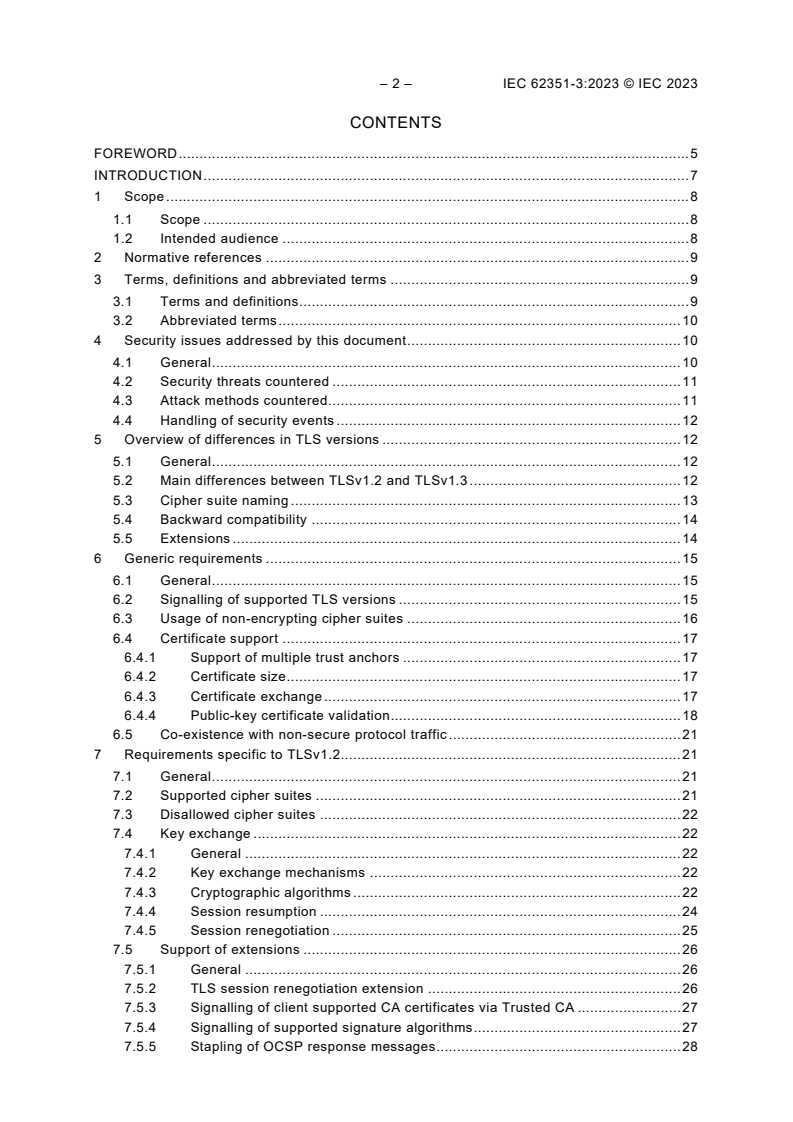
CONTENTS
FOREWORD . 5
INTRODUCTION . 7
1 Scope . 8
1.1 Scope . 8
1.2 Intended audience . 8
2 Normative references . 9
3 Terms, definitions and abbreviated terms . 9
3.1 Terms and definitions . 9
3.2 Abbreviated terms . 10
4 Security issues addressed by this document . 10
4.1 General . 10
4.2 Security threats countered . 11
4.3 Attack methods countered . 11
4.4 Handling of security events . 12
5 Overview of differences in TLS versions . 12
5.1 General . 12
5.2 Main differences between TLSv1.2 and TLSv1.3 . 12
5.3 Cipher suite naming . 13
5.4 Backward compatibility . 14
5.5 Extensions . 14
6 Generic requirements . 15
6.1 General . 15
6.2 Signalling of supported TLS versions . 15
6.3 Usage of non-encrypting cipher suites . 16
6.4 Certificate support . 17
6.4.1 Support of multiple trust anchors . 17
6.4.2 Certificate size . 17
6.4.3 Certificate exchange . 17
6.4.4 Public-key certificate validation . 18
6.5 Co-existence with non-secure protocol traffic . 21
7 Requirements specific to TLSv1.2. 21
7.1 General . 21
7.2 Supported cipher suites . 21
7.3 Disallowed cipher suites . 22
7.4 Key exchange . 22
7.4.1 General . 22
7.4.2 Key exchange mechanisms . 22
7.4.3 Cryptographic algorithms . 22
7.4.4 Session resumption . 24
7.4.5 Session renegotiation . 25
7.5 Support of extensions . 26
7.5.1 General . 26
7.5.2 TLS session renegotiation extension . 26
7.5.3 Signalling of client supported CA certificates via Trusted CA . 27
7.5.4 Signalling of supported signature algorithms . 27
7.5.5 Stapling of OCSP response messages . 28
7.5.6 Signalling of intended target TLS server via Server Name Indication . 29
7.5.7 Support of encryption before authentication . 29
8 Requirements specific to TLSv1.3. 30
8.1 General . 30
8.2 Supported cipher suites . 30
8.3 Key exchange . 30
8.3.1 General . 30
8.3.2 Handshake modes . 31
8.3.3 Diffie-Hellman Groups . 32
8.3.4 Signature algorithms . 32
8.4 Session key update (post-handshake message) . 33
8.5 New session ticket (post-handshake message) . 34
8.6 Session resumption . 34
8.7 Certificate validation . 34
8.8 Support of extensions . 35
8.8.1 General . 35
8.8.2 Signalling of supported TLS versions . 35
8.8.3 Cookie . 35
8.8.4 Signalling of supported signature algorithms . 35
8.8.5 Signalling of supported groups . 36
8.8.6 Signalling of key share . 36
8.8.7 Signalling of intended target TLS server via Server Name Indication . 36
8.8.8 Signalling of supported certificate authorities . 37
8.8.9 Support of PSK based key agreement . 37
8.8.10 Stapling of OCSP response messages . 37
8.8.11 Signalling of early data . 38
9 Optional security measure support. 38
10 Conformance . 38
10.1 General . 38
10.2 Notation . 38
10.3 Conformance to selected TLS versions . 38
10.4 Conformance to certificate handling . 39
10.5 Conformance to TLSv1.2 specifics . 39
10.5.1 Conformance to selected cipher suites . 39
10.5.2 Conformance to cryptographic algorithm support . 40
10.5.3 Conformance to TLSv1.2 session management features . 40
10.5.4 Conformance to selected TLSv1.2 extensions . 41
10.6 Conformance to TLSv1.3 specifics . 41
10.6.1 Conformance to selected TLSv1.3 cipher suites. 41
10.6.2 Conformance to selected TLSv1.3 session management features . 42
10.6.3 Conformance to selected TLSv1.3 extensions . 44
10.6.4 Conformance to selected TLSv1.3 post-handshake messages . 44
Annex A (informative) Security Events . 46
A.1 Security event logs . 46
A.2 Mapping of TLS events related to the TLS handshake . 46
A.3 Mapping of TLS events related to the certificate handling . 48
Bibliography . 49
– 4 – IEC 62351-3:2023 © IEC 2023
Figure 1 – Definition of cipher suites according to TLSv1.2 (RFC 5246) . 14
Figure 2 – Definition of cipher suites according to TLSv1.3 (RFC 8446) . 14
Table 1 – Support of cipher suites for TLSv1.2. 21
Table 2 – Support of cipher suites for TLSv1.3. 30
Table 3 – Support of PSK-based handshake modes for TLSv1.3 . 31
Table 4 – Support of Diffie Hellman Groups for TLSv1.3 . 32
Table 5 – Supported signature algorithms for the handshake in TLSv1.3 . 32
Table 6 – Supported signature algorithms for the certificates in TLSv1.3 . 33
Table 7 – Conformance to TLS versions . 38
Table 8 – Conformance to certificate support . 39
Table 9 – Conformance to TLSv1.2 usable cipher suites . 40
Table 10 – Conformance to cryptographic algorithm support . 40
Table 11 – Conformance to TLSv1.2 session management features. 41
Table 12 – Conformance to TLSv1.2 handshake extensions . 41
Table 13 – Conformance to TLSv1.3 cipher suites . 42
Table 14 – Conformance to handshake modes of TLSv1.3 . 42
Table 15 –Conformance to early data feature (0-RTT) of TLSv1.3 . 42
Table 16 – Conformance to supported Diffie Hellman Groups in TLSv1.3 . 43
Table 17 – Conformance to supported signature algorithms for the handshake in
TLSv1.3 . 43
Table 18 – Conformance to supported signature algorithms for the certificates in
TLSv1.3 . 44
Table 19 – Conformance to TLSv1.3 extensions . 44
Table 20 – Conformance to post-handshake messages of TLSv1.3 . 45
Table A.1 – Security event logs related to TLS handshake defined in IEC 62351-3:—
(Ed.2) mapped to IEC 62351-14 . 46
Table A.2 – Security event logs related to certificate validation defined in IEC 62351-3
Ed.2 mapped to IEC 62351-14 . 48
INTERNATIONAL ELECTROTECHNICAL COMMISSION
____________
POWER SYSTEMS MANAGEMENT AND ASSOCIATED INFORMATION
EXCHANGE – DATA AND COMMUNICATIONS SECURITY –
Part 3: Communication network and system security –
Profiles including TCP/IP
FOREWORD
1) The International Electrotechnical Commission (IEC) is a worldwide organization for standardization comprising
all national electrotechnical committees (IEC National Committees). The object of IEC is to promote international
co-operation on all questions concerning standardization in the electrical and electronic fields. To this end and
in addition to other activities, IEC publishes International Standards, Technical Specifications, Technical Reports,
Publicly Available Specifications (PAS) and Guides (hereafter referred to as "IEC Publication(s)"). Their
preparation is entrusted to technical committees; any IEC National Committee interested in the subject dealt with
may participate in this preparatory work. International, governmental and non-governmental organizations liaising
with the IEC also participate in this preparation. IEC collaborates closely with the International Organization for
Standardization (ISO) in accordance with conditions determined by agreement between the two organizations.
2) The formal decisions or agreements of IEC on technical matters express, as nearly as possible, an international
consensus of opinion on the relevant subjects since each technical committee has representation from all
interested IEC National Committees.
3) IEC Publications have the form of recommendations for international use and are accepted by IEC National
Committees in that sense. While all reasonable efforts are made to ensure that the technical content of IEC
Publications is accurate, IEC cannot be held responsible for the way in which they are used or for any
misinterpretation by any end user.
4) In order to promote international uniformity, IEC National Committees undertake to apply IEC Publications
transparently to the maximum extent possible in their national and regional publications. Any divergence between
any IEC Publication and the corresponding national or regional publication shall be clearly indicated in the latter.
5) IEC itself does not provide any attestation of conformity. Independent certification bodies provide conformity
assessment services and, in some areas, access to IEC marks of conformity. IEC is not responsible for any
services carried out by independent certification bodies.
6) All users should ensure that they have the latest edition of this publication.
7) No liability shall attach to IEC or its directors, employees, servants or agents including individual experts and
members of its technical committees and IEC National Committees for any personal injury, property damage or
other damage of any nature whatsoever, whether direct or indirect, or for costs (including legal fees) and
expenses arising out of the publication, use of, or reliance upon, this IEC Publication or any other IEC
Publications.
8) Attention is drawn to the Normative references cited in this publication. Use of the referenced publications is
indispensable for the correct application of this publication.
9) Attention is drawn to the possibility that some of the elements of this IEC Publication may be the subject of patent
rights. IEC shall not be held responsible for identifying any or all such patent rights.
IEC 62351-3 has been prepared by IEC technical committee 57: Power systems management
and associated information exchange. It is an International Standard.
This second edition cancels and replaces the first edition published in 2014, Amendment 1:2018
and Amendment 2:2020. This edition constitutes a technical revision.
This edition includes the following significant technical changes with respect to the previous
edition:
a) Inclusion of the TLSv1.2 related parameter required in IEC 62351-3 Ed.1.2 to be specified
by the referencing standard. This comprises the following parameter:
• Mandatory TLSv1.2 cipher suites to be supported.
• Specification of session resumption parameters.
• Specification of session renegotiation parameters.
– 6 – IEC 62351-3:2023 © IEC 2023
• Revocation handling using CRL and OCSP.
• Handling of security events.
b) Inclusion of a TLSv1.3 profile to be applicable for the power system domain in a similar way
as for TLSv1.2 session.
The text of this International Standard is based on the following documents:
Draft Report on voting
57/2578/FDIS 57/2593/RVD
Full information on the voting for its approval can be found in the report on voting indicated in
the above table.
The language used for the development of this International Standard is English.
This document was drafted in accordance with ISO/IEC Directives, Part 2, and developed in
accordance with ISO/IEC Directives, Part 1 and ISO/IEC Directives, IEC Supplement, available
at www.iec.ch/members_experts/refdocs. The main document types developed by IEC are
described in greater detail at www.iec.ch/publications.
NOTE The following print types are used:
• Abstract Syntax Notation One (ASN.1) are presented in courier new and bold courier new
A list of all parts in the IEC 62351 series, published under the general title Power systems
management and associated information exchange – Data and communications security, can
be found on the IEC website.
The committee has decided that the contents of this document will remain unchanged until the
stability date indicated on the IEC website under webstore.iec.ch in the data related to the
specific document. At this date, the document will be
• reconfirmed,
• withdrawn,
• replaced by a revised edition, or
• amended.
IMPORTANT – The "colour inside" logo on the cover page of this document indicates that it
contains colours which are considered to be useful for the correct understanding of its
contents. Users should therefore print this document using a colour printer.
INTRODUCTION
This edition of IEC 62351-3 is a self-contained document profiling the usage of TLS for to secure
power system communication. It is recommended to refer to this edition of this document rather
than any previous edition, because this edition updates the utilized cryptographic algorithms
(ciphersuites), provides enhanced functionality, and covers different TLS versions. In contrast
to previous editions, this document specifies all necessary TLS specific settings and does not
require the referencing standard to define specific settings for TLS.
Note that the recommendation to use this edition, potentially also with older referencing
standards, requires technical support by implementations of the TLS settings specified in this
edition of the document.
– 8 – IEC 62351-3:2023 © IEC 2023
POWER SYSTEMS MANAGEMENT AND ASSOCIATED INFORMATION
EXCHANGE – DATA AND COMMUNICATIONS SECURITY –
Part 3: Communication network and system security –
Profiles including TCP/IP
1 Scope
1.1 Scope
This part of IEC 62351 specifies how to provide confidentiality, integrity protection, and
message level authentication for protocols that make use of TCP/IP as a message transport
layer and utilize Transport Layer Security when cyber-security is required. This may relate to
SCADA/telecontrol, protection, automation and control protocols.
IEC 62351-3 specifies how to secure TCP/IP-based protocols through constraints on the
specification of the messages, procedures, and algorithms of Transport Layer Security (TLS)
(TLSv1.2 defined in RFC 5246, TLSv1.3 defined in RFC 8446). In the specific clauses, there
will be subclauses to note the differences and commonalities in the application depending on
the target TLS version. The use and specification of intervening external security devices (e.g.,
"bump-in-the-wire") are considered out-of-scope.
In contrast to previous editions of this document, this edition is self-contained in terms of
completely defining a profile of TLS. Hence, it can be applied directly, without the need to
specify further TLS parameters, except the port number, over which the communication will be
performed. Therefore, this part can be directly utilized from a referencing standard and can be
combined with further security measures on other layers. Providing the profiling of TLS without
the need for further specifying TLS parameters allows declaring conformity to the described
functionality without the need to involve further IEC 62351 documents.
This document is intended to be referenced as a normative part of other IEC standards that
have the need for providing security for their TCP/IP-based protocol exchanges under similar
boundary conditions. However, it is up to the individual protocol security initiatives to decide if
this document is to be referenced.
The document also defines security events for specific conditions, which support error handling,
security audit trails, intrusion detection, and conformance testing. Any action of an organization
in response to events to an error condition described in this document are beyond the scope of
this document and are expected to be defined by the organization’s security policy.
This document reflects the security requirements of the IEC power systems management
protocols. Should other standards bring forward new requirements, this document may need to
be revised.
1.2 Intended audience
The initial audience for this document is intended to be experts developing or making use of
protocols in the field of power systems management and associated information exchange. For
the measures described in this document to take effect, they must be accepted and referenced
by the specifications of protocols making use of TCP/IP security by applying TLS. This
document is written to enable that process.
The subsequent audience for this document is intended to be the developers of products that
implement these protocols.
Portions of this document may also be of use to managers and executives in order to understand
the purpose and requirements of the work.
2 Normative references
The following documents are referred to in the text in such a way that some or all of their content
constitutes requirements of this document. For dated references, only the edition cited applies.
For undated references, the latest edition of the referenced document (including any
amendments) applies.
IEC TS 62351-1:2007, Power systems management and associated information exchange –
Data and communications security – Part 1: Communication network and system security –
Introduction to security issues
IEC TS 62351-2:2008, Power systems management and associated information exchange –
Data and communications security – Part 2: Glossary of terms
IEC 62351-9, Power systems management and associated information exchange – Data and
communications security – Part 9: Cyber security key management for power system equipment
ISO/IEC 9594-8:2020 | Rec. ITU-T X.509 (2019), Information technology – Open systems
interconnection – The Directory: Public-key and attribute certificate frameworks
RFC 5246:2008, The TLS Protocol Version 1.2
RFC 5280:2008, Internet X.509 Public Key Infrastructure Certificate and Certificate Revocation
List (CRL) Profile
RFC 5288:2008, AES Galois Counter Mode (GCM) Cipher Suites for TLS
RFC 5289:2008, TLS Elliptic Curve Cipher Suites with SHA-256/384 and AES Galois Counter
Mode (GCM)
RFC 5746:2010, Transport Layer Security (TLS) Renegotiation Indication Extension
RFC 6066:2011, Transport Layer Security Extensions
RFC 6176:2011, Prohibiting Secure Sockets Layer (SSL) Version 2.0
RFC 8422:2018, ECC Cipher Suites for TLSv1.2 and earlier
RFC 8446:2018, The TLS Protocol Version 1.3
RFC 9150:2021, TLS 1.3 Authentication and Integrity only Cipher Suites
3 Terms, definitions and abbreviated terms
3.1 Terms and definitions
For the purposes of this document, the terms and definitions given in IEC TS 62351-2 and the
following apply.
___________
This is typically referred to as SSL/TLS.
– 10 – IEC 62351-3:2023 © IEC 2023
ISO and IEC maintain terminological databases for use in standardization at the following
addresses:
• IEC Electropedia: available at http://www.electropedia.org/
• ISO Online browsing platform: available at http://www.iso.org/obp
3.2 Abbreviated terms
ACSE Association Control Service Element
AEAD Authenticated Encryption with Associated Data
BCP Best Current Practice
CRL Certificate Revocation List
DER Distinguished Encoding Rules
DH(E) Diffie Hellman (Ephemeral) Key Agreement (see also IEC 62351-9)
ECDH(E) Elliptic Curve based Diffie Hellman (Ephemeral) Key Agreement (see also
IEC 62351-9)
ECDSA Elliptic Curve Digital Signature Algorithm
IV Initialization Vector
MAC Message Authentication Code
MitM Man-in-the-Middle (type of attack)
OCSP Online Certificate Status Protocol (see RFC 6960)
PICS Protocol Implementation Conformance Statement
PIXIT Protocol Implementation eXtra Information for Testing
PSK Pre-shared key
TLS Transport Layer Security
4 Security issues addressed by this document
4.1 General
The IEC power system environment has different operational requirements from many
Information Technology (IT) applications that make use of TLS to protect the transport of
information over a TCP/IP connection. This requires on one hand the management of
certificates used to authenticate entities, which is handled in IEC 62351-9. On the other hand,
specific TLS related security parameters such as selected cipher suites, session management
parameter and utilized extensions need to be defined, which is the focus of this document. One
main difference in the application of TLS in the power system domain is the duration of the
TCP/IP connection for which security needs to be maintained. Besides this it also has to be
considered that the equipment in power system automation is long lasting. This may also require
supporting older versions of TLS or cipher suites to retain backward compatibility.
Many IT protocols have short duration connections, which allow the encryption algorithms to be
renegotiated at connection re-establishment. However, the connections within a telecontrol
environment tend to have longer durations, often "permanent". It is the longevity of connections
in the field of power systems management and associated information exchange that give rise
to the need for specific consideration. In this regard, in order to provide protection for the
"permanent" connections, a mechanism for updating the session key is selected within this
document, based upon existing TLS features. Note that TLSv1.2 and TLSv1.3 support different
approaches for rekeying.
TLS allows for a wide variety of settings such as selected cipher suites to protect the handshake
and the record layer protocol, which are negotiated during connection establishment. It also
supports session management mechanisms to setup new sessions or renew existing sessions.
To ensure interoperability between different implementations, this document specifies a
common set of TLS features to be supported by conforming implementations.
TLS has evolved and is available in version 1.3. In version 1.3 several parts of the protocol
have been reworked, resulting in a protocol, which is functionally not backward compatible to
TLSv1.2. As the first message exchange is defined in a backward compatible way, the TLS
server may be able to switch to either version, depending on the security policy.
Additionally, this document specifies the use of particular TLS capabilities that allow for specific
security threats to be countered (see also 4.2). Specifically, TLS allows the definition of
extensions to the protocol to mitigate potential protocol vulnerabilities or to enhance protocol
functionality. This specification makes use of already-defined extensions.
Note that TLS utilizes X.509 certificates (see also ISO/IEC 9594-8 or RFC 5280) for
authentication and key agreement. In the context of this document the term certificate always
relates to public-key certificates (in contrast to attribute certificates).
NOTE It is assumed that the certificate management necessary to operate TLS is addressed in accordance with
IEC 62351-9.
4.2 Security threats countered
See IEC TS 62351-1 for a discussion of security threats and attack methods.
TCP/IP and the security specifications in this document cover only the communication transport
layers (OSI layers 4 and lower). Specifically, TLS protects the transported messages from OSI
layer 5 and above in a transparent way. This document does not cover security functionality
specific for the communication application layers (OSI layers 5 and above) or application-to-
application security. This is defined in other parts of IEC 62351, e.g., IEC 62351-4 for MMS,
IEC 62351-5 for serial communication and telecontrol, and IEC 62351-6 for (R)GOOSE and
(R)SV.
NOTE The application of TLS as profiled in this document supports the protection of information sent over a TLS
protected connection.
The specific threats countered in this document for the transport layer include:
– Tampering (unauthorized modification or insertion of messages) is addressed by mutual,
certificate-based authentication of the communication participants, and TLS packet-level
integrity protection.
Additionally, when the information has been identified as requiring confidentiality protection:
– Unauthorized access to information through TLS packet-level encryption of the messages.
4.3 Attack methods countered
The following security attack methods are countered through the appropriate implementation of
the specifications and recommendations in this document.
– Impersonation: This threat is countered through the use of mutual authentication based on
X.509 certificates during the TLS handshake and digitally signed information as revocation
information.
– Man-in-the-middle (MitM): This threat is countered for the TLS record layer through the use
of cryptographic checksums (MAC) based on mutually authenticated negotiation of session
keys. These keys are set up during the TLS handshake. Protection against MitM attacks
during the TLS handshake phase itself is provided by the Finish message, ending the
handshake phase. This message is encrypted and contains a hash value over all messages
– 12 – IEC 62351-3:2023 © IEC 2023
exchanged in the handshake. In addition, TLSv1.3 already provides cryptographic protection
of the handshake messages directly (except the ClientHello).
– Replay: This threat is countered by the application of a MAC for integrity protection on a per
packet bases including a sequence number to detect an actual replay.
– Eavesdropping: This threat is countered through the use of encryption cipher suites, when
negotiating TLS record layer security.
NOTE The actual performance characteristics of an implementation claiming conformance to this part of the
IEC 62351 series are out-of-scope of this document.
4.4 Handling of security events
Throughout the document security events are defined. These security events are intended to
support error handling and thus to increase system resilience. Implementations should provide
a mechanism for announcing security events to an evaluation system. A recommended standard
is IEC 62351-4.
The information about security events and potential detailed information can only be provided
by the entity based on the availability of this information through the underlying platform or
utilized components.
It is recommended that the security events defined throughout this document are made
available to the operational infrastructure by cyber security events as specified in IEC 62351-14
or by monitoring objects as specified in IEC 62351-7. Annex A provides a mapping of the
defined events in this document to the notion of IEC 62351-14.
Note that notice, warnings, errors, and alarms are used to indicate the severity of an event from
a security point of view. The following notion from IEC 62351-14 is used:
– A notice refers to a cyber security related activity during the routine use or maintenance of
an entity. It does not relate to a cyber security breach or attack or deviation from the normal
operating condition of an entity.
– A warning is a deviation from the normal operating condition of an entity but not necessary
a cyber-attack.
– An error describes an unforeseen condition, which may indicate unauthorized activity. It may
not require immediate action.
– An alarm is an indication of a serious problem, which may indicate unauthorized activity.
Action is recommended to be taken immediately.
In any case, it is expected that an organization’s security policy determines the final handling
of events based on the operational environment. For instance, the assessment of one or more
alarms could rise to the level of an incident.
5 Overview of differences in TLS versions
5.1 General
This clause provides a short overview about the main differences between the TLS version 1.2
and TLS version 1.3. Specifically addressed is the naming of cipher suites, backward
compatibility, and extensions, which have been used in previous version of this standard.
5.2 Main differences between TLSv1.2 and TLSv1.3
In the following the main differences between TLSv1.2 and TLSv1.3 for the different
subprotocols (TLS Handshake, TLS Record Layer) are listed (note that RFC 8446 provides a
complete list of changes from TLSv1.2 to TLSv1.3), which have a relation to features used in
TLSv1.2 in IEC 62351-3:
– Fewer handshake roundtrips in TLSv1.3 (one roundtrip for unilateral authenticated sessions,
1.5 for mutual authentication).
– TLSv1.3 handshake messages are encrypted, except the ClientHello and parts of the
ServerHello are send in plain. Note that there is ongoing work in the IETF to define
extensions to allow to encrypt part of the ClientHello, like the Server Name Indication
(SNI) resulting in an encrypted SNI (ESNI) or encrypting the whole ClientHello as
encrypted ClientHello (ECH).
– TLSv1.3 removes support for obsolete and vulnerable cryptographic algorithms: Export
ciphers, DES, 3DES, AES-CBC, RC4, MD5, SHA-1 are no longer supported
– TLSv1.3 changes in key establishment
• Removal of arbitrary Diffie-Hellman groups
• Key establishment is based on ephemeral Diffie-Hellman
• No support for RSA key encryption
– TLSv1.3 removes session renegotiation but provides post-handshake messages for key and
IV update as well as client authentication.
– TLSv1.3 simplifies session resumption by using PSK and Session Tickets
– TLSv1.3 introduces post handshake messages for
• Session Ticket
• Client authentication
• Key and IV Update
– TLSv1.3 removes the multistapling support of OCSP responses according to RFC 6961
(status_request_v2). It has been replaced with a direct variant allowing the stapling of OCSP
response to certificates in a chain by an extension of a CertificateEntry.
– TLSv1.3 introduces OCSP stapling for client certificates, which may be important specifically
for industrial use cases, in which the server often resides on the field device with potential
limited capability of checking revocation state of received certificates
– TLSv1.3 removes non-AEAD cipher suites for TLS record layer protection. Note that
integrity-only cipher suites have been defined in RFC 9051.
– TLSv1.3 provides the option to have already encrypted ap
...