


IEC 60745-2-3:2006+AMD1:2010 CSV
(Main)Hand-held motor-operated electric tools - Safety - Part 2-3: Particular requirements for grinders, polishers and disk-type sanders
Hand-held motor-operated electric tools - Safety - Part 2-3: Particular requirements for grinders, polishers and disk-type sanders
IEC 60745-2-3:2006+A1:2010 Applies to grinders, with a rated speed not exceeding a peripheral speed of the accessory of 80 m/s at rated capacity, polishers and disk-type sanders, including angle, straight and vertical with a rated capacity not exceeding 230 mm. Does not apply to random-orbit polishers and random-orbit sanders. These are covered by IEC 60745-2-4. This consolidated version consists of the second edition (2006) and its amendment 1 (2010). Therefore, no need to order amendment in addition to this publication.
Outils électroportatifs à moteur - Sécurité - Partie 2-3: Règles particulières pour les meuleuses, lustreuses et ponceuses du type à disque
La CEI 60745-2-3:2006+A1:2010 S'applique aux meuleuses dont la vitesse assignée ne dépasse pas une vitesse périphérique de l'accessoire de 80 m/s à la capacité assignée, aux lustreuses et aux ponceuses du type à disque, y compris d'angle, droites et verticales dont la capacité assignée ne dépasse pas 230 mm. Cette norme ne s'applique pas aux lustreuses à orbite aléatoire et aux ponceuses à orbite aléatoire. Ces dernières sont couvertes par la CEI 60745-2-4. Cette version consolidée comprend la deuxième édition (2006) et son amendement 1 (2010). Il n'est donc pas nécessaire de commander l'amendement avec cette publication.
General Information
- Status
- Published
- Publication Date
- 24-Feb-2011
- Technical Committee
- TC 116 - Safety of motor-operated electric tools
- Current Stage
- PPUB - Publication issued
- Start Date
- 25-Feb-2011
- Completion Date
- 25-Feb-2011
Overview
IEC 60745-2-3:2006+AMD1:2010 CSV sets out the safety requirements for hand-held, motor-operated electric tools, specifically focusing on grinders, polishers, and disk-type sanders. Published by the International Electrotechnical Commission (IEC), this consolidated version outlines particular guidelines for the design, safety testing, and usage of these tools when the rated capacity does not exceed 230 mm and the peripheral speed of accessories does not exceed 80 m/s. Random-orbit polishers and sanders are not included in this scope and are addressed in IEC 60745-2-4.
This standard helps manufacturers, compliance engineers, and safety professionals ensure hand-held grinders, polishers, and disk-type sanders meet essential international safety benchmarks, reducing risks to users and enhancing product reliability.
Key Topics
IEC 60745-2-3 addresses several key areas to ensure safe operation of applicable power tools:
- Scope and Definitions: Defines the types of tools covered, including angle, straight, and vertical grinders, polishers, and disk-type sanders.
- Marking and Instructions: Specifies mandatory labels, including rated speed, capacity, direction of rotation, and clear safety warnings such as mandatory eye protection.
- Protection Against Hazards: Details requirements for guarding moving parts, protection from electric shock, mechanical strength, and safe construction.
- Testing Methods: Establishes general conditions and procedures for safety and performance testing.
- Accessories and Guards: Sets requirements for wheel guards, flanges, accessory compatibility, and supporting hardware.
- Personal Protective Equipment: Mandates clear instructions about the use of appropriate protection: safety goggles, dust masks, ear protection, and gloves.
- Operation and Handling: Includes fundamental operating precautions, such as handling kickback, preventing wheel breakage, and proper accessory use.
Applications
Compliance with IEC 60745-2-3 is critical across various industries and occupational settings:
- Manufacturing: Tool manufacturers utilize this standard to ensure their grinders, polishers, and disk-type sanders meet internationally accepted safety criteria, aiding product certification and market access.
- Quality assurance and Testing: Laboratories and compliance engineers reference these requirements during product design, development, and safety validation, minimizing risks for end users.
- Health and Safety Management: Workplace safety officers integrate these guidelines into training and safety programs, ensuring correct tool usage and risk mitigation.
- Procurement and Specification: Buyers and specifiers reference this standard to ensure tool purchases meet required safety benchmarks, supporting workplace safety and regulatory compliance.
Related Standards
To provide comprehensive safety coverage, consider referencing these related IEC and international standards:
- IEC 60745-1: Hand-held motor-operated electric tools – Safety – Part 1: General requirements (the base standard covering all tool types).
- IEC 60745-2-4: Particular requirements for sanders and polishers other than disk type (covers random-orbit sanders and polishers).
- IEC 60745-2-22: Covers dedicated cut-off machines that are not included in IEC 60745-2-3.
- ISO 603 Series: Bonded abrasive products – Dimensions (pertaining to grinding wheels and accessories).
- ANSI B7.1: Safety Requirements for the Use, Care and Protection of Abrasive Wheels.
Conclusion
IEC 60745-2-3 is an essential international safety standard, ensuring that hand-held grinders, polishers, and disk-type sanders are safe for users and workplaces. By integrating its requirements into the design, manufacture, and usage of these power tools, companies support global best practices, reduce injury risks, and demonstrate conformity with major international safety regulations in the field of electric power tools.
Get Certified
Connect with accredited certification bodies for this standard

DVS-ZERT GmbH
German welding certification society.
CARES (UK Certification Authority for Reinforcing Steels)
UK certification for reinforcing steels and construction.
EWF/IIW (European/International Welding Federation)
International welding personnel certification.
Sponsored listings
Frequently Asked Questions
IEC 60745-2-3:2006+AMD1:2010 CSV is a standard published by the International Electrotechnical Commission (IEC). Its full title is "Hand-held motor-operated electric tools - Safety - Part 2-3: Particular requirements for grinders, polishers and disk-type sanders". This standard covers: IEC 60745-2-3:2006+A1:2010 Applies to grinders, with a rated speed not exceeding a peripheral speed of the accessory of 80 m/s at rated capacity, polishers and disk-type sanders, including angle, straight and vertical with a rated capacity not exceeding 230 mm. Does not apply to random-orbit polishers and random-orbit sanders. These are covered by IEC 60745-2-4. This consolidated version consists of the second edition (2006) and its amendment 1 (2010). Therefore, no need to order amendment in addition to this publication.
IEC 60745-2-3:2006+A1:2010 Applies to grinders, with a rated speed not exceeding a peripheral speed of the accessory of 80 m/s at rated capacity, polishers and disk-type sanders, including angle, straight and vertical with a rated capacity not exceeding 230 mm. Does not apply to random-orbit polishers and random-orbit sanders. These are covered by IEC 60745-2-4. This consolidated version consists of the second edition (2006) and its amendment 1 (2010). Therefore, no need to order amendment in addition to this publication.
IEC 60745-2-3:2006+AMD1:2010 CSV is classified under the following ICS (International Classification for Standards) categories: 25.140.20 - Electric tools. The ICS classification helps identify the subject area and facilitates finding related standards.
IEC 60745-2-3:2006+AMD1:2010 CSV is available in PDF format for immediate download after purchase. The document can be added to your cart and obtained through the secure checkout process. Digital delivery ensures instant access to the complete standard document.
Standards Content (Sample)
IEC 60745-2-3 ®
Edition 2.1 2011-02
INTERNATIONAL
STANDARD
NORME
INTERNATIONALE
colour
inside
Hand-held motor-operated electric tools – Safety –
Part 2-3: Particular requirements for grinders, polishers and disk-type sanders
Outils électroportatifs à moteur – Sécurité –
Partie 2-3: Règles particulières pour les meuleuses, lustreuses et ponceuses du
type à disque
IEC 60745-2-3:2006+A1:2010
All rights reserved. Unless otherwise specified, no part of this publication may be reproduced or utilized in any form or by
any means, electronic or mechanical, including photocopying and microfilm, without permission in writing from either IEC or
IEC's member National Committee in the country of the requester.
If you have any questions about IEC copyright or have an enquiry about obtaining additional rights to this publication,
please contact the address below or your local IEC member National Committee for further information.
Droits de reproduction réservés. Sauf indication contraire, aucune partie de cette publication ne peut être reproduite
ni utilisée sous quelque forme que ce soit et par aucun procédé, électronique ou mécanique, y compris la photocopie
et les microfilms, sans l'accord écrit de la CEI ou du Comité national de la CEI du pays du demandeur.
Si vous avez des questions sur le copyright de la CEI ou si vous désirez obtenir des droits supplémentaires sur cette
publication, utilisez les coordonnées ci-après ou contactez le Comité national de la CEI de votre pays de résidence.
IEC Central Office
3, rue de Varembé
CH-1211 Geneva 20
Switzerland
Email: inmail@iec.ch
Web: www.iec.ch
About the IEC
The International Electrotechnical Commission (IEC) is the leading global organization that prepares and publishes
International Standards for all electrical, electronic and related technologies.
About IEC publications
The technical content of IEC publications is kept under constant review by the IEC. Please make sure that you have the
latest edition, a corrigenda or an amendment might have been published.
Catalogue of IEC publications: www.iec.ch/searchpub
The IEC on-line Catalogue enables you to search by a variety of criteria (reference number, text, technical committee,…).
It also gives information on projects, withdrawn and replaced publications.
IEC Just Published: www.iec.ch/online_news/justpub
Stay up to date on all new IEC publications. Just Published details twice a month all new publications released. Available
on-line and also by email.
Electropedia: www.electropedia.org
The world's leading online dictionary of electronic and electrical terms containing more than 20 000 terms and definitions
in English and French, with equivalent terms in additional languages. Also known as the International Electrotechnical
Vocabulary online.
Customer Service Centre: www.iec.ch/webstore/custserv
If you wish to give us your feedback on this publication or need further assistance, please visit the Customer Service
Centre FAQ or contact us:
Email: csc@iec.ch
Tel.: +41 22 919 02 11
Fax: +41 22 919 03 00
A propos de la CEI
La Commission Electrotechnique Internationale (CEI) est la première organisation mondiale qui élabore et publie des
normes internationales pour tout ce qui a trait à l'électricité, à l'électronique et aux technologies apparentées.
A propos des publications CEI
Le contenu technique des publications de la CEI est constamment revu. Veuillez vous assurer que vous possédez
l’édition la plus récente, un corrigendum ou amendement peut avoir été publié.
Catalogue des publications de la CEI: www.iec.ch/searchpub/cur_fut-f.htm
Le Catalogue en-ligne de la CEI vous permet d’effectuer des recherches en utilisant différents critères (numéro de référence,
texte, comité d’études,…). Il donne aussi des informations sur les projets et les publications retirées ou remplacées.
Just Published CEI: www.iec.ch/online_news/justpub
Restez informé sur les nouvelles publications de la CEI. Just Published détaille deux fois par mois les nouvelles
publications parues. Disponible en-ligne et aussi par email.
Electropedia: www.electropedia.org
Le premier dictionnaire en ligne au monde de termes électroniques et électriques. Il contient plus de 20 000 termes et
définitions en anglais et en français, ainsi que les termes équivalents dans les langues additionnelles. Egalement appelé
Vocabulaire Electrotechnique International en ligne.
Service Clients: www.iec.ch/webstore/custserv/custserv_entry-f.htm
Si vous désirez nous donner des commentaires sur cette publication ou si vous avez des questions, visitez le FAQ du
Service clients ou contactez-nous:
Email: csc@iec.ch
Tél.: +41 22 919 02 11
Fax: +41 22 919 03 00
IEC 60745-2-3 ®
Edition 2.1 2011-02
INTERNATIONAL
STANDARD
NORME
INTERNATIONALE
colour
inside
Hand-held motor-operated electric tools – Safety –
Part 2-3: Particular requirements for grinders, polishers and disk-type sanders
Outils électroportatifs moteur – Sécurité –
Partie 2-3: Règles particulières pour les meuleuses, lustreuses et ponceuses du
type à disque
INTERNATIONAL
ELECTROTECHNICAL
COMMISSION
COMMISSION
ELECTROTECHNIQUE
PRICE CODE
INTERNATIONALE
CP
CODE PRIX
ICS 25.140.20 ISBN 978-2-88912-286-8
– 2 – 60745-2-3 IEC:2006+A1:2010
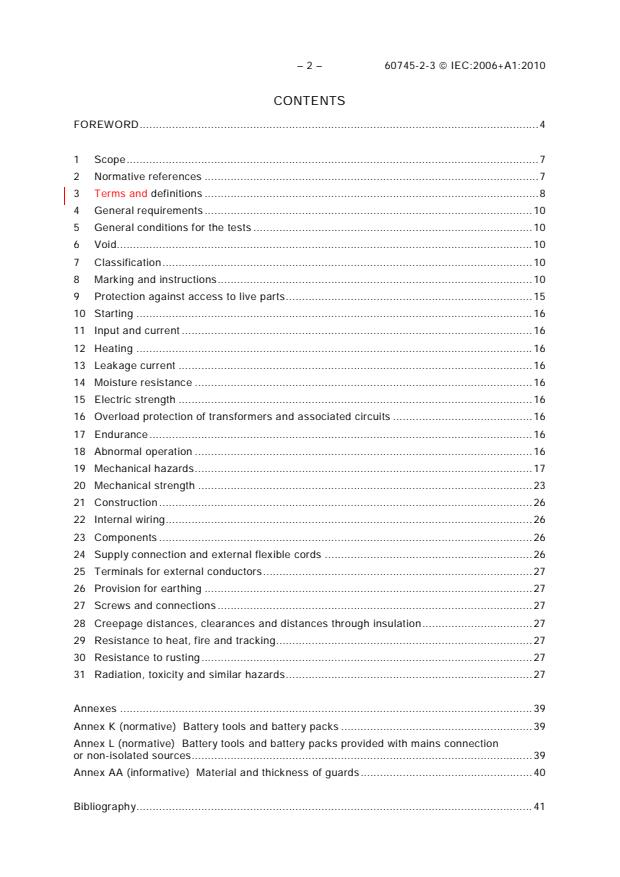
CONTENTS
FOREWORD . 4
1 Scope . 7
2 Normative references . 7
3 Terms and definitions . 8
4 General requirements . 10
5 General conditions for the tests . 10
6 Void. 10
7 Classification . 10
8 Marking and instructions . 10
9 Protection against access to live parts . 15
10 Starting . 16
11 Input and current . 16
12 Heating . 16
13 Leakage current . 16
14 Moisture resistance . 16
15 Electric strength . 16
16 Overload protection of transformers and associated circuits . 16
17 Endurance . 16
18 Abnormal operation . 16
19 Mechanical hazards . 17
20 Mechanical strength . 23
21 Construction . 26
22 Internal wiring . 26
23 Components . 26
24 Supply connection and external flexible cords . 26
25 Terminals for external conductors . 27
26 Provision for earthing . 27
27 Screws and connections . 27
28 Creepage distances, clearances and distances through insulation . 27
29 Resistance to heat, fire and tracking . 27
30 Resistance to rusting . 27
31 Radiation, toxicity and similar hazards . 27
Annexes . 39
Annex K (normative) Battery tools and battery packs . 39
Annex L (normative) Battery tools and battery packs provided with mains connection
or non-isolated sources. 39
Annex AA (informative) Material and thickness of guards . 40
Bibliography . 41
60745-2-3 IEC:2006+A1:2010 – 3 –
Figure 101 – Typical guard designs a) and b) for wheel Types 1, 41 and 42 . 28
Figure 102 – Typical guard design with front lip for wheel Types 27, 28 and 29 . 30
Figure 103 – Adjustable guard for cup wheel Types 6 and 11 . 31
Figure 104 – Principal dimensions of flanges . 32
Figure 105 – Dimensions of an adaptor backing flange . 55
Figure 106 – Guard strength test: explanation of guard positions . 34
Figure 107 – Guard strength test: preparation of the grinder . 35
Figure 108 – Guard strength test: preparation of cup wheel Types 6 and 11 . 35
Figure 109 – Guard strength test: straight grinder with additional masses . 36
Figure 110 – Guard strength test box . 38
Table 101 – Torques for testing flanges . 22
Table 102 – Typical pre-cut length ranges for standard wheel dimensions . 24
– 4 – 60745-2-3 IEC:2006+A1:2010
INTERNATIONAL ELECTROTECHNICAL COMMISSION
____________
HAND-HELD MOTOR-OPERATED ELECTRIC TOOLS –
SAFETY –
Part 2-3: Particular requirements for grinders,
polishers and disk-type sanders
FOREWORD
1) The International Electrotechnical Commission (IEC) is a worldwide organization for standardization comprising
all national electrotechnical committees (IEC National Committees). The object of IEC is to promote
international co-operation on all questions concerning standardization in the electrical and electronic fields. To
this end and in addition to other activities, IEC publishes International Standards, Technical Specifications,
Technical Reports, Publicly Available Specifications (PAS) and Guides (hereafter referred to as “IEC
Publication(s)”). Their preparation is entrusted to technical committees; any IEC National Committee interested
in the subject dealt with may participate in this preparatory work. International, governmental and non-
governmental organizations liaising with the IEC also participate in this preparation. IEC collaborates closely
with the International Organization for Standardization (ISO) in accordance with conditions determined by
agreement between the two organizations.
2) The formal decisions or agreements of IEC on technical matters express, as nearly as possible, an international
consensus of opinion on the relevant subjects since each technical committee has representation from all
interested IEC National Committees.
3) IEC Publications have the form of recommendations for international use and are accepted by IEC National
Committees in that sense. While all reasonable efforts are made to ensure that the technical content of IEC
Publications is accurate, IEC cannot be held responsible for the way in which they are used or for any
misinterpretation by any end user.
4) In order to promote international uniformity, IEC National Committees undertake to apply IEC Publications
transparently to the maximum extent possible in their national and regional publications. Any divergence
between any IEC Publication and the corresponding national or regional publication shall be clearly indicated in
the latter.
5) IEC itself does not provide any attestation of conformity. Independent certification bodies provide conformity
assessment services and, in some areas, access to IEC marks of conformity. IEC is not responsible for any
services carried out by independent certification bodies.
6) All users should ensure that they have the latest edition of this publication.
7) No liability shall attach to IEC or its directors, employees, servants or agents including individual experts and
members of its technical committees and IEC National Committees for any personal injury, property damage or
other damage of any nature whatsoever, whether direct or indirect, or for costs (including legal fees) and
expenses arising out of the publication, use of, or reliance upon, this IEC Publication or any other IEC
Publications.
8) Attention is drawn to the Normative references cited in this publication. Use of the referenced publications is
indispensable for the correct application of this publication.
9) Attention is drawn to the possibility that some of the elements of this IEC Publication may be the subject of
patent rights. IEC shall not be held responsible for identifying any or all such patent rights.
This consolidated version of IEC 60745-2-3 consists of the second edition (2006)
[documents 61F/624/FDIS and 61F/634/RVD] and its amendment 1 (2010) [documents
116/53/FDIS and 116/56/RVD]. It bears the edition number 2.1.
The technical content is therefore identical to the base edition and its amendment and
has been prepared for user convenience. A vertical line in the margin shows where the
base publication has been modified by amendment 1. Additions and deletions are
displayed in red, with deletions being struck through.
60745-2-3 IEC:2006+A1:2010 – 5 –
International Standard IEC 60745-2-3 has been prepared by subcommittee 61F: Safety of
hand-held motor-operated electric tools, of IEC technical committee 61: Safety of household
and similar electrical appliances.
This publication has been drafted in accordance with the ISO/IEC Directives, Part 2.
This part 2 is to be used in conjunction with the latest edition of IEC 60745-1, Hand-held
motor-operated electric tools – Safety – Part 1: General requirements, and its amendments. It
was established on the basis of the third edition (2001) of that standard.
NOTE 1 When “Part 1” is mentioned in this standard, it refers to IEC 60745-1.
This part 2 supplements or modifies the corresponding clauses of IEC 60745-1, so as to
convert that publication into the IEC standard: Safety for grinders, polishers and disk-type
sanders.
When a particular subclause of Part 1 is not mentioned in this part 2, that subclause applies
as far as is reasonable. When this standard states “addition”, “modification” or “replacement”,
the relevant text in Part 1 is to be adapted accordingly.
NOTE 2 The following numbering system is used:
– subclauses, tables and figures that are numbered starting from 101 are additional to those in Part 1;
– additional annexes are lettered AA, BB, etc.
NOTE 3 In this standard, the following print types are used:
– requirements: in roman type;
– test specifications: in italic type;
– notes: in smaller roman type.
Words in bold in the text are defined in Clause 3. When a definition concerns an adjective, the adjective and the
associated noun are also in bold.
IEC 60745 consists of the following parts, under the general title Hand-held motor-operated
electric tools – Safety:
Part 1: General requirements
Part 2-1: Particular requirements for drills and impact drills
Part 2-2: Particular requirements for screwdrivers and impact wrenches
Part 2-3: Particular requirements for grinders, polishers and disk-type sanders
Part 2-4: Particular requirements for sanders and polishers other than disk type
Part 2-5: Particular requirements for circular saws and circular knives
Part 2-6: Particular requirements for hammers
Part 2-7: Particular requirements for spray guns for non-flammable liquids
Part 2-8: Particular requirements for shears and nibblers
Part 2-9: Particular requirements for tappers
Part 2-11: Particular requirements for reciprocating saws (jig and sabre saws)
Part 2-12: Particular requirements for concrete vibrators
Part 2-13: Particular requirements for chain saws
Part 2-14: Particular requirements for planers
Part 2-15: Particular requirements for hedge trimmers and grass shears
Part 2-16: Particular requirements for tackers
Part 2-17: Particular requirements for routers and trimmers
Part 2-18: Particular requirements for strapping tools
– 6 – 60745-2-3 IEC:2006+A1:2010
Part 2-19: Particular requirements for jointers
Part 2-20: Particular requirements for band saws
Part 2-21: Particular requirements for drain cleaners
The amendment modifies the present part 2-3 to ensure its conformity with the fourth edition
(2006) of IEC 60745-1, Hand-held motor-operated electric tools – Safety – Part 1: General
requirements.
The committee has decided that the contents of the base publication and its amendments will
remain unchanged until the stability date indicated on the IEC web site under
"http://webstore.iec.ch" in the data related to the specific publication. At this date, the
publication will be
• reconfirmed,
• withdrawn,
• replaced by a revised edition, or
• amended.
IMPORTANT – The “colour inside” logo on the cover page of this publication indicates
that it contains colours which are considered to be useful for the correct understanding
of its contents. Users should therefore print this publication using a colour printer.
60745-2-3 IEC:2006+A1:2010 – 7 –
HAND-HELD MOTOR-OPERATED ELECTRIC TOOLS –
SAFETY –
Part 2-3: Particular requirements for grinders,
polishers and disk-type sanders
1 Scope
This clause of Part 1 is applicable, except as follows:
1.1 Addition:
This standard applies to grinders, with a rated speed not exceeding a peripheral speed of the
accessory of 80 m/s at rated capacity, polishers and disk-type sanders, including angle,
straight and vertical. This standard applies to tools with a rated capacity not exceeding
230 mm.
This standard does not apply to random-orbit polishers and random-orbit sanders. These are
covered by IEC 60745-2-4.
This clause of Part 1 is applicable, except as follows:
Addition:
This standard applies to grinders, polishers and disk-type sanders, including angle, straight
and vertical tools, with a rated capacity not exceeding 230 mm. For grinders, the rated speed
does not exceed a peripheral speed of the accessory of 80 m/s at rated capacity.
This standard does not apply to dedicated cut-off machines which are covered by
IEC 60745-2-22.
This standard does not apply to random-orbit polishers and random-orbit sanders which are
covered by IEC 60745-2-4.
2 Normative references
This clause of Part 1 is applicable except as follows:
Addition:
ISO 603-12:1999, Bonded abrasive products – Dimensions – Part 12: Grinding wheels for
deburring and fettling on a straight grinder
ISO 603-14:1999, Bonded abrasive products – Dimensions – Part 14: Grinding wheels for
deburring and fettling/snagging on an angle grinder
ISO 603-16:1999, Bonded abrasive products – Dimensions – Part 16: Grinding wheels for
cutting-off on hand held power tools
ANSI B7.1:2000, Safety Requirements for the Use, Care and Protection of Abrasive Wheels
– 8 – 60745-2-3 IEC:2006+A1:2010
3 Terms and definitions
This clause of Part 1 is applicable, except as follows:
3.101
blotter
thin piece of an easily compressible material, between the abrasive product and flange
3.102
disk-type sander
tool, constructed like a grinder, intended for sanding
3.102.1
angle disk-type sander
tool with the rotating spindle at a right angle to the motor shaft, intended for lateral sanding
3.102.2
straight disk-type sander
tool with the rotating spindle in-line with the motor shaft, intended for peripheral or lateral
sanding
3.102.3
vertical disk-type sander
tool with the rotating spindle in-line with the motor shaft, intended for lateral sanding
3.103
flange
collar, disc or plate between or against which wheels are mounted
3.103.1
unrecessed flange
flange fixed to the machine spindle having an unrecessed flat surface against which a
threaded hole abrasive product is screwed, e.g. a cup wheel, a cone or a plug
3.103.2
recessed flange
flange fixed to the machine spindle having a recessed flat surface
3.103.3
flange outside diameter
outside diameter of the contact surface of a flange
3.103.4
backing flange
contacts and provides support to the back side of the wheel and is located on the spindle
between wheel and tool
3.103.5
locking flange
supports the front side of the wheel and secures and clamps the wheel to the spindle and the
backing flange
3.104
grinder
tool driving a rotating spindle on which a bonded abrasive product is mounted
60745-2-3 IEC:2006+A1:2010 – 9 –
3.104.1
angle grinder
tool with the rotating spindle at a right angle to the motor shaft, intended for peripheral and
lateral grinding
3.104.2
straight grinder
tool with the rotating spindle in-line with the motor shaft, either equipped with an abrasive
wheel intended for peripheral grinding or equipped with a collet or chuck intended for use with
mounted wheels, points or burrs
3.104.3
vertical grinder
tool with the rotating spindle in-line with the motor shaft, intended for lateral grinding
3.105
mounted wheels
various shapes and sizes that may be either organic or inorganic bonded abrasives and are
mounted on a mandrel or threaded onto a mandrel
3.106
polisher
tool equipped with a rotating disk or pad intended for polishing
3.106.1
angle polisher
tool with the rotating spindle at a right angle to the motor shaft, intended for peripheral and
lateral polishing
3.106.2
straight polisher
tool with the rotating spindle in-line with the motor shaft, intended for peripheral polishing
3.106.3
vertical polisher
tool with the rotating spindle in-line with the motor shaft, intended for lateral polishing
3.107
rated capacity
maximum diameter of the rotating accessory to be fitted on the tool as recommended by the
manufacturer’s instruction
3.108
rated speed
maximum attainable speed, with any recommended accessory installed, at rated voltage or at
the upper limit of the rated voltage range designated by the manufacturer
rated speed
maximum attainable speed as designated by the manufacturer, with any recommended
accessory installed, at rated voltage or at the upper limit of the rated voltage range
3.109
wheel guard
device which partly encloses the abrasive wheel and gives protection to the operator
– 10 – 60745-2-3 IEC:2006+A1:2010
3.110
wheel types
wheels for different applications in accordance with ISO 603-12, ISO 603-14, ISO 603-16 or
ANSI B 7.1
3.111
minor fragment
particles less than 1/16 of the mass of the abrasive wheel
4 General requirements
This clause of Part 1 is applicable.
5 General conditions for the tests
This clause of Part 1 is applicable.
6 Void
7 Classification
This clause of Part 1 is applicable.
8 Marking and instructions
This clause of Part 1 is applicable, except as follows:
8.1 Addition:
Tools shall also be marked with:
– rated speed in revolutions per minute. Tools designed for operation at more than one
rated speed shall be marked with the rated speed for each of the speed settings in such a
way that it is clear which speed corresponds with each of the settings;
– rated capacity in mm;
– indication of direction of rotation of the spindle. This shall be indicated by an arrow, raised
or sunk, or by any other means no less visible and indelible;
– tools provided with a threaded spindle shall be marked with spindle thread size;
– “ WARNING Always wear eye protection” or the sign M004 of ISO 7010 .
8.1 Addition:
Tools shall also be marked with:
– rated speed in revolutions per minute;
– rated capacity in mm;
– tools provided with a threaded spindle shall be marked with the spindle thread size;
– “ WARNING Always wear eye protection” or sign M004 of ISO 7010 or the following
safety sign:
___________
The future safety sign M004 is currently in DIS stage as ISO 7010:2003/DAmd6.
60745-2-3 IEC:2006+A1:2010 – 11 –
The eye protection symbol may be modified by adding other personal protective
equipment such as ear protection, dust mask, etc.
8.6 Addition:
n……………………….rated speed
8.12.1 Addition:
For the following safety instructions specified in 8.12.1.101 to 8.12.1.107, the terms like
grinding/grinder, sanding/sander, wire brushing/wire brush, polishing/polisher or cutting-
off/cut-off tool, are selected as recommended by the manufacturer. These terms in the
warnings and headings must be consistently used or deleted based on the selected
operations. The “and”/“or” conjunctions may be used as appropriate.
If the power tool is recommended only for one of the listed operations, the heading of that
section is to be used for all warnings.
8.12.1 Addition:
For the following safety instructions specified in 8.12.1.101 to 8.12.1.107, terms such as
grinding/grinder, sanding/sander, wire brushing/wire brush, polishing/polisher or cutting-
off/cut-off tool are selected as recommended by the manufacturer. These terms in the
warnings and headings shall be consistently used or deleted based on the selected
operations. The “and”/“or” conjunctions may be used as appropriate.
If the power tool is recommended only for one of the listed operations, the heading of that
section is to be used for all warnings.
8.12.1.101 Safety instructions for all operations
Safety Warnings Common for Grinding, Sanding, Wire Brushing, Polishing or Abrasive
Cutting-Off Operations:
NOTE In the above heading, those operations not applicable may be omitted.
a) This power tool is intended to function as a grinder, sander, wire brush, polisher or
cut-off tool. Read all safety warnings, instructions, illustrations and specifications
provided with this power tool. Failure to follow all instructions listed below may result in
electric shock, fire and/or serious injury.
b) Operations such as grinding, sanding, wire brushing, polishing or cutting-off are
not recommended to be performed with this power tool. Operations for which the
power tool was not designed may create a hazard and cause personal injury.
NOTE List only those operations that were not included in the first warning. If all listed operations are
recommended, then this warning may be omitted but all subsequent warnings must be given without an
exclusion.
Operations such as grinding, sanding, wire brushing, polishing or cutting-off are not
recommended to be performed with this power tool. Operations for which the power
tool was not designed may create a hazard and cause personal injury.
NOTE List only those operations that were not included in the first warning. If all listed operations are
recommended, then this warning may be omitted, but all subsequent warnings are to be given without
exclusion.
– 12 – 60745-2-3 IEC:2006+A1:2010
c) Do not use accessories which are not specifically designed and recommended by
the tool manufacturer. Just because the accessory can be attached to your power tool, it
does not assure safe operation.
d) The rated speed of the accessory must be at least equal to the maximum speed
marked on the power tool. Accessories running faster than their rated speed can break
and fly apart.
e) The outside diameter and the thickness of your accessory must be within the
capacity rating of your power tool. Incorrectly sized accessories cannot be adequately
guarded or controlled.
f) The arbour size of wheels, flanges, backing pads or any other accessory must
properly fit the spindle of the power tool. Accessories with arbour holes that do not
match the mounting hardware of the power tool will run out of balance, vibrate excessively
and may cause loss of control.
g) Do not use a damaged accessory. Before each use inspect the accessory such as
abrasive wheels for chips and cracks, backing pad for cracks, tear or excess wear,
wire brush for loose or cracked wires. If power tool or accessory is dropped, inspect
for damage or install an undamaged accessory. After inspecting and installing an
accessory, position yourself and bystanders away from the plane of the rotating
accessory and run the power tool at maximum no-load speed for one minute.
Damaged accessories will normally break apart during this test time.
h) Wear personal protective equipment. Depending on application, use face shield,
safety goggles or safety glasses. As appropriate, wear dust mask, hearing
protectors, gloves and workshop apron capable of stopping small abrasive or
workpiece fragments. The eye protection must be capable of stopping flying debris
generated by various operations . The dust mask or respirator must be capable of filtrating
particles generated by your operation. Prolonged exposure to high intensity noise may
cause hearing loss.
i) Keep bystanders a safe distance away from work area. Anyone entering the work
area must wear personal protective equipment. Fragments of workpiece or of a broken
accessory may fly away and cause injury beyond immediate area of operation.
j) Hold power tool by insulated gripping surfaces only, when performing an operation
where the cutting accessory may contact hidden wiring or its own cord. Cutting
accessory contacting a "live" wire may make exposed metal parts of the power tool "live"
and shock the operator.
NOTE The above warning may be omitted if polishing is the only recommended operation.
Hold the power tool by insulated gripping surfaces only, when performing an
operation where the cutting accessory may contact hidden wiring or its own cord.
Cutting accessory contacting a "live" wire may make exposed metal parts of the power
tool "live" and could give the operator an electric shock.
NOTE The above warning may be omitted if polishing or sanding are the only recommended operations.
k) Position the cord clear of the spinning accessory. If you lose control, the cord may be
cut or snagged and your hand or arm may be pulled into the spinning accessory.
l) Never lay the power tool down until the accessory has come to a complete stop. The
spinning accessory may grab the surface and pull the power tool out of your control.
m) Do not run the power tool while carrying it at your side. Accidental contact with the
spinning accessory could snag your clothing, pulling the accessory into your body.
n) Regularly clean the power tool’s air vents. The motor’s fan will draw the dust inside the
housing and excessive accumulation of powdered metal may cause electrical hazards.
o) Do not operate the power tool near flammable materials. Sparks could ignite these
materials.
p) Do not use accessories that require liquid coolants. Using water or other liquid
coolants may result in electrocution or shock.
NOTE The above warning does not apply for power tools specifically designed for use with a liquid system.
60745-2-3 IEC:2006+A1:2010 – 13 –
8.12.1.102 Further safety instructions for all operations
Kickback and Related Warnings
Kickback is a sudden reaction to a pinched or snagged rotating wheel, backing pad, brush or
any other accessory. Pinching or snagging causes rapid stalling of the rotating accessory
which in turn causes the uncontrolled power tool to be forced in the direction opposite of the
accessory’s rotation at the point of the binding.
For example, if an abrasive wheel is snagged or pinched by the workpiece, the edge of the
wheel that is entering into the pinch point can dig into the surface of the material causing the
wheel to climb out or kick out. The wheel may either jump toward or away from the operator,
depending on direction of the wheel’s movement at the point of pinching. Abrasive wheels
may also break under these conditions.
Kickback is the result of power tool misuse and/or incorrect operating procedures or
conditions and can be avoided by taking proper precautions as given below.
a) Maintain a firm grip on the power tool and position your body and arm to allow you
to resist kickback forces. Always use auxiliary handle, if provided, for maximum
control over kickback or torque reaction during start-up. The operator can control
torque reactions or kickback forces, if proper precautions are taken.
b) Never place your hand near the rotating accessory. Accessory may kickback over your
hand.
c) Do not position your body in the area where power tool will move if kickback
occurs. Kickback will propel the tool in direction opposite to the wheel’s movement at the
point of snagging.
d) Use special care when working corners, sharp edges etc. Avoid bouncing and
snagging the accessory. Corners, sharp edges or bouncing have a tendency to snag the
rotating accessory and cause loss of control or kickback.
e) Do not attach a saw chain woodcarving blade or toothed saw blade. Such blades
create frequent kickback and loss of control.
8.12.1.103 Additional safety instructions for grinding and cutting-off operations
NOTE If grinding and cut-off operations are not recommended by the manufacturer, this section may be omitted.
Safety Warnings Specific for Grinding and Abrasive Cutting-Off Operations:
a) Use only wheel types that are recommended for your power tool and the specific
guard designed for the selected wheel. Wheels for which the power tool was not
designed cannot be adequately guarded and are unsafe.
b) The guard must be securely attached to the power tool and positioned for maximum
safety, so the least amount of wheel is exposed towards the operator. The guard
helps to protect operator from broken wheel fragments and accidental contact with wheel.
NOTE The above warning may be omitted for die grinders and grinders or cut-off grinders with rated capacity
of less than 55mm.
The guard must be securely attached to the power tool and positioned for maximum
safety, so the least amount of wheel is exposed towards the operator. The guard
helps to protect the operator from broken wheel fragments, accidental contact with wheel
and sparks that could ignite clothing.
NOTE The above warning may be omitted for grinders or cut-off grinders with a rated capacity of less than
55 mm.
c) Wheels must be used only for recommended applications. For example: do not grind
with the side of cut-off wheel. Abrasive cut-off wheels are intended for peripheral
grinding, side forces applied to these wheels may cause them to shatter.
d) Always use undamaged wheel flanges that are of correct size and shape for your
selected wheel. Proper wheel flanges support the wheel thus reducing the possibility of
wheel breakage. Flanges for cut-off wheels may be different from grinding wheel flanges.
– 14 – 60745-2-3 IEC:2006+A1:2010
e) Do not use worn down wheels from larger power tools. Wheel intended for larger
power tool is not suitable for the higher speed of a smaller tool and may burst.
8.12.1.104 Additional safety instructions for cutting-off operations
NOTE If cutting-off operation is not recommended by the manufacturer, this section may be omitted.
Additional Safety Warnings Specific for Abrasive Cutting-Off Operations:
a) Do not “jam” the cut-off wheel or apply excessive pressure. Do not attempt to make
an excessive depth of cut. Overstressing the wheel increases the loading and
susceptibility to twisting or binding of the wheel in the cut and the possibility of kickback or
wheel breakage.
b) Do not position your body in line with and behind the rotating wheel. When the
wheel, at the point of operation, is moving away from your body, the possible kickback
may propel the spinning wheel and the power tool directly at you.
c) When wheel is binding or when interrupting a cut for any reason, switch off the
power tool and hold the power tool motionless until the wheel comes to a complete
stop. Never attempt to remove the cut-off wheel from the cut while the wheel is in
motion otherwise kickback may occur. Investigate and take corrective action to
eliminate the cause of wheel binding.
d) Do not restart the cutting operation in the workpiece. Let the wheel reach full speed
and carefully reenter the cut. The wheel may bind, walk up or kickback if the power tool
is restarted in the workpiece.
Do not restart the cutting operation in the workpiece. Let the wheel reach full speed
and carefully re-enter the cut. The wheel may bind, walk up or kickback if the power tool
is restarted in the workpiece.
e) Support panels or any oversized workpiece to minimize the risk of wheel pinching
and kickback. Large workpieces tend to sag under their own weight. Supports must be
placed under the workpiece near the line of cut and near the edge of the workpiece on
both sides of the wheel.
f) Use extra caution when making a “pocket cut” into existing walls or other blind
areas. The protruding wheel may cut gas or water pipes, electrical wiring or objects that
can cause kickback.
8.12.1.105 Additional safety instructions for sanding operations
NOTE If sanding operation is not recommended by the manufacturer, this section may be omitted.
Safety Warnings Specific for Sanding Operations:
a) Do not use excessively oversized sanding disc paper. Follow manufacturers
recommendations, when selecting sanding paper. Larger sanding paper extending
beyond the sanding pad presents a laceration hazard and may cause snagging, tearing of
the disc or kickback.
8.12.1.106 Additional safety instructions for polishing operations
NOTE If polishing operation is not recommended by the manufacturer, this section may be omitted.
Safety Warnings Specific for Polishing Operations:
a) Do not allow any loose portion of the polishing bonnet or its attachment strings to
spin freely. Tuck away or trim any loose attachment strings. Loose and spinning
attachment strings can entangle your fingers or snag on the workpiece.
8.12.1.107 Additional safety instructions for wire brushing operations
NOTE If wire brushing operation is not recommended by the manufacturer, this section may be omitted.
60745-2-3 IEC:2006+A1:2010 – 15 –
Safety Warnings Specific for Wire Brushing Operations:
a) Be aware that wire bristles are thrown by the brush even during ordinary operation.
Do not overstress the wires by applying excessive load to the brush. The wire
bristles can easily penetrate light clothing and/or skin.
b) If the use of a guard is recommended for wire brushing, do not allow any
interference of the wire wheel or brush with the guard. Wire wheel or brush may
expand in diameter due to work load and centrifugal forces.
8.12.2 a) Addition:
101) Recommended diameter of accessories for the tool
101) Types of accessories in accordance with 8.12.1.101 a)
102) Thickness and diameter of grinding wheels
8.12.2 b) Addition:
101) Proper use of blotters, when they are provided with the bonded abrasive product
102) Mounting of accessories and use of the correct flanges, use and care of the abrasive
product
Mounting of accessories and use of the correct flanges, use and care of the abrasive
product. For reversible flanges, the correct method of fitting the flanges
103) Instruction for the proper type of guard for the type of wheel being used, mounting and
positioning of the guard e.g. operator’s position to the guard opening
Instruction to the operator on the use of all the different types of wheels specified in
the instructions in accordance with 8.12.2 a) 101), e.g. side grinding, peripheral
grinding
104) Instruction to the operator on the use of all the different types of wheels recommended
in the instruction sheet e.g. side grinding, peripheral grinding
Instruction for the proper type of guard for the type of wheel being used
105) Instruction for the mounting and securing of the guard identifying allowable
adjustments to ensure maximum protection of the operator
105 106) Proper support for the workpiece
106 107) In case of cup-wheels, cones or plugs with a threaded hole intended to be mounted
on the machine spindle, critical dimensions and other data shall be given in order to
prevent the spindle end from touching the bottom of the hole of the abrasive product
107 108) For disk-type sanders exclusively intended for sanding wooden floors, an
instruction stating how to connect the external dust collection equipment where
applicable
8.12.2 c) Addition:
101) Storage and handling of recommended accessories
8.101 Tools shall also be marked with an indication of direction of rotation of the spindle.
This shall be indicated by an arrow, raised or sunk, or by any other means no less visible and
indelible.
9 Protection against access to live parts
This clause of Part 1 is applicable.
– 16 – 60745-2-3 IEC:2006+A1:2010
10 Starting
This clause of Part 1 is applicable.
11 Input and current
This clause of Part 1 is applicable.
12 Heating
This clause of Part 1 is applicable, except as follows:
12.4 Replacement:
The tool is operated at rated input or rated current for 30 min. The temperature rises are
measured at the end of the 30 min.
13 Leakage current
This clause of Part 1 is applicable.
14 Moisture resistance
This clause of Part 1 is applicable.
15 Electric strength
This clause of Part 1 is applicable.
16 Overload protection of transformers and associated circuits
This clause of Part 1 is applicable.
17 Endurance
This clause of Part 1 is applicable.
18 Abnormal operation
This clause of Part 1 is applicable, except as follows:
18.10 Addition:
During these tests, the speed of the spindle shall not exceed 120 % of the rated speed.
18.10
...
Questions, Comments and Discussion
Ask us and Technical Secretary will try to provide an answer. You can facilitate discussion about the standard in here.
Loading comments...