

IEC TR 63283-3:2022
(Main)Industrial-process measurement, control and automation - Smart manufacturing - Part 3: Challenges for cybersecurity
General Information
- Abstract
IEC TR 63283-3:2022(E) identifies challenges which apply to the engineering of a smart manufacturing facility related to cybersecurity.
- Status
- Published
- Publication Date
- 08-Mar-2022
- Technical Committee
- TC 65 - Industrial-process measurement, control and automation
- Drafting Committee
- WG 23 - TC 65/WG 23
- Current Stage
- PPUB - Publication issued
- Start Date
- 09-Mar-2022
- Completion Date
- 05-Apr-2022
Overview
IEC TR 63283-3:2022 - Industrial-process measurement, control and automation - Smart manufacturing - Part 3: Challenges for cybersecurity - is a Technical Report from IEC that identifies cybersecurity challenges relevant to the engineering of smart manufacturing facilities. It frames the security implications of architectural shifts in smart manufacturing (convergence of design, planning, engineering, IIoT, edge, ML, wireless and supply‑chain systems) and documents threat vectors, lifecycle considerations and domain‑specific use cases.
Key topics and technical areas covered
- Systems engineering for cybersecurity: integration of security into the systems engineering processes that support smart manufacturing projects.
- Application of IEC 62443: guidance on how the IEC 62443 series applies to smart manufacturing environments, including reference models, foundational requirements and mapping to roles and life cycles.
- Relation to ISO/IEC 27000: considerations for harmonizing industrial automation security practices with broader information security management standards.
- Zones and conduits: segmentation concepts for complex systems of systems and how to protect boundaries between functional zones.
- Security risk assessment & security levels: lifecycle‑oriented approaches to assessing threats and assigning security levels.
- Security lifecycle, auditing and logging: operational requirements for monitoring, incident response and ongoing assurance.
- Use‑case driven threat analysis: detailed challenges for common smart manufacturing use cases - individualized production, modular systems, flexible scheduling, simulations (design & operation), ML‑based optimization, energy management, device updates/configuration, and information extraction.
- Foundational requirements mapping: challenges organized by control areas such as Identification & Authentication (AC), Use Control (UC), Data & System Integrity (DI), Data Confidentiality (DC), Restricted Data Flow (RDF), Timely Response to Events (TRE) and Resource Availability (RA).
- Secure identities & privacy (informative annex): identity management and privacy considerations in production environments.
Practical applications and who uses this standard
IEC TR 63283-3 is practical for:
- Automation architects & system integrators designing secure smart manufacturing solutions.
- Cybersecurity engineers & OT security teams conducting risk assessments, defining zones/conduits, and implementing IEC 62443 controls.
- Plant managers & operations teams planning secure lifecycle management, updates and incident response.
- Vendors & OEMs aligning product design with industrial security challenges.
- Auditors, compliance and procurement teams evaluating cybersecurity readiness across ecosystems and supply chains.
Use cases include secure IIoT deployment, ML model governance in production, safe simulation integration, secure firmware/functional updates and data confidentiality/privacy controls.
Related standards
- IEC 62443 (industrial automation & control systems security) - core reference for implementing controls.
- ISO/IEC 27000 series - for alignment with enterprise information security practices.
- ISO/IEC/IEEE 15288 - systems engineering lifecycle processes referenced for engineering integration.
- Other parts of the IEC 63283 series addressing smart manufacturing topics.
Keywords: IEC TR 63283-3, smart manufacturing cybersecurity, IEC 62443, IIoT security, industrial control systems, systems engineering, zones and conduits, security lifecycle, risk assessment.
Get Certified
Connect with accredited certification bodies for this standard

DVS-ZERT GmbH
German welding certification society.
CARES (UK Certification Authority for Reinforcing Steels)
UK certification for reinforcing steels and construction.
EWF/IIW (European/International Welding Federation)
International welding personnel certification.
Sponsored listings
Frequently Asked Questions
IEC TR 63283-3:2022 is a technical report published by the International Electrotechnical Commission (IEC). Its full title is "Industrial-process measurement, control and automation - Smart manufacturing - Part 3: Challenges for cybersecurity". This standard covers: IEC TR 63283-3:2022(E) identifies challenges which apply to the engineering of a smart manufacturing facility related to cybersecurity.
IEC TR 63283-3:2022(E) identifies challenges which apply to the engineering of a smart manufacturing facility related to cybersecurity.
IEC TR 63283-3:2022 is classified under the following ICS (International Classification for Standards) categories: 25.040.40 - Industrial process measurement and control. The ICS classification helps identify the subject area and facilitates finding related standards.
IEC TR 63283-3:2022 is available in PDF format for immediate download after purchase. The document can be added to your cart and obtained through the secure checkout process. Digital delivery ensures instant access to the complete standard document.
Standards Content (Sample)
IEC TR 63283-3 ®
Edition 1.0 2022-03
TECHNICAL
REPORT
colour
inside
Industrial-process measurement, control and automation – Smart
manufacturing –
Part 3: Challenges for cybersecurity
All rights reserved. Unless otherwise specified, no part of this publication may be reproduced or utilized in any form
or by any means, electronic or mechanical, including photocopying and microfilm, without permission in writing from
either IEC or IEC's member National Committee in the country of the requester. If you have any questions about IEC
copyright or have an enquiry about obtaining additional rights to this publication, please contact the address below or
your local IEC member National Committee for further information.
IEC Secretariat Tel.: +41 22 919 02 11
3, rue de Varembé info@iec.ch
CH-1211 Geneva 20 www.iec.ch
Switzerland
About the IEC
The International Electrotechnical Commission (IEC) is the leading global organization that prepares and publishes
International Standards for all electrical, electronic and related technologies.
About IEC publications
The technical content of IEC publications is kept under constant review by the IEC. Please make sure that you have the
latest edition, a corrigendum or an amendment might have been published.
IEC publications search - webstore.iec.ch/advsearchform IEC Products & Services Portal - products.iec.ch
The advanced search enables to find IEC publications by a Discover our powerful search engine and read freely all the
variety of criteria (reference number, text, technical publications previews. With a subscription you will always have
committee, …). It also gives information on projects, replaced access to up to date content tailored to your needs.
and withdrawn publications.
Electropedia - www.electropedia.org
IEC Just Published - webstore.iec.ch/justpublished
The world's leading online dictionary on electrotechnology,
Stay up to date on all new IEC publications. Just Published
containing more than 22 300 terminological entries in English
details all new publications released. Available online and once
and French, with equivalent terms in 19 additional languages.
a month by email.
Also known as the International Electrotechnical Vocabulary
(IEV) online.
IEC Customer Service Centre - webstore.iec.ch/csc
If you wish to give us your feedback on this publication or need
further assistance, please contact the Customer Service
Centre: sales@iec.ch.
IEC TR 63283-3 ®
Edition 1.0 2022-03
TECHNICAL
REPORT
colour
inside
Industrial-process measurement, control and automation – Smart
manufacturing –
Part 3: Challenges for cybersecurity
INTERNATIONAL
ELECTROTECHNICAL
COMMISSION
ICS 25.040.40 ISBN 978-2-8322-1085-8
– 2 – IEC TR 63283-3:2022 IEC 2022
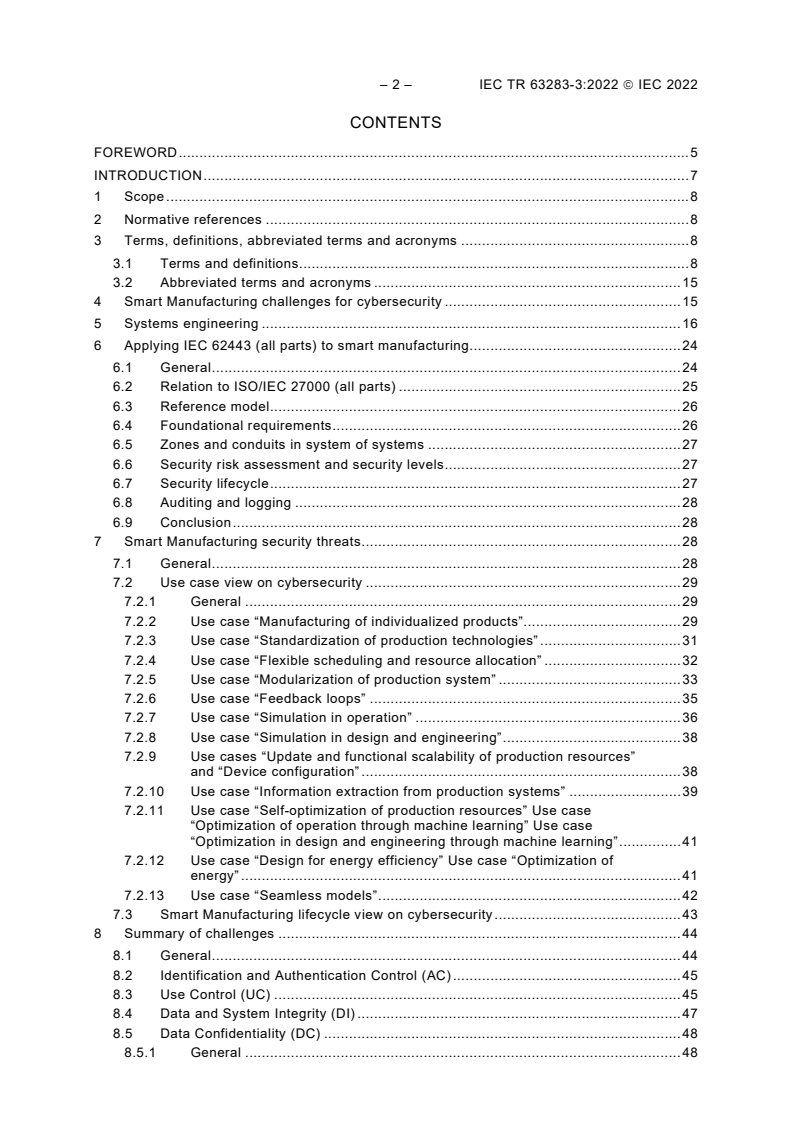
CONTENTS
FOREWORD . 5
INTRODUCTION . 7
1 Scope . 8
2 Normative references . 8
3 Terms, definitions, abbreviated terms and acronyms . 8
3.1 Terms and definitions . 8
3.2 Abbreviated terms and acronyms . 15
4 Smart Manufacturing challenges for cybersecurity . 15
5 Systems engineering . 16
6 Applying IEC 62443 (all parts) to smart manufacturing. 24
6.1 General . 24
6.2 Relation to ISO/IEC 27000 (all parts) . 25
6.3 Reference model . 26
6.4 Foundational requirements . 26
6.5 Zones and conduits in system of systems . 27
6.6 Security risk assessment and security levels . 27
6.7 Security lifecycle . 27
6.8 Auditing and logging . 28
6.9 Conclusion . 28
7 Smart Manufacturing security threats . 28
7.1 General . 28
7.2 Use case view on cybersecurity . 29
7.2.1 General . 29
7.2.2 Use case “Manufacturing of individualized products”. 29
7.2.3 Use case “Standardization of production technologies” . 31
7.2.4 Use case “Flexible scheduling and resource allocation” . 32
7.2.5 Use case “Modularization of production system” . 33
7.2.6 Use case “Feedback loops” . 35
7.2.7 Use case “Simulation in operation” . 36
7.2.8 Use case “Simulation in design and engineering” . 38
7.2.9 Use cases “Update and functional scalability of production resources”
and “Device configuration” . 38
7.2.10 Use case “Information extraction from production systems” . 39
7.2.11 Use case “Self-optimization of production resources” Use case
“Optimization of operation through machine learning” Use case
“Optimization in design and engineering through machine learning” . 41
7.2.12 Use case “Design for energy efficiency” Use case “Optimization of
energy” . 41
7.2.13 Use case “Seamless models” . 42
7.3 Smart Manufacturing lifecycle view on cybersecurity . 43
8 Summary of challenges . 44
8.1 General . 44
8.2 Identification and Authentication Control (AC) . 45
8.3 Use Control (UC) . 45
8.4 Data and System Integrity (DI) . 47
8.5 Data Confidentiality (DC) . 48
8.5.1 General . 48
8.5.2 Intended Use . 48
8.5.3 Data Confidentiality . 49
8.6 Restricted Data Flow (RDF) . 49
8.7 Timely Response to Events (TRE) . 49
8.8 Resource Availability (RA) . 50
Annex A (informative) Mapping use cases to foundational requirements . 51
Annex B (informative) Secure identities . 52
Bibliography . 53
Figure 1 – The IEC 62443 series . 24
Figure 2 – Details of the application of individual parts of IEC 62443 by different roles
during the individual life cycles of automation assets . 25
Figure 3 – Use case “Manufacturing of individualized products” . 29
Figure 4 – Use case “Standardization of production technologies” . 31
Figure 5 – Use case “Flexible scheduling and resource allocation”. 32
Figure 6 – Use case “Modularization of production system” . 33
Figure 7 – Use case “Feedback loops” . 36
Figure 8 – Use case “Simulation in operation” . 37
Figure 9 – Use case “Simulation in design and engineering” . 38
Figure 10 – Use case “Information extraction from production systems” . 40
Figure 11 – From Value Streams to Value Networks . 43
Figure 12 – Lifecycles, users/stakeholders, granted privileges, and views . 46
Figure 13 – Privacy and Intended Use . 48
Table 1 – ISO/IEC/IEEE 15288 System engineering process . 17
Table 2 – Use case “Manufacturing of individualized products” . 30
Table 3 – Use case “Standardization of production technologies”. 32
Table 4 – Use case “Flexible Scheduling and resource allocation” . 33
Table 5 – Use case “Modularization of production system” . 34
Table 6 – Use Case “Feedback loops” . 36
Table 7 – Use case “Simulation in operation” . 37
Table 8 – Use case “Simulation in design and engineering” . 38
Table 9 – Use case “Update and functional scalability of production resources”, Use
case “Device configuration”. 39
Table 10 – Use case “Information extraction from production systems” . 40
Table 11 – Use case “Machine learning” . 41
Table 12 – Use case “Design for energy efficiency”, Use case “Optimization of energy” . 42
Table 13 – Use case “Seamless models” . 43
Table 14 – Smart Manufacturing Lifecycle View on Cybersecurity . 44
Table 15 – Identification and Authentication Control (AC) challenges . 45
Table 16 – Use Control (UC) challenges . 46
Table 17 – Data and System Integrity (DI) challenges . 47
Table 18 – Data Confidentiality (DC) challenges regarding privacy . 48
Table 19 – Data Confidentiality (DC) requirements other than privacy . 49
– 4 – IEC TR 63283-3:2022 IEC 2022
Table 20 – Restricted Data Flow (RDF) challenges . 49
Table 21 – Timely Response to Events (TRE) challenges . 50
Table 22 – Resource Availability (RA) challenges . 50
Table A.1 – Mapping use cases to foundational requirements . 51
INTERNATIONAL ELECTROTECHNICAL COMMISSION
____________
INDUSTRIAL-PROCESS MEASUREMENT, CONTROL
AND AUTOMATION – SMART MANUFACTURING –
Part 3: Challenges for cybersecurity
FOREWORD
1) The International Electrotechnical Commission (IEC) is a worldwide organization for standardization comprising
all national electrotechnical committees (IEC National Committees). The object of IEC is to promote international
co-operation on all questions concerning standardization in the electrical and electronic fields. To this end and
in addition to other activities, IEC publishes International Standards, Technical Specifications, Technical Reports,
Publicly Available Specifications (PAS) and Guides (hereafter referred to as “IEC Publication(s)”). Their
preparation is entrusted to technical committees; any IEC National Committee interested in the subject dealt with
may participate in this preparatory work. International, governmental and non-governmental organizations liaising
with the IEC also participate in this preparation. IEC collaborates closely with the International Organization for
Standardization (ISO) in accordance with conditions determined by agreement between the two organizations.
2) The formal decisions or agreements of IEC on technical matters express, as nearly as possible, an international
consensus of opinion on the relevant subjects since each technical committee has representation from all
interested IEC National Committees.
3) IEC Publications have the form of recommendations for international use and are accepted by IEC National
Committees in that sense. While all reasonable efforts are made to ensure that the technical content of IEC
Publications is accurate, IEC cannot be held responsible for the way in which they are used or for any
misinterpretation by any end user.
4) In order to promote international uniformity, IEC National Committees undertake to apply IEC Publications
transparently to the maximum extent possible in their national and regional publications. Any divergence between
any IEC Publication and the corresponding national or regional publication shall be clearly indicated in the latter.
5) IEC itself does not provide any attestation of conformity. Independent certification bodies provide conformity
assessment services and, in some areas, access to IEC marks of conformity. IEC is not responsible for any
services carried out by independent certification bodies.
6) All users should ensure that they have the latest edition of this publication.
7) No liability shall attach to IEC or its directors, employees, servants or agents including individual experts and
members of its technical committees and IEC National Committees for any personal injury, property damage or
other damage of any nature whatsoever, whether direct or indirect, or for costs (including legal fees) and
expenses arising out of the publication, use of, or reliance upon, this IEC Publication or any other IEC
Publications.
8) Attention is drawn to the Normative references cited in this publication. Use of the referenced publications is
indispensable for the correct application of this publication.
9) Attention is drawn to the possibility that some of the elements of this IEC Publication may be the subject of patent
rights. IEC shall not be held responsible for identifying any or all such patent rights.
IEC TR 63283-3 has been prepared by Technical Committee 65: Industrial-process
measurement, control and automation. It is a Technical Report.
The text of this Technical Report is based on the following documents:
Draft Report on voting
65/865/DTR 65/906/RVDTR
Full information on the voting for its approval can be found in the report on voting indicated in
the above table.
The language used for the development of this Technical Report is English.
– 6 – IEC TR 63283-3:2022 IEC 2022
This document was drafted in accordance with ISO/IEC Directives, Part 2, and developed in
accordance with ISO/IEC Directives, Part 1 and ISO/IEC Directives, IEC Supplement, available
at www.iec.ch/members_experts/refdocs. The main document types developed by IEC are
described in greater detail at www.iec.ch/standardsdev/publications.
A list of all parts in the IEC 63283 series, published under the general title Industrial-process
measurement, control and automation – Smart Manufacturing, can be found on the IEC website.
The committee has decided that the contents of this document will remain unchanged until the
stability date indicated on the IEC website under webstore.iec.ch in the data related to the
specific document. At this date, the document will be
• reconfirmed,
• withdrawn,
• replaced by a revised edition, or
• amended.
IMPORTANT – The 'colour inside' logo on the cover page of this publication indicates
that it contains colours which are considered to be useful for the correct understanding
of its contents. Users should therefore print this document using a colour printer.
INTRODUCTION
Smart Manufacturing comes with many new challenges to cybersecurity. It starts from
architectural paradigm shifts combining many valuable assets (design, production planning,
engineering, supply chain management, etc.) currently enclosed into dedicated systems into
one system. Many stakeholders need to cooperate and exchange information. This is enabled
by the application of new information technologies such as industrial internet-of-things (IIoT),
edge technology, machine learning, wireless communications and new production technologies
as additive manufacturing, exposure of data belonging to contracting parties.
From the point of view of cybersecurity increasing digitalization, tight networking and
interconnectivity, usage of standard IT technologies, etc., increase the attack surface and could
enable new types of attack. This puts the protection goals integrity and availability of the
production system, as well as confidentiality of data involved in the production process at risk.
Examples are counterfeiting, loss of know-how or intellectual property, leaking of key
performance indicators.
This Technical Report contains smart manufacturing challenges for cybersecurity, i.e., it
identifies issues that need to be addressed/fulfilled by smart manufacturing systems in order to
ensure their security.
Cybersecurity is a concern for any kind of production method such as:
• discrete manufacturing;
• continuous production;
• batch production.
The tasks of the IEC 65 WG 23 taskforce cybersecurity are:
• review smart manufacturing use cases to find cybersecurity relevant scenarios and
requirements;
• if necessary, propose additional smart manufacturing use cases showing potential
cybersecurity issues;
• develop a list of smart manufacturing requirements that are necessary to provide
cybersecurity in smart manufacturing components, systems, design, integration, and
operation and maintenance;
• propose possibilities for smart manufacturing specific profiling in order to simplify
application of IEC 62443 (all parts).
This report is limited to cybersecurity related impacts of smart manufacturing. Other
requirements for smart manufacturing systems such as safety and reliability are left to be
addressed in future reports. However, cybersecurity needs to consider and address safety
issues triggered by security attacks.
The initial use case analysis constitutes a bottom-up approach intended to gain a better
understanding of the topic. The provided use cases are not necessarily exhaustive. A top-down
approach for a generic smart manufacturing model is aimed for in the future.
– 8 – IEC TR 63283-3:2022 IEC 2022
INDUSTRIAL-PROCESS MEASUREMENT, CONTROL
AND AUTOMATION – SMART MANUFACTURING –
Part 3: Challenges for cybersecurity
1 Scope
This part of IEC 63283 identifies challenges which apply to the engineering of a smart
manufacturing facility related to cybersecurity.
NOTE Cybersecurity challenges and how to deal with them can impose constraints on the engineering of the smart
manufacturing system.
2 Normative references
The following documents are referred to in the text in such a way that some or all of their content
constitutes requirements of this document. For dated references, only the edition cited applies.
For undated references, the latest edition of the referenced document (including any
amendments) applies.
IEC 62443 (all parts), Security for industrial automation and control systems
3 Terms, definitions, abbreviated terms and acronyms
3.1 Terms and definitions
For the purposes of this document, the following terms and definitions apply.
ISO and IEC maintain terminological databases for use in standardization at the following
addresses:
• IEC Electropedia: available at http://www.electropedia.org/
• ISO Online browsing platform: available at http://www.iso.org/obp
NOTE The definitions are fully aligned with IEC TR 63283-1 (65/683/DTR).
3.1.1
access
ability and means to communicate with or otherwise interact with a system in order to use
system resources
Note 1 to entry: Access may involve physical access (authorization to be allowed physically in an area, possession
of a physical key lock, PIN code, or access card or biometric attributes that allow access) or logical access
(authorization to log in to a system and application, through a combination of logical and physical means).
[SOURCE: IEC TS 62443-1-1:2009, 3.2.1]
___________
Under preparation. Stage at the time of publication: IEC/DECPUB 63283-1:2022.
3.1.2
access control
protection of system resources against unauthorized access; a process by which use of system
resources is regulated according to a security policy and is permitted by only authorized entities
(users, programs, processes, or other systems) according to that policy
[SOURCE: IEC TS 62443-1-1:2009, 3.2.2]
3.1.3
administrator
user role whose responsibilities include controlling access to and implementing security policies
for a system
3.1.4
asset
entity owned by or under the custodial duties of an organization, which has either a perceived
or actual value to the organization
3.1.5
attack
assault on a system that derives from an intelligent threat – i.e., an intelligent act that is a
deliberate attempt (especially in the sense of a method or technique) to evade security services
and violate the security policy of a system
Note 1 to entry: There are different commonly recognized classes of attack:
a) An "active attack" attempts to alter system resources or affect their operation.
b) A "passive attack" attempts to learn or make use of information from the system but does not affect system
resources.
c) An "inside attack" is an attack initiated by an entity inside the security perimeter (an "insider") – i.e., an entity
that is authorized to access system resources but uses them in a way not approved by those who granted the
authorization.
d) An "outside attack" is initiated from outside the perimeter, by an unauthorized or illegitimate user of the system
(including an insider attacking from outside the security perimeter). Potential outside attackers range from
amateur pranksters to organized criminals, international terrorists, and hostile governments.
[SOURCE: IEC TS 62443-1-1:2009, 3.2.9]
3.1.6
attribute
property or characteristic of an entity
[SOURCE: IEC TR 62390:2005, 3.1.3]
3.1.7
audit log
traceable record that requires a higher level of integrity protection than provided by typical event
logs
Note 1 to entry: Audit logs are used to protect against claims that repudiate responsibility for an action.
3.1.8
authenticate
verify the identity of a user, user device, or other entity, or the integrity of data stored,
transmitted, or otherwise exposed to unauthorized modification in an information system, or to
establish the validity of a transmission
[SOURCE: IEC TS 62443-1-1:2009, 3.2.12]
– 10 – IEC TR 63283-3:2022 IEC 2022
3.1.9
authentication
security measure designed to establish the validity of a transmission, message, or originator,
or a means of verifying an individual's authorization to receive specific categories of information
[SOURCE: IEC TS 62443-1-1:2009, 3.2.13]
3.1.10
authorization
right or permission that is granted to a system entity to access a system resource
[SOURCE: IEC TS 62443-1-1:2009, 3.2.14]
3.1.11
availability
ability of an item to be in a state to perform a required function under given conditions at a given
instant or over a given time interval, assuming that the required external resources are provided
Note 1 to entry: This ability depends on the combined aspects of the reliability performance, the maintainability
performance and the maintenance support performance.
Note 2 to entry: Required external resources, other than maintenance resources do not affect the availability
performance of the item.
[SOURCE: IEC TS 62443-1-1:2009, 3.2.16, modified – (performance) removed after the term.]
3.1.12
batch production
production process where products or components are produced in batches and where each
separate batch consists of a number of the same products or components
[SOURCE: EN 14943:2005]
3.1.13
conduit
logical grouping of communication assets that protects the security of the channels it contains
Note 1 to entry: This is analogous to the way that a physical conduit protects cables from physical damage.
[SOURCE: IEC TS 62443-1-1:2009, 3.2.27]
3.1.14
confidentiality
assurance that information is not disclosed to unauthorized individuals, processes, or devices
[SOURCE: IEC TS 62443-1-1:2009, 3.2.28]
3.1.15
continuous production
production that is running at a steady rate
[SOURCE: ISO 2859-3:2005, 3.1.1, modified – The word "running" has been added and the
Note has been deleted.]
3.1.16
cybersecurity
actions required to preclude unauthorized use of, denial of service to, modifications to,
disclosure of, loss of revenue from, or destruction of critical systems or informational assets
Note 1 to entry: The objective is to reduce the risk of causing personal injury or endangering public health, losing
public or consumer confidence, disclosing sensitive assets, failing to protect business assets or failing to comply
with regulations. These concepts are applied to any system in the production process and include both stand-alone
and networked components. Communications between systems may be either through internal messaging or by any
human or machine interfaces that authenticate, operate, control, or exchange data with any of these control systems.
Cybersecurity includes the concepts of identification, authentication, accountability, authorization, availability, and
privacy.
[SOURCE: IEC TS 62443-1-1:2009, 3.2.36]
3.1.17
data confidentiality
property that information is not made available or disclosed to any unauthorized system entity,
including unauthorized individuals, entities, or processes
[SOURCE: IEC TS 62443-1-1:2009, 3.2.37]
3.1.18
data integrity
property that data has not been changed, destroyed, or lost in an unauthorized or accidental
manner
Note 1 to entry: This term deals with constancy of and confidence in data values, not with the information that the
values represent or the trustworthiness of the source of the values.
[SOURCE: IEC TS 62443-1-1:2009, 3.2.38]
3.1.19
denial of service
prevention or interruption of authorized access to a system resource or the delaying of system
operations and functions
Note 1 to entry: In the context of industrial automation and control systems, denial of service can refer to loss of
process function, not just loss of data communications.
[SOURCE: IEC TS 62443-1-1:2009, 3.2.42]
3.1.20
device
independent physical entity capable of performing one or more specified functions in a particular
context and delimited by its interfaces
[SOURCE: IEC 61804-2:2018, 3.1.18]
3.1.21
digital signature
result of a cryptographic transformation of data which, when properly implemented, provides
the services of origin authentication, data integrity, and signer non-repudiation
[SOURCE: IEC TS 62443-1-1:2009, 3.2.43]
3.1.22
discrete manufacturing
method of manufacturing where products are manufactured in a non-continuous manner, e.g.
automobiles, appliances, computers
[SOURCE: EN 14943:2005]
– 12 – IEC TR 63283-3:2022 IEC 2022
3.1.23
entity
thing (physical or non-physical) having a distinct existence
[SOURCE: ISO/IEC 20924:2021, 3.1.18]
3.1.24
functional requirement
specification of a behaviour that a solution or part of a solution shall perform
3.1.25
host
computer that is attached to a communication sub-network or inter-network and can use
services provided by the network to exchange data with other attached systems
[SOURCE: IEC TS 62443-1-1:2009, 3.2.56]
3.1.26
Identifier
ID
information that unambiguously distinguishes one entity from other entities in a given identity
context
[SOURCE: IEC 60050-741: 2020, 741-01-21]
3.1.27
impact
evaluated consequence of a particular event
Note 1 to entry: Impact may be expressed in terms of numbers of injuries and/or fatalities, extent of environmental
damage and/or magnitude of losses such as property damage, material loss, loss of intellectual property, lost
production, market share loss, and recovery costs.
3.1.28
incident
event that is not part of the expected operation of a system or service that causes, or may
cause, an interruption to, or a reduction in, the quality of the service provided by the control
system
3.1.29
industrial automation and control systems
IACS
collection of personnel, hardware, and software that can affect or influence the safe, secure,
and reliable operation of an industrial process
Note 1 to entry: These systems include, but are not limited to:
– industrial control systems, including distributed control systems (DCSs), programmable logic controllers (PLCs),
remote terminal units (RTUs), intelligent electronic devices, supervisory control and data acquisition (SCADA),
networked electronic sensing and control, and monitoring and diagnostic systems. (In this context, process control
systems include basic process control system and safety-instrumented system (SIS) functions, whether they are
physically separate or integrated.)
– associated information systems such as advanced or multivariable control, online optimizers, dedicated
equipment monitors, graphical interfaces, process historians, manufacturing execution systems, and plant
information management systems.
– associated internal, human, network, or machine interfaces used to provide control, safety, and manufacturing
operations functionality to continuous, batch, discrete, and other processes.
[SOURCE: IEC TS 62443-1-1:2009, 3.2.57]
3.1.30
manufacturing
all life cycle activities and procedures involved in the design, production, and support of
manufacturing systems and of manufactured products
3.1.31
nonrepudiation
security service that provides protection against false denial of involvement in a communication
[SOURCE: IEC TS 62443-1-1:2009, 3.2.72]
3.1.32
privilege
authorization or set of authorizations to perform specific functions, especially in the context of
a computer operating system
EXAMPLE Functions that are controlled through the use of privilege include acknowledging alarms, changing
setpoints, modifying control algorithms.
[SOURCE: IEC TS 62443-1-1:2009, 3.2.78]
3.1.33
process
set of activities performed with a set of resources to realize an objective within a specified
timeline
[SOURCE: ISO 22400-1:2014, 2.1.8]
3.1.34
product
result of labour or of a natural or industrial process
[SOURCE: IEC 61360-1:2017, 3.1.23]
3.1.35
public key certificate
set of data that uniquely identifies an entity, contains the entity’s public key, and is digitally
signed by a trusted party, thereby binding the public key to the entity
3.1.36
resilience
ability of an IACS organization, process entity or system, to resist being affected by disruptions
3.1.37
risk
combination of the probability of occurrence of harm and the severity of that harm
3.1.38
risk assessment
process that systematically identifies potential vulnerabilities to valuable system resources and
threats to those resources, quantifies loss exposures and consequences based on probability
of occurrence, and (optionally) recommends how to allocate resources to countermeasures to
minimize total exposure
Note 1 to entry: Types of resources include physical, logical and human.
Note 2 to entry: Risk assessments are often combined with vulnerability assessments to identify vulnerabilities and
quantify the associated risk. They are carried out initially and periodically to reflect changes in the organization's risk
tolerance, vulnerabilities, procedures, personnel and technological changes.
– 14 – IEC TR 63283-3:2022 IEC 2022
[SOURCE: IEC TS 62443-1-1:2009, 3.2.88]
3.1.39
security
a) measures taken to protect a system
b) condition of a system that results from the establishment and maintenance of measures to
protect the system
c) condition of system resources being free from unauthorized access and from unauthorized
or accidental change, destruction, or loss
d) capability of a computer-based system to provide adequate confidence that unauthorized
persons and systems can neither modify the software and its data nor gain access to the
system functions, and yet to ensure that this is not denied to authorized persons and
systems
e) prevention of illegal or unwanted penetration of, or interference with the proper and
intended operation of an industrial automation and control system
Note 1 to entry: Measures can be controls related to physical security (controlling physical access to computing
assets) or logical security (capability to login to a given system and application).
[SOURCE: IEC TS 62443-1-1:2009, 3.2.99]
3.1.40
smart
capable of some independent action
3.1.41
system
set of interrelated elements considered in a defined context as a whole and separated from its
environment
Note 1 to entry: Such elements may be both material objects and concepts as well as the results thereof (e.g. forms
of organization, mathematical methods, and programming languages).
Note 2 to entry: The system is considered to be separated from the environment and other external systems by an
imaginary surface, which can cut the links between them and the considered system.
[SOURCE: IEC 61804-2:2018, 3.1.65]
3.1.42
system of systems
set or arrangement of systems that results when independent systems are integrated into a
larger system
3.1.43
threat
potential for violation of security, which exists when there is a circumstance, capability, action,
or event that could breach security and cause harm
[SOURCE: IEC TS 62443-1-1:2009, 3.2.125]
3.1.44
use case
specification of a set of actions performed by a system, which yields an observable result that
is, typically, of value for one or more actors or other stakeholders of the system
[SOURCE: ISO/IEC 19505-2:2012, 16.3.6]
3.1.45
zone
grouping of logical or physical assets based upon risk or other criteria, such as criticality of
assets, operational function, physical or logical location, required access (for example, least
privilege principles) or responsible organization
Note 1 to entry: All unqualified uses of the term “zone” in this document should be assumed to refer to a security
zone.
[SOURCE: IEC 62443-3-2:2020, 3.1.25, modified – Note 1 to entry is different.]
3.2 Abbreviated terms and acronyms
AC Identification and Authentication Control (Defined as a security functional
requirement in IEC TS 62443-1-1)
ACS Automation and Control System
CAD Computer Aided Design
CAPP Computer Aided Production Planning
DC Data Confidentiality (Defined as a security functional requirement in
IEC TS 62443-1-1)
FMEA Failure Mode and Effects Analysis
FR Foundational Requirement
IACS Industrial Automation and Control System
IIoT Industrial Internet-of-Things
IDS/IPS Intrusion Detection System/Intrusion Prevention System
IP Intellectual Property
ISMS Information Security Management System
KPI Key Performance Indicator
RA Resource Availability (Defined as a security functional requirement in
IEC TS 62443-1-1)
RDF Restricted Data Flow (Defined as a security functional requirement in
IEC TS 62443-1-1)
SI System Integrity (Defined as a security functional requirement in
IEC TS 62443-1-1)
SM Smart Manufacturing
TRE Timely Response to Events (Defined as a security functional requirement in
IEC TS 62443-1-1)
UC Use Control (Defined as a security functional requirement in IEC TS 62443-1-1)
4 Smart Manufacturing challenges for cybersecurity
Smart Manufacturing bears some new challenges with regard to automation control system
(ACS) security. Compared to classic manufacturing systems the following characteristics of
smart manufacturing systems have an impact on cybersecurity:
• Multiple stakeholders: The ACS is no longer under the control of a single stakeholder.
Instead multiple stakeholders need to interact, e.g., product owner, owner of production
equipment, production process owner, data analytics service providers. The security
mechanisms used need to be able to support multiple stakeholders and to balance and
protect their potentially opposing interests.
– 16 – IEC TR 63283-3:2022 IEC 2022
• Continuous change: A smart manufacturing system is subject to continuous change and
reconfiguration, e.g., functional enhancements, changes of production equipment, change
of the product being produced, process optimization. The boundaries between different
lifecycle phases become blurred (especially product design, engineering, operation). The
security of the system needs to accommodate these changes, including while in transition,
and adjust accordingly.
• Intensive use of digital data (digitalization): Smart Manufacturing systems produce and
process a vast amount of control and other digital data. Product and process design data
(e.g., Computer Aided Design (CAD), Computer Aided Production Planning (CAPP)), sensor
data, engineering data, equipment self-descriptive data, simulation model data, which have
formerly been kept on distinct systems are now an intrinsic part of the manufacturing system.
This increases data exposure and makes it more susceptible to attack. Potential attackers
either draw direct benefits from that data (e.g., product or process/algorithmic intellectual
property (IP)), gain competitive advantages (key performance indicator (KPI) data), or use
captured data to develop more sophisticated attacks (e.g., by working with simulation
models, that themselves need to have restricted access).
• Architecture: The classic automation pyramid dissolves and it is transformed into a
structured automation network relying on service-oriented paradigms. New architectural
concepts arise from, e.g., IEC PAS 63088:2017 [3] (RAMI 4.0), ISO/IEC 30141:2018, IoT –
Reference architecture [13], ISO/IEC 30166:2020, IoT – Industrial IoT [14]. This requires
adjustments in the corresponding security architecture.
• Application of new communication technologies in manufacturing: The adaption of
wireless networking such as Wi-Fi and 3GPP technologies (LTE, 5G) for smart
manufacturing allows increased flexibility (e.g., easy relocation of production equipment).
However, wireless networks need to provide well-defined performance. With new
communication infrastructure paradigms, such as software defined networking (SDN) and
5G, enabling easy remote communications and in some cases communication across the
IEC PAS 63088 [3] levels according to IEC 62264 (all parts) or IEC 61512 (all parts) [16].
For example, Field device sensors (level 1) are potentially allowed to directly communicate
to the enterprise/connected world (level 4) bypassing traditional pyramid layers.
This report is mainly based on the evaluation of a subset of smart manufacturing use cases.
Further work is required but not limited to, e.g., extending the evaluation on a larger set of use
cases. Also, this work needs to be aligned with other work taking place in the rapid developing
field of smart manufacturing cybersecurity.
5 Systems engineering
Smart Manufacturing facilities are complex integrated systems of systems. They are engineered
by deploying the processes, activities and tasks defined in ISO/IEC/IEEE 15288:2015 [7]. Some
System Engineering processes need a specific consideration from the cybersecurity point of
view. This happens when activities of these processes will use cybersecurity related inputs or
produce cybersecurity related outputs. Table 1 below identifies processes and activities
concerned. It proposes specific aspects that have to be taken into consideration as far as
cybersecurity is concerned.
Table 1 – ISO/IEC/IEEE 15288 System engineering process
Processes Purpose Security aspects of Security activities
ISO/IEC/IEEE engineering outcomes considerations
15288:2015
Technical management processes
Project The purpose of the Project Security objectives and plans
planning Planning process is to are defined;
produce and coordinate
Roles, responsibilities,
effective and workable
accountabilities, authorities for
plans.
security aspects are defined;
This process determines the
Resources and services
scope of the project
necessary to achieve the
management and technical
security objectives are
activities, identifies process
formally requested and
outputs, tasks and
committed.
deli
...