

IEC 62471-6:2022
(Main)Photobiological safety of lamps and lamp systems - Part 6: Ultraviolet lamp products
General Information
- Abstract
IEC 62471-6:2022 IEC 62471:2006/CIE S009:2002. IEC 62471 covers light emitting diodes (LEDs), incandescent, low- and high- pressure gas-discharge, arc and other lamps. It also covers lamps which are designed primarily to emit ultraviolet radiant energy, such as ultraviolet sources intended to excite fluorescence of irradiated materials, for insect light traps, for scientific studies, mineral identification, for non-destructive testing, germicidal irradiation, and other purposes.
This part of IEC 62471 provides the optical radiation safety requirements for ultraviolet lamp products, including UV LED lamp products.
This document provides requirements for:
optical radiation safety assessment and ultraviolet-product risk groups;
user information for safety measures;
appropriate labelling of ultraviolet lamp products.
This document addresses those lamps and lamp products where the ultraviolet emission serves the primary purpose of the product and where more than half of the radiant power emitted between 180 nm and 3 000 nm is in the spectral region 180 nm to 400 nm. If more than half of the optical radiation emitted between 180 nm and 3 000 nm is outside of the spectral region 180 nm to 400 nm, then the base standard IEC 62471 should be used. This document covers medical diagnostic and cosmetic devices/products that emit primarily UV radiation.
- Status
- Published
- Publication Date
- 10-Oct-2022
- Technical Committee
- TC 76 - Optical radiation safety and laser equipment
- Drafting Committee
- WG 9 - TC 76/WG 9
- Current Stage
- PPUB - Publication issued
- Start Date
- 11-Oct-2022
- Completion Date
- 04-Nov-2022
IEC 62471-6:2022 Overview
IEC 62471-6:2022, titled Photobiological Safety of Lamps and Lamp Systems - Part 6: Ultraviolet Lamp Products, is an international standard published by the International Electrotechnical Commission (IEC). This standard specifically addresses the optical radiation safety requirements for ultraviolet (UV) lamp products, including UV LED lamp products. It forms part of the broader IEC 62471 series, which covers photobiological safety considerations for various types of lamps such as LEDs, incandescent, gas-discharge, and arc lamps.
The scope of IEC 62471-6 includes lamps and lamp systems where UV emissions serve as the primary function, notably when over 50% of the radiant power between 180 nm and 3000 nm lies within the 180 nm to 400 nm spectral range. Common applications are diagnostic medical devices, cosmetic UV products, germicidal irradiation sources, insect light traps, scientific research instruments, and mineral identification tools.
Key Topics
IEC 62471-6:2022 provides comprehensive guidelines on:
- UV Product Risk Groups: Establishes risk group classifications (RG-0 to RG-3) for ultraviolet lamp products based on the intensity and spectral distribution of UV emissions. These risk groups guide the level of user risk and necessary safety controls.
- Optical Radiation Safety Assessment: Defines measurement procedures and assessment distances for determining compliance with safety criteria. The standard highlights the importance of time-weighted average irradiance and spectral weighting functions to evaluate photobiological hazards.
- Engineering Controls: Details mandatory protective measures for higher risk UV systems (RG-2 and RG-3), including enclosure requirements, proximity sensors, orientation control, delayed-on timers, and automatic shutoff features.
- Warning and Labelling Requirements: Specifies mandatory labelling and product information to inform users about UV exposure risks, safe operation, maintenance, and required protective measures. Tailored labels are mandated per risk group classification.
- User Information: The standard mandates clear communication of safety precautions, limitations on usage, risk reduction strategies, and maintenance instructions in product manuals.
Practical Applications
IEC 62471-6 is essential for manufacturers, testing laboratories, and safety regulators involved with UV lamp products used across various sectors:
- Healthcare and Medical Diagnostics: Ensures safety for UV-emitting medical devices such as phototherapy lamps and dental curing lights.
- Germicidal and Disinfection Systems: Provides safety requirements for UV-C lamps used in water treatment, air purification, and surface sterilization, critical for controlling infections.
- Industrial and Scientific Instruments: Guides UV lamps used in fluorescence excitation, mineral identification, and non-destructive testing - applications that require controlled UV exposure to protect operators.
- Consumer Products: Covers UV nail curing lamps and insect light traps, helping ensure user safety through proper design and warnings.
- Public Health UV Installations: Applies to upper-room germicidal UV luminaires that reduce airborne pathogens while safeguarding occupants.
Related Standards
IEC 62471-6:2022 is part of the IEC 62471 series on photobiological safety of lamps and lamp systems. It complements and builds upon:
- IEC 62471:2006 (Base Standard) - General framework for photobiological safety classification of all lamp types, applicable when the majority of emitted optical radiation is outside the UV spectral range.
- CIE S009:2002 - A joint CIE and IEC guideline for photobiological safety concerning ultraviolet sources.
- Industry-specific standards on UV measurement techniques and occupational safety regulations related to UV exposure.
Why IEC 62471-6:2022 Matters
Ensuring photobiological safety in UV lamp products is vital due to the potential adverse effects of ultraviolet radiation on skin and eyes, including erythema, photokeratitis, cataracts, and long-term cancer risks. This standard provides a structured approach to evaluating and mitigating these risks, promoting safer product design, informed usage, and regulatory compliance worldwide.
Keywords
Photobiological safety, ultraviolet lamp products, UV LED safety, UV lamp risk groups, IEC 62471, germicidal UV, UV medical devices, UV emissions labelling, optical radiation safety, UV product standards, UV exposure limits, photobiological risk assessment
Get Certified
Connect with accredited certification bodies for this standard

IMQ S.p.A. (Certification)
Italian electrical product certification.

SLG Prüf- und Zertifizierungs GmbH
German testing and certification body.

UL Solutions
Global safety science company with testing, inspection and certification.
Sponsored listings
Frequently Asked Questions
IEC 62471-6:2022 is a standard published by the International Electrotechnical Commission (IEC). Its full title is "Photobiological safety of lamps and lamp systems - Part 6: Ultraviolet lamp products". This standard covers: IEC 62471-6:2022 IEC 62471:2006/CIE S009:2002. IEC 62471 covers light emitting diodes (LEDs), incandescent, low- and high- pressure gas-discharge, arc and other lamps. It also covers lamps which are designed primarily to emit ultraviolet radiant energy, such as ultraviolet sources intended to excite fluorescence of irradiated materials, for insect light traps, for scientific studies, mineral identification, for non-destructive testing, germicidal irradiation, and other purposes. This part of IEC 62471 provides the optical radiation safety requirements for ultraviolet lamp products, including UV LED lamp products. This document provides requirements for: optical radiation safety assessment and ultraviolet-product risk groups; user information for safety measures; appropriate labelling of ultraviolet lamp products. This document addresses those lamps and lamp products where the ultraviolet emission serves the primary purpose of the product and where more than half of the radiant power emitted between 180 nm and 3 000 nm is in the spectral region 180 nm to 400 nm. If more than half of the optical radiation emitted between 180 nm and 3 000 nm is outside of the spectral region 180 nm to 400 nm, then the base standard IEC 62471 should be used. This document covers medical diagnostic and cosmetic devices/products that emit primarily UV radiation.
IEC 62471-6:2022 IEC 62471:2006/CIE S009:2002. IEC 62471 covers light emitting diodes (LEDs), incandescent, low- and high- pressure gas-discharge, arc and other lamps. It also covers lamps which are designed primarily to emit ultraviolet radiant energy, such as ultraviolet sources intended to excite fluorescence of irradiated materials, for insect light traps, for scientific studies, mineral identification, for non-destructive testing, germicidal irradiation, and other purposes. This part of IEC 62471 provides the optical radiation safety requirements for ultraviolet lamp products, including UV LED lamp products. This document provides requirements for: optical radiation safety assessment and ultraviolet-product risk groups; user information for safety measures; appropriate labelling of ultraviolet lamp products. This document addresses those lamps and lamp products where the ultraviolet emission serves the primary purpose of the product and where more than half of the radiant power emitted between 180 nm and 3 000 nm is in the spectral region 180 nm to 400 nm. If more than half of the optical radiation emitted between 180 nm and 3 000 nm is outside of the spectral region 180 nm to 400 nm, then the base standard IEC 62471 should be used. This document covers medical diagnostic and cosmetic devices/products that emit primarily UV radiation.
IEC 62471-6:2022 is classified under the following ICS (International Classification for Standards) categories: 29.140.01 - Lamps in general; 31.260 - Optoelectronics. Laser equipment. The ICS classification helps identify the subject area and facilitates finding related standards.
IEC 62471-6:2022 is available in PDF format for immediate download after purchase. The document can be added to your cart and obtained through the secure checkout process. Digital delivery ensures instant access to the complete standard document.
Standards Content (Sample)
IEC 62471-6 ®
Edition 1.0 2022-10
INTERNATIONAL
STANDARD
NORME
INTERNATIONALE
colour
inside
Photobiological safety of lamps and lamp systems –
Part 6: Ultraviolet lamp products
Sécurité photobiologique des lampes et des appareils utilisant des lampes –
Partie 6: Appareils à lampes ultraviolettes
All rights reserved. Unless otherwise specified, no part of this publication may be reproduced or utilized in any form
or by any means, electronic or mechanical, including photocopying and microfilm, without permission in writing from
either IEC or IEC's member National Committee in the country of the requester. If you have any questions about IEC
copyright or have an enquiry about obtaining additional rights to this publication, please contact the address below or
your local IEC member National Committee for further information.
Droits de reproduction réservés. Sauf indication contraire, aucune partie de cette publication ne peut être reproduite ni
utilisée sous quelque forme que ce soit et par aucun procédé, électronique ou mécanique, y compris la photocopie et
les microfilms, sans l'accord écrit de l'IEC ou du Comité national de l'IEC du pays du demandeur. Si vous avez des
questions sur le copyright de l'IEC ou si vous désirez obtenir des droits supplémentaires sur cette publication, utilisez
les coordonnées ci-après ou contactez le Comité national de l'IEC de votre pays de résidence.
IEC Secretariat Tel.: +41 22 919 02 11
3, rue de Varembé info@iec.ch
CH-1211 Geneva 20 www.iec.ch
Switzerland
About the IEC
The International Electrotechnical Commission (IEC) is the leading global organization that prepares and publishes
International Standards for all electrical, electronic and related technologies.
About IEC publications
The technical content of IEC publications is kept under constant review by the IEC. Please make sure that you have the
latest edition, a corrigendum or an amendment might have been published.
IEC publications search - webstore.iec.ch/advsearchform IEC Products & Services Portal - products.iec.ch
The advanced search enables to find IEC publications by a Discover our powerful search engine and read freely all the
variety of criteria (reference number, text, technical publications previews. With a subscription you will always have
committee, …). It also gives information on projects, replaced access to up to date content tailored to your needs.
and withdrawn publications.
Electropedia - www.electropedia.org
IEC Just Published - webstore.iec.ch/justpublished
The world's leading online dictionary on electrotechnology,
Stay up to date on all new IEC publications. Just Published
containing more than 22 300 terminological entries in English
details all new publications released. Available online and once
and French, with equivalent terms in 19 additional languages.
a month by email.
Also known as the International Electrotechnical Vocabulary
(IEV) online.
IEC Customer Service Centre - webstore.iec.ch/csc
If you wish to give us your feedback on this publication or need
further assistance, please contact the Customer Service
Centre: sales@iec.ch.
A propos de l'IEC
La Commission Electrotechnique Internationale (IEC) est la première organisation mondiale qui élabore et publie des
Normes internationales pour tout ce qui a trait à l'électricité, à l'électronique et aux technologies apparentées.
A propos des publications IEC
Le contenu technique des publications IEC est constamment revu. Veuillez vous assurer que vous possédez l’édition la
plus récente, un corrigendum ou amendement peut avoir été publié.
Recherche de publications IEC - Découvrez notre puissant moteur de recherche et consultez
webstore.iec.ch/advsearchform gratuitement tous les aperçus des publications. Avec un
La recherche avancée permet de trouver des publications IEC abonnement, vous aurez toujours accès à un contenu à jour
en utilisant différents critères (numéro de référence, texte, adapté à vos besoins.
comité d’études, …). Elle donne aussi des informations sur les
projets et les publications remplacées ou retirées. Electropedia - www.electropedia.org
Le premier dictionnaire d'électrotechnologie en ligne au monde,
IEC Just Published - webstore.iec.ch/justpublished
avec plus de 22 300 articles terminologiques en anglais et en
Restez informé sur les nouvelles publications IEC. Just
français, ainsi que les termes équivalents dans 19 langues
Published détaille les nouvelles publications parues.
additionnelles. Egalement appelé Vocabulaire
Disponible en ligne et une fois par mois par email.
Electrotechnique International (IEV) en ligne.
Service Clients - webstore.iec.ch/csc
Si vous désirez nous donner des commentaires sur cette
publication ou si vous avez des questions contactez-nous:
sales@iec.ch.
IEC Products & Services Portal - products.iec.ch
IEC 62471-6 ®
Edition 1.0 2022-10
INTERNATIONAL
STANDARD
NORME
INTERNATIONALE
colour
inside
Photobiological safety of lamps and lamp systems –
Part 6: Ultraviolet lamp products
Sécurité photobiologique des lampes et des appareils utilisant des lampes –
Partie 6: Appareils à lampes ultraviolettes
INTERNATIONAL
ELECTROTECHNICAL
COMMISSION
COMMISSION
ELECTROTECHNIQUE
INTERNATIONALE
ICS 29.140.01; 31.260 ISBN 978-2-8322-5828-6
– 2 – IEC 62471-6:2022 © IEC 2022
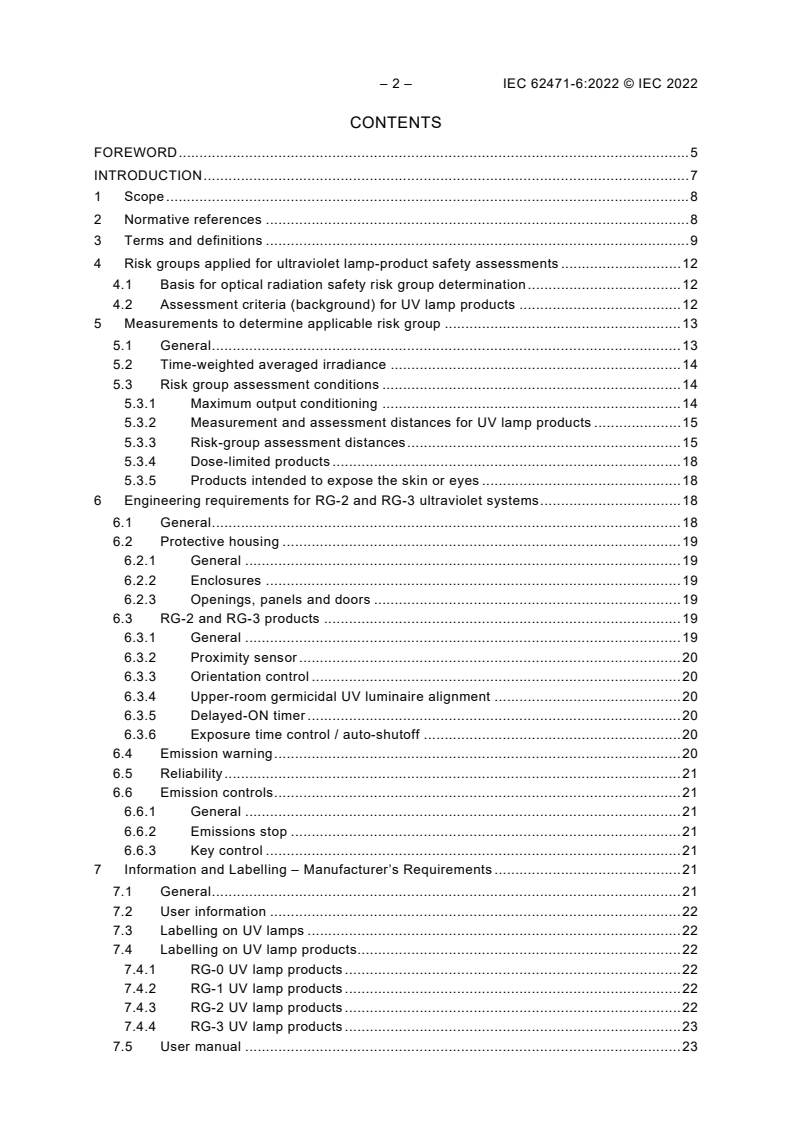
CONTENTS
FOREWORD . 5
INTRODUCTION . 7
1 Scope . 8
2 Normative references . 8
3 Terms and definitions . 9
4 Risk groups applied for ultraviolet lamp-product safety assessments . 12
4.1 Basis for optical radiation safety risk group determination . 12
4.2 Assessment criteria (background) for UV lamp products . 12
5 Measurements to determine applicable risk group . 13
5.1 General . 13
5.2 Time-weighted averaged irradiance . 14
5.3 Risk group assessment conditions . 14
5.3.1 Maximum output conditioning . 14
5.3.2 Measurement and assessment distances for UV lamp products . 15
5.3.3 Risk-group assessment distances . 15
5.3.4 Dose-limited products . 18
5.3.5 Products intended to expose the skin or eyes . 18
6 Engineering requirements for RG-2 and RG-3 ultraviolet systems . 18
6.1 General . 18
6.2 Protective housing . 19
6.2.1 General . 19
6.2.2 Enclosures . 19
6.2.3 Openings, panels and doors . 19
6.3 RG-2 and RG-3 products . 19
6.3.1 General . 19
6.3.2 Proximity sensor . 20
6.3.3 Orientation control . 20
6.3.4 Upper-room germicidal UV luminaire alignment . 20
6.3.5 Delayed-ON timer . 20
6.3.6 Exposure time control / auto-shutoff . 20
6.4 Emission warning . 20
6.5 Reliability . 21
6.6 Emission controls . 21
6.6.1 General . 21
6.6.2 Emissions stop . 21
6.6.3 Key control . 21
7 Information and Labelling – Manufacturer’s Requirements . 21
7.1 General . 21
7.2 User information . 22
7.3 Labelling on UV lamps . 22
7.4 Labelling on UV lamp products. 22
7.4.1 RG-0 UV lamp products . 22
7.4.2 RG-1 UV lamp products . 22
7.4.3 RG-2 UV lamp products . 22
7.4.4 RG-3 UV lamp products . 23
7.5 User manual . 23
7.5.1 General . 23
7.5.2 Risk reduction measures . 23
7.5.3 Limited use . 24
7.6 Maintenance and service . 24
Annex A (informative) Typical applications of UV lamp products . 25
A.1 Background. 25
A.2 Applications of UV lamp products . 25
A.2.1 Near-UV (UV-A) “black-light” sources to view fluorescent pigments . 25
A.2.2 Near-UV (UV-A) insect attractant lamp products . 25
A.2.3 UV germicidal (UV-C) lamp products . 26
A.2.4 UV nail curing and treatment . 26
A.2.5 UV medical and dental sources . 27
Annex B (informative) Potentially hazardous biological effects . 28
B.1 Background. 28
B.2 Adverse acute biological effects from ultraviolet irradiation . 28
B.2.1 Photokeratitis and photoconjunctivitis . 28
B.2.2 UV-Cornea reference documents . 29
B.2.3 Erythema (sunburn) . 29
B.2.4 Erythema reference documents . 29
B.3 Adverse biological effects from chronic exposure to ultraviolet irradiation . 30
B.3.1 Skin cancer . 30
B.3.2 Skin cancer reference documents . 31
B.3.3 Pterygium and pinguecula . 31
B.3.4 Pterygium and pinguecula reference documents . 31
B.3.5 Cataract . 32
B.3.6 Cataract reference documents . 32
B.3.7 Labrador keratopathy . 32
B.3.8 Corneal reference documents . 32
B.3.9 Visual effects from UV-A exposure – Lens fluorescence . 33
B.3.10 Photoretinitis – or photic maculopathy (blue light hazard) . 33
B.3.11 Retinal-photochemical biological effects reference documents . 34
Annex C (informative) Measurement of ultraviolet lamp products . 35
C.1 General . 35
C.2 Radiometers . 35
C.3 Spectroradiometers . 35
C.4 Entrance optic . 36
C.5 Spectroradiometer- radiometer approach . 37
C.6 Measurement distance versus assessment distance . 37
C.6.1 General . 37
C.6.2 Spectroradiometer approach . 37
C.6.3 Radiometer approach . 38
C.7 Reference documents . 38
Annex D (informative) Spectral weighting function S(λ) from 180 nm to 400 nm for
assessing actinic radiation hazard . 39
Annex E (informative) Examples of risk group classification applying the concept of
TWA of a spectrally-weighted emission . 42
E.1 Spectral weighting to determine effective irradiance using S(λ) . 42
E.2 Time weighting of an exposure . 42
– 4 – IEC 62471-6:2022 © IEC 2022
E.3 Field radiometric measurements for final acceptance testing of a GUV
installation . 45
Annex F (informative) Upper room GUV – Background and rationale to achieve safety . 46
F.1 General . 46
F.2 Product Goals . 46
F.3 Product test measurement conditions. 46
F.3.1 General . 46
F.3.2 Elevation plane for radiometric measurements . 47
F.3.3 Test grid for measurements . 47
F.3.4 Detector acceptance angle (field-of-view) . 47
F.3.5 Instrument performance specifications . 47
F.4 GUV luminaires . 47
F.4.1 Adjustable UV luminaires . 47
F.4.2 Interlock safeguards on removable baffles . 47
F.4.3 Labelling requirements . 48
F.4.4 Efficacy and information for the user . 48
F.5 Acceptance testing. 48
F.5.1 Scope of the installation acceptance testing . 48
F.5.2 Time-weighted averaging . 48
F.6 Reference documents. . 48
Bibliography . 50
Figure 1 – Based on Graphic 6040 of UV lamp inside triangle from IEC 60417 . 23
Figure 2 – Alternative labels to provide added information for narrow-band UV lamps . 23
Figure B.1 – CIE Standard Action Spectrum for NMSC . 30
Figure B.2 – Semi-logarithmic comparison of three action spectra (ICNIRP S(λ) – solid
line; McKinlay, Diffey erythema – dashed; NMSC – dots) . 31
Figure C.1 – Geometry of irradiance / spectral irradiance measurements . 36
Figure E.1 – Example of how an occupational hygienist might determine different
zones of exposure by time-weighting . 43
Figure E.2 – Time-weighted averaging (TWA) over an 8 h period . 44
Figure E.3 – Field GUV safety meter with 80° full field of view . 45
Table 1 – Emission limits for risk groups for time-weighted averaged irradiance . 14
a
Table 2 – Risk group assessment distances for unrestricted-use products . 16
Table 3 – Risk group assessment distances for restricted-use products intended to be
used by instructed persons . 17
Table 4 – Risk group assessment distances for lamps or lamp products intended for
use by professional, competent persons . 18
Table D.1 – Spectral weighting function S(λ) values at 1 nm intervals . 39
INTERNATIONAL ELECTROTECHNICAL COMMISSION
____________
PHOTOBIOLOGICAL SAFETY OF LAMPS AND LAMP SYSTEMS –
Part 6: Ultraviolet lamp products
FOREWORD
1) The International Electrotechnical Commission (IEC) is a worldwide organization for standardization comprising
all national electrotechnical committees (IEC National Committees). The object of IEC is to promote international
co-operation on all questions concerning standardization in the electrical and electronic fields. To this end and
in addition to other activities, IEC publishes International Standards, Technical Specifications, Technical Reports,
Publicly Available Specifications (PAS) and Guides (hereafter referred to as “IEC Publication(s)”). Their
preparation is entrusted to technical committees; any IEC National Committee interested in the subject dealt with
may participate in this preparatory work. International, governmental and non-governmental organizations liaising
with the IEC also participate in this preparation. IEC collaborates closely with the International Organization for
Standardization (ISO) in accordance with conditions determined by agreement between the two organizations.
2) The formal decisions or agreements of IEC on technical matters express, as nearly as possible, an international
consensus of opinion on the relevant subjects since each technical committee has representation from all
interested IEC National Committees.
3) IEC Publications have the form of recommendations for international use and are accepted by IEC National
Committees in that sense. While all reasonable efforts are made to ensure that the technical content of IEC
Publications is accurate, IEC cannot be held responsible for the way in which they are used or for any
misinterpretation by any end user.
4) In order to promote international uniformity, IEC National Committees undertake to apply IEC Publications
transparently to the maximum extent possible in their national and regional publications. Any divergence between
any IEC Publication and the corresponding national or regional publication shall be clearly indicated in the latter.
5) IEC itself does not provide any attestation of conformity. Independent certification bodies provide conformity
assessment services and, in some areas, access to IEC marks of conformity. IEC is not responsible for any
services carried out by independent certification bodies.
6) All users should ensure that they have the latest edition of this publication.
7) No liability shall attach to IEC or its directors, employees, servants or agents including individual experts and
members of its technical committees and IEC National Committees for any personal injury, property damage or
other damage of any nature whatsoever, whether direct or indirect, or for costs (including legal fees) and
expenses arising out of the publication, use of, or reliance upon, this IEC Publication or any other IEC
Publications.
8) Attention is drawn to the Normative references cited in this publication. Use of the referenced publications is
indispensable for the correct application of this publication.
9) Attention is drawn to the possibility that some of the elements of this IEC Publication may be the subject of patent
rights. IEC shall not be held responsible for identifying any or all such patent rights.
IEC 62471-6 has been prepared by IEC technical committee 76: Optical radiation safety and
laser equipment. It is an International Standard.
The text of this International Standard is based on the following documents:
FDIS Report on voting
76/714/FDIS 76/718/RVD
Full information on the voting for its approval can be found in the report on voting indicated in
the above table.
The language used for the development of this International Standard is English.
This document was drafted in accordance with ISO/IEC Directives, Part 2, and developed in
accordance with ISO/IEC Directives, Part 1 and ISO/IEC Directives, IEC Supplement, available
at www.iec.ch/members_experts/refdocs. The main document types developed by IEC are
described in greater detail at www.iec.ch/standardsdev/publications.
– 6 – IEC 62471-6:2022 © IEC 2022
In this standard, the following print types are used:
conformity statements: in italic type.
A list of all parts in the IEC 62471 series, published under the general title Photobiological
safety of lamps and lamp systems, can be found on the IEC website.
The committee has decided that the contents of this document will remain unchanged until the
stability date indicated on the IEC website under webstore.iec.ch in the data related to the
specific document. At this date, the document will be
• reconfirmed,
• withdrawn,
• replaced by a revised edition, or
• amended.
IMPORTANT – The "colour inside" logo on the cover page of this document indicates that it
contains colours which are considered to be useful for the correct understanding of its
contents. Users should therefore print this document using a colour printer.
INTRODUCTION
Most lamps and lamp products are safe and do not pose photobiological risks except under
unusual exposure conditions; however, one group of products-ultraviolet lamp products-can
under some conditions pose optical hazards during use and require risk assessment for direct
and indirect exposure of the eyes and skin. Optical radiation hazards from all types of lamps or
other broadband light sources are assessed by the application of
IEC 62471:2006/CIE S009:2002. IEC 62471 covers light emitting diodes (LEDs), incandescent,
low- and high- pressure gas-discharge, arc and other lamps. It also covers lamps which are
designed primarily to emit ultraviolet radiant energy, such as ultraviolet sources intended to
excite fluorescence of irradiated materials, for insect light traps, for scientific studies, mineral
identification, for non-destructive testing, germicidal irradiation, and other purposes.
This document provides a risk group (RG) classification system for all ultraviolet lamp products,
and the assessment distances and measurement conditions for different products (Annex A and
Annex C). It includes manufacturing and user safety requirements that may be required as a
result of an ultraviolet lamp product being assigned to a particular risk group. The scope is
limited to products where the sole intent is to emit ultraviolet radiant energy. The advantage of
applying this document, intended solely for ultraviolet lamp products, instead of the horizontal
IEC 62471 standard, is that the risks from visible and infrared optical radiation need not be
assessed using this document, as they are assumed to be insignificant for a lamp that emits
mainly UV. The assigned risk group of an ultraviolet lamp product using this document may also
be used to assist with any needed risk assessments, e.g. for occupational exposure in
workplaces.
– 8 – IEC 62471-6:2022 © IEC 2022
PHOTOBIOLOGICAL SAFETY OF LAMPS AND LAMP SYSTEMS –
Part 6: Ultraviolet lamp products
1 Scope
This part of IEC 62471 provides the optical radiation safety requirements for ultraviolet lamp
products, including UV LED lamp products.
This document provides requirements for:
• optical radiation safety assessment and ultraviolet-product risk groups;
• user information for safety measures;
• appropriate labelling of ultraviolet lamp products.
This document addresses those lamps and lamp products where the ultraviolet emission serves
the primary purpose of the product and where more than half of the radiant power emitted
between 180 nm and 3 000 nm is in the spectral region 180 nm to 400 nm. If more than half of
the optical radiation emitted between 180 nm and 3 000 nm is outside of the spectral region
180 nm to 400 nm, then the base standard IEC 62471 should be used. This document covers
medical diagnostic and cosmetic devices/products that emit primarily UV radiation.
Because photobiological effects from UV radiation are based on the total accumulated exposure
(dose) received, this document relies on the concept of ‘time-weighted average’ exposures
where the assessment distance for determining the RG is chosen based on realistic exposure
distances and exposure durations. In other words, it is not expected that people will be exposed
at very close distances, e.g. 20 cm to 30 cm, for extended periods of time. This document
provides assessment distances and specific guidance that are application-specific and realistic
rather than the more general values in IEC 62471 where the specific application is unknown
and time-weighted average exposures are not application-specific.
This document does not provide requirements for:
• lamps which primarily emit visible (such as GLS – general lighting source) and/or infrared
radiant energy;
• lamp products used for general lighting or infrared illumination or heating, which are treated
in separate standards;
• fluorescent ultraviolet lamps for tanning (covered by IEC 60335-2-27 and IEC 61228);
• medical treatment devices/products (see IEC 60601-2-57), but covers UV medical
diagnostic products;
• non-optical hazards, e.g. ozone, mercury, etc.
2 Normative references
The following documents are referred to in the text in such a way that some or all of their content
constitutes requirements of this document. For dated references, only the edition cited applies.
For undated references, the latest edition of the referenced document (including any
amendments) applies.
IEC 60335-2-27, Household and similar electrical appliances – Safety – Part 2-27: Particular
requirements for appliances for skin exposure to optical radiation
IEC 60417:2002, Graphical symbols for use on equipment – 12-month subscription to regularly
updated online database comprising all graphical symbols published in IEC 60417
IEC 60601-2-57, Medical electrical equipment – Part 2-57: Particular requirements for the basic
safety and essential performance of non-laser light source equipment intended for therapeutic,
diagnostic, monitoring and cosmetic/aesthetic use
IEC 61549, Miscellaneous lamps
IEC 62471:2006/CIE S009:2002, Photobiological safety of lamps and lamp systems
ISO 7010: Graphical symbols – Safety colours and safety signs – Registered safety signs
ISO 15004-2: Ophthalmic instruments – Fundamental requirements and test methods – Part 2:
Light hazard protection
CIE 247:2021, Guide for the Gonioradiometric Measurement of Upper Air Ultraviolet Germicidal
Irradiation Luminaires, ISBN 978-3-902842-19-0, Vienna
3 Terms and definitions
For the purposes of this document, the following terms and definitions apply.
ISO and IEC maintain terminological databases for use in standardization at the following
addresses:
• IEC Electropedia: available at http://www.electropedia.org/
• ISO Online browsing platform: available at http://www.iso.org/obp
3.1
actinic UV
UV radiation capable of producing a photochemical effect
Note 1 to entry: In the context of this document, the biological effects have a demonstrated action spectrum, S(λ),
and refer most significantly to UV-B and UV-C effects, e.g, UV erythema (skin reddening), UV photokeratitis ('welder's
flash' or 'snowblindness'), etc. See also Annex B.
3.2
assessment distance
distance used to determine the risk group classification of a lamp or lamp product
Note 1 to entry: The risk group assessment distance takes account of the TWA exposure (variable irradiance,
exposure distances and durations).
Note 2 to entry: This is usually the distance from the closest point of human access to the emission, to the point of
assessment or measurement.
3.3
blue light hazard
potential for a photochemically induced retinal injury resulting from radiation exposure at
wavelengths primarily between 400 nm and 500 nm
Note 1 to entry: This damage mechanism normally dominates over thermal mechanisms for intense visible light for
viewing times exceeding 10 s, but is rarely of concern from UV lamps (unless the basic lamp is an arc lamp).
[SOURCE: IEC 60050-845:2020,845-26-055]
– 10 – IEC 62471-6:2022 © IEC 2022
3.4
competent person
person who can demonstrate a combination of knowledge and skills to effectively, efficiently,
and safely carry out specific activities
3.5
consumer
person who purchases or employs goods and services for personal use
Note 1 to entry: Consumers include not only users of the ultraviolet lamp product, but also all persons who may
have access to the lamp product or who may be in the vicinity of the product.
Note 2 to entry: Also termed “ordinary person” in IEC 62368-1.
3.6
controlled access location
location where an engineering and/or administrative control measure is established to restrict
access except to authorised personnel with appropriate safety training
3.7
dose-limited product
product where the emitted radiant exposure (dose) is limited by time or actual exposure
monitoring at the assessment distance to a set level during any day
2.
Note 1 to entry: The emission limit is expressed in J/m
3.8
emission limit
limit defined for each risk group, based upon reasonably foreseeable conditions of time-
weighted average (TWA) exposure
Note 1 to entry: The emission limit incorporates both the concept of exposure duration and variable exposure
distance and is derived from exposure limits, however, the risk group assessment distance incorporates the TWA
exposure.
3.9
general lighting source
GLS
general term for lamps, nominally of “white” colour, intended for lighting spaces that are typically
occupied or viewed by people
Note 1 to entry: See IEC 62471 for requirements.
Note 2 to entry: This document does not cover GLS lamps or lamp products.
3.10
germicidal lamp product
any UV lamp product designed to disinfect by ultraviolet germicidal (UVG) irradiation to
inactivate microorganisms so they are no longer capable of replicating and causing adverse
health effects
3.11
instructed person
person who has been instructed and trained by a competent person, or who is supervised by a
competent person, to identify ultraviolet sources that may cause pain or injury and to take
precautions to avoid unintentional exposure to those sources
[SOURCE: IEC 62368-1:2018, 0.2.3, modified to use competent instead of skilled person]
3.12
intended use
usage of a product, process or service in accordance with specifications, instructions and
information provided by the manufacturer or supplier
3.13
UV lamp
electric lamp or light emitting diode (LED) lamp that radiates especially strongly in the
ultraviolet, the visible radiation produced, if any, not being of direct interest
Note 1 to entry: There are several types of ultraviolet lamp used for photobiological, photochemical and biomedical
purposes.
[SOURCE: IEC 60050-845:2020, 845-27-091, modified, with Note 2 to entry omitted and with
LED lamp (845-27-054) addition]
3.14
UV lamp product
product incorporating a UV lamp or UV lamps, including fixtures, and possibly filters, where the
ultraviolet emission is the primary purpose of the lamp product and where more than half of the
optical radiation emitted between 180 nm and 3 000 nm is in the spectral region 180 nm to
400 nm
3.15
UV luminaire
apparatus which distributes, filters or transforms the ultraviolet radiant energy transmitted from
at least one source of optical radiation and which includes, except the sources themselves, all
the parts necessary for fixing and protecting the sources and, where necessary, circuit
auxiliaries together with the means for connecting them to the power supply
[SOURCE: IEC 60050-845:2020,845-30-001, modified for UV]
3.16
photocuring lamp product
lamp product that usually employs UV-A to photopolymerize liquid polymers to a solid state
Note 1 to entry: Examples include photopolymerization of liquid inks in printing or rapid curing of plastic products.
3.17
time-weighted average exposure
TWA exposure
averaged cumulative exposure dose over a given period of time (normally any 30 000 s to
approximately 8 h period) divided by the exposure duration to provide an effective irradiance
for both variable distances and durations
Note 1 to entry: The TWA is essential in considering lengthy exposures to ultraviolet hazards, since variable
exposure distances at different irradiances and durations determine the reasonably foreseeable worst-case
exposures (for photochemical hazards) which correspond therefore to the measured/calculated irradiance at a
specified distance for RG determination (analogous to the 500-lx assessment distance for GLS lamps). See Annex E.
3.18
ultraviolet radiation
optical radiation within the wavelength range from 100 nm to 400 nm
Note 1 to entry: The UV-C extends from 100 nm to 280 nm, UV-B from 280 nm to 315 nm, and UV-A from 315 nm
to 400 nm.
Note 2 to entry: Ultraviolet radiation at wavelengths less than 180 nm is considered vacuum ultraviolet radiation for
the purpose of this document and is not included in the scope.
[SOURCE: IEC 60050-845:2020, 845-21-008, modified: Notes 2 to 5 to entry omitted and new
Note 2.]
– 12 – IEC 62471-6:2022 © IEC 2022
3.19
ultraviolet-fluorescence illuminator
any UV-A lamp designed to illuminate and excite fluorescence to permit increased visualization
of the material
Note 1 to entry: Examples include “black-light” fluorescent illuminators, security-code reading UV-A lamps used for
counterfeit money detection, medical applications, etc.
4 Risk groups applied for ultraviolet lamp-product safety assessments
4.1 Basis for optical radiation safety risk group determination
IEC 62471/CIE S009 provides the fundamental method to determine the risk group of any
individual lamp and also the default measurement condition to determine the risk group of any
lamp or any product incorporating a lamp, unless a vertical (application-specific) standard exists
that includes measurement conditions for its specific application. The risk groups in IEC 62471
indicate the degree of risk from potential optical radiation hazards and minimize the need for
further measurements. The risk groups were developed based upon decades of lamp use
experience and the analysis of accidental injuries related to optical radiation emission (where
injuries were, generally, quite rare except from ultraviolet-emitting lamps or arc lamps). The risk
groups are also used in determining appropriate measures for risk management. There are four
basic risk groups:
• Exempt group (RG-0) where no optical hazard is considered reasonably foreseeable, even
for continuous, unrestricted use. Typical examples are small UV-A LED lamps and UV-A
fluorescent lamps used in ultraviolet fluorescence illuminators or in domestic insect light
traps;
• Risk group 1 (RG-1) products are safe for most use applications, except where prolonged
direct ocular exposures may be expected. An example of a risk group 1 lamp products are
some battery-operated UV-A torches (flashlights) or large, industrial insect light traps;
• Risk group 2 (RG-2) products generally do not pose a realistic optical hazard because of
either discomfort glare from lens fluorescence or where lengthy exposures are unrealistic;
examples include some UV-C germicidal fixtures;
• Risk group 3 (RG-3) products pose a potential hazard even for very brief exposures at close
distance, and product safety requirements are generally essential; examples include
sunlamp products (IEC 60335-2-27), Vitamin-D lamp products and unenclosed UV-C
germicidal lamp products.
IEC 62471 does not provide guidance on manufacturing requirements and control measures.
These issues are addressed in application-specific vertical standards such as this document.
Labelling requirements and user information for each UV-lamp-product risk group are provided
in this document (see 7.2 and 7.3).
4.2 Assessment criteria (background) for UV lamp products
The standard measurement conditions consider the emission spectrum and, for ultraviolet
radiation, the irradiance to determine risk to the eye and/or the skin. The measurement
conditions are intended to optimize the signal of trace amounts of UV-B and UV-C radiation that
are emitted from lamp products intended to emit largely in the UV-A spectral region. The risk-
group assessment distance is related to potentially hazardous exposure conditions and time-
weighted-average (TWA) effective assessment distances based upon reasonably foreseeable
worst-case exposure durations. This is built into the emission limits. The concept of a hazard
distance normally does not apply to photochemical hazards, since UV hazardous doses
accumulate, and the daily exposure determines the potential hazard. For time-varying sources,
the accumulated exposure (dose) determining the TWA exposure will be the same as a
continuous (CW) exposure for the same total duration. Optical sources are rarely at a fixed
distance from the eyes, nor does an individual stare at a UV source for 30 000 s (approximately
8 h) a day, or more. The UV (actinic) S(λ) corneal/skin limit (see Annex D) applies to chronic
exposure, where daily skin exposure will be higher than ocular exposure in almost all
applications. The risk-group assessment distances, therefore, vary for each application and are
listed in Table 2, Table 3 and Table 4 for various types of lamp products.
Assessment and measurement conditions necessarily differ for different special application
lamp systems, such as insect light-traps, germicidal lamps, UV photocuring lamp products or
UV-A fluorescence illuminators. Different application groups define a range of operational,
maintenance and servicing conditions. Thus, the assessment applied to UV lamp products in
this document justifies somewhat different measurement conditions than default
measurement/assessment conditions in IEC 62471 for some products.
In general, the assessment of a single lamp/LED cannot be automatically transferred to the final
lamp product. Under specific conditions, the assessment of a single lamp/LED is directly
transferable to the lamp system. The risk group will remain the same, or may be reduced (e.g.,
by filters, etc.). However, as a general rule the UV luminaire will alter the spectrum or geometry
of the irradiance field. The use of reflectors or appropriate focussing optics may increase the
irradiance and increase the risk group, in which case the lamp assessment is not transferrable
to the lamp system. Results may not be transferrable if multiple lamps are used in a lamp system.
The requirements in this application-specific (vertical) standard are for the risk group that can
be used in some specific applications. Examples include unrestricted-use products which can
be used in the home or uncontro
...