


IEC 61158-5-3:2007
(Main)Industrial communication networks - Fieldbus specifications - Part 5-3: Application layer service definition - Type 3 elements
Industrial communication networks - Fieldbus specifications - Part 5-3: Application layer service definition - Type 3 elements
It is one of a series produced to facilitate the interconnection of automation system components. It is related to other standards in the set as defined by the "three-layer" fieldbus reference model described in IEC/TR 61158 1. This sub-part contains material specific to Type 3 fieldbus. It includes the following significant changes with respect to the previous edition deletion of the former Type 6 fieldbus, and the placeholder for a Type 5 fieldbus data-link layer, for lack of market relevance; addition of new types of fieldbuses; division of this part into multiple parts numbered.
General Information
- Status
- Published
- Publication Date
- 13-Dec-2007
- Technical Committee
- SC 65C - Industrial networks
- Drafting Committee
- WG 9 - TC 65/SC 65C/WG 9
- Current Stage
- DELPUB - Deleted Publication
- Start Date
- 06-Aug-2010
- Completion Date
- 26-Oct-2025
Relations
- Effective Date
- 05-Sep-2023
- Effective Date
- 05-Sep-2023
- Effective Date
- 05-Sep-2023
Overview
IEC 61158-5-3:2007 is part of the IEC 61158 series for industrial communication networks – fieldbus specifications. This sub-part defines the application layer service definition for Type 3 fieldbus elements within the three-layer fieldbus reference model (see IEC/TR 61158‑1). It is intended to facilitate interconnection of automation system components by specifying the services, data types and behaviors required at the application layer for Type 3 fieldbus implementations. The 2007 edition also documents structural changes to the series (removal of former Type 6, placeholder for Type 5, addition and re-numbering of new types).
Key topics and technical requirements
- Application layer services (ASEs): Definitions of Application Service Elements and how application processes interact with them.
- Communication model and DP concepts: Detailed DP (Distributed Peripheral / DP) communication models, DP-master/DP-slave relationships and slave models (modular and compact).
- Data types and APOs: Data type ASE definitions plus Application Process Objects (APOs) used for mapping real-world device data to fieldbus objects.
- FAL classes and conformance: Summary of Fieldbus Application Layer (FAL) classes, permitted services by AREP roles and conformance class requirements for device certification.
- State machines and timing: Description of PLL, INPUT and OUTPUT state machines, isochronous DP cycle timing and synchronization primitives.
- Service primitives and tables: Comprehensive lists and tables of primitives, status values, access rights, format/consistency rules and diagnostic/status types.
- System and application characteristics: Application relationships (MSx, MMx types), publisher/subscriber associations, inter-network addressing examples and memory/load region rules.
Practical applications and who uses it
- Device manufacturers: To implement compliant Type 3 fieldbus application layers in sensors, actuators and I/O modules.
- PLC and controller vendors: For integrating DP-masters and ensuring correct master/slave behaviors and timing.
- System integrators and automation engineers: To design, commission and troubleshoot networks using Type 3 fieldbus systems.
- Test labs and certification bodies: For evaluating conformance classes, ASE behavior and interoperability.
- Software and firmware developers: Implementing ASEs, APO mapping, state machines and publisher/subscriber logic.
Related standards
- IEC 61158 series (other parts for data-link, physical layers and other Type variants)
- IEC/TR 61158-1 (three-layer fieldbus reference model)
Keywords: IEC 61158-5-3, Type 3 fieldbus, industrial communication networks, application layer service definition, fieldbus DP, ASE, APO, fieldbus conformance, automation systems.
Frequently Asked Questions
IEC 61158-5-3:2007 is a standard published by the International Electrotechnical Commission (IEC). Its full title is "Industrial communication networks - Fieldbus specifications - Part 5-3: Application layer service definition - Type 3 elements". This standard covers: It is one of a series produced to facilitate the interconnection of automation system components. It is related to other standards in the set as defined by the "three-layer" fieldbus reference model described in IEC/TR 61158 1. This sub-part contains material specific to Type 3 fieldbus. It includes the following significant changes with respect to the previous edition deletion of the former Type 6 fieldbus, and the placeholder for a Type 5 fieldbus data-link layer, for lack of market relevance; addition of new types of fieldbuses; division of this part into multiple parts numbered.
It is one of a series produced to facilitate the interconnection of automation system components. It is related to other standards in the set as defined by the "three-layer" fieldbus reference model described in IEC/TR 61158 1. This sub-part contains material specific to Type 3 fieldbus. It includes the following significant changes with respect to the previous edition deletion of the former Type 6 fieldbus, and the placeholder for a Type 5 fieldbus data-link layer, for lack of market relevance; addition of new types of fieldbuses; division of this part into multiple parts numbered.
IEC 61158-5-3:2007 is classified under the following ICS (International Classification for Standards) categories: 25.040.40 - Industrial process measurement and control; 35.100.20 - Data link layer. The ICS classification helps identify the subject area and facilitates finding related standards.
IEC 61158-5-3:2007 has the following relationships with other standards: It is inter standard links to IEC 61158-5:2003/COR1:2004, IEC 61158-5:2003, IEC 61158-5-3:2010. Understanding these relationships helps ensure you are using the most current and applicable version of the standard.
You can purchase IEC 61158-5-3:2007 directly from iTeh Standards. The document is available in PDF format and is delivered instantly after payment. Add the standard to your cart and complete the secure checkout process. iTeh Standards is an authorized distributor of IEC standards.
Standards Content (Sample)
IEC 61158-5-3
Edition 1.0 2007-12
INTERNATIONAL
STANDARD
Industrial communication networks – Fieldbus specifications –
Part 5-3: Application layer service definition – Type 3 elements
All rights reserved. Unless otherwise specified, no part of this publication may be reproduced or utilized in any form
or by any means, electronic or mechanical, including photocopying and microfilm, without permission in writing from
either IEC or IEC's member National Committee in the country of the requester.
If you have any questions about IEC copyright or have an enquiry about obtaining additional rights to this publication,
please contact the address below or your local IEC member National Committee for further information.
IEC Central Office
3, rue de Varembé
CH-1211 Geneva 20
Switzerland
Email: inmail@iec.ch
Web: www.iec.ch
About the IEC
The International Electrotechnical Commission (IEC) is the leading global organization that prepares and publishes
International Standards for all electrical, electronic and related technologies.
About IEC publications
The technical content of IEC publications is kept under constant review by the IEC. Please make sure that you have the
latest edition, a corrigenda or an amendment might have been published.
ƒ Catalogue of IEC publications: www.iec.ch/searchpub
The IEC on-line Catalogue enables you to search by a variety of criteria (reference number, text, technical committee,…).
It also gives information on projects, withdrawn and replaced publications.
ƒ IEC Just Published: www.iec.ch/online_news/justpub
Stay up to date on all new IEC publications. Just Published details twice a month all new publications released. Available
on-line and also by email.
ƒ Electropedia: www.electropedia.org
The world's leading online dictionary of electronic and electrical terms containing more than 20 000 terms and definitions
in English and French, with equivalent terms in additional languages. Also known as the International Electrotechnical
Vocabulary online.
ƒ Customer Service Centre: www.iec.ch/webstore/custserv
If you wish to give us your feedback on this publication or need further assistance, please visit the Customer Service
Centre FAQ or contact us:
Email: csc@iec.ch
Tel.: +41 22 919 02 11
Fax: +41 22 919 03 00
IEC 61158-5-3
Edition 1.0 2007-12
INTERNATIONAL
STANDARD
Industrial communication networks – Fieldbus specifications –
Part 5-3: Application layer service definition – Type 3 elements
INTERNATIONAL
ELECTROTECHNICAL
COMMISSION
PRICE CODE
XH
ICS 25.040.40; 35.100.70 ISBN 2-8318-9445-X
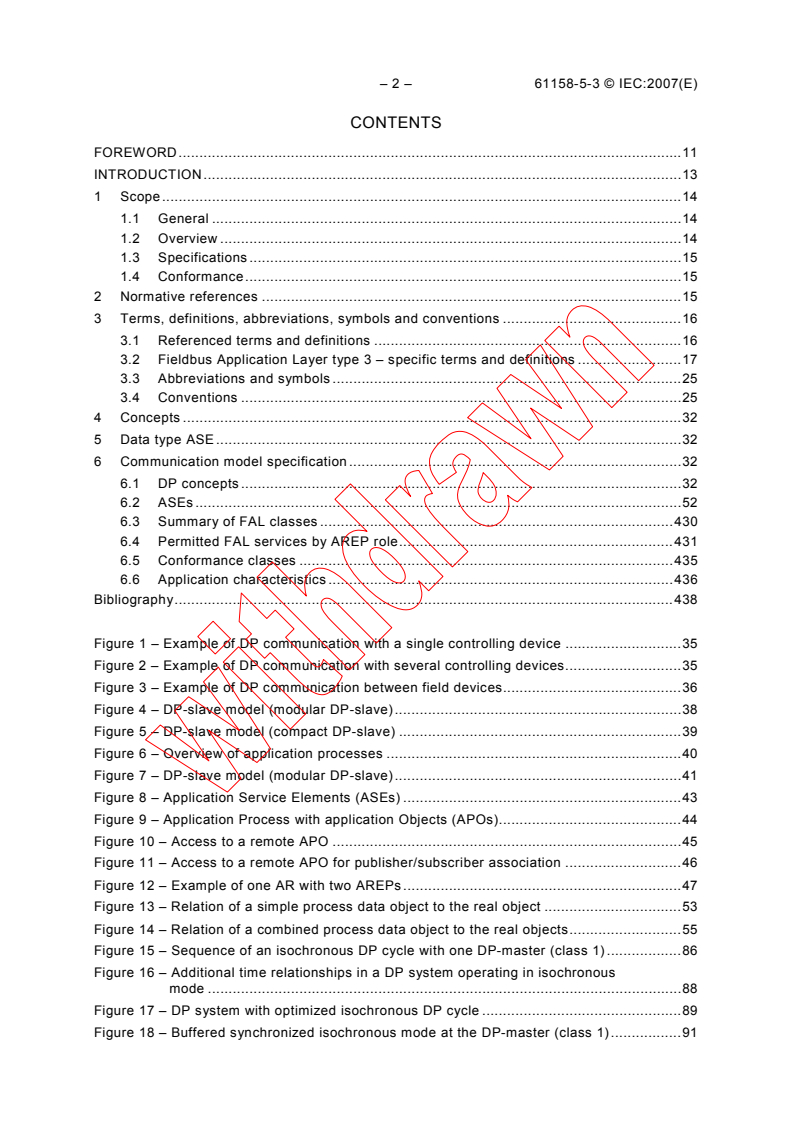
– 2 – 61158-5-3 © IEC:2007(E)
CONTENTS
FOREWORD.11
INTRODUCTION.13
1 Scope.14
1.1 General .14
1.2 Overview .14
1.3 Specifications .15
1.4 Conformance.15
2 Normative references .15
3 Terms, definitions, abbreviations, symbols and conventions .16
3.1 Referenced terms and definitions .16
3.2 Fieldbus Application Layer type 3 – specific terms and definitions .17
3.3 Abbreviations and symbols .25
3.4 Conventions .25
4 Concepts .32
5 Data type ASE.32
6 Communication model specification .32
6.1 DP concepts .32
6.2 ASEs .52
6.3 Summary of FAL classes .430
6.4 Permitted FAL services by AREP role.431
6.5 Conformance classes .435
6.6 Application characteristics .436
Bibliography.438
Figure 1 – Example of DP communication with a single controlling device .35
Figure 2 – Example of DP communication with several controlling devices.35
Figure 3 – Example of DP communication between field devices.36
Figure 4 – DP-slave model (modular DP-slave).38
Figure 5 – DP-slave model (compact DP-slave) .39
Figure 6 – Overview of application processes .40
Figure 7 – DP-slave model (modular DP-slave).41
Figure 8 – Application Service Elements (ASEs) .43
Figure 9 – Application Process with application Objects (APOs).44
Figure 10 – Access to a remote APO .45
Figure 11 – Access to a remote APO for publisher/subscriber association .46
Figure 12 – Example of one AR with two AREPs.47
Figure 13 – Relation of a simple process data object to the real object .53
Figure 14 – Relation of a combined process data object to the real objects.55
Figure 15 – Sequence of an isochronous DP cycle with one DP-master (class 1).86
Figure 16 – Additional time relationships in a DP system operating in isochronous
mode .88
Figure 17 – DP system with optimized isochronous DP cycle .89
Figure 18 – Buffered synchronized isochronous mode at the DP-master (class 1).91
61158-5-3 © IEC:2007(E) – 3 –
Figure 19 – Enhanced synchronized isochronous mode at the DP-master (class 1).92
Figure 20 – Input, output and PLL state machine interaction .92
Figure 21 – PLL state diagram .98
Figure 22 – OUTPUT state diagram .102
Figure 23 – INPUT state diagram .106
Figure 24 – Treatment of an alarm in the DP system.139
Figure 25 – Load Region state diagram for erasable memory.237
Figure 26 – Load region state diagram for non erasable memory .238
Figure 27 – Function invocation state diagram .270
Figure 28 – System architecture.284
Figure 29 – Assignment of communication relationship to application relationship .291
Figure 30 – MS0 application relationship.297
Figure 31 – Output buffer model of a DP-slave without sync functionality.298
Figure 32 – Output buffer model of a DP-slave with sync functionality.298
Figure 33 – Input buffer model of a DP-slave without freeze functionality.299
Figure 34 – Input buffer model of a DP-slave with freeze functionality.299
Figure 35 – MS1 application relationship.300
Figure 36 – MS2 application relationship.300
Figure 37 – Example of inter-network communication.302
Figure 38 – Example without inter-network addressing.302
Figure 39 – First example with inter-network addressing .303
Figure 40 – Second example with inter-network addressing .304
Figure 41 – MS3 application relationship.305
Figure 42 – MM1 application relationship .305
Figure 43 – MM2 application relationship .306
Figure 44 – Cycle time of the DP system.437
Table 1 – Requirements and features of fieldbus DP.34
Table 2 – Status values of the service primitives.51
Table 3 – Access Rights MS1 .54
Table 4 – Access Rights MS2 .54
Table 5 – Access Rights MS1 .57
Table 6 – Access Rights MS2 .57
Table 7 – SCL matching rules .58
Table 8 – Read .58
Table 9 – Write .60
Table 10 – Data transport .61
Table 11 – Format (simple input data description).65
Table 12 – Consistency (simple input data description).65
Table 13 – Format (simple output data).67
Table 14 – Consistency (simple output data).67
Table 15 – Format (extended input data).68
Table 16 – Consistency (extended input data).69
– 4 – 61158-5-3 © IEC:2007(E)
Table 17 – Format (extended output data) .70
Table 18 – Consistency (extended output data) .71
Table 19 – Set Input .72
Table 20 – Read Input .72
Table 21 – Get Input .74
Table 22 – New Input.75
Table 23 – Set Output.76
Table 24 – Final.77
Table 25 – Read Output.77
Table 26 – Get Output .78
Table 27 – Clear Flag .78
Table 28 – New Flag .79
Table 29 – New Output .79
Table 30 – Clear Flag .79
Table 31 – Global Control .80
Table 32 – Clear Command .80
Table 33 – Sync Command .80
Table 34 – Freeze Command .81
Table 35 – New publisher data.81
Table 36 – Get publisher data .82
Table 37 – New Flag .82
Table 38 – SYNCH.83
Table 39 – SYNCH Delayed .83
Table 40 – DX Finished.84
Table 41 – SYNCH Event.84
Table 42 – Status.84
Table 43 – Primitives issued by the AL to the PLL state machine .94
Table 44 – Primitives issued by the user to the PLL state machine .94
Table 45 – Allowed values of Status .94
Table 46 – Primitives issued by the user to the input state machine.95
Table 47 – Primitives issued by the user to the output state machine.95
Table 48 – Primitives issued by the PLL to the output state machine .95
Table 49 – Primitives issued by the output to the PLL state machine .95
Table 50 – Primitives issued by the PLL to the input state machine.95
Table 51 – Primitives issued by the output to the input state machine .96
Table 52 – Primitives issued by the output state machine to the AL .96
Table 53 – Primitives issued by the AL to the output state machine .96
Table 54 – Primitives issued by the input state machine to the AL .96
Table 55 – Primitives issued by the AL to the input state machine .96
Table 56 – PLL state table .99
Table 57 – OUTPUT state table .103
Table 58 – INPUT state table .107
Table 59 – Identifier status.109
61158-5-3 © IEC:2007(E) – 5 –
Table 60 – Channel type .110
Table 61 – IO type .111
Table 62 – Error type .111
Table 63 – Status type .112
Table 64 – Status specifier .112
Table 65 – Status specifier .113
Table 66 – Module status.113
Table 67 – Status specifier .114
Table 68 – Link status.115
Table 69 – Link error.115
Table 70 – Set Slave Diag .116
Table 71 – Ext Diag Flag.117
Table 72 – Get Slave Diag .119
Table 73 – Read Slave Diag .129
Table 74 – New Slave Diag.138
Table 75 – Alarm type.140
Table 76 – Add Ack.141
Table 77 – Alarm specifier .141
Table 78 – Alarm notification.142
Table 79 – Alarm Ack.143
Table 80 – Prm data type.148
Table 81 – Supported feature.158
Table 82 – Supported profile feature .158
Table 83 – Role .159
Table 84 – Check user Prm.160
Table 85 – Prm structure.161
Table 86 – MS1 Command.164
Table 87 – Check user Prm result .165
Table 88 – Status values.166
Table 89 – Check Ext user Prm.167
Table 90 – Check Ext user Prm result .170
Table 91 – Status values.171
Table 92 – Check Cfg .171
Table 93 – Check Cfg result.172
Table 94 – Status values.173
Table 95 – Set Cfg.173
Table 96 – Get Cfg.174
Table 97 – Set Slave Add .175
Table 98 – Initiate .176
Table 99 – Abort .179
Table 100 – Instance .179
Table 101 – MS0 init DP-slave .180
Table 102 – MS1 init DP-slave .180
– 6 – 61158-5-3 © IEC:2007(E)
Table 103 – MS2 init DP-slave .181
Table 104 – DP-slave started.181
Table 105 – Alarm limit .182
Table 106 – DP-slave stopped .182
Table 107 – Reset DP-slave .183
Table 108 – DP-slave fault.183
Table 109 – Application ready DP-slave.183
Table 110 – Start subscriber .184
Table 111 – Stop subscriber .184
Table 112 – Publisher active.185
Table 113 – Status.186
Table 114 – Init DP-master Cl1 .186
Table 115 – DP-master Cl1 started .187
Table 116 – Alarm limit .188
Table 117 – DP-master Cl1 stopped.188
Table 118 – Reset DP-master Cl1.188
Table 119 – DP-master Cl1 fault .189
Table 120 – DP-master Cl1 reject .189
Table 121 – Set mode DP-master Cl1 .190
Table 122 – DP-master Cl1 mode changed .191
Table 123 – Load bus Par DP-master Cl1 .192
Table 124 – Mark DP-master Cl1 .193
Table 125 – Abort DP-master Cl1.193
Table 126 – Read value DP-master Cl1 .194
Table 127 – Delete SC DP-master Cl1 .194
Table 128 – DP-master Cl1 event .195
Table 129 – Init DP-master Cl2 .196
Table 130 – Reset DP-master Cl2.197
Table 131 – DP-master Cl2 fault .197
Table 132 – DP-master Cl2 reject .197
Table 133 – DP-master Cl2 closed.198
Table 134 – DP-master Cl2 event .198
Table 135 – USIF state .199
Table 136 – Data rate .203
Table 137 – USIF state .204
Table 138 – Isochronous mode .204
Table 139 – Slave type .207
Table 140 – Alarm mode .208
Table 141 – Get Master Diag .211
Table 142 – MDiag identifier .211
Table 143 – Start Seq .212
Table 144 – Area code (start seq) .213
Table 145 – Download .214
61158-5-3 © IEC:2007(E) – 7 –
Table 146 – Upload.215
Table 147 – End Seq .216
Table 148 – Act Para Brct .217
Table 149 – Area code (Act Para Brct).217
Table 150 – Act param.218
Table 151 – Area code (Act param).219
Table 152 – Activate .219
Table 153 – Access rights MS1.221
Table 154 – Access rights MS2.222
Table 155 – Load region state.222
Table 156 – Initiate load .224
Table 157 – Default values for the parameter Intersegment Request Timeout .225
Table 158 – Push segment.226
Table 159 – Pull segment .228
Table 160 – Terminate load .230
Table 161 – Primitives issued by the user to the Load Region state machine .232
Table 162 – Primitives issued by the Load Region state machine to the user .233
Table 163 – Primitives issued by the Function Invocation to the Load Region state
machine.233
Table 164 – Primitives issued by the Load Region to the Function Invocation state
machine.234
Table 165 – Load Region state definitions .234
Table 166 – Load Region function table .235
Figure 25 – Load Region state diagram for erasable memory.237
Table 167 – Load Region state table for erasable memory.238
Table 168 – Load Region state table for non erasable memory .251
Table 169 – Access rights MS1.255
Table 170 – Access rights MS2.255
Table 171 – Function Invocation state.256
Table 172 – Load Region object in use .256
Table 173 – Access rights MS1.258
Table 174 – Access rights MS2.258
Table 175 – Load Region object in use .258
Table 176 – Start .259
Table 177 – Stop .260
Table 178 – Resume.261
Table 179 – Reset.262
Table 180 – Get FI state .263
Table 181 – Call.264
Table 182 – Primitives issued by the user to the Function Invocation state machine .266
Table 183 – Primitives issued by the Function Invocation state machine to the user .267
Table 184 – Primitives issued by the Load Region to the Function Invocation state
machine.267
– 8 – 61158-5-3 © IEC:2007(E)
Table 185 – Primitives issued by the Function Invocation to the Load Region state
machine.268
Table 186 – Function Invocation state definitions.268
Table 187 – Function definitions .269
Table 188 – Function Invocation state table .270
Table 189 – CS status .286
Table 190 – Summertime .286
Table 191 – Synchronization active.287
Table 192 – Announcement hour.287
Table 193 – Summertime .288
Table 194 – Accuracy .288
Table 195 – Set time.289
Table 196 – Sync interval violation.290
Table 197 – Parameter of Initiate service without inter-network addressing.303
Table 198 – Parameter of Initiate service with inter-network addressing (first example) .303
Table 199 – Parameter of Initiate service with inter-network addressing (second
example).304
Table 200 – AR type .310
Table 201 – Sync supported .312
Table 202 – Freeze supported .312
Table 203 – Group identifier.314
Table 204 – DPV1 enabled .314
Table 205 – Fail safe .315
Table 206 – WD base .315
Table 207 – No Add change.317
Table 208 – Alarm mode supported.320
Table 209 – Isochronous mode supp.324
Table 210 – Isochronous mode .324
Table 211 – Alarm mode .325
Table 212 – Time device type .326
Table 213 – S_SAP_index .329
Table 214 – D_addr .330
Table 215 – Service_activate .330
Table 216 – Role_in_service.331
Table 217 – Indication_mode .332
Table 218 – Max_DLSDU_length_req_low .332
Table 219 – Max_DLSDU_length_req_high.333
Table 220 – Max_DLSDU_length_ind_low.333
Table 221 – Max_DLSDU_length_ind_high .334
Table 222 – S_SAP_index .339
Table 223 – D_SAP_index .339
Table 224 – D_addr .340
Table 225 – Service_activate .340
61158-5-3 © IEC:2007(E) – 9 –
Table 226 – Role_in_service.341
Table 227 – Indication_mode .341
Table 228 – Max_DLSDU_length_req_low .342
Table 229 – Max_DLSDU_length_req_high.342
Table 230 – Max_DLSDU_length_ind_low.343
Table 231 – Max_DLSDU_length_ind_high .343
Table 232 – Sync .344
Table 233 – Freeze.345
Table 234 – DPV1 enabled .346
Table 235 – Fail safe .346
Table 236 – Enable publisher.347
Table 237 – WD base .347
Table 238 – Alarm mode .348
Table 239 – Fail safe .358
Table 240 – S_SAP_index .365
Table 241 – D_SAP_index .366
Table 242 – D_addr .366
Table 243 – Service_activate .366
Table 244 – Role_in_service.367
Table 245 – Max_DLSDU_length_req_low .367
Table 246 – Max_DLSDU_length_req_high.367
Table 247 – Max_DLSDU_length_ind_low.368
Table 248 – Max_DLSDU_length_ind_high .368
Table 249 – DLL init DP-slave.369
Table 250 – Load ARL DP-slave .370
Table 251 – Get ARL DP-slave .376
Table 252 – Set ARL isochronous mode .382
Table 253 – Load ARL DP-master Cl1.383
Table 254 – Get ARL DP-master Cl1.386
Table 255 – ARL Slave update DP-master Cl1 .388
Table 256 – Load ARL DP-master Cl2.390
Table 257 – Get ARL DP-master Cl2.391
Table 258 – Load CRL DP-slave .392
Table 259 – Load CRL DXB link entries .394
Table 260 – Get CRL DP-slave .395
Table 261 – Load CRL DP-master Cl1 .397
Table 262 – Get CRL DP-master Cl1 .
...
Questions, Comments and Discussion
Ask us and Technical Secretary will try to provide an answer. You can facilitate discussion about the standard in here.
Loading comments...