

IEC 60034-9:2021
(Main)Rotating electrical machines - Part 9: Noise limits
General Information
- Abstract
IEC 60034-9:2021 specifies test methods for the determination of sound power level of rotating electrical machines and specifies maximum A-weighted sound power levels for factory acceptance testing of network-supplied, rotating electrical machines in accordance with lEC 60034-1, having methods of cooling according to lEC 60034-6 and degrees of protection according to lEC 60034-5, and having the following characteristics:
- standard design, either AC or DC, without additional special electrical, mechanical, or acoustical modifications intended to reduce the sound power level
- rated output from 1 kW (or kVA) up to and including 5 500 kW (or kVA)
- rated speed not greater than 3 750 min–1
This fifth edition cancels and replaces the fourth edition, published in 2003 and its amendment 1, published in 2007. This edition includes the following significant technical changes with respect to the previous edition:
a) In Table 2 and Table 3 cooling methods IC01, IC11, IC21 and IC31, IC71, IC81 are now covered.
b) This edition adds Table 3 for 60 Hz machines, whereas Table 2, which covers only 50 Hz machines, has no change in levels.
c) In Table 3, grade A is added to harmonize the highest levels seen in IEC and NEMA, whereas grade B was added to harmonize the lowest, more restrictive levels seen in IEC and NEMA.
d) The clause “Determination of noise increments caused by converter supply” has been shifted to Annex B and renamed “Information on typical noise increments caused by converter supply”.
- Status
- Published
- Publication Date
- 13-Oct-2021
- Technical Committee
- TC 2 - Rotating machinery
- Drafting Committee
- MT 2 - TC 2/MT 2
- Current Stage
- PPUB - Publication issued
- Start Date
- 14-Oct-2021
- Completion Date
- 05-Nov-2021
Buy Documents
REDLINE IEC 60034-9:2021 CMV - Rotating electrical machines - Part 9: Noise limits Released:10/14/2021
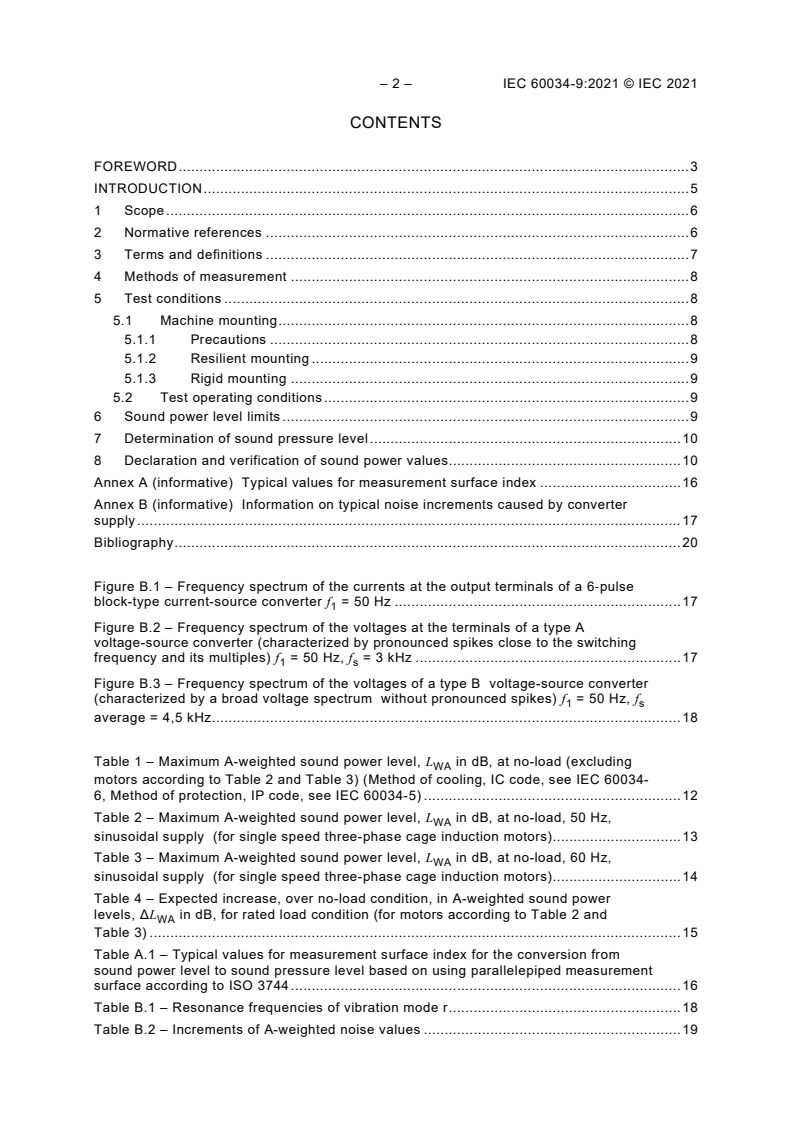
IEC 60034-9:2021 - Rotating electrical machines - Part 9: Noise limits Released:10/14/2021
Overview
IEC 60034-9:2021 - "Rotating electrical machines - Part 9: Noise limits" specifies how to measure and limit airborne noise from standard rotating electrical machines. The standard defines test methods for sound power level (A-weighted, LWA) and sets maximum A-weighted sound power levels for factory acceptance testing of network‑supplied machines (AC or DC) of standard design, rated 1 kW up to 5 500 kW, and with rated speeds ≤ 3 750 min⁻¹. This is the 5th edition (2021), replacing the 2003 edition and its 2007 amendment.
Key topics and technical requirements
- Sound power measurement methods: procedures to determine A‑weighted sound power level independent of environment, with references to ISO/IEC acoustics methods.
- Maximum sound power limits: tabulated limits for machines at no‑load (Tables 1–3) including separate tables for 50 Hz and newly added 60 Hz machines; levels depend on rated power, cooling method (IC code per IEC 60034‑6) and protection degree (IP code per IEC 60034‑5).
- Test conditions and mounting: standardized test operating conditions and machine mounting (resilient vs. rigid) to ensure repeatable factory acceptance tests.
- Conversion to sound pressure: guidance (Clause 7) to estimate sound pressure levels at a distance using standardized measurement surfaces and indices (Annex A).
- Verification and declaration: rules for declaring sound power values and verifying compliance during factory acceptance testing.
- Converter-supplied machines: guidance on typical noise increments caused by converter supply moved to Annex B (informative); explicit exclusion of noise limits for AC motors powered by converters (see IEC 60034‑17 for application guidance).
- Notable 2021 changes:
- Coverage extended to additional cooling methods (IC01, IC11, IC21, IC31, IC71, IC81).
- Added Table 3 for 60 Hz machines and new grading (Grade A and B) to harmonize IEC and NEMA levels.
- Converter noise guidance relocated to Annex B.
Applications and who uses it
- Motor and generator manufacturers - design validation and factory acceptance testing to ensure compliance with noise limits.
- Test laboratories and acoustic engineers - standard test procedures and measurement best practices.
- OEMs and end‑users (industrial plants, OEM equipment suppliers) - procurement specifications, noise control planning, and selection of machines for noise‑sensitive installations.
- Certification bodies and compliance teams - verification of declared sound power levels for regulatory or contractual requirements.
Related standards
- IEC 60034‑1 (rating & performance), IEC 60034‑5 (IP code), IEC 60034‑6 (IC code), IEC 60034‑17 (motors fed from converters)
- ISO 3741 / 3743 / 3744 / 3745 / 3746 / 3747 series - acoustics measurement methods
Keywords: IEC 60034-9, rotating electrical machines, noise limits, sound power level, A‑weighted, factory acceptance testing, IC code, IP code, converter noise, 50 Hz, 60 Hz.
Relations
- Effective Date
- 05-Sep-2023
- Revises
IEC 60034-9:2003/AMD1:2007 - Amendment 1 - Rotating electrical machines - Part 9: Noise limits - Effective Date
- 05-Sep-2023
Buy Documents
REDLINE IEC 60034-9:2021 CMV - Rotating electrical machines - Part 9: Noise limits Released:10/14/2021
IEC 60034-9:2021 - Rotating electrical machines - Part 9: Noise limits Released:10/14/2021
Get Certified
Connect with accredited certification bodies for this standard

IMQ S.p.A. (Certification)
Italian electrical product certification.

SLG Prüf- und Zertifizierungs GmbH
German testing and certification body.

UL Solutions
Global safety science company with testing, inspection and certification.
Sponsored listings
Frequently Asked Questions
IEC 60034-9:2021 is a standard published by the International Electrotechnical Commission (IEC). Its full title is "Rotating electrical machines - Part 9: Noise limits". This standard covers: IEC 60034-9:2021 specifies test methods for the determination of sound power level of rotating electrical machines and specifies maximum A-weighted sound power levels for factory acceptance testing of network-supplied, rotating electrical machines in accordance with lEC 60034-1, having methods of cooling according to lEC 60034-6 and degrees of protection according to lEC 60034-5, and having the following characteristics: - standard design, either AC or DC, without additional special electrical, mechanical, or acoustical modifications intended to reduce the sound power level - rated output from 1 kW (or kVA) up to and including 5 500 kW (or kVA) - rated speed not greater than 3 750 min–1 This fifth edition cancels and replaces the fourth edition, published in 2003 and its amendment 1, published in 2007. This edition includes the following significant technical changes with respect to the previous edition: a) In Table 2 and Table 3 cooling methods IC01, IC11, IC21 and IC31, IC71, IC81 are now covered. b) This edition adds Table 3 for 60 Hz machines, whereas Table 2, which covers only 50 Hz machines, has no change in levels. c) In Table 3, grade A is added to harmonize the highest levels seen in IEC and NEMA, whereas grade B was added to harmonize the lowest, more restrictive levels seen in IEC and NEMA. d) The clause “Determination of noise increments caused by converter supply” has been shifted to Annex B and renamed “Information on typical noise increments caused by converter supply”.
IEC 60034-9:2021 specifies test methods for the determination of sound power level of rotating electrical machines and specifies maximum A-weighted sound power levels for factory acceptance testing of network-supplied, rotating electrical machines in accordance with lEC 60034-1, having methods of cooling according to lEC 60034-6 and degrees of protection according to lEC 60034-5, and having the following characteristics: - standard design, either AC or DC, without additional special electrical, mechanical, or acoustical modifications intended to reduce the sound power level - rated output from 1 kW (or kVA) up to and including 5 500 kW (or kVA) - rated speed not greater than 3 750 min–1 This fifth edition cancels and replaces the fourth edition, published in 2003 and its amendment 1, published in 2007. This edition includes the following significant technical changes with respect to the previous edition: a) In Table 2 and Table 3 cooling methods IC01, IC11, IC21 and IC31, IC71, IC81 are now covered. b) This edition adds Table 3 for 60 Hz machines, whereas Table 2, which covers only 50 Hz machines, has no change in levels. c) In Table 3, grade A is added to harmonize the highest levels seen in IEC and NEMA, whereas grade B was added to harmonize the lowest, more restrictive levels seen in IEC and NEMA. d) The clause “Determination of noise increments caused by converter supply” has been shifted to Annex B and renamed “Information on typical noise increments caused by converter supply”.
IEC 60034-9:2021 is classified under the following ICS (International Classification for Standards) categories: 29.160.01 - Rotating machinery in general. The ICS classification helps identify the subject area and facilitates finding related standards.
IEC 60034-9:2021 has the following relationships with other standards: It is inter standard links to IEC 60034-9:2003, IEC 60034-9:2003/AMD1:2007. Understanding these relationships helps ensure you are using the most current and applicable version of the standard.
IEC 60034-9:2021 is available in PDF format for immediate download after purchase. The document can be added to your cart and obtained through the secure checkout process. Digital delivery ensures instant access to the complete standard document.
Standards Content (Sample)
IEC 60034-9 ®
Edition 5.0 2021-10
COMMENTED VERSION
INTERNATIONAL
STANDARD
colour
inside
Rotating electrical machines –
Part 9: Noise limits
All rights reserved. Unless otherwise specified, no part of this publication may be reproduced or utilized in any form
or by any means, electronic or mechanical, including photocopying and microfilm, without permission in writing from
either IEC or IEC's member National Committee in the country of the requester. If you have any questions about IEC
copyright or have an enquiry about obtaining additional rights to this publication, please contact the address below or
your local IEC member National Committee for further information.
IEC Central Office Tel.: +41 22 919 02 11
3, rue de Varembé info@iec.ch
CH-1211 Geneva 20 www.iec.ch
Switzerland
About the IEC
The International Electrotechnical Commission (IEC) is the leading global organization that prepares and publishes
International Standards for all electrical, electronic and related technologies.
About IEC publications
The technical content of IEC publications is kept under constant review by the IEC. Please make sure that you have the
latest edition, a corrigendum or an amendment might have been published.
IEC publications search - webstore.iec.ch/advsearchform IEC online collection - oc.iec.ch
The advanced search enables to find IEC publications by a Discover our powerful search engine and read freely all the
variety of criteria (reference number, text, technical publications previews. With a subscription you will always
committee, …). It also gives information on projects, replaced have access to up to date content tailored to your needs.
and withdrawn publications.
Electropedia - www.electropedia.org
IEC Just Published - webstore.iec.ch/justpublished
The world's leading online dictionary on electrotechnology,
Stay up to date on all new IEC publications. Just Published
containing more than 22 000 terminological entries in English
details all new publications released. Available online and
and French, with equivalent terms in 18 additional languages.
once a month by email.
Also known as the International Electrotechnical Vocabulary
(IEV) online.
IEC Customer Service Centre - webstore.iec.ch/csc
If you wish to give us your feedback on this publication or
need further assistance, please contact the Customer Service
Centre: sales@iec.ch.
IEC 60034-9 ®
Edition 5.0 2021-10
COMMENTED VERSION
INTERNATIONAL
STANDARD
colour
inside
Rotating electrical machines –
Part 9: Noise limits
INTERNATIONAL
ELECTROTECHNICAL
COMMISSION
ICS 29.160.01 ISBN 978-2-8322-4015-1
– 2 – IEC 60034-9:2021 CMV © IEC 2021
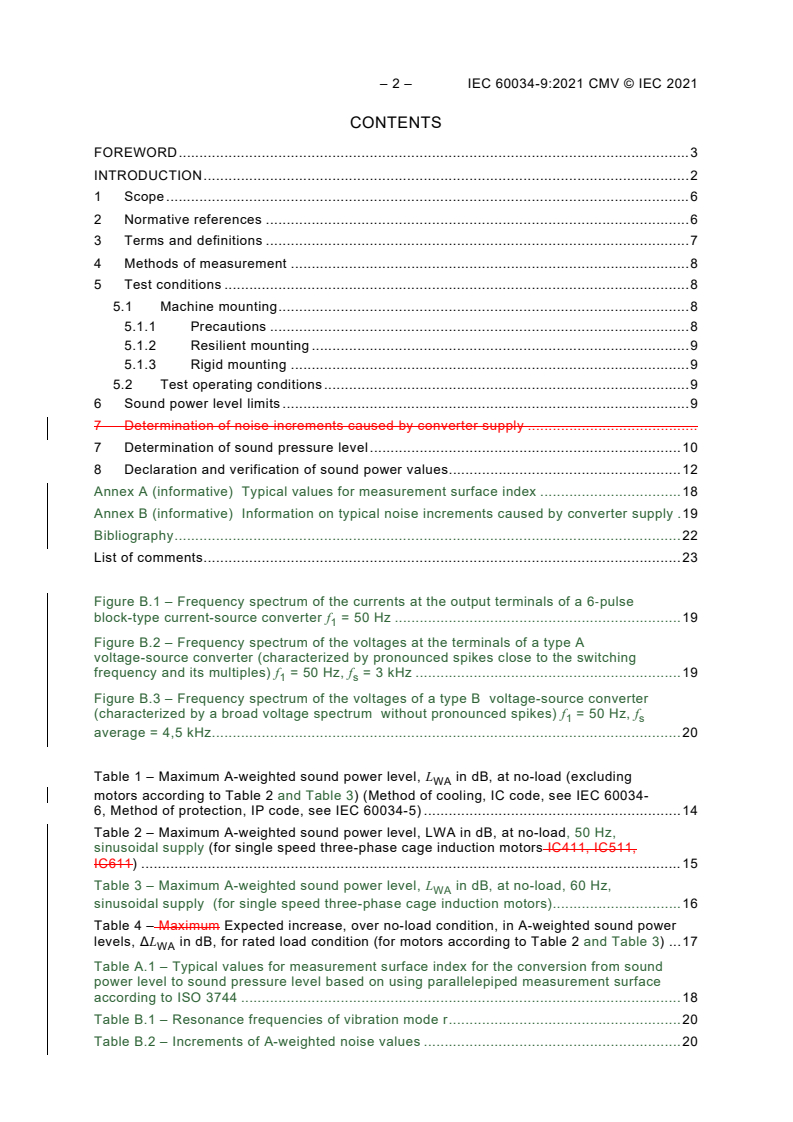
CONTENTS
FOREWORD . 3
INTRODUCTION . 2
1 Scope . 6
2 Normative references . 6
3 Terms and definitions . 7
4 Methods of measurement . 8
5 Test conditions . 8
5.1 Machine mounting . 8
5.1.1 Precautions . 8
5.1.2 Resilient mounting . 9
5.1.3 Rigid mounting . 9
5.2 Test operating conditions . 9
6 Sound power level limits . 9
7 Determination of noise increments caused by converter supply .
7 Determination of sound pressure level . 10
8 Declaration and verification of sound power values. 12
Annex A (informative) Typical values for measurement surface index . 18
Annex B (informative) Information on typical noise increments caused by converter supply . 19
Bibliography . 22
List of comments . 23
Figure B.1 – Frequency spectrum of the currents at the output terminals of a 6‑pulse
block-type current-source converter f = 50 Hz . 19
Figure B.2 – Frequency spectrum of the voltages at the terminals of a type A
voltage-source converter (characterized by pronounced spikes close to the switching
frequency and its multiples) f = 50 Hz, f = 3 kHz . 19
1 s
Figure B.3 – Frequency spectrum of the voltages of a type B voltage-source converter
= 50 Hz, f
(characterized by a broad voltage spectrum without pronounced spikes) f
1 s
average = 4,5 kHz . 20
Table 1 – Maximum A-weighted sound power level, L in dB, at no-load (excluding
WA
motors according to Table 2 and Table 3) (Method of cooling, IC code, see IEC 60034-
6, Method of protection, IP code, see IEC 60034-5) . 14
Table 2 – Maximum A-weighted sound power level, LWA in dB, at no-load, 50 Hz,
sinusoidal supply (for single speed three-phase cage induction motors IC411, IC511,
IC611) . 15
Table 3 – Maximum A-weighted sound power level, L in dB, at no-load, 60 Hz,
WA
sinusoidal supply (for single speed three-phase cage induction motors). 16
Table 4 – Maximum Expected increase, over no-load condition, in A-weighted sound power
levels, ΔL in dB, for rated load condition (for motors according to Table 2 and Table 3) . 17
WA
Table A.1 – Typical values for measurement surface index for the conversion from sound
power level to sound pressure level based on using parallelepiped measurement surface
according to ISO 3744 . 18
Table B.1 – Resonance frequencies of vibration mode r . 20
Table B.2 – Increments of A-weighted noise values . 20
INTERNATIONAL ELECTROTECHNICAL COMMISSION
____________
ROTATING ELECTRICAL MACHINES –
Part 9: Noise limits
FOREWORD
1) The International Electrotechnical Commission (IEC) is a worldwide organization for standardization comprising
all national electrotechnical committees (IEC National Committees). The object of IEC is to promote international
co-operation on all questions concerning standardization in the electrical and electronic fields. To this end and
in addition to other activities, IEC publishes International Standards, Technical Specifications, Technical Reports,
Publicly Available Specifications (PAS) and Guides (hereafter referred to as “IEC Publication(s)”). Their
preparation is entrusted to technical committees; any IEC National Committee interested in the subject dealt with
may participate in this preparatory work. International, governmental and non-governmental organizations liaising
with the IEC also participate in this preparation. IEC collaborates closely with the International Organization for
Standardization (ISO) in accordance with conditions determined by agreement between the two organizations.
2) The formal decisions or agreements of IEC on technical matters express, as nearly as possible, an international
consensus of opinion on the relevant subjects since each technical committee has representation from all
interested IEC National Committees.
3) IEC Publications have the form of recommendations for international use and are accepted by IEC National
Committees in that sense. While all reasonable efforts are made to ensure that the technical content of IEC
Publications is accurate, IEC cannot be held responsible for the way in which they are used or for any
misinterpretation by any end user.
4) In order to promote international uniformity, IEC National Committees undertake to apply IEC Publications
transparently to the maximum extent possible in their national and regional publications. Any divergence between
any IEC Publication and the corresponding national or regional publication shall be clearly indicated in the latter.
5) IEC itself does not provide any attestation of conformity. Independent certification bodies provide conformity
assessment services and, in some areas, access to IEC marks of conformity. IEC is not responsible for any
services carried out by independent certification bodies.
6) All users should ensure that they have the latest edition of this publication.
7) No liability shall attach to IEC or its directors, employees, servants or agents including individual experts and
members of its technical committees and IEC National Committees for any personal injury, property damage or
other damage of any nature whatsoever, whether direct or indirect, or for costs (including legal fees) and
expenses arising out of the publication, use of, or reliance upon, this IEC Publication or any other IEC
Publications.
8) Attention is drawn to the Normative references cited in this publication. Use of the referenced publications is
indispensable for the correct application of this publication.
9) Attention is drawn to the possibility that some of the elements of this IEC Publication may be the subject of patent
rights. IEC shall not be held responsible for identifying any or all such patent rights.
This commented version (CMV) of the official standard IEC 60034-9:2021 edition 5.0
allows the user to identify the changes made to the previous IEC 60034-9:2003
+AMD1:2007 CSV edition 4.1. Futhermore, comments from IEC TC 2 experts are provided
to explain the reasons of the most relevant changes.
A vertical bar appears in the margin wherever a change has been made. Additions are in
green text, deletions are in strikethrough red text. Experts' comments are identified by a
blue-background number. Mouse over a number to display a pop-up note with the
comment.
This publication contains the CMV and the official standard. The full list of comments is
available at the end of the CMV.
– 4 – IEC 60034-9:2021 CMV © IEC 2021
IEC 60034-9 has been prepared by IEC technical committee 2: Rotating machinery. It is an
International Standard.
This fifth edition cancels and replaces the fourth edition, published in 2003 and its
amendment 1, published in 2007. This edition constitutes a technical revision.
This edition includes the following significant technical changes with respect to the previous
edition:
a) In Table 2 and Table 3 cooling methods IC01, IC11, IC21 and IC31, IC71, IC81 are now
covered.
b) This edition adds Table 3 for 60 Hz machines, whereas Table 2, which covers only 50 Hz
machines, has no change in levels.
c) In Table 3, grade A is added to harmonize the highest levels seen in IEC and NEMA,
whereas grade B was added to harmonize the lowest, more restrictive levels seen in IEC
and NEMA.
d) The clause “Determination of noise increments caused by converter supply” has been
shifted to Annex B and renamed “Information on typical noise increments caused by
converter supply”
The text of this International Standard is based on the following documents:
FDIS Report on voting
2/2064/FDIS 2/2069/RVD
Full information on the voting for its approval can be found in the report on voting indicated in
the above table.
The language used for the development of this International Standard is English.
A list of all parts in the IEC 60034 series, published under the general title Rotating electrical
machines, can be found on the IEC website.
This document was drafted in accordance with ISO/IEC Directives, Part 2, and developed in
accordance with ISO/IEC Directives, Part 1 and ISO/IEC Directives, IEC Supplement, available
at www.iec.ch/members_experts/refdocs. The main document types developed by IEC are
described in greater detail at www.iec.ch/standardsdev/publications.
The committee has decided that the contents of this document will remain unchanged until the
stability date indicated on the IEC website under webstore.iec.ch in the data related to the
specific document. At this date, the document will be
• reconfirmed,
• withdrawn,
• replaced by a revised edition, or
• amended.
IMPORTANT – The 'colour inside' logo on the cover page of this publication indicates that it
contains colours which are considered to be useful for the correct understanding of its
contents. Users should therefore print this document using a colour printer.
INTRODUCTION
Acoustic quantities can be expressed in sound pressure terms or sound power terms. The use
of a sound power level, which can be specified independently of the measurement surface and
environmental conditions, avoids the complications associated with sound pressure levels,
which require additional data to be specified. Sound power levels provide a measure of radiated
energy and have advantages in acoustic analysis and design.
– 6 – IEC 60034-9:2021 CMV © IEC 2021
ROTATING ELECTRICAL MACHINES –
Part 9: Noise limits
1 Scope
This part of IEC 60034:
– specifies test methods for the determination of sound power level of rotating electrical
machines;
– specifies maximum A-weighted sound power levels for factory acceptance testing of
network-supplied, rotating electrical machines in accordance with lEC 60034-1, having
methods of cooling according to lEC 60034-6 and degrees of protection according to
lEC 60034-5, and having the following characteristics:
• standard design, either AC or DC, without additional special electrical, mechanical, or
acoustical modifications intended to reduce the sound power level
• rated output from 1 kW (or kVA) up to and including 5 500 kW (or kVA)
–1
• rated speed not greater than 3 750 min
– provides guidance for the determination of noise levels for a.c. cage induction motors
supplied by converters.
Excluded are noise limits for AC motors supplied by converters. For these conditions see
IEC 60034-17 Annex B for guidance.
The object of this document is to determine maximum A-weighted sound power levels, L in
WA
decibels, dB, for airborne noise emitted by rotating electrical machines of standard design, as
a function of power, speed and load, and to specify the method of measurement and the test
conditions appropriate for the determination of the sound power level of the machines to provide
a standardized evaluation of machine noise up to the maximum specified sound power levels.
This document does not provide correction for the existence of tonal characteristics.
Sound pressure levels at a distance from the machine may be required in some applications,
such as hearing protection programs. Information is provided on such a procedure in Clause 7
based on a standardized test environment.
NOTE 1 This document recognizes the economic reason for the availability of standard noise-level machines for
use in non-critical areas or for use with supplementary means of noise attenuation.
NOTE 2 Where sound power levels lower than those specified in Table 1, Table 2 or Table 3 are required, these
should be are agreed between the manufacturer and the purchaser, as special electrical, mechanical, or acoustical
design may involve additional measures.
2 Normative references
The following documents are referred to in the text in such a way that some or all of their content
constitutes requirements of this document. For dated references, only the edition cited applies.
For undated references, the latest edition of the referenced document (including any
amendments) applies.
IEC 60034-1, Rotating electrical machines – Part 1: Rating and performance
IEC 60034-5, Rotating electrical machines – Part 5: Degrees of protection provided by the
integral design of rotating electrical machines (IP code) – Classification
IEC 60034-6, Rotating electrical machines – Part 6: Methods of cooling (IC Code)
IEC 60034-17, Rotating electrical machines – Part 17: Cage induction motors when fed from
convertors – Application guide
ISO 3741, Acoustics – Determination of sound power levels and sound energy levels of noise
sources using sound pressure – Precision methods for reverberation test rooms
ISO 3743-1, Acoustics – Determination of sound power levels and sound energy levels of noise
sources using sound pressure – Engineering methods for small, movable sources in reverberant
fields – Part 1: Comparison method for a hard-walled test room
ISO 3743-2, Acoustics – Determination of sound power levels of noise sources using sound
pressure – Engineering methods for small, movable sources in reverberant fields – Part 2:
Methods for special reverberation test rooms
ISO 3744, Acoustics – Determination of sound power levels and sound energy levels of noise
sources using sound pressure – Engineering methods for an essentially free field over a
reflecting plane
ISO 3745, Acoustics – Determination of sound power levels and sound energy levels of noise
sources using sound pressure – Precision methods for anechoic rooms and semi hemi-anechoic
rooms
ISO 3746, Acoustics – Determination of sound power levels and sound energy levels of noise
sources using sound pressure – Survey method using an enveloping measurement surface over
a reflecting plane
ISO 3747, Acoustics – Determination of sound power levels and sound energy levels of noise
sources using sound pressure – Comparison method in situ Engineering/survey methods for
use in situ in a reverberant environment
ISO 4871, Acoustics – Declaration and verification of noise emission values of machinery and
equipment
ISO 9614-1, Acoustics – Determination of sound power levels of noise sources using sound
intensity – Part 1: Measurement at discrete points
ISO 9614-2, Acoustics – Determination of sound power levels of noise sources using sound
intensity – Part 2: Measurement by scanning
3 Terms and definitions
For the purposes of this document, the following terms and definitions apply.
ISO and IEC maintain terminological databases for use in standardization at the following
addresses:
• IEC Electropedia: available at http://www.electropedia.org/
• ISO Online browsing platform: available at http://www.iso.org/obp
3.1
sound power level
L
W
ten times the logarithm to the base 10 of the ratio of the sound power radiated by the source
–12
under test to the reference sound power [W = 1 pW (10 W)] expressed in decibels
o
– 8 – IEC 60034-9:2021 CMV © IEC 2021
3.2
sound pressure level
L
p
ten times the logarithm to the base 10 of the ratio of the square of the sound pressure to the
–5
square of the reference sound pressure [P = 20 µPa (2 × 10 Pa)] expressed in decibels
o
3.3
measurement surface index
L
S
ten times the logarithm to the base 10 of the ratio of the measurement surface S to the reference
surface [S = 1 m ] expressed in decibels
3.4
maximum value
value that defines the upper limit without further tolerance
4 Methods of measurement
4.1 Sound pressure level measurements and calculation of sound power level produced by
the machine shall be made in accordance with ISO 3744, unless one of the alternative methods
specified in 4.3 or 4.4 below applies.
NOTE It is recommended that the hemispherical method be used for machines with shaft height up to 180 mm and
the parallelepiped method used for machines larger than 355 mm. Either method may be used for intermediate shaft
heights. It is general practice to use the parallelepiped method for all shaft heights. 1
4.2 The maximum sound power levels specified in Table 1, Table 2 and Table 3 or adjusted
by Table 4 relate to measurements made in accordance with 4.1.
4.3 When appropriate, one of the methods of precision or engineering grade accuracy, such
as the methods of ISO 3741, ISO 3743-1, ISO 3743-2, ISO 3745, ISO 9614-1 or ISO 9614-2,
may be used to determine sound power levels.
4.4 The simpler but less accurate method specified in ISO 3746 or ISO 3747 may be used,
especially when the environmental conditions required by ISO 3744 cannot be satisfied (for
example, for large machines).
However, to prove compliance with this document, unless a correction due to inaccuracy of the
measurement has already been applied to the values determined by this method in accordance
with ISO 3746 or ISO 3747, the levels of Table 1, Table 2 and Table 3 shall be decreased by
2 dB.
4.5 If testing under rated load conditions, the methods of ISO 9614 are preferred. However,
other methods are allowed when the load machine and auxiliary equipment are acoustically
isolated or located outside the test environment.
5 Test conditions
5.1 Machine mounting
5.1.1 Precautions
Care should be taken to minimize the transmission and the radiation of structure-borne noise
from all mounting elements including the foundation. This can be achieved by the resilient
mounting for smaller machines; however, larger machines can usually only be tested under rigid
mounting conditions.
Machines tested under load conditions shall be rigidly mounted.
5.1.2 Resilient mounting
The natural frequency of the support system and the machine under test shall be lower than
a quarter third 2 of the frequency corresponding to the lowest rotational speed of the machine.
The effective mass of the resilient support shall be not greater than one-tenth of that of the
machine under test.
5.1.3 Rigid mounting
The machines shall be rigidly mounted to a surface with dimensions adequate for the machine
type (for example by foot or flange fixed in accordance with the manufacturer's instructions).
The machine shall not be subject to additional mounting stresses from incorrect shimming or
fasteners.
5.2 Test operating conditions
The following test conditions shall apply:
a) The machine shall operate at rated voltage(s), rated frequency or rated speed(s) and with
appropriate field current(s) (when applicable). These shall be measured with instruments of
an accuracy of 1 % or better.
– The standard load condition shall be no-load, except for series wound motors.
– When required, the machine shall be operated at an agreed load condition.
b) Machines shall be tested in their operating position within their specified duty that generates
the greatest noise.
c) For an AC motor, the waveform and the degree of unbalance of the supply system shall
comply with the requirements of IEC 60034-1.
NOTE Any increase of voltage (and current) waveform distortion and unbalance will result in an increase
of noise.
d) A synchronous motor with adjustable excitation field shall be run with excitation to obtain
unity power factor or for large machines tested as a generator.
e) A generator shall be either run as a motor or driven at rated speed with excitation to obtain
the rated voltage on open circuit.
f) A machine suitable for more than one speed shall be evaluated over the operating speed
range.
g) A motor intended to be reversible shall be operated in both directions unless no difference
in sound power level is expected. A unidirectional motor shall be tested in its design
direction.
6 Sound power level limits
Where a machine is tested under the conditions specified in Clause 5, the sound power level of
the machine shall not exceed the relevant value(s) specified as follows:
a) A machine, other than those specified in b), operating at no-load shall be as specified in
Table 1.
b) A single-speed three-phase cage induction motor with cooling classification IC411, IC511,
IC611, IC01, IC11, IC21, IC31, IC71 and IC81, at 50 Hz or 60 Hz, shaft heights from 90 up
to and including 560, and with rated output not less than 1,0 kW and not exceeding 1 000
kW:
• operating at no-load shall be as specified in Table 2 and Table 3
– 10 – IEC 60034-9:2021 CMV © IEC 2021
• operating at rated load shall be the sum of the values established in Table 2, Table 3
and Table 4
• Grade A in Table 3 is the maximum level that a standard 60 Hz motor shall meet
• Grade B in Table 3 is a reduced level for 60 Hz motors that will meet the more stringent
requirements of the end-user
• unless grade B is specifically requested, grade A is to be used as the default noise level
for 60 Hz motors.
Converter-supplied a.c. machines are excluded from specified limits.
NOTE 1 The limits of Table 1, Table 2 and Table 3 recognize class 2 accuracy grade levels of measurement
uncertainty and production variations.
NOTE 2 Sound power levels, under full-load condition, are normally higher than those at no-load. Generally, if
ventilation noise is predominant the change may be small; but if the electromagnetic noise is predominant the change
may be significant.
NOTE 3 The limits are irrespective of the direction of rotation. A machine with a unidirectional ventilator is generally
less noisy than one with a bi-directional ventilator. This effect is more significant for high-speed machines, which
may be designed for unidirectional operation only.
NOTE 4 For some machines, the limits in Table 1 may not apply for speeds below nominal speed. In such a case,
or where the relationship between noise level and load is important, limits should be agreed between the
manufacturer and the purchaser.
NOTE 5 For multispeed machines the values in the Table 1 apply.
7 Determination of noise increments caused by converter supply
Noise emissions of electromagnetic origin at the converter supply can be considered as the
superposition of:
• the noise generated by the voltages and currents of fundamental frequency, which is
identical with the noise at sinusoidal supply of the same values, and
• an increment caused by voltages and currents at other frequencies.
Two features mainly influence this increment:
a) The frequency spectrum at the converter terminals
Three typical frequency spectra can be identified:
1) Spectrum of a block-type current-source converter
120 %
100 %
80 %
Frequency spectrum of the currents
60 %
at the output terminals of a 6-pulse
current-source converter
40 %
f = 50 Hz
20 %
0 %
0 300 600 900 1 200 1 500 1 800 2 100 2 400
Frequency Hz
IEC 337/07
2) Spectrum of type A voltage-source converter (characterized by pronounced spikes CLOSE
to the switching frequency and its multiples)
Current %
120 %
100 %
Frequency spectrum of the voltages
80 %
at the terminals of a type A voltage-source
60 %
converter
40 %
f = 50 Hz, f = 3 kHz
1 s
20 %
0 %
0 1 000 2 000 3 000 4 000 5 000
500 1 500 2 500 3 500 4 500
Frequency Hz
IEC 338/07
3) Spectrum of type B voltage-source converter (characterized by a broad voltage spectrum
without pronounced spikes.)
120 %
100 %
80 %
Frequency spectrum of the voltages
60 % of a type B voltage-source converter
f = 50 Hz, f average = 4,5 kHz
1 s
40 %
20 %
0 %
0 1 000 2 000 3 000 4 000 5 000
500 1 500 2 500 3 500 4 500
Frequency Hz IEC 339/07
Specific considerations are necessary when the spectrum deviates significantly from a typical
spectrum.
b) The resonance frequencies of the motor for the modes of vibration caused
by the harmonics
The relevant resonance frequencies of motors can be grouped according to the following table:
Shaft height H Resonance frequencies of vibration mode r
r = 0 r = 2 r = 4 r = 6
H ≤ 200 mm > 4 000 Hz > 600 Hz > 4 000 Hz > 5 000 Hz
< 3 000 Hz < 500 Hz < 2 500 Hz < 4 000 Hz
H ≥ 280 mm
A magnetically excited tone is generated by the interaction of the fundamental fields of the
number of pole-pairs p of the fundamental frequency f1 at the motor terminals and of one of the
harmonic frequencies n ∙ f , as shown in the relevant frequency spectrum. The tones are of:
(n + 1) ⋅ f
f = f ⋅ (n ± 1) =
r 1
(n − 1) ⋅ f
2 p
r = p ± p =
Usually combinations with n ∙ f , close to the switching frequency generate objectionable tones.
A reasonable increase of the audible noise is to be expected, if the frequency and the vibration
mode of a tone are close to the corresponding values of the resonant structure of the motor. In
Voltage %
Voltage %
– 12 – IEC 60034-9:2021 CMV © IEC 2021
some cases, objectionable tones may be avoided by changes to the parameter assignment of
the converter.
The following table shows the expected increase of noise, at converter supply, when compared
to the noise at sinusoidal supply, with the same fundamental values of voltage and frequency.
Increments of noise
Kind of converter Case Expected increment
1 to 5 dB(A)
The higher values relate to motors
Block-type current-source converter 6-pulse or 12-pulse
with low ventilation noise.
Increment depends on load.
Up to 15 dB(A)
High frequency voltages of high
Increment does not depend on load.
amplitudes excite resonances of the
Initial calculation possible by
motor
Type A
adequate software.
voltage-source converter
High frequency voltages of high
1 to 5 dB(A)
amplitudes do not excite resonances
Increment does not depend on load.
of the motor
5 to 10 dB(A)
Type B Broad voltage spectrum without
voltage-source converter pronounced spikes
Increment does not depend on load.
7 Determination of sound pressure level
Sound pressure levels are not required as part of this document.
If requested, an A-weighted sound pressure level may be determined directly from the sound
power level as follows:
S
L = L − 10lg
p W
S
0
where
L is the sound pressure level in a free-field over a reflecting plane at 1 m distance from the
p
machine;
L is the sound power level determined according to this standard;
W
S is 1,0 m ;
S is the area of the surface enveloping the machine at a distance from the machine of 1 m
according to ISO 3744 and the following rule:
Shaft height Surface area, S
mm
m
≤280 Hemisphere
>280 Parallelepiped
However, if requested by end user to provide pressure levels, for example in accordance with
Annex A, it shall be per agreement between user and manufacturer. An A-weighted sound
pressure level may be determined directly from the sound power level as follows:
𝐿𝐿 =𝐿𝐿 −𝐿𝐿 3
p W S
𝑆𝑆
𝐿𝐿 = 10 log � �
S 10
𝑆𝑆
where:
L is the sound pressure level in a free field over a reflecting plane at 1 m distance from
p
the machine;
L is the sound power level determined according to this document;
W
L is the measurement surface index;
S
2;
S is 1,0 m
S is the area of the surface enveloping the machine at a distance of 1 m according to
ISO 3744, 7.2.4. (Parallelepiped measurement surface).
NOTE 1 These sound pressure levels are for free field, over a reflecting plane. The sound pressure level for in situ
conditions (that is, for hearing protection requirements) is different.
NOTE 2 For typical values of the measurement surface index used for conversions from sound power to sound
pressure levels for machines in Table 2 and Table 3, see Annex A.
8 Declaration and verification of sound power values
A machine can be declared to comply with this document if, when tested under the conditions
specified in Clause 5, the sound power level of the machine does not exceed the value specified
in Clause 6.
The method selected and the type of measurement surface used shall be reported.
When requested sound power values determined according to this document can be reported
according to the procedures of ISO 4871 using the dual-number presentation (determined
sound power level L and uncertainty K).
Values for the uncertainty K are:
a) single machine
1,5 dB (grade 1: laboratory)
2,5 dB (grade 2: expertise)
4,5 dB (grade 3: verification) (confidence 95 %).
b) set of machines of the same batch
1,5 dB to 4,0 dB (grades 1 and 2)
4,0 dB to 6,0 dB (grade 3).
– 14 – IEC 60034-9:2021 CMV © IEC 2021
Table 1 – Maximum A-weighted sound power level, L in dB, at no-load (excluding motors according to Table 2 and Table 3)
WA
(Method of cooling, IC code, see IEC 60034-6, Method of protection, IP code, see IEC 60034-5)
Rated speed
n ≤ 960 960
N N N N N N
−1
n min
N
IC01 IC411 IC31 IC01 IC411 IC31 IC01 IC411 IC31 IC01 IC411 IC31 IC01 IC411 IC31 IC01 IC411 IC31
Methods
IC11 IC511 IC71W IC11 IC511 IC71W IC11 IC511 IC71W IC11 IC511 IC71W IC11 IC511 IC71W IC11 IC511 IC71W
of cooling
IC21 IC611 IC81W IC21 IC611 IC81W IC21 IC611 IC81W IC21 IC611 IC81W IC21 IC611 IC81W IC21 IC611 IC81W
(simplified
IC8A1W7 IC8A1W7 IC8A1W7 IC8A1W7 IC8A1W7 IC8A1W7
code)
NOTE 1 NOTE 2 NOTE 2 NOTE 1 NOTE 2 NOTE 2 NOTE 1 NOTE 2 NOTE 2 NOTE 1 NOTE 2 NOTE 2 NOTE 1 NOTE 2 NOTE 2 NOTE 1 NOTE 2 NOTE 2
Rated output
P
N
kW (or kVA)
1≤P ≤1,1 73 73 – 76 76 – 77 78 – 79 81 – 81 84 – 82 88 –
N
1,1
N
2,2
N
5,5
N
11
N
22
N
37
N
55
N
110
N
220
N
550
N
1 100
N
2 200
N
NOTE 1 Typical enclosure classification IP22 or IP23.
NOTE 2 Typical enclosure classification IP44 or IP55.
Table 2 – Maximum A-weighted sound power level, L in dB, at no-load, 50 Hz, sinusoidal supply
WA
(for single speed three-phase cage induction motors IC411, IC511, IC611)
IC411, IC511, IC611 IC01, IC11, IC21
IC31, IC71, IC81
Shaft height,
H
2 pole 4 pole 6 pole 8 pole 2 pole 4 pole 6 pole 8 pole
in mm
(NEMA frame number)
90 (140) 78 66 63 63 85 73 67 67
100 (N.A.) 82 70 64 64 89 77 68 68
112 (180) 83 72 70 70 90 79 74 74
132 (210) 85 75 73 71 92 82 77 75
160 (250) 87 77 73 72 94 84 77 76
180 (280) 88 80 77 76 95 87 81 80
200 (320) 90 83 80 79 97 90 84 83
225 (360) 92 84 80 79 99 91 84 83
250 (400) 92 85 82 80 99 92 86 84
280 (440) 94 88 85 82 101 95 89 86
315 (500) 98 94 89 88 105 101 93 92
355 (580) 100 95 94 92 107 102 98 96
400 (N.A.) 100 96 95 94 107 103 99 98
450 (680) 100 98 98 96 107 105 102 100
500 (800) 103 99 98 97 110 106 102 101
560 (N.A.) 105 100 99 98 112 107 103 102
NOTE 1 Motors of IC01, IC11, IC21 may have higher sound-power levels as follows: 2 and 4 poles: + 7 dB(A); 6 and 8 poles: + 4 dB(A). Values combine the cooling methods
IC01, IC11, IC21 and IC31, IC71, IC81 within one limit.
NOTE 2 The sound-power levels for 2 and 4 pole motors with shaft heights > 315 mm recognize a directional fan configuration. All other values are for bi-directional fans.
NOTE 3 Values for 60 Hz motors are increased as follows: 2 pole: + 5 dB(A); 4, 6 and 8 poles: + 3 dB(A). NEMA frame number is defined in NEMA MG 1.
– 16 – IEC 60034-9:2021 CMV © IEC 2021
Table 3 – Maximum A-weighted sound power level, L in dB, at no-load, 60 Hz, sinusoidal supply
WA
(for single speed three-phase cage induction motors) 4
IC01, IC11, IC21
IC411, IC511, IC611
IC31, IC71, IC81
Shaft height,
H
in mm 2 pole 4 pole 6 pole 8 pole 2 pole 4 pole 6 pole 8 pole
(NEMA frame
number)
grade grade grade grade grade grade grade grade grade grade grade grade grade grade grade grade
A B A B A B A B A B A B A B A B
90 (140) 85 83 70 69 66 64 69 66 90 76 76 70 70 65 70 69
100 (N.A.) 88 87 74 73 67 67 69 67 94 76 80 72 71 67 71 69
112 (180) 88 88 75 74 73 67 73 69 95 80 82 72 77 67 77 69
132 (210) 91 90 79 78 76 71 74 72 97 82 85 76 80 72 78 70
160 (250) 94 92 84 80 76 75 76 75 99 84 87 80 80 76 79 73
180 (280) 94 93 88 83 80 80 80 79 100 86 90 80 84 81 83 76
200 (320) 100 95 89 86 83 83 83 82 102 89 93 84 87 83 86 79
225 (360) 101 97 95 87 86 83 86 82 104 94 94 86 87 86 86 81
250 (400) 102 97 98 88 90 85 89 83 104 98 95 89 89 88 87 84
280 (440) 107 99 105 91 100 88 97 85 107 106 103 98 99 92 95 87
315 (500) 113 103 108 97 103 92 100 91 111 110 108 104 102 96 98 95
355 (580) 116 105 111 98 106 97 102 95 112 112 109 105 107 101 101 99
400 (N.A.) 116 105 111 99 106 98 102 97 112 112 110 106 107 102 101 101
450 (680) 116 105 113 101 106 101 105 99 114 112 110 108 107 105 103 101
500 (800) 118 108 113 102 108 101 107 100 115 114 110 109 109 105 107 104
560 (N.A.) 118 110 113 103 109 102 107 101 117 114 110 110 109 106 107 105
NOTE 1 Values combine the cooling methods IC01, IC11, IC21 and IC31, IC71, IC81 within one limit.
NOTE 2 The sound-power levels for 2 and 4 pole motors with shaft heights > 315 mm recognize a directional fan configuration. All other values are for bi-directional fans.
NOTE 3 NEMA frame number is defined in NEMA MG 1.
Table 4 – Maximum Expected increase, over no-load condition, in A-weighted sound
power levels, ΔL in dB, for rated load condition
WA
Table 2 and Table 3)
(for motors according to
Shaft height,
H 2 pole 4 pole 6 pole 8 pole
mm
2 5 7 8
90 ≤ H ≤ 160
2 4 6 7
180 ≤ H ≤ 200
2 3 6 7
225 ≤ H ≤ 280
H = 315 2 3 5 6
355 ≤ H 2 2 4 5
NOTE 1 This table gives the maximum expected increase at rated load condition to be added to any declared
no-load value.
NOTE 2 This table does not give guaranteed values. Values can be different for various machines and
manufacturers.
NOTE 2 3 The values apply to both 50 Hz and 60 Hz supplies.
– 18 – IEC 60034-9:2021 CMV © IEC 2021
Annex A
(informative)
Typical values for measurement surface index 5
Table A.1 – Typical values for measurement surface index for the conversion from
sound power level to sound pressure level based on using parallelepiped measurement
surface according to ISO 3744
𝑆𝑆
𝐿𝐿 = 10 log � �
S 10
𝑆𝑆
Shaft height,
L
H
S
mm
dB
(NEMA frame number)
90 (140) 12
100 (N.A.) 12
112 (180) 12
132 (210) 12
160 (250) 12
180 (280) 13
200 (320) 13
225 (360) 13
250 (400) 14
280 (440) 14
315 (500) 14
355 (580) 15
400 (N.A.) 16
450 (680) 16
500 (800) 17
560 (N.A.) 17
NOTE The values above are only for guidance and are not used for sound power
level determination according to ISO 3744 or other relevant standards.
Annex B
(informative)
Information on typical noise increments caused by converter supply
Noise emissions of electromagnetic origin at the converter supply can be considered as the
superposition of:
• the noise generated by the voltages and currents of fundamental frequency, which is
identical with the noise at sinusoidal supply of the same values, and
• an increment caused by voltages and currents at other frequencies.
Two features mainly influence this increment:
a) The frequency spectrum at the converter terminals
Three typical frequency spectra can be identified in Figure B.1, Figure B.2 and Figure B.3.
Figure B.1 – Frequency spectrum of the currents at the output terminals
of a 6‑pulse block-type current-source converter f = 50 Hz
Figure B.2 – Frequency spectrum of the voltages at the terminals of a type A
voltage-source converter (characterized by pronounced spikes close
to the switching frequency and its multiples) f = 50 Hz, f = 3 kHz
1 s
– 20 – IEC 60034-9:2021 CMV © IEC 2021
Figure B.3 – Frequency spectrum of the voltages of a type B
voltage-source converter (characterized by a broad voltage spectrum
without pronounced spikes) f = 50 Hz, f average = 4,5 kHz
1 s
Specific considerations are necessary when the spectrum deviates significantly from a
typical spectrum.
b) Typical values, historically based, for resonance frequencies of the motor for the modes of
vibration caused by the harmonics
The relevant resonance frequencies of motors can be grouped according to Table B.1.
Table B.1 – Resonance frequencies of vibration mode r
Shaft height H Resonance frequencies of vibration mode r
r = 0 r = 2 r = 4 r = 6
H ≤ 200 mm > 4 000 Hz > 600 Hz > 4 000 Hz > 5 000 Hz
< 3 000 Hz < 500 Hz < 2 500 Hz < 4 000 Hz
H ≥ 280 mm
A magnetically excited tone is generated by the interaction of the fundamental fields of the
number of pole pairs p of the fundamental frequency f at the motor terminals and of one of the
harmonic frequencies n × f , as shown in the relevant frequency spectrum. The tones are of:
(𝑛𝑛 + 1) ×𝑓𝑓
frequencies 𝑓𝑓 =𝑓𝑓 × (𝑛𝑛 ± 1) =�
𝑟𝑟 1
(𝑛𝑛− 1) ×𝑓𝑓
2𝑝𝑝
vibration modes 𝑟𝑟 =𝑝𝑝 ±𝑝𝑝 =�
Usually combinations with n × f , close to the switching frequency generate objectionable tones.
A reasonable increase of the audible noise is to be expected, if the frequency and the vibration
mode of a tone are close to the corresponding values of the resonant structure of the motor. In
some cases, objectionable tones may be avoided by changes to the parameter assignment of
the converter.
Table B.2 shows the typical increase of noise, at converter supply, when compared to the noise
at sinusoidal supply, with the same fundamental values of voltage and frequency.
Table B.2 – Increments of A-weighted noise values
Kind of converter Case Expected increment
1 dB to 5 dB
The higher values relate to motors
...
IEC 60034-9 ®
Edition 5.0 2021-10
INTERNATIONAL
STANDARD
NORME
INTERNATIONALE
Rotating electrical machines –
Part 9: Noise limits
Machines électriques tournantes –
Partie 9: Limites de bruit
All rights reserved. Unless otherwise specified, no part of this publication may be reproduced or utilized in any form
or by any means, electronic or mechanical, including photocopying and microfilm, without permission in writing from
either IEC or IEC's member National Committee in the country of the requester. If you have any questions about IEC
copyright or have an enquiry about obtaining additional rights to this publication, please contact the address below or
your local IEC member National Committee for further information.
Droits de reproduction réservés. Sauf indication contraire, aucune partie de cette publication ne peut être reproduite
ni utilisée sous quelque forme que ce soit et par aucun procédé, électronique ou mécanique, y compris la photocopie
et les microfilms, sans l'accord écrit de l'IEC ou du Comité national de l'IEC du pays du demandeur. Si vous avez des
questions sur le copyright de l'IEC ou si vous désirez obtenir des droits supplémentaires sur cette publication, utilisez
les coordonnées ci-après ou contactez le Comité national de l'IEC de votre pays de résidence.
IEC Central Office Tel.: +41 22 919 02 11
3, rue de Varembé info@iec.ch
CH-1211 Geneva 20 www.iec.ch
Switzerland
About the IEC
The International Electrotechnical Commission (IEC) is the leading global organization that prepares and publishes
International Standards for all electrical, electronic and related technologies.
About IEC publications
The technical content of IEC publications is kept under constant review by the IEC. Please make sure that you have the
latest edition, a corrigendum or an amendment might have been published.
IEC publications search - webstore.iec.ch/advsearchform IEC online collection - oc.iec.ch
The advanced search enables to find IEC publications by a Discover our powerful search engine and read freely all the
variety of criteria (reference number, text, technical publications previews. With a subscription you will always
committee, …). It also gives information on projects, replaced have access to up to date content tailored to your needs.
and withdrawn publications.
Electropedia - www.electropedia.org
IEC Just Published - webstore.iec.ch/justpublished
The world's leading online dictionary on electrotechnology,
Stay up to date on all new IEC publications. Just Published
containing more than 22 000 terminological entries in English
details all new publications released. Available online and
and French, with equivalent terms in 18 additional languages.
once a month by email.
Also known as the International Electrotechnical Vocabulary
(IEV) online.
IEC Customer Service Centre - webstore.iec.ch/csc
If you wish to give us your feedback on this publication or
need further assistance, please contact the Customer Service
Centre: sales@iec.ch.
A propos de l'IEC
La Commission Electrotechnique Internationale (IEC) est la première organisation mondiale qui élabore et publie des
Normes internationales pour tout ce qui a trait à l'électricité, à l'électronique et aux technologies apparentées.
A propos des publications IEC
Le contenu technique des publications IEC est constamment revu. Veuillez vous assurer que vous possédez l’édition la
plus récente, un corrigendum ou amendement peut avoir été publié.
Recherche de publications IEC - IEC online collection - oc.iec.ch
webstore.iec.ch/advsearchform Découvrez notre puissant moteur de recherche et consultez
La recherche avancée permet de trouver des publications IEC gratuitement tous les aperçus des publications. Avec un
en utilisant différents critères (numéro de référence, texte, abonnement, vous aurez toujours accès à un contenu à jour
comité d’études, …). Elle donne aussi des informations sur adapté à vos besoins.
les projets et les publications remplacées ou retirées.
Electropedia - www.electropedia.org
IEC Just Published - webstore.iec.ch/justpublished
Le premier dictionnaire d'électrotechnologie en ligne au
Restez informé sur les nouvelles publications IEC. Just
monde, avec plus de 22 000 articles terminologiques en
Published détaille les nouvelles publications parues.
anglais et en français, ainsi que les termes équivalents dans
Disponible en ligne et une fois par mois par email.
16 langues additionnelles. Egalement appelé Vocabulaire
Electrotechnique International (IEV) en ligne.
Service Clients - webstore.iec.ch/csc
Si vous désirez nous donner des commentaires sur cette
publication ou si vous avez des questions contactez-nous:
sales@iec.ch.
IEC 60034-9 ®
Edition 5.0 2021-10
INTERNATIONAL
STANDARD
NORME
INTERNATIONALE
Rotating electrical machines –
Part 9: Noise limits
Machines électriques tournantes –
Partie 9: Limites de bruit
INTERNATIONAL
ELECTROTECHNICAL
COMMISSION
COMMISSION
ELECTROTECHNIQUE
INTERNATIONALE
ICS 29.160.01 ISBN 978-2-8322-1034-0
– 2 – IEC 60034-9:2021 © IEC 2021
CONTENTS
FOREWORD . 3
INTRODUCTION . 5
1 Scope . 6
2 Normative references . 6
3 Terms and definitions . 7
4 Methods of measurement . 8
5 Test conditions . 8
5.1 Machine mounting . 8
5.1.1 Precautions . 8
5.1.2 Resilient mounting . 9
5.1.3 Rigid mounting . 9
5.2 Test operating conditions . 9
6 Sound power level limits . 9
7 Determination of sound pressure level . 10
8 Declaration and verification of sound power values. 10
Annex A (informative) Typical values for measurement surface index . 16
Annex B (informative) Information on typical noise increments caused by converter
supply . 17
Bibliography . 20
Figure B.1 – Frequency spectrum of the currents at the output terminals of a 6‑pulse
block-type current-source converter f = 50 Hz . 17
Figure B.2 – Frequency spectrum of the voltages at the terminals of a type A
voltage-source converter (characterized by pronounced spikes close to the switching
frequency and its multiples) f = 50 Hz, f = 3 kHz . 17
1 s
Figure B.3 – Frequency spectrum of the voltages of a type B voltage-source converter
(characterized by a broad voltage spectrum without pronounced spikes) f = 50 Hz, f
1 s
average = 4,5 kHz . 18
Table 1 – Maximum A-weighted sound power level, L in dB, at no-load (excluding
WA
motors according to Table 2 and Table 3) (Method of cooling, IC code, see IEC 60034-
6, Method of protection, IP code, see IEC 60034-5) . 12
Table 2 – Maximum A-weighted sound power level, L in dB, at no-load, 50 Hz,
WA
sinusoidal supply (for single speed three-phase cage induction motors). 13
Table 3 – Maximum A-weighted sound power level, L in dB, at no-load, 60 Hz,
WA
sinusoidal supply (for single speed three-phase cage induction motors). 14
Table 4 – Expected increase, over no-load condition, in A-weighted sound power
levels, ΔL in dB, for rated load condition (for motors according to Table 2 and
WA
Table 3) . 15
Table A.1 – Typical values for measurement surface index for the conversion from
sound power level to sound pressure level based on using parallelepiped measurement
surface according to ISO 3744 . 16
Table B.1 – Resonance frequencies of vibration mode r . 18
Table B.2 – Increments of A-weighted noise values . 19
INTERNATIONAL ELECTROTECHNICAL COMMISSION
____________
ROTATING ELECTRICAL MACHINES –
Part 9: Noise limits
FOREWORD
1) The International Electrotechnical Commission (IEC) is a worldwide organization for standardization comprising
all national electrotechnical committees (IEC National Committees). The object of IEC is to promote international
co-operation on all questions concerning standardization in the electrical and electronic fields. To this end and
in addition to other activities, IEC publishes International Standards, Technical Specifications, Technical Reports,
Publicly Available Specifications (PAS) and Guides (hereafter referred to as “IEC Publication(s)”). Their
preparation is entrusted to technical committees; any IEC National Committee interested in the subject dealt with
may participate in this preparatory work. International, governmental and non-governmental organizations liaising
with the IEC also participate in this preparation. IEC collaborates closely with the International Organization for
Standardization (ISO) in accordance with conditions determined by agreement between the two organizations.
2) The formal decisions or agreements of IEC on technical matters express, as nearly as possible, an international
consensus of opinion on the relevant subjects since each technical committee has representation from all
interested IEC National Committees.
3) IEC Publications have the form of recommendations for international use and are accepted by IEC National
Committees in that sense. While all reasonable efforts are made to ensure that the technical content of IEC
Publications is accurate, IEC cannot be held responsible for the way in which they are used or for any
misinterpretation by any end user.
4) In order to promote international uniformity, IEC National Committees undertake to apply IEC Publications
transparently to the maximum extent possible in their national and regional publications. Any divergence between
any IEC Publication and the corresponding national or regional publication shall be clearly indicated in the latter.
5) IEC itself does not provide any attestation of conformity. Independent certification bodies provide conformity
assessment services and, in some areas, access to IEC marks of conformity. IEC is not responsible for any
services carried out by independent certification bodies.
6) All users should ensure that they have the latest edition of this publication.
7) No liability shall attach to IEC or its directors, employees, servants or agents including individual experts and
members of its technical committees and IEC National Committees for any personal injury, property damage or
other damage of any nature whatsoever, whether direct or indirect, or for costs (including legal fees) and
expenses arising out of the publication, use of, or reliance upon, this IEC Publication or any other IEC
Publications.
8) Attention is drawn to the Normative references cited in this publication. Use of the referenced publications is
indispensable for the correct application of this publication.
9) Attention is drawn to the possibility that some of the elements of this IEC Publication may be the subject of patent
rights. IEC shall not be held responsible for identifying any or all such patent rights.
IEC 60034-9 has been prepared by IEC technical committee 2: Rotating machinery. It is an
International Standard.
This fifth edition cancels and replaces the fourth edition, published in 2003 and its
amendment 1, published in 2007. This edition constitutes a technical revision.
This edition includes the following significant technical changes with respect to the previous
edition:
a) In Table 2 and Table 3 cooling methods IC01, IC11, IC21 and IC31, IC71, IC81 are now
covered.
b) This edition adds Table 3 for 60 Hz machines, whereas Table 2, which covers only 50 Hz
machines, has no change in levels.
c) In Table 3, grade A is added to harmonize the highest levels seen in IEC and NEMA,
whereas grade B was added to harmonize the lowest, more restrictive levels seen in IEC
and NEMA.
– 4 – IEC 60034-9:2021 © IEC 2021
d) The clause “Determination of noise increments caused by converter supply” has been
shifted to Annex B and renamed “Information on typical noise increments caused by
converter supply”
The text of this International Standard is based on the following documents:
FDIS Report on voting
2/2064/FDIS 2/2069/RVD
Full information on the voting for its approval can be found in the report on voting indicated in
the above table.
The language used for the development of this International Standard is English.
A list of all parts in the IEC 60034 series, published under the general title Rotating electrical
machines, can be found on the IEC website.
This document was drafted in accordance with ISO/IEC Directives, Part 2, and developed in
accordance with ISO/IEC Directives, Part 1 and ISO/IEC Directives, IEC Supplement, available
at www.iec.ch/members_experts/refdocs. The main document types developed by IEC are
described in greater detail at www.iec.ch/standardsdev/publications.
The committee has decided that the contents of this document will remain unchanged until the
stability date indicated on the IEC website under webstore.iec.ch in the data related to the
specific document. At this date, the document will be
• reconfirmed,
• withdrawn,
• replaced by a revised edition, or
• amended.
INTRODUCTION
Acoustic quantities can be expressed in sound pressure terms or sound power terms. The use
of a sound power level, which can be specified independently of the measurement surface and
environmental conditions, avoids the complications associated with sound pressure levels,
which require additional data to be specified. Sound power levels provide a measure of radiated
energy and have advantages in acoustic analysis and design.
– 6 – IEC 60034-9:2021 © IEC 2021
ROTATING ELECTRICAL MACHINES –
Part 9: Noise limits
1 Scope
This part of IEC 60034:
– specifies test methods for the determination of sound power level of rotating electrical
machines;
– specifies maximum A-weighted sound power levels for factory acceptance testing of
network-supplied, rotating electrical machines in accordance with lEC 60034-1, having
methods of cooling according to lEC 60034-6 and degrees of protection according to
lEC 60034-5, and having the following characteristics:
• standard design, either AC or DC, without additional special electrical, mechanical, or
acoustical modifications intended to reduce the sound power level
• rated output from 1 kW (or kVA) up to and including 5 500 kW (or kVA)
–1
• rated speed not greater than 3 750 min
Excluded are noise limits for AC motors supplied by converters. For these conditions see
Annex B for guidance.
The object of this document is to determine maximum A-weighted sound power levels, L in
WA
decibels, dB, for airborne noise emitted by rotating electrical machines of standard design, as
a function of power, speed and load, and to specify the method of measurement and the test
conditions appropriate for the determination of the sound power level of the machines to provide
a standardized evaluation of machine noise up to the maximum specified sound power levels.
This document does not provide correction for the existence of tonal characteristics.
Sound pressure levels at a distance from the machine may be required in some applications,
such as hearing protection programs. Information is provided on such a procedure in Clause 7
based on a standardized test environment.
NOTE 1 This document recognizes the economic reason for the availability of standard noise-level machines for
use in non-critical areas or for use with supplementary means of noise attenuation.
NOTE 2 Where sound power levels lower than those specified in Table 1, Table 2 or Table 3 are required, these
are agreed between the manufacturer and the purchaser, as special electrical, mechanical, or acoustical design may
involve additional measures.
2 Normative references
The following documents are referred to in the text in such a way that some or all of their content
constitutes requirements of this document. For dated references, only the edition cited applies.
For undated references, the latest edition of the referenced document (including any
amendments) applies.
IEC 60034-1, Rotating electrical machines – Part 1: Rating and performance
IEC 60034-5, Rotating electrical machines – Part 5: Degrees of protection provided by the
integral design of rotating electrical machines (IP code) – Classification
IEC 60034-6, Rotating electrical machines – Part 6: Methods of cooling (IC Code)
ISO 3741, Acoustics – Determination of sound power levels and sound energy levels of noise
sources using sound pressure – Precision methods for reverberation test rooms
ISO 3743-1, Acoustics – Determination of sound power levels and sound energy levels of noise
sources using sound pressure – Engineering methods for small, movable sources in reverberant
fields – Part 1: Comparison method for a hard-walled test room
ISO 3743-2, Acoustics – Determination of sound power levels of noise sources using sound
pressure – Engineering methods for small, movable sources in reverberant fields – Part 2:
Methods for special reverberation test rooms
ISO 3744, Acoustics – Determination of sound power levels and sound energy levels of noise
sources using sound pressure – Engineering methods for an essentially free field over a
reflecting plane
ISO 3745, Acoustics – Determination of sound power levels and sound energy levels of noise
sources using sound pressure – Precision methods for anechoic rooms and hemi-anechoic
rooms
ISO 3746, Acoustics – Determination of sound power levels and sound energy levels of noise
sources using sound pressure – Survey method using an enveloping measurement surface over
a reflecting plane
ISO 3747, Acoustics – Determination of sound power levels and sound energy levels of noise
sources using sound pressure – Engineering/survey methods for use in situ in a reverberant
environment
ISO 4871, Acoustics – Declaration and verification of noise emission values of machinery and
equipment
ISO 9614-1, Acoustics – Determination of sound power levels of noise sources using sound
intensity – Part 1: Measurement at discrete points
ISO 9614-2, Acoustics – Determination of sound power levels of noise sources using sound
intensity – Part 2: Measurement by scanning
3 Terms and definitions
For the purposes of this document, the following terms and definitions apply.
ISO and IEC maintain terminological databases for use in standardization at the following
addresses:
• IEC Electropedia: available at http://www.electropedia.org/
• ISO Online browsing platform: available at http://www.iso.org/obp
3.1
sound power level
L
W
ten times the logarithm to the base 10 of the ratio of the sound power radiated by the source
–12
under test to the reference sound power [W = 1 pW (10 W)] expressed in decibels
o
– 8 – IEC 60034-9:2021 © IEC 2021
3.2
sound pressure level
L
p
ten times the logarithm to the base 10 of the ratio of the square of the sound pressure to the
–5
square of the reference sound pressure [P = 20 µPa (2 × 10 Pa)] expressed in decibels
o
3.3
measurement surface index
L
S
ten times the logarithm to the base 10 of the ratio of the measurement surface S to the reference
surface [S = 1 m ] expressed in decibels
3.4
maximum value
value that defines the upper limit without further tolerance
4 Methods of measurement
4.1 Sound pressure level measurements and calculation of sound power level produced by
the machine shall be made in accordance with ISO 3744, unless one of the alternative methods
specified in 4.3 or 4.4 below applies.
NOTE It is general practice to use the parallelepiped method for all shaft heights.
4.2 The maximum sound power levels specified in Table 1, Table 2 and Table 3 or adjusted
by Table 4 relate to measurements made in accordance with 4.1.
4.3 When appropriate, one of the methods of precision or engineering grade accuracy, such
as the methods of ISO 3741, ISO 3743-1, ISO 3743-2, ISO 3745, ISO 9614-1 or ISO 9614-2,
may be used to determine sound power levels.
4.4 The simpler but less accurate method specified in ISO 3746 or ISO 3747 may be used,
especially when the environmental conditions required by ISO 3744 cannot be satisfied (for
example, for large machines).
However, to prove compliance with this document, unless a correction due to inaccuracy of the
measurement has already been applied to the values determined by this method in accordance
with ISO 3746 or ISO 3747, the levels of Table 1, Table 2 and Table 3 shall be decreased by
2 dB.
4.5 If testing under rated load conditions, the methods of ISO 9614 are preferred. However,
other methods are allowed when the load machine and auxiliary equipment are acoustically
isolated or located outside the test environment.
5 Test conditions
5.1 Machine mounting
5.1.1 Precautions
Care should be taken to minimize the transmission and the radiation of structure-borne noise
from all mounting elements including the foundation. This can be achieved by the resilient
mounting for smaller machines; however, larger machines can usually only be tested under rigid
mounting conditions.
Machines tested under load conditions shall be rigidly mounted.
5.1.2 Resilient mounting
The natural frequency of the support system and the machine under test shall be lower than a
third of the frequency corresponding to the lowest rotational speed of the machine.
The effective mass of the resilient support shall be not greater than one-tenth of that of the
machine under test.
5.1.3 Rigid mounting
The machines shall be rigidly mounted to a surface with dimensions adequate for the machine
type (for example by foot or flange fixed in accordance with the manufacturer's instructions).
The machine shall not be subject to additional mounting stresses from incorrect shimming or
fasteners.
5.2 Test operating conditions
The following test conditions shall apply:
a) The machine shall operate at rated voltage(s), rated frequency or rated speed(s) and with
appropriate field current(s) (when applicable). These shall be measured with instruments of
an accuracy of 1 % or better.
– The standard load condition shall be no-load, except for series wound motors.
– When required, the machine shall be operated at an agreed load condition.
b) Machines shall be tested in their operating position within their specified duty that generates
the greatest noise.
c) For an AC motor, the waveform and the degree of unbalance of the supply system shall
comply with the requirements of IEC 60034-1.
NOTE Any increase of voltage (and current) waveform distortion and unbalance will result in an increase
of noise.
d) A synchronous motor with adjustable excitation field shall be run with excitation to obtain
unity power factor or for large machines tested as a generator.
e) A generator shall be either run as a motor or driven at rated speed with excitation to obtain
the rated voltage on open circuit.
f) A machine suitable for more than one speed shall be evaluated over the operating speed
range.
g) A motor intended to be reversible shall be operated in both directions unless no difference
in sound power level is expected. A unidirectional motor shall be tested in its design
direction.
6 Sound power level limits
Where a machine is tested under the conditions specified in Clause 5, the sound power level of
the machine shall not exceed the relevant value(s) specified as follows:
a) A machine, other than those specified in b), operating at no-load shall be as specified in
Table 1.
b) A single-speed three-phase cage induction motor with cooling classification IC411, IC511,
IC611, IC01, IC11, IC21, IC31, IC71 and IC81, at 50 Hz or 60 Hz, shaft heights from 90 up
to and including 560, and with rated output not less than 1,0 kW and not exceeding 1 000
kW:
• operating at no-load shall be as specified in Table 2 and Table 3
• operating at rated load shall be the sum of the values established in Table 2, Table 3
and Table 4
• Grade A in Table 3 is the maximum level that a standard 60 Hz motor shall meet
– 10 – IEC 60034-9:2021 © IEC 2021
• Grade B in Table 3 is a reduced level for 60 Hz motors that will meet the more stringent
requirements of the end-user
• unless grade B is specifically requested, grade A is to be used as the default noise level
for 60 Hz motors.
NOTE 1 The limits of Table 1, Table 2 and Table 3 recognize class 2 accuracy grade levels of measurement
uncertainty and production variations.
NOTE 2 Sound power levels, under full-load condition, are normally higher than those at no-load. Generally, if
ventilation noise is predominant the change may be small; but if the electromagnetic noise is predominant the change
may be significant.
NOTE 3 The limits are irrespective of the direction of rotation. A machine with a unidirectional ventilator is generally
less noisy than one with a bi-directional ventilator. This effect is more significant for high-speed machines, which
may be designed for unidirectional operation only.
NOTE 4 For some machines, the limits in Table 1 may not apply for speeds below nominal speed. In such a case,
or where the relationship between noise level and load is important, limits should be agreed between the
manufacturer and the purchaser.
NOTE 5 For multispeed machines the values in the Table 1 apply.
7 Determination of sound pressure level
Sound pressure levels are not required as part of this document.
However, if requested by end user to provide pressure levels, for example in accordance with
Annex A, it shall be per agreement between user and manufacturer. An A-weighted sound
pressure level may be determined directly from the sound power level as follows:
=𝐿𝐿 −𝐿𝐿
𝐿𝐿
p W S
𝑆𝑆
𝐿𝐿 = 10 log � �
S 10
𝑆𝑆
where:
L is the sound pressure level in a free field over a reflecting plane at 1 m distance from
p
the machine;
L is the sound power level determined according to this document;
W
is the measurement surface index;
L
S
2;
S is 1,0 m
S is the area of the surface enveloping the machine at a distance of 1 m according to
ISO 3744, 7.2.4. (Parallelepiped measurement surface).
NOTE 1 These sound pressure levels are for free field, over a reflecting plane. The sound pressure level for in situ
conditions (that is, for hearing protection requirements) is different.
NOTE 2 For typical values of the measurement surface index used for conversions from sound power to sound
pressure levels for machines in Table 2 and Table 3, see Annex A.
8 Declaration and verification of sound power values
A machine can be declared to comply with this document if, when tested under the conditions
specified in Clause 5, the sound power level of the machine does not exceed the value specified
in Clause 6.
The method selected and the type of measurement surface used shall be reported.
When requested sound power values determined according to this document can be reported
according to the procedures of ISO 4871 using the dual-number presentation (determined
sound power level L and uncertainty K).
Values for the uncertainty K are:
a) single machine
1,5 dB (grade 1: laboratory)
2,5 dB (grade 2: expertise)
4,5 dB (grade 3: verification) (confidence 95 %).
b) set of machines of the same batch
1,5 dB to 4,0 dB (grades 1 and 2)
4,0 dB to 6,0 dB (grade 3).
– 12 – IEC 60034-9:2021 © IEC 2021
Table 1 – Maximum A-weighted sound power level, L in dB, at no-load (excluding motors according to Table 2 and Table 3)
WA
(Method of cooling, IC code, see IEC 60034-6,
Method of protection, IP code, see IEC 60034-5)
Rated speed
n ≤ 960 960
N N N N N N
−1
n min
N
IC01 IC411 IC31 IC01 IC411 IC31 IC01 IC411 IC31 IC01 IC411 IC31 IC01 IC411 IC31 IC01 IC411 IC31
Methods
IC11 IC511 IC71W IC11 IC511 IC71W IC11 IC511 IC71W IC11 IC511 IC71W IC11 IC511 IC71W IC11 IC511 IC71W
of cooling
IC21 IC611 IC81W IC21 IC611 IC81W IC21 IC611 IC81W IC21 IC611 IC81W IC21 IC611 IC81W IC21 IC611 IC81W
(simplified
IC8A1W7 IC8A1W7 IC8A1W7 IC8A1W7 IC8A1W7 IC8A1W7
code)
NOTE 1 NOTE 2 NOTE 2 NOTE 1 NOTE 2 NOTE 2 NOTE 1 NOTE 2 NOTE 2 NOTE 1 NOTE 2 NOTE 2 NOTE 1 NOTE 2 NOTE 2 NOTE 1 NOTE 2 NOTE 2
Rated output
P
N
kW (or kVA)
1≤P ≤1,1 73 73 – 76 76 – 77 78 – 79 81 – 81 84 – 82 88 –
N
1,1
N
2,2
N
5,5
N
11
N
22
N
37
N
55
N
110
N
220
N
550
N
1 100
N
2 200
N
NOTE 1 Typical enclosure classification IP22 or IP23.
NOTE 2 Typical enclosure classification IP44 or IP55.
Table 2 – Maximum A-weighted sound power level, L in dB, at no-load, 50 Hz, sinusoidal supply
WA
(for single speed three-phase cage induction motors)
IC411, IC511, IC611 IC01, IC11, IC21
IC31, IC71, IC81
Shaft height,
H
2 pole 4 pole 6 pole 8 pole 2 pole 4 pole 6 pole 8 pole
in mm
(NEMA frame number)
90 (140) 78 66 63 63 85 73 67 67
100 (N.A.) 82 70 64 64 89 77 68 68
112 (180) 83 72 70 70 90 79 74 74
132 (210) 85 75 73 71 92 82 77 75
160 (250) 87 77 73 72 94 84 77 76
180 (280) 88 80 77 76 95 87 81 80
200 (320) 90 83 80 79 97 90 84 83
225 (360) 92 84 80 79 99 91 84 83
250 (400) 92 85 82 80 99 92 86 84
280 (440) 94 88 85 82 101 95 89 86
315 (500) 98 94 89 88 105 101 93 92
355 (580) 100 95 94 92 107 102 98 96
400 (N.A.) 100 96 95 94 107 103 99 98
450 (680) 100 98 98 96 107 105 102 100
500 (800) 103 99 98 97 110 106 102 101
560 (N.A.) 105 100 99 98 112 107 103 102
NOTE 1 Values combine the cooling methods IC01, IC11, IC21 and IC31, IC71, IC81 within one limit.
NOTE 2 The sound-power levels for 2 and 4 pole motors with shaft heights > 315 mm recognize a directional fan configuration. All other values are for bi-directional fans.
NOTE 3 NEMA frame number is defined in NEMA MG 1.
– 14 – IEC 60034-9:2021 © IEC 2021
Table 3 – Maximum A-weighted sound power level, L in dB, at no-load, 60 Hz, sinusoidal supply
WA
(for single speed three-phase cage induction motors)
IC01, IC11, IC21
IC411, IC511, IC611
IC31, IC71, IC81
Shaft height,
H
in mm 2 pole 4 pole 6 pole 8 pole 2 pole 4 pole 6 pole 8 pole
(NEMA frame
number)
grade grade grade grade grade grade grade grade grade grade grade grade grade grade grade grade
A B A B A B A B A B A B A B A B
90 (140) 85 83 70 69 66 64 69 66 90 76 76 70 70 65 70 69
100 (N.A.) 88 87 74 73 67 67 69 67 94 76 80 72 71 67 71 69
112 (180) 88 88 75 74 73 67 73 69 95 80 82 72 77 67 77 69
132 (210) 91 90 79 78 76 71 74 72 97 82 85 76 80 72 78 70
160 (250) 94 92 84 80 76 75 76 75 99 84 87 80 80 76 79 73
180 (280) 94 93 88 83 80 80 80 79 100 86 90 80 84 81 83 76
200 (320) 100 95 89 86 83 83 83 82 102 89 93 84 87 83 86 79
225 (360) 101 97 95 87 86 83 86 82 104 94 94 86 87 86 86 81
250 (400) 102 97 98 88 90 85 89 83 104 98 95 89 89 88 87 84
280 (440) 107 99 105 91 100 88 97 85 107 106 103 98 99 92 95 87
315 (500) 113 103 108 97 103 92 100 91 111 110 108 104 102 96 98 95
355 (580) 116 105 111 98 106 97 102 95 112 112 109 105 107 101 101 99
400 (N.A.) 116 105 111 99 106 98 102 97 112 112 110 106 107 102 101 101
450 (680) 116 105 113 101 106 101 105 99 114 112 110 108 107 105 103 101
500 (800) 118 108 113 102 108 101 107 100 115 114 110 109 109 105 107 104
560 (N.A.) 118 110 113 103 109 102 107 101 117 114 110 110 109 106 107 105
NOTE 1 Values combine the cooling methods IC01, IC11, IC21 and IC31, IC71, IC81 within one limit.
NOTE 2 The sound-power levels for 2 and 4 pole motors with shaft heights > 315 mm recognize a directional fan configuration. All other values are for bi-directional fans.
NOTE 3 NEMA frame number is defined in NEMA MG 1.
Table 4 – Expected increase, over no-load condition, in A-weighted sound power levels,
ΔL in dB, for rated load condition
WA
(for motors according to Table 2 and Table 3)
Shaft height,
H 2 pole 4 pole 6 pole 8 pole
mm
2 5 7 8
90 ≤ H ≤ 160
2 4 6 7
180 ≤ H ≤ 200
2 3 6 7
225 ≤ H ≤ 280
H = 315 2 3 5 6
355 ≤ H 2 2 4 5
NOTE 1 This table gives the expected increase at rated load condition to be added to any declared no-load
value.
NOTE 2 This table does not give guaranteed values. Values can be different for various machines and
manufacturers.
NOTE 3 The values apply to both 50 Hz and 60 Hz supplies.
– 16 – IEC 60034-9:2021 © IEC 2021
Annex A
(informative)
Typical values for measurement surface index
Table A.1 – Typical values for measurement surface index for the conversion from
sound power level to sound pressure level based on using parallelepiped measurement
surface according to ISO 3744
𝑆𝑆
𝐿𝐿 = 10 log � �
S 10
𝑆𝑆
Shaft height,
L
H
S
mm
dB
(NEMA frame number)
90 (140) 12
100 (N.A.) 12
112 (180) 12
132 (210) 12
160 (250) 12
180 (280) 13
200 (320) 13
225 (360) 13
250 (400) 14
280 (440) 14
315 (500) 14
355 (580) 15
400 (N.A.) 16
450 (680) 16
500 (800) 17
560 (N.A.) 17
NOTE The values above are only for guidance and are not used for sound power
level determination according to ISO 3744 or other relevant standards.
Annex B
(informative)
Information on typical noise increments caused by converter supply
Noise emissions of electromagnetic origin at the converter supply can be considered as the
superposition of:
• the noise generated by the voltages and currents of fundamental frequency, which is
identical with the noise at sinusoidal supply of the same values, and
• an increment caused by voltages and currents at other frequencies.
Two features mainly influence this increment:
a) The frequency spectrum at the converter terminals
Three typical frequency spectra can be identified in Figure B.1, Figure B.2 and Figure B.3.
Figure B.1 – Frequency spectrum of the currents at the output terminals
of a 6‑pulse block-type current-source converter f = 50 Hz
Figure B.2 – Frequency spectrum of the voltages at the terminals of a type A
voltage-source converter (characterized by pronounced spikes close
to the switching frequency and its multiples) f = 50 Hz, f = 3 kHz
1 s
– 18 – IEC 60034-9:2021 © IEC 2021
Figure B.3 – Frequency spectrum of the voltages of a type B
voltage-source converter (characterized by a broad voltage spectrum
without pronounced spikes) f = 50 Hz, f average = 4,5 kHz
1 s
Specific considerations are necessary when the spectrum deviates significantly from a
typical spectrum.
b) Typical values, historically based, for resonance frequencies of the motor for the modes of
vibration caused by the harmonics
The relevant resonance frequencies of motors can be grouped according to Table B.1.
Table B.1 – Resonance frequencies of vibration mode r
Shaft height H Resonance frequencies of vibration mode r
r = 0 r = 2 r = 4 r = 6
H ≤ 200 mm > 4 000 Hz > 600 Hz > 4 000 Hz > 5 000 Hz
< 3 000 Hz < 500 Hz < 2 500 Hz < 4 000 Hz
H ≥ 280 mm
A magnetically excited tone is generated by the interaction of the fundamental fields of the
number of pole pairs p of the fundamental frequency f at the motor terminals and of one of the
harmonic frequencies n × f , as shown in the relevant frequency spectrum. The tones are of:
(𝑛𝑛 + 1) ×𝑓𝑓
frequencies 𝑓𝑓 =𝑓𝑓 × (𝑛𝑛 ± 1) =�
𝑟𝑟 1
(𝑛𝑛− 1) ×𝑓𝑓
2𝑝𝑝
vibration modes 𝑟𝑟 =𝑝𝑝 ±𝑝𝑝 =�
Usually combinations with n × f , close to the switching frequency generate objectionable tones.
A reasonable increase of the audible noise is to be expected, if the frequency and the vibration
mode of a tone are close to the corresponding values of the resonant structure of the motor. In
some cases, objectionable tones may be avoided by changes to the parameter assignment of
the converter.
Table B.2 shows the typical increase of noise, at converter supply, when compared to the noise
at sinusoidal supply, with the same fundamental values of voltage and frequency.
Table B.2 – Increments of A-weighted noise values
Kind of converter Case Expected increment
1 dB to 5 dB
The higher values relate to motors
Block-type current-source converter 6-pulse or 12-pulse
with low ventilation noise.
Increment depends on load.
Up to 15 dB
High frequency voltages of high
Increment does not depend on load.
amplitudes excite resonances of the
Initial calculation possible by
motor
Type A
adequate software.
voltage-source converter
High frequency voltages of high 1 dB to 5 dB
amplitudes do not excite resonances
Increment does not depend on load.
of the motor
5 dB to 10 dB
Type B Broad voltage spectrum without
voltage-source converter pronounced spikes
Increment does not depend on load.
– 20 – IEC 60034-9:2021 © IEC 2021
Bibliography
IEC TS 60034-25, Rotating electrical machines – Part 25: AC electrical machines used in power
drive system – Application guide
ISO 1680, Acoustics – Test code for the measurement of airborne noise emitted by rotating
electrical machines
ISO 80000-8, Quantities and units – Part 8: Acoustics
NEMA MG 1, Motors and Generators – Part 9: Rotating Electrical Machines – Sound Power
Limits and Measurement Procedures
____________
– 22 – IEC 60034-9:2021 © IEC 2021
SOMMAIRE
AVANT-PROPOS . 23
INTRODUCTION . 25
1 Domaine d’application . 26
2 Références normatives . 26
3 Termes et définitions . 27
4 Méthodes de mesure . 28
5 Conditions d’essai . 29
5.1 Montage de la machine . 29
5.1.1 Précautions . 29
5.1.2 Montage élastique . 29
5.1.3 Montage rigide . 29
5.2 Conditions d’exécution de l’essai . 29
6 Limites des niveaux de puissance acoustique . 30
7 Détermination du niveau de pression acoustique . 30
8 Déclaration et vérification des valeurs de puissance acoustique . 31
Annexe A (informative) Valeurs types de l’indice de surface de mesure . 36
Annexe B (informative) Informations sur l’augmentation type de bruit provoquée par
l’alimentation du convertisseur . 37
Bibliographie . 40
Figure B.1 – Spectre de fréquence des courants aux bornes de sortie d'un
convertisseur de source de courant à 6 impulsions f = 50 Hz . 37
Figure B.2 – Spectre de fréquence des tensions aux bornes d'un convertisseur de
source de tension de type A (caractérisé par des pics prononcés au voisinage de la
fréquence de commutation et de ses multiples) f = 50 Hz, f = 3 kHz .
...