


ISO/IEC 11518-8:1999
(Main)Information technology - High-Performance Parallel Interface - Part 8: Mapping to Asynchronous Transfer Mode (HIPPI-ATM)
Information technology - High-Performance Parallel Interface - Part 8: Mapping to Asynchronous Transfer Mode (HIPPI-ATM)
This part of ISO/IEC 11518 defines the frame formats and protocol definitions for encapsulation of High-Performance Parallel Interface -- Mechanical, Electrical, and Signalling Protocol Specification (HIPPI-PH) packets for transfer over Asynchronous Transfer Mode (ATM) equipment, i.e., tunnelling through ATM, or for use with other media.
General Information
- Status
- Withdrawn
- Publication Date
- 22-Feb-1999
- Withdrawal Date
- 01-Jul-2010
- Technical Committee
- ISO/IEC JTC 1/SC 25 - Interconnection of information technology equipment
- Current Stage
- WPUB - Publication withdrawn
- Start Date
- 02-Jul-2010
- Completion Date
- 13-Feb-2026

Get Certified
Connect with accredited certification bodies for this standard

BSI Group
BSI (British Standards Institution) is the business standards company that helps organizations make excellence a habit.

NYCE
Mexican standards and certification body.
Sponsored listings
Frequently Asked Questions
ISO/IEC 11518-8:1999 is a standard published by the International Electrotechnical Commission (IEC). Its full title is "Information technology - High-Performance Parallel Interface - Part 8: Mapping to Asynchronous Transfer Mode (HIPPI-ATM)". This standard covers: This part of ISO/IEC 11518 defines the frame formats and protocol definitions for encapsulation of High-Performance Parallel Interface -- Mechanical, Electrical, and Signalling Protocol Specification (HIPPI-PH) packets for transfer over Asynchronous Transfer Mode (ATM) equipment, i.e., tunnelling through ATM, or for use with other media.
This part of ISO/IEC 11518 defines the frame formats and protocol definitions for encapsulation of High-Performance Parallel Interface -- Mechanical, Electrical, and Signalling Protocol Specification (HIPPI-PH) packets for transfer over Asynchronous Transfer Mode (ATM) equipment, i.e., tunnelling through ATM, or for use with other media.
ISO/IEC 11518-8:1999 is classified under the following ICS (International Classification for Standards) categories: 35.200 - Interface and interconnection equipment. The ICS classification helps identify the subject area and facilitates finding related standards.
ISO/IEC 11518-8:1999 is available in PDF format for immediate download after purchase. The document can be added to your cart and obtained through the secure checkout process. Digital delivery ensures instant access to the complete standard document.
Standards Content (Sample)
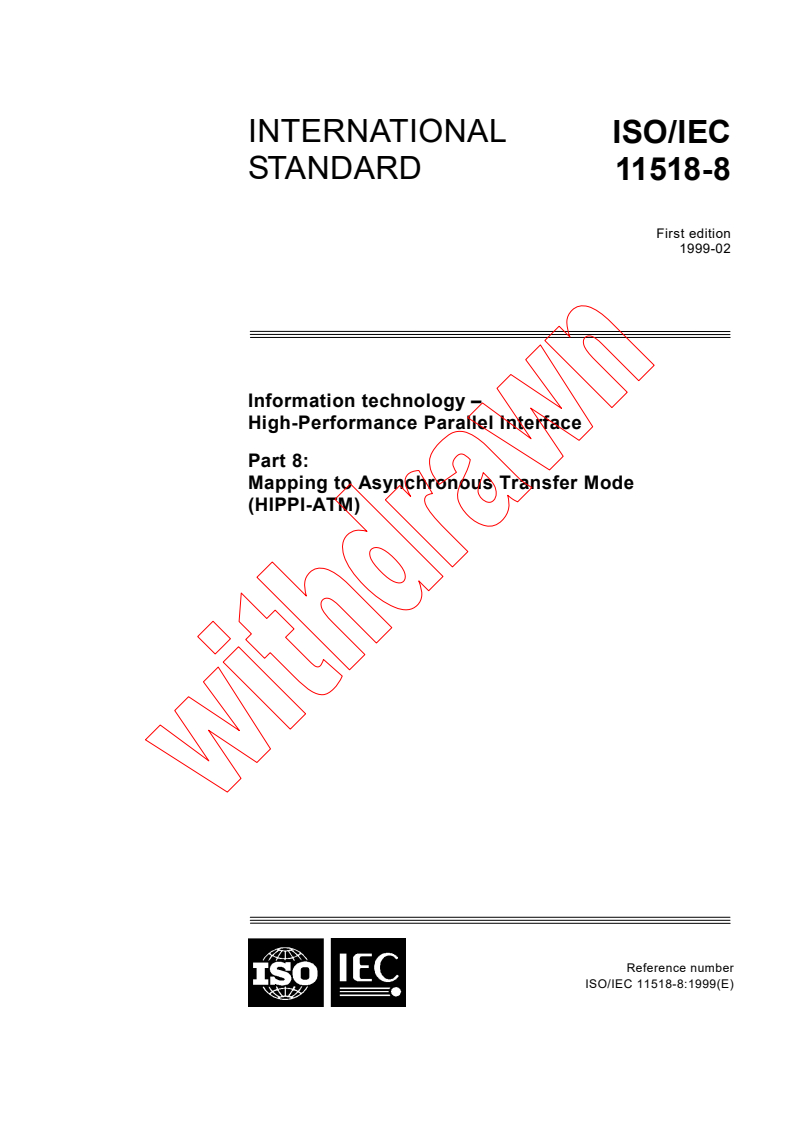
INTERNATIONAL
ISO/IEC
STANDARD
11518-8
First edition
1999-02
Information technology –
High-Performance Parallel Interface
Part 8:
Mapping to Asynchronous Transfer Mode
(HIPPI-ATM)
Reference number
INTERNATIONAL
ISO/IEC
STANDARD
11518-8
First edition
1999-02
Information technology –
High-Performance Parallel Interface
Part 8:
Mapping to Asynchronous Transfer Mode
(HIPPI-ATM)
ISO/IEC 1999
All rights reserved. Unless otherwise specified, no part of this publication may be reproduced or utilized in any form or by any
means, electronic or mechanical, including photocopying and microfilm, without permission in writing from the publisher.
ISO/IEC Copyright Office Case postale 56 CH-1211 Genève 20 Switzerland
• • •
PRICE CODE
K
For price, see current catalogue
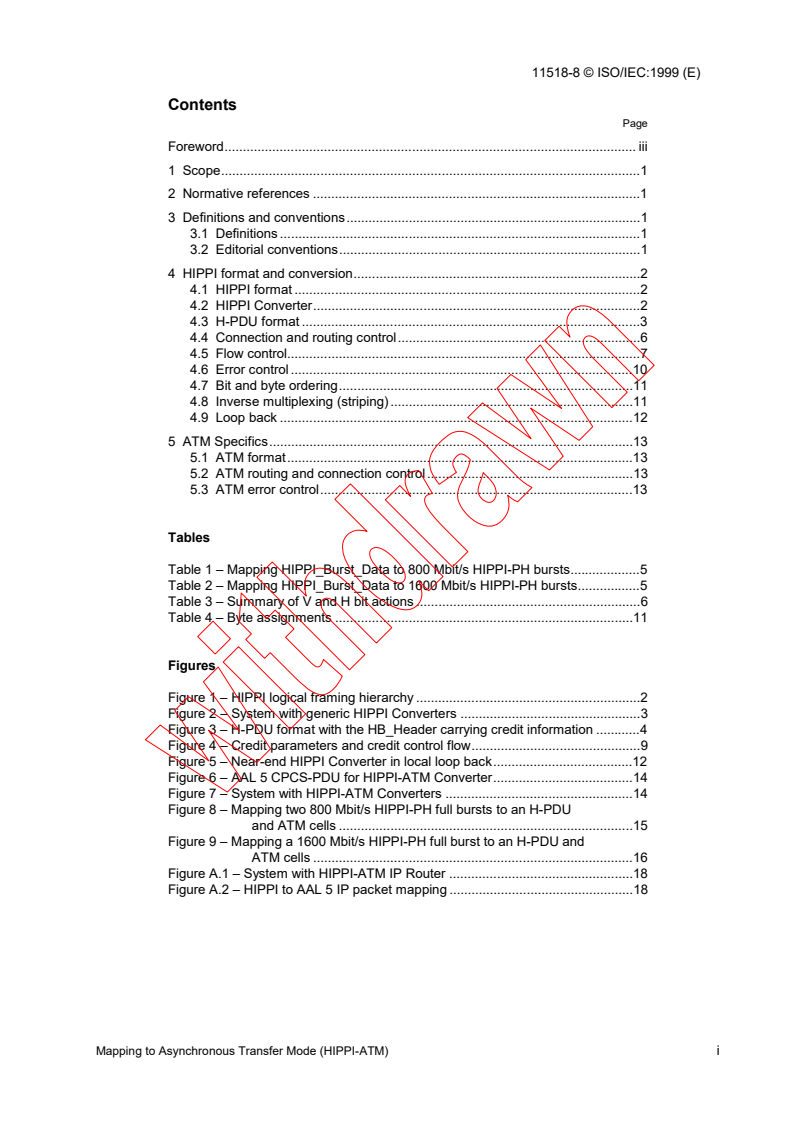
11518-8 © ISO/IEC:1999 (E)
Contents
Page
Foreword. iii
1 Scope.1
2 Normative references .1
3 Definitions and conventions.1
3.1 Definitions .1
3.2 Editorial conventions.1
4 HIPPI format and conversion.2
4.1 HIPPI format .2
4.2 HIPPI Converter.2
4.3 H-PDU format .3
4.4 Connection and routing control.6
4.5 Flow control.7
4.6 Error control .10
4.7 Bit and byte ordering.11
4.8 Inverse multiplexing (striping).11
4.9 Loop back .12
5 ATM Specifics.13
5.1 ATM format.13
5.2 ATM routing and connection control.13
5.3 ATM error control.13
Tables
Table 1 – Mapping HIPPI_Burst_Data to 800 Mbit/s HIPPI-PH bursts.5
Table 2 – Mapping HIPPI_Burst_Data to 1600 Mbit/s HIPPI-PH bursts.5
Table 3 – Summary of V and H bit actions .6
Table 4 – Byte assignments .11
Figures
Figure 1 – HIPPI logical framing hierarchy .2
Figure 2 – System with generic HIPPI Converters .3
Figure 3 – H-PDU format with the HB_Header carrying credit information .4
Figure 4 – Credit parameters and credit control flow.9
Figure 5 – Near-end HIPPI Converter in local loop back.12
Figure 6 – AAL 5 CPCS-PDU for HIPPI-ATM Converter.14
Figure 7 – System with HIPPI-ATM Converters .14
Figure 8 – Mapping two 800 Mbit/s HIPPI-PH full bursts to an H-PDU
and ATM cells .15
Figure 9 – Mapping a 1600 Mbit/s HIPPI-PH full burst to an H-PDU and
ATM cells .16
Figure A.1 – System with HIPPI-ATM IP Router .18
Figure A.2 – HIPPI to AAL 5 IP packet mapping .18
Mapping to Asynchronous Transfer Mode (HIPPI-ATM) i
11518-8 © ISO/IEC:1999 (E)
Annexes
A HIPPI-ATM IP Router .17
A.1 Overview.17
A.2 IP packet mapping.18
B Bibliography.19
ii Mapping to Asynchronous Transfer Mode (HIPPI-ATM)
11518-8 © ISO/IEC:1999 (E)
Information technology –
High-Performance Parallel Interface –
Part 8:
Mapping to Asynchronous Transfer Mode
(HIPPI-ATM)
Foreword
ISO (the International Organization for Standardization) and IEC (the
International Electrotechnical Commission) form the specialized system for
worldwide standardization. National bodies that are members of ISO or IEC
participate in the development of International Standards through technical
committees established by the respective organization to deal with particular
fields of technical activity. ISO and IEC technical committees collaborate in
fields of mutual interest. Other international organizations, governmental and
non-governmental, in liaison with ISO and IEC, also take part in the work.
In the field of information technology, ISO and IEC have established a joint
technical committee, ISO/IEC JTC 1. Draft International Standards adopted
by the joint technical committee are circulated to national bodies for voting.
Publication as an International Standard requires approval by at least 75% of
the national bodies casting a vote.
International Standard ISO/IEC 11518-8 was prepared by Joint Technical
Committee ISO/IEC JTC 1, Information technology, Subcommittee SC 25,
Interconnection of information technology equipment.
ISO/IEC 11518 consists of the following parts, under the general title
Information technology – High-Performance Parallel Interface:
– Part 1: Mechanical, electrical, and signalling protocol specification
(HIPPI-PH)
– Part 2: Framing Protocol (HIPPI-FP)
– Part 3: Encapsulation of ISO/IEC 8802-2 (IEEE Std 802.2) Logical Link
Control Protocol Data Units (HIPPI-LE)
– Part 4: Mapping of HIPPI to IPI device generic command sets (HIPPI-IPI)
– Part 5: Memory Interface (HIPPI-MI)
– Part 6: Physical Switch Control (HIPPI-SC)
– Part 8: Mapping to Asynchronous Transfer Mode (HIPPI-ATM)
– Part 9: Serial Specification (HIPPI-Serial)
Annexes A and B of this part of ISO/IEC 11518 are for information only.
Mapping to Asynchronous Transfer Mode (HIPPI-ATM) iii
11518-8 © ISO/IEC:1999 (E)
Information technology –
High-Performance Parallel Interface –
Part 8:
Mapping to Asynchronous Transfer Mode (HIPPI-ATM)
ITU-T Recommendation I.361-1993, B-ISDN
1 Scope
ATM Layer Specification
This part of ISO/IEC 11518 defines the frame
ITU-T Recommendation I.363-1993, B-ISDN
formats and protocol definitions for
ATM Adaptation Layer (AAL) Specification
encapsulation of High-Performance Parallel
Interface – Mechanical, Electrical, and
Signalling Protocol Specification (HIPPI-PH)
packets for transfer over Asynchronous
Transfer Mode (ATM) equipment, i.e., tunnelling
3 Definitions and conventions
through ATM, or for use with other media. An
informative annex describes an IP Router for
use between HIPPI and ATM systems.
3.1 Definitions
Physical layer specifications for transporting
For the purposes of this International Standard,
ATM cells are not specified. Both the
the following definitions apply.
800 Mbit/s (100 MByte/s) and 1600 Mbit/s
3.1.1 HB_Header: The eight-byte header of an
(200 MByte/s) HIPPI-PH options are supported.
H-PDU.
Transfers from an 800 Mbit/s HIPPI-PH, through
HIPPI-ATM, to a 1600 Mbit/s HIPPI-PH, and
3.1.2 H-PDU: A protocol data unit consisting of
vice versa, are supported.
a HB_Header, and possibly the data portion of
one or two HIPPI-PH bursts.
3.1.3 protocol data unit (PDU): The unit of
data transfer between communicating peer layer
2 Normative references
entities.
The following standards contain provisions
which, through reference in this text, constitute
3.2 Editorial conventions
provisions of this International Standard. At the
time of publication, the editions indicated were
In this part of ISO/IEC 11518, a number of
valid. All standards are subject to revision, and
conditions, mechanisms, parameters, or similar
parties to agreements based on this Inter-
terms are printed with the first letter of each
national standard are encouraged to investigate
word in uppercase and the rest lowercase (e.g.,
the possibility of applying the most recent
Pad). Any lowercase uses of these words have
editions of the standards listed below.
the normal technical English meaning.
ISO/IEC 11518-1:1995, High-Performance
In this standard the words byte and octet are
Parallel Interface - Part 1: Mechanical, electrical,
synonymous.
and signalling protocol specification (HIPPI-PH)
11518-8 © ISO/IEC:1999 (E)
In figure 2, the boxes labeled XX convert
4 HIPPI format and conversion
between the HIPPI-PH signals and the
intermediate media. The use of ATM as an
intermediate media is detailed in clause 5.
4.1 HIPPI format
Other intermediate media (e.g., FDDI or Fibre
Channel) may also be used to transport the
Figure 1 shows the HIPPI physical level format
H-PDUs, but specifics are not included in
as specified in ISO/IEC 11518-1, HIPPI-PH.
HIPPI-ATM.
HIPPI-PH signals are encapsulated in H-PDUs,
Connection Connection Connection
transferred transparently through the
Established Established Established
intermediate media, and reconstituted as
HIPPI-PH signals. There are no requirements
as to the format or data content of the HIPPI
Packet Packet Packet signals other than they shall meet the
specifications of ISO/IEC 11518-1, HIPPI-PH.
The use of HIPPI-FP [2], or other HIPPI upper
layer protocol, while not precluded, is not
required. Other than the delay through the
Burst Burst Burst
intermediate media equipment, the only
differences seen between the near-end HIPPI
Source signals and the signals received by the
far-end HIPPI Destination should be at most
256 words of 4 or 8 bytes each
some non-critical timing differences, and the
fact that the number of READY indications may
differ between the two ends.
Figure 1 – HIPPI logical framing hierarchy
After connections are made (see 4.4 for
connection details) the functions performed in
figure 2 include:
Once a connection is established a packet (or
multiple packets) can be sent from the Source
a) The HIPPI Source outputs a packet of data,
to the Destination. Each packet contains one or
with the packet composed of one or more
more bursts. Bursts contain 1 word to 256
bursts. There are no restrictions as to the size
words. The 800 Mbit/s HIPPI-PH option uses
or content of the packet, or to the inclusion or
4-byte words, the 1600 Mbit/s option uses
location of short bursts. Although not shown,
8-byte words. Bursts that contain less than
HIPPI switches as described in HIPPI-SC [1],
256 words are called short bursts. A packet
may be between the HIPPI devices – e.g.,
may contain no more than one short burst. A
between the near-end HIPPI-based device
short burst may be either the first burst, or the
(Source) and the HIPPI Converter (sending-
last burst of a multi-burst packet.
side) similarly for the far-end.
4.2 HIPPI Converter
Figure 2 shows HIPPI Converters in a
representative full-duplex system. HIPPI
switches, e.g., as described in HIPPI-SC [1],
may exist between the HIPPI-based devices
and the HIPPI Converters. For convenience in
reading this clause, the HIPPI Converter
sending-side is called the sending-side, and the
HIPPI Converter receiving-side is called the
receiving-side.
2 Mapping to Asynchronous Transfer Mode (HIPPI-ATM)
11518-8 © ISO/IEC:1999 (E)
N ear-end Far-end
HIPPI-based HIPPI HIPPI HIPPI-based
device device
Converter Converter
(Source) (Destination)
Transparent Transparent
(sending-side) (receiving-side)
Data Data
HIPPI
HIPPI
HIPPI-PH XX XX HIPPI-PH
HIPPI-PH HIPPI-PH
Intermediate
CONNECT,
CONNECT,
READY
READY Media
(Destination) (Source)
Transparent Transparent
(receiving-side) (sending-side)
Data Data
HIPPI
HIPPI
HIPPI-PH XX XX HIPPI-PH
HIPPI-PH HIPPI-PH
Figure 2 – System with generic HIPPI Converters
b) The sending-side shall assemble up to 4.3.1 HB_Header Word 0
2048 bytes of HIPPI-PH burst data received
An HB_Header passes control information
(in one or two bursts), with an HB_Header,
between HIPPI Converters. It may be sent by
into an H-PDU. Each H-PDU is then carried
itself, or with HIPPI data burst(s). The
through the intermediate media. An
HB_Header shall be the first eight bytes of the
intermediate media reverse direction path for
H-PDU. The fields in Word 0 are:
Credit information provides flow control similar
to the HIPPI READY signals. (See 4.5.)
V = Valid (bit 31)
V = 1 means that HB_Header Word 1
c) At the receiving-side, the H-PDUs are
contains valid information. (See the I bit for
recovered. Each H-PDU containing HIPPI
contents selection.)
data shall be translated by the receiving-side
V = 0 means that contents of HB_Header
into one or two HIPPI-PH bursts. H-PDUs
Word 1 shall be ignored.
without HIPPI data may be used for passing
control information. The HIPPI-PH signals
I = I-Field (bit 30) signifies which of two
from the HIPPI Converter receiving-side are
parameter sets is contained in HB_Header
equivalent to those generated by the original
Word 1 when V = 1.
HIPPI Source.
I = 1 means that a new connection is being
requested and Word 1 contains I-Field
4.3 H-PDU format
information.
I = 0 means that Word 1 contains credit and
A HIPPI-PH packet is composed of one or more
capability information. I = 0 shall be
data bursts. The data portion of one or two of
transmitted when V = 0.
these bursts, and an eight byte HB_Header
form an H-PDU. Control information may be
D = Disconnect (bit 29)
sent along with the HIPPI data, or in H-PDUs
D = 1 means that the near-end HIPPI Source
consisting of only the HB_Header. Figure 3
has deasserted the REQUEST signal,
shows the format of an H-PDU and an
breaking the connection. The receiving-side
HB_Header carrying credit information.
shall deassert the REQUEST signal
Mapping to Asynchronous Transfer Mode (HIPPI-ATM) 3
B-Bit, Credit
LLB
B-Bit, Credit
11518-8 © ISO/IEC:1999 (E)
breaking the connection to the far-end R = Reset (bit 25).
HIPPI Destination. If the H-PDU contains
R = 1 signals receiving-side to initialise itself.
HIPPI_Burst_Data, then the REQUEST
(See 4.5.2.)
signal shall be deasserted after transmitting
R = 0 requires no action by the receiving-side.
the burst(s).
H = HIPPI-significant (bit 23)
D = 0 requires no action by the receiving-side.
H = 1 means that this H-PDU contains
HIPPI_Burst_Data or HIPPI-PH state
PA = PACKET signal control (bits 28,27)
change information (i.e., any of I = 1, D = 1,
PA = 00 requires no action by the receiving-
PA ? 00, E = 1, R = 1, or L = 1).
side.
H = 0 means that the contents of this H-PDU
PA = 01 means that the receiving-side shall
do not affect the HIPPI receiving-side (i.e.,
assert the PACKET signal. If the H-PDU
this H-PDU contains only credit update
contains HIPPI_Burst_Data, then the
information for the sending-side). H-PDUs
PACKET signal shall be asserted before
without HIPPI-significant information (i.e.,
transmitting the burst(s).
with H = 0 in the HB_Header) are not flow
PA = 10 means that the receiving-side shall
controlled. An H-PDU with H = 0 may be
deassert the PACKET signal. If the H-PDU
transmitted by the sending-side regardless
contains HIPPI_Burst_Data, then the
of the value of its Credit_Count. The
PACKET signal shall be deasserted after
sending-side shall not decrement
transmitting the burst(s).
Credit_Count when transmitting an H-PDU
PA = 11 means that the receiving-side shall
with H = 0. A receiving-side shall not
assert the PACKET signal before
change the New_Credit value when
transmitting the burst, and then deassert the
processing an H-PDU with H = 0.
PACKET signal after transmitting the
burst(s).
Rsv = Reserved (bit 22) shall be transmitted as
zero, but shall not be checked at the receiver.
E = Error (bit 26)
E = 1 means that the sending-side detected a Burst_Length (bits 21-12) denotes the length of
parity or LLRC error in the data from the the HIPPI_Burst_Data field in 32-bit words, i.e.,
HIPPI Source. The receiving-side shall Burst_Length times 4 bytes.
force parity and/or LLRC errors in the
burst(s) being sent to the HIPPI Destination. H-PDU_Count (bits 11-0) is a running count,
E = 0 requires no action by the receiving-side. modulo 4096, of the number of H-PDUs with H
= 1 transmitted. See 4.6.2 for details on using
the H-PDU_Count to detect lost H-PDUs.
Byte 0Byte 1Byte 2Byte 3
15 7 0
Bit 31 23
Rsv Rsv Word 0
V ID PA ER H Burst_Length
H-PDU_Count
HB_Header
(8 bytes)
Word 1
BN Rsv Credit_Information
.
HIPPI
.
Burst data
HIPPI_Burst_Data (0 to 2048 bytes)
.
(0-2048
.
bytes)
Figure 3 – H-PDU format with the HB_Header carrying credit information
4 Mapping to Asynchronous Transfer Mode (HIPPI-ATM)
11518-8 © ISO/IEC:1999 (E)
4.3.2 HB_Header Word 1
– one short burst (< 1024 bytes), or
HB_Header Word 1 shall contain I-Field, or – one full burst (1024 bytes) if this is the last
credit and initialisation information, when V = 1, or only burst in the packet, or
or no information when V = 0. Figure 3 shows
– two full bursts (1024 bytes each for
the case where V = 1 (Valid) and I = 0 (Word 1
2048 bytes total).
contains credit information).
The H-PDUs from the sending-side of a
B = Break connection (bit 31)
HIPPI-ATM connected to a 1600 Mbit/s
B = 1 means that the far-end HIPPI
HIPPI-PH shall contain one of the following in
Destination has deasserted the CONNECT
the HIPPI_Burst_Data field:
signal to break the connection before
– one short burst (< 2048 bytes), or
receiving D = 1, i.e., unexpectedly
disconnected. The near-end HIPPI
– one full burst (2048 bytes)
Converter receiving-side shall pass this
indication to its local sending-side, which in
An H-PDU containing n bytes of
turn shall deassert the CONNECT signal to
HIPPI_Burst_Data, received by the receiving-
the near-end HIPPI Source. As noted in A.6
side of an HIPPI-ATM connected to an
of ISO/IEC 11518-1, HIPPI-PH, the near-
800 Mbit/s HIPPI-PH, shall be passed to the
end HIPPI Source may not see this
HIPPI-PH as shown in table 1.
indication, or associate it with the
connection that caused the indication.
Table 1 – Mapping HIPPI_Burst_Data to
B = 0 requires no action by the receiving-side.
800 Mbit/s HIPPI-PH bursts
N = Credit_Information (bit 30)
n (bytes) Convert HIPPI Burst_Data to:
N = 1 means that the Credit_Information is
≤ 1024 one short burst
New_Credit.
N = 0 means that the Credit_Information is
1024 one full burst
Initial_Credit.
the first data sent as a full
1025 to 2047 burst, remaining data sent as a
Rsv = Reserved (bits 29-20) shall be transmitted
short burst
as zeros, but shall not be checked at the
2048 two full bursts
receiver.
Credit_Information (bits 19-0) (See 4.5.1.)
4.3.3 Data fields An H-PDU containing n bytes of
HIPPI_Burst_Data, received by the receiving-
HIPPI_Burst_Data is the HIPPI Source
side of an HIPPI-ATM connected to a 1600
information from one or two HIPPI-PH bursts.
Mbit/s HIPPI-PH, shall be passed to the
Note that bursts on 800 Mbit/s HIPPI-PH contain
HIPPI-PH as shown in table 2.
from one to 256 32-bit words (four bytes to
1024 bytes), and bursts on 1600 Mbit/s Table 2 – Mapping HIPPI_Burst_Data to
HIPPI-PH contain from one 64-bit word to 1600 Mbit/s HIPPI-PH bursts
256 64-bit words (eight bytes to 2048 bytes).
The individual HIPPI-PH bursts are transferred
n (bytes) Convert HIPPI Burst_Data to:
as entities, and shall not be split between
≤ 2048 one short burst
multiple H-PDUs.
2048 one full burst
The H-PDUs from the sending-side of a
HIPPI-ATM connected to an 800 Mbit/s
HIPPI-PH shall contain one of the following in
the HIPPI_Burst_Data field:
Mapping to Asynchronous Transfer Mode (HIPPI-ATM) 5
11518-8 © ISO/IEC:1999 (E)
4.3.4 Processing H-PDUs based on V and H the intermediate media may be independent of
bits the HIPPI equipment making and breaking
connections. For example, the intermediate
The V bit in the HB_Header tells the receiving- media connection may last across multiple
side if HB_Header Word 1 contains credit packets and for a long time, as in the case of
information that should be passed to its local ATM. The near-end and far-end HIPPI
sending-side. The H bit in the HB_Header tells Converters are also assumed to be independent
the receiving-side if the H-PDU contains HIPPI of each other to avoid the latency of the
data, or if HB_Header Word 0 contains HIPPI intermediate media becoming part of the
state information, for processing by this connection setup time. These separate
receiving-side . Table 3 is a summary of the connections allow a system to send small
actions taken for the different combinations of packets composed of a single H-PDU, or a
the V and H bits. V = 0 and H = 0 is an invalid small number of H-PDUs, in a store-and-
combination. forward fashion, with the connection breaking
on one link while the packet is being forwarded
on the next link.
4.4 Connection and routing control
For example, it is reasonable to expect a HIPPI
In relation to figure 2, an end-to-end connection Source to make a connection to its local HIPPI
is actually composed of three separate Converter, send a short packet (e.g., 64 kBytes)
connections. The connection between the and then break the connection. In this example,
HIPPI-based device and the HIPPI Converter the HIPPI Converter would forward the
shall be as specified by ISO/IEC 11518-1, connection, packet, and disconnection over the
HIPPI-PH, i.e., by the HIPPI REQUEST and intermediate media. If the intermediate media
CONNECT signals and the I-Field. covers a large distance (e.g., an ATM link) then
there may be several operations and H-PDUs in
NOTE – HIPPI switches between the HIPPI-
flight at any one time. When the far-end HIPPI
based devices and the HIPPI Converters may
Converter receives a HIPPI connection
use the I-Field for routing and control as
sequence, it shall make a connection to the far-
described in HIPPI-SC [1]
end HIPPI-based device, send the packet, and
then disconnect from the far-end HIPPI-based
The connection across an ATM intermediate
device.
media is specified in 5.2. Connections, or
passing of H-PDUs, across other intermediate
If a parity error occurred on an I-Field from the
media shall be as specified for the particular
HIPPI Source to the near-end sending-side, the
media.
HIPPI Converter shall immediately reject the
connection and not send an H-PDU.
These connections are separated for
performance reasons. The connection across
Table 3 – Summary of V and H bit actions
V and H bits Action
01 10 11
√√ Sending-side increments the H-PDU_Count in the H-PDU
√√√ Sending-side can transmit the H-PDU when Credit_Count ≠ 0
√ Sending-side can transmit the H-PDU when Credit_Count = 0
√√ Sending-side decrements Credit_Count when it transmits the H-PDU
√√ Receiving-side passes Word 1 to its local sending-side
Receiving-side processes Word 0 and burst data, and increments New_Credit
√√
when done
6 Mapping to Asynchronous Transfer Mode (HIPPI-ATM)
11518-8 © ISO/IEC:1999 (E)
If H-PDUs cannot be transferred across the 4.5 Flow control
intermediate media for whatever reason (e.g., a
connection cannot be established) and the As with the connection control, the flow control
HIPPI-based device Source tries to make a is also treated as three separate entities. The
connection to the sending-side, then the function of the flow control mechanisms is to
sending-side shall immediately reject the provide a way for the data receivers to inform
connection. the data transmitters of the data receivers ability
to accept data, e.g., how much receive buffer
If a connection(s) exists between the HIPPI space is available.
Converter and a HIPPI-based device, and the
state of the intermediate media unexpectedly The flow control between the HIPPI-based
changes such that H-PDUs can no longer be device and the HIPPI Converter shall be as
transferred across the intermediate media, then specified by ISO/IEC 11518-1, HIPPI-PH, i.e.,
the HIPPI Converter sending-side shall break by HIPPI READY indications.
any existing connections to the HIPPI-based
device Source. Disconnection from the HIPPI- A credit mechanism provides positive flow
based Destination shall occur after sending as control across the intermediate media to prevent
much data as possible from the receiving-side. buffer overflow at the receiving-side. The credit
is separate and independent of any flow control
If the receiving-side is unable to establish a
mechanism in the intermediate media, e.g., to
connection with the requested HIPPI-based
pace the insertion of cells into the ATM
device, it shall time out and discard any packet
equipment, or to prevent cell loss within the
information associated with this connection
ATM equipment. The credit is also separate
request.
and independent of the HIPPI READY pulses
controlling the flow between the HIPPI end
If the HIPPI Converter receiving-side receives a
nodes and the HIPPI Converters.
Rejected connection sequence (see annex A.7
of ISO/IEC 11518-1, HIPPI-PH) while trying to
The flow of H-PDUs is paced by the receiving-
establish a connection, it may retry the
side. The receiving-side sends an Initial_Credit
connection at a later time. If the HIPPI
value to the sending-side. This value denotes
Converter receiving-side is unable to establish a
the capability of the receiving-side to accept
connection with the requested HIPPI-based
H-PDUs, e.g., one credit for each 1024-byte
device, it shall time out and discard any packet
HIPPI burst. The sending-side now has
information associated with this connection
permission to send that number of H-PDUs to
request. The default value of this time out
the receiving-side.
period shall be 3 seconds. Note that the
sending-side will be unaware of these actions
As the receiving-side processes the H-PDUs,
and will need to use higher layer protocols for
and forwards the bursts to the HIPPI
recovery.
Destination, it frees up buffers. The receiving-
side notifies the sending-side of the now free
If the sending-side does not receive a credit
buffers by sending credit updates.
update for 15 seconds, then the intermediate
media link is assumed to be dead. The
H-PDUs without HIPPI-significant information
sending-side shall break any existing
(i.e., containing only credit update information,
connections with the HIPPI-based device
H = 0) are not flow controlled. (See 4.3.1 and
Source, and shall reinitialise the intermediate
4.3.4.)
media link as specified in 4.5.2.
As noted in ISO/IEC 11518-1, HIPPI-PH,
approximately one 1024-byte receive buffer is
required for each kilometre of distance to
sustain the full 800 Mbit/s HIPPI bandwidth.
Fewer buffers would be needed for slower links,
e.g., if the maximum bandwidth is limited to
100 Mbit/s then one buffer would be needed for
Mapping to Asynchronous Transfer Mode (HIPPI-ATM) 7
11518-8 © ISO/IEC:1999 (E)
each 8 km of distance to sustain the 100 Mbit/s 4.5.2 Initialising credit and other parameters
rate. In terms of a bandwidth-delay product:
Figure 4 shows the credit parameters in HIPPI
n ≥ 0,12 x BW x RTT
Converters separated by an intermediate media,
where:
and provides references for the information flow.
n = number of buffers, or credits, needed to
sustain BW The initialisation process starts by the near-end
BW = data transfer rate (in Mbit/s) sending-side:
RTT = round trip delay time (in milliseconds)
set Credit_Count = 1;
set H-PDU_Count = 0;
4.5.1 Credit parameters
send an H-PDU with R = 1 and H = 1 in the
HB_Header.
Operations on the credit values shall be done
Any HIPPI data within the sending-side shall be
with two's complement arithmetic. The sending-
discarded. Passing the initialisation H-PDU is
side shall use the following credit parameters:
shown as (A) in figure 4.
– Credit_Count – The current number of
receiving-side buffers available. The
Upon receiving this H-PDU with R = 1 and
Credit_Count shall be decremented by the
H = 1, the far-end receiving-side shall:
sending-side for each H-PDU with H = 1
initialise its logic;
transmitted. The sending-side shall not send
initialise its buffers;
H-PDUs with H = 1 when Credit_Count = 0.
set New_Credit = 0;
The Credit_Count value shall be 20 bits in
set H-PDU_Count = 0;
length. (See 4.3.1 and 4.3.4 for operations
set an appropriate Initial_Credit value.
with H = 0.)
This Initial_Credit value is then passed to the
– Old_Credit – The previous New_Credit
far-end sending-side. This is shown as (B) in
value received from the receiving-side. The
figure 4. Any HIPPI data within the receiving-
Old_Credit value shall be ten bits in length.
side shall be discarded.
The receiving-side shall use the following credit
The far-end sending-side shall form up an
parameters:
HB_Header:
– Initial_Credit – The number of 1032-byte
set V = 1;
H-PDUs that can be accepted by the
set I = 0;
receiving-side without buffer overflow. The
set H = 1 if this HB_Header also contains
Initial_Credit value shall be 20 bits in length.
HIPPI state change information or
Burst_Length ≠ 0;
– New_Credit – The number of buffers made
set N = 0;
available since the Initial_Credit was sent.
set Credit_Information = Initi
...
Questions, Comments and Discussion
Ask us and Technical Secretary will try to provide an answer. You can facilitate discussion about the standard in here.
Loading comments...