

IEC 60335-2-72:2016
(Main)Household and similar electrical appliances - Safety - Part 2-72: Particular requirements for floor treatment machines with or without traction drive, for commercial use
General Information
- Abstract
IEC 60335-2-72:2016 deals with the safety of powered ride-on and powered walk-behind machines intended for commercial indoor or outdoor use for the following applications: sweeping, scrubbing, wet or dry pick-up, polishing, application of wax, sealing products and powder based detergents and shampooing of floors with an artificial surface. Their cleaning motion is more linear than lateral or periodic. This standard applies to machines for commercial use. The following list, although not comprehensive, gives an indication of locations that are included in the scope:
- public use areas such as hotels, schools, hospitals;
- industrial locations, for example factories and manufacturing shops;
- retail outlets, for example shops and supermarkets;
- businesss premises, for example offices and banks and all uses other than normal housekeeping purposes. They may be equipped with a traction drive system. The following power systems are covered:
- internal combustion engines,
- mains powered motors up to a rated voltage of 250 V for single-phase appliances and 480 V for other appliances and
- battery powered motors. Battery powered machines may be equipped with a built-in battery charger. This fourth edition cancels and replaces the third edition published in 2012. It constitutes a technical revision. This edition includes the following significant technical changes with respect to the previous edition (minor changes are not listed):
- the title has been changed for better distinction with regard to IEC 60335-2-67;
- the scope has been revised editorially to avoid misunderstandings;
- Clause 3 has been revised with regard to the requirements revised;
- the standard has been revised in general and updated regarding state-of-the-art, as far as necessary, in particular some changes have been made to Clauses 15, 22, and 25;
- the markings and instructions (Clause 7) have been revised basically;
- a new Annex DD Emission of acoustical noise was added and a new Annex EE Emission of vibration was added. The attention of National Committees is drawn to the fact that equipment manufacturers and testing organizations may need a transitional period following publication of a new, amended or revised IEC publication in which to make products in accordance with the new requirements and to equip themselves for conducting new or revised tests. It is the recommendation of the committee that the content of this standard be adopted for implementation nationally not earlier than 12 months or later than 36 months from the date of publication. Key words: Floor treatment machines, Walk-behind machines, powered ride-on machines, Traction drive.
This publication is to be read in conjunction with IEC 60335-1:2010.
- Status
- Published
- Publication Date
- 17-May-2016
- Technical Committee
- SC 61J - Safety of electrical motor-operated cleaning appliances for commercial use
- Drafting Committee
- MT 1 - TC 61/SC 61J/MT 1
- Current Stage
- DELPUB - Deleted Publication
- Start Date
- 12-Jul-2021
- Completion Date
- 01-Jul-2019
Buy Documents
IEC 60335-2-72:2016 - Household and similar electrical appliances - Safety - Part 2-72: Particular requirements for floor treatment machines with or without traction drive, for commercial use Released:5/18/2016
IEC 60335-2-72:2016 Overview
IEC 60335-2-72:2016 is an international standard developed by the International Electrotechnical Commission (IEC) that specifies safety requirements for floor treatment machines designed for commercial use. This includes powered ride-on and walk-behind machines, equipped with or without traction drive systems, intended for indoor and outdoor applications such as sweeping, scrubbing, polishing, waxing, sealing, and shampooing floors with artificial surfaces.
The standard is essential for ensuring the safe design, construction, and operation of these machines across various commercial environments, including hotels, schools, hospitals, factories, retail outlets, and office buildings. It applies to machines powered by internal combustion engines, mains electricity, or batteries-covering a wide range of power input types and voltages.
IEC 60335-2-72:2016 represents the fourth edition of this standard, bringing major technical revisions that reflect the latest state of the art and regulatory best practices in safety engineering for commercial cleaning machines. It must be used alongside IEC 60335-1:2010, which provides general safety requirements for household and similar electrical appliances.
Key Topics Covered
- Scope and Applications: Covers powered floor treatment machines for commercial settings, detailing applications like sweeping, scrubbing, and polishing.
- Power Systems: Addresses machines powered by internal combustion engines, mains voltage (up to 250 V single-phase or 480 V multi-phase), and battery-powered systems, including built-in chargers.
- Safety Requirements: Includes clauses on protection against electric shock, prevention of mechanical hazards, overload protection, moisture resistance, and electrical insulation.
- Marking and Instructions: Sets requirements for clear, correct labeling and user instructions to ensure safe operation and maintenance.
- Noise and Vibration Emission: Introduces new informative annexes (Annex DD and EE) that provide guidance on measuring acoustical noise and vibration emissions-a key factor in operator safety and comfort.
- Mechanical and Electrical Testing: Defines test procedures related to mechanical strength, stability, leakage current, electric strength, and endurance to ensure reliability under commercial use conditions.
- Special Features: Includes additional requirements for traction drive systems and performance under abnormal conditions.
Practical Applications
IEC 60335-2-72:2016 is crucial for manufacturers, testing laboratories, certification bodies, and commercial users aiming to:
- Design Compliant Machines: Use the standard’s specific safety criteria to engineer floor treatment machines suitable for commercial use, ensuring legal and safety compliance worldwide.
- Certify Safety and Performance: Facilitate the testing and certification process by adhering to established test methods, such as leakage current measurement and mechanical hazard assessments.
- Improve User Safety: Inform the development of clear user instructions and safety labels, minimizing risks related to electrical hazards, mechanical injury, or exposure to noise and vibration.
- Maintain Equipment Reliability: Support durability through defined endurance and moisture resistance tests, helping machines perform reliably in demanding commercial environments.
- Reduce Environmental Impact: Control noise and vibration emissions, improving workplace conditions and contributing to occupational health.
Related IEC Standards
- IEC 60335-1:2010 – General safety requirements for household and similar electrical appliances, which form the foundational standard used in conjunction with IEC 60335-2-72.
- IEC 60335-2-67 – Safety requirements for floor treatment machines for household use, providing complementary specifications distinct from commercial applications.
- IEC 60335-2-29 – Safety of rechargeable-battery-powered appliances, referenced for battery charger testing methods.
- IEC 60335-2 Series – A wider series of standards covering various motor-operated electrical appliances with specialized safety requirements.
Keywords
Floor treatment machines, commercial floor cleaning machines, powered ride-on machines, walk-behind machines, traction drive safety, electric floor scrubbers, industrial cleaning equipment safety, battery-powered cleaning machines, IEC safety standards for commercial use, acoustic noise emission, vibration emission, commercial electrical appliance safety.
Relations
- Effective Date
- 05-Sep-2023
- Effective Date
- 05-Sep-2023
Buy Documents
IEC 60335-2-72:2016 - Household and similar electrical appliances - Safety - Part 2-72: Particular requirements for floor treatment machines with or without traction drive, for commercial use Released:5/18/2016
Frequently Asked Questions
IEC 60335-2-72:2016 is a standard published by the International Electrotechnical Commission (IEC). Its full title is "Household and similar electrical appliances - Safety - Part 2-72: Particular requirements for floor treatment machines with or without traction drive, for commercial use". This standard covers: IEC 60335-2-72:2016 deals with the safety of powered ride-on and powered walk-behind machines intended for commercial indoor or outdoor use for the following applications: sweeping, scrubbing, wet or dry pick-up, polishing, application of wax, sealing products and powder based detergents and shampooing of floors with an artificial surface. Their cleaning motion is more linear than lateral or periodic. This standard applies to machines for commercial use. The following list, although not comprehensive, gives an indication of locations that are included in the scope: - public use areas such as hotels, schools, hospitals; - industrial locations, for example factories and manufacturing shops; - retail outlets, for example shops and supermarkets; - businesss premises, for example offices and banks and all uses other than normal housekeeping purposes. They may be equipped with a traction drive system. The following power systems are covered: - internal combustion engines, - mains powered motors up to a rated voltage of 250 V for single-phase appliances and 480 V for other appliances and - battery powered motors. Battery powered machines may be equipped with a built-in battery charger. This fourth edition cancels and replaces the third edition published in 2012. It constitutes a technical revision. This edition includes the following significant technical changes with respect to the previous edition (minor changes are not listed): - the title has been changed for better distinction with regard to IEC 60335-2-67; - the scope has been revised editorially to avoid misunderstandings; - Clause 3 has been revised with regard to the requirements revised; - the standard has been revised in general and updated regarding state-of-the-art, as far as necessary, in particular some changes have been made to Clauses 15, 22, and 25; - the markings and instructions (Clause 7) have been revised basically; - a new Annex DD Emission of acoustical noise was added and a new Annex EE Emission of vibration was added. The attention of National Committees is drawn to the fact that equipment manufacturers and testing organizations may need a transitional period following publication of a new, amended or revised IEC publication in which to make products in accordance with the new requirements and to equip themselves for conducting new or revised tests. It is the recommendation of the committee that the content of this standard be adopted for implementation nationally not earlier than 12 months or later than 36 months from the date of publication. Key words: Floor treatment machines, Walk-behind machines, powered ride-on machines, Traction drive. This publication is to be read in conjunction with IEC 60335-1:2010.
IEC 60335-2-72:2016 deals with the safety of powered ride-on and powered walk-behind machines intended for commercial indoor or outdoor use for the following applications: sweeping, scrubbing, wet or dry pick-up, polishing, application of wax, sealing products and powder based detergents and shampooing of floors with an artificial surface. Their cleaning motion is more linear than lateral or periodic. This standard applies to machines for commercial use. The following list, although not comprehensive, gives an indication of locations that are included in the scope: - public use areas such as hotels, schools, hospitals; - industrial locations, for example factories and manufacturing shops; - retail outlets, for example shops and supermarkets; - businesss premises, for example offices and banks and all uses other than normal housekeeping purposes. They may be equipped with a traction drive system. The following power systems are covered: - internal combustion engines, - mains powered motors up to a rated voltage of 250 V for single-phase appliances and 480 V for other appliances and - battery powered motors. Battery powered machines may be equipped with a built-in battery charger. This fourth edition cancels and replaces the third edition published in 2012. It constitutes a technical revision. This edition includes the following significant technical changes with respect to the previous edition (minor changes are not listed): - the title has been changed for better distinction with regard to IEC 60335-2-67; - the scope has been revised editorially to avoid misunderstandings; - Clause 3 has been revised with regard to the requirements revised; - the standard has been revised in general and updated regarding state-of-the-art, as far as necessary, in particular some changes have been made to Clauses 15, 22, and 25; - the markings and instructions (Clause 7) have been revised basically; - a new Annex DD Emission of acoustical noise was added and a new Annex EE Emission of vibration was added. The attention of National Committees is drawn to the fact that equipment manufacturers and testing organizations may need a transitional period following publication of a new, amended or revised IEC publication in which to make products in accordance with the new requirements and to equip themselves for conducting new or revised tests. It is the recommendation of the committee that the content of this standard be adopted for implementation nationally not earlier than 12 months or later than 36 months from the date of publication. Key words: Floor treatment machines, Walk-behind machines, powered ride-on machines, Traction drive. This publication is to be read in conjunction with IEC 60335-1:2010.
IEC 60335-2-72:2016 is classified under the following ICS (International Classification for Standards) categories: 97.080 - Cleaning appliances. The ICS classification helps identify the subject area and facilitates finding related standards.
IEC 60335-2-72:2016 has the following relationships with other standards: It is inter standard links to IEC 60335-2-72:2012, IEC 60335-2-72:2021. Understanding these relationships helps ensure you are using the most current and applicable version of the standard.
IEC 60335-2-72:2016 is available in PDF format for immediate download after purchase. The document can be added to your cart and obtained through the secure checkout process. Digital delivery ensures instant access to the complete standard document.
Standards Content (Sample)
IEC 60335-2-72 ®
Edition 4.0 2016-05
INTERNATIONAL
STANDARD
NORME
INTERNATIONALE
colour
inside
Household and similar electrical appliances – Safety –
Part 2-72: Particular requirements for floor treatment machines with or without
traction drive, for commercial use
Appareils électrodomestiques et analogues – Sécurité –
Partie 2-72: Exigences particulières pour les machines de traitement des sols
avec ou sans commande de dispositif de déplacement, à usage commercial
All rights reserved. Unless otherwise specified, no part of this publication may be reproduced or utilized in any form
or by any means, electronic or mechanical, including photocopying and microfilm, without permission in writing from
either IEC or IEC's member National Committee in the country of the requester. If you have any questions about IEC
copyright or have an enquiry about obtaining additional rights to this publication, please contact the address below or
your local IEC member National Committee for further information.
Droits de reproduction réservés. Sauf indication contraire, aucune partie de cette publication ne peut être reproduite
ni utilisée sous quelque forme que ce soit et par aucun procédé, électronique ou mécanique, y compris la photocopie
et les microfilms, sans l'accord écrit de l'IEC ou du Comité national de l'IEC du pays du demandeur. Si vous avez des
questions sur le copyright de l'IEC ou si vous désirez obtenir des droits supplémentaires sur cette publication, utilisez
les coordonnées ci-après ou contactez le Comité national de l'IEC de votre pays de résidence.
IEC Central Office Tel.: +41 22 919 02 11
3, rue de Varembé Fax: +41 22 919 03 00
CH-1211 Geneva 20 info@iec.ch
Switzerland www.iec.ch
About the IEC
The International Electrotechnical Commission (IEC) is the leading global organization that prepares and publishes
International Standards for all electrical, electronic and related technologies.
About IEC publications
The technical content of IEC publications is kept under constant review by the IEC. Please make sure that you have the
latest edition, a corrigenda or an amendment might have been published.
IEC Catalogue - webstore.iec.ch/catalogue Electropedia - www.electropedia.org
The stand-alone application for consulting the entire The world's leading online dictionary of electronic and
bibliographical information on IEC International Standards, electrical terms containing 20 000 terms and definitions in
Technical Specifications, Technical Reports and other English and French, with equivalent terms in 15 additional
documents. Available for PC, Mac OS, Android Tablets and languages. Also known as the International Electrotechnical
iPad. Vocabulary (IEV) online.
IEC publications search - www.iec.ch/searchpub IEC Glossary - std.iec.ch/glossary
The advanced search enables to find IEC publications by a 65 000 electrotechnical terminology entries in English and
variety of criteria (reference number, text, technical French extracted from the Terms and Definitions clause of
committee,…). It also gives information on projects, replaced IEC publications issued since 2002. Some entries have been
and withdrawn publications. collected from earlier publications of IEC TC 37, 77, 86 and
CISPR.
IEC Just Published - webstore.iec.ch/justpublished
Stay up to date on all new IEC publications. Just Published IEC Customer Service Centre - webstore.iec.ch/csc
details all new publications released. Available online and If you wish to give us your feedback on this publication or
also once a month by email. need further assistance, please contact the Customer Service
Centre: csc@iec.ch.
A propos de l'IEC
La Commission Electrotechnique Internationale (IEC) est la première organisation mondiale qui élabore et publie des
Normes internationales pour tout ce qui a trait à l'électricité, à l'électronique et aux technologies apparentées.
A propos des publications IEC
Le contenu technique des publications IEC est constamment revu. Veuillez vous assurer que vous possédez l’édition la
plus récente, un corrigendum ou amendement peut avoir été publié.
Catalogue IEC - webstore.iec.ch/catalogue Electropedia - www.electropedia.org
Application autonome pour consulter tous les renseignements
Le premier dictionnaire en ligne de termes électroniques et
bibliographiques sur les Normes internationales,
électriques. Il contient 20 000 termes et définitions en anglais
Spécifications techniques, Rapports techniques et autres
et en français, ainsi que les termes équivalents dans 15
documents de l'IEC. Disponible pour PC, Mac OS, tablettes
langues additionnelles. Egalement appelé Vocabulaire
Android et iPad.
Electrotechnique International (IEV) en ligne.
Recherche de publications IEC - www.iec.ch/searchpub
Glossaire IEC - std.iec.ch/glossary
La recherche avancée permet de trouver des publications IEC 65 000 entrées terminologiques électrotechniques, en anglais
en utilisant différents critères (numéro de référence, texte, et en français, extraites des articles Termes et Définitions des
comité d’études,…). Elle donne aussi des informations sur les publications IEC parues depuis 2002. Plus certaines entrées
projets et les publications remplacées ou retirées. antérieures extraites des publications des CE 37, 77, 86 et
CISPR de l'IEC.
IEC Just Published - webstore.iec.ch/justpublished
Service Clients - webstore.iec.ch/csc
Restez informé sur les nouvelles publications IEC. Just
Published détaille les nouvelles publications parues. Si vous désirez nous donner des commentaires sur cette
Disponible en ligne et aussi une fois par mois par email. publication ou si vous avez des questions contactez-nous:
csc@iec.ch.
IEC 60335-2-72 ®
Edition 4.0 2016-05
INTERNATIONAL
STANDARD
NORME
INTERNATIONALE
colour
inside
Household and similar electrical appliances – Safety –
Part 2-72: Particular requirements for floor treatment machines with or without
traction drive, for commercial use
Appareils électrodomestiques et analogues – Sécurité –
Partie 2-72: Exigences particulières pour les machines de traitement des sols
avec ou sans commande de dispositif de déplacement, à usage commercial
INTERNATIONAL
ELECTROTECHNICAL
COMMISSION
COMMISSION
ELECTROTECHNIQUE
INTERNATIONALE
ICS 97.080 ISBN 978-2-83223-313-9
– 2 – IEC 60335-2-72:2016 © IEC 2016
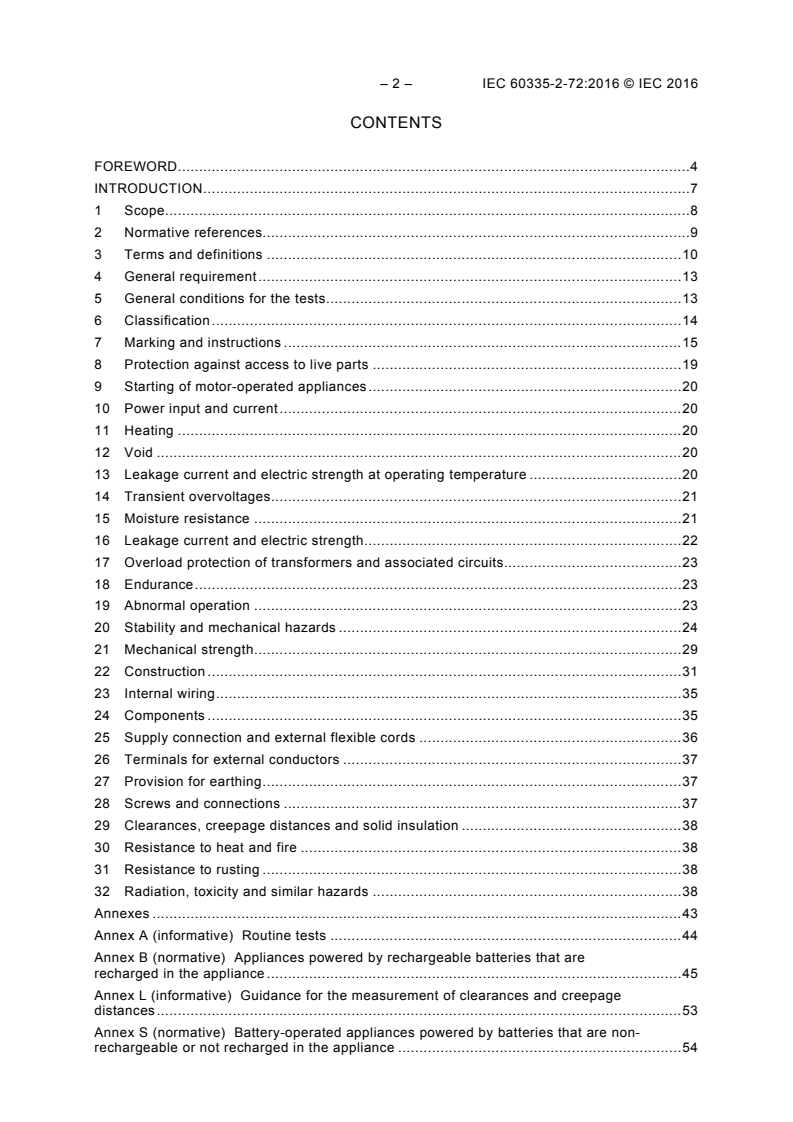
CONTENTS
FOREWORD . 4
INTRODUCTION . 7
1 Scope . 8
2 Normative references. 9
3 Terms and definitions . 10
4 General requirement . 13
5 General conditions for the tests . 13
6 Classification . 14
7 Marking and instructions . 15
8 Protection against access to live parts . 19
9 Starting of motor-operated appliances . 20
10 Power input and current . 20
11 Heating . 20
12 Void . 20
13 Leakage current and electric strength at operating temperature . 20
14 Transient overvoltages. 21
15 Moisture resistance . 21
16 Leakage current and electric strength . 22
17 Overload protection of transformers and associated circuits . 23
18 Endurance . 23
19 Abnormal operation . 23
20 Stability and mechanical hazards . 24
21 Mechanical strength . 29
22 Construction . 31
23 Internal wiring . 35
24 Components . 35
25 Supply connection and external flexible cords . 36
26 Terminals for external conductors . 37
27 Provision for earthing . 37
28 Screws and connections . 37
29 Clearances, creepage distances and solid insulation . 38
30 Resistance to heat and fire . 38
31 Resistance to rusting . 38
32 Radiation, toxicity and similar hazards . 38
Annexes . 43
Annex A (informative) Routine tests . 44
Annex B (normative) Appliances powered by rechargeable batteries that are
recharged in the appliance . 45
Annex L (informative) Guidance for the measurement of clearances and creepage
distances . 53
Annex S (normative) Battery-operated appliances powered by batteries that are non-
rechargeable or not recharged in the appliance . 54
Annex AA (normative) Precast paving slabs . 58
Annex BB (normative) Requirements for internal combustion engine powered
machines using liquefied petroleum gas (LPG) . 59
Annex CC (normative) Falling-object protective structures (FOPS) – Dynamic test and
performance requirements . 62
Annex DD (informative) Emission of acoustical noise . 65
Annex EE (informative) Emission of vibration . 68
Bibliography . 69
Figure 101 – Impact test apparatus . 39
Figure 102 – Apparatus for testing the abrasion resistance of current-carrying hoses . 40
Figure 103 – Apparatus for testing the resistance to flexing of current-carrying hoses . 41
Figure 104 – Configuration of the hose for the freezing treatment . 41
Figure 105 – Flexing positions for the hose after removal from the freezing cabinet . 42
Figure 106 – Warning symbol: Do not inhale exhaust fumes . 42
Figure B.101 – Forms of constructions for cleaning machines covered by Annex B . 46
Figure B.102 – Circuit for testing battery chargers (taken from IEC 60335-2-29) . 52
Figure CC.1 – Satisfactory protection by the overhead guard . 63
Figure CC.2 – Admissible deformation when the overhead guard is supported at all
sides . 64
Figure CC.3 – Admissible deformation when the overhead guard is supported at one side . 64
Table 12 – Pull force and torque . 37
Table DD.1 – Determination of uncertainty . 67
– 4 – IEC 60335-2-72:2016 © IEC 2016
INTERNATIONAL ELECTROTECHNICAL COMMISSION
____________
HOUSEHOLD AND SIMILAR ELECTRICAL APPLIANCES –
SAFETY –
Part 2-72: Particular requirements for floor treatment machines
with or without traction drive, for commercial use
FOREWORD
1) The International Electrotechnical Commission (IEC) is a worldwide organization for standardization comprising
all national electrotechnical committees (IEC National Committees). The object of IEC is to promote
international co-operation on all questions concerning standardization in the electrical and electronic fields. To
this end and in addition to other activities, IEC publishes International Standards, Technical Specifications,
Technical Reports, Publicly Available Specifications (PAS) and Guides (hereafter referred to as “IEC
Publication(s)”). Their preparation is entrusted to technical committees; any IEC National Committee interested
in the subject dealt with may participate in this preparatory work. International, governmental and non-
governmental organizations liaising with the IEC also participate in this preparation. IEC collaborates closely
with the International Organization for Standardization (ISO) in accordance with conditions determined by
agreement between the two organizations.
2) The formal decisions or agreements of IEC on technical matters express, as nearly as possible, an international
consensus of opinion on the relevant subjects since each technical committee has representation from all
interested IEC National Committees.
3) IEC Publications have the form of recommendations for international use and are accepted by IEC National
Committees in that sense. While all reasonable efforts are made to ensure that the technical content of IEC
Publications is accurate, IEC cannot be held responsible for the way in which they are used or for any
misinterpretation by any end user.
4) In order to promote international uniformity, IEC National Committees undertake to apply IEC Publications
transparently to the maximum extent possible in their national and regional publications. Any divergence
between any IEC Publication and the corresponding national or regional publication shall be clearly indicated in
the latter.
5) IEC itself does not provide any attestation of conformity. Independent certification bodies provide conformity
assessment services and, in some areas, access to IEC marks of conformity. IEC is not responsible for any
services carried out by independent certification bodies.
6) All users should ensure that they have the latest edition of this publication.
7) No liability shall attach to IEC or its directors, employees, servants or agents including individual experts and
members of its technical committees and IEC National Committees for any personal injury, property damage or
other damage of any nature whatsoever, whether direct or indirect, or for costs (including legal fees) and
expenses arising out of the publication, use of, or reliance upon, this IEC Publication or any other IEC
Publications.
8) Attention is drawn to the Normative references cited in this publication. Use of the referenced publications is
indispensable for the correct application of this publication.
9) Attention is drawn to the possibility that some of the elements of this IEC Publication may be the subject of
patent rights. IEC shall not be held responsible for identifying any or all such patent rights.
International Standard IEC 60335-2-72 has been prepared by subcommittee 61J: Electrical
motor-operated cleaning appliances for commercial use, of IEC technical committee 61:
Safety of household and similar electrical appliances.
This fourth edition cancels and replaces the third edition published in 2012. It constitutes a
technical revision.
This edition includes the following significant technical changes with respect to the previous
edition (minor changes are not listed):
– the title has been changed for better distinction with regard to IEC 60335-2-67;
– the scope has been revised editorially to avoid misunderstandings;
– Clause 3 has been revised with regard to the requirements revised;
– the standard has been revised in general and updated regarding state-of-the-art, as far as
necessary, in particular some changes have been made to Clauses 15, 22, and 25;
– the markings and instructions (Clause 7) have been revised basically;
– a new Annex DD 'Emission of acoustical noise' was added; and
– a new Annex EE 'Emission of vibration' was added.
The text of this standard is based on the following documents:
FDIS Report on voting
61J/625/FDIS 61J/636/RVD
Full information on the voting for the approval of this standard can be found in the report on
voting indicated in the above table.
This publication has been drafted in accordance with the ISO/IEC Directives, Part 2.
This part 2 is to be used in conjunction with the latest edition of IEC 60335-1 and its
amendments. It was established on the basis of the fifth edition (2010) of that standard.
NOTE 1 When “Part 1” is mentioned in this standard, it refers to IEC 60335-1.
This part 2 supplements or modifies the corresponding clauses in IEC 60335-1, so as to
convert that publication into the IEC standard: Safety requirements for floor treatment
machines with or without traction drive, for commercial use.
When a particular sub clause of Part 1 is not mentioned in this part 2, that subclause applies
as far as is reasonable. When this standard states “addition”, “modification” or “replacement”,
the relevant text in Part 1 is to be adapted accordingly.
NOTE 2 The following numbering system is used:
– subclauses, tables and figures that are numbered starting from 101 are additional to those in Part 1;
– unless notes are in a new sub clause or involve notes in Part 1, they are numbered starting from 101, including
those in a replaced clause or sub clause;
– additional annexes are lettered AA, BB, etc.
NOTE 3 The following print types are used:
– requirements: in roman type;
– test specifications: in italic type;
– notes: in small roman type.
NOTE 4 The attention of National Committees is drawn to the fact that equipment manufacturers and testing
organizations may need a transitional period following publication of a new, amended or revised IEC publication in
which to make products in accordance with the new requirements and to equip themselves for conducting new or
revised tests.
It is the recommendation of the committee that the content of this publication be adopted for implementation
nationally not earlier than 12 months or later than 36 months from the date of publication.
The following differences exist in the countries indicated below.
– Annex AA: The CO-emission of LPG driven machines, intended to be used indoors, has to comply with the
value specified in Annex BB. The result shall be documented (Germany).
– Annex BB: For machines intended to be used indoors, except single cylinder engines, the exhaust gas shall
not contain more than 0,1 % volume of carbon monoxide (CO). If adjustments are necessary, the adjusting
means shall be easily accessible. The measurement shall be carried out with a warm engine, idling, using
98 % propane. The revolution speed of the engine shall be documented (Germany).
Words in bold in the text are defined in Clause 3. When a definition concerns an adjective, the adjective and the
associated noun are also in bold.
– 6 – IEC 60335-2-72:2016 © IEC 2016
A list of all parts of the IEC 60335 series, under the general title: Household and similar
electrical appliances – Safety, can be found on the IEC website.
The committee has decided that the contents of this publication will remain unchanged until
the stability date indicated on the IEC website under "http://webstore.iec.ch" in the data
related to the specific publication. At this date, the publication will be
• reconfirmed,
• withdrawn,
• replaced by a revised edition, or
• amended.
IMPORTANT – The 'colour inside' logo on the cover page of this publication indicates
that it contains colours which are considered to be useful for the correct
understanding of its contents. Users should therefore print this document using a
colour printer.
INTRODUCTION
It has been assumed in the drafting of this International Standard that the execution of its
provisions is entrusted to appropriately qualified and experienced persons.
This standard recognizes the internationally accepted level of protection against hazards such
as electrical, mechanical, thermal, fire and radiation of appliances when operated as in
normal use taking into account the manufacturer's instructions. It also covers abnormal
situations that can be expected in practice and takes into account the way in which
electromagnetic phenomena can affect the safe operation of appliances.
This standard takes into account the requirements of IEC 60364 as far as possible so that
there is compatibility with the wiring rules when the appliance is connected to the supply
mains. However, national wiring rules may differ.
If an appliance within the scope of this standard also incorporates functions that are covered
by another part 2 of IEC 60335, the relevant part 2 is applied to each function separately, as
far as is reasonable. If applicable, the influence of one function on the other is taken into
account.
When a part 2 standard does not include additional requirements to cover hazards dealt with
in Part 1, Part 1 applies.
NOTE 1 This means that the technical committees responsible for the part 2 standards have determined that it is
not necessary to specify particular requirements for the appliance in question over and above the general
requirements.
This standard is a product family standard dealing with the safety of appliances and takes
precedence over horizontal and generic standards covering the same subject.
NOTE 2 Horizontal and generic standards covering a hazard are not applicable since they have been taken into
consideration when developing the general and particular requirements for the IEC 60335 series of standards. For
example, in the case of temperature requirements for surfaces on many appliances, generic standards, such as
ISO 13732-1 for hot surfaces, are not applicable in addition to Part 1 or part 2 standards.
An appliance that complies with the text of this standard will not necessarily be considered to
comply with the safety principles of the standard if, when examined and tested, it is found to
have other features that impair the level of safety covered by these requirements.
An appliance employing materials or having forms of construction differing from those detailed
in the requirements of this standard may be examined and tested according to the intent of
the requirements and, if found to be substantially equivalent, may be considered to comply
with the standard.
– 8 – IEC 60335-2-72:2016 © IEC 2016
HOUSEHOLD AND SIMILAR ELECTRICAL APPLIANCES –
SAFETY –
Part 2-72: Particular requirements for floor treatment machines
with or without traction drive, for commercial use
1 Scope
This clause of Part 1 is replaced by the following.
This International Standard deals with the safety of powered ride-on and powered walk-
behind machines intended for commercial indoor or outdoor use for the following
applications:
– sweeping,
– scrubbing,
– wet or dry pick-up,
– polishing,
– application of wax, sealing products and powder based detergents,
– shampooing
of floors with an artificial surface.
Their cleaning motion is more linear than lateral or periodic.
NOTE 101 By contrast, the cleaning motion of machines covered by IEC 60335-2-67 is more lateral or periodic
than linear.
NOTE 102 This standard applies to machines for commercial use. The following list, although not
comprehensive, gives an indication of locations that are included in the scope:
– public use areas such as hotels, schools, hospitals;
– industrial locations, for example factories and manufacturing shops;
– retail outlets, for example shops and supermarkets;
– business premises, for example offices and banks;
– all uses other than normal housekeeping purposes.
They may be equipped with a traction drive system. The following power systems are
covered:
– internal combustion engines,
– mains powered motors up to a rated voltage of 250 V for single-phase appliances and
480 V for other appliances,
– battery powered motors.
Battery powered machines may be equipped with a built-in battery charger.
This standard does not apply to
– floor treatment appliances for household use (IEC 60335-2-10);
– floor treatment machines for commercial use (IEC 60335-2-67);
– spray extraction machines for commercial use (IEC 60335-2-68);
– wet and dry vacuum cleaners, including power brush, for commercial use
(IEC 60335-2-69);
– road sweepers;
NOTE 103 In Europe, EN 13019 covers road sweepers.
– machines designed for use on slopes with a gradient exceeding 20 %;
– machines equipped with a power take-off (PTO);
– machines designed for use in corrosive or explosive environments (dust, vapour or gas);
– machines designed for picking up hazardous dusts (as defined in IEC 60335-2-69),
inflammable substances, or glowing particles;
– machines designed for use in vehicles or on board of ships or aircraft.
NOTE 104 Attention is drawn to the fact that
– in many countries additional requirements on the safe use of the equipment covered can be specified by the
national health authorities, the national authorities responsible for the protection of labour, the national water
supply authorities and similar authorities;
– ride-on machines designed for transport over public roads can be subject to additional requirements (e.g.
lighting, license plate etc.).
NOTE 105 Requirements for fuel-cells are under consideration.
2 Normative references
This clause of Part 1 is applicable except as follows.
Addition:
IEC 60312-1, Vacuum cleaners for household use – Part 1: Dry vacuum cleaners – Methods
for measuring the performance
IEC 62061, Safety of machinery – Functional safety of safety-related electrical, electronic and
programmable electronic control systems
ISO 3411, Earth moving machinery – Physical dimensions of operators and minimum operator
space envelope
ISO 5353, Earth-moving machinery, and tractors and machinery for agriculture and forestry –
Seat index point
ISO 6344-2, Coated abrasives – Grain size analysis – Part 2: Determination of grain size
distribution of macrogrits P12 to P220
ISO 13849-1, Safety of machinery – Safety-related parts of control systems – Part 1: General
principles for design
ISO 13857, Safety of machinery – Safety distances to prevent hazard zones being reached by
the upper and lower limbs
ISO 25119 (all parts), Tractors and machinery for agriculture and forestry – Safety-related
parts of control systems
Replacement:
IEC 60068-2-78:2012, Environmental testing – Part 2-78: Tests – Test Cab: Damp heat,
steady state
– 10 – IEC 60335-2-72:2016 © IEC 2016
IEC 60529:1989, Degrees of protection provided by enclosures (IP Code)
IEC 60529:1989/AMD1:1999
IEC 60529:1989/AMD2:2013
3 Terms and definitions
This clause of Part 1 is applicable except as follows.
3.1.9 Replacement:
normal operation
conditions under which the machine is operated in normal use, as intended by the
manufacturer
It denotes the load corresponding to the rated power input or the highest obtainable load of
all particular loads of the various functions that can be operated at the same time in
accordance with the manufacturer’s instructions. For machines provided with a seat or an
operator platform, a mass of 75 kg secured in position at the appropriate height is used to
simulate the operator in the most unfavourable position. Internal combustion engine driven
machines are operated with the fuel specified by the manufacturer except where otherwise
stated in this standard.
Socket-outlets for accessories are loaded with a resistive load in accordance with the
marking.
Operational functions include all treatment and driving functions.
The normal operation related to the operational functions is specified in 3.1.9.101 to
3.1.9.103:
3.1.9.101 Scrubbing and sweeping machines are operated on a surface of hydraulically
pressed concrete paving slabs (see Annex AA) intermittently at least 30 min switched on, and
for a period of 5 min switched off.
An alternative is a smooth concrete area of a surface consistency comparable with
hydraulically pressed concrete paving slabs.
3.1.9.102 Polishing and dry buffing machines are operated as follows.
PVC- or comparable flooring surfaces are considered to be suitable for establishing normal
operation. The peak of input occurring during the drying process of the chemical applied to
treat the surface is not taken as normal operation but is averaged by extending
measurements over a period of at least 10 min.
3.1.9.103 Carpet shampooers are operated on a test surface consisting of a carpet, in
accordance with IEC 60312-1, the carpet being fastened to the floor.
Prior to testing, the brush of the shampooing machine is conditioned by operating it for 15 min
on a clean, dry concrete surface. After running on the concrete surface, the brush is
immersed in a shampoo solution for at least 30 min.
The solution tank is filled and the machine is operated over a period of 10 min.
3.101
traction drive
system used to propel the machine, e.g. by powered wheels
Traction by the effect of rotating brushes is not included.
3.102
walk-behind machine
machine with or without a traction drive designed to be controlled by the operator walking
behind the machine
It may be equipped with a detachable sulky.
3.103
ride-on machine
machine with a traction drive and with an operator seat or a platform on which the operator
is sitting/standing during operation
3.104
sulky (trailer)
removable trailing seat or stand-on platform with wheels or skids designed to carry an
operator in a sitting or standing position, while controlling a walk-behind machine with
traction drive
3.105
wet cleaning machine
machine for applying and sucking up liquids
3.106
water-suction cleaning machine
machine for sucking up liquids
3.107
motorized cleaning head
hand-held or hand-guided cleaning device connected to the machine, with an integrated
electrical motor
Note 1 to entry: The main cleaning head permanently attached is not regarded as a motorized cleaning head.
3.108
hopper
container to store picked up debris
3.109
parking brake
means, actuated by the operator in the normal operating position, to prevent a stationary
machine from moving
3.110
service brake
means for decelerating and stopping a machine, with a traction drive, from its ground travel
speed
3.111
operator presence control
OPC
control device that automatically interrupts the power, e.g. to a drive or an engine, when the
operator's actuating force is removed
Note 1 to entry: Such devices can be, for example, continuous action controls ("hold-to-run" controls) or seat
switches.
3.112
guard
part of the machine specifically designed to provide protection by means of a physical barrier,
such as, for example, a casing, a shield, a cover, a screen, a door, an enclosure or a fence;
– 12 – IEC 60335-2-72:2016 © IEC 2016
other parts of the machine that fulfil a primarily operational function, such as, for example, the
frame of the machine, may also fulfil a protective function but are not referred to as guards
Note 1 to entry: Three main kinds of guards can be distinguished: fixed guards, interlocking moveable guards
and adjustable guards. Interlocking movable guards are required where frequent access is envisaged, while fixed
guards can be used where frequent access is not envisaged.
3.113
operator
person installing, operating, adjusting, cleaning, moving, or performing user maintenance on
the machine
3.114
gross vehicle weight
GVW
maximum allowable fully laden weight of the machine and its payload, as ready for use
Note 1 to entry: See 5.102 for further test conditions.
3.115
test solution
solution which consists of 20 g of NaCl and 1 ml of a solution of 28 % by mass of dodecyl
sodium sulphate in each 8 l of water
Note 1 to entry: The chemical designation of dodecyl sodium sulphate is C H NaSO .
12 25 4
3.116
level surface
plane with a gradient up to and including 2 %
3.117
slope
inclined plane with a gradient greater than 2 % but not exceeding 20 %
3.118
maximum cleaning gradeability
maximum gradient according to manufacturer's instruction and as indicated on the machine,
on which the machine can be used safely for cleaning purposes
3.119
maximum transport gradeability
maximum gradient according to manufacturer's instruction, on which the machine can be used
safely for transport purposes
3.120
built-in charger
charger mounted on or into the machine and designed to operate only on or into the machine
Note 1 to entry: Built-in battery chargers can also be called on-board chargers.
3.121
built-in charger with power supply function
component intended to provide power for charging, operation or both
3.122
commercial use
intended use of machines covered by this standard, i.e. not intended for normal housekeeping
purposes by private persons but which may be a source of danger to the public
I.e. in particular that
– the machines may be used by cleaning contractors, cleaning staff, etc.;
– they are used in commercial or public premises (i.e. offices, shops, hotels, hospitals,
schools, etc.) or in industrial (plants etc.) and light industrial (workshops etc.)
environments.
Note 1 to entry: Commercial use is also called professional use.
3.123
battery low voltage
BLV
battery-supplied floating d.c. working voltage in the range of > 42 and ≤ 60 V
Batteries of BLV systems may be charged with voltages up to 75 V d.c. All voltages are
regarded as d.c. if the peak-to-peak value does not exceed 10 % of the average value.
Note 1 to entry: BLV is not considered to be of class I, class II, or class III.
3.124
hazardous voltage
voltage between parts having an average value exceeding 60 V d.c. or 42 V peak when the
peak-to-peak ripple exceeds 10 % of the average value
3.125
battery connector
plug connecting system applied for the connection of the battery either with the charging
system, or with the machine, which can be engaged and disengaged without the use of any
tools
3.126
BLV insulation
insulation applied to live parts to provide basic protection against electric shock and which is
identical with basic insulation in the voltage range defined by BLV
4 General requirement
This clause of Part 1 is applicable except as follows:
Replacement of the first paragraph by the following:
Machines shall be constructed so that they function safely so as to cause no danger to
persons or surroundings during normal use, even in the event of carelessness, and during
installation, adjusting, maintenance, cleaning, repairing or transportation.
Addition:
For the purposes of this standard, the term ‘appliance’ as used in Part 1 is to be read as
‘machine’.
5 General conditions for the tests
This clause of Part 1 is applicable except as follows.
5.8.1 Addition:
When measuring voltage, the peak value of any superimposed ripple exceeding 10 % of the
average value shall be included. Transient voltages are ignored, such as a temporary
increase of voltage, for example after the battery is disconnected from the charging circuit.
– 14 – IEC 60335-2-72:2016 © IEC 2016
5.17 Modification:
Appliances powered by rechargeable batteries that are recharged in the appliance by built-in
battery chargers are tested in accordance with Annex B.
Battery-operated appliances powered by batteries that are non-rechargeable or charged by
separate charger in or out of the machine are tested in accordance with Annex S.
5.101 The test solution is to be stored in a cool atmosphere and used within seven days
after its preparation.
5.102 The GVW includes, if applicable, full clean water tanks, empty dirty water tanks (half
full for recycling systems), empty dust bags, hopper loaded at rated capacity, largest
recommended batteries, all options such as cords, hoses, wands, cleaning agents, brooms
and brushes.
For ride-on machines, the GVW includes a standard operator, weighing 75 kg.
5.103 Liquid containers of machines for wet scrubbing and shampooing are filled to the
highest level indicated by the manufacturer.
5.104 Machines that are designed to have a sulky are tested with the sulky including the
weight of a standard operator (75 kg) or without the sulky, whichever is the most
unfavourable condition.
5.105 Combustion engine-powered machines shall be supplied with the fuel as specified by
the manufacturer, except if stated elsewhere in this standard.
6 Classification
This clause of Part 1 is applicable except as follows.
6.1 Replacement:
Machines shall be one of the following classes with respect to the protection against electric
shock:
Working voltage d.c. Working voltage a.c. Classification
Class III
≤ 42 V (SELV) ≤ 42 V (SELV)
≤ 42 V (ELV) ≤ 42 V (ELV) Class I or II
BLV; special conditions apply as
> 42 and ≤ 60 V (≤ 75 V during
given in this standard.
charging mode) (BLV);
Class I or II
> 60 V (> 75 V during charging mode) > 42 V
Compliance is checked by inspection and by the relevant tests.
6.2 Addition:
Mains supplied and battery powered machines for indoor use intended for dry cleaning only
shall be at least IPX0. Other machines shall be at least IPX3.
7 Marking and instructions
This clause of Part 1 is applicable except as follows.
th
7.1 Replacement of the 4 dashed item as follows:
– the business name and address of the manufacturer and, if applicable, his authorized
representative; any address shall be sufficient to ensure postal contact;
Addition:
Machines shall be marked in addition with the following:
– serial number, if any;
– designation of the machine and series or type, allowing the technical identification of the
product. This may be achieved by a combination of letters and/or numbers;
NOTE 101 Designation of machine, series or type includes the model or type reference as required in Part 1.
– year of construction, i.e. the year in which the manufacturing process is completed;
NOTE 102 The year of construction can be part of the serial number.
– GVW of the machine, in kg;
– the symbol indicating the maximum cleaning gradeability, with the value of x.
NOTE 103 I.e. the machine might be able to drive on a higher gradient (maximum transport gradeability). This
additional information can be given also in the instructions for use.
Machines intended to be used indoors and powered by internal combustion engines shall be
marked in addition with the symbol according to Figure 106. It is acceptable to show this
symbol in monochrome colour.
7.1.101 Motorized cleaning heads shall be marked with
– rated voltage or rated voltage range in volts;
– rated power input in watts;
– name, trade mark or identification mark of the manufacturer or responsible vendor;
– model or type reference;
– mass of the most usual configuration in kg.
Motorized cleaning heads for water-suction cleaning appliances, except those of class III
construction having a working voltage up to 24 V shall be marked with symbol
IEC 60417-5935 (2012-09).
NOTE This symbol is an information sign and, except for the colours, the rules of ISO 3864-1 apply.
Compliance is checked by inspection.
7.1.102 Socket-outlets for accessories shall be marked with the maximum load in watts on
the socket-outlet or close to it.
Compliance is checked by inspection.
– 16 – IEC 60335-2-72:2016 © IEC 2016
7.6 Addition:
x %
maximum cleaning gradeability ‘x’
motorized cleaning head for water-
[symbol IEC 60417-5935 (2012-09)]
suction cleaning
7.12 Modification:
th
Replace the 4 paragraph by the following text.
This machine is not intended for use by persons (including children) with reduced physical,
sensory or mental capabilities, or lack of experience and knowledge.
Addition:
The front cover of the instructions shall include the substance of the following warning:
CAUTION Read the instructions before using the machine.
This wording may be replaced by symbols ISO 7000-0434A (2004-01) and ISO 7000-0790
(2004-01).
The instructions shall contain at least the following:
– the business name and full address of the manufacturer and, if applicable, his authorized
representative;
– designation of series or type of the machine as marked on the machine itself, except for
the serial number;
NOTE 101 The designation of series or type can be abstracted, as long as the identification of the product is
ensured.
– the general description of the machine;
– the GVW of the machine
...