


ISO/IEC 14776-362:2006
(Main)Information technology - Small computer system interface (SCSI) - Part 362: Multimedia commands-2 (MMC-2)
Information technology - Small computer system interface (SCSI) - Part 362: Multimedia commands-2 (MMC-2)
The Small Computer System Interface (SCSI) protocol is designed to provide an efficient peer-to-peer I/O bus with the maximum number of hosts and peripherals determined by the bus width (8 or 16). This International Standard defines the SCSI command set extensions to access multimedia features for all classes of SCSI devices.
General Information
- Status
- Published
- Publication Date
- 17-Apr-2006
- Technical Committee
- ISO/IEC JTC 1/SC 25 - Interconnection of information technology equipment
- Current Stage
- PPUB - Publication issued
- Start Date
- 18-Apr-2006
- Completion Date
- 31-Jan-2002
Overview
ISO/IEC 14776-362:2006 (MMC-2) defines the SCSI (Small Computer System Interface) multimedia command set extensions used to access and control optical-media features (CD, DVD and changer devices). As part of the SCSI family, this International Standard specifies command behavior, data formats, device models and feature/profile semantics for multimedia devices so hosts and peripherals interoperate reliably.
Keywords: ISO/IEC 14776-362, SCSI, MMC-2, multimedia commands, optical disc, CD, DVD, command set
Key topics
- Device and media models: CD and DVD logical/physical models, multi-session and track topology, removable-medium behavior and changer addressing.
- Features and profiles: Feature codes, profile lists and device profiles (CD-ROM, CD-R, DVD-ROM, DVD-R, rewritable, changer, etc.).
- Mode pages and parameters: Parameters used by MODE SENSE/SELECT such as read/write error recovery, write parameters, CD audio control, and power condition.
- Command set: Detailed definitions for multimedia SCSI commands including BLANK, CLOSE TRACK/SESSION, GET CONFIGURATION, READ CD, READ DVD STRUCTURE, READ CAPACITY, REPORT KEY, SEND KEY, PLAY/PAUSE/STOP, WRITE and VERIFY, GET PERFORMANCE, and many others.
- Error reporting and sense data: Additional sense codes for optical media, deferred errors and CD-Audio specific reporting.
- Copy protection and security: References to DVD CSS and REPORT/SEND KEY command behavior.
- Normative annexes: ATAPI compliance (for ATA Packet Interface devices) and SBP-2 requirements (for Serial Bus Protocol devices), plus requirements for configuration ROM and login/security support.
Applications
ISO/IEC 14776-362 is intended for professionals implementing, testing or integrating optical-media support:
- Optical drive manufacturers - firmware and hardware design for CD/DVD readers, writers and changers.
- Operating system and driver developers - SCSI / storage stack implementation of multimedia commands and mode pages.
- Embedded systems and appliance vendors - devices that require standard control of optical media (media players, archival systems).
- Test labs and compliance engineers - interoperability testing, conformance to ATAPI and SBP-2 sub-profiles.
- Forensics, data recovery and archival specialists - understanding device behavior, error reporting and media structure.
Related standards
- The broader SCSI family and other parts of ISO/IEC 14776 (MMC series) that define multimedia command semantics and device profiles.
- Normative references inside the standard include ATAPI and SBP-2 compliance requirements for different transport layers.
This standard is essential for anyone building or integrating SCSI-based multimedia command support for optical media and ensures consistent device-host behavior across CDs, DVDs and changer devices.

Get Certified
Connect with accredited certification bodies for this standard

BSI Group
BSI (British Standards Institution) is the business standards company that helps organizations make excellence a habit.

NYCE
Mexican standards and certification body.
Sponsored listings
Frequently Asked Questions
ISO/IEC 14776-362:2006 is a standard published by the International Electrotechnical Commission (IEC). Its full title is "Information technology - Small computer system interface (SCSI) - Part 362: Multimedia commands-2 (MMC-2)". This standard covers: The Small Computer System Interface (SCSI) protocol is designed to provide an efficient peer-to-peer I/O bus with the maximum number of hosts and peripherals determined by the bus width (8 or 16). This International Standard defines the SCSI command set extensions to access multimedia features for all classes of SCSI devices.
The Small Computer System Interface (SCSI) protocol is designed to provide an efficient peer-to-peer I/O bus with the maximum number of hosts and peripherals determined by the bus width (8 or 16). This International Standard defines the SCSI command set extensions to access multimedia features for all classes of SCSI devices.
ISO/IEC 14776-362:2006 is classified under the following ICS (International Classification for Standards) categories: 35.200 - Interface and interconnection equipment. The ICS classification helps identify the subject area and facilitates finding related standards.
ISO/IEC 14776-362:2006 is available in PDF format for immediate download after purchase. The document can be added to your cart and obtained through the secure checkout process. Digital delivery ensures instant access to the complete standard document.
Standards Content (Sample)
INTERNATIONAL ISO/IEC
STANDARD 14776-362
First edition
2006-04
Information technology –
Small computer system interface (SCSI) –
Part 362:
Multimedia commands-2 (MMC-2)
Reference number
INTERNATIONAL ISO/IEC
STANDARD 14776-362
First edition
2006-04
Information technology –
Small computer system interface (SCSI) –
Part 362:
Multimedia commands-2 (MMC-2)
No part of this publication may be reproduced or utilized in any form or by any means, electronic or
mechanical, including photocopying and microfilm, without permission in writing from the publisher.
International Electrotechnical Commission, 3, rue de Varembé, PO Box 131, CH-1211 Geneva 20, Switzerland
Telephone: +41 22 919 02 11 Telefax: +41 22 919 03 00 E-mail: inmail@iec.ch Web: www.iec.ch
PRICE CODE
XC
For price, see current catalogue
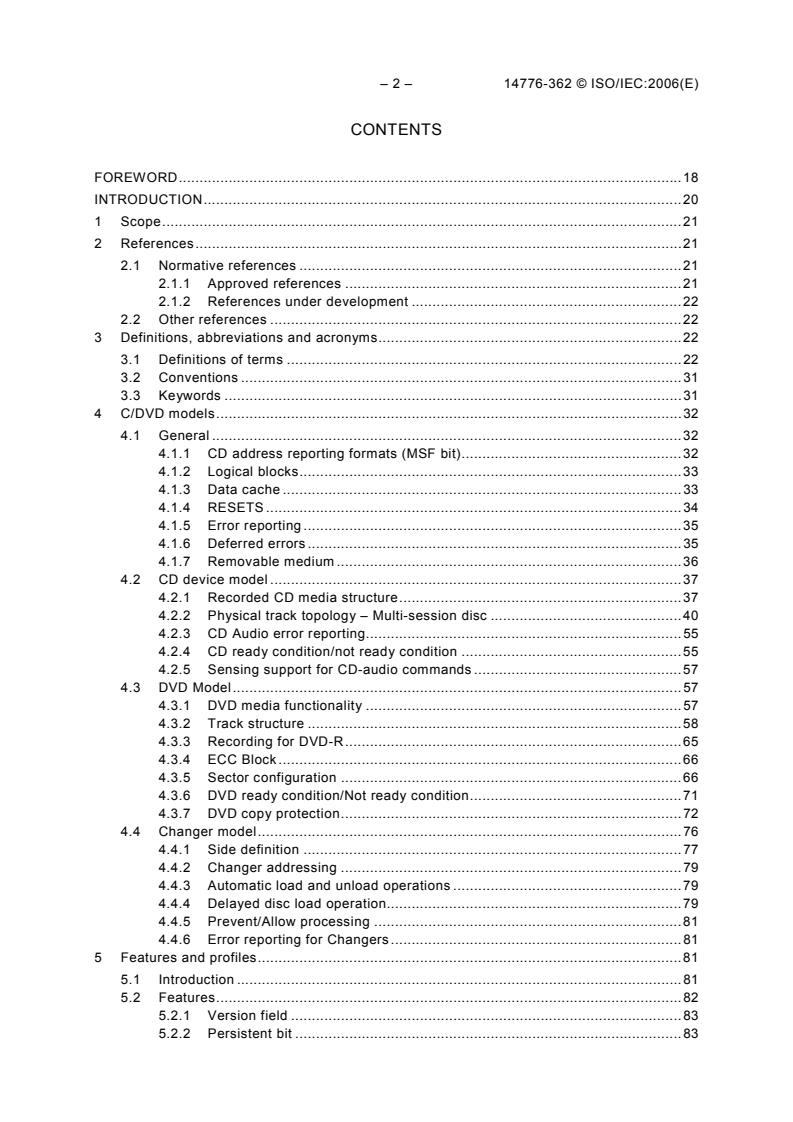
– 2 – 14776-362 © ISO/IEC:2006(E)
CONTENTS
FOREWORD.18
INTRODUCTION.20
1 Scope.21
2 References.21
2.1 Normative references .21
2.1.1 Approved references .21
2.1.2 References under development .22
2.2 Other references .22
3 Definitions, abbreviations and acronyms.22
3.1 Definitions of terms .22
3.2 Conventions .31
3.3 Keywords .31
4 C/DVD models.32
4.1 General .32
4.1.1 CD address reporting formats (MSF bit).32
4.1.2 Logical blocks.33
4.1.3 Data cache .33
4.1.4 RESETS .34
4.1.5 Error reporting .35
4.1.6 Deferred errors.35
4.1.7 Removable medium .36
4.2 CD device model .37
4.2.1 Recorded CD media structure.37
4.2.2 Physical track topology – Multi-session disc .40
4.2.3 CD Audio error reporting.55
4.2.4 CD ready condition/not ready condition .55
4.2.5 Sensing support for CD-audio commands .57
4.3 DVD Model.57
4.3.1 DVD media functionality .57
4.3.2 Track structure .58
4.3.3 Recording for DVD-R.65
4.3.4 ECC Block.66
4.3.5 Sector configuration .66
4.3.6 DVD ready condition/Not ready condition.71
4.3.7 DVD copy protection.72
4.4 Changer model.76
4.4.1 Side definition .77
4.4.2 Changer addressing .79
4.4.3 Automatic load and unload operations .79
4.4.4 Delayed disc load operation.79
4.4.5 Prevent/Allow processing .81
4.4.6 Error reporting for Changers.81
5 Features and profiles.81
5.1 Introduction .81
5.2 Features.82
5.2.1 Version field .83
5.2.2 Persistent bit .83
14776-362 © ISO/IEC:2006(E) – 3 –
5.2.3 Current bit .83
5.2.4 Additional length field .83
5.2.5 Feature codes .83
5.3 Feature definitions.85
5.3.1 Profile list feature (0000h) .85
5.3.2 Core feature (0001h) .86
5.3.3 Morphing feature (0002h) .88
5.3.4 Removable medium feature (0003h) .89
5.3.5 Random readable feature (0010h) .90
5.3.6 Multi-Read feature (001Dh) .92
5.3.7 CD read feature (001Eh) .92
5.3.8 DVD read feature (001Fh) .93
5.3.9 Random writable feature (0020h).94
5.3.10 Incremental streaming writable (0021h) .95
5.3.11 Sector erasable feature (0022h) .97
5.3.12 Formattable feature (0023h) .97
5.3.13 Defect management feature (0024h).98
5.3.14 Write once feature (0025h) .99
5.3.15 Restricted overwrite feature (0026h).100
5.3.16 CD Track at once feature (002Dh) .101
5.3.17 CD mastering (session at once) feature (002Eh).102
5.3.18 DVD-R write feature (002Fh) .104
5.3.19 Power management feature (0100h) .105
5.3.20 Embedded changer feature (0102h).105
5.3.21 CD audio external play feature (0103h) .106
5.3.22 Microcode upgrade feature (0104h) .108
5.3.23 Time-out feature (0105h) .108
5.3.24 DVD-CSS Feature (0106h) .109
5.3.25 Real-time streaming feature (0107h).110
5.3.26 Feature 0108h – Logical unit serial number .110
5.3.27 Feature 010Ah - Disc control blocks .111
5.4 Profile definitions .112
5.4.1 Profile 2 - Removable disk.113
5.4.2 Profile 3 - Magneto-optical.113
5.4.3 Profile 4 - Magneto-optical write once.114
5.4.4 Profile 5h - AS-MO .114
5.4.5 Profile 8 - CD-ROM .115
5.4.6 Profile 9 - CD-R .115
5.4.7 Profile Ah - CD-RW .116
5.4.8 Profile 10h - DVD-ROM .116
5.4.9 Profile 11h - DVD-R.117
5.4.10 Profile 12h - DVD re-writable .117
5.4.11 Profile FFFFh - Logical units not conforming to a standard profile .118
5.5 Parameters for all logical unit types.118
5.5.1 Mode pages.118
5.5.2 Mode select/sense parameters .119
5.5.3 Read/write error recovery parameters page (page code 01h).121
5.5.4 Write parameters mode page (page code 05h) .126
5.5.5 CD device parameters (page code 0Dh) .130
5.5.6 CD audio control parameters page (page code 0Eh).131
5.5.7 Power condition page (page code 1Ah).133
5.5.8 Fault/failure reporting control page .134
– 4 – 14776-362 © ISO/IEC:2006(E)
5.5.9 Time-out and protect page.136
5.5.10 Capabilities and mechanical status page .137
6 Command descriptions for all logical units .141
6.1 C/DVD commands .142
6.1.1 BLANK command .143
6.1.2 CLOSE TRACK/SESSION command .145
6.1.3 FORMAT UNIT command .147
6.1.4 GET CONFIGURATION command .154
6.1.5 GET EVENT/STATUS NOTIFICATION.158
6.1.6 GET PERFORMANCE .167
6.1.7 LOAD/UNLOAD MEDIUM command .171
6.1.8 MECHANISM STATUS command .173
6.1.9 PAUSE/RESUME command.176
6.1.10 PLAY AUDIO (10) Command .177
6.1.11 PLAY AUDIO (12) command.178
6.1.12 PLAY AUDIO MSF command.179
6.1.13 Play CD command (obsolete) .180
6.1.14 READ BUFFER CAPACITY command (obsolete) .182
6.1.15 READ CD command .183
6.1.16 READ CD MSF command .191
6.1.17 READ CAPACITY command .193
6.1.18 READ DISC INFORMATION command .194
6.1.19 READ DVD STRUCTURE command .198
6.1.20 READ FORMAT CAPACITIES .215
6.1.21 READ HEADER command (obsolete) .219
6.1.22 READ MASTER CUE command (obsolete) .221
6.1.23 READ SUB-CHANNEL command.222
6.1.24 READ TOC/PMA/ATIP command .229
6.1.25 TOC/PMA/ATIP response data format 0100b .237
6.1.26 READ TRACK INFORMATION command.239
6.1.27 REPAIR TRACK command (obsolete).247
6.1.28 REPORT KEY command.247
6.1.29 RESERVE TRACK command.253
6.1.30 SCAN command .255
6.1.31 SEND CUE SHEET command.258
6.1.32 SEND DVD STRUCTURE command .266
6.1.33 SEND EVENT Command .271
6.1.34 SEND KEY command .273
6.1.35 SEND OPC INFORMATION Command .275
6.1.36 SET CD SPEED command (obsolete) .277
6.1.37 SET READ AHEAD command.278
6.1.38 SET STREAMING command.279
6.1.39 STOP PLAY/SCAN command .282
6.1.40 SYNCHRONIZE CACHE command .283
6.1.41 WRITE (10) command .284
6.1.42 WRITE AND VERIFY (10) command.287
Annex A (normative) Additional Sense Codes for CD .289
A.1 Error reporting.289
Annex B (normative) ATAPI Compliance .299
B.1 Introduction .299
14776-362 © ISO/IEC:2006(E) – 5 –
B.2 General .299
B.2.1 Terms.299
B.2.2 Supported Block Sizes .299
B.2.3 CD Audio error reporting .299
B.2.4 Multi-Initiator Environment.299
B.2.5 Command Packet Padding .300
B.2.6 Mapping of reset functions .300
B.3 ATAPI commands requirements.300
Annex C (normative) Requirements for SBP-2 compliance.303
C.1 SBP-2 definitions.303
C.2 SBP-2 Storage Model .304
C.2.1 Model configuration .304
C.2.2 Model operation .305
C.2.3 Reconnect/Power reset support (normative) .306
C.3 Configuration ROM support .306
C.3.1 Unit Directory – Command_Set_Spec_ID .306
C.3.2 Unit Directory – Command_Set .306
C.3.3 Unit Directory – Command_Set_Revision .307
C.3.4 Unit Directory – Logical_Unit_Number .307
C.4 Login support .307
C.5 Security support .308
C.6 Status block support.308
C.7 Unsolicited Status support.308
C.8 Unit attention condition.309
Annex D (normative) Requirements for Fibre Channel Protocol for SCSI Compliance .310
D.1 Introduction .310
D.2 General .310
D.2.1 Terms.310
D.2.2 Information units .310
D.2.3 Process login/logout .310
D.2.4 Sense information .310
D.2.5 Reset mapping .311
Annex E (normative) SCSI Implementation notes .312
E.1 Introduction .312
E.2 SCSI signal utilization .312
E.3 SCSI compatibility .312
E.3.1 Additions to the SCSI Standards (ISO/IEC 14776-xxx) .312
E.4 Reset Functionality.312
E.4.1 Power On Reset .312
E.4.2 Hard Reset.312
E.4.3 TARGET RESET task management function.313
E.4.4 Device Reset.313
E.4.5 Power Management and Device Reset in SCSI .313
E.4.6 Mapping of reset functions .314
Annex F (normative) Power management functions.315
F.1 Power management states .315
F.2 Power state transitions .316
– 6 – 14776-362 © ISO/IEC:2006(E)
F.2.1 Active State (D0) .316
F.2.2 Idle State (D1).316
F.2.3 Standby State (D2).316
F.2.4 Sleep State (D3).317
F.3 Power management state diagram.317
F.4 Power Management Timers .318
F.5 Standby timer .319
F.6 Power Management Status Reporting.321
Annex G (informative) SCSI command listings .322
G.1 List of SCSI commands .322
Annex H (informative) Implementation of features.323
H.1 What’s a Feature? .323
H.2 History.323
H.3 Implementation of Features .324
H.4 Compatibility .325
H.5 Summary.325
Annex I (informative) MMC command listings.326
Annex J (informative) CD -TEXT Format in the Lead-in Area .329
Bibliography.332
Figure 1 – Single Session Disc .40
Figure 2 – Multi-Session Recorded Disc .40
Figure 3 – Q Sub-channel Mode-1 Format recorded in Program Area .42
Figure 4 – Q Sub-channel Mode-2 Format .42
Figure 5 – Q Sub-channel, Mode-3 Format .43
Figure 6 – Q Sub-channel Mode-1 Format recorded in Lead-in .44
Figure 7 – Q Sub-channel Mode-5 Format recorded in Lead-in .45
Figure 8 – Synchronization Field pattern.46
Figure 9 – CD-R and CD-RW medium .50
Figure 10 – PMA, Q Sub-channel.51
Figure 11 – Packet Format.52
Figure 12 – Physical and Logical Layout of Single Layer DVD-ROM Media .59
Figure 13 – Physical and Logical Layout of Parallel Track Path DVD-ROM Media.60
Figure 14 – Physical and Logical Layout of Opposite Track Path DVD-ROM Media.61
Figure 15 – Physical and Logical Layout of DVD-R Media.62
Figure 16 – Physical and Logical Layout of Single Layer DVD + RW Media .63
Figure 17 – Physical and Logical Layout of DVD-RAM Media.64
Figure 18 – Data Organization within an ECC Block.66
Figure 19 – Formation of Data Unit 3 .66
Figure 20 – Data Unit 1.67
Figure 21 – Data ID Field definition.67
Figure 22 – Data Structure of Disc Lead-in Area .68
Figure 23 – Device key exchange and authentication state diagram.73
14776-362 © ISO/IEC:2006(E) – 7 –
Figure 24 – Authentication flag sequence .73
Figure 25 – Region State Diagram .76
Figure 26 – Media Changer Mechanism Model.77
Figure 27 – Changer State Diagram.79
Figure 28 – Read CD Sub-channel, R-W (100b).190
Figure 29 – CD (CD-DA) .262
Figure 30 – CD-ROM mode 1.263
Figure 31 – CD-ROM XA, CD-I.263
Figure 32 – CD-ROM Mode 2.264
Figure 33 – Location of Sub-channel Data .265
Figure 34 – Stop Play/Play Audio/Audio Scan/Pause/Resume Sequencing .283
Figure C.1 – Mass storage interface block diagram.304
Figure C.2 – Command_Set_Spec_ID.306
Figure C.3 – Command_Set.307
Figure C.4 – Command_Set_Revision.307
Figure C.5 – Logical_Unit_Number .307
Figure C.6 – Status block for MMC-2 .308
Figure F.1 – Power Management STATE diagram.318
Figure J.1 – Block number character position.330
Table 1 – MSF address format .33
Table 2 – Sense key responses for error reporting.35
Table 3 – Small Frame layout and definition .37
Table 4 – CD Frame Structure from Small Frames .38
Table 5 – Sub-Channel byte layout .38
Table 6 – P-Sub-Channel Layout .39
Table 7 – Q Sub-channel record format .41
Table 8 – ISRC 6 bit character codes (in hexadecimal) .43
Table 9 – Sync pattern block header.46
Table 10 – Mode zero data format .47
Table 11 – Mode 1 data format .47
Table 12 – Mode 2 formless block format.48
Table 13 – Mode 2 form 1 data format .48
Table 14 – Mode 2 form 1 sub-header format.49
Table 15 – Mode 2 form 2 data format .49
Table 16 – ATIP format.50
Table 17 – Block Identifier bits.53
Table 18 – Track Descriptor Block (TDB) header .54
Table 19 – Track Descriptor Unit (TDU) Format .54
Table 20 – Not Ready Error Reporting (by command) .56
Table 21 – Data field number for DVD media .68
Table 22 – Control structure of control data block .69
– 8 – 14776-362 © ISO/IEC:2006(E)
Table 23 – Common part of physical format information.69
Table 24 – Book type field .69
Table 25 – DVD-ROM unique part of physical format information .70
Table 26 – DVD-R unique part of physical format information .70
Table 27 – DVD-RAM unique part of physical format information .70
Table 28 – DVD + RW unique part of physical format.70
Table 29 – Data area allocation definition .71
Table 30 – Commands that may cause delayed loads to occur .80
Table 31 – Commands that will cause delayed loads to occur .80
Table 32 – Commands that should not cause delayed loads to occur .80
Table 33 – Error conditions and Sense Keys for Changer mechanisms .81
Table 34 – GET CONFIGURATION response data format.82
Table 35 – Feature header.82
Table 36 – Feature descriptor generic format.83
Table 37 – Feature codes .84
Table 38 – Profile list descriptor format.85
Table 39 – Profile descriptor .85
Table 40 – Profile list .86
Table 41 – Core commands .87
Table 42 – Core feature descriptor format.87
Table 43 – Physical interface standard .88
Table 44 – Morphing feature commands .88
Table 45 – Morphing descriptor format.88
Table 46 – Removable medium commands .89
Table 47 – Removable medium descriptor format.89
Table 48 – Loading mechanism type .90
Table 49 – Random readable feature .90
Table 50 – Random Readable Descriptor format .91
Table 51 – Multi-Read feature commands .92
Table 52 – Multi-Read descriptor format .92
Table 53 – CD READ commands .92
Table 54 – CD Read descriptor format .93
Table 55 – DVD READ feature commands .93
Table 56 – DVD read descriptor format .93
Table 57 – Random writable block device commands .94
Table 58 – Random writable descriptor format .94
Table 59 – Incremental streaming commands .95
Table 60 – Incremental streaming parameters .96
Table 61 – Incremental streaming writable descriptor format.96
Table 62 – Sector erasable feature commands .97
Table 63 – Sector erasable .97
Table 64 – Formattable feature commands .97
14776-362 © ISO/IEC:2006(E) – 9 –
Table 65 – Formattable descriptor format.98
Table 66 – Defect management feature parameters .98
Table 67 – Defect management descriptor format .98
Table 68 – Write once feature commands .99
Table 69 – Write once feature parameters .99
Table 70 – Write once descriptor format .99
Table 71 – Restricted overwrite commands.100
Table 72 – Restricted Overwrite parameter .100
Table 73 – Restricted overwrite descriptor format .100
Table 74 – CD track at once feature commands.101
Table 75 – CD track at once feature parameters .101
Table 76 – CD Track at once descriptor format .101
Table 77 – CD mastering (session at once) feature commands .102
Table 78 – CD mastering (session at once) parameter.102
Table 79 – CD mastering (RAW) feature commands .102
Table 80 – CD mastering (RAW) parameters .102
Table 81 – CD mastering feature descriptor .103
Table 82 – DVD-R write commands .104
Table 83 – DVD-R write feature parameters.104
Table 84 – DVD-R write feature descriptor format .104
Table 85 – Power management commands .105
Table 86 – Power management mode parameters.105
Table 87 – Power management descriptor format .105
Table 88 – Embedded changer command .106
Table 89 – Embedded changer descriptor format .106
Table 90 – CD-audio external play feature commands .107
Table 91 – CD-Audio External Output Parameters .107
Table 92 – CD audio external play descriptor format.107
Table 93 – Microcode upgrade command.108
Table 94 – Microcode upgrade descriptor format .108
Table 95 – Time-out feature parameter .108
Table 96 – Time-Out Descriptor Format .109
Table 97 – DVD-CSS feature commands .109
Table 98 – DVD-CSS feature descriptor format .109
Table 99 – Real-time streaming feature commands.110
Table 100 – Real-time streaming feature descriptor format .110
Table 101 – Logical unit serial number feature descriptor .111
Table 102 – Disc control blocks feature commands.111
Table 103 – Disc control blocks feature descriptor .112
Table 104 – Mandatory features for removable disks .113
Table 105 – Mandatory features for magneto-optical erasable .113
Table 106 – Mandatory features for magneto-optical write once.114
– 10 – 14776-362 © ISO/IEC:2006(E)
Table 107 – Mandatory features for AS-MO .114
Table 108 – Mandatory features for CD-ROM .115
Table 109 – Mandatory features for CD-R.115
Table 110 – Mandatory features for CD-RW.116
Table 111 – Mandatory Features for DVD-ROM .116
Table 112 – Mandatory features for DVD-R.117
Table 113 – Mandatory features for DVD re-writable.117
Table 114 – Mandatory features for logical units not conforming to a standard profile .118
Table 115 – Mode page codes for C/DVD .118
Table 116 – Mode parameter list.119
Table 117 – Mode page format .119
Table 118 – Mode parameter header .120
Table 119 – Block Descriptor Block Sizes fo
...
Questions, Comments and Discussion
Ask us and Technical Secretary will try to provide an answer. You can facilitate discussion about the standard in here.
Loading comments...