


ISO/IEC 14543-2-1:2006
(Main)Information technology - Home electronic system (HES) architecture - Part 2-1: Introduction and device modularity
Information technology - Home electronic system (HES) architecture - Part 2-1: Introduction and device modularity
Home Electronic System (HES) standards describe the architecture of home control systems including communication and interoperability aspects. This International Standard specifies the general features as well as the basic functional structure of an HES.
General Information
- Status
- Published
- Publication Date
- 12-Sep-2006
- Technical Committee
- ISO/IEC JTC 1/SC 25 - Interconnection of information technology equipment
- Current Stage
- PPUB - Publication issued
- Start Date
- 13-Sep-2006
- Completion Date
- 30-Sep-2006
Relations
- Effective Date
- 05-Sep-2023
- Effective Date
- 05-Sep-2023
Overview
ISO/IEC 14543-2-1:2006 - Information technology - Home Electronic System (HES) architecture - Part 2-1: Introduction and device modularity defines the general features, reference model and basic functional structure of a Home Electronic System. The standard frames how home control systems (lighting, HVAC, security, A/V, energy management, etc.) interconnect and interoperate over different media (power line, twisted pair, RF, infrared) and specifies device modularity and interfaces to support scalable, multi-application home automation.
Key Topics
- HES reference model: A layered architecture aligned with OSI concepts (physical, data link, network, transport, session, presentation, application) to organize communication and services within HES devices and networks.
- Device modularity: Functional structure and interfaces for HES devices and application processes to enable modular devices and plug‑and‑play integration.
- Communication aspects: Guidance on media, physical and data link considerations, and transport/session/presentation/application layer roles for reliable home control and interoperability.
- Classes of HES: Defines three capability classes:
- Class 1: Telecontrol/transport-only capabilities.
- Class 2: Includes Class 1 plus switched medium‑bandwidth data channels.
- Class 3: Adds high‑bandwidth switched data channels.
- Management: System and application management concepts for resource control, configuration and lifecycle of HES components.
- System aspects: Network topology, interapplication interaction, grouping, access control and geographic zoning within buildings.
- Conformance and terminology: Definitions, normative references (including ISO/IEC 7498-1 and ISO/IEC 10192-1) and conformance rules to ensure consistent implementation.
Applications
ISO/IEC 14543-2-1 is practical for:
- Designing interoperable home automation and building control systems.
- Specifying device interfaces and modular firmware/software architectures for smart devices (sensors, actuators, gateways).
- Planning networked systems using multiple media (power line, RF, twisted pair) and integrating external services (telephony, cable, utility networks).
- Guiding architects, builders and installers on resource sharing and wiring infrastructure to minimize retrofit costs.
- Informing system integrators and manufacturers about management, grouping and access control best practices for multi-application HES deployments.
Who uses this standard
- Device manufacturers and firmware developers
- System integrators and installers
- Home/building automation solution architects
- Test laboratories and certification bodies
- Standards committees and product interoperability teams
Related Standards
- ISO/IEC 7498-1 (OSI Basic Reference Model)
- ISO/IEC 10192-1 (HES universal interface class 1)
- Other parts of ISO/IEC 14543 (Parts 3 and 5 series) and ISO/IEC 18012 (product interoperability guidance)
Keywords: ISO/IEC 14543-2-1, Home Electronic System, HES architecture, device modularity, home automation, interoperability, home control system, HES classes.
Get Certified
Connect with accredited certification bodies for this standard

BSI Group
BSI (British Standards Institution) is the business standards company that helps organizations make excellence a habit.

NYCE
Mexican standards and certification body.
Sponsored listings
Frequently Asked Questions
ISO/IEC 14543-2-1:2006 is a standard published by the International Electrotechnical Commission (IEC). Its full title is "Information technology - Home electronic system (HES) architecture - Part 2-1: Introduction and device modularity". This standard covers: Home Electronic System (HES) standards describe the architecture of home control systems including communication and interoperability aspects. This International Standard specifies the general features as well as the basic functional structure of an HES.
Home Electronic System (HES) standards describe the architecture of home control systems including communication and interoperability aspects. This International Standard specifies the general features as well as the basic functional structure of an HES.
ISO/IEC 14543-2-1:2006 is classified under the following ICS (International Classification for Standards) categories: 35.240.67 - IT applications in building and construction industry. The ICS classification helps identify the subject area and facilitates finding related standards.
ISO/IEC 14543-2-1:2006 has the following relationships with other standards: It is inter standard links to ISO/IEC TR 14543-1:2000, ISO/IEC TR 14543-2:2000. Understanding these relationships helps ensure you are using the most current and applicable version of the standard.
ISO/IEC 14543-2-1:2006 is available in PDF format for immediate download after purchase. The document can be added to your cart and obtained through the secure checkout process. Digital delivery ensures instant access to the complete standard document.
Standards Content (Sample)
ISO/IEC 14543-2-1
Edition 1.0 2006-09
INTERNATIONAL
STANDARD
Information technology – Home electronic system (HES) architecture –
Part 2-1: Introduction and device modularity
All rights reserved. Unless otherwise specified, no part of this publication may be reproduced or utilized in any form
or by any means, electronic or mechanical, including photocopying and microfilm, without permission in writing from
either IEC or IEC's member National Committee in the country of the requester. If you have any questions about IEC
copyright or have an enquiry about obtaining additional rights to this publication, please contact the address below or
your local IEC member National Committee for further information.
IEC Central Office Tel.: +41 22 919 02 11
3, rue de Varembé info@iec.ch
CH-1211 Geneva 20 www.iec.ch
Switzerland
About the IEC
The International Electrotechnical Commission (IEC) is the leading global organization that prepares and publishes
International Standards for all electrical, electronic and related technologies.
About IEC publications
The technical content of IEC publications is kept under constant review by the IEC. Please make sure that you have the
latest edition, a corrigendum or an amendment might have been published.
IEC publications search - webstore.iec.ch/advsearchform Electropedia - www.electropedia.org
The advanced search enables to find IEC publications by a The world's leading online dictionary on electrotechnology,
variety of criteria (reference number, text, technical containing more than 22 000 terminological entries in English
committee,…). It also gives information on projects, replaced and French, with equivalent terms in 16 additional languages.
and withdrawn publications. Also known as the International Electrotechnical Vocabulary
(IEV) online.
IEC Just Published - webstore.iec.ch/justpublished
Stay up to date on all new IEC publications. Just Published IEC Glossary - std.iec.ch/glossary
details all new publications released. Available online and 67 000 electrotechnical terminology entries in English and
once a month by email. French extracted from the Terms and definitions clause of
IEC publications issued between 2002 and 2015. Some
IEC Customer Service Centre - webstore.iec.ch/csc entries have been collected from earlier publications of IEC
If you wish to give us your feedback on this publication or TC 37, 77, 86 and CISPR.
need further assistance, please contact the Customer Service
Centre: sales@iec.ch.
ISO/IEC 14543-2-1
Edition 1.0 2006-09
INTERNATIONAL
STANDARD
Information technology – Home electronic system (HES) architecture –
Part 2-1: Introduction and device modularity
INTERNATIONAL
ELECTROTECHNICAL
COMMISSION
ICS 35.240.67 ISBN 2-8318-8803-4
2 14543-2-1 © ISO/IEC:2006(E)
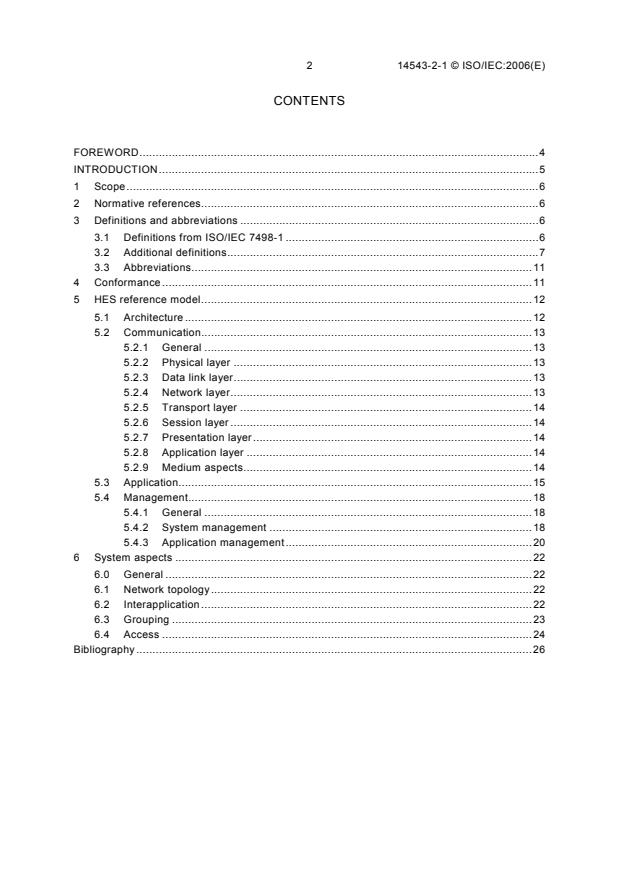
CONTENTS
FOREWORD.4
INTRODUCTION.5
1 Scope.6
2 Normative references.6
3 Definitions and abbreviations .6
3.1 Definitions from ISO/IEC 7498-1 .6
3.2 Additional definitions.7
3.3 Abbreviations.11
4 Conformance.11
5 HES reference model.12
5.1 Architecture.12
5.2 Communication.13
5.2.1 General .13
5.2.2 Physical layer .13
5.2.3 Data link layer.13
5.2.4 Network layer.13
5.2.5 Transport layer .14
5.2.6 Session layer .14
5.2.7 Presentation layer.14
5.2.8 Application layer .14
5.2.9 Medium aspects.14
5.3 Application.15
5.4 Management.18
5.4.1 General .18
5.4.2 System management .18
5.4.3 Application management.20
6 System aspects .22
6.0 General .22
6.1 Network topology.22
6.2 Interapplication.22
6.3 Grouping .23
6.4 Access .24
Bibliography .26
14543-2-1 © ISO/IEC:2006(E) 3
Table 1 – Layer Management functions .18
Table 2 – General management functions.19
Table 3 – Examples of application management entity (AME) functions.21
Table 4 – Connection categories .24
Figure 1 – Overview of the home electronic system reference model .12
Figure 2 – Application process of an HES.15
Figure 3 – HES device application process structure.16
Figure 4 – HES device application process model.17
Figure 5 – Link of user processes.17
Figure 6 – Management of communication resources .19
Figure 7 – User interface of the communication resources.19
Figure 8 – Example of management functions of a device using the universal interface.20
Figure 9 – Management of application process .21
Figure 10 – User interface of the application process resources.21
Figure 11 – HES interapplication .23
Figure 12 – Geographical zones in buildings.23
4 14543-2-1 © ISO/IEC:2006(E)
INFORMATION TECHNOLOGY –
HOME ELECTRONIC SYSTEM (HES) ARCHITECTURE –
Part 2-1: Introduction and device modularity
FOREWORD
1) ISO (International Organization for Standardization) and IEC (International Electrotechnical Commission) form
the specialized system for worldwide standardization. National bodies that are members of ISO or IEC
participate in the development of International Standards. Their preparation is entrusted to technical
committees; any ISO and IEC member body interested in the subject dealt with may participate in this
preparatory work. International governmental and non-governmental organizations liaising with ISO and IEC
also participate in this preparation.
2) In the field of information technology, ISO and IEC have established a joint technical committee,
ISO/IEC JTC 1. Draft International Standards adopted by the joint technical committee are circulated to
national bodies for voting. Publication as an International Standard requires approval by at least 75 % of the
national bodies casting a vote.
3) The formal decisions or agreements of IEC and ISO on technical matters express, as nearly as possible, an
international consensus of opinion on the relevant subjects since each technical committee has representation
from all interested IEC and ISO member bodies.
4) IEC, ISO and ISO/IEC Publications have the form of recommendations for international use and are accepted
by IEC and ISO member bodies in that sense. While all reasonable efforts are made to ensure that the
technical content of IEC, ISO and ISO/IEC Publications is accurate, IEC or ISO cannot be held responsible for
the way in which they are used or for any misinterpretation by any end user.
5) In order to promote international uniformity, IEC and ISO member bodies undertake to apply IEC, ISO and
ISO/IEC Publications transparently to the maximum extent possible in their national and regional publications.
Any divergence between any ISO/IEC Publication and the corresponding national or regional publication should
be clearly indicated in the latter.
6) ISO and IEC provide no marking procedure to indicate their approval and cannot be rendered responsible for
any equipment declared to be in conformity with an ISO/IEC Publication.
7) All users should ensure that they have the latest edition of this publication.
8) No liability shall attach to IEC or ISO or its directors, employees, servants or agents including individual
experts and members of their technical committees and IEC or ISO member bodies for any personal injury,
property damage or other damage of any nature whatsoever, whether direct or indirect, or for costs (including
legal fees) and expenses arising out of the publication of, use of, or reliance upon, this ISO/IEC publication or
any other IEC, ISO or ISO/IEC publications.
9) Attention is drawn to the normative references cited in this publication. Use of the referenced publications is
indispensable for the correct application of this publication.
10) Attention is drawn to the possibility that some of the elements of this International Standard may be the subject
of patent rights. ISO and IEC shall not be held responsible for identifying any or all such patent rights.
International Standard ISO/IEC 14543-2-1 was prepared by subcommittee 25: Interconnection
of information technology equipment, of ISO/IEC joint technical committee 1: Information
technology.
ISO/IEC 14543-2-1 cancels and replaces ISO/IEC TR 14543-1 and ISO/IEC TR 14543-2,
published in 2000. It constitutes a complete revision of the principles outlined in
ISO/IEC TR 14543-1 and ISO/IEC TR 14543-2 and provides the specifications essential for an
international standard.
This International Standard has been approved by vote of the member bodies, and the voting
results may be obtained from the address given on the title page.
This publication has been drafted in accordance with the ISO/IEC Directives, Part 2.
14543-2-1 © ISO/IEC:2006(E) 5
INTRODUCTION
Various electrically controlled devices are used in homes and similar environments for many
different applications. Examples of such applications are lighting, heating, food preparation,
washing, energy management, water control, fire alarms, blinds control, different forms of
security control and entertainment (audio and video).
When several such devices are able to interwork via a common internal network (in this
document called a home network), the resulting total system is called a home control system.
When a home control system follows all the specifications in the ISO/IEC HES Standards, it is
called a Home Electronic System (HES).
Three different classes of HES are defined. Class 1 has transport capabilities for telecontrol
applications only. Class 2 includes Class 1, but also supports switched medium bandwidth data
channels. Class 3 includes Classes 1 and 2 and, in addition, supports high bandwidth switched
data channels.
A home network may be based on one or more different media (for example power line,
balanced cables, infrared or radio) and may also be connected to outside networks (for
example telephone, cable television, power and alarm networks).
The implementation of a specific Home Electronic System will typically be assembled by a
consumer by adding one application at a time, starting from single applications like lighting
control, security control or audio and video control, to develop into an integrated multi-
application system. The cost of adding an application depends on whether rewiring of the
house is needed and whether existing cables and prefitted ducts or other media can be used.
Hence the HES standards and supplementary technical reports will also give guidance to
architects and builders as well as to users on how to share such resources.
Currently, ISO/IEC 14543, Information technology – Home Electronic System (HES)
architecture, consists of the following parts:
Part 2-1: Introduction and device modularity
Part 3-1 Communication layers – Application layer for network based control of HES Class 1
Part 3-2: Communication layers – Transport, network and general parts of data link layer for
network based control of HES Class 1
Part 3-3: User process for network based control of HES Class 1 (under consideration)
Part 3-4: System management – Management procedures for network based control of HES
Class 1 (under consideration)
Part 3-5: Media and media dependent layers – Power line for network based control of HES
Class 1 (under consideration)
Part 3-6: Media and media dependent layers – Twisted pair for network based control of
HES Class 1 (under consideration)
Part 3-7: Media and media dependent layers – Radio frequency for network based control of
HES Class 1 (under consideration)
Part 4: Home and building automation in a mixed-use building (technical report)
Part 5-1: Intelligent grouping and resource sharing for HES Class 2 and Class 3 – Core
ptotocol
Part 5-2: Intelligent grouping and resource sharing for HES Class 2 and Class 3 – Device
certification
Additional parts may be added later.
ISO/IEC 18012, “Guidelines for product interoperability,” specifies how applications can co-
operate across different protocols. To facilitate interoperability of various protocols,
amendments to published standards may be needed.
6 14543-2-1 © ISO/IEC:2006(E)
INFORMATION TECHNOLOGY –
HOME ELECTRONIC SYSTEM (HES) ARCHITECTURE –
Part 2-1: Introduction and device modularity
1 Scope
This part of ISO/IEC 14543 specifies the general features and architecture of the HES.
The object is to
− define new terms for use in the ISO/IEC 14543 series,
− give general information and advice on the required HES features and its architecture,
− specify the HES model,
− specify the basic functional structure of an HES with its interfaces.
2 Normative references
The following referenced documents are indispensable for the application of this document. For
dated references, only the edition cited applies. For undated references, the latest edition of
the referenced document (including any amendments) applies.
ISO/IEC 7498-1, Information technology – Open systems interconnection – Basic Reference
Model – Part 1: The Basic Model.
ISO/IEC 10192-1, Information technology – Home electronic system (HES) interfaces – Part 1:
Universal interface class 1
3 Definitions and abbreviations
For the purpose of this standard the following definitions apply.
3.1 Definitions from ISO/IEC 7498-1
3.1.1
application entity
active element, within the application process, ambodying a set of capabilities which is
pertinent to OSI and which is defined for the application layer, that corresponds to a specific
application-entity type (without any extra capabilities being used)
[ISO/IEC 7498-1, 7.1.1.1]
3.1.2
application process
element within a real open system which performs the information processing for a particular
application
[ISO/IEC 7498-1, 4.1.4]
3.1.3
connection-mode transmission
(N)-data-transmission in the context of an (N)-connection
[ISO/IEC 7498-1, 5.3.1.17]
14543-2-1 © ISO/IEC:2006(E) 7
3.1.4
connectionless-mode transmission
(N)-data-transmission not in the context of an (N)-connection and not required to maintain any
logical relationship between (N)-service-data-units
[ISO/IEC 7498-1, 5.3.1.18]
3.1.5
(N)-service-data-unit, (N)-SDU
amount of information whose identity is preserved when transferred between peer-(N+1)-
entities and which is not interpreted by the supporting (N)-entities.
[ISO/IEC 7498-1, 5.6.1.4]
3.1.6
flow control
function which controls the flow of data within a layer or between adjacent layers
[ISO/IEC 7498-1, 5.8.1.8]
3.1.7
OSI environment, OSIE
abstract representation of the set of concepts, elements, functions, services, protocols, etc., as
defined by the OSI reference model and the derived specific standards which, when applied,
enable communications among open systems
[ISO/IEC 7498-1, 4.1.5]
3.1.8
segmenting
function performed by an (N)-entity to map multiple (N)-service-data-unit into multiple (N)-
protocol-data-units
[ISO/IEC 7498-1, 5.8.1.9]
3.1.9
(N)-service access point, (N)-SAP
point at which (N)-services are provided by an (N)-entitiy to an(N+1)-entity
[ISO/IEC 7498-1, 5.2.1.8]
3.2 Additional definitions
3.2.1
application
field of use of an HES
NOTE An HES may support more than one application.
3.2.2
application object
an HES object located within the HES device application process
3.2.3
application process
an element within an HES which performs the information processing for a particular
application
3.2.4
application protocol
standardized protocol for the exchange of information between application processes in an
HES; it is transported without interpretation by the home network resources
8 14543-2-1 © ISO/IEC:2006(E)
3.2.5
connection
association established between functional units for data transmission across a network (or
part of a network) for the purpose of communication between the units; the association is
explicitly established at some point in time and exists until explicitly ended
NOTE Data transmission includes, in this context, audio, video and other information in either analogue or digital
form.
3.2.6
control channel
communication channel that is established between two or more entities for the primary
purpose of exchange of HES control and monitoring messages
3.2.7
device
physical implementation of functions belonging to one or more functional groupings providing a
service directly for an end-user
3.2.8
device application process
element within a device that performs information processing for a particular application;
device application processes can represent manual, automated, computerised or physical
processes
3.2.9
device modularity
property of devices that specifies the extent to which they have been composed out of separate
parts called modules
3.2.10
domain
range of validity
NOTE When the term is used for a more specific concept, it should be qualified. Two examples are the application
domain (the range including OSI layer seven and above) and the user domain (the range above OSI layer seven).
3.2.11
HES-application
field of use of an HES
NOTE An HES may support more than one application.
3.2.12
HES application object
an HES application object is an HES-object located within the HES device application process
3.2.13
device application process
an element within a device which performs information processing for a particular application; it
can represent a manual, automated, computerised or physical process
14543-2-1 © ISO/IEC:2006(E) 9
3.2.14
HES class 1
HES with transport capabilities for telecontrol applications such as:
- Control,
- Monitoring,
- Measurement,
- Alarm,
- Low speed data transfer
NOTE These capabilities are typically provided for by the single packet-mode low bandwitdth channel and the digital
transmission.
3.2.15
HES class 2
HES with capabilities for switched voice or other information transfer with similar bandwidth
NOTE These capabilities are typically provided for by a class 1 system, enhanced with multiple switched medium
bandwidth channels and analogue or digital transmission or both. In principle, all class 2 capabilities may be
supported by a single class 2 channel.
For practical reasons, however, HES class 2 may contain a separate channel or use a separate medium to support
class 1 capabilities.
3.2.16
HES class 3
HES with capabilities for switched high quality sound and video transfer and high speed data
transfer
NOTE These capabilities are typically provided for by a class 2 system enhanced with multiple switched medium
bandwidth channels and analogue or digital transmission or both.
In principle all class 3 capabilities may be supported on a single class 3 channel. For practical reasons, however,
HES class 3 may contain a separate channel or use a separate medium to support class 1 and class 2 capabilities.
3.2.17
HES device application process
the part of a device application process which is accessible through the HES communication
network
NOTE 1 An HES device application process is built up with application objects.
NOTE 2 The functionality of the HES device application process is defined in this series of standards or in the
appropriate product standards.
3.2.18
HES-object
set of data with associated functions applicable to it
NOTE An HES-object can be implemented in various ways.
3.2.19
HES user process
the part of the HES device application process belonging to the user domain of the HES
3.2.20
home electronic system (HES)
various electronic devices are used in homes, buildings and similar environments (including
their immediate surroundings) for several applications relevant to the home and/or building
NOTE The expression “Home Electronic System” (HES) covers any combination of electronic devices linked via a
digital transmission network. The HES includes a specification for this communication network. There are three
classes of HES, depending on the transmission throughput capabilities.
10 14543-2-1 © ISO/IEC:2006(E)
3.2.21
home network
internal network for digital and analogue information transport in a home or on business
premises of similar complexity, providing defined access points and using one or more media
in any topology
3.2.22
information channel
a communication channel established between two or more entities for the primary purpose of
exchange of information other than HES control and monitoring messages
NOTE Examples of such information are audio or video data, facsimile data and analogue speech signals.
3.2.23
interface
shared boundary between two implementations of functions belonging to one or more
functional groupings
3.2.24
interoperability
the ability of devices to exchange information via the higher layers resulting in meaningful
actions; this includes aspects of the application domain which, by definition, is beyond the OSI
domain
3.2.25
local application process
the part of an application process within a device which is not accessible through the HES
communication network, it is located inside the user domain
3.2.26
network access unit (NAU)
piece of equipment which comprises the mechanical, electrical and communicational functions
for an HES connection
NOTE The NAU corresponds to one network service access point (NSAP) and can be uniquely identified by one or
more n
...
Questions, Comments and Discussion
Ask us and Technical Secretary will try to provide an answer. You can facilitate discussion about the standard in here.
Loading comments...