

IEC 62024-3:2026
(Main)High frequency inductive components - Electrical characteristics and measuring methods - Part 3: AC loss measured by sinusoidal wave of inductors for DC-to-DC converters
- Abstract
IEC 62024-3:2026 specifies test methods for AC losses of high-frequency inductive components for power supplies used in DC-to-DC converters and similar devices at currents close to actual operation and introduces the measurement principle, scope of application and matters to be noted for each method. This document is applicable to leaded and surface mount inductors with dimensions in accordance with IEC 62024-2.
- Status
- Published
- Publication Date
- 18-Jun-2026
- Technical Committee
- TC 51 - Magnetic components, ferrite and magnetic powder materials
- Drafting Committee
- WG 9 - TC 51/WG 9
- Current Stage
- PPUB - Publication issued
- Start Date
- 19-Jun-2026
- Completion Date
- 17-Jul-2026
Buy Documents
IEC 62024-3:2026 - High frequency inductive components - Electrical characteristics and measuring methods - Part 3: AC loss measured by sinusoidal wave of inductors for DC-to-DC converters
IEC 62024-3:2026 is an International Standard from the IEC for measuring AC loss in high-frequency inductive components used in DC-to-DC converters and similar devices. It specifies sinusoidal-wave test methods for inductors with dimensions in accordance with IEC 62024-2, so users can compare losses at currents close to actual operation.
What does IEC 62024-3:2026 specify?
IEC 62024-3:2026 specifies how to measure AC loss in inductors for power supplies used in DC-to-DC converters and similar devices. It focuses on current levels close to real use, because that is what matters when estimating converter efficiency and heat.
The document is organized into Scope, a method-selection clause, two measuring methods, and an informative annex on measuring accuracy.
- Clause 4 selects the measuring method.
- Clause 5 covers the cross-power method.
- Clause 6 covers the amplified vector network analyzer method.
- Annex A gives accuracy checks, waveform comparisons, and bias T error guidance.
What are the key requirements of IEC 62024-3:2026?
IEC 62024-3:2026 gives two standardized ways to measure AC loss, and the user chooses the one that matches the frequency and impedance range of the inductor under test. The document also explains the jig, calibration, and correction steps needed to make the result repeatable.
Method selection and measurement ranges
Clause 4 says the document covers the cross-power method for low frequencies and the amplified vector network analyzer (VNA) method for higher frequencies. Table 1 links each method to a frequency range and impedance range, and it also distinguishes Series through and Shunt through connections for the VNA method.
In practice, this means the test setup is not one-size-fits-all. The engineer has to choose the method that fits the DUT impedance and the frequency band to be measured.
Cross-power method
Clause 5 describes a digitizing method that samples voltage and current, then uses Fast Fourier Transform (FFT) processing and cross-power calculation to obtain AC loss. The method is intended to capture loss accurately, including harmonic content created by inductor nonlinearity, and it conforms to IEC 62044-3.
Clause 5 also allows DC bias measurement by adding a bias T and a DC bias current source. That matters when the inductor operates with a DC component, because the test needs to reflect real converter conditions.
Cross-power jig and practical limits
Clause 5.2.2 defines jig features that support measurement correlation and accuracy, such as reducing distributed capacitance and placing the DUT in a controlled position relative to the voltage detection lines. Clause 5.2.3 warns that stray capacitance can shift resonance and raise the measured AC resistance (ACR), so the measurement frequency should stay below one-tenth of the resonant frequency.
In practice, the user must keep the fixture and instrument capacitance low and avoid measuring too close to resonance.
Amplified VNA method
Clause 6 defines a setup built from a VNA, a power amplifier (PA), a coupler, and an attenuator (ATT). It calculates AC loss from two-port transmission characteristics and detected power, and it supports both 2-way coupler and forward-directional coupler arrangements.
This method is useful when the user needs higher-frequency coverage, but it also requires careful calibration and compensation because the amplifier, coupler, ATT, and bias T affect the measurement.
Calibration, compensation, and calculation
Clause 6.2.4 requires calibration at the jig connection to remove system influence, then additional compensation to remove residual errors and jig characteristics. Clause 6.2.5 says the calculation formula depends on the circuit and the DUT connection type, and the power and current calculations must account for ATT loss and any bias T effect.
In practice, the user must use the correct formula for the exact test configuration, or the loss value will not be meaningful.
Annex A guidance
Annex A explains how to confirm measuring accuracy with a reference part that does not change much with AC current or DC bias current. It also explains why sinusoidal-wave loss and triangular-wave loss are not the same, even at the same effective current, and it describes bias T-related error sources.
Who uses IEC 62024-3:2026?
IEC 62024-3:2026 is used by engineers, test laboratories, and component suppliers who need comparable AC-loss data for inductors in DC-to-DC converter applications. It is also useful for quality teams and buyers who have to compare vendor data, define test methods, or verify that a reported loss value was measured in a repeatable way.
Which standards are used with IEC 62024-3:2026?
IEC 62024-3:2026 refers to related IEC documents that give context or companion methods:
- IEC 62024-2 - provides the dimensional basis for the leaded and surface mount inductors covered here, and it is also named in the scope.
- IEC 62024-1 - covers nanohenry range chip inductors and is cited as a different AC-loss measurement context.
- IEC 62044-3 - the cross-power method is stated to conform to this standard.
- IEC 63300 - is cited as a different testing area for magnetic powder cores, not the same application as this document.
What does the IEC 62024-3:2026 document contain?
IEC 62024-3:2026 contains one table comparing measuring methods, several figures showing circuits and jigs, and calculation formulas for resonance, impedance, current, and AC power loss. The figures support setup of the cross-power method and the amplified VNA method, including calibration and compensation jigs.
Annex A adds practical measurement guidance, including accuracy confirmation, waveform comparison, and bias T error considerations. That makes the document useful not only for testing, but also for method development, inter-laboratory comparison, and setting up repeatable measurement procedures.
Buy Documents
IEC 62024-3:2026 - High frequency inductive components - Electrical characteristics and measuring methods - Part 3: AC loss measured by sinusoidal wave of inductors for DC-to-DC converters
Get Certified
Connect with accredited certification bodies for this standard

IMQ S.p.A. (Certification)
Italian electrical product certification.

SLG Prüf- und Zertifizierungs GmbH
German testing and certification body.

UL Solutions
Global safety science company with testing, inspection and certification.
Sponsored listings
Frequently Asked Questions
IEC 62024-3:2026 is a standard published by the International Electrotechnical Commission (IEC). Its full title is "High frequency inductive components - Electrical characteristics and measuring methods - Part 3: AC loss measured by sinusoidal wave of inductors for DC-to-DC converters". This standard covers: IEC 62024-3:2026 specifies test methods for AC losses of high-frequency inductive components for power supplies used in DC-to-DC converters and similar devices at currents close to actual operation and introduces the measurement principle, scope of application and matters to be noted for each method. This document is applicable to leaded and surface mount inductors with dimensions in accordance with IEC 62024-2.
IEC 62024-3:2026 specifies test methods for AC losses of high-frequency inductive components for power supplies used in DC-to-DC converters and similar devices at currents close to actual operation and introduces the measurement principle, scope of application and matters to be noted for each method. This document is applicable to leaded and surface mount inductors with dimensions in accordance with IEC 62024-2.
IEC 62024-3:2026 is classified under the following ICS (International Classification for Standards) categories: 29.100.10 - Magnetic components. The ICS classification helps identify the subject area and facilitates finding related standards.
IEC 62024-3:2026 is available in PDF format for immediate download after purchase. The document can be added to your cart and obtained through the secure checkout process. Digital delivery ensures instant access to the complete standard document.
Standards Content (Sample)
IEC 62024-3 ®
Edition 1.0 2026-06
INTERNATIONAL
STANDARD
High frequency inductive components - Electrical characteristics and measuring
methods -
Part 3: AC loss measured by sinusoidal wave of inductors for DC-to-DC
converters
ICS 29.100.10 ISBN 978-2-8327-1325-9
All rights reserved. Unless otherwise specified, no part of this publication may be reproduced or utilized in any form or
by any means, electronic or mechanical, including photocopying and microfilm, without permission in writing from either
IEC or IEC's member National Committee in the country of the requester. If you have any questions about IEC copyright
or have an enquiry about obtaining additional rights to this publication, please contact the address below or your local
IEC member National Committee for further information.
IEC Secretariat Tel.: +41 22 919 02 11
3, rue de Varembé info@iec.ch
CH-1211 Geneva 20 www.iec.ch
Switzerland
About the IEC
The International Electrotechnical Commission (IEC) is the leading global organization that prepares and publishes
International Standards for all electrical, electronic and related technologies.
About IEC publications
The technical content of IEC publications is kept under constant review by the IEC. Please make sure that you have the
latest edition, a corrigendum or an amendment might have been published.
IEC publications search - IEC Products & Services Portal - products.iec.ch
webstore.iec.ch/advsearchform Discover our powerful search engine and read freely all the
The advanced search enables to find IEC publications by a
publications previews, graphical symbols and the glossary.
variety of criteria (reference number, text, technical With a subscription you will always have access to up to date
committee, …). It also gives information on projects, content tailored to your needs.
replaced and withdrawn publications.
Electropedia - www.electropedia.org
IEC Just Published - webstore.iec.ch/justpublished The world's leading online dictionary on electrotechnology,
Stay up to date on all new IEC publications. Just Published containing more than 22 500 terminological entries in English
details all new publications released. Available online and and French, with equivalent terms in 25 additional languages.
once a month by email. Also known as the International Electrotechnical Vocabulary
(IEV) online.
IEC Customer Service Centre - webstore.iec.ch/csc
If you wish to give us your feedback on this publication or
need further assistance, please contact the Customer
Service Centre: sales@iec.ch.
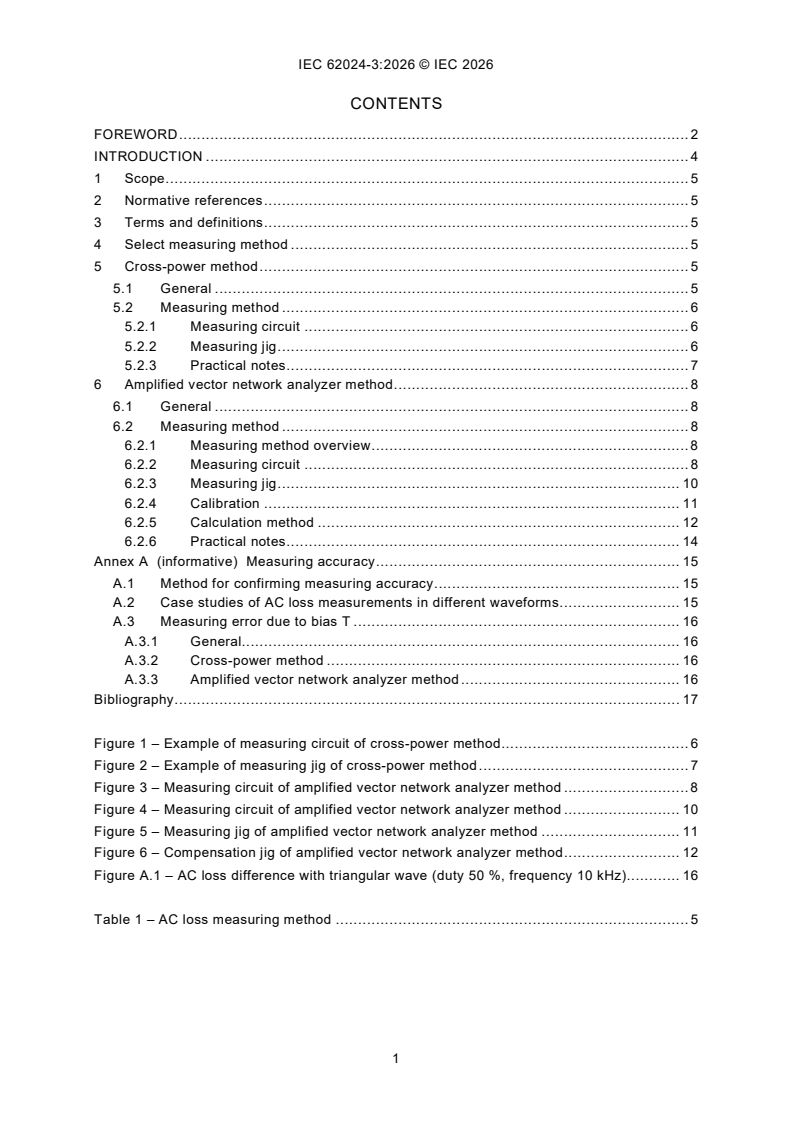
CONTENTS
FOREWORD . 2
INTRODUCTION . 4
1 Scope . 5
2 Normative references . 5
3 Terms and definitions . 5
4 Select measuring method . 5
5 Cross-power method . 5
5.1 General . 5
5.2 Measuring method . 6
5.2.1 Measuring circuit . 6
5.2.2 Measuring jig . 6
5.2.3 Practical notes . 7
6 Amplified vector network analyzer method . 8
6.1 General . 8
6.2 Measuring method . 8
6.2.1 Measuring method overview . 8
6.2.2 Measuring circuit . 8
6.2.3 Measuring jig . 10
6.2.4 Calibration . 11
6.2.5 Calculation method . 12
6.2.6 Practical notes . 14
Annex A (informative) Measuring accuracy . 15
A.1 Method for confirming measuring accuracy . 15
A.2 Case studies of AC loss measurements in different waveforms . 15
A.3 Measuring error due to bias T . 16
A.3.1 General. 16
A.3.2 Cross-power method . 16
A.3.3 Amplified vector network analyzer method . 16
Bibliography . 17
Figure 1 – Example of measuring circuit of cross-power method . 6
Figure 2 – Example of measuring jig of cross-power method . 7
Figure 3 – Measuring circuit of amplified vector network analyzer method . 8
Figure 4 – Measuring circuit of amplified vector network analyzer method . 10
Figure 5 – Measuring jig of amplified vector network analyzer method . 11
Figure 6 – Compensation jig of amplified vector network analyzer method . 12
Figure A.1 – AC loss difference with triangular wave (duty 50 %, frequency 10 kHz). 16
Table 1 – AC loss measuring method . 5
INTERNATIONAL ELECTROTECHNICAL COMMISSION
____________
High frequency inductive components -
Electrical characteristics and measuring methods -
Part 3: AC loss measured by sinusoidal wave of
inductors for DC-to-DC converters
FOREWORD
1) The International Electrotechnical Commission (IEC) is a worldwide organization for standardization comprising
all national electrotechnical committees (IEC National Committees). The object of IEC is to promote international
co-operation on all questions concerning standardization in the electrical and electronic fields. To this end and
in addition to other activities, IEC publishes International Standards, Technical Specifications, Technical Reports,
Publicly Available Specifications (PAS) and Guides (hereafter referred to as “IEC Publication(s)”). Their
preparation is entrusted to technical committees; any IEC National Committee interested in the subject dealt with
may participate in this preparatory work. International, governmental and non-governmental organizations liaising
with the IEC also participate in this preparation. IEC collaborates closely with the International Organization for
Standardization (ISO) in accordance with conditions determined by agreement between the two organizations.
2) The formal decisions or agreements of IEC on technical matters express, as nearly as possible, an international
consensus of opinion on the relevant subjects since each technical committee has representation from all
interested IEC National Committees.
3) IEC Publications have the form of recommendations for international use and are accepted by IEC National
Committees in that sense. While all reasonable efforts are made to ensure that the technical content of IEC
Publications is accurate, IEC cannot be held responsible for the way in which they are used or for any
misinterpretation by any end user.
4) In order to promote international uniformity, IEC National Committees undertake to apply IEC Publications
transparently to the maximum extent possible in their national and regional publications. Any divergence between
any IEC Publication and the corresponding national or regional publication shall be clearly indicated in the latter.
5) IEC itself does not provide any attestation of conformity. Independent certification bodies provide conformity
assessment services and, in some areas, access to IEC marks of conformity. IEC is not responsible for any
services carried out by independent certification bodies.
6) All users should ensure that they have the latest edition of this publication.
7) No liability shall attach to IEC or its directors, employees, servants or agents including individual experts and
members of its technical committees and IEC National Committees for any personal injury, property damage or
other damage of any nature whatsoever, whether direct or indirect, or for costs (including legal fees) and
expenses arising out of the publication, use of, or reliance upon, this IEC Publication or any other IEC
Publications.
8) Attention is drawn to the Normative references cited in this publication. Use of the referenced publications is
indispensable for the correct application of this publication.
9) IEC draws attention to the possibility that the implementation of this document may involve the use of (a)
patent(s). IEC takes no position concerning the evidence, validity or applicability of any claimed patent rights in
respect thereof. As of the date of publication of this document, IEC had not received notice of (a) patent(s), which
may be required to implement this document. However, implementers are cautioned that this may not represent
the latest information, which may be obtained from the patent database available at https://patents.iec.ch. IEC
shall not be held responsible for identifying any or all such patent rights.
IEC 62024-3 has been prepared by IEC technical committee 51: Magnetic components, ferrite
and magnetic powder materials. It is an International Standard.
The text of this International Standard is based on the following documents:
Draft Report on voting
51/1617/FDIS 51/1625/RVD
Full information on the voting for its approval can be found in the report on voting indicated in
the above table.
The language used for the development of this International Standard is English.
This document was drafted in accordance with ISO/IEC Directives, Part 2, and developed in
accordance with ISO/IEC Directives, Part 1 and ISO/IEC Directives, IEC Supplement, available
at www.iec.ch/members_experts/refdocs. The main document types developed by IEC are
described in greater detail at www.iec.ch/publications.
A list of all parts in the IEC 62024 series, published under the general title High frequency
inductive components - Electrical characteristics and measuring methods, can be found on the
IEC website.
The committee has decided that the contents of this document will remain unchanged until the
stability date indicated on the IEC website under webstore.iec.ch in the data related to the
specific document. At this date, the document will be
– reconfirmed,
– withdrawn, or
– revised.
INTRODUCTION
This document is intended for high-frequency inductive components used in DC-to-DC
converters.
Power saving of DC-to-DC converters is crucial owing to heat generation measures for
miniaturization and high-density mounting, longer battery life for mobile devices, and increased
power consumption in data centres with increased communication traffic. Under these
circumstances, the loss of high-frequency inductive components is an important characteristic
that determines the power saving of DC-to-DC converters. To measure the loss for possible
implementation in DC-to-DC converters, it is important to measure the AC loss at current values
close to the actual drive, but there was no measurement standard. AC loss measurements for
high-frequency inductive components are defined in IEC 62024-1, but the measured currents
are small and are not intended to be driven by DC-to-DC converters. IEC 62044-3 and
IEC 63300 address testing for large alternating current, but the applications are different
because they are for magnetic materials such as cores. Therefore, appropriate metrics for high-
frequency inductive components for DC-to-DC converter are crucial. This document introduces
a method for measuring the loss of high frequency inductive components when an alternating
current corresponding to the actual drive is applied.
This document is one of the IEC 62024 series of standards for high-frequency inductive parts.
This document specifies the test method and a measuring jig for accurately comparing AC
losses of high-frequency inductive components for DC-to-DC converters by sinusoidal wave
current. This document also presents measuring principles, application ranges, and attentions
of each method. Two different measurement methods with different ranges of measurement
frequencies are presented. AC losses are measured by setting the frequency, the magnitude of
the current, and the DC bias current.
The inductor current used in a DC-to-DC converter is a triangular wave, and the inductor loss
depends on the shape of the triangular wave in addition to the current, frequency, and DC bias
current. Therefore, the loss value measured by the measurement method using the sinusoidal
current in this document does not necessarily match the inductor loss of the DC-to-DC converter,
even if the same effective current is used. The measurement results are described in Annex A.
In the future, a separate standard defining the triangular current drive testing can be developed
for publication.
1 Scope
This part of IEC 62024 specifies test methods for AC losses of high-frequency inductive
components for power supplies used in DC-to-DC converters and similar devices at currents
close to actual operation and introduces the measurement principle, scope of application and
matters to be noted for each method. This document is applicable to leaded and surface mount
inductors with dimensions in accordance with IEC 62024-2.
2 Normative references
There are no normative references in this document.
3 Terms and definitions
No terms and definitions are listed in this document.
ISO and IEC maintain terminological databases for use in standardization at the following
addresses:
– IEC Electropedia: available at https://www.electropedia.org/
– ISO Online browsing platform: available at https://www.iso.org/obp
4 Select measuring method
This document covers two methods for measuring AC losses of inductors at high currents: the
digitizing method using cross-power spectrum calculation, herein referred to as the cross-power
method, which is suitable for low frequencies, and the amplified vector network analyzer method,
using S-parameter which is suitable for high frequencies.
Table 1 shows the frequency range and impedance range for each measurement method. The
recommended connection method for the amplified network analyzer method varies depending
on the impedance range to be measured.
Table 1 – AC loss measuring method
Measuring method Connection method Frequency range Impedance range
Cross-power method - 10 kHz to 10 MHz 0,1 Ω to 10 kΩ
Amplified vector network analyzer Shunt through 100 kHz to 200 MHz 1 Ω to 100 Ω
method
Series through 100 kHz to 200 MHz 10 Ω to 10 kΩ
5 Cross-power method
5.1 General
The cross-power method is one of the multiplying methods. By sampling and detecting voltage
and current signals, performing FFT (Fast Fourier Transform) processing and calculating, it is
possible to measure the inductor loss accurately, including harmonic components generated by
the inductor nonlinearity. The cross-power method conforms to IEC 62044-3.
5.2 Measuring method
5.2.1 Measuring circuit
One way of measuring circuit is shown in Figure 1. The sinusoidal signal for measuring is
generated by measuring instruments (MI), amplified to the required AC current by an excitation
source (ES), and applied to the device under test (DUT). The AC voltage waveform gen
...