

IEC TS 62073:2016
(Main)Guidance on the measurement of hydrophobicity of insulator surfaces
General Information
- Abstract
CORRECTED VERSION 2026-07
IEC TS 62073:2016(E) specifies the measurement of the hydrophobicity of the shed and housing material of composite insulators for overhead lines, substations and equipment or ceramic insulators covered or not covered by a coating. The obtained value represents the hydrophobicity at the time of the measurement. The object of this technical specification is to describe three methods that can be used to determine the hydrophobicity of insulators. The determination of the ability of water to wet the surface of insulators may be useful to evaluate the condition of the surface of insulators in service, or as part of the insulator testing in the laboratory. This second edition cancels and replaces the first edition published in 2003. This edition constitutes a technical revision. This edition includes the following significant technical changes with respect to the previous edition:
a) Changed wettability to hydrophobicity throughout the document
b) Redefined the criteria for the determination of hydrophobicity class in paragraph 3.4.
The content of the corrigendum 1 (2026-07) has been included in this copy.
- Status
- Published
- Publication Date
- 09-Feb-2016
- Technical Committee
- TC 36 - Insulators
- Drafting Committee
- MT 16 - TC 36/MT 16
- Current Stage
- PPUB - Publication issued
- Start Date
- 10-Feb-2016
- Completion Date
- 31-May-2016
Buy Documents
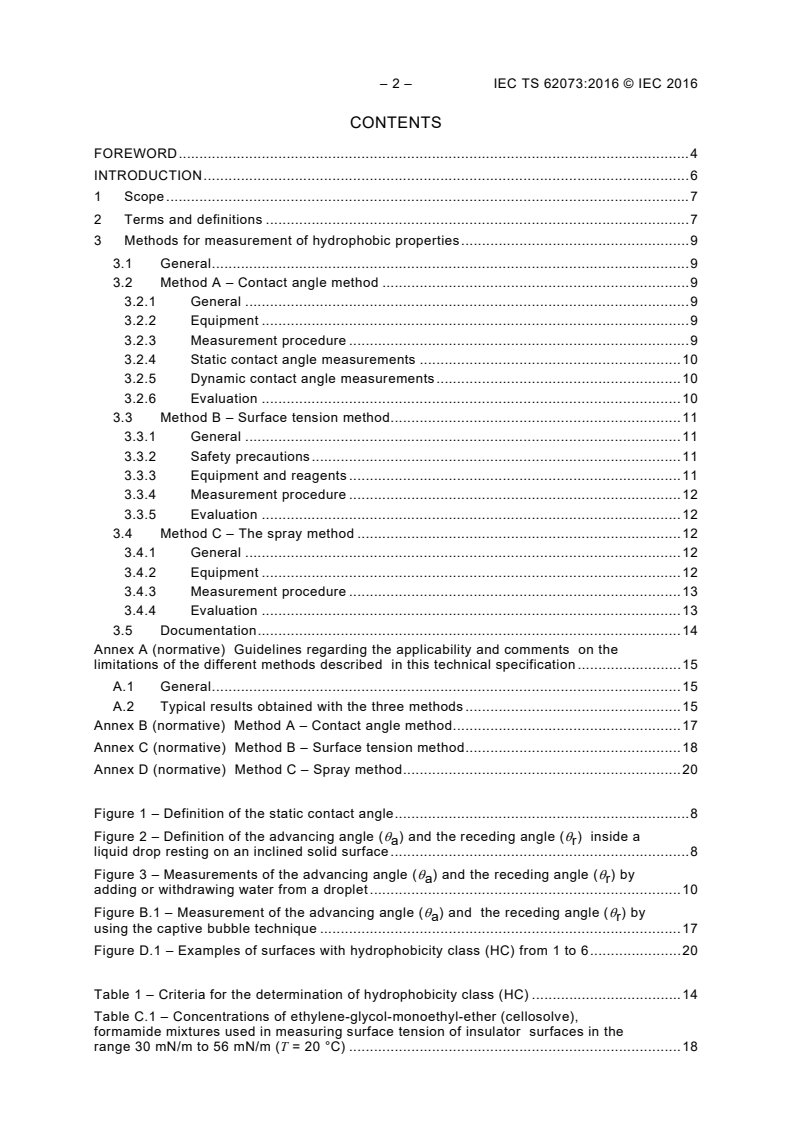
IEC TS 62073:2016 - Guidance on the measurement of hydrophobicity of insulator surfaces
IEC TS 62073:2016 - Guidance on the measurement of hydrophobicity of insulator surfaces Released:2/10/2016
Overview - IEC TS 62073:2016 (Hydrophobicity measurement)
IEC TS 62073:2016 provides guidance on the measurement of hydrophobicity of insulator surfaces. It applies to shed and housing materials of composite insulators used on overhead lines, substations and equipment, and to ceramic insulators with or without coatings. The technical specification describes three accepted measurement methods and defines how to document and assign hydrophobicity classes. The measured value represents the hydrophobicity at the time of measurement.
Key topics and requirements
- Scope and definitions
- Defines key terms such as hydrophobicity, hydrophilicity, surface tension and static contact angle.
- Three measurement methods
- Method A - Contact angle method: static and dynamic contact angle measurements (advancing/receding angles) to quantify surface wetting behavior.
- Method B - Surface tension method: determination using standardized liquid mixtures to infer surface energy/tension of the insulator surface.
- Method C - Spray method: visual/classification method suitable for in-service assessment of hydrophobicity.
- Evaluation and classification
- Procedures for evaluating results and assigning a hydrophobicity class (HC) (criteria redefined in this edition; see clause 3.4 and Table 1 of the specification).
- Documentation and limitations
- Requirements for recording test conditions and results, and annexes that describe applicability and limitations of each method (lab vs in-situ challenges).
- Edition changes
- Terminology updated from “wettability” to hydrophobicity, and classification criteria were revised from the 2003 edition.
Practical applications and users
IEC TS 62073 is intended for:
- Utility and transmission engineers assessing insulator condition on overhead lines and substations.
- Insulator manufacturers and coating suppliers performing product qualification and quality control.
- High-voltage test laboratories conducting laboratory or in-service measurements.
- Maintenance and asset managers who evaluate performance degradation, hydrophobicity transfer materials (HTM) behavior, and pollution effects. Practical uses include condition monitoring, comparative product testing, acceptance testing after manufacture or coating, and research on aging and contamination effects.
Related guidance and notes
- The specification highlights that hydrophobicity is dynamic (affected by material type, surface roughness, ageing, contamination and environmental exposure). Measurements are non-destructive but can vary by location on an insulator; multiple measurement points are recommended.
- For implementation, consult IEC TS 62073:2016 clauses, normative annexes (A–D) and Table 1 for HC criteria. For broader context, also refer to IEC publications covering insulator testing and high-voltage equipment.
Relations
- Effective Date
- 03-Jul-2026
- Effective Date
- 05-Sep-2023
Buy Documents
IEC TS 62073:2016 - Guidance on the measurement of hydrophobicity of insulator surfaces
IEC TS 62073:2016 - Guidance on the measurement of hydrophobicity of insulator surfaces Released:2/10/2016
Get Certified
Connect with accredited certification bodies for this standard

IMQ S.p.A. (Certification)
Italian electrical product certification.

SLG Prüf- und Zertifizierungs GmbH
German testing and certification body.

UL Solutions
Global safety science company with testing, inspection and certification.
Sponsored listings
Frequently Asked Questions
IEC TS 62073:2016 is a technical specification published by the International Electrotechnical Commission (IEC). Its full title is "Guidance on the measurement of hydrophobicity of insulator surfaces". This standard covers: CORRECTED VERSION 2026-07 IEC TS 62073:2016(E) specifies the measurement of the hydrophobicity of the shed and housing material of composite insulators for overhead lines, substations and equipment or ceramic insulators covered or not covered by a coating. The obtained value represents the hydrophobicity at the time of the measurement. The object of this technical specification is to describe three methods that can be used to determine the hydrophobicity of insulators. The determination of the ability of water to wet the surface of insulators may be useful to evaluate the condition of the surface of insulators in service, or as part of the insulator testing in the laboratory. This second edition cancels and replaces the first edition published in 2003. This edition constitutes a technical revision. This edition includes the following significant technical changes with respect to the previous edition: a) Changed wettability to hydrophobicity throughout the document b) Redefined the criteria for the determination of hydrophobicity class in paragraph 3.4. The content of the corrigendum 1 (2026-07) has been included in this copy.
CORRECTED VERSION 2026-07 IEC TS 62073:2016(E) specifies the measurement of the hydrophobicity of the shed and housing material of composite insulators for overhead lines, substations and equipment or ceramic insulators covered or not covered by a coating. The obtained value represents the hydrophobicity at the time of the measurement. The object of this technical specification is to describe three methods that can be used to determine the hydrophobicity of insulators. The determination of the ability of water to wet the surface of insulators may be useful to evaluate the condition of the surface of insulators in service, or as part of the insulator testing in the laboratory. This second edition cancels and replaces the first edition published in 2003. This edition constitutes a technical revision. This edition includes the following significant technical changes with respect to the previous edition: a) Changed wettability to hydrophobicity throughout the document b) Redefined the criteria for the determination of hydrophobicity class in paragraph 3.4. The content of the corrigendum 1 (2026-07) has been included in this copy.
IEC TS 62073:2016 is classified under the following ICS (International Classification for Standards) categories: 29.080.10 - Insulators. The ICS classification helps identify the subject area and facilitates finding related standards.
IEC TS 62073:2016 has the following relationships with other standards: It is inter standard links to IEC TS 62073:2016/COR1:2026, IEC TS 62073:2003. Understanding these relationships helps ensure you are using the most current and applicable version of the standard.
IEC TS 62073:2016 is available in PDF format for immediate download after purchase. The document can be added to your cart and obtained through the secure checkout process. Digital delivery ensures instant access to the complete standard document.
Standards Content (Sample)
IEC TS 62073 ®
Edition 2.0 2016-02
Corrected version
2026-07
TECHNICAL
SPECIFICATION
Guidance on the measurement of hydrophobicity of insulator surfaces
All rights reserved. Unless otherwise specified, no part of this publication may be reproduced or utilized in any form
or by any means, electronic or mechanical, including photocopying and microfilm, without permission in writing from
either IEC or IEC's member National Committee in the country of the requester. If you have any questions about IEC
copyright or have an enquiry about obtaining additional rights to this publication, please contact the address below or
your local IEC member National Committee for further information.
IEC Central Office Tel.: +41 22 919 02 11
3, rue de Varembé Fax: +41 22 919 03 00
CH-1211 Geneva 20 info@iec.ch
Switzerland www.iec.ch
About the IEC
The International Electrotechnical Commission (IEC) is the leading global organization that prepares and publishes
International Standards for all electrical, electronic and related technologies.
About IEC publications
The technical content of IEC publications is kept under constant review by the IEC. Please make sure that you have the
latest edition, a corrigenda or an amendment might have been published.
IEC Catalogue - webstore.iec.ch/catalogue Electropedia - www.electropedia.org
The stand-alone application for consulting the entire The world's leading online dictionary of electronic and
bibliographical information on IEC International Standards, electrical terms containing 20 000 terms and definitions in
Technical Specifications, Technical Reports and other English and French, with equivalent terms in 15 additional
documents. Available for PC, Mac OS, Android Tablets and languages. Also known as the International Electrotechnical
iPad. Vocabulary (IEV) online.
IEC publications search - www.iec.ch/searchpub IEC Glossary - std.iec.ch/glossary
The advanced search enables to find IEC publications by a 65 000 electrotechnical terminology entries in English and
variety of criteria (reference number, text, technical French extracted from the Terms and Definitions clause of
committee,…). It also gives information on projects, replaced IEC publications issued since 2002. Some entries have been
and withdrawn publications. collected from earlier publications of IEC TC 37, 77, 86 and
CISPR.
IEC Just Published - webstore.iec.ch/justpublished
Stay up to date on all new IEC publications. Just Published IEC Customer Service Centre - webstore.iec.ch/csc
details all new publications released. Available online and If you wish to give us your feedback on this publication or
also once a month by email. need further assistance, please contact the Customer Service
Centre: csc@iec.ch.
IEC TS 62073 ®
Edition 2.0 2016-02
Corrected version
TECHNICAL
2026-07
SPECIFICATION
Guidance on the measurement of hydrophobicity of insulator surfaces
INTERNATIONAL
ELECTROTECHNICAL
COMMISSION
ICS 29.080.10 ISBN 978-2-8322-3169-2
– 2 – IEC TS 62073:2016 © IEC 2016
CONTENTS
FOREWORD . 4
INTRODUCTION . 6
1 Scope . 7
2 Terms and definitions . 7
3 Methods for measurement of hydrophobic properties . 9
3.1 General . 9
3.2 Method A – Contact angle method . 9
3.2.1 General . 9
3.2.2 Equipment . 9
3.2.3 Measurement procedure . 9
3.2.4 Static contact angle measurements . 10
3.2.5 Dynamic contact angle measurements . 10
3.2.6 Evaluation . 10
3.3 Method B – Surface tension method. 11
3.3.1 General . 11
3.3.2 Safety precautions . 11
3.3.3 Equipment and reagents . 11
3.3.4 Measurement procedure . 12
3.3.5 Evaluation . 12
3.4 Method C – The spray method . 12
3.4.1 General . 12
3.4.2 Equipment . 12
3.4.3 Measurement procedure . 13
3.4.4 Evaluation . 13
3.5 Documentation . 14
Annex A (normative) Guidelines regarding the applicability and comments on the
limitations of the different methods described in this technical specification . 15
A.1 General . 15
A.2 Typical results obtained with the three methods . 15
Annex B (normative) Method A – Contact angle method . 17
Annex C (normative) Method B – Surface tension method . 18
Annex D (normative) Method C – Spray method . 20
Figure 1 – Definition of the static contact angle . 8
Figure 2 – Definition of the advancing angle (θ ) and the receding angle (θ ) inside a
a r
liquid drop resting on an inclined solid surface . 8
Figure 3 – Measurements of the advancing angle (θ ) and the receding angle (θ ) by
a r
adding or withdrawing water from a droplet . 10
Figure B.1 – Measurement of the advancing angle (θ ) and the receding angle (θ ) by
a r
using the captive bubble technique . 17
Figure D.1 – Examples of surfaces with hydrophobicity class (HC) from 1 to 6 . 20
Table 1 – Criteria for the determination of hydrophobicity class (HC) . 14
Table C.1 – Concentrations of ethylene-glycol-monoethyl-ether (cellosolve),
formamide mixtures used in measuring surface tension of insulator surfaces in the
range 30 mN/m to 56 mN/m (T = 20 °C) . 18
Table C.2 – Concentrations of distilled water and formamide mixture used in
measuring surface tension of insulator surfaces in the range 58 mN/m to 73 mN/m
(T = 20 °C) . 19
Table C.3 – Concentrations of distilled water and sodium chloride in mixtures used in
measuring surface tension of insulator surfaces in the range 73 mN/m to 82 mN/m
(T = 20 °C) . 19
– 4 – IEC TS 62073:2016 © IEC 2016
INTERNATIONAL ELECTROTECHNICAL COMMISSION
____________
GUIDANCE ON THE MEASUREMENT OF HYDROPHOBICITY
OF INSULATOR SURFACES
FOREWORD
1) The International Electrotechnical Commission (IEC) is a worldwide organization for standardization comprising
all national electrotechnical committees (IEC National Committees). The object of IEC is to promote
international co-operation on all questions concerning standardization in the electrical and electronic fields. To
this end and in addition to other activities, IEC publishes International Standards, Technical Specifications,
Technical Reports, Publicly Available Specifications (PAS) and Guides (hereafter referred to as “IEC
Publication(s)”). Their preparation is entrusted to technical committees; any IEC National Committee interested
in the subject dealt with may participate in this preparatory work. International, governmental and non-
governmental organizations liaising with the IEC also participate in this preparation. IEC collaborates closely
with the International Organization for Standardization (ISO) in accordance with conditions determined by
agreement between the two organizations.
2) The formal decisions or agreements of IEC on technical matters express, as nearly as possible, an international
consensus of opinion on the relevant subjects since each technical committee has representation from all
interested IEC National Committees.
3) IEC Publications have the form of recommendations for international use and are accepted by IEC National
Committees in that sense. While all reasonable efforts are made to ensure that the technical content of IEC
Publications is accurate, IEC cannot be held responsible for the way in which they are used or for any
misinterpretation by any end user.
4) In order to promote international uniformity, IEC National Committees undertake to apply IEC Publications
transparently to the maximum extent possible in their national and regional publications. Any divergence
between any IEC Publication and the corresponding national or regional publication shall be clearly indicated in
the latter.
5) IEC itself does not provide any attestation of conformity. Independent certification bodies provide conformity
assessment services and, in some areas, access to IEC marks of conformity. IEC is not responsible for any
services carried out by independent certification bodies.
6) All users should ensure that they have the latest edition of this publication.
7) No liability shall attach to IEC or its directors, employees, servants or agents including individual experts and
members of its technical committees and IEC National Committees for any personal injury, property damage or
other damage of any nature whatsoever, whether direct or indirect, or for costs (including legal fees) and
expenses arising out of the publication, use of, or reliance upon, this IEC Publication or any other IEC
Publications.
8) Attention is drawn to the Normative references cited in this publication. Use of the referenced publications is
indispensable for the correct application of this publication.
9) Attention is drawn to the possibility that some of the elements of this IEC Publication may be the subject of
patent rights. IEC shall not be held responsible for identifying any or all such patent rights.
The main task of IEC technical committees is to prepare International Standards. In
exceptional circumstances, a technical committee may propose the publication of a technical
specification when
• the required support cannot be obtained for the publication of an International Standard,
despite repeated efforts, or
• the subject is still under technical development or where, for any other reason, there is the
future but no immediate possibility of an agreement on an International Standard.
Technical specifications are subject to review within three years of publication to decide
whether they can be transformed into International Standards.
IEC 62073, which is a technical specification, has been prepared by IEC technical committee
36: Insulators.
This second edition cancels and replaces the first edition published in 2003. This edition
constitutes a technical revision.
This edition includes the following significant technical changes with respect to the previous
edition:
a) Changed wettability to hydrophobicity throughout the document
b) Redefined the criteria for the determination of hydrophobicity class in paragraph 3.4;
The text of this technical specification is based on the following documents:
Enquiry draft Report on voting
36/363/DTS 36/367/RVC
Full information on the voting for the approval of this technical specification can be found in
the report on voting indicated in the above table.
This publication has been drafted in accordance with the ISO/IEC Directives, Part 2.
The committee has decided that the contents of this publication will remain unchanged until
the stability date indicated on the IEC website under "http://webstore.iec.ch" in the data
related to the specific publication. At this date, the publication will be
• transformed into an International standard,
• reconfirmed,
• withdrawn,
• replaced by a revised edition, or
• amended.
A bilingual version of this publication may be issued at a later date.
The content of the corrigendum 1 (2026-07) has been included in this copy.
– 6 – IEC TS 62073:2016 © IEC 2016
INTRODUCTION
The wetting properties of a surface by water are commonly described by the terms
hydrophobic (or hydrophobicity) and hydrophilic (or hydrophilicity). A hydrophobic surface is
water-repellent, while a surface that is easily wetted by water is hydrophilic.
The wetting phenomenon of a surface is complex and many different parameters can
influence its hydrophobic properties. Some important parameters include: type of insulator
material, surface roughness, heterogeneities of the surface, chemical composition (e.g. due to
ageing) and presence of pollution. For insulator materials in common use, the hydrophobic
properties can change over time, due to the influence of the ambient conditions. This change
can be either reversible or irreversible. Thus, the result of the measurement of the
hydrophobicity may be influenced by the ambient conditions and the HV corona or dry-band
arcing to which the insulator has been previously exposed. This dynamic behaviour of the
hydrophobicity is more or less specific to different insulator materials. These types of
materials, which have an ability to retain and transfer hydrophobicity, are commonly called
Hydrophobicity Transfer Materials (HTM).
The dynamic behaviour of the hydrophobicity exhibited by insulator materials is due to their
chemical composition. Different processes such as oxidation, hydrolysis, migration of low
molecular weight compounds, formation of complex compounds between e.g. siloxanes and
water, rotation of flexible polymer chains, inter- and intra-molecular rearrangements,
microbiological growth, deposition of contaminants, adhesion and encapsulation of
contaminant particles, may take place at different rates, depending on material and ambient
conditions. Thus hydrophobicity along and around an insulator can vary, due to differences in
the exposure to solar radiation, rain, corona discharges, deposited pollution, etc. Therefore,
hydrophobicity of insulators is usually measured on several separate areas of the insulator.
Measurement of the hydrophobicity of a surface is readily performed in the laboratory on well
defined, homogeneous, smooth and planar surfaces of prepared specimens. In the case of
insulators, for which non-destructive measurements are usually required (and where cut-out of
material samples is usually not desired), these conditions do not exist and measurement with
high precision is a difficult task. This is especially true when the measurement has to be
performed on an insulator installed in an overhead line, substation or even in a high voltage
test set-up in the laboratory.
Previously wettability class (WC) was used as equivalent technology.
GUIDANCE ON THE MEASUREMENT OF HYDROPHOBICITY
OF INSULATOR SURFACES
1 Scope
The methods described in this technical specification can be used for the measurement of the
hydrophobicity of the shed and housing material of composite insulators for overhead lines,
substations and equipment or ceramic insulators covered or not covered by a coating. The
obtained value represents the hydrophobicity at the time of the measurement.
The object of this technical specification is to describe three methods that can be used to
determine the hydrophobicity of insulators. The determination of the ability of water to wet the
surface of insulators may be useful to evaluate the condition of the surface of insulators in
service, or as part of the insulator testing in the laboratory.
2 Terms and definitions
For the purposes of this document, the following definitions apply.
2.1
hydrophobicity
state of a surface with a low surface tension and thus is water-repellent
2.2
hydrophilicity
state of a surface with a high surface tension and thus is wetted by water (in the form of a
film)
2.3
surface tension
region of finite thickness (usually less than 0,1 µm) in which the composition and energy vary
continuously from one bulk phase to the other
Note 1 to entry: The pressure (force field) in the interfacial zone has a gradient perpendicular to the interfacial
boundary. A net energy is required to create an interface (surface) by transporting the matter from the bulk phase
to the interfacial (surface) zone. The reversible work required to create a unit interfacial (surface) area is the
surface tension and is defined thermodynamically as follows:
∂G
γ =
∂A
T,P,n
where
γ is the surface (interfacial) tension or surface energy;
G is the Gibbs free energy of the total system;
A is the surface (interfacial) area;
T is the temperature;
P is the pressure;
n is the total number of moles of matter in the system.
The surface tension (γ) is usually expressed in mN/m (1 mN/m = 1 dyn/cm).
– 8 – IEC TS 62073:2016 © IEC 2016
2.4
static contact angle
angle of a drop of liquid resting on the surface of a solid, and a gas is in contact with both, the
forces acting at the interfaces are in balance
Note 1 to entry: These forces are due to surface tensions acting in the direction of the respective surfaces. From
Figure 1 it follows that:
γ cosθ =γ −γ
GL s GS SL
where
θ is the static contact angle of the edge of the drop with the solid surface,
s
γ is the surface tension of the gas-liquid interface,
GL
γ is the surface tension of the gas-solid interface, and
GS
γ is the surface tension of the solid-liquid interface.
SL
Note 2 to entry: The above equation (Young´s equation) is only valid for ideal and smooth surfaces.
Air
γ
Liquid GL
θ
S
γ γ
SL GS
Solid
IEC
Figure 1 – Definition of the static contact angle
The right side of the above equation (the difference between the surface tensions of the gas-solid and the solid-
liquid interfaces) is defined as the surface tension of the solid surface. It is not a fundamental property of the
surface but depends on the interaction between the solid and a particular environment.
When the gas is air saturated with vapour of the liquid, γ will be the surface tension of the liquid. If the contact
GL
angle is 0°, the liquid is said to just wet the surface of the solid, and in this particular case (since cos θ = 1), the
s
surface tension of the solid will be equal to the surface tension of the liquid.
2.5
advancing and receding contact angle (dynamic contact angles)
angles of a droplet on an inclined solid surface that exhibits two different angles
Note 1 to entry: The advancing contact angle (θ ) is the angle inside the water droplet between the solid surface
a
and the droplet surface at the lower part of the droplet on the inclined surface (see Figure 2). The receding contact
angle (θ ) of a droplet on an inclined surface is the angle inside the droplet between the solid surface and the
r
droplet surface at the droplet rear (highest part on the inclined surface). If the receding contact angle is zero, a
completely wetted trace of water is formed as the drop moves along the solid inclined surface (see Figure 2). The
general physical relation between the advancing and receding contact angle and the static contact angle defined in
2.4 is: θ ≤ θ ≤ θ .
r s a
Air
θ
r
Liquid
θ
a
Solid
IEC
Figure 2 – Definition of the advancing angle (θ ) and the receding angle (θ )
a r
inside a liquid drop resting on an inclined solid surface
2.6
hydrophobicity class
HC
specific level of the scale used in the spray method (Method C)
Note 1 to entry: Seven classes, HC/1 to HC/7, have been defined. HC/1 corresponds to the most hydrophobic
surface and HC/7 to the most hydrophilic surface.
3 Methods for measurement of hydrophobic properties
3.1 General
Three methods for measurement of the hydrophobicity, differing in accuracy, simplicity, size
of measured surface area and applicability, are described in this technical specification and
are as follows:
a) the contact angle method;
b) the surface tension method;
c) the spray method.
Guidance relative to the specific use of the three methods is found in Annex A.
3.2 Method A – Contact angle method
3.2.1 General
The contact angle method is a measurement that involves the evaluation of the contact angle
formed between the edge of a single droplet of water and the surface of a solid material. If
done on a horizontal surface, the advancing and receding contact angles can be measured by
adding water to or withdrawing water from the droplet.
The contact angles depend strongly on the surface roughness and contact angles measured
on polluted
...
IEC TS 62073 ®
Edition 2.0 2016-02
TECHNICAL
SPECIFICATION
Guidance on the measurement of hydrophobicity of insulator surfaces
All rights reserved. Unless otherwise specified, no part of this publication may be reproduced or utilized in any form
or by any means, electronic or mechanical, including photocopying and microfilm, without permission in writing from
either IEC or IEC's member National Committee in the country of the requester. If you have any questions about IEC
copyright or have an enquiry about obtaining additional rights to this publication, please contact the address below or
your local IEC member National Committee for further information.
IEC Central Office Tel.: +41 22 919 02 11
3, rue de Varembé Fax: +41 22 919 03 00
CH-1211 Geneva 20 info@iec.ch
Switzerland www.iec.ch
About the IEC
The International Electrotechnical Commission (IEC) is the leading global organization that prepares and publishes
International Standards for all electrical, electronic and related technologies.
About IEC publications
The technical content of IEC publications is kept under constant review by the IEC. Please make sure that you have the
latest edition, a corrigenda or an amendment might have been published.
IEC Catalogue - webstore.iec.ch/catalogue Electropedia - www.electropedia.org
The stand-alone application for consulting the entire The world's leading online dictionary of electronic and
bibliographical information on IEC International Standards, electrical terms containing 20 000 terms and definitions in
Technical Specifications, Technical Reports and other English and French, with equivalent terms in 15 additional
documents. Available for PC, Mac OS, Android Tablets and languages. Also known as the International Electrotechnical
iPad. Vocabulary (IEV) online.
IEC publications search - www.iec.ch/searchpub IEC Glossary - std.iec.ch/glossary
The advanced search enables to find IEC publications by a 65 000 electrotechnical terminology entries in English and
variety of criteria (reference number, text, technical French extracted from the Terms and Definitions clause of
committee,…). It also gives information on projects, replaced IEC publications issued since 2002. Some entries have been
and withdrawn publications. collected from earlier publications of IEC TC 37, 77, 86 and
CISPR.
IEC Just Published - webstore.iec.ch/justpublished
Stay up to date on all new IEC publications. Just Published IEC Customer Service Centre - webstore.iec.ch/csc
details all new publications released. Available online and If you wish to give us your feedback on this publication or
also once a month by email. need further assistance, please contact the Customer Service
Centre: csc@iec.ch.
IEC TS 62073 ®
Edition 2.0 2016-02
TECHNICAL
SPECIFICATION
Guidance on the measurement of hydrophobicity of insulator surfaces
INTERNATIONAL
ELECTROTECHNICAL
COMMISSION
ICS 29.080.10 ISBN 978-2-8322-3169-2
– 2 – IEC TS 62073:2016 © IEC 2016
CONTENTS
FOREWORD . 4
INTRODUCTION . 6
1 Scope . 7
2 Terms and definitions . 7
3 Methods for measurement of hydrophobic properties . 9
3.1 General . 9
3.2 Method A – Contact angle method . 9
3.2.1 General . 9
3.2.2 Equipment . 9
3.2.3 Measurement procedure . 9
3.2.4 Static contact angle measurements . 10
3.2.5 Dynamic contact angle measurements . 10
3.2.6 Evaluation . 10
3.3 Method B – Surface tension method . 11
3.3.1 General . 11
3.3.2 Safety precautions . 11
3.3.3 Equipment and reagents . 11
3.3.4 Measurement procedure . 12
3.3.5 Evaluation . 12
3.4 Method C – The spray method . 12
3.4.1 General . 12
3.4.2 Equipment . 12
3.4.3 Measurement procedure . 13
3.4.4 Evaluation . 13
3.5 Documentation . 14
Annex A (normative) Guidelines regarding the applicability and comments on the
limitations of the different methods described in this technical specification . 15
A.1 General . 15
A.2 Typical results obtained with the three methods . 15
Annex B (normative) Method A – Contact angle method . 17
Annex C (normative) Method B – Surface tension method . 18
Annex D (normative) Method C – Spray method . 20
Figure 1 – Definition of the static contact angle . 8
Figure 2 – Definition of the advancing angle (θ ) and the receding angle (θ ) inside a
a r
liquid drop resting on an inclined solid surface . 8
Figure 3 – Measurements of the advancing angle (θ ) and the receding angle (θ ) by
a r
adding or withdrawing water from a droplet. 10
Figure B.1 – Measurement of the advancing angle (θ ) and the receding angle (θ ) by
a r
using the captive bubble technique. 17
Figure D.1 – Examples of surfaces with hydrophobicity class (HC) from 1 to 6 . 20
Table 1 – Criteria for the determination of hydrophobicity class (HC) . 14
Table C.1 – Concentrations of ethylene-glycol-monoethyl-ether (cellosolve),
formamide mixtures used in measuring surface tension of insulator surfaces in the
range 30 mN/m to 56 mN/m (T = 20 °C) . 18
Table C.2 – Concentrations of distilled water and formamide mixture used in
measuring surface tension of insulator surfaces in the range 58 mN/m to 73 mN/m
(T = 20 °C) . 19
Table C.3 – Concentrations of distilled water and sodium chloride in mixtures used in
measuring surface tension of insulator surfaces in the range 73 mN/m to 82 mN/m
(T = 20 °C) . 19
– 4 – IEC TS 62073:2016 © IEC 2016
INTERNATIONAL ELECTROTECHNICAL COMMISSION
____________
GUIDANCE ON THE MEASUREMENT OF HYDROPHOBICITY
OF INSULATOR SURFACES
FOREWORD
1) The International Electrotechnical Commission (IEC) is a worldwide organization for standardization comprising
all national electrotechnical committees (IEC National Committees). The object of IEC is to promote
international co-operation on all questions concerning standardization in the electrical and electronic fields. To
this end and in addition to other activities, IEC publishes International Standards, Technical Specifications,
Technical Reports, Publicly Available Specifications (PAS) and Guides (hereafter referred to as “IEC
Publication(s)”). Their preparation is entrusted to technical committees; any IEC National Committee interested
in the subject dealt with may participate in this preparatory work. International, governmental and non-
governmental organizations liaising with the IEC also participate in this preparation. IEC collaborates closely
with the International Organization for Standardization (ISO) in accordance with conditions determined by
agreement between the two organizations.
2) The formal decisions or agreements of IEC on technical matters express, as nearly as possible, an international
consensus of opinion on the relevant subjects since each technical committee has representation from all
interested IEC National Committees.
3) IEC Publications have the form of recommendations for international use and are accepted by IEC National
Committees in that sense. While all reasonable efforts are made to ensure that the technical content of IEC
Publications is accurate, IEC cannot be held responsible for the way in which they are used or for any
misinterpretation by any end user.
4) In order to promote international uniformity, IEC National Committees undertake to apply IEC Publications
transparently to the maximum extent possible in their national and regional publications. Any divergence
between any IEC Publication and the corresponding national or regional publication shall be clearly indicated in
the latter.
5) IEC itself does not provide any attestation of conformity. Independent certification bodies provide conformity
assessment services and, in some areas, access to IEC marks of conformity. IEC is not responsible for any
services carried out by independent certification bodies.
6) All users should ensure that they have the latest edition of this publication.
7) No liability shall attach to IEC or its directors, employees, servants or agents including individual experts and
members of its technical committees and IEC National Committees for any personal injury, property damage or
other damage of any nature whatsoever, whether direct or indirect, or for costs (including legal fees) and
expenses arising out of the publication, use of, or reliance upon, this IEC Publication or any other IEC
Publications.
8) Attention is drawn to the Normative references cited in this publication. Use of the referenced publications is
indispensable for the correct application of this publication.
9) Attention is drawn to the possibility that some of the elements of this IEC Publication may be the subject of
patent rights. IEC shall not be held responsible for identifying any or all such patent rights.
The main task of IEC technical committees is to prepare International Standards. In
exceptional circumstances, a technical committee may propose the publication of a technical
specification when
• the required support cannot be obtained for the publication of an International Standard,
despite repeated efforts, or
• the subject is still under technical development or where, for any other reason, there is the
future but no immediate possibility of an agreement on an International Standard.
Technical specifications are subject to review within three years of publication to decide
whether they can be transformed into International Standards.
IEC 62073, which is a technical specification, has been prepared by IEC technical committee
36: Insulators.
This second edition cancels and replaces the first edition published in 2003. This edition
constitutes a technical revision.
This edition includes the following significant technical changes with respect to the previous
edition:
a) Changed wettability to hydrophobicity throughout the document
b) Redefined the criteria for the determination of hydrophobicity class in paragraph 3.4;
The text of this technical specification is based on the following documents:
Enquiry draft Report on voting
36/363/DTS 36/367/RVC
Full information on the voting for the approval of this technical specification can be found in
the report on voting indicated in the above table.
This publication has been drafted in accordance with the ISO/IEC Directives, Part 2.
The committee has decided that the contents of this publication will remain unchanged until
the stability date indicated on the IEC website under "http://webstore.iec.ch" in the data
related to the specific publication. At this date, the publication will be
• transformed into an International standard,
• reconfirmed,
• withdrawn,
• replaced by a revised edition, or
• amended.
A bilingual version of this publication may be issued at a later date.
– 6 – IEC TS 62073:2016 © IEC 2016
INTRODUCTION
The wetting properties of a surface by water are commonly described by the terms
hydrophobic (or hydrophobicity) and hydrophilic (or hydrophilicity). A hydrophobic surface is
water-repellent, while a surface that is easily wetted by water is hydrophilic.
The wetting phenomenon of a surface is complex and many different parameters can
influence its hydrophobic properties. Some important parameters include: type of insulator
material, surface roughness, heterogeneities of the surface, chemical composition (e.g. due to
ageing) and presence of pollution. For insulator materials in common use, the hydrophobic
properties can change over time, due to the influence of the ambient conditions. This change
can be either reversible or irreversible. Thus, the result of the measurement of the
hydrophobicity may be influenced by the ambient conditions and the HV corona or dry-band
arcing to which the insulator has been previously exposed. This dynamic behaviour of the
hydrophobicity is more or less specific to different insulator materials. These types of
materials, which have an ability to retain and transfer hydrophobicity, are commonly called
Hydrophobicity Transfer Materials (HTM).
The dynamic behaviour of the hydrophobicity exhibited by insulator materials is due to their
chemical composition. Different processes such as oxidation, hydrolysis, migration of low
molecular weight compounds, formation of complex compounds between e.g. siloxanes and
water, rotation of flexible polymer chains, inter- and intra-molecular rearrangements,
microbiological growth, deposition of contaminants, adhesion and encapsulation of
contaminant particles, may take place at different rates, depending on material and ambient
conditions. Thus hydrophobicity along and around an insulator can vary, due to differences in
the exposure to solar radiation, rain, corona discharges, deposited pollution, etc. Therefore,
hydrophobicity of insulators is usually measured on several separate areas of the insulator.
Measurement of the hydrophobicity of a surface is readily performed in the laboratory on well
defined, homogeneous, smooth and planar surfaces of prepared specimens. In the case of
insulators, for which non-destructive measurements are usually required (and where cut-out of
material samples is usually not desired), these conditions do not exist and measurement with
high precision is a difficult task. This is especially true when the measurement has to be
performed on an insulator installed in an overhead line, substation or even in a high voltage
test set-up in the laboratory.
Previously wettability class (WC) was used as equivalent technology.
GUIDANCE ON THE MEASUREMENT OF HYDROPHOBICITY
OF INSULATOR SURFACES
1 Scope
The methods described in this technical specification can be used for the measurement of the
hydrophobicity of the shed and housing material of composite insulators for overhead lines,
substations and equipment or ceramic insulators covered or not covered by a coating. The
obtained value represents the hydrophobicity at the time of the measurement.
The object of this technical specification is to describe three methods that can be used to
determine the hydrophobicity of insulators. The determination of the ability of water to wet the
surface of insulators may be useful to evaluate the condition of the surface of insulators in
service, or as part of the insulator testing in the laboratory.
2 Terms and definitions
For the purposes of this document, the following definitions apply.
2.1
hydrophobicity
state of a surface with a low surface tension and thus is water-repellent
2.2
hydrophilicity
state of a surface with a high surface tension and thus is wetted by water (in the form of a
film)
2.3
surface tension
region of finite thickness (usually less than 0,1 µm) in which the composition and energy vary
continuously from one bulk phase to the other
Note 1 to entry: The pressure (force field) in the interfacial zone has a gradient perpendicular to the interfacial
boundary. A net energy is required to create an interface (surface) by transporting the matter from the bulk phase
to the interfacial (surface) zone. The reversible work required to create a unit interfacial (surface) area is the
surface tension and is defined thermodynamically as follows:
∂G
γ =
∂A
T,P,n
where
γ is the surface (interfacial) tension or surface energy;
G is the Gibbs free energy of the total system;
A is the surface (interfacial) area;
T is the temperature;
P is the pressure;
n is the total number of moles of matter in the system.
The surface tension (γ) is usually expressed in mN/m (1 mN/m = 1 dyn/cm).
– 8 – IEC TS 62073:2016 © IEC 2016
2.4
static contact angle
angle of a drop of liquid resting on the surface of a solid, and a gas is in contact with both, the
forces acting at the interfaces are in balance
Note 1 to entry: These forces are due to surface tensions acting in the direction of the respective surfaces. From
Figure 1 it follows that:
γ cosθ =γ −γ
GL s GS SL
where
θ is the static contact angle of the edge of the drop with the solid surface,
s
γ is the surface tension of the gas-liquid interface,
GL
γ is the surface tension of the gas-solid interface, and
GS
γ is the surface tension of the solid-liquid interface.
SL
Note 2 to entry: The above equation (Young´s equation) is only valid for ideal and smooth surfaces.
Air
γ
Liquid GL
θ
S
γ γ
SL GS
Solid
IEC
Figure 1 – Definition of the static contact angle
The right side of the above equation (the difference between the surface tensions of the gas-solid and the solid-
liquid interfaces) is defined as the surface tension of the solid surface. It is not a fundamental property of the
surface but depends on the interaction between the solid and a particular environment.
When the gas is air saturated with vapour of the liquid, γ will be the surface tension of the liquid. If the contact
GL
angle is 0°, the liquid is said to just wet the surface of the solid, and in this particular case (since cos θ = 1), the
s
surface tension of the solid will be equal to the surface tension of the liquid.
2.5
advancing and receding contact angle (dynamic contact angles)
angles of a droplet on an inclined solid surface that exhibits two different angles
Note 1 to entry: The advancing contact angle (θ ) is the angle inside the water droplet between the solid surface
a
and the droplet surface at the lower part of the droplet on the inclined surface (see Figure 2). The receding contact
angle (θ ) of a droplet on an inclined surface is the angle inside the droplet between the solid surface and the
r
droplet surface at the droplet rear (highest part on the inclined surface). If the receding contact angle is zero, a
completely wetted trace of water is formed as the drop moves along the solid inclined surface (see Figure 2). The
general physical relation between the advancing and receding contact angle and the static contact angle defined in
2.4 is: θ ≤ θ ≤ θ .
r s a
Air
θ
r
Liquid
θ
a
Solid
IEC
Figure 2 – Definition of the advancing angle (θ ) and the receding angle (θ )
a r
inside a liquid drop resting on an inclined solid surface
2.6
hydrophobicity class
HC
specific level of the scale used in the spray method (Method C)
Note 1 to entry: Seven classes, HC/1 to HC/7, have been defined. HC/1 corresponds to the most hydrophobic
surface and HC/7 to the most hydrophilic surface.
3 Methods for measurement of hydrophobic properties
3.1 General
Three methods for measurement of the hydrophobicity, differing in accuracy, simplicity, size
of measured surface area and applicability, are described in this technical specification and
are as follows:
a) the contact angle method;
b) the surface tension method;
c) the spray method.
Guidance relative to the specific use of the three methods is found in Annex A.
3.2 Method A – Contact angle method
3.2.1 General
The contact angle method is a measurement that involves the evaluation of the contact angle
formed between the edge of a single droplet of water and the surface of a solid material. If
done on a horizontal surface, the advancing and receding contact angles can be measured by
adding water to or withdrawing water from the droplet.
The contact angles depend strongly on the surface roughness and contact angles measured
on polluted surfaces may differ significantly from contact angles measured on smooth, clean
and planar surfaces.
3.2.2
...