

IEC 61669:2015
(Main)Electroacoustics - Measurement of real-ear acoustical performance characteristics of hearing aids
General Information
- Abstract
IEC 61669:2015 gives recommendations and requirements for the measurement and estimation of the real-ear acoustical performance characteristics of air-conduction hearing aids and for the measurement of certain acoustic properties of the ear related to the application of hearing aids. Measurements of real-ear acoustical characteristics of hearing aids which apply non-linear or analytical processing techniques are valid only for the test signals used and conditions employed. The purpose of this standard is to ensure that measurements of real-ear acoustical performance characteristics of a given hearing aid on a given human ear can be replicated in other locations with other test equipment. This second edition cancels and replaces the first edition of IEC 61669:2001 and the first edition of ISO 12124:2001. This edition constitutes a technical revision.
- Status
- Published
- Publication Date
- 16-Jan-2025
- Technical Committee
- TC 29 - Electroacoustics
- Drafting Committee
- WG 13 - TC 29/WG 13
- Current Stage
- PPUB - Publication issued
- Start Date
- 04-Nov-2015
- Completion Date
- 15-Dec-2015
Buy Documents
IEC 61669:2015+AMD1:2025 CSV - Electroacoustics - Measurement of real-ear acoustical performance characteristics of hearing aids Released:1/17/2025
IEC 61669:2015 - Electroacoustics - Measurement of real-ear acoustical performance characteristics of hearing aids Released:11/4/2015
Overview
IEC 61669:2015 (Edition 2) + AMD1:2025 - published by the International Electrotechnical Commission - is the international standard for measuring the real‑ear acoustical performance characteristics of air‑conduction hearing aids. It provides recommendations and requirements for test setups, signals, equipment, procedures and uncertainty assessment so that measurements made on a given hearing aid and human ear can be reliably reproduced across locations and test systems. This edition supersedes IEC 61669:2001 and ISO 12124:2001 and introduces technical updates such as the International Speech Test Signal and methods for real‑ear to coupler/dial differences.
Key topics and technical requirements
- Scope and reproducibility: Ensures repeatable real‑ear measurements and specifies limitations for devices using non‑linear or analytical processing (measurements are valid only for the specific test signals and conditions used).
- Real‑ear metrics defined: Procedures for measuring REAR (real‑ear aided response), REIG (real‑ear insertion gain), REUR/REUG (real‑ear unaided response/gain), REOR/REOG (occluded response/gain), RECD (real‑ear to coupler difference) and REDD (real‑ear to dial difference).
- Test equipment and setup: Requirements for probe‑microphone measurement systems, sound sources, equalization methods (substitution, modified pressure), signal levels, frequency and distortion limits, and ambient/test space acoustical properties.
- Probe microphone positioning: Guidance and informative Annex A on visual, acoustically‑assisted and geometrical positioning of the probe inlet at the measurement point.
- Measurement uncertainty and tolerances: Clause on estimating uncertainty and informative Annex C relating tolerance and acceptance intervals to permitted measurement uncertainty.
- Annex on RECD: Annex B discusses practical issues when measuring and applying RECD (important for coupling to coupler measurements and prescribing for infants/children).
Practical applications and users
Who uses IEC 61669:
- Audiologists and clinicians - validating hearing‑aid fittings and verifying aided sound levels in the ear.
- Hearing aid manufacturers and R&D labs - product development, QA, and performance verification under standardized conditions.
- Test laboratories and certification bodies - ensuring measurement traceability and conformity.
- Researchers and regulatory agencies - comparing device performance and establishing clinical best practices.
Typical applications:
- Verifying aided sound pressure levels for speech and test signals (REAR).
- Calculating insertion gain (REIG) to assess benefit over unaided condition.
- Using RECD to translate coupler measurements to real‑ear predictions - critical for pediatric fittings and for when real‑ear measurement is not feasible.
Related standards
- IEC 60118‑0 and IEC 60118‑7 (electroacoustics of hearing aids) - referenced for complementary laboratory methods.
- ISO 12124:2001 - superseded by this edition.
Keywords: IEC 61669, real‑ear measurement, REAR, REIG, RECD, probe microphone, hearing aid testing, real‑ear acoustical performance.
Relations
- Effective Date
- 25-Aug-2026
- Effective Date
- 11-Mar-2026
- Effective Date
- 07-Jun-2024
- Effective Date
- 05-Sep-2023
Buy Documents
IEC 61669:2015+AMD1:2025 CSV - Electroacoustics - Measurement of real-ear acoustical performance characteristics of hearing aids Released:1/17/2025
IEC 61669:2015 - Electroacoustics - Measurement of real-ear acoustical performance characteristics of hearing aids Released:11/4/2015
Get Certified
Connect with accredited certification bodies for this standard

BSMI (Bureau of Standards, Metrology and Inspection)
Taiwan's standards and inspection authority.
Sponsored listings
Frequently Asked Questions
IEC 61669:2015 is a standard published by the International Electrotechnical Commission (IEC). Its full title is "Electroacoustics - Measurement of real-ear acoustical performance characteristics of hearing aids". This standard covers: IEC 61669:2015 gives recommendations and requirements for the measurement and estimation of the real-ear acoustical performance characteristics of air-conduction hearing aids and for the measurement of certain acoustic properties of the ear related to the application of hearing aids. Measurements of real-ear acoustical characteristics of hearing aids which apply non-linear or analytical processing techniques are valid only for the test signals used and conditions employed. The purpose of this standard is to ensure that measurements of real-ear acoustical performance characteristics of a given hearing aid on a given human ear can be replicated in other locations with other test equipment. This second edition cancels and replaces the first edition of IEC 61669:2001 and the first edition of ISO 12124:2001. This edition constitutes a technical revision.
IEC 61669:2015 gives recommendations and requirements for the measurement and estimation of the real-ear acoustical performance characteristics of air-conduction hearing aids and for the measurement of certain acoustic properties of the ear related to the application of hearing aids. Measurements of real-ear acoustical characteristics of hearing aids which apply non-linear or analytical processing techniques are valid only for the test signals used and conditions employed. The purpose of this standard is to ensure that measurements of real-ear acoustical performance characteristics of a given hearing aid on a given human ear can be replicated in other locations with other test equipment. This second edition cancels and replaces the first edition of IEC 61669:2001 and the first edition of ISO 12124:2001. This edition constitutes a technical revision.
IEC 61669:2015 is classified under the following ICS (International Classification for Standards) categories: 17.140.50 - Electroacoustics. The ICS classification helps identify the subject area and facilitates finding related standards.
IEC 61669:2015 has the following relationships with other standards: It is inter standard links to EN ISO 21388:2021, EN ISO 21388-2:2024, IEC 61669:2015/AMD1:2025, IEC 61669:2001. Understanding these relationships helps ensure you are using the most current and applicable version of the standard.
IEC 61669:2015 is available in PDF format for immediate download after purchase. The document can be added to your cart and obtained through the secure checkout process. Digital delivery ensures instant access to the complete standard document.
Standards Content (Sample)
IEC 61669 ®
Edition 2.1 2025-01
CONSOLIDATED VERSION
INTERNATIONAL
STANDARD
colour
inside
Electroacoustics – Measurement of real-ear acoustical performance
characteristics of hearing aids
All rights reserved. Unless otherwise specified, no part of this publication may be reproduced or utilized in any form
or by any means, electronic or mechanical, including photocopying and microfilm, without permission in writing from
either IEC or IEC's member National Committee in the country of the requester. If you have any questions about IEC
copyright or have an enquiry about obtaining additional rights to this publication, please contact the address below or
your local IEC member National Committee for further information.
IEC Secretariat Tel.: +41 22 919 02 11
3, rue de Varembé info@iec.ch
CH-1211 Geneva 20 www.iec.ch
Switzerland
About the IEC
The International Electrotechnical Commission (IEC) is the leading global organization that prepares and publishes
International Standards for all electrical, electronic and related technologies.
About IEC publications
The technical content of IEC publications is kept under constant review by the IEC. Please make sure that you have the
latest edition, a corrigendum or an amendment might have been published.
IEC publications search - webstore.iec.ch/advsearchform IEC Products & Services Portal - products.iec.ch
The advanced search enables to find IEC publications by a Discover our powerful search engine and read freely all the
variety of criteria (reference number, text, technical publications previews, graphical symbols and the glossary.
committee, …). It also gives information on projects, replaced With a subscription you will always have access to up to date
and withdrawn publications. content tailored to your needs.
IEC Just Published - webstore.iec.ch/justpublished
Electropedia - www.electropedia.org
Stay up to date on all new IEC publications. Just Published
The world's leading online dictionary on electrotechnology,
details all new publications released. Available online and once
containing more than 22 500 terminological entries in English
a month by email.
and French, with equivalent terms in 25 additional languages.
Also known as the International Electrotechnical Vocabulary
IEC Customer Service Centre - webstore.iec.ch/csc
(IEV) online.
If you wish to give us your feedback on this publication or need
further assistance, please contact the Customer Service
Centre: sales@iec.ch.
IEC 61669 ®
Edition 2.1 2025-01
CONSOLIDATED VERSION
INTERNATIONAL
STANDARD
colour
inside
Electroacoustics – Measurement of real-ear acoustical performance
characteristics of hearing aids
INTERNATIONAL
ELECTROTECHNICAL
COMMISSION
ICS 17.140.50 ISBN 978-2-8327-0151-5
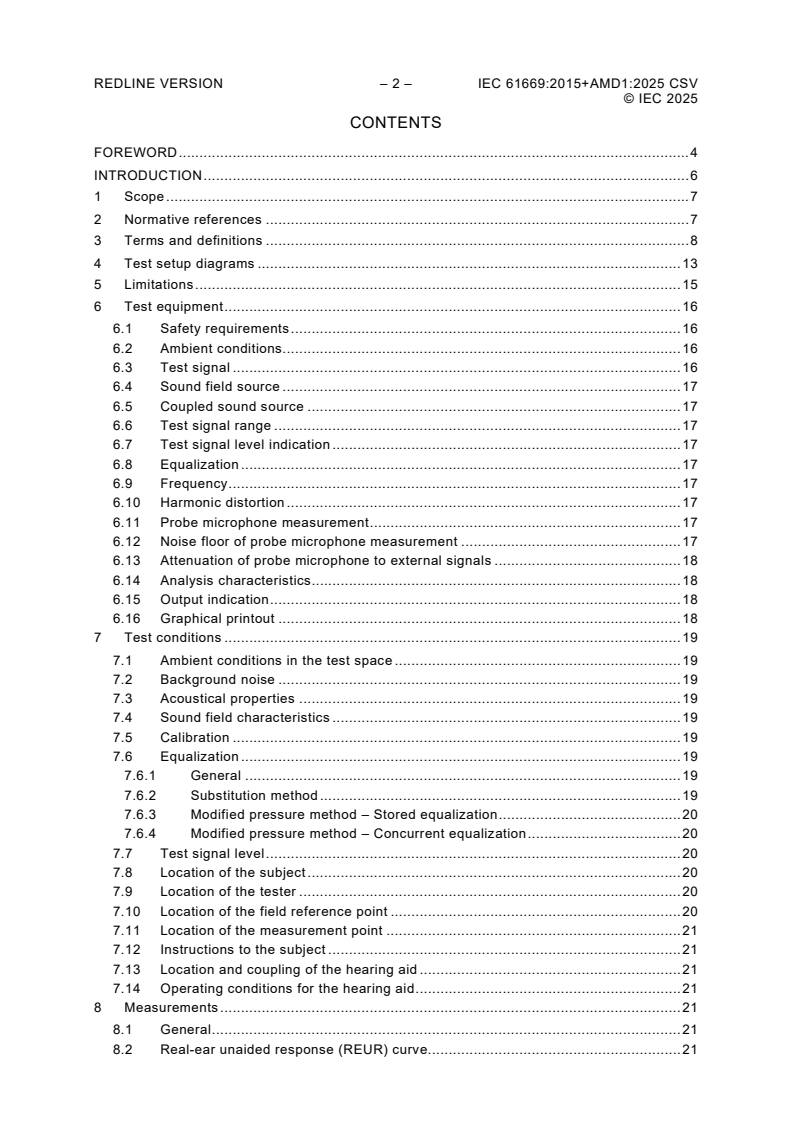
REDLINE VERSION – 2 – IEC 61669:2015+AMD1:2025 CSV
© IEC 2025
CONTENTS
FOREWORD . 4
INTRODUCTION . 6
1 Scope . 7
2 Normative references . 7
3 Terms and definitions . 8
4 Test setup diagrams . 13
5 Limitations . 15
6 Test equipment . 16
6.1 Safety requirements . 16
6.2 Ambient conditions. 16
6.3 Test signal . 16
6.4 Sound field source . 17
6.5 Coupled sound source . 17
6.6 Test signal range . 17
6.7 Test signal level indication . 17
6.8 Equalization . 17
6.9 Frequency . 17
6.10 Harmonic distortion . 17
6.11 Probe microphone measurement . 17
6.12 Noise floor of probe microphone measurement . 17
6.13 Attenuation of probe microphone to external signals . 18
6.14 Analysis characteristics. 18
6.15 Output indication . 18
6.16 Graphical printout . 18
7 Test conditions . 19
7.1 Ambient conditions in the test space . 19
7.2 Background noise . 19
7.3 Acoustical properties . 19
7.4 Sound field characteristics . 19
7.5 Calibration . 19
7.6 Equalization . 19
7.6.1 General . 19
7.6.2 Substitution method . 19
7.6.3 Modified pressure method – Stored equalization . 20
7.6.4 Modified pressure method – Concurrent equalization . 20
7.7 Test signal level . 20
7.8 Location of the subject . 20
7.9 Location of the tester . 20
7.10 Location of the field reference point . 20
7.11 Location of the measurement point . 21
7.12 Instructions to the subject . 21
7.13 Location and coupling of the hearing aid . 21
7.14 Operating conditions for the hearing aid . 21
8 Measurements . 21
8.1 General . 21
8.2 Real-ear unaided response (REUR) curve. 21
© IEC 2025
8.3 Real-ear unaided gain (REUG) curve . 22
8.4 Real-ear occluded response (REOR) curve . 22
8.5 Real-ear occluded gain (REOG) curve . 22
8.6 Real-ear aided response (REAR) curve. 22
8.7 Real-ear aided gain (REAG) curve . 23
8.8 Real-ear insertion gain (REIG) curve . 23
8.9 Real-ear to coupler difference (RECD) curve . 23
8.10 Real-ear to dial difference (REDD) curve . 23
9 Measurement uncertainty for the performance requirements of Clause 6 . 24
Annex A (informative) Positioning the probe microphone sound inlet at the
measurement point . 25
A.1 General . 25
A.2 Visual positioning . 25
A.3 Acoustically-assisted positioning . 25
A.4 Acoustic positioning – Method 1 . 26
A.5 Acoustic positioning – Method 2 . 26
A.6 Geometrical positioning . 26
Annex B (informative) Issues in RECD measurement and application . 27
B.1 General . 27
B.2 Influence of the coupled sound source . 27
B.3 Estimating ear canal SPL produced by a hearing aid. 30
B.4 Correcting an HL audiogram obtained with an insert earphone and a
standard eartip . 32
B.5 Correcting an HL audiogram obtained with an insert earphone and a custom
earmould. 33
Annex C (informative) Relationship between tolerance interval, corresponding
acceptance interval and the maximum permitted uncertainty of measurement . 35
Bibliography . 36
Figure 1 – Test set-up . 14
Figure 2 – Real-ear measurement arrangement . 15
Figure B.1 – Computer-simulated ECLD for an average adult ear . 29
Figure B.2 – Computer-simulated ECLD for an average 3-month old child’s ear . 29
Figure B.3 – Computer-simulated error in estimating SPL in an average adult ear . 31
Figure B.4 – Computer-simulated error in estimating SPL in an average 3-month old
child’s ear . 32
Figure B.5 – Computer-simulated HL correction for an average 3 month old child’s ear . 34
Figure C.1 – Relationship between tolerance interval, corresponding acceptance
interval and the maximum permitted uncertainty of measurement . 35
Table 1 – Tolerance limits, acceptance limits and U for basic measurements . 24
max
REDLINE VERSION – 4 – IEC 61669:2015+AMD1:2025 CSV
© IEC 2025
INTERNATIONAL ELECTROTECHNICAL COMMISSION
____________
ELECTROACOUSTICS –
MEASUREMENT OF REAL-EAR ACOUSTICAL
PERFORMANCE CHARACTERISTICS OF HEARING AIDS
FOREWORD
1) The International Electrotechnical Commission (IEC) is a worldwide organization for standardization comprising
all national electrotechnical committees (IEC National Committees). The object of IEC is to promote
international co-operation on all questions concerning standardization in the electrical and electronic fields. To
this end and in addition to other activities, IEC publishes International Standards, Technical Specifications,
Technical Reports, Publicly Available Specifications (PAS) and Guides (hereafter referred to as "IEC
Publication(s)"). Their preparation is entrusted to technical committees; any IEC National Committee interested
in the subject dealt with may participate in this preparatory work. International, governmental and non-
governmental organizations liaising with the IEC also participate in this preparation. IEC collaborates closely
with the International Organization for Standardization (ISO) in accordance with conditions determined by
agreement between the two organizations.
2) The formal decisions or agreements of IEC on technical matters express, as nearly as possible, an international
consensus of opinion on the relevant subjects since each technical committee has representation from all
interested IEC National Committees.
3) IEC Publications have the form of recommendations for international use and are accepted by IEC National
Committees in that sense. While all reasonable efforts are made to ensure that the technical content of IEC
Publications is accurate, IEC cannot be held responsible for the way in which they are used or for any
misinterpretation by any end user.
4) In order to promote international uniformity, IEC National Committees undertake to apply IEC Publications
transparently to the maximum extent possible in their national and regional publications. Any divergence
between any IEC Publication and the corresponding national or regional publication shall be clearly indicated in
the latter.
5) IEC itself does not provide any attestation of conformity. Independent certification bodies provide conformity
assessment services and, in some areas, access to IEC marks of conformity. IEC is not responsible for any
services carried out by independent certification bodies.
6) All users should ensure that they have the latest edition of this publication.
7) No liability shall attach to IEC or its directors, employees, servants or agents including individual experts and
members of its technical committees and IEC National Committees for any personal injury, property damage or
other damage of any nature whatsoever, whether direct or indirect, or for costs (including legal fees) and
expenses arising out of the publication, use of, or reliance upon, this IEC Publication or any other IEC
Publications.
8) Attention is drawn to the Normative references cited in this publication. Use of the referenced publications is
indispensable for the correct application of this publication.
9) IEC draws attention to the possibility that the implementation of this document may involve the use of (a)
patent(s). IEC takes no position concerning the evidence, validity or applicability of any claimed patent rights in
respect thereof. As of the date of publication of this document, IEC had not received notice of (a) patent(s),
which may be required to implement this document. However, implementers are cautioned that this may not
represent the latest information, which may be obtained from the patent database available at
https://patents.iec.ch. IEC shall not be held responsible for identifying any or all such patent rights.
This consolidated version of the official IEC Standard and its amendment has been
prepared for user convenience.
IEC 61669 edition 2.1 contains the second edition (2015-11) [documents 29/886/FDIS
and 29/893/RVD] and its amendment 1 (2025-01) [documents 29/1179/CDV and
29/1194/RVC].
In this Redline version, a vertical line in the margin shows where the technical content
is modified by amendment 1. Additions are in green text, deletions are in strikethrough
red text. A separate Final version with all changes accepted is available in this
publication.
© IEC 2025
International Standard IEC 61669 has been prepared by IEC technical committee 29:
Electroacoustics.
This second edition cancels and replaces the first edition of IEC 61669:2001 and the first
edition of ISO 12124:2001. This edition constitutes a technical revision.
This edition includes the following significant technical changes with respect to
IEC 61669:2001 and ISO 12124:2001:
a) the addition of the International Speech Test Signal as a preferred speech-like stimulus;
b) definitions and test methods for the real-ear to dial difference;
c) definitions and test methods for the real-ear to coupler difference and
d) an annex dealing with issues in the measurement and application of the real-ear to
coupler difference;
This publication has been drafted in accordance with the ISO/IEC Directives, Part 2.
The committee has decided that the contents of this document and its amendment will remain
unchanged until the stability date indicated on the IEC website under webstore.iec.ch in the
data related to the specific document. At this date, the document will be
• reconfirmed,
• withdrawn, or
• revised.
IMPORTANT – The "colour inside" logo on the cover page of this document indicates
that it contains colours which are considered to be useful for the correct
understanding of its contents. Users should therefore print this document using a
colour printer.
REDLINE VERSION – 6 – IEC 61669:2015+AMD1:2025 CSV
© IEC 2025
INTRODUCTION
The performance characteristics of hearing aids in actual use can differ significantly from
those determined in accordance with standards such as IEC 60118-0, and IEC 60118-7, due
to differing acoustic influence and coupling presented by individual ears. Measuring methods
that take into account the acoustic coupling and the acoustic influence of the individual
wearer on the performance of hearing aids are therefore important in the fitting of these
devices. Such measuring methods have come to be known as “real-ear measurements” and
are sometimes performed clinically in less than ideal acoustic environments. The accuracy
and repeatability of measurements made under such conditions are complex functions of the
sound field, the test environment, the nature of the test signal, the hearing aid under
evaluation, the method of test signal control, the location of the sound field source, the nature
of the data acquisition, analysis and presentation as well as the degree of subject movement
permitted.
This standard provides definitions for terms used in the measurement of real-ear performance
characteristics of hearing aids, provides procedural and reporting guidelines, and identifies
essential characteristics to be reported by the manufacturer of equipment used for this
purpose. Acceptable tolerances for the control and measurement of sound pressure levels
are indicated. Where possible, sources of error have been identified and suggestions provided
for their management.
© IEC 2025
ELECTROACOUSTICS –
MEASUREMENT OF REAL-EAR ACOUSTICAL
PERFORMANCE CHARACTERISTICS OF HEARING AIDS
1 Scope
This International Standard gives recommendations and requirements for the measurement
and estimation of the real-ear acoustical performance characteristics of air-conduction
hearing aids and for the measurement of certain acoustic properties of the ear related to the
application of hearing aids.
Measurements of real-ear acoustical characteristics of hearing aids which apply non-linear or
analytical processing techniques are valid only for the test signals used and conditions
employed.
The purpose of this standard is to ensure that measurements of real-ear acoustical
performance characteristics of a given hearing aid on a given human ear can be replicated in
other locations with other test equipment.
2 Normative references
The following documents, in whole or in part, are normatively referenced in this document and
are indispensable for its application. For dated references, only the edition cited applies. For
undated references, the latest edition of the referenced document (including any
amendments) applies.
IEC 60601-1, Medical electrical equipment – Part 1: General requirements for basic safety
and essential performance
IEC 60601-1-2, Medical electrical equipment – Part 1-2: General requirements for basic safety
and essential performance – Collateral Standard: Electromagnetic disturbances –
Requirements and tests
IEC 60318-5, Electroacoustics – Simulators of human head and ear – Part 5: 2 cm coupler
for the measurement of hearing aids and earphones coupled to the ear by means of ear
inserts
IEC 60942, Electroacoustics – Sound calibrators
IEC 61260-1, Electroacoustics – Octave-band and fractional-octave-band filters – Part 1:
Specifications
ISO 266, Acoustics – Preferred frequencies
ISO 8253-2, Acoustics – Audiometric test methods – Part 2: Sound field audiometry with pure-
tone and narrow-band test signals
ISO/TR 25417, Acoustics – Definitions of basic quantities and terms
REDLINE VERSION – 8 – IEC 61669:2015+AMD1:2025 CSV
© IEC 2025
3 Terms and definitions
For the purpose of this document, the terms and definitions of ISO/TR 25417 and the
following apply:
3.1
test signal
acoustic signal at the field reference point
3.2
coupled sound source
earphone or hearing aid receiver and any tubing used to couple its acoustic output, without
leakage, to the ear canal or the cavity of a coupler
3.3
free sound field
sound field where the boundaries of the room exert a negligible effect on the sound waves
Note 1 to entry: In practice, a free sound field is a field in which the influence of reflections at the boundaries or
other disturbing objects is negligible over the frequency range of interest.
[SOURCE: ISO 8253-2:2009, 3.12, modified (addition of note to entry)]
3.4
quasi-free sound field
sound field where the boundaries of the room exert only a moderate effect on the sound
waves
[SOURCE: ISO 8253-2:2009, 3.13]
3.5
subject
person in whose ear the hearing aid performance is characterized
3.6
subject reference point
point bisecting the line joining the centres of the openings of the ear canals of the subject (at
the junction between concha and ear canal)
Note 1 to entry: In cases where severe head shape abnormality or asymmetry make it difficult to determine the
reference point of the subject, the subject reference point used should be stated.
3.7
subject test position
position with subject seated in a reproducible upright position with the head erect and the
subject reference point located on the test axis at the working distance
3.8
test axis
line through the centre of the surface from which sound exits the sound field source and in the
direction of maximum acoustic radiation
SEE: Figure 1.
3.9
test point
reproducible position on the test axis at which the subject reference point is located for test
purposes
© IEC 2025
SEE: Figure 1.
3.10
working distance
distance from the subject reference point to the plane of the mounting ring or protective grille
of the sound field source measured along the test axis
SEE: Figure 1.
3.11
SPL
sound pressure level
ten times the logarithm to the base 10 of the ratio of the square of the sound pressure, p, to
the square of a reference value, p
2 2
L = 10lg(p /p ) dB
p 0
where the reference value, p , is 20 µPa
Note 1 to entry: Sound pressure level is expressed in decibels.
Note 2 to entry: Because of practical limitations of the measuring instruments, p is always understood to denote
the square of a frequency-weighted, frequency-band-limited or time-weighted sound pressure.
Note 3 to entry: This note applies to the French version only.
[SOURCE: ISO/TR 25417:2007, 1.2]
3.12
BSPL
band sound pressure level
SPL for a specified frequency band
Note 1 to entry: This note applies to the French language only.
3.13
test signal level
SPL of the test signal at the field reference point
Note 1 to entry: For broad-band signals the bandwidth of the SPL measurement and the BSPL as a function of
frequency should be specified and stated.
3.14
equalization
process of controlling the test signal level as a function of frequency such that it does not vary
from the desired level
3.14.1
concurrent equalization
real time equalization
equalization performed at the time of measurement based on the monitoring of the test signal
level
3.14.2
stored equalization
equalization performed at the time of measurement based on data recorded during a prior
measurement of the sound field
REDLINE VERSION – 10 – IEC 61669:2015+AMD1:2025 CSV
© IEC 2025
3.15
reference microphone
controlling microphone
microphone used to measure the test signal level in the measurement process and/or to
control it in the equalization process
SEE: Figure 2.
3.16
sound inlet
aperture through which sound enters a microphone and at which the microphone is calibrated
3.17
field reference point
point at which the sound inlet of the reference microphone is located during equalization
and/or measurement
SEE: Figure 2.
3.18
probe microphone
microphone adapted to explore a sound field without significantly disturbing it
Note 1 to entry: If the probe microphone utilizes a probe tube; this tube is considered part of the probe
microphone and its open end is the probe microphone sound inlet.
3.19
test ear
ear of the subject in which the probe microphone sound inlet is placed
3.20
measurement point
point in the ear canal of the test ear at which the probe microphone sound inlet is placed
3.21
axis of rotation
straight line about which the subject can be rotated, passing through the subject reference
point and lying in the vertical plane of symmetry
SEE: Figure 1.
3.22
azimuth angle of sound incidence
angle between the plane of symmetry of the subject and the plane defined by the axis of
rotation and the test axis
SEE: Figure 1.
Note 1 to entry: When the subject faces the sound field source, the azimuth angle of sound incidence is defined
as 0°. When the test ear of the subject faces the sound field source, the azimuth angle is defined as 90°. When the
non-test ear faces the sound field source, the angle is defined as –90°.
3.23
subject reference plane
horizontal plane that contains the subject reference point
SEE: Figure 1.
© IEC 2025
3.24
elevation angle of sound incidence
angle between the subject reference plane and the test axis
SEE: Figure 1.
Note 1 to entry: When the sound field source is directly above the subject, the elevation angle is defined as +90°.
When the test axis lies in the subject reference plane, the elevation angle is defined as 0°.
3.25
test signal type
identification of the test signal in terms of its frequency spectrum and/or temporal properties
3.26
maximum length sequence
MLS
periodic pseudo-random binary sequence of length one less than an integer power of two,
whose circular autocorrelation function is an impulse
Note 1 to entry: This note applies to the French language only.
3.27
substitution method
method of measurement using stored equalization with the reference microphone located at
the subject reference point and the subject absent during the recording of the SPL at the test
point
3.28
modified pressure method
method of measurement using stored or concurrent equalization with the field reference point
near the surface of the head of the subject close to the test ear, but outside the acoustic
influence of the pinna and the hearing aid
Note 1 to entry: The exact location of the field reference point should be specified by its perpendicular distance
from the surface of the head and its distance (in millimetres) forward of and above or below the centre of the ear
canal entrance.
3.29
differential comparison
measurement in which the test signal level is subtracted from the SPL at the measurement
point
Note 1 to entry: When using broad-band signals, BSPL should be used.
3.30
real-ear unaided response
REUR
SPL as a function of frequency at the measurement point in the unoccluded ear canal for a
specified test signal level
Note 1 to entry: When using broad-band signals, BSPL should be used.
Note 2 to entry: This note applies to the French language only.
3.31
real-ear unaided gain
REUG
difference, as a function of frequency, between the SPL at the measurement point in the
unoccluded ear canal and the test signal level
Note 1 to entry: When using broad-band signals, BSPL should be used.
REDLINE VERSION – 12 – IEC 61669:2015+AMD1:2025 CSV
© IEC 2025
Note 2 to entry: This note applies to the French language only.
3.32
real-ear occluded response
REOR
SPL as a function of frequency at the measurement point for a specified test signal level, with
the hearing aid in place and switched off
Note 1 to entry: This note applies to the French language only.
3.33
real-ear occluded gain
REOG
difference as a function of frequency, between the SPL at the measurement point and the test
signal level, with the hearing aid in place and switched off
Note 1 to entry: When using broad-band signals, BSPL should be used.
Note 2 to entry: This note applies to the French language only.
3.34
real-ear aided response
REAR
SPL as a function of frequency at the measurement point for a specified test signal level, with
the hearing aid in place and switched on
Note 1 to entry: The term Real-Ear Saturation Response (RESR) has sometimes been used for the REAR with a
stimulus SPL of 85 dB or 90 dB. The use of this term is deprecated in favour of REAR85 or REAR90.
Note 2 to entry: This note applies to the French language only.
3.35
real-ear aided gain
REAG
difference as a function of frequency, between the SPL at the measurement point and the test
signal level, with the hearing aid in place and switched on
Note 1 to entry: When using broad-band signals, BSPL should be used.
Note 2 to entry: This note applies to the French language only.
3.36
real-ear insertion gain
REIG
difference as a function of frequency, between aided response and unaided response (REIG =
REAR – REUR), or between aided gain and unaided gain (REIG = REAG – REUG)
Note 1 to entry: It is assumed that REAR and REUR have been derived using the same test signal.
Note 2 to entry: REIG is expressed in decibels.
Note 3 to entry: This note applies to the French language only.
3.37
real-ear to coupler difference
RECD
difference as a function of frequency, between the SPL produced near the tympanic
membrane in an occluded ear canal by a coupled sound source having a high acoustic
impedance and that produced in the 2 cm coupler specified in IEC 60318-5 by the same
coupled sound source connected directly to its cavity
Note 1 to entry: This note applies to the French language only.
© IEC 2025
3.38
real-ear to dial difference
REDD
difference as a function of frequency, between the SPL produced near the tympanic
membrane by an audiometric sound source and the hearing level indicated by the audiometer
driving the sound source
Note 1 to entry: This note applies to the French language only.
3.39
curve
real-ear acoustical characteristic expressed and graphically displayed as a function of
frequency
EXAMPLE Real-ear aided response curve.
3.40
crest factor
ratio of the peak sound pressure to the root-mean-square sound pressure of the test signal
Note 1 to entry: When expressed in decibels, crest factor is the difference between the peak and r.m.s levels of
the test signal.
3.41
long term average speech spectrum
LTASS
SPL in contiguous one-third-octave bands measured over the duration of a speech sample
4 Test setup diagrams
The following two figures illustrate the relationship between the subject and the parts of the
measurement system that deliver and receive sound.
REDLINE VERSION – 14 – IEC 61669:2015+AMD1:2025 CSV
© IEC 2025
IEC
Key
1 Plane of symmetry
2 Azimuth angle of sound incidence
3 Test axis
4 Subject reference point and Test point
5 Sound source
6 Working distance
7 Elevation angle of sound incidence
8 Subject reference plane
9 Axis of rotation
Figure 1 – Test set-up
© IEC 2025
IEC
Key
1 Hearing aid or earmould
2 Measurement point and probe microphone sound inlet
3 Marking or marking device
4 Probe tube (part of probe microphone)
5 Field reference point
6 Probe microphone (includes a probe tube if used)
7 Reference microphone
Figure 2 – Real-ear measurement arrangement
5 Limitations
Measurements of real-ear acoustical performance characteristics of hearing aids are
influenced by the following factors:
• type of hearing aid,
• test signal,
• method of equalization,
• test environment,
• signal analysis characteristics
• result analysis and presentation,
• degree of subject movement permitted,
• hearing aid – subject interface,
• physical characteristics of the subject.
REDLINE VERSION – 16 – IEC 61669:2015+AMD1:2025 CSV
© IEC 2025
6 Test equipment
6.1 Safety requirements
Equipment shall conform to the requirements of IEC 60601-1 and IEC 60601-1-2.
6.2 Ambient conditions
Performance requirements shall be met for the following ambient conditions:
Temperature: 18 °C to 28 °C
Relative humidity: 20 % to 80 %
Atmospheric pressure: 81,3 kPa to 106,3 kPa
If other conditions apply, these conditions shall be stated. If the calibration of the
measurement system depends on ambient conditions, corrections for such dependence shall
be made.
6.3 Test signal
The equipment manufacturer shall report the test signal type(s) provided by the equipment
and shall supply the information listed below for each type. For hearing aids employing
advanced signal processing techniques the International Speech Test Signal (ISTS) specified
in IEC 60118-15 should be used.
For a pure-tone test signal, report the frequency spacing (if stepped) and total harmonic
distortion.
For a tone burst, report the frequency spacing (if stepped), the ON and OFF times for the
burst, the number of repetitions at each frequency and the SPL during the ON time of the tone
burst.
For a warble tone test signal, report the frequency spacing (if stepped), modulating frequency,
frequency deviation, and type of modulating waveform.
For a narrow-band noise test signal, report the frequency spacing (if stepped), effective
bandwidth, slope of band skirts, and the spacing of frequency components within the band (if
pseudo-random).
For a random noise test signal, report the crest factor and frequency spectrum employed.
For pseudo-random noise, chirp, and click test signals, report the spacing and number of
frequency components, lowest frequency present, frequency spectrum employed, repetition
rate, and crest factor.
For an MLS test signal, report order, sampling rate, crest factor, and frequency spectrum
employed.
For a speech-like test signal, report the test signal level and the bandwidth over which it is
determined, the LTASS and, if digitized, the sampling rate and number of bits. If the test
signal is standardized or commercially available, report the source and identifying information.
The International Speech Test Signal (ISTS) specified in IEC 60118-15 is the preferred
speech-like test signal.
If the speech has been modified by other than linear filtering, a description of the processing
or a reference where it can be found should be provided.
© IEC 2025
Measurements of real-ear acoustical performance characteristics of hearing aids which use
non-linear or analytical processing techniques are valid only for the test signals and
conditions employed. These measurements should be performed in accordance with the
hearing aid manufacturer’s recommendations, as they can require specific test signals or test
conditions outside the scope of this standard.
6.4 Sound field source
When using the substitution method, the sound field source shall consist only of coaxial
elements. In order to avoid reflections, the frontal surface of the sound field source enclosure
shall be covered with a suitable absorbing material. When using the modified pressure
method these restrictions do not apply.
6.5 Coupled sound source
The magnitude of the acoustic impedance of the coupled sound source used in the
measurement of the RECD shall be at least 3.16 times that of the occluded test ear and of the
2 cm coupler.
6.6 Test signal range
Narrow-band test signal levels shall cover the range from 50 dB to 90 dB at a working
distance of 0,5 m in an anechoic environment, with a maximum step size of 5 dB.
6.7 Test signal level indication
For the range of levels indicated by the equipment manufacturer, when measured at the inlet
to the reference microphone, the indicated test signal level as a function of frequency shall be
accurate within 4 dB.
6.8 Equalization
In an anechoic environment, equalization shall allow the test signal to be controlled, as a
function of frequency, to within 4 dB of the intended test signal level at the field reference
point at a working distance of 0,5 m.
6.9 Frequency
The frequency, or components, of the test signal shall cover the frequency range from 200 Hz
to 8 000 Hz (i.e. covering the one-third octave bands from 250 Hz to 6 300 Hz).
The indicated frequency of a narrow-band test signal or the indicated centre frequency of the
analysis bands for a broad-band test signal shall be accurate within 3 %.
6.10 Harmonic distortion
For a pure-tone test signal in an anechoic environment, the total harmonic distortion of the
test signal at the field reference point at a working distance of 0,5 m shall not exceed 3 %.
6.11 Probe microphone measurement
For the measurement range indicated by the equipment manufacturer, the probe
microphone measurement shall be accurate within 4 dB over the frequency range 200 Hz to
8 000 Hz (i.e. covering the one-third-octave bands from 250 Hz to 6 300 Hz).
6.12 Noise floor of probe microphone measurement
When the probe microphone sound inlet is acoustically sealed, the indicated SPL, as a
function of frequency, shall be at least 10 dB below the lowest level to be measured over the
REDLINE VERSION – 18 – IEC 61669:2015+AMD1:2025 CSV
© IEC 2025
frequency range 200 Hz to 8 000 Hz, for pure tones, or in the one-third-octave bands from
250 Hz to 6 300 Hz for broad-band signals.
Care shall be taken to avoid errors caused by extraneous noise when verifying this indication.
6.13 Attenuation of probe microphone to external signals
When the probe microphone sound inlet is acoustically sealed and placed in a sound field, the
SPL, as a function of frequency, measured by the probe microphone, shall be at least 10 dB
lower than the lowest level to be measured with the sound inlet open, over the frequency
range 200 Hz to 8 000 Hz, for pure tones, or in the one-third octave bands from 250 Hz to 6
300 Hz for broad-band signals.
The sound field used for this measurement shall be uniform over the surface of the entire
probe microphone and of sufficient level to cause the measured SPL to exceed the noise floor
of the probe microphone by at least 10 dB.
6.14 Analysis characteristics
The equipment manufacturer shall report the analysis type(s) employed by the equipment and
shall supply the information listed below for each type.
For analysis of a tone-burst test signal, report the integration time of the SPL measurement if
different from the ON time of the tone-burst.
For broad-band analysis, report the measurement bandwidth and integration time.
For spectrum analysis employing a swept filter, report the filter bandwidth and skirt slope.
For spectrum analysis employing digital means, report sampling rate, digital resolution,
averaging time or number of averages, analysis bandwidth, block length, windowing type,
window overlap, method (synchronous, FFT auto-spectrum, FFT cross-spectrum, digital filter),
and total frequency range of analysis. For analysis using a digital filter bank, report centre
frequencies, bandwidth and integration times. Octave or fractional-octave band filters should
conform to IEC 61260 Class 2.
Preferred frequencies are the one-third-octave frequencies specified in ISO 266.
6.15 Output indication
The output indicator used shall give r.m.s. value indication within 2 dB of the true r.m.s. value
for the type of signal to be measured.
If, under certain conditions, it is necessary to use a selective measuring system, e.g. filtering,
to ensure that the response of the hearing aid to the test signal can be differentiated from
inherent noise in the hearing aid, the use of the selective system should be stated in the
report.
NOTE The type of output indicator employed can influence the test results significantly if a non-sinusoidal voltage
is being measured. Such non-sinusoidal voltages can be present when making measurements with high input levels
to the hearing aid.
6.16 Graphical printout
It is recommended that frequency response curves be plotted on a grid having a linear decibel
ordinate scale and a logarithmic frequency abscissa scale with the length of one decade on
the abscissa scale equal to the length of (50 ± 2) dB on the ordinate scale.
© IEC 2025
7 Test conditions
7.1 Ambient conditions in the test space
The operator shall ensure that the equipment has reached a stable operating condition and
that ambient conditions in the test space at the time of test are within the ranges specified in
6.2. If other conditions apply, these conditions shall be stated. If the calibration of the
measurement syste
...
IEC 61669 ®
Edition 2.0 2015-11
INTERNATIONAL
STANDARD
NORME
INTERNATIONALE
Electroacoustics – Measurement of real-ear acoustical performance
characteristics of hearing aids
Électroacoustique – Mesure des caractéristiques de performances acoustiques
des appareils de correction auditive sur une oreille réelle
All rights reserved. Unless otherwise specified, no part of this publication may be reproduced or utilized in any form
or by any means, electronic or mechanical, including photocopying and microfilm, without permission in writing from
either IEC or IEC's member National Committee in the country of the requester. If you have any questions about IEC
copyright or have an enquiry about obtaining additional rights to this publication, please contact the address below or
your local IEC member National Committee for further information.
Droits de reproduction réservés. Sauf indication contraire, aucune partie de cette publication ne peut être reproduite
ni utilisée sous quelque forme que ce soit et par aucun procédé, électronique ou mécanique, y compris la photocopie
et les microfilms, sans l'accord écrit de l'IEC ou du Comité national de l'IEC du pays du demandeur. Si vous avez des
questions sur le copyright de l'IEC ou si vous désirez obtenir des droits supplémentaires sur cette publication, utilisez
les coordonnées ci-après ou contactez le Comité national de l'IEC de votre pays de résidence.
IEC Central Office Tel.: +41 22 919 02 11
3, rue de Varembé Fax: +41 22 919 03 00
CH-1211 Geneva 20 info@iec.ch
Switzerland www.iec.ch
About the IEC
The International Electrotechnical Commission (IEC) is the leading global organization that prepares and publishes
International Standards for all electrical, electronic and related technologies.
About IEC publications
The technical content of IEC publications is kept under constant review by the IEC. Please make sure that you have the
latest edition, a corrigenda or an amendment might have been published.
IEC Catalogue - webstore.iec.ch/catalogue Electropedia - www.electropedia.org
The stand-alone application for consulting the entire The world's leading online dictionary of electronic and
bibliographical information on IEC International Standards, electrical terms containing more than 30 000 terms and
Technical Specifications, Technical Reports and other definitions in English and French, with equivalent terms in 15
documents. Available for PC, Mac OS, Android Tablets and additional languages. Also known as the International
iPad. Electrotechnical Vocabulary (IEV) online.
IEC publications search - www.iec.ch/searchpub IEC Glossary - std.iec.ch/glossary
The advanced search enables to find IEC publications by a More than 60 000 electrotechnical terminology entries in
variety of criteria (reference number, text, technical English and French extracted from the Terms and Definitions
committee,…). It also gives information on projects, replaced clause of IEC publications issued since 2002. Some entries
and withdrawn publications. have been collected from earlier publications of IEC TC 37,
77, 86 and CISPR.
IEC Just Published - webstore.iec.ch/justpublished
Stay up to date on all new IEC publications. Just Published IEC Customer Service Centre - webstore.iec.ch/csc
details all new publications released. Available online and If you wish to give us your feedback on this publication or
also once a month by email. need further assistance, please contact the Customer Service
Centre: csc@iec.ch.
A propos de l'IEC
La Commission Electrotechnique Internationale (IEC) est la première organisation mondiale qui élabore et publie des
Normes internationales pour tout ce qui a trait à l'électricité, à l'électronique et aux technologies apparentées.
A propos des publications IEC
Le contenu technique des publications IEC est constamment revu. Veuillez vous assurer que vous possédez l’édition la
plus récente, un corrigendum ou amendement peut avoir été publié.
Catalogue IEC - webstore.iec.ch/catalogue Electropedia - www.electropedia.org
Application autonome pour consulter tous les renseignements
Le premier dictionnaire en ligne de termes électroniques et
bibliographiques sur les Normes internationales,
électriques. Il contient plus de 30 000 termes et définitions en
Spécifications techniques, Rapports techniques et autres
anglais et en français, ainsi que les termes équivalents dans
documents de l'IEC. Disponible pour PC, Mac OS, tablettes
15 langues additionnelles. Egalement appelé Vocabulaire
Android et iPad.
Electrotechnique International (IEV) en ligne.
Recherche de publications IEC - www.iec.ch/searchpub
Glossaire IEC - std.iec.ch/glossary
Plus de 60 000 entrées terminologiques électrotechniques, en
La recherche avancée permet de trouver des publications IEC
en utilisant différents critères (numéro de référence, texte, anglais et en français, extraites des articles Termes et
comité d’études,…). Elle donne aussi des informations sur les Définitions des publications IEC parues depuis 2002. Plus
projets et les publications remplacées ou retirées. certaines entrées antérieures extraites des publications des
CE 37, 77, 86 et CISPR de l'IEC.
IEC Just Published - webstore.iec.ch/justpublished
Service Clients - webstore.iec.ch/csc
Restez informé sur les nouvelles publications IEC. Just
Published détaille les nouvelles publications parues. Si vous désirez nous donner des commentaires sur cette
Disponible en ligne et aussi une fois par mois par email. publication ou si vous avez des questions contactez-nous:
csc@iec.ch.
IEC 61669 ®
Edition 2.0 2015-11
INTERNATIONAL
STANDARD
NORME
INTERNATIONALE
Electroacoustics – Measurement of real-ear acoustical performance
characteristics of hearing aids
Électroacoustique – Mesure des caractéristiques de performances acoustiques
des appareils de correction auditive sur une oreille réelle
INTERNATIONAL
ELECTROTECHNICAL
COMMISSION
COMMISSION
ELECTROTECHNIQUE
INTERNATIONALE
ICS 17.140.50 ISBN 978-2-8322-2994-1
– 2 – IEC 61669:2015 © IEC 2015
CONTENTS
FOREWORD . 4
INTRODUCTION . 6
1 Scope . 7
2 Normative references . 7
3 Terms and definitions . 8
4 Test setup diagrams . 13
5 Limitations . 15
6 Test equipment . 16
6.1 Safety requirements . 16
6.2 Ambient conditions. 16
6.3 Test signal . 16
6.4 Sound field source . 17
6.5 Coupled sound source . 17
6.6 Test signal range . 17
6.7 Test signal level indication . 17
6.8 Equalization . 17
6.9 Frequency . 17
6.10 Harmonic distortion . 17
6.11 Probe microphone measurement . 17
6.12 Noise floor of probe microphone measurement . 17
6.13 Attenuation of probe microphone to external signals . 18
6.14 Analysis characteristics. 18
6.15 Output indication . 18
6.16 Graphical printout . 18
7 Test conditions . 19
7.1 Ambient conditions in the test space . 19
7.2 Background noise . 19
7.3 Acoustical properties . 19
7.4 Sound field characteristics . 19
7.5 Calibration . 19
7.6 Equalization . 19
7.6.1 General . 19
7.6.2 Substitution method . 19
7.6.3 Modified pressure method – Stored equalization . 20
7.6.4 Modified pressure method – Concurrent equalization . 20
7.7 Test signal level . 20
7.8 Location of the subject . 20
7.9 Location of the tester . 20
7.10 Location of the field reference point . 20
7.11 Location of the measurement point . 21
7.12 Instructions to the subject . 21
7.13 Location and coupling of the hearing aid . 21
7.14 Operating conditions for the hearing aid . 21
8 Measurements . 21
8.1 General . 21
8.2 Real-ear unaided response (REUR) curve. 21
8.3 Real-ear unaided gain (REUG) curve . 22
8.4 Real-ear occluded response (REOR) curve . 22
8.5 Real-ear occluded gain (REOG) curve . 22
8.6 Real-ear aided response (REAR) curve. 22
8.7 Real-ear aided gain (REAG) curve . 23
8.8 Real-ear insertion gain (REIG) curve . 23
8.9 Real-ear to coupler difference (RECD) curve . 23
8.10 Real-ear to dial difference (REDD) curve . 23
9 Measurement uncertainty for the performance requirements of Clause 6 . 24
Annex A (informative) Positioning the probe microphone sound inlet at the
measurement point . 25
A.1 General . 25
A.2 Visual positioning . 25
A.3 Acoustically-assisted positioning . 25
A.4 Acoustic positioning – Method 1 . 26
A.5 Acoustic positioning – Method 2 . 26
A.6 Geometrical positioning . 26
Annex B (informative) Issues in RECD measurement and application . 27
B.1 General . 27
B.2 Influence of the coupled sound source . 27
B.3 Estimating ear canal SPL produced by a hearing aid. 30
B.4 Correcting an HL audiogram obtained with an insert earphone and a
standard eartip . 32
B.5 Correcting an HL audiogram obtained with an insert earphone and a custom
earmould. 32
Annex C (informative) Relationship between tolerance interval, corresponding
acceptance interval and the maximum permitted uncertainty of measurement . 34
Bibliography . 35
Figure 1 – Test set-up . 14
Figure 2 – Real-ear measurement arrangement . 15
Figure B.1 – Computer-simulated ECLD for an average adult ear . 29
Figure B.2 – Computer-simulated ECLD for an average 3-month old child’s ear . 29
Figure B.3 – Computer-simulated error in estimating SPL in an average adult ear . 31
Figure B.4 – Computer-simulated error in estimating SPL in an average 3-month old
child’s ear . 31
Figure B.5 – Computer-simulated HL correction for an average 3 month old child’s ear . 33
Figure C.1 – Relationship between tolerance interval, corresponding acceptance
interval and the maximum permitted uncertainty of measurement . 34
Table 1 – Tolerance limits, acceptance limits and U for basic measurements . 24
max
– 4 – IEC 61669:2015 © IEC 2015
INTERNATIONAL ELECTROTECHNICAL COMMISSION
____________
ELECTROACOUSTICS –
MEASUREMENT OF REAL-EAR ACOUSTICAL
PERFORMANCE CHARACTERISTICS OF HEARING AIDS
FOREWORD
1) The International Electrotechnical Commission (IEC) is a worldwide organization for standardization comprising
all national electrotechnical committees (IEC National Committees). The object of IEC is to promote
international co-operation on all questions concerning standardization in the electrical and electronic fields. To
this end and in addition to other activities, IEC publishes International Standards, Technical Specifications,
Technical Reports, Publicly Available Specifications (PAS) and Guides (hereafter referred to as “IEC
Publication(s)”). Their preparation is entrusted to technical committees; any IEC National Committee interested
in the subject dealt with may participate in this preparatory work. International, governmental and non-
governmental organizations liaising with the IEC also participate in this preparation. IEC collaborates closely
with the International Organization for Standardization (ISO) in accordance with conditions determined by
agreement between the two organizations.
2) The formal decisions or agreements of IEC on technical matters express, as nearly as possible, an international
consensus of opinion on the relevant subjects since each technical committee has representation from all
interested IEC National Committees.
3) IEC Publications have the form of recommendations for international use and are accepted by IEC National
Committees in that sense. While all reasonable efforts are made to ensure that the technical content of IEC
Publications is accurate, IEC cannot be held responsible for the way in which they are used or for any
misinterpretation by any end user.
4) In order to promote international uniformity, IEC National Committees undertake to apply IEC Publications
transparently to the maximum extent possible in their national and regional publications. Any divergence
between any IEC Publication and the corresponding national or regional publication shall be clearly indicated in
the latter.
5) IEC itself does not provide any attestation of conformity. Independent certification bodies provide conformity
assessment services and, in some areas, access to IEC marks of conformity. IEC is not responsible for any
services carried out by independent certification bodies.
6) All users should ensure that they have the latest edition of this publication.
7) No liability shall attach to IEC or its directors, employees, servants or agents including individual experts and
members of its technical committees and IEC National Committees for any personal injury, property damage or
other damage of any nature whatsoever, whether direct or indirect, or for costs (including legal fees) and
expenses arising out of the publication, use of, or reliance upon, this IEC Publication or any other IEC
Publications.
8) Attention is drawn to the Normative references cited in this publication. Use of the referenced publications is
indispensable for the correct application of this publication.
9) Attention is drawn to the possibility that some of the elements of this IEC Publication may be the subject of
patent rights. IEC shall not be held responsible for identifying any or all such patent rights.
International Standard IEC 61669 has been prepared by IEC technical committee 29:
Electroacoustics.
This second edition cancels and replaces the first edition of IEC 61669:2001 and the first
edition of ISO 12124:2001. This edition constitutes a technical revision.
This edition includes the following significant technical changes with respect to
IEC 61669:2001 and ISO 12124:2001:
a) the addition of the International Speech Test Signal as a preferred speech-like stimulus;
b) definitions and test methods for the real-ear to dial difference;
c) definitions and test methods for the real-ear to coupler difference and
d) an annex dealing with issues in the measurement and application of the real-ear to
coupler difference;
The text of this standard is based on the following documents:
FDIS Report on voting
29/886/FDIS 29/893/RVD
Full information on the voting for the approval of this standard can be found in the report on
voting indicated in the above table.
This publication has been drafted in accordance with the ISO/IEC Directives, Part 2.
The committee has decided that the contents of this publication will remain unchanged until
the stability date indicated on the IEC website under "http://webstore.iec.ch" in the data
related to the specific publication. At this date, the publication will be
• reconfirmed,
• withdrawn,
• replaced by a revised edition, or
• amended.
– 6 – IEC 61669:2015 © IEC 2015
INTRODUCTION
The performance characteristics of hearing aids in actual use can differ significantly from
those determined in accordance with standards such as IEC 60118-0, and IEC 60118-7, due
to differing acoustic influence and coupling presented by individual ears. Measuring methods
that take into account the acoustic coupling and the acoustic influence of the individual
wearer on the performance of hearing aids are therefore important in the fitting of these
devices. Such measuring methods have come to be known as “real-ear measurements” and
are sometimes performed clinically in less than ideal acoustic environments. The accuracy
and repeatability of measurements made under such conditions are complex functions of the
sound field, the test environment, the nature of the test signal, the hearing aid under
evaluation, the method of test signal control, the location of the sound field source, the nature
of the data acquisition, analysis and presentation as well as the degree of subject movement
permitted.
This standard provides definitions for terms used in the measurement of real-ear performance
characteristics of hearing aids, provides procedural and reporting guidelines, and identifies
essential characteristics to be reported by the manufacturer of equipment used for this
purpose. Acceptable tolerances for the control and measurement of sound pressure levels
are indicated. Where possible, sources of error have been identified and suggestions provided
for their management.
ELECTROACOUSTICS –
MEASUREMENT OF REAL-EAR ACOUSTICAL
PERFORMANCE CHARACTERISTICS OF HEARING AIDS
1 Scope
This International Standard gives recommendations and requirements for the measurement
and estimation of the real-ear acoustical performance characteristics of air-conduction
hearing aids and for the measurement of certain acoustic properties of the ear related to the
application of hearing aids.
Measurements of real-ear acoustical characteristics of hearing aids which apply non-linear or
analytical processing techniques are valid only for the test signals used and conditions
employed.
The purpose of this standard is to ensure that measurements of real-ear acoustical
performance characteristics of a given hearing aid on a given human ear can be replicated in
other locations with other test equipment.
2 Normative references
The following documents, in whole or in part, are normatively referenced in this document and
are indispensable for its application. For dated references, only the edition cited applies. For
undated references, the latest edition of the referenced document (including any
amendments) applies.
IEC 60601-1, Medical electrical equipment – Part 1: General requirements for basic safety
and essential performance
IEC 60601-1-2, Medical electrical equipment – Part 1-2: General requirements for basic safety
and essential performance – Collateral Standard: Electromagnetic disturbances –
Requirements and tests
IEC 60318-5, Electroacoustics – Simulators of human head and ear – Part 5: 2 cm coupler
for the measurement of hearing aids and earphones coupled to the ear by means of ear
inserts
IEC 60942, Electroacoustics – Sound calibrators
IEC 61260-1, Electroacoustics – Octave-band and fractional-octave-band filters – Part 1:
Specifications
ISO 266, Acoustics – Preferred frequencies
ISO 8253-2, Acoustics – Audiometric test methods – Part 2: Sound field audiometry with pure-
tone and narrow-band test signals
ISO/TR 25417, Acoustics – Definitions of basic quantities and terms
– 8 – IEC 61669:2015 © IEC 2015
3 Terms and definitions
For the purpose of this document, the terms and definitions of ISO/TR 25417 and the
following apply:
3.1
test signal
acoustic signal at the field reference point
3.2
coupled sound source
earphone or hearing aid receiver and any tubing used to couple its acoustic output, without
leakage, to the ear canal or the cavity of a coupler
3.3
free sound field
sound field where the boundaries of the room exert a negligible effect on the sound waves
Note 1 to entry: In practice, a free sound field is a field in which the influence of reflections at the boundaries or
other disturbing objects is negligible over the frequency range of interest.
[SOURCE: ISO 8253-2:2009, 3.12, modified (addition of note to entry)]
3.4
quasi-free sound field
sound field where the boundaries of the room exert only a moderate effect on the sound
waves
[SOURCE: ISO 8253-2:2009, 3.13]
3.5
subject
person in whose ear the hearing aid performance is characterized
3.6
subject reference point
point bisecting the line joining the centres of the openings of the ear canals of the subject (at
the junction between concha and ear canal)
Note 1 to entry: In cases where severe head shape abnormality or asymmetry make it difficult to determine the
reference point of the subject, the subject reference point used should be stated.
3.7
subject test position
position with subject seated in a reproducible upright position with the head erect and the
subject reference point located on the test axis at the working distance
3.8
test axis
line through the centre of the surface from which sound exits the sound field source and in the
direction of maximum acoustic radiation
SEE: Figure 1.
3.9
test point
reproducible position on the test axis at which the subject reference point is located for test
purposes
SEE: Figure 1.
3.10
working distance
distance from the subject reference point to the plane of the mounting ring or protective grille
of the sound field source measured along the test axis
SEE: Figure 1.
3.11
SPL
sound pressure level
ten times the logarithm to the base 10 of the ratio of the square of the sound pressure, p, to
the square of a reference value, p
2 2
L = 10lg(p /p ) dB
p 0
where the reference value, p , is 20 µPa
Note 1 to entry: Sound pressure level is expressed in decibels.
Note 2 to entry: Because of practical limitations of the measuring instruments, p is always understood to denote
the square of a frequency-weighted, frequency-band-limited or time-weighted sound pressure.
Note 3 to entry: This note applies to the French version only.
[SOURCE: ISO/TR 25417:2007, 1.2]
3.12
BSPL
band sound pressure level
SPL for a specified frequency band
Note 1 to entry: This note applies to the French language only.
3.13
test signal level
SPL of the test signal at the field reference point
Note 1 to entry: For broad-band signals the bandwidth of the SPL measurement and the BSPL as a function of
frequency should be specified and stated.
3.14
equalization
process of controlling the test signal level as a function of frequency such that it does not vary
from the desired level
3.14.1
concurrent equalization
real time equalization
equalization performed at the time of measurement based on the monitoring of the test signal
level
3.14.2
stored equalization
equalization performed at the time of measurement based on data recorded during a prior
measurement of the sound field
– 10 – IEC 61669:2015 © IEC 2015
3.15
reference microphone
controlling microphone
microphone used to measure the test signal level in the measurement process and/or to
control it in the equalization process
SEE: Figure 2.
3.16
sound inlet
aperture through which sound enters a microphone and at which the microphone is calibrated
3.17
field reference point
point at which the sound inlet of the reference microphone is located during equalization
and/or measurement
SEE: Figure 2.
3.18
probe microphone
microphone adapted to explore a sound field without significantly disturbing it
Note 1 to entry: If the probe microphone utilizes a probe tube; this tube is considered part of the probe
microphone and its open end is the probe microphone sound inlet.
3.19
test ear
ear of the subject in which the probe microphone sound inlet is placed
3.20
measurement point
point in the ear canal of the test ear at which the probe microphone sound inlet is placed
3.21
axis of rotation
straight line about which the subject can be rotated, passing through the subject reference
point and lying in the vertical plane of symmetry
SEE: Figure 1.
3.22
azimuth angle of sound incidence
angle between the plane of symmetry of the subject and the plane defined by the axis of
rotation and the test axis
SEE: Figure 1.
Note 1 to entry: When the subject faces the sound field source, the azimuth angle of sound incidence is defined
as 0°. When the test ear of the subject faces the sound field source, the azimuth angle is defined as 90°. When the
non-test ear faces the sound field source, the angle is defined as –90°.
3.23
subject reference plane
horizontal plane that contains the subject reference point
SEE: Figure 1.
3.24
elevation angle of sound incidence
angle between the subject reference plane and the test axis
SEE: Figure 1.
Note 1 to entry: When the sound field source is directly above the subject, the elevation angle is defined as +90°.
When the test axis lies in the subject reference plane, the elevation angle is defined as 0°.
3.25
test signal type
identification of the test signal in terms of its frequency spectrum and/or temporal properties
3.26
maximum length sequence
MLS
periodic pseudo-random binary sequence of length one less than an integer power of two,
whose circular autocorrelation function is an impulse
Note 1 to entry: This note applies to the French language only.
3.27
substitution method
method of measurement using stored equalization with the reference microphone located at
the subject reference point and the subject absent during the recording of the SPL at the test
point
3.28
modified pressure method
method of measurement using stored or concurrent equalization with the field reference point
near the surface of the head of the subject close to the test ear, but outside the acoustic
influence of the pinna and the hearing aid
Note 1 to entry: The exact location of the field reference point should be specified by its perpendicular distance
from the surface of the head and its distance (in millimetres) forward of and above or below the centre of the ear
canal entrance.
3.29
differential comparison
measurement in which the test signal level is subtracted from the SPL at the measurement
point
Note 1 to entry: When using broad-band signals, BSPL should be used.
3.30
real-ear unaided response
REUR
SPL as a function of frequency at the measurement point in the unoccluded ear canal for a
specified test signal level
Note 1 to entry: When using broad-band signals, BSPL should be used.
Note 2 to entry: This note applies to the French language only.
3.31
real-ear unaided gain
REUG
difference, as a function of frequency, between the SPL at the measurement point in the
unoccluded ear canal and the test signal level
Note 1 to entry: When using broad-band signals, BSPL should be used.
– 12 – IEC 61669:2015 © IEC 2015
Note 2 to entry: This note applies to the French language only.
3.32
real-ear occluded response
REOR
SPL as a function of frequency at the measurement point for a specified test signal level, with
the hearing aid in place and switched off
Note 1 to entry: This note applies to the French language only.
3.33
real-ear occluded gain
REOG
difference as a function of frequency, between the SPL at the measurement point and the test
signal level, with the hearing aid in place and switched off
Note 1 to entry: When using broad-band signals, BSPL should be used.
Note 2 to entry: This note applies to the French language only.
3.34
real-ear aided response
REAR
SPL as a function of frequency at the measurement point for a specified test signal level, with
the hearing aid in place and switched on
Note 1 to entry: The term Real-Ear Saturation Response (RESR) has sometimes been used for the REAR with a
stimulus SPL of 85 dB or 90 dB. The use of this term is deprecated in favour of REAR85 or REAR90.
Note 2 to entry: This note applies to the French language only.
3.35
real-ear aided gain
REAG
difference as a function of frequency, between the SPL at the measurement point and the test
signal level, with the hearing aid in place and switched on
Note 1 to entry: When using broad-band signals, BSPL should be used.
Note 2 to entry: This note applies to the French language only.
3.36
real-ear insertion gain
REIG
difference as a function of frequency, between aided response and unaided response (REIG =
REAR – REUR), or between aided gain and unaided gain (REIG = REAG – REUG)
Note 1 to entry: It is assumed that REAR and REUR have been derived using the same test signal.
Note 2 to entry: REIG is expressed in decibels.
Note 3 to entry: This note applies to the French language only.
3.37
real-ear to coupler difference
RECD
difference as a function of frequency, between the SPL produced near the tympanic
membrane in an occluded ear canal by a coupled sound source having a high acoustic
impedance and that produced in the 2 cm coupler specified in IEC 60318-5 by the same
coupled sound source connected directly to its cavity
Note 1 to entry: This note applies to the French language only.
3.38
real-ear to dial difference
REDD
difference as a function of frequency, between the SPL produced near the tympanic
membrane by an audiometric sound source and the hearing level indicated by the audiometer
driving the sound source
Note 1 to entry: This note applies to the French language only.
3.39
curve
real-ear acoustical characteristic expressed and graphically displayed as a function of
frequency
EXAMPLE Real-ear aided response curve.
3.40
crest factor
ratio of the peak sound pressure to the root-mean-square sound pressure of the test signal
Note 1 to entry: When expressed in decibels, crest factor is the difference between the peak and r.m.s levels of
the test signal.
3.41
long term average speech spectrum
LTASS
SPL in contiguous one-third-octave bands measured over the duration of a speech sample
4 Test setup diagrams
The following two figures illustrate the relationship between the subject and the parts of the
measurement system that deliver and receive sound.
– 14 – IEC 61669:2015 © IEC 2015
IEC
Key
1 Plane of symmetry
2 Azimuth angle of sound incidence
3 Test axis
4 Subject reference point and Test point
5 Sound source
6 Working distance
7 Elevation angle of sound incidence
8 Subject reference plane
9 Axis of rotation
Figure 1 – Test set-up
IEC
Key
1 Hearing aid or earmould
2 Measurement point and probe microphone sound inlet
3 Marking or marking device
4 Probe tube (part of probe microphone)
5 Field reference point
6 Probe microphone (includes a probe tube if used)
7 Reference microphone
Figure 2 – Real-ear measurement arrangement
5 Limitations
Measurements of real-ear acoustical performance characteristics of hearing aids are
influenced by the following factors:
• type of hearing aid,
• test signal,
• method of equalization,
• test environment,
• signal analysis characteristics
• result analysis and presentation,
• degree of subject movement permitted,
• hearing aid – subject interface,
• physical characteristics of the subject.
– 16 – IEC 61669:2015 © IEC 2015
6 Test equipment
6.1 Safety requirements
Equipment shall conform to the requirements of IEC 60601-1 and IEC 60601-1-2.
6.2 Ambient conditions
Performance requirements shall be met for the following ambient conditions:
Temperature: 18 °C to 28 °C
Relative humidity: 20 % to 80 %
Atmospheric pressure: 81,3 kPa to 106,3 kPa
If other conditions apply, these conditions shall be stated. If the calibration of the
measurement system depends on ambient conditions, corrections for such dependence shall
be made.
6.3 Test signal
The equipment manufacturer shall report the test signal type(s) provided by the equipment
and shall supply the information listed below for each type. For hearing aids employing
advanced signal processing techniques the International Speech Test Signal (ISTS) specified
in IEC 60118-15 should be used.
For a pure-tone test signal, report the frequency spacing (if stepped) and total harmonic
distortion.
For a tone burst, report the frequency spacing (if stepped), the ON and OFF times for the
burst, the number of repetitions at each frequency and the SPL during the ON time of the tone
burst.
For a warble tone test signal, report the frequency spacing (if stepped), modulating frequency,
frequency deviation, and type of modulating waveform.
For a narrow-band noise test signal, report the frequency spacing (if stepped), effective
bandwidth, slope of band skirts, and the spacing of frequency components within the band (if
pseudo-random).
For a random noise test signal, report the crest factor and frequency spectrum employed.
For pseudo-random noise, chirp, and click test signals, report the spacing and number of
frequency components, lowest frequency present, frequency spectrum employed, repetition
rate, and crest factor.
For an MLS test signal, report order, sampling rate, crest factor, and frequency spectrum
employed.
For a speech-like test signal, report the test signal level and the bandwidth over which it is
determined, the LTASS and, if digitized, the sampling rate and number of bits. If the test
signal is standardized or commercially available, report the source and identifying information.
The International Speech Test Signal (ISTS) specified in IEC 60118-15 is the preferred
speech-like test signal.
If the speech has been modified by other than linear filtering, a description of the processing
or a reference where it can be found should be provided.
Measurements of real-ear acoustical performance characteristics of hearing aids which use
non-linear or analytical processing techniques are valid only for the test signals and
conditions employed. These measurements should be performed in accordance with the
hearing aid manufacturer’s recommendations, as they can require specific test signals or test
conditions outside the scope of this standard.
6.4 Sound field source
When using the substitution method, the sound field source shall consist only of coaxial
elements. In order to avoid reflections, the frontal surface of the sound field source enclosure
shall be covered with a suitable absorbing material. When using the modified pressure
method these restrictions do not apply.
6.5 Coupled sound source
The magnitude of the acoustic impedance of the coupled sound source used in the
measurement of the RECD shall be at least 3.16 times that of the occluded test ear and of the
2 cm coupler.
6.6 Test signal range
Narrow-band test signal levels shall cover the range from 50 dB to 90 dB at a working
distance of 0,5 m in an anechoic environment, with a maximum step size of 5 dB.
6.7 Test signal level indication
For the range of levels indicated by the equipment manufacturer, when measured at the inlet
to the reference microphone, the indicated test signal level as a function of frequency shall be
accurate within 4 dB.
6.8 Equalization
In an anechoic environment, equalization shall allow the test signal to be controlled, as a
function of frequency, to within 4 dB of the intended test signal level at the field reference
point at a working distance of 0,5 m.
6.9 Frequency
The frequency, or components, of the test signal shall cover the frequency range from 200 Hz
to 8 000 Hz (i.e. covering the one-third octave bands from 250 Hz to 6 300 Hz).
The indicated frequency of a narrow-band test signal or the indicated centre frequency of the
analysis bands for a broad-band test signal shall be accurate within 3 %.
6.10 Harmonic distortion
For a pure-tone test signal in an anechoic environment, the total harmonic distortion of the
test signal at the field reference point at a working distance of 0,5 m shall not exceed 3 %.
6.11 Probe microphone measurement
For the measurement range indicated by the equipment manufacturer, the probe
microphone measurement shall be accurate within 4 dB over the frequency range 200 Hz to
8 000 Hz (i.e. covering the one-third-octave bands from 250 Hz to 6 300 Hz).
6.12 Noise floor of probe microphone measurement
When the probe microphone sound inlet is acoustically sealed, the indicated SPL, as a
function of frequency, shall be at least 10 dB below the lowest level to be measured over the
– 18 – IEC 61669:2015 © IEC 2015
frequency range 200 Hz to 8 000 Hz, for pure tones, or in the one-third-octave bands from
250 Hz to 6 300 Hz for broad-band signals.
Care shall be taken to avoid errors caused by extraneous noise when verifying this indication.
6.13 Attenuation of probe microphone to external signals
When the probe microphone sound inlet is acoustically sealed and placed in a sound field, the
SPL, as a function of frequency, measured by the probe microphone, shall be at least 10 dB
lower than the lowest level to be measured with the sound inlet open, over the frequency
range 200 Hz to 8 000 Hz, for pure tones, or in the one-third octave bands from 250 Hz to 6
300 Hz for broad-band signals.
The sound field used for this measurement shall be uniform over the surface of the entire
probe microphone and of sufficient level to cause the measured SPL to exceed the noise floor
of the probe microphone by at least 10 dB.
6.14 Analysis characteristics
The equipment manufacturer shall report the analysis type(s) employed by the equipment and
shall supply the information listed below for each type.
For analysis of a tone-burst test signal, report the integration time of the SPL measurement if
different from the ON time of the tone-burst.
For broad-band analysis, report the measurement bandwidth and integration time.
For spectrum analysis employing a swept filter, report the filter bandwidth and skirt slope.
For
...