

IEC 61557-7:2019
(Main)Electrical safety in low voltage distribution systems up to 1 000 V AC and 1 500 V DC - Equipment for testing, measuring or monitoring of protective measures - Part 7: Phase sequence
General Information
- Abstract
IEC 61557-7:2019 specifies the requirements applicable to measuring equipment for testing the phase sequence in three-phase distribution systems. Indication of the phase sequence can be mechanical, visual and/or audible. This document does not apply to additional measurements for other quantities. It does not apply to monitoring relays. IEC 61557-7:2019 cancels and replaces the second edition published in 2007. This edition constitutes a technical revision. This edition includes the following changes with respect to the previous edition:
a) alignment of the structure with that of the whole IEC 61557 series;
b) updated requirements in 4.3 in accordance with new editions of IEC 61010-1 and IEC 61010-031;
c) the information on markings was extended;
d) the information on the operating instructions was extended;
e) complement to the information on the testing of leads;
f) test leads for insulated conductors were introduced;
g) Annex B was added with information on phase sequence tests and indications.
- Status
- Published
- Publication Date
- 24-Aug-2023
- Technical Committee
- TC 85 - Measuring equipment for electrical and electromagnetic quantities
- Drafting Committee
- WG 8 - TC 85/WG 8
- Current Stage
- PPUB - Publication issued
- Start Date
- 26-Jul-2019
- Completion Date
- 09-Aug-2019
Buy Documents
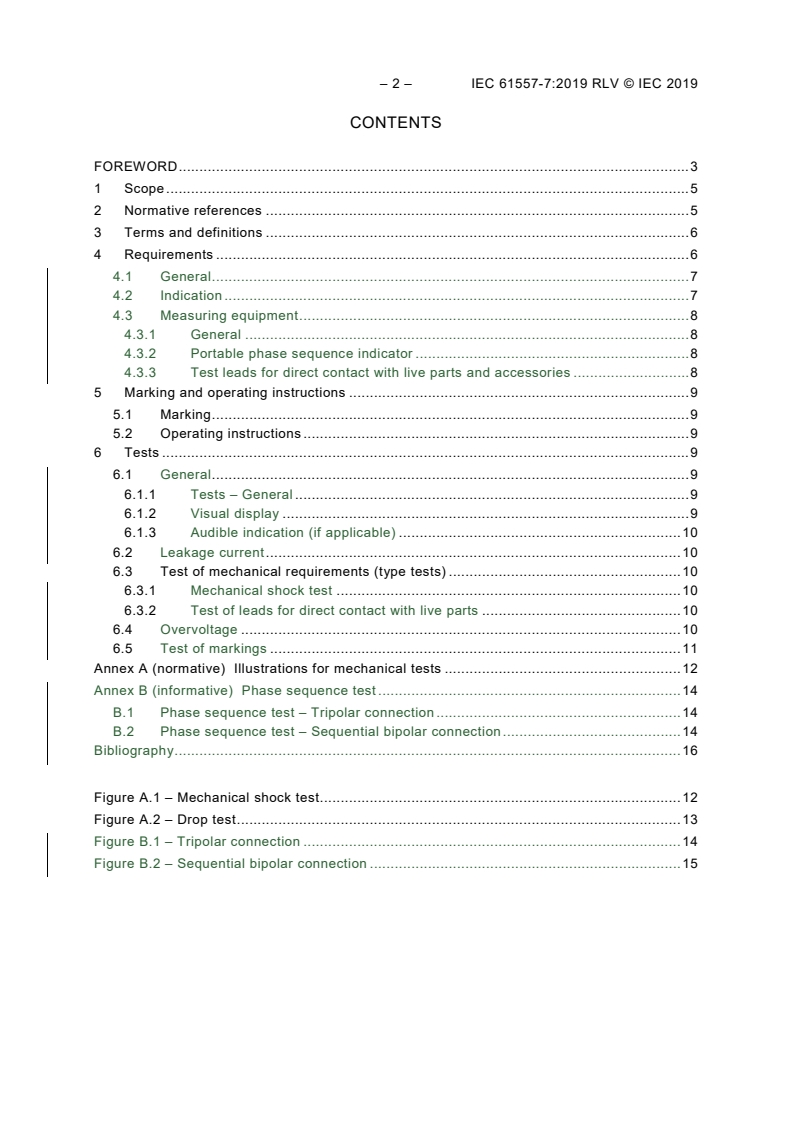
IEC 61557-7:2019 RLV - Electrical safety in low voltage distribution systems up to 1 000 V AC and 1 500 V DC - Equipment for testing, measuring or monitoring of protective measures - Part 7: Phase sequence Released:7/26/2019
IEC 61557-7:2019 - Electrical safety in low voltage distribution systems up to 1 000 V AC and 1 500 V DC - Equipment for testing, measuring or monitoring of protective measures - Part 7: Phase sequence Released:7/26/2019

IEC 61557-7:2019+AMD1:2023 CSV - Electrical safety in low voltage distribution systems up to 1 000 V AC and 1 500 V DC - Equipment for testing, measuring or monitoring of protective measures - Part 7: Phase sequence Released:8/25/2023
Overview
IEC 61557-7:2019 - part of the IEC 61557 series - specifies requirements for measuring equipment used to test phase sequence in three‑phase low‑voltage distribution systems (up to 1 000 V AC and 1 500 V DC). It covers portable and fixed phase sequence indicators that give mechanical, visual and/or audible indications. The standard applies to dedicated phase sequence measuring equipment only (it does not apply to monitoring relays or instruments whose primary function is a different measurement).
This third edition (2019) is a technical revision of the 2007 edition and aligns structure and safety requirements with related IEC 61010 standards, expands marking and operating instruction guidance, introduces test leads for insulated conductors, and adds Annex B with phase sequence test information.
Key Topics
- Scope & definitions - what constitutes a phase sequence indicator and which equipment is covered/excluded.
- Indication performance - phase sequence must be unambiguous between 85 % and 110 % of nominal system voltage and within 95 %–105 % of nominal frequency; indication must resist visual/audible interference.
- Safety & construction
- Portable equipment: double or reinforced insulation (Class II) and insulating enclosures.
- Suitable for continuous operation.
- Must withstand 120 % of rated system voltage without damage or user hazard.
- Leakage current limit - when one or two leads are earthed and remaining leads connected to phases, total current to earth shall not exceed 3.5 mA r.m.s. (phase conductors at 110 % rated voltage).
- Leads and connectors - leads require minimum dimensions and construction: outer diameter ≥ 3.5 mm, copper cross‑section ≥ 0.75 mm², individual wire diameter ≤ 0.07 mm, and double/reinforced insulation. Leads shall be permanently attached or use plug devices with live parts inaccessible (per IEC 61010‑3‑031).
- Mechanical and electrical tests - drop, shock, overvoltage, leakage current and marking tests; Annex A/B provide test illustrations and phase sequence test guidance.
Applications and Users
IEC 61557-7 is intended for:
- Electricians and commissioning engineers verifying correct phase rotation during installation or maintenance.
- Maintenance and testing teams in industrial, utility and commercial three‑phase systems.
- Manufacturers and designers of phase sequence indicators and portable test equipment.
- Inspection bodies and conformity assessment laboratories performing type or routine tests.
Typical uses include motor and transformer commissioning, verifying correct supply phase order before connecting rotating equipment, and safety checks during installation.
Related Standards
- IEC 61557-1:2019 - General requirements for equipment testing protective measures.
- IEC 61010-1 / IEC 61010-031 / IEC 61010-2-030 - safety requirements for electrical measuring and test equipment.
- IEC 60417, Electropedia and other IEC 61557 parts for protective‑measure testing.
Keywords: IEC 61557-7:2019, phase sequence, phase sequence indicator, three‑phase distribution systems, low voltage, measuring equipment, test leads, IEC 61010.
Relations
- Effective Date
- 05-Sep-2023
- Effective Date
- 05-Sep-2023
Buy Documents
IEC 61557-7:2019 RLV - Electrical safety in low voltage distribution systems up to 1 000 V AC and 1 500 V DC - Equipment for testing, measuring or monitoring of protective measures - Part 7: Phase sequence Released:7/26/2019
IEC 61557-7:2019 - Electrical safety in low voltage distribution systems up to 1 000 V AC and 1 500 V DC - Equipment for testing, measuring or monitoring of protective measures - Part 7: Phase sequence Released:7/26/2019
IEC 61557-7:2019+AMD1:2023 CSV - Electrical safety in low voltage distribution systems up to 1 000 V AC and 1 500 V DC - Equipment for testing, measuring or monitoring of protective measures - Part 7: Phase sequence Released:8/25/2023
Get Certified
Connect with accredited certification bodies for this standard

IMQ S.p.A. (Certification)
Italian electrical product certification.

SLG Prüf- und Zertifizierungs GmbH
German testing and certification body.

UL Solutions
Global safety science company with testing, inspection and certification.
Sponsored listings
Frequently Asked Questions
IEC 61557-7:2019 is a standard published by the International Electrotechnical Commission (IEC). Its full title is "Electrical safety in low voltage distribution systems up to 1 000 V AC and 1 500 V DC - Equipment for testing, measuring or monitoring of protective measures - Part 7: Phase sequence". This standard covers: IEC 61557-7:2019 specifies the requirements applicable to measuring equipment for testing the phase sequence in three-phase distribution systems. Indication of the phase sequence can be mechanical, visual and/or audible. This document does not apply to additional measurements for other quantities. It does not apply to monitoring relays. IEC 61557-7:2019 cancels and replaces the second edition published in 2007. This edition constitutes a technical revision. This edition includes the following changes with respect to the previous edition: a) alignment of the structure with that of the whole IEC 61557 series; b) updated requirements in 4.3 in accordance with new editions of IEC 61010-1 and IEC 61010-031; c) the information on markings was extended; d) the information on the operating instructions was extended; e) complement to the information on the testing of leads; f) test leads for insulated conductors were introduced; g) Annex B was added with information on phase sequence tests and indications.
IEC 61557-7:2019 specifies the requirements applicable to measuring equipment for testing the phase sequence in three-phase distribution systems. Indication of the phase sequence can be mechanical, visual and/or audible. This document does not apply to additional measurements for other quantities. It does not apply to monitoring relays. IEC 61557-7:2019 cancels and replaces the second edition published in 2007. This edition constitutes a technical revision. This edition includes the following changes with respect to the previous edition: a) alignment of the structure with that of the whole IEC 61557 series; b) updated requirements in 4.3 in accordance with new editions of IEC 61010-1 and IEC 61010-031; c) the information on markings was extended; d) the information on the operating instructions was extended; e) complement to the information on the testing of leads; f) test leads for insulated conductors were introduced; g) Annex B was added with information on phase sequence tests and indications.
IEC 61557-7:2019 is classified under the following ICS (International Classification for Standards) categories: 17.220.20 - Measurement of electrical and magnetic quantities; 29.080.01 - Electrical insulation in general; 29.240.01 - Power transmission and distribution networks in general. The ICS classification helps identify the subject area and facilitates finding related standards.
IEC 61557-7:2019 has the following relationships with other standards: It is inter standard links to IEC 61557-7:2019/AMD1:2023, IEC 61557-7:2007. Understanding these relationships helps ensure you are using the most current and applicable version of the standard.
IEC 61557-7:2019 is available in PDF format for immediate download after purchase. The document can be added to your cart and obtained through the secure checkout process. Digital delivery ensures instant access to the complete standard document.
Standards Content (Sample)
IEC 61557-7 ®
Edition 3.0 2019-07
REDLINE VERSION
INTERNATIONAL
STANDARD
colour
inside
Electrical safety in low voltage distribution systems up to 1 000 V a.c. and
1 500 V d.c. – Equipment for testing, measuring or monitoring of protective
measures –
Part 7: Phase sequence
All rights reserved. Unless otherwise specified, no part of this publication may be reproduced or utilized in any form
or by any means, electronic or mechanical, including photocopying and microfilm, without permission in writing from
either IEC or IEC's member National Committee in the country of the requester. If you have any questions about IEC
copyright or have an enquiry about obtaining additional rights to this publication, please contact the address below or
your local IEC member National Committee for further information.
IEC Central Office Tel.: +41 22 919 02 11
3, rue de Varembé info@iec.ch
CH-1211 Geneva 20 www.iec.ch
Switzerland
About the IEC
The International Electrotechnical Commission (IEC) is the leading global organization that prepares and publishes
International Standards for all electrical, electronic and related technologies.
About IEC publications
The technical content of IEC publications is kept under constant review by the IEC. Please make sure that you have the
latest edition, a corrigendum or an amendment might have been published.
IEC publications search - webstore.iec.ch/advsearchform Electropedia - www.electropedia.org
The advanced search enables to find IEC publications by a The world's leading online dictionary on electrotechnology,
variety of criteria (reference number, text, technical containing more than 22 000 terminological entries in English
committee,…). It also gives information on projects, replaced and French, with equivalent terms in 16 additional languages.
and withdrawn publications. Also known as the International Electrotechnical Vocabulary
(IEV) online.
IEC Just Published - webstore.iec.ch/justpublished
Stay up to date on all new IEC publications. Just Published IEC Glossary - std.iec.ch/glossary
details all new publications released. Available online and 67 000 electrotechnical terminology entries in English and
once a month by email. French extracted from the Terms and Definitions clause of
IEC publications issued since 2002. Some entries have been
IEC Customer Service Centre - webstore.iec.ch/csc collected from earlier publications of IEC TC 37, 77, 86 and
If you wish to give us your feedback on this publication or CISPR.
need further assistance, please contact the Customer Service
Centre: sales@iec.ch.
IEC 61557-7 ®
Edition 3.0 2019-07
REDLINE VERSION
INTERNATIONAL
STANDARD
colour
inside
Electrical safety in low voltage distribution systems up to 1 000 V a.c. and
1 500 V d.c. – Equipment for testing, measuring or monitoring of protective
measures –
Part 7: Phase sequence
INTERNATIONAL
ELECTROTECHNICAL
COMMISSION
ICS 17.220.20; 29.080.01; 29.240.01 ISBN 978-2-8322-7161-2
– 2 – IEC 61557-7:2019 RLV © IEC 2019
CONTENTS
FOREWORD . 3
1 Scope . 5
2 Normative references . 5
3 Terms and definitions . 6
4 Requirements . 6
4.1 General . 7
4.2 Indication . 7
4.3 Measuring equipment . 8
4.3.1 General . 8
4.3.2 Portable phase sequence indicator . 8
4.3.3 Test leads for direct contact with live parts and accessories . 8
5 Marking and operating instructions . 9
5.1 Marking . 9
5.2 Operating instructions . 9
6 Tests . 9
6.1 General . 9
6.1.1 Tests – General . 9
6.1.2 Visual display . 9
6.1.3 Audible indication (if applicable) . 10
6.2 Leakage current . 10
6.3 Test of mechanical requirements (type tests) . 10
6.3.1 Mechanical shock test . 10
6.3.2 Test of leads for direct contact with live parts . 10
6.4 Overvoltage . 10
6.5 Test of markings . 11
Annex A (normative) Illustrations for mechanical tests . 12
Annex B (informative) Phase sequence test . 14
B.1 Phase sequence test – Tripolar connection . 14
B.2 Phase sequence test – Sequential bipolar connection . 14
Bibliography . 16
Figure A.1 – Mechanical shock test . 12
Figure A.2 – Drop test . 13
Figure B.1 – Tripolar connection . 14
Figure B.2 – Sequential bipolar connection . 15
INTERNATIONAL ELECTROTECHNICAL COMMISSION
____________
ELECTRICAL SAFETY IN LOW VOLTAGE DISTRIBUTION SYSTEMS
UP TO 1 000 V AC AND 1 500 V DC –
EQUIPMENT FOR TESTING, MEASURING OR MONITORING
OF PROTECTIVE MEASURES –
Part 7: Phase sequence
FOREWORD
1) The International Electrotechnical Commission (IEC) is a worldwide organization for standardization comprising
all national electrotechnical committees (IEC National Committees). The object of IEC is to promote
international co-operation on all questions concerning standardization in the electrical and electronic fields. To
this end and in addition to other activities, IEC publishes International Standards, Technical Specifications,
Technical Reports, Publicly Available Specifications (PAS) and Guides (hereafter referred to as "IEC
Publication(s)"). Their preparation is entrusted to technical committees; any IEC National Committee interested
in the subject dealt with may participate in this preparatory work. International, governmental and non-
governmental organizations liaising with the IEC also participate in this preparation. IEC collaborates closely
with the International Organization for Standardization (ISO) in accordance with conditions determined by
agreement between the two organizations.
2) The formal decisions or agreements of IEC on technical matters express, as nearly as possible, an international
consensus of opinion on the relevant subjects since each technical committee has representation from all
interested IEC National Committees.
3) IEC Publications have the form of recommendations for international use and are accepted by IEC National
Committees in that sense. While all reasonable efforts are made to ensure that the technical content of IEC
Publications is accurate, IEC cannot be held responsible for the way in which they are used or for any
misinterpretation by any end user.
4) In order to promote international uniformity, IEC National Committees undertake to apply IEC Publications
transparently to the maximum extent possible in their national and regional publications. Any divergence
between any IEC Publication and the corresponding national or regional publication shall be clearly indicated in
the latter.
5) IEC itself does not provide any attestation of conformity. Independent certification bodies provide conformity
assessment services and, in some areas, access to IEC marks of conformity. IEC is not responsible for any
services carried out by independent certification bodies.
6) All users should ensure that they have the latest edition of this publication.
7) No liability shall attach to IEC or its directors, employees, servants or agents including individual experts and
members of its technical committees and IEC National Committees for any personal injury, property damage or
other damage of any nature whatsoever, whether direct or indirect, or for costs (including legal fees) and
expenses arising out of the publication, use of, or reliance upon, this IEC Publication or any other IEC
Publications.
8) Attention is drawn to the Normative references cited in this publication. Use of the referenced publications is
indispensable for the correct application of this publication.
9) Attention is drawn to the possibility that some of the elements of this IEC Publication may be the subject of
patent rights. IEC shall not be held responsible for identifying any or all such patent rights.
This redline version of the official IEC Standard allows the user to identify the changes
made to the previous edition. A vertical bar appears in the margin wherever a change
has been made. Additions are in green text, deletions are in strikethrough red text.
– 4 – IEC 61557-7:2019 RLV © IEC 2019
International Standard IEC 61557-7 has been prepared by IEC technical committee 85:
Measuring equipment for electrical and electromagnetic quantities.
This third edition cancels and replaces the second edition published in 2007. This edition
constitutes a technical revision.
This edition includes the following changes with respect to the previous edition:
a) alignment of the structure with that of the whole IEC 61557 series;
b) updated requirements in 4.3 in accordance with new editions of IEC 61010-1
and IEC 61010-031;
c) the information on markings was extended;
d) the information on the operating instructions was extended;
e) complement to the information on the testing of leads;
f) test leads for insulated conductors were introduced;
g) Annex B was added with information on phase sequence tests and indications.
The text of this International Standard is based on the following documents:
FDIS Report on voting
85/683/FDIS 85/698/RVD
Full information on the voting for the approval of this International Standard can be found in
the report on voting indicated in the above table.
This document has been drafted in accordance with the ISO/IEC Directives, Part 2.
This International Standard is to be used in conjunction with IEC 61557-1:2019.
A list of all parts of the IEC 61557 series, published under the general title Electrical safety in
low voltage distribution systems up to 1 000 V AC and 1 500 V DC – Equipment for testing,
measuring or monitoring of protective measures, can be found on the IEC website
The committee has decided that the contents of this document will remain unchanged until the
stability date indicated on the IEC website under "http://webstore.iec.ch" in the data related to
the specific document. At this date, the document will be
• reconfirmed,
• withdrawn,
• replaced by a revised edition, or
• amended.
IMPORTANT – The “colour inside” logo on the cover page of this publication indicates
that it contains colours which are considered to be useful for the correct understanding
of its contents. Users should therefore print this document using a colour printer.
ELECTRICAL SAFETY IN LOW VOLTAGE DISTRIBUTION SYSTEMS
UP TO 1 000 V AC AND 1 500 V DC –
EQUIPMENT FOR TESTING, MEASURING OR MONITORING
OF PROTECTIVE MEASURES –
Part 7: Phase sequence
1 Scope
This part of IEC 61557 specifies the requirements for applicable to measuring equipment
applied to for testing the phase sequence in three-phase distribution systems. Indication of
the phase sequence may can be mechanical, visual and/or audible.
This part of IEC 61557 does not apply to ancillary measuring equipment for other quantities,
for example voltage testers comprising an additional phase sequence indicator. This
document does not apply to additional measurements for other quantities. It does not apply to
monitoring relays.
NOTE Phase lamps are not considered to be voltage testers. Common worldwide three-phase distribution
systems are depicted in IEC 61010-1.
2 Normative references
The following documents are referred to in the text in such a way that some or all of their
content constitutes requirements of this document. For dated references, only the edition
cited applies. For undated references, the latest edition of the referenced document (including
any amendments) applies.
IEC 60417, Graphical symbols for use on equipment
IEC 61010-1:2010, Safety requirements for electrical equipment for measurement, control,
and laboratory use – Part 1: General requirements
IEC 61010-1:2010/AMD1:2016
IEC 61010-2-030:2017, Safety requirements for electrical equipment for measurement, control,
and laboratory use – Part 2-030: Particular requirements for equipment having testing or
measuring circuits
IEC 61010-031, Safety requirements for electrical equipment for measurement, control and
laboratory use – Part 031: Safety requirements for hand-held and hand-manipulated
assemblies for electrical test and measurement
IEC 61010-3-031, Safety requirements for electrical equipment for measurement, control, and
laboratory use – Part 3-031: Conformity verification report for IEC 61010-031:2002 – Safety
requirements for hand-held probe assemblies for electrical test and measurement
IEC 61557-1:2019 Electrical safety in low voltage distribution systems up to 1 000 V AC and
1 500 V DC – Equipment for testing, measuring or monitoring of protective measures – Part 1:
General requirements
——————
A consolidated version of this publication exists, comprising IEC 61010-1:2010 and
IEC 61010-1:2010/AMD1:2016.
– 6 – IEC 61557-7:2019 RLV © IEC 2019
3 Terms and definitions
For the purposes of this document, the terms and definitions given in IEC 61557-1 and the
following apply.
ISO and IEC maintain terminological databases for use in standardization at the following
addresses:
• IEC Electropedia: available at http://www.electropedia.org/
• ISO Online browsing platform: available at http://www.iso.org/obp
3.1
phase sequence indicator
instrument intended to indicate, in a polyphase system, the sequence in which the
instantaneous voltages of the phase conductors reach their maximum values
[SOURCE: IEC 60050-313:2001, 313-01-21]
3.2
phase sequence indication
information displayed by a phase sequence indicator
3.3
phase sequence test
test taken to determine that the phase sequence of a polyphase winding is correct
[SOURCE: IEC 60050-411:1996, 411-53-45]
4 Requirements
The following requirements as well as those given in IEC 61557-1 shall apply.
4.1 Indication shall be unambiguous between 85 % and 110 % of the nominal system voltage
or within the range of the nominal voltage and between 95 % and 105 % of the nominal
system frequency.
4.2 Indication shall also be unambiguously detectable in the presence of visual or audible
interference.
4.3 The measuring equipment shall be suitable for continuous operation.
4.4 Portable measuring equipment shall be housed in an enclosure of insulating material and
comply with double insulation or reinforced insulation (protection class II).
4.5 Portable measuring equipment shall be designed in such a manner that when either one
or two measuring leads are connected to earth and the remaining measuring leads are
connected to their corresponding phase conductors, the resulting total current to earth should
not exceed 3,5 mA r.m.s. The phase conductors shall be at 110 % of the maximum rated
voltage for which the equipment is designed.
4.6 The measuring equipment shall not be damaged nor shall the user be exposed to danger
when the measuring equipment is connected to 120 % of the rated system voltage or to 120 %
of its rated maximum voltage range.
4.7 Portable measuring equipment shall be provided with permanently attached leads or with
a plug device with live parts not accessible, whether plugged or unplugged (according to
IEC 61010-3-031).
The following applies to leads
– they shall have an outer diameter of at least 3,5 mm;
²
– the copper cross-section shall be at least ≥ 0,75 mm ;
– they shall be made from individual wires with a diameter ≤ 0,07 mm;
– they shall be provided with double or reinforced insulation.
4.8 Portable measuring equipment, together with their leads, shall comply with the
mechanical requirements and shall be tested in accordance with 6.3. After these tests:
– the enclosure of the measuring equipment shall be free from damage;
– permanently attached leads shall not have become detached from the measuring
equipment;
– live parts of the leads connected by means of plugs shall remain inaccessible when they
have become unplugged from the measuring equipment;
– no parts inside the measuring equipment shall have become loose.
4.9 Requirements given in 4.8 need not apply when the phase sequence indicator forms part
of multi-purpose measuring equipment, provided that the following conditions are met:
– live parts of the leads remain inaccessible even when they have become unplugged from
the measuring equipment;
– the measuring equipment shall be suitable for being carried, for example over the shoulder,
when measurements are carried out.
4.1 General
In addition to the requirements of IEC 61557-1:2019, Clause 4, the requirements of Clause 4
of this document shall apply.
4.2 Indication
All indications shall be unambiguously displayed on the phase sequence indicator when the
input to the phase indicator is between 85 % and 110 % of the nominal system voltage and
between 95 % and 105 % of the nominal system frequency.
Indications shall also be unambiguously detectable in the presence of visual or audible
interference.
The phase sequence indicator shall display a valid phase sequence indication, positive or
negative, if the values of the voltage to earth of the three phases are within the voltage range
specified above and the phase delay between two consecutive phases is 120°.
The phase sequence indicator shall not display a valid phase sequence indication, positive or
negative, if the three-phase distribution system is heavily unbalanced.
NOTE An unbalanced system could be due to unbalanced loads on the three phases or due to cabling errors.
In particular the measuring equipment shall not display a valid phase sequence indication in
the following cases:
1) one or more of the phase conductors are open-circuit;
– 8 – IEC 61557-7:2019 RLV © IEC 2019
2) one or more of the phase conductors are connected to neutral or protective earth;
3) two conductors are connected to the same phase.
The specific indications displayed in the above error cases shall be mentioned in the
operating instructions of the phase sequence indicator.
The limits of unbalance in amplitude and in phase delay that the phase sequence indicator
can handle reliably shall also be mentioned in the operating instructions.
4.3 Measuring equipment
4.3.1 General
The measuring equipment for the phase sequence test is intended for temporary operation,
but shall withstand continuous operation.
Equipment intended to be used on the distribution system shall be rated at least for
measurement category III according to IEC 61010-2-030.
Equipment intended to be used on socket outlets only can be rated for measurement category
II according to IEC 61010-2-030.
The measuring equipment shall not be damaged nor shall the user be exposed to danger
when the measuring equipment is connected to 120 % of the rated system voltage or to 120 %
of the maximum voltage of its rated voltage range.
The phase sequence test (see Annex B) can be realised with test probes for direct contact
with live parts, conductors or terminals, or with test clamps for inductive detection on
insulated conductors.
4.3.2 Portable phase sequence indicator
Portable phase sequence indicators shall be housed in an enclosure of insulating material and
comply with the requirements for double insulation or reinforced insulation (protection class II).
Portable phase sequence indicators shall be designed in such a manner that when either one
or two measuring leads are connected to earth and the remaining measuring leads are
connected to their corresponding phase conductors, the resulting total current to earth should
not exceed 3,5 mA RMS. The phase conductors shall be at 110 % of the maximum rated
voltage for which the equipment is designed.
4.3.3 Test leads for direct contact with live parts and accessories
Phase sequence indicators designed for direct contact to live parts shall be provided with
permanently connected test leads or with terminals for removable test leads complying with
IEC 61010-031.
The following applies to leads.
Test probes, test leads, clips and other accessories used with phase sequence indicators
shall be in accordance with the requirements of IEC 61010-031.
A test lead cable that has a wear indicator shall, at the minimum, provide double insulation or
reinforced insulation when new and, at the minimum, basic insulation when the wear indicator
is reached (see IEC 61010-031).
Portable measuring equipment, together with its test leads, shall comply with the
requirements for mechanical strength according to IEC 61010-1 and in addition shall be tested
in accordance with 6.4.
These requirements do not apply when the phase sequence indicator forms part of a
multi-purpose instrument with provisions for carrying.
5 Marking and operating instructions
5.1 Marking
In addition to the marking in accordance with IEC 61557-1:2019, 5.1 and 5.2, the following
information shall be provided on the measuring equipment:
5.1.1 Symbol for the protection class in accordance with symbol IEC 60417-5172
(2003-02).
5.1.2 Phase sequence.
5.1.3 Designation of the leads L1, L2 and L3 on the equipment and on the leads.
– symbol for double insulation in accordance with IEC 61010-1:2010, Table 1, symbol 11;
– designation of leads L1, L2 and L3 on the equipment and on the leads;
– the measurement category shall be printed on the equipment close to the test lead
connection.
5.2 Operating instructions
The operating instructions need not include any statements other than the statements given in
IEC 61557-1, except for the equipment mentioned in 4.9.
IEC 61557-1:2019, 5.3 applies.
6 Tests
6.1 General
6.1.1 Tests – General
In addition to IEC 61557-1, with the exception of the tests given in 6.1 to 6.3 of that standard,
the following tests shall be executed.
Test of the detectability of the indication in accordance with 4.1 and 4.2.
In addition to the tests of IEC 61557-1:2019, Clause 6, the following tests shall be performed.
6.1.2 Visual display
Tests of the visual display are executed performed under the following conditions (type tests).
The display shall be unambiguously discernible by a person with 6/6 vision from a distance of
500 mm at ambient lighting levels from 30 lx to 1 000 lx. During the measurement, the
measuring equipment shall be placed on a matt grey surface (type test).
– 10 – IEC 61557-7:2019 RLV © IEC 2019
A visual comparison under reference conditions with equipment that has successfully passed
the type test is adequate for a routine test with respect to the visual display. The display on
the item under test shall produce a similar or better readability (routine tests).
6.1.3 Audible indication (if applicable)
The test for the audible indication is executed performed at a sound level of L = 75 dB(A)
AF
(white noise). The indication shall generate a sound between 1 kHz and 4 kHz and be
unambiguously discernible by a person with a hearing loss of less than 15 dB HL under these
conditions (routine test).
6.2 Leakage current
Proof of compliance with the requirements under 4.5 shall be provided as follows:
The requirements under 4.3.2 shall be tested as follows.
The phase sequence indicator shall be connected in series with a current measuring
instrument on that has one lead connected with earth, and with the other interconnected other
leads connected with a phase conductor at a voltage of 110 % of its rated voltage or a voltage
at the upper limit of its rated voltage range. The magnitude of the current shall not exceed the
value specified under 4.5 4.3.2.
This test shall be executed on each conductor (routine test).
6.3 Test of mechanical requirements (type tests)
6.3.1 Mechanical shock test
For the purpose of a mechanical shock test, the item under test shall be suspended as shown
in Annex A, Figure A.1, using a pendulum length of 2 m. The item under test shall be dropped
in a pendulum movement with a deflection of 1 m in height to hit a hard wooden plate 50 mm
thick. The test shall be carried out so that each of the sides of the enclosure parallel to the
suspension hits the wood once.
6.3.2 Test of leads for direct contact with live parts
The strain relief of permanently attached leads shall be tested by a drop test in accordance
with Annex A, Figure A.2, in the following manner:
– the item under test shall be suspended so that it is caught with the extended lead after a
free drop of 2 m;
– the item under test shall be dropped three times from the suspension point for each of the
leads;
– the enclosure of the measuring equipment shall be free from damage;
– permanently attached leads shall not have become detached from the measuring
equipment;
– live parts of the leads connected by means of plugs shall remain inaccessible when they
have become unplugged from the measuring equipment;
– no parts inside the measuring equipment shall have become loose.
6.4 Overvoltage
The applicable requirement of 4.3.1 shall be tested as follows:
Compliance with the requirements given in 4.6 shall be checked by visual inspection or by
measurement (type test).
Compliance with the requirements given in 4.3.1 shall be tested by connecting, for a duration
of at least 10 min, the item under test to a three-phase system at 120 % of the rated system
voltage or, in the case of multi-range measuring equipment, at 120 % of all rated voltages
(type test).
The surface temperature of EUT shall be measured and checked according to IEC 61010-1.
Compliance with the requirements given in 4.3 shall be tested by operating the item under test
for a duration of at least 1 h at the rated voltage or, in the case of multi-range measuring
equipment, at all rated voltage values (type test).
6.5 Test of markings
The markings shall be checked in respect of legibility by a visual inspection (type test).
6.8 Compliance with the requirements given in 4.9 shall be tested by visual inspection of the
sling and with probe assemblies plugged and unplugged (type test).
6.9 The compliance with the tests in this clause shall be recorded.
– 12 – IEC 61557-7:2019 RLV © IEC 2019
Annex A
(normative)
Illustrations for mechanical tests
Mechanical shock tests shall be performed according to Figure A.1.
Dimensions in metres
Figure A.1 – Mechanical shock test
Drop tests shall be performed according to Figure A.2.
Dimensions in metres
Key
a original lead A initial position where the equipment is held
b joint B end position after the release of the equipment
c extension to 2 m
Figure A.2 – Drop test
– 14 – IEC 61557-7:2019 RLV © IEC 2019
Annex B
(informative)
Phase sequence test
B.1 Phase sequence test – Tripolar connection
The measuring equipment for the phase sequence test with tripolar connection is connected
to the three-phase distribution system using three separate test probes marked L1, L2 and L3
(see 5.1).
Each test probe is connected to the conductor or terminal foreseen to be at the corresponding
phase L1, L2 or L3 of the distribution system.
Figure B.1 – Tripolar connection
The phase sequence indication is positive, commonly called "clockwise" (CW) or "right" (R), if
the three phases are in the foreseen phase sequence.
The phase sequence indication is negative, commonly called "counter-clockwise" (CCW) or
"left" (L), if the three phases are in a sequence different than foreseen: two of the three phase
connections are crossed.
NOTE New phase sequence tests carried out after crossing tests probes L1 and L2, and then L2 and L3, allow the
crossed phases to be isolated.
B.2 Phase sequence test – Sequential bipolar connection
The measuring equipment for the phase sequence test with sequential bipolar connection has
only two test probes L1 and L2 and is operated in a sequence of two steps.
The test probe L1 is kept connected to the conductor or terminal of the foreseen phase L1
throughout the test sequence.
In the first step, the test probe L2 is connected to the conductor or terminal of the foreseen
phase L2. The phase delay L2 – L1 is measured and memorised by the measuring equipment.
In the second step, the operator moves the test probe L2 to the conductor or terminal of the
foreseen phase L3. The phase delay L3 – L1 is measured and compared to the memorised
phase delay by the measuring equipment.
Figure B.2 – Sequential bipolar connection
With these two phase delay measurements, the phase sequence indication can be displayed
in the same way as for the tripolar connection.
The measuring equipment shall indicate when the phase delay value of the first step is stored
in the memory; the value shall be maintained in the memory for a reasonable period of time to
allow the operator to switch from the first to the second step of the test sequence.
– 16 – IEC 61557-7:2019 RLV © IEC 2019
Bibliography
IEC 60050-311:2001, International Electrotechnical Vocabulary (IEV) – Part 311: General
terms relating to measurements
IEC 60050-411:1996, International Electrotechnical Vocabulary (IEV) – Part 411: Rotating
machinery
IEC 60417, Graphical symbols for use on equipment (available at http://www.graphical-
symbols.info/equipment)
___________
IEC 61557-7 ®
Edition 3.0 2019-07
INTERNATIONAL
STANDARD
NORME
INTERNATIONALE
colour
inside
Electrical safety in low voltage distribution systems up to 1 000 V a.c. and
1 500 V d.c. – Equipment for testing, measuring or monitoring of protective
measures –
Part 7: Phase sequence
Sécurité électrique dans les réseaux de distribution basse tension au plus
égale à 1 000 V c.a. et 1 500 V c.c. – Dispositifs de contrôle, de mesure ou
de surveillance de mesures de protection –
Partie 7: Ordre de phases
– 2 – IEC 61557-7:2019 © IEC 2019
CONTENTS
FOREWORD . 3
1 Scope . 5
2 Normative references . 5
3 Terms and definitions . 5
4 Requirements . 6
4.1 General . 6
4.2 Indication . 6
4.3 Measuring equipment . 7
4.3.1 General . 7
4.3.2 Portable phase sequence indicator . 7
4.3.3 Test leads for direct contact with live parts and accessories . 7
5 Marking and operating instructions . 8
5.1 Marking . 8
5.2 Operating instructions . 8
6 Tests . 8
6.1 General . 8
6.1.1 Tests – General . 8
6.1.2 Visual display . 8
6.1.3 Audible indication (if applicable) . 8
6.2 Leakage current . 8
6.3 Test of mechanical requirements (type tests) . 9
6.3.1 Mechanical shock test . 9
6.3.2 Test of leads for direct contact with live parts . 9
6.4 Overvoltage . 9
6.5 Test of markings . 9
Annex A (normative) Illustrations for mechanical tests . 10
Annex B (informative) Phase sequence test . 12
B.1 Phase sequence test – Tripolar connection . 12
B.2 Phase sequence test – Sequential bipolar connection . 12
Bibliography . 14
Figure A.1 – Mechanical shock test . 10
Figure A.2 – Drop test . 11
Figure B.1 – Tripolar connection . 12
Figure B.2 – Sequential bipolar connection . 13
INTERNATIONAL ELECTROTECHNICAL COMMISSION
____________
ELECTRICAL SAFETY IN LOW VOLTAGE DISTRIBUTION SYSTEMS
UP TO 1 000 V AC AND 1 500 V DC –
EQUIPMENT FOR TESTING, MEASURING OR MONITORING
OF PROTECTIVE MEASURES –
Part 7: Phase sequence
FOREWORD
1) The International Electrotechnical Commission (IEC) is a worldwide organization for standardization comprising
all national electrotechnical committees (IEC National Committees). The object of IEC is to promote
international co-operation on all questions concerning standardization in the electrical and electronic fields. To
this end and in addition to other activities, IEC publishes International Standards, Technical Specifications,
Technical Reports, Publicly Available Specifications (PAS) and Guides (hereafter referred to as "IEC
Publication(s)"). Their preparation is entrusted to technical committees; any IEC National Committee interested
in the subject dealt with may participate in this preparatory work. International, governmental and non-
governmental organizations liaising with the IEC also participate in this preparation. IEC collaborates closely
with the International Organization for Standardization (ISO) in accordance with conditions determined by
agreement between the two organizations.
2) The formal decisions or agreements of IEC on technical matters express, as nearly as possible, an international
consensus of opinion on the relevant subjects since each technical committee has representation from all
interested IEC National Committees.
3) IEC Publications have the form of recommendations for international use and are accepted by IEC National
Committees in that sense. While all reasonable efforts are made to ensure that the technical content of IEC
Publications is accurate, IEC cannot be held responsible for the way in which they are used or for any
misinterpretation by any end user.
4) In order to promote international uniformity, IEC National Committees undertake to apply IEC Publications
transparently to the maximum extent possible in their national and regional publications. Any divergence
between any IEC Publication and the corresponding national or regional publication shall be clearly indicated in
the latter.
5) IEC itself does not provide any attestation of conformity. Independent certification bodies provide conformity
assessment services and, in some areas, access to IEC marks of conformity. IEC is not responsible for any
services carried out by independent certification bodies.
6) All users should ensure that they have the latest edition of this publication.
7) No liability shall attach to IEC or its directors, employees, servants or agents including individual experts and
members of its technical committees and IEC National Committees for any personal injury, property damage or
other damage of any nature whatsoever, whether direct or indirect, or for costs (including legal fees) and
expenses arising out of the publication, use of, or reliance upon, this IEC Publication or any other IEC
Publications.
8) Attention is drawn to the Normative references cited in this publication. Use of the referenced publications is
indispensable for the correct application of this publication.
9) Attention is drawn to the possibility that some of the elements of this IEC Publication may be the subject of
patent rights. IEC shall not be held responsible for identifying any or all such patent rights.
International Standard IEC 61557-7 has been prepared by IEC technical committee 85:
Measuring equipment for electrical and electromagnetic quantities.
This third edition cancels and replaces the second edition published in 2007. This edition
constitutes a technical revision.
This edition includes the following changes with respect to the previous edition:
a) alignment of the structure with that of the whole IEC 61557 series;
b) updated requirements in 4.3 in accordance with new editions of IEC 61010-1
and IEC 61010-031;
c) the information on markings was extended;
d) the information on the operating instructions was extended;
– 4 – IEC 61557-7:2019 © IEC 2019
e) complement to the information on the testing of leads;
f) test leads for insulated conductors were introduced;
g) Annex B was added with information on phase sequence tests and indications.
The text of this International Standard is based on the following documents:
FDIS Report on voting
85/683/FDIS 85/698/RVD
Full information on the voting for the approval of this International Standard can be found in
the report on voting indicated in the above table.
This document has been drafted in accordance with the ISO/IEC Directives, Part 2.
This International Standard is to be used in conjunction with IEC 61557-1:2019.
A list of all parts of the IEC 61557 series, published under the general title Electrical safety in
low voltage distribution systems up to 1 000 V AC and 1 500 V DC – Equipment for testing,
measuring or monitoring of protective measures, can be found on the IEC website
The committee has decided that the contents of this document will remain unchanged until the
stability date indicated on the IEC website under "http://webstore.iec.ch" in the data related to
the specific document. At this date, the document will be
• reconfirmed,
• withdrawn,
• replaced by a revised edition, or
• amended.
IMPORTANT – The 'colour inside' logo on the cover page of this publication indicates that it
contains colours which are considered to be useful for the correct understanding of its
contents. Users should therefore print this document using a colour printer.
ELECTRICAL SAFETY IN LOW VOLTAGE DISTRIBUTION SYSTEMS
UP TO 1 000 V AC AND 1 500 V DC –
EQUIPMENT FOR TESTING, MEASURING OR MONITORING
OF PROTECTIVE MEASURES –
Part 7: Phase sequence
1 Scope
This part of IEC 61557 specifies the requirements applicable to measuring equipment for
testing the phase sequence in three-phase distribution systems. Indication of the phase
sequence can be mechanical, visual and/or audible.
This document does not apply to additional measurements for other quantities.
...
IEC 61557-7 ®
Edition 3.0 2019-07
INTERNATIONAL
STANDARD
NORME
INTERNATIONALE
colour
inside
Electrical safety in low voltage distribution systems up to 1 000 V a.c. and
1 500 V d.c. – Equipment for testing, measuring or monitoring of protective
measures –
Part 7: Phase sequence
Sécurité électrique dans les réseaux de distribution basse tension au plus
égale à 1 000 V c.a. et 1 500 V c.c. – Dispositifs de contrôle, de mesure ou
de surveillance de mesures de protection –
Partie 7: Ordre de phases
All rights reserved. Unless otherwise specified, no part of this publication may be reproduced or utilized in any form
or by any means, electronic or mechanical, including photocopying and microfilm, without permission in writing from
either IEC or IEC's member National Committee in the country of the requester. If you have any questions about IEC
copyright or have an enquiry about obtaining additional rights to this publication, please contact the address below or
your local IEC member National Committee for further information.
Droits de reproduction réservés. Sauf indication contraire, aucune partie de cette publication ne peut être reproduite
ni utilisée sous quelque forme que ce soit et par aucun procédé, électronique ou mécanique, y compris la photocopie
et les microfilms, sans l'accord écrit de l'IEC ou du Comité national de l'IEC du pays du demandeur. Si vous avez des
questions sur le copyright de l'IEC ou si vous désirez obtenir des droits supplémentaires sur cette publication, utilisez
les coordonnées ci-après ou contactez le Comité national de l'IEC de votre pays de résidence.
IEC Central Office Tel.: +41 22 919 02 11
3, rue de Varembé info@iec.ch
CH-1211 Geneva 20 www.iec.ch
Switzerland
About the IEC
The International Electrotechnical Commission (IEC) is the leading global organization that prepares and publishes
International Standards for all electrical, electronic and related technologies.
About IEC publications
The technical content of IEC publications is kept under constant review by the IEC. Please make sure that you have the
latest edition, a corrigendum or an amendment might have been published.
IEC publications search - webstore.iec.ch/advsearchform Electropedia - www.electropedia.org
The advanced search enables to find IEC publications by a The world's leading online dictionary on electrotechnology,
variety of criteria (reference number, text, technical containing more than 22 000 terminological entries in English
committee,…). It also gives information on projects, replaced and French, with equivalent terms in 16 additional languages.
and withdrawn publications. Also known as the International Electrotechnical Vocabulary
(IEV) online.
IEC Just Published - webstore.iec.ch/justpublished
Stay up to date on all new IEC publications. Just Published IEC Glossary - std.iec.ch/glossary
details all new publications released. Available online and 67 000 electrotechnical terminology entries in English and
once a month by email. French extracted from the Terms and Definitions clause of
IEC publications issued since 2002. Some entries have been
IEC Customer Service Centre - webstore.iec.ch/csc collected from earlier publications of IEC TC 37, 77, 86 and
If you wish to give us your feedback on this publication or CISPR.
need further assistance, please contact the Customer Service
Centre: sales@iec.ch.
A propos de l'IEC
La Commission Electrotechnique Internationale (IEC) est la première organisation mondiale qui élabore et publie des
Normes internationales pour tout ce qui a trait à l'électricité, à l'électronique et aux technologies apparentées.
A propos des publications IEC
Le contenu technique des publications IEC est constamment revu. Veuillez vous assurer que vous possédez l’édition la
plus récente, un corrigendum ou amendement peut avoir été publié.
Recherche de publications IEC - Electropedia - www.electropedia.org
webstore.iec.ch/advsearchform Le premier dictionnaire d'électrotechnologie en ligne au
La recherche avancée permet de trouver des publications IEC monde, avec plus de 22 000 articles terminologiques en
en utilisant différents critères (numéro de référence, texte, anglais et en français, ainsi que les termes équivalents dans
comité d’études,…). Elle donne aussi des informations sur les 16 langues additionnelles. Egalement appelé Vocabulaire
projets et les publications remplacées ou retirées. Electrotechnique International (IEV) en ligne.
IEC Just Published - webstore.iec.ch/justpublished Glossaire IEC - std.iec.ch/glossary
Restez informé sur les nouvelles publications IEC. Just 67 000 entrées terminologiques électrotechniques, en anglais
Published détaille les nouvelles publications parues. et en français, extraites des articles Termes et Définitions des
Disponible en ligne et une fois par mois par email. publications IEC parues depuis 2002. Plus certaines entrées
antérieures extraites des publications des CE 37, 77, 86 et
Service Clients - webstore.iec.ch/csc CISPR de l'IEC.
Si vous désirez nous donner des commentaires sur cette
publication ou si vous avez des questions contactez-nous:
sales@iec.ch.
IEC 61557-7 ®
Edition 3.0 2019-07
INTERNATIONAL
STANDARD
NORME
INTERNATIONALE
colour
inside
Electrical safety in low voltage distribution systems up to 1 000 V a.c. and
1 500 V d.c. – Equipment for testing, measuring or monitoring of protective
measures –
Part 7: Phase sequence
Sécurité électrique dans les réseaux de distribution basse tension au plus
égale à 1 000 V c.a. et 1 500 V c.c. – Dispositifs de contrôle, de mesure ou
de surveillance de mesures de protection –
Partie 7: Ordre de phases
INTERNATIONAL
ELECTROTECHNICAL
COMMISSION
COMMISSION
ELECTROTECHNIQUE
INTERNATIONALE
ICS 17.220.20; 29.080.01; 29.240.01 ISBN 978-2-8322-7161-2
– 2 – IEC 61557-7:2019 © IEC 2019
CONTENTS
FOREWORD . 3
1 Scope . 5
2 Normative references . 5
3 Terms and definitions . 5
4 Requirements . 6
4.1 General . 6
4.2 Indication . 6
4.3 Measuring equipment . 7
4.3.1 General . 7
4.3.2 Portable phase sequence indicator . 7
4.3.3 Test leads for direct contact with live parts and accessories . 7
5 Marking and operating instructions . 8
5.1 Marking . 8
5.2 Operating instructions . 8
6 Tests . 8
6.1 General . 8
6.1.1 Tests – General . 8
6.1.2 Visual display . 8
6.1.3 Audible indication (if applicable) . 8
6.2 Leakage current . 8
6.3 Test of mechanical requirements (type tests) . 9
6.3.1 Mechanical shock test . 9
6.3.2 Test of leads for direct contact with live parts . 9
6.4 Overvoltage . 9
6.5 Test of markings . 9
Annex A (normative) Illustrations for mechanical tests . 10
Annex B (informative) Phase sequence test . 12
B.1 Phase sequence test – Tripolar connection . 12
B.2 Phase sequence test – Sequential bipolar connection . 12
Bibliography . 14
Figure A.1 – Mechanical shock test . 10
Figure A.2 – Drop test . 11
Figure B.1 – Tripolar connection . 12
Figure B.2 – Sequential bipolar connection . 13
INTERNATIONAL ELECTROTECHNICAL COMMISSION
____________
ELECTRICAL SAFETY IN LOW VOLTAGE DISTRIBUTION SYSTEMS
UP TO 1 000 V AC AND 1 500 V DC –
EQUIPMENT FOR TESTING, MEASURING OR MONITORING
OF PROTECTIVE MEASURES –
Part 7: Phase sequence
FOREWORD
1) The International Electrotechnical Commission (IEC) is a worldwide organization for standardization comprising
all national electrotechnical committees (IEC National Committees). The object of IEC is to promote
international co-operation on all questions concerning standardization in the electrical and electronic fields. To
this end and in addition to other activities, IEC publishes International Standards, Technical Specifications,
Technical Reports, Publicly Available Specifications (PAS) and Guides (hereafter referred to as "IEC
Publication(s)"). Their preparation is entrusted to technical committees; any IEC National Committee interested
in the subject dealt with may participate in this preparatory work. International, governmental and non-
governmental organizations liaising with the IEC also participate in this preparation. IEC collaborates closely
with the International Organization for Standardization (ISO) in accordance with conditions determined by
agreement between the two organizations.
2) The formal decisions or agreements of IEC on technical matters express, as nearly as possible, an international
consensus of opinion on the relevant subjects since each technical committee has representation from all
interested IEC National Committees.
3) IEC Publications have the form of recommendations for international use and are accepted by IEC National
Committees in that sense. While all reasonable efforts are made to ensure that the technical content of IEC
Publications is accurate, IEC cannot be held responsible for the way in which they are used or for any
misinterpretation by any end user.
4) In order to promote international uniformity, IEC National Committees undertake to apply IEC Publications
transparently to the maximum extent possible in their national and regional publications. Any divergence
between any IEC Publication and the corresponding national or regional publication shall be clearly indicated in
the latter.
5) IEC itself does not provide any attestation of conformity. Independent certification bodies provide conformity
assessment services and, in some areas, access to IEC marks of conformity. IEC is not responsible for any
services carried out by independent certification bodies.
6) All users should ensure that they have the latest edition of this publication.
7) No liability shall attach to IEC or its directors, employees, servants or agents including individual experts and
members of its technical committees and IEC National Committees for any personal injury, property damage or
other damage of any nature whatsoever, whether direct or indirect, or for costs (including legal fees) and
expenses arising out of the publication, use of, or reliance upon, this IEC Publication or any other IEC
Publications.
8) Attention is drawn to the Normative references cited in this publication. Use of the referenced publications is
indispensable for the correct application of this publication.
9) Attention is drawn to the possibility that some of the elements of this IEC Publication may be the subject of
patent rights. IEC shall not be held responsible for identifying any or all such patent rights.
International Standard IEC 61557-7 has been prepared by IEC technical committee 85:
Measuring equipment for electrical and electromagnetic quantities.
This third edition cancels and replaces the second edition published in 2007. This edition
constitutes a technical revision.
This edition includes the following changes with respect to the previous edition:
a) alignment of the structure with that of the whole IEC 61557 series;
b) updated requirements in 4.3 in accordance with new editions of IEC 61010-1
and IEC 61010-031;
c) the information on markings was extended;
d) the information on the operating instructions was extended;
– 4 – IEC 61557-7:2019 © IEC 2019
e) complement to the information on the testing of leads;
f) test leads for insulated conductors were introduced;
g) Annex B was added with information on phase sequence tests and indications.
The text of this International Standard is based on the following documents:
FDIS Report on voting
85/683/FDIS 85/698/RVD
Full information on the voting for the approval of this International Standard can be found in
the report on voting indicated in the above table.
This document has been drafted in accordance with the ISO/IEC Directives, Part 2.
This International Standard is to be used in conjunction with IEC 61557-1:2019.
A list of all parts of the IEC 61557 series, published under the general title Electrical safety in
low voltage distribution systems up to 1 000 V AC and 1 500 V DC – Equipment for testing,
measuring or monitoring of protective measures, can be found on the IEC website
The committee has decided that the contents of this document will remain unchanged until the
stability date indicated on the IEC website under "http://webstore.iec.ch" in the data related to
the specific document. At this date, the document will be
• reconfirmed,
• withdrawn,
• replaced by a revised edition, or
• amended.
IMPORTANT – The 'colour inside' logo on the cover page of this publication indicates that it
contains colours which are considered to be useful for the correct understanding of its
contents. Users should therefore print this document using a colour printer.
ELECTRICAL SAFETY IN LOW VOLTAGE DISTRIBUTION SYSTEMS
UP TO 1 000 V AC AND 1 500 V DC –
EQUIPMENT FOR TESTING, MEASURING OR MONITORING
OF PROTECTIVE MEASURES –
Part 7: Phase sequence
1 Scope
This part of IEC 61557 specifies the requirements applicable to measuring equipment for
testing the phase sequence in three-phase distribution systems. Indication of the phase
sequence can be mechanical, visual and/or audible.
This document does not apply to additional measurements for other quantities. It does not
apply to monitoring relays.
NOTE Common worldwide three-phase distribution systems are depicted in IEC 61010-1.
2 Normative references
The following documents are referred to in the text in such a way that some or all of their
content constitutes requirements of this document. For dated references, only the edition
cited applies. For undated references, the latest edition of the referenced document (including
any amendments) applies.
IEC 61010-1:2010, Safety requirements for electrical equipment for measurement, control,
and laboratory use – Part 1: General requirements
IEC 61010-1:2010/AMD1:2016
IEC 61010-2-030:2017, Safety requirements for electrical equipment for measurement, control,
and laboratory use – Part 2-030: Particular requirements for equipment having testing or
measuring circuits
IEC 61010-031, Safety requirements for electrical equipment for measurement, control and
laboratory use – Part 031: Safety requirements for hand-held and hand-manipulated
assemblies for electrical test and measurement
IEC 61557-1:2019 Electrical safety in low voltage distribution systems up to 1 000 V AC and
1 500 V DC – Equipment for testing, measuring or monitoring of protective measures – Part 1:
General requirements
3 Terms and definitions
For the purposes of this document, the terms and definitions given in IEC 61557-1 and the
following apply.
ISO and IEC maintain terminological databases for use in standardization at the following
addresses:
——————
A consolidated version of this publication exists, comprising IEC 61010-1:2010 and
IEC 61010-1:2010/AMD1:2016.
– 6 – IEC 61557-7:2019 © IEC 2019
• IEC Electropedia: available at http://www.electropedia.org/
• ISO Online browsing platform: available at http://www.iso.org/obp
3.1
phase sequence indicator
instrument intended to indicate, in a polyphase system, the sequence in which the
instantaneous voltages of the phase conductors reach their maximum values
[SOURCE: IEC 60050-313:2001, 313-01-21]
3.2
phase sequence indication
information displayed by a phase sequence indicator
3.3
phase sequence test
test taken to determine that the phase sequence of a polyphase winding is correct
[SOURCE: IEC 60050-411:1996, 411-53-45]
4 Requirements
4.1 General
In addition to the requirements of IEC 61557-1:2019, Clause 4, the requirements of Clause 4
of this document shall apply.
4.2 Indication
All indications shall be unambiguously displayed on the phase sequence indicator when the
input to the phase indicator is between 85 % and 110 % of the nominal system voltage and
between 95 % and 105 % of the nominal system frequency.
Indications shall also be unambiguously detectable in the presence of visual or audible
interference.
The phase sequence indicator shall display a valid phase sequence indication, positive or
negative, if the values of the voltage to earth of the three phases are within the voltage range
specified above and the phase delay between two consecutive phases is 120°.
The phase sequence indicator shall not display a valid phase sequence indication, positive or
negative, if the three-phase distribution system is heavily unbalanced.
NOTE An unbalanced system could be due to unbalanced loads on the three phases or due to cabling errors.
In particular the measuring equipment shall not display a valid phase sequence indication in
the following cases:
1) one or more of the phase conductors are open-circuit;
2) one or more of the phase conductors are connected to neutral or protective earth;
3) two conductors are connected to the same phase.
The specific indications displayed in the above error cases shall be mentioned in the
operating instructions of the phase sequence indicator.
The limits of unbalance in amplitude and in phase delay that the phase sequence indicator
can handle reliably shall also be mentioned in the operating instructions.
4.3 Measuring equipment
4.3.1 General
The measuring equipment for the phase sequence test is intended for temporary operation,
but shall withstand continuous operation.
Equipment intended to be used on the distribution system shall be rated at least for
measurement category III according to IEC 61010-2-030.
Equipment intended to be used on socket outlets only can be rated for measurement category
II according to IEC 61010-2-030.
The measuring equipment shall not be damaged nor shall the user be exposed to danger
when the measuring equipment is connected to 120 % of the rated system voltage or to 120 %
of the maximum voltage of its rated voltage range.
The phase sequence test (see Annex B) can be realised with test probes for direct contact
with live parts, conductors or terminals, or with test clamps for inductive detection on
insulated conductors.
4.3.2 Portable phase sequence indicator
Portable phase sequence indicators shall be housed in an enclosure of insulating material and
comply with the requirements for double insulation or reinforced insulation (protection class II).
Portable phase sequence indicators shall be designed in such a manner that when either one
or two measuring leads are connected to earth and the remaining measuring leads are
connected to their corresponding phase conductors, the resulting total current to earth should
not exceed 3,5 mA RMS. The phase conductors shall be at 110 % of the maximum rated
voltage for which the equipment is designed.
4.3.3 Test leads for direct contact with live parts and accessories
Phase sequence indicators designed for direct contact to live parts shall be provided with
permanently connected test leads or with terminals for removable test leads complying with
IEC 61010-031.
The following applies to leads.
Test probes, test leads, clips and other accessories used with phase sequence indicators
shall be in accordance with the requirements of IEC 61010-031.
A test lead cable that has a wear indicator shall, at the minimum, provide double insulation or
reinforced insulation when new and, at the minimum, basic insulation when the wear indicator
is reached (see IEC 61010-031).
Portable measuring equipment, together with its test leads, shall comply with the
requirements for mechanical strength according to IEC 61010-1 and in addition shall be tested
in accordance with 6.4.
These requirements do not apply when the phase sequence indicator forms part of a
multi-purpose instrument with provisions for carrying.
– 8 – IEC 61557-7:2019 © IEC 2019
5 Marking and operating instructions
5.1 Marking
In addition to IEC 61557-1:2019, 5.1 and 5.2, the following information shall be provided on
the measuring equipment:
– symbol for double insulation in accordance with IEC 61010-1:2010, Table 1, symbol 11;
– designation of leads L1, L2 and L3 on the equipment and on the leads;
– the measurement category shall be printed on the equipment close to the test lead
connection.
5.2 Operating instructions
IEC 61557-1:2019, 5.3 applies.
6 Tests
6.1 General
6.1.1 Tests – General
In addition to the tests of IEC 61557-1:2019, Clause 6, the following tests shall be performed.
6.1.2 Visual display
Tests of the visual display are performed under the following conditions.
The display shall be unambiguously discernible by a person with 6/6 vision from a distance of
500 mm at ambient lighting levels from 30 lx to 1 000 lx. During the measurement, the
measuring equipment shall be placed on a matt grey surface (type test).
A visual comparison under reference conditions with equipment that has successfully passed
the type test is adequate for a routine test with respect to the visual display. The display on
the item under test shall produce a similar or better readability (routine tests).
6.1.3 Audible indication (if applicable)
The test for the audible indication is performed at a sound level of L = 75 dB (white noise).
AF
The indication shall generate a sound between 1 kHz and 4 kHz and be unambiguously
discernible by a person with a hearing loss of less than 15 dB HL under these conditions
(routine test).
6.2 Leakage current
The requirements under 4.3.2 shall be tested as follows.
The phase sequence indicator shall be connected in series with a current measuring
instrument that has one lead connected with earth, and with the other interconnected leads
connected with a phase conductor at a voltage of 110 % of its rated voltage or a voltage at
the upper limit of its rated voltage range. The magnitude of the current shall not exceed the
value specified under 4.3.2.
This test shall be executed on each conductor (routine test).
6.3 Test of mechanical requirements (type tests)
6.3.1 Mechanical shock test
For the purpose of a mechanical shock test, the item under test shall be suspended as shown
in Annex A, Figure A.1, using a pendulum length of 2 m. The item under test shall be dropped
in a pendulum movement with a deflection of 1 m in height to hit a hard wooden plate 50 mm
thick. The test shall be carried out so that each of the sides of the enclosure parallel to the
suspension hits the wood once.
6.3.2 Test of leads for direct contact with live parts
The strain relief of permanently attached leads shall be tested by a drop test in accordance
with Annex A, Figure A.2, in the following manner:
– the item under test shall be suspended so that it is caught with the extended lead after a
free drop of 2 m;
– the item under test shall be dropped three times from the suspension point for each of the
leads;
– the enclosure of the measuring equipment shall be free from damage;
– permanently attached leads shall not have become detached from the measuring
equipment;
– live parts of the leads connected by means of plugs shall remain inaccessible when they
have become unplugged from the measuring equipment;
– no parts inside the measuring equipment shall have become loose.
6.4 Overvoltage
The applicable requirement of 4.3.1 shall be tested as follows:
Compliance with the requirements given in 4.3.1 shall be tested by connecting, for a duration
of at least 10 min, the item under test to a three-phase system at 120 % of the rated system
voltage or, in the case of multi-range measuring equipment, at 120 % of all rated voltages
(type test).
The surface temperature of EUT shall be measured and checked according to IEC 61010-1.
Compliance with the requirements given in 4.3 shall be tested by operating the item under test
for a duration of at least 1 h at the rated voltage or, in the case of multi-range measuring
equipment, at all rated voltage values (type test).
6.5 Test of markings
The markings shall be checked in respect of legibility by a visual inspection (type test).
– 10 – IEC 61557-7:2019 © IEC 2019
Annex A
(normative)
Illustrations for mechanical tests
Mechanical shock tests shall be performed according to Figure A.1.
Dimensions in metres
Figure A.1 – Mechanical shock test
Drop tests shall be performed according to Figure A.2.
Dimensions in metres
Key
a original lead A initial position where the equipment is held
b joint B end position after the release of the equipment
c extension to 2 m
Figure A.2 – Drop test
– 12 – IEC 61557-7:2019 © IEC 2019
Annex B
(informative)
Phase sequence test
B.1 Phase sequence test – Tripolar connection
The measuring equipment for the phase sequence test with tripolar connection is connected
to the three-phase distribution system using three separate test probes marked L1, L2 and L3
(see 5.1).
Each test probe is connected to the conductor or terminal foreseen to be at the corresponding
phase L1, L2 or L3 of the distribution system.
Figure B.1 – Tripolar connection
The phase sequence indication is positive, commonly called "clockwise" (CW) or "right" (R), if
the three phases are in the foreseen phase sequence.
The phase sequence indication is negative, commonly called "counter-clockwise" (CCW) or
"left" (L), if the three phases are in a sequence different than foreseen: two of the three
...
IEC 61557-7 ®
Edition 3.1 2023-08
CONSOLIDATED VERSION
INTERNATIONAL
STANDARD
NORME
INTERNATIONALE
colour
inside
Electrical safety in low voltage distribution systems up to 1 000 V AC and
1 500 V DC – Equipment for testing, measuring or monitoring of protective
measures –
Part 7: Phase sequence
Sécurité électrique dans les réseaux de distribution basse tension au plus égale
à 1 000 V en courant alternatif et 1 500 V en courant continu – Dispositifs de
contrôle, de mesure ou de surveillance de mesures de protection –
Partie 7: Ordre de phases
All rights reserved. Unless otherwise specified, no part of this publication may be reproduced or utilized in any form
or by any means, electronic or mechanical, including photocopying and microfilm, without permission in writing from
either IEC or IEC's member National Committee in the country of the requester. If you have any questions about IEC
copyright or have an enquiry about obtaining additional rights to this publication, please contact the address below or
your local IEC member National Committee for further information.
Droits de reproduction réservés. Sauf indication contraire, aucune partie de cette publication ne peut être reproduite ni
utilisée sous quelque forme que ce soit et par aucun procédé, électronique ou mécanique, y compris la photocopie et
les microfilms, sans l'accord écrit de l'IEC ou du Comité national de l'IEC du pays du demandeur. Si vous avez des
questions sur le copyright de l'IEC ou si vous désirez obtenir des droits supplémentaires sur cette publication, utilisez
les coordonnées ci-après ou contactez le Comité national de l'IEC de votre pays de résidence.
IEC Secretariat Tel.: +41 22 919 02 11
3, rue de Varembé info@iec.ch
CH-1211 Geneva 20 www.iec.ch
Switzerland
About the IEC
The International Electrotechnical Commission (IEC) is the leading global organization that prepares and publishes
International Standards for all electrical, electronic and related technologies.
About IEC publications
The technical content of IEC publications is kept under constant review by the IEC. Please make sure that you have the
latest edition, a corrigendum or an amendment might have been published.
IEC publications search - webstore.iec.ch/advsearchform IEC Products & Services Portal - products.iec.ch
The advanced search enables to find IEC publications by a Discover our powerful search engine and read freely all the
variety of criteria (reference number, text, technical publications previews. With a subscription you will always have
committee, …). It also gives information on projects, replaced access to up to date content tailored to your needs.
and withdrawn publications.
Electropedia - www.electropedia.org
IEC Just Published - webstore.iec.ch/justpublished
The world's leading online dictionary on electrotechnology,
Stay up to date on all new IEC publications. Just Published
containing more than 22 300 terminological entries in English
details all new publications released. Available online and once
and French, with equivalent terms in 19 additional languages.
a month by email.
Also known as the International Electrotechnical Vocabulary
(IEV) online.
IEC Customer Service Centre - webstore.iec.ch/csc
If you wish to give us your feedback on this publication or need
further assistance, please contact the Customer Service
Centre: sales@iec.ch.
A propos de l'IEC
La Commission Electrotechnique Internationale (IEC) est la première organisation mondiale qui élabore et publie des
Normes internationales pour tout ce qui a trait à l'électricité, à l'électronique et aux technologies apparentées.
A propos des publications IEC
Le contenu technique des publications IEC est constamment revu. Veuillez vous assurer que vous possédez l’édition la
plus récente, un corrigendum ou amendement peut avoir été publié.
Recherche de publications IEC - Découvrez notre puissant moteur de recherche et consultez
webstore.iec.ch/advsearchform gratuitement tous les aperçus des publications. Avec un
La recherche avancée permet de trouver des publications IEC abonnement, vous aurez toujours accès à un contenu à jour
en utilisant différents critères (numéro de référence, texte, adapté à vos besoins.
comité d’études, …). Elle donne aussi des informations sur les
projets et les publications remplacées ou retirées. Electropedia - www.electropedia.org
Le premier dictionnaire d'électrotechnologie en ligne au monde,
IEC Just Published - webstore.iec.ch/justpublished
avec plus de 22 300 articles terminologiques en anglais et en
Restez informé sur les nouvelles publications IEC. Just
français, ainsi que les termes équivalents dans 19 langues
Published détaille les nouvelles publications parues.
additionnelles. Egalement appelé Vocabulaire
Disponible en ligne et une fois par mois par email.
Electrotechnique International (IEV) en ligne.
Service Clients - webstore.iec.ch/csc
Si vous désirez nous donner des commentaires sur cette
publication ou si vous avez des questions contactez-nous:
sales@iec.ch.
IEC Products & Services Portal - products.iec.ch
IEC 61557-7 ®
Edition 3.1 2023-08
CONSOLIDATED VERSION
INTERNATIONAL
STANDARD
NORME
INTERNATIONALE
colour
inside
Electrical safety in low voltage distribution systems up to 1 000 V AC and
1 500 V DC – Equipment for testing, measuring or monitoring of protective
measures –
Part 7: Phase sequence
Sécurité électrique dans les réseaux de distribution basse tension au plus égale
à 1 000 V en courant alternatif et 1 500 V en courant continu – Dispositifs de
contrôle, de mesure ou de surveillance de mesures de protection –
Partie 7: Ordre de phases
INTERNATIONAL
ELECTROTECHNICAL
COMMISSION
COMMISSION
ELECTROTECHNIQUE
INTERNATIONALE
ICS 17.220.20, 29.080.01, 29.240.01 ISBN 978-2-8322-7453-8
IEC 61557-7 ®
Edition 3.1 2023-08
CONSOLIDATED VERSION
REDLINE VERSION
VERSION REDLINE
colour
inside
Electrical safety in low voltage distribution systems up to 1 000 V AC and
1 500 V DC – Equipment for testing, measuring or monitoring of protective
measures –
Part 7: Phase sequence
Sécurité électrique dans les réseaux de distribution basse tension au plus égale
à 1 000 V en courant alternatif et 1 500 V en courant continu – Dispositifs de
contrôle, de mesure ou de surveillance de mesures de protection –
Partie 7: Ordre de phases
– 2 – IEC 61557-7:2019+AMD1:2023 CSV
© IEC 2023
CONTENTS
FOREWORD . 3
1 Scope . 5
2 Normative references . 5
3 Terms and definitions . 5
4 Requirements . 6
4.1 General . 6
4.2 Indication . 6
4.3 Measuring equipment . 7
4.3.1 General . 7
4.3.2 Portable phase sequence indicator . 7
4.3.3 Test leads for direct contact with live parts and accessories . 7
4.3.4 Test clips for non-contact phase detection . 8
5 Marking and operating instructions . 8
5.1 Marking . 8
5.2 Operating instructions . 8
6 Tests . 8
6.1 General . 8
6.1.1 Tests – General . 8
6.1.2 Visual display . 8
6.1.3 Audible indication (if applicable) . 8
6.2 Leakage current . 9
6.3 Test of mechanical requirements (type tests) . 9
6.3.1 Mechanical shock test . 9
6.3.2 Test of leads for direct contact with live parts . 10
6.3.3 Test of clips for non-contact phase detection . 10
6.4 Overvoltage . 10
6.5 Test of markings . 10
Annex A (normative) Illustrations for mechanical tests . 11
Annex B (informative) Phase sequence test . 13
B.1 Phase sequence test – Tripolar connection . 13
B.2 Phase sequence test – Sequential bipolar connection . 13
Bibliography . 15
Figure 1 – Test set-up for measurement of perceptibility of the audible indication . 9
Figure A.1 – Mechanical shock test . 11
Figure A.2 – Drop test . 12
Figure B.1 – Tripolar connection . 13
Figure B.2 – Sequential bipolar connection . 14
© IEC 2023
INTERNATIONAL ELECTROTECHNICAL COMMISSION
____________
ELECTRICAL SAFETY IN LOW VOLTAGE DISTRIBUTION SYSTEMS
UP TO 1 000 V AC AND 1 500 V DC –
EQUIPMENT FOR TESTING, MEASURING OR MONITORING
OF PROTECTIVE MEASURES –
Part 7: Phase sequence
FOREWORD
1) The International Electrotechnical Commission (IEC) is a worldwide organization for standardization comprising
all national electrotechnical committees (IEC National Committees). The object of IEC is to promote
international co-operation on all questions concerning standardization in the electrical and electronic fields. To
this end and in addition to other activities, IEC publishes International Standards, Technical Specifications,
Technical Reports, Publicly Available Specifications (PAS) and Guides (hereafter referred to as "IEC
Publication(s)"). Their preparation is entrusted to technical committees; any IEC National Committee interested
in the subject dealt with may participate in this preparatory work. International, governmental and non-
governmental organizations liaising with the IEC also participate in this preparation. IEC collaborates closely
with the International Organization for Standardization (ISO) in accordance with conditions determined by
agreement between the two organizations.
2) The formal decisions or agreements of IEC on technical matters express, as nearly as possible, an international
consensus of opinion on the relevant subjects since each technical committee has representation from all
interested IEC National Committees.
3) IEC Publications have the form of recommendations for international use and are accepted by IEC National
Committees in that sense. While all reasonable efforts are made to ensure that the technical content of IEC
Publications is accurate, IEC cannot be held responsible for the way in which they are used or for any
misinterpretation by any end user.
4) In order to promote international uniformity, IEC National Committees undertake to apply IEC Publications
transparently to the maximum extent possible in their national and regional publications. Any divergence
between any IEC Publication and the corresponding national or regional publication shall be clearly indicated in
the latter.
5) IEC itself does not provide any attestation of conformity. Independent certification bodies provide conformity
assessment services and, in some areas, access to IEC marks of conformity. IEC is not responsible for any
services carried out by independent certification bodies.
6) All users should ensure that they have the latest edition of this publication.
7) No liability shall attach to IEC or its directors, employees, servants or agents including individual experts and
members of its technical committees and IEC National Committees for any personal injury, property damage or
other damage of any nature whatsoever, whether direct or indirect, or for costs (including legal fees) and
expenses arising out of the publication, use of, or reliance upon, this IEC Publication or any other IEC
Publications.
8) Attention is drawn to the Normative references cited in this publication. Use of the referenced publications is
indispensable for the correct application of this publication.
9) Attention is drawn to the possibility that some of the elements of this IEC Publication may be the subject of
patent rights. IEC shall not be held responsible for identifying any or all such patent rights.
This consolidated version of the official IEC Standard and its amendment has been
prepared for user convenience.
IEC 61557-7 edition 3.1 contains the third edition (201-07) [documents 85/683/FDIS and
85/698/RVD] and its amendment 1 (2023-08) [documents 85/872/FDIS and 85/882/RVD].
In this Redline version, a vertical line in the margin shows where the technical content
is modified by amendment 1. Additions are in green text, deletions are in strikethrough
red text. A separate Final version with all changes accepted is available in this
publication.
– 4 – IEC 61557-7:2019+AMD1:2023 CSV
© IEC 2023
International Standard IEC 61557-7 has been prepared by IEC technical committee 85:
Measuring equipment for electrical and electromagnetic quantities.
This third edition constitutes a technical revision.
This edition includes the following changes with respect to the previous edition:
a) alignment of the structure with that of the whole IEC 61557 series;
b) updated requirements in 4.3 in accordance with new editions of IEC 61010-1
and IEC 61010-031;
c) the information on markings was extended;
d) the information on the operating instructions was extended;
e) complement to the information on the testing of leads;
f) test leads for insulated conductors were introduced;
g) Annex B was added with information on phase sequence tests and indications.
This document has been drafted in accordance with the ISO/IEC Directives, Part 2.
This International Standard is to be used in conjunction with IEC 61557-1:2019.
A list of all parts of the IEC 61557 series, published under the general title Electrical safety in
low voltage distribution systems up to 1 000 V AC and 1 500 V DC – Equipment for testing,
measuring or monitoring of protective measures, can be found on the IEC website
The committee has decided that the contents of this document and its amendment will remain
unchanged until the stability date indicated on the IEC website under webstore.iec.ch in the
data related to the specific document. At this date, the document will be
• reconfirmed,
• withdrawn,
• replaced by a revised edition, or
• amended.
IMPORTANT – The 'colour inside' logo on the cover page of this publication indicates
that it contains colours which are considered to be useful for the correct
understanding of its contents. Users should therefore print this document using a
colour printer.
© IEC 2023
ELECTRICAL SAFETY IN LOW VOLTAGE DISTRIBUTION SYSTEMS
UP TO 1 000 V AC AND 1 500 V DC –
EQUIPMENT FOR TESTING, MEASURING OR MONITORING
OF PROTECTIVE MEASURES –
Part 7: Phase sequence
1 Scope
This part of IEC 61557 specifies the requirements applicable to measuring equipment for
testing the phase sequence in three-phase distribution systems. Indication of the phase
sequence can be mechanical, visual and/or audible.
This document does not apply to additional measurements for other quantities. It does not
apply to monitoring relays.
NOTE Common worldwide three-phase distribution systems are depicted in IEC 61010-1:2010, Annex I and
IEC 61010-1:2010/AMD1:2016, Annex I.
2 Normative references
The following documents are referred to in the text in such a way that some or all of their
content constitutes requirements of this document. For dated references, only the edition
cited applies. For undated references, the latest edition of the referenced document (including
any amendments) applies.
IEC 61010-1:2010, Safety requirements for electrical equipment for measurement, control,
and laboratory use – Part 1: General requirements
IEC 61010-1:2010/AMD1:2016
IEC 61010-2-030:2017, Safety requirements for electrical equipment for measurement, control,
and laboratory use – Part 2-030: Particular requirements for equipment having testing or
measuring circuits
IEC 61010-031, Safety requirements for electrical equipment for measurement, control and
laboratory use – Part 031: Safety requirements for hand-held and hand-manipulated
assemblies for electrical test and measurement
IEC 61557-1:2019 Electrical safety in low voltage distribution systems up to 1 000 V AC and
1 500 V DC – Equipment for testing, measuring or monitoring of protective measures – Part 1:
General requirements
3 Terms and definitions
For the purposes of this document, the terms and definitions given in IEC 61557-1 and the
following apply.
ISO and IEC maintain terminological databases for use in standardization at the following
addresses:
——————
A consolidated version of this publication exists, comprising IEC 61010-1:2010 and
IEC 61010-1:2010/AMD1:2016.
– 6 – IEC 61557-7:2019+AMD1:2023 CSV
© IEC 2023
• IEC Electropedia: available at http://www.electropedia.org/
• ISO Online browsing platform: available at http://www.iso.org/obp
3.1
phase sequence indicator
instrument intended to indicate, in a polyphase system, the sequence in which the
instantaneous voltages of the phase conductors reach their maximum values
[SOURCE: IEC 60050-313:2001, 313-01-21]
3.2
phase sequence indication
information displayed by a phase sequence indicator
3.3
phase sequence test
test taken to determine that the phase sequence of a polyphase winding is correct
[SOURCE: IEC 60050-411:1996, 411-53-45]
4 Requirements
4.1 General
In addition to the requirements of IEC 61557-1:2019, Clause 4, the requirements of Clause 4
of this document shall apply.
4.2 Indication
All indications shall be unambiguously displayed on the phase sequence indicator when the
input to the phase indicator is between 85 % and 110 % of the nominal system voltage and
between 95 % and 105 % of the nominal system frequency.
Indications shall also be unambiguously detectable in the presence of visual or audible
interference.
The phase sequence indicator shall display a valid phase sequence indication, positive or
negative, if the values of the voltage to earth of the three phases are within the voltage range
specified above and the phase delay between two consecutive phases is 120°.
The phase sequence indicator shall not display a valid phase sequence indication, positive or
negative, if the three-phase distribution system is heavily unbalanced.
NOTE An unbalanced system could be due to unbalanced loads on the three phases or due to cabling errors.
In particular the measuring equipment shall not display a valid phase sequence indication in
the following cases:
1) one or more of the phase conductors are open-circuit;
2) one or more of the phase conductors are connected to neutral or protective earth;
3) two conductors are connected to the same phase.
The specific indications displayed in the above error cases shall be mentioned in the
operating instructions of the phase sequence indicator.
The limits of unbalance in amplitude and in phase delay that the phase sequence indicator
can handle reliably shall also be mentioned in the operating instructions.
© IEC 2023
4.3 Measuring equipment
4.3.1 General
The measuring equipment for the phase sequence test is intended for temporary operation,
but shall withstand continuous operation.
Equipment intended to be used on the distribution system shall be rated at least for
measurement category III according to IEC 61010-2-030.
Equipment intended to be used on socket outlets only can be rated for measurement category
II according to IEC 61010-2-030.
The measuring equipment shall not be damaged nor shall the user be exposed to danger
when the measuring equipment is connected to 120 % of the rated system voltage or to 120 %
of the maximum voltage of its rated voltage range.
The phase sequence test (see Annex B) can be realised with test probes for direct contact
with live parts, conductors or terminals, or with capacitive test clamps clips for inductive non-
contact phase detection on insulated or uninsulated conductors.
4.3.2 Portable phase sequence indicator
Portable phase sequence indicators shall be housed in an enclosure of insulating material and
comply with the requirements for double insulation or reinforced insulation (protection class II).
Portable phase sequence indicators shall be designed in such a manner that when either one
or two measuring leads are connected to earth and the remaining measuring leads are
connected to their corresponding phase conductors, the resulting total current to earth should
not exceed 3,5 mA RMS. The phase conductors shall be at 110 % of the maximum rated
voltage for which the equipment is designed.
4.3.3 Test leads for direct contact with live parts and accessories
Phase sequence indicators designed for direct contact to live parts shall be provided with
permanently connected test leads or with terminals for removable test leads complying with
IEC 61010-031.
The following applies to leads.
Test probes, test leads, clips and other accessories used with phase sequence indicators
shall be in accordance with the requirements of IEC 61010-031.
A test lead cable that has a wear indicator shall, at the minimum, provide double insulation or
reinforced insulation when new and, at the minimum, basic insulation when the wear indicator
is reached (see IEC 61010-031).
Portable measuring equipment, together with its test leads, shall comply with the
requirements for mechanical strength according to in accordance with IEC 61010-1 and in
addition shall be tested in accordance with 6.4 6.3.1.
These requirements do not apply when the phase sequence indicator forms part of a
multi-purpose instrument with provisions for carrying.
– 8 – IEC 61557-7:2019+AMD1:2023 CSV
© IEC 2023
4.3.4 Test clips for non-contact phase detection
Phase sequence indicators designed for operation without direct contact to live parts shall be
provided with leads and capacitive test clips for phase detection on insulated or uninsulated
conductors complying with the requirements for spring-loaded clips of IEC 61010-031.
5 Marking and operating instructions
5.1 Marking
In addition to IEC 61557-1:2019, 5.1 and 5.2, the following information shall be provided on
the measuring equipment:
– symbol for double insulation in accordance with IEC 61010-1:2010, Table 1, symbol 11;
– designation of leads L1, L2 and L3 on the equipment and on the leads;
– the measurement category shall be printed on the equipment close to the test lead
connection.
5.2 Operating instructions
IEC 61557-1:2019, 5.3 applies.
In addition to IEC 61557-1:2019, 5.3, the following information shall be provided in the
operating instructions:
– specific indications for the error cases of 4.2,
– limits of unbalance in amplitude and phase delay handled reliably by the phase sequence
indicator.
6 Tests
6.1 General
6.1.1 Tests – General
In addition to the tests of IEC 61557-1:2019, Clause 6, the following tests shall be performed.
6.1.2 Visual display
Tests of the visual display are performed under the following conditions.
The display shall be unambiguously discernible by a person an observer with 6/6 vision
average sight from a distance of 500 mm 0,5 m at ambient lighting levels from 30 lx to
1 000 lx. During the measurement, the measuring equipment shall be placed on a matt grey
surface (type test).
A visual comparison under reference conditions with equipment that has successfully passed
the type test is adequate for a routine test with respect to the visual display. The display on
the item under test shall produce a similar or better readability (routine tests).
6.1.3 Audible indication (if applicable)
The test for the audible indication is performed at a sound level of L = 75 dB (white noise).
AF
The indication shall generate a sound between 1 kHz and 4 kHz and be unambiguously
discernible by a person with a hearing loss of less than 15 dB HL under these conditions
(routine test).
© IEC 2023
The audible indication shall generate a sound level equal to or greater than 58,5 dB if
continuous or 55,5 dB if intermittent in the frequency range between 1 kHz and 4 kHz.
The test shall be performed in accordance with Figure 1.
The alternative test consisting in comparing the perceptibility of the audible indication under
reference conditions with a phase sequence indicator that has successfully passed the type
test is adequate for the routine test. The sound on the item under test shall produce a similar
or better indication (routine test).
Dimensions in millimetres
Key
A hemisphere measurement distance
B microphone
C sound emitter
D phase sequence indicator
E sound absorbing material
F mounting surface
Figure 1 – Test set-up for measurement of perceptibility of the audible indication
6.2 Leakage current
The requirements under 4.3.2 shall be tested as follows.
The phase sequence indicator shall be connected in series with a current measuring
instrument that has one lead connected with earth, and with the other interconnected leads
connected with a phase conductor at a voltage of 110 % of its rated voltage or a voltage at
the upper limit of its rated voltage range. The magnitude of the current shall not exceed the
value specified under 4.3.2.
This test shall be executed on each conductor (routine test).
6.3 Test of mechanical requirements (type tests)
6.3.1 Mechanical shock test
For the purpose of a mechanical shock test, the item under test shall be suspended as shown
in Annex A, Figure A.1, using a pendulum length of 2 m. The item under test shall be dropped
– 10 – IEC 61557-7:2019+AMD1:2023 CSV
© IEC 2023
in a pendulum movement with a deflection of 1 m in height to hit a hard wooden plate 50 mm
thick. The test shall be carried out so that each of the sides of the enclosure parallel to the
suspension hits the wood once.
6.3.2 Test of leads for direct contact with live parts
The strain relief of permanently attached leads shall be tested by a drop test in accordance
with Annex A, Figure A.2, in the following manner:
– the item under test shall be suspended so that it is caught with the extended lead after a
free drop of 2 m;
– the item under test shall be dropped three times from the suspension point for each of the
leads;
– the enclosure of the measuring equipment shall be free from damage;
– permanently attached leads shall not have become detached from the measuring
equipment;
– live parts of the leads connected by means of plugs shall remain inaccessible when they
have become unplugged from the measuring equipment;
– no parts inside the measuring equipment shall have become loose.
6.3.3 Test of clips for non-contact phase detection
Tests clips and leads for non-contact detection on insulated or uninsulated conductors shall
comply with the conformity tests for spring-loaded clips of IEC 61010-031.
6.4 Overvoltage
The applicable requirement of 4.3.1 shall be tested as follows:
Compliance with the requirements given in 4.3.1 shall be tested by connecting, for a duration
of at least 10 min, the item under test to a three-phase system at 120 % of the rated system
voltage or, in the case of multi-range measuring equipment, at 120 % of all rated voltages
(type test).
The surface temperature of EUT shall be measured and checked according to in accordance
with IEC 61010-1:2010, Clause 10 and IEC 61010-1:2010/AMD:2016, Clause 10.
Compliance with the requirements given in 4.3 shall be tested by operating the item under test
for a duration of at least 1 h at the rated voltage or, in the case of multi-range measuring
equipment, at all rated voltage values (type test).
6.5 Test of markings
The markings shall be checked in respect of legibility by a visual inspection (type test).
© IEC 2023
Annex A
(normative)
Illustrations for mechanical tests
Mechanical shock tests shall be performed according to Figure A.1.
Dimensions in metres
Figure A.1 – Mechanical shock test
– 12 – IEC 61557-7:2019+AMD1:2023 CSV
© IEC 2023
Drop tests shall be performed according to Figure A.2.
Dimensions in metres
Key
a original lead A initial position where the equipment is held
b joint B end position after the release of the equipment
c extension to 2 m
Figure A.2 – Drop test
© IEC 2023
Annex B
(informative)
Phase sequence test
B.1 Phase sequence test – Tripolar connection
The measuring equipment for the phase sequence test with tripolar connection is connected
to the three-phase distribution system using three separate test probes marked L1, L2 and L3
(see 5.1).
Each test probe is connected to the conductor or terminal foreseen to be at the corresponding
phase L1, L2 or L3 of the distribution system.
Figure B.1 – Tripolar connection
The phase sequence indication is positive, commonly called "clockwise" (CW) or "right" (R), if
the three phases are in the foreseen phase sequence.
The phase sequence indication is negative, commonly called "counter-clockwise" (CCW) or
"left" (L), if the three phases are in a sequence different than foreseen: two of the three phase
connections are crossed.
NOTE New phase sequence tests carried out after crossing tests probes L1 and L2, and then L2 and L3, allow the
crossed phases to be isolated.
B.2 Phase sequence test – Sequential bipolar connection
The measuring equipment for the phase sequence test with sequential bipolar connection has
only two test probes L1 and L2 and is operated in a sequence of two steps.
The test probe L1 is kept connected to the conductor or terminal of the foreseen phase L1
throughout the test sequence.
– 14 – IEC 61557-7:2019+AMD1:2023 CSV
© IEC 2023
In the first step, the test probe L2 is connected to the conductor or terminal of the foreseen
phase L2. The phase delay L2 – L1 is measured and memorised by the measuring equipment.
In the second step, the operator moves the test probe L2 to the conductor or terminal of the
foreseen phase L3. The phase delay L3 – L1 is measured and compared to the memorised
phase delay by the measuring equipment.
Figure B.2 – Sequential bipolar connection
With these two phase delay measurements, the phase sequence indication can be displayed
in the same way as for the tripolar connection.
The measuring equipment shall indicate when the phase delay value of the first step is stored
in the memory; the value shall be maintained in the memory for a reasonable period of time to
allow the operator to switch from the first to the second step of the test sequence.
© IEC 2023
Bibliography
IEC 60050-311:2001, International Electrotechnical Vocabulary (IEV) – Part 311: General
terms relating to measurements
IEC 60050-411:1996, International Electrotechnical Vocabulary (IEV) – Part 411: Rotating
machinery
IEC 60417, Graphical symbols for use on equipment (available at http://www.graphical-
symbols.info/equipment)
___________
– 16 – IEC 61557-7:2019+AMD1:2023 CSV
© IEC 2023
SOMMAIRE
AVANT-PROPOS . 17
1 Domaine d'application . 19
2 Références normatives . 19
3 Termes et définitions . 19
4 Exigences . 20
4.1 Généralités . 20
4.2 Indication . 20
4.3 Appareil de mesure . 21
4.3.1 Généralités . 21
4.3.2 Indicateur d'ordre de phases portatif . 21
4.3.3 Câbles d'essai pour un contact direct avec les parties actives et
accessoires . 21
4.3.4 Pinces d’essai pour la détection de phase sans contact . 22
5 Marquage et instructions de fonctionnement . 22
5.1 Marquage . 22
5.2 Instructions de fonctionnement . 22
6 Essais . 22
6.1 Généralités . 22
6.1.1 Essais – Généralités . 22
6.1.2 Indication visuelle . 22
6.1.3 Indication sonore (le cas échéant) . 22
6.2 Courant de fuite . 23
6.3 Essai de conformité aux exigences mécaniques (essais de type) . 24
6.3.1 Essai de tenue aux chocs mécaniques . 24
6.3.2 Essai des câbles pour un contact direct avec les parties actives . 24
6.3.3 Essai des pinces pour la détection de phase sans contact . 24
6.4 Surtension . 24
6.5 Essai des marquages . 24
Annexe A (normative) Représentation des essais mécaniques . 25
Annexe B (informative) Essai d'ordre des phases . 27
B.1 Essai d'ordre des phases – Raccordement tripolaire . 27
B.2 Raccordement séquentiel bipolaire . 27
Bibliographie . 29
Figure 1 – Configuration d’essai pour mesurer la perceptibilité de l’indication sonore . 23
Figure A.1 – Essai de tenue aux chocs mécaniques . 25
Figure A.2 – Essai de tenue aux chutes . 26
Figure B.1 – Raccordement tripolaire . 27
Figure B.2 – Raccordement séquentiel bipolaire . 28
© IEC 2023
COMMISSION ÉLECTROTECHNIQUE INTERNATIONALE
____________
SÉCURITÉ ÉLECTRIQUE DANS LES RÉSEAUX DE DISTRIBUTION BASSE
TENSION AU PLUS ÉGALE À 1 000 V C.A. ET 1 500 V C.C. –
DISPOSITIFS DE CONTRÔLE, DE MESURE OU DE SURVEILLANCE DE
MESURES DE PROTECTION –
Partie 7: Ordre de phases
AVANT-PROPOS
1) La Commission Electrotechnique Internationale (IEC) est une organisation mondiale de normalisation
composée de l'ensemble des comités électrotechniques nationaux (Comités nationaux de l'IEC). L'IEC a pour
objet de favoriser la coopération internationale pour toutes les questions de normalisation dans les domaines
de l'électricité et de l'électronique. A cet effet, l'IEC – entre autres activités – publie des Normes internationales,
des Spécifications techniques, des Rapports techniques, des Spécifications accessibles au public (PAS) et des
Guides (ci-après dénommés "Publication(s) de l'IEC"). Leur élaboration est confiée à des comités d'études, aux
travaux desquels tout Comité national intéressé par le sujet traité peut participer. Les organisations
internationales, gouvernementales et non gouvernementales, en liaison avec l'IEC, participent également aux
travaux. L'IEC collabore étroitement avec l'Organisation Internationale de Normalisation (ISO), selon des
conditions fixées par accord entre les deux organisations.
2) Les décisions ou accords officiels de l'IEC concernant les questions techniques représentent, dans la mesure
du possible, un accord international sur les sujets étudiés, étant donné que les Comités nationaux de l'IEC
intéressés sont représentés dans chaque comité d'études.
3) Les Publications de l'IEC se présentent sous la forme de recommandations internationales et sont agréées
comme telles par les Comités nationaux de l'IEC. Tous les efforts raisonnables sont entrepris afin que l'IEC
s'assure de l'exactitude du contenu technique de ses publications; l'IEC ne peut pas être tenue responsable de
l'éventuelle mauvaise utilisation ou interprétation qui en est faite par un quelconque utilisateur final.
4) Dans le but d'encourager l'uniformité internationale, les Comités nationaux de l'IEC s'engagent, dans toute la
mesure possible, à appliquer de façon transparente les Publications de l'IEC dans leurs publications nationales
et régionales. Toutes divergences entre toutes Publications de l'IEC et toutes publications nationales ou
régionales correspondantes doivent être indiquées en termes clairs dans ces dernières.
5) L'IEC elle-même ne fournit aucune attestation de conformité. Des organismes de certification indépendants
fournissent des services d'évaluation de conformité et, dans certains secteurs, accèdent aux marques de
conformité de l'IEC. L'IEC n'est responsable d'aucun des services effectués par les organismes de certification
indépendants.
6) Tous les utilisateurs doivent s'assurer qu'ils sont en possession de la dernière édition de cette publication.
7) Aucune responsabilité ne doit être imputée à l'IEC, à ses administrateurs, employés, auxiliaires ou mandataires,
y compris ses experts particuliers et les membres de ses comités d'études et des Comités nationaux de l'IEC,
pour tout préjudice causé en cas de dommages corporels et matériels, ou de tout autre dommage de quelque
nature que ce soit, directe ou indirecte, ou pour supporter les coûts (y compris les frais de justice) et les
dépenses découlant de la publication ou de l'utilisation de cette Publication de l'IEC ou de toute autre
Publication de l'IEC, ou au crédit qui lui est accordé.
8) L'attention est attirée sur les références normatives citées dans cette publication. L'utilisation de publications
référencées est obligatoire pour une application correcte de la présente publication.
9) L'attention est attirée sur le fait que certains des éléments de la présente Publication de l'IEC peuvent faire
l'objet de droits de brevet. L'IEC ne saurait être tenue pour responsable de ne pas avoir identifié de tels droits
de brevets et de ne pas avoir signalé leur existence.
Cette version consolidée de la Norme IEC officielle et de son amendement a été
préparée pour la commodité de l'utilisateur.
L’IEC 61557-7 édition 3.1 contient la troisième édition (201-07) [documents 85/683/FDIS
et 85/698/RVD] et son amendement 1 (2023-08) [documents 85/872/FDIS et 85/882/RVD].
Dans cette version Redline, une ligne verticale dans la marge indique où le contenu
technique est modifié par l'amendement 1. Les ajouts sont en vert, les suppressions
sont en rouge, barrées. Une version Finale avec toutes les modifications acceptées est
disponible dans cette publication.
– 18 – IEC 61557-7:2019+AMD1:2023 CSV
© IEC 2023
La Norme internationale IEC 61557-7 a été établie par le comité d'études 85 de l'IEC:
Equipement de mesure des grandeurs électriques et électromagnétiques.
Cette troisième édition constitue une révision technique.
Cette édition inclut les modifications majeures suivantes par rapport à l'édition précédente:
a) alignement de la structure sur l'ensemble de la série IEC 61557;
b) mise à jour des exigences définies au 4.3 par rapport aux nouvelles éditions de
l'IEC 61010-1
...