

IEC 63182-9:2026
(Main)Magnetic powder cores - Guidelines on dimensions and the limits of surface irregularities - Part 9: Ellipse-cores
- Abstract
IEC 63182-9:2026 specifies the dimensions that are of importance for mechanical interchangeability for a preferred range of ellipse-cores made of metallic magnetic powder, and gives guidelines on allowable limits of surface irregularities applicable to ellipse-cores.
This document is a specification useful in the negotiations between magnetic powder core suppliers and users about surface irregularities.
The use of "derived" standards which give more detailed specifications of component parts while still permitting compliance with this document is discussed in Annex A.
- Status
- Published
- Publication Date
- 08-Oct-2026
- Technical Committee
- TC 51 - Magnetic components, ferrite and magnetic powder materials
- Drafting Committee
- WG 1 - TC 51/WG 1
- Current Stage
- PPUB - Publication issued
- Start Date
- 09-Oct-2026
- Completion Date
- 06-Nov-2026
IEC 63182-9:2026 is an International Electrotechnical Commission (IEC) standard for magnetic powder cores. It specifies the dimensions that matter for mechanical interchangeability of a preferred range of ellipse-cores made of metallic magnetic powder, and it gives guidelines for allowable surface irregularities. It is written for suppliers and users who need a common basis for drawings, inspection, and acceptance discussions.
What does IEC 63182-9:2026 specify?
IEC 63182-9:2026 covers ellipse-cores and the dimensional and visual features that affect fit and interchangeability. The main text is organized into scope, normative references, terms and definitions, primary dimensions, and limits of surface irregularities, with one informative annex on derived standards.
| Annex | What it covers |
|---|---|
| Annex A | Derived standards and how more detailed local or national specifications can remain compatible with this primary standard |
The scope is limited to a preferred range of ellipse-cores made of metallic magnetic powder. The document also positions itself as a negotiation aid for surface irregularities, so it is meant to support agreement between the supplier and the user, not only internal design work.
What are the key requirements of IEC 63182-9:2026?
IEC 63182-9:2026 focuses on two things: the core dimensions needed for interchangeability, and the limits for visible surface defects. In practice, these are the dimensions and inspection rules that determine whether two parts can be treated as compatible.
- Clause 4.1 says compliance with the listed primary dimensions supports mechanical interchangeability of complete assemblies. For users, this means the core must fit the intended assembly without extra adaptation.
- Clause 4.2 defines the ellipse-core nomenclature: A is the long axis, B the short axis, and C the height. This shared naming matters for drawings, purchasing data, and inspection reports.
- Clause 4.3 and Table 1 give preferred size designations and the dimensional limits for ellipse-cores, and they also provide tolerance ranges for new designs. That helps designers and buyers work from a controlled family of sizes instead of inventing private dimensions.
- Clause 5.3 sets limits for chips and ragged edges, including rules for the minimum visible chip area, the cumulative chip area, and tighter control on the mating surface. In practice, this is what inspectors use when judging whether edge damage is acceptable.
- Clause 5.4 and Table 2 define crack limits by location. Some side-surface cracking is allowed within limits, while cracks on the mating surface, vertically across side and mating surfaces, or reaching an end are not allowed.
- Clause 5.5 limits flash height, and Clause 5.6 limits rust by surface area while prohibiting rust on the mating surface. These limits matter because excess flash or corrosion can interfere with fit and long-term usability.
- Clause 5.7 leaves discoloration generally without a fixed limit, unless manufacturer and customer agree a limit sample. This gives parties a practical way to settle borderline appearance questions.
- Annex A explains derived standards. It allows more detailed local or national specifications, but they should not exclude other ellipse-cores that still meet this primary standard and remain functionally interchangeable.
What terms does IEC 63182-9:2026 define?
IEC 63182-9:2026 uses the terms and definitions from IEC 63182-1, so the shared vocabulary comes from the general part of the series. The following terms are central to this part:
- Ellipse-core - A magnetic powder core with a long axis, a short axis, and a height, and with curved ends formed by semicircles.
- Primary dimensions - The main dimensions that determine whether complete assemblies remain mechanically interchangeable.
- Mating surface - The surface that must fit properly against another part, so defect limits are stricter there.
- Surface irregularities - Visible defects such as chips, ragged edges, cracks, flash, rust, and discoloration.
- Derived standards - More detailed local or national standards that add detail while staying compatible with this primary standard.
Who uses IEC 63182-9:2026?
IEC 63182-9:2026 is used by magnetic powder core manufacturers, their customers, and the engineers and quality staff who specify or inspect ellipse-cores. It is also useful for procurement teams that need a clear basis for acceptance criteria.
In practice, users apply it when designing cores, checking dimensional interchangeability, inspecting surface condition, and negotiating what level of irregularity is acceptable. It is especially relevant where a supplier and customer need the same language for fit, appearance, and allowable defects.
Which standards are used with IEC 63182-9:2026?
IEC 63182-1 is the normative reference used with IEC 63182-9:2026. It provides the general specifications for the series, the shared terms and definitions, and the visual inspection references used for area and length assessment.
What does the IEC 63182-9:2026 document contain?
IEC 63182-9:2026 contains a nomenclature figure for ellipse-cores, a dimension figure, and a dimension table for the preferred size range. It also includes figures that show examples of surface irregularities and the locations used to judge chips, ragged edges, cracks, flash, and rust.
The document gives a crack-limit table and text rules for chips, ragged edges, flash, rust, and discoloration. Annex A explains how derived standards can add detail for everyday use while preserving compatibility with the primary dimensions in the main body.
Get Certified
Connect with accredited certification bodies for this standard

IMQ S.p.A. (Certification)
Italian electrical product certification.

SLG Prüf- und Zertifizierungs GmbH
German testing and certification body.

UL Solutions
Global safety science company with testing, inspection and certification.
Sponsored listings
Frequently Asked Questions
IEC 63182-9:2026 is a standard published by the International Electrotechnical Commission (IEC). Its full title is "Magnetic powder cores - Guidelines on dimensions and the limits of surface irregularities - Part 9: Ellipse-cores". This standard covers: IEC 63182-9:2026 specifies the dimensions that are of importance for mechanical interchangeability for a preferred range of ellipse-cores made of metallic magnetic powder, and gives guidelines on allowable limits of surface irregularities applicable to ellipse-cores. This document is a specification useful in the negotiations between magnetic powder core suppliers and users about surface irregularities. The use of "derived" standards which give more detailed specifications of component parts while still permitting compliance with this document is discussed in Annex A.
IEC 63182-9:2026 specifies the dimensions that are of importance for mechanical interchangeability for a preferred range of ellipse-cores made of metallic magnetic powder, and gives guidelines on allowable limits of surface irregularities applicable to ellipse-cores. This document is a specification useful in the negotiations between magnetic powder core suppliers and users about surface irregularities. The use of "derived" standards which give more detailed specifications of component parts while still permitting compliance with this document is discussed in Annex A.
IEC 63182-9:2026 is classified under the following ICS (International Classification for Standards) categories: 29.100.10 - Magnetic components. The ICS classification helps identify the subject area and facilitates finding related standards.
IEC 63182-9:2026 is available in PDF format for immediate download after purchase. The document can be added to your cart and obtained through the secure checkout process. Digital delivery ensures instant access to the complete standard document.
Standards Content (Sample)
IEC 63182-9 ®
Edition 1.0 2026-10
INTERNATIONAL
STANDARD
Magnetic powder cores - Guidelines on dimensions and the limits of surface
irregularities -
Part 9: Ellipse-cores
ICS 29.100.10 ISBN 978-2-8327-1548-2
All rights reserved. Unless otherwise specified, no part of this publication may be reproduced or utilized in any form or
by any means, electronic or mechanical, including photocopying and microfilm, without permission in writing from either
IEC or IEC's member National Committee in the country of the requester. If you have any questions about IEC copyright
or have an enquiry about obtaining additional rights to this publication, please contact the address below or your local
IEC member National Committee for further information.
IEC Secretariat Tel.: +41 22 919 02 11
3, rue de Varembé info@iec.ch
CH-1211 Geneva 20 www.iec.ch
Switzerland
About the IEC
The International Electrotechnical Commission (IEC) is the leading global organization that prepares and publishes
International Standards for all electrical, electronic and related technologies.
About IEC publications
The technical content of IEC publications is kept under constant review by the IEC. Please make sure that you have the
latest edition, a corrigendum or an amendment might have been published.
IEC publications search - IEC Products & Services Portal - products.iec.ch
webstore.iec.ch/advsearchform Discover our powerful search engine and read freely all the
The advanced search enables to find IEC publications by a publications previews, graphical symbols and the glossary.
variety of criteria (reference number, text, technical With a subscription you will always have access to up to date
committee, …). It also gives information on projects, content tailored to your needs.
replaced and withdrawn publications.
Electropedia - www.electropedia.org
The world's leading online dictionary on electrotechnology,
IEC Just Published - webstore.iec.ch/justpublished
Stay up to date on all new IEC publications. Just Published containing more than 22 500 terminological entries in English
details all new publications released. Available online and and French, with equivalent terms in 25 additional languages.
once a month by email. Also known as the International Electrotechnical Vocabulary
(IEV) online.
IEC Customer Service Centre - webstore.iec.ch/csc
If you wish to give us your feedback on this publication or
need further assistance, please contact the Customer
Service Centre: sales@iec.ch.
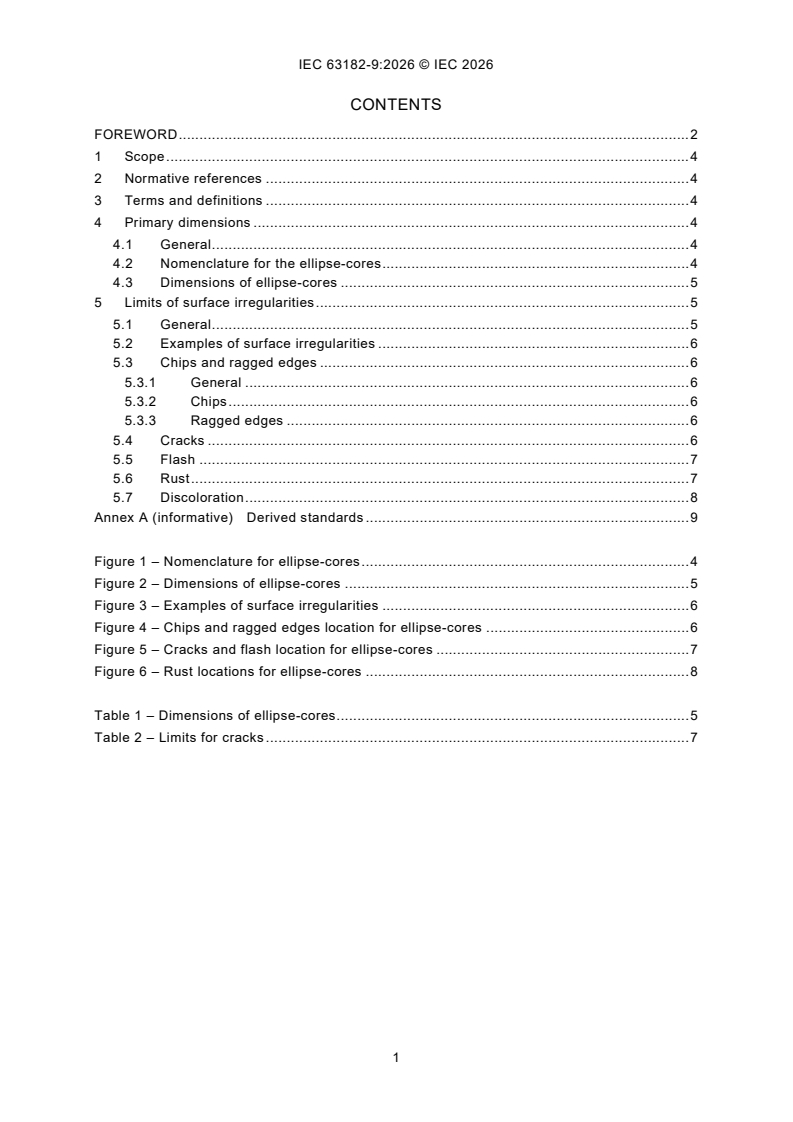
CONTENTS
FOREWORD . 2
1 Scope . 4
2 Normative references . 4
3 Terms and definitions . 4
4 Primary dimensions . 4
4.1 General . 4
4.2 Nomenclature for the ellipse-cores . 4
4.3 Dimensions of ellipse-cores . 5
5 Limits of surface irregularities . 5
5.1 General . 5
5.2 Examples of surface irregularities . 6
5.3 Chips and ragged edges . 6
5.3.1 General . 6
5.3.2 Chips . 6
5.3.3 Ragged edges . 6
5.4 Cracks . 6
5.5 Flash . 7
5.6 Rust . 7
5.7 Discoloration . 8
Annex A (informative) Derived standards . 9
Figure 1 – Nomenclature for ellipse-cores . 4
Figure 2 – Dimensions of ellipse-cores . 5
Figure 3 – Examples of surface irregularities . 6
Figure 4 – Chips and ragged edges location for ellipse-cores . 6
Figure 5 – Cracks and flash location for ellipse-cores . 7
Figure 6 – Rust locations for ellipse-cores . 8
Table 1 – Dimensions of ellipse-cores . 5
Table 2 – Limits for cracks . 7
INTERNATIONAL ELECTROTECHNICAL COMMISSION
____________
Magnetic powder cores -
Guidelines on dimensions and the limits of surface irregularities -
Part 9: Ellipse-cores
FOREWORD
1) The International Electrotechnical Commission (IEC) is a worldwide organization for standardization comprising
all national electrotechnical committees (IEC National Committees). The object of IEC is to promote international
co-operation on all questions concerning standardization in the electrical and electronic fields. To this end and
in addition to other activities, IEC publishes International Standards, Technical Specifications, Technical Reports,
Publicly Available Specifications (PAS) and Guides (hereafter referred to as “IEC Publication (s)”). Their
preparation is entrusted to technical committees; any IEC National Committee interested in the subject dealt with
may participate in this preparatory work. International, governmental and non-governmental organizations liaising
with the IEC also participate in this preparation. IEC collaborates closely with the International Organization for
Standardization (ISO) in accordance with conditions determined by agreement between the two organizations.
2) The formal decisions or agreements of IEC on technical matters express, as nearly as possible, an international
consensus of opinion on the relevant subjects since each technical committee has representation from all
interested IEC National Committees.
3) IEC Publications have the form of recommendations for international use and are accepted by IEC National
Committees in that sense. While all reasonable efforts are made to ensure that the technical content of IEC
Publications is accurate, IEC cannot be held responsible for the way in which they are used or for any
misinterpretation by any end user.
4) In order to promote international uniformity, IEC National Committees undertake to apply IEC Publications
transparently to the maximum extent possible in their national and regional publications. Any divergence between
any IEC Publication and the corresponding national or regional publication shall be clearly indicated in the latter.
5) IEC itself does not provide any attestation of conformity. Independent certification bodies provide conformity
assessment services and, in some areas, access to IEC marks of conformity. IEC is not responsible for any
services carried out by independent certification bodies.
6) All users should ensure that they have the latest edition of this publication.
7) No liability shall attach to IEC or its directors, employees, servants or agents including individual experts and
members of its technical committees and IEC National Committees for any personal injury, property damage or
other damage of any nature whatsoever, whether direct or indirect, or for costs (including legal fees) and
expenses arising out of the publication, use of, or reliance upon, this IEC Publication or any other IEC
Publications.
8) Attention is drawn to the Normative references cited in this publication. Use of the referenced publications is
indispensable for the correct application of this publication.
9) IEC draws attention to the
...