

IEC TR 63214:2019
(Main)Nuclear power plants - Control rooms - Human factors engineering
General Information
- Abstract
IEC TR 63214:2019 provides a summary of arguments and a technical basis for the development of a new Human Factors Engineering IEC standard and the alignment of IEC 60964. Based on the provided argumentation, the participating members will vote for such an approach. The proposed content of the new standard provides the basis for fruitful discussion within IEC SC 45A WG 8 and raises interest in the development of the new standard.
The scope of the new HFE IEC standard will follow a holistic approach towards the design of the plant-wide control rooms and all HMI, including e.g. the local control stations located throughout the plant. The general principle is to consider the complete nuclear installation design as a sociotechnical system, in a holistic and integrated way.
- Status
- Published
- Publication Date
- 28-Oct-2019
- Current Stage
- PPUB - Publication issued
- Start Date
- 29-Oct-2019
- Completion Date
- 29-Oct-2019
Overview
IEC TR 63214:2019 is an informative Technical Report from the IEC that establishes the technical basis and argumentation for developing a dedicated Human Factors Engineering (HFE) standard for nuclear power plant control rooms. It recommends aligning and limiting IEC 60964 to pure control room design while creating a new, holistic HFE standard that covers plant‑wide control rooms, HMI, and local control stations. The report frames the nuclear installation as a sociotechnical system and aims to stimulate WG 8 and IEC SC 45A discussion and international vote on progressing a new HFE standard.
Keywords: IEC TR 63214:2019, human factors engineering, nuclear power plants, control room design, HMI, IEC 60964.
Key Topics and Technical Focus
IEC TR 63214 does not set normative requirements but identifies gaps and direction for normative work. Key topics covered include:
- Scope gaps in IEC 60964 - limitations stemming from a narrow electrical-systems focus and incomplete HFE content.
- Missing and outdated information - where current guidance needs modernization (terminology, task analysis wording and HFE lifecycle content).
- Industry needs - practical expectations for HFE across design, operation, verification and validation.
- Proposed HFE structure - a suggested table of contents for the new standard and a graphical HFE process to guide design decisions.
- Holistic HMI coverage - plant-wide HMI including local control stations, operator interfaces, and integrated control room ecosystems.
- Impact analysis - how a new HFE standard would affect IEC 60964 and other SC45A standards.
Practical Applications and Who Uses It
IEC TR 63214 is targeted at practitioners and stakeholders involved in nuclear control room and HMI design, including:
- Human factors engineers and ergonomists planning HFE programs
- Control room designers and I&C system engineers implementing operator interfaces
- Plant operators and utilities for design, modification, and safety-case justification
- Regulatory bodies and reviewers assessing HFE coverage in licensing and reviews
- Vendors and integrators supplying control room equipment and software
- Standards developers within IEC SC45A and national committees
Use cases include shaping HFE requirements during conceptual design, defining task analysis and functional assignment, guiding HFE verification & validation (V&V), and aligning national practice with international guidance.
Related Standards and Context
IEC TR 63214 positions the new HFE work within the SC45A framework alongside:
- IEC 60964 (control room design) - proposed to be refocused
- IEC 61513 and IEC 63046 - top‑level I&C and electrical system requirements
- Other SC45A standards and IAEA safety and security guidance (e.g., SSR‑2/1, SSG series)
This Technical Report is a preparatory, non‑normative document intended to spur development of a formal IEC HFE standard that is integrated, modern, and aligned with international nuclear safety practices.
Get Certified
Connect with accredited certification bodies for this standard

DNV
DNV is an independent assurance and risk management provider.

Lloyd's Register
Lloyd's Register is a global professional services organisation specialising in engineering and technology.
DNV Energy Systems
Energy and renewable energy certification.
Sponsored listings
Frequently Asked Questions
IEC TR 63214:2019 is a technical report published by the International Electrotechnical Commission (IEC). Its full title is "Nuclear power plants - Control rooms - Human factors engineering". This standard covers: IEC TR 63214:2019 provides a summary of arguments and a technical basis for the development of a new Human Factors Engineering IEC standard and the alignment of IEC 60964. Based on the provided argumentation, the participating members will vote for such an approach. The proposed content of the new standard provides the basis for fruitful discussion within IEC SC 45A WG 8 and raises interest in the development of the new standard. The scope of the new HFE IEC standard will follow a holistic approach towards the design of the plant-wide control rooms and all HMI, including e.g. the local control stations located throughout the plant. The general principle is to consider the complete nuclear installation design as a sociotechnical system, in a holistic and integrated way.
IEC TR 63214:2019 provides a summary of arguments and a technical basis for the development of a new Human Factors Engineering IEC standard and the alignment of IEC 60964. Based on the provided argumentation, the participating members will vote for such an approach. The proposed content of the new standard provides the basis for fruitful discussion within IEC SC 45A WG 8 and raises interest in the development of the new standard. The scope of the new HFE IEC standard will follow a holistic approach towards the design of the plant-wide control rooms and all HMI, including e.g. the local control stations located throughout the plant. The general principle is to consider the complete nuclear installation design as a sociotechnical system, in a holistic and integrated way.
IEC TR 63214:2019 is classified under the following ICS (International Classification for Standards) categories: 27.120.20 - Nuclear power plants. Safety. The ICS classification helps identify the subject area and facilitates finding related standards.
IEC TR 63214:2019 is available in PDF format for immediate download after purchase. The document can be added to your cart and obtained through the secure checkout process. Digital delivery ensures instant access to the complete standard document.
Standards Content (Sample)
IEC TR 63214 ®
Edition 1.0 2019-10
TECHNICAL
REPORT
Nuclear power plants – Control rooms – Human factors engineering
All rights reserved. Unless otherwise specified, no part of this publication may be reproduced or utilized in any form
or by any means, electronic or mechanical, including photocopying and microfilm, without permission in writing from
either IEC or IEC's member National Committee in the country of the requester. If you have any questions about IEC
copyright or have an enquiry about obtaining additional rights to this publication, please contact the address below or
your local IEC member National Committee for further information.
IEC Central Office Tel.: +41 22 919 02 11
3, rue de Varembé info@iec.ch
CH-1211 Geneva 20 www.iec.ch
Switzerland
About the IEC
The International Electrotechnical Commission (IEC) is the leading global organization that prepares and publishes
International Standards for all electrical, electronic and related technologies.
About IEC publications
The technical content of IEC publications is kept under constant review by the IEC. Please make sure that you have the
latest edition, a corrigendum or an amendment might have been published.
IEC publications search - webstore.iec.ch/advsearchform Electropedia - www.electropedia.org
The advanced search enables to find IEC publications by a The world's leading online dictionary on electrotechnology,
variety of criteria (reference number, text, technical containing more than 22 000 terminological entries in English
committee,…). It also gives information on projects, replaced and French, with equivalent terms in 16 additional languages.
and withdrawn publications. Also known as the International Electrotechnical Vocabulary
(IEV) online.
IEC Just Published - webstore.iec.ch/justpublished
Stay up to date on all new IEC publications. Just Published IEC Glossary - std.iec.ch/glossary
details all new publications released. Available online and 67 000 electrotechnical terminology entries in English and
once a month by email. French extracted from the Terms and Definitions clause of
IEC publications issued since 2002. Some entries have been
IEC Customer Service Centre - webstore.iec.ch/csc collected from earlier publications of IEC TC 37, 77, 86 and
If you wish to give us your feedback on this publication or CISPR.
need further assistance, please contact the Customer Service
Centre: sales@iec.ch.
IEC TR 63214 ®
Edition 1.0 2019-10
TECHNICAL
REPORT
Nuclear power plants – Control rooms – Human factors engineering
INTERNATIONAL
ELECTROTECHNICAL
COMMISSION
ICS 27.120.20 ISBN 978-2-8322-7528-3
– 2 – IEC TR 63214:2019 © IEC 2019
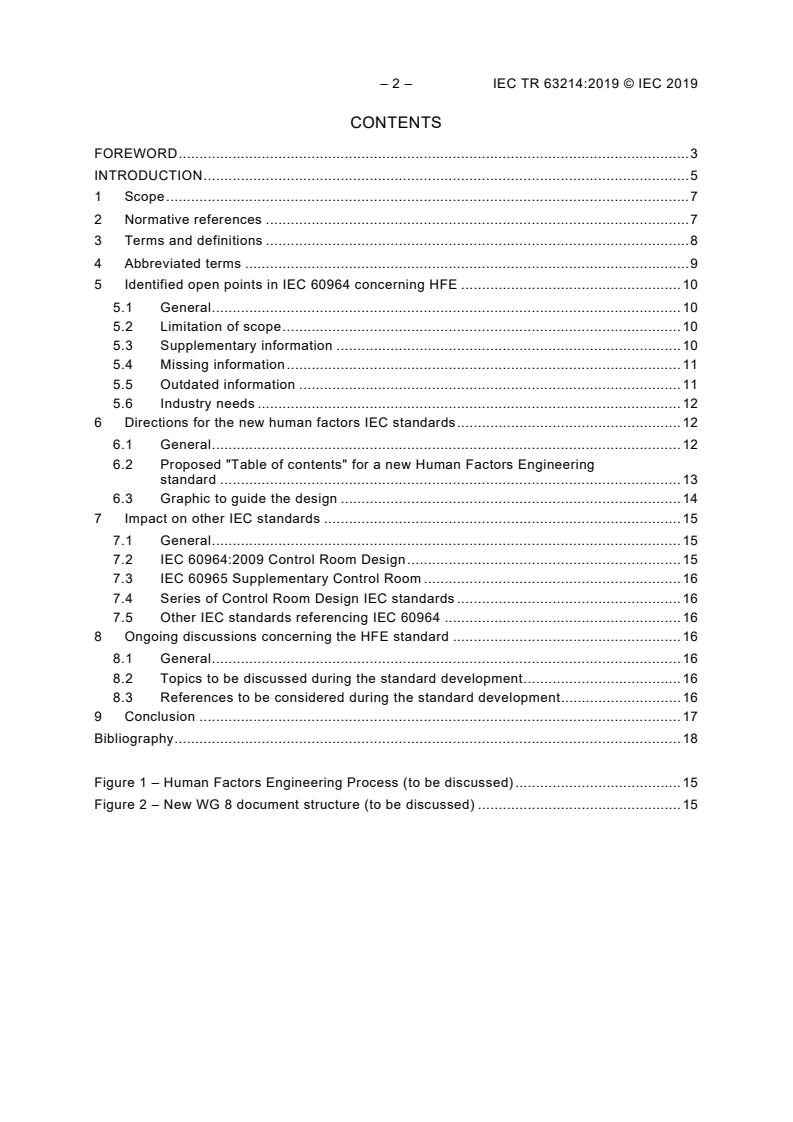
CONTENTS
FOREWORD . 3
INTRODUCTION . 5
1 Scope . 7
2 Normative references . 7
3 Terms and definitions . 8
4 Abbreviated terms . 9
5 Identified open points in IEC 60964 concerning HFE . 10
5.1 General . 10
5.2 Limitation of scope . 10
5.3 Supplementary information . 10
5.4 Missing information . 11
5.5 Outdated information . 11
5.6 Industry needs . 12
6 Directions for the new human factors IEC standards . 12
6.1 General . 12
6.2 Proposed "Table of contents" for a new Human Factors Engineering
standard . 13
6.3 Graphic to guide the design . 14
7 Impact on other IEC standards . 15
7.1 General . 15
7.2 IEC 60964:2009 Control Room Design . 15
7.3 IEC 60965 Supplementary Control Room . 16
7.4 Series of Control Room Design IEC standards . 16
7.5 Other IEC standards referencing IEC 60964 . 16
8 Ongoing discussions concerning the HFE standard . 16
8.1 General . 16
8.2 Topics to be discussed during the standard development . 16
8.3 References to be considered during the standard development . 16
9 Conclusion . 17
Bibliography . 18
Figure 1 – Human Factors Engineering Process (to be discussed) . 15
Figure 2 – New WG 8 document structure (to be discussed) . 15
INTERNATIONAL ELECTROTECHNICAL COMMISSION
____________
NUCLEAR POWER PLANTS – CONTROL ROOMS –
HUMAN FACTORS ENGINEERING
FOREWORD
1) The International Electrotechnical Commission (IEC) is a worldwide organization for standardization comprising
all national electrotechnical committees (IEC National Committees). The object of IEC is to promote
international co-operation on all questions concerning standardization in the electrical and electronic fields. To
this end and in addition to other activities, IEC publishes International Standards, Technical Specifications,
Technical Reports, Publicly Available Specifications (PAS) and Guides (hereafter referred to as “IEC
Publication(s)”). Their preparation is entrusted to technical committees; any IEC National Committee interested
in the subject dealt with may participate in this preparatory work. International, governmental and non-
governmental organizations liaising with the IEC also participate in this preparation. IEC collaborates closely
with the International Organization for Standardization (ISO) in accordance with conditions determined by
agreement between the two organizations.
2) The formal decisions or agreements of IEC on technical matters express, as nearly as possible, an international
consensus of opinion on the relevant subjects since each technical committee has representation from all
interested IEC National Committees.
3) IEC Publications have the form of recommendations for international use and are accepted by IEC National
Committees in that sense. While all reasonable efforts are made to ensure that the technical content of IEC
Publications is accurate, IEC cannot be held responsible for the way in which they are used or for any
misinterpretation by any end user.
4) In order to promote international uniformity, IEC National Committees undertake to apply IEC Publications
transparently to the maximum extent possible in their national and regional publications. Any divergence
between any IEC Publication and the corresponding national or regional publication shall be clearly indicated in
the latter.
5) IEC itself does not provide any attestation of conformity. Independent certification bodies provide conformity
assessment services and, in some areas, access to IEC marks of conformity. IEC is not responsible for any
services carried out by independent certification bodies.
6) All users should ensure that they have the latest edition of this publication.
7) No liability shall attach to IEC or its directors, employees, servants or agents including individual experts and
members of its technical committees and IEC National Committees for any personal injury, property damage or
other damage of any nature whatsoever, whether direct or indirect, or for costs (including legal fees) and
expenses arising out of the publication, use of, or reliance upon, this IEC Publication or any other IEC
Publications.
8) Attention is drawn to the Normative references cited in this publication. Use of the referenced publications is
indispensable for the correct application of this publication.
9) Attention is drawn to the possibility that some of the elements of this IEC Publication may be the subject of
patent rights. IEC shall not be held responsible for identifying any or all such patent rights.
The main task of IEC technical committees is to prepare International Standards. However, a
technical committee may propose the publication of a technical report when it has collected
data of a different kind from that which is normally published as an International Standard, for
example "state of the art".
IEC TR 63214, which is a technical report, has been prepared by subcommittee 45A:
Instrumentation, control and electrical power systems of nuclear facilities, of IEC technical
committee 45: Nuclear instrumentation.
The text of this technical report is based on the following documents:
Enquiry draft Report on voting
45A/1226/DTR 45A/1247A/RVDTR
Full information on the voting for the approval of this technical report can be found in the
report on voting indicated in the above table.
– 4 – IEC TR 63214:2019 © IEC 2019
This document has been drafted in accordance with the ISO/IEC Directives, Part 2.
A bilingual version of this publication may be issued at a later date.
The committee has decided that the contents of this document will remain unchanged until the
stability date indicated on the IEC website under "http://webstore.iec.ch" in the data related to
the specific document. At this date, the document will be
• reconfirmed,
• withdrawn,
• replaced by a revised edition, or
• amended.
INTRODUCTION
a) Technical background, main issues and organisation of the Technical Report
IEC 60964: Nuclear power plants – Control rooms – Design includes a detailed set of
requirements to be applied when designing a control room and a process to implement
Human Factors Engineering. The two topics are mixed and the Human Factors part is
incomplete and does not reflect state-of-the-art knowledge and wording. In addition, the
standard was written considering only Human Factors within the scope of electrical systems in
control room design. The result is that the document does not take a holistic approach
towards the design of the plant-wide control rooms and HMI, including e.g. the local control
stations located throughout the plant.
The third edition of IEC 60964:2018 considers mainly the wording and the description of task
analyses. The authors and the IEC Committee 45A Working Group 8 identified that changing
only this aspect is already leading to a set of additional questions (e.g., concerning details of
Functional Assignment and HFE V&V) triggered by outdated or incomplete information. Based
on this, the Working Group realized that a minor change of the document does not solve all
topics in the standard. Instead, it was proposed to publish a technical report to argue and
propose a dedicated Human Factors Engineering standard, while limiting IEC 60964 to a pure
control room design standard.
In addition, the IAEA is in the process of publishing a Human Factors Guide (DS492) that
should also be reflected in IEC standardisation.
This document was developed to define the content of a future IEC HFE standard as a
conclusion of the 2017 Shanghai IEC SC45A meeting with participants from Japan, China,
Russia, Spain, France, Switzerland, and Germany.
b) Situation of the current Technical Report in the structure of the IEC SC 45A standard
series
The technical report IEC TR 63214 is a fourth level IEC SC 45A document.
This report is not proving the final standard for discussion; it is recommending an international
development of the standard, proving the needs and providing a first set of ideas. Outstanding
work has still to be conducted.
For more details on the structure of the IEC SC 45A standard series, see item d) of this
introduction.
c) Recommendations and limitations regarding the application of the Technical Report
It is important to note that a technical report is entirely informative in nature. It gathers data
collected from different origins and it establishes no requirements.
d) Description of the structure of the IEC SC45A standard series and relationships with
other IEC documents and other bodies documents (IAEA, ISO)
The top-level documents of the IEC SC45A standard series are IEC 61513 and IEC 63046.
IEC 61513 provides general requirements for I&C systems and equipment that are used to
perform functions important to safety in NPPs. IEC 63046 provides general requirements for
electrical power systems of NPPs; it covers power supply systems including the supply
systems of the I&C systems. IEC 61513 and IEC 63046 are to be considered in conjunction
and at the same level. IEC 61513 and IEC 63046 structure the IEC SC45A standard series
and shape a complete framework establishing general requirements for instrumentation,
control and electrical systems for nuclear power plants.
– 6 – IEC TR 63214:2019 © IEC 2019
IEC 61513 and IEC 63046 refer directly to other IEC SC45A standards for general topics
related to categorization of functions and classification of systems, qualification, separation,
defence against common cause failure, control room design, electromagnetic compatibility,
cybersecurity, software and hardware aspects for programmable digital systems, coordination
of safety and security requirements and management of ageing. The standards referenced
directly at this second level should be considered together with IEC 61513 and IEC 63046 as
a consistent document set.
At a third level, IEC SC45A standards not directly referenced by IEC 61513 or by IEC 63046
are standards related to specific equipment, technical methods, or specific activities. Usually
these documents, which make reference to second-level documents for general topics, can be
used on their own.
A fourth level extending the IEC SC45 standard series, corresponds to the Technical Reports
which are not normative.
The IEC SC45A standards series consistently implements and details the safety and security
principles and basic aspects provided in the relevant IAEA safety standards and in the
relevant documents of the IAEA nuclear security series (NSS). In particular this includes the
IAEA requirements SSR-2/1, establishing safety requirements related to the design of nuclear
power plants (NPPs), the IAEA safety guide SSG-30 dealing with the safety classification of
structures, systems and components in NPPs, the IAEA safety guide SSG-39 dealing with the
design of instrumentation and control systems for NPPs, the IAEA safety guide SSG-34
dealing with the design of electrical power systems for NPPs and the implementing guide
NSS17 for computer security at nuclear facilities. The safety and security terminology and
definitions used by SC45A standards are consistent with those used by the IAEA.
IEC 61513 and IEC 63046 have adopted a presentation format similar to the basic safety
publication IEC 61508 with an overall life-cycle framework and a system life-cycle framework.
Regarding nuclear safety, IEC 61513 and IEC 63046 provide the interpretation of the general
requirements of IEC 61508-1, IEC 61508-2 and IEC 61508-4, for the nuclear application
sector. In this framework IEC 60880, IEC 62138 and IEC 62566 correspond to IEC 61508-3
for the nuclear application sector. IEC 61513 and IEC 63046 refer to ISO as well as to
IAEA GS-R part 2 and IAEA GS-G-3.1 and IAEA GS-G-3.5 for topics related to quality
assurance (QA). At level 2, regarding nuclear security, IEC 62645 is the entry document for
the IEC/SC45A security standards. It builds upon the valid high level principles and main
concepts of the generic security standards, in particular ISO/IEC 27001 and ISO/IEC 27002; it
adapts them and completes them to fit the nuclear context and coordinates with the
IEC 62443 series. At level 2, IEC 60964 is the entry document for the IEC/SC45A control
rooms standards and IEC 62342 is the entry document for the ageing management standards.
NOTE 1 It is assumed that for the design of I&C systems in NPPs that implement conventional safety functions
(e.g. to address worker safety, asset protection, chemical hazards, process energy hazards) international or
national standards would be applied.
NOTE 2 IEC/SC45A domain was extended in 2013 to cover electrical systems. In 2014 and 2015 discussions
were held in IEC/SC45A to decide how and where general requirements for the design of electrical systems were to
be considered. IEC/SC45A experts recommended that an independent standard be developed at the same level as
IEC 61513 to establish general requirements for electrical systems. Project IEC 63046 is now launched to cover
this objective. When IEC 63046 is published, this Note 2 of the introduction of IEC/SC45A standards will be
suppressed.
NUCLEAR POWER PLANTS – CONTROL ROOMS –
HUMAN FACTORS ENGINEERING
1 Scope
This document provides a summary of arguments and a technical basis for the development
of a new Human Factors Engineering IEC standard and the alignment of IEC 60964. Based on
the provided argumentation, the participating members will vote for such an approach. The
proposed content of the new standard provides the basis for fruitful discussion within
IEC SC 45A WG 8 and raises interest in the development of the new standard.
The scope of the new HFE IEC standard will follow a holistic approach towards the design of
the plant-wide control rooms and all HMI, including e.g. the local control stations located
throughout the plant. The general principle is to consider the complete nuclear installation
design as a sociotechnical system, in a holistic and integrated way.
This document is organized as follows:
• Clause 5 addresses the open points that serve as a basis for the discussion about a new
Human Factors standard within IEC.
• Clause 6 proposes a basic structure for the new standard to clearly identify the scope of
this development.
• Clause 7 addresses the changes needed to existing IEC standards to be aligned with a
new Human Factors standard.
2 Normative references
The following documents are referred to in the text in such a way that some or all of their
content constitutes requirements of this document. For dated references, only the edition
cited applies. For undated references, the latest edition of the referenced document (including
any amendments) applies.
IEC 60964:2009, Nuclear power plants- Control rooms - Design
IEC 60965, Nuclear power plants – Control rooms – Supplementary control room for reactor
shutdown without access to the main control room
IEC 61771, Nuclear power plants – Main control room – Verification and validation of design
IEC 61839, Nuclear power plants – Design of control rooms – Functional analysis and
assignments
ISO 11064 (all parts), Ergonomic design of control centres
IAEA Guide DS492 Human Factors Engineering in the Design of Nuclear Power Plants;
Status: DRAFT
– 8 – IEC TR 63214:2019 © IEC 2019
3 Terms and definitions
For the purposes of this document, the following terms and definitions apply.
ISO and IEC maintain terminological databases for use in standardization at the following
addresses:
• IEC Electropedia: available at http://www.electropedia.org/
• ISO Online browsing platform: available at http://www.iso.org/obp
3.1
function
specific purpose or objective to be accomplished, that can be specified or described without
reference to the physical means of achieving it.
[SOURCE: IEC 61226: 2009, 3.7]
3.2
functional analysis
examination of the functional goals of a system with respect to available manpower,
technology, and other resources, to provide the basis for determining how the function may be
assigned and executed
3.3
human factors engineering
engineering in which factors that could influence human performance and that could affect
safety are understood and are taken into account, especially in the design and operation of
facilities
3.4
human-machine interface
interface between operating staff and I&C system and computer systems l
...