

IEC TS 62351-100-6:2022
(Main)Power systems management and associated information exchange - Data and communication security - Part 100-6: Cybersecurity conformance testing for IEC 61850-8-1 and IEC 61850-9-2
General Information
- Abstract
IEC TS 62351-100-6:2022 (E), which is a technical specification, is part of the IEC 62351 suite of standards, which describes test cases for interoperability conformance testing of data and communication security for Substation Automation Systems [SAS] and telecontrol systems which implement IEC TS 62351-6. The tests described in this part do not evaluate the security of the implementation. Thus, citing conformance to this part does not imply that any particular security level has been achieved by the corresponding product, or by the system in which it is used.
The goal of this part of IEC 62351 is to enable interoperability by providing a standard method of testing protocol implementations, but it does not guarantee the full interoperability of devices. It is expected that using this specification during testing will minimize the risk of non-interoperability. Additional testing and assurance measures will be required to verify that a particular implementation of IEC TC 62351-6 has correctly implemented all the security functions and that they can be assured to be present in all delivered products. This topic is covered in other IEC standards, for example IEC 62443.
The scope of this document is to specify common available procedures and definitions for conformance and/or interoperability testing of IEC 62351-6, the IEC 61850-8-1, IEC 61850-9-2 and also their recommendations over IEC 62351-3 for profiles including TCP/IP and IEC 62351 4 for profiles including MMS. These are the security extensions for IEC 61850 and derivatives to enable unambiguous and standardized evaluation of IEC TS 62351-6 and its companion standards protocol implementations.
The detailed test cases per companion standard, containing among others mandatory and optional mandatory test cases per Secure Communication Application Function, secure ASDU (Application Service Data Unit) and transmission procedures, will become available as technical specifications (TS). Other functionality may need additional test cases, but this is outside the scope of this part of IEC 62351. This document is such a technical specification for the mentioned companion standard.
This document deals mainly with data and communication security conformance testing; therefore, other requirements, such as safety or EMC (Electromagnetic compatibility) are not covered. These requirements are covered by other standards (if applicable) and the proof of compliance for these topics is done according to these standards.
- Status
- Published
- Publication Date
- 16-Aug-2022
- Technical Committee
- TC 57 - Power systems management and associated information exchange
- Drafting Committee
- WG 15 - TC 57/WG 15
- Current Stage
- PPUB - Publication issued
- Start Date
- 17-Aug-2022
- Completion Date
- 16-Aug-2022
Buy Documents
IEC TS 62351-100-6:2022 - Power systems management and associated information exchange - Data and communication security - Part 100-6: Cybersecurity conformance testing for IEC 61850-8-1 and IEC 61850-9-2 Released:8/17/2022
Overview
IEC TS 62351-100-6:2022 is a technical specification developed by the International Electrotechnical Commission (IEC) and is part of the IEC 62351 suite of standards. This document focuses on cybersecurity conformance testing for IEC 61850-8-1 and IEC 61850-9-2, which are extensively used in Substation Automation Systems (SAS) and telecontrol systems. The primary goal of this specification is to provide standardized test cases for verifying interoperability and conformance of data and communication security implementations based on IEC TS 62351-6.
It is important to note that this standard outlines test cases to evaluate interoperability in security-related communication protocols, but does not assess or guarantee the security level of a device or system. Citing conformance with IEC TS 62351-100-6:2022 means only that the implementation follows prescribed testing procedures – not that it achieves any particular cybersecurity assurance.
Key Topics
Scope of Testing:
- Focuses on interoperability and conformance testing for the security mechanisms as specified in IEC TS 62351-6.
- Covers communication profiles:
- IEC 61850-8-1 (GOOSE, MMS)
- IEC 61850-9-2 (Sampled Values)
- Related profiles using TCP/IP (IEC 62351-3) and MMS (IEC 62351-4).
- Excludes safety and electromagnetic compatibility (EMC), which are addressed by other standards.
Testing Methodologies:
- Test cases are designed for both publisher and subscriber devices (Device Under Test or DUT).
- Requires use of specific testing tools and environments simulating real-world operational conditions.
- Supports both normal operation and resilience (fault) scenarios.
Documentation & Reporting:
- Requires detailed documentation, including Protocol Implementation Conformance Statements (PICS) and Protocol Implementation eXtra Information for Testing (PIXIT).
- Testing facilities must maintain comprehensive, reproducible test records and version documentation for all involved devices, software, and test plans.
Limitations:
- Passing these tests does not ensure full interoperability or guarantee the implementation of all required security functions.
- Full security assurance must be complemented by other tests and standards, such as IEC 62443.
Applications
IEC TS 62351-100-6:2022 is applicable to organizations and professionals involved in:
Substation Automation Systems (SAS):
Implementers and integrators using IEC 61850-8-1/9-2 in substation environments can utilize these test cases to assess and document the secure interoperability of devices before system commissioning.Vendor and Laboratory Conformance Testing:
Vendors and independent testing labs use these test cases as a reference to validate that their products conform to IEC 62351-6 protocol security extensions for GOOSE, Sampled Values (SV), and related protocols.Acceptance Testing:
Assists utilities and grid operators in minimizing the risk of integration issues during Factory Acceptance Testing (FAT) and Site Acceptance Testing (SAT), ensuring that devices have met baseline interoperability regardless of their individual security implementation.Product Documentation and Certification:
Forms the basis of transparent reporting and documentation when a device is evaluated for compliance, aiding stakeholders in demonstrating due diligence in cybersecurity for critical infrastructure.
Related Standards
The effective implementation of IEC TS 62351-100-6:2022 is best achieved in conjunction with the following standards:
- IEC 61850 Series - Communication networks and systems for power utility automation.
- IEC 62351-3: Communication network and system security – Profiles including TCP/IP.
- IEC 62351-4: Communication network and system security – Profiles including MMS.
- IEC 62351-6: Security for IEC 61850.
- IEC 62443 Series: Industrial communication networks – Network and system security, providing further guidance on security assurance measures across the lifecycle.
Conclusion
IEC TS 62351-100-6:2022 delivers a standardized approach for cybersecurity conformance and interoperability testing for secure data and communication protocols in modern power systems. By adhering to these test cases, the energy industry can promote improved cross-vendor compatibility and foundational cybersecurity preparedness in substation automation and telecontrol networks, supporting global efforts to enhance electric grid resilience.
Buy Documents
IEC TS 62351-100-6:2022 - Power systems management and associated information exchange - Data and communication security - Part 100-6: Cybersecurity conformance testing for IEC 61850-8-1 and IEC 61850-9-2 Released:8/17/2022
Get Certified
Connect with accredited certification bodies for this standard

ANCE
Mexican certification and testing association.

Intertek Slovenia
Intertek testing, inspection, and certification services in Slovenia.

LNE (Laboratoire National de Métrologie et d'Essais)
French national laboratory for metrology and testing.
Sponsored listings
Frequently Asked Questions
IEC TS 62351-100-6:2022 is a technical specification published by the International Electrotechnical Commission (IEC). Its full title is "Power systems management and associated information exchange - Data and communication security - Part 100-6: Cybersecurity conformance testing for IEC 61850-8-1 and IEC 61850-9-2". This standard covers: IEC TS 62351-100-6:2022 (E), which is a technical specification, is part of the IEC 62351 suite of standards, which describes test cases for interoperability conformance testing of data and communication security for Substation Automation Systems [SAS] and telecontrol systems which implement IEC TS 62351-6. The tests described in this part do not evaluate the security of the implementation. Thus, citing conformance to this part does not imply that any particular security level has been achieved by the corresponding product, or by the system in which it is used. The goal of this part of IEC 62351 is to enable interoperability by providing a standard method of testing protocol implementations, but it does not guarantee the full interoperability of devices. It is expected that using this specification during testing will minimize the risk of non-interoperability. Additional testing and assurance measures will be required to verify that a particular implementation of IEC TC 62351-6 has correctly implemented all the security functions and that they can be assured to be present in all delivered products. This topic is covered in other IEC standards, for example IEC 62443. The scope of this document is to specify common available procedures and definitions for conformance and/or interoperability testing of IEC 62351-6, the IEC 61850-8-1, IEC 61850-9-2 and also their recommendations over IEC 62351-3 for profiles including TCP/IP and IEC 62351 4 for profiles including MMS. These are the security extensions for IEC 61850 and derivatives to enable unambiguous and standardized evaluation of IEC TS 62351-6 and its companion standards protocol implementations. The detailed test cases per companion standard, containing among others mandatory and optional mandatory test cases per Secure Communication Application Function, secure ASDU (Application Service Data Unit) and transmission procedures, will become available as technical specifications (TS). Other functionality may need additional test cases, but this is outside the scope of this part of IEC 62351. This document is such a technical specification for the mentioned companion standard. This document deals mainly with data and communication security conformance testing; therefore, other requirements, such as safety or EMC (Electromagnetic compatibility) are not covered. These requirements are covered by other standards (if applicable) and the proof of compliance for these topics is done according to these standards.
IEC TS 62351-100-6:2022 (E), which is a technical specification, is part of the IEC 62351 suite of standards, which describes test cases for interoperability conformance testing of data and communication security for Substation Automation Systems [SAS] and telecontrol systems which implement IEC TS 62351-6. The tests described in this part do not evaluate the security of the implementation. Thus, citing conformance to this part does not imply that any particular security level has been achieved by the corresponding product, or by the system in which it is used. The goal of this part of IEC 62351 is to enable interoperability by providing a standard method of testing protocol implementations, but it does not guarantee the full interoperability of devices. It is expected that using this specification during testing will minimize the risk of non-interoperability. Additional testing and assurance measures will be required to verify that a particular implementation of IEC TC 62351-6 has correctly implemented all the security functions and that they can be assured to be present in all delivered products. This topic is covered in other IEC standards, for example IEC 62443. The scope of this document is to specify common available procedures and definitions for conformance and/or interoperability testing of IEC 62351-6, the IEC 61850-8-1, IEC 61850-9-2 and also their recommendations over IEC 62351-3 for profiles including TCP/IP and IEC 62351 4 for profiles including MMS. These are the security extensions for IEC 61850 and derivatives to enable unambiguous and standardized evaluation of IEC TS 62351-6 and its companion standards protocol implementations. The detailed test cases per companion standard, containing among others mandatory and optional mandatory test cases per Secure Communication Application Function, secure ASDU (Application Service Data Unit) and transmission procedures, will become available as technical specifications (TS). Other functionality may need additional test cases, but this is outside the scope of this part of IEC 62351. This document is such a technical specification for the mentioned companion standard. This document deals mainly with data and communication security conformance testing; therefore, other requirements, such as safety or EMC (Electromagnetic compatibility) are not covered. These requirements are covered by other standards (if applicable) and the proof of compliance for these topics is done according to these standards.
IEC TS 62351-100-6:2022 is classified under the following ICS (International Classification for Standards) categories: 33.200 - Telecontrol. Telemetering. The ICS classification helps identify the subject area and facilitates finding related standards.
IEC TS 62351-100-6:2022 is available in PDF format for immediate download after purchase. The document can be added to your cart and obtained through the secure checkout process. Digital delivery ensures instant access to the complete standard document.
Standards Content (Sample)
IEC TS 62351-100-6 ®
Edition 1.0 2022-08
TECHNICAL
SPECIFICATION
colour
inside
Power systems management and associated information exchange – Data and
communication security
Part 100-6: Cybersecurity conformance testing for IEC 61850-8-1 and
IEC 61850-9-2
All rights reserved. Unless otherwise specified, no part of this publication may be reproduced or utilized in any form
or by any means, electronic or mechanical, including photocopying and microfilm, without permission in writing from
either IEC or IEC's member National Committee in the country of the requester. If you have any questions about IEC
copyright or have an enquiry about obtaining additional rights to this publication, please contact the address below or
your local IEC member National Committee for further information.
IEC Secretariat Tel.: +41 22 919 02 11
3, rue de Varembé info@iec.ch
CH-1211 Geneva 20 www.iec.ch
Switzerland
About the IEC
The International Electrotechnical Commission (IEC) is the leading global organization that prepares and publishes
International Standards for all electrical, electronic and related technologies.
About IEC publications
The technical content of IEC publications is kept under constant review by the IEC. Please make sure that you have the
latest edition, a corrigendum or an amendment might have been published.
IEC publications search - webstore.iec.ch/advsearchform IEC Products & Services Portal - products.iec.ch
The advanced search enables to find IEC publications by a Discover our powerful search engine and read freely all the
variety of criteria (reference number, text, technical publications previews. With a subscription you will always have
committee, …). It also gives information on projects, replaced access to up to date content tailored to your needs.
and withdrawn publications.
Electropedia - www.electropedia.org
IEC Just Published - webstore.iec.ch/justpublished
The world's leading online dictionary on electrotechnology,
Stay up to date on all new IEC publications. Just Published
containing more than 22 300 terminological entries in English
details all new publications released. Available online and once
and French, with equivalent terms in 19 additional languages.
a month by email.
Also known as the International Electrotechnical Vocabulary
(IEV) online.
IEC Customer Service Centre - webstore.iec.ch/csc
If you wish to give us your feedback on this publication or need
further assistance, please contact the Customer Service
Centre: sales@iec.ch.
IEC TS 62351-100-6 ®
Edition 1.0 2022-08
TECHNICAL
SPECIFICATION
colour
inside
Power systems management and associated information exchange – Data and
communication security
Part 100-6: Cybersecurity conformance testing for IEC 61850-8-1 and
IEC 61850-9-2
INTERNATIONAL
ELECTROTECHNICAL
COMMISSION
ICS 33.200 ISBN 978-2-8322-3976-6
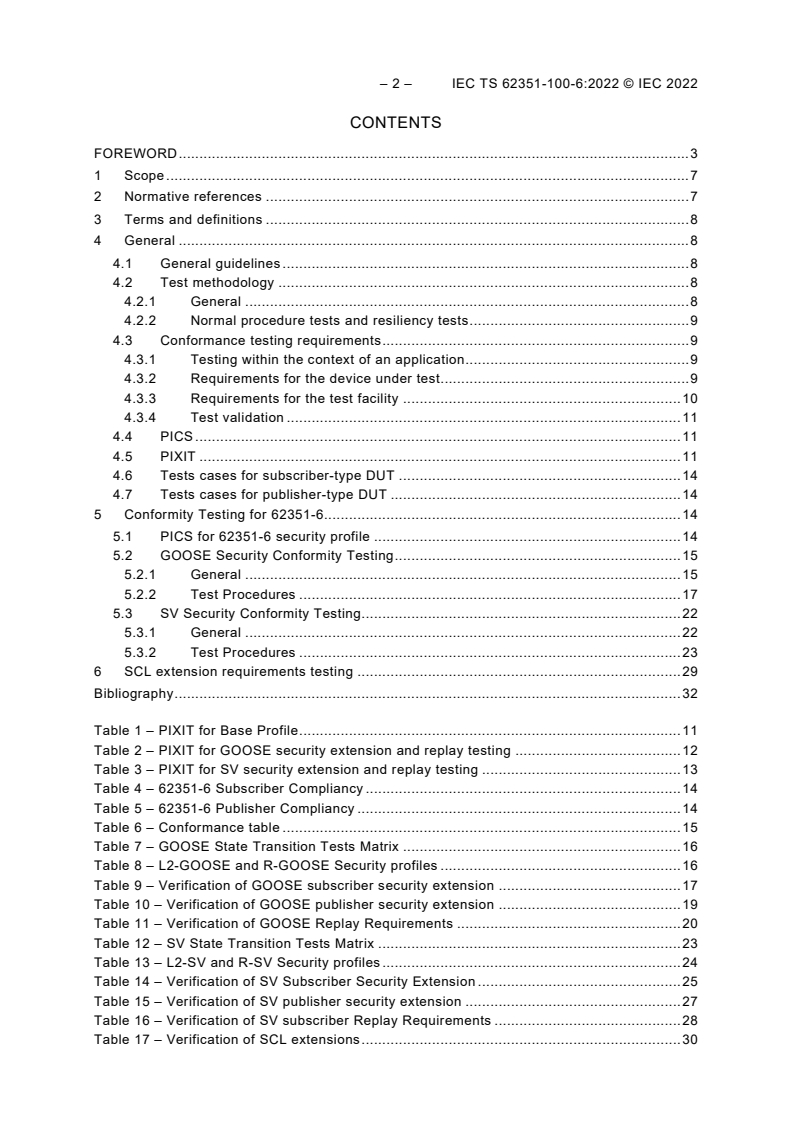
– 2 – IEC TS 62351-100-6:2022 © IEC 2022
CONTENTS
FOREWORD . 3
1 Scope . 7
2 Normative references . 7
3 Terms and definitions . 8
4 General . 8
4.1 General guidelines . 8
4.2 Test methodology . 8
4.2.1 General . 8
4.2.2 Normal procedure tests and resiliency tests . 9
4.3 Conformance testing requirements . 9
4.3.1 Testing within the context of an application . 9
4.3.2 Requirements for the device under test. 9
4.3.3 Requirements for the test facility . 10
4.3.4 Test validation . 11
4.4 PICS . 11
4.5 PIXIT . 11
4.6 Tests cases for subscriber-type DUT . 14
4.7 Tests cases for publisher-type DUT . 14
5 Conformity Testing for 62351-6. 14
5.1 PICS for 62351-6 security profile . 14
5.2 GOOSE Security Conformity Testing . 15
5.2.1 General . 15
5.2.2 Test Procedures . 17
5.3 SV Security Conformity Testing . 22
5.3.1 General . 22
5.3.2 Test Procedures . 23
6 SCL extension requirements testing . 29
Bibliography . 32
Table 1 – PIXIT for Base Profile . 11
Table 2 – PIXIT for GOOSE security extension and replay testing . 12
Table 3 – PIXIT for SV security extension and replay testing . 13
Table 4 – 62351-6 Subscriber Compliancy . 14
Table 5 – 62351-6 Publisher Compliancy . 14
Table 6 – Conformance table . 15
Table 7 – GOOSE State Transition Tests Matrix . 16
Table 8 – L2-GOOSE and R-GOOSE Security profiles . 16
Table 9 – Verification of GOOSE subscriber security extension . 17
Table 10 – Verification of GOOSE publisher security extension . 19
Table 11 – Verification of GOOSE Replay Requirements . 20
Table 12 – SV State Transition Tests Matrix . 23
Table 13 – L2-SV and R-SV Security profiles . 24
Table 14 – Verification of SV Subscriber Security Extension . 25
Table 15 – Verification of SV publisher security extension . 27
Table 16 – Verification of SV subscriber Replay Requirements . 28
Table 17 – Verification of SCL extensions . 30
INTERNATIONAL ELECTROTECHNICAL COMMISSION
____________
POWER SYSTEMS MANAGEMENT AND ASSOCIATED INFORMATION
EXCHANGE – DATA AND COMMUNICATION SECURITY –
Part 100-6: Cybersecurity conformance
testing for IEC 61850-8-1 and IEC 61850-9-2
FOREWORD
1) The International Electrotechnical Commission (IEC) is a worldwide organization for standardization comprising
all national electrotechnical committees (IEC National Committees). The object of IEC is to promote international
co-operation on all questions concerning standardization in the electrical and electronic fields. To this end and
in addition to other activities, IEC publishes International Standards, Technical Specifications, Technical Reports,
Publicly Available Specifications (PAS) and Guides (hereafter referred to as “IEC Publication(s)”). Their
preparation is entrusted to technical committees; any IEC National Committee interested in the subject dealt with
may participate in this preparatory work. International, governmental and non-governmental organizations liaising
with the IEC also participate in this preparation. IEC collaborates closely with the International Organization for
Standardization (ISO) in accordance with conditions determined by agreement between the two organizations.
2) The formal decisions or agreements of IEC on technical matters express, as nearly as possible, an international
consensus of opinion on the relevant subjects since each technical committee has representation from all
interested IEC National Committees.
3) IEC Publications have the form of recommendations for international use and are accepted by IEC National
Committees in that sense. While all reasonable efforts are made to ensure that the technical content of IEC
Publications is accurate, IEC cannot be held responsible for the way in which they are used or for any
misinterpretation by any end user.
4) In order to promote international uniformity, IEC National Committees undertake to apply IEC Publications
transparently to the maximum extent possible in their national and regional publications. Any divergence between
any IEC Publication and the corresponding national or regional publication shall be clearly indicated in the latter.
5) IEC itself does not provide any attestation of conformity. Independent certification bodies provide conformity
assessment services and, in some areas, access to IEC marks of conformity. IEC is not responsible for any
services carried out by independent certification bodies.
6) All users should ensure that they have the latest edition of this publication.
7) No liability shall attach to IEC or its directors, employees, servants or agents including individual experts and
members of its technical committees and IEC National Committees for any personal injury, property damage or
other damage of any nature whatsoever, whether direct or indirect, or for costs (including legal fees) and
expenses arising out of the publication, use of, or reliance upon, this IEC Publication or any other IEC
Publications.
8) Attention is drawn to the Normative references cited in this publication. Use of the referenced publications is
indispensable for the correct application of this publication.
9) Attention is drawn to the possibility that some of the elements of this IEC Publication may be the subject of patent
rights. IEC shall not be held responsible for identifying any or all such patent rights.
IEC TS 62351-100-6 has been prepared by IEC technical committee 57: Power systems
management and associated information exchange. It is a Technical Specification.
The text of this Technical Specification is based on the following documents:
Draft Report on voting
57/2438/DTS 57/2484/RVDTS
Full information on the voting for its approval can be found in the report on voting indicated in
the above table.
The language used for the development of this Technical Specification is English.
– 4 – IEC TS 62351-100-6:2022 © IEC 2022
This document was drafted in accordance with ISO/IEC Directives, Part 2, and developed in
accordance with ISO/IEC Directives, Part 1 and ISO/IEC Directives, IEC Supplement, available
at www.iec.ch/members_experts/refdocs. The main document types developed by IEC are
described in greater detail at www.iec.ch/standardsdev/publications.
A list of all parts in the IEC 62351 series, published under the general title Power systems
management and associated information exchange – Data and communication security, can be
found on the IEC website.
The committee has decided that the contents of this document will remain unchanged until the
stability date indicated on the IEC website under webstore.iec.ch in the data related to the
specific document. At this date, the document will be
• reconfirmed,
• withdrawn,
• replaced by a revised edition, or
• amended.
IMPORTANT – The "colour inside" logo on the cover page of this document indicates that it
contains colours which are considered to be useful for the correct understanding of its
contents. Users should therefore print this document using a colour printer.
INTRODUCTION
The International Electrotechnical Commission (IEC) draws attention to the fact that it is claimed
that compliance with this document may involve the use of a patent. IEC takes no position
concerning the evidence, validity, and scope of this patent right.
The holder of this patent right has assured IEC that s/he is willing to negotiate licences under
reasonable and non-discriminatory terms and conditions with applicants throughout the world.
In this respect, the statement of the holder of this patent right is registered with IEC. Information
may be obtained from the patent database available at http://patents.iec.ch.
Attention is drawn to the possibility that some of the elements of this document may be the
subject of patent rights other than those in the patent database. IEC shall not be held
responsible for identifying any or all such patent rights.
The quality system of a device producer forms the basis of reliable testing in development and
production activities. Many internal tests during the development of a device result in a unit
level test performed at least by the provider and – if required by applicable standards – by an
independent test authority. In the context of this document, the term type test is restricted to
the functional behavior of the device.
Conformance testing does not replace project-specific system related tests such as the FAT
(Factory acceptance Test) and SAT (Site Acceptance Test). The FAT and SAT are based on
specific customer requirements for a dedicated substation automation system and are done by
the system integrator and normally witnessed by the customer. These tests increase the
confidence level that all potential problems in the system have been identified and solved.
These tests establish that the delivered substation automation system is performing as specified.
The conformance testing reduces the risks of failure during the FAT and SAT.
The purpose of this part of IEC 62351 is to cover all possible situations taking into consideration
the normal operating test cases and also the failure test cases to demonstrate the capability of
the DUT (Device Under Test) to operate with other devices in the specified way according to
the IEC 62351-6.
Through this part of IEC 62351, a test facility can prove the IEC TS 62351-100-6:2022 (E),
which is a technical specification, is part of the IEC 62351 suite of standards, which describes
test cases for interoperability conformance testing of data and communication security for
Substation Automation Systems [SAS] and telecontrol systems which implement IEC TS 62351-
6. The tests described in this part do not evaluate the security of the implementation. Thus,
citing conformance to this part does not imply that any particular security level has been
achieved by the corresponding product, or by the system in which it is used.
The goal of this part of IEC 62351 is to enable interoperability by providing a standard method
of testing protocol implementations, but it does not guarantee the full interoperability of devices.
It is expected that using this specification during testing will minimize the risk of non-
interoperability. Additional testing and assurance measures will be required to verify that a
particular implementation of IEC TC 62351-6 has correctly implemented all the security
functions and that they can be assured to be present in all delivered products. This topic is
covered in other IEC standards, for example IEC 62443.
The scope of this document is to specify common available procedures and definitions for
conformance and/or interoperability testing of IEC 62351-6, the IEC 61850-8-1, IEC 61850-9-2
and also their recommendations over IEC 62351-3 for profiles including TCP/IP and IEC 62351
4 for profiles including MMS. These are the security extensions for IEC 61850 and derivatives
to enable unambiguous and standardized evaluation of IEC TS 62351-6 and its companion
standards protocol implementations.
– 6 – IEC TS 62351-100-6:2022 © IEC 2022
The detailed test cases per companion standard, containing among others mandatory and
optional mandatory test cases per Secure Communication Application Function, secure ASDU
(Application Service Data Unit) and transmission procedures, will become available as technical
specifications (TS). Other functionality may need additional test cases, but this is outside the
scope of this part of IEC 62351. This document is such a technical specification for the
mentioned companion standard.
This document deals mainly with data and communication security conformance testing;
therefore, other requirements, such as safety or EMC (Electromagnetic compatibility) are not
covered. These requirements are covered by other standards (if applicable) and the proof of
compliance for these topics is done according to these standards. SMV at the DUT
communication subsystem (or a part of it) conforms to IEC 62351-6.
The tests cases described in this specification do not guarantee full cybersecurity conformance
testing. It should be complemented with other test suites.
POWER SYSTEMS MANAGEMENT AND ASSOCIATED INFORMATION
EXCHANGE – DATA AND COMMUNICATION SECURITY –
Part 100-6: Cybersecurity conformance
testing for IEC 61850-8-1 and IEC 61850-9-2
1 Scope
IEC TS 62351-100-6, which is a technical specification, is part of the IEC 62351 suite of
standards, which describes test cases for interoperability conformance testing of data and
communication security for Substation Automation Systems [SAS] and telecontrol systems
which implement IEC TS 62351-6. The tests described in this part do not evaluate the security
of the implementation. Thus, citing conformance to this part does not imply that any particular
security level has been achieved by the corresponding product, or by the system in which it is
used.
The goal of this part of IEC 62351 is to enable interoperability by providing a standard method
of testing protocol implementations, but it does not guarantee the full interoperability of devices.
It is expected that using this specification during testing will minimize the risk of non-
interoperability. Additional testing and assurance measures will be required to verify that a
particular implementation of IEC TC 62351-6 has correctly implemented all the security
functions and that they can be assured to be present in all delivered products. This topic is
covered in other IEC standards, for example IEC 62443.
The scope of this document is to specify common available procedures and definitions for
conformance and/or interoperability testing of IEC 62351-6, the IEC 61850-8-1, IEC 61850-9-2
and also their recommendations over IEC 62351-3 for profiles including TCP/IP and
IEC 62351-4 for profiles including MMS. These are the security extensions for IEC 61850 and
derivatives to enable unambiguous and standardized evaluation of IEC TS 62351-6 and its
companion standards protocol implementations.
The detailed test cases per companion standard, containing among others mandatory and
optional mandatory test cases per Secure Communication Application Function, secure ASDU
(Application Service Data Unit) and transmission procedures, will become available as technical
specifications (TS). Other functionality may need additional test cases, but this is outside the
scope of this part of IEC 62351. This document is such a technical specification for the
mentioned companion standard.
This document deals mainly with data and communication security conformance testing;
therefore, other requirements, such as safety or EMC (Electromagnetic compatibility) are not
covered. These requirements are covered by other standards (if applicable) and the proof of
compliance for these topics is done according to these standards.
2 Normative references
The following documents are referred to in the text in such a way that some or all of their content
constitutes requirements of this document. For dated references, only the edition cited applies.
For undated references, the latest edition of the referenced document (including any
amendments) applies.
IEC 62351-3, Power systems management and associated information exchange – Data and
communications security – Part 3: Communication network and system security – Profiles
including TCP/IP
– 8 – IEC TS 62351-100-6:2022 © IEC 2022
IEC 62351-4, Power systems management and associated information exchange – Data and
communications security – Part 4: Profiles including MMS and derivatives
IEC 62351-6, Power systems management and associated information exchange – Data and
communications security – Part 6: Security for IEC 61850
IEC 62351-9, Power systems management and associated information exchange – Data and
communications security – Part 9: Cyber security key management for power system equipment
3 Terms and definitions
No terms and definitions are listed in this document.
ISO and IEC maintain terminological databases for use in standardization at the following
addresses:
• IEC Electropedia: available at http://www.electropedia.org/
• ISO Online browsing platform: available at http://www.iso.org/obp
4 General
4.1 General guidelines
The test environment shall be as close as possible to the final environment. To perform the test,
a specially designed testing device is used to test the DUT. Since the IED (Intelligent Electronic
Device) can be tested in publisher or subscriber mode, there exist two versions of testing
devices.
To realize the tests described in this document, a test equipment (TEQ) shall support the
capability of analysis all the IEC 62351-6 requirements and be able to generate invalid
messages to test the robustness of the DUT. The DUT shall provide means of
reporting/displaying internal status (see 4.3.4) to provide to the test engineer enough
information in order to validate the state machine status and the results of the tests.
The test facility will likely use a single publisher/subscriber simulator, but there is no restriction
on using one publisher/subscriber which only supports certain communication services and
using another to do the rest i.e. as long as the server(s)/client(s) simulators can cover the input
requirements to the test case/DUT. Such test environment adaptions shall be documented in
the test report.
A certificate authority is also required for the tests.
4.2 Test methodology
4.2.1 General
The tests are realized in a non-intrusive mode. The DUT has the same software and parameters
as the production system. To realize the conformity testing, IED functions, at application level,
are used to generate GOOSE or SV (Sampled Values) messages. When an operation fails, the
DUT shall have the capability to provide an output to the tester to verify failing tests. The output
may be through at least one of the following: DUT logs and security events (e.g. IEC 62351-14),
internal data representation (e. g. if LGOS is supported, the data change in the application) and
network management MIBs (e.g. IEC 62351-7). The tests are grouped in tables for each type
of tests. In these tables, the test procedures have numeric references. If the test case needs
more than one step, it will be enumerated as 1a), 1b), etc. If the test comprises different variants,
it will be enumerated as 1-1, 1-2, etc. The test cases in this document should be referred as
follows: "Table 1-1a)".
The detailed test procedures are not part of this document and are left to the test labs. Test
labs claiming the ability to perform conformance testing to these parts shall be accredited for
quality and technical competency by an internationally recognized organization.
4.2.2 Normal procedure tests and resiliency tests
IEC 62351-6 specifies how each IED (client and server) shall execute the procedures in normal
conditions (expected behavior) and how it shall behave when unexpected or fault events occur
during their execution (negative behaviors).
Normal procedure tests and resiliency tests shall be performed at least once for one of the
mandatory cipher suites required by the standard referencing IEC 62351-6.
4.3 Conformance testing requirements
4.3.1 Testing within the context of an application
The test cases listed in this document shall be executed within the context of an application.
The DUT claiming conformance to IEC 62351-6 shall execute an application protocol defined in
a standard requiring conformance to the IEC 62351-6.
4.3.2 Requirements for the device under test
Prior to the present conformity testing, the DUT should have successfully performed the
conformity testing for the base protocol which may include IEC61850 MMS and/or GOOSE
and/or SV. It is expected that the DUT submitted for these tests has the same firmware version
as the one used in the base protocol testing.
Before the beginning of the testing, the PIDs (Protocol Implementation Documents) that
includes all the required parameters, settings and options for a particular protocol implemented
in the IED is required. The required PIDs documents include the PICS (Protocol Implementation
Conformance Statement) and PIXIT (Protocol Implementation eXtra Information for Testing)
that will be provided and referenced by the test lab during the tests.
The entity submitting the device for testing shall provide the following:
a) The DUT ready for testing;
b) PICS (Protocol Implementation Conformance Statement);
c) PIXIT (Protocol Implementation eXtra Information for Testing);
d) Instruction manuals detailing the installation and operation of the device or assistance for
operating the DUT during the test.
A device is ready for testing when the following are satisfied:
a) The DUT is able to operate as a subscriber and/or publisher according to what has been
stated in the PICS.
b) The DUT shall be configured with a similar configuration submitted for a Client/Server
Conformance Test. The supported security features declared in the PICS shall all be
configured to allow all applicable test cases to be executed.
c) The digital and/or analogue data that is in the configuration shall be verifiable in human
readable way e.g., by an MMS client read of the data model, via the DUT HMI, LEDs, SNMP
MIB Datapoint etc. as described in the DUT base protocol PIXIT. This verification can also
include Syslog events according to IEC 62351-14 if supported.
d) The DUT has successfully passed the initial PIDs verification to ensure all supported
features have been presented and detailed. This verification is expected to be in advance
of the any test case commencement.
61850 DUT shall also include:
– 10 – IEC TS 62351-100-6:2022 © IEC 2022
e) IED capability description in SCL (Substation Configuration Language) format (ICD)
f) CID (Configured IED Description) and/or SCD (Substation Configuration Description) and/or
IID (Instantiated IED description) file in SCL format as supported. The configuration within
the configured SCL file shall also match the supported features stated in the PIDs.
4.3.3 Requirements for the test facility
The following requirements shall be satisfied by the test facility:
• The documentation provided with the DUT shall be inspected for correctness and
completeness.
• The software and hardware versions of the DUT shall be verified.
• Conformance testing shall be customized for the DUT based on the capabilities identified in
the base profile and Security PIDs. Upon this customization, the test facility shall
communicate what the tailored test plan will cover.
• The test cases listed in Table 4 and Table 5 shall be performed with no errors detected
during testing.
• The test cases should be performed in the order listed and the steps in each test case shall
be followed, which means that the DUT is able to function as described in the specific test
case.
• For each test case, the test results need to be marked in the appropriate column of the test
result chart. Each test case can either pass the test (Passed), fail the test (Failed), not
applicable (N.A.), when the configuration value is not supported by the device, or the test
case was not performed (Empty). Ideally, there should be no empty box when testing is
complete.
• Release a conformance test report of the DUT to the test requester.
The tests can be verified automatically by a testing software or verified manually by review of
the test history log after execution provided that the test history log can clearly state which test
case is run. If a complete test procedure log is not able to provide a separation with clearly
stated test case references, it is expected that a log is inspected after each individual test case.
The simulator is preferably flexible in adding or changing test cases in order to be adaptable to
changes in the protocol standard and the PID provided with the DUT. In all cases, the test shall
be reproducible over time by test engineers in the test facility.
All prerequisites of the tests including PID version numbers, DUT software version, Test
Simulator version etc. should be captured in the Test Report and maintained in the event where
test engineers need to reproduce the same test e.g., a retest due to failure.
In operational use, the device may show communication and/or behavior errors which forces
the supplier to reproduce the complete conformance test (for example for verification afterwards)
or for reproducing only the tests that were shown to have errors. It is expected that the DUT
and Software version supplied to the test facility is not a Beta version and ready for market.
The test focuses only on the protocol elements and functions as described in the PIDs; the test
does not include the application logic and the operation of the tested system.
For client testing, a homologated server shall be used. This server shall have the capability of
sending conformant and erroneous message.
For server testing, a homologated client shall be used. This client shall have the capability of
sending conformant and erroneous message.
Conformity testing shal
...