


ISO/IEC 14776-222:2005
(Main)Information techonology - Small computer system interface (SCSI) - Part 222: Fibre Channel Protocol for SCSI, Second Version (FCP-2)
Information techonology - Small computer system interface (SCSI) - Part 222: Fibre Channel Protocol for SCSI, Second Version (FCP-2)
The SCSI protocol is designed to provide an efficient peer-to-peer I/O bus with the maximum number of hosts and peripherals determined by the bus width (8 or 16). Data may be transferred asynchronously or synchronously at rates that depend primarily on device implementation and cable length. SCSI is an I/O interface that may be operated over a wide range of media and transfer rates. This international standard defines a Fibre Channel mapping layer (FC-4) that uses the services defined by NCITS Project 1311D, Fibre Channel Framing and Signaling Interface (FC-FS) to transmit SCSI command, data, and status information between a SCSI initiator and a SCSI target. The use of this standard enables the transmission of standard SCSI command formats, the transmission of standard SCSI data and parameter strings, and the receipt of SCSI status and sense information across the Fibre Channel using only the standard Fibre Channel frame and sequence formats. The Fibre Channel protocol operates with Fibre Channel Classes of Service 1, 2, and 3 and operates across Fibre Channel fabrics and arbitrated loops.
General Information
- Status
- Published
- Publication Date
- 22-Feb-2005
- Technical Committee
- ISO/IEC JTC 1/SC 25 - Interconnection of information technology equipment
- Current Stage
- PPUB - Publication issued
- Start Date
- 23-Feb-2005
- Completion Date
- 30-Aug-2004
Overview
ISO/IEC 14776-222:2005 - "Information technology - Small Computer System Interface (SCSI) - Part 222: Fibre Channel Protocol for SCSI, Second Version (FCP-2)" defines the FC-4 mapping layer that carries SCSI over Fibre Channel. The standard specifies how SCSI commands, data and status are encapsulated in Fibre Channel frames using the services of NCITS Project 1311D (FC-FS). It enables interoperable SCSI exchanges between an initiator and a target across Fibre Channel fabrics and arbitrated loops and supports Fibre Channel Classes of Service 1, 2 and 3.
Key topics and technical requirements
- FC-4 mapping for SCSI (FCP-2): Rules for packaging standard SCSI command formats, data/parameter strings, and SCSI status/sense information into Fibre Channel frames and sequences.
- FCP Information Units (IUs): Defined IU types such as FCP_CMND, FCP_DATA, FCP_XFER_RDY, FCP_RSP, and FCP_CONF, with field formats and semantics for command delivery and response.
- Link services and login/logout: Process Login (PRLI) and Process Logout (PRLO) mechanisms, plus FC-4 link service definitions to establish process associations and capabilities.
- Addressing and discovery: Use of World Wide Names (WWNs), SCSI third-party device identifiers and mechanisms to discover FCP capabilities.
- Task and error management: Task management semantics, confirmed completion, retransmission strategies, task retry identification, and procedures for exchange/sequence error recovery.
- Mode pages and control parameters: SCSI mode parameters tailored for Fibre Channel (port/LUN control, disconnect/reconnect, burst sizing, buffer thresholds).
- Timers and recovery: Definitions of operational timers (e.g., resource allocation and recovery timers) and link error recovery procedures to ensure reliable transport.
- Operational contexts: Support across fabrics and arbitrated loops and compatibility with FC-FS framing and FC-AL-2 behaviours.
Applications and who uses this standard
- Storage array vendors and SAN hardware designers implement FCP-2 to build Fibre Channel targets and initiators that interoperate in enterprise SANs.
- Firmware and device driver developers for HBAs, controllers and operating systems use FCP-2 to correctly format IUs, handle logins, and manage errors/retries.
- Data center architects and SAN engineers rely on these specifications for predictable behaviour in storage fabrics, performance tuning, and troubleshooting.
- Conformance and test labs use the standard to validate interoperability, timing, and error-recovery behaviours between products.
Keywords: SCSI over Fibre Channel, FCP-2, FC-4 mapping, FC-FS, Fibre Channel Classes of Service, FCP_CMND, FCP_DATA, WWN discovery, SAN interoperability.
Related standards
- NCITS Project 1311D - Fibre Channel Framing and Signaling Interface (FC-FS)
- SCSI-3 family references (for SCSI command/data/status formats)
- Fibre Channel Arbitration Loop and fabric specifications (e.g., FC-AL-2)

Get Certified
Connect with accredited certification bodies for this standard

BSI Group
BSI (British Standards Institution) is the business standards company that helps organizations make excellence a habit.

NYCE
Mexican standards and certification body.
Sponsored listings
Frequently Asked Questions
ISO/IEC 14776-222:2005 is a standard published by the International Electrotechnical Commission (IEC). Its full title is "Information techonology - Small computer system interface (SCSI) - Part 222: Fibre Channel Protocol for SCSI, Second Version (FCP-2)". This standard covers: The SCSI protocol is designed to provide an efficient peer-to-peer I/O bus with the maximum number of hosts and peripherals determined by the bus width (8 or 16). Data may be transferred asynchronously or synchronously at rates that depend primarily on device implementation and cable length. SCSI is an I/O interface that may be operated over a wide range of media and transfer rates. This international standard defines a Fibre Channel mapping layer (FC-4) that uses the services defined by NCITS Project 1311D, Fibre Channel Framing and Signaling Interface (FC-FS) to transmit SCSI command, data, and status information between a SCSI initiator and a SCSI target. The use of this standard enables the transmission of standard SCSI command formats, the transmission of standard SCSI data and parameter strings, and the receipt of SCSI status and sense information across the Fibre Channel using only the standard Fibre Channel frame and sequence formats. The Fibre Channel protocol operates with Fibre Channel Classes of Service 1, 2, and 3 and operates across Fibre Channel fabrics and arbitrated loops.
The SCSI protocol is designed to provide an efficient peer-to-peer I/O bus with the maximum number of hosts and peripherals determined by the bus width (8 or 16). Data may be transferred asynchronously or synchronously at rates that depend primarily on device implementation and cable length. SCSI is an I/O interface that may be operated over a wide range of media and transfer rates. This international standard defines a Fibre Channel mapping layer (FC-4) that uses the services defined by NCITS Project 1311D, Fibre Channel Framing and Signaling Interface (FC-FS) to transmit SCSI command, data, and status information between a SCSI initiator and a SCSI target. The use of this standard enables the transmission of standard SCSI command formats, the transmission of standard SCSI data and parameter strings, and the receipt of SCSI status and sense information across the Fibre Channel using only the standard Fibre Channel frame and sequence formats. The Fibre Channel protocol operates with Fibre Channel Classes of Service 1, 2, and 3 and operates across Fibre Channel fabrics and arbitrated loops.
ISO/IEC 14776-222:2005 is classified under the following ICS (International Classification for Standards) categories: 35.200 - Interface and interconnection equipment. The ICS classification helps identify the subject area and facilitates finding related standards.
ISO/IEC 14776-222:2005 is available in PDF format for immediate download after purchase. The document can be added to your cart and obtained through the secure checkout process. Digital delivery ensures instant access to the complete standard document.
Standards Content (Sample)
INTERNATIONAL ISO/IEC
STANDARD 14776-222
First edition
2005-02
Information technology –
Small computer system interface (SCSI) –
Part 222:
Fibre Channel Protocol for SCSI,
Second Version (FCP-2)
Reference number
INTERNATIONAL ISO/IEC
STANDARD 14776-222
First edition
2005-02
Information technology –
Small computer system interface (SCSI) –
Part 222:
Fibre Channel Protocol for SCSI,
Second Version (FCP-2)
© ISO/IEC 2005
All rights reserved. Unless otherwise specified, no part of this publication may be reproduced or utilized in any form or by any
means, electronic or mechanical, including photocopying and microfilm, without permission in writing from the publisher.
ISO/IEC Copyright Office Case postale 56 CH-1211 Genève 20 Switzerland
• • •
PRICE CODE
XB
For price, see current catalogue
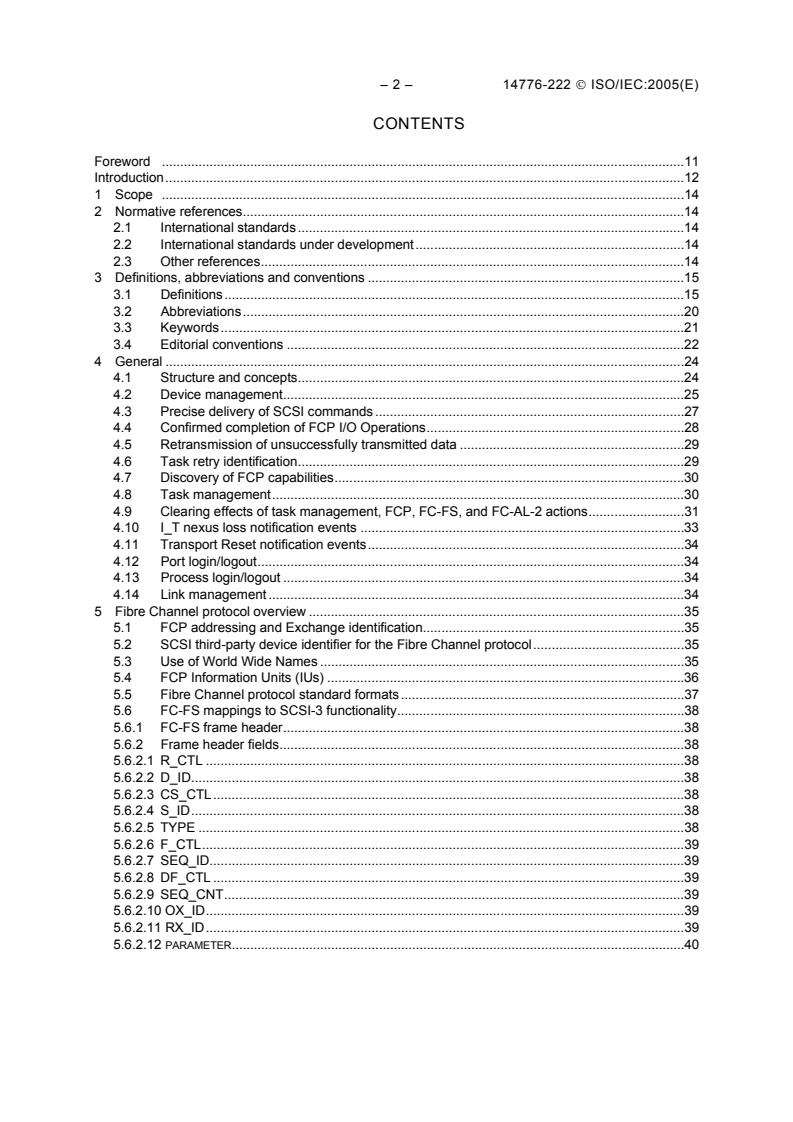
– 2 – 14776-222 © ISO/IEC:2005(E)
CONTENTS
Foreword .11
Introduction.12
1 Scope .14
2 Normative references.14
2.1 International standards.14
2.2 International standards under development.14
2.3 Other references.14
3 Definitions, abbreviations and conventions .15
3.1 Definitions.15
3.2 Abbreviations.20
3.3 Keywords.21
3.4 Editorial conventions .22
4 General.24
4.1 Structure and concepts.24
4.2 Device management.25
4.3 Precise delivery of SCSI commands .27
4.4 Confirmed completion of FCP I/O Operations.28
4.5 Retransmission of unsuccessfully transmitted data .29
4.6 Task retry identification.29
4.7 Discovery of FCP capabilities.30
4.8 Task management.30
4.9 Clearing effects of task management, FCP, FC-FS, and FC-AL-2 actions.31
4.10 I_T nexus loss notification events .33
4.11 Transport Reset notification events.34
4.12 Port login/logout.34
4.13 Process login/logout .34
4.14 Link management .34
5 Fibre Channel protocol overview .35
5.1 FCP addressing and Exchange identification.35
5.2 SCSI third-party device identifier for the Fibre Channel protocol.35
5.3 Use of World Wide Names .35
5.4 FCP Information Units (IUs) .36
5.5 Fibre Channel protocol standard formats.37
5.6 FC-FS mappings to SCSI-3 functionality.38
5.6.1 FC-FS frame header.38
5.6.2 Frame header fields.38
5.6.2.1 R_CTL .38
5.6.2.2 D_ID.38
5.6.2.3 CS_CTL.38
5.6.2.4 S_ID.38
5.6.2.5 TYPE.38
5.6.2.6 F_CTL.39
5.6.2.7 SEQ_ID.39
5.6.2.8 DF_CTL .39
5.6.2.9 SEQ_CNT.39
5.6.2.10 OX_ID.39
5.6.2.11 RX_ID.39
5.6.2.12 PARAMETER.40
14776-222 © ISO/IEC:2005(E) – 3 –
6 FCP basic and extended link service definitions .40
6.1 Overview of link service requirements.40
6.2 Overview of Process Login/Logout.40
6.3 Process Login (PRLI) .41
6.3.1 Use of Process Login by the Fibre Channel protocol.41
6.3.2 Process_Associator requirements.41
6.3.3 New or repeated PRLI.41
6.3.4 Process Login request FCP Service Parameter page format .42
6.3.5 Process Login accept FCP Service Parameter page format.45
6.4 Process Logout (PRLO) .46
6.5 Read Exchange Concise (REC ).46
7 FC-4 specific name server objects .47
7.1 Overview of FC-4 specific objects for the Fibre Channel protocol .47
7.2 FC-4 Features object.47
7.3 FC-4 Descriptor object.47
8 FC-4 Link Service definitions .48
8.1 FC-4 Link Services for the Fibre Channel protocol .48
8.2 Sequence Retransmission Request (SRR).48
8.3 FCP FC-4 Link Service Reject.50
9 FCP Information Unit (IU) formats .52
9.1 FCP_CMND IU .52
9.1.1 FCP_CMND IU format.52
9.1.2 FCP_CMND IU Field descriptions.52
9.1.2.1 FCP_LUN .52
9.1.2.2 COMMAND REFERENCE NUMBER.53
9.1.2.3 TASK ATTRIBUTE .53
9.1.2.4 TASK MANAGEMENT FLAGS .53
9.1.2.5 ADDITIONAL FCP_CDB LENGTH .56
9.1.2.6 RDDATA.56
9.1.2.7 WRDATA .56
9.1.2.8 FCP_CDB.56
9.1.2.9 ADDITIONAL_FCP_CDB.56
9.1.2.10 FCP_DL .56
9.1.3 Additional mechanisms for performing task management functions - ABORT TASK.57
9.2 FCP_XFER_RDY IU.57
9.2.1 Overview and format of FCP_XFER_RDY IU .57
9.2.2 FCP_DATA_RO.57
9.2.3 FCP_BURST_LEN.58
9.3 FCP_DATA IU .58
9.4 FCP_RSP IU.59
9.4.1 Overview and format of FCP_RSP IU .59
9.4.2 FCP_CONF_REQ.60
9.4.3 FCP_RESID_UNDER.60
9.4.4 FCP_RESID_OVER.60
9.4.5 FCP_SNS_LEN_VALID .61
9.4.6 FCP_RSP_LEN_VALID .61
9.4.7 SCSI STATUS CODE.61
9.4.8 FCP_RESID .61
9.4.9 FCP_SNS_LEN .62
9.4.10 FCP_RSP_LEN .62
9.4.11 FCP_RSP_INFO .62
9.4.12 FCP_SNS_INFO .63
9.5 FCP_CONF IU.63
– 4 – 14776-222 © ISO/IEC:2005(E)
10 SCSI mode parameters for the Fibre Channel protocol .64
10.1 Overview of mode page codes for the Fibre Channel protocol.64
10.2 Disconnect-Reconnect mode page .64
10.2.1 Overview and format of Disconnect-Reconnect mode page for FCP .64
10.2.2 BUFFER FULL RATIO.65
10.2.3 BUFFER EMPTY RATIO.66
10.2.4 BUS INACTIVITY LIMIT.66
10.2.5 DISCONNECT TIME LIMIT.66
10.2.6 CONNECT TIME LIMIT.66
10.2.7 MAXIMUM BURST SIZE FIELD.66
10.2.8 ENABLE MODIFY DATA POINTERS (EMDP).67
10.2.9 FAA, FAB, FAC .67
10.2.10 FIRST BURST SIZE .67
10.3 Fibre Channel Logical Unit Control mode page .68
10.4 Fibre Channel Port Control mode page.68
10.4.1 Overview and format of Fibre Channel Port Control mode page .68
10.4.2 DISABLE TARGET ORIGINATED LOOP INITIALIZATION (DTOLI).69
10.4.3 DISABLE TARGET INITIATED PORT ENABLE (DTIPE).69
10.4.4 ALLOW LOGIN WITHOUT LOOP INITIALIZATION (ALWLI).69
10.4.5 REQUIRE HARD ADDRESS (RHA).69
10.4.6 DISABLE LOOP MASTER (DLM).69
10.4.7 DISABLE DISCOVERY (DDIS).70
10.4.8 PREVENT LOOP PORT BYPASS (PLPB).70
10.4.9 DISABLE TARGET FABRIC DISCOVERY (DTFD).70
10.4.10 RESOURCE RECOVERY TIME-OUT VALUE (RR_TOV) .70
11 Timers for FCP operation and recovery.72
11.1 Summary of timers for the Fibre Channel protocol.72
11.2 Error_Detect Time-out (E_D_TOV) .72
11.3 Resource Allocation Time-out (R_A_TOV) .73
11.4 Resource Recovery Timer (RR_TOV).73
11.5 Read Exchange Concise Time-out Value (REC_TOV).74
11.6 Upper Level Protocol Time-out (ULP_TOV).74
12 Link error recovery procedure.75
12.1 Overview.75
12.1.1 Exchange level error recovery.75
12.1.2 Sequence level error recovery.75
12.2 FCP Error Detection .75
12.2.1 Overview of FCP-2 Error Detection.75
12.2.2 FCP-2 Error Detection using protocol errors for all classes of service.75
12.2.3 Error Detection mechanisms for acknowledged classes of Service.76
12.3 Exchange level recovery using recovery abort.77
12.3.1 Recovery abort requirements .77
12.3.2 Initiator invocation of recovery abort .77
12.3.3 Target response to recovery abort .77
12.3.4 Additional error recovery by initiator.78
12.3.5 Additional error recovery by target .78
14776-222 © ISO/IEC:2005(E) – 5 –
12.4 Sequence level error detection and recovery.78
12.4.1 Using information from REC to perform Sequence level recovery.78
12.4.1.1 Polling Exchange state with REC.78
12.4.1.2 Detection of errors while polling with REC.79
12.4.1.3 FCP_CMND IU Recovery using information from REC.79
12.4.1.4 FCP_XFER_RDY IU Recovery.79
12.4.1.5 FCP_RSP IU Recovery.79
12.4.1.6 FCP_DATA IU Recovery – Write .81
12.4.1.7 FCP_DATA IU Recovery – Read .81
12.4.1.8 FCP_CONF IU Recovery .81
12.4.2 Additional error recovery requirements .82
12.4.2.1 Error indicated in ACK.82
12.4.2.2 Missing ACK.82
12.4.2.3 Distinguishing exchange to be aborted.82
12.5 Second-level error recovery .83
12.5.1 ABTS.83
12.5.2 REC.83
12.5.3 SRR.83
12.6 Responses to FCP type frames before PLOGI or PRLI.83
– 6 – 14776-222 © ISO/IEC:2005(E)
Annex A (normative) FCP mapping to SAM-2 (Fibre Channel Protocol Service mapping to
SCSI Architectural Model (SAM-2)).84
A.1 Definition of procedure terms .84
A.2 Notation for procedures and functions .85
A.3 Application client SCSI command services.86
A.4 Send SCSI command service.86
A.5 Data Transfer Protocol Services .87
A.5.1 Overview of data buffer movement services .87
A.5.2 Data-in delivery service .87
A.5.3 Data-out delivery service.87
A.6 Task management services.87
Annex B (informative) FCP examples.88
B.1 Examples of the use of FCP Information Units (IUs) .88
B.1.1 Overview of examples .88
B.1.2 SCSI FCP read operation.88
B.1.3 SCSI FCP write operation .89
B.1.4 SCSI FCP operation with no data transfer or with check condition. .89
B.1.5 SCSI FCP read operation with multiple FCP_DATA IUs .90
B.1.6 SCSI FCP write operation with FCP_XFR_RDY disabled .90
B.1.7 SCSI linked commands .91
B.1.8 SCSI WRITE command with confirmed completion.91
B.1.9 SCSI FCP task management function .92
B.2 FCP write example, frame level .93
B.3 FCP read example, frame level.95
Annex C (informative) Error detection and recovery action examples.97
Annex D (informative) FCP-2 examples of link service usage. 131
D.1 Formats for recovery link services. 131
D.2 Abort Sequence (ABTS) Request . 131
D.2.1 Abort Sequence (ABTS) Request fields. 131
D.2.2 Basic Accept (BA_ACC) Frame to ABTS. 132
D.2.3 Basic Reject (BA_RJT) Frame to ABTS. 132
D.3 Reinstate Recovery Qualifier (RRQ) . 133
Annex E (informative) Bidirectional operation support. 134
E.1 Introduction. 134
E.2 Changes in the FCP device management model. 134
E.2.1 Support of bidirectional operation. 134
E.2.2 Relationship between bidirectional and unidirectional operation . 134
E.3 FCP_CMND IU changes . 135
E.3.1 FCP_CMND IU payload . 135
E.3.2 TASK MANAGEMENT FLAGS . 135
E.3.3 RDDATA and WRDATA . 136
E.3.4 FCP_DL. 136
E.3.5 FCP_BIDIRECTIONAL_READ_DL . 136
E.4 FCP_DATA IU changes. 136
E.5 FCP_RSP IU changes. 137
E.5.1 FCP_RSP IU payload. 137
E.5.2 FCP_BIDI_RSP. 137
E.5.3 FCP_BIDI_ READ_RESID_UNDER . 137
E.5.4 FCP_BIDI_ READ_RESID_OVER. 138
E.5.5 FCP_RESID . 138
E.5.6 FCP_BIDIRECTIONAL_READ_ RESID. 138
14776-222 © ISO/IEC:2005(E) – 7 –
E.6 Error recovery changes . 139
E.6.1 Overview. 139
E.6.2 Sequence level error recovery. 139
E.6.3 FCP-2 Error Detection using protocol errors for all classes of service. 139
E.7 FCP Example. 139
E.7.1 Overview. 139
E.7.2 SCSI FCP bidirectional command with write before read . 141
E.7.3 SCSI FCP bidirectional command with read before write . 141
E.7.4 SCSI FCP bidirectional command, write first, write FCP_XFER_RDY disabled. 142
E.7.5 SCSI FCP bidirectional command with intermixed writes and reads . 143
Annex F (informative) FCP Device Discovery Procedure. 144
F.1 FCP Device Discovery Procedure. 144
F.1.1 Initiator discovery of Fabric-attached targets . 144
F.1.2 Initiator discovery of loop-attached targets. 144
F.2 Fabric and Device Authentication. 145
F.3 Logical unit authentication. 145
Bibliography. 146
– 8 – 14776-222 © ISO/IEC:2005(E)
Table 1 – SCSI and Fibre Channel protocol functions.25
Table 2 – Discovery of FCP–2 capabilities .30
Table 3 – Task management functions, SAM–2 to FCP.31
Table 4 – Clearing effects of link related functions .32
Table 5 – Clearing effects of initiator actions .33
Table 6 – FCP third–party device id format.35
Table 7 – FCP Information Units (IUs) sent to targets .36
Table 8 – FCP Information Units (IUs) sent to initiators.37
Table 9 – FCP frame header.38
Table 10 – FCP Service Parameter page, PRLI request .42
Table 11 – FCP Service Parameter page, PRLI accept .45
Table 12 – FCP definition of FC–4 Feature bits.47
Table 13 – FCP FC–4 Link Service Requests and Responses for FCP–2.48
Table 14 – SRR Payload.49
Table 15 – SRR Accept Payload.49
Table 16 – FCP FC–4 Link Service Reject (FCP_RJT) Payload.50
Table 17 – FCP FC–4 Link Service Reject reason codes.50
Table 18 – FCP FC–4 Link Service Reject reason code explanation.51
Table 19 – FCP_CMND IU Payload.52
Table 20 – TASK ATTRIBUTE field values .53
Table 21 – task management Flags.54
Table 22 – FCP_XFER_RDY IU payload.57
Table 23 – FCP_RSP IU Payload .60
Table 24 – FCP_RSP_INFO field format .62
Table 25 – RSP_CODE definitions .63
Table 26 – Mode page codes for FCP .64
Table 27 – Disconnect–reconnect page (02h) .65
Table 28 – Fibre Channel Logical Unit Control page (18h).68
Table 29 – Fibre Channel Port Control page (19h).69
Table 30 – Values for RR_TOV UNITS.71
Table 31 – Timer summary .72
Table 32 – Initiator REC_TOV Usage .74
Table 33 – Target REC_TOV usage .74
Table A.1 – FCP procedure terms mapped to terms from SAM–2 standard .84
Table A.2 – Procedure Terms .85
Table A.3 – Processing of send SCSI command service procedure .86
Table A.4 – Processing of data–in delivery service procedure.87
Table A.5 – Processing of data–out delivery service procedure.87
Table B.1 – FCP read operation, example.88
Table B.2 – FCP write operation, example .89
Table B.3 – FCP operation without data transfer, example .89
Table B.4 – FCP read operation, example.90
Table B.5 – FCP write operation with FCP_XFER_RDY disabled, example.90
Table B.6 – FCP linked commands, example.91
Table B.7 – FCP write command with confirmed completion .91
Table B.8 – FCP task management function, example.93
Table C.1 – Diagram Drawing conventions.97
Table D.1 – ABTS Frame. 131
Table D.2 – BA_ACC Frame to ABTS . 132
Table D.3 – BA_RJT Frame to ABTS . 132
Table D.4 – Reinstate Recovery Qualifier. 133
Table E.1 – FCP_CMND payload for a bidirectional command. 135
Table E.2 – FCP_RSP IU Payload. 137
Table E.3 – FCP bidirectional command with write before read, example . 140
Table E.4 – FCP bidirectional command with read before write, example . 141
Table E.5 – FCP bidirectional command, write FCP_XFER_RDY disabled, example . 142
Table E.6 – FCP bidirectional command with intermixed writes and reads, example . 143
14776-222 © ISO/IEC:2005(E) – 9 –
Figure B.1 – Example of class 2 FCP write I/O operation.93
Figure B.2 – Example of class 2 FCP_DATA write.94
Figure B.3 – Example of class 2 FCP read I/O operation .95
Figure B.4 – Example of class 2 FCP_DATA read .96
Figure C.1 – Lengthy FCP_CMND or Lost ACK .98
Figure C.2 – FCP_CMND Lost, Unacknowledged Classes .99
Figure C.3 – FCP_CMND Lost, Acknowledged Classes . 100
Figure C.4 – FCP_CMND Acknowledgement Lost, Acknowledged Classes. 101
Figure C.5 – FCP_XFER_RDY Lost, Unacknowledged Classes. 102
Figure C.6 – FCP_XFER_RDY Lost, Acknowledged Classes. 103
Figure C.7 – FCP_XFER_RDY Received, ACK Lost, Acknowledged Classes . 104
Figure C.8 – FCP_RSP Lost, FCP_CONF not requested, Unacknowledged Classes. 105
Figure C.9 – FCP_RSP Lost, FCP_CONF not requested, Acknowledged Classes. 106
Figure C.10 – FCP_RSP Lost Read Command, no FCP_CONF, Acknowledged Classes. 107
Figure C.11 – FCP_RSP Received, ACK Lost, Acknowledged Classes, Example 1. 108
Figure C.12 – FCP_RSP Received, ACK Lost, Acknowledged Classes, Example 2. 109
Figure C.13 – Lost Write Data, Last Frame of Sequence, Unacknowledged Classes . 110
Figure C.14 – Lost Write Data, Last Frame of Sequence, Acknowledged Classes. 111
Figure C.15 – Lost Write Data, Not Last Frame of Sequence, Unacknowledged Classes. 112
Figure C.16 – Lost Write Data, Not Last Frame of Sequence, Acknowledged Classes. 113
Figure C.17 – Lost Read Data, Last Frame of Sequence, Unacknowledged Classes . 114
Figure C.18 – Lost Read Data, Last Frame of Sequence, Acknowledged Classes . 115
Figure C.19 – Lost Read Data, Not Last Frame of Sequence, Unacknowledged Classes . 116
Figure C.20 – Lost Read Data, Not Last Frame of Sequence, Acknowledged Classes. 117
Figure C.21 – ACK Lost on Read (Acknowledged Classes). 118
Figure C.22 – ACK Lost on Write (Acknowledged Classes) . 119
Figure C.23 – FCP_CONF Lost, Unacknowledged Classes. 120
Figure C.24 – FCP_CONF Lost, Acknowledged Classes. 121
Figure C.25 – ACK lost on FCP_CONF, Acknowledged Classes. 122
Figure C.26 – REC or REC Response Lost, Unacknowledged Classes . 123
Figure C.27 – REC Lost, Acknowledged Classes. 124
Figure C.28 – REC Response Lost, Acknowledged Classes . 125
Figure C.29 – Two RECs Lost, Unacknowledged Classes, Abort the original Exchange . 126
Figure C.30 – SRR Lost, Unacknowledged Classes, Abort original Exchange . 127
Figure C.31 – SRR Response Lost, Unacknowledged Classes . 128
Figure C.32 – SRR Lost, Acknowledged Classes. 129
Figure C.33 – SRR Response Lost, Acknowledged Classes . 130
– 10 – 14776-222 © ISO/IEC:2005(E)
14776-222 © ISO/IEC:2005(E) – 11 –
INFORMATION TECHNOLOGY –
SMALL COMPUTER SYSTEM INTERFACE –
PART 222: Fibre Channel Protocol for SCSI,
Second Version (FCP-2)
FOREWORD
1) ISO (International Organization for Standardization) and IEC (International Electrotechnical Commission) form the
specialized system for worldwide standardization. National bodies that are members of ISO or IEC participate in
the development of International Standards through technical committees established by the respective
organization to deal with particular fields of technical activity. ISO and IEC technical committees collaborate in
fields of mutual interest. Other international organizations, governmental and non-governmental, in liaison with
ISO and IEC, also take part in the work.
2) In the field of information technology, ISO and IEC have established a join
...
Questions, Comments and Discussion
Ask us and Technical Secretary will try to provide an answer. You can facilitate discussion about the standard in here.
Loading comments...