


IEC 60660:1999
(Main)Insulators - Tests on indoor post insulators of organic material for systems with nominal voltages greater than 1 000 V up to but not including 300 kV
Insulators - Tests on indoor post insulators of organic material for systems with nominal voltages greater than 1 000 V up to but not including 300 kV
Applicable to post insulators of organic material for indoor service in electrical installations or equipment operating in air at atmospheric pressure on alternating current with a nominal voltage greater than 1 000 V up, but not including, 300 kV, as defined by range I of IEC 60071-1, and a frequency not greater than 100 Hz. Composite insulators are not covered by this standard.
Isolateurs - Essais des supports isolants d'intérieur en matière organique destinés à des installations de tension nominale supérieure à 1 000 V jusqu'à 300 kV non compris
Est applicable aux supports isolants d'intérieur en matière organique destinés à l'équipement d'installations ou d'appareils électriques fonctionnant dans l'air, à la pression atmosphérique, en courant alternatif, à une tension nominale supérieure à 1000 V jusqu'à 300 kV non compris et à une fréquence au plus égale à 100 Hz comme défini dans la gamme I de la CEI 60071-1. Les isolateurs ne sont pas couverts par la présente norme.
General Information
- Status
- Published
- Publication Date
- 28-Oct-1999
- Technical Committee
- TC 36 - Insulators
- Current Stage
- PPUB - Publication issued
- Start Date
- 29-Oct-1999
- Completion Date
- 15-Dec-1999
Overview
IEC 60660:1999 is an international standard published by the International Electrotechnical Commission (IEC) that defines the testing requirements for indoor post insulators made of organic material. This standard applies to electrical systems with nominal voltages greater than 1,000 V and up to, but not including, 300 kV. It is specifically designed for insulators used in air at atmospheric pressure and operating on alternating current with frequencies not exceeding 100 Hz. Importantly, composite insulators are excluded from this standard.
This edition-second and revised since 1979-addresses the performance, durability, and safety testing of indoor post insulators, ensuring their reliable operation in medium- and high-voltage electrical installations or equipment.
Key Topics
The IEC 60660 standard covers a comprehensive range of test procedures to evaluate the suitability and robustness of organic post insulators for indoor use:
- Scope and Definitions: Clarifies the applicable voltage range, types of insulators covered, service conditions, and technical terminology.
- General Testing Requirements: Classifies the types of tests (type, sample, routine) and outlines quality assurance protocols.
- Electrical Tests:
- Lightning impulse voltage withstand tests (dry conditions)
- Power-frequency voltage withstand tests (dry conditions)
- Partial discharge extinction voltage measurement
- Lightning impulse puncture tests evaluating dielectric strength
- Mechanical Tests:
- Mechanical failing load and bending strength under various temperatures
- Deflection measurements under load at normal temperature
- Environmental and Material Tests:
- Water absorption evaluation
- Ageing and humidity resistance testing inside controlled atmospheres
- Flammability assessment for fire safety
- Resistance to rapid temperature variations
- Dimensional and Visual Inspection: Verification of form and position tolerances, and routine visual examinations.
- Documentation Requirements: Detailed record-keeping for test results and procedures.
This structured testing regimen ensures that indoor post insulators made of organic material meet strict international quality, safety, and performance standards.
Applications
IEC 60660:1999 is essential for manufacturers, testing laboratories, utilities, and engineers involved in the design, procurement, testing, and maintenance of electrical installations employing indoor post insulators within the specified voltage range. Typical applications include:
- Indoor high-voltage switchgear and apparatus requiring reliable insulation
- Electrical substations and control rooms with indoor installations
- Power transformers and related electrical equipment supporting medium- and high-voltage distribution
- Quality assurance and compliance testing during production and on-site acceptance
- Development of new organic insulating materials and post insulator designs for indoor use
By adhering to these standard tests, stakeholders ensure that post insulators possess adequate electrical strength, mechanical integrity, environmental reliability, and safety under operational stresses, contributing to the stable and safe operation of electrical power systems.
Related Standards
To fully understand and implement IEC 60660:1999, it is recommended to consult complementary IEC standards and documents, including:
- IEC 60071-1: Insulation co-ordination - Part 1: Definitions, principles, and rules, which defines voltage ranges and insulation requirements referenced by IEC 60660.
- IEC 60050 (International Electrotechnical Vocabulary): For precise definitions of electrical terminology used throughout the standard.
- IEC 60027, IEC 60417, IEC 60617: Standards relating to graphical symbols, letter symbols, and graphical symbols for use in electrical technology, important for documentation and diagrams.
- Other IEC standards on composite insulators and outdoor insulator testing, as IEC 60660 explicitly excludes composite types and outdoor applications.
Together, these standards form a harmonized framework supporting the design, testing, and certification of electrical insulators and contributes to global standardization and interoperability in the electrical power industry.
Keywords: IEC 60660, indoor post insulators, organic material insulators, high voltage insulator testing, lightning impulse test, power frequency test, mechanical load test, electrical insulation standards, medium and high voltage insulators, IEC electrical standards, insulation coordination, electrical safety testing.
Get Certified
Connect with accredited certification bodies for this standard

Intertek Testing Services NA Inc.
Intertek certification services in North America.

UL Solutions
Global safety science company with testing, inspection and certification.

ANCE
Mexican certification and testing association.
Sponsored listings
Frequently Asked Questions
IEC 60660:1999 is a standard published by the International Electrotechnical Commission (IEC). Its full title is "Insulators - Tests on indoor post insulators of organic material for systems with nominal voltages greater than 1 000 V up to but not including 300 kV". This standard covers: Applicable to post insulators of organic material for indoor service in electrical installations or equipment operating in air at atmospheric pressure on alternating current with a nominal voltage greater than 1 000 V up, but not including, 300 kV, as defined by range I of IEC 60071-1, and a frequency not greater than 100 Hz. Composite insulators are not covered by this standard.
Applicable to post insulators of organic material for indoor service in electrical installations or equipment operating in air at atmospheric pressure on alternating current with a nominal voltage greater than 1 000 V up, but not including, 300 kV, as defined by range I of IEC 60071-1, and a frequency not greater than 100 Hz. Composite insulators are not covered by this standard.
IEC 60660:1999 is classified under the following ICS (International Classification for Standards) categories: 29.080.10 - Insulators. The ICS classification helps identify the subject area and facilitates finding related standards.
IEC 60660:1999 is available in PDF format for immediate download after purchase. The document can be added to your cart and obtained through the secure checkout process. Digital delivery ensures instant access to the complete standard document.
Standards Content (Sample)
NORME CEI
INTERNATIONALE IEC
INTERNATIONAL
Deuxième édition
STANDARD
Second edition
1999-10
Isolateurs –
Essais des supports isolants d'intérieur en matière
organique destinés à des installations de tension
nominale supérieure à 1 000 V jusqu'à 300 kV
non compris
Insulators –
Tests on indoor post insulators of organic material
for systems with nominal voltages greater than
1 000 V up to but not including 300 kV
Numéro de référence
Reference number
CEI/IEC 60660:1999
Numéros des publications Numbering
Depuis le 1er janvier 1997, les publications de la CEI As from 1 January 1997 all IEC publications are
sont numérotées à partir de 60000. issued with a designation in the 60000 series.
Publications consolidées Consolidated publications
Les versions consolidées de certaines publications de Consolidated versions of some IEC publications
la CEI incorporant les amendements sont disponibles. including amendments are available. For example,
Par exemple, les numéros d’édition 1.0, 1.1 et 1.2 edition numbers 1.0, 1.1 and 1.2 refer, respectively, to
indiquent respectivement la publication de base, la the base publication, the base publication incor-
publication de base incorporant l’amendement 1, et la porating amendment 1 and the base publication
publication de base incorporant les amendements 1 incorporating amendments 1 and 2.
et 2.
Validité de la présente publication Validity of this publication
Le contenu technique des publications de la CEI est The technical content of IEC publications is kept
constamment revu par la CEI afin qu'il reflète l'état under constant review by the IEC, thus ensuring that
actuel de la technique. the content reflects current technology.
Des renseignements relatifs à la date de reconfir- Information relating to the date of the reconfirmation
mation de la publication sont disponibles dans le of the publication is available in the IEC catalogue.
Catalogue de la CEI.
Les renseignements relatifs à des questions à l’étude et Information on the subjects under consideration and
des travaux en cours entrepris par le comité technique work in progress undertaken by the technical
qui a établi cette publication, ainsi que la liste des committee which has prepared this publication, as well
publications établies, se trouvent dans les documents ci- as the list of publications issued, is to be found at the
dessous: following IEC sources:
• «Site web» de la CEI* • IEC web site*
• Catalogue des publications de la CEI • Catalogue of IEC publications
Publié annuellement et mis à jour Published yearly with regular updates
régulièrement (On-line catalogue)*
(Catalogue en ligne)*
• IEC Bulletin
• Bulletin de la CEI Available both at the IEC web site* and
Disponible à la fois au «site web» de la CEI* as a printed periodical
et comme périodique imprimé
Terminologie, symboles graphiques Terminology, graphical and letter
et littéraux
symbols
En ce qui concerne la terminologie générale, le lecteur For general terminology, readers are referred to
se reportera à la CEI 60050: Vocabulaire Electro-
IEC 60050: International Electrotechnical Vocabulary
technique International (VEI).
(IEV).
Pour les symboles graphiques, les symboles littéraux For graphical symbols, and letter symbols and signs
et les signes d'usage général approuvés par la CEI, le approved by the IEC for general use, readers are
lecteur consultera la CEI 60027: Symboles littéraux à referred to publications IEC 60027: Letter symbols to
utiliser en électrotechnique, la CEI 60417: Symboles
be used in electrical technology, IEC 60417: Graphical
graphiques utilisables sur le matériel. Index, relevé et
symbols for use on equipment. Index, survey and
compilation des feuilles individuelles, et la CEI 60617: compilation of the single sheets and IEC 60617:
Symboles graphiques pour schémas. Graphical symbols for diagrams.
* Voir adresse «site web» sur la page de titre.
* See web site address on title page.
NORME CEI
INTERNATIONALE IEC
INTERNATIONAL
Deuxième édition
STANDARD
Second edition
1999-10
Isolateurs –
Essais des supports isolants d'intérieur en matière
organique destinés à des installations de tension
nominale supérieure à 1 000 V jusqu'à 300 kV
non compris
Insulators –
Tests on indoor post insulators of organic material
for systems with nominal voltages greater than
1 000 V up to but not including 300 kV
IEC 1999 Droits de reproduction réservés Copyright - all rights reserved
Aucune partie de cette publication ne peut être reproduite ni No part of this publication may be reproduced or utilized in
utilisée sous quelque forme que ce soit et par aucun procédé, any form or by any means, electronic or mechanical,
électronique ou mécanique, y compris la photo-copie et les including photocopying and microfilm, without permission in
microfilms, sans l'accord écrit de l'éditeur. writing from the publisher.
International Electrotechnical Commission 3, rue de Varembé Geneva, Switzerland
Telefax: +41 22 919 0300 e-mail: inmail@iec.ch IEC web site http://www.iec.ch
CODE PRIX
Commission Electrotechnique Internationale
U
PRICE CODE
International Electrotechnical Commission
Pour prix, voir catalogue en vigueur
For price, see current catalogue
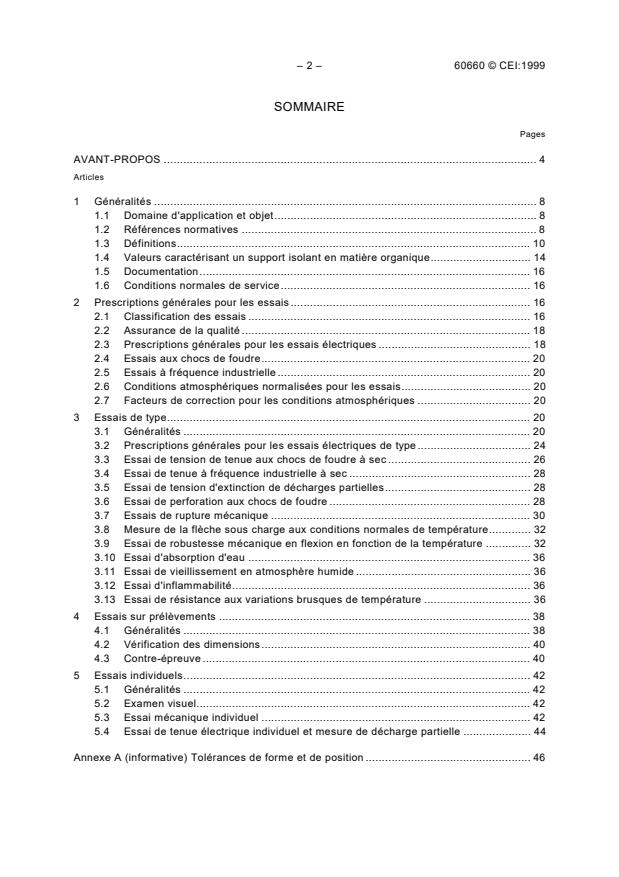
– 2 – 60660 © CEI:1999
SOMMAIRE
Pages
AVANT-PROPOS . 4
Articles
1 Généralités . 8
1.1 Domaine d'application et objet. 8
1.2 Références normatives . 8
1.3 Définitions. 10
1.4 Valeurs caractérisant un support isolant en matière organique. 14
1.5 Documentation. 16
1.6 Conditions normales de service. 16
2 Prescriptions générales pour les essais. 16
2.1 Classification des essais . 16
2.2 Assurance de la qualité . 18
2.3 Prescriptions générales pour les essais électriques . 18
2.4 Essais aux chocs de foudre. 20
2.5 Essais à fréquence industrielle . 20
2.6 Conditions atmosphériques normalisées pour les essais. 20
2.7 Facteurs de correction pour les conditions atmosphériques . 20
3 Essais de type. 20
3.1 Généralités . 20
3.2 Prescriptions générales pour les essais électriques de type. 24
3.3 Essai de tension de tenue aux chocs de foudre à sec . 26
3.4 Essai de tenue à fréquence industrielle à sec . 28
3.5 Essai de tension d'extinction de décharges partielles. 28
3.6 Essai de perforation aux chocs de foudre . 28
3.7 Essais de rupture mécanique . 30
3.8 Mesure de la flèche sous charge aux conditions normales de température. 32
3.9 Essai de robustesse mécanique en flexion en fonction de la température . 32
3.10 Essai d'absorption d'eau . 36
3.11 Essai de vieillissement en atmosphère humide . 36
3.12 Essai d'inflammabilité. 36
3.13 Essai de résistance aux variations brusques de température . 36
4 Essais sur prélèvements . 38
4.1 Généralités . 38
4.2 Vérification des dimensions. 40
4.3 Contre-épreuve . 40
5 Essais individuels. 42
5.1 Généralités . 42
5.2 Examen visuel. 42
5.3 Essai mécanique individuel . 42
5.4 Essai de tenue électrique individuel et mesure de décharge partielle . 44
Annexe A (informative) Tolérances de forme et de position . 46
60660 © IEC:1999 – 3 –
CONTENTS
Page
FOREWORD . 5
Clause
1 General. 9
1.1 Scope and object . 9
1.2 Normative references. 9
1.3 Definitions. 11
1.4 Values which characterise a post insulator of organic material. 15
1.5 Documentation. 17
1.6 Normal service conditions . 17
2 General requirements for tests . 17
2.1 Classification of tests . 17
2.2 Quality assurance . 19
2.3 General requirements for electrical tests . 19
2.4 Lightning impulse voltage tests. 21
2.5 Power-frequency voltage tests. 21
2.6 Standard reference atmospheric conditions for tests. 21
2.7 Correction factors for atmospheric conditions . 21
3 Type tests . 21
3.1 General. 21
3.2 General requirements for electrical type tests . 25
3.3 Dry lightning impulse withstand voltage test. 27
3.4 Dry power-frequency withstand voltage test . 29
3.5 Partial discharge extinction voltage test. 29
3.6 Lightning impulse puncture test . 29
3.7 Mechanical failing load test . 31
3.8 Test for deflection under load at normal ambient temperature conditions . 33
3.9 Test for mechanical bending strength as a function of temperature . 33
3.10 Water absorption test. 37
3.11 Ageing and humidity test . 37
3.12 Flammability test. 37
3.13 Temperature cycle test. 37
4 Sample tests . 39
4.1 General. 39
4.2 Verification of dimensions . 41
4.3 Re-test procedure . 41
5 Routine tests.43
5.1 General. 43
5.2 Visual examination . 43
5.3 Mechanical routine test . 43
5.4 Electrical routine test and partial discharge measurement. 45
Annex A (informative) Tolerances of form and position. 47
– 4 – 60660 © CEI:1999
COMMISSION ÉLECTROTECHNIQUE INTERNATIONALE
____________
ISOLATEURS – ESSAIS DES SUPPORTS ISOLANTS D'INTÉRIEUR
EN MATIÈRE ORGANIQUE DESTINÉS À DES INSTALLATIONS
DE TENSION NOMINALE SUPÉRIEURE À 1 000 V
JUSQU'À 300 kV NON COMPRIS
AVANT-PROPOS
1) La CEI (Commission Électrotechnique Internationale) est une organisation mondiale de normalisation composée
de l'ensemble des comités électrotechniques nationaux (Comités nationaux de la CEI). La CEI a pour objet de
favoriser la coopération internationale pour toutes les questions de normalisation dans les domaines de
l'électricité et de l'électronique. A cet effet, la CEI, entre autres activités, publie des Normes internationales.
Leur élaboration est confiée à des comités d'études, aux travaux desquels tout Comité national intéressé par le
sujet traité peut participer. Les organisations internationales, gouvernementales et non gouvernementales, en
liaison avec la CEI, participent également aux travaux. La CEI collabore étroitement avec l'Organisation
Internationale de Normalisation (ISO), selon des conditions fixées par accord entre les deux organisations.
2) Les décisions ou accords officiels de la CEI concernant les questions techniques représentent, dans la mesure
du possible, un accord international sur les sujets étudiés, étant donné que les Comités nationaux intéressés
sont représentés dans chaque comité d’études.
3) Les documents produits se présentent sous la forme de recommandations internationales. Ils sont publiés
comme normes, spécifications techniques, rapports techniques ou guides et agréés comme tels par les Comités
nationaux.
4) Dans le but d'encourager l'unification internationale, les Comités nationaux de la CEI s'engagent à appliquer de
façon transparente, dans toute la mesure possible, les Normes internationales de la CEI dans leurs normes
nationales et régionales. Toute divergence entre la norme de la CEI et la norme nationale ou régionale
correspondante doit être indiquée en termes clairs dans cette dernière.
5) La CEI n’a fixé aucune procédure concernant le marquage comme indication d’approbation et sa responsabilité
n’est pas engagée quand un matériel est déclaré conforme à l’une de ses normes.
6) L’attention est attirée sur le fait que certains des éléments de la présente Norme internationale peuvent faire
l’objet de droits de propriété intellectuelle ou de droits analogues. La CEI ne saurait être tenue pour
responsable de ne pas avoir identifié de tels droits de propriété et de ne pas avoir signalé leur existence.
La Norme internationale CEI 60660 a été établie par le sous-comité 36C: Isolateurs pour sous-
stations, du comité d’études 36 de la CEI: Isolateurs.
Cette deuxième édition annule et remplace la première édition parue en 1979 et constitue une
révision technique.
Le texte de cette norme est issu des documents suivants:
FDIS Rapport de vote
36C/111/FDIS 36C/114/RVD
Le rapport de vote indiqué dans le tableau ci-dessus donne toute information sur le vote ayant
abouti à l'approbation de cette norme.
Cette publication a été rédigée selon les Directives ISO/CEI, Partie 3.
L’annexe A est donnée uniquement à titre d’information.
60660 © IEC:1999 – 5 –
INTERNATIONAL ELECTROTECHNICAL COMMISSION
____________
INSULATORS – TESTS ON INDOOR POST INSULATORS OF
ORGANIC MATERIAL FOR SYSTEMS WITH NOMINAL
VOLTAGES GREATER THAN 1 000 V UP TO BUT
NOT INCLUDING 300 kV
FOREWORD
1) The IEC (International Electrotechnical Commission) is a worldwide organization for standardization comprising
all national electrotechnical committees (IEC National Committees). The object of the IEC is to promote
international co-operation on all questions concerning standardization in the electrical and electronic fields. To
this end and in addition to other activities, the IEC publishes International Standards. Their preparation is
entrusted to technical committees; any IEC National Committee interested in the subject dealt with may
participate in this preparatory work. International, governmental and non-governmental organizations liaising
with the IEC also participate in this preparation. The IEC collaborates closely with the International Organization
for Standardization (ISO) in accordance with conditions determined by agreement between the two
organizations.
2) The formal decisions or agreements of the IEC on technical matters express, as nearly as possible, an
international consensus of opinion on the relevant subjects since each technical committee has representation
from all interested National Committees.
3) The documents produced have the form of recommendations for international use and are published in the form
of standards, technical specifications, technical reports or guides and they are accepted by the National
Committees in that sense.
4) In order to promote international unification, IEC National Committees undertake to apply IEC International
Standards transparently to the maximum extent possible in their national and regional standards. Any
divergence between the IEC Standard and the corresponding national or regional standard shall be clearly
indicated in the latter.
5) The IEC provides no marking procedure to indicate its approval and cannot be rendered responsible for any
equipment declared to be in conformity with one of its standards.
6) Attention is drawn to the possibility that some of the elements of this International Standard may be the subject
of patent rights. The IEC shall not be held responsible for identifying any or all such patent rights.
International Standard IEC 60660 has been prepared by subcommittee 36C: Insulators for
substations, of IEC technical committee 36: Insulators.
This second edition cancels and replaces the first edition published in 1979 and constitutes a
technical revision.
The text of this standard is based on the following documents:
FDIS Report on voting
36C/111/FDIS 36C/114/RVD
Full information on the voting for the approval of this standard can be found in the report on
voting indicated in the above table.
This publication has been drafted in accordance with the ISO/IEC Directives, Part 3.
Annex A is for information only.
– 6 – 60660 © CEI:1999
Le comité a décidé que cette publication reste valable jusqu’en 2006.
A cette date, selon décision préalable du comité, la publication sera
• reconduite;
• supprimée;
• remplacée par une édition révisée, ou
• amendée.
60660 © IEC:1999 – 7 –
The committee has decided that this publication remains valid until 2006.
At this date, in accordance with the committee’s decision, the publication will be
• reconfirmed;
• withdrawn;
• replaced by a revised edition, or
• amended.
– 8 – 60660 © CEI:1999
ISOLATEURS – ESSAIS DES SUPPORTS ISOLANTS D'INTÉRIEUR
EN MATIÈRE ORGANIQUE DESTINÉS À DES INSTALLATIONS
DE TENSION NOMINALE SUPÉRIEURE À 1 000 V
JUSQU'À 300 kV NON COMPRIS
1 Généralités
1.1 Domaine d'application et objet
La présente Norme internationale est applicable aux supports isolants d'intérieur en matière
organique destinés à l'équipement d'installations ou d'appareils électriques fonctionnant dans
l'air, à la pression atmosphérique, en courant alternatif, à une tension nominale supérieure
à 1 000 V jusqu'à 300 kV non compris et à une fréquence au plus égale à 100 Hz comme défini
dans la gamme I de la CEI 60071-1. Les isolateurs composites ne sont pas couverts par la
présente norme.
La présente norme a pour objet
– de définir les termes employés;
– de définir les caractéristiques électriques et mécaniques des supports isolants en matière
organique et de fixer les conditions dans lesquelles les valeurs spécifiées de ces
caractéristiques doivent être vérifiée;
– de prescrire les méthodes d'essai;
– de fixer les conditions d'acceptation.
Cette norme ne donne pas de valeur numérique pour les caractéristiques des isolateurs et ne
contient pas de prescriptions relatives au choix d'un isolateur en fonction du service qu'il doit
assurer. La CEI 60273 spécifie les valeurs numériques pour les caractéristiques électriques et
mécaniques, et donne les dimensions nécessaires à l'interchangeabilité des supports isolants.
1.2 Références normatives
Les documents normatifs suivants contiennent des dispositions qui, par suite de la référence
qui y est faite, constituent des dispositions valables pour la présente partie des Directives
ISO/CEI. Pour les références datées, les amendements ultérieurs ou les révisions de ces
publications ne s’appliquent pas. Toutefois, les parties prenantes aux accords fondés sur la
présente partie des Directives ISO/CEI sont invitées à rechercher la possibilité d'appliquer les
éditions les plus récentes des documents normatifs indiqués ci-après. Pour les références non
datées, la dernière édition du document normatif en référence s’applique. Les membres de
la CEI et de l'ISO possèdent le registre des Normes internationales en vigueur.
CEI 60050(471):1984, Vocabulaire Electrotechnique International (VEI) – Chapitre 471: Isolateurs
CEI 60060-1, Techniques des essais à haute tension – Première partie: Définitions et
prescriptions générales relatives aux essais
CEI 60071-1, Coordination de l'isolement – Partie 1: Définitions, principes et règles
CEI 60270, Mesures des décharges partielles
CEI 60273, Dimensions des supports isolants d'intérieur et d'extérieur destinés à des
installations de tension nominale supérieure à 1 000 V
CEI 60587, Méthode d'essai pour évaluer la résistance au cheminement et à l'érosion des
matériaux isolants électriques utilisés dans des conditions ambiantes sévères
60660 © IEC:1999 – 9 –
INSULATORS – TESTS ON INDOOR POST INSULATORS OF
ORGANIC MATERIAL FOR SYSTEMS WITH NOMINAL
VOLTAGES GREATER THAN 1 000 V UP TO BUT
NOT INCLUDING 300 kV
1 General
1.1 Scope and object
This International Standard is applicable to post insulators of organic material for indoor
service in electrical installations or equipment operating in air at atmospheric pressure on
alternating current with a nominal voltage greater than 1 000 V up to, but not including, 300 kV,
as defined by range I of IEC 60071-1, and a frequency not greater than 100 Hz. Composite
insulators are not covered by this standard.
The object of this standard is
– to define the terms used;
– to define electrical and mechanical characteristics of post insulators of organic material
and to prescribe the conditions under which the specified values of these characteristics
are verified;
– to prescribe methods of testing;
– to prescribe acceptance criteria.
This standard does not give numerical values for insulator characteristics; nor does it deal with
a choice of insulators for specific operating conditions. IEC 60273 specifies numerical values
for electrical and mechanical characteristics and gives the dimensions necessary for inter-
changeability of post insulators.
1.2 Normative references
The following normative documents contain provisions which, through reference in this text,
constitute provisions of this part of the ISO/IEC Directives. For dated references, subsequent
amendments to, or revisions of, any of these publications do not apply. However, parties to
agreements based on this part of the ISO/IEC Directives are encouraged to investigate the
possibility of applying the most recent editions of the normative documents indicated below.
For undated references, the latest edition of the normative document referred to applies.
Members of IEC and ISO maintain registers of currently valid International Standards.
IEC 60050(471):1984, International Electrotechnical Vocabulary (IEV) – Chapter 471:
Insulators
IEC 60060-1, High-voltage test techniques – Part 1: General definitions and test requirements
IEC 60071-1, Insulation co-ordination – Part 1: Definitions, principles and rules
IEC 60270, Partial discharge measurements
IEC 60273, Characteristics of indoor and outdoor post insulators for systems with nominal
voltages greater than 1 000 V
IEC 60587, Test method for evaluating resistance to tracking and erosion of electrical
insulating materials used under severe ambient conditions
– 10 – 60660 © CEI:1999
CEI 60695-11-10:1999, Essais relatifs au risque du feu – Partie 11-10: Flammes d’essai –
Méthodes d’essai horizontale et verticale à la flamme de 50 W
CEI 60932, Spécifications complémentaires pour l'appareillage sous enveloppe de 1 kV à 72,5
kV destiné à être utilisé dans des conditions climatiques sévères
ISO 9000-1, Normes pour le management de la qualité et l'assurance de la qualité – Partie 1:
Lignes directrices pour leur sélection et utilisation
ISO 9002, Systèmes qualité – Modèle pour l'assurance de la qualité en production, installation
et prestations associées
1.3 Définitions
Pour les besoins de la présente norme, les définitions suivantes s'appliquent avec celles de
la CEI 60050(471).
NOTE – Les définitions concernant les tensions d'essai ne sont indiquées qu'à titre de rappel. Pour plus de détails,
voir la CEI 60060-1.
1.3.1
support isolant en matière organique
support isolant destiné à fixer rigidement une pièce sous tension qui doit être isolée de la terre
ou d'une autre pièce sous tension. La matière composant l'isolant est constituée totalement ou
en partie de matières organiques, c'est-à-dire de matières appartenant à la chimie des
composés du carbone ou à la chimie des composés du carbone et du silicium. Ces matières
organiques peuvent être utilisées seules ou conjointement avec d'autres matières (minérales
ou organiques) comme charges, renforcement, etc.
1.3.2
support isolant d'intérieur
support isolant non destiné à être exposé aux conditions climatiques extérieures. Pour les
installations intérieures soumises à des condensations importantes, des supports isolants
d'extérieur ou des supports isolants d'intérieur d'un type spécial peuvent être utilisés
[VEI 471-04-04, modifié]
1.3.3
catégorie de conception
selon leur construction, les supports isolants en matière organique sont divisés en deux
catégories:
Catégorie de conception A
Supports isolants cylindriques avec armature interne métallique pour lesquels la plus courte
longueur du canal de perforation à travers la matière isolante solide est égale ou au tiers plus
grande de la distance d'arc extérieure entre l'armature métallique
Catégorie de conception B
Supports isolants cylindriques avec armature interne métallique pour lesquels la plus courte
longueur du canal de perforation à travers la matière isolante solide est inférieure au tiers de la
distance d'arc extérieure entre les armatures métalliques
NOTE – Le terme «isolateurs cylindriques» comprend les isolateurs de forme tronconique.
60660 © IEC:1999 – 11 –
IEC 60695-11-10:1999, Fire hazard testing – Part 11-10: Test flames – 50 W horizontal and
vertical flame test methods
IEC 60932, Additional requirements for enclosed switchgear and controlgear from 1 kV
to 72,5 kV to be used in severe climatic conditions
ISO 9000-1, Quality management and quality assurance standards – Part 1: Guidelines for
selection and use
ISO 9002, Quality systems – Model for quality assurance in production, installation and
servicing
1.3 Definitions
For the purpose of this standard, the following definitions apply, together with those in
IEC 60050(471)
NOTE – The definitions regarding test voltages are given for convenience. For additional details, see IEC 60060-1.
1.3.1
post insulator of organic material
post insulator intended to give rigid support to a live part which is to be insulated from earth
and from another live part. The whole or part of the material composing the post insulator
consists of organic materials, i.e. of material pertaining to the chemistry of the compounds
produced from carbon or to the chemistry of the compounds produced from carbon and silicon.
These organic materials may be used alone or in conjunction with other materials (mineral or
organic) as fillers, reinforcements, etc.
1.3.2
indoor post insulator
a post insulator not intended to be exposed to outdoor atmospheric conditions. For indoor
installations subject to excessive condensation, outdoor post insulators or special indoor post
insulators may be used
[IEV 471-04-04, modified]
1.3.3
design category
post insulators of organic materials are divided into two different design categories according
to their construction. The design categories covered by this standard are:
Design category A
Cylindrical post insulators with internal metal fittings in which the length of the shortest
puncture path through solid insulating material is equal to or greater than one-third the external
arcing distance between the metal fittings
Design category B
Cylindrical post insulators with internal metal fittings in which the length of the shortest
puncture path through solid insulating material is less than one-third the external arcing
distance between the metal fittings
NOTE – The term “cylindrical insulators” is intended to cover insulators of the truncated conical form.
– 12 – 60660 © CEI:1999
1.3.4
lot
groupe d'isolateurs proposé pour homologation par le même fabricant, de même conception et
fabriqué dans les mêmes conditions de production. Un ou plusieurs lots peuvent être proposés
pour homologation; le ou les lots proposés peuvent être constitués d’une partie ou de
l'ensemble des quantités commandées
1.3.5
contournement
décharge disruptive extérieure à l’isolateur et sur sa surface se produisant entre les parties qui
sont normalement soumises à la tension de service. Le terme «contournement» employé dans
la présente norme comprend le contournement le long de la surface de l'isolateur ainsi que des
décharges disruptives par amorçage dans l'air près de l'isolateur [VEI 471-01-12 modifié]
1.3.6
perforation
décharge disruptive à travers la matière isolante solide de l’isolateur qui entraîne la perte
définitive de la rigidité diélectrique
Un fragment qui se détache du bord d'une ailette ou la détérioration de l'isolateur sous l'action
de la chaleur due à une décharge superficielle ne sont pas considérés comme une perforation
[VEI 471-01-11 modifié]
1.3.7
tension de tenue aux chocs de foudre à sec
tension de choc de foudre que le support isolant tient à sec dans les conditions d'essai
prescrites
1.3.8
tension de contournement à 50 % aux chocs de foudre à sec
valeur de la tension de choc de foudre qui, dans les conditions d'essai prescrites, a une
probabilité de 50 % de provoquer un contournement à sec du support isolant
1.3.9
tension de tenue à fréquence industrielle à sec
tension à fréquence industrielle que le support isolant tient, à sec, dans les conditions d'essai
prescrites
1.3.10
tension de contournement à fréquence industrielle à sec
valeur moyenne arithmétique des tensions mesurées qui provoquent le contournement du
support isolant, à sec, dans les conditions d'essai prescrites
1.3.11
charge de rupture mécanique
effort maximal qui peut être atteint lorsqu’un isolateur organique est essayé dans les conditions
d'essai prescrites
1.3.12
ligne de fuite
la plus courte distance suivant les contours des surfaces extérieures des parties isolantes,
des supports isolants entre les parties qui sont normalement soumises à la tension de service.
Cependant, pour tenir compte des parties métalliques équipant le support isolant, la distance
qui, dans les conditions de service, est recouverte par les parties métalliques ne doit pas être
comprise dans la ligne de fuite
60660 © IEC:1999 – 13 –
1.3.4
lot
group of insulators offered for acceptance from the same manufacturer, of the same design
and manufactured under similar conditions of production. One or more lots may be offered
together for acceptance; the lot(s) offered may consist of the whole, or part, of the quantity
ordered
1.3.5
flashover
disruptive discharge external to the insulator, and over its surface, connecting those parts
which normally have the operating voltage between them. The term "flashover" used in this
standard includes flashover across the insulator surface as well as disruptive discharges by
sparkover through air adjacent to the insulator [IEV 471-01-12, modified]
1.3.6
puncture
a disruptive discharge passing through the solid insulating material of the insulator which
produces a permanent loss of dielectric strength
A fragment breaking away from the rim of a shed or damage to the insulator due to the heat of
the surface discharge is not considered as a puncture [IEV 471-01-11, modified]
1.3.7
dry lightning impulse withstand voltage
lightning impulse voltage which the dry post insulator withstands under the prescribed
conditions of test
1.3.8
50 % dry lightning impulse flashover voltage
value of the lightning impulse voltage which has a 50 % probability of producing flashover on
the dry post insulator under the prescribed conditions of test
1.3.9
dry power-frequency withstand voltage
power-frequency voltage which the dry post insulator withstands under the prescribed
conditions of test
1.3.10
dry power-frequency flashover voltage
arithmetic mean value of the measured voltages which cause flashover on the dry post
insulator under the prescribed conditions of test
1.3.11
mechanical failing load
maximum load reached when an organic insulator is tested under the prescribed conditions of
test
1.3.12
creepage distance
shortest distance along the contours of the external surfaces of the insulating parts of the post
insulator between those parts which normally have the operating voltage between them.
However, to take account of the metal fittings attached to the post insulator, the distance which
in service conditions is covered by metal fittings is not included in the creepage distance
– 14 – 60660 © CEI:1999
NOTE 1 – Si des revêtements à haute résistance électrique sont appliqués sur des parties du support isolant, de
tels revêtements sont considérés comme des surfaces de fuite effectives et la distance par dessus ceux-ci est
comprise dans la ligne de fuite.
NOTE 2 – La résistivité superficielle de ces revêtements à haute résistance est habituellement de l'ordre de 10 Ω
mais peut descendre à 10 Ω.
NOTE 3 – Si des revêtements à haute résistance électrique sont appliqués sur toute la surface du support isolant (il
prend alors le nom d'isolateur stabilisé), les questions de résistivité superficielle et de ligne de fuite font l'objet d'un
accord entre le fabricant et l'acheteur.
NOTE 4 – Normalement, la ligne de fuite n'est pas spécifiée.
1.3.13
caractéristique spécifiée
– soit la valeur numérique d'une tension, d'une charge mécanique ou de toute autre
caractéristique, définie comme telle dans une norme de la CEI,
– soit la valeur numérique de toute caractéristique fixée d'un commun accord entre le
fabricant et l'acheteur
Les tensions de tenue et de contournement spécifiées et les charges de rupture s'entendent
pour les conditions atmosphériques normales
1.3.14
parallélisme entre les faces extrêmes
différence maximale de hauteur d’un support isolant mesurée entre les surfaces des parties
métalliques situées à chaque extrémité
1.3.15
excentricité
distance perpendiculaire à l’axe du support isolant entre les centres des cercles de perçage
des parties métalliques situées aux deux extrémités
1.3.16
décalage angulaire des trous de fixation
déplacement en rotation, exprimé en angle, entre les trous de perçage correspondants des
parties métalliques situées aux deux extrémités
1.4 Valeurs caractérisant un support isolant en matière organique
Un support isolant en matière organique est caractérisé par les valeurs suivantes quand elles
lui sont applicables:
a) la tension de tenue spécifiée aux chocs de foudre à sec;
b) la tension de tenue spécifiée à fréquence industrielle à sec;
c) la tension de choc de foudre de perforation spécifiée (seulement pour les supports isolants
de la catégorie B);
d) les charges de rupture mécanique spécifiées;
e) les dimensions importantes spécifiées;
f) la différence maximale entre la flèche à 20 % et 50 % de la charge de rupture mécanique spécifiée.
Si cela est requis, un dessin de la conception du support isolant doit être soumis.
NOTE 1 – La tension de service n’est pas considérée comme une caractéristique d'un support isolant.
NOTE 2 – Les tensions de tenue des supports isolants, dans les conditions de service, peuvent être différentes des
tensions obtenues avec les conditions d'essai normalisées.
60660 © IEC:1999 – 15 –
NOTE 1 – If high-resistance coatings are applied to parts of the post insulators, such coatings are considered as
effective creepage surfaces and the distance over them is included in the creepage distance.
NOTE 2 – The surface resistivity of such high-resistance coatings is usually about 10 Ω but may be as low
as 10 Ω.
NOTE 3 – If high-resistance coatings are applied to the whole surface of the post insulator (the so-called
stabilized insulator), the questions of surface resistivity and creepage distance is subject to agreement between
the manufacturer and the purchaser.
NOTE 4 – The creepage distance is normally not specified.
1.3.13
specified characteristic
– either the numerical value of a voltage or of a mechanical load or of any other characteristic
specified in an IEC standard,
– or the numerical value of any such characteristic agreed between the manufacturer and
the purchaser
Specified withstand and flashover voltages are referred to standard atmospheric conditions
1.3.14
parallelism of the end faces
maximum difference in the height of the post insulator measured across the surface of the
metal fittings at each end
1.3.15
eccentricity
displacement, perpendicular to the axis of the post insulator, between the centres of the pitch
circles of the fixing holes in the top and bottom metal fittings
1.3.16
angular deviation of fixing holes
rotational displacement, expressed as an angle, between corresponding fixing holes in the
metal fittings at the top and bottom of a post insulator
1.4 Values which characterise a post insulator of organic material
A post insulator of organic material is characterised by the following values where applicable:
a) the specified dry lightning impulse withstand voltage;
b) the specified dry power-frequency withstand voltage;
c) the specified lightning impulse puncture voltage (for post insulators of design category B
only);
d) the specified mechanical failing loads;
e) the specified significant dimensions;
f) the maximum difference between the deflection at 20 % and 50 % of the specified mech-
anical failing load.
If requested, a design drawing of the post insulator shall be submitted.
NOTE 1 – Service voltage is not considered as a characteristic of a post insulator.
NOTE 2 – The withstand voltages of post insulators under service conditions may differ from the voltages under
standard testing conditions.
– 16 – 60660 © CEI:1999
1.5 Documentation
1.5.1 Marquage
Le marquage de chacun des supports isolants doit être le suivant:
– nom et marque du fabricant;
– date de fabrication ou numéro de série pour les isolateurs destinés à être utilisés pour les
tensions égales ou supérieures à 72,5 kV. Pour les tensions inférieures, seule l'année de
fabrication est requise;
– la désignation commerciale du support isolant.
1.5.2 Documentation des isolateurs
Le fabricant doit conserver un registre de tous les isolateurs support produits conformément à la
présente norme pendant au moins 10 ans. Ces registres doivent contenir les informations
suivantes:
– numéro de référence;
– date de fabrication ou numéro de série pour les isolateurs destinés à être utilisés pour les
tensions égales ou supérieures à 72,5 kV. Pour les tensions inférieures, seule l'année de
fabrication est requise;
– essais de type, date et résultats;
– essais sur prélèvement, date et résultats;
– essais individuels, date et résultats.
1.6 Conditions normales de service
Les conditions normales de température et d'humidité relative en service sont définies comme suit:
a) la température de l'air ambiant n'excède pas 40 °C et sa valeur moyenne, mesurée sur une
période de 24 h, n'excède pas 35 °C;
b) la température minimale de l'air ambiant est –5 °C, –15 °C ou, en variante, –25 °C;
c) l'altitude n'excède pas 1 000 m;
d) l'air ambiant ne contient pratiquement ni poussière, ni fumée, ni gaz et vapeurs corrosifs ou
inflammables, ni sel;
e) la valeur moyenne de l'humidité relative, mesurée sur une période de 24 h, n'excède pas 95 %;
f) la valeur moyenne de l'humidité relative, mesurée sur une période d'un mois, n'excède pas 90 %.
NOTE – Dans ces conditions maximales d'humidité relative et de température (95 % et 40 °C), une baisse de 1 °C
de la température des supports isolants fait apparaître de la condensation.
2 Prescriptions générales pour les essais
2.1 Classification des essais
Les essais se divisent en trois groupes, comme suit.
a) Essais de type
Ces essais sont destinés à vérifier les principales caractéristiques du support isolant en matière
organique qui dépendent surtout de sa conception, du matériau utilisé et du procédé de fabrication.
60660 © IEC:1999 – 17 –
1.5 Documentation
1.5.1 Marking
Markings on each post insulator shall be the following:
– name and trade mark of the manufacturer;
– date of manufacture or serial number for insulators intended to be used for system voltages
72,5 kV and above. For lower voltages, only the year of manufacture is required;
– post insulator reference mark.
1.5.2 Records of ins
...
Questions, Comments and Discussion
Ask us and Technical Secretary will try to provide an answer. You can facilitate discussion about the standard in here.
Loading comments...