

IEC 60794-4:2018
(Main)Optical fibre cables - Part 4: Sectional specification - Aerial optical cables along electrical power lines
General Information
- Abstract
IEC 60794-4:2018 covers cable construction, test methods, optical, mechanical, environmental and electrical performance requirements for aerial optical fibre cables and cable elements which are intended to be used along power lines (OCEPL) as a high bandwidth transport media for communications and control optical signals, including optical ground wires (OPGW), optical phase conductors (OPPC), metallic aerial self-supported cables (MASS), all-dielectric self-supporting cables (ADSS) and optical attached cables (OPAC). This document excludes figure-8 optical cables to be used on telephone utility poles. The IEC TR 62839-1 gives recommendations to provide the customer with the environmental declaration on request. This second edition cancels and replaces the first edition published in 2003. This edition constitutes a technical revision. This edition includes the following significant technical changes with respect to the previous edition:
a) the specification has been streamlined by cross-referencing IEC 60794-1-1;
b) the classification as type tests or routine tests has been deleted;
c) cable kink test has been deleted;
d) creep test for ADSS is referred to IEC 60794-4-20.
Keywords: aerial optical fibre cables
- Status
- Published
- Publication Date
- 24-Jun-2018
- Technical Committee
- SC 86A - Fibres and cables
- Current Stage
- PPUB - Publication issued
- Start Date
- 25-Jun-2018
- Completion Date
- 29-Jun-2018
Buy Documents
IEC 60794-4:2018 RLV - Optical fibre cables - Part 4: Sectional specification - Aerial optical cables along electrical power lines Released:6/25/2018
IEC 60794-4:2018 - Optical fibre cables - Part 4: Sectional specification - Aerial optical cables along electrical power lines Released:6/25/2018
Overview
IEC 60794-4:2018 - "Optical fibre cables - Part 4: Sectional specification - Aerial optical cables along electrical power lines" specifies construction, test methods and performance requirements for aerial optical fibre cables intended for use along power lines (OCEPL). The standard covers optical, mechanical, environmental and electrical performance for cable types used on power networks, including OPGW, OPPC, MASS, ADSS and OPAC. It excludes figure‑8 cables for telephone utility poles. This second edition (2018) is a technical revision that streamlines references to IEC 60794‑1‑1 and updates testing and classification practices.
Key topics and technical requirements
- Scope of cable types: definitions and characteristics for optical ground wire (OPGW), optical phase conductor (OPPC), metallic aerial self‑supported (MASS), all‑dielectric self‑supporting (ADSS) and optical attached cables (OPAC).
- Cable construction: requirements for cable elements (slotted cores, ribbons, plastic or metallic tubes), core filling, strength members and sheathing (inner/outer for ADSS/OPAC).
- Performance requirements: optical attenuation, cut‑off wavelength, PMD and fibre colouring; mechanical and environmental limits for installation and operation.
- Test methods: a broad set of tests for tensile performance, sheave and bending, short‑circuit, lightning, ageing, hydrogen penetration, aeolian vibration, creep (ADSS referenced to IEC 60794‑4‑20), tracking/erosion, UV weathering and shotgun resistance.
- Quality and documentation: packaging, quality assurance and recommended calculation methods (Annex A) for rated tensile strength, modulus of elasticity, linear expansion and DC resistance for metallic cables.
- Notable 2018 changes: streamlined cross‑referencing to IEC 60794‑1‑1; removal of type/routine test classification and cable kink test; creep testing for ADSS now referenced to IEC 60794‑4‑20. IEC TR 62839‑1 provides environmental declaration guidance.
Practical applications and users
IEC 60794-4:2018 is used when specifying, manufacturing, testing, procuring or installing aerial optical fibre cables along electrical power infrastructure. Typical users:
- Power utilities and transmission operators specifying communications and protection links
- Cable manufacturers designing OPGW/OPPC/MASS/ADSS/OPAC products
- Telecom system designers integrating fibres into power corridors
- Test laboratories and conformity assessors performing mechanical, optical and electrical tests
- Procurement engineers and installation contractors ensuring compliant acceptance criteria
Applications include high‑bandwidth communications, SCADA/control signalling, line monitoring and combining grounding and communications functionality (OPGW/OPPC).
Related standards
- IEC 60794‑1‑1 (general reference for optical fibre cable tests and requirements)
- IEC 60794 series (other sectional specifications)
- IEC 60794‑4‑20 (ADSS creep testing)
- IEC TR 62839‑1 (environmental declaration guidance)
Keywords: IEC 60794-4:2018, aerial optical fibre cables, OPGW, ADSS, OPPC, OPAC, MASS, cable testing, power line communications.
Relations
- Effective Date
- 05-Sep-2023
Buy Documents
IEC 60794-4:2018 RLV - Optical fibre cables - Part 4: Sectional specification - Aerial optical cables along electrical power lines Released:6/25/2018
IEC 60794-4:2018 - Optical fibre cables - Part 4: Sectional specification - Aerial optical cables along electrical power lines Released:6/25/2018
Get Certified
Connect with accredited certification bodies for this standard

ANCE
Mexican certification and testing association.

Intertek Slovenia
Intertek testing, inspection, and certification services in Slovenia.

LNE (Laboratoire National de Métrologie et d'Essais)
French national laboratory for metrology and testing.
Sponsored listings
Frequently Asked Questions
IEC 60794-4:2018 is a standard published by the International Electrotechnical Commission (IEC). Its full title is "Optical fibre cables - Part 4: Sectional specification - Aerial optical cables along electrical power lines". This standard covers: IEC 60794-4:2018 covers cable construction, test methods, optical, mechanical, environmental and electrical performance requirements for aerial optical fibre cables and cable elements which are intended to be used along power lines (OCEPL) as a high bandwidth transport media for communications and control optical signals, including optical ground wires (OPGW), optical phase conductors (OPPC), metallic aerial self-supported cables (MASS), all-dielectric self-supporting cables (ADSS) and optical attached cables (OPAC). This document excludes figure-8 optical cables to be used on telephone utility poles. The IEC TR 62839-1 gives recommendations to provide the customer with the environmental declaration on request. This second edition cancels and replaces the first edition published in 2003. This edition constitutes a technical revision. This edition includes the following significant technical changes with respect to the previous edition: a) the specification has been streamlined by cross-referencing IEC 60794-1-1; b) the classification as type tests or routine tests has been deleted; c) cable kink test has been deleted; d) creep test for ADSS is referred to IEC 60794-4-20. Keywords: aerial optical fibre cables
IEC 60794-4:2018 covers cable construction, test methods, optical, mechanical, environmental and electrical performance requirements for aerial optical fibre cables and cable elements which are intended to be used along power lines (OCEPL) as a high bandwidth transport media for communications and control optical signals, including optical ground wires (OPGW), optical phase conductors (OPPC), metallic aerial self-supported cables (MASS), all-dielectric self-supporting cables (ADSS) and optical attached cables (OPAC). This document excludes figure-8 optical cables to be used on telephone utility poles. The IEC TR 62839-1 gives recommendations to provide the customer with the environmental declaration on request. This second edition cancels and replaces the first edition published in 2003. This edition constitutes a technical revision. This edition includes the following significant technical changes with respect to the previous edition: a) the specification has been streamlined by cross-referencing IEC 60794-1-1; b) the classification as type tests or routine tests has been deleted; c) cable kink test has been deleted; d) creep test for ADSS is referred to IEC 60794-4-20. Keywords: aerial optical fibre cables
IEC 60794-4:2018 is classified under the following ICS (International Classification for Standards) categories: 33.180.10 - Fibres and cables. The ICS classification helps identify the subject area and facilitates finding related standards.
IEC 60794-4:2018 has the following relationships with other standards: It is inter standard links to IEC 60794-4:2003. Understanding these relationships helps ensure you are using the most current and applicable version of the standard.
IEC 60794-4:2018 is available in PDF format for immediate download after purchase. The document can be added to your cart and obtained through the secure checkout process. Digital delivery ensures instant access to the complete standard document.
Standards Content (Sample)
IEC 60794-4 ®
Edition 2.0 2018-06
REDLINE VERSION
INTERNATIONAL
STANDARD
colour
inside
Optical fibre cables –
Part 4: Sectional specification – Aerial optical cables along electrical power
lines
All rights reserved. Unless otherwise specified, no part of this publication may be reproduced or utilized in any form
or by any means, electronic or mechanical, including photocopying and microfilm, without permission in writing from
either IEC or IEC's member National Committee in the country of the requester. If you have any questions about IEC
copyright or have an enquiry about obtaining additional rights to this publication, please contact the address below or
your local IEC member National Committee for further information.
IEC Central Office Tel.: +41 22 919 02 11
3, rue de Varembé info@iec.ch
CH-1211 Geneva 20 www.iec.ch
Switzerland
About the IEC
The International Electrotechnical Commission (IEC) is the leading global organization that prepares and publishes
International Standards for all electrical, electronic and related technologies.
About IEC publications
The technical content of IEC publications is kept under constant review by the IEC. Please make sure that you have the
latest edition, a corrigenda or an amendment might have been published.
IEC Catalogue - webstore.iec.ch/catalogue Electropedia - www.electropedia.org
The stand-alone application for consulting the entire The world's leading online dictionary of electronic and
bibliographical information on IEC International Standards, electrical terms containing 21 000 terms and definitions in
Technical Specifications, Technical Reports and other English and French, with equivalent terms in 16 additional
documents. Available for PC, Mac OS, Android Tablets and languages. Also known as the International Electrotechnical
iPad. Vocabulary (IEV) online.
IEC publications search - webstore.iec.ch/advsearchform IEC Glossary - std.iec.ch/glossary
The advanced search enables to find IEC publications by a 67 000 electrotechnical terminology entries in English and
variety of criteria (reference number, text, technical French extracted from the Terms and Definitions clause of
committee,…). It also gives information on projects, replaced IEC publications issued since 2002. Some entries have been
and withdrawn publications. collected from earlier publications of IEC TC 37, 77, 86 and
CISPR.
IEC Just Published - webstore.iec.ch/justpublished
Stay up to date on all new IEC publications. Just Published IEC Customer Service Centre - webstore.iec.ch/csc
details all new publications released. Available online and If you wish to give us your feedback on this publication or
also once a month by email. need further assistance, please contact the Customer Service
Centre: sales@iec.ch.
IEC 60794-4 ®
Edition 2.0 2018-06
REDLINE VERSION
INTERNATIONAL
STANDARD
colour
inside
Optical fibre cables –
Part 4: Sectional specification – Aerial optical cables along electrical power
lines
INTERNATIONAL
ELECTROTECHNICAL
COMMISSION
ICS 33.180.10 ISBN 978-2-8322-5850-7
– 2 – IEC 60794-4:2018 RLV © IEC 2018
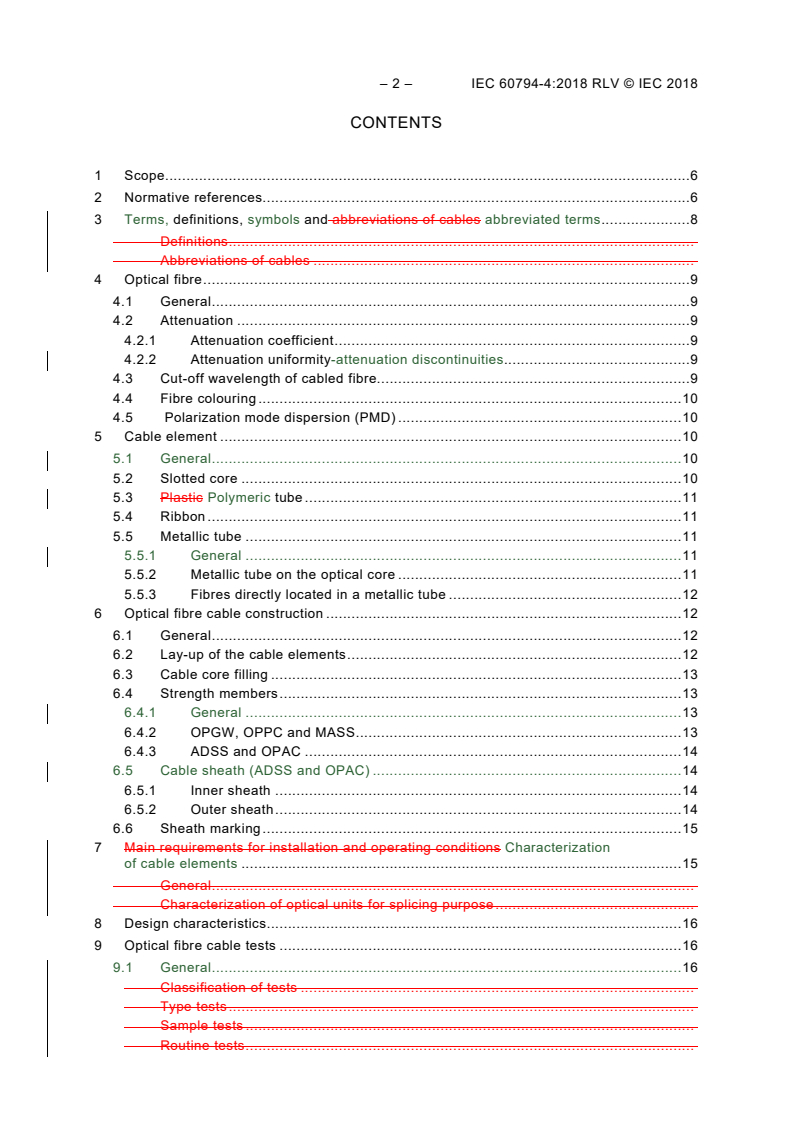
CONTENTS
1 Scope . 6
2 Normative references. 6
3 Terms, definitions, symbols and abbreviations of cables abbreviated terms . 8
Definitions .
Abbreviations of cables .
4 Optical fibre . 9
4.1 General . 9
4.2 Attenuation . 9
4.2.1 Attenuation coefficient . 9
4.2.2 Attenuation uniformity-attenuation discontinuities . 9
4.3 Cut-off wavelength of cabled fibre. 9
4.4 Fibre colouring . 10
4.5 Polarization mode dispersion (PMD) . 10
5 Cable element . 10
5.1 General . 10
5.2 Slotted core . 10
5.3 Plastic Polymeric tube . 11
5.4 Ribbon . 11
5.5 Metallic tube . 11
5.5.1 General . 11
5.5.2 Metallic tube on the optical core . 11
5.5.3 Fibres directly located in a metallic tube . 12
6 Optical fibre cable construction . 12
6.1 General . 12
6.2 Lay-up of the cable elements . 12
6.3 Cable core filling . 13
6.4 Strength members . 13
6.4.1 General . 13
6.4.2 OPGW, OPPC and MASS . 13
6.4.3 ADSS and OPAC . 14
6.5 Cable sheath (ADSS and OPAC) . 14
6.5.1 Inner sheath . 14
6.5.2 Outer sheath . 14
6.6 Sheath marking . 15
7 Main requirements for installation and operating conditions Characterization
of cable elements . 15
General .
Characterization of optical units for splicing purpose .
8 Design characteristics . 16
9 Optical fibre cable tests . 16
9.1 General . 16
Classification of tests .
Type tests .
Sample tests .
Routine tests .
9.2 Tensile performance . 18
9.3 Stress-strain test on metallic cables. 18
Installation capability .
9.4 Sheave test . 19
Repeated bending .
Impact .
Crush .
Kink .
Torsion .
Temperature cycling .
9.5 Short-circuit . 19
9.6 Lightning test . 20
9.7 Ageing . 20
9.8 Fibre coating compatibility . 20
Finished cable .
9.9 Hydrogen gas . 20
9.10 Aeolian vibration . 20
9.11 Creep . 20
9.12 Fitting compatibility . 20
Water penetration (for filled cables only) .
Bleeding (for filled cables only) .
9.13 Grease . 21
9.14 Attenuation . 21
9.15 Tracking and erosion resistance test on ADSS and OPAC . 21
9.16 Weathering UV resistance test on ADSS and OPAC . 21
9.17 Shotgun resistance test on ADSS and OPAC . 21
9.18 Conductor access trolley for OPAC . 21
10 Quality assurance . 21
11 Packaging . 21
Annex A (informative normative) Recommended methods of calculating rated tensile
strength, cross-section of a layer of trapezoidal shaped wires, modulus of elasticity,
linear expansion and DC resistance for OPGW, OPPC and MASS . 23
A.1 Calculation of rated tensile strength (RTS) . 23
A.2 Calculation of the cross-sectional area of a layer of trapezoidal or Z- shaped
wires . 23
A.3 Calculation of the final modulus of elasticity (E) . 23
A.4 Calculation of coefficient of linear expansion (β) . 24
A.5 Calculation of DC resistance . 24
Bibliography . 25
Table 1 – Characteristics of different types of cable elements . 15
Table 2 – Design characteristics . 16
Table 3 – Mechanical and environmental applicable tests . 17
– 4 – IEC 60794-4:2018 RLV © IEC 2018
INTERNATIONAL ELECTROTECHNICAL COMMISSION
____________
OPTICAL FIBRE CABLES –
Part 4: Sectional specification –
Aerial optical cables along electrical power lines
FOREWORD
1) The International Electrotechnical Commission (IEC) is a worldwide organization for standardization comprising
all national electrotechnical committees (IEC National Committees). The object of IEC is to promote
international co-operation on all questions concerning standardization in the electrical and electronic fields. To
this end and in addition to other activities, IEC publishes International Standards, Technical Specifications,
Technical Reports, Publicly Available Specifications (PAS) and Guides (hereafter referred to as “IEC
Publication(s)”). Their preparation is entrusted to technical committees; any IEC National Committee interested
in the subject dealt with may participate in this preparatory work. International, governmental and non-
governmental organizations liaising with the IEC also participate in this preparation. IEC collaborates closely
with the International Organization for Standardization (ISO) in accordance with conditions determined by
agreement between the two organizations.
2) The formal decisions or agreements of IEC on technical matters express, as nearly as possible, an international
consensus of opinion on the relevant subjects since each technical committee has representation from all
interested IEC National Committees.
3) IEC Publications have the form of recommendations for international use and are accepted by IEC National
Committees in that sense. While all reasonable efforts are made to ensure that the technical content of IEC
Publications is accurate, IEC cannot be held responsible for the way in which they are used or for any
misinterpretation by any end user.
4) In order to promote international uniformity, IEC National Committees undertake to apply IEC Publications
transparently to the maximum extent possible in their national and regional publications. Any divergence
between any IEC Publication and the corresponding national or regional publication shall be clearly indicated in
the latter.
5) IEC itself does not provide any attestation of conformity. Independent certification bodies provide conformity
assessment services and, in some areas, access to IEC marks of conformity. IEC is not responsible for any
services carried out by independent certification bodies.
6) All users should ensure that they have the latest edition of this publication.
7) No liability shall attach to IEC or its directors, employees, servants or agents including individual experts and
members of its technical committees and IEC National Committees for any personal injury, property damage or
other damage of any nature whatsoever, whether direct or indirect, or for costs (including legal fees) and
expenses arising out of the publication, use of, or reliance upon, this IEC Publication or any other IEC
Publications.
8) Attention is drawn to the Normative references cited in this publication. Use of the referenced publications is
indispensable for the correct application of this publication.
9) Attention is drawn to the possibility that some of the elements of this IEC Publication may be the subject of
patent rights. IEC shall not be held responsible for identifying any or all such patent rights.
This redline version of the official IEC Standard allows the user to identify the changes
made to the previous edition. A vertical bar appears in the margin wherever a change
has been made. Additions are in green text, deletions are in strikethrough red text.
International Standard IEC 60794-4 has been prepared by subcommittee 86A: Fibres and
cables, of IEC technical committee TC 86: Fibre optics.
This second edition cancels and replaces the first edition published in 2003. This edition
constitutes a technical revision.
This edition includes the following significant technical changes with respect to the previous
edition:
a) the specification has been streamlined by cross-referencing IEC 60794-1-1;
b) the classification as type tests or routine tests has been deleted;
c) cable kink test has been deleted;
d) creep test for ADSS is referred to IEC 60794-4-20.
The text of this International Standard is based on the following documents:
FDIS Report on voting
86A/1862/FDIS 86A/1868/RVD
Full information on the voting for the approval of this International Standard can be found in
the report on voting indicated in the above table.
This document has been drafted in accordance with the ISO/IEC Directives, Part 2.
A list of all parts in the IEC 60794 series, published under the general title Optical fibre
cables, can be found on the IEC website.
The committee has decided that the contents of this document will remain unchanged until the
stability date indicated on the IEC website under "http://webstore.iec.ch" in the data related to
the specific document. At this date, the document will be
• reconfirmed,
• withdrawn,
• replaced by a revised edition, or
• amended.
IMPORTANT – The “colour inside” logo on the cover page of this publication indicates
that it contains colours which are considered to be useful for the correct understanding
of its contents. Users should therefore print this publication using a colour printer.
– 6 – IEC 60794-4:2018 RLV © IEC 2018
OPTICAL FIBRE CABLES –
Part 4: Sectional specification –
Aerial optical cables along electrical power lines
1 Scope
This part of IEC 60794 specifies the electrical, mechanical and optical requirements and test
methods for aerial optical cables including OPGW (optical ground wire), OPPC (optical phase
conductor), MASS (metallic aerial self-supported cable), ADSS (all-dielectric self-supporting
cable) and OPAC (optical attached cable).
This part of IEC 60794 covers cable construction, test methods, optical, mechanical,
environmental and electrical performance requirements for aerial optical fibre cables and
cable elements which are intended to be used along power lines (OCEPL) as a high
bandwidth transport media for communications and control optical signals, including optical
ground wires (OPGW), optical phase conductors (OPPC), metallic aerial self-supported cables
(MASS), all-dielectric self-supporting cables (ADSS) and optical attached cables (OPAC).
This document excludes figure-8 optical cables to be used on telephone utility poles.
The IEC TR 62839-1 gives recommendations to provide the customer with the environmental
declaration on request.
2 Normative references
The following documents are referred to in the text in such a way that some or all of their
content constitutes requirements of this document. For dated references, only the edition
cited applies. For undated references, the latest edition of the referenced document (including
any amendments) applies.
They complete the normative references already listed in the generic specification (IEC
60794-1-1, Clause 2, and IEC 60794-1-2, Clause 2) and in the sectional specification (IEC
60794-3, Clause 2).
IEC 60104:1987, Aluminium-magnesium-silicon alloy wire for overhead line conductors
IEC 60304:1982, Standard colours for insulation for low-frequency cables and wires
IEC 60708-1:1981, Low-frequency cables with polyolefin insulation and moisture barrier
polyolefin sheath – Part 1: General design details and requirements
IEC 60793-1-21, Optical fibres – Part 1-21: Measurement methods and test procedures –
Coating geometry
IEC 60793-1-32, Optical fibres – Part 1-32: Measurement methods and test procedures –
Coating strippability
IEC 60793-1-40, Optical fibres – Part 1-40: Measurement methods and test procedures –
Attenuation
IEC 60793-1-44, Optical fibres – Part 1-44: Measurement methods and test procedures –
Cut-off wavelength
IEC 60793-1-48, Optical fibres – Part 1-48: Measurement methods and test procedures –
Polarization mode dispersion
IEC 60793-2, Optical fibres – Part 2: Product specifications – General
IEC 60794-1-1, Optical fibre cables – Part 1-1: Generic specification – General
IEC 60794-1-21, Optical fibre cables – Part 1-21: Generic specification – Basic optical cable
test procedures – Mechanical tests methods
IEC 60794-1-22, Optical fibre cables – Part 1-22: Generic specification – Basic optical cable
test procedures – Environmental tests methods
IEC 60794-1-23, Optical fibre cables – Part 1-23: Generic specification – Basic optical cable
test procedures – Cable element test methods
IEC 60794-1-24, Optical fibre cables – Part 1-24: Generic specification – Basic optical cable
test procedures – Electrical test methods
IEC 60794-3:2001, Optical fibre cables – Part 3: Outdoor cables – Sectional specification
IEC 60794-4-20:2012, Optical fibre cables – Part 4-20: Aerial optical cables along power lines
– Family specification for ADSS (All Dielectric Self Supported) optical cables
IEC 60811-4-2:1990, Common test methods for insulating and sheathing materials of electric
cables – Part 4: Methods specific to polyethylene and polypropylene compounds – Section
Two: Elongation at break after pre-conditioning – Wrapping test after pre-conditioning –
Wrapping test after thermal ageing in air – Measurement of mass increase – Long-term
stability test (Appendix A) – Test method for copper-catalysed oxidative degradation
(Appendix B)
IEC 60811-5-1:1990, Common test methods for insulating and sheathing materials of electric
cables – Part 5: Methods specific to filling compounds – Section one: Drop point – Separation
of oil – Lower temperature brittleness – Total acid number – Absence of corrosive
components – Permittivity at 23 °C – DC resistivity at 23 °C and 100 °C
IEC 60811-202, Electric and optical fibre cables – Test methods for non-metallic materials –
Part 202: General tests – Measurement of thickness of non-metallic sheath
IEC 60811-203, Electric and optical fibre cables – Test methods for non-metallic materials –
Part 203: General tests – Measurement of overall dimensions
IEC 60811-401, Electric and optical fibre cables – Test methods for non-metallic materials –
Part 401: Miscellaneous tests – Thermal ageing methods – Ageing in an air oven
IEC 60811-406, Electric and optical fibre cables – Test methods for non-metallic materials –
Part 406: Miscellaneous tests – Resistance to stress cracking of polyethylene and
polypropylene compounds
IEC 60811-501, Electric and optical fibre cables – Test methods for non-metallic materials –
Part 501: Mechanical tests – Tests for determining the mechanical properties of insulating and
sheathing compounds
– 8 – IEC 60794-4:2018 RLV © IEC 2018
IEC 60811-604:2012, Electric and optical fibre cables – Test methods for non-metallic
materials – Part 604: Physical tests – Measurement of absence of corrosive components in
filling compounds
IEC 60811-607, Electric and optical fibre cables – Test methods for non-metallic materials –
Part 607: Physical tests – Test for the assessment of carbon black dispersion in polyethylene
and polypropylene
IEC 60888:1987, Zinc-coated steel wires for stranded conductors
IEC 60889:1987, Hard-drawn aluminium wire for overhead line conductors
IEC 61089:1991, Round wire concentric lay overhead electrical stranded conductors
IEC 61232:1993, Aluminium-clad steel wires for electrical purposes
IEC 61394:1997, Overhead lines – Characteristics of Requirements for greases for aluminium,
aluminium alloy and steel bare conductors
IEC 61395:1998, Overhead electrical conductors – Creep test procedures for stranded
conductors
3 Terms, definitions, symbols and abbreviations of cables abbreviated terms
For the purposes of this document, the following terms, definitions, symbols and abbreviations
of cables abbreviated terms given in IEC 60794-1-1 apply.
ISO and IEC maintain terminological databases for use in standardization at the following
addresses:
• IEC Electropedia: available at http://www.electropedia.org/
• ISO Online browsing platform: available at http://www.iso.org/obp
3.1 Definitions
3.1.1
MAT
maximum allowable tension
maximum tensile load that may be applied to the cable without detriment to the tensile
performance requirement (optical performance, fibre strain)
3.1.2
RTS
rated tensile strength
summation of the product of nominal cross-sectional area, minimum tensile strength and
stranding factor for each load bearing material in the cable construction (refer to Annex A in
the case of OPGW)
3.1.3
strain margin
amount of strain the OCEPL can sustain without strain on the fibres due to the OCEPL's
elongation
3.2 Abbreviations of cables
ADSS all-dielectric self-supporting cable
MASS metallic aerial self-supported cable which is not designed to have ground or phase
capability
OCEPL optical cable to be used along electrical power lines
OPAC optical attached cable consisting of the following three attachment methods:
• wrapped: all-dielectric (wrap). Using special machinery, a lightweight flexible
non-metallic cable can be wrapped helically around either the earth wire or the
phase conductor.
• lashed: non-metallic cables that are installed longitudinally alongside the earth
wire, the phase conductor or on a separate catenary (on a pole route) and are
held in position with a binder or adhesive cord.
• preform attached: similar to the lashed cables except that the method of
attachment involves the use of special preformed spiral attachment clips.
OPGW optical ground wire. An OPGW has the dual performance functions of a conven-
tional ground wire with telecommunication capabilities.
OPPC optical phase conductor. An OPPC has the dual performance functions of a phase
conductor with telecommunication capabilities.
4 Optical fibre
4.1 General
Single-mode optical fibre which meets the requirements of IEC 60793-2 shall be used. Fibres
other than those specified above can be used, if mutually agreed between the customer user
and the supplier.
4.2 Attenuation
4.2.1 Attenuation coefficient
The typical maximum cable attenuation coefficient of a cable at 1 310 nm is 0,45 dB/km and/or
at 1 550 nm it is 0,30 dB/km shall conform to IEC 60794-1-1.
Particular values shall may be agreed between the customer and supplier. The attenuation
coefficient shall be measured in accordance with IEC 60793-1-40.
4.2.2 Attenuation uniformity-attenuation discontinuities
4.2.2.1 Attenuation discontinuities
The local attenuation shall not have point discontinuities in excess of 0,10 dB.
The test method best suited to provide the functional requirements is in accordance with
IEC 60793-1-40.
4.2.2.2 Attenuation linearity
The functional requirements are under consideration.
Point discontinuities shall be measured in accordance with IEC 60793-1-40, method C, and
conform to IEC 60794-1-1.
4.3 Cut-off wavelength of cabled fibre
For single mode fibre, the cabled fibre cut-off wavelength, λ , shall be less than the
cc
operational wavelength, when measured in accordance with IEC 60793-1-44, and conform to
IEC 60794-1-1.
– 10 – IEC 60794-4:2018 RLV © IEC 2018
4.4 Fibre colouring
If the primary coated fibres are coloured for identification, the coloured coating shall be
readily identifiable throughout the lifetime of the cable and shall be a reasonable match to
IEC 60304. If required, the colouring shall permit sufficient light to be transmitted through
the primary coating to allow local light injection and detection. Alternatively, the colour may
be removable.
4.5 Polarization mode dispersion (PMD)
Refer to 5.5 of IEC 60794-3.
Cabled single-mode fibre PMD shall be measured in accordance with IEC 60793-1-48 and
conform to IEC 60794-1-1.
5 Cable element
5.1 General
Generally, optical cables comprise several elements or individual constituents, depending on
the cable design, which take into account the cable application, operating environment and
manufacturing processes, as well as the need to protect the fibre during handling and cabling.
The material(s) used for a cable element shall be selected to be compatible with the other
elements in contact with it. An appropriate compatibility test method shall be defined in the
family or product detail specification.
When the fibres are in contact with a filling compound, the compatibility of the filling
compound with the fibre coating shall be demonstrated by testing coating stripping force
stability after accelerated ageing in accordance with IEC 60794-1-21, method E5. Alternative
ageing conditions and tests may be agreed between the customer and supplier.
Optical elements are cable elements containing optical fibres and are designed to be a
primary functional unit of the cable core. They may comprise any of the cable elements
described below. Optical elements and each fibre within a cable element shall be uniquely
identified, for example, by colours, a positional scheme, markings, tapes, threads or specified
in the product detail specification.
Tests may be performed on cable elements either in uncabled form or in finished cable.
Unless otherwise specified, testing shall be performed on cable elements in a finished cable.
This means that testing shall be performed only on a finished cable if the cable element
manufacturing operation is done by the same manufacturer as the cabling operation. Testing
shall be performed on cable elements only if the cable element is supplied by a third party;
this does not exclude testing of the finished cable.
Different types of optical elements are described below.
5.2 Slotted core
The slotted core is either a metallic (for example, aluminium alloy) or non-metallic (for
example, polyethylene or polypropylene) material with a defined number of slots, with
longitudinal, helical or SZ configuration along the core. One or more primary coated fibres or
optical element is located in each slot which shall be filled, if necessary, with a suitable water
blocking system.
If metallic, it shall be electrically bonded with the other metallic elements of the cable. If non-
metallic, the slotted core usually contains a central element which shall be non-metallic. In
this case, there shall be adequate adhesion between the central element and the extruded
core in order to obtain the required temperature stability and tensile behaviour for the slotted
core element.
The slotted core is obtained by extruding a suitable material (for example polyethylene or
polypropylene) with a defined number of slots, providing helical or SZ configuration along the
core. One or more primary coated fibres or optical element is located in each slot which may
be filled.
The slotted core usually contains a central element which may be either metallic or non-
metallic. In this case, there shall be adequate adhesion between the central element and the
extruded core in order to obtain the required temperature stability and tensile behaviour for
the slotted core element.
The profile of the slot shall be uniform and shall ensure the optical and mechanical
performance required for the optical cable.
5.3 Plastic Polymeric tube
One or more primary coated fibres or optical elements are packaged (loosely or not) in a tube
construction which shall be filled, if necessary, with a suitable water use dry-blocking system
methods or be otherwise water blocked. The plastic tube may be reinforced with a composite
wall.
If required, the suitability of the tube shall be determined by an evaluation of its kink
resistance in accordance with IEC 60794-1-23, method G7.
If used, the filling compound in the tube shall comply with IEC 60794-1-2, Method E14
(compound flow (drip)) or Method E15 (bleeding and evaporation) the evaporation test in
accordance with IEC 60794-1-21, method E15. The filled tube shall comply with drip test in
accordance with IEC 60794-1-22, method F16, when tested in tube or cabled form.
NOTE Method E15 of IEC 60794-1-21 will be transferred in IEC 60794-1-23:— as method G9.
5.4 Ribbon
Optical fibre ribbons are assembled optical fibres; they shall be in accordance with
IEC 60794-3.
NOTE The technical content of IEC 60794-3 regarding optical fibre ribbons will be moved to IEC 60794-1-31:— .
Users are directed to that document when it is issued.
5.5 Metallic tube
5.5.1 General
Constructions having fibres within a hermetically sealed tube shall consider the possibility of
evolution of hydrogen gas. See 9.9 for guidance.
5.5.2 Metallic tube on the optical core
A metallic tube (for example, aluminium tube) may be applied over the optical core (for
example, aluminium spacer or stranded tube).
___________
This second edition is under preparation. Stage at the time of publication: IEC/NFDIS 60794-1-23:2018.
Under preparation. Stage at the time of publication: IEC/APUB 60794-1-31:2018.
– 12 – IEC 60794-4:2018 RLV © IEC 2018
5.5.3 Fibres directly located in a metallic tube
One or more primary coated and coloured fibres are packaged in a metallic hermetically
sealed tube, which shall be filled with a suitable compound if necessary to avoid water
penetration.
The inside surface of the tube should be smooth without any defects.
6 Optical fibre cable construction
6.1 General
The intent is that the cable shall be designed and manufactured for a predicted operating
lifetime of at least 20 years depending on the type of cable. In this context, the attenuation of
the installed cable at the operational wavelength(s) shall not exceed values agreed between
the customer and supplier. The tests of this document are intended to assess the
performance of cables as manufactured and under agreed ageing and performance-limit tests.
These tests are not intended to define end-of-life performance, but may be used as agreed
between manufacturer and customer to predict such performance. The materials in the cable
shall not present a health hazard within its intended use.
The fibres in the cables are usually of the same type, but some cables may contain multiple
specified fibre types, and fibres of the same type may have different origins.
There shall be no fibre splice in a delivery length, unless otherwise agreed by the customer
and supplier.
It shall be possible to identify each individual fibre throughout the length of the cable.
If mutually agreed between customer purchaser and supplier manufacturer to avoid excess
fibre strain induced by the environmental conditions, such as wind or ice loading, the cable
construction and particularly the strength members shall be selected to avoid any long-term
detrimental effects on fibres up to the specified MAT.
The optical fibre unit shall house the optical fibres and protect them from damage due to
environmental or mechanical forces such as longitudinal compression, crushing, bending,
twisting, tensile stress, long- and short-term heat effects.
The aerial cable types covered by this document can be divided into the following groups:
a) optical ground wire or optical phase conductor (OPGW or OPPC);
b) all-dielectric self-supporting cable (ADSS);
c) optical attached cables (OPAC);
d) metallic aerial self-supported cables (MASS).
These aerial cables have different constructions, environmental and electrical operating
conditions for use on high-voltage lines.
6.2 Lay-up of the cable elements
Optical unit elements as described in Clause 5 may be laid up as follows:
a) optical element(s) without a stranding lay, such as a single optical unit in the cable centre,
which may contain one or more optical elements;
b) a number of homogeneous optical elements using helical or SZ stranding configurations
(ribbon elements may be laid up by stacking two or more elements);
c) a number of hybrid different configurations in slotted core such as ribbon or plastic tube,
which may contain one or more optical elements;
d) for OPGW, if required, insulated copper conductors in single, pair or quad construction
may be laid up with the optical elements.
6.3 Cable core filling
If specified, the element(s) and in addition the cable core shall be continuously filled with
water-blocking material. Alternatively, water blocks may be applied at regular intervals. The
material shall be easily removed without the use of materials considered to be hazardous or
dangerous.
The blocking material used shall be compatible with the other relevant cable elements. Where
a filling compound is used, its suitability shall be demonstrated by the use of the following test
methods:
d) The amount of oil separation from the filling compound shall meet the requirements of
Clause 5 of IEC 60811-5-1; alternatively, the filling compound shall be tested in
accordance with IEC 60794-1-2, Method E15.
e) For cables containing metallic elements, the filling compound shall be tested for the
presence of corrosive compounds in accordance with IEC 60811-5-1, Clause 8.
f) The filling compound shall not be liquid at temperatures lower than a specified value. The
determination of the drop point shall be in accordance with IEC 60811-5-1, Clause 4.
g) Increase in weight shall be tested as specified in IEC 60811-4-2, Clause 11. The increase
in weight shall not exceed the value specified for the particular material.
h) Where the blocking material is water swellable, suitability tests are under consideration.
If specified, the element(s) and in addition the cable core shall contain water blocking
material, such as grease-like and/or dry-block materials, to prevent longitudinal water
penetration in accordance with IEC 60794-1-22, method F5. The material shall be easily
removed without the use of substances considered to be hazardous or dangerous. The
grease-like compound shall comply with IEC 60794-1-21, method E15. The cable shall pass
the compound flow test of IEC 60794-1-21, method E14.
The blocking material used shall be compatible with the other relevant cable elements. Where
a grease-like filling compound is used in cables containing metallic elements, it shall be
tested for the presence of corrosive compounds in accordance with IEC 60811-604:2012,
Clause 4.
6.4 Strength members
6.4.1 General
The type of materials used as strength members shall fulfil the mechanical and thermal
requirements of the overhead lines.
6.4.2 OPGW, OPPC and MASS
The stranded wires used for armouring may be round according to IEC 61089 or other cross-
sectional shapes, i.e. trapezoidal or z-form and can be of the following materials:
– aluminium alloy IEC 60104;
– galvanized steel IEC 60888;
– aluminium IEC 60889;
– aluminium-clad steel IEC 61232.
These standards give requirements on wire before stranding.
– 14 – IEC 60794-4:2018 RLV © IEC 2018
Unless other requirements are mutually agreed between the customer purchaser and the
supplier manufacturer, after stranding, the wires shall meet the requirements of IEC 61089.
Materials other than those specified can be used if mutually agreed between the customer
purchaser and the supplier manufacturer.
In order to reduce the risk of corrosion, it may can be necessary for the armouring to be
greased (see 9.13).
6.4.3 ADSS and OPAC
The strength member elements shall consist of aramid yarns, glass-reinforced materials or
equivalent dielectric strength members.
6.5 Cable sheath (ADSS and OPAC)
6.5.1 Inner sheath
A cable inner sheath may be applied by agreement between the customer purchaser and the
supplier. When required for a specific construction, or for manufacturing purposes, cable
cores or sub-units within the core, or both, may be covered by inner sheaths. Unless
otherwise specified, the inner sheath shall be made of polyethylene.
6.5.2 Outer sheath
6.5.2.1 General requirements
If the aerial cable has an outer sheath, this shall be made of UV-stabilized weather-resistant
material in accordance with IEC 60708-1, Clause 22, unless otherwise agreed between the
customer and the supplier. In the case of ADSS and OPAC, in certain conditions it shall be
necessary to consider the use of a tracking-resistant sheath.
ADSS and OPAC cables shall have a seamless sheath made of UV-stabilized weather
resistant polyethylene, containing 2,0 % minimum well-dispersed carbon black in accordance
with IEC 60811-607, unless otherwise agreed between the customer and supplier. Under
certain conditions, it shall be necessary to consider the use of a tracking-resistant sheath.
The sheath thickness (tested in accordance with IEC 60811-202) and cable overall diameter
(tested in accordance with IEC 60811-203) and its variations shall take into account the
installation conditions and shall be determined by the relevant specification or by agreement
between the customer and supplier.
6.5.2.2 Tensile strength and elongation
When tested in accordance with IEC 60811-501, the measured values of tensile strength shall
be not less than:
a) 10 MPa for low- or linear low-density polyethylene;
b) 12,0 MPa for medium-density polyethylene;
c) 16,5 MPa for high-density polyethylene.
The measured values of elongation at break shall be not less than 300 %.
6.5.2.3 Elongation at break after ageing
The mechanical characteristics of the sheath shall remain sufficiently constant during normal
use. This is checked by determining the elongation at break according to IEC 60811-501 after
an ageing test at 100 °C ± 2 °C for 10 × 24 h according to IEC 60811-401. The median of the
values of elongation at break shall be not less than 300 %.
6.5.2.4 Resistance to environmental stress cracking
The resistance to environmental stress cracking shall comply with the requirements of
IEC 60811-406. Meth
...
IEC 60794-4 ®
Edition 2.0 2018-06
INTERNATIONAL
STANDARD
NORME
INTERNATIONALE
Optical fibre cables –
Part 4: Sectional specification – Aerial optical cables along electrical power lines
Câbles à fibres optiques –
Partie 4: Spécification intermédiaire – Câbles optiques aériens le long des lignes
électriques de transport d’énergie
All rights reserved. Unless otherwise specified, no part of this publication may be reproduced or utilized in any form
or by any means, electronic or mechanical, including photocopying and microfilm, without permission in writing from
either IEC or IEC's member National Committee in the country of the requester. If you have any questions about IEC
copyright or have an enquiry about obtaining additional rights to this publication, please contact the address below or
your local IEC member National Committee for further information.
Droits de reproduction réservés. Sauf indication contraire, aucune partie de cette publication ne peut être reproduite
ni utilisée sous quelque forme que ce soit et par aucun procédé, électronique ou mécanique, y compris la photocopie
et les microfilms, sans l'accord écrit de l'IEC ou du Comité national de l'IEC du pays du demandeur. Si vous avez des
questions sur le copyright de l'IEC ou si vous désirez obtenir des droits supplémentaires sur cette publication, utilisez
les coordonnées ci-après ou contactez le Comité national de l'IEC de votre pays de résidence.
IEC Central Office Tel.: +41 22 919 02 11
3, rue de Varembé info@iec.ch
CH-1211 Geneva 20 www.iec.ch
Switzerland
About the IEC
The International Electrotechnical Commission (IEC) is the leading global organization that prepares and publishes
International Standards for all electrical, electronic and related technologies.
About IEC publications
The technical content of IEC publications is kept under constant review by the IEC. Please make sure that you have the
latest edition, a corrigenda or an amendment might have been published.
IEC Catalogue - webstore.iec.ch/catalogue Electropedia - www.electropedia.org
The stand-alone application for consulting the entire The world's leading online dictionary of electronic and
bibliographical information on IEC International Standards, electrical terms containing 21 000 terms and definitions in
Technical Specifications, Technical Reports and other English and French, with equivalent terms in 16 additional
documents. Available for PC, Mac OS, Android Tablets and languages. Also known as the International Electrotechnical
iPad. Vocabulary (IEV) online.
IEC publications search - webstore.iec.ch/advsearchform IEC Glossary - std.iec.ch/glossary
The advanced search enables to find IEC publications by a 67 000 electrotechnical terminology entries in English and
variety of criteria (reference number, text, technical French extracted from the Terms and Definitions clause of
committee,…). It also gives information on projects, replaced IEC publications issued since 2002. Some entries have been
and withdrawn publications. collected from earlier publications of IEC TC 37, 77, 86 and
CISPR.
IEC Just Published - webstore.iec.ch/justpublished
Stay up to date on all new IEC publications. Just Published IEC Customer Service Centre - webstore.iec.ch/csc
details all new publications released. Available online and If you wish to give us your feedback on this publication or
also once a month by email. need further assistance, please contact the Customer Service
Centre: sales@iec.ch.
A propos de l'IEC
La Commission Electrotechnique Internationale (IEC) est la première organisation mondiale qui élabore et publie des
Normes internationales pour tout ce qui a trait à l'électricité, à l'électronique et aux technologies apparentées.
A propos des publications IEC
Le contenu technique des publications IEC est constamment revu. Veuillez vous assurer que vous possédez l’édition la
plus récente, un corrigendum ou amendement peut avoir été publié.
Catalogue IEC - webstore.iec.ch/catalogue Electropedia - www.electropedia.org
Application autonome pour consulter tous les renseignements
Le premier dictionnaire en ligne de termes électroniques et
bibliographiques sur les Normes internationales,
électriques. Il contient 21 000 termes et définitions en anglais
Spécifications techniques, Rapports techniques et autres
et en français, ainsi que les termes équivalents dans 16
documents de l'IEC. Disponible pour PC, Mac OS, tablettes
langues additionnelles. Egalement appelé Vocabulaire
Android et iPad.
Electrotechnique International (IEV) en ligne.
Recherche de publications IEC -
Glossaire IEC - std.iec.ch/glossary
webstore.iec.ch/advsearchform
67 000 entrées terminologiques électrotechniques, en anglais
La recherche avancée permet de trouver des publications IEC et en français, extraites des articles Termes et Définitions des
en utilisant différents critères (numéro de référence, texte, publications IEC parues depuis 2002. Plus certaines entrées
comité d’études,…). Elle donne aussi des informations sur les antérieures extraites des publications des CE 37, 77, 86 et
projets et les publications remplacées ou retirées. CISPR de l'IEC.
IEC Just Published - webstore.iec.ch/justpublished Service Clients - webstore.iec.ch/csc
Restez informé sur les nouvelles publications IEC. Just Si vous désirez nous donner des commentaires sur cette
Published détaille les nouvelles publications parues. publication ou si vous avez des questions contactez-nous:
Disponible en ligne et aussi une fois par mois par email. sales@iec.ch.
IEC 60794-4 ®
Edition 2.0 2018-06
INTERNATIONAL
STANDARD
NORME
INTERNATIONALE
Optical fibre cables –
Part 4: Sectional specification – Aerial optical cables along electrical power lines
Câbles à fibres optiques –
Partie 4: Spécification intermédiaire – Câbles optiques aériens le long des lignes
électriques de transport d’énergie
INTERNATIONAL
ELECTROTECHNICAL
COMMISSION
COMMISSION
ELECTROTECHNIQUE
INTERNATIONALE
ICS 33.180.10 ISBN 978-2-8322-5782-1
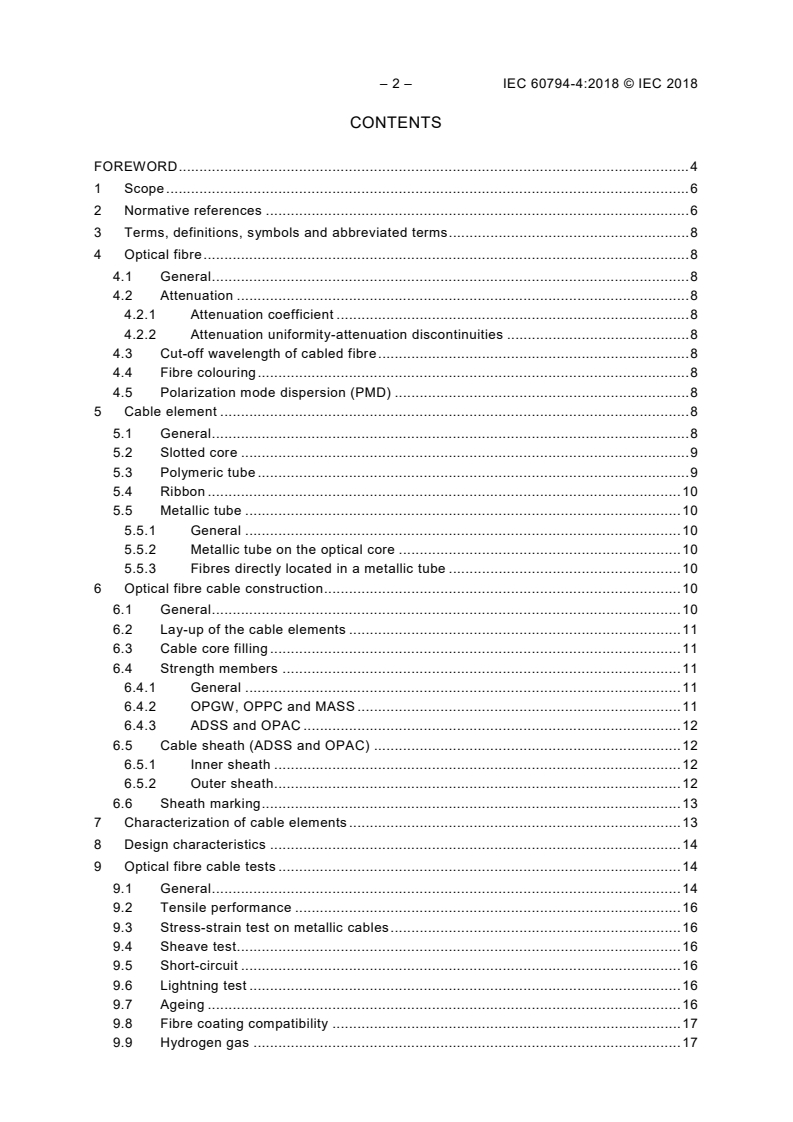
– 2 – IEC 60794-4:2018 © IEC 2018
CONTENTS
FOREWORD . 4
1 Scope . 6
2 Normative references . 6
3 Terms, definitions, symbols and abbreviated terms . 8
4 Optical fibre . 8
4.1 General . 8
4.2 Attenuation . 8
4.2.1 Attenuation coefficient . 8
4.2.2 Attenuation uniformity-attenuation discontinuities . 8
4.3 Cut-off wavelength of cabled fibre . 8
4.4 Fibre colouring . 8
4.5 Polarization mode dispersion (PMD) . 8
5 Cable element . 8
5.1 General . 8
5.2 Slotted core . 9
5.3 Polymeric tube . 9
5.4 Ribbon . 10
5.5 Metallic tube . 10
5.5.1 General . 10
5.5.2 Metallic tube on the optical core . 10
5.5.3 Fibres directly located in a metallic tube . 10
6 Optical fibre cable construction . 10
6.1 General . 10
6.2 Lay-up of the cable elements . 11
6.3 Cable core filling . 11
6.4 Strength members . 11
6.4.1 General . 11
6.4.2 OPGW, OPPC and MASS . 11
6.4.3 ADSS and OPAC . 12
6.5 Cable sheath (ADSS and OPAC) . 12
6.5.1 Inner sheath . 12
6.5.2 Outer sheath . 12
6.6 Sheath marking . 13
7 Characterization of cable elements . 13
8 Design characteristics . 14
9 Optical fibre cable tests . 14
9.1 General . 14
9.2 Tensile performance . 16
9.3 Stress-strain test on metallic cables . 16
9.4 Sheave test . 16
9.5 Short-circuit . 16
9.6 Lightning test . 16
9.7 Ageing . 16
9.8 Fibre coating compatibility . 17
9.9 Hydrogen gas . 17
9.10 Aeolian vibration . 17
9.11 Creep. 17
9.12 Fitting compatibility . 17
9.13 Grease . 17
9.14 Attenuation . 17
9.15 Tracking and erosion resistance test on ADSS and OPAC . 17
9.16 UV resistance test on ADSS and OPAC . 17
9.17 Shotgun resistance test on ADSS and OPAC . 18
9.18 Conductor access trolley for OPAC . 18
10 Quality assurance . 18
11 Packaging . 18
Annex A (normative) Recommended methods of calculating rated tensile strength,
cross-section of a layer of trapezoidal shaped wires, modulus of elasticity, linear
expansion and DC resistance for OPGW, OPPC and MASS . 19
A.1 Calculation of rated tensile strength (RTS) . 19
A.2 Calculation of the cross-sectional area of a layer of trapezoidal or Z- shaped
wires . 19
A.3 Calculation of the final modulus of elasticity (E) . 19
A.4 Calculation of coefficient of linear expansion (β) . 20
A.5 Calculation of DC resistance . 20
Bibliography . 21
Table 1 – Characteristics of different types of cable elements . 13
Table 2 – Design characteristics . 14
Table 3 – Mechanical and environmental applicable tests . 15
– 4 – IEC 60794-4:2018 © IEC 2018
INTERNATIONAL ELECTROTECHNICAL COMMISSION
____________
OPTICAL FIBRE CABLES –
Part 4: Sectional specification –
Aerial optical cables along electrical power lines
FOREWORD
1) The International Electrotechnical Commission (IEC) is a worldwide organization for standardization comprising
all national electrotechnical committees (IEC National Committees). The object of IEC is to promote
international co-operation on all questions concerning standardization in the electrical and electronic fields. To
this end and in addition to other activities, IEC publishes International Standards, Technical Specifications,
Technical Reports, Publicly Available Specifications (PAS) and Guides (hereafter referred to as “IEC
Publication(s)”). Their preparation is entrusted to technical committees; any IEC National Committee interested
in the subject dealt with may participate in this preparatory work. International, governmental and non-
governmental organizations liaising with the IEC also participate in this preparation. IEC collaborates closely
with the International Organization for Standardization (ISO) in accordance with conditions determined by
agreement between the two organizations.
2) The formal decisions or agreements of IEC on technical matters express, as nearly as possible, an international
consensus of opinion on the relevant subjects since each technical committee has representation from all
interested IEC National Committees.
3) IEC Publications have the form of recommendations for international use and are accepted by IEC National
Committees in that sense. While all reasonable efforts are made to ensure that the technical content of IEC
Publications is accurate, IEC cannot be held responsible for the way in which they are used or for any
misinterpretation by any end user.
4) In order to promote international uniformity, IEC National Committees undertake to apply IEC Publications
transparently to the maximum extent possible in their national and regional publications. Any divergence
between any IEC Publication and the corresponding national or regional publication shall be clearly indicated in
the latter.
5) IEC itself does not provide any attestation of conformity. Independent certification bodies provide conformity
assessment services and, in some areas, access to IEC marks of conformity. IEC is not responsible for any
services carried out by independent certification bodies.
6) All users should ensure that they have the latest edition of this publication.
7) No liability shall attach to IEC or its directors, employees, servants or agents including individual experts and
members of its technical committees and IEC National Committees for any personal injury, property damage or
other damage of any nature whatsoever, whether direct or indirect, or for costs (including legal fees) and
expenses arising out of the publication, use of, or reliance upon, this IEC Publication or any other IEC
Publications.
8) Attention is drawn to the Normative references cited in this publication. Use of the referenced publications is
indispensable for the correct application of this publication.
9) Attention is drawn to the possibility that some of the elements of this IEC Publication may be the subject of
patent rights. IEC shall not be held responsible for identifying any or all such patent rights.
International Standard IEC 60794-4 has been prepared by subcommittee 86A: Fibres and
cables, of IEC technical committee TC 86: Fibre optics.
This second edition cancels and replaces the first edition published in 2003. This edition
constitutes a technical revision.
This edition includes the following significant technical changes with respect to the previous
edition:
a) the specification has been streamlined by cross-referencing IEC 60794-1-1;
b) the classification as type tests or routine tests has been deleted;
c) cable kink test has been deleted;
d) creep test for ADSS is referred to IEC 60794-4-20.
The text of this International Standard is based on the following documents:
FDIS Report on voting
86A/1862/FDIS 86A/1868/RVD
Full information on the voting for the approval of this International Standard can be found in
the report on voting indicated in the above table.
This document has been drafted in accordance with the ISO/IEC Directives, Part 2.
A list of all parts in the IEC 60794 series, published under the general title Optical fibre
cables, can be found on the IEC website.
The committee has decided that the contents of this document will remain unchanged until the
stability date indicated on the IEC website under "http://webstore.iec.ch" in the data related to
the specific document. At this date, the document will be
• reconfirmed,
• withdrawn,
• replaced by a revised edition, or
• amended.
– 6 – IEC 60794-4:2018 © IEC 2018
OPTICAL FIBRE CABLES –
Part 4: Sectional specification –
Aerial optical cables along electrical power lines
1 Scope
This part of IEC 60794 covers cable construction, test methods, optical, mechanical,
environmental and electrical performance requirements for aerial optical fibre cables and
cable elements which are intended to be used along power lines (OCEPL) as a high
bandwidth transport media for communications and control optical signals, including optical
ground wires (OPGW), optical phase conductors (OPPC), metallic aerial self-supported cables
(MASS), all-dielectric self-supporting cables (ADSS) and optical attached cables (OPAC).
This document excludes figure-8 optical cables to be used on telephone utility poles.
The IEC TR 62839-1 gives recommendations to provide the customer with the environmental
declaration on request.
2 Normative references
The following documents are referred to in the text in such a way that some or all of their
content constitutes requirements of this document. For dated references, only the edition
cited applies. For undated references, the latest edition of the referenced document (including
any amendments) applies.
IEC 60104, Aluminium-magnesium-silicon alloy wire for overhead line conductors
IEC 60304, Standard colours for insulation for low-frequency cables and wires
IEC 60793-1-21, Optical fibres – Part 1-21: Measurement methods and test procedures –
Coating geometry
IEC 60793-1-32, Optical fibres – Part 1-32: Measurement methods and test procedures –
Coating strippability
IEC 60793-1-40, Optical fibres – Part 1-40: Measurement methods and test procedures –
Attenuation
IEC 60793-1-44, Optical fibres – Part 1-44: Measurement methods and test procedures –
Cut-off wavelength
IEC 60793-1-48, Optical fibres – Part 1-48: Measurement methods and test procedures –
Polarization mode dispersion
IEC 60793-2, Optical fibres – Part 2: Product specifications – General
IEC 60794-1-1, Optical fibre cables – Part 1-1: Generic specification – General
IEC 60794-1-21, Optical fibre cables – Part 1-21: Generic specification – Basic optical cable
test procedures – Mechanical tests methods
IEC 60794-1-22, Optical fibre cables – Part 1-22: Generic specification – Basic optical cable
test procedures – Environmental tests methods
IEC 60794-1-23, Optical fibre cables – Part 1-23: Generic specification – Basic optical cable
test procedures – Cable element test methods
IEC 60794-1-24, Optical fibre cables – Part 1-24: Generic specification – Basic optical cable
test procedures – Electrical test methods
IEC 60794-3, Optical fibre cables – Part 3: Outdoor cables – Sectional specification
IEC 60794-4-20:2012, Optical fibre cables – Part 4-20: Aerial optical cables along power lines
– Family specification for ADSS (All Dielectric Self Supported) optical cables
IEC 60811-202, Electric and optical fibre cables – Test methods for non-metallic materials –
Part 202: General tests – Measurement of thickness of non-metallic sheath
IEC 60811-203, Electric and optical fibre cables – Test methods for non-metallic materials –
Part 203: General tests – Measurement of overall dimensions
IEC 60811-401, Electric and optical fibre cables – Test methods for non-metallic materials –
Part 401: Miscellaneous tests – Thermal ageing methods – Ageing in an air oven
IEC 60811-406, Electric and optical fibre cables – Test methods for non-metallic materials –
Part 406: Miscellaneous tests – Resistance to stress cracking of polyethylene and
polypropylene compounds
IEC 60811-501, Electric and optical fibre cables – Test methods for non-metallic materials –
Part 501: Mechanical tests – Tests for determining the mechanical properties of insulating and
sheathing compounds
IEC 60811-604:2012, Electric and optical fibre cables – Test methods for non-metallic
materials – Part 604: Physical tests – Measurement of absence of corrosive components in
filling compounds
IEC 60811-607, Electric and optical fibre cables – Test methods for non-metallic materials –
Part 607: Physical tests – Test for the assessment of carbon black dispersion in polyethylene
and polypropylene
IEC 60888, Zinc-coated steel wires for stranded conductors
IEC 60889, Hard-drawn aluminium wire for overhead line conductors
IEC 61089:1991, Round wire concentric lay overhead electrical stranded conductors
IEC 61232, Aluminium-clad steel wires for electrical purposes
IEC 61394, Overhead lines – Requirements for greases for aluminium, aluminium alloy and
steel bare conductors
IEC 61395, Overhead electrical conductors – Creep test procedures for stranded conductors
– 8 – IEC 60794-4:2018 © IEC 2018
3 Terms, definitions, symbols and abbreviated terms
For the purposes of this document, the terms, definitions, symbols and abbreviated terms
given in IEC 60794-1-1 apply.
ISO and IEC maintain terminological databases for use in standardization at the following
addresses:
• IEC Electropedia: available at http://www.electropedia.org/
• ISO Online browsing platform: available at http://www.iso.org/obp
4 Optical fibre
4.1 General
Single-mode optical fibre which meets the requirements of IEC 60793-2 shall be used. Fibres
other than those specified above can be used, if mutually agreed between the user and the
supplier.
4.2 Attenuation
4.2.1 Attenuation coefficient
The typical maximum cable attenuation coefficient shall conform to IEC 60794-1-1.
Particular values may be agreed between the customer and supplier. The attenuation
coefficient shall be measured in accordance with IEC 60793-1-40.
4.2.2 Attenuation uniformity-attenuation discontinuities
Point discontinuities shall be measured in accordance with IEC 60793-1-40, method C, and
conform to IEC 60794-1-1.
4.3 Cut-off wavelength of cabled fibre
For single mode fibre, the cabled fibre cut-off wavelength, λ , shall be less than the
cc
operational wavelength, when measured in accordance with IEC 60793-1-44, and conform to
IEC 60794-1-1.
4.4 Fibre colouring
If the primary coated fibres are coloured for identification, the coloured coating shall be
readily identifiable throughout the lifetime of the cable and shall be a reasonable match to
IEC 60304.
4.5 Polarization mode dispersion (PMD)
Cabled single-mode fibre PMD shall be measured in accordance with IEC 60793-1-48 and
conform to IEC 60794-1-1.
5 Cable element
5.1 General
Generally, optical cables comprise several elements or individual constituents, depending on
the cable design, which take into account the cable application, operating environment and
manufacturing processes, as well as the need to protect the fibre during handling and cabling.
The material(s) used for a cable element shall be selected to be compatible with the other
elements in contact with it. An appropriate compatibility test method shall be defined in the
family or detail specification.
When the fibres are in contact with a filling compound, the compatibility of the filling
compound with the fibre coating shall be demonstrated by testing coating stripping force
stability after accelerated ageing in accordance with IEC 60794-1-21, method E5. Alternative
ageing conditions and tests may be agreed between the customer and supplier.
Optical elements are cable elements containing optical fibres and are designed to be a
primary functional unit of the cable core. They may comprise any of the cable elements
described below. Optical elements and each fibre within a cable element shall be uniquely
identified, for example, by colours, a positional scheme, markings, tapes, threads or specified
in the detail specification.
Tests may be performed on cable elements either in uncabled form or in finished cable.
Unless otherwise specified, testing shall be performed on cable elements in a finished cable.
This means that testing shall be performed only on a finished cable if the cable element
manufacturing operation is done by the same manufacturer as the cabling operation. Testing
shall be performed on cable elements only if the cable element is supplied by a third party;
this does not exclude testing of the finished cable.
Different types of optical elements are described below.
5.2 Slotted core
The slotted core is obtained by extruding a suitable material (for example polyethylene or
polypropylene) with a defined number of slots, providing helical or SZ configuration along the
core. One or more primary coated fibres or optical element is located in each slot which may
be filled.
The slotted core usually contains a central element which may be either metallic or non-
metallic. In this case, there shall be adequate adhesion between the central element and the
extruded core in order to obtain the required temperature stability and tensile behaviour for
the slotted core element.
The profile of the slot shall be uniform and shall ensure the optical and mechanical
performance required for the optical cable.
5.3 Polymeric tube
One or more primary coated fibres or optical elements are packaged (loosely or not) in a tube
construction which shall be filled, use dry-blocking methods or be otherwise water blocked.
The plastic tube may be reinforced with a composite wall.
If required, the suitability of the tube shall be determined by an evaluation of its kink
resistance in accordance with IEC 60794-1-23, method G7.
If used, the filling compound in the tube shall comply with the evaporation test in accordance
with IEC 60794-1-21, method E15. The filled tube shall comply with drip test in accordance
with IEC 60794-1-22, method F16, when tested in tube or cabled form.
NOTE Method E15 of IEC 60794-1-21 will be transferred in IEC 60794-1-23:— as method G9.
___________
This second edition is under preparation. Stage at the time of publication: IEC/NFDIS 60794-1-23:2018.
– 10 – IEC 60794-4:2018 © IEC 2018
5.4 Ribbon
Optical fibre ribbons are assembled optical fibres; they shall be in accordance with
IEC 60794-3.
NOTE The technical content of IEC 60794-3 regarding optical fibre ribbons will be moved to IEC 60794-1-31:— .
Users are directed to that document when it is issued.
5.5 Metallic tube
5.5.1 General
Constructions having fibres within a hermetically sealed tube shall consider the possibility of
evolution of hydrogen gas. See 9.9 for guidance.
5.5.2 Metallic tube on the optical core
A metallic tube (for example, aluminium tube) may be applied over the optical core (for
example, aluminium spacer or stranded tube).
5.5.3 Fibres directly located in a metallic tube
One or more primary coated and coloured fibres are packaged in a metallic hermetically
sealed tube, which shall be filled with a suitable compound if necessary to avoid water
penetration.
The inside surface of the tube should be smooth without any defects.
6 Optical fibre cable construction
6.1 General
The intent is that the cable be designed and manufactured for a predicted operating lifetime of
at least 20 years. In this context, the attenuation of the installed cable at the operational
wavelength(s) shall not exceed values agreed between the customer and supplier. The tests
of this document are intended to assess the performance of cables as manufactured and
under agreed ageing and performance-limit tests. These tests are not intended to define end-
of-life performance, but may be used as agreed between manufacturer and customer to
predict such performance. The materials in the cable shall not present a health hazard within
its intended use.
The fibres in the cables are usually of the same type, but some cables may contain multiple
specified fibre types, and fibres of the same type may have different origins.
There shall be no fibre splice in a delivery length, unless otherwise agreed by the customer
and supplier.
It shall be possible to identify each individual fibre throughout the length of the cable.
If mutually agreed between purchaser and manufacturer to avoid excess fibre strain induced
by the environmental conditions, such as wind or ice loading, the cable construction and
particularly the strength members shall be selected to avoid any long-term detrimental effects
on fibres up to the specified MAT.
___________
Under preparation. Stage at the time of publication: IEC/APUB 60794-1-31:2018.
The optical fibre unit shall house the optical fibres and protect them from damage due to
environmental or mechanical forces such as longitudinal compression, crushing, bending,
twisting, tensile stress, long- and short-term heat effects.
The aerial cable types covered by this document can be divided into the following groups:
a) optical ground wire or optical phase conductor (OPGW or OPPC);
b) all-dielectric self-supporting cable (ADSS);
c) optical attached cables (OPAC);
d) metallic aerial self-supported cables (MASS).
These aerial cables have different constructions, environmental and electrical operating
conditions for use on high-voltage lines.
6.2 Lay-up of the cable elements
Optical unit elements as described in Clause 5 may be laid up as follows:
a) optical element(s) without a stranding lay, such as a single optical unit in the cable centre;
b) a number of homogeneous optical elements using helical or SZ stranding configurations
(ribbon elements may be laid up by stacking two or more elements);
c) a number of different configurations in slotted core such as ribbon or plastic tube;
d) for OPGW, if required, insulated copper conductors in single, pair or quad construction
may be laid up with the optical elements.
6.3 Cable core filling
If specified, the element(s) and in addition the cable core shall contain water blocking
material, such as grease-like and/or dry-block materials, to prevent longitudinal water
penetration in accordance with IEC 60794-1-22, method F5. The material shall be easily
removed without the use of substances considered to be hazardous or dangerous. The
grease-like compound shall comply with IEC 60794-1-21, method E15. The cable shall pass
the compound flow test of IEC 60794-1-21, method E14.
The blocking material used shall be compatible with the other relevant cable elements. Where
a grease-like filling compound is used in cables containing metallic elements, it shall be
tested for the presence of corrosive compounds in accordance with IEC 60811-604:2012,
Clause 4.
6.4 Strength members
6.4.1 General
The type of materials used as strength members shall fulfil the mechanical and thermal
requirements of the overhead lines.
6.4.2 OPGW, OPPC and MASS
The stranded wires used for armouring may be round according to IEC 61089 or other cross-
sectional shapes, i.e. trapezoidal or z-form and can be of the following materials:
– aluminium alloy IEC 60104;
– galvanized steel IEC 60888;
– aluminium IEC 60889;
– aluminium-clad steel IEC 61232.
These standards give requirements on wire before stranding.
– 12 – IEC 60794-4:2018 © IEC 2018
Unless other requirements are mutually agreed between the purchaser and the manufacturer,
after stranding, the wires shall meet the requirements of IEC 61089.
Materials other than those specified can be used if mutually agreed between the purchaser
and the manufacturer.
In order to reduce the risk of corrosion, it can be necessary for the armouring to be greased
(see 9.13).
6.4.3 ADSS and OPAC
The strength member elements shall consist of aramid yarns, glass-reinforced materials or
equivalent dielectric strength members.
6.5 Cable sheath (ADSS and OPAC)
6.5.1 Inner sheath
A cable inner sheath may be applied by agreement between the purchaser and the supplier.
When required for a specific construction, or for manufacturing purposes, cable cores or
sub-units within the core, or both, may be covered by inner sheaths. Unless otherwise
specified, the inner sheath shall be made of polyethylene.
6.5.2 Outer sheath
6.5.2.1 General requirements
ADSS and OPAC cables shall have a seamless sheath made of UV-stabilized weather
resistant polyethylene, containing 2,0 % minimum well-dispersed carbon black in accordance
with IEC 60811-607, unless otherwise agreed between the customer and supplier. Under
certain conditions, it shall be necessary to consider the use of a tracking-resistant sheath.
The sheath thickness (tested in accordance with IEC 60811-202) and cable overall diameter
(tested in accordance with IEC 60811-203) and its variations shall take into account the
installation conditions and shall be determined by the relevant specification or by agreement
between the customer and supplier.
6.5.2.2 Tensile strength and elongation
When tested in accordance with IEC 60811-501, the measured values of tensile strength shall
be not less than:
a) 10 MPa for low- or linear low-density polyethylene;
b) 12,0 MPa for medium-density polyethylene;
c) 16,5 MPa for high-density polyethylene.
The measured values of elongation at break shall be not less than 300 %.
6.5.2.3 Elongation at break after ageing
The mechanical characteristics of the sheath shall remain sufficiently constant during normal
use. This is checked by determining the elongation at break according to IEC 60811-501 after
an ageing test at 100 °C ± 2 °C for 10 × 24 h according to IEC 60811-401. The median of the
values of elongation at break shall be not less than 300 %.
6.5.2.4 Resistance to environmental stress cracking
The resistance to environmental stress cracking shall comply with the requirements of
IEC 60811-406. Method B of IEC 60811-406 shall be applied.
6.6 Sheath marking
If required for non-metallic aerial cable, the sheath shall be marked by a method agreed
between the customer and supplier. Common methods of marking are embossing, sintering,
imprinting, hot foil and surface printing.
The information given in the marking text may include cable length, the number of fibres, fibre
type, manufacturer’s name and the date of manufacture.
The characters shall be spaced at intervals of not more than 1 m. The actual length of the
cable shall be within +1 %, –0 % of the length indicated by the length marking. For example,
1 000 m of cable, if the starting sheath length mark was 0, should have a final sheath mark in
the range 990 m to 1 000 m. Occasional illegible markings are permitted, provided that a
legible mark is located within 5 m of the illegible mark. Cables may be remarked in a second
contrasting colour, if the first marking process is unsuccessful.
Marking may be provided as a single or double line of marking. A single line of marking shall
be provided by marking longitudinally along the length of the cable. A double line of marking
shall be provided with the two lines diametrically opposite each other, longitudinally along the
length of the cable.
The abrasion resistance of the sheath markings shall be demonstrated in accordance with
IEC 60794-1-21, method E2B.
For a double line of marking, the abrasion resistance test only needs be carried out on one
line of marking.
If there is a risk due to high-voltage tracking effects, then sheath marking may be omitted.
7 Characterization of cable elements
The tests in Table 1 are intended to characterize the different types of cable elements.
Table 1 – Characteristics of different types of cable elements
Characteristics Family Test methods Remarks
requirements
Dimensions 5.0 IEC 60793-1-21 Secondary coating
Dimensions 6.1, 6.2, 6.4, 6.6 IEC 60811-202 and Loose tube, slotted core
IEC 60811-203 and ruggedized elements
Dimensions 6.3 IEC 60794-1-23 Ribbons
Methods G2, G3
IEC 60794-1-23 Secondary coating,
Bend 5.0, 6.2
Method G1 loose tube
Kink 6.4 IEC 60794-1-23 Tube
Method G7
Strippability 5.0 IEC 60793-1-32 Fibre coatings
Compound flow 6.4 IEC 60794-1-22 Tube
Method F16
– 14 – IEC 60794-4:2018 © IEC 2018
8 Design characteristics
Table 2 is a summary of important OCEPL characteristics which may be of relevance to both
the purchaser and the manufacturer. Other characteristics may be mutually agreed upon by
both purchaser and manufacturer.
Table 2 – Design characteristics
Design characteristics OPGW OPPC MASS ADSS OPAC
Number and type of fibres X X X X X
Detailed description of the cable X X X X X
design
Overall diameter (mm) X X X X X
Calculated cross-sectional area X X X – –
concerning calculation of rated tensile strength
(RTS) (mm )
Calculated mass (kg/km) X X X X X
RTS (kN) X X X – –
Modulus of elasticity (N/mm ) X X X X X
–1
Coefficient of thermal expansion (K ) X X X X X
X X – – –
DC resistance (Ω/km)
a
2 2
Fault-current capacity I t (kA × s) X X – –
MAT – Maximum allowable tension (kN) X X X X X
Allowable temperature range for X X X X X
storage, installation and operation (°C)
Strain margin X X X X X
(according to IEC 60794-1-2) (%)
Lay direction of outer layer X X X – –
Tracking resistant sheath (if applicable) – – – X X
a
Maximum operating current of the cable under short-circuit shall be specified by the manufacturer.
9 Optical fibre cable tests
9.1 General
Compliance with specification requirements shall be verified by carrying out tests as required
by the relevant family or detail specification. Suitable tests are detailed in Table 3. It is not
intended that all tests shall be carried out: the frequency of testing shall be agreed between
the customer and supplier.
Guidance on qualification sampling and interpretation of test results are given in
IEC 60794-1-1. The number of fibres tested shall be representative of the cable design and
shall be agreed between the customer and supplier.
The parameters specified in this document may be affected by measurement uncertainty
arising either from measurement errors or calibration errors due to the lack of suitable
standards. Acceptance criteria shall be interpreted with respect to this consideration. The total
uncertainty of measurement for this document shall be less than, or equal to, 0,05 dB for
attenuation.
The expression of no change in attenuation means that any change in measurement value,
either positive or negative, within the uncertainty of measurement shall be ignored.
The number of fibres tested shall be representative of the cable design and shall be agreed
between the purchaser and the manufacturer.
The tests applicable for aerial cables are listed below. The minimum acceptance criteria for
the different types of cables are given in the relevant family specifications.
Table 3 – Mechanical and environmental applicable tests
Characteristics Family requirements Test methods Remarks
IEC 60794-1-21
Tensile performance 9.2
Method E1
IEC 60794-1-21 OPGW, OPPC, MASS
Sheave test 9.4
Method E18B and ADSS
IEC 60794-1-21
Crush Family specification
Method E3
IEC 60794-1-21
Impact Family specification
Method E4
IEC 69794-1-24
Short-circuit 9.5 OPGW, OPPC, OPAC
Method H1
IEC 60794-1-24
Lightning 9.6 OPGW, OPPC
Method H2
9.12 and family
Fitting compatibility OPGW, ADSS, OPPC
specification
IEC 60794-4-20:2012
Tracking and erosion 9.15 ADSS, OPAC
Annex B
IEC 60794-1-21
Repeated bending Family specification
Method E6
IEC 60794-1-21
Torsion Family specification
Method E7
IEC 60794-1-21
Bend Family specification
Method E11
IEC 60794-1-21 Aerial cables specified
Shotgun resistance 9.17
Method E13 for shotgun protection
IEC 60794-1-21 OPGW, OPPC, ADSS,
Aeolian vibration 9.10
Method E19 MASS
Low frequency vibration IEC 60794-1-21 OPGW, OPPC, ADSS,
Family specification
(galloping) Method E26 MASS
Creep Family specification IEC 61395 OPGW, OPPC, MASS
Stress-strain test on metallic
Family specification IEC 61089 OPGW, OPPC, MASS
cables
IEC 60794-1-22
Temperature cycling Famil
...