


IEC 60130-17:1998
(Main)Connectors for frequencies below 3 MHz - Part 17: Detailspecification for interconnection devices which permit multi-directional mating, for use with rechargeable batteries
Connectors for frequencies below 3 MHz - Part 17: Detailspecification for interconnection devices which permit multi-directional mating, for use with rechargeable batteries
Is a connector detail specification for a battery interconnection system for portable computers, cellular telephones and other electronic devices requiring power not to exceed 50 V d.c. SELV (safety extra low voltage).
Connecteurs utilisés aux fréquences jusqu'à 3 MHz - Partie 17: Spécification particulière des dispositifs d'interconnexion qui permettent un accouplement multidirectionnel, à utiliser avec des batteries rechargeables
Est une spécification particulière de connecteurs pour un système d'interconnexion d'accumulateurs d'ordinateurs portables, de téléphones cellulaires et autres dispositifs électroniques nécessitant une puissance inférieure à 50 V c.c. SELV (basse tension de sécurité).
General Information
- Status
- Published
- Publication Date
- 11-Feb-1998
- Technical Committee
- SC 48B - Electrical connectors
- Current Stage
- PPUB - Publication issued
- Start Date
- 12-Feb-1998
- Completion Date
- 31-Dec-1997
Overview
IEC 60130-17:1998 is an international standard published by the International Electrotechnical Commission (IEC) that defines detailed specifications for connectors used with rechargeable batteries. These connectors operate at frequencies below 3 MHz and are intended for use in portable electronic devices such as portable computers and cellular telephones. The standard ensures reliable interconnection systems that allow multi-directional mating for power systems operating at or below 50 V d.c. SELV (Safety Extra Low Voltage). This enhances device safety, interoperability, and performance in rechargeable battery applications.
Key Topics
Scope and Application
The standard is applicable to connectors designed for power transmission in electronic devices demanding a maximum voltage of 50 V d.c. SELV. It focuses on connectors that enable flexible, multi-directional mating suitable for portable consumer electronics.Connector Types and Dimensions
IEC 60130-17 specifies a range of connector types based on voltage ratings (4.8 V, 7.2 V, 10.8 V, and 12 V systems). It includes precise dimensional information for both fixed (mounted) and free (removable) connectors:- Type A: 7.2 V battery interconnection
- Type B: 10.8 V battery interconnection
- Type C: 4.8 V battery interconnection
- Type D: 12.0 V battery interconnection
The document provides data on connector shapes, mating directions (right-angle and vertical), and keyed models preventing misconnection.
Performance Characteristics
Key electrical characteristics such as rated voltage, current-carrying capacity, initial contact resistance, and voltage proof requirements are detailed. Mechanical characteristics include insertion and withdrawal forces, mechanical operation cycles, and contact retention forces to ensure connector reliability and safety.Marking and Identification
Requirements for marking each connector and its packaging are included to guarantee traceability and conformity with the IEC designation system. This aids manufacturers and users in identifying compatible components and maintaining quality control.Testing and Quality Assurance
The standard defines comprehensive test schedules including mechanical, electrical, climatic, and dynamic stress tests. This ensures connectors comply with strict quality, reliability, and safety standards suitable for consumer electronics.
Applications
IEC 60130-17 connectors are vital for powering portable electronic devices with rechargeable batteries, offering secure and flexible interconnection solutions. Typical applications include:
Portable Computers
Ensuring reliable battery connections with multi-directional mating enhances user convenience and device durability.Cellular Telephones
Safe low-voltage connectors improve battery replacement procedures and electrical safety in mobile handsets.Other Consumer Electronics
Devices requiring rechargeable battery integration such as cameras, handheld tools, and small appliances benefit from standardized connector dimensions and performance.
Using IEC 60130-17 connectors helps manufacturers design interoperable, safe, and user-friendly power interfaces while reducing complexity in device assembly and maintenance.
Related Standards
IEC 60050 – International Electrotechnical Vocabulary defines standardized terminology relevant to electrical components and connectors.
IEC 60027, IEC 60417, IEC 60617 – Cover letter symbols, graphical symbols, and schematic symbols used in electrical technology, aiding standardized documentation and labeling.
Other Parts of IEC 60130 Series – Address connectors for various frequency ranges and specific usage scenarios beyond rechargeable battery interfaces.
By aligning with IEC 60130-17 and complementary IEC standards, manufacturers and designers contribute to global harmonization of connector systems, enhancing safety, compatibility, and performance in rechargeable battery-powered electronics.
Frequently Asked Questions
IEC 60130-17:1998 is a standard published by the International Electrotechnical Commission (IEC). Its full title is "Connectors for frequencies below 3 MHz - Part 17: Detailspecification for interconnection devices which permit multi-directional mating, for use with rechargeable batteries". This standard covers: Is a connector detail specification for a battery interconnection system for portable computers, cellular telephones and other electronic devices requiring power not to exceed 50 V d.c. SELV (safety extra low voltage).
Is a connector detail specification for a battery interconnection system for portable computers, cellular telephones and other electronic devices requiring power not to exceed 50 V d.c. SELV (safety extra low voltage).
IEC 60130-17:1998 is classified under the following ICS (International Classification for Standards) categories: 31.220.10 - Plug-and-socket devices. Connectors. The ICS classification helps identify the subject area and facilitates finding related standards.
IEC 60130-17:1998 is available in PDF format for immediate download after purchase. The document can be added to your cart and obtained through the secure checkout process. Digital delivery ensures instant access to the complete standard document.
Standards Content (Sample)
NORME
CEI
INTERNATIONALE
IEC
60130-17
INTERNATIONAL
Première édition
STANDARD
First edition
1998-02
Connecteurs utilisés aux fréquences
jusqu'à 3 MHz –
Partie 17:
Spécification particulière des dispositifs
d'interconnexion qui permettent
un accouplement multidirectionnel,
à utiliser avec des batteries rechargeables
Connectors for frequencies below 3 MHz –
Part 17:
Detail specification for interconnection
devices which permit multi-directional mating,
for use with rechargeable batteries
Numéro de référence
Reference number
CEI/IEC 60130-17:1998
Numéros des publications Numbering
Depuis le 1er janvier 1997, les publications de la CEI As from 1 January 1997 all IEC publications are issued
sont numérotées à partir de 60000. with a designation in the 60000 series.
Publications consolidées Consolidated publications
Les versions consolidées de certaines publications de Consolidated versions of some IEC publications
la CEI incorporant les amendements sont disponibles. including amendments are available. For example,
Par exemple, les numéros d’édition 1.0, 1.1 et 1.2 edition numbers 1.0, 1.1 and 1.2 refer, respectively, to
indiquent respectivement la publication de base, la the base publication, the base publication incorporating
publication de base incorporant l’amendement 1, et la amendment 1 and the base publication incorporating
publication de base incorporant les amendements 1 amendments 1 and 2.
et 2.
Validité de la présente publication Validity of this publication
Le contenu technique des publications de la CEI est The technical content of IEC publications is kept under
constamment revu par la CEI afin qu'il reflète l'état constant review by the IEC, thus ensuring that the
actuel de la technique. content reflects current technology.
Des renseignements relatifs à la date de reconfirmation Information relating to the date of the reconfirmation of
de la publication sont disponibles dans le Catalogue de the publication is available in the IEC catalogue.
la CEI.
Les renseignements relatifs à ces révisions, à l'établis- Information on the revision work, the issue of revised
sement des éditions révisées et aux amendements editions and amendments may be obtained from
peuvent être obtenus auprès des Comités nationaux de IEC National Committees and from the following
la CEI et dans les documents ci-dessous: IEC sources:
• Bulletin de la CEI • IEC Bulletin
• Annuaire de la CEI • IEC Yearbook
Accès en ligne* On-line access*
• Catalogue des publications de la CEI • Catalogue of IEC publications
Publié annuellement et mis à jour régulièrement Published yearly with regular updates
(Accès en ligne)* (On-line access)*
Terminologie, symboles graphiques Terminology, graphical and letter
et littéraux symbols
En ce qui concerne la terminologie générale, le lecteur For general terminology, readers are referred to
se reportera à la CEI 60050: Vocabulaire Electro- IEC 60050: International Electrotechnical Vocabulary
technique International (VEI). (IEV).
Pour les symboles graphiques, les symboles littéraux et For graphical symbols, and letter symbols and signs
les signes d'usage général approuvés par la CEI, le approved by the IEC for general use, readers are
referred to publications IEC 60027: Letter symbols to
lecteur consultera la CEI 60027: Symboles littéraux à
utiliser en électrotechnique, la CEI 60417: Symboles be used in electrical technology, IEC 60417: Graphical
graphiques utilisables sur le matériel. Index, relevé et symbols for use on equipment. Index, survey and
compilation des feuilles individuelles, et la CEI 60617: compilation of the single sheets and IEC 60617:
Symboles graphiques pour schémas. Graphical symbols for diagrams.
Publications de la CEI établies par IEC publications prepared by the same
le même comité d'études technical committee
L'attention du lecteur est attirée sur les listes figurant à The attention of readers is drawn to the end pages of
la fin de cette publication, qui énumèrent les this publication which list the IEC publications issued
publications de la CEI préparées par le comité d'études by the technical committee which has prepared the
qui a établi la présente publication. present publication.
* Voir adresse «site web» sur la page de titre. * See web site address on title page.
NORME
CEI
INTERNATIONALE
IEC
60130-17
INTERNATIONAL
Première édition
STANDARD
First edition
1998-02
Connecteurs utilisés aux fréquences
jusqu'à 3 MHz –
Partie 17:
Spécification particulière des dispositifs
d'interconnexion qui permettent
un accouplement multidirectionnel,
à utiliser avec des batteries rechargeables
Connectors for frequencies below 3 MHz –
Part 17:
Detail specification for interconnection
devices which permit multi-directional mating,
for use with rechargeable batteries
IEC 1998 Droits de reproduction réservés Copyright - all rights reserved
Aucune partie de cette publication ne peut être reproduite ni No part of this publication may be reproduced or utilized in
utilisée sous quelque forme que ce soit et par aucun any form or by any means, electronic or mechanical,
procédé, électronique ou mécanique, y compris la photo- including photocopying and microfilm, without permission in
copie et les microfilms, sans l'accord écrit de l'éditeur. writing from the publisher.
International Electrotechnical Commission 3, rue de Varembé Geneva, Switzerland
Telefax: +41 22 919 0300 e-mail: inmail@iec.ch IEC web site http: //www.iec.ch
CODE PRIX
Commission Electrotechnique Internationale
PRICE CODE V
International Electrotechnical Commission
Pour prix, voir catalogue en vigueur
For price, see current catalogue
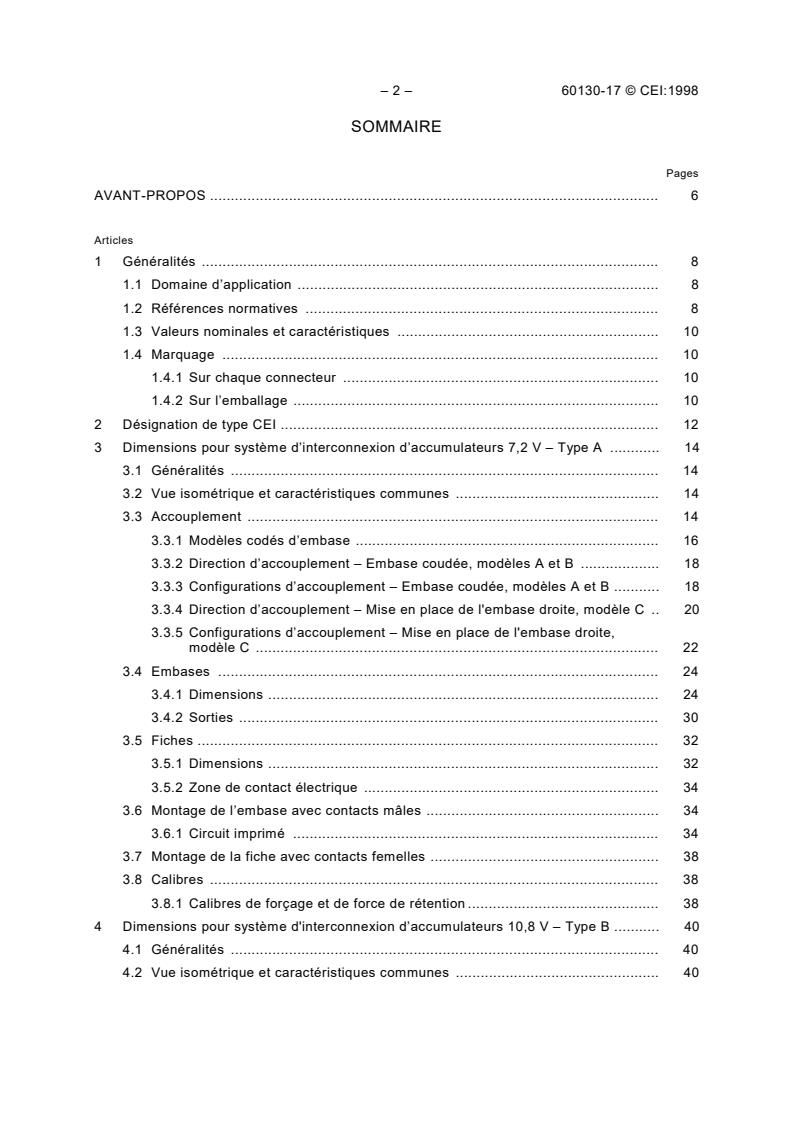
– 2 – 60130-17 © CEI:1998
SOMMAIRE
Pages
AVANT-PROPOS . 6
Articles
1 Généralités . 8
1.1 Domaine d’application . 8
1.2 Références normatives . 8
1.3 Valeurs nominales et caractéristiques . 10
1.4 Marquage . 10
1.4.1 Sur chaque connecteur . 10
1.4.2 Sur l’emballage . 10
2 Désignation de type CEI . 12
3 Dimensions pour système d’interconnexion d’accumulateurs 7,2 V – Type A . 14
3.1 Généralités . 14
3.2 Vue isométrique et caractéristiques communes . 14
3.3 Accouplement . 14
3.3.1 Modèles codés d’embase . 16
3.3.2 Direction d’accouplement – Embase coudée, modèles A et B . 18
3.3.3 Configurations d’accouplement – Embase coudée, modèles A et B . 18
3.3.4 Direction d’accouplement – Mise en place de l'embase droite, modèle C . 20
3.3.5 Configurations d’accouplement – Mise en place de l'embase droite,
modèle C . 22
3.4 Embases . 24
3.4.1 Dimensions . 24
3.4.2 Sorties . 30
3.5 Fiches . 32
3.5.1 Dimensions . 32
3.5.2 Zone de contact électrique . 34
3.6 Montage de l’embase avec contacts mâles . 34
3.6.1 Circuit imprimé . 34
3.7 Montage de la fiche avec contacts femelles . 38
3.8 Calibres . 38
3.8.1 Calibres de forçage et de force de rétention . 38
4 Dimensions pour système d'interconnexion d’accumulateurs 10,8 V – Type B . 40
4.1 Généralités . 40
4.2 Vue isométrique et caractéristiques communes . 40
60130-17 © IEC:1998 – 3 –
CONTENTS
Page
FOREWORD . 7
Clause
1 General . 9
1.1 Scope . 9
1.2 Normative references . 9
1.3 Ratings and characteristics . 11
1.4 Marking . 11
1.4.1 On each connector . 11
1.4.2 On the package . 11
2 IEC type designation . 13
3 Dimensional information for 7,2 V battery interconnection system – Type A . 15
3.1 General . 15
3.2 Isometric view and common features . 15
3.3 Mating information . 15
3.3.1 Keyed fixed connector styles . 17
3.3.2 Mating direction – Right-angle fixed connector, styles A and B . 19
3.3.3 Mating configurations – Right-angle fixed connector, styles A and B . 19
3.3.4 Mating direction – Vertical fixed connector assembly, style C . 21
3.3.5 Mating configurations – Vertical fixed connector assembly, style C . 23
3.4 Fixed connectors . 25
3.4.1 Dimensions . 25
3.4.2 Terminations . 31
3.5 Free connectors . 33
3.5.1 Dimensions . 33
3.5.2 Electrical contact area . 35
3.6 Mounting information for fixed connector with male contacts . 35
3.6.1 Printed board . 35
3.7 Mounting information for free connector with female contacts . 39
3.8 Gauges . 39
3.8.1 Sizing and retention force gauge . 39
4 Dimensional information for 10,8 V battery interconnection system – Type B . 41
4.1 General . 41
4.2 Isometric view and common features . 41
– 4 – 60130-17 © CEI:1998
Articles Pages
4.3 Accouplement . 40
4.3.1 Modèles codés d’embase . 40
4.3.2 Direction d’accouplement . 42
4.3.3 Configurations d’accouplement . 42
4.4 Embases . 42
4.4.1 Dimensions . 42
4.4.2 Sorties . 48
4.5 Fiches . 48
4.5.1 Dimensions . 48
4.5.2 Zone de contact électrique . 50
4.6 Montage de l’embase avec contacts mâles . 50
4.6.1 Circuit imprimé . 50
4.7 Montage de la fiche avec contacts femelles . 50
4.8 Calibres . 50
4.8.1 Calibres de forçage et de force de rétention . 50
5 Dimensions pour système d'interconnexion d’accumulateurs 4,8 V – Type C . 52
6 Dimensions pour système d'interconnexion d’accumulateurs 12,0 V – Type D . 52
7 Caractéristiques . 52
7.1 Catégorie climatique . 52
7.2 Caractéristiques électriques . 52
7.2.1 Tension de tenue . 52
7.2.2 Courant limite . 52
7.2.3 Résistance de contact initiale . 54
7.3 Caractéristiques mécaniques . 54
7.3.1 Fonctionnement mécanique . 54
7.3.2 Forces d’insertion et d’extraction . 54
8 Programme d’essais . 56
8.1 Généralités . 56
8.2 Montage pour essais de contrainte dynamique . 58
9 Tableaux des programmes d’essais . 60
9.1 Groupe préliminaire d’essais P . 60
9.2 Groupe AP . 62
9.3 Groupe BP . 64
9.4 Groupe CP . 66
60130-17 © IEC:1998 – 5 –
Clause Page
4.3 Mating information . 41
4.3.1 Keyed fixed connector styles . 41
4.3.2 Mating direction . 43
4.3.3 Mating configuration . 43
4.4 Fixed connectors . 43
4.4.1 Dimensions . 43
4.4.2 Terminations . 49
4.5 Free connectors . 49
4.5.1 Dimensions . 49
4.5.2 Electrical contact area . 51
4.6 Mounting information for fixed connector with male contacts . 51
4.6.1 Printed board . 51
4.7 Mounting information for free connector with female contacts . 51
4.8 Gauges . 51
4.8.1 Sizing and retention force gauge . 51
5 Dimensional information for 4,8 V battery interconnection system – Type C . 53
6 Dimensional information for 12,0 V battery interconnection system – Type D . 53
7 Characteristics . 53
7.1 Climatic category . 53
7.2 Electrical . 53
7.2.1 Voltage proof . 53
7.2.2 Current-carrying capacity . 53
7.2.3 Initial contact resistance . 55
7.3 Mechanical . 55
7.3.1 Mechanical operation . 55
7.3.2 Insertion and withdrawal forces . 55
8 Test schedule . 57
8.1 General . 57
8.2 Arrangement for dynamic stress tests . 59
9 Test schedule tables . 61
9.1 Preliminary test group P . 61
9.2 Group AP . 63
9.3 Group BP . 65
9.4 Group CP . 67
– 6 – 60130-17 © CEI:1998
COMMISSION ÉLECTROTECHNIQUE INTERNATIONALE
___________
CONNECTEURS UTILISÉS AUX FRÉQUENCES JUSQU’À 3 MHz –
Partie 17: Spécification particulière des dispositifs d’interconnexion
qui permettent un accouplement multidirectionnel,
à utiliser avec des batteries rechargeables
AVANT-PROPOS
1) La CEI (Commission Electrotechnique Internationale) est une organisation mondiale de normalisation composée
de l'ensemble des comités électrotechniques nationaux (Comités nationaux de la CEI). La CEI a pour objet de
favoriser la coopération internationale pour toutes les questions de normalisation dans les domaines de
l'électricité et de l'électronique. A cet effet, la CEI, entre autres activités, publie des Normes Internationales.
Leur élaboration est confiée à des comités d'études, aux travaux desquels tout Comité national intéressé par le
sujet traité peut participer. Les organisations internationales, gouvernementales et non gouvernementales, en
liaison avec la CEI, participent également aux travaux. La CEI collabore étroitement avec l'Organisation
Internationale de Normalisation (ISO), selon des conditions fixées par accord entre les deux organisations.
2) Les décisions ou accords officiels de la CEI concernant les questions techniques, représentent, dans la mesure
du possible un accord international sur les sujets étudiés, étant donné que les Comités nationaux intéressés
sont représentés dans chaque comité d’études.
3) Les documents produits se présentent sous la forme de recommandations internationales. Ils sont publiés
comme normes, rapports techniques ou guides et agréés comme tels par les Comités nationaux.
4) Dans le but d'encourager l'unification internationale, les Comités nationaux de la CEI s'engagent à appliquer de
façon transparente, dans toute la mesure possible, les Normes internationales de la CEI dans leurs normes
nationales et régionales. Toute divergence entre la norme de la CEI et la norme nationale ou régionale
correspondante doit être indiquée en termes clairs dans cette dernière.
5) La CEI n’a fixé aucune procédure concernant le marquage comme indication d’approbation et sa responsabilité
n’est pas engagée quand un matériel est déclaré conforme à l’une de ses normes.
6) L’attention est attirée sur le fait que certains des éléments de la présente Norme internationale peuvent faire
l’objet de droits de propriété intellectuelle ou de droits analogues. La CEI ne saurait être tenue pour
responsable de ne pas avoir identifié de tels droits de propriété et de ne pas avoir signalé leur existence.
La Norme internationale CEI 60130-17 a été établie par le sous-comité 48B: Connecteurs, du
comité d’études 48 de la CEI: Composants électromécaniques et structures mécaniques pour
équipements électroniques.
Le texte de cette norme est issu des documents suivants:
FDIS Rapport de vote
48B/652/FDIS 48B/658/RVD
Le rapport de vote indiqué dans le tableau ci-dessus donne toute information sur le vote ayant
abouti à I’approbation de cette norme.
60130-17 © IEC:1998 – 7 –
INTERNATIONAL ELECTROTECHNICAL COMMISSION
___________
CONNECTORS FOR FREQUENCIES BELOW 3 MHz –
Part 17: Detail specification for interconnection devices which
permit multi-directional mating, for use with rechargeable batteries
FOREWORD
1) The IEC (International Electrotechnical Commission) is a worldwide organization for standardization comprising
all national electrotechnical committees (IEC National Committees). The object of the IEC is to promote
international co-operation on all questions concerning standardization in the electrical and electronic fields. To
this end and in addition to other activities, the IEC publishes International Standards. Their preparation is
entrusted to technical committees; any IEC National Committee interested in the subject dealt with may
participate in this preparatory work. International, governmental and non-governmental organizations liaising
with the IEC also participate in this preparation. The IEC collaborates closely with the International Organization
for Standardization (ISO) in accordance with conditions determined by agreement between the two
organizations.
2) The formal decisions or agreements of the IEC on technical matters express, as nearly as possible, an
international consensus of opinion on the relevant subjects since each technical committee has representation
from all interested National Committees.
3) The documents produced have the form of recommendations for international use and are published in the form
of standards, technical reports or guides and they are accepted by the National Committees in that sense.
4) In order to promote international unification, IEC National Committees undertake to apply IEC International
Standards transparently to the maximum extent possible in their national and regional standards. Any
divergence between the IEC Standard and the corresponding national or regional standard shall be clearly
indicated in the latter.
5) The IEC provides no marking procedure to indicate its approval and cannot be rendered responsible for any
equipment declared to be in conformity with one of its standards.
6) Attention is drawn to the possibility that some of the elements of this International Standard may be the subject
of patent rights. The IEC shall not be held responsible for identifying any or all such patent rights.
International Standard IEC 60130-17 has been prepared by subcommittee 48B: Connectors, of
IEC technical committee 48: Electromechanical components and mechanical structures for
electronic equipment.
The text of this standard is based on the following document:
FDIS Report on voting
48B/652/FDIS 48B/658/RVD
Full information on the voting for the approval of this standard can be found in the report on
voting indicated in the above table.
– 8 – 60130-17 © CEI:1998
CONNECTEURS UTILISÉS AUX FRÉQUENCES JUSQU’À 3 MHz –
Partie 17: Spécification particulière des dispositifs d’interconnexion
qui permettent un accouplement multidirectionnel,
à utiliser avec des batteries rechargeables
1 Généralités
1.1 Domaine d’application
La présente partie de la CEI 60130 est une spécification particulière de connecteurs pour un
système d’interconnexion d'accumulateurs d’ordinateurs portables, de téléphones cellulaires et
autres dispositifs électroniques nécessitant une puissance inférieure à 50 V c.c. SELV (basse
tension de sécurité).
1.2 Références normatives
Les documents normatifs suivants contiennent des dispositions qui, par suite de la référence
qui y est faite, constituent des dispositions valables pour la présente partie de la CEI 60130.
Au moment de la publication, les éditions indiquées étaient en vigueur. Tout document normatif
est sujet à révision et les parties prenantes aux accords fondés sur la présente partie de la
CEI 60130 sont invitées à rechercher la possibilité d'appliquer les éditions les plus récentes
des documents normatifs indiqués ci-après. Les membres de la CEI et de l'ISO possèdent le
registre des Normes internationales en vigueur.
CEI 60130-0:1970, Connecteurs utilisés aux fréquences jusqu’à 3 MHz – Partie zéro: Guide
concernant les renseignements devant être fournis par les dessins des spécifications détaillées
CEI 60130-1:1988, Connecteurs utilisés aux fréquences jusqu’à 3 MHz – Partie 1: Règles
générales et méthodes de mesure
CEI 60512-1:1994, Composants électromécaniques pour équipements électroniques;
procédures d'essai de base et méthodes de mesure – Partie 1: Généralités
CEI 60512-2:1985, Composants électromécaniques pour équipements électroniques;
procédures d'essai de base et méthodes de mesure – Partie 2: Examen général, essais de
continuité électrique et de résistance de contact, essais d'isolement et essais de contrainte
diélectrique
CEI 60512-3:1976, Composants électromécaniques pour équipements électroniques;
procédures d'essai de base et méthodes de mesure – Partie 3: Essais de courant limite
CEI 60512-4:1976, Composants électromécaniques pour équipements électroniques;
procédures d'essai de base et méthodes de mesure – Partie 4: Essais de contraintes
dynamiques
CEI 60512-5:1992, Composants électromécaniques pour équipements électroniques;
procédures d'essai de base et méthodes de mesure – Partie 5: Essais d'impact (composants
libres), essais d'impact sous charge statique (composants fixes), essais d'endurance et essais
de surcharge
CEI 60512-6:1984, Composants électromécaniques pour équipements électroniques;
procédures d'essai de base et méthodes de mesure – Partie 6: Essais climatiques et essais de
soudure
60130-17 © IEC:1998 – 9 –
CONNECTORS FOR FREQUENCIES BELOW 3 MHz –
Part 17: Detail specification for interconnection devices which
permit multi-directional mating, for use with rechargeable batteries
1 General
1.1 Scope
This part of IEC 60130 is a connector detail specification for a battery interconnection system
for portable computers, cellular telephones and other electronic devices requiring power not to
exceed 50 V d.c. SELV (Safety Extra Low Voltage).
1.2 Normative references
The following normative documents contain provisions which, through reference in this text,
constitute provisions of this part of IEC 60130. At the time of publication, the editions indicated
were valid. All normative documents are subject to revision, and parties to agreements based
on this part of IEC 60130 are encouraged to investigate the possibility of applying the most
recent editions of the normative documents indicated below. Members of IEC and ISO maintain
registers of currently valid International Standards
IEC 60130-0:1970, Connectors for frequencies below 3 MHz – Part 0: Guide to drawing
information in detail specifications
IEC 60130-1:1988, Connectors for frequencies below 3 MHz – Part 1: General requirements
and measuring methods
IEC 60512-1:1994, Electromechanical components for electronic equipment; basic testing
procedures and measuring methods – Part 1: General
IEC 60512-2:1985, Electromechanical components for electronic equipment; basic testing
procedures and measuring methods – Part 2: General examination, electrical continuity and
contact resistance tests, insulation resistance tests and voltage stress tests
IEC 60512-3:1976, Electromechanical components for electronic equipment; basic testing
procedures and measuring methods – Part 3: Current-carrying capacity tests
IEC 60512-4:1976, Electromechanical components for electronic equipment; basic testing
procedures and measuring methods – Part 4: Dynamic stress tests
IEC 60512-5:1992, Electromechanical components for electronic equipment; basic testing
procedures and measuring methods – Part 5: Impact tests (free components), static load tests
(fixed components), endurance tests and overload tests
IEC 60512-6:1984, Electromechanical components for electronic equipment; basic testing
procedures and measuring methods – Part 6: Climatic tests and soldering tests
– 10 – 60130-17 © CEI:1998
CEI 60512-7:1993, Composants électromécaniques pour équipements électroniques;
procédures d'essai de base et méthodes de mesure – Partie 7: Essais de fonctionnement
mécanique et essais d'étanchéité
CEI 60512-8:1993, Composants électromécaniques pour équipements électroniques;
procédures d'essai de base et méthodes de mesure – Partie 8: Essais mécaniques des
connecteurs, des contacts et des sorties
ISO 468:1982, Rugosité de surface – Paramètres, leurs valeurs et les règles générales de la
détermination des spécifications
1.3 Valeurs nominales et caractéristiques
Tension assignée: Maximum 50 V c.c.
Courant assigné: 4 A, 30 °C d'échauffement
Résistance d’isolement: 1 000 MΩ
Catégorie climatique: 30/070/10
Epaisseur du circuit imprimé: 1,6 mm
Espace entre contacts: 5 mm
1.4 Marquage
1.4.1 Sur chaque connecteur
Chaque connecteur doit comporter le marquage de la position du contact n° 1 comme cela est
indiqué pour l’embase dans la présente spécification particulière.
Les marquages additionnels doivent inclure les informations suivantes:
a) marque d’origine (nom du fabricant ou appellation commerciale);
b) année et mois (ou semaine) de fabrication;
c) désignation de type CEI, selon l’article 2.
Cependant, si le nombre de caractères requis dépasse la capacité du logiciel, le fabricant peut
utiliser sa propre codification, à condition qu'il fournisse une liste de décodage.
Si l’emplacement du marquage est limité, on n’indiquera que ce qui est possible mais dans
l’ordre indiqué.
1.4.2 Sur l’emballage
Les informations spécifiées aux points a), b) et c) doivent toujours être marquées sur
l’emballage.
60130-17 © IEC:1998 – 11 –
IEC 60512-7:1993, Electromechanical components for electronic equipment; basic testing
procedures and measuring methods – Part 7: Mechanical operating tests and sealing tests
IEC 60512-8:1993, Electromechanical components for electronic equipment; basic testing
procedures and measuring methods – Part 8: Connector tests (mechanical) and mechanical
tests on contacts and terminations
ISO 468:1982, Surface roughness – Parameters, their values and general rules for specifying
requirements
1.3 Ratings and characteristics
Rated voltage: Maximum 50 V d.c.
Current rating: 4 A, 30 °C temperature rise
Insulation resistance: 1 000 MΩ
Climatic category: 30/070/10
Printed board thickness: 1,6 mm
Contact spacing: 5 mm
1.4 Marking
1.4.1 On each connector
Each connector shall have the identification of the number one contact position marked as
indicated on the fixed connector in this detail specification.
Additional markings shall include the following information:
a) mark of origin (manufacturer's name or trade mark);
b) year and month (or week) of manufacture;
c) IEC type designation, according to clause 2.
However, since the number of characters this requires may exceed the limitation imposed by
computer processing systems, the manufacturer may use his own part number, providing that a
cross-reference list is made available.
If space does not permit full marking, as much as possible of the information, in the order
shown, shall be included.
1.4.2 On the package
The information specified in items a), b) and c) shall always be marked on the package.
– 12 – 60130-17 © CEI:1998
2 Désignation de type CEI
IEC 60130-17 L N N L L L N L N
–
Type de système Niveau de performance
7,2 V A 1 PL1
10,8 V B 2 PL2 *
4,8 V * C 3 PL3 *
12,0 V * D
Modèle de connecteur Epaisseur de carte
Embase A 1,6 mm
B 2,4 mm
Modèle A
C 3,2 mm
Modèle B
Modèle C 3
Fiche Type de montage
Modèle A-C 4 1 Angle droit
2 Vertical
3 Câble *
Nombre de contacts
Constitution chimique de la batterie
Type de sortie Nickel hydride
HP
Nickel cadmium *
Trou métallisé A
Ion lithium *
Montage en surface * B
Insertion à force * C
* A l’étude
Exemple: IEC 60130-17-A15AHP1A1
Embase à cinq contacts à angle droit de modèle A (clé de tension à droite) pour trou métallisé
dans un circuit imprimé de 1,6 mm; 7,2 V, nickel hydride.
60130-17 © IEC:1998 – 13 –
2 IEC type designation
IEC 60130-17 L N N L L L N L N
–
Type of system Performance level
7,2 V A 1 PL1
10,8 V B 2 PL2 *
4,8 V * C 3 PL3 *
12,0 V * D
Style of connector Board thickness
Fixed A 1,6 mm
B 2,4 mm
Style A 1
C 3,2 mm
Style B
Style C
Free Type of mounting
Style A-C 4 1 Right angle
2 Vertical
3 Cable *
Number of contacts
Battery chemistry
HP Nickel-metal hydride
Type of termination
Nickel cadmium *
Solder A
Lithium ion *
Surface mount * B
Press-in * C
* Under consideration
Example: IEC 60130-17-A15AHP1A1
Five pole right-angle fixed connector with right-handed voltage key for through-hole solder
termination to a 1,6 mm board, 7,2 V, nickel-metal hydride.
– 14 – 60130-17 © CEI:1998
3 Dimensions pour système d’interconnexion d’accumulateurs 7,2 V – Type A
3.1 Généralités
Les dimensions sont métriques. Les dessins sont montrés en projection du troisième dièdre.
La forme du connecteur peut être différente de celle des dessins dans la mesure où les
dimensions requises sont respectées. Toutes les dimensions sont données en millimètres.
3.2 Vue isométrique et caractéristiques communes
IEC 102/98
Figure 1 – Dispositif de codage servant de guide pendant l’accouplement
3.3 Accouplement
La conception de l’embase avec divers dispositifs de codage empêche les erreurs
d’accouplement. Les connecteurs sont totalement accouplés lorsqu’il existe une distance
maximale de 1,50 mm entre l’embase et la fiche (voir figure 2).
IEC 103/98
Figure 2 – Espacement des contacts
60130-17 © IEC:1998 – 15 –
3 Dimensional information for 7,2 V battery interconnection system – Type A
3.1 General
Dimensions are metric. Drawings are shown in third angle projection. The shape of the
connector may deviate from those given in the following drawings as long as the specified
dimensions are maintained. All dimensions are given in millimetres.
3.2 Isometric view and common features
IEC 102/98
Figure 1 – Keying feature serving as guide during mating
3.3 Mating information
The design of the fixed connector with various keying features prevents mismating. The
connectors are fully mated when there is a maximum space of 1,50 mm between the fixed and
free connectors (see figure 2).
IEC 103/98
Figure 2 – Contact spacing
– 16 – 60130-17 © CEI:1998
3.3.1 Modèles codés d’embase
Il existe trois modèles.
Tableau 1 – Modèle A
Modèle
Clé de tension à droite
A
IEC 104/98
Clé de tension à gauche
B
IEC 105/98
Montage vertical
C
IEC 106/98
60130-17 © IEC:1998 – 17 –
3.3.1 Keyed fixed connector styles
There are three styles:
Table 1 – Type A
Style
Right-handed voltage key
A
IEC 104/98
Left-handed voltage key
B
IEC 105/98
Vertical mount
C
IEC 106/98
– 18 – 60130-17 © CEI:1998
3.3.2 Direction d’accouplement – Embase coudée, modèles A et B
Les diverses méthodes d’accouplement de la fiche et de l’embase sont illustrées à la figure 3.
IEC 107/98
Figure 3 – Direction d’accouplement – Embase coudée, modèles A et B
3.3.3 Configurations d’accouplement – Embase coudée, modèles A et B
La position de la fiche lors de l’accouplement avec l’embase est illustrée dans des inclinaisons
variant de 0° à 90°.
IEC 108/98
IEC 109/98
Figure 4a – Accouplement horizontal Figure 4c – Horizontal incliné
IEC 111/98
IEC 110/98
Figure 4 b – Accouplement vertical Figure 4d – Vertical incliné
Figure 4 – Configurations d’accouplement – Embase coudée, modèles A et B
60130-17 © IEC:1998 – 19 –
3.3.2 Mating direction – Right-angle fixed connector, styles A and B
The various methods of mating the free connector with the fixed connector are illustrated in
figure 3.
IEC 107/98
Figure 3 – Mating orientation – Right-angle fixed connector, styles A and B
3.3.3 Mating configurations – Right-angle fixed connector, styles A and B
The position of the free connector when mating with the fixed connector is illustrated in various
inclinations ranging from 0° to 90°.
IEC 108/98
IEC 109/98
Figure 4a – Mate-in Figure 4c – Cam-in
IEC 111/98
Figure 4d – Cam-down
Figure 4b – Mate-down
Figure 4 – Mating configurations – Right-angle fixed connector, styles A and B
– 20 – 60130-17 © CEI:1998
3.3.4 Direction d’accouplement – Mise en place de l'embase droite, modèle C
Les diverses méthodes d’accouplement de la fiche et de l’embase sont illustrées à la figure 5.
IEC 112/98
Figure 5 – Direction d’accouplement – Mise en place de l'embase droite, modèle C
60130-17 © IEC:1998 – 21 –
3.3.4 Mating direction – Vertical fixed connector assembly, style C
The various methods of mating the free connector with the fixed connector are illustrated in
figure 5.
IEC 112/98
Figure 5 – Mating orientation – Vertical fixed connector assembly, style C
– 22 – 60130-17 © CEI:1998
3.3.5 Configurations d’accouplement – Mise en place de l'embase droite, modèle C
La position de la fiche lors de l’accouplement avec l’embase est illustrée dans des inclinaisons
variant de 0° à 90°.
IEC 113/98
Figure 6a – Accouplement horizontal
IEC 114/98
Figure 6b – Accouplement vertical
IEC 115/98
IEC 116/98
Figure 6c – Horizontal incliné Figure 6d – Vertical incliné
Figure 6 – Configurations d’accouplement – Mise en place de l'embase droite, modèle C
60130-17 © IEC:1998 – 23 –
3.3.5 Mating configurations – Vertical fixed connector assembly, style C
The position of the free connector when mating with the fixed connector is illustrated in various
inclinations ranging from 0° to 90°.
IEC 113/98
Figure 6a – Mate-in
IEC 114/98
Figure 6b – Mate-down
IEC 115/98
IEC 116/98
Figure 6c – Cam-in Figure 6d – Cam-down
Figure 6 – Mating configurations – Vertical fixed connector assembly, style C
– 24 – 60130-17 © CEI:1998
3.4 Embases
3.4.1 Dimensions
3.4.1.1 Type A, modèle A
IEC 117/98
Dimensions en millimètres
Figure 7 – Type A, modèle A: embase coudée avec contacts mâles et clé de tension à droite
60130-17 © IEC:1998 – 25 –
3.4 Fixed connectors
3.4.1 Dimensions
3.4.1.1 Type A, style A
IEC 117/98
Dimensions in millimetres
Figure 7 – Type A, style A: Right-angle fixed connector with male contacts
and right-handed voltage key
– 26 – 60130-17 © CEI:1998
3.4.1.2 Type A, modèle B
IEC 118/98
Dimensions en millimètres
Figure 8 – Type A, modèle B: embase coudée avec contacts mâles
et clé de tension à gauche
60130-17 © IEC:1998 – 27 –
3.4.1.2 Type A, style B
IEC 118/98
Dimensions in millimetres
Figure 8 – Type A, style B: Right-angle fixed connector with male contacts
and left-handed voltage key
– 28 – 60130-17 © CEI:1998
3.4.1.3 Type A, modèle C
IEC 119/98
Dimensions en millimètres
Figure 9 – Type A, modèle C: embase droite
60130-17 © IEC:1998 – 29 –
3.4.1.3 Type A, style C
IEC 119/98
Dimensions in millimetres
Figure 9 – Type A, style C: Vertical fixed connector assembly
– 30 – 60130-17 © CEI:1998
3.4.2 Sorties
L’embase à contacts mâles doit être insérée dans un circuit imprimé par un trou métallisé, être
un composant de montage en surface ou être insérée à force.
3.4.2.1 Méthode du trou métallisé
Lorsque le connecteur est soudé à la carte, la surface arrière de l’embase doit être dans les
tolérances indiquées à la figure 10. Lorsque le connecteur est totalement enfiché, la marque
de la soudure débordera au minimum de 0,80 mm au-delà du circuit imprimé. Cette exigence
s’applique à toutes les épaisseurs de circuits imprimés.
IEC 120/98
Figure 10a – Modèles A et B
IEC 121/98
Figure 10b – Modèle C
Figure 10 – Méthode du trou métallisé
3.4.2.2 Méthode de montage en surface
A l’étude.
3.4.2.3 Méthode d'insertion à force
A l’étude.
60130-17 © IEC:1998 – 31 –
3.4.2 Terminations
The fixed connector with male contacts shall be terminated on a printed board by through-hole
solder, surface mo
...
Questions, Comments and Discussion
Ask us and Technical Secretary will try to provide an answer. You can facilitate discussion about the standard in here.
Loading comments...