


IEC 60034-26:2006/COR1:2014
(Corrigendum)Corrigendum 1 - Rotating electrical machines - Part 26: Effects of unbalanced voltages on the performance of three-phase cage induction motors
Corrigendum 1 - Rotating electrical machines - Part 26: Effects of unbalanced voltages on the performance of three-phase cage induction motors
Corrigendum 1 - Machines électriques tournantes - Partie 26: Effets d'un système de tensions déséquilibrées sur les caractéristiques de fonctionnement des moteurs à cage asynchrones triphasés
General Information
Relations
Standards Content (Sample)
IEC 60034-26 IEC 60034-26
(First edition – 2006) (Première édition – 2006)
Rotating electrical machines – Machines électriques tournantes –
Part 26: Effects of unbalanced voltages on the Partie 26: Effets d'un système de tensions
performance of three-phase cage induction déséquilibrées sur les caractéristiques de
motors fonctionnement des moteurs à cage asynchrones
triphasés
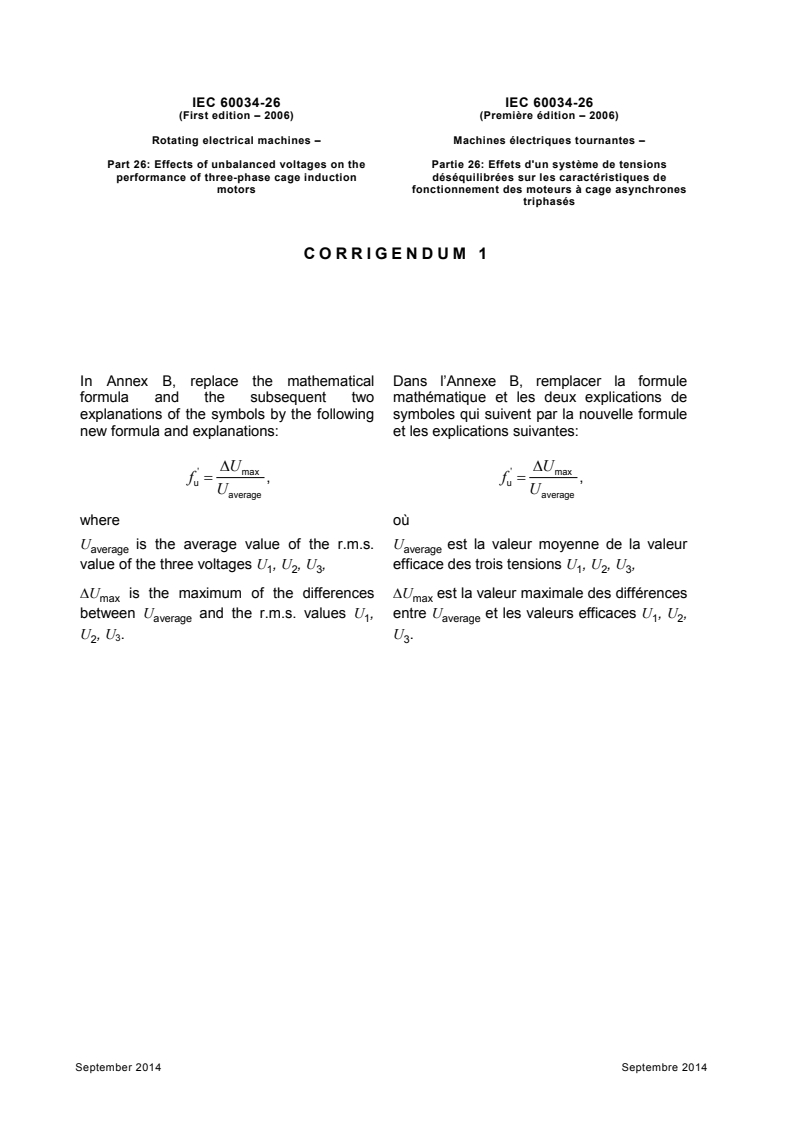
CO RRI G E NDUM 1
In Annex B, replace the mathematical Dans l’Annexe B, remplacer la formule
formula and the subsequent two mathématique et les deux explications de
explanations of the symbols by the following symboles qui suivent par la nou
...
This May Also Interest You
IEC 60034-30-1:2025 specifies efficiency classes for single-speed electric motors that are rated in accordance with IEC 60034‑1 or IEC 60079‑0 and are rated for operation on a sinusoidal either 50 Hz or 60 Hz, or both voltage supply.
The motors within this document:
- have a rated power PN from 0,12 kW to 1 000 kW;
- have a rated voltage UN from 50 V up to and including 1 000 V;
- have 2, 4, 6 or 8 poles;
- are capable of continuous operation at their rated power with a temperature rise within the specified insulation temperature class;
NOTE 1 Most motors covered by this document are rated for duty type S1 (continuous duty). However, some motors that are rated for other duty cycles are still capable of continuous operation at their rated power, and these motors are also covered by this document.
- are marked with any ambient temperature within the range of –30 °C to +60 °C;
NOTE 2 The rated efficiency and efficiency classes are based on 25 °C ambient temperature in accordance with IEC 60034‑2‑1.
NOTE 3 Motors exclusively rated for temperatures outside the range – 30 °C and +60 °C are considered to be of special construction and are consequently excluded from this document.
NOTE 4 Smoke extraction motors with a temperature class of up to and including 400 °C are covered by this document.
- are marked with an altitude up to 4 000 m above sea level.
NOTE 5 The rated efficiency and efficiency class are based on a rating for altitudes up to 1 000 m above sea level.
This document establishes a set of nominal efficiency values based on supply frequency, number of poles and motor output power. No distinction is made between motor technologies, supply voltage or motors with increased insulation designed specifically for converter operation even though not all motor technologies are capable of reaching the higher efficiency classes (see Table 1). This makes different motor technologies fully comparable with respect to their energy efficiency potential.
The efficiency of power-drive systems is not covered by this document. Motor losses due to harmonic content of the supply voltage, losses in cables, filters and frequency-converters, are not covered.
Motors with flanges, feet or shafts with mechanical dimensions different from IEC 60072‑1 are covered by this document.
Geared motors are covered by this document including those incorporating non-standard shafts and flanges.
This document does not apply to the following:
- Single-speed motors with 10 or more poles or multi-speed motors.
- Motors with mechanical commutators (such as DC motors).
- Motors completely integrated into a machine (for example pump, fan and compressor) that cannot be practically tested separately from the machine even with provision of a temporary end-shield and drive-end bearing. This means the motor: a) shares common components (apart from connectors such as bolts) with the driven unit (for example, a shaft or housing) and b) is not designed in such a way as to enable the motor to be separated from the driven unit as an entire motor that can operate independently of the driven unit. That is, for a motor to be excluded from this document, the process of separation shall render the motor inoperative.
- Totally enclosed air-over machines (TEAO, IC418), i.e. totally enclosed frame-surface cooled machines intended for exterior cooling by a ventilating means external to the machine. Efficiency testing of such motors can be performed with the fan removed and the cooling provided by an external blower with a similar airflow rate as the original fan.
- Motors with integrated frequency converters (compact drives) when the motor cannot be tested separately from the converter. Energy efficiency classification of compact drives is based on the complete product (PDS, ie. Power Drive System) and is defined in IEC 61800‑9‑2.
NOTE 6 A motor is not excluded when the motor and frequency-converter can be separated, and the motor can be tested independently of th
- Standard83 pagesEnglish languagesale 15% off
IEC 60072-2: 2025 covers the majority of rotating electrical machines for industrial purposes within the dimension range and output powers:
- Foot-mounted: shaft heights: 355 mm to 1 000 mm.
- Flange-mounted: pitch circle diameter of flange: 1 180 mm to 2 360 mm.
It gives tables of fixing dimensions, shaft extension dimensions and their tolerances. However, the variety of construction and the wide range of applications for the large machines with shaft heights above 315 mm have led to the establishment of a relatively large number of values for the dimension in order to cover all possible constructions. Owing to this, the present part covers a wider range than IEC 60072-1 within which range values suitable for all designs or for a more detailed standardization can be chosen. NOTE The mounting dimensions given in this document for shaft heights 355 mm and 400 mm have been chosen from values given in IEC 60072-1.
This second edition cancels and replaces the first edition published in 1990. This edition constitutes a technical revision. This edition includes the following significant technical changes with respect to the previous edition:
a) complete revision on the basis of IEC 60072-1;
b) additional tolerances and measurements for shafts and flanges (DIN SPEC 42955).
- Standard14 pagesEnglish languagesale 15% off
- Standard14 pagesFrench languagesale 15% off
- Standard28 pagesEnglish and French languagesale 15% off
IEC 60034-15: 2025 relates to AC machines incorporating form-wound stator coils that are intended to be connected to a standard grid supply. It specifies the test procedures and voltages to be applied to sample coils, as well as routine tests performed on coils mounted in the stator core. The purpose of this document is to show the ability of a stator winding to resist voltage transients originating from the grid the machine is connected to. Annex A gives further information. The stator windings and coils for converter-fed machines are excluded from the scope of this document. This document is not intended for use on complete windings since it is difficult to determine when the turn insulation has failed due to the test.
This fourth edition cancels and replaces the third edition published in 2009. This edition constitutes a technical revision. This edition includes the following significant technical changes with respect to the previous edition:
- harmonize the standard test levels with IEEE Std 522TM [2];
- introduce an enhanced surge impulse voltage withstand level;
- introduce the option to test up to the point of electrical breakdown;
- improve the evaluation of the recorded impulses in case of oscillations and overshoot;
- indicate that converter fed machines are excluded from the scope;
- provide guidance on the execution of impulse tests.
- Standard88 pagesEnglish and French languagesale 15% off
IEC 60034-12:2024 specifies the parameters for eight designs of starting performance of single-speed three-phase 50 Hz or 60 Hz cage induction motors in accordance with IEC 60034‑1 that:
- have a rated voltage up to 1 000 V;
- are intended for direct-on-line or star-delta starting;
- are rated on the basis of duty type S1;
- are constructed to any degree of protection as defined in IEC 60034-5 and explosion protection.
This document also applies to dual voltage motors provided that the flux saturation level is the same for both voltages. This fourth edition cancels and replaces the third edition published in 2016. Aligned with the requirements for explosion protected motors from TC31 WG27
- new clause on methods for measuring locked-rotor current and torque;
- new informative annex on the general current and torque characteristics with locked rotor;
- new informative annex on correction of voltage and frequency;
- aligned with the requirements for explosion protected motors from TC31 WG27.
- Standard75 pagesEnglish languagesale 15% off
- Standard50 pagesEnglish and French languagesale 15% off
IEC 60034-2-3:2024 specifies test methods and an interpolation procedure for determining losses and efficiencies of converter-fed motors. The motor is then part of a variable frequency power drive system (PDS) as defined in IEC 61800‑9‑2. This document also specifies procedures to determine motor losses at any load point (torque, speed) within the constant flux range (constant torque range, base speed range), the field weakening range and the overload range based on determination of losses at seven standardized load points. This procedure is applicable to any variable speed AC motor (induction and synchronous) rated according to IEC 60034-1 for operation on a variable frequency and variable voltage power supply. This second edition cancels and replaces the first edition of IEC 60034-2-3 published in 2020. This edition includes the following significant technical changes with respect to the previous edition:
- Harmonization of requirements and procedures with IEC 60034-2-1.
- Extension of the interpolation procedure to the field weakening range.
- Standard69 pagesEnglish and French languagesale 15% off
IEC 60034-2-1:2024 is intended to establish methods of determining efficiencies from tests, and also to specify methods of obtaining specific losses. This document applies to DC machines and to AC synchronous and induction machines of all sizes within the scope of IEC 60034-1 rated for mains operation. These methods may be applied to other types of machines such as rotary converters, AC commutator motors and single-phase induction motors. This third edition cancels and replaces the second edition of IEC 60034-2-1 published in 2014. This edition includes the following significant technical changes with respect to the previous edition:
- Harmonization of layout and requirements with IEC 60034-2-2 and IEC 60034-2-3.
- Standard293 pagesEnglish languagesale 15% off
- Standard193 pagesEnglish and French languagesale 15% off
IEC 60034-2-2:2024 applies to large rotating electrical machines and establishes additional methods of determining separate losses and to define an efficiency supplementing IEC 60034‑2‑1. These methods apply when full-load testing is not practical and results in a greater uncertainty. The specific methods described are:
- Calibrated-machine method.
- Retardation method.
- Calorimetric method.
- Summation of losses for permanent magnet excited synchronous machines.
This second edition cancels and replaces the first edition published in 2010. This edition includes the following significant technical changes with respect to the previous edition:
- Layout and procedures aligned with IEC 60034-2-1 and IEC 60034-2-3.
- Annex A added: an informative procedure for the summation of losses for large permanent-magnet excited synchronous machines.
- Standard69 pagesEnglish and French languagesale 15% off
IEC 60034-30-3:2024 specifies efficiency classes for fixed-speed three-phase high-voltage cage induction motors in accordance with IEC 60034-1 that
- have a rated voltage exceeding 1 000 V, but not exceeding 11 kV;
- have a rated power from 200 kW to 2 000 kW;
This document provides the global harmonization of energy-efficiency classes of three-phase cage induction motors with rated voltage above 1 000 V that are rated for direct online starting and fixed-speed operation at a 50 Hz or 60 Hz supply with sinusoidal voltage.
- Standard45 pagesEnglish and French languagesale 15% off
- Standard2 pagesEnglish and French languagesale 15% off
IEC 60034-27-2:2023 deals with on-line PD measurements and provides a common basis with standardized procedures if possible for:
- measuring techniques and instruments;
- the arrangement of the installation;
- normalization and sensitivity assessment;
- measuring procedures;
- noise reduction;
- the documentation of results;
- the interpretation of results;
with respect to partial discharge on-line measurements on the stator winding insulation of non‑converter driven rotating electrical machines with rated voltage of 3 kV and up. This document covers PD measuring systems and methods detecting electrical PD signals. The same measuring devices and procedures can also be used to detect electrical sparking and arcing phenomena.
- Standard140 pagesEnglish and French languagesale 15% off
Questions, Comments and Discussion
Ask us and Technical Secretary will try to provide an answer. You can facilitate discussion about the standard in here.
Loading comments...