


IEC 60601-2-21:2009/COR1:2013
(Corrigendum)Corrigendum 1 - Medical electrical equipment - Part 2-21: Particular requirements for the basic safety and essential performance of infant radiant warmers
General Information
- Abstract
- Status
- Published
- Publication Date
- 24-Feb-2013
- Technical Committee
- SC 62D - Particular medical equipment, software, and systems
- Current Stage
- DELPUB - Deleted Publication
- Start Date
- 29-Sep-2020
- Completion Date
- 28-Aug-2026
Buy Documents


IEC 60601-2-21:2009/COR1:2013 - Corrigendum 1 - Medical electrical equipment - Part 2-21: Particular requirements for the basic safety and essential performance of infant radiant warmers Released:2/25/2013
Relations
- Effective Date
- 05-Sep-2023
- Effective Date
- 05-Sep-2023
Buy Documents
IEC 60601-2-21:2009/COR1:2013 - Corrigendum 1 - Medical electrical equipment - Part 2-21: Particular requirements for the basic safety and essential performance of infant radiant warmers Released:2/25/2013
Get Certified
Connect with accredited certification bodies for this standard

BSI Group
BSI (British Standards Institution) is the business standards company that helps organizations make excellence a habit.

TÜV Rheinland
TÜV Rheinland is a leading international provider of technical services.

TÜV SÜD
TÜV SÜD is a trusted partner of choice for safety, security and sustainability solutions.
Sponsored listings
Frequently Asked Questions
IEC 60601-2-21:2009/COR1:2013 is a standard published by the International Electrotechnical Commission (IEC). Its full title is "Corrigendum 1 - Medical electrical equipment - Part 2-21: Particular requirements for the basic safety and essential performance of infant radiant warmers". This standard covers: Corrigendum 1 - Medical electrical equipment - Part 2-21: Particular requirements for the basic safety and essential performance of infant radiant warmers
Corrigendum 1 - Medical electrical equipment - Part 2-21: Particular requirements for the basic safety and essential performance of infant radiant warmers
IEC 60601-2-21:2009/COR1:2013 is classified under the following ICS (International Classification for Standards) categories: 11.040.10 - Anaesthetic, respiratory and reanimation equipment. The ICS classification helps identify the subject area and facilitates finding related standards.
IEC 60601-2-21:2009/COR1:2013 has the following relationships with other standards: It is inter standard links to IEC 60601-2-21:2009, IEC 60601-2-21:2020. Understanding these relationships helps ensure you are using the most current and applicable version of the standard.
IEC 60601-2-21:2009/COR1:2013 is available in PDF format for immediate download after purchase. The document can be added to your cart and obtained through the secure checkout process. Digital delivery ensures instant access to the complete standard document.
Standards Content (Sample)
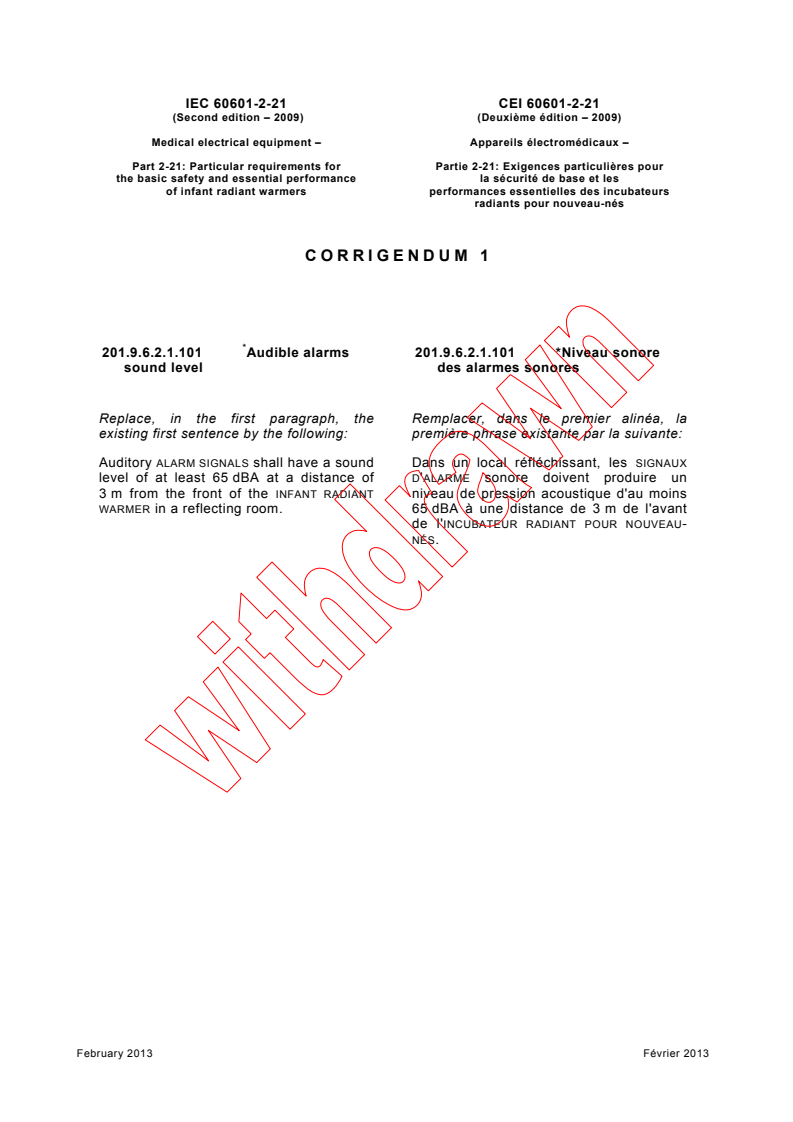
IEC 60601-2-21 CEI 60601-2-21
(Second edition – 2009) (Deuxième édition – 2009)
Medical electrical equipment – Appareils électromédicaux –
Part 2-21: Particular requirements for Partie 2-21: Exigences particulières pour
the basic safety and essential performance la sécurité de base et les
of infant radiant warmers performances essentielles des incubateurs
radiants pour nouveau-nés
CO RRI G ENDU M 1
*
201.9.6.2.1.101 Audible alarms 201.9.6.2.1.101 *Niveau sonore
sound level des alarmes sonores
Replace, in the first paragra
...
This May Also Interest You
- Standard34 pagesEnglish languagesale 15% off
- Standard36 pagesFrench languagesale 15% off
ISO 80601-2-67:2026 This document is applicable to the basic safety and essential performance of oxygen conserving equipment, hereafter referred to as ME equipment, in combination with its accessories intended to conserve supplemental oxygen by delivering gas intermittently and synchronized with the patient's inspiratory cycle, when used in the home healthcare environment. Oxygen conserving equipment is typically used by a lay operator.
NOTE 1 Conserving equipment can also be used in professional health care facilities.
This document is also applicable to conserving equipment that is incorporated with other equipment.
EXAMPLE Conserving equipment combined with a pressure regulator[4], an oxygen concentrator[12] or liquid oxygen equipment[7].
This document is also applicable to those accessories intended by their manufacturer to be connected to conserving equipment, where the characteristics of those accessories can affect the basic safety or essential performance of the conserving equipment.
This document is intended to clarify the difference in operation of various conserving equipment models, as well as between the operation of conserving equipment and continuous flow oxygen equipment, by requiring standardized performance testing and labelling.
This document is only applicable to active devices (e.g. pneumatically or electrically powered) and is not applicable to non-active devices (e.g. reservoir cannulas).
If a clause or subclause is specifically intended to be applicable to ME equipment only, or to ME systems only, the title and content of that clause or subclause will say so. If that is not the case, the clause or subclause applies both to ME equipment and to ME systems, as relevant.
Hazards inherent in the intended physiological function of ME equipment or ME systems within the scope of this document are not covered by specific requirements in this document except in IEC 60601‑1:2005+AMD1:2012+AMD2:2020, 7.2.13 and 8.4.1.
NOTE 2 Additional information can be found in IEC 60601-1:2005+AMD1:2012+AMD2:2020, 4.2.
- Standard59 pagesEnglish languagesale 15% off
- Standard62 pagesFrench languagesale 15% off
ISO 80601-2-74:2026 This document applies to the basic safety and essential performance of a humidifier, also hereafter referred to as ME equipment, in combination with its accessories, the combination also hereafter referred to as ME system.
This document is also applicable to those accessories intended by their manufacturer to be connected to a humidifier where the characteristics of those accessories can affect the basic safety or essential performance of the humidifier.
EXAMPLE 1 Heated breathing tubes (heated-wire breathing tubes) or ME equipment intended to control these heated breathing tubes (heated breathing tube controllers).
NOTE 2 Heated breathing tubes and their controllers are ME equipment and are subject to the requirements of IEC 60601‑1.
NOTE 3 ISO 5367 specifies other safety and performance requirements for breathing tubes.
This document includes requirements for the different medical uses of humidification, such as invasive ventilation, non-invasive ventilation, nasal high-flow therapy, and obstructive sleep apnoea therapy, as well as humidification therapy for tracheostomy patients.
NOTE 4 A humidifier can be integrated into other equipment. When this is the case, the requirements of the other equipment also apply to the humidifier.
EXAMPLE 2 Heated humidifier incorporated into a critical care ventilator where ISO 80601‑2-12 also applies.
EXAMPLE 3 Heated humidifier incorporated into a homecare ventilator for dependent patients where ISO 80601‑2‑72 also applies.
EXAMPLE 4 Heated humidifier incorporated into sleep apnoea therapy equipment where ISO 80601‑2‑70 also applies.
EXAMPLE 5 Heated humidifier incorporated into ventilatory support equipment where either ISO 80601-2-79 or ISO 80601-2-80 also apply.
EXAMPLE 6 Heated humidifier incorporated into respiratory high-flow therapy equipment where ISO 80601‑2‑90 also applies.
This document also includes requirements for an active HME (heat and moisture exchanger), ME equipment which actively adds heat and moisture to increase the humidity level of the gas delivered from the HME to the patient. This document is not applicable to a passive HME, which returns a portion of the expired moisture and heat of the patient to the respiratory tract during inspiration without adding heat or moisture.
NOTE 5 ISO 9360‑1 and ISO 9360‑2 specify safety and performance requirements for a passive HME.
NOTE 6 If a clause or subclause is specifically intended to be applicable to ME equipment only, or to ME systems only, the title and content of that clause or subclause will say so. If that is not the case, the clause or subclause applies both to ME equipment and to ME systems, as relevant.
Hazards inherent in the intended physiological function of ME equipment or ME systems within the scope of this document are not covered by specific requirements in this document except in IEC 60601‑1:2005+AMD1:2012+AMD2:2020, 7.2.13 and 8.4.1.
NOTE 7 Additional information can be found in IEC 60601‑1:2005+AMD1:2012+AMD2:2020, 4.2.
This document does not specify the requirements for cold pass-over or cold bubble-through humidification devices, the requirements for which are given in ISO 20789.
This document is not applicable to equipment commonly referred to as “room humidifiers” or humidifiers used in heating, ventilation and air conditioning systems, or humidifiers incorporated into infant incubators to humidify the chamber air (i.e., are not directly connected to the patient).
This document is not applicable to nebulizers used for the delivery of a drug to patients.
NOTE 8 ISO 27427 specifies the safety and performance requirements for nebulizers.
- Standard113 pagesEnglish languagesale 15% off
- Standard124 pagesFrench languagesale 15% off
ISO 80601-2-61:2026 This document applies to the basic safety and essential performance of pulse oximeter equipment intended for use on humans, hereafter referred to as ME equipment. This includes any part necessary for normal use, including the pulse oximeter monitor, pulse oximeter probe, and probe cable extender.
These requirements apply to pulse oximeter equipment, including pulse oximeter monitors, pulse oximeter probes and probe cable extenders regardless of their origin (i.e. including remanufactured products).
The intended use of pulse oximeter equipment includes, but is not limited to, the estimation of arterial oxygen haemoglobin saturation and pulse rate of patients in professional healthcare institutions as well as patients in the home healthcare environment and the emergency medical services environment.
If a clause or subclause is specifically intended to be applicable to ME equipment only, or to ME systems only, the title and content of that clause or subclause says so. If that is not the case, the clause or subclause applies both to ME equipment and to ME systems, as relevant.
Hazards inherent in the intended physiological function of ME equipment or ME systems within the scope of this document are not covered by specific requirements in this document except in 201.11.1.2.2, IEC 60601-1:2005+AMD1:2012+AMD2:2020, 7.2.13 and 8.4.1.
NOTE 2 See also IEC 60601-1:2005+AMD1:2012+AMD2:2020, 4.2.
This document can also be applied to ME equipment and their accessories used for compensation or alleviation of disease, injury, or disability.
This document is not applicable to pulse oximeter equipment intended for use in laboratory research applications nor to oximeters that require a blood sample from the patient.
This document is not applicable to pulse oximeter equipment intended solely for foetal use.
This document is not applicable to remote or slave (secondary) equipment that displays SpO2 values that are located outside of the patient environment.
NOTE 3 ME equipment that provides selection between diagnostic and monitoring functions is expected to meet the appropriate requirements of this document when configured for that function.
This document is applicable to pulse oximeter equipment intended for use under extreme or uncontrolled environmental conditions outside the hospital environment or physician’s office, such as in ambulances and air transport. Additional standards can apply to pulse oximeter equipment for those environments of use.
This document is a particular standard in the IEC 60601-1 and ISO and IEC 80601 series of standards.
- Standard150 pagesEnglish languagesale 15% off
- Standard309 pagesEnglish and French languagesale 15% off
ISO 80601-2-69:2026 This document is applicable to a transit-operable and non-transit-operable oxygen concentrator. This document is applicable to an oxygen concentrator integrated into or used with other medical devices, ME equipment or ME systems.
EXAMPLE 1 An oxygen concentrator with integrated oxygen conserving equipment function or humidifier function.
EXAMPLE 2 An oxygen concentrator used with a flowmeter stand.
EXAMPLE 3 An oxygen concentrator as part of an anaesthetic system for use in areas with limited logistical supplies of electricity and anaesthetic gases[2].
EXAMPLE 4 An oxygen concentrator with an integrated liquid reservoir function or gas cylinder filling system function.
This document is also applicable to those accessories intended by their manufacturer to be connected to an oxygen concentrator, where the characteristics of those accessories can affect the basic safety or essential performance of the oxygen concentrator.
NOTE 2 Such accessories can include, but are not limited to, masks, cannulae, extension tubing, humidifiers, carts, carrying cases, external power sources and oxygen conserving equipment.
This document does not specify requirements for oxygen concentrators for use with a medical gas pipeline system.
If a clause or subclause is specifically intended to be applicable to ME equipment only, or to ME systems only, the title and content of that clause or subclause will say so. If that is not the case, the clause or subclause applies both to ME equipment and to ME systems, as relevant.
Hazards inherent in the intended physiological function of ME equipment or ME systems within the scope of this document are not covered by specific requirements in this document except in 7.2.13 and 8.4.1 of the general standard.
NOTE 3 See also 4.2 of the general standard.
- Standard68 pagesEnglish languagesale 15% off
- Standard76 pagesFrench languagesale 15% off
This document specifies requirements for masks and accessories, including any connecting element, that are required to connect the patient-connection port of sleep apnoea breathing therapy equipment to a patient for the application of sleep apnoea breathing therapy (e.g. nasal masks, exhaust ports and headgear).
This document applies to masks and their accessories used to connect sleep apnoea breathing therapy equipment to the patient.
The requirements in this document take priority over the requirements in ISO 18190.
This document does not cover oral appliances.
NOTE This document has been prepared to address the relevant essential principles [14] and labelling principles [15] of the International Medical Devices Regulators Forum (IMDRF) as indicated in Annex I.
- Standard36 pagesEnglish languagesale 15% off
- Standard37 pagesFrench languagesale 15% off
ISO 80601-2-70:2025 This document is applicable to the basic safety and essential performance of sleep apnoea breathing therapy equipment, hereafter referred to as ME equipment, intended to alleviate the symptoms of patients who suffer from obstructive sleep apnoea by delivering a therapeutic breathing pressure to the respiratory tract of the patient. Sleep apnoea breathing therapy equipment is intended for use in the home healthcare environment by lay operators as well as in professional healthcare institutions.
Sleep apnoea breathing therapy equipment is not considered to utilize a physiologic closed-loop-control system unless it uses a physiological patient variable to adjust the therapy settings.
This document excludes sleep apnoea breathing therapy equipment intended for use with neonates.
This document is applicable to ME equipment or an ME system intended for those patients who are not dependent on artificial ventilation. This document is not applicable to ME equipment or an ME system intended for those patients who are dependent on artificial ventilation such as patients with central sleep apnoea.
This document is also applicable to those accessories intended by their manufacturer to be connected to sleep apnoea breathing therapy equipment, where the characteristics of those accessories can affect the basic safety or essential performance of the sleep apnoea breathing therapy equipment.
Masks and application accessories intended for use during sleep apnoea breathing therapy are additionally addressed by ISO 17510. Refer to Figure AA.1 for items covered further under this document.
If a clause or subclause is specifically intended to be applicable to ME equipment only, or to ME systems only, the title and content of that clause or subclause will say so. If that is not the case, the clause or subclause applies both to ME equipment and to ME systems, as relevant.
Hazards inherent in the intended physiological function of ME equipment or ME systems within the scope of this document are not covered by specific requirements in this document except in 7.2.13 and 8.4.1 of the general standard.
NOTE 2 See also 4.2 of the general standard.
This document does not specify the requirements for:
– ventilators or accessories intended for critical care ventilators for ventilator-dependent patients, which are given in ISO 80601‑2‑12.
– ventilators or accessories intended for anaesthetic applications, which are given in ISO 80601-2-13.
– ventilators or accessories intended for home care ventilators for ventilator-dependent patients, which are given in ISO 80601-2-72.
– ventilators or accessories intended for emergency and transport, which are given in ISO 80601-2-84.
– ventilators or accessories intended for home-care ventilatory support, which are given in ISO 80601‑2-79 and ISO 80601‑2‑80.
– high-frequency ventilators[23], which are given in ISO 80601-2-87.
– respiratory high flow equipment, which are given in ISO 80601‑2‑90;
NOTE 3 ISO 80601-2-80 ventilatory support equipment can incorporate high-flow therapy operational mode, but such a mode is only for spontaneously breathing patients.
– user-powered resuscitators, which are given in ISO 10651-4;
– gas-powered emergency resuscitators, which are given in ISO 10651-5;
– oxygen therapy constant flow ME equipment; and
– cuirass or “iron-lung” ventilation equipment.
- Standard78 pagesEnglish languagesale 15% off
- Standard83 pagesFrench languagesale 15% off
This document specifies general interface requirements for small-bore connectors that form part of a medical device or accessory that conveys liquids or gases to a patient. This document also identifies the applications for which these small-bore connectors are intended to be used, which include, but are not limited to:
- respiratory;
- enteral;
- limb cuff inflation;
- neural;
- intravascular or hypodermic;
- other use cases utilizing an ISO 80369-7 small-bore connector.
This document provides the methodology to assess non-interconnectable characteristics of small-bore connectors based on their inherent design in order to reduce the risk of misconnections between medical devices or between accessories for different applications as specified in this document as well as those that can be developed under future parts of the ISO and IEC 80369 series.
NOTE Clause A.2 contains guidance or rationale for this Clause.
- Standard41 pagesEnglish languagesale 15% off
- Standard41 pagesFrench languagesale 15% off
NOTE 1 There is guidance or rationale for this subclause contained in Clause AA.2.
This document applies to the basic safety and essential performance of ventilatory support equipment, as defined in 201.3.302, for ventilatory insufficiency, as defined in 201.3.302, hereafter also referred to as ME equipment, in combination with its accessories:
- intended for use in the home healthcare environment;
NOTE 2 In the home healthcare environment, the supply mains driving the ventilatory support equipment is often not reliable.
NOTE 3 Such ventilatory support equipment can also be used in professional health care facilities.
- intended for use by a lay operator;
- intended for use with patients who have ventilatory insufficiency or failure, the most fragile of which would likely experience injury with the loss of this artificial ventilation;
- intended for transit-operable use; and
- not intended for patients who are dependent on artificial ventilation for their immediate life support.
EXAMPLE 1 Patients with moderate to severe chronic obstructive pulmonary disease (COPD), moderate amyotrophic lateral sclerosis (ALS), severe bronchopulmonary dysplasia or muscular dystrophy.
Ventilatory support equipment is not considered to use a physiologic closed-loop control system unless it uses a physiological patient variable to adjust the artificial ventilation therapy settings.
This document is also applicable to those accessories intended by their manufacturer to be connected to the ventilator breathing system of ventilatory support equipment for ventilatory insufficiency, where the characteristics of those accessories can affect the basic safety or essential performance of the ventilatory support equipment for ventilatory insufficiency.
EXAMPLE 2 Breathing sets, connectors, water traps, expiratory valve, humidifier, breathing system filter, external electrical power source, distributed alarm system.
If a clause or subclause is specifically intended to be applicable to ME equipment only, or to ME systems only, the title and content of that clause or subclause will say so. If that is not the case, the clause or subclause applies both to ME equipment and to ME systems, as relevant.
Hazards inherent in the intended physiological function of ME equipment or ME systems within the scope of this document are not covered by specific requirements in this document except in IEC 60601‑1:2005+AMD1:2012+AMD2:2020, 7.2.13 and 8.4.1.
NOTE 4 Additional information can be found in IEC 60601‑1:2005+AMD1:2012+AMD2:2020, 4.2.
NOTE 5 See ISO/TR 21954 for guidance on the selection of the appropriate ventilator for a given patient.
This document does not specify the requirements for:
- ventilators or accessories for ventilator-dependent patients intended for critical care applications, which are given in ISO 80601‑2‑12;
- ventilators or accessories intended for anaesthetic applications, which are given in ISO 80601‑2‑13;
- ventilators or accessories intended for the emergency medical services environment, which are given in ISO 80601‑2‑84;
- ventilators or accessories intended for ventilator-dependent patients in the home healthcare environment, which are given in ISO 80601‑2‑72;
- ventilatory support equipment or accessories intended for ventilatory impairment, which are given in ISO 80601‑2‑79;
- sleep apnoea therapy ME equipment, which are given in ISO 80601‑2‑70;
- high-frequency jet ventilators (HFJVs), which are given in ISO 80601‑2‑87;
- high-frequency oscillatory ventilators (HFOVs);
- respiratory high flow equipment, which are given in ISO 80601‑2‑90;
NOTE 6 Ventilatory support equipment can incorporate high-flow therapy operational mode, but such a mode is only for spontaneously breathing patients.
- user-powered resuscitators, which are given in ISO 10651-4;
- gas-powered emergency resuscitators, which are given in ISO 10651-5;
- oxygen therapy constant flow ME equipment; and
- cuirass or “iron-lung” ventilation equipment.
- Standard120 pagesEnglish languagesale 15% off
- Standard130 pagesFrench languagesale 15% off
NOTE 1 There is guidance or rationale for this subclause contained in Clause AA.2.
This document applies to the basic safety and essential performance of ventilatory support equipment, as defined in 201.3.302, for ventilatory impairment, as defined in 201.3.300, hereafter also referred to as ME equipment, in combination with its accessories:
- intended for use in the home healthcare environment;
NOTE 2 In the home healthcare environment, the supply mains driving the ventilatory support equipment is often not reliable.
NOTE 3 Such ventilatory support equipment can also be used in professional health care facilities.
- intended for use by a lay operator;
- intended for use with patients who have ventilatory impairment, the most fragile of these patients, would not likely experience injury with the loss of this artificial ventilation; and
- not intended for patients who are dependent on artificial ventilation for their immediate life support.
EXAMPLE 1 Patients with mild to moderate chronic obstructive pulmonary disease (COPD).
Ventilatory support equipment is not considered to use a physiologic closed-loop control system unless it uses a physiological patient variable to adjust the artificial ventilation therapy settings.
This document is also applicable to those accessories intended by their manufacturer to be connected to the breathing system of ventilatory support equipment for ventilatory impairment, where the characteristics of those accessories can affect the basic safety or essential performance of the ventilatory support equipment for ventilatory impairment.
EXAMPLE 2 Breathing sets, connectors, water traps, expiratory valve, humidifier, breathing system filter, external electrical power source, distributed alarm system.
If a clause or subclause is specifically intended to be applicable to ME equipment only, or to ME systems only, the title and content of that clause or subclause will say so. If that is not the case, the clause or subclause applies both to ME equipment and to ME systems, as relevant.
Hazards inherent in the intended physiological function of ME equipment or ME systems within the scope of this document are not covered by specific requirements in this document except in IEC 60601‑1:2005+AMD1:2012+AMD2:2020, 7.2.13 and 8.4.1.
NOTE 4 Additional information can be found in IEC 60601‑1:2005+AMD1:2012+AMD2:2020, 4.2.
NOTE 5 See ISO/TR 21954 for guidance on the selection of the appropriate ventilator for a given patient.
This document does not specify the requirements for:
- ventilators or accessories for ventilator-dependent patients intended for critical care applications, which are given in ISO 80601‑2‑12;
- ventilators or accessories intended for anaesthetic applications, which are given in ISO 80601‑2‑13;
- ventilators or accessories intended for the emergency medical services environment, which are given in ISO 80601‑2‑84;
- ventilators or accessories intended for ventilator-dependent patients in the home healthcare environment, which are given in ISO 80601‑2‑72;
- ventilatory support equipment or accessories intended for ventilatory insufficiency, which are given in ISO 80601‑2‑80;
- sleep apnoea therapy ME equipment, which are given in ISO 80601‑2‑70;
- high-frequency jet ventilators (HFJVs), which are given in ISO 80601‑2‑87;
- high-frequency oscillatory ventilators (HFOVs);
- respiratory high flow equipment, which are given in ISO 80601‑2‑90;
NOTE 6 Ventilatory support equipment can incorporate high-flow therapy operational mode, but such a mode is only for spontaneously breathing patients.
- user-powered resuscitators, which are given in ISO 10651-4;
- gas-powered emergency resuscitators, which are given in ISO 10651-5;
- oxygen therapy constant flow ME equipment; and
- cuirass or “iron-lung” ventilation equipment.
- Standard107 pagesEnglish languagesale 15% off
- Standard107 pagesFrench languagesale 15% off