

IEC TR 62271-307:2024
(Main)High-voltage switchgear and controlgear - Part 307: Guidance for the extension of validity of type tests of AC metal and solid-insulation enclosed switchgear and controlgear for rated voltages above 1 kV and up to and including 52 kV
General Information
- Abstract
IEC TR 62271-307:2024 refers to prefabricated metal-enclosed and solid-insulation enclosed (both hereinafter called enclosed) switchgear and controlgear assemblies for alternating current of rated voltages above 1 kV and up to and including 52 kV as specified in IEC 62271‑200 and IEC 62271‑201, and to other equipment included in the same enclosure with any possible mutual influence. This second edition cancels and replaces the first edition published in 2015. This edition constitutes a technical revision.
This edition includes the following significant technical changes with respect to the previous edition:
a) Structure of document updated.
b) Updated references to IEC 62271-200:2021 and IEC 62271-1:2017.
c) Addition of criteria for the extension of validity of type tests from functional unit(s) with a different insulating gas to the functional unit to be validated.
d) Figure 5 for the validation of a design modification was added.
e) Clause B.7 for the extension of validity of type test for a GIS with insulation gas A to insulation gas B was added.
- Status
- Published
- Publication Date
- 04-Dec-2024
- Technical Committee
- SC 17C - Assemblies
- Drafting Committee
- MT 43 - TC 17/SC 17C/MT 43
- Current Stage
- PPUB - Publication issued
- Start Date
- 05-Dec-2024
- Completion Date
- 08-Nov-2024
Buy Documents
IEC TR 62271-307:2024 - High-voltage switchgear and controlgear - Part 307: Guidance for the extension of validity of type tests of AC metal and solid-insulation enclosed switchgear and controlgear for rated voltages above 1 kV and up to and including 52 kV/5/2024
IEC TR 62271-307:2024 RLV - High-voltage switchgear and controlgear - Part 307: Guidance for the extension of validity of type tests of AC metal and solid-insulation enclosed switchgear and controlgear for rated voltages above 1 kV and up to and including 52 kV Released:12/5/2024
Overview
IEC TR 62271-307:2024 is a Technical Report from the IEC that provides guidance for the extension of validity of type tests for AC metal-enclosed and solid‑insulation enclosed high‑voltage switchgear and controlgear with rated voltages above 1 kV and up to and including 52 kV. It explains when and how existing type-test reports can be applied to other functional units, design variants or insulating gases, and documents validation processes for assemblies and design modifications.
This second edition (2024) updates the document structure, aligns references to IEC 62271‑200:2021 and IEC 62271‑1:2017, and adds criteria for extending validity between different insulating gases (see Clause B.7). It also adds a figure illustrating validation of design modifications (Figure 5).
Key Topics and Technical Requirements
- Scope and applicability for prefabricated metal‑enclosed and solid‑insulation enclosed assemblies (per IEC 62271‑200 / IEC 62271‑201).
- Extension criteria for major test categories:
- Dielectric tests (clearances, insulating supports, gas properties)
- Temperature‑rise / continuous current tests (conductor layout, ventilation, gas thermal performance)
- Mechanical tests (shutters, interlocks, removable parts)
- Short‑time and peak withstand current tests (mechanical and thermal stresses)
- Making and breaking tests (arc behavior, contact geometry)
- Internal arc fault tests (compartment volume, pressure relief, material in arc initiation zone)
- Calculation methods referenced for validation: temperature rise, electric field, mechanical stress, short‑circuit current, and internal arc pressure rise.
- Information requirements for extension dossiers (design data, test reports, calculations).
- Validation workflows for:
- Extending a test report to other functional units (situation a)
- Family validation by selection of test objects (situation b)
- Validating an assembly from existing reports (situation c)
- Validation of design modifications (situation d)
- Informative Annex A (rationale) and Annex B (practical examples) support interpretation and implementation.
Practical Applications and Users
This TR is intended for:
- Switchgear manufacturers seeking to apply existing type‑tests across product families or after design changes.
- Test laboratories and certification bodies that assess the scope of type‑test validity and approve extensions.
- Design and application engineers evaluating alternative insulating gases (e.g., GIS gas changes) or modified assemblies.
- Asset owners, utilities and specifiers who rely on validated type‑tests to justify equipment selection, safety and compliance.
Using this guidance reduces unnecessary retesting, supports product family strategies, and helps manage transitions (e.g., gas substitutions) while maintaining safety and performance.
Related Standards
- IEC 62271‑1 (Common specifications)
- IEC 62271‑200 / IEC 62271‑201 (Specifics for metal‑enclosed and solid‑insulation enclosed equipment)
- Relevant test and design standards referenced within the TR
Keywords: IEC TR 62271‑307:2024, high‑voltage switchgear, controlgear, extension of validity, type tests, GIS, insulating gas, dielectric tests, internal arc.
Relations
- Effective Date
- 05-Sep-2023
Buy Documents
IEC TR 62271-307:2024 - High-voltage switchgear and controlgear - Part 307: Guidance for the extension of validity of type tests of AC metal and solid-insulation enclosed switchgear and controlgear for rated voltages above 1 kV and up to and including 52 kV/5/2024
IEC TR 62271-307:2024 RLV - High-voltage switchgear and controlgear - Part 307: Guidance for the extension of validity of type tests of AC metal and solid-insulation enclosed switchgear and controlgear for rated voltages above 1 kV and up to and including 52 kV Released:12/5/2024
Get Certified
Connect with accredited certification bodies for this standard

IMQ S.p.A. (Certification)
Italian electrical product certification.

SLG Prüf- und Zertifizierungs GmbH
German testing and certification body.

UL Solutions
Global safety science company with testing, inspection and certification.
Sponsored listings
Frequently Asked Questions
IEC TR 62271-307:2024 is a technical report published by the International Electrotechnical Commission (IEC). Its full title is "High-voltage switchgear and controlgear - Part 307: Guidance for the extension of validity of type tests of AC metal and solid-insulation enclosed switchgear and controlgear for rated voltages above 1 kV and up to and including 52 kV". This standard covers: IEC TR 62271-307:2024 refers to prefabricated metal-enclosed and solid-insulation enclosed (both hereinafter called enclosed) switchgear and controlgear assemblies for alternating current of rated voltages above 1 kV and up to and including 52 kV as specified in IEC 62271‑200 and IEC 62271‑201, and to other equipment included in the same enclosure with any possible mutual influence. This second edition cancels and replaces the first edition published in 2015. This edition constitutes a technical revision. This edition includes the following significant technical changes with respect to the previous edition: a) Structure of document updated. b) Updated references to IEC 62271-200:2021 and IEC 62271-1:2017. c) Addition of criteria for the extension of validity of type tests from functional unit(s) with a different insulating gas to the functional unit to be validated. d) Figure 5 for the validation of a design modification was added. e) Clause B.7 for the extension of validity of type test for a GIS with insulation gas A to insulation gas B was added.
IEC TR 62271-307:2024 refers to prefabricated metal-enclosed and solid-insulation enclosed (both hereinafter called enclosed) switchgear and controlgear assemblies for alternating current of rated voltages above 1 kV and up to and including 52 kV as specified in IEC 62271‑200 and IEC 62271‑201, and to other equipment included in the same enclosure with any possible mutual influence. This second edition cancels and replaces the first edition published in 2015. This edition constitutes a technical revision. This edition includes the following significant technical changes with respect to the previous edition: a) Structure of document updated. b) Updated references to IEC 62271-200:2021 and IEC 62271-1:2017. c) Addition of criteria for the extension of validity of type tests from functional unit(s) with a different insulating gas to the functional unit to be validated. d) Figure 5 for the validation of a design modification was added. e) Clause B.7 for the extension of validity of type test for a GIS with insulation gas A to insulation gas B was added.
IEC TR 62271-307:2024 is classified under the following ICS (International Classification for Standards) categories: 29.130.10 - High voltage switchgear and controlgear. The ICS classification helps identify the subject area and facilitates finding related standards.
IEC TR 62271-307:2024 has the following relationships with other standards: It is inter standard links to IEC TR 62271-307:2015. Understanding these relationships helps ensure you are using the most current and applicable version of the standard.
IEC TR 62271-307:2024 is available in PDF format for immediate download after purchase. The document can be added to your cart and obtained through the secure checkout process. Digital delivery ensures instant access to the complete standard document.
Standards Content (Sample)
IEC TR 62271-307 ®
Edition 2.0 2024-12
TECHNICAL
REPORT
colour
inside
High- voltage switchgear and controlgear –
Part 307: Guidance for the extension of validity of type tests of AC metal and
solid-insulation enclosed switchgear and controlgear for rated voltages above
1 kV and up to and including 52 kV
All rights reserved. Unless otherwise specified, no part of this publication may be reproduced or utilized in any form
or by any means, electronic or mechanical, including photocopying and microfilm, without permission in writing from
either IEC or IEC's member National Committee in the country of the requester. If you have any questions about IEC
copyright or have an enquiry about obtaining additional rights to this publication, please contact the address below or
your local IEC member National Committee for further information.
IEC Secretariat Tel.: +41 22 919 02 11
3, rue de Varembé info@iec.ch
CH-1211 Geneva 20 www.iec.ch
Switzerland
About the IEC
The International Electrotechnical Commission (IEC) is the leading global organization that prepares and publishes
International Standards for all electrical, electronic and related technologies.
About IEC publications
The technical content of IEC publications is kept under constant review by the IEC. Please make sure that you have the
latest edition, a corrigendum or an amendment might have been published.
IEC publications search - webstore.iec.ch/advsearchform IEC Products & Services Portal - products.iec.ch
The advanced search enables to find IEC publications by a Discover our powerful search engine and read freely all the
variety of criteria (reference number, text, technical publications previews, graphical symbols and the glossary.
committee, …). It also gives information on projects, replaced With a subscription you will always have access to up to date
and withdrawn publications. content tailored to your needs.
IEC Just Published - webstore.iec.ch/justpublished
Electropedia - www.electropedia.org
Stay up to date on all new IEC publications. Just Published
The world's leading online dictionary on electrotechnology,
details all new publications released. Available online and once
containing more than 22 500 terminological entries in English
a month by email.
and French, with equivalent terms in 25 additional languages.
Also known as the International Electrotechnical Vocabulary
IEC Customer Service Centre - webstore.iec.ch/csc
(IEV) online.
If you wish to give us your feedback on this publication or need
further assistance, please contact the Customer Service
Centre: sales@iec.ch.
IEC TR 62271-307 ®
Edition 2.0 2024-12
TECHNICAL
REPORT
colour
inside
High- voltage switchgear and controlgear –
Part 307: Guidance for the extension of validity of type tests of AC metal and
solid-insulation enclosed switchgear and controlgear for rated voltages above
1 kV and up to and including 52 kV
INTERNATIONAL
ELECTROTECHNICAL
COMMISSION
ICS 29.130.10 ISBN 978-2-8327-0060-0
– 2 – IEC TR 62271-307:2024 © IEC 2024
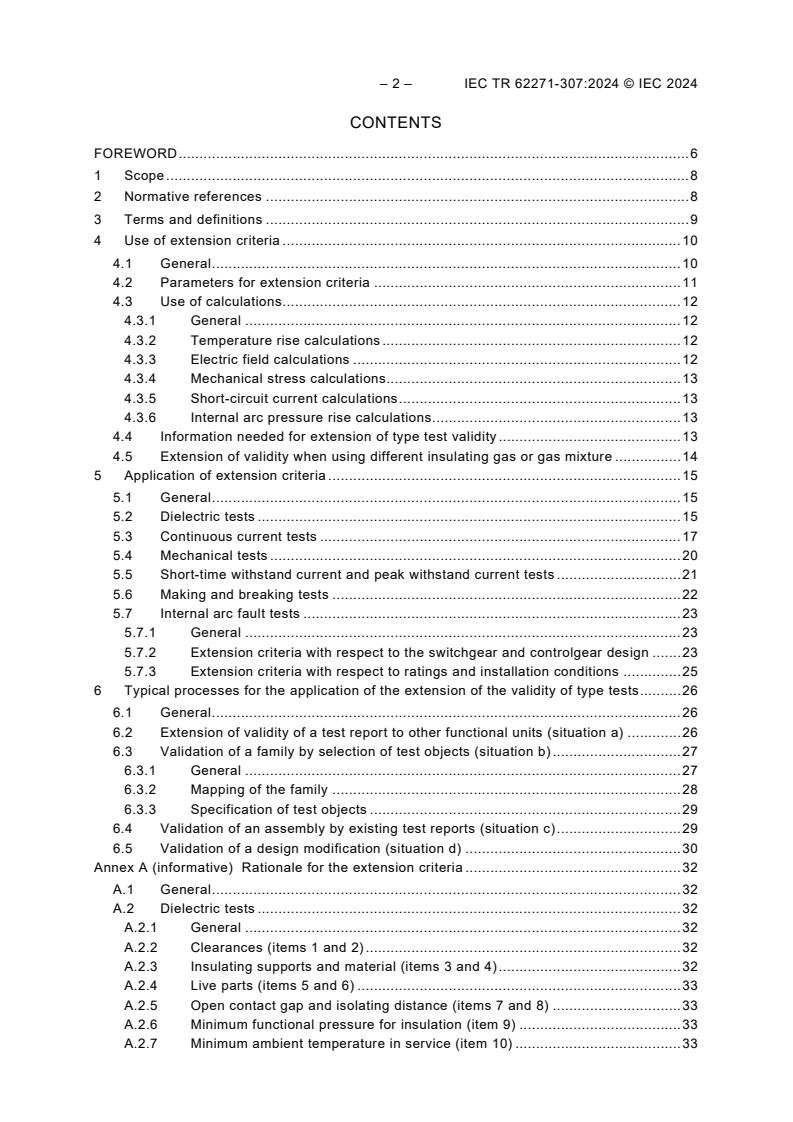
CONTENTS
FOREWORD . 6
1 Scope . 8
2 Normative references . 8
3 Terms and definitions . 9
4 Use of extension criteria . 10
4.1 General . 10
4.2 Parameters for extension criteria . 11
4.3 Use of calculations . 12
4.3.1 General . 12
4.3.2 Temperature rise calculations . 12
4.3.3 Electric field calculations . 12
4.3.4 Mechanical stress calculations. 13
4.3.5 Short-circuit current calculations . 13
4.3.6 Internal arc pressure rise calculations . 13
4.4 Information needed for extension of type test validity . 13
4.5 Extension of validity when using different insulating gas or gas mixture . 14
5 Application of extension criteria . 15
5.1 General . 15
5.2 Dielectric tests . 15
5.3 Continuous current tests . 17
5.4 Mechanical tests . 20
5.5 Short-time withstand current and peak withstand current tests . 21
5.6 Making and breaking tests . 22
5.7 Internal arc fault tests . 23
5.7.1 General . 23
5.7.2 Extension criteria with respect to the switchgear and controlgear design . 23
5.7.3 Extension criteria with respect to ratings and installation conditions . 25
6 Typical processes for the application of the extension of the validity of type tests . 26
6.1 General . 26
6.2 Extension of validity of a test report to other functional units (situation a) . 26
6.3 Validation of a family by selection of test objects (situation b) . 27
6.3.1 General . 27
6.3.2 Mapping of the family . 28
6.3.3 Specification of test objects . 29
6.4 Validation of an assembly by existing test reports (situation c) . 29
6.5 Validation of a design modification (situation d) . 30
Annex A (informative) Rationale for the extension criteria . 32
A.1 General . 32
A.2 Dielectric tests . 32
A.2.1 General . 32
A.2.2 Clearances (items 1 and 2) . 32
A.2.3 Insulating supports and material (items 3 and 4) . 32
A.2.4 Live parts (items 5 and 6) . 33
A.2.5 Open contact gap and isolating distance (items 7 and 8) . 33
A.2.6 Minimum functional pressure for insulation (item 9) . 33
A.2.7 Minimum ambient temperature in service (item 10) . 33
A.2.8 Minimum dielectric properties of insulation gas or gas mixture (item 11) . 34
A.3 Continuous current tests . 34
A.3.1 General . 34
A.3.2 Centre distance between phase conductors (item 1) . 34
A.3.3 Phase to earth distance (item 2) . 35
A.3.4 Enclosure and compartment volume (item 3) . 35
A.3.5 Pressure (density) of insulating gas (item 4) . 35
A.3.6 Conductors (items 5 and 6) . 35
A.3.7 Conductor joints and connections (items 7, 8 and 9) . 36
A.3.8 Ventilation area of partitions and enclosure (item 10) . 36
A.3.9 Power dissipation of components (item 11) . 36
A.3.10 Insulating barriers (Item 12) . 37
A.3.11 Insulating coating of conductors and enclosures (items 13 and 14) . 37
A.3.12 Insulating material in contact with conductors (item 15) . 37
A.3.13 Minimum thermal performance of gas or gas mixture (item 16) . 37
A.4 Mechanical tests . 38
A.4.1 General . 38
A.4.2 Shutter systems (item 1) . 38
A.4.3 Contacts of removable parts (item 2) . 39
A.4.4 Interlocking systems (items 3 and 4) . 39
A.5 Short-time withstand current and peak withstand current tests . 40
A.5.1 General . 40
A.5.2 Centre distance between phase conductors (item 1) . 40
A.5.3 Conductors (items 2, 5 and 6) . 40
A.5.4 Insulating conductor supports (items 3 and 4) . 41
A.5.5 Insulating material in contact with conductors (item 7) . 41
A.5.6 Enclosure, partitions or bushings (item 8) . 41
A.5.7 Contacts of removable part (item 9) . 41
A.6 Making and breaking tests . 41
A.6.1 General . 41
A.6.2 Clearance between phases and to earth (items 1 and 2) . 42
A.6.3 Enclosure and compartment volume (item 3) . 42
A.6.4 Insulating gas (item 4) . 42
A.6.5 Conductors (items 5 and 6) . 42
A.6.6 Insulating supports (items 7, 8 and 9) . 43
A.6.7 Dielectric withstand capability (item 10) . 43
A.7 Internal arc fault tests . 43
A.7.1 General . 43
A.7.2 Clearance between phases and to earth (items 1 and 2) . 43
A.7.3 Compartment volume (item 3) . 44
A.7.4 Pressure of insulating gas (item 4) . 44
A.7.5 Material in the region of arc initiation (items 5, 6, 7 and 8) . 44
A.7.6 Pressure relief opening devices (items 9, 10 and 11) . 45
A.7.7 Enclosure and compartments (items 12, 13, 14 and 15) . 45
A.8 Rationale for extension criteria with respect to arc fault ratings and
installation conditions . 45
A.8.1 General . 45
A.8.2 Rated arc fault current and duration (items 1 and 2) . 46
A.8.3 Rated voltage (item 3) . 46
– 4 – IEC TR 62271-307:2024 © IEC 2024
A.8.4 Rated frequency (item 4) . 46
A.8.5 Arrangement of assembly (items 5, 6 and 7) . 46
A.8.6 Indoor or outdoor installation (item 8) . 46
A.8.7 Type of accessibility (item 9) . 46
A.8.8 Accessible sides (item 10) . 47
Annex B (informative) Examples for the extension of validity of type tests . 48
B.1 General . 48
B.2 Design modification of a cable terminal in air insulated switchgear and
controlgear (AIS) . 48
B.3 Design modification of an AIS bus riser functional unit by adding current
transformers . 49
B.4 Design modification of a key-lock in the door of a functional unit of AIS . 51
B.5 Extension of a ring-main unit (RMU) of gas insulated type to functional units
with larger width . 51
B.6 Extension of a family of gas insulated switchgear and controlgear (GIS) by a
functional unit . 53
B.7 Extension of a GIS with insulation gas-A to insulation gas-B . 55
Bibliography . 57
Figure 1 – Example for extension of validity of test report for dielectric testing with
regard to different construction design variants and insulation gases of the same family
of switchgear and controlgear . 14
Figure 2 – Extension of validity of one test report – Situation a) . 27
Figure 3 – Validation of a family by selection of appropriate test objects – Situation b) . 28
Figure 4 – Validation of actual assembly with existing test reports – Situation c) . 30
Figure 5 – Validation of a design modification – Situation d) . 31
Figure B.1 – Cable terminals in the connection compartment of AIS. 48
Figure B.2 – Addition of block-type current transformers into the bus riser functional
unit of AIS . 50
Figure B.3 – Special type of key-lock as replacement for a standard key-lock in the
door of AIS . 51
Figure B.4 – Front view and top cross-sectional view of a combination of functional
units making up a RMU . 52
Figure B.5 – Cross-section of two different functional units of GIS . 54
Table 1 – Examples of design parameters. 11
Table 2 – Extension criteria for dielectric withstand tests . 15
Table 3 – Extension criteria for continuous current performance . 18
Table 4 – Extension criteria for mechanical performance . 20
Table 5 – Extension criteria for short-time and peak withstand current performance . 21
Table 6 – Extension criteria for making and breaking capacity . 22
Table 7 – Extension criteria for internal arc fault withstand performance . 24
Table 8 – Extension criteria for internal arc fault classification with respect to
installation conditions . 25
Table B.1 – Affirmation of extension criteria with respect to dielectric withstand
performance of a functional unit . 49
Table B.2 – Affirmation of extension criteria with respect to short-time current
withstand performance of a functional unit . 50
Table B.3 – Affirmation of extension criteria with respect to continuous current
performance of a RMU . 53
Table B.4 – Affirmation of extension criteria with respect to internal arc classification of
a GIS circuit-breaker compartment . 54
Table B.5 – Reference test results for lightning impulse voltage tests . 55
Table B.6 – Reference test results for power-frequency voltage tests . 55
Table B.7 – Extension criteria for dielectric withstand tests . 56
– 6 – IEC TR 62271-307:2024 © IEC 2024
INTERNATIONAL ELECTROTECHNICAL COMMISSION
____________
HIGH-VOLTAGE SWITCHGEAR AND CONTROLGEAR –
Part 307: Guidance for the extension of validity of type tests of
AC metal and solid-insulation enclosed switchgear and controlgear
for rated voltages above 1 kV and up to and including 52 kV
FOREWORD
1) The International Electrotechnical Commission (IEC) is a worldwide organization for standardization comprising
all national electrotechnical committees (IEC National Committees). The object of IEC is to promote international
co-operation on all questions concerning standardization in the electrical and electronic fields. To this end and
in addition to other activities, IEC publishes International Standards, Technical Specifications, Technical Reports,
Publicly Available Specifications (PAS) and Guides (hereafter referred to as "IEC Publication(s)"). Their
preparation is entrusted to technical committees; any IEC National Committee interested in the subject dealt with
may participate in this preparatory work. International, governmental and non-governmental organizations liaising
with the IEC also participate in this preparation. IEC collaborates closely with the International Organization for
Standardization (ISO) in accordance with conditions determined by agreement between the two organizations.
2) The formal decisions or agreements of IEC on technical matters express, as nearly as possible, an international
consensus of opinion on the relevant subjects since each technical committee has representation from all
interested IEC National Committees.
3) IEC Publications have the form of recommendations for international use and are accepted by IEC National
Committees in that sense. While all reasonable efforts are made to ensure that the technical content of IEC
Publications is accurate, IEC cannot be held responsible for the way in which they are used or for any
misinterpretation by any end user.
4) In order to promote international uniformity, IEC National Committees undertake to apply IEC Publications
transparently to the maximum extent possible in their national and regional publications. Any divergence between
any IEC Publication and the corresponding national or regional publication shall be clearly indicated in the latter.
5) IEC itself does not provide any attestation of conformity. Independent certification bodies provide conformity
assessment services and, in some areas, access to IEC marks of conformity. IEC is not responsible for any
services carried out by independent certification bodies.
6) All users should ensure that they have the latest edition of this publication.
7) No liability shall attach to IEC or its directors, employees, servants or agents including individual experts and
members of its technical committees and IEC National Committees for any personal injury, property damage or
other damage of any nature whatsoever, whether direct or indirect, or for costs (including legal fees) and
expenses arising out of the publication, use of, or reliance upon, this IEC Publication or any other IEC
Publications.
8) Attention is drawn to the Normative references cited in this publication. Use of the referenced publications is
indispensable for the correct application of this publication.
9) IEC draws attention to the possibility that the implementation of this document may involve the use of (a)
patent(s). IEC takes no position concerning the evidence, validity or applicability of any claimed patent rights in
respect thereof. As of the date of publication of this document, IEC had not received notice of (a) patent(s), which
may be required to implement this document. However, implementers are cautioned that this may not represent
the latest information, which may be obtained from the patent database available at https://patents.iec.ch. IEC
shall not be held responsible for identifying any or all such patent rights.
IEC TR 62271-307 has been prepared by subcommittee 17C: Assemblies, of IEC technical
committee 17: High-voltage switchgear and controlgear. It is a Technical Report.
This second edition cancels and replaces the first edition published in 2015. This edition
constitutes a technical revision.
This edition includes the following significant technical changes with respect to the previous
edition:
a) Structure of document updated.
b) Updated references to IEC 62271-200:2021 and IEC 62271-1:2017.
c) Addition of criteria for the extension of validity of type tests from functional unit(s) with a
different insulating gas to the functional unit to be validated.
d) Figure 5 for the validation of a design modification was added.
e) Clause B.7 for the extension of validity of type test for a GIS with insulation gas A to
insulation gas B was added.
The text of this Technical Report is based on the following documents:
Draft Report on voting
17C/939/DTR 17C/957/RVDTR
Full information on the voting for its approval can be found in the report on voting indicated in
the above table.
The language used for the development of this Technical Report is English.
This document was drafted in accordance with ISO/IEC Directives, Part 2, and developed in
accordance with ISO/IEC Directives, Part 1 and ISO/IEC Directives, IEC Supplement, available
at www.iec.ch/members_experts/refdocs. The main document types developed by IEC are
described in greater detail at www.iec.ch/publications.
A list of all parts in the IEC 62271 series, published under the general title High-voltage
switchgear and controlgear, can be found on the IEC website.
This Technical Report is to be used in conjunction with IEC 62271-1:2017, IEC 62271-200:2021,
and IEC 62271-201:2014 to which it refers and which are applicable unless otherwise specified.
The committee has decided that the contents of this document will remain unchanged until the
stability date indicated on the IEC website under webstore.iec.ch in the data related to the
specific document. At this date, the document will be
• reconfirmed,
• withdrawn, or
• revised.
IMPORTANT – The "colour inside" logo on the cover page of this document indicates
that it contains colours which are considered to be useful for the correct understanding
of its contents. Users should therefore print this document using a colour printer.
– 8 – IEC TR 62271-307:2024 © IEC 2024
HIGH-VOLTAGE SWITCHGEAR AND CONTROLGEAR –
Part 307: Guidance for the extension of validity of type tests of
AC metal and solid-insulation enclosed switchgear and controlgear
for rated voltages above 1 kV and up to and including 52 kV
1 Scope
This part of IEC 62271, which is a Technical Report, refers to prefabricated metal-enclosed and
solid-insulation enclosed (both hereinafter called enclosed) switchgear and controlgear
assemblies for alternating current of rated voltages above 1 kV and up to and including 52 kV
as specified in IEC 62271-200 and IEC 62271-201, and to other equipment included in the same
enclosure with any possible mutual influence.
This document can be used for the extension of the validity of type tests performed on one test
object with a defined set of ratings to another switchgear and controlgear assembly of the same
family with a different set of ratings or different arrangements of components or insulating fluids.
It supports the selection of representative test objects composed of functional units of a family
of switchgear and controlgear aimed at the optimization of type tests in order to perform a
consistent conformity assessment.
The extension of validity, as this is the case for type tests, does not cover ageing, material
compatibility, human health toxicity or impact on the environment, among others. It is the task
of the manufacturer and the user to check those aspects are covered for the technical validation
of an assembly design.
The extension of validity of type tests according to a component standard is outside the scope
of this document.
This document utilises a combination of sound technical and physical principles, manufacturer
and user experience, and calculations to establish guidance for the extension of validity of type
tests, covering various design and rating aspects.
2 Normative references
The following documents are referred to in the text in such a way that some or all of their content
constitutes requirements of this document. For dated references, only the edition cited applies.
For undated references, the latest edition of the referenced document (including any
amendments) applies.
IEC 60050-151:2001, International Electrotechnical Vocabulary (IEV) – Part 151: Electrical and
magnetic devices
IEC 60050-441:1984, International Electrotechnical Vocabulary (IEV) – Part 441: Switchgear,
controlgear and fuses
IEC 60050-441:1984/AMD1:2000
IEC 62271-1:2017, High-voltage switchgear and controlgear – Part 1: Common specifications
for alternating current switchgear and controlgear
IEC 62271-1:2017/AMD1:2021
IEC 62271-200:2021, High-voltage switchgear and controlgear – Part 200: AC metal-enclosed
switchgear and controlgear for rated voltages above 1 kV and up to and including 52 kV
IEC 62271-201:2014, High-voltage switchgear and controlgear – Part 201: AC solid-insulation
enclosed switchgear and controlgear for rated voltages above 1 kV and up to and including
52 kV
3 Terms and definitions
For the purposes of this document, the terms and definitions given in IEC 60050-151,
IEC 60050-441, IEC 62271-1, IEC 62271-200, IEC 62271-201 and the following apply.
ISO and IEC maintain terminology databases for use in standardization at the following
addresses:
• IEC Electropedia: available at https://www.electropedia.org/
• ISO Online browsing platform: available at https://www.iso.org/obp
NOTE Some standard terms and definitions are recalled here for ease of reference.
3.1
family of switchgear and controlgear
functional units designed to be physically combined in assemblies and providing a range of
ratings and characteristics (e.g. current, voltage, degree of protection)
3.2
functional unit
part of an assembly comprising the main circuits, earthing circuit and auxiliary
circuits that contribute to the fulfilment of a single function
Note 1 to entry: Functional units can be distinguished according to the function for which they are intended, e.g.
incoming unit, through which electrical energy is normally fed into the assembly, outgoing unit, through which
electrical energy is normally supplied to one or more external circuits.
[SOURCE: IEC 62271-200:2021, 3.5.103]
3.3
assembly
a combination of switchgear and/or controlgear completely
assembled with all internal electrical and mechanical interconnections
Note 1 to entry: An assembly is comprised of one or more functional units.
[SOURCE: IEC 60050-441:1984, 441-12-01, modified – addition of a note to entry.]
3.4
component
essential part of the high-voltage or earthing circuits of an assembly which
serves a specific function (e.g. circuit-breaker, disconnector, switch, fuse, earthing switch,
instrument transformer, bushing, busbar)
[SOURCE: IEC 62271-200:2021, 3.5.104]
3.5
main circuit
all the high-voltage conductive parts of an assembly included in a circuit
which is intended to carry the rated continuous current
[SOURCE: IEC 62271-200:2021, 3.5.105]
– 10 – IEC TR 62271-307:2024 © IEC 2024
3.6
test object
item submitted to a test, including any accessories, unless otherwise specified
[SOURCE: IEC 60050-151:2001, 151-16-28]
3.7
extension (of validity) criterion
criterion based on the design parameters, which can be applied to validate the performance of
an untested assembly based on the positive results of test(s) performed on another assembly
for a specific characteristic
3.8
homogeneous group
group of functional units of a family of switchgear and controlgear having design parameters
which allows for a specific characteristic extending the validity of the result of a type test
performed on one member of the group to the rest of the group
3.9
clearance
the distance between two conductive parts along a string stretched the shortest way between
these conductive parts
[SOURCE: IEC 60050-441:1984, 441-17-31]
3.10
clearance between phases
the clearance between any conductive parts of adjacent phases
3.11
clearance to earth
clearance between any conductive parts and any parts which are earthed or intended to be
earthed
[SOURCE: IEC 60050-441:1984, 441-17-33]
3.12
centre distance between phases
distance between the centres of adjacent phase conductors
3.13
continuous current performance
ability of the gas or gas mixture to carry heat losses from inner components
to the walls of the gas filled compartment for identical construction design
4 Use of extension criteria
4.1 General
Because of the variety of types of functional units, ratings and possible combinations of
components, it is not practical to perform type tests with all the possible assemblies of enclosed
switchgear and controlgear. Therefore, the performance of a particular assembly can be
evaluated by reference to type test reports of other assemblies of the same family of switchgear
and controlgear. Subclauses 5.1 to 5.7 provide for each kind of type test (or characteristic) a
non-exhaustive list of design parameters, to be analysed for extension of validity.
The analysis is intended to be based on sound technical and physical principles and can also
be supported by calculations, if applicable.
Each design parameter of the assembly to be assessed listed in the respective column of the
tables in 5.1 to 5.7 is intended to be compared with the design parameter of the already type
tested assembly applying the acceptance criteria provided in the same tables. The affirmation
of every extension criterion allows a test performed on one assembly having specific
characteristics to be applied to another assembly of the same family with different
characteristics (e.g. some of the ratings or dimensions). For example, the affirmation of item (1)
in Table 2 reads: the clearance between phases of the assessed assembly is larger than or
equal to the clearance between phases of the tested assembly.
If any of the extension criteria cannot be affirmed, further evidence is required, for example by
technical arguments, calculation/simulation or specific tests. Calculations are applied in a
comparative sense as indicated in 4.3.
4.2 Parameters for extension criteria
The criteria for the extension of type tests available for a family of switchgear and controlgear
depend on a number of design parameters such as the ones listed in Table 1. Every assembly
is characterized by its own set of design parameters.
Component parameters are design and operating parameters that influence the capability of
the component with respect to its own ratings. These parameters are controlled and specified
by the manufacturer of the component. All applications of a component within a family of
switchgear and controlgear are expected to meet the manufacturer's specified tolerances for
component parameters.
NOTE Some switching devices, such as earthing switches, can be unavailable as a separate component and will
be tested inside an assembly according to their relevant component standards.
Table 1 – Examples of design parameters
Design parameter Related to
Raw material of a contact in a switching device Component
Geometry of a contact in a switching device Component
Opening and closing speed of a switching device Component
Allowable rebound time of a switching device Component
Clearance between phases Component / assembly
Clearance to earth Component / assembly
Pressure of insulating gas in a compartment Component / assembly
Insulation gas or gas mixture Component / assembly
Insulation class of all insulation parts in contact with conductors Component / assembly
Length of unsupported section of busbar Assembly
Arrangement of components Assembly
NOTE This table includes examples only; it is not intended to be complete.
Assembly parameters are those parameters that are directly influenced by the design of an
assembly of a family of switchgear and controlgear, however, they can depend on component
parameters. Assembly parameters are considered within the scope of this document.
– 12 – IEC TR 62271-307:2024 © IEC 2024
4.3 Use of calculations
4.3.1 General
For the purpose of this document, calculations and simulations can only be applied in a
comparative sense using calculation results available for a type tested assembly and results
obtained for another assembly that is under investigation. The comparison is always based on
the design parameters and the acceptance criteria in Table 2 to Table 7.
In many cases the performance of a given assembly, with respect to a particular type test,
cannot be evaluated by a single value of a design parameter due to the complexity of the design.
For example, the clearance between phase conductors might vary considerably along the
current path. Calculations have the potential to compare the respective design parameter with
spatial resolution supporting a comparison using technical arguments and expertise.
Depending on the type test and the particular design parameter, sometimes a simple model of
the relevant switchgear and controlgear might be sufficient using an analytical or empirical
formula, and sometimes a complete three-dimensional simulation model might be required
using a complex numerical tool provided the results of the simulation tool are consistent and
repeatable.
The validation of software tools and calculation methods themselves is outside the scope of
this document. Some of these calculation methods are briefly mentioned below with their
particular characteristics.
4.3.2 Temperature rise calculations
IEC TR 60890 [1] provides calculation procedures for low-voltage assemblies, which could
also be applied to high-voltage switchgear and controlgear assemblies having regard to the
particular limitations of this calculation method. The calculation is done in dependence of the
total power generated inside, the area of enclosure walls and their mounting conditions, the
number of horizontal partitions, and the area of ventilation openings. The temperature of air
inside the tested compartment is the parameter to compare.
For complex geometries, a comparison can be performed by thermal networks, where the whole
assembly with all components is divided into discrete elements built from heat generating
resistors and heat conducting and convection elements. Also, more complex computational fluid
dynamics (CFD) tools can be applied requiring a complete three-dimensional model of the
switchgear and controlgear.
CIGRE TB 830 [2] provides guidelines for state-of-the-art temperature rise modelling of
medium- and high-voltage switchgear and controlgear.
4.3.3 Electric field calculations
The dielectric withstand performance of two assemblies can be assessed by an electric field
simulation of both designs comparing the resulting electric field strengths. Finite element (FE)
or finite volume (FV) software tools exist, which allow simulating even complex three-
dimensional geometries. A CIGRE publication [3] concludes in particular with respect to electric
field calculations: "Simulation is an excellent and instructive tool… to predict performance,
where performance is proven by tests on similar designs (interpolation)".
This document does not provide information for extrapolation but only for interpolation of
characteristics, for example extending validity to higher values of electric field strengths is not
covered.
___________
Numbers in square brackets refer to the Bibliography.
4.3.4 Mechanical stress calculations
Simulation software for operating mechanisms exists and can give information on the
mechanical stress on parts of the mechanism. However, it is not feasible to assess the
mechanical endurance by these programs. Therefore, at the present state of available
simulation software, it is better if simulations for the extension of validity of mechanical type
tests are not used. Nevertheless, the strength of single parts or mechanical supports can be
assessed by such calculations.
4.3.5 Short-circuit current calculations
With respect to the short-time current withstand performance, guidance and calculation
formulas for bus-bar designs can be found in the guideline on short-circuit withstand of low-
voltage assemblies IEC TR 61117 [4], and on the calculation of the short-circuit current effects
in IEC 60865-1 [5] and IEC TR 60865-2 [6]. This includes the determination of mutual
electromagnetic forces between phase conductors and the resulting mechanical stress which is
able to bend bus-bar conductors and damage insulators. The mechanical stress on busbars
and forces on the supports can be assessed through stress analysis programs, when applying
the calculated electromagnetic forces. Additionally, a calculation of the thermal stress using
I t can be done when the assessment is made for a lower I and higher t than the ones
k k k k
tested.
4.3.6 Internal arc pressure rise calculations
The comparison of the pressure withstand performance of two assemblies can be substantiated
by pressure rise calculations for the compartments under investigation. CIGRE TB 602 [7]
provides some guidance on simulation tools for this purpose. The calculations are able to
provide the pressure rise in the compartments under investigation, taking into account the
opening of pressure relief devices. An assessment of the strength of the enclosure walls under
the pressure stress can be made for simple geometries using calculation formulae, otherwise
using finite element mechanical stress analysis.
The flow of hot gases expelled from the compartment can be simulated by CFD programs,
however, it is, at the time of the publication of this document, not possible to simulate the
ignition of indicators, which is an important acceptance criterion in the type test.
Therefore, such programs have limited applications for the extension of type test validity.
CIGRE TB 686 [8] provides some examples of pressure rise calculations.
4.4 Information needed for extension of type test validity
For the extension of type test validity, similar information on the assembly under evaluation are
collected as it is required for type test objects according to IEC 62271-200:2021, 7.1.3 or
IEC 62271-201:2014, 6.1.3. In addition, Table 2 to Table 7 given in Clause 5 can be used to
provide for each characteristic, i.e. type test relevant information on design parameters of the
tested object and of the functional units under evaluation. Only the tables that are relevant for
the characteristic under evaluation need to be used.
The applicable type test reports of the tested assembly are to be considered as far as they
concern the comparison of the two assemblies.
Ideally, the manufacturer will provide relevant information on design parameters of the tested
object as listed in Table 2 to Table 7 of Clause 5 to be included in any type test report in addition
to the information required by the product standards.
Most often single value design parameters are not sufficient to perform the evaluation. In this
case relevant drawings of both objects can be necessary.
– 14 – IEC TR 62271-307:2024 © IEC 2024
If a comparison is substantiated by calculations, numerical data or by formula, the type of
software used, the reference numb
...
IEC TR 62271-307 ®
Edition 2.0 2024-12
REDLINE VERSION
TECHNICAL
REPORT
colour
inside
High- voltage switchgear and controlgear –
Part 307: Guidance for the extension of validity of type tests of AC metal and
solid-insulation enclosed switchgear and controlgear for rated voltages above
1 kV and up to and including 52 kV
All rights reserved. Unless otherwise specified, no part of this publication may be reproduced or utilized in any form
or by any means, electronic or mechanical, including photocopying and microfilm, without permission in writing from
either IEC or IEC's member National Committee in the country of the requester. If you have any questions about IEC
copyright or have an enquiry about obtaining additional rights to this publication, please contact the address below or
your local IEC member National Committee for further information.
IEC Secretariat Tel.: +41 22 919 02 11
3, rue de Varembé info@iec.ch
CH-1211 Geneva 20 www.iec.ch
Switzerland
About the IEC
The International Electrotechnical Commission (IEC) is the leading global organization that prepares and publishes
International Standards for all electrical, electronic and related technologies.
About IEC publications
The technical content of IEC publications is kept under constant review by the IEC. Please make sure that you have the
latest edition, a corrigendum or an amendment might have been published.
IEC publications search - webstore.iec.ch/advsearchform IEC Products & Services Portal - products.iec.ch
The advanced search enables to find IEC publications by a Discover our powerful search engine and read freely all the
variety of criteria (reference number, text, technical publications previews, graphical symbols and the glossary.
committee, …). It also gives information on projects, replaced With a subscription you will always have access to up to date
and withdrawn publications. content tailored to your needs.
IEC Just Published - webstore.iec.ch/justpublished
Electropedia - www.electropedia.org
Stay up to date on all new IEC publications. Just Published
The world's leading online dictionary on electrotechnology,
details all new publications released. Available online and once
containing more than 22 500 terminological entries in English
a month by email.
and French, with equivalent terms in 25 additional languages.
Also known as the International Electrotechnical Vocabulary
IEC Customer Service Centre - webstore.iec.ch/csc
(IEV) online.
If you wish to give us your feedback on this publication or need
further assistance, please contact the Customer Service
Centre: sales@iec.ch.
IEC TR 62271-307 ®
Edition 2.0 2024-12
REDLINE VERSION
TECHNICAL
REPORT
colour
inside
High- voltage switchgear and controlgear –
Part 307: Guidance for the extension of validity of type tests of AC metal and
solid-insulation enclosed switchgear and controlgear for rated voltages above
1 kV and up to and including 52 kV
INTERNATIONAL
ELECTROTECHNICAL
COMMISSION
ICS 29.130.10 ISBN 978-2-8327-0085-3
– 2 – IEC TR 62271-307:2024 RLV © IEC 2024
CONTENTS
FOREWORD . 6
1 General .
1 Scope . 8
2 Normative references . 8
3 Terms and definitions . 9
4 Use of extension criteria . 11
4.1 General . 11
4.2 Parameters for extension criteria . 11
4.3 Use of calculations . 12
4.3.1 General . 12
4.3.2 Temperature rise calculations . 13
4.3.3 Electric field calculations . 13
4.3.4 Mechanical stress calculations. 13
4.3.5 Short-circuit current calculations . 13
4.3.6 Internal arc pressure rise calculations . 14
4.4 Information needed for extension of type test validity . 14
4.5 Extension of validity when using different insulating gas or gas mixture . 14
5 Application of extension criteria . 15
5.1 General . 15
5.2 Dielectric tests . 15
5.3 Temperature rise Continuous current tests . 18
5.4 Mechanical tests . 20
5.5 Short-time withstand current and peak withstand current tests . 21
5.6 Making and breaking tests . 22
5.7 Internal arc fault tests . 23
5.7.1 General . 23
5.7.2 Extension criteria with respect to the switchgear and controlgear design . 24
5.7.3 Extension criteria with respect to ratings and installation conditions . 25
6 Extending Typical processes for the application of the extension of the validity of
type tests . 26
6.1 General . 26
6.2 Extension of validity of a test report to other functional units (situation a) . 26
6.3 Validation of a family by selection of test objects (situation b) . 29
6.3.1 General . 29
6.3.2 Mapping of the family . 30
6.3.3 Specification of test objects . 31
6.4 Validation of an assembly by existing test reports (situation c) . 31
6.5 Validation of a design modification (situation d) . 33
Annex A (informative) Rationale for the extension criteria . 35
A.1 General . 35
A.2 Dielectric tests . 35
A.2.1 General . 35
A.2.2 Clearances (items 1 and 2) . 35
A.2.3 Insulating supports and material (items 3 and 4) . 35
A.2.4 Live parts (items 5 and 6) . 36
A.2.5 Open contact gap and isolating distance (items 7 and 8) . 36
A.2.6 Minimum functional pressure for insulation (item 9) . 36
A.2.7 Minimum ambient temperature in service (item 10) . 36
A.2.8 Minimum dielectric properties of insulation gas or gas mixture (item 11) . 37
A.3 Temperature rise Continuous current tests . 37
A.3.1 General . 37
A.3.2 Centre distance between phase conductors (item 1) . 37
A.3.3 Phase to earth distance (item 2) . 38
A.3.4 Enclosure and compartment volume (item 3) . 38
A.3.5 Pressure (density) of insulating gas (item 4) . 38
A.3.6 Conductors (items 5 and 6) . 38
A.3.7 Conductor joints and connections (items 7, 8 and 9) . 39
A.3.8 Ventilation area of partitions and enclosure (item 10) . 39
A.3.9 Power dissipation of components (item 11) . 39
A.3.10 Insulating barriers (Item 12) . 40
A.3.11 Insulating coating of conductors and enclosures (items 13 and 14) . 40
A.3.12 Insulating material in contact with conductors (item 15) . 40
A.3.13 Minimum thermal performance of gas or gas mixture (item 16) . 40
A.4 Mechanical tests . 41
A.4.1 General . 41
A.4.2 Shutter systems (item 1) . 41
A.4.3 Contacts of removable parts (item 2) . 42
A.4.4 Interlocking systems (items 3 and 4) . 42
A.5 Short-time withstand current and peak withstand current tests . 43
A.5.1 General . 43
A.5.2 Centre distance between phase conductors (item 1) . 43
A.5.3 Conductors (items 2, 5 and 6) . 43
A.5.4 Insulating conductor supports (items 3 and 4) . 44
A.5.5 Insulating material in contact with conductors (item 7) . 44
A.5.6 Enclosure, partitions or bushings (item 8) . 44
A.5.7 Contacts of removable part (item 9) . 44
A.6 Making and breaking tests . 44
A.6.1 General . 44
A.6.2 Clearance between phases and to earth (items 1 and 2) . 45
A.6.3 Enclosure and compartment volume (item 3) . 45
A.6.4 Insulating gas (item 4) . 45
A.6.5 Conductors (items 5 and 6) . 45
A.6.6 Insulating supports (items 7, 8 and 9) . 46
A.6.7 Dielectric withstand capability (item 10) . 46
A.7 Internal arc fault tests . 46
A.7.1 General . 46
A.7.2 Clearance between phases and to earth (items 1 and 2) . 46
A.7.3 Compartment volume (item 3) . 47
A.7.4 Pressure of insulating gas (item 4) . 47
A.7.5 Material in the region of arc initiation (items 5, 6, 7 and 8) . 47
A.7.6 Pressure relief opening devices (items 9, 10 and 11) . 48
A.7.7 Enclosure and compartments (items 12, 13, 14 and 15) . 48
A.8 Rationale for extension criteria with respect to arc fault ratings and
installation conditions . 48
A.8.1 General . 48
– 4 – IEC TR 62271-307:2024 RLV © IEC 2024
A.8.2 Rated arc fault current and duration (items 1 and 2) . 49
A.8.3 Rated voltage (item 3) . 49
A.8.4 Rated frequency (item 4) . 49
A.8.5 Arrangement of assembly (items 5, 6 and 7) . 49
A.8.6 Indoor or outdoor installation (item 8) . 49
A.8.7 Type of accessibility (item 9) . 49
A.8.8 Accessible sides (item 10) . 50
Annex B (informative) Examples for the extension of validity of type tests . 51
B.1 General . 51
B.2 Design modification of a cable terminal in air insulated switchgear and
controlgear (AIS) . 51
B.3 Design modification of an AIS bus riser functional unit by adding current
transformers . 52
B.4 Design modification of a key-lock in the door of a functional unit of AIS . 54
B.5 Extension of a ring-main unit (GIS) (RMU) of gas insulated type to functional
units with larger width . 54
B.6 Extension of a family of gas insulated switchgear and controlgear (GIS) by a
functional unit . 56
B.7 Extension of a GIS with insulation gas-A to insulation gas-B . 58
Bibliography . 60
Figure 1 – Example for extension of validity of test report for dielectric testing with
regard to different construction design variants and insulation gases of the same family
of switchgear and controlgear . 15
Figure 2 – Extension of validity of one test report – Situation a) . 28
Figure 3 – Validation of a family by selection of appropriate test objects – Situation b) . 30
Figure 4 – Validation of actual assembly with existing test reports – Situation c) . 33
Figure 5 – Validation of a design modification – Situation d) . 34
Figure B.1 – Cable terminals in the connection compartment of AIS. 51
Figure B.2 – Addition of block-type current transformers into the bus riser functional
unit of AIS . 53
Figure B.3 – Special type of key-lock as replacement for a standard key-lock in the
door of AIS . 54
Figure B.4 – Front view and top cross-sectional view of a combination of functional
units making up a RMU . 55
Figure B.5 – Cross-section of two different functional units of GIS . 57
Table 1 – Examples of design parameters. 12
Table 2 – Extension criteria for dielectric withstand performance tests . 16
Table 3 – Extension criteria for temperature rise continuous current performance . 19
Table 4 – Extension criteria for mechanical performance . 21
Table 5 – Extension criteria for short-time and peak withstand current performance . 22
Table 6 – Extension criteria for making and breaking capacity . 23
Table 7 – Extension criteria for internal arc fault withstand performance . 24
Table 8 – Extension criteria for internal arc fault classification with respect to
installation conditions . 25
Table B.1 – Affirmation of extension criteria with respect to dielectric withstand
performance of a functional unit . 52
Table B.2 – Affirmation of extension criteria with respect to short-time current
withstand performance of a functional unit . 53
Table B.3 – Affirmation of extension criteria with respect to temperature rise
continuous current performance of a RMU . 56
Table B.4 – Affirmation of extension criteria with respect to internal arc classification of
a GIS circuit-breaker compartment . 57
Table B.5 – Reference test results for lightning impulse voltage tests . 58
Table B.6 – Reference test results for power-frequency voltage tests . 58
Table B.7 – Extension criteria for dielectric withstand tests . 59
– 6 – IEC TR 62271-307:2024 RLV © IEC 2024
INTERNATIONAL ELECTROTECHNICAL COMMISSION
____________
HIGH-VOLTAGE SWITCHGEAR AND CONTROLGEAR –
Part 307: Guidance for the extension of validity of type tests of
AC metal and solid-insulation enclosed switchgear and controlgear
for rated voltages above 1 kV and up to and including 52 kV
FOREWORD
1) The International Electrotechnical Commission (IEC) is a worldwide organization for standardization comprising
all national electrotechnical committees (IEC National Committees). The object of IEC is to promote international
co-operation on all questions concerning standardization in the electrical and electronic fields. To this end and
in addition to other activities, IEC publishes International Standards, Technical Specifications, Technical Reports,
Publicly Available Specifications (PAS) and Guides (hereafter referred to as "IEC Publication(s)"). Their
preparation is entrusted to technical committees; any IEC National Committee interested in the subject dealt with
may participate in this preparatory work. International, governmental and non-governmental organizations liaising
with the IEC also participate in this preparation. IEC collaborates closely with the International Organization for
Standardization (ISO) in accordance with conditions determined by agreement between the two organizations.
2) The formal decisions or agreements of IEC on technical matters express, as nearly as possible, an international
consensus of opinion on the relevant subjects since each technical committee has representation from all
interested IEC National Committees.
3) IEC Publications have the form of recommendations for international use and are accepted by IEC National
Committees in that sense. While all reasonable efforts are made to ensure that the technical content of IEC
Publications is accurate, IEC cannot be held responsible for the way in which they are used or for any
misinterpretation by any end user.
4) In order to promote international uniformity, IEC National Committees undertake to apply IEC Publications
transparently to the maximum extent possible in their national and regional publications. Any divergence between
any IEC Publication and the corresponding national or regional publication shall be clearly indicated in the latter.
5) IEC itself does not provide any attestation of conformity. Independent certification bodies provide conformity
assessment services and, in some areas, access to IEC marks of conformity. IEC is not responsible for any
services carried out by independent certification bodies.
6) All users should ensure that they have the latest edition of this publication.
7) No liability shall attach to IEC or its directors, employees, servants or agents including individual experts and
members of its technical committees and IEC National Committees for any personal injury, property damage or
other damage of any nature whatsoever, whether direct or indirect, or for costs (including legal fees) and
expenses arising out of the publication, use of, or reliance upon, this IEC Publication or any other IEC
Publications.
8) Attention is drawn to the Normative references cited in this publication. Use of the referenced publications is
indispensable for the correct application of this publication.
9) IEC draws attention to the possibility that the implementation of this document may involve the use of (a)
patent(s). IEC takes no position concerning the evidence, validity or applicability of any claimed patent rights in
respect thereof. As of the date of publication of this document, IEC had not received notice of (a) patent(s), which
may be required to implement this document. However, implementers are cautioned that this may not represent
the latest information, which may be obtained from the patent database available at https://patents.iec.ch. IEC
shall not be held responsible for identifying any or all such patent rights.
This redline version of the official IEC Standard allows the user to identify the changes
made to the previous edition TR 62271-307:2015. A vertical bar appears in the margin
wherever a change has been made. Additions are in green text, deletions are in
strikethrough red text.
IEC TR 62271-307 has been prepared by subcommittee 17C: Assemblies, of IEC technical
committee 17: High-voltage switchgear and controlgear. It is a Technical Report.
This second edition cancels and replaces the first edition published in 2015. This edition
constitutes a technical revision.
This edition includes the following significant technical changes with respect to the previous
edition:
a) Structure of document updated.
b) Updated references to IEC 62271-200:2021 and IEC 62271-1:2017.
c) Addition of criteria for the extension of validity of type tests from functional unit(s) with a
different insulating gas to the functional unit to be validated.
d) Figure 5 for the validation of a design modification was added.
e) Clause B.7 for the extension of validity of type test for a GIS with insulation gas A to
insulation gas B was added.
The text of this Technical Report is based on the following documents:
Draft Report on voting
17C/939/DTR 17C/957/RVDTR
Full information on the voting for its approval can be found in the report on voting indicated in
the above table.
The language used for the development of this Technical Report is English.
This document was drafted in accordance with ISO/IEC Directives, Part 2, and developed in
accordance with ISO/IEC Directives, Part 1 and ISO/IEC Directives, IEC Supplement, available
at www.iec.ch/members_experts/refdocs. The main document types developed by IEC are
described in greater detail at www.iec.ch/publications.
A list of all parts in the IEC 62271 series, published under the general title High-voltage
switchgear and controlgear, can be found on the IEC website.
This Technical Report is to be used in conjunction with IEC 62271-1:2017, IEC 62271-200:2021,
and IEC 62271-201:2014 to which it refers and which are applicable unless otherwise specified.
The committee has decided that the contents of this document will remain unchanged until the
stability date indicated on the IEC website under webstore.iec.ch in the data related to the
specific document. At this date, the document will be
• reconfirmed,
• withdrawn, or
• revised.
IMPORTANT – The "colour inside" logo on the cover page of this document indicates
that it contains colours which are considered to be useful for the correct understanding
of its contents. Users should therefore print this document using a colour printer.
– 8 – IEC TR 62271-307:2024 RLV © IEC 2024
HIGH-VOLTAGE SWITCHGEAR AND CONTROLGEAR –
Part 307: Guidance for the extension of validity of type tests of
AC metal and solid-insulation enclosed switchgear and controlgear
for rated voltages above 1 kV and up to and including 52 kV
1 General
1 Scope
This part of IEC 62271, which is a Technical Report, refers to prefabricated metal-enclosed and
solid-insulation enclosed (both hereinafter called enclosed) switchgear and controlgear
assemblies for alternating current of rated voltages above 1 kV and up to and including 52 kV
as specified in IEC 62271-200 and IEC 62271-201, and to other equipment included in the same
enclosure with any possible mutual influence.
This document may can be used for the extension of the validity of type tests performed on one
test object with a defined set of ratings to another switchgear and controlgear assembly of the
same family with a different set of ratings or different arrangements of components or insulating
fluids. It supports the selection of representative test objects composed of functional units of a
family of switchgear and controlgear aimed at the optimization of type tests in order to perform
a consistent conformity assessment.
The extension of validity, as this is the case for type tests, does not cover ageing, material
compatibility, human health toxicity or impact on the environment, among others. It is the task
of the manufacturer and the user to check those aspects are covered for the technical validation
of an assembly design.
The extension of validity of type tests according to a component standard is outside the scope
of this document.
This document utilises a combination of sound technical and physical principles, manufacturer
and user experience, and calculations to establish guidance for the extension of validity of type
tests, covering various design and rating aspects.
2 Normative references
The following documents are referred to in the text in such a way that some or all of their content
constitutes requirements of this document. For dated references, only the edition cited applies.
For undated references, the latest edition of the referenced document (including any
amendments) applies.
IEC 60050-151:2001, International Electrotechnical Vocabulary (IEV) – Part 151: Electrical and
magnetic devices
IEC 60050-441:1984, International Electrotechnical Vocabulary (IEV) – Part 441: Switchgear,
controlgear and fuses
IEC 60050-441:1984/AMD1:2000
IEC 62271-1:20072017, High-voltage switchgear and controlgear – Part 1: Common
specifications for alternating current switchgear and controlgear
IEC 62271-1:20072017/AMD1:20112021
IEC 62271-200:20112021, High-voltage switchgear and controlgear – Part 200: AC metal-
enclosed switchgear and controlgear for rated voltages above 1 kV and up to and including
52 kV
IEC 62271-201:2014, High-voltage switchgear and controlgear – Part 201: AC solid-insulation
enclosed switchgear and controlgear for rated voltages above 1 kV and up to and including
52 kV
3 Terms and definitions
For the purposes of this document, the terms and definitions given in IEC 60050-151,
IEC 60050-441, IEC 62271-1, IEC 62271-200, IEC 62271-201 and the following apply.
ISO and IEC maintain terminology databases for use in standardization at the following
addresses:
• IEC Electropedia: available at https://www.electropedia.org/
• ISO Online browsing platform: available at https://www.iso.org/obp
NOTE Some standard terms and definitions are recalled here for ease of reference.
2.101
switchgear and controlgear
general term covering switching devices and their combination with associated control,
measuring, protective and regulating equipment, also assemblies of such devices and
equipment with associated interconnections, accessories, enclosures and supporting structures
[SOURCE: IEC 60050-441:1984, 441-11-01]
3.1
family of switchgear and controlgear
functional units designed to be physically combined in assemblies and providing a range of
ratings and characteristics (e.g. current, voltage, degree of protection)
3.2
functional unit
part of an assembly of switchgear and controlgear comprising all the
components of the main circuits, earthing circuit and auxiliary circuits that contribute to the
fulfilment of a single function
Note 1 to entry: Functional units may can be distinguished according to the function for which they are intended,
e.g. incoming unit, through which electrical energy is normally fed into the assembly, outgoing unit, through which
electrical energy is normally supplied to one or more external circuits.
[SOURCE: IEC 60050-441:1984, 441-13-04 IEC 62271-200:2021, 3.5.103]
3.3
assembly
a combination of switchgear and/or controlgear completely
assembled with all internal electrical and mechanical interconnections
Note 1 to entry: An assembly is comprised of one or more functional units.
[SOURCE: IEC 60050-441:1984, 441-12-01, modified – addition of a note to entry.]
– 10 – IEC TR 62271-307:2024 RLV © IEC 2024
3.4
component
essential part of the high voltage or earthing circuits of metal and solid-insulation enclosed
switchgear and controlgear which serves a specific function
Note 1 to entry: Examples of components include: circuit-breaker, disconnector, switch, fuse, instrument
transformer, bushing, bus-bar.
[SOURCE: IEC 62271-200:2011, 3.113, modified – rephrasing of the definition and addition of
a note to entry.]
essential part of the high-voltage or earthing circuits of an assembly which
serves a specific function (e.g. circuit-breaker, disconnector, switch, fuse, earthing switch,
instrument transformer, bushing, busbar)
[SOURCE: IEC 62271-200:2021, 3.5.104]
3.5
main circuit
all the highvoltage conductive parts of metal and solid-insulation enclosed switchgear and
controlgear included in a circuit which is intended to carry the rated normal current
[SOURCE: IEC 60050-441:1984, 441-13-02, modified – rephrasing of the definition.]
all the high-voltage conductive parts of an assembly included in a circuit
which is intended to carry the rated continuous current
[SOURCE: IEC 62271-200:2021, 3.5.105]
3.6
test object
item submitted to a test, including any accessories, unless otherwise specified
[SOURCE: IEC 60050-151:2001, 151-16-28]
3.7
extension (of validity) criterion
criterion based on the design parameters, which can be applied to validate the performance of
an untested assembly based on the positive results of test(s) performed on another assembly
for a specific characteristic
3.8
homogeneous group
group of functional units of a family of switchgear and controlgear having design parameters
which allows for a specific characteristic extending the validity of the result of a type test
performed on one member of the group to the rest of the group
3.9
clearance
the distance between two conductive parts along a string stretched the shortest way between
these conductive parts
[SOURCE: IEC 60050-441:1984, 441-17-31]
3.10
clearance between phases
the clearance between any conductive parts of adjacent phases
[SOURCE: IEC 60050-441:1984, 441-17-32; modified – modification of the term.]
3.11
clearance to earth
clearance between any conductive parts and any parts which are earthed or intended to be
earthed
[SOURCE: IEC 60050-441:1984, 441-17-33]
3.12
centre distance between phases
distance between the centres of adjacent phase conductors
3.13
continuous current performance
ability of the gas or gas mixture to carry heat losses from inner components
to the walls of the gas filled compartment for identical construction design
4 Use of extension criteria
4.1 General
Because of the variety of types of functional units, ratings and possible combinations of
components, it is not practical to perform type tests with all the possible assemblies of enclosed
switchgear and controlgear. Therefore, the performance of a particular assembly may can be
evaluated by reference to type test reports of other assemblies of the same family of switchgear
and controlgear. Subclauses 5.1 to 5.7 provide for each kind of type test (or characteristic) a
non-exhaustive list of design parameters, which should to be analysed for extension of validity.
The analysis should is intended to be based on sound technical and physical principles and
may can also be supported by calculations, if applicable.
Each design parameter of the assembly to be assessed listed in the respective column of the
tables in 5.1 to 5.7 should is intended to be compared with the design parameter of the already
type tested assembly applying the acceptance criteria provided in the same tables. The
affirmation of every extension criterion allows a test performed on one assembly having specific
characteristics to be applied to another assembly of the same family with different
characteristics (e.g. some of the ratings or dimensions). For example, the affirmation of item (1)
in Table 2 reads: the clearance between phases of the assessed assembly is larger than or
equal to the clearance between phases of the tested assembly.
If any of the extension criteria cannot be affirmed, further evidence is required, for example by
technical arguments, calculation/simulation or specific tests. Calculations can only be are
applied in a comparative sense as indicated in 4.3.
4.2 Parameters for extension criteria
The criteria for the extension of type tests available for a family of switchgear and controlgear
depend on a number of design parameters such as the ones listed in Table 1. Every assembly
is characterized by its own set of design parameters.
Component parameters are design and operating parameters that influence the capability of
the component with respect to its own ratings. These parameters are controlled and specified
by the manufacturer of the component. All applications of a component within a family of
switchgear and controlgear should are expected to meet the manufacturer's specified
tolerances for component parameters. The extension of validity of type tests according to a
component standard is outside the scope of this Technical Report.
– 12 – IEC TR 62271-307:2024 RLV © IEC 2024
NOTE Some switching devices, such as earthing switches, may not can be available unavailable as a separate
component and need to will be tested inside an assembly according to their relevant component standards.
Table 1 – Examples of design parameters
Design parameter Related to
Raw material of a contact in a switching device Component
Geometry of a contact in a switching device Component
Opening and closing speed of a switching device Component
Allowable rebound time of a switching device Component
Clearance between phases Component / assembly
Clearance to earth Component / assembly
Pressure of insulating gas in a compartment Component / assembly
Insulation gas or gas mixture Component / assembly
Insulation class of all insulation parts in contact with conductors Component / assembly
Length of unsupported section of busbar Assembly
Arrangement of components Assembly
NOTE This table includes examples only; it is not intended to be complete.
Assembly parameters are those parameters that are directly influenced by the design of an
assembly of a family of switchgear and controlgear, however, they may can depend on
component parameters. Assembly parameters are considered within the scope of this
document.
4.3 Use of calculations
4.3.1 General
For the purpose of this document, calculations and simulations may can only be applied in a
comparative sense using calculation results available for a type tested assembly and results
obtained for another assembly that is under investigation. The comparison is always based on
the design parameters and the acceptance criteria in Table 2 to Table 7.
In many cases the performance of a given assembly, with respect to a particular type test,
cannot be evaluated by a single value of a design parameter due to the complexity of the design.
For example, the clearance between phase conductors might vary considerably along the
current path. Calculations have the potential to compare the respective design parameter with
spatial resolution supporting a comparison using technical arguments and expertise.
Depending on the type test and the particular design parameter, sometimes a simple model of
the relevant switchgear and controlgear might be sufficient using an analytical or empirical
formula, and sometimes a complete three-dimensional simulation model might be required
using a complex numerical tool provided the results of the simulation tool are consistent and
repeatable.
The validation of software tools and calculation methods themselves is outside the scope of
this document. Some of these calculation methods are briefly mentioned below with their
particular characteristics.
4.3.2 Temperature rise calculations
IEC TR 60890 [1] provides calculation procedures for low-voltage assemblies, which could
also be applied to high-voltage switchgear and controlgear assemblies having regard to the
particular limitations of this calculation method. The calculation is done in dependence of the
total power generated inside, the area of enclosure walls and their mounting conditions, the
number of horizontal partitions, and the area of ventilation openings. The temperature of air
inside the tested compartment is the parameter to compare.
For complex geometries, a comparison may can be performed by thermal networks, where the
whole assembly with all components is divided into discrete elements built from heat generating
resistors and heat conducting and convection elements. Also, more complex computational fluid
dynamics (CFD) tools may can be applied requiring a complete three-dimensional model of the
switchgear and controlgear.
CIGRE TB 830 [2] provides guidelines for state-of-the-art temperature rise modelling of
medium- and high-voltage switchgear and controlgear.
4.3.3 Electric field calculations
The dielectric withstand performance of two assemblies may can be assessed by an electric
field simulation of both designs comparing the resulting electric field strengths. Finite element
(FE) or finite volume (FV) software tools exist, which allow simulating even complex three-
dimensional geometries. A CIGRE publication [3] concludes in particular with respect to electric
field calculations: "Simulation is an excellent and instructive tool… to predict performance,
where performance is proven by tests on similar designs (interpolation)".
It may be remarked that this Technical Report This document does not provide information for
extrapolation but only for interpolation of characteristics, for example extending validity to
higher values of electric field strengths is not covered.
4.3.4 Mechanical stress calculations
Simulation software for operating mechanisms exists and can give information on the
mechanical stress on parts of the mechanism. However, it is not feasible to assess the
mechanical endurance by these programs. Therefore, at the present state of available
simulation software, it is not recommended to use better if simulations for the extension of
validity of mechanical type tests are not used. Nevertheless, the strength of single parts or
mechanical supports may can be assessed by such calculations.
4.3.5 Short-circuit current calculations
With respect to the short-time current withstand performance, guidance and calculation
formulas for bus-bar designs can be found in the guideline on short-circuit withstand of low-
voltage assemblies IEC TR 61117 [4], and on the calculation of the short-circuit current effects
in IEC 60865-1 [5] and IEC TR 60865-2 [6]. This includes the determination of mutual
electromagnetic forces between phase conductors and the resulting mechanical stress which is
able to bend bus-bar conductors and damage insulators. The mechanical stress on busbars
and forces on the supports may can be assessed through stress analysis programs, when
applying the calculated electromagnetic forces. Additionally, a calculation of the thermal stress
using I t might can be done when the assessment is made for a lower I and higher t than
k k k k
the ones tested.
___________
Numbers in square brackets refer to the Bibliography.
– 14 – IEC TR 62271-307:2024 RLV © IEC 2024
4.3.6 Internal arc pressure rise calculations
The comparison of the pressure withstand performance of two assemblies may can be
substantiated by pressure rise calculations for the compartments under investigation.
CIGRE TB 602 [7] provides some guidance on simulation tools for this purpose. The
calculations are able to provide the pressure rise in the compartments under consideration of
investigation, taking into account the openi
...