

IEC TR 62453-42:2016
(Main)Field device tool (FDT) interface specification - Part 42: Object model integration profile - Common Language Infrastructure
- Abstract
IEC TR 62453-42:2016(E), which is a technical report, defines how the common FDT principles are implemented based on the .NET technology, including the object behaviour and object interaction via .NET interfaces. This document specifies FDT version 2.0.
- Status
- Published
- Publication Date
- 25-Apr-2016
- Technical Committee
- SC 65E - Devices and integration
- Drafting Committee
- WG 4 - Field device tool interface specification
- Current Stage
- PPUB - Publication issued - 60 Publication
- Start Date
- 26-Apr-2016
- Due Date
- 31-Mar-2016
- Completion Date
- 31-Mar-2016
Overview
IEC TR 62453-42:2016 is a key technical report published by the International Electrotechnical Commission (IEC) that addresses the integration of Field Device Tool (FDT) interface specifications within the .NET Common Language Infrastructure (CLI). Specifically, this document provides guidance on implementing the FDT object model using .NET technology, focusing on interaction via .NET interfaces and ensuring interoperability in industrial automation environments. As part of the IEC 62453 series, this report pertains to FDT version 2.0, enabling more flexible and vendor-independent device configuration and management.
Key Topics
- FDT and .NET Integration: Describes how the abstract FDT object model can be realized using the .NET framework, outlining object behaviors, interface requirements, and standardized interaction patterns.
- Object Behavior and Interaction: Details the expected behaviors for field device objects and their interactions using standardized .NET interfaces.
- DTM (Device Type Manager) Implementation: Covers business logic, user interface integration, data persistence, parameter access, communication handling, and modularity within the .NET context.
- System Topology Management: Explains concepts for managing network and device configurations, topology scanning, and connectivity in industrial automation systems.
- Data Handling and Security: Discusses support for data persistence, audit trails, localization, and security features such as code access and assembly validation within .NET environments.
- Workflows and Lifecycle Management: Provides guidance on instantiation, configuration, data storage, multi-user access, and lifecycle management for field device components and their user interfaces.
Applications
IEC TR 62453-42:2016 delivers significant value to stakeholders in process automation and factory automation by providing a unified approach for integrating and managing field devices. Practical applications include:
- Device Management: Enables seamless configuration, diagnostics, and maintenance of a wide variety of field devices through standardized .NET-based interfaces.
- System Integration: Facilitates interoperability between products from different vendors by defining common data models and interaction protocols using the .NET CLI.
- Software Development: Supports developers in designing FDT-compliant applications and DTMs that run efficiently on both 32-bit and 64-bit .NET platforms.
- Operational Efficiency: Streamlines workflows such as device parameterization, data exchange, user management, and network topology adjustments in complex automation systems.
- Security and Auditability: Provides mechanisms for code security, user access control, and maintaining detailed audit trails, ensuring compliance and traceability.
Related Standards
IEC TR 62453-42:2016 is part of a broader suite of international standards and related resources for device integration and industrial communication, including:
- IEC 62453 Series: Comprehensive standards for Field Device Tool (FDT) interface specifications covering various aspects of interoperability and communication.
- IEC 61158 and IEC 61784: Standards for fieldbus and industrial network communication protocols.
- IEC 62541 (OPC UA): Specification for open platform communications and interoperability in automation environments.
- IEC 61010 and IEC 61326: Standards relating to safety and electromagnetic compatibility of measurement and control equipment.
By aligning with IEC TR 62453-42:2016 and related standards, organizations can leverage improved interoperability, flexibility, and efficiency in managing and integrating complex automation environments through standardized FDT and .NET CLI approaches. For further information or the latest updates, consult the official IEC webstore or contact your local IEC member body.
Get Certified
Connect with accredited certification bodies for this standard

BSI Group
BSI (British Standards Institution) is the business standards company that helps organizations make excellence a habit.

DVS-ZERT GmbH
German welding certification society.

CARES (UK Certification Authority for Reinforcing Steels)
UK certification for reinforcing steels and construction.
Sponsored listings
Frequently Asked Questions
IEC TR 62453-42:2016 is a technical report published by the International Electrotechnical Commission (IEC). Its full title is "Field device tool (FDT) interface specification - Part 42: Object model integration profile - Common Language Infrastructure". This standard covers: IEC TR 62453-42:2016(E), which is a technical report, defines how the common FDT principles are implemented based on the .NET technology, including the object behaviour and object interaction via .NET interfaces. This document specifies FDT version 2.0.
IEC TR 62453-42:2016(E), which is a technical report, defines how the common FDT principles are implemented based on the .NET technology, including the object behaviour and object interaction via .NET interfaces. This document specifies FDT version 2.0.
IEC TR 62453-42:2016 is classified under the following ICS (International Classification for Standards) categories: 25.040.40 - Industrial process measurement and control; 35.100.05 - Multilayer applications; 35.110 - Networking. The ICS classification helps identify the subject area and facilitates finding related standards.
IEC TR 62453-42:2016 is available in PDF format for immediate download after purchase. The document can be added to your cart and obtained through the secure checkout process. Digital delivery ensures instant access to the complete standard document.
Standards Content (Sample)
IEC TR 62453-42 ®
Edition 1.0 2016-04
TECHNICAL
REPORT
colour
inside
Field device tool (FDT) interface specification –
Part 42: Object model integration profile – Common Language Infrastructure
All rights reserved. Unless otherwise specified, no part of this publication may be reproduced or utilized in any form
or by any means, electronic or mechanical, including photocopying and microfilm, without permission in writing from
either IEC or IEC's member National Committee in the country of the requester. If you have any questions about IEC
copyright or have an enquiry about obtaining additional rights to this publication, please contact the address below or
your local IEC member National Committee for further information.
IEC Central Office Tel.: +41 22 919 02 11
3, rue de Varembé Fax: +41 22 919 03 00
CH-1211 Geneva 20 info@iec.ch
Switzerland www.iec.ch
About the IEC
The International Electrotechnical Commission (IEC) is the leading global organization that prepares and publishes
International Standards for all electrical, electronic and related technologies.
About IEC publications
The technical content of IEC publications is kept under constant review by the IEC. Please make sure that you have the
latest edition, a corrigenda or an amendment might have been published.
IEC Catalogue - webstore.iec.ch/catalogue Electropedia - www.electropedia.org
The stand-alone application for consulting the entire The world's leading online dictionary of electronic and
bibliographical information on IEC International Standards, electrical terms containing 20 000 terms and definitions in
Technical Specifications, Technical Reports and other English and French, with equivalent terms in 15 additional
documents. Available for PC, Mac OS, Android Tablets and languages. Also known as the International Electrotechnical
iPad. Vocabulary (IEV) online.
IEC publications search - www.iec.ch/searchpub IEC Glossary - std.iec.ch/glossary
The advanced search enables to find IEC publications by a 65 000 electrotechnical terminology entries in English and
variety of criteria (reference number, text, technical French extracted from the Terms and Definitions clause of
committee,…). It also gives information on projects, replaced IEC publications issued since 2002. Some entries have been
and withdrawn publications. collected from earlier publications of IEC TC 37, 77, 86 and
CISPR.
IEC Just Published - webstore.iec.ch/justpublished
Stay up to date on all new IEC publications. Just Published IEC Customer Service Centre - webstore.iec.ch/csc
details all new publications released. Available online and If you wish to give us your feedback on this publication or
also once a month by email. need further assistance, please contact the Customer Service
Centre: csc@iec.ch.
IEC TR 62453-42 ®
Edition 1.0 2016-04
TECHNICAL
REPORT
colour
inside
Field device tool (FDT) interface specification –
Part 42: Object model integration profile – Common Language Infrastructure
INTERNATIONAL
ELECTROTECHNICAL
COMMISSION
ICS 25.040.40; 35.100.05; 35.110 ISBN 978-2-8322-3226-2
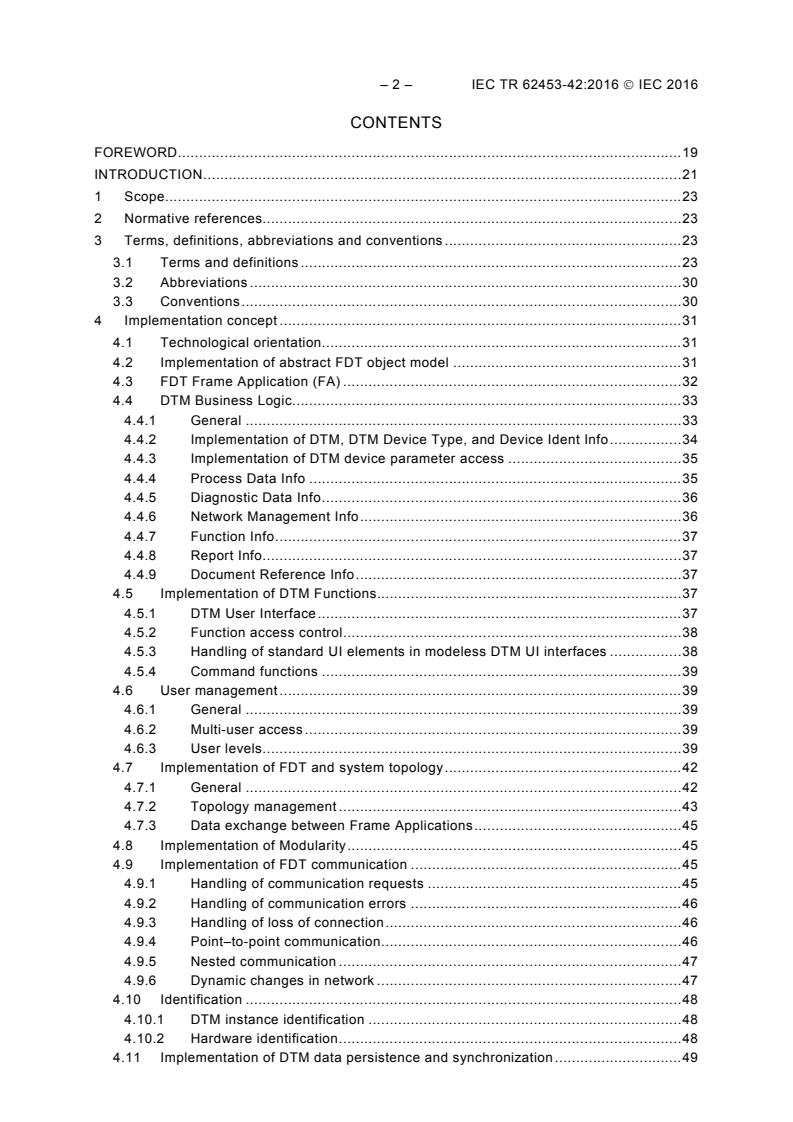
– 2 – IEC TR 62453-42:2016 IEC 2016
CONTENTS
FOREWORD . 19
INTRODUCTION . 21
1 Scope . 23
2 Normative references. 23
3 Terms, definitions, abbreviations and conventions . 23
3.1 Terms and definitions . 23
3.2 Abbreviations . 30
3.3 Conventions . 30
4 Implementation concept . 31
4.1 Technological orientation . 31
4.2 Implementation of abstract FDT object model . 31
4.3 FDT Frame Application (FA) . 32
4.4 DTM Business Logic. 33
4.4.1 General . 33
4.4.2 Implementation of DTM, DTM Device Type, and Device Ident Info . 34
4.4.3 Implementation of DTM device parameter access . 35
4.4.4 Process Data Info . 35
4.4.5 Diagnostic Data Info . 36
4.4.6 Network Management Info . 36
4.4.7 Function Info . 37
4.4.8 Report Info . 37
4.4.9 Document Reference Info . 37
4.5 Implementation of DTM Functions . 37
4.5.1 DTM User Interface . 37
4.5.2 Function access control . 38
4.5.3 Handling of standard UI elements in modeless DTM UI interfaces . 38
4.5.4 Command functions . 39
4.6 User management . 39
4.6.1 General . 39
4.6.2 Multi-user access . 39
4.6.3 User levels . 39
4.7 Implementation of FDT and system topology . 42
4.7.1 General . 42
4.7.2 Topology management . 43
4.7.3 Data exchange between Frame Applications . 45
4.8 Implementation of Modularity . 45
4.9 Implementation of FDT communication . 45
4.9.1 Handling of communication requests . 45
4.9.2 Handling of communication errors . 46
4.9.3 Handling of loss of connection . 46
4.9.4 Point–to-point communication . 46
4.9.5 Nested communication . 47
4.9.6 Dynamic changes in network . 47
4.10 Identification . 48
4.10.1 DTM instance identification . 48
4.10.2 Hardware identification . 48
4.11 Implementation of DTM data persistence and synchronization . 49
4.11.1 Persistence overview . 49
4.11.2 Relations of DTMDataSet . 50
4.11.3 DTMDataSet structure . 51
4.11.4 Types of persistent DTM data . 52
4.11.5 Data synchronization . 52
4.12 Implementation of access to device data and IO information . 53
4.12.1 Exposing device data and IO information . 53
4.12.2 Data access control . 54
4.12.3 Routed IO information . 56
4.12.4 Comparison of DTM and device data . 56
4.12.5 Support for multirole devices . 57
4.13 Clone of DTM instances . 58
4.13.1 General . 58
4.13.2 Replicating a part of topology with Parent DTM and a subset of its Child
DTMs . 58
4.13.3 Cloning of a DTM without its children . 58
4.13.4 Delayed cloning . 58
4.14 Lifecycle concepts . 59
4.15 Audit trail . 59
4.15.1 General . 59
4.15.2 Audit trail events . 59
5 Technical concepts . 60
5.1 General . 60
5.2 Support of .NET Common Language Runtime versions . 62
5.2.1 General . 62
5.2.2 Rules for FDT .NET assemblies . 62
5.2.3 DTM rules . 62
5.2.4 Frame Application rules . 62
5.2.5 FDT CLR extension concept . 63
5.3 Support for 32-bit and 64-bit target platforms . 63
5.4 Object activation and deactivation . 64
5.4.1 General . 64
5.4.2 Assembly loading and object creation . 64
5.4.3 Assembly dependencies . 65
5.4.4 Shared assemblies . 65
5.4.5 Object deactivation and unloading . 66
5.5 Datatypes . 67
5.5.1 General . 67
5.5.2 Serialization / deserialization . 67
5.5.3 Support of XML . 68
5.5.4 Optional elements . 68
5.5.5 Verify . 68
5.5.6 Clone . 68
5.5.7 Equals . 69
5.5.8 Lists . 69
5.5.9 Nullable . 70
5.5.10 Enumeration . 70
5.5.11 Protocol-specific datatypes. 70
5.5.12 Custom datatypes . 72
– 4 – IEC TR 62453-42:2016 IEC 2016
5.6 General object interaction. 73
5.6.1 General . 73
5.6.2 Decoupling of FDT Objects . 73
5.6.3 Parameter interchange with .NET datatypes . 74
5.6.4 Interaction patterns . 74
5.6.5 Properties . 74
5.6.6 Synchronous methods . 74
5.6.7 Asynchronous methods . 75
5.6.8 Events pattern . 81
5.6.9 Exception handling . 82
5.7 Threading . 86
5.7.1 Introduction . 86
5.7.2 Threading rules . 87
5.8 Localization support . 88
5.8.1 General . 88
5.8.2 Access to localized resources and culture-dependent functions . 89
5.8.3 Handling of cultures . 89
5.8.4 Switching the User Interface language . 90
5.9 DTM User Interface implementation . 90
5.9.1 General . 90
5.9.2 Resizing . 90
5.9.3 Private dialogs . 92
5.10 DTM User Interface hosting . 92
5.10.1 General . 92
5.10.2 Hosting DTM WPF controls . 92
5.10.3 Hosting DTM WinForms controls . 93
5.11 Static Function implementation . 94
5.12 Persistence . 96
5.12.1 Overview . 96
5.12.2 Data format . 97
5.12.3 Adding / reading / writing / deleting of data . 97
5.12.4 Searching for data . 99
5.13 Comparison of DTM and device data . 100
5.13.1 Comparison of datasets using IDeviceData / IInstanceData . 100
5.13.2 Comparison of datasets using IComparison . 101
5.14 Tracing . 101
5.15 Report generation . 101
5.15.1 General . 101
5.15.2 Report types . 102
5.15.3 DTM report data format . 102
5.15.4 Report data exchange . 103
5.16 Security . 103
5.16.1 General . 103
5.16.2 Strong naming of assemblies . 103
5.16.3 Identification of origin . 104
5.16.4 Code access security . 104
5.16.5 Validation of FDT compliance certification . 104
6 FDT Objects and interfaces . 106
6.1 General . 106
6.2 Frame Application . 107
6.3 DTM Business Logic. 109
6.3.1 DTM BL interfaces . 109
6.3.2 State machines related to DTM BL . 114
6.3.3 State machine of instance data . 120
6.4 DTM User Interface . 123
6.5 Communication Channel . 124
6.6 Availability of interface methods . 125
7 FDT datatypes . 126
7.1 General . 126
7.2 Datatypes – Base . 127
7.3 General datatypes . 127
7.4 Datatypes – DtmInfo / TypeInfo . 128
7.5 Datatypes – DeviceIdentInfo . 130
7.6 Datatypes for installation and deployment . 135
7.6.1 Datatypes – SetupManifest . 135
7.6.2 Datatypes – DtmManifest . 136
7.6.3 Datatypes – DtmUiManifest . 137
7.7 Datatypes – Communication . 137
7.8 Datatypes – BusCategory . 143
7.9 Datatypes – Device / Instance Data . 143
7.9.1 General . 143
7.9.2 Datatypes used in reading and writing DeviceData . 150
7.10 Datatypes for export and import . 152
7.10.1 Datatypes – TopologyImportExport . 152
7.10.2 Datatypes – ImportExportDataset . 153
7.11 Datatypes for process data description . 154
7.11.1 Datatypes – ProcessDataInfo . 154
7.11.2 Datatypes – Process Image . 159
7.12 Datatypes – Address information . 160
7.13 Datatypes – NetworkDataInfo . 164
7.14 Datatypes – DTM functions . 166
7.15 Datatypes – DTM messages . 168
7.16 Datatypes for delegation of DTM UI dialog actions . 170
7.17 Datatypes – CommunicationChannelInfo . 170
7.18 Datatypes – HardwareIdentification and scanning . 172
7.18.1 General . 172
7.18.2 Datatypes – DeviceScanInfo . 172
7.18.3 Example – HardwareIdentification and scanning for HART . 173
7.19 Datatypes – DTM report types . 174
7.20 Information related to device modules in a monolithic DTM . 174
8 Workflows . 176
8.1 General . 176
8.2 Instantiation, loading and release . 176
8.2.1 Finding a DTM BL object . 176
8.2.2 Instantiation of a new DTM BL . 178
8.2.3 Configuring access rights . 180
8.2.4 Loading a DTM BL . 181
8.2.5 Loading a DTM with Expert user level . 182
– 6 – IEC TR 62453-42:2016 IEC 2016
8.2.6 Release of a DTM BL . 183
8.3 Persistent storage of a DTM . 184
8.3.1 Saving instance data of a DTM . 184
8.3.2 Copy and versioning of a DTM instance . 185
8.3.3 Dataset commit failed . 186
8.3.4 Export a DTM dataset to file . 186
8.4 Locking and DataTransactions in multi-user environments . 187
8.4.1 General . 187
8.4.2 Propagation of changes. 188
8.4.3 Synchronizing DTMs in multi-user environments . 190
8.5 Execution of DTM Functions . 191
8.5.1 General . 191
8.5.2 Finding a DTM User Interface object . 191
8.5.3 Instantiation of an integrated DTM graphical user interface . 192
8.5.4 Instantiation of a DTM UI triggered by the DTM BL . 193
8.5.5 Instantiation of a modal DTM UI triggered by DTM BL . 194
8.5.6 Release of a DTM User Interface . 195
8.5.7 Release of a DTM UI triggered by the DTM BL . 196
8.5.8 Release of a DTM User Interface triggered by itself . 197
8.5.9 Release of a non-modal DTM User Interface triggered by a standard
action . 198
8.5.10 Progress indication for prolonged DTM actions . 199
8.5.11 Starting an application . 200
8.5.12 Terminating applications . 201
8.5.13 Execution of command functions . 201
8.5.14 Execution of a command function with user interface . 201
8.5.15 Opening of documents . 202
8.5.16 Interaction between DTM User Interface and DTM Business Logic . 203
8.5.17 Interaction between DTM Business Logic and DTM User Interface . 205
8.5.18 Interaction between DTM User Interface and DTM Business Logic with
Cancel . 206
8.5.19 Retrieving information about available Static Functions . 207
8.5.20 Executing a Static Function . 208
8.5.21 Executing a Static Function with multiple arguments . 209
8.6 DTM communication . 210
8.6.1 General . 210
8.6.2 Establishing a communication connection . 211
8.6.3 Cancel establishment of communication connection . 212
8.6.4 Communicating with the device . 212
8.6.5 Frame Application or Child DTM disconnect a device . 213
8.6.6 Terminating a communication connection . 214
8.6.7 DTM aborts communication connection . 215
8.6.8 Communication Channel aborts communication connection . 216
8.7 Nested communication . 216
8.7.1 General . 216
8.7.2 Communication request for a nested connection . 217
8.7.3 Propagation of errors for a nested connection . 218
8.8 Topology planning . 219
8.8.1 General . 219
8.8.2 Adding a DTM to the topology . 219
8.8.3 Removing a DTM from topology . 220
8.8.4 Frame Application creates topology . 221
8.8.5 DTM generates sub-topology . 222
8.8.6 Physical Layer and DataLinkLayer . 224
8.9 Instantiation, configuration, move and release of Child DTMs . 224
8.9.1 General . 224
8.9.2 Instantiation and configuration of Child DTM BL . 224
8.9.3 Interaction between Parent DTM and Child DTM . 225
8.9.4 Interaction between Parent DTM and Child DTM using IDtmMessaging . 227
8.9.5 Parent DTM moves a Child DTM . 227
8.9.6 Parent DTM removes Child DTM . 228
8.10 Topology scan . 229
8.10.1 General . 229
8.10.2 Scan of network topology . 229
8.10.3 Cancel topology scan . 230
8.10.4 Scan based DTM assignment . 231
8.10.5 Manufacturer-specific device identification . 232
8.11 Configuration of communication networks . 234
8.11.1 Configuration of a fieldbus master . 234
8.11.2 Integration of a passive device . 235
8.12 Using IO information . 235
8.12.1 Assignment of symbolic name to process data . 235
8.12.2 Creation of Process Image . 237
8.12.3 Validation of changes in process image while PLC is running . 238
8.12.4 Changing of variable names using process image interface . 239
8.13 Managing addresses . 240
8.13.1 Set DTM address with user interface . 240
8.13.2 Set DTM addresses without user interface . 241
8.13.3 Display or modify addresses of all Child DTMs with user interface . 242
8.14 Device-initiated data transfer . 243
8.15 Reading and writing data . 244
8.15.1 Read/write instance data . 244
8.15.2 Read/write device data . 246
8.16 Comparing data . 248
8.16.1 Comparing device dataset and instance dataset . 248
8.16.2 Comparing different instance datasets . 248
8.17 Reassigning a different DtmDeviceType at a device node . 249
8.17.1 General . 249
8.17.2 DTM detects a change in connected device type . 250
8.17.3 Search matching DtmDeviceTypes after incompatible device exchange . 252
8.17.4 Reassign DtmDeviceType after incompatible device exchange . 253
8.18 Copying part of FDT Topology . 255
8.18.1 Cloning of a single DTM without Children. 255
8.18.2 Cloning of a DTM with all its Children . 256
8.19 Sequences for audit trail . 256
8.19.1 General . 256
8.19.2 Audit trail of parameter modifications in instance dataset . 256
8.19.3 Audit trail of parameter modifications in device dataset . 257
– 8 – IEC TR 62453-42:2016 IEC 2016
8.19.4 Audit trail of function calls . 258
8.19.5 Audit trail of general notification . 259
9 Installation . 259
9.1 General . 259
9.2 Common rules . 259
9.2.1 Predefined installation paths . 259
9.2.2 Manifest files . 262
9.2.3 Paths in manifest files . 263
9.2.4 Common command line arguments . 263
9.2.5 Digital signatures of setup components . 264
9.3 Installation of FDT core assemblies . 264
9.4 Installation of communication protocols . 264
9.4.1 General . 264
9.4.2 Registration . 264
9.4.3 Protocol manifest . 264
9.5 Installation of DTMs . 265
9.5.1 General . 265
9.5.2 Registration . 266
9.5.3 DTM manifest . 267
9.5.4 DTM User Interface manifest . 268
9.6 DTM setup . 269
9.6.1 Structure . 269
9.6.2 DTM setup manifest . 270
9.6.3 DTM device identification manifest . 271
9.6.4 Setup creation rules . 273
9.7 DTM deployment . 274
9.8 Paths and file information . 276
9.8.1 Path information provided by a DTM . 276
9.8.2 Paths and persistence . 276
9.8.3 Multi-user systems . 276
10 Life cycle concept . 276
10.1 General . 276
10.2 Technical concept . 277
10.2.1 General . 277
10.2.2 DtmManifest / DtmInfo . 278
10.2.3 TypeInfo . 278
10.2.4 Supported DataSet formats . 279
10.2.5 DeviceIdentInfo . 279
10.2.6 Dataset . 280
10.2.7 DeviceScanInfo . 280
10.3 DTM setup . 280
10.4 Life Cycle Scenarios . 281
10.4.1 Overview . 281
10.4.2 Search for device type in DTM setups . 282
10.4.3 Search for installed DTMs . 283
10.4.4 Dataset migration for reassigned DTM . 285
11 Frame Application architectures . 286
11.1 General . 286
11.2 Standalone application . 286
11.3 Remoted user Interface . 286
11.4 Distributed multi-user application . 287
11.5 OPC UA . 287
Annex A (normative) FDT2 Use case model . 289
A.1 Use case model overview . 289
A.2 Actors . 289
A.3 Use cases . 290
A.3.1 Use case overview . 290
A.3.2 Observation use cases . 291
A.3.3 Operation use cases . 292
A.3.4 Maintenance use cases . 294
A.3.5 Planning use cases . 299
A.3.6 Main Operation . 301
A.3.7 OEM Service . 302
A.3.8 Administration . 302
Annex B (normative) FDT interface definition and datatypes .
...