


ISO 4612:2018
(Main)Plastics - Preparation of PVC pastes for test purposes - Planetary-mixer method
Plastics - Preparation of PVC pastes for test purposes - Planetary-mixer method
This document specifies two methods, A and B, for the preparation of pastes (also known as plastisols) from appropriate PVC resins, plasticizers and other ingredients using a planetary mixing process. Both method A and method B can be used to prepare pastes of any composition. Method A (single-speed) is particularly applicable to resins prone to heat build-up during paste preparation, while method B (two-speed) might be preferred for repetitive work, e.g. for process control during resin manufacture, because of its shorter mixing time. Such pastes can be used for a variety of test purposes, including the determination of rheological properties for resin designation and specification.
Plastiques — Préparation des pâtes PVC pour essais — Méthodes utilisant un mélangeur planétaire
Le présent document spécifie deux méthodes, A et B, pour la préparation des pâtes (encore appelées plastisols) à partir de résines PVC, de plastifiants et autres ingrédients, en utilisant un mélangeur de type planétaire. Les deux méthodes A et B peuvent être utilisées pour la préparation de pâtes de toute composition. La méthode A (à une seule vitesse) est particulièrement adaptée aux résines qui ont tendance à s'échauffer au cours de la préparation de la pâte, tandis que la méthode B (à deux vitesses) peut avoir la préférence dans le cas de tâches répétitives du fait de sa plus courte durée de mélangeage. C'est le cas, par exemple, lors du contrôle du procédé de fabrication des résines. Ces pâtes peuvent être utilisées pour une grande variété d'essais, y compris la détermination des propriétés rhéologiques aux fins de désignation et de spécification.
General Information
Relations
Overview
ISO 4612:2018 - Plastics - Preparation of PVC pastes for test purposes - Planetary-mixer method describes two standardized procedures (Method A and Method B) for preparing PVC pastes (plastisols) using a planetary mixer. The standard covers required apparatus, sample conditioning, step-by-step mixing sequences, temperature checks, de-aeration and reporting. Prepared pastes are intended for laboratory test purposes, notably the determination of rheological properties used in resin designation and specification.
Key topics and requirements
- Two mixing methods
- Method A (single-speed): Designed for resins prone to heat build-up. Fixed-speed mixing with a longer total mixing time (specified in the standard).
- Method B (two-speed): Faster, two‑speed procedure suited to repetitive process-control work; shorter total mixing time.
- Planetary mixer specifications
- Stainless-steel mixing bowl (manufacturer recommended fill level to allow efficient mixing for typical charges).
- Beater/bowl configuration and fixed speed ratio between beat rotation and orbital motion (manufacturer set; approximate ratio provided in the standard).
- Optional features: cooling jacket, rotating wiper/scraper, vacuum capability.
- Process controls
- Preconditioning of PVC resin to 23 °C ± 2 °C and (50 ± 5) % RH (per ISO 291) before use.
- Order of addition: resin, then plasticizer, with other powders or liquids added according to formulation guidance.
- Defined mixing speeds, timed scrape-downs or continuous mixing if a rotating scraper is fitted.
- Immediate temperature check after mixing; if paste temperature exceeds the limit given in the standard, corrective actions are required (cooling, more plasticizer, or alternative method).
- De-aeration of paste under partial vacuum and storage at controlled atmosphere until testing.
- Documentation
- The paste-preparation report must reference ISO 4612:2018, include formulation, paste temperature on completion, preparation date and any deviations.
Applications and users
- Applications
- Preparation of laboratory PVC pastes (plastisols) for rheological testing, quality control, resin designation and specification.
- Development and comparison of PVC resins, plasticizers and additives under repeatable, standardized conditions.
- Who benefits
- PVC resin manufacturers, laboratory technicians, R&D and quality-control teams, standards and testing laboratories, and formulators of plastisols and PVC-based coatings or products.
Related standards
- ISO 291 (conditioning for plastics testing) - referenced for atmospheric conditioning prior to paste preparation.
- Prepared by ISO/TC 61 Plastics, Subcommittee SC 9 (Thermoplastic materials).
Keywords: ISO 4612:2018, PVC pastes, plastisols, planetary mixer, paste preparation, mixing method, rheological properties, PVC resin, paste de-aeration.
Standards Content (Sample)
INTERNATIONAL ISO
STANDARD 4612
Third edition
2018-12
Plastics — Preparation of PVC pastes
for test purposes — Planetary-mixer
method
Plastiques — Préparation des pâtes PVC pour essais — Méthodes
utilisant un mélangeur planétaire
Reference number
©
ISO 2018
© ISO 2018
All rights reserved. Unless otherwise specified, or required in the context of its implementation, no part of this publication may
be reproduced or utilized otherwise in any form or by any means, electronic or mechanical, including photocopying, or posting
on the internet or an intranet, without prior written permission. Permission can be requested from either ISO at the address
below or ISO’s member body in the country of the requester.
ISO copyright office
CP 401 • Ch. de Blandonnet 8
CH-1214 Vernier, Geneva
Phone: +41 22 749 01 11
Fax: +41 22 749 09 47
Email: copyright@iso.org
Website: www.iso.org
Published in Switzerland
ii © ISO 2018 – All rights reserved
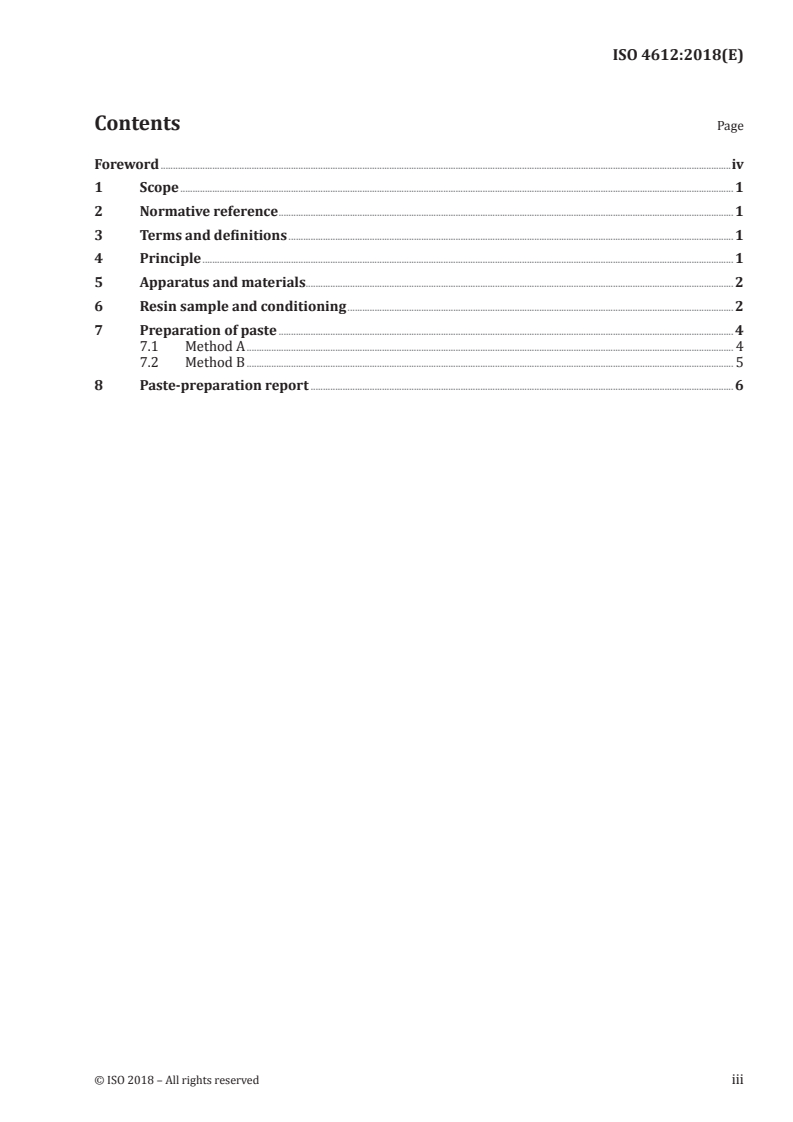
Contents Page
Foreword .iv
1 Scope . 1
2 Normative reference . 1
3 Terms and definitions . 1
4 Principle . 1
5 Apparatus and materials. 2
6 Resin sample and conditioning . 2
7 Preparation of paste . 4
7.1 Method A . 4
7.2 Method B . 5
8 Paste-preparation report . 6
Foreword
ISO (the International Organization for Standardization) is a worldwide federation of national standards
bodies (ISO member bodies). The work of preparing International Standards is normally carried out
through ISO technical committees. Each member body interested in a subject for which a technical
committee has been established has the right to be represented on that committee. International
organizations, governmental and non-governmental, in liaison with ISO, also take part in the work.
ISO collaborates closely with the International Electrotechnical Commission (IEC) on all matters of
electrotechnical standardization.
The procedures used to develop this document and those intended for its further maintenance are
described in the ISO/IEC Directives, Part 1. In particular, the different approval criteria needed for the
different types of ISO documents should be noted. This document was drafted in accordance with the
editorial rules of the ISO/IEC Directives, Part 2 (see www .iso .org/directives).
Attention is drawn to the possibility that some of the elements of this document may be the subject of
patent rights. ISO shall not be held responsible for identifying any or all such patent rights. Details of
any patent rights identified during the development of the document will be in the Introduction and/or
on the ISO list of patent declarations received (see www .iso .org/patents).
Any trade name used in this document is information given for the convenience of users and does not
constitute an endorsement.
For an explanation of the voluntary nature of standards, the meaning of ISO specific terms and
expressions related to conformity assessment, as well as information about ISO's adherence to the
World Trade Organization (WTO) principles in the Technical Barriers to Trade (TBT) see www .iso
.org/iso/foreword .html.
This document was prepared by Technical Committee ISO/TC 61, Plastics, Subcommittee SC 9,
Thermoplastic materials.
This third edition cancels and replaces the second edition (ISO 4612:1999), of which it constitutes a
minor revision to update the reference in Clause 2.
Any feedback or questions on this document should be directed to the user’s national standards body. A
complete listing of these bodies can be found at www .iso .org/members .html.
iv © ISO 2018 – All rights reserved
INTERNATIONAL STANDARD ISO 4612:2018(E)
Plastics — Preparation of PVC pastes for test purposes —
Planetary-mixer method
1 Scope
This document specifies two methods, A and B, for the preparation of pastes (also known as plastisols)
from appropriate PVC resins, plasticizers and other ingredients using a planetary mixing process.
Both method A and method B can be used to prepare pastes of any composition. Method A (single-speed)
is particularly applicable to resins prone to heat build-up during paste preparation, while method B
(two-speed) might be preferred for repetitive work, e.g. for process control during resin manufacture,
because of its shorter mixing time.
Such pastes can be used for a variety of test purposes, including the determination of rheological
properties for resin designation and specification.
2 Normative reference
The following documents are referred to in the text in such a way that some or all of their content
constitutes requirements of this document. For dated references, only the edition cited applies. For
undated references, the latest edition of the referenced document (including any amendments) applies.
ISO 291, Plastics — Standard atmospheres for conditioning and testing
3 Terms and definitions
For the purposes of this document, the following terms and definitions apply.
ISO and IEC maintain terminological databases for use in standardization at the following addresses:
— ISO Online browsing platform: available at https: //www .iso .org/obp
— IEC Electropedia: available at http: //www .electropedia .org/
3.1
paste
plastisol
homogeneous dispersion of PVC resin in an organic liquid
3.2
planetary mixer
mixer in which the beater or stirrer not only rotates about an axis within the mixing vessel, but the axis
of rotation itself also describes a circular path
4 Principle
Liquid plasticizer, PVC resin powder and other appropriate ingredients, in liquid, paste or powder form,
are combined in a mixer where the shearing action causes the powder(s) to disperse in the liquid(s).
The paste-making process involves the partial solvation of the resin powder by the plasticizer, and
hence the “dispersion” will remain in liquid form for prolonged periods, i.e. the powder does not readily
settle out.
5 Apparatus and materials
5.1 Planetary mixer, having at least the key features shown in Figure 1, and with a mixing-bowl/
beater configuration similar to one of those illustrated in Figure 2.
The mixing bowl shall be made of stainless steel and may be fitted with a jacket for the circulation of
cooling water. The bowl will have a recommended filling level,
...
NORME ISO
INTERNATIONALE 4612
Troisième édition
2018-12
Plastiques — Préparation des pâtes
PVC pour essais — Méthodes utilisant
un mélangeur planétaire
Plastics — Preparation of PVC pastes for test purposes — Planetary-
mixer method
Numéro de référence
©
ISO 2018
DOCUMENT PROTÉGÉ PAR COPYRIGHT
© ISO 2018
Tous droits réservés. Sauf prescription différente ou nécessité dans le contexte de sa mise en œuvre, aucune partie de cette
publication ne peut être reproduite ni utilisée sous quelque forme que ce soit et par aucun procédé, électronique ou mécanique,
y compris la photocopie, ou la diffusion sur l’internet ou sur un intranet, sans autorisation écrite préalable. Une autorisation peut
être demandée à l’ISO à l’adresse ci-après ou au comité membre de l’ISO dans le pays du demandeur.
ISO copyright office
Case postale 401 • Ch. de Blandonnet 8
CH-1214 Vernier, Genève
Tél.: +41 22 749 01 11
Fax: +41 22 749 09 47
E-mail: copyright@iso.org
Web: www.iso.org
Publié en Suisse
ii © ISO 2018 – Tous droits réservés
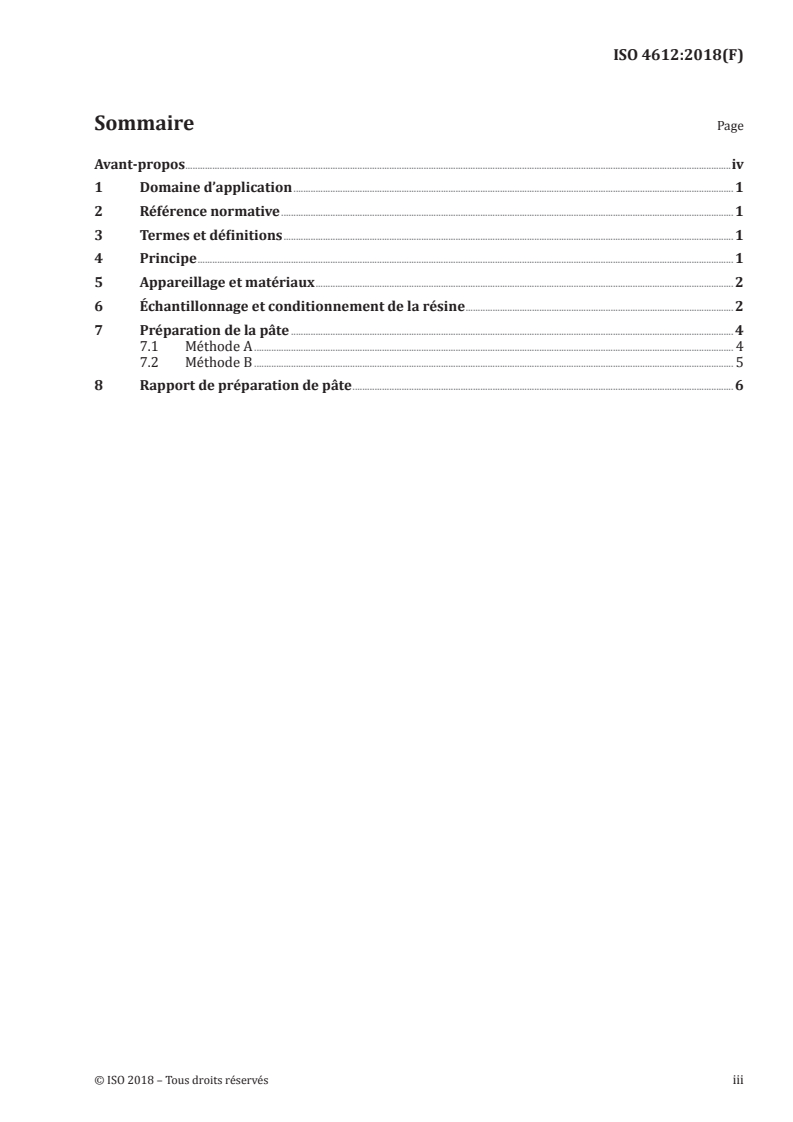
Sommaire Page
Avant-propos .iv
1 Domaine d’application . 1
2 Référence normative . 1
3 Termes et définitions . 1
4 Principe . 1
5 Appareillage et matériaux . 2
6 Échantillonnage et conditionnement de la résine . 2
7 Préparation de la pâte . 4
7.1 Méthode A . 4
7.2 Méthode B . 5
8 Rapport de préparation de pâte . 6
Avant-propos
L'ISO (Organisation internationale de normalisation) est une fédération mondiale d'organismes
nationaux de normalisation (comités membres de l'ISO). L'élaboration des Normes internationales est
en général confiée aux comités techniques de l'ISO. Chaque comité membre intéressé par une étude
a le droit de faire partie du comité technique créé à cet effet. Les organisations internationales,
gouvernementales et non gouvernementales, en liaison avec l'ISO participent également aux travaux.
L'ISO collabore étroitement avec la Commission électrotechnique internationale (IEC) en ce qui
concerne la normalisation électrotechnique.
Les procédures utilisées pour élaborer le présent document et celles destinées à sa mise à jour sont
décrites dans les Directives ISO/IEC, Partie 1. Il convient, en particulier, de prendre note des différents
critères d'approbation requis pour les différents types de documents ISO. Le présent document a été
rédigé conformément aux règles de rédaction données dans les Directives ISO/IEC, Partie 2 (voir www
.iso .org/directives).
L'attention est attirée sur le fait que certains des éléments du présent document peuvent faire l'objet de
droits de propriété intellectuelle ou de droits analogues. L'ISO ne saurait être tenue pour responsable
de ne pas avoir identifié de tels droits de propriété et averti de leur existence. Les détails concernant
les références aux droits de propriété intellectuelle ou autres droits analogues identifiés lors de
l'élaboration du document sont indiqués dans l'Introduction et/ou dans la liste des déclarations de
brevets reçues par l'ISO (voir www .iso .org/brevets).
Les appellations commerciales éventuellement mentionnées dans le présent document sont données
pour information, par souci de commodité, à l’intention des utilisateurs et ne sauraient constituer un
engagement.
Pour une explication de la nature volontaire des normes, la signification des termes et expressions
spécifiques de l'ISO liés à l'évaluation de la conformité, ou pour toute information au sujet de l'adhésion
de l'ISO aux principes de l’Organisation mondiale du commerce (OMC) concernant les obstacles
techniques au commerce (OTC), voir www .iso .org/avant -propos.
Le présent document a été élaboré par le comité technique ISO/TC 61, Plastiques, sous-comité SC 9,
Matériaux thermoplastiques.
Cette troisième édition annule et remplace la deuxième édition (ISO 4612:1999), qui a fait l'objet d'une
révision mineure pour mettre à jour la référence dans l'Article 2.
Il convient que l’utilisateur adresse tout retour d’information ou toute question concernant le présent
document à l’organisme national de normalisation de son pays. Une liste exhaustive desdits organismes
se trouve à l’adresse www .iso .org/fr/members .html.
iv © ISO 2018 – Tous droits réservés
NORME INTERNATIONALE ISO 4612:2018(F)
Plastiques — Préparation des pâtes PVC pour essais —
Méthodes utilisant un mélangeur planétaire
1 Domaine d’application
Le présent document spécifie deux méthodes, A et B, pour la préparation des pâtes (encore appelées
plastisols) à partir de résines PVC, de plastifiants et autres ingrédients, en utilisant un mélangeur de
type planétaire.
Les deux méthodes A et B peuvent être utilisées pour la préparation de pâtes de toute composition. La
méthode A (à une seule vitesse) est particulièrement adaptée aux résines qui ont tendance à s'échauffer
au cours de la préparation de la pâte, tandis que la méthode B (à deux vitesses) peut avoir la préférence
dans le cas de tâches répétitives du fait de sa plus courte durée de mélangeage. C'est le cas, par exemple,
lors du contrôle du procédé de fabrication des résines.
Ces pâtes peuvent être utilisées pour une grande variété d'essais, y compris la détermination des
propriétés rhéologiques aux fins de désignation et de spécification.
2 Référence normative
Les documents suivants sont mentionnés dans le texte de telle manière qu’une partie ou la totalité de
leur contenu constitue les exigences du présent document. Pour les références datées, seule l’édition
citée s’applique. Pour les références non datées, la dernière édition du document de référence s’applique
(y compris les éventuels amendements).
ISO 291, Plastiques — Atmosphères normales de conditionnement et d'essai
3 Termes et définitions
Pour les besoins du présent document, les termes et définitions suivants s’appliquent.
L’ISO et l’IEC tiennent à jour des bases de données terminologiques destinées à être utilisées en
normalisation, consultables aux adresses suivantes:
— Online browsing platform de l’ISO: disponible à l’adresse http: //www .iso .org/obp
— Electropedia de l’IEC: disponible à l’adresse http: //www .electropedia .org/
3.1
pâte
plastisol
dispersion homogène de résine PVC dans un liquide organique
3.2
mélangeur planétaire
appareil dans lequel le batteur ou l'agitateur non seulement tourne sur son axe à l'intérieur du bol, mais
l'axe de rotation lui-même décrit également un mouvement circulaire
4 Principe
Un plastifiant liquide, une poudre de résine PVC et d'autres ingrédients appropriés sous forme de
liquide, de pâte ou de poudre, sont introduits simultanément dans un mélangeur dans lequel l'effet de
cisaillement provoque la dispersion de la (des) poudre(s) dans le(s) liquide(s).
Le processus de formation de la pâte implique une dissolution partielle de la poudre de résine dans le
plastifiant. La «dispersion» demeure donc sous forme liquide pendant une période prolongée; la poudre
ne décante pas rapidement.
5 Appareillage et matériaux
5.1 Mélangeur planétaire, ayant au moins les principales caractéristiques illustrées à la Figure 1 et
dont la configuration du bol et du batteur est
...
Frequently Asked Questions
ISO 4612:2018 is a standard published by the International Organization for Standardization (ISO). Its full title is "Plastics - Preparation of PVC pastes for test purposes - Planetary-mixer method". This standard covers: This document specifies two methods, A and B, for the preparation of pastes (also known as plastisols) from appropriate PVC resins, plasticizers and other ingredients using a planetary mixing process. Both method A and method B can be used to prepare pastes of any composition. Method A (single-speed) is particularly applicable to resins prone to heat build-up during paste preparation, while method B (two-speed) might be preferred for repetitive work, e.g. for process control during resin manufacture, because of its shorter mixing time. Such pastes can be used for a variety of test purposes, including the determination of rheological properties for resin designation and specification.
This document specifies two methods, A and B, for the preparation of pastes (also known as plastisols) from appropriate PVC resins, plasticizers and other ingredients using a planetary mixing process. Both method A and method B can be used to prepare pastes of any composition. Method A (single-speed) is particularly applicable to resins prone to heat build-up during paste preparation, while method B (two-speed) might be preferred for repetitive work, e.g. for process control during resin manufacture, because of its shorter mixing time. Such pastes can be used for a variety of test purposes, including the determination of rheological properties for resin designation and specification.
ISO 4612:2018 is classified under the following ICS (International Classification for Standards) categories: 83.080.20 - Thermoplastic materials. The ICS classification helps identify the subject area and facilitates finding related standards.
ISO 4612:2018 has the following relationships with other standards: It is inter standard links to ISO 14960-2:2014, ISO 4612:1999. Understanding these relationships helps ensure you are using the most current and applicable version of the standard.
You can purchase ISO 4612:2018 directly from iTeh Standards. The document is available in PDF format and is delivered instantly after payment. Add the standard to your cart and complete the secure checkout process. iTeh Standards is an authorized distributor of ISO standards.
Questions, Comments and Discussion
Ask us and Technical Secretary will try to provide an answer. You can facilitate discussion about the standard in here.
Loading comments...