

ISO 13584-25:2004
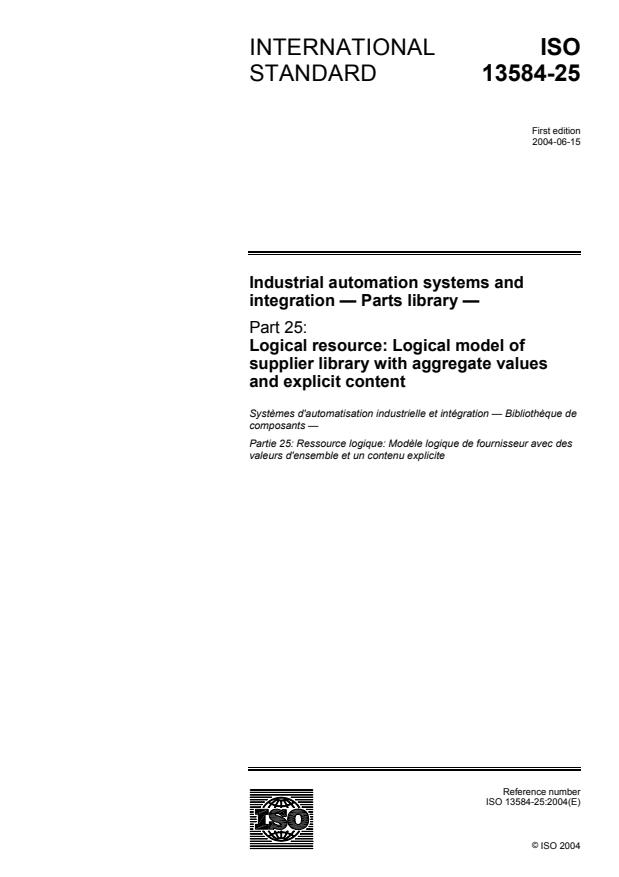
(Main)Industrial automation systems and integration — Parts library — Part 25: Logical resource: Logical model of supplier library with aggregate values and explicit content
General Information
- Abstract
ISO 13584-25:2004 provides generic EXPRESS resource constructs that support the description of aggregate data types and values occurring in supplier libraries. It also contains an integrated EXPRESS information model for representing supplier libraries for the purpose of exchange. This integrated information model integrates the above resource constructs with other EXPRESS resource constructs from different parts of ISO 13584 and ISO 10303 into one single schema. Supplier libraries may consist of definitions and of representations of families of parts. They may also define new representation categories. Supplier libraries may consist only of dictionary elements with or without aggregate data types, or they may also contain explicit specifications of the sets of permitted instances. When used together with view exchange protocols, this integrated information model also permits the exchange of one or several representation categories for the parts defined in a parts library. The following are within the scope of ISO 13584-25:2004: generic resource constructs for representing aggregate data types. Aggregate data types and values are modelled according to the definition of aggregate data types of the EXPRESS language (ISO 10303-11); generic resource constructs for representing aggregate values; generic resource constructs for representing assembled parts that may contain an unlimited number of constituent components; a library integrated information model that provides for modelling and exchanging supplier libraries that contain properties whose values may be aggregate-structured, and whose possible class extensions are explicitly described as sets of instances. The following are outside the scope of this part of ISO 13584-25:2004: representation of expressions and variables; implicit description of the set of permitted instances of a class by means of constraints; specification of a software system able to manage supplier libraries represented according to the information models defined in ISO 13584-25:2004.
- Status
- Published
- Publication Date
- 06-Jun-2004
- Technical Committee
- ISO/TC 184/SC 4 - Industrial data
- Current Stage
- 9060 - Close of review
- Completion Date
- 04-Jun-2030
Buy Documents
ISO 13584-25:2004 - Industrial automation systems and integration — Parts library — Part 25: Logical resource: Logical model of supplier library with aggregate values and explicit content Released:6/7/2004
ISO 13584-25:2004 - Industrial automation systems and integration — Parts library — Part 25: Logical resource: Logical model of supplier library with aggregate values and explicit content Released:6/7/2004
Overview
ISO 13584-25:2004 - part of the ISO 13584 series on parts libraries - defines a logical model of supplier libraries that supports aggregate values and explicit content using the EXPRESS modeling language. The standard provides generic EXPRESS resource constructs to represent aggregate data types and values, and an integrated EXPRESS information model for exchanging supplier libraries. It enables supplier libraries to contain definitions, part families, representation categories and explicit instance sets, facilitating structured parts library exchange in industrial automation and PLM environments.
Key Topics
- EXPRESS-based resource constructs for modeling aggregate data types and aggregate values (aligned with ISO 10303-11 definitions).
- Integrated information model combining constructs from ISO 13584 parts and ISO 10303 to form a single schema for supplier libraries.
- Representation categories and explicit content: libraries can define representation categories, dictionary elements, and explicit sets of permitted instances (explicit content models).
- Assembled parts modeling: constructs for representing assembled parts that may contain an unlimited number of constituent components.
- Data exchange enabling: designed to be used with view exchange protocols to permit exchange of one or several representation categories for parts defined in a parts library.
- Scope boundaries: explicitly excludes representation of expressions and variables, implicit instance-set descriptions via constraints, and specification of a software system to manage supplier libraries.
Applications
ISO 13584-25:2004 is intended for organizations that need standardized, machine-readable representations of supplier part libraries where properties can be aggregate-structured or where classes have explicitly enumerated instances. Typical applications include:
- Exchanging supplier parts and catalog data between CAD/PDM/PLM systems.
- Defining supplier libraries that include complex aggregated property values (lists, arrays, sets).
- Integrating part families and multi-component assemblies into data exchange workflows.
- Implementing view-exchange scenarios to share selected representation categories of parts.
Who uses this standard
- Manufacturers and suppliers preparing structured digital catalogs.
- System integrators and OEMs needing consistent parts data for automation systems.
- PLM/PDM and CAD software vendors implementing parts library import/export and data exchange features.
- Data modelers and standards specialists working with EXPRESS schemas and ISO 10303 interoperability.
Related Standards
- ISO 13584 (other parts) - Parts library family of standards.
- ISO 10303-11 - EXPRESS language and aggregate data type definitions (referenced by ISO 13584-25).
Using ISO 13584-25:2004 supports interoperable parts library exchange, precise modeling of aggregate property values, and clearer supplier–consumer data flows in industrial automation and product lifecycle management.
Relations
- Effective Date
- 10-Feb-2026
- Effective Date
- 10-Feb-2026
Buy Documents
ISO 13584-25:2004 - Industrial automation systems and integration — Parts library — Part 25: Logical resource: Logical model of supplier library with aggregate values and explicit content Released:6/7/2004
ISO 13584-25:2004 - Industrial automation systems and integration — Parts library — Part 25: Logical resource: Logical model of supplier library with aggregate values and explicit content Released:6/7/2004
Get Certified
Connect with accredited certification bodies for this standard

DVS-ZERT GmbH
German welding certification society.
CARES (UK Certification Authority for Reinforcing Steels)
UK certification for reinforcing steels and construction.
EWF/IIW (European/International Welding Federation)
International welding personnel certification.
Sponsored listings
Frequently Asked Questions
ISO 13584-25:2004 is a standard published by the International Organization for Standardization (ISO). Its full title is "Industrial automation systems and integration — Parts library — Part 25: Logical resource: Logical model of supplier library with aggregate values and explicit content". This standard covers: ISO 13584-25:2004 provides generic EXPRESS resource constructs that support the description of aggregate data types and values occurring in supplier libraries. It also contains an integrated EXPRESS information model for representing supplier libraries for the purpose of exchange. This integrated information model integrates the above resource constructs with other EXPRESS resource constructs from different parts of ISO 13584 and ISO 10303 into one single schema. Supplier libraries may consist of definitions and of representations of families of parts. They may also define new representation categories. Supplier libraries may consist only of dictionary elements with or without aggregate data types, or they may also contain explicit specifications of the sets of permitted instances. When used together with view exchange protocols, this integrated information model also permits the exchange of one or several representation categories for the parts defined in a parts library. The following are within the scope of ISO 13584-25:2004: generic resource constructs for representing aggregate data types. Aggregate data types and values are modelled according to the definition of aggregate data types of the EXPRESS language (ISO 10303-11); generic resource constructs for representing aggregate values; generic resource constructs for representing assembled parts that may contain an unlimited number of constituent components; a library integrated information model that provides for modelling and exchanging supplier libraries that contain properties whose values may be aggregate-structured, and whose possible class extensions are explicitly described as sets of instances. The following are outside the scope of this part of ISO 13584-25:2004: representation of expressions and variables; implicit description of the set of permitted instances of a class by means of constraints; specification of a software system able to manage supplier libraries represented according to the information models defined in ISO 13584-25:2004.
ISO 13584-25:2004 provides generic EXPRESS resource constructs that support the description of aggregate data types and values occurring in supplier libraries. It also contains an integrated EXPRESS information model for representing supplier libraries for the purpose of exchange. This integrated information model integrates the above resource constructs with other EXPRESS resource constructs from different parts of ISO 13584 and ISO 10303 into one single schema. Supplier libraries may consist of definitions and of representations of families of parts. They may also define new representation categories. Supplier libraries may consist only of dictionary elements with or without aggregate data types, or they may also contain explicit specifications of the sets of permitted instances. When used together with view exchange protocols, this integrated information model also permits the exchange of one or several representation categories for the parts defined in a parts library. The following are within the scope of ISO 13584-25:2004: generic resource constructs for representing aggregate data types. Aggregate data types and values are modelled according to the definition of aggregate data types of the EXPRESS language (ISO 10303-11); generic resource constructs for representing aggregate values; generic resource constructs for representing assembled parts that may contain an unlimited number of constituent components; a library integrated information model that provides for modelling and exchanging supplier libraries that contain properties whose values may be aggregate-structured, and whose possible class extensions are explicitly described as sets of instances. The following are outside the scope of this part of ISO 13584-25:2004: representation of expressions and variables; implicit description of the set of permitted instances of a class by means of constraints; specification of a software system able to manage supplier libraries represented according to the information models defined in ISO 13584-25:2004.
ISO 13584-25:2004 is classified under the following ICS (International Classification for Standards) categories: 25.040.40 - Industrial process measurement and control. The ICS classification helps identify the subject area and facilitates finding related standards.
ISO 13584-25:2004 has the following relationships with other standards: It is inter standard links to EN 62656-1:2015, EN 61360-5:2004. Understanding these relationships helps ensure you are using the most current and applicable version of the standard.
ISO 13584-25:2004 is available in PDF format for immediate download after purchase. The document can be added to your cart and obtained through the secure checkout process. Digital delivery ensures instant access to the complete standard document.
Standards Content (Sample)
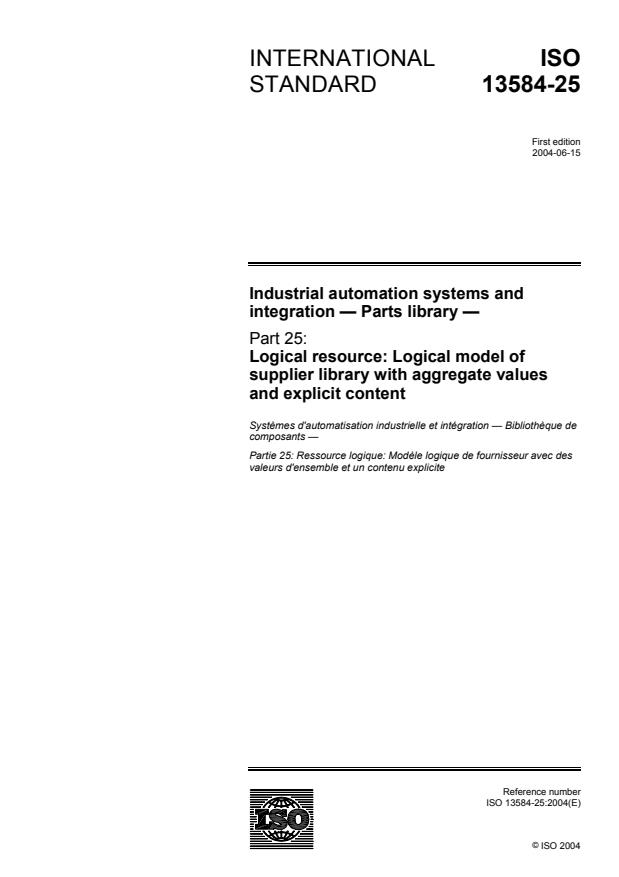
INTERNATIONAL ISO
STANDARD 13584-25
First edition
2004-06-15
Industrial automation systems and
integration — Parts library —
Part 25:
Logical resource: Logical model of
supplier library with aggregate values
and explicit content
Systèmes d'automatisation industrielle et intégration — Bibliothèque de
composants —
Partie 25: Ressource logique: Modèle logique de fournisseur avec des
valeurs d'ensemble et un contenu explicite
Reference number
©
ISO 2004
PDF disclaimer
This PDF file may contain embedded typefaces. In accordance with Adobe's licensing policy, this file may be printed or viewed but
shall not be edited unless the typefaces which are embedded are licensed to and installed on the computer performing the editing. In
downloading this file, parties accept therein the responsibility of not infringing Adobe's licensing policy. The ISO Central Secretariat
accepts no liability in this area.
Adobe is a trademark of Adobe Systems Incorporated.
Details of the software products used to create this PDF file can be found in the General Info relative to the file; the PDF-creation
parameters were optimized for printing. Every care has been taken to ensure that the file is suitable for use by ISO member bodies. In
the unlikely event that a problem relating to it is found, please inform the Central Secretariat at the address given below.
© ISO 2004
All rights reserved. Unless otherwise specified, no part of this publication may be reproduced or utilized in any form or by any means,
electronic or mechanical, including photocopying and microfilm, without permission in writing from either ISO at the address below or
ISO's member body in the country of the requester.
ISO copyright office
Case postale 56 • CH-1211 Geneva 20
Tel. + 41 22 749 01 11
Fax + 41 22 749 09 47
E-mail copyright@iso.org
Web www.iso.org
Published in Switzerland
ii © ISO 2004 – All rights reserved
Page
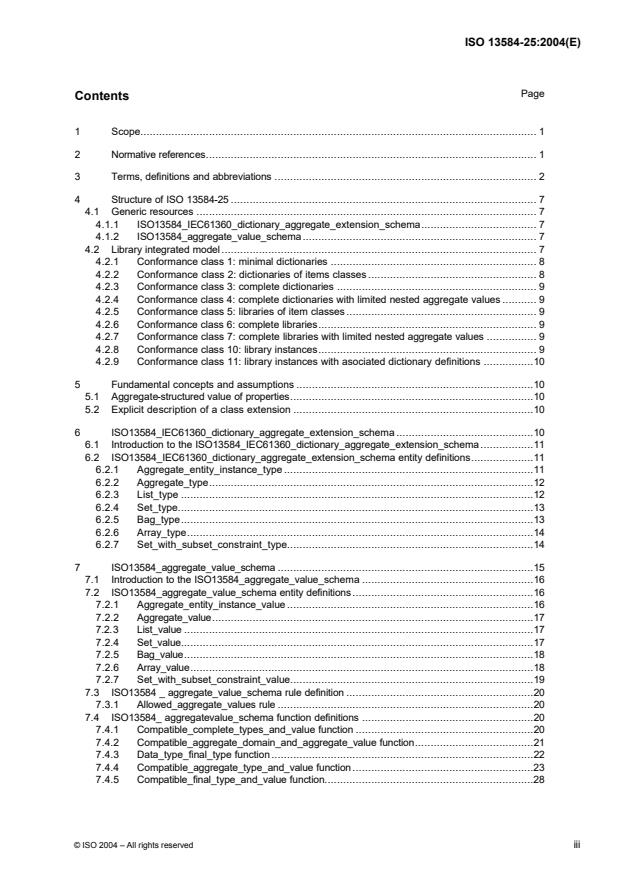
Contents
1 Scope. 1
2 Normative references. 1
3 Terms, definitions and abbreviations . 2
4 Structure of ISO 13584-25 . 7
4.1 Generic resources . 7
4.1.1 ISO13584_IEC61360_dictionary_aggregate_extension_schema. 7
4.1.2 ISO13584_aggregate_value_schema. 7
4.2 Library integrated model. 7
4.2.1 Conformance class 1: minimal dictionaries . 8
4.2.2 Conformance class 2: dictionaries of items classes . 8
4.2.3 Conformance class 3: complete dictionaries . 9
4.2.4 Conformance class 4: complete dictionaries with limited nested aggregate values . 9
4.2.5 Conformance class 5: libraries of item classes. 9
4.2.6 Conformance class 6: complete libraries. 9
4.2.7 Conformance class 7: complete libraries with limited nested aggregate values . 9
4.2.8 Conformance class 10: library instances. 9
4.2.9 Conformance class 11: library instances with asociated dictionary definitions .10
5 Fundamental concepts and assumptions .10
5.1 Aggregate-structured value of properties.10
5.2 Explicit description of a class extension .10
6 ISO13584_IEC61360_dictionary_aggregate_extension_schema .10
6.1 Introduction to the ISO13584_IEC61360_dictionary_aggregate_extension_schema.11
6.2 ISO13584_IEC61360_dictionary_aggregate_extension_schema entity definitions.11
6.2.1 Aggregate_entity_instance_type .11
6.2.2 Aggregate_type.12
6.2.3 List_type .12
6.2.4 Set_type.13
6.2.5 Bag_type.13
6.2.6 Array_type.14
6.2.7 Set_with_subset_constraint_type.14
7 ISO13584_aggregate_value_schema .15
7.1 Introduction to the ISO13584_aggregate_value_schema .16
7.2 ISO13584_aggregate_value_schema entity definitions.16
7.2.1 Aggregate_entity_instance_value.16
7.2.2 Aggregate_value.17
7.2.3 List_value .17
7.2.4 Set_value.17
7.2.5 Bag_value.18
7.2.6 Array_value.18
7.2.7 Set_with_subset_constraint_value.19
7.3 ISO13584 _ aggregate_value_schema rule definition .20
7.3.1 Allowed_aggregate_values rule .20
7.4 ISO13584_ aggregatevalue_schema function definitions .20
7.4.1 Compatible_complete_types_and_value function .20
7.4.2 Compatible_aggregate_domain_and_aggregate_value function.21
7.4.3 Data_type_final_type function.22
7.4.4 Compatible_aggregate_type_and_value function.23
7.4.5 Compatible_final_type_and_value function.28
8 Library integrated information model 25.31
8.1 ISO13584_25_IEC61360_5_liim_schema short listing .32
8.2 Conformance class requirements .38
8.2.1 Conformance class 1: minimal dictionaries .38
8.2.2 Conformance class 2: dictionaries of items classes .40
8.2.3 Conformance class 3: complete dictionaries .42
8.2.4 Conformance class 4: complete dictionaries with limited nested aggregate values .43
8.2.5 Conformance class 5: libraries of item classes.43
8.2.6 Conformance class 6: complete libraries.45
8.2.7 Conformance class 7: complete libraries with limited nested aggregate values .46
8.2.8 Conformance class 10: library instances.46
8.2.9 Conformance class 11: library instances with asociated dictionary definitions .48
Annex A (normative) Short names of entities defined in this part .52
Annex B (normative) Information object registration.53
B.1 Document identification.53
B.2 Schema identification .53
B.2.1 ISO13584_IEC61360_dictionary_aggregate_extension_schema .53
B.2.2 ISO13584_aggregate_value_schema.53
B.3.2 ISO13584_25_IEC61360_5_liim_schema .53
Annex C (normative) ISO13584_25_IEC61360_5_library_implicit_schema expanded listing .54
Annex D (normative) Standard data requirements for library integrated information model 25.56
D.1 Constraints on a library delivery file for referencing library integrated information model 25.56
D.2 Conformance class specification table.57
D.3 Standard data for conformance class 2 to 7 and 10 to 11 (all the conformance classes but
conformance class 1).57
D.3.1 Allowed_reference_to_LIIM_25_rule rule.58
D.3.2 Allowed_entity_instance_type_in_LIIM_25_rule rule.60
D.3.3 Allowed_language_assignement_rule rule.62
D.3.4 Compliant_http_protocol_25 function.62
D.3.5 Compliant_8859_1_protocol_25 function.63
D.3.6 Compliant_external_file_protocol_25 function.64
D.3.7 Is_correct_liim_25_application_value function .65
D.4 Additional constraint for conformance classes 4 and 7.66
D.4.1. nesting_level_aggregate_limit_rule rule.66
D.4.2. no_more_than_two_nested_levels function .67
Annex E (normative) Implementation method specific requirements for the library integrated information
model 25 .68
Annex F (informative) EXPRESS-G diagrams .69
Annex G (informative) Commented example of library integrated information model 25 physical files.
Exchange of explicit general models .72
G.1 Capturing a parts family in ISO 13584.72
G.2 Description of the PAW parts family .73
G.2.1 Dictionary description: the BSU mechanism.74
G.2.2 Dictionary description: the dictionary element definition.74
G.2.3 Library specification: description of the class extension.75
G.3 A complete physical file for explicit general models.76
Annex H (informative) Commented example of library integrated information model 25 physical files.
Exchange of explicit functional models compliant with ISO 13584-101.80
H.1 Description of the PAW parts family and its geometry .80
H.1.1 Dictionary description.80
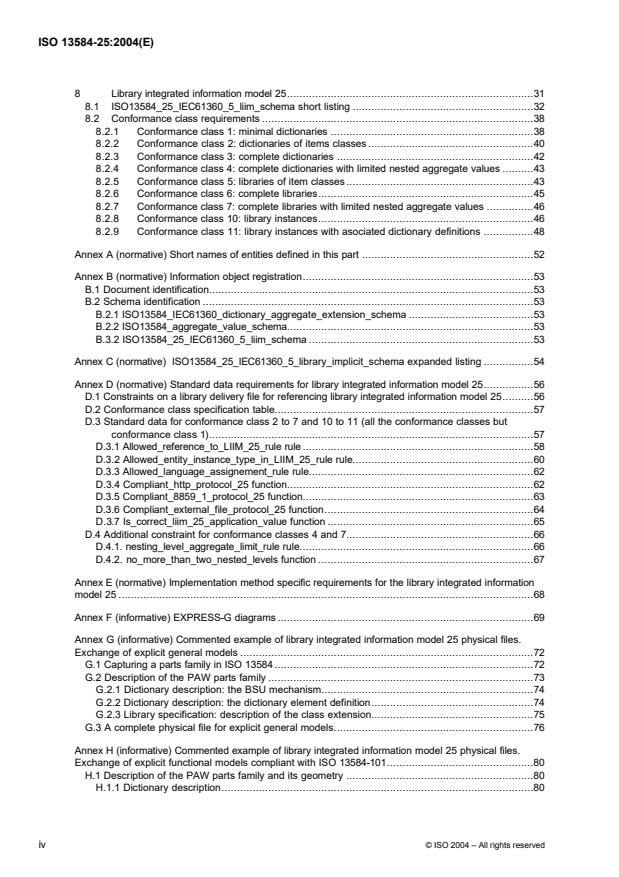
iv © ISO 2004 – All rights reserved
H.2. Description of geometric representations for the PAW parts family.81
H.3. Library specification of the functional model class .82
H.4 A complete physical file for explicit functional models compliant with ISO 13584-101.84
Index.95
Figures
Figure F.1 — ISO13584_IEC61630_dictionary_aggregate_extension_schema diagram 1 of 1.70
Figure F.2 — ISO13584_aggregate_value_schema diagram 1 of 1.71
Figure G.1 — PAW family description .72
Figure G.2 — Instance of a dictionary description.73
Figure G.3 — Explicit description of a dictionary description.73
Figure G.4 — Identifiers of the concepts involved in the PAW family.74
Figure G.5 — The BSU / Dictionary element relationship.74
Figure G.6 — Dictionary_element of the concepts involved in the PAW family.75
Figure G.7 — Dictionary_element of the concepts involved in the PAW family.75
Figure G.8 — Dictionary_element of the concepts involved in the PAW family.76
Figure H.1 — The Identifiers of the concepts involved in the Paw family and its geometry
representation .81
Figure H.2 — View control variables range definition .82
Figure H.3 — Specification of the view created by a functional model class.82
Figure H.4 — Description by extension of the instances of a functional model .83
Figure H.5 — References to FORTRAN programs that display geometry. .84
Figure H.6 — The BSU / Dictionary element relationship.84
Tables
Table 1 — Conformance options of library integrated information model 25.32
Table A.1 — Short names of entities .52
Table D. 1 — ISO 13584 LIIM 25 conformance class specification.57
Foreword
ISO (the International Organization for Standardization) is a worldwide federation of national standards bodies
(ISO member bodies). The work of preparing International Standards is normally carried out through ISO
technical committees. Each member body interested in a subject for which a technical committee has been
established has the right to be represented on that committee. International organizations, governmental and
non-governmental, in liaison with ISO, also take part in the work. ISO collaborates closely with the
International Electrotechnical Commission (IEC) on all matters of electrotechnical standardization.
International Standards are drafted in accordance with the rules given in the ISO/IEC Directives, Part 2.
The main task of technical committees is to prepare International Standards. Draft International Standards
adopted by the technical committees are circulated to the member bodies for voting. Publication as an
International Standard requires approval by at least 75 % of the member bodies casting a vote.
Attention is drawn to the possibility that some of the elements of this document may be the subject of patent
rights. ISO shall not be held responsible for identifying any or all such patent rights.
ISO 13584-25 was prepared by Technical Committee ISO/TC 184, Industrial automation systems and
integration, Subcommittee SC 4, Industrial data.
ISO 13584 consists of the following parts, under the general title Industrial automation systems and
integration — Parts library:
— Part 1: Overview and fundamental principles
— Part 20: Logical resource: Logical model of expressions
— Part 24: Logical resource: Logical model of supplier library
— Part 25: Logical resource: Logical model of supplier library with aggregate values and explicit content
— Part 26: Logical resource: Information supplier identification
— Part 31: Implementation resources: Geometric programming interface
— Part 42: Description methodology: Methodology for structuring part families
— Part 101: Geometrical view exchange protocol by parametric program
— Part 102: View exchange protocol by ISO 10303 conforming specification
The structure of ISO 13584 is described in ISO 13584-1. The numbering of the parts of ISO 13584 reflects its
structure:
— Parts 10 to 19 specify the conceptual descriptions;
— Parts 20 to 29 specify the logical resources;
— Parts 30 to 39 specify the implementation resources;
vi © ISO 2004 – All rights reserved
— Parts 40 to 49 specify the description methodology;
— Parts 100 to 199 specify the view exchange protocol.
Should further parts of ISO 13584 be published, they will follow the same numbering pattern.
Introduction
ISO 13584 is an International Standard for the computer-interpretable representation and exchange of
parts library data. The objective is to provide a neutral mechanism capable of transferring parts library
data, independent of any application that is using a parts library data system. The nature of this
description makes it suitable not only for the exchange of files containing parts, but also as a basis for
implementing and sharing databases of parts library data.
ISO 13584 is organized as a series of parts, each published separately. The parts of
ISO 13854 fall into one of the following series: conceptual descriptions, logical resources,
implementation resources, description methodology and view exchange protocol. The series are
described in ISO 13584-1. This part of ISO 13584 is a member of the logical resources series.
This part of ISO 13584 specifies the generic resources needed for modelling supplier libraries that
contain properties whose values may be aggregate-structured, and whose possible content is explicitly
described as a set of instances. It also provides the EXPRESS integrated information models that permit
the exchange of such supplier libraries. Knowledge of EXPRESS as defined in ISO 10303-11 is required
to understand this part of ISO 13584. Basic knowledge of ISO 13584-24 and ISO 13584-42 is also
required.
The generic resources specified in this document were developed as a joint effort of
ISO TC184/SC4/WG2 and IEC SC3D. They are intended to be documented both in this part of
ISO 13584 and in IEC 61360-5. Both committees agreed not to change and/or modify the presented
EXPRESS schemas independent of each other in order to guarantee the harmonization and the
reusability of the work from both committees. Requests for amendments should therefore be sent to
both committees. These requests should be adopted by both committees before modifying the
EXPRESS schemas.
viii © ISO 2004 – All rights reserved
INTERNATIONAL STANDARD ISO 13584-25:2004(E)
Industrial automation systems and integration — Parts
library —
Part 25:
Logical resource: Logical model of supplier library with
aggregate values and explicit content
1 Scope
This part of ISO 13584 provides generic EXPRESS resource constructs that support the description of
aggregate data types and values occurring in supplier libraries. It also contains an integrated EXPRESS
information model for representing supplier libraries for the purpose of exchange. This integrated
information model integrates the above resource constructs with other EXPRESS resource constructs
from different parts of ISO 13584 and ISO 10303 into one single schema. Supplier libraries may consist
of definitions and of representations of families of parts. They may also define new representation
categories. Supplier libraries may consist only of dictionary elements with or without aggregate data
types, or they may also contain explicit specifications of the sets of permitted instances.
When used together with view exchange protocols, this integrated information model also permits the
exchange of one or several representation categories for the parts defined in a parts library.
The following are within the scope of this part of ISO 13584:
— generic resource constructs for representing aggregate data types. Aggregate data types and
values are modeled according to the definition of aggregate data types of the EXPRESS language
(ISO 10303-11);
— generic resource constructs for representing aggregate values;
— generic resource constructs for representing of assembled parts that may contain an unlimited
number of constituent components;
— a library integrated information model that provides for modeling and exchanging supplier libraries
that contain properties whose values may be aggregate-structured, and whose possible class
extensions are explicitly described as sets of instances.
The following are outside the scope of this part of ISO 13584:
— representation of expressions and variables;
— implicit description of the set of permitted instances of a class by means of constraints;
— specification of a software system able to manage supplier libraries represented according to the
information models defined in this part of ISO 13584.
2 Normative references
The following referenced documents are indispensable for the application of this document. For dated
references, only the edition cited applies. For undated references, the latest edition of the referenced
document (including any amendments) applies.
IEC 61360-2:1998, Standard data element types with associated classification scheme for electric
components — Part 2: EXPRESS dictionary schema
ISO/IEC 8824-1, Information technology — Abstract Syntax Notation One (ASN.1): Specification of
basic notation
ISO 8859-1, Information technology — 8-bit single-byte coded graphic character sets — Part 1: Latin
alphabet No. 1
ISO 10303-11:1994, Industrial automation systems and integration — Product data representation and
exchange — Part 11: Description methods: The EXPRESS language reference manual
ISO 10303-21:2002, Industrial automation systems and integration — Product data representation and
exchange — Part 21: Implementation methods: Clear text encoding of the exchange structure
ISO 10303-41:2000, Industrial automation systems and integration — Product data representation and
exchange — Part 41: Integrated generic resource: Fundamentals of product description and support
ISO 10303-42: 2003, Industrial automation systems and integration — Product data representation and
exchange — Part 42: Integrated generic resource: Geometric and topological representation
ISO 10303-43: 2000, Industrial automation systems: and integration — Product data representation and
exchange — Part 43: Integrated generic resource: Representation structures
ISO 13584-24:2003, Industrial automation systems and integration — Parts library — Part 24: Logical
resource: Logical model of supplier library
ISO 13584-42:1998, Industrial automation systems and integration — Parts library — Part 42: Description
methodology: Methodology for structuring part families
IAB RFC 2068, Hypertext transfer protocol HTTP/1.1 (HTTP-1.1), Internet architecture board proposed
standard protocol
3 Terms, definitions and abbreviations
For the purposes of this document, the following terms and definitions apply. Some of these
terms and definitions are repeated for convenience from:
— ISO 10303-1:1994;
— ISO 10303-11:1994;
— ISO 13584-1:2001;
— ISO 13584-24:2003;
— ISO 13584-42:1998.
NOTE Definitions copied verbatim from other standards are followed by a reference to the source
standard in brackets. Definitions that have been adapted from other standards are followed by an
explanatory note.
2 © ISO 2004 All rights reserved
3.1
applicable property
a property that is defined for some family of parts and that shall apply to any part that belongs to this
family of parts
[ISO 13584-24:2003]
EXAMPLE For a screw generic family of parts, the threaded diameter is an applicable property: this
characteristic applies to any screw.
3.2
basic semantic unit
BSU
the entity that provides an absolute and universal identification of certain objects of the application
domain (e.g. classes, data element types)
[ISO 13584-42:1998]
3.3
class extension
set of all the different possible instances conforming to the specification defined by a class
[ISO 13584-24:2003]
3.4
common dictionary schema
the information model for a dictionary, using the EXPRESS modeling language, resulting from a joint
effort between ISO TC184/SC4/WG2 and IEC SC3D
[ISO 13584-42:1998]
NOTE The common dictionary schema is formally named ISO13584_IEC61360_dictionary_schema
and is specified in IEC 61360-2. This schema is duplicated in Annex D of ISO 13584-42:1998.
3.5
conformance class
a subset of a standard for which conformance may be claimed
[ISO 13584-24:2003]
3.6
conformance requirement
a precise, text definition of a characteristic required to be present in a conforming implementation
[ISO 10303-1:1994]
3.7
dictionary element
the set of attributes that constitutes the dictionary description of certain objects of the application
domain (e.g. classes, data element types)
[ISO 13584-42:1998]
3.8
data element type
DET
unit of data for which the identification, the description and value representation have been specified
[ISO 13584-42:1998]
3.9
data type
a domain of values
[ISO 10303-11:1994]
3.10
family of parts
a simple or generic family of parts
[ISO 13584-24:2003]
3.11
functional model of a part
the library data that represent one representation category of a part in an integrated library
[ISO 13584-1:2001]
3.12
functional view of a part
the data that represent one representation category of a part in product data
[ISO 13584-1:2001]
NOTE The structure of a functional view does not depend on the part it represents.
3.13
general model of a part
the library data that carries the definition and identity of a part in an integrated library
[ISO 13584-1:2001]
3.14
generic family of parts
a grouping of simple or generic families of parts done for purposes of classification or for factoring
common information
[ISO 13584-24:2003]
3.15
library delivery file
a population of EXPRESS entity instances conforming to a library integrated information model and
represented according to one of the implementation methods specified in ISO 10303
[ISO 13584-24:2003]
NOTE A library delivery file specifies the structure and the content of a supplier library. It may reference
library external files.
3.16
library part
a part associated with a set of data that represents it in a library
[ISO 13584-1:2001]
4 © ISO 2004 All rights reserved
3.17
library part data
the data that represent a part in a library
[ISO 13584-1:2001]
3.18
library exchange context
the set of one library delivery file and zero, one or several library external files that represent together a
supplier library
[ISO 13584-24:2003]
3.19
library external file
a file, referenced from a library delivery file, that contributes to the definition of a supplier library
[ISO 13584-24:2003]
NOTE The structure and the format of a library external file is specified in the library delivery file
that references it.
3.20
library integrated information model
LIIM
an EXPRESS schema that integrates resource constructs from different EXPRESS schemas for
representing supplier libraries for the purpose of exchange and that is associated with conformance
requirements
[ISO 13584-24:2003]
3.21
library specification of a class
explicit representation of a class extension in a supplier library
[ISO 13584-24:2003]
NOTE 1 In the ISO 13584 series, every class is intentionally defined through a dictionary element. Only
those classes of which the supplier desires to represent explicitly the possible instances are associated
with a library specification.
NOTE 2 In this part of ISO 13584, the library specification of a class consists of a set that contains all the
different possible instances.
3.22
part
material or functional element that is intended to constitute a component of different products
[ISO 13584-1:2001]
3.23
property
an information that may be represented by a data element type
[ISO 13584-42:1998]
3.24
representation category
an abstraction used to distinguish between different possible user requirements regarding a part
representation
[ISO 13584-1:2001]
NOTE In the model defined in the ISO 13584 standard series, this distinction is formally expressed in
terms of a view logical name and in terms of the view control variables.
3.25
resource construct
the collection of EXPRESS language entities, types, functions, rules and references that together define
a valid description of data
[ISO 13584-24:2003]
3.26
simple family of parts
a set of parts of which each part may be described by the same group of properties
]
[ISO 13584-24:2003
3.27
supplier library
a set of data, and possibly of programs, for which the supplier is defined and that describes in the
standard format defined in ISO 13584 a set of parts and/or a set of representation of parts
[ISO 13584-1:2001]
3.28
user library
the information that results from the integration of one or more supplier libraries by the library
management system and possibly from a later adaptation performed by the user
[ISO 13584-1:2001]
3.29
view exchange protocol
VEP
a part of ISO 13584 that describes the use of resource constructs and of representation transmission
interfaces that satisfy the information requirement for the exchange of one representation category of
parts
[ISO 13584-24:2003]
3.30
visible property
a property that is defined for some family of parts and that may or not apply to the different parts of this
family of parts
[ISO 13584-24:2003]
EXAMPLE For a generic family of screws, the non-threaded length is a visible property: it is clearly
defined for any screw, but only those screws with a non-threaded part have a value for this property.
6 © ISO 2004 All rights reserved
NOTE The code of the class where a property is defined as visible is part of the identification of the data
element type that represents this property.
4 Structure of ISO 13584-25
ISO 13584-25 has two main parts.
The generic resources part provides resource constructs for representing aggregate data types and
values. Aggregate data types and values include those defined in the EXPRESS language.
Library integrated information model LIIM 25 gathers the above resource constructs with other generic
resource constructs from other parts of ISO 13584 and from ISO 10303 into a single schema for
representing supplier libraries. That schema includes aggregate data types and aggregate values and
explicitly describes class extensions as sets of instances.
4.1 Generic resources
The generic resources consist of the following EXPRESS schemas:
— ISO13584_IEC61360_dictionary_aggregate_extension_schema;
— ISO13584_aggregate_value_schema.
These schemas provide resource constructs that are generic in nature. They may be used outside
ISO 13584, and particularly in all the applications that use a data dictionary compliant with the
IEC 61360 standard series.
4.1.1 ISO13584_IEC61360_dictionary_aggregate_extension_schema
The ISO13584_IEC61360_dictionary_aggregate_extension_schema provides the resource
constructs needed to describe data types corresponding to aggregate data types that include those
defined in the EXPRESS language. It defines resources to describe array, bag, list, set and set of
subsets data types. These data types extend the data types already defined in the
ISO13584_IEC61360_dictionary_schema published in IEC 61360-2:1998 and whose content is
duplicated in an informative Annex of ISO 13584-42:1998.
4.1.2 ISO13584_aggregate_value_schema
The ISO13584_aggregate_value_schema provides the resource constructs needed to describe values
of data types corresponding to aggregate data types as defined in the EXPRESS language. It defines
resources to describe array, bag, list and set–structured values. These data values extend the data
values already defined in the ISO13584_instance_resource_schema specified in ISO 13584-24.
4.2 Library integrated model
The library integrated information model specified in this part of ISO 13584, called LIIM 25, gathers the
generic resource constructs defined in this part of ISO 13584 with other generic resource constructs
from other parts of ISO 13584 and from ISO 10303 into a single schema for representing supplier
libraries for the purpose of exchange. LIIM 25 enables the exchange of seven kinds of dictionaries or
libraries and the exchange of a set of library instances without library structure, between a library data
supplier and a library end-user.
— Dictionaries that define hierarchies of classes of items, that may be parts, materials or other
items, with aggregate-structured properties using only the EXPRESS resource constructs defined
in the ISO/IEC common dictionary schema or in the
ISO13584_IEC61360_dictionary_aggregate _extension_schema defined in this part of ISO
13584 corresponds to conformance class 1;
— Dictionaries that define hierarchies of classes of items, that may be parts, materials, features or
other items, using the extension of the ISO/IEC common dictionary schema defined in ISO
13584-24, but without description of item representations and of representation categories of
items, and without aggregate-structured properties, corresponds to conformance class 2;
— Dictionaries that define hierarchies of classes of items, of item representations, and of
representation categories of items, with aggregate-structured properties, corresponds to
conformance class 3;
— Dictionaries with the same scope as conformance class 3 but with no more than two levels
nesting for aggregate-structured properties, corresponds to conformance class 4;
— Libraries that define the set of instances that belong to some hierarchies of classes of items,
without classes of item representations and of representation categories of items, and without
aggregate-structured properties, corresponds to conformance class 5;
— Libraries that define the set of instances that belong to some hierarchies of classes of items and
of item representations, with aggregate-structured properties corresponds to conformance
class 6;
— Libraries with the same scope as conformance class 6 but with no more than two levels nesting
for aggregate-structured properties corresponds to conformance class 7;
— Set of item instances and of item representation instances without dictionary definitions and
without library structure corresponds to conformance class 10;
— Set of item instances and of item representation instances without library structure but possibly
with dictionary definitions corresponds to conformance class 11.
Each of the above kind of exchange context corresponds to one conformance class of LIIM 25. Each
conformance class specifies the conformance requirements for implementations that claim conformance
to this conformance class. Conformance classes 6 and 7 supports all the entities, types and associated
constructs that are part of LIIM 25. Other conformance classes shall only support a subset of this set of
resource constructs. In this part of ISO 13584, each subset that defines a conformance class is defined
by means of a list of entities. An implementation that claims conformance to any conformance class
shall support all the entities listed for this conformance class and related constructs.
4.2.1 Conformance class 1: minimal dictionaries
Conformance class 1 supports the information requirements for exchanging definitions of hierarchies of
item classes, where items may be parts or materials. It allows the exchange of all the dictionary
elements from the ISO/IEC dictionary schema and item classes whose properties may have aggregate-
structured values. Conformance class 1 is associated with implementation methods for the library
delivery file. Conformance requirements to conformance class 1 of LIIM 25 are defined in Clause 8.2.1 of
this part of ISO 13584.
4.2.2 Conformance class 2: dictionaries of items classes
Conformance class 2 supports the information requirements for exchanging definitions of hierarchies of
item classes, where items may be parts, materials or features, whose properties may not have
aggregate-structured values. Conformance class 2 is associated with a set of standard data that defines
the formats of library external files that may be referenced by a library delivery file conforming to
conformance class 2 of LIIM 25, and with implementation methods for the library delivery file.
Conformance requirements for conformance class 2 of LIIM 25 are defined in Clause 8.2.2 of this part of
ISO 13584.
8 © ISO 2004 All rights reserved
4.2.3 Conformance class 3: complete dictionaries
Conformance class 3 supports the information requirements for exchanging definitions of hierarchies of
item classes, where items may be parts, materials or features , together with definitions of
representations of such item classes, and with definitions of representation categories of such item
classes. Properties of all these classes may have aggregate-structured values. Conformance class 3 is
associated with a set of standard data that defines the formats of library external files that may be
referenced by a library delivery file conforming to conformance class 3 of LIIM 25, and with
implementation methods for the library delivery file. Conformance requirements for conformance class 3
of LIIM 25 are defined in Clause 8.2.3 of this part of ISO 13584.
4.2.4 Conformance class 4: complete dictionaries with limited nested aggregate values
Conformance class 4 supports the information requirements corresponding to conformance class 3 with
a restriction. The aggregate values involved in conformance class 4 shall not be nested more than twice.
Conformance requirements for conformance class 4 of LIIM 25 are defined in Clause 8.2.4 of this part of
ISO 13584.
4.2.5 Conformance class 5: libraries of item classes
Conformance class 5 supports the information requirements for exchanging definitions and instances of
hierarchies of item classes, where items may be parts, materials or features, whose properties may not
have aggregate-structured values. Class extensions may only be defined by sets of instances, without
any constraint or expression. Conformance class 5 is associated with a set of standard data that
defines the formats of library external files that may be referenced by a library delivery file conforming to
conformance class 5 of LIIM 25, and with implementation methods for the library delivery file.
Conformance requirements for conformance class 5 of LIIM 25 are defined in Clause 8.2.5 of this part of
ISO 13584.
4.2.6 Conformance class 6: complete libraries
Conformance class 6 supports the information requirements for exchanging definitions and instances of
hierarchies of item classes, where items may be parts, materials or features together with definitions
and instances of representations of such item classes, and with definitions of representation categories
of such item classes. Properties of all these classes may have aggregate-structured values. Class
extensions may only be defined by sets of instances, without any constraint or expression.
Conformance class 6 is associated with a set of standard data that defines the formats of library
external files that may be referenced by a library delivery file conforming to conformance class 6 of LIIM
25, and with implementation methods for the library delivery file. Conformance requirements for
conformance class 6 of LIIM 25 are defined in Clause 8.2.6 of this part of ISO 13584.
4.2.7 Conformance class 7: complete libraries with limited nested aggregate values
Conformance class 7 supports the information requirements corresponding to conformance class 6 with
a restriction. The aggregate values involved in this conformance class shall not be nested more than
twice. Conformance requirements for conformance class 7 of LIIM 25 are defined in Clause 8.2.7 of this
part of ISO 13584.
4.2.8 Conformance class 10: library instances
Conformance class 10 supports the information requirements for exchanging one or several instances of
items, where items may be parts, materials or features, or of item representation but without dictionary
definitions. This conformance class is intended to provide resources for delivering a set of instance
selected by a user in a library, possibly with item representations. Conformance class 10 is associated
with a set of standard data that defines the formats of library external files that may be referenced by a
libr
...
INTERNATIONAL ISO
STANDARD 13584-25
First edition
2004-06-15
Industrial automation systems and
integration — Parts library —
Part 25:
Logical resource: Logical model of
supplier library with aggregate values
and explicit content
Systèmes d'automatisation industrielle et intégration — Bibliothèque de
composants —
Partie 25: Ressource logique: Modèle logique de fournisseur avec des
valeurs d'ensemble et un contenu explicite
Reference number
©
ISO 2004
PDF disclaimer
This PDF file may contain embedded typefaces. In accordance with Adobe's licensing policy, this file may be printed or viewed but
shall not be edited unless the typefaces which are embedded are licensed to and installed on the computer performing the editing. In
downloading this file, parties accept therein the responsibility of not infringing Adobe's licensing policy. The ISO Central Secretariat
accepts no liability in this area.
Adobe is a trademark of Adobe Systems Incorporated.
Details of the software products used to create this PDF file can be found in the General Info relative to the file; the PDF-creation
parameters were optimized for printing. Every care has been taken to ensure that the file is suitable for use by ISO member bodies. In
the unlikely event that a problem relating to it is found, please inform the Central Secretariat at the address given below.
This CD-ROM contains the following.
1) The publication ISO 13584-25:2004 in portable document format (PDF), which can be viewed using
Adobe® Acrobat® Reader.
2) The EXPRESS schemas for ISO 13584-25
...