

ISO/IEC 14776-262:2017
(Main)Information technology — Small computer system interface (SCSI) — Part 262: SAS protocol layer - 2 (SPL-2)
General Information
- Abstract
ISO/IEC 14776-262:2017(E) This standards defines the model and command set extensions to be used in conjunction with the SCSI Primary Command Set Standard - 4 (SPC-4) to facilitate operation of SCSI direct-access block devices (e.g. hard disk drives).
- Status
- Published
- Publication Date
- 14-Feb-2017
- Technical Committee
- ISO/IEC JTC 1/SC 25 - Interconnection of information technology equipment
- Current Stage
- 6060 - International Standard published
- Start Date
- 15-Feb-2017
- Due Date
- 26-Aug-2016
- Completion Date
- 26-Aug-2016
Buy Documents
ISO/IEC 14776-262:2017 - Information technology -- Small computer system interface (SCSI)
ISO/IEC 14776-262:2017 - Information technology — Small computer system interface (SCSI) — Part 262: SAS protocol layer - 2 (SPL-2)/15/2017
Overview
ISO/IEC 14776-262:2017 - "Information technology - Small Computer System Interface (SCSI) - Part 262: SAS Protocol Layer - 2 (SPL-2)" specifies the protocol-layer model and command set extensions used together with the SCSI Primary Command Set (SPC‑4) to support operation of SCSI direct‑access block devices (for example, hard disk drives). The standard defines behavioral models, state machines, naming and addressing, and the expander/port mechanisms required for reliable Serial Attached SCSI (SAS) operation at the protocol layer.
Key topics and technical requirements
- Architecture and layering: Defines the SAS protocol layer concepts, physical links (phys), logical links, narrow/wide ports, and how the protocol integrates with SPC‑4 for block device commands.
- State machines and data paths: Specifies transmit and receive data‑path state machines and their transitions for robust command delivery and error handling.
- Expander device model: Detailed model of expander devices including expander ports, routing, connection manager (ECM), connection router (ECR), and broadcast propagation processor (BPP).
- Discovery and configuration: Procedures for topology discovery, routing table construction, multiplexing enablement, and expander configuration options.
- Names, identifiers and addressing: Rules for SAS addresses, NAA formats, hashed addresses, port and phy identifiers, and handling of SATA devices with world wide names.
- Events and resets: Defined behaviors for hard resets, I_T nexus loss, power‑loss events and related recovery sequences.
- Zoning and security controls: Zoning mechanisms, zone groups, permission tables and how zoning affects expander routing and broadcast handling.
- Routing and topology: Expander route tables, routing attributes and methods, topology restrictions and optimization considerations.
Applications and who uses this standard
ISO/IEC 14776-262:2017 is used by:
- Firmware and hardware engineers designing SAS host bus adapters (HBAs), controllers, expanders and storage enclosure logic.
- Storage system architects and OEMs implementing SAS-based RAID arrays, JBOD enclosures and enterprise storage solutions.
- Interoperability and test teams performing compliance, conformance and interoperability testing between SAS devices.
- Integrators and data center operators implementing zoning, path management and high‑availability storage networks. Practical benefits include consistent device behavior, predictable discovery and routing, improved interoperability, and standardized error/recovery procedures for SCSI direct‑access block devices over SAS.
Related standards
- SCSI Primary Command Set (SPC‑4) - used in conjunction with SPL‑2 for command semantics.
- Other parts of the SAS protocol family and SAS physical‑layer standards (related SPL and PHY documents) that define lower‑level signaling and additional protocol layers.
Keywords: ISO/IEC 14776-262:2017, SAS Protocol Layer 2, SPL-2, SCSI, SPC-4, SAS expander, SAS addressing, zoning, storage interoperability.
Buy Documents
ISO/IEC 14776-262:2017 - Information technology -- Small computer system interface (SCSI)
ISO/IEC 14776-262:2017 - Information technology — Small computer system interface (SCSI) — Part 262: SAS protocol layer - 2 (SPL-2)/15/2017
Get Certified
Connect with accredited certification bodies for this standard

BSI Group
BSI (British Standards Institution) is the business standards company that helps organizations make excellence a habit.

NYCE
Mexican standards and certification body.
Sponsored listings
Frequently Asked Questions
ISO/IEC 14776-262:2017 is a standard published by the International Organization for Standardization (ISO). Its full title is "Information technology — Small computer system interface (SCSI) — Part 262: SAS protocol layer - 2 (SPL-2)". This standard covers: ISO/IEC 14776-262:2017(E) This standards defines the model and command set extensions to be used in conjunction with the SCSI Primary Command Set Standard - 4 (SPC-4) to facilitate operation of SCSI direct-access block devices (e.g. hard disk drives).
ISO/IEC 14776-262:2017(E) This standards defines the model and command set extensions to be used in conjunction with the SCSI Primary Command Set Standard - 4 (SPC-4) to facilitate operation of SCSI direct-access block devices (e.g. hard disk drives).
ISO/IEC 14776-262:2017 is classified under the following ICS (International Classification for Standards) categories: 35.200 - Interface and interconnection equipment. The ICS classification helps identify the subject area and facilitates finding related standards.
ISO/IEC 14776-262:2017 is available in PDF format for immediate download after purchase. The document can be added to your cart and obtained through the secure checkout process. Digital delivery ensures instant access to the complete standard document.
Standards Content (Sample)
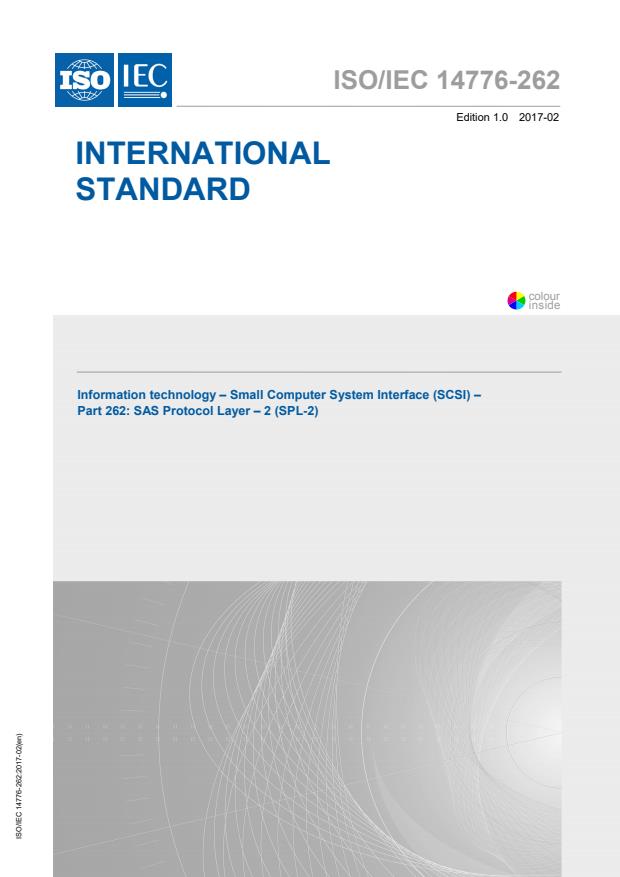
ISO/IEC 14776-262
Edition 1.0 2017-02
INTERNATIONAL
STANDARD
colour
inside
Information technology – Small Computer System Interface (SCSI) –
Part 262: SAS Protocol Layer – 2 (SPL-2)
All rights reserved. Unless otherwise specified, no part of this publication may be reproduced or utilized in any form
or by any means, electronic or mechanical, including photocopying and microfilm, without permission in writing from
either IEC or IEC's member National Committee in the country of the requester. If you have any questions about
ISO/IEC copyright or have an enquiry about obtaining additional rights to this publication, please contact the address
below or your local IEC member National Committee for further information.
IEC Central Office Tel.: +41 22 919 02 11
3, rue de Varembé Fax: +41 22 919 03 00
CH-1211 Geneva 20 info@iec.ch
Switzerland www.iec.ch
About the IEC
The International Electrotechnical Commission (IEC) is the leading global organization that prepares and publishes
International Standards for all electrical, electronic and related technologies.
About IEC publications
The technical content of IEC publications is kept under constant review by the IEC. Please make sure that you have the
latest edition, a corrigenda or an amendment might have been published.
IEC Catalogue - webstore.iec.ch/catalogue Electropedia - www.electropedia.org
The stand-alone application for consulting the entire The world's leading online dictionary of electronic and
bibliographical information on IEC International Standards, electrical terms containing 20 000 terms and definitions in
Technical Specifications, Technical Reports and other English and French, with equivalent terms in 16 additional
documents. Available for PC, Mac OS, Android Tablets and languages. Also known as the International Electrotechnical
iPad. Vocabulary (IEV) online.
IEC publications search - www.iec.ch/searchpub IEC Glossary - std.iec.ch/glossary
The advanced search enables to find IEC publications by a 65 000 electrotechnical terminology entries in English and
variety of criteria (reference number, text, technical French extracted from the Terms and Definitions clause of
committee,…). It also gives information on projects, replaced IEC publications issued since 2002. Some entries have been
and withdrawn publications. collected from earlier publications of IEC TC 37, 77, 86 and
CISPR.
IEC Just Published - webstore.iec.ch/justpublished
Stay up to date on all new IEC publications. Just Published IEC Customer Service Centre - webstore.iec.ch/csc
details all new publications released. Available online and If you wish to give us your feedback on this publication or
also once a month by email. need further assistance, please contact the Customer Service
Centre: csc@iec.ch.
ISO/IEC 14776-262
Edition 1.0 2017-02
INTERNATIONAL
STANDARD
colour
inside
Information technology – Small Computer System Interface (SCSI) –
Part 262: SAS Protocol Layer – 2 (SPL-2)
INTERNATIONAL
ELECTROTECHNICAL
COMMISSION
ICS 35.200 ISBN 978-2-8322-3952-0
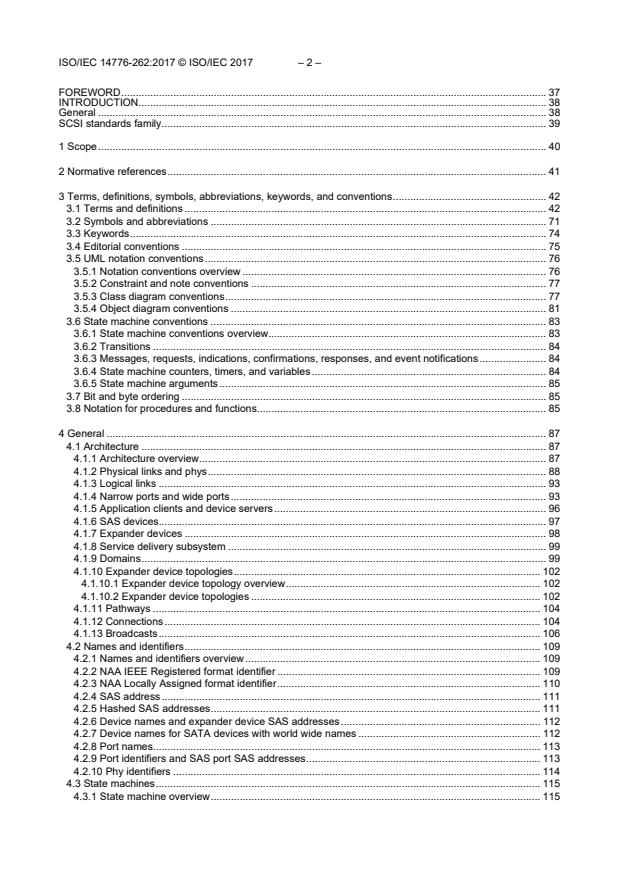
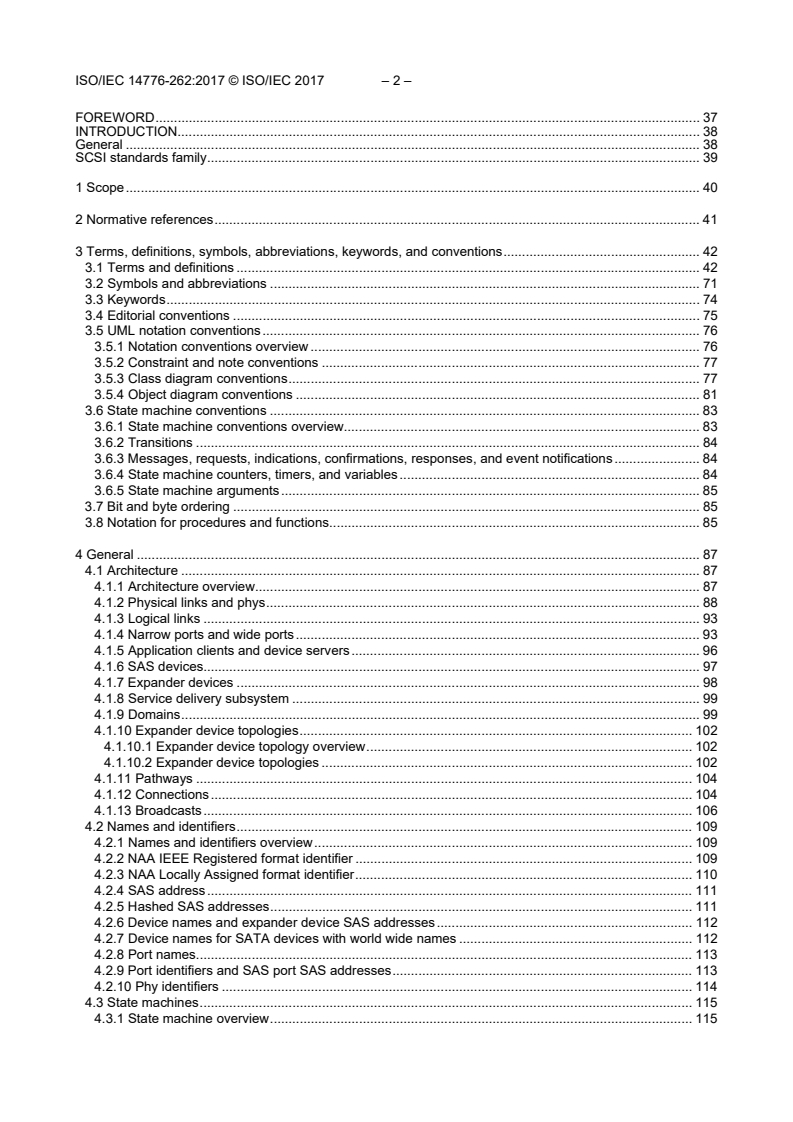
FOREWORD. 37
INTRODUCTION. 38
General . 38
SCSI standards family. 39
1 Scope. 40
2 Normative references. 41
3 Terms, definitions, symbols, abbreviations, keywords, and conventions. 42
3.1 Terms and definitions . 42
3.2 Symbols and abbreviations . 71
3.3 Keywords. 74
3.4 Editorial conventions . 75
3.5 UML notation conventions. 76
3.5.1 Notation conventions overview . 76
3.5.2 Constraint and note conventions . 77
3.5.3 Class diagram conventions. 77
3.5.4 Object diagram conventions . 81
3.6 State machine conventions . 83
3.6.1 State machine conventions overview. 83
3.6.2 Transitions . 84
3.6.3 Messages, requests, indications, confirmations, responses, and event notifications. 84
3.6.4 State machine counters, timers, and variables. 84
3.6.5 State machine arguments. 85
3.7 Bit and byte ordering . 85
3.8 Notation for procedures and functions. 85
4 General . 87
4.1 Architecture . 87
4.1.1 Architecture overview. 87
4.1.2 Physical links and phys. 88
4.1.3 Logical links . 93
4.1.4 Narrow ports and wide ports. 93
4.1.5 Application clients and device servers. 96
4.1.6 SAS devices. 97
4.1.7 Expander devices . 98
4.1.8 Service delivery subsystem . 99
4.1.9 Domains. 99
4.1.10 Expander device topologies. 102
4.1.10.1 Expander device topology overview. 102
4.1.10.2 Expander device topologies . 102
4.1.11 Pathways . 104
4.1.12 Connections. 104
4.1.13 Broadcasts. 106
4.2 Names and identifiers. 109
4.2.1 Names and identifiers overview. 109
4.2.2 NAA IEEE Registered format identifier . 109
4.2.3 NAA Locally Assigned format identifier. 110
4.2.4 SAS address. 111
4.2.5 Hashed SAS addresses. 111
4.2.6 Device names and expander device SAS addresses. 112
4.2.7 Device names for SATA devices with world wide names . 112
4.2.8 Port names. 113
4.2.9 Port identifiers and SAS port SAS addresses. 113
4.2.10 Phy identifiers . 114
4.3 State machines. 115
4.3.1 State machine overview. 115
– 3 – ISO/IEC 14776-262:2017 © ISO/IEC 2017
4.3.2 Transmit data path. 116
4.3.3 Receive data path. 121
4.3.4 State machines and SAS Device, SAS Port, and SAS Phy classes. 125
4.4 Events. 126
4.4.1 Reset sequences . 126
4.4.2 Hard reset . 128
4.4.2.1 Hard reset overview . 128
4.4.2.2 Additional hard reset processing by SAS ports. 128
4.4.2.3 Additional hard reset processing by expander ports . 128
4.4.3 I_T nexus loss. 128
4.4.4 Power loss expected. 129
4.5 Expander device model. 129
4.5.1 Expander device model overview . 129
4.5.2 Expander ports. 131
4.5.3 Expander connection manager (ECM). 131
4.5.4 Expander connection router (ECR). 131
4.5.5 Broadcast propagation processor (BPP) . 132
4.5.6 Expander device interfaces. 132
4.5.6.1 Expander device interface overview. 132
4.5.6.2 Expander device interfaces detail . 134
4.5.6.3 ECM interface. 135
4.5.6.4 ECR interface. 137
4.5.6.5 BPP interface . 138
4.5.7 Expander device routing . 140
4.5.7.1 Routing attributes and routing methods . 140
4.5.7.2 Expander device topology routing attribute restrictions. 140
4.5.7.3 Connection request routing . 141
4.5.7.4 Expander route table. 141
4.5.7.4.1 Expander route table overview . 141
4.5.7.4.2 Phy-based expander route table. 142
4.5.7.4.3 Expander-based expander route table . 143
4.5.8 Expander device reduced functionality . 143
4.5.9 Broadcast (Expander) handling . 144
4.6 Discover process. 144
4.6.1 Discover process overview . 144
4.6.2 Starting the discover process (Broadcast (Change) handling) . 144
4.6.3 Discover process traversal. 144
4.6.4 Discover process in a self-configuring expander device. 146
4.6.5 Enabling multiplexing. 147
4.7 Configuration subprocess. 147
4.7.1 Configuration subprocess overview. 147
4.7.2 Allowed expander device topologies. 148
4.7.3 Externally configurable expander device route table optimization. 149
4.7.4 Externally configurable expander device expander route index order. 150
4.8 Zoning. 157
4.8.1 Zoning overview. 157
4.8.2 Zoning expander device requirements. 161
4.8.3 Zoning operation. 164
4.8.3.1 Zone phy information. 164
4.8.3.2 Zone groups . 166
4.8.3.3 Zone permission table. 166
4.8.3.4 Zoning expander route table . 168
4.8.3.5 Source zone group and destination zone group determination. 169
4.8.4 Zone phy information and link reset sequences . 169
4.8.5 Broadcast processing in a zoning expander device with zoning enabled. 172
4.8.6 Zone configuration . 172
4.8.6.1 Zone configuration overview . 172
4.8.6.2 Lock step. 173
4.8.6.3 Load step. 173
4.8.6.4 Activate step. 174
4.8.6.5 Unlock step. 174
4.8.6.6 Zone lock inactivity timer. 175
4.8.6.7 Enable a zoning expander device . 175
4.9 SAS device and expander device power conditions. 176
4.10 Phy power conditions . 176
4.10.1 Low phy power conditions. 176
4.10.1.1 Low phy power conditions overview. 176
4.10.1.2 Active phy power condition. 176
4.10.1.3 Partial phy power condition . 176
4.10.1.4 Slumber phy power condition. 177
4.10.1.5 End device low phy power conditions . 177
4.10.1.6 Expander device low phy power conditions . 177
4.10.2 SATA phy power conditions. 178
4.11 Phy test functions . 178
4.11.1 Phy test functions overview . 178
4.11.2 Transmit pattern phy test function. 179
4.12 Phy events. 179
5 Phy layer . 184
5.1 Phy layer overview . 184
5.2 8b10b coding. 184
5.2.1 8b10b coding overview . 184
5.2.2 8b10b coding notation conventions . 184
5.3 Character encoding and decoding. 185
5.3.1 Introduction . 185
5.3.2 Bit transmission order . 185
5.3.3 Character transmission order. 185
5.3.4 Frame transmission order. 185
5.3.5 Running disparity (RD). 186
5.3.6 Data characters. 186
5.3.7 Control characters. 191
5.3.8 Encoding characters in the transmitter . 192
5.3.9 Decoding characters in the receiver . 193
5.4 Dwords, primitives, data dwords, and invalid dwords. 193
5.5 Bit order. 193
5.6 Out of band (OOB) signals . 195
5.6.1 OOB signals overview. 195
5.6.2 SP Transmission of OOB signals. 195
5.6.3 Receiver detection of OOB signals. 196
5.6.4 SATA port selection signal. 198
5.6.5 Phy power conditions. 199
5.7 Phy capabilities bits. 199
5.8 BMC coding. 203
5.8.1 BMC coding overview . 203
5.8.2 TTIU bit cell encoding in the transmitter . 204
5.8.3 TTIU bit transmission order. 205
5.8.4 TTIU bit cell decoding in the receiver. 205
5.9 Train_Tx-SNW TTIUs. 206
5.9.1 Train_Tx-SNW TTIU format. 206
5.9.2 Control/Status TTIU . 207
5.9.3 Error Response TTIU. 211
5.10 Phy reset sequences. 213
5.10.1 Phy reset sequences overview . 213
5.10.2 SATA phy reset sequence . 214
5.10.2.1 SATA OOB sequence . 214
5.10.2.2 SATA speed negotiation sequence. 215
– 5 – ISO/IEC 14776-262:2017 © ISO/IEC 2017
5.10.3 SAS to SATA phy reset sequence. 216
5.10.4 SAS to SAS phy reset sequence . 217
5.10.4.1 SAS OOB sequence. 217
5.10.4.2 SAS speed negotiation sequence . 219
5.10.4.2.1 SAS speed negotiation sequence overview . 219
5.10.4.2.2 SAS speed negotiation sequence timing specifications . 219
5.10.4.2.3 Speed negotiation window (SNW) definitions. 221
5.10.4.2.3.1 SNW definitions overview . 221
5.10.4.2.3.2 SNW-1, SNW-2, and Final-SNW. 221
5.10.4.2.3.3 SNW-3. 223
5.10.4.2.3.4 Train_Tx-SNW . 224
5.10.4.2.3.4.1 Phy’s transmitter initial condition . 224
5.10.4.2.3.4.2 Transmitter training. 224
5.10.4.2.3.4.3 Pattern marker. 226
5.10.4.2.3.5 Train_Rx-SNW. 227
5.10.4.2.4 SAS speed negotiation sequence.230
5.10.4.2.5 SAS speed negotiation sequence examples . 231
5.10.4.2.6 Train_Tx pattern sequence. 239
5.10.4.2.6.1 Train_Tx pattern sequence overview. 239
5.10.4.2.6.2 Train_Tx pattern initial sequence.239
5.10.4.2.6.3 Train_Tx pattern handshake sequence. 243
5.10.4.2.6.3.1 Train_Tx pattern handshake sequence overview. 243
5.10.4.2.6.3.2 Attached phy’s receiver increment or decrement request . 243
5.10.4.2.6.3.3 Attached phy’s receiver reference_1, reference_2, or no_equalization request . 246
5.10.4.2.6.4 Train_Tx pattern completion sequence. 248
5.10.4.2.6.5 Invalid TTIU sequence . 251
5.10.4.3 Multiplexing sequence. 252
5.10.5 Phy reset sequence after devices are attached. 253
5.11 Phy power condition sequences. 254
5.11.1 Transitioning from the active phy power condition to a low phy power condition . 254
5.11.2 Transitioning from a low phy power condition to the active phy power condition . 254
5.11.3 Events during low phy power condition. 255
5.12 SP (phy layer) state machine . 256
5.12.1 SP state machine overview. 256
5.12.2 SP transmitter and SP receiver. 259
5.12.3 OOB sequence states. 262
5.12.3.1 OOB sequence states overview. 262
5.12.3.2 SP0:OOB_COMINIT state. 263
5.12.3.2.1 State description. 263
5.12.3.2.2 Transition SP0:OOB_COMINIT to SP1:OOB_AwaitCOMX. 264
5.12.3.2.3 Transition SP0:OOB_COMINIT to SP3:OOB_AwaitCOMINIT_Sent. 264
5.12.3.2.4 Transition SP0:OOB_COMINIT to SP4:OOB_COMSAS. 264
5.12.3.3 SP1:OOB_AwaitCOMX state . 264
5.12.3.3.1 State description. 264
5.12.3.3.2 Transition SP1:OOB_AwaitCOMX to SP0:OOB_COMINIT. 264
5.12.3.3.3 Transition SP1:OOB_AwaitCOMX to SP4:OOB_COMSAS . 264
5.12.3.4 SP2:OOB_NoCOMSASTimeout state. 264
5.12.3.4.1 State description. 264
5.12.3.4.2 Transition SP2:OOB_NoCOMSASTimeout to SP0:OOB_COMINIT . 265
5.12.3.4.3 Transition SP2:OOB_NoCOMSASTimeout to SP4:OOB_COMSAS. 265
5.12.3.5 SP3:OOB_AwaitCOMINIT_Sent state . 265
5.12.3.5.1 State description. 265
5.12.3.5.2 Transition SP3:OOB_AwaitCOMINIT_Sent to SP4:OOB_COMSAS . 265
5.12.3.6 SP4:OOB_COMSAS state . 265
5.12.3.6.1 State description. 265
5.12.3.6.2 Transition SP4:OOB_COMSAS to SP5:OOB_AwaitCOMSAS_Sent. 265
5.12.3.6.3 Transition SP4:OOB_COMSAS to SP6:OOB_AwaitNoCOMSAS. 265
5.12.3.6.4 Transition SP4:OOB_COMSAS to SP7:OOB_AwaitCOMSAS . 266
5.12.3.7 SP5:OOB_AwaitCOMSAS_Sent state. 266
5.12.3.7.1 State description. 266
5.12.3.7.2 Transition SP5:OOB_AwaitCOMSAS_Sent to SP6:OOB_AwaitNoCOMSAS. 266
5.12.3.8 SP6:OOB_AwaitNoCOMSAS state. 266
5.12.3.8.1 State description. 266
5.12.3.8.2 Transition SP6:OOB_AwaitNoCOMSAS to SP0:OOB_COMINIT . 266
5.12.3.8.3 Transition SP6:OOB_AwaitNoCOMSAS to SP8:SAS_Start. 266
5.12.3.9 SP7:OOB_AwaitCOMSAS state .266
5.12.3.9.1 State description. 266
5.12.3.9.2 Transition SP7:OOB_AwaitCOMSAS to SP2:OOB_NoCOMSASTimeout. 266
5.12.3.9.3 Transition SP7:OOB_AwaitCOMSAS to SP6:OOB_AwaitNoCOMSAS. 266
5.12.3.9.4 Transition SP7:OOB_AwaitCOMSAS to SP16:SATA_COMWAKE. 266
5.12.3.9.5 Transition SP7:OOB_AwaitCOMSAS to SP26:SATA _SpinupHold. 267
5.12.4 SAS speed negotiation states. 267
5.12.4.1 SAS speed negotiation states overview. 267
5.12.4.2 Negotiation idle. 267
5.12.4.3 SP8:SAS_Start state. 270
5.12.4.3.1 State description. 270
5.12.4.3.2 Transition SP8:SAS_Start to SP0:OOB_COMINIT . 270
5.12.4.3.3 Transition SP8:SAS_Start to SP1:OOB_AwaitCOMX. 270
5.12.4.3.4 Transition SP8:SAS_Start to SP9:SAS_WindowNotSupported . 271
5.12.4.3.5 Transition SP8:SAS_Start to SP10:SAS_AwaitALIGN. 271
5.12.4.3.6 Transition SP8:SAS_Start to SP27:SAS_Settings . 271
5.12.4.4 SP9:SAS_WindowNotSupported state. 271
5.12.4.4.1 State description. 271
5.12.4.4.2 Transition SP9:SAS_WindowNotSupported to SP0:OOB_COMINIT. 271
5.12.4.4.3 Transition SP9:SAS_WindowNotSupported to SP14:SAS_Fail . 271
5.12.4.5 SP10:SAS_AwaitALIGN state. 271
5.12.4.5.1 State description. 271
5.12.4.5.2 Transition SP10:SAS_AwaitALIGN to SP0:OOB_COMINIT . 271
5.12.4.5.3 Transition SP10:SAS_AwaitALIGN to SP11:SAS_AwaitALIGN1. 271
5.12.4.5.4 Transition SP10:SAS_AwaitALIGN to SP12:SAS_AwaitSNW . 272
5.12.4.5.5 Transition SP10:SAS_AwaitALIGN to SP14:SAS_Fail. 272
5.12.4.6 SP11:SAS_AwaitALIGN1 state. 272
5.12.4.6.1 State description. 272
5.12.4.6.2 Transition SP11:SAS_AwaitALIGN1 to SP0:OOB_COMINIT . 272
5.12.4.6.3 Transition SP11:SAS_AwaitALIGN1 to SP12:SAS_AwaitSNW . 272
5.12.4.6.4 Transition SP11:SAS_AwaitALIGN1 to SP14:SAS_Fail. 272
5.12.4.7 SP12:SAS_AwaitSNW state . 272
5.12.4.7.1 State description. 272
5.12.4.7.2 Transition SP12:SAS_AwaitSNW to SP0:OOB_COMINIT. 272
5.12.4.7.3 Transition SP12:SAS_AwaitSNW to SP13:SAS_Pass. 272
5.12.4.8 SP13:SAS_Pass state. 273
5.12.4.8.1 State description. 273
5.12.4.8.2 Transition SP13:SAS_Pass to SP0:OOB_COMINIT. 273
5.12.4.8.3 Transition SP13:SAS_Pass to SP8:SAS_Start . 273
5.12.4.8.4 Transition SP13:SAS_Pass to SP15:SAS_PHY_Ready . 273
5.12.4.9 SP14:SAS_Fail state. 273
5.12.4.9.1 State description. 273
5.12.4.9.2 Transition SP14:SAS_Fail to SP1:OOB_AwaitCOMX. 273
5.12.4.9.3 Transition SP14:SAS_Fail to SP8:SAS_Start. 273
5.12.4.10 SP15:SAS_PHY_Ready state. 273
5.12.4.10.1 State description. 273
5.12.4.10.2 Transition SP15:SAS_PHY_Ready to SP0:OOB_COMINIT . 274
5.12.4.10.3 Transition SP15:SAS_PHY_Ready to SP31:SAS_PS_Low_Phy_Power . 274
5.12.4.11 SP27:SAS_Settings state. 274
5.12.4.11.1 State description. 274
5.12.4.11.2 Transition SP27:SAS_Settings to SP0:OOB_COMINIT. 274
– 7 – ISO/IEC 14776-262:2017 © ISO/IEC 2017
5.12.4.11.3 Transition SP27:SAS_Settings to SP1:OOB_AwaitCOMX. 275
5.12.4.11.4 Transition SP27:SAS_Settings to SP8:SAS_Start . 275
5.12.4.11.5 Transition SP27:SAS_Settings to SP28:SAS_TrainSetup . 275
5.12.4.12 SP28:SAS_TrainSetup. 275
5.12.4.12.1 State description. 275
5.12.4.12.2 Transition SP28:SAS_TrainSetup to SP0:OOB_COMINIT . 275
5.12.4.12.3 Transition SP28:SAS_TrainSetup to SP29:SAS_Train_Rx. 276
5.12.4.12.4 Transition SP28:SAS_TrainSetup to SP34:SAS_Train_Tx . 276
5.12.4.13 SP34:SAS_Train_Tx state . 276
5.12.4.13.1 State description. 276
5.12.4.13.2 Transition SP34:SAS_Train_Tx to SP1:OOB_AwaitCOMX . 276
5.12.4.13.3 Transition SP34:SAS_Train_Tx to SP28:SAS_TrainSetup . 276
5.12.4.
...
ISO/IEC 14776-262
Edition 1.0 2017-02
INTERNATIONAL
STANDARD
colour
inside
Information technology – Small Computer System Interface (SCSI) –
Part 262: SAS Protocol Layer – 2 (SPL-2)
All rights reserved. Unless otherwise specified, no part of this publication may be reproduced or utilized in any form
or by any means, electronic or mechanical, including photocopying and microfilm, without permission in writing from
either IEC or IEC's member National Committee in the country of the requester. If you have any questions about
ISO/IEC copyright or have an enquiry about obtaining additional rights to this publication, please contact the address
below or your local IEC member National Committee for further information.
IEC Central Office Tel.: +41 22 919 02 11
3, rue de Varembé Fax: +41 22 919 03 00
CH-1211 Geneva 20 info@iec.ch
Switzerland www.iec.ch
About the IEC
The International Electrotechnical Commission (IEC) is the leading global organization that prepares and publishes
International Standards for all electrical, electronic and related technologies.
About IEC publications
The technical content of IEC publications is kept under constant review by the IEC. Please make sure that you have the
latest edition, a corrigenda or an amendment might have been published.
IEC Catalogue - webstore.iec.ch/catalogue Electropedia - www.electropedia.org
The stand-alone application for consulting the entire The world's leading online dictionary of electronic and
bibliographical information on IEC International Standards, electrical terms containing 20 000 terms and definitions in
Technical Specifications, Technical Reports and other English and French, with equivalent terms in 16 additional
documents. Available for PC, Mac OS, Android Tablets and languages. Also known as the International Electrotechnical
iPad. Vocabulary (IEV) online.
IEC publications search - www.iec.ch/searchpub IEC Glossary - std.iec.ch/glossary
The advanced search enables to find IEC publications by a 65 000 electrotechnical terminology entries in English and
variety of criteria (reference number, text, technical French extracted from the Terms and Definitions clause of
committee,…). It also gives information on projects, replaced IEC publications issued since 2002. Some entries have been
and withdrawn publications. collected from earlier publications of IEC TC 37, 77, 86 and
CISPR.
IEC Just Published - webstore.iec.ch/justpublished
Stay up to date on all new IEC publications. Just Published IEC Customer Service Centre - webstore.iec.ch/csc
details all new publications released. Available online and If you wish to give us your feedback on this publication or
also once a month by email. need further assistance, please contact the Customer Service
Centre: csc@iec.ch.
ISO/IEC 14776-262
Edition 1.0 2017-02
INTERNATIONAL
STANDARD
colour
inside
Information technology – Small Computer System Interface (SCSI) –
Part 262: SAS Protocol Layer – 2 (SPL-2)
INTERNATIONAL
ELECTROTECHNICAL
COMMISSION
ICS 35.200 ISBN 978-2-8322-3952-0
FOREWORD. 37
INTRODUCTION. 38
General . 38
SCSI standards family. 39
1 Scope. 40
2 Normative references. 41
3 Terms, definitions, symbols, abbreviations, keywords, and conventions. 42
3.1 Terms and definitions . 42
3.2 Symbols and abbreviations . 71
3.3 Keywords. 74
3.4 Editorial conventions . 75
3.5 UML notation conventions. 76
3.5.1 Notation conventions overview . 76
3.5.2 Constraint and note conventions . 77
3.5.3 Class diagram conventions. 77
3.5.4 Object diagram conventions . 81
3.6 State machine conventions . 83
3.6.1 State machine conventions overview. 83
3.6.2 Transitions . 84
3.6.3 Messages, requests, indications, confirmations, responses, and event notifications. 84
3.6.4 State machine counters, timers, and variables. 84
3.6.5 State machine arguments. 85
3.7 Bit and byte ordering . 85
3.8 Notation for procedures and functions. 85
4 General . 87
4.1 Architecture . 87
4.1.1 Architecture overview. 87
4.1.2 Physical links and phys. 88
4.1.3 Logical links . 93
4.1.4 Narrow ports and wide ports. 93
4.1.5 Application clients and device servers. 96
4.1.6 SAS devices. 97
4.1.7 Expander devices . 98
4.1.8 Service delivery subsystem . 99
4.1.9 Domains. 99
4.1.10 Expander device topologies. 102
4.1.10.1 Expander device topology overview. 102
4.1.10.2 Expander device topologies . 102
4.1.11 Pathways . 104
4.1.12 Connections. 104
4.1.13 Broadcasts. 106
4.2 Names and identifiers. 109
4.2.1 Names and identifiers overview. 109
4.2.2 NAA IEEE Registered format identifier . 109
4.2.3 NAA Locally Assigned format identifier. 110
4.2.4 SAS address. 111
4.2.5 Hashed SAS addresses. 111
4.2.6 Device names and expander device SAS addresses. 112
4.2.7 Device names for SATA devices with world wide names . 112
4.2.8 Port names. 113
4.2.9 Port identifiers and SAS port SAS addresses. 113
4.2.10 Phy identifiers . 114
4.3 State machines. 115
4.3.1 State machine overview. 115
– 3 – ISO/IEC 14776-262:2017 © ISO/IEC 2017
4.3.2 Transmit data path. 116
4.3.3 Receive data path. 121
4.3.4 State machines and SAS Device, SAS Port, and SAS Phy classes. 125
4.4 Events. 126
4.4.1 Reset sequences . 126
4.4.2 Hard reset . 128
4.4.2.1 Hard reset overview . 128
4.4.2.2 Additional hard reset processing by SAS ports. 128
4.4.2.3 Additional hard reset processing by expander ports . 128
4.4.3 I_T nexus loss. 128
4.4.4 Power loss expected. 129
4.5 Expander device model. 129
4.5.1 Expander device model overview . 129
4.5.2 Expander ports. 131
4.5.3 Expander connection manager (ECM). 131
4.5.4 Expander connection router (ECR). 131
4.5.5 Broadcast propagation processor (BPP) . 132
4.5.6 Expander device interfaces. 132
4.5.6.1 Expander device interface overview. 132
4.5.6.2 Expander device interfaces detail . 134
4.5.6.3 ECM interface. 135
4.5.6.4 ECR interface. 137
4.5.6.5 BPP interface . 138
4.5.7 Expander device routing . 140
4.5.7.1 Routing attributes and routing methods . 140
4.5.7.2 Expander device topology routing attribute restrictions. 140
4.5.7.3 Connection request routing . 141
4.5.7.4 Expander route table. 141
4.5.7.4.1 Expander route table overview . 141
4.5.7.4.2 Phy-based expander route table. 142
4.5.7.4.3 Expander-based expander route table . 143
4.5.8 Expander device reduced functionality . 143
4.5.9 Broadcast (Expander) handling . 144
4.6 Discover process. 144
4.6.1 Discover process overview . 144
4.6.2 Starting the discover process (Broadcast (Change) handling) . 144
4.6.3 Discover process traversal. 144
4.6.4 Discover process in a self-configuring expander device. 146
4.6.5 Enabling multiplexing. 147
4.7 Configuration subprocess. 147
4.7.1 Configuration subprocess overview. 147
4.7.2 Allowed expander device topologies. 148
4.7.3 Externally configurable expander device route table optimization. 149
4.7.4 Externally configurable expander device expander route index order. 150
4.8 Zoning. 157
4.8.1 Zoning overview. 157
4.8.2 Zoning expander device requirements. 161
4.8.3 Zoning operation. 164
4.8.3.1 Zone phy information. 164
4.8.3.2 Zone groups . 166
4.8.3.3 Zone permission table. 166
4.8.3.4 Zoning expander route table . 168
4.8.3.5 Source zone group and destination zone group determination. 169
4.8.4 Zone phy information and link reset sequences . 169
4.8.5 Broadcast processing in a zoning expander device with zoning enabled. 172
4.8.6 Zone configuration . 172
4.8.6.1 Zone configuration overview . 172
4.8.6.2 Lock step. 173
4.8.6.3 Load step. 173
4.8.6.4 Activate step. 174
4.8.6.5 Unlock step. 174
4.8.6.6 Zone lock inactivity timer. 175
4.8.6.7 Enable a zoning expander device . 175
4.9 SAS device and expander device power conditions. 176
4.10 Phy power conditions . 176
4.10.1 Low phy power conditions. 176
4.10.1.1 Low phy power conditions overview. 176
4.10.1.2 Active phy power condition. 176
4.10.1.3 Partial phy power condition . 176
4.10.1.4 Slumber phy power condition. 177
4.10.1.5 End device low phy power conditions . 177
4.10.1.6 Expander device low phy power conditions . 177
4.10.2 SATA phy power conditions. 178
4.11 Phy test functions . 178
4.11.1 Phy test functions overview . 178
4.11.2 Transmit pattern phy test function. 179
4.12 Phy events. 179
5 Phy layer . 184
5.1 Phy layer overview . 184
5.2 8b10b coding. 184
5.2.1 8b10b coding overview . 184
5.2.2 8b10b coding notation conventions . 184
5.3 Character encoding and decoding. 185
5.3.1 Introduction . 185
5.3.2 Bit transmission order . 185
5.3.3 Character transmission order. 185
5.3.4 Frame transmission order. 185
5.3.5 Running disparity (RD). 186
5.3.6 Data characters. 186
5.3.7 Control characters. 191
5.3.8 Encoding characters in the transmitter . 192
5.3.9 Decoding characters in the receiver . 193
5.4 Dwords, primitives, data dwords, and invalid dwords. 193
5.5 Bit order. 193
5.6 Out of band (OOB) signals . 195
5.6.1 OOB signals overview. 195
5.6.2 SP Transmission of OOB signals. 195
5.6.3 Receiver detection of OOB signals. 196
5.6.4 SATA port selection signal. 198
5.6.5 Phy power conditions. 199
5.7 Phy capabilities bits. 199
5.8 BMC coding. 203
5.8.1 BMC coding overview . 203
5.8.2 TTIU bit cell encoding in the transmitter . 204
5.8.3 TTIU bit transmission order. 205
5.8.4 TTIU bit cell decoding in the receiver. 205
5.9 Train_Tx-SNW TTIUs. 206
5.9.1 Train_Tx-SNW TTIU format. 206
5.9.2 Control/Status TTIU . 207
5.9.3 Error Response TTIU. 211
5.10 Phy reset sequences. 213
5.10.1 Phy reset sequences overview . 213
5.10.2 SATA phy reset sequence . 214
5.10.2.1 SATA OOB sequence . 214
5.10.2.2 SATA speed negotiation sequence. 215
– 5 – ISO/IEC 14776-262:2017 © ISO/IEC 2017
5.10.3 SAS to SATA phy reset sequence. 216
5.10.4 SAS to SAS phy reset sequence . 217
5.10.4.1 SAS OOB sequence. 217
5.10.4.2 SAS speed negotiation sequence . 219
5.10.4.2.1 SAS speed negotiation sequence overview . 219
5.10.4.2.2 SAS speed negotiation sequence timing specifications . 219
5.10.4.2.3 Speed negotiation window (SNW) definitions. 221
5.10.4.2.3.1 SNW definitions overview . 221
5.10.4.2.3.2 SNW-1, SNW-2, and Final-SNW. 221
5.10.4.2.3.3 SNW-3. 223
5.10.4.2.3.4 Train_Tx-SNW . 224
5.10.4.2.3.4.1 Phy’s transmitter initial condition . 224
5.10.4.2.3.4.2 Transmitter training. 224
5.10.4.2.3.4.3 Pattern marker. 226
5.10.4.2.3.5 Train_Rx-SNW. 227
5.10.4.2.4 SAS speed negotiation sequence.230
5.10.4.2.5 SAS speed negotiation sequence examples . 231
5.10.4.2.6 Train_Tx pattern sequence. 239
5.10.4.2.6.1 Train_Tx pattern sequence overview. 239
5.10.4.2.6.2 Train_Tx pattern initial sequence.239
5.10.4.2.6.3 Train_Tx pattern handshake sequence. 243
5.10.4.2.6.3.1 Train_Tx pattern handshake sequence overview. 243
5.10.4.2.6.3.2 Attached phy’s receiver increment or decrement request . 243
5.10.4.2.6.3.3 Attached phy’s receiver reference_1, reference_2, or no_equalization request . 246
5.10.4.2.6.4 Train_Tx pattern completion sequence. 248
5.10.4.2.6.5 Invalid TTIU sequence . 251
5.10.4.3 Multiplexing sequence. 252
5.10.5 Phy reset sequence after devices are attached. 253
5.11 Phy power condition sequences. 254
5.11.1 Transitioning from the active phy power condition to a low phy power condition . 254
5.11.2 Transitioning from a low phy power condition to the active phy power condition . 254
5.11.3 Events during low phy power condition. 255
5.12 SP (phy layer) state machine . 256
5.12.1 SP state machine overview. 256
5.12.2 SP transmitter and SP receiver. 259
5.12.3 OOB sequence states. 262
5.12.3.1 OOB sequence states overview. 262
5.12.3.2 SP0:OOB_COMINIT state. 263
5.12.3.2.1 State description. 263
5.12.3.2.2 Transition SP0:OOB_COMINIT to SP1:OOB_AwaitCOMX. 264
5.12.3.2.3 Transition SP0:OOB_COMINIT to SP3:OOB_AwaitCOMINIT_Sent. 264
5.12.3.2.4 Transition SP0:OOB_COMINIT to SP4:OOB_COMSAS. 264
5.12.3.3 SP1:OOB_AwaitCOMX state . 264
5.12.3.3.1 State description. 264
5.12.3.3.2 Transition SP1:OOB_AwaitCOMX to SP0:OOB_COMINIT. 264
5.12.3.3.3 Transition SP1:OOB_AwaitCOMX to SP4:OOB_COMSAS . 264
5.12.3.4 SP2:OOB_NoCOMSASTimeout state. 264
5.12.3.4.1 State description. 264
5.12.3.4.2 Transition SP2:OOB_NoCOMSASTimeout to SP0:OOB_COMINIT . 265
5.12.3.4.3 Transition SP2:OOB_NoCOMSASTimeout to SP4:OOB_COMSAS. 265
5.12.3.5 SP3:OOB_AwaitCOMINIT_Sent state . 265
5.12.3.5.1 State description. 265
5.12.3.5.2 Transition SP3:OOB_AwaitCOMINIT_Sent to SP4:OOB_COMSAS . 265
5.12.3.6 SP4:OOB_COMSAS state . 265
5.12.3.6.1 State description. 265
5.12.3.6.2 Transition SP4:OOB_COMSAS to SP5:OOB_AwaitCOMSAS_Sent. 265
5.12.3.6.3 Transition SP4:OOB_COMSAS to SP6:OOB_AwaitNoCOMSAS. 265
5.12.3.6.4 Transition SP4:OOB_COMSAS to SP7:OOB_AwaitCOMSAS . 266
5.12.3.7 SP5:OOB_AwaitCOMSAS_Sent state. 266
5.12.3.7.1 State description. 266
5.12.3.7.2 Transition SP5:OOB_AwaitCOMSAS_Sent to SP6:OOB_AwaitNoCOMSAS. 266
5.12.3.8 SP6:OOB_AwaitNoCOMSAS state. 266
5.12.3.8.1 State description. 266
5.12.3.8.2 Transition SP6:OOB_AwaitNoCOMSAS to SP0:OOB_COMINIT . 266
5.12.3.8.3 Transition SP6:OOB_AwaitNoCOMSAS to SP8:SAS_Start. 266
5.12.3.9 SP7:OOB_AwaitCOMSAS state .266
5.12.3.9.1 State description. 266
5.12.3.9.2 Transition SP7:OOB_AwaitCOMSAS to SP2:OOB_NoCOMSASTimeout. 266
5.12.3.9.3 Transition SP7:OOB_AwaitCOMSAS to SP6:OOB_AwaitNoCOMSAS. 266
5.12.3.9.4 Transition SP7:OOB_AwaitCOMSAS to SP16:SATA_COMWAKE. 266
5.12.3.9.5 Transition SP7:OOB_AwaitCOMSAS to SP26:SATA _SpinupHold. 267
5.12.4 SAS speed negotiation states. 267
5.12.4.1 SAS speed negotiation states overview. 267
5.12.4.2 Negotiation idle. 267
5.12.4.3 SP8:SAS_Start state. 270
5.12.4.3.1 State description. 270
5.12.4.3.2 Transition SP8:SAS_Start to SP0:OOB_COMINIT . 270
5.12.4.3.3 Transition SP8:SAS_Start to SP1:OOB_AwaitCOMX. 270
5.12.4.3.4 Transition SP8:SAS_Start to SP9:SAS_WindowNotSupported . 271
5.12.4.3.5 Transition SP8:SAS_Start to SP10:SAS_AwaitALIGN. 271
5.12.4.3.6 Transition SP8:SAS_Start to SP27:SAS_Settings . 271
5.12.4.4 SP9:SAS_WindowNotSupported state. 271
5.12.4.4.1 State description. 271
5.12.4.4.2 Transition SP9:SAS_WindowNotSupported to SP0:OOB_COMINIT. 271
5.12.4.4.3 Transition SP9:SAS_WindowNotSupported to SP14:SAS_Fail . 271
5.12.4.5 SP10:SAS_AwaitALIGN state. 271
5.12.4.5.1 State description. 271
5.12.4.5.2 Transition SP10:SAS_AwaitALIGN to SP0:OOB_COMINIT . 271
5.12.4.5.3 Transition SP10:SAS_AwaitALIGN to SP11:SAS_AwaitALIGN1. 271
5.12.4.5.4 Transition SP10:SAS_AwaitALIGN to SP12:SAS_AwaitSNW . 272
5.12.4.5.5 Transition SP10:SAS_AwaitALIGN to SP14:SAS_Fail. 272
5.12.4.6 SP11:SAS_AwaitALIGN1 state. 272
5.12.4.6.1 State description. 272
5.12.4.6.2 Transition SP11:SAS_AwaitALIGN1 to SP0:OOB_COMINIT . 272
5.12.4.6.3 Transition SP11:SAS_AwaitALIGN1 to SP12:SAS_AwaitSNW . 272
5.12.4.6.4 Transition SP11:SAS_AwaitALIGN1 to SP14:SAS_Fail. 272
5.12.4.7 SP12:SAS_AwaitSNW state . 272
5.12.4.7.1 State description. 272
5.12.4.7.2 Transition SP12:SAS_AwaitSNW to SP0:OOB_COMINIT. 272
5.12.4.7.3 Transition SP12:SAS_AwaitSNW to SP13:SAS_Pass. 272
5.12.4.8 SP13:SAS_Pass state. 273
5.12.4.8.1 State description. 273
5.12.4.8.2 Transition SP13:SAS_Pass to SP0:OOB_COMINIT. 273
5.12.4.8.3 Transition SP13:SAS_Pass to SP8:SAS_Start . 273
5.12.4.8.4 Transition SP13:SAS_Pass to SP15:SAS_PHY_Ready . 273
5.12.4.9 SP14:SAS_Fail state. 273
5.12.4.9.1 State description. 273
5.12.4.9.2 Transition SP14:SAS_Fail to SP1:OOB_AwaitCOMX. 273
5.12.4.9.3 Transition SP14:SAS_Fail to SP8:SAS_Start. 273
5.12.4.10 SP15:SAS_PHY_Ready state. 273
5.12.4.10.1 State description. 273
5.12.4.10.2 Transition SP15:SAS_PHY_Ready to SP0:OOB_COMINIT . 274
5.12.4.10.3 Transition SP15:SAS_PHY_Ready to SP31:SAS_PS_Low_Phy_Power . 274
5.12.4.11 SP27:SAS_Settings state. 274
5.12.4.11.1 State description. 274
5.12.4.11.2 Transition SP27:SAS_Settings to SP0:OOB_COMINIT. 274
– 7 – ISO/IEC 14776-262:2017 © ISO/IEC 2017
5.12.4.11.3 Transition SP27:SAS_Settings to SP1:OOB_AwaitCOMX. 275
5.12.4.11.4 Transition SP27:SAS_Settings to SP8:SAS_Start . 275
5.12.4.11.5 Transition SP27:SAS_Settings to SP28:SAS_TrainSetup . 275
5.12.4.12 SP28:SAS_TrainSetup. 275
5.12.4.12.1 State description. 275
5.12.4.12.2 Transition SP28:SAS_TrainSetup to SP0:OOB_COMINIT . 275
5.12.4.12.3 Transition SP28:SAS_TrainSetup to SP29:SAS_Train_Rx. 276
5.12.4.12.4 Transition SP28:SAS_TrainSetup to SP34:SAS_Train_Tx . 276
5.12.4.13 SP34:SAS_Train_Tx state . 276
5.12.4.13.1 State description. 276
5.12.4.13.2 Transition SP34:SAS_Train_Tx to SP1:OOB_AwaitCOMX . 276
5.12.4.13.3 Transition SP34:SAS_Train_Tx to SP28:SAS_TrainSetup . 276
5.12.4.
...