

ISO 12989-2:2004
(Main)Carbonaceous materials used in the production of aluminium — Baked anodes and sidewall blocks — Determination of the reactivity to air — Part 2: Thermogravimetric method
General Information
- Abstract
ISO 12989-2:2004 covers the thermogravimetric analysis (TGA) of air reactivities and dusting of shaped carbon electrodes used in the aluminium-production industry. Many types of apparatus are available, with various thermal conditions, sample-size capability, materials of construction and procedures for determining the mass loss and subsequent rate of reaction. This test method sets standard reaction times and temperatures, and provides a mathematical method to normalize the gas velocity over the exposed surfaces, such that results obtained on different types of apparatus are correlatable.
- Status
- Published
- Publication Date
- 20-May-2004
- Technical Committee
- ISO/TC 226 - Materials for the production of primary aluminium
- Drafting Committee
- ISO/TC 226 - Materials for the production of primary aluminium
- Current Stage
- 9093 - International Standard confirmed
- Start Date
- 25-Sep-2024
- Completion Date
- 29-Aug-2026
Overview
ISO 12989-2:2004 specifies a standardized thermogravimetric method for determining the reactivity to air and the air dusting rate of carbonaceous materials used in aluminium production, specifically baked anodes and sidewall blocks. By setting out clear procedures for thermogravimetric analysis (TGA), this international standard ensures that measurements of reactivity and dusting are reliable, comparable, and can be reproduced across different laboratories and types of apparatus.
These measurements are crucial for evaluating the quality and performance of carbon electrodes, which directly impact the efficiency and operational costs of aluminium smelting processes. Reactivity to air influences the lifespan of carbon artifacts and determines how much carbon is available for the primary reduction of alumina.
Key Topics
- Thermogravimetric Analysis (TGA): Provides guidelines for sample preparation, specification of apparatus, control of reaction temperature, and gas flow rates to determine changes in mass as carbon reacts with air.
- Reactivity Parameters: Defines and standardizes the calculation of initial, final, and total air reactivity, as well as the air dusting rate, based on precise mass loss measurements and exposed surface areas.
- Apparatus and Calibration: Specifications for furnaces, reaction chambers, sample suspension devices, gas preheating, and measurement instrumentation to ensure repeatable and accurate results.
- Test Procedure: Detailed steps for preparing and conditioning samples, conducting the thermal reaction under controlled conditions, measuring mass loss, collecting dust, and recording results.
- Precision and Reproducibility: Establishes statistical criteria for repeatability and reproducibility, increasing confidence in test results when used for material certification or research.
- Reporting Requirements: Outlines the necessary elements of an effective test report, ensuring the traceability and integrity of results.
Applications
- Raw Material Selection: Air reactivity data supports the selection of carbonaceous raw materials for anode and sidewall block production, optimizing for performance and durability in aluminium reduction cells.
- Quality Control: Provides a reliable benchmark for routine quality assurance, helping manufacturers ensure product consistency and compliance with industry requirements.
- Process Optimization: Reactivity and dusting rates are vital for both research and plant operations to evaluate and improve beneficiation processes, electrode formulations, and smelting efficiency.
- Performance Assessment: Enables producers and users of baked carbon artifacts to compare materials from different sources objectively, informing decisions on purchasing and process parameters.
- Standardized Testing: Supports globally harmonized approaches to the evaluation of carbon used in aluminium production, reducing variability between labs and facilitating international trade.
Related Standards
- ISO 12989-1: Carbonaceous materials used in aluminium production - Baked anodes and sidewall blocks - Determination of the reactivity to air - Part 1: Loss in mass method.
- ASTM D 6559: Standard that provides the basis for the thermogravimetric method outlined in ISO 12989-2.
- ASTM D 6353: Standard Guide for Sampling Plan and Core Sampling for Prebaked Anodes Used in Aluminum Production.
- ASTM D 6354: Standard Guide for Sampling Plan and Core Sampling of Carbon Cathode Blocks Used in Aluminum Production.
ISO 12989-2:2004 is indispensable for quality control laboratories, aluminium smelters, and carbon product manufacturers seeking robust, replicable, and internationally recognized test methods for the evaluation of baked anodes and sidewall blocks. Employing this standard ensures consistent product performance and enhances process optimization across the industry.
Get Certified
Connect with accredited certification bodies for this standard

ECOCERT
Organic and sustainability certification.

Eurofins Food Testing Global
Global leader in food, environment, and pharmaceutical product testing.

Intertek Bangladesh
Intertek certification and testing services in Bangladesh.
Sponsored listings
Frequently Asked Questions
ISO 12989-2:2004 is a standard published by the International Organization for Standardization (ISO). Its full title is "Carbonaceous materials used in the production of aluminium — Baked anodes and sidewall blocks — Determination of the reactivity to air — Part 2: Thermogravimetric method". This standard covers: ISO 12989-2:2004 covers the thermogravimetric analysis (TGA) of air reactivities and dusting of shaped carbon electrodes used in the aluminium-production industry. Many types of apparatus are available, with various thermal conditions, sample-size capability, materials of construction and procedures for determining the mass loss and subsequent rate of reaction. This test method sets standard reaction times and temperatures, and provides a mathematical method to normalize the gas velocity over the exposed surfaces, such that results obtained on different types of apparatus are correlatable.
ISO 12989-2:2004 covers the thermogravimetric analysis (TGA) of air reactivities and dusting of shaped carbon electrodes used in the aluminium-production industry. Many types of apparatus are available, with various thermal conditions, sample-size capability, materials of construction and procedures for determining the mass loss and subsequent rate of reaction. This test method sets standard reaction times and temperatures, and provides a mathematical method to normalize the gas velocity over the exposed surfaces, such that results obtained on different types of apparatus are correlatable.
ISO 12989-2:2004 is classified under the following ICS (International Classification for Standards) categories: 71.100.10 - Materials for aluminium production. The ICS classification helps identify the subject area and facilitates finding related standards.
ISO 12989-2:2004 is available in PDF format for immediate download after purchase. The document can be added to your cart and obtained through the secure checkout process. Digital delivery ensures instant access to the complete standard document.
Standards Content (Sample)
INTERNATIONAL ISO
STANDARD 12989-2
First edition
2004-05-15
Carbonaceous materials used in the
production of aluminium — Baked
anodes and sidewall blocks —
Determination of the reactivity to air —
Part 2:
Thermogravimetric method
Produits carbonés utilisés pour la production de l'aluminium — Anodes
et blocs de façade cuits — Détermination de la réactivité à l'air —
Partie 2: Méthode thermogravimétrique
Reference number
©
ISO 2004
PDF disclaimer
This PDF file may contain embedded typefaces. In accordance with Adobe's licensing policy, this file may be printed or viewed but
shall not be edited unless the typefaces which are embedded are licensed to and installed on the computer performing the editing. In
downloading this file, parties accept therein the responsibility of not infringing Adobe's licensing policy. The ISO Central Secretariat
accepts no liability in this area.
Adobe is a trademark of Adobe Systems Incorporated.
Details of the software products used to create this PDF file can be found in the General Info relative to the file; the PDF-creation
parameters were optimized for printing. Every care has been taken to ensure that the file is suitable for use by ISO member bodies. In
the unlikely event that a problem relating to it is found, please inform the Central Secretariat at the address given below.
© ISO 2004
All rights reserved. Unless otherwise specified, no part of this publication may be reproduced or utilized in any form or by any means,
electronic or mechanical, including photocopying and microfilm, without permission in writing from either ISO at the address below or
ISO's member body in the country of the requester.
ISO copyright office
Case postale 56 • CH-1211 Geneva 20
Tel. + 41 22 749 01 11
Fax + 41 22 749 09 47
E-mail copyright@iso.org
Web www.iso.org
Published in Switzerland
ii © ISO 2004 – All rights reserved
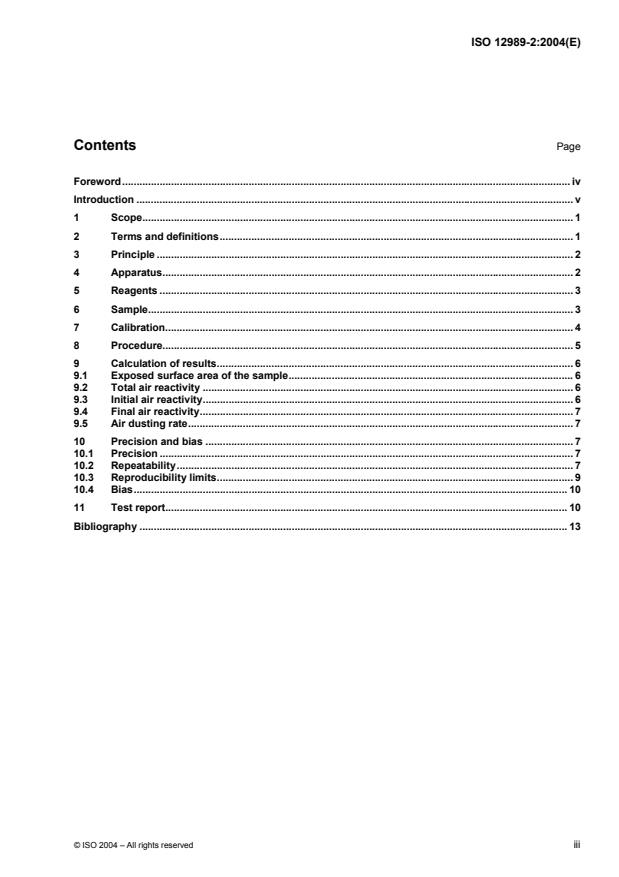
Contents Page
Foreword. iv
Introduction . v
1 Scope. 1
2 Terms and definitions. 1
3 Principle. 2
4 Apparatus. 2
5 Reagents. 3
6 Sample. 3
7 Calibration. 4
8 Procedure. 5
9 Calculation of results. 6
9.1 Exposed surface area of the sample. 6
9.2 Total air reactivity . 6
9.3 Initial air reactivity. 6
9.4 Final air reactivity. 7
9.5 Air dusting rate. 7
10 Precision and bias. 7
10.1 Precision. 7
10.2 Repeatability. 7
10.3 Reproducibility limits. 9
10.4 Bias. 10
11 Test report. 10
Bibliography . 13
Foreword
ISO (the International Organization for Standardization) is a worldwide federation of national standards bodies
(ISO member bodies). The work of preparing International Standards is normally carried out through ISO
technical committees. Each member body interested in a subject for which a technical committee has been
established has the right to be represented on that committee. International organizations, governmental and
non-governmental, in liaison with ISO, also take part in the work. ISO collaborates closely with the
International Electrotechnical Commission (IEC) on all matters of electrotechnical standardization.
International Standards are drafted in accordance with the rules given in the ISO/IEC Directives, Part 2.
The main task of technical committees is to prepare International Standards. Draft International Standards
adopted by the technical committees are circulated to the member bodies for voting. Publication as an
International Standard requires approval by at least 75 % of the member bodies casting a vote.
Attention is drawn to the possibility that some of the elements of this document may be the subject of patent
rights. ISO shall not be held responsible for identifying any or all such patent rights.
ISO 12989-2 was prepared by Technical Committee ISO/TC 47, Chemistry, Subcommittee SC 7, Aluminium
oxide, cryolite, aluminium fluoride, sodium fluoride, carbonaceous products for the aluminium industry.
ISO 12989 consists of the following parts, under the general title Carbonaceous materials used in the
production of aluminium — Baked anodes and sidewall blocks — Determination of the reactivity to air:
Part 1: Loss in mass method
Part 2: Thermogravimetric method
iv © ISO 2004 – All rights reserved
Introduction
Comparison of air reactivities, or air reaction rates, and air dusting rates is useful in selecting raw materials for
the manufacture of commercial electrodes for specific smelting technologies in the production of aluminium.
Air reactivities are used to quantify the tendency of a carbon artifact to react with air. Carbon consumed by
this unwanted side reaction is unavailable for the primary reaction of reducing alumina to the metal. Air
reactivities and the dusting rate are used by some companies to quantify the tendency of the coke aggregate
or binder coke of a carbon artifact to selectively react with air. Preferential attack of the binder coke or coke
aggregate of a carbon artifact by air causes some carbon to fall off as dust, making the carbon unavailable for
the primary reaction of reducing alumina and, more importantly, reducing the efficiency of the reduction cell.
Air reactivities are used for evaluating the effectiveness of beneficiation processes and for research purposes.
Sampling guidelines are under development.
This part of ISO 12989 is based on ASTM D 6559-00.
INTERNATIONAL STANDARD ISO 12989-2:2004(E)
Carbonaceous materials used in the production of aluminium —
Baked anodes and sidewall blocks — Determination of the
reactivity to air —
Part 2
Thermogravimetric method
WARNING — This part of ISO 12989 does not purport to address all of the safety concerns, if any,
associated with its use. It is the responsibility of the user of this part of ISO 12989 to establish
appropriate safety and health practices and determine the applicability of regulatory limitations prior
to use.
1 Scope
This part of ISO 12989 allows the determination by thermogravimetric analysis (TGA) of air reactivities and
dusting of shaped carbon electrodes used in the aluminium-reduction industry. Many types of apparatus are
available, with various thermal conditions, sample-size capabilities, materials of construction and procedures
for determining the mass loss and subsequent rate of reaction. This test method standardizes the variables of
sample dimensions, reaction times and temperatures, and provides a mathematical method to normalize the
gas velocity over the exposed surfaces, such that results obtained on different types of apparatus are
correlatable.
2 Terms and definitions
For the purposes of this document, the following terms and definitions apply.
2.1
air dusting rate
α
d
normalized rate at which carbon falls off the carbon artifact during the test
NOTE The dusting rate is expressed in milligrams per square centimetre per hour.
2.2
final air reactivity
α
f
rate of mass loss of the carbon artifact during the final 30 min of exposure to air in the reaction chamber
divided by the initial exposed surface area of a sample having the form of a right cylinder
NOTE The final air reactivity is expressed in milligrams per square centimetre per hour.
2.3
initial air reactivity
α
i
rate of mass loss of the carbon artifact during the first 30 min of exposure to air in the reaction chamber
divided by the initial exposed surface area of a sample having the form of a right cylinder
NOTE The initial air reactivity is expressed in milligrams per square centimetre per hour.
2.4
total air reactivity
α
T
rate of mass loss of the carbon artifact (including dusting) during the total time that the sample is exposed to
air (180 min) in the reaction chamber divided by the initial exposed surface area of a sample having the form
of a right cylinder
NOTE The total air reactivity is expressed in milligrams per square centimetre per hour.
3 Principle
The air dusting rate and the initial, final and total air reactivities are determined by passing air at a flow rate
giving a standard velocity of reactant gas around cylindrically shaped carbon artifacts under nearly isothermal
conditions for a specified length of time. The air reactivities are determined by continuously monitoring the
mass loss of the sample. The air dusting rate is determined by collecting and determining the mass of the
carbon particles that fall off the sample during reaction.
4 Apparatus
4.1 Air reactivity apparatus, as simple as possible and commensurate with the aims of the test.
The principal criterion is that the reaction rate be determined under isothermal conditions and be unaffected
by physical and chemical properties inherent in the apparatus (such as gas diffusion patterns, gas
temperature, exposed sample surface area, and so forth). A typical apparatus that has been found to be
suitable is illustrated in Figure 1.
4.2 Furnace and controller, capable of maintaining the temperature constant to within ± 2 °C in the
100-mm reaction zone in which the sample is centred.
A typical apparatus (Figure 1) employs a three-zone heating element and associated controls to accomplish
this, but other types of heaters such as tapered windings or long linear heaters are also suitable. The control
thermocouple is a grounded type and shall be located within the reaction chamber near the surface of the test
sample. This is to allow the furnace controller to compensate for the exothermic reactions that occur when the
furnace is used for air reactivity testing. The control thermocouple shall be positioned 4 mm ± 1 mm from the
side surface of the sample and within 5 mm vertically of the centre of the reaction chamber. The furnace shall
be large enough to accommodate the reaction chamber.
4.3 Reaction chamber, consisting of a vertical tube constructed of a material capable of withstanding the
temperature of the reaction and with a sufficiently large inside diameter to accomodate the sample and
sample suspension device while not affecting the gas flow past the sample. An inside diameter of
100 mm ± 25 mm is recommended.
The reaction chamber shall be constructed with a removable dust collection cup at the bottom capable of
capturing all the dust that falls off the sample during the test. The most common materials of construction are
1)
quartz and Incone .
4.4 Sample suspension device, capable of supporting the sample in the reaction chamber for the duration
of the test and which should be reusable.
The sample suspension device shall not change in mass during the test, shall not affect the flow pattern of the
gas past the sample, shall not limit the gas-accessible surface area of the test sample and shall not interfere
with the production of dust by the sample. A typical sample suspension device is illustrated in Figure 2.
1) Inconel is an example of a suitable product available commercially. This information is given for the convenience of
users of this part of ISO 12989 and does not constitute an endorsement by ISO of this product.
2 © ISO 2004 – All rights reserved
4.5 Gas preheat tube, extending into the first heating zone of the reaction chamber, to preheat the gas
prior to entering the reaction chamber.
The length and diameter of the tube may vary, as long as the gas leaving the tube is at the same temperature
as the reaction chamber. The inlet gas shall leave the preheat tube downward to prevent channelling of the
gas through the reaction chamber and to prevent plugging of the preheat tube with carbon dust.
4.6 Balance, capable of measuring the mass (approximately 200 g maximum) of the sample and sample
suspension device to the nearest 0,01 g continuously throughout the duration of the test.
4.7 Gas flow meter, capable of measuring the flow rate of the gas entering the reaction chamber.
All gas
...