

ISO 14420:2020
(Main)Carbonaceous products for the production of aluminium — Baked anodes and shaped carbon products — Determination of the coefficient of linear thermal expansion
General Information
- Abstract
This document specifies a method to determine the coefficient of linear thermal expansion of carbonaceous or graphite materials (solid materials) for the production of aluminium between 20 °C and 300 °C. It applies to baked anodes and shaped carbon products.
- Status
- Published
- Publication Date
- 04-Mar-2020
- Technical Committee
- ISO/TC 226 - Materials for the production of primary aluminium
- Drafting Committee
- ISO/TC 226 - Materials for the production of primary aluminium
- Current Stage
- 9093 - International Standard confirmed
- Start Date
- 12-Jan-2026
- Completion Date
- 29-Aug-2026
Buy Documents
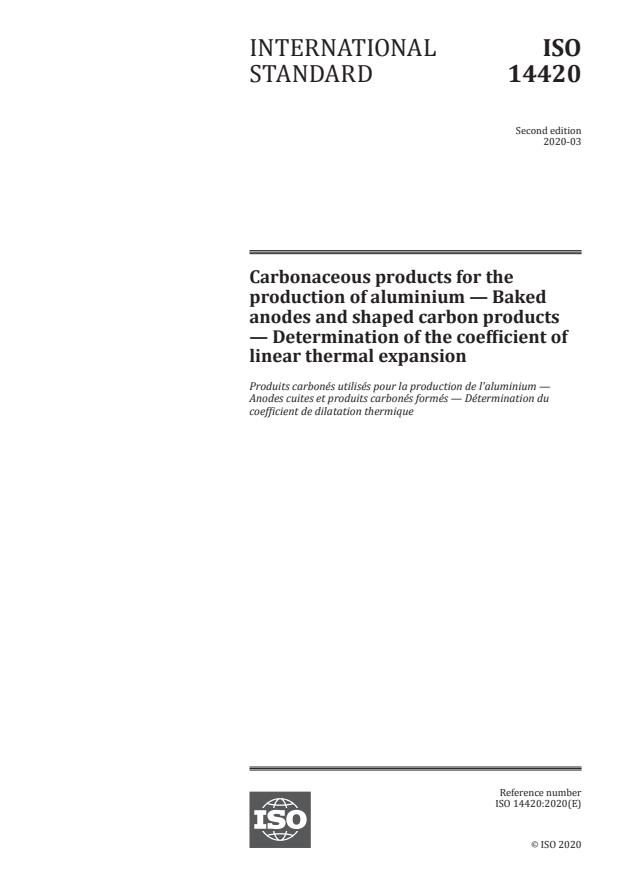
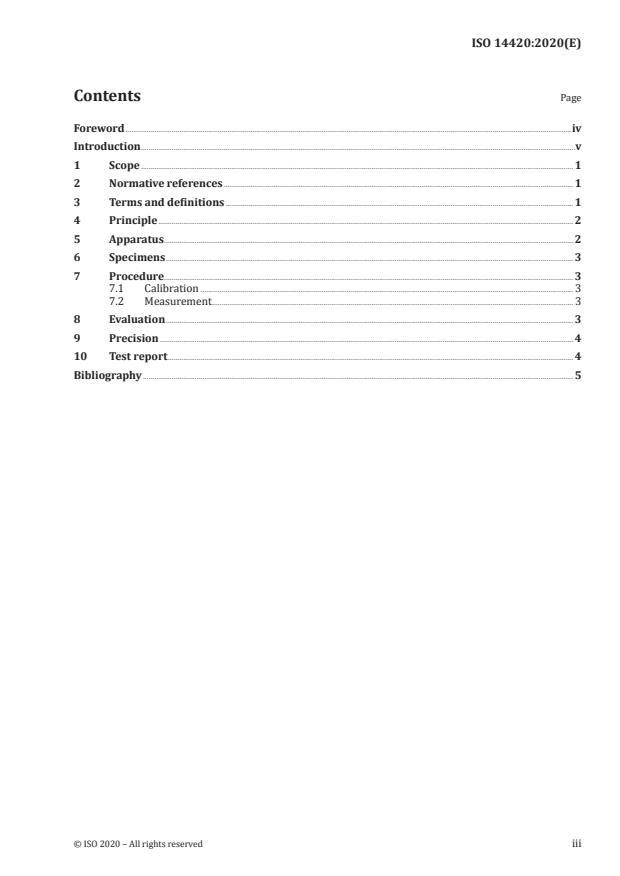
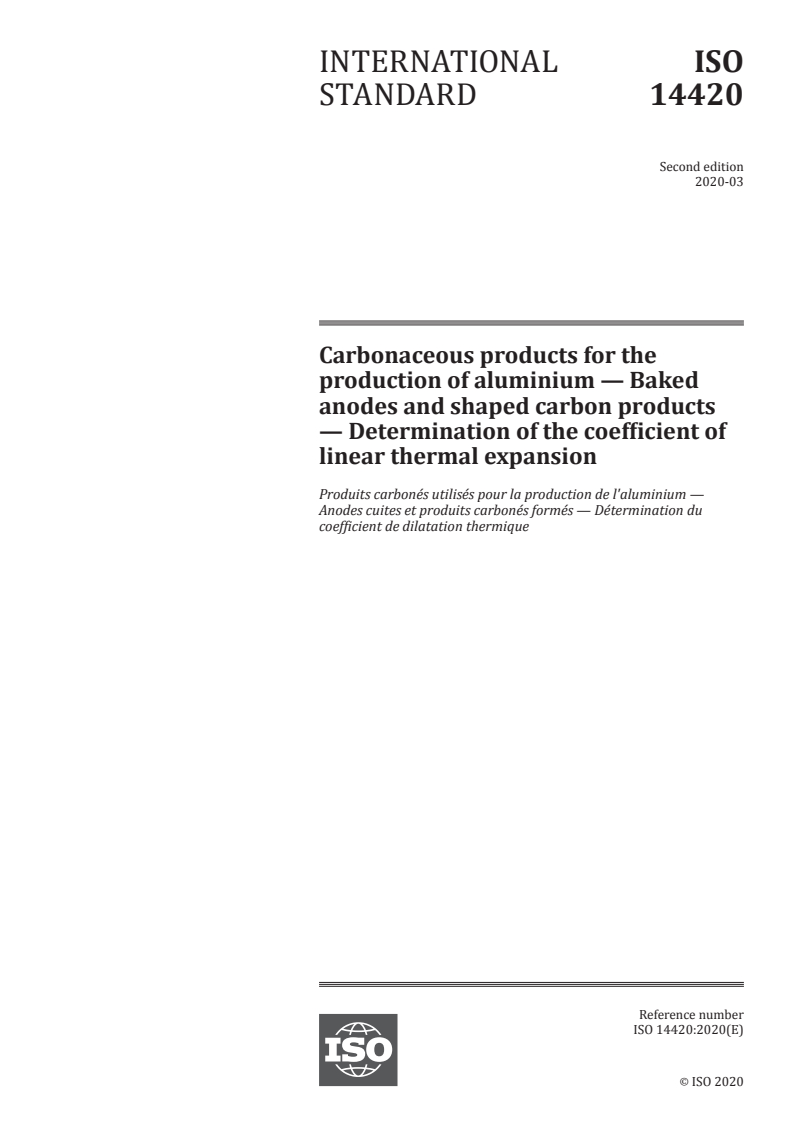
ISO 14420:2020 - Carbonaceous products for the production of aluminium -- Baked anodes and shaped carbon products -- Determination of the coefficient of linear thermal expansion
ISO 14420:2020 - Carbonaceous products for the production of aluminium — Baked anodes and shaped carbon products — Determination of the coefficient of linear thermal expansion/5/2020
Overview
ISO 14420:2020 specifies a standardized laboratory method to determine the coefficient of linear thermal expansion (CLTE) of carbonaceous and graphite materials used in aluminium production - specifically baked anodes and shaped carbon products. The method covers measurements between 20 °C and 300 °C using a push‑rod dilatometer, and defines specimen preparation, apparatus, calibration, measurement, evaluation and reporting requirements.
Keywords: ISO 14420:2020, coefficient of linear thermal expansion, baked anodes, shaped carbon products, aluminium production, dilatometer, thermal expansion testing.
Key topics and technical requirements
- Scope and principle
- Determines average CLTE for solid carbonaceous/graphite materials between 20 °C and 300 °C.
- Uses a push‑rod dilatometer with a low‑expansivity sample holder (e.g., flint glass) transmitting length change to an external measuring system.
- Apparatus accuracy
- Length‑measurement device with error limits around ±0.5 µm for dilatometer output; vernier calliper per ISO 13385‑1 for initial lengths (error limit ±0.2%).
- Furnace stability: temperature held within ±0.5% along specimen length.
- Temperature measurement accuracy: thermocouple or equivalent within ±0.5%.
- Specimen preparation
- Cylindrical or prismatic specimens; length ≥ 25 mm (preferably 50–120 mm).
- Transverse dimensions at least twice the largest structural constituent and not smaller than 4 mm.
- End surfaces machined to plane‑parallelism within 0.2 mm.
- Optional stress relief by annealing at 1 000 °C in a non‑oxidizing atmosphere.
- Procedure
- Calibration using calibrated reference samples.
- Zeroing of the measuring system, heating to the upper temperature limit, recording length change, and correcting for sample‑holder/push‑rod expansion.
- Evaluation and precision
- Average CLTE computed from measured length change, original length and temperature interval, accounting for apparatus expansion.
- Reported precision (interlaboratory): repeatability r = 0.10 × 10^‑6 K^‑1; reproducibility R = 0.17 × 10^‑6 K^‑1.
- Test report content
- Must include sample ID, reference to ISO 14420:2020, pre‑treatment, specimen count, temperature range, CLTE values (units 10^‑6 K^‑1), deviations and test date.
Applications and users
- Quality control and specification acceptance for baked anodes, carbon electrodes and shaped carbon products in aluminium smelting.
- Materials R&D for graphite/carbon product development and process optimization.
- Metrology and testing laboratories performing thermal‑expansion characterization.
- Process engineers, materials scientists and procurement teams specifying CLTE for thermal compatibility in potline components.
Related standards
- ISO 13385‑1 (dimensional measuring equipment - callipers)
- DIN 51909:2009 (basis for this document)
- ASTM E691 (precision assessment method referenced)
ISO 14420:2020 helps ensure consistent, comparable CLTE data for carbonaceous materials used in aluminium production, supporting reliable component design, quality control and materials selection.
Relations
- Effective Date
- 04-Nov-2015
Buy Documents
ISO 14420:2020 - Carbonaceous products for the production of aluminium -- Baked anodes and shaped carbon products -- Determination of the coefficient of linear thermal expansion
ISO 14420:2020 - Carbonaceous products for the production of aluminium — Baked anodes and shaped carbon products — Determination of the coefficient of linear thermal expansion/5/2020
Get Certified
Connect with accredited certification bodies for this standard

ECOCERT
Organic and sustainability certification.

Eurofins Food Testing Global
Global leader in food, environment, and pharmaceutical product testing.

Intertek Bangladesh
Intertek certification and testing services in Bangladesh.
Sponsored listings
Frequently Asked Questions
ISO 14420:2020 is a standard published by the International Organization for Standardization (ISO). Its full title is "Carbonaceous products for the production of aluminium — Baked anodes and shaped carbon products — Determination of the coefficient of linear thermal expansion". This standard covers: This document specifies a method to determine the coefficient of linear thermal expansion of carbonaceous or graphite materials (solid materials) for the production of aluminium between 20 °C and 300 °C. It applies to baked anodes and shaped carbon products.
This document specifies a method to determine the coefficient of linear thermal expansion of carbonaceous or graphite materials (solid materials) for the production of aluminium between 20 °C and 300 °C. It applies to baked anodes and shaped carbon products.
ISO 14420:2020 is classified under the following ICS (International Classification for Standards) categories: 71.100.10 - Materials for aluminium production. The ICS classification helps identify the subject area and facilitates finding related standards.
ISO 14420:2020 has the following relationships with other standards: It is inter standard links to ISO 14420:2005. Understanding these relationships helps ensure you are using the most current and applicable version of the standard.
ISO 14420:2020 is available in PDF format for immediate download after purchase. The document can be added to your cart and obtained through the secure checkout process. Digital delivery ensures instant access to the complete standard document.
Standards Content (Sample)
INTERNATIONAL ISO
STANDARD 14420
Second edition
2020-03
Carbonaceous products for the
production of aluminium — Baked
anodes and shaped carbon products
— Determination of the coefficient of
linear thermal expansion
Produits carbonés utilisés pour la production de l'aluminium —
Anodes cuites et produits carbonés formés — Détermination du
coefficient de dilatation thermique
Reference number
©
ISO 2020
© ISO 2020
All rights reserved. Unless otherwise specified, or required in the context of its implementation, no part of this publication may
be reproduced or utilized otherwise in any form or by any means, electronic or mechanical, including photocopying, or posting
on the internet or an intranet, without prior written permission. Permission can be requested from either ISO at the address
below or ISO’s member body in the country of the requester.
ISO copyright office
CP 401 • Ch. de Blandonnet 8
CH-1214 Vernier, Geneva
Phone: +41 22 749 01 11
Fax: +41 22 749 09 47
Email: copyright@iso.org
Website: www.iso.org
Published in Switzerland
ii © ISO 2020 – All rights reserved
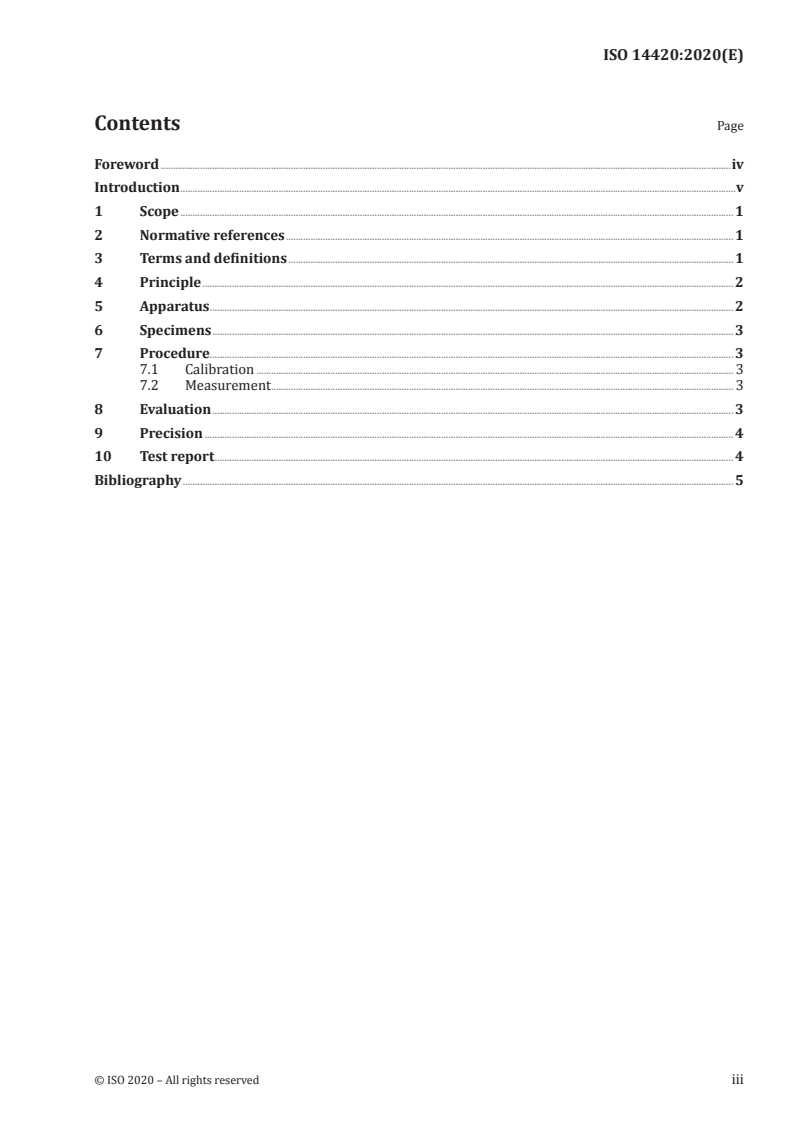
Contents Page
Foreword .iv
Introduction .v
1 Scope . 1
2 Normative references . 1
3 Terms and definitions . 1
4 Principle . 2
5 Apparatus . 2
6 Specimens . 3
7 Procedure. 3
7.1 Calibration . 3
7.2 Measurement . 3
8 Evaluation . 3
9 Precision . 4
10 Test report . 4
Bibliography . 5
Foreword
ISO (the International Organization for Standardization) is a worldwide federation of national standards
bodies (ISO member bodies). The work of preparing International Standards is normally carried out
through ISO technical committees. Each member body interested in a subject for which a technical
committee has been established has the right to be represented on that committee. International
organizations, governmental and non-governmental, in liaison with ISO, also take part in the work.
ISO collaborates closely with the International Electrotechnical Commission (IEC) on all matters of
electrotechnical standardization.
The procedures used to develop this document and those intended for its further maintenance are
described in the ISO/IEC Directives, Part 1. In particular, the different approval criteria needed for the
different types of ISO documents should be noted. This document was drafted in accordance with the
editorial rules of the ISO/IEC Directives, Part 2 (see www .iso .org/ directives).
Attention is drawn to the possibility that some of the elements of this document may be the subject of
patent rights. ISO shall not be held responsible for identifying any or all such patent rights. Details of
any patent rights identified during the development of the document will be in the Introduction and/or
on the ISO list of patent declarations received (see www .iso .org/ patents).
Any trade name used in this document is information given for the convenience of users and does not
constitute an endorsement.
For an explanation of the voluntary nature of standards, the meaning of ISO specific terms and
expressions related to conformity assessment, as well as information about ISO's adherence to the
World Trade Organization (WTO) principles in the Technical Barriers to Trade (TBT), see www .iso .org/
iso/ foreword .html.
This document was prepared by Technical Committee ISO/TC 226, Materials for the production of
primary aluminium.
This second edition cancels and replaces the first edition (ISO 14420:2005), of which it constitutes a
minor revision.
The main changes to the previous edition are as follows:
— 5.4 has been revised to remove micrometer calliper;
— the formulae in Clause 9, previously Clause 10, have been revised;
— Clause 10, previously Clause 9, has been revised according to ISO/IEC Directives Part 2.
Any feedback or questions on this document should be directed to the user’s national standards body. A
complete listing of these bodies can be found at www .iso .org/ members .html
iv © ISO 2020 – All rights reserved
Introduction
This document is based on DIN 51909:2009.
INTERNATIONAL STANDARD ISO 14420:2020(E)
Carbonaceous products for the production of
aluminium — Baked anodes and shaped carbon products
— Determination of the coefficient of linear thermal
expansion
1 Scope
This document specifies a method to determine the coefficient of linear thermal expansion of
carbonaceous or graphite materials (solid materials) for the production of aluminium between 20 °C
and 300 °C. It applies to baked anodes and shaped carbon products.
2 Normative references
The following documents are referred to in the text in such a way that some or all of their content
constitutes requirements of this document. For dated references, only the edition cited applies. For
undated references, the latest edition of the referenced document (including any amendments) applies.
ISO 13385-1, Geometrical product specifications (GPS) — Dimensional measuring equipment — Part 1:
Design and metrological characteristics of callipers
DIN 1333, Presentation of numerical data
3 Terms and definitions
For the purposes of this document, the following terms and definitions apply.
ISO and IEC maintain terminological databases for use in standardization at the following addresses:
— ISO Online browsing platform: available at https:// www .iso .org/ obp
— IEC Electropedia: available at http:// www .electropedia .org/
3.1
...
INTERNATIONAL ISO
STANDARD 14420
Second edition
2020-03
Carbonaceous products for the
production of aluminium — Baked
anodes and shaped carbon products
— Determination of the coefficient of
linear thermal expansion
Produits carbonés utilisés pour la production de l'aluminium —
Anodes cuites et produits carbonés formés — Détermination du
coefficient de dilatation thermique
Reference number
©
ISO 2020
© ISO 2020
All rights reserved. Unless otherwise specified, or required in the context of its implementation, no part of this publication may
be reproduced or utilized otherwise in any form or by any means, electronic or mechanical, including photocopying, or posting
on the internet or an intranet, without prior written permission. Permission can be requested from either ISO at the address
below or ISO’s member body in the country of the requester.
ISO copyright office
CP 401 • Ch. de Blandonnet 8
CH-1214 Vernier, Geneva
Phone: +41 22 749 01 11
Fax: +41 22 749 09 47
Email: copyright@iso.org
Website: www.iso.org
Published in Switzerland
ii © ISO 2020 – All rights reserved
Contents Page
Foreword .iv
Introduction .v
1 Scope . 1
2 Normative references . 1
3 Terms and definitions . 1
4 Principle . 2
5 Apparatus . 2
6 Specimens . 3
7 Procedure. 3
7.1 Calibration . 3
7.2 Measurement . 3
8 Evaluation . 3
9 Precision . 4
10 Test report . 4
Bibliography . 5
Foreword
ISO (the International Organization for Standardization) is a worldwide federation of national standards
bodies (ISO member bodies). The work of preparing International Standards is normally carried out
through ISO technical committees. Each member body interested in a subject for which a technical
committee has been established has the right to be represented on that committee. International
organizations, governmental and non-governmental, in liaison with ISO, also take part in the work.
ISO collaborates closely with the International Electrotechnical Commission (IEC) on all matters of
electrotechnical standardization.
The procedures used to develop this document and those intended for its further maintenance are
described in the ISO/IEC Directives, Part 1. In particular, the different approval criteria needed for the
different types of ISO documents should be noted. This document was drafted in accordance with the
editorial rules of the ISO/IEC Directives, Part 2 (see www .iso .org/ directives).
Attention is drawn to the possibility that some of the elements of this document may be the subject of
patent rights. ISO shall not be held responsible for identifying any or all such patent rights. Details of
any patent rights identified during the development of the document will be in the Introduction and/or
on the ISO list of patent declarations received (see www .iso .org/ patents).
Any trade name used in this document is information given for the convenience of users and does not
constitute an endorsement.
For an explanation of the voluntary nature of standards, the meaning of ISO specific terms and
expressions related to conformity assessment, as well as information about ISO's adherence to the
World Trade Organization (WTO) principles in the Technical Barriers to Trade (TBT), see www .iso .org/
iso/ foreword .html.
This document was prepared by Technical Committee ISO/TC 226, Materials for the production of
primary aluminium.
This second edition cancels and replaces the first edition (ISO 14420:2005), of which it constitutes a
minor revision.
The main changes to the previous edition are as follows:
— 5.4 has been revised to remove micrometer calliper;
— the formulae in Clause 9, previously Clause 10, have been revised;
— Clause 10, previously Clause 9, has been revised according to ISO/IEC Directives Part 2.
Any feedback or questions on this document should be directed to the user’s national standards body. A
complete listing of these bodies can be found at www .iso .org/ members .html
iv © ISO 2020 – All rights reserved
Introduction
This document is based on DIN 51909:2009.
INTERNATIONAL STANDARD ISO 14420:2020(E)
Carbonaceous products for the production of
aluminium — Baked anodes and shaped carbon products
— Determination of the coefficient of linear thermal
expansion
1 Scope
This document specifies a method to determine the coefficient of linear thermal expansion of
carbonaceous or graphite materials (solid materials) for the production of aluminium between 20 °C
and 300 °C. It applies to baked anodes and shaped carbon products.
2 Normative references
The following documents are referred to in the text in such a way that some or all of their content
constitutes requirements of this document. For dated references, only the edition cited applies. For
undated references, the latest edition of the referenced document (including any amendments) applies.
ISO 13385-1, Geometrical product specifications (GPS) — Dimensional measuring equipment — Part 1:
Design and metrological characteristics of callipers
DIN 1333, Presentation of numerical data
3 Terms and definitions
For the purposes of this document, the following terms and definitions apply.
ISO and IEC maintain terminological databases for use in standardization at the following addresses:
— ISO Online browsing platform: available at https:// www .iso .org/ obp
— IEC Electropedia: available at http:// www .electropedia .org/
3.1
...