

ISO 19225:2017
(Main)Underground mining machines — Mobile extracting machines at the face — Safety requirements for shearer loaders and plough systems
General Information
- Abstract
ISO 19225:2017 specifies safety requirements to minimize the hazards listed in Clause 4 that can occur during the assembly, use, maintenance, repair, decommissioning, disassembly and disposal of shearer loaders and plough systems when used as intended and under conditions of misuse which are reasonably foreseeable by the manufacturer, in underground mining. ISO 19225:2017 does not cover any hazards resulting from explosive atmospheres. Requirements for explosive atmospheres can be found in ISO/IEC 80079‑38. ISO 19225:2017 is not applicable to machines that are manufactured before the date of its publication.
- Status
- Published
- Publication Date
- 08-May-2017
- Technical Committee
- ISO/TC 82 - Mining
- Drafting Committee
- ISO/TC 82 - Mining
- Current Stage
- 9093 - International Standard confirmed
- Start Date
- 16-Sep-2022
- Completion Date
- 29-Aug-2026
Buy Documents


ISO 19225:2017 - Underground mining machines -- Mobile extracting machines at the face -- Safety requirements for shearer loaders and plough systems

ISO 19225:2017 - Underground mining machines — Mobile extracting machines at the face — Safety requirements for shearer loaders and plough systems/9/2017



ISO 19225:2017 - Machines d'exploitation de mines et carrieres souterraines -- Machines mobiles d'abattage de front de taille -- Exigences de sécurité imposées aux haveuses a tambour(s) et aux rabots

ISO 19225:2017 - Machines d'exploitation de mines et carrières souterraines — Machines mobiles d'abattage de front de taille — Exigences de sécurité imposées aux haveuses à tambour(s) et aux rabots/9/2017
Overview
ISO 19225:2017 - "Underground mining machines - Mobile extracting machines at the face - Safety requirements for shearer loaders and plough systems" - specifies safety requirements to minimize hazards throughout the lifecycle of shearer loaders and plough systems in underground mining. The standard covers assembly, use, maintenance, repair, decommissioning, disassembly and disposal when machines are used as intended or under reasonably foreseeable misuse. It is a type‑C machinery standard and takes precedence over more general type‑A/B standards for machines designed to its requirements. Note: explosive atmospheres are excluded (see ISO/IEC 80079‑38) and the standard does not apply to machines manufactured before its publication date.
Key topics and technical requirements
ISO 19225:2017 organizes safety requirements across technical domains. Major areas include:
- Hazard identification and risk reduction - list of significant hazards (Clause 4) and verification (Clause 6).
- Control devices and systems - design, safety, reliability, emergency stop, protection against inadvertent movements, remote and radio control, automatic control (Clause 5.4).
- Mechanical and structural safety - stability, contact surfaces (sharp edges, hot surfaces), chains and gearboxes, load attachment points (Clauses 5.2–5.9).
- Hydraulic, water and electrical systems - safety of hydraulic systems, power supply failure modes, cable protection, bonding and lighting (Clauses 5.8, 5.10).
- Environmental and operational risks - falling objects, ejected material, dust control and suppression, noise (Clauses 5.5–5.7).
- Fire protection, maintenance, repair and verification - safe servicing, guarding, maintenance access, and procedures for decommissioning (Clauses 5.11–5.13, 6).
- Information for use and marking - operator instructions, signals, warning devices, documentation for transport, assembly, operation, maintenance and emergencies (Clause 7).
Practical applications - who uses ISO 19225:2017
- Manufacturers and designers of shearer loaders and plough systems - to design compliant, safe machines and components.
- Mine operators and safety managers - to specify equipment procurement, operational controls and maintenance regimes.
- Maintenance personnel and service providers - for safe repair, commissioning and decommissioning practices.
- Regulators, conformity assessors and certifiers - to evaluate machine safety and compliance.
- Technical writers and trainers - to prepare user instructions, safety manuals and training materials aligned with the standard.
Related standards
ISO 19225:2017 references and aligns with key standards, including:
- ISO 12100 (risk assessment), ISO 13849‑1 (safety-related control systems), ISO/IEC 80079‑38 (explosive atmospheres), IEC 60204‑1 (electrical equipment), ISO 14120 (guards), plus others on hydraulics, ergonomics, noise and labeling.
Using ISO 19225:2017 helps reduce workplace injuries, supports regulatory compliance, and provides a structured framework for safe design and lifecycle management of mobile extracting machines at the face.
Relations
- Effective Date
- 12-Feb-2026
- Effective Date
- 06-Jun-2022
- Consolidated By
ISO 8994:2018 - Anodizing of aluminium and its alloys — Rating system for the evaluation of pitting corrosion — Grid method - Effective Date
- 06-Jun-2022
- Effective Date
- 18-Dec-2021
Buy Documents
ISO 19225:2017 - Underground mining machines -- Mobile extracting machines at the face -- Safety requirements for shearer loaders and plough systems
ISO 19225:2017 - Underground mining machines — Mobile extracting machines at the face — Safety requirements for shearer loaders and plough systems/9/2017
ISO 19225:2017 - Machines d'exploitation de mines et carrieres souterraines -- Machines mobiles d'abattage de front de taille -- Exigences de sécurité imposées aux haveuses a tambour(s) et aux rabots
ISO 19225:2017 - Machines d'exploitation de mines et carrières souterraines — Machines mobiles d'abattage de front de taille — Exigences de sécurité imposées aux haveuses à tambour(s) et aux rabots/9/2017
Get Certified
Connect with accredited certification bodies for this standard

Bureau Veritas Chile
Bureau Veritas certification services in Chile.
Bureau Veritas Peru
Bureau Veritas certification services in Peru.
BVQI Peru
Bureau Veritas certification in Peru.
Sponsored listings
Frequently Asked Questions
ISO 19225:2017 is a standard published by the International Organization for Standardization (ISO). Its full title is "Underground mining machines — Mobile extracting machines at the face — Safety requirements for shearer loaders and plough systems". This standard covers: ISO 19225:2017 specifies safety requirements to minimize the hazards listed in Clause 4 that can occur during the assembly, use, maintenance, repair, decommissioning, disassembly and disposal of shearer loaders and plough systems when used as intended and under conditions of misuse which are reasonably foreseeable by the manufacturer, in underground mining. ISO 19225:2017 does not cover any hazards resulting from explosive atmospheres. Requirements for explosive atmospheres can be found in ISO/IEC 80079‑38. ISO 19225:2017 is not applicable to machines that are manufactured before the date of its publication.
ISO 19225:2017 specifies safety requirements to minimize the hazards listed in Clause 4 that can occur during the assembly, use, maintenance, repair, decommissioning, disassembly and disposal of shearer loaders and plough systems when used as intended and under conditions of misuse which are reasonably foreseeable by the manufacturer, in underground mining. ISO 19225:2017 does not cover any hazards resulting from explosive atmospheres. Requirements for explosive atmospheres can be found in ISO/IEC 80079‑38. ISO 19225:2017 is not applicable to machines that are manufactured before the date of its publication.
ISO 19225:2017 is classified under the following ICS (International Classification for Standards) categories: 73.100.30 - Equipment for drilling and mine excavation. The ICS classification helps identify the subject area and facilitates finding related standards.
ISO 19225:2017 has the following relationships with other standards: It is inter standard links to EN ISO 19225:2017, ISO 17785-1:2016, ISO 8994:2018, ISO 19225:2017/Amd 1:2019. Understanding these relationships helps ensure you are using the most current and applicable version of the standard.
ISO 19225:2017 is available in PDF format for immediate download after purchase. The document can be added to your cart and obtained through the secure checkout process. Digital delivery ensures instant access to the complete standard document.
Standards Content (Sample)
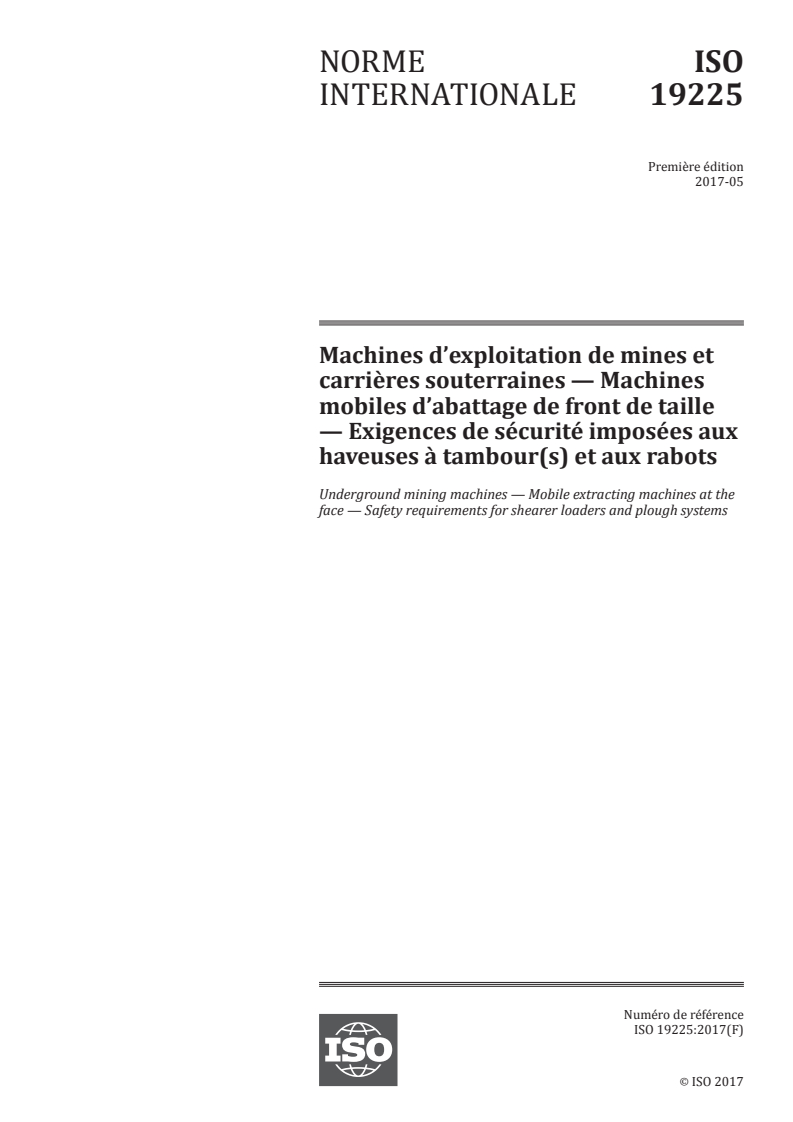
INTERNATIONAL ISO
STANDARD 19225
First edition
2017-05
Underground mining machines —
Mobile extracting machines at the face
— Safety requirements for shearer
loaders and plough systems
Machines d’exploitation de mines et carrières souterraines —
Machines mobiles d’abattage de front de taille — Exigences de
sécurité imposées aux haveuses à tambour(s) et aux rabots
Reference number
©
ISO 2017
© ISO 2017, Published in Switzerland
All rights reserved. Unless otherwise specified, no part of this publication may be reproduced or utilized otherwise in any form
or by any means, electronic or mechanical, including photocopying, or posting on the internet or an intranet, without prior
written permission. Permission can be requested from either ISO at the address below or ISO’s member body in the country of
the requester.
ISO copyright office
Ch. de Blandonnet 8 • CP 401
CH-1214 Vernier, Geneva, Switzerland
Tel. +41 22 749 01 11
Fax +41 22 749 09 47
copyright@iso.org
www.iso.org
ii © ISO 2017 – All rights reserved
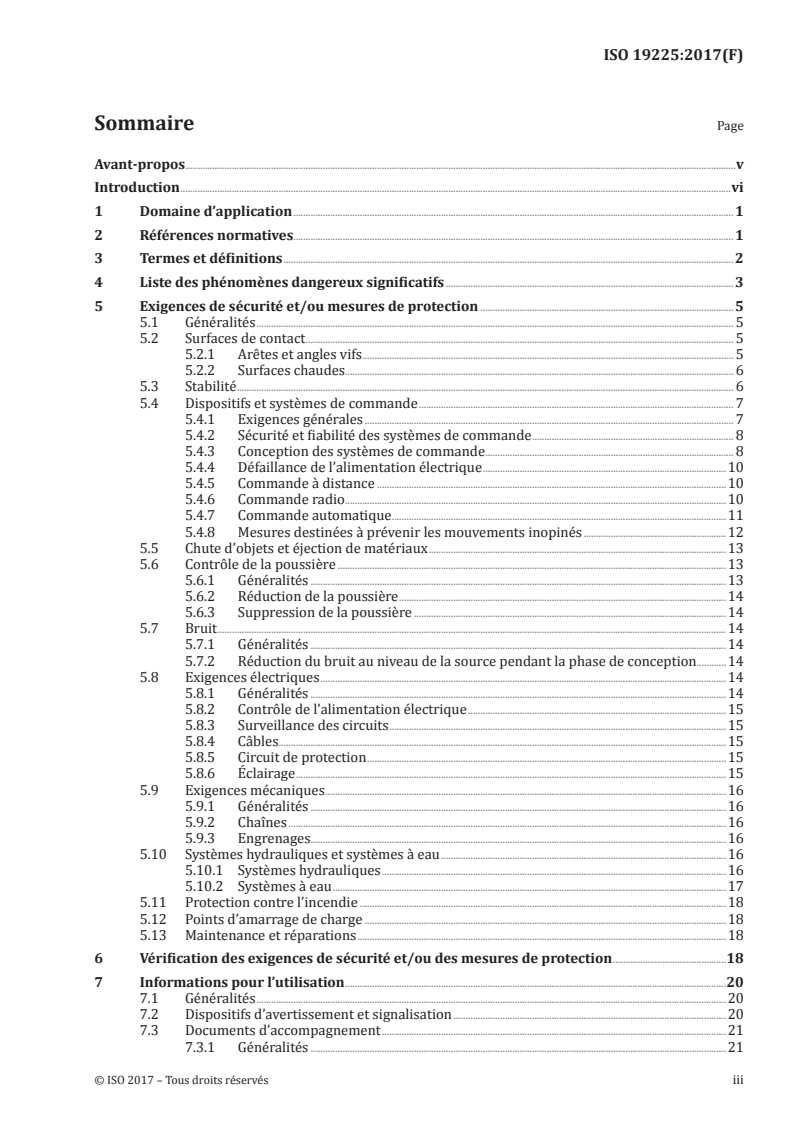
Contents Page
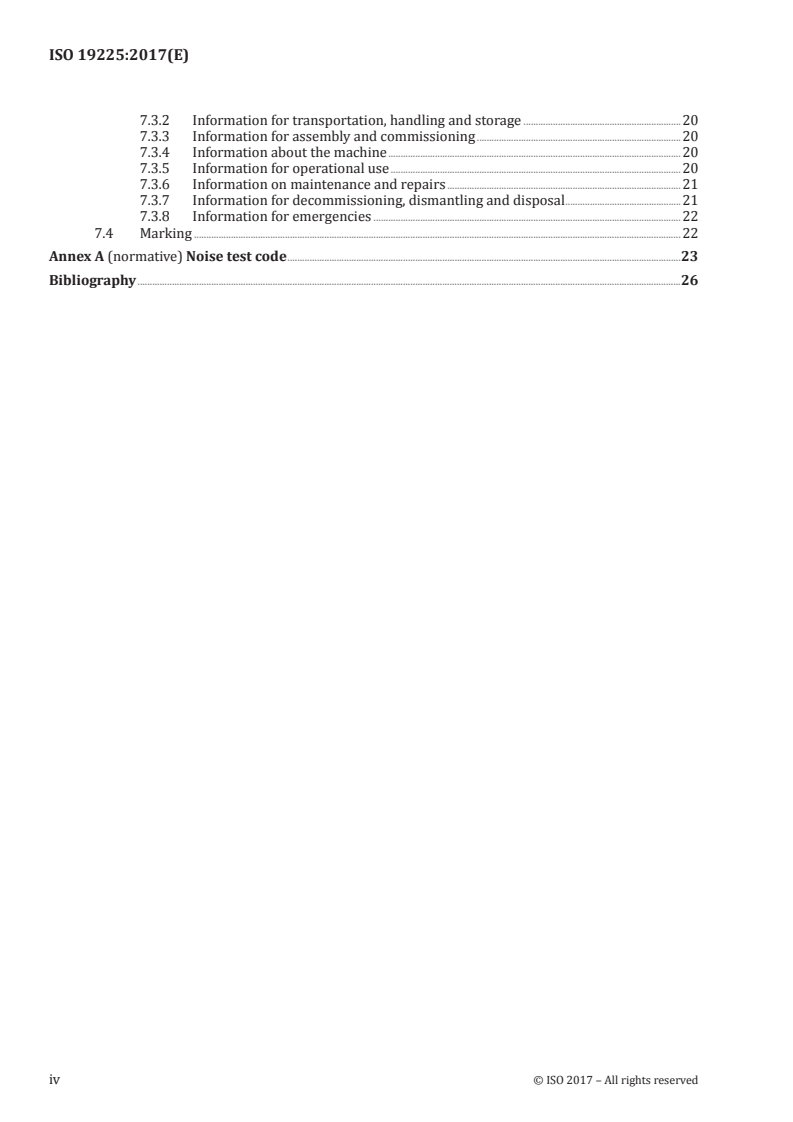
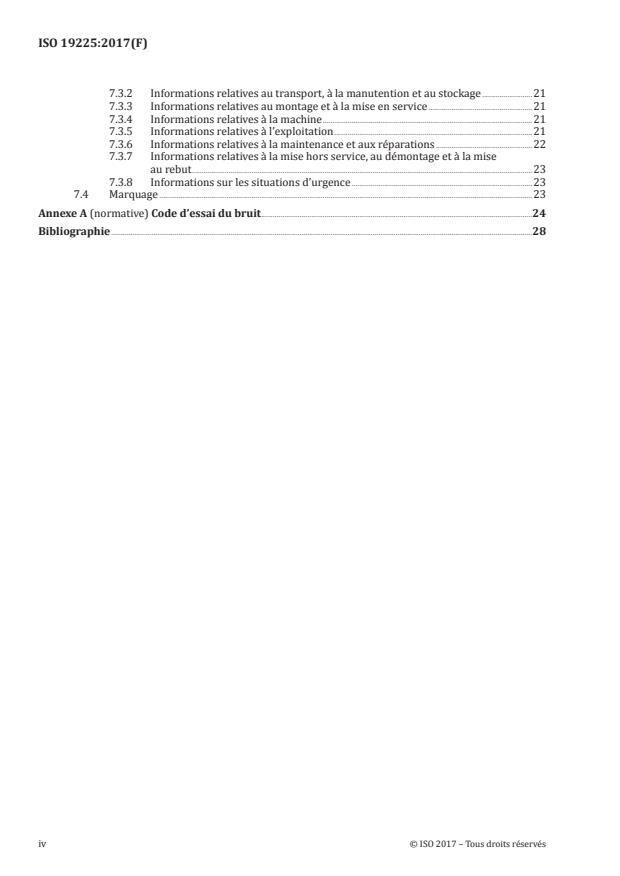
Foreword .v
Introduction .vi
1 Scope . 1
2 Normative references . 1
3 Terms and definitions . 2
4 List of significant hazards . 3
5 Safety requirements and/or protective measures . 5
5.1 General . 5
5.2 Contact surfaces . 5
5.2.1 Sharp corners and edges . 5
5.2.2 Hot surfaces. 6
5.3 Stability . 6
5.4 Control devices and systems . 7
5.4.1 General requirements . 7
5.4.2 Safety and reliability of control systems . 8
5.4.3 Design of control systems . 8
5.4.4 Failure of power supply .10
5.4.5 Remote control .10
5.4.6 Radio control .10
5.4.7 Automatic control .11
5.4.8 Measures to prevent inadvertent movements .12
5.5 Falling objects and ejected material .13
5.6 Dust control .13
5.6.1 General.13
5.6.2 Dust reduction .13
5.6.3 Dust suppression .13
5.7 Noise .13
5.7.1 General.13
5.7.2 Noise reduction at the source at the design stage .14
5.8 Electrical requirements .14
5.8.1 General.14
5.8.2 Control of electrical power supply .14
5.8.3 Monitoring of circuits .14
5.8.4 Cables . .15
5.8.5 Bonding .15
5.8.6 Lighting .15
5.9 Mechanical requirements .15
5.9.1 General.15
5.9.2 Chains .15
5.9.3 Gearboxes .16
5.10 Hydraulic systems and water systems .16
5.10.1 Hydraulic systems .16
5.10.2 Water systems .16
5.11 Fire protection .17
5.12 Load attachment points .17
5.13 Maintenance and repair .17
6 Verification of the safety requirements and/or protective measures .18
7 Information for use .19
7.1 General .19
7.2 Signals and warning devices .19
7.3 Accompanying documents .20
7.3.1 General.20
7.3.2 Information for transportation, handling and storage .20
7.3.3 Information for assembly and commissioning .20
7.3.4 Information about the machine .20
7.3.5 Information for operational use .20
7.3.6 Information on maintenance and repairs .21
7.3.7 Information for decommissioning, dismantling and disposal .21
7.3.8 Information for emergencies .22
7.4 Marking .22
Annex A (normative) Noise test code .23
Bibliography .26
iv © ISO 2017 – All rights reserved
Foreword
ISO (the International Organization for Standardization) is a worldwide federation of national standards
bodies (ISO member bodies). The work of preparing International Standards is normally carried out
through ISO technical committees. Each member body interested in a subject for which a technical
committee has been established has the right to be represented on that committee. International
organizations, governmental and non-governmental, in liaison with ISO, also take part in the work.
ISO collaborates closely with the International Electrotechnical Commission (IEC) on all matters of
electrotechnical standardization.
The procedures used to develop this document and those intended for its further maintenance are
described in the ISO/IEC Directives, Part 1. In particular the different approval criteria needed for the
different types of ISO documents should be noted. This document was drafted in accordance with the
editorial rules of the ISO/IEC Directives, Part 2 (see www .iso .org/ directives).
Attention is drawn to the possibility that some of the elements of this document may be the subject of
patent rights. ISO shall not be held responsible for identifying any or all such patent rights. Details of
any patent rights identified during the development of the document will be in the Introduction and/or
on the ISO list of patent declarations received (see www .iso .org/ patents).
Any trade name used in this document is information given for the convenience of users and does not
constitute an endorsement.
For an explanation on the voluntary nature of standards, the meaning of ISO specific terms and
expressions related to conformity assessment, as well as information about ISO’s adherence to the
World Trade Organization (WTO) principles in the Technical Barriers to Trade (TBT) see the following
URL: w w w . i s o .org/ iso/ foreword .html
The committee responsible for this document is ISO/ TC 82, Mining.
Introduction
This document is a type-C standard as stated in ISO 12100.
The machinery concerned and the extent to which hazards, hazardous situations or hazardous events
are covered are indicated in the Scope of this document.
When requirements of this type-C standard are different from those which are stated in type-A or
type-B standards, the requirements of this type-C standard take precedence over the requirements of
the other standards for machines that have been designed and built according to the requirements of
this type C standard.
The machines concerned work with tools for cutting minerals such as coal, ore, salt and surrounding
rock, at a fixed or variable height and are guided on armoured face conveyors or their attachments.
Shearer loaders have built-in haulage systems. They can be directly operated by one or more drivers or
be remotely or program controlled. Plough systems are remotely controlled. Wireless remote control
systems of shearer loaders are used in the immediate environment of the machines.
vi © ISO 2017 – All rights reserved
INTERNATIONAL STANDARD ISO 19225:2017(E)
Underground mining machines — Mobile extracting
machines at the face — Safety requirements for shearer
loaders and plough systems
1 Scope
This document specifies safety requirements to minimize the hazards listed in Clause 4 that can
occur during the assembly, use, maintenance, repair, decommissioning, disassembly and disposal of
shearer loaders and plough systems when used as intended and under conditions of misuse which are
reasonably foreseeable by the manufacturer, in underground mining.
This document does not cover any hazards resulting from explosive atmospheres. Requirements for
explosive atmospheres can be found in ISO/IEC 80079-38.
This document is not applicable to machines that are manufactured before the date of its publication.
2 Normative references
The following documents are referred to in the text in such a way that some or all of their content
constitutes requirements of this document. For dated references, only the edition cited applies. For
undated references, the latest edition of the referenced document (including any amendments) applies.
ISO 3457:2003, Earth-moving machinery — Guards — Definitions and requirements
ISO 3864-3, Graphical symbols — Safety colours and safety signs — Part 3: Design principles for graphical
symbols for use in safety signs
ISO 4413:2010, Hydraulic fluid power — General rules and safety requirements for systems and their
components
ISO 6405-1, Earth-moving machinery — Symbols for operator controls and other displays — Part 1:
Common symbols
ISO 7731:2003, Ergonomics — Danger signals for public and work areas — Auditory danger signals
ISO 9244, Earth-moving machinery — Machine safety labels — General principles
ISO 9355-1, Ergonomic requirements for the design of displays and control actuators — Part 1: Human
interactions with displays and control actuators
ISO 12100:2010, Safety of machinery — General principles for design — Risk assessment and risk reduction
ISO 12922, Lubricants, industrial oils and related products (class L) — Family H (Hydraulic systems) —
Specifications for hydraulic fluids in categories HFAE, HFAS, HFB, HFC, HFDR and HFDU
ISO 13732-1, Ergonomics of the thermal environment — Methods for the assessment of human responses to
contact with surfaces — Part 1: Hot surfaces
ISO 13849-1, Safety of machinery — Safety-related parts of control systems — Part 1: General principles
for design
ISO 13850, Safety of machinery — Emergency stop function — Principles for design
ISO 14120, Safety of machinery — Guards — General requirements for the design and construction of fixed
and movable guards
ISO/IEC 80079-38, Explosive atmospheres — Part 38: Equipment and components in explosive atmospheres
in underground mines
IEC 60204-1:2005, Safety of machinery — Electrical equipment of machines — Part 1: General requirements
IEC 60204-11, Safety of machinery — Electrical equipment of machines — Part 11: Requirements for HV
equipment for voltages above 1000 V a.c. or 1500 V d.c. and not exceeding 36 kV
IEC 60529, Degrees of protection provided by enclosures (IP code)
IEC 60947-1, Low-voltage switchgear and controlgear — Part 1: General rules
IEC 61310-1, Safety of machinery — Indications, marking and actuation — Part 1: Requirements for visual,
auditory and tactile signals
IEC 61439-1, Low-voltage switchgear and controlgear assemblies — Part 1: General rules
IEC 61439-2, Low-voltage switchgear and controlgear assemblies — Part 2: Power switchgear and
controlgear assemblies
IEC 61439-4, Low-voltage switchgear and controlgear assemblies — Part 4: Particular requirements for
assemblies for construction sites (ACS)
3 Terms and definitions
For the purposes of this document, the following terms and definitions apply.
ISO and IEC maintain terminological databases for use in standardization at the following addresses:
— IEC Electropedia: available at http:// www .electropedia .org/
— ISO Online browsing platform: available at http:// www .iso .org/ obp
3.1
remote control
operating mode where the operator controls the moving machine from a fixed position outside of the
working area of the machine
3.2
radio control
operating mode where the operator controls the moving machine from within the working area of the
machine by means of mobile radio transmitters
3.3
working area
operating area of the machine, consisting of the face and the roadway junctions
3.4
load attachment point
means of attachment for devices to enable them to carry a load
3.5
transport units
parts or subassemblies which, for transportation reasons, are not fitted to the complete machine until
the point of use
3.6
energizing
introducing power to the machine without starting or operating of the machine
2 © ISO 2017 – All rights reserved
3.7
starting
activating the machine without necessarily causing the machine to move
Note 1 to entry: For example, a shearer loader is started up when the hydraulic pump drive is switched on but
externally the machine has clearly not yet moved.
3.8
cutting cycle
operation of the shearer or plough, from one end of the face to the other and back, including the face-
end operations
4 List of significant hazards
This clause lists the hazards, hazardous situations and events, as far as they are dealt with in this
document, identified as significant for shearer loaders (see Figure 1) and plough systems (see Figure 2)
and which require an action to eliminate or reduce the risk, see Table 1.
Figure 1 — Shearer loader (side view)
Figure 2 — Plough system (top view)
Table 1 — List of significant hazards with associated requirements
Hazard Shear- Plough Sub-clause
er-loader system
1. Mechanical hazards
5.4.8
5.5
5.9
— crushing or shearing between machine parts or
X X
between machine parts and their surrounding
5.10
5.12
5.13
5.8.4
— drawing into moving cutting tools, drive wheels,
X X 5.9
trailing cables and chains
5.10
— skidding or inadvertent movement of the machine
X X 5.4.8
and parts of it
— whipping or breaking chains X X 5.9
— insufficient stability X X 5.3
2. Thermal hazards
5.9.3
— scalding by fluids X X
5.10.1
5.2.2
— burning due to hot surfaces X X
5.9.3
4 © ISO 2017 – All rights reserved
Table 1 (continued)
Hazard Shear- Plough Sub-clause
er-loader system
3. Fire hazards
— burning due to open flames X X 5.11
4. Hazards generated by materials and other substances released when machinery is used
— spalling of cut material or cutting tools X X 5.5
— fluids harmful to health X — 5.10.1
— dust harmful to health X X 5.6
5. Hazards generated by neglecting ergonomic principles in machine design
— personal injury and damage to hoses and cables X X 5.2.1
— controls that cannot be operated when operator is
X X 5.4.1
wearing protective gloves
5.4.1
— unhealthy postures or excessive effort X X
5.12
— personal injury due to excessive noise X X 5.7
6. Hazards generated by power supply faults and other failures
— spraying of fluids at high pressure X X 5.10
— hydraulic pressure drop X X 5.10.1
— control system failure X X 5.4
— falling objects X X 5.12
— injury due to electrical energy X X 5.8
7. Hazards generated by temporary absence of protective measures
5.4
5.7
— personal injury or damage to machinery X X 5.8
5.10
5.13
8. Hazard due to errors of fitting
— personal injury or damage to machinery X X 5.13
5 Safety requirements and/or protective measures
5.1 General
Shearer loaders and plough systems shall comply with the safety requirements and/or protective
measures of this clause.
In addition, they shall be designed according to the principles of ISO 12100 for relevant but not
significant hazards which are not dealt with by this document.
5.2 Contact surfaces
5.2.1 Sharp corners and edges
Accessible parts of the machines shall be designed and manufactured to minimize sharp edges, angles
or rough surfaces which are likely to cause injury, see ISO 12508.
5.2.2 Hot surfaces
Where there is a risk of contact with hot surfaces in accessible areas, suitable measures shall be taken
in accordance with ISO 13732-1.
This requirement does not apply to the excavation tools.
5.3 Stability
The manufacturer shall specify limit values for the permissible tilting of the machines in all directions.
This is to avoid possible instability of the shearer during operation or while standing, which could cause
injury to personnel within the area of the machine.
To evaluate the stability of shearer loaders, the forces acting on the two cutting drums and the weight
of the machine simplified in the transverse plane to the machine are taken into account (see Figure 3).
The size of the forces and their directions as well as the distance to the bearing points A + B shall be
determined by the manufacturer.
At least one of the bearing points A + B shall be designed as a form-fit bearing to absorb vertical as well
as horizontal forces.
The maximum permissible inclination of the machine in longitudinal and transverse direction has to be
determined by the manufacturer and indicated in the operating manual.
Key
A, B loading pads
S centre of gravity
F machine weight
G
a)
F forces on the cutting drums, radial
WR1,2
F forces on the cutting drums, axial
WA1,2
α angle of transverse dip
a)
1 and 2 as a function of the direction of rotation.
Figure 3 — Example of forces on the shearer loader
6 © ISO 2017 – All rights reserved
The coal plough (see Figure 4) runs on a special guidance, lying along the longwall face and attached to
the armoured face conveyor pans.
In that way plough bodies are restraint-guided with one degree of freedom aligned in the face direction.
Through the compulsory guide a plough body cannot leave the guidance, even in case of very high loads
acting on that body.
In situations where the plough body is decisively higher than the plough body guidance, the use of
additional stabilizers might be necessary.
Key
A loading and gliding pad
B plough body guidance
S centre of gravity
F machine weight
G
a)
F forces on the cutting plough body
N
α angle of transverse dip
a)
Lateral forces as a function of plough body movement.
Figure 4 — Example of forces on the plough
5.4 Control devices and systems
5.4.1 General requirements
Control devices and systems shall be designed and built to meet the high demands of an underground
environment and to be reliable in service.
They shall be able to withstand shock loads of 15 g/11 ms, along with ambient air temperatures of up to
40 °C, and up to 100 % humidity.
Control devices shall meet the requirements of ISO 9355-1. They shall be set out clearly and designed
so that they can be actuated easily and safely by the operator even when wearing gloves. Pushbuttons
on hand-held devices shall be at least 14 mm in diameter and the distance between buttons shall be at
least 3 mm.
The direction of movement and control effect of the control devices shall be logical. Control devices
shall be permanently and unambiguously marked.
The colour coding as specified in IEC 61310-1 shall be used for control devices and displays.
Control devices for ranging arms, lump breaker, cowls and sloughing covers shall be designed as
hold-to-run devices, as described in ISO 12100, automatically self-releasing to the basic position after
actuation; this also applies to the control devices of a transmitter if the machine is operated by means
of radio or similar controls.
If shearer loaders are operated by two people simultaneously, with two radio-transmitters, the
functions ”raise/lower left-hand ranging arm” and if appropriate ”slew left hand cowl” shall only be
initiated from the left-hand control unit, and the corresponding right-hand side functions of the machine
from the right-hand control unit. The same applies for any other functions, with the exception of the
shearer loader haulage drives which can be controlled by both operators. Contradictory simultaneous
commands shall result in the machine stopping.
5.4.2 Safety and reliability of control systems
Control functions of machinery shall be divided into operational functions and safety-related functions.
While operational functions shall comply with good engineering practice, for safety-related functions
increased requirements in respect of reliability shall be met
Safety-related functions may be performed either by separate safety control equipment or by devices
or subsystems of the operational control system. In the latter case, the operational control system (or at
least parts of it) shall meet the requirements of safety-related functions.
All safety-related parts of control systems shall meet as a minimum the Performance Level (PL) “c”
according ISO 13849-1.
5.4.3 Design of control systems
5.4.3.1 General
Electrical control systems shall be designed as per IEC 60204-1.
Hydraulic control systems shall be designed as per ISO 4413.
Ergonomic requirements of ISO 9355-1 shall be addressed.
5.4.3.2 Energizing
The machines shall be fitted with devices to prevent unauthorized energizing, e.g. lockable control
devices or levers attached to immobilization switches that can only be removed in the OFF position.
5.4.3.3 Starting
It shall only be possible to start the machine by intentional actuation of a control device provided for
the purpose. The same requirement applies, when restarting the machine after a stoppage, whatever
the cause is.
8 © ISO 2017 – All rights reserved
5.4.3.4 Start-up warning devices
Start-up warning devices for shearer loaders shall indicate the starting of the cutting drums by means
of an unmistakable warning signal which is clearly perceptible at the driver’s position, and in an area
extending 10 m in front of and behind the shearer loader.
Start-up warning devices for plough systems shall indicate the starting of movement by means of an
unmistakable audible warning signal which is clearly perceptible along the whole face.
For shearer loaders and plough systems, the drives shall not start up less than 5 s after the beginning of
the warning signal, and only start up while the warning signal is activated.
Audible signals or water sprays shall be used as the start-up warning device on the shearer loader.
Water sprays that may themselves generate a hazard shall not be used as a start-up warning device. A
water jet is regarded as hazardous if the product of its flow rate and pressure exceeds a value of 330
bar l/min at a minimum flow rate of 15 l/min.
Audible start-up warning devices shall meet the requirements of ISO 7731. At a distance of 0,5 m from
the source of sound, the sound pressure level of the warning tone shall be at least 78 dB (A) (see 4.2 in
ISO 7731:2003). The warning tone shall have intermittent characteristic (see 6.3 in ISO 7731:2003).
5.4.3.5 Stopping
5.4.3.5.1 Stopping in normal operation
Each machine mounted control panel, radio-transmitter and remote control console shall be equipped
with a control device for stopping all motors. The stop control command shall override the start-up
command.
The shearer shall be capable of coming to a controlled stop while travelling at maximum speed down
the maximum operating gradient.
5.4.3.5.2 Stopping at the end of the working range
For plough systems, a mechanical stop at the face-ends is required.
Plough systems shall be equipped with overrun monitors based on a detection of the plough position in
the face. The plough drives shall stop automatically if one of the working range end points is reached.
For shearer loaders, a mechanical stop is required to be fitted to the haulage rack at the face-ends. In
addition to this, a position detection system may be installed to control the speed of the shearer when
approaching the face-end positions.
5.4.3.5.3 Stopping in case of an emergency
The machines shall be fitted with emergency stop devices which shall conform to ISO 13850.
They shall stop all relevant movements or functions as quickly as possible to prevent the development
of a dangerous situation without creating an additional hazard.
They shall be designed so that all machine drives are disconnected and locked against start-up by
actuating a switch. The device may also consist of a pullwire acting on a switch and extending over the
whole length of the machine.
Radio-transmitters shall have a pushbutton by means of which all the machine drives are disconnected.
Each remote control console shall be equipped with a device conforming to ISO 13850 capable of stopping
the machine in an emergency. They shall be designed so that all machine drives are disconnected and
locked against start-up by actuating a switch.
Plough system control devices shall be provided with an interlock device so that all the plough system
and face conveyor drives are stopped immediately if an emergency stop device is actuated.
Remote control consoles shall be provided with a latch-down on/off switch in accordance with
ISO 13850 for stopping the complete system.
5.4.4 Failure of power supply
Re-establishment of the power supply after an interruption or fluctuation shall not lead to a hazardous
situation. See IEC 60204-1:2005, 7.5.
5.4.5 Remote control
If the machine is capable of remote operator control from outside the working area, the control system
shall meet the requirements of the following sub-clauses of IEC 60204-1:2005:
— 9.2.7.2 (control limitation);
— 9.2.7.4 (use of more than one operator control station).
A remotely controlled machine shall be equipped with devices for stopping all operations automatically
and in a safe manner for preventing potentially dangerous operation in the following situations:
— if the data transmission is interrupted;
— if it receives a stop signal;
— if a fault is detected in a safety-related part of the system;
— if no validation signal is detected.
Once stopped, the machine shall not restart except by deliberate actuation of the controls when it has
been determined that it is safe to do so.
The instruction handbook (see Clause 7) shall contain a warning that the operator shall supervise the
machine when operating the machine by remote control.
5.4.6 Radio control
If the machine is capable of radio operator control by wireless means within the working area of the
machine, the control system shall meet the requirements of the following sub-clause of IEC 60204-1:2005:
— 9.2.7.2 (control limitation).
NOTE Radio control does not apply to plough systems.
A radio controlled machine shall be equipped with devices for stopping all operations automatically
and in a safe manner for preventing potentially dangerous operation in the following situations:
— if the transmitter loses the connection to the receiver;
— if it receives a stop signal;
— if a fault is detected in a safety-related part of the system;
— if no validation signal is detected for longer than 1,25 s.
Once stopped, the machine shall not restart except by deliberate actuation of the controls when it has
been determined that it is safe to do so.
The instruction handbook (see Clause 7) shall contain a warning that the operator shall supervise the
machine when operating the machine by radio control.
10 © ISO 2017 – All rights reserved
5.4.7 Automatic control
5.4.7.1 Shearer loaders
The shearer loader control system may incorporate an “Automatic Control Mode”. This may be activated
when the machine is operated with a radio control system or a remote control system.
One or more flashing lights at the machine, visible from the operator’s position, shall indicate the
activated Automatic Control Mode.
When the Automatic Control Mode is activated, individual control functions of the machine through to
control of complete cutting cycles may be executed by the machine automatically but under supervision
of an operator.
The system shall allow the operator to be able to override the Automatic Control Mode. Manually issued
commands by the operator shall have priority over automatic control commands.
The Automatic Control Mode operated machine shall revert to a safe status mode for preventing
potentially dangerous operation in the following situations:
— if it receives a stop signal;
— if a fault is detected in a safety-related part of the machine;
— if the transmitter loses the connection to the receiver when the machine is operated with a radio
control system;
— if no validation signal between transmitter and receiver is detected for longer than 1,25 s when the
machine is operated with a radio control system;
— if the data transmission between machine and remote control station is interrupted when the
machine is operated with a remote control system;
— if no validation signal between machine and remote control station is detected when the machine is
operated with a remote control system.
Once stopped, the Automatic Control Mode shall not restart except by deliberate actuation of the
controls when it has been determined that it is safe to do so.
The instruction handbook (see Clause 7) shall contain a warning that the operator shall supervise the
machine when operating the machine by automatic control.
5.4.7.2 Plough systems
Plough systems may be controlled from the drives or from areas outside the face. Switching on and off
or changing the speed of a plough within the face may be controlled manually or automatically. When
the automatic control mode is activated, the system shall stay under supervision of an operator.
Slowing down and stopping of the plough while approaching a face-end shall occur automatically in
such a way as to avoid a mechanical collision between the plough body and the machine drive.
One or more flashing lights at the face-ends shall indicate an approach of the plough body to the drive.
Overload protection of the plough drives should be applied to minimize the danger of serious damage
or haulage chain breaks due to rapid load surges or obstacles blocking the passage of the plough body.
The instruction handbook (see Clause 7) shall contain a warning that the operator shall supervise the
plough system when operating the plough system by automatic control.
5.4.8 Measures to prevent inadvertent movements
5.4.8.1 General
Inadvertent movements include those listed in Table 2.
Table 2 — Inadvertent movements with associated preventive measures
Type of movement Measures
5.4.8.2
moving of the whole machine
5.4.8.5
5.4.8.3
moving of the ranging arms
5.4.8.5
5.4.8.4
rotation of the drums
5.4.8.5
rotation of the cowls 5.4.8.5
5.4.8.3
movement of the lump breaker
5.4.8.5
5.4.8.3
movement of the sloughing covers
5.4.8.5
The switching of motors on or off, a break in the power supply or its restoration after a break, or any
other change in the power supply to the machines shall not lead to inadvertent movements of the
machines.
NOTE Additional guidance can be found in ISO 14118.
5.4.8.2 Brakes
The manufacturer shall declare the maximum gradient for safe operation of the shearer without brakes
and the maximum gradient for safe operation of the shearer with brakes. If the shearer is equipped
with brakes:
— it shall be equipped with two independent brakes that are automatically actuated when the drives
are disconnected or when there is a power loss;
— each individual brake shall be capable of stopping and holding the machine. Wear and function of
each brake shall be monitored individually or it shall be possible to verify them individually;
— the shearer shall be capable of coming to a controlled stop while travelling at maximum speed down
the maximum operating gradient.
5.4.8.3 Check valve
Hydraulic cylinders for positioning machine parts, e.g. ranging arms, shall be fitted with check valves
that prevent any unintentional movements in the event of pressure loss between the hydraulic pump
and the cylinder (see ISO 4413:2010, 5.4.7).
5.4.8.4 Mechanical disconnection
Shearer drums or other cutting tools that rotate when the machines are in operation shall be capable of
being disconnected mechanically and shall remain disconnected from the drive motor when stopped.
12 © ISO 2017 – All rights reserved
5.4.8.5 Electrical isolation
Shearer loaders shall be provided with a means of immobilization that interrupts the power supply. It
shall be provided with an easily accessible handle that is removable or lockable only in the off position.
5.5 Falling objects and ejected material
Where falling or ejected material from the face presents a significant safety hazard, sloughing covers
mounted to the shearer body shall be provided.
As a result of the mode of operation and depending on the ambient conditions, there is a risk, when
using the machines concerned, that parts of the mineral to be won or parts of the surrounding rock be
thrown into the travel way, or that parts of the rock become detached from the roof or the side wall.
The operator should be protected against these hazards. This is generally provided by the roof support
or by the side spill plate of the conveyor and/or by personal protective equipment. The operator of a
shearer loader can also be additionally protected, for example by a roof on the machine or by using
remote or radio control.
5.6 Dust control
5.6.1 General
The manufacturer shall contribute to dust control, depending on the type of the machine (shearer loader
or plough system). This shall be done either by dust reduction in dust produced or by dust suppression,
or by a combination of both.
NOTE Dust is generated not only by the mode of operation of the machines, but also by the material to be
extracted, the environment, the roof support and the conveyor. For example, equipping the machine with a water
spray may not completely eliminate the hazard on its own.
5.6.2 Dust reduction
The manufacturer shall design the shearer loader and plough system to minimize the amount of dust
produced.
NOTE Dust production can be reduced significantly by reducing cutting speed, or by changing the layout of
the cutting tools.
5.6.3 Dust suppression
Both for shearer loaders and plough systems, the manufacturer shall provide effective water spraying
systems.
NOTE 1 For shearer loaders, a water spraying system is typically incorporated with the cutting drums,
interlocked with working parts, equipped with devices for monitoring and adjusting the operation modes
without creating additional adverse factors (noise, vibration, etc.) exceeding the maximum permissible levels.
NOTE 2 For plough systems, normally an effective water spraying system is located on the canopies of shields
and/or on armoured face conveyor spill plates.
Dust suppression with water spray systems shall not be used for the intended purpose in potash,
gypsum and salt mines. In this case, the machine shall be marked accordingly.
5.7 Noise
5.7.1 General
Persons working on or near shearer loaders and plough systems are at risk of hearing damage and
interference with speech communication, acoustic signals, etc. As far as practicable, shearer loaders
and plough systems shall generate noise levels as low as possible. Therefore, noise reduction shall be
an integral part of the design process, taking into account measures at the source as very generally
described in ISO/TR 11688-1.
Information on noise emission values shall be given to the user, see 7.3.5.
The determination, declaration and verification of the noise emission characteristics has to be carried
out in accordance with Annex A.
NOTE Only a small amount of the noise emitted at the point of use of shearer l
...
INTERNATIONAL ISO
STANDARD 19225
First edition
2017-05
Underground mining machines —
Mobile extracting machines at the face
— Safety requirements for shearer
loaders and plough systems
Machines d’exploitation de mines et carrières souterraines —
Machines mobiles d’abattage de front de taille — Exigences de
sécurité imposées aux haveuses à tambour(s) et aux rabots
Reference number
©
ISO 2017
© ISO 2017, Published in Switzerland
All rights reserved. Unless otherwise specified, no part of this publication may be reproduced or utilized otherwise in any form
or by any means, electronic or mechanical, including photocopying, or posting on the internet or an intranet, without prior
written permission. Permission can be requested from either ISO at the address below or ISO’s member body in the country of
the requester.
ISO copyright office
Ch. de Blandonnet 8 • CP 401
CH-1214 Vernier, Geneva, Switzerland
Tel. +41 22 749 01 11
Fax +41 22 749 09 47
copyright@iso.org
www.iso.org
ii © ISO 2017 – All rights reserved
Contents Page
Foreword .v
Introduction .vi
1 Scope . 1
2 Normative references . 1
3 Terms and definitions . 2
4 List of significant hazards . 3
5 Safety requirements and/or protective measures . 5
5.1 General . 5
5.2 Contact surfaces . 5
5.2.1 Sharp corners and edges . 5
5.2.2 Hot surfaces. 6
5.3 Stability . 6
5.4 Control devices and systems . 7
5.4.1 General requirements . 7
5.4.2 Safety and reliability of control systems . 8
5.4.3 Design of control systems . 8
5.4.4 Failure of power supply .10
5.4.5 Remote control .10
5.4.6 Radio control .10
5.4.7 Automatic control .11
5.4.8 Measures to prevent inadvertent movements .12
5.5 Falling objects and ejected material .13
5.6 Dust control .13
5.6.1 General.13
5.6.2 Dust reduction .13
5.6.3 Dust suppression .13
5.7 Noise .13
5.7.1 General.13
5.7.2 Noise reduction at the source at the design stage .14
5.8 Electrical requirements .14
5.8.1 General.14
5.8.2 Control of electrical power supply .14
5.8.3 Monitoring of circuits .14
5.8.4 Cables . .15
5.8.5 Bonding .15
5.8.6 Lighting .15
5.9 Mechanical requirements .15
5.9.1 General.15
5.9.2 Chains .15
5.9.3 Gearboxes .16
5.10 Hydraulic systems and water systems .16
5.10.1 Hydraulic systems .16
5.10.2 Water systems .16
5.11 Fire protection .17
5.12 Load attachment points .17
5.13 Maintenance and repair .17
6 Verification of the safety requirements and/or protective measures .18
7 Information for use .19
7.1 General .19
7.2 Signals and warning devices .19
7.3 Accompanying documents .20
7.3.1 General.20
7.3.2 Information for transportation, handling and storage .20
7.3.3 Information for assembly and commissioning .20
7.3.4 Information about the machine .20
7.3.5 Information for operational use .20
7.3.6 Information on maintenance and repairs .21
7.3.7 Information for decommissioning, dismantling and disposal .21
7.3.8 Information for emergencies .22
7.4 Marking .22
Annex A (normative) Noise test code .23
Bibliography .26
iv © ISO 2017 – All rights reserved
Foreword
ISO (the International Organization for Standardization) is a worldwide federation of national standards
bodies (ISO member bodies). The work of preparing International Standards is normally carried out
through ISO technical committees. Each member body interested in a subject for which a technical
committee has been established has the right to be represented on that committee. International
organizations, governmental and non-governmental, in liaison with ISO, also take part in the work.
ISO collaborates closely with the International Electrotechnical Commission (IEC) on all matters of
electrotechnical standardization.
The procedures used to develop this document and those intended for its further maintenance are
described in the ISO/IEC Directives, Part 1. In particular the different approval criteria needed for the
different types of ISO documents should be noted. This document was drafted in accordance with the
editorial rules of the ISO/IEC Directives, Part 2 (see www .iso .org/ directives).
Attention is drawn to the possibility that some of the elements of this document may be the subject of
patent rights. ISO shall not be held responsible for identifying any or all such patent rights. Details of
any patent rights identified during the development of the document will be in the Introduction and/or
on the ISO list of patent declarations received (see www .iso .org/ patents).
Any trade name used in this document is information given for the convenience of users and does not
constitute an endorsement.
For an explanation on the voluntary nature of standards, the meaning of ISO specific terms and
expressions related to conformity assessment, as well as information about ISO’s adherence to the
World Trade Organization (WTO) principles in the Technical Barriers to Trade (TBT) see the following
URL: w w w . i s o .org/ iso/ foreword .html
The committee responsible for this document is ISO/ TC 82, Mining.
Introduction
This document is a type-C standard as stated in ISO 12100.
The machinery concerned and the extent to which hazards, hazardous situations or hazardous events
are covered are indicated in the Scope of this document.
When requirements of this type-C standard are different from those which are stated in type-A or
type-B standards, the requirements of this type-C standard take precedence over the requirements of
the other standards for machines that have been designed and built according to the requirements of
this type C standard.
The machines concerned work with tools for cutting minerals such as coal, ore, salt and surrounding
rock, at a fixed or variable height and are guided on armoured face conveyors or their attachments.
Shearer loaders have built-in haulage systems. They can be directly operated by one or more drivers or
be remotely or program controlled. Plough systems are remotely controlled. Wireless remote control
systems of shearer loaders are used in the immediate environment of the machines.
vi © ISO 2017 – All rights reserved
INTERNATIONAL STANDARD ISO 19225:2017(E)
Underground mining machines — Mobile extracting
machines at the face — Safety requirements for shearer
loaders and plough systems
1 Scope
This document specifies safety requirements to minimize the hazards listed in Clause 4 that can
occur during the assembly, use, maintenance, repair, decommissioning, disassembly and disposal of
shearer loaders and plough systems when used as intended and under conditions of misuse which are
reasonably foreseeable by the manufacturer, in underground mining.
This document does not cover any hazards resulting from explosive atmospheres. Requirements for
explosive atmospheres can be found in ISO/IEC 80079-38.
This document is not applicable to machines that are manufactured before the date of its publication.
2 Normative references
The following documents are referred to in the text in such a way that some or all of their content
constitutes requirements of this document. For dated references, only the edition cited applies. For
undated references, the latest edition of the referenced document (including any amendments) applies.
ISO 3457:2003, Earth-moving machinery — Guards — Definitions and requirements
ISO 3864-3, Graphical symbols — Safety colours and safety signs — Part 3: Design principles for graphical
symbols for use in safety signs
ISO 4413:2010, Hydraulic fluid power — General rules and safety requirements for systems and their
components
ISO 6405-1, Earth-moving machinery — Symbols for operator controls and other displays — Part 1:
Common symbols
ISO 7731:2003, Ergonomics — Danger signals for public and work areas — Auditory danger signals
ISO 9244, Earth-moving machinery — Machine safety labels — General principles
ISO 9355-1, Ergonomic requirements for the design of displays and control actuators — Part 1: Human
interactions with displays and control actuators
ISO 12100:2010, Safety of machinery — General principles for design — Risk assessment and risk reduction
ISO 12922, Lubricants, industrial oils and related products (class L) — Family H (Hydraulic systems) —
Specifications for hydraulic fluids in categories HFAE, HFAS, HFB, HFC, HFDR and HFDU
ISO 13732-1, Ergonomics of the thermal environment — Methods for the assessment of human responses to
contact with surfaces — Part 1: Hot surfaces
ISO 13849-1, Safety of machinery — Safety-related parts of control systems — Part 1: General principles
for design
ISO 13850, Safety of machinery — Emergency stop function — Principles for design
ISO 14120, Safety of machinery — Guards — General requirements for the design and construction of fixed
and movable guards
ISO/IEC 80079-38, Explosive atmospheres — Part 38: Equipment and components in explosive atmospheres
in underground mines
IEC 60204-1:2005, Safety of machinery — Electrical equipment of machines — Part 1: General requirements
IEC 60204-11, Safety of machinery — Electrical equipment of machines — Part 11: Requirements for HV
equipment for voltages above 1000 V a.c. or 1500 V d.c. and not exceeding 36 kV
IEC 60529, Degrees of protection provided by enclosures (IP code)
IEC 60947-1, Low-voltage switchgear and controlgear — Part 1: General rules
IEC 61310-1, Safety of machinery — Indications, marking and actuation — Part 1: Requirements for visual,
auditory and tactile signals
IEC 61439-1, Low-voltage switchgear and controlgear assemblies — Part 1: General rules
IEC 61439-2, Low-voltage switchgear and controlgear assemblies — Part 2: Power switchgear and
controlgear assemblies
IEC 61439-4, Low-voltage switchgear and controlgear assemblies — Part 4: Particular requirements for
assemblies for construction sites (ACS)
3 Terms and definitions
For the purposes of this document, the following terms and definitions apply.
ISO and IEC maintain terminological databases for use in standardization at the following addresses:
— IEC Electropedia: available at http:// www .electropedia .org/
— ISO Online browsing platform: available at http:// www .iso .org/ obp
3.1
remote control
operating mode where the operator controls the moving machine from a fixed position outside of the
working area of the machine
3.2
radio control
operating mode where the operator controls the moving machine from within the working area of the
machine by means of mobile radio transmitters
3.3
working area
operating area of the machine, consisting of the face and the roadway junctions
3.4
load attachment point
means of attachment for devices to enable them to carry a load
3.5
transport units
parts or subassemblies which, for transportation reasons, are not fitted to the complete machine until
the point of use
3.6
energizing
introducing power to the machine without starting or operating of the machine
2 © ISO 2017 – All rights reserved
3.7
starting
activating the machine without necessarily causing the machine to move
Note 1 to entry: For example, a shearer loader is started up when the hydraulic pump drive is switched on but
externally the machine has clearly not yet moved.
3.8
cutting cycle
operation of the shearer or plough, from one end of the face to the other and back, including the face-
end operations
4 List of significant hazards
This clause lists the hazards, hazardous situations and events, as far as they are dealt with in this
document, identified as significant for shearer loaders (see Figure 1) and plough systems (see Figure 2)
and which require an action to eliminate or reduce the risk, see Table 1.
Figure 1 — Shearer loader (side view)
Figure 2 — Plough system (top view)
Table 1 — List of significant hazards with associated requirements
Hazard Shear- Plough Sub-clause
er-loader system
1. Mechanical hazards
5.4.8
5.5
5.9
— crushing or shearing between machine parts or
X X
between machine parts and their surrounding
5.10
5.12
5.13
5.8.4
— drawing into moving cutting tools, drive wheels,
X X 5.9
trailing cables and chains
5.10
— skidding or inadvertent movement of the machine
X X 5.4.8
and parts of it
— whipping or breaking chains X X 5.9
— insufficient stability X X 5.3
2. Thermal hazards
5.9.3
— scalding by fluids X X
5.10.1
5.2.2
— burning due to hot surfaces X X
5.9.3
4 © ISO 2017 – All rights reserved
Table 1 (continued)
Hazard Shear- Plough Sub-clause
er-loader system
3. Fire hazards
— burning due to open flames X X 5.11
4. Hazards generated by materials and other substances released when machinery is used
— spalling of cut material or cutting tools X X 5.5
— fluids harmful to health X — 5.10.1
— dust harmful to health X X 5.6
5. Hazards generated by neglecting ergonomic principles in machine design
— personal injury and damage to hoses and cables X X 5.2.1
— controls that cannot be operated when operator is
X X 5.4.1
wearing protective gloves
5.4.1
— unhealthy postures or excessive effort X X
5.12
— personal injury due to excessive noise X X 5.7
6. Hazards generated by power supply faults and other failures
— spraying of fluids at high pressure X X 5.10
— hydraulic pressure drop X X 5.10.1
— control system failure X X 5.4
— falling objects X X 5.12
— injury due to electrical energy X X 5.8
7. Hazards generated by temporary absence of protective measures
5.4
5.7
— personal injury or damage to machinery X X 5.8
5.10
5.13
8. Hazard due to errors of fitting
— personal injury or damage to machinery X X 5.13
5 Safety requirements and/or protective measures
5.1 General
Shearer loaders and plough systems shall comply with the safety requirements and/or protective
measures of this clause.
In addition, they shall be designed according to the principles of ISO 12100 for relevant but not
significant hazards which are not dealt with by this document.
5.2 Contact surfaces
5.2.1 Sharp corners and edges
Accessible parts of the machines shall be designed and manufactured to minimize sharp edges, angles
or rough surfaces which are likely to cause injury, see ISO 12508.
5.2.2 Hot surfaces
Where there is a risk of contact with hot surfaces in accessible areas, suitable measures shall be taken
in accordance with ISO 13732-1.
This requirement does not apply to the excavation tools.
5.3 Stability
The manufacturer shall specify limit values for the permissible tilting of the machines in all directions.
This is to avoid possible instability of the shearer during operation or while standing, which could cause
injury to personnel within the area of the machine.
To evaluate the stability of shearer loaders, the forces acting on the two cutting drums and the weight
of the machine simplified in the transverse plane to the machine are taken into account (see Figure 3).
The size of the forces and their directions as well as the distance to the bearing points A + B shall be
determined by the manufacturer.
At least one of the bearing points A + B shall be designed as a form-fit bearing to absorb vertical as well
as horizontal forces.
The maximum permissible inclination of the machine in longitudinal and transverse direction has to be
determined by the manufacturer and indicated in the operating manual.
Key
A, B loading pads
S centre of gravity
F machine weight
G
a)
F forces on the cutting drums, radial
WR1,2
F forces on the cutting drums, axial
WA1,2
α angle of transverse dip
a)
1 and 2 as a function of the direction of rotation.
Figure 3 — Example of forces on the shearer loader
6 © ISO 2017 – All rights reserved
The coal plough (see Figure 4) runs on a special guidance, lying along the longwall face and attached to
the armoured face conveyor pans.
In that way plough bodies are restraint-guided with one degree of freedom aligned in the face direction.
Through the compulsory guide a plough body cannot leave the guidance, even in case of very high loads
acting on that body.
In situations where the plough body is decisively higher than the plough body guidance, the use of
additional stabilizers might be necessary.
Key
A loading and gliding pad
B plough body guidance
S centre of gravity
F machine weight
G
a)
F forces on the cutting plough body
N
α angle of transverse dip
a)
Lateral forces as a function of plough body movement.
Figure 4 — Example of forces on the plough
5.4 Control devices and systems
5.4.1 General requirements
Control devices and systems shall be designed and built to meet the high demands of an underground
environment and to be reliable in service.
They shall be able to withstand shock loads of 15 g/11 ms, along with ambient air temperatures of up to
40 °C, and up to 100 % humidity.
Control devices shall meet the requirements of ISO 9355-1. They shall be set out clearly and designed
so that they can be actuated easily and safely by the operator even when wearing gloves. Pushbuttons
on hand-held devices shall be at least 14 mm in diameter and the distance between buttons shall be at
least 3 mm.
The direction of movement and control effect of the control devices shall be logical. Control devices
shall be permanently and unambiguously marked.
The colour coding as specified in IEC 61310-1 shall be used for control devices and displays.
Control devices for ranging arms, lump breaker, cowls and sloughing covers shall be designed as
hold-to-run devices, as described in ISO 12100, automatically self-releasing to the basic position after
actuation; this also applies to the control devices of a transmitter if the machine is operated by means
of radio or similar controls.
If shearer loaders are operated by two people simultaneously, with two radio-transmitters, the
functions ”raise/lower left-hand ranging arm” and if appropriate ”slew left hand cowl” shall only be
initiated from the left-hand control unit, and the corresponding right-hand side functions of the machine
from the right-hand control unit. The same applies for any other functions, with the exception of the
shearer loader haulage drives which can be controlled by both operators. Contradictory simultaneous
commands shall result in the machine stopping.
5.4.2 Safety and reliability of control systems
Control functions of machinery shall be divided into operational functions and safety-related functions.
While operational functions shall comply with good engineering practice, for safety-related functions
increased requirements in respect of reliability shall be met
Safety-related functions may be performed either by separate safety control equipment or by devices
or subsystems of the operational control system. In the latter case, the operational control system (or at
least parts of it) shall meet the requirements of safety-related functions.
All safety-related parts of control systems shall meet as a minimum the Performance Level (PL) “c”
according ISO 13849-1.
5.4.3 Design of control systems
5.4.3.1 General
Electrical control systems shall be designed as per IEC 60204-1.
Hydraulic control systems shall be designed as per ISO 4413.
Ergonomic requirements of ISO 9355-1 shall be addressed.
5.4.3.2 Energizing
The machines shall be fitted with devices to prevent unauthorized energizing, e.g. lockable control
devices or levers attached to immobilization switches that can only be removed in the OFF position.
5.4.3.3 Starting
It shall only be possible to start the machine by intentional actuation of a control device provided for
the purpose. The same requirement applies, when restarting the machine after a stoppage, whatever
the cause is.
8 © ISO 2017 – All rights reserved
5.4.3.4 Start-up warning devices
Start-up warning devices for shearer loaders shall indicate the starting of the cutting drums by means
of an unmistakable warning signal which is clearly perceptible at the driver’s position, and in an area
extending 10 m in front of and behind the shearer loader.
Start-up warning devices for plough systems shall indicate the starting of movement by means of an
unmistakable audible warning signal which is clearly perceptible along the whole face.
For shearer loaders and plough systems, the drives shall not start up less than 5 s after the beginning of
the warning signal, and only start up while the warning signal is activated.
Audible signals or water sprays shall be used as the start-up warning device on the shearer loader.
Water sprays that may themselves generate a hazard shall not be used as a start-up warning device. A
water jet is regarded as hazardous if the product of its flow rate and pressure exceeds a value of 330
bar l/min at a minimum flow rate of 15 l/min.
Audible start-up warning devices shall meet the requirements of ISO 7731. At a distance of 0,5 m from
the source of sound, the sound pressure level of the warning tone shall be at least 78 dB (A) (see 4.2 in
ISO 7731:2003). The warning tone shall have intermittent characteristic (see 6.3 in ISO 7731:2003).
5.4.3.5 Stopping
5.4.3.5.1 Stopping in normal operation
Each machine mounted control panel, radio-transmitter and remote control console shall be equipped
with a control device for stopping all motors. The stop control command shall override the start-up
command.
The shearer shall be capable of coming to a controlled stop while travelling at maximum speed down
the maximum operating gradient.
5.4.3.5.2 Stopping at the end of the working range
For plough systems, a mechanical stop at the face-ends is required.
Plough systems shall be equipped with overrun monitors based on a detection of the plough position in
the face. The plough drives shall stop automatically if one of the working range end points is reached.
For shearer loaders, a mechanical stop is required to be fitted to the haulage rack at the face-ends. In
addition to this, a position detection system may be installed to control the speed of the shearer when
approaching the face-end positions.
5.4.3.5.3 Stopping in case of an emergency
The machines shall be fitted with emergency stop devices which shall conform to ISO 13850.
They shall stop all relevant movements or functions as quickly as possible to prevent the development
of a dangerous situation without creating an additional hazard.
They shall be designed so that all machine drives are disconnected and locked against start-up by
actuating a switch. The device may also consist of a pullwire acting on a switch and extending over the
whole length of the machine.
Radio-transmitters shall have a pushbutton by means of which all the machine drives are disconnected.
Each remote control console shall be equipped with a device conforming to ISO 13850 capable of stopping
the machine in an emergency. They shall be designed so that all machine drives are disconnected and
locked against start-up by actuating a switch.
Plough system control devices shall be provided with an interlock device so that all the plough system
and face conveyor drives are stopped immediately if an emergency stop device is actuated.
Remote control consoles shall be provided with a latch-down on/off switch in accordance with
ISO 13850 for stopping the complete system.
5.4.4 Failure of power supply
Re-establishment of the power supply after an interruption or fluctuation shall not lead to a hazardous
situation. See IEC 60204-1:2005, 7.5.
5.4.5 Remote control
If the machine is capable of remote operator control from outside the working area, the control system
shall meet the requirements of the following sub-clauses of IEC 60204-1:2005:
— 9.2.7.2 (control limitation);
— 9.2.7.4 (use of more than one operator control station).
A remotely controlled machine shall be equipped with devices for stopping all operations automatically
and in a safe manner for preventing potentially dangerous operation in the following situations:
— if the data transmission is interrupted;
— if it receives a stop signal;
— if a fault is detected in a safety-related part of the system;
— if no validation signal is detected.
Once stopped, the machine shall not restart except by deliberate actuation of the controls when it has
been determined that it is safe to do so.
The instruction handbook (see Clause 7) shall contain a warning that the operator shall supervise the
machine when operating the machine by remote control.
5.4.6 Radio control
If the machine is capable of radio operator control by wireless means within the working area of the
machine, the control system shall meet the requirements of the following sub-clause of IEC 60204-1:2005:
— 9.2.7.2 (control limitation).
NOTE Radio control does not apply to plough systems.
A radio controlled machine shall be equipped with devices for stopping all operations automatically
and in a safe manner for preventing potentially dangerous operation in the following situations:
— if the transmitter loses the connection to the receiver;
— if it receives a stop signal;
— if a fault is detected in a safety-related part of the system;
— if no validation signal is detected for longer than 1,25 s.
Once stopped, the machine shall not restart except by deliberate actuation of the controls when it has
been determined that it is safe to do so.
The instruction handbook (see Clause 7) shall contain a warning that the operator shall supervise the
machine when operating the machine by radio control.
10 © ISO 2017 – All rights reserved
5.4.7 Automatic control
5.4.7.1 Shearer loaders
The shearer loader control system may incorporate an “Automatic Control Mode”. This may be activated
when the machine is operated with a radio control system or a remote control system.
One or more flashing lights at the machine, visible from the operator’s position, shall indicate the
activated Automatic Control Mode.
When the Automatic Control Mode is activated, individual control functions of the machine through to
control of complete cutting cycles may be executed by the machine automatically but under supervision
of an operator.
The system shall allow the operator to be able to override the Automatic Control Mode. Manually issued
commands by the operator shall have priority over automatic control commands.
The Automatic Control Mode operated machine shall revert to a safe status mode for preventing
potentially dangerous operation in the following situations:
— if it receives a stop signal;
— if a fault is detected in a safety-related part of the machine;
— if the transmitter loses the connection to the receiver when the machine is operated with a radio
control system;
— if no validation signal between transmitter and receiver is detected for longer than 1,25 s when the
machine is operated with a radio control system;
— if the data transmission between machine and remote control station is interrupted when the
machine is operated with a remote control system;
— if no validation signal between machine and remote control station is detected when the machine is
operated with a remote control system.
Once stopped, the Automatic Control Mode shall not restart except by deliberate actuation of the
controls when it has been determined that it is safe to do so.
The instruction handbook (see Clause 7) shall contain a warning that the operator shall supervise the
machine when operating the machine by automatic control.
5.4.7.2 Plough systems
Plough systems may be controlled from the drives or from areas outside the face. Switching on and off
or changing the speed of a plough within the face may be controlled manually or automatically. When
the automatic control mode is activated, the system shall stay under supervision of an operator.
Slowing down and stopping of the plough while approaching a face-end shall occur automatically in
such a way as to avoid a mechanical collision between the plough body and the machine drive.
One or more flashing lights at the face-ends shall indicate an approach of the plough body to the drive.
Overload protection of the plough drives should be applied to minimize the danger of serious damage
or haulage chain breaks due to rapid load surges or obstacles blocking the passage of the plough body.
The instruction handbook (see Clause 7) shall contain a warning that the operator shall supervise the
plough system when operating the plough system by automatic control.
5.4.8 Measures to prevent inadvertent movements
5.4.8.1 General
Inadvertent movements include those listed in Table 2.
Table 2 — Inadvertent movements with associated preventive measures
Type of movement Measures
5.4.8.2
moving of the whole machine
5.4.8.5
5.4.8.3
moving of the ranging arms
5.4.8.5
5.4.8.4
rotation of the drums
5.4.8.5
rotation of the cowls 5.4.8.5
5.4.8.3
movement of the lump breaker
5.4.8.5
5.4.8.3
movement of the sloughing covers
5.4.8.5
The switching of motors on or off, a break in the power supply or its restoration after a break, or any
other change in the power supply to the machines shall not lead to inadvertent movements of the
machines.
NOTE Additional guidance can be found in ISO 14118.
5.4.8.2 Brakes
The manufacturer shall declare the maximum gradient for safe operation of the shearer without brakes
and the maximum gradient for safe operation of the shearer with brakes. If the shearer is equipped
with brakes:
— it shall be equipped with two independent brakes that are automatically actuated when the drives
are disconnected or when there is a power loss;
— each individual brake shall be capable of stopping and holding the machine. Wear and function of
each brake shall be monitored individually or it shall be possible to verify them individually;
— the shearer shall be capable of coming to a controlled stop while travelling at maximum speed down
the maximum operating gradient.
5.4.8.3 Check valve
Hydraulic cylinders for positioning machine parts, e.g. ranging arms, shall be fitted with check valves
that prevent any unintentional movements in the event of pressure loss between the hydraulic pump
and the cylinder (see ISO 4413:2010, 5.4.7).
5.4.8.4 Mechanical disconnection
Shearer drums or other cutting tools that rotate when the machines are in operation shall be capable of
being disconnected mechanically and shall remain disconnected from the drive motor when stopped.
12 © ISO 2017 – All rights reserved
5.4.8.5 Electrical isolation
Shearer loaders shall be provided with a means of immobilization that interrupts the power supply. It
shall be provided with an easily accessible handle that is removable or lockable only in the off position.
5.5 Falling objects and ejected material
Where falling or ejected material from the face presents a significant safety hazard, sloughing covers
mounted to the shearer body shall be provided.
As a result of the mode of operation and depending on the ambient conditions, there is a risk, when
using the machines concerned, that parts of the mineral to be won or parts of the surrounding rock be
thrown into the travel way, or that parts of the rock become detached from the roof or the side wall.
The operator should be protected against these hazards. This is generally provided by the roof support
or by the side spill plate of the conveyor and/or by personal protective equipment. The operator of a
shearer loader can also be additionally protected, for example by a roof on the machine or by using
remote or radio control.
5.6 Dust control
5.6.1 General
The manufacturer shall contribute to dust control, depending on the type of the machine (shearer loader
or plough system). This shall be done either by dust reduction in dust produced or by dust suppression,
or by a combination of both.
NOTE Dust is generated not only by the mode of operation of the machines, but also by the material to be
extracted, the environment, the roof support and the conveyor. For example, equipping the machine with a water
spray may not completely eliminate the hazard on its own.
5.6.2 Dust reduction
The manufacturer shall design the shearer loader and plough system to minimize the amount of dust
produced.
NOTE Dust production can be reduced significantly by reducing cutting speed, or by changing the layout of
the cutting tools.
5.6.3 Dust suppression
Both for shearer loaders and plough systems, the manufacturer shall provide effective water spraying
systems.
NOTE 1 For shearer loaders, a water spraying system is typically incorporated with the cutting drums,
interlocked with working parts, equipped with devices for monitoring and adjusting the operation modes
without creating additional adverse factors (noise, vibration, etc.) exceeding the maximum permissible levels.
NOTE 2 For plough systems, normally an effective water spraying system is located on the canopies of shields
and/or on armoured face conveyor spill plates.
Dust suppression with water spray systems shall not be used for the intended purpose in potash,
gypsum and salt mines. In this case, the machine shall be marked accordingly.
5.7 Noise
5.7.1 General
Persons working on or near shearer loaders and plough systems are at risk of hearing damage and
interference with speech communication, acoustic signals, etc. As far as practicable, shearer loaders
and plough systems shall generate noise levels as low as possible. Therefore, noise reduction shall be
an integral part of the design process, taking into account measures at the source as very generally
described in ISO/TR 11688-1.
Information on noise emission values shall be given to the user, see 7.3.5.
The determination, declaration and verification of the noise emission characteristics has to be carried
out in accordance with Annex A.
NOTE Only a small amount of the noise emitted at the point of use of shearer l
...
NORME ISO
INTERNATIONALE 19225
Première édition
2017-05
Machines d’exploitation de mines et
carrières souterraines — Machines
mobiles d’abattage de front de taille
— Exigences de sécurité imposées aux
haveuses à tambour(s) et aux rabots
Underground mining machines — Mobile extracting machines at the
face — Safety requirements for shearer loaders and plough systems
Numéro de référence
©
ISO 2017
DOCUMENT PROTÉGÉ PAR COPYRIGHT
© ISO 2017, Publié en Suisse
Droits de reproduction réservés. Sauf indication contraire, aucune partie de cette publication ne peut être reproduite ni utilisée
sous quelque forme que ce soit et par aucun procédé, électronique ou mécanique, y compris la photocopie, l’affichage sur
l’internet ou sur un Intranet, sans autorisation écrite préalable. Les demandes d’autorisation peuvent être adressées à l’ISO à
l’adresse ci-après ou au comité membre de l’ISO dans le pays du demandeur.
ISO copyright office
Ch. de Blandonnet 8 • CP 401
CH-1214 Vernier, Geneva, Switzerland
Tel. +41 22 749 01 11
Fax +41 22 749 09 47
copyright@iso.org
www.iso.org
ii © ISO 2017 – Tous droits réservés
Sommaire Page
Avant-propos .v
Introduction .vi
1 Domaine d’application . 1
2 Références normatives . 1
3 Termes et définitions . 2
4 Liste des phénomènes dangereux significatifs . 3
5 Exigences de sécurité et/ou mesures de protection . 5
5.1 Généralités . 5
5.2 Surfaces de contact . 5
5.2.1 Arêtes et angles vifs . 5
5.2.2 Surfaces chaudes. 6
5.3 Stabilité . 6
5.4 Dispositifs et systèmes de commande . 7
5.4.1 Exigences générales . 7
5.4.2 Sécurité et fiabilité des systèmes de commande . 8
5.4.3 Conception des systèmes de commande . 8
5.4.4 Défaillance de l’alimentation électrique .10
5.4.5 Commande à distance .10
5.4.6 Commande radio .10
5.4.7 Commande automatique .11
5.4.8 Mesures destinées à prévenir les mouvements inopinés .12
5.5 Chute d’objets et éjection de matériaux .13
5.6 Contrôle de la poussière .13
5.6.1 Généralités .13
5.6.2 Réduction de la poussière .14
5.6.3 Suppression de la poussière .14
5.7 Bruit .14
5.7.1 Généralités .14
5.7.2 Réduction du bruit au niveau de la source pendant la phase de conception .14
5.8 Exigences électriques .14
5.8.1 Généralités .14
5.8.2 Contrôle de l’alimentation électrique .15
5.8.3 Surveillance des circuits .15
5.8.4 Câbles . .15
5.8.5 Circuit de protection .15
5.8.6 Éclairage .15
5.9 Exigences mécaniques .16
5.9.1 Généralités .16
5.9.2 Chaînes .16
5.9.3 Engrenages . . .16
5.10 Systèmes hydrauliques et systèmes à eau .16
5.10.1 Systèmes hydrauliques .16
5.10.2 Systèmes à eau .17
5.11 Protection contre l’incendie .18
5.12 Points d’amarrage de charge .18
5.13 Maintenance et réparations .18
6 Vérification des exigences de sécurité et/ou des mesures de protection .18
7 Informations pour l’utilisation .20
7.1 Généralités .20
7.2 Dispositifs d’avertissement et signalisation .20
7.3 Documents d’accompagnement .21
7.3.1 Généralités .21
7.3.2 Informations relatives au transport, à la manutention et au stockage .21
7.3.3 Informations relatives au montage et à la mise en service .21
7.3.4 Informations relatives à la machine .21
7.3.5 Informations relatives à l’exploitation .21
7.3.6 Informations relatives à la maintenance et aux réparations .22
7.3.7 Informations relatives à la mise hors service, au démontage et à la mise
au rebut .23
7.3.8 Informations sur les situations d’urgence .23
7.4 Marquage .23
Annexe A (normative) Code d’essai du bruit .24
Bibliographie .28
iv © ISO 2017 – Tous droits réservés
Avant-propos
L’ISO (Organisation internationale de normalisation) est une fédération mondiale d’organismes
nationaux de normalisation (comités membres de l’ISO). L’élaboration des Normes internationales est
en général confiée aux comités techniques de l’ISO. Chaque comité membre intéressé par une étude
a le droit de faire partie du comité technique créé à cet effet. Les organisations internationales,
gouvernementales et non gouvernementales, en liaison avec l’ISO participent également aux travaux.
L’ISO collabore étroitement avec la Commission électrotechnique internationale (IEC) en ce qui
concerne la normalisation électrotechnique.
Les procédures utilisées pour élaborer le présent document et celles destinées à sa mise à jour sont
décrites dans les Directives ISO/IEC, Partie 1. Il convient, en particulier de prendre note des différents
critères d’approbation requis pour les différents types de documents ISO. Le présent document a été
rédigé conformément aux règles de rédaction données dans les Directives ISO/IEC, Partie 2 (voir www
.iso .org/ directives).
L’attention est appelée sur le fait que certains des éléments du présent document peuvent faire l’objet de
droits de propriété intellectuelle ou de droits analogues. L’ISO ne saurait être tenue pour responsable
de ne pas avoir identifié de tels droits de propriété et averti de leur existence. Les détails concernant
les références aux droits de propriété intellectuelle ou autres droits analogues identifiés lors de
l’élaboration du document sont indiqués dans l’Introduction et/ou dans la liste des déclarations de
brevets reçues par l’ISO (voir www .iso .org/ brevets).
Les appellations commerciales éventuellement mentionnées dans le présent document sont données
pour information, par souci de commodité, à l’intention des utilisateurs et ne sauraient constituer un
engagement.
Pour une explication de la nature volontaire des normes, de la signification des termes et expressions
spécifiques de l’ISO liés à l’évaluation de la conformité, ou pour toute information au sujet de l’adhésion
de l’ISO aux principes de l’Organisation mondiale du commerce (OMC) concernant les obstacles
techniques au commerce (OTC), voir le lien suivant: w w w . i s o .org/ iso/ fr/ avant -propos .html
Le comité chargé de l’élaboration du présent document est l’ISO/TC 82, Exploitation minière.
Introduction
Le présent document est une norme de type C comme défini dans l’ISO 12100.
Le type de machines concerné et les phénomènes, situations ou événements dangereux couverts sont
mentionnés dans le domaine d’application du présent document.
Lorsque des exigences de la présente norme de type C sont différentes de celles mentionnées dans les
normes de type A ou de type B, les exigences de la présente norme de type C prennent le pas sur les
exigences des autres normes, pour les machines ayant été conçues et fabriquées suivant les exigences
de la présente norme de type C.
Les machines concernées fonctionnent avec des outils permettant la coupe de minéraux tels que
charbon, minerais, sel et roches environnantes, à une hauteur de taille fixe ou variable, et sont guidées
par des convoyeurs de taille blindés ou leurs accessoires. Les haveuses à tambour(s) sont munies
de systèmes de halage intégrés. Elles peuvent être manœuvrées directement par un ou plusieurs
conducteurs, ou être commandées à distance ou pilotées par un automate programmable. Les rabots
sont commandés à distance. Les systèmes de commande à distance sans fil des haveuses à tambour(s)
sont utilisés à proximité immédiate des machines.
vi © ISO 2017 – Tous droits réservés
NORME INTERNATIONALE ISO 19225:2017(F)
Machines d’exploitation de mines et carrières
souterraines — Machines mobiles d’abattage de front de
taille — Exigences de sécurité imposées aux haveuses à
tambour(s) et aux rabots
1 Domaine d’application
Le présent document spécifie les exigences de sécurité visant à réduire le plus possible les phénomènes
dangereux énumérés à l’Article 4 qui peuvent se produire en exploitation minière souterraine pendant
le montage, l’utilisation, la maintenance, les réparations, la mise hors service, le démontage et la mise
au rebut des haveuses à tambour(s) et des rabots quand ils sont utilisés comme prévu et dans des
conditions d’utilisation abusive raisonnablement prévisibles par le constructeur.
Le présent document ne couvre pas les phénomènes dangereux résultant des atmosphères explosives.
L’ISO/IEC 80079-38 fournit des exigences pour les atmosphères explosives.
Le présent document ne s’applique pas aux machines construites avant sa date de publication.
2 Références normatives
Les documents suivants cités dans le texte constituent, pour tout ou partie de leur contenu, des
exigences du présent document. Pour les références datées, seule l’édition citée s’applique. Pour les
références non datées, la dernière édition du document de référence s’applique (y compris les éventuels
amendements).
ISO 3457:2003, Engins de terrassement — Protecteurs — Définitions et exigences
ISO 3864-3, Symboles graphiques — Couleurs de sécurité et signaux de sécurité — Partie 3: Principes de
conception pour les symboles graphiques utilisés dans les signaux de sécurité
ISO 4413:2010, Transmissions hydrauliques — Règles générales et exigences de sécurité relatives aux
systèmes et leurs composants
ISO 6405-1, Engins de terrassement — Symboles pour les commandes de l’opérateur et autres indicateurs —
Partie 1: Symboles communs
ISO 7731:2003, Ergonomie - Signaux de danger pour lieux publics et lieux de travail — Signaux de danger
auditifs
ISO 9244, Engins de terrassement — Étiquetage de sécurité de la machine — Principes généraux
ISO 9355-1, Spécifications ergonomiques pour la conception des dispositifs de signalisation et des organes
de service — Partie 1: Interactions entre l’homme et les dispositifs de signalisation et organes de service
ISO 12100:2010, Sécurité des machines — Principes généraux de conception — Appréciation du risque et
réduction du risque
ISO 12922, Lubrifiants, huiles industrielles et produits connexes (classe L) — Famille H (Systèmes
hydrauliques) — Spécifications applicables aux fluides hydrauliques des catégories HFAE, HFAS, HFB, HFC,
HFDR et HFDU
ISO 13732-1, Ergonomie des ambiances thermiques — Méthodes d’évaluation de la réponse humaine au
contact avec des surfaces — Partie 1: Surfaces chaudes
ISO 13849-1, Sécurité des machines — Parties des systèmes de commande relatives à la sécurité — Partie 1:
Principes généraux de conception
ISO 13850, Sécurité des machines — Fonction d’arrêt d’urgence — Principes de conception
ISO 14120, Sécurité des machines — Protecteurs — Prescriptions générales pour la conception et la
construction des protecteurs fixes et mobiles
ISO/IEC 80079-38, Atmosphères explosives — Partie 38: Appareils et composants destinés à être utilisés
dans les mines souterraines grisouteuses
IEC 60204-1:2005, Sécurité des machines — Équipement électrique des machines — Partie 1: Exigences
générales
IEC 60204-11, Sécurité des machines — Équipement électrique des machines — Partie 11: Prescriptions
pour les équipements HT fonctionnant à des tensions supérieures à 1 000 V c.a. ou 1 500 V c.c. et ne
dépassant pas 36 kV
IEC 60529, Degrés de protection procurés par les enveloppes (Code IP)
IEC 60947-1, Appareillage à basse tension — Partie 1: Règles générales
IEC 61310-1, Sécurité des machines — Indication, marquage et manœuvre — Partie 1: Exigences pour les
signaux visuels, acoustiques et tactiles
IEC 61439-1, Ensembles d’appareillage à basse tension — Partie 1: Règles générales
IEC 61439-2, Ensembles d’appareillage à basse tension — Partie 2: Ensembles d’appareillage de puissance
IEC 61439-4, Ensembles d’appareillage à basse tension — Partie 4: Exigences particulières pour ensembles
de chantiers (EC)
3 Termes et définitions
Pour les besoins du présent document, les termes et définitions suivants s’appliquent.
L’ISO et l’IEC tiennent à jour des bases de données terminologiques destinées à être utilisées en
normalisation, consultables aux adresses suivantes:
— IEC Electropedia: disponible à l’adresse http:// www .electropedia .org/ .
— ISO Online browsing platform: disponible à l’adresse http:// www .iso .org/ obp.
3.1
commande à distance
mode de fonctionnement lors duquel l’opérateur commande la machine en mouvement à partir d’un
emplacement fixe situé en dehors de la zone de travail de la machine
3.2
commande radio
mode de fonctionnement lors duquel l’opérateur commande la machine en mouvement depuis un
emplacement situé dans la zone de travail de la machine au moyen de radio-émetteurs mobiles
3.3
zone de travail
zone dans laquelle la machine est exploitée, constituée du front de taille et des carrefours de la voie
de roulage
3.4
point d’amarrage de charge
point offrant une possibilité de fixation de dispositifs de suspension de charge
2 © ISO 2017 – Tous droits réservés
3.5
unités de transport
éléments ou sous-ensembles qui, pour des raisons de transport, ne sont assemblés à la machine qu’au
lieu prévu à cet effet, en vue de compléter ladite machine
3.6
mise sous tension
amenée de puissance électrique à la machine sans la démarrer ou la faire fonctionner
3.7
démarrage
activation de la machine sans provoquer nécessairement sa mise en mouvement
Note 1 à l’article: Par exemple, une haveuse à tambour(s) est démarrée dès l’activation de l’entraînement de la
pompe hydraulique, bien qu’il n’y ait encore aucun signe extérieur visible de la mise en mouvement de la machine.
3.8
cycle de coupe
fonctionnement de la haveuse ou du rabot depuis une extrémité du front de taille vers l’autre et retour,
y compris les opérations en extrémité du front
4 Liste des phénomènes dangereux significatifs
Le présent article fournit la liste des phénomènes, situations et événements dangereux abordés dans
le présent document, qui ont été identifiés comme étant significatifs pour les haveuses à tambour(s)
(voir Figure 1) et les rabots (voir Figure 2) et qui exigent la prise de mesures en vue d’éliminer ou
d’atténuer le risque, voir Tableau 1.
Figure 1 — Haveuse à tambour(s) (vue latérale)
Figure 2 — Rabot (vue de dessus)
Tableau 1 — Liste des phénomènes dangereux et exigences associées
Phénomène dangereux Haveuse à Rabot Paragraphe
tambour(s)
1. Risques mécaniques
5.4.8
5.5
5.9
— écrasement ou cisaillement entre des éléments de la machine
X X
ou entre des éléments de la machine et leur environnement
5.10
5.12
5.13
5.8.4
— entraînement dans des outils coupants mobiles, des roues
X X 5.9
motrices, des câbles et des chaînes de halage
5.10
— ripage ou mouvement inopiné de la machine et de certains
X X 5.4.8
éléments de la machine
— coup de fouet ou rupture des chaînes X X 5.9
— stabilité insuffisante X X 5.3
2. Risques thermiques
5.9.3
— brûlures par des fluides X X
5.10.1
5.2.2
— brûlures dues à des surfaces chaudes X X
5.9.3
4 © ISO 2017 – Tous droits réservés
Tableau 1 (suite)
Phénomène dangereux Haveuse à Rabot Paragraphe
tambour(s)
3. Risques d’incendie
— brûlures dues aux flammes nues X X 5.11
4. Risques engendrés par des matériaux et autres substances dégagées par les machines en service
— éclatement de matériaux découpés ou d’outils coupants X X 5.5
— fluides nocifs pour la santé X — 5.10.1
— poussières nocives pour la santé X X 5.6
5. Risques engendrés par le non-respect des principes ergonomiques lors de la conception des machines
— blessures aux personnes et dommages sur les flexibles et les câbles X X 5.2.1
— dispositifs de commande qui ne peuvent pas être manœuvrés
X X 5.4.1
lorsque l’opérateur porte des gants de protection
5.4.1
— postures malsaines ou effort excessif X X
5.12
— lésions dues au bruit excessif X X 5.7
6. Risques engendrés par la défaillance de l’alimentation en énergie et autres défaillances
— projection de fluides sous haute pression X X 5.10
— chute de la pression hydraulique X X 5.10.1
— défaillance du système de commande X X 5.4
— chute d’objets X X 5.12
— blessures dues à l’énergie électrique X X 5.8
7. Risques engendrés par l’absence temporaire de moyens de protection
5.4
5.7
— blessures aux personnes ou dommages aux machines X X 5.8
5.10
5.13
8. Risques dus à des erreurs d’ajustage
— blessures aux personnes ou dommages aux machines X X 5.13
5 Exigences de sécurité et/ou mesures de protection
5.1 Généralités
Les haveuses à tambour(s) et les rabots doivent répondre aux exigences de sécurité et/ou mesures de
protection du présent article.
De plus, ils doivent être conçus conformément aux principes de l’ISO 12100 concernant les phénomènes
dangereux afférents mais non significatifs qui ne sont pas abordés dans le présent document.
5.2 Surfaces de contact
5.2.1 Arêtes et angles vifs
Les parties accessibles des machines doivent être conçues et fabriquées de sorte à réduire le plus
possible les arêtes, les angles vifs ou les surfaces rugueuses susceptibles de provoquer des blessures,
voir l’ISO 12508.
5.2.2 Surfaces chaudes
Lorsqu’il existe un risque de contact avec des surfaces chaudes dans les zones accessibles, des mesures
appropriées doivent être prises conformément à l’ISO 13732-1.
Cette exigence ne s’applique pas aux outils de terrassement.
5.3 Stabilité
Le constructeur doit spécifier les valeurs limites relatives à l’inclinaison admissible des machines, dans
toutes les directions, afin d’éviter l’éventuelle instabilité de la haveuse en marche ou à l’arrêt, ce qui
pourrait provoquer des blessures aux personnes dans le périmètre de fonctionnement de la machine.
Pour évaluer la stabilité des haveuses à tambour(s), il est tenu compte des forces qui agissent sur les
deux tambours de havage et du poids de la machine. Pour simplifier, on considère que les forces sont
appliquées dans un plan transversal par rapport à la machine (voir Figure 3).
L’amplitude des forces et leurs directions ainsi que la distance entre les points d’appui A + B doivent
être déterminées par le constructeur.
Au moins l’un des points d’appui A + B doit être conçu comme appui à conjugaison de forme afin
d’absorber les forces verticales et horizontales.
L’inclinaison maximale possible de la machine, dans les sens longitudinal et transversal, doit être
déterminée par le constructeur et indiquée dans le manuel d’utilisation.
Légende
A, B patins de roulement
S centre de gravité
F poids de la machine
G
a)
F forces radiales exercées sur les tambours de havage
WR1,2
F forces axiales exercées sur les tambours de havage
WA1,2
α angle d’inclinaison transversale
a)
1 et 2 en fonction du sens de rotation
Figure 3 — Exemple de forces agissant sur la haveuse à tambour(s)
6 © ISO 2017 – Tous droits réservés
Le rabot à charbon (voir Figure 4) fonctionne suivant un dispositif de guidage spécial situé le long du
front de longue taille et fixé aux godets du convoyeur de taille blindé.
De cette manière, les bâtis des rabots sont guidés tout en étant retenus, avec un degré de liberté
d’alignement par rapport au sens du front de taille.
En raison du guidage obligatoire, le bâti d’un rabot ne peut pas se dégager du dispositif de guidage,
même dans les cas où des charges très élevées agissent sur ce bâti.
Dans les situations où le bâti d’un rabot est franchement plus élevé que le dispositif de guidage du bâti
du rabot, il peut être nécessaire d’utiliser des stabilisateurs supplémentaires.
Légende
A patin de chargement et de glissement
B dispositif de guidage du rabot
S centre de gravité
F poids de la machine
G
a)
F forces exercées sur le bâti du rabot
N
α angle d’inclinaison transversale
a)
forces latérales dues au mouvement du bâti du rabot
Figure 4 — Exemple de forces agissant sur le rabot
5.4 Dispositifs et systèmes de commande
5.4.1 Exigences générales
Les dispositifs et systèmes de commande doivent être conçus et construits de manière à répondre aux
exigences élevées de l’environnement souterrain et à être fiables en fonctionnement.
Ils doivent pouvoir résister à des charges de choc de 15 g/11 ms ainsi qu’à des températures ambiantes
de l’air allant jusqu’à 40 °C, et jusqu’à 100 % d’humidité.
Les dispositifs de commande doivent satisfaire aux exigences de l’ISO 9355-1. Ils doivent être disposés
clairement et conçus de telle façon qu’ils puissent être actionnés facilement et sans danger par
l’opérateur, y compris si celui-ci porte des gants. Le diamètre des boutons-poussoirs sur les dispositifs
portatifs doit être au minimum de 14 mm et leur entraxe ne doit pas être inférieur à 3 mm.
Le sens du mouvement et le résultat de l’actionnement des dispositifs de commande doivent être
logiques. Les dispositifs de commande doivent porter un marquage permanent excluant tout risque de
confusion.
Le code de couleurs spécifié par l’IEC 61310-1 doit être utilisé pour les dispositifs de commande et les
dispositifs d’affichage.
Les dispositifs de commande pour les bras mobiles, le concasseur, les déflecteurs et les protecteurs
contre les éboulements doivent être conçus comme des dispositifs à action maintenue tels que décrits
dans l’ISO 12100 et automatiquement revenir en position de repos après avoir été actionnés; ceci
s’applique également aux dispositifs de commande de l’émetteur si la machine est manœuvrée par des
dispositifs de commande radio ou similaires.
Si les haveuses à tambour(s) sont actionnées par deux personnes en même temps, avec deux radio-
émetteurs, les fonctions «lever/baisser le bras mobile gauche», et éventuellement «faire pivoter le
déflecteur gauche» ne doivent alors être effectuées que depuis le dispositif de commande gauche, et
les fonctions correspondantes de la partie droite de la machine que depuis le dispositif de commande
droit. Il en va de même pour toutes les autres fonctions, à l’exception des commandes du mécanisme de
halage de la haveuse à tambour(s) qui peuvent être actionnées par les deux opérateurs. Des commandes
contradictoires simultanées doivent provoquer l’arrêt de la machine.
5.4.2 Sécurité et fiabilité des systèmes de commande
Les fonctions de commande des machines doivent être divisées en fonctions opérationnelles et
fonctions relatives à la sécurité. Alors que les fonctions opérationnelles doivent être conformes aux
bonnes pratiques de l’ingénierie, des exigences plus élevées doivent être respectées pour la fiabilité des
fonctions relatives à la sécurité.
Les fonctions relatives à la sécurité peuvent être exécutées soit par un équipement de commande de la
sécurité dédié, soit par des dispositifs ou des sous-systèmes du système de commande opérationnelle.
Dans ce dernier cas, le système de commande opérationnelle (ou au moins certains éléments de celui-ci)
est également soumis aux exigences des fonctions relatives à la sécurité.
Tous les éléments relatifs à la sécurité des systèmes de commande doivent être conformes au minimum
au niveau de performance (PL) «c» de l’ISO 13849-1.
5.4.3 Conception des systèmes de commande
5.4.3.1 Généralités
Les systèmes de commande électrique doivent être conçus selon l’IEC 60204-1.
Les systèmes de commande hydraulique doivent être conçus selon l’ISO 4413.
Les exigences en matière d’ergonomie de l’ISO 9355-1 doivent être abordées.
5.4.3.2 Mise sous tension
Les machines doivent être équipées de dispositifs empêchant toute mise sous tension non autorisée,
par exemple de dispositifs ou leviers de commande verrouillables, montés sur des dispositifs de
sectionnement qui ne peuvent être retirés qu’en position ARRET.
8 © ISO 2017 – Tous droits réservés
5.4.3.3 Démarrage
Il ne doit être possible de démarrer la machine que par l’actionnement intentionnel d’un dispositif de
commande prévu à ces fins. La même exigence s’applique lors du redémarrage de la machine après un
arrêt, quelle qu’en soit la cause.
5.4.3.4 Dispositifs de présignalisation du démarrage
Les dispositifs de présignalisation du démarrage pour les haveuses à tambour(s) doivent prévenir du
démarrage des tambours de havage au moyen d’un signal d’avertissement qui ne puisse être confondu
avec un autre et qui soit clairement perceptible depuis le poste du conducteur, et dans une zone de plus
de 10 m à l’avant et à l’arrière de la haveuse à tambour(s).
Les dispositifs de présignalisation du démarrage pour les rabots doivent prévenir du démarrage du
mouvement au moyen d’un signal d’avertissement qui ne puisse être confondu avec un autre et qui soit
clairement perceptible tout le long du front de taille.
Pour les haveuses à tambour(s) et les rabots, les moteurs ne doivent pas démarrer moins de 5 s après
le début du signal d’avertissement, et en tout état de cause uniquement pendant que le signal retentit.
Des signaux sonores ou des pulvérisations d’eau doivent être utilisés comme dispositif de
présignalisation du démarrage sur la haveuse à tambour(s). Il est interdit d’utiliser en tant que dispositif
de présignalisation du démarrage des pulvérisations d’eau susceptibles de générer par elles-mêmes un
phénomène dangereux. Un jet d’eau est considéré comme dangereux si le produit de son débit par sa
pression dépasse la valeur de 330 bar l/min pour un débit minimal de 15 l/min.
Les dispositifs de présignalisation sonore du démarrage doivent être conformes aux exigences de
l’ISO 7731. Le niveau de pression acoustique de la tonalité de présignalisation doit atteindre au
minimum 78 dB (A) à une distance de 0,5 m de la source sonore (voir 4.2 de l’ISO 7731:2003). La tonalité
de présignalisation doit avoir une caractéristique intermittente (voir 6.3 de l’ISO 7731:2003).
5.4.3.5 Arrêt
5.4.3.5.1 Arrêt en exploitation normale
Chaque panneau de commande, radio-émetteur et console de commande à distance montés sur la
machine doit être équipé d’un dispositif de commande permettant d’arrêter tous les moteurs. La
commande d’arrêt doit avoir priorité sur la commande de démarrage.
La haveuse doit être capable de se placer en arrêt contrôlé tout en descendant à sa vitesse maximale la
pente d’exploitation maximale.
5.4.3.5.2 Arrêt à l’extrémité du périmètre de travail
Pour les rabots, un arrêt mécanique aux extrémités du front de taille est exigé.
Les rabots doivent être équipés de détecteurs de surcourse basés sur la détection de la position du
rabot au niveau du front de taille. Si l’une des extrémités du périmètre de travail est atteinte, les têtes
motrices des rabots doivent s’arrêter automatiquement.
Pour les haveuses à tambour(s), il est exigé d’installer un arrêt mécanique sur le bâti de halage aux
extrémités du front de taille. De plus, un système de détection de position peut être installé pour
contrôler la vitesse de la haveuse au moment de l’approche des positions d’extrémité du front de taille.
5.4.3.5.3 Arrêt en cas d’urgence
Les machines doivent être équipées de dispositifs d’arrêt d’urgence qui doivent être conformes à
l’ISO 13850.
Ils doivent arrêter le plus rapidement possible tous les mouvements ou fonctions pertinents afin d’éviter
l’évolution de toute situation dangereuse sans créer un phénomène dangereux supplémentaire.
Ils doivent être conçus de sorte à permettre de désactiver tous les moteurs des machines par
l’actionnement d’un commutateur qui interdit tout démarrage. Le dispositif peut également être
constitué d’un câble d’acier installé tout le long de la machine et qui agit sur un commutateur.
Les radio-émetteurs doivent présenter un bouton-poussoir dont l’actionnement permet d’arrêter tous
les moteurs des machines.
Chaque console de commande à distance doit être équipée d’un dispositif conforme à l’ISO 13850
capable d’arrêter la machine en cas d’urgence. Ils doivent être conçus de sorte à permettre de désactiver
tous les moteurs des machines par l’actionnement d’un commutateur qui interdit tout démarrage.
Les dispositifs de commande des rabots doivent être munis d’un dispositif d’interverrouillage de sorte
qu’en cas d’actionnement d’un dispositif d’arrêt d’urgence, tous les moteurs du rabot et du convoyeur de
taille s’arrêtent immédiatement.
Pour arrêter tout le système, les consoles de commande à distance doivent être munies d’un interrupteur
marche/arrêt à verrouillage conforme à l’ISO 13850.
5.4.4 Défaillance de l’alimentation électrique
Le rétablissement de l’alimentation électrique après une interruption ou une fluctuation ne doit pas
entraîner une situation dangereuse. Voir l’IEC 60204-1:2005, 7.5.
5.4.5 Commande à distance
Si la machine est capable d’être commandée à distance par un opérateur à partir d’un emplacement
situé en dehors de la zone de travail, le système de commande doit être conforme aux exigences des
paragraphes suivants de l’IEC 60204-1:2005:
— 9.2.7.2 (limitation de la commande);
— 9.2.7.4 (utilisation de plus d’un poste de commande opérateur).
Une machine commandée à distance doit être équipée de dispositifs permettant l’arrêt automatique et
en toute sécurité de toutes les opérations afin d’empêcher une exploitation potentiellement dangereuse
dans les situations suivantes:
— si la transmission des données est interrompue;
— si elle reçoit un signal d’arrêt;
— si un défaut est détecté sur un élément associé à la sécurité du système;
— si aucun signal de validation n’est détecté.
Une fois arrêtée, la machine ne doit pas redémarrer, sauf par un actionnement délibéré des commandes
une fois qu’il a été déterminé que le redémarrage est sans danger.
Le manuel d’instructions (voir l’Article 7) doit contenir un avertissement mentionnant que l’opérateur
doit surveiller la machine lorsqu’il utilise la commande à distance.
5.4.6 Commande radio
Si la machine est capable d’être commandée à distance par radio par un opérateur à partir d’un
emplacement situé dans la zone de travail de la machine, le système de commande doit être conforme
aux exigences du paragraphe suivant de l’IEC 60204-1:2005:
— 9.2.7.2 (limitation de la commande).
10 © ISO 2017 – Tous droits réservés
NOTE La commande radio ne s’applique pas aux rabots.
Une machine commandée par radio doit être équipée de dispositifs permettant l’arrêt automatique et
en toute sécurité de toutes les opérations afin d’empêcher une exploitation potentiellement dangereuse
dans les situations suivantes:
— si l’émetteur perd la liaison avec le récepteur;
— si elle reçoit un signal d’arrêt;
— si un défaut est détecté sur un élément associé à la sécurité du système;
— si aucun signal de validation n’est détecté pendant plus de 1,25 s.
Une fois arrêtée, la machine ne doit pas redémarrer, sauf par un actionnement délibéré des commandes
une fois qu’il a été déterminé que le redémarrage est sans danger.
Le manuel d’instructions (voir l’Article 7) doit contenir un avertissement mentionnant que l’opérateur
doit surveiller la machine lorsqu’il utilise la commande radio.
5.4.7 Commande automatique
5.4.7.1 Haveuses à tambour(s)
Le système de commande des haveuses à tambour(s) peut comprendre un « mode de commande
automatique ». Celui-ci peut être activé lorsque la machine est commandée avec un système de
commande radio ou un système de commande à distance.
Au moins un voyant clignotant, présent sur la machine et visible depuis l’emplacement de l’opérateur
doit indiquer lorsque le mode de commande automatique est activé.
Lorsque le mode de commande automatique est activé, différentes fonctions de commande individuelles
de cycles de coupe complets de la machine peuvent être exécutées automatiquement par la machine,
mais sous la surveillance d’un opérateur.
Le système doit permettre à l’opérateur de prendre la main sur le mode de commande automatique. Les
actions de commande émises manuellement pas l’opérateur doivent être prioritaires sur les actions de
commande automatiques.
La machine en mode de commande automatique doit revenir à un mode d’état sûr afin d’empêcher une
exploitation potentiellement dangereuse dans les situations suivantes:
— si elle reçoit un signal d’arrêt;
— si un défaut est détecté sur un élément associé à la sécurité de la machine;
— si l’émetteur perd la liaison avec le récepteur lorsque la machine est commandée avec un système de
commande radio;
— si aucun signal de validation n’est détecté entre l’émetteur et le récepteur pendant plus de 1,25 s
lorsque la machine est commandée avec un système de commande radio;
— si la transmission de données entre la machine et le poste de commande à distance est interrompue
lorsque la machine est commandée avec un système de commande radio;
— si aucun signal de validation entre la machine et le poste de commande à distance n’est détecté
lorsque la machine est commandée avec un système de commande radio.
Une fois arrêté, le mode de commande automatique ne doit pas redémarrer, sauf par un actionnement
délibéré des commandes une fois qu’il a été déterminé que le redémarrage est sans danger.
Le manuel d’instructions (voir l’Article 7) doit contenir un avertissement mentionnant que l’opérateur
doit surveiller la machine lorsqu’il utilise la commande automatique.
5.4.7.2 Rabots
Les rabots peuvent être commandés depuis les moteurs ou depuis des zones situées en dehors du
front de taille. L’activation et désactivation ou le changement de la vitesse d’un rabot sur le front de
taille peuvent être commandés manuellement ou automatiquement. Lorsque le mode de commande
automatique est activé, le système doit toujours se trouver sous la surveillance d’un opérateur.
Le ralentissement et l’arrêt du rabot lorsqu’il s’approche d’une extrémité du front de taille doivent se
faire automatiquement de sorte à éviter toute collision mécanique entre le bâti du rabot et le moteur de
la machine.
Au moins un voyant clignotant au niveau des extrémités du front de taille doit indiquer que le bâti du
rabot s’approche du moteur.
Il convient d’appliquer une protection contre la surcharge des moteurs du rabot afin de réduire le plus
possible le danger de graves dommages ou de ruptures de la chaîne de halage dû à des augmentations
de charge brusques ou à des obstacles qui bloquent le passage du bâti du rabot.
Le manuel d’instructions (voir l’Article 7) doit contenir un avertissement mentionnant que l’opérateur
doit surveiller le rabot lorsqu’il utilise le rabot avec la commande automatique.
5.4.8 Mesures destinées à prévenir les mouvements inopinés
5.4.8.1 Généralités
Les mouvements inopinés incluent ceux énumérés au Tableau 2.
Tableau 2 — Mouvements inopinés et les mesures préventives associées
Type de mouvement Mesures
5.4.8.2
déplacement de la machine complète
5.4.8.5
5.4.8.3
déplacement des bras mobiles
5.4.8.5
5.4.8.4
rotation des tambours
5.4.8.5
rotation des déflecteurs 5.4.8.5
5.4.8.3
déplacement du concasseur
5.4.8.5
5.4.8.3
déplacement des protecteurs contre les éboulements
5.4.8.5
Aucun mouvement inopiné des machines ne doit résulter de la mise sous tension ou hors tension des
moteurs, d’une coupure de l’alimentation électrique ou du rétablissement de celle-ci après coupure, ou
de toute autre modification de l’alimentation électrique des machines.
NOTE L’ISO 14118 fournit des préconisations supplémentaires.
12 © ISO 2017 – Tous droits
...
NORME ISO
INTERNATIONALE 19225
Première édition
2017-05
Machines d’exploitation de mines et
carrières souterraines — Machines
mobiles d’abattage de front de taille
— Exigences de sécurité imposées aux
haveuses à tambour(s) et aux rabots
Underground mining machines — Mobile extracting machines at the
face — Safety requirements for shearer loaders and plough systems
Numéro de référence
©
ISO 2017
DOCUMENT PROTÉGÉ PAR COPYRIGHT
© ISO 2017, Publié en Suisse
Droits de reproduction réservés. Sauf indication contraire, aucune partie de cette publication ne peut être reproduite ni utilisée
sous quelque forme que ce soit et par aucun procédé, électronique ou mécanique, y compris la photocopie, l’affichage sur
l’internet ou sur un Intranet, sans autorisation écrite préalable. Les demandes d’autorisation peuvent être adressées à l’ISO à
l’adresse ci-après ou au comité membre de l’ISO dans le pays du demandeur.
ISO copyright office
Ch. de Blandonnet 8 • CP 401
CH-1214 Vernier, Geneva, Switzerland
Tel. +41 22 749 01 11
Fax +41 22 749 09 47
copyright@iso.org
www.iso.org
ii © ISO 2017 – Tous droits réservés
Sommaire Page
Avant-propos .v
Introduction .vi
1 Domaine d’application . 1
2 Références normatives . 1
3 Termes et définitions . 2
4 Liste des phénomènes dangereux significatifs . 3
5 Exigences de sécurité et/ou mesures de protection . 5
5.1 Généralités . 5
5.2 Surfaces de contact . 5
5.2.1 Arêtes et angles vifs . 5
5.2.2 Surfaces chaudes. 6
5.3 Stabilité . 6
5.4 Dispositifs et systèmes de commande . 7
5.4.1 Exigences générales . 7
5.4.2 Sécurité et fiabilité des systèmes de commande . 8
5.4.3 Conception des systèmes de commande . 8
5.4.4 Défaillance de l’alimentation électrique .10
5.4.5 Commande à distance .10
5.4.6 Commande radio .10
5.4.7 Commande automatique .11
5.4.8 Mesures destinées à prévenir les mouvements inopinés .12
5.5 Chute d’objets et éjection de matériaux .13
5.6 Contrôle de la poussière .13
5.6.1 Généralités .13
5.6.2 Réduction de la poussière .14
5.6.3 Suppression de la poussière .14
5.7 Bruit .14
5.7.1 Généralités .14
5.7.2 Réduction du bruit au niveau de la source pendant la phase de conception .14
5.8 Exigences électriques .14
5.8.1 Généralités .14
5.8.2 Contrôle de l’alimentation électrique .15
5.8.3 Surveillance des circuits .15
5.8.4 Câbles . .15
5.8.5 Circuit de protection .15
5.8.6 Éclairage .15
5.9 Exigences mécaniques .16
5.9.1 Généralités .16
5.9.2 Chaînes .16
5.9.3 Engrenages . . .16
5.10 Systèmes hydrauliques et systèmes à eau .16
5.10.1 Systèmes hydrauliques .16
5.10.2 Systèmes à eau .17
5.11 Protection contre l’incendie .18
5.12 Points d’amarrage de charge .18
5.13 Maintenance et réparations .18
6 Vérification des exigences de sécurité et/ou des mesures de protection .18
7 Informations pour l’utilisation .20
7.1 Généralités .20
7.2 Dispositifs d’avertissement et signalisation .20
7.3 Documents d’accompagnement .21
7.3.1 Généralités .21
7.3.2 Informations relatives au transport, à la manutention et au stockage .21
7.3.3 Informations relatives au montage et à la mise en service .21
7.3.4 Informations relatives à la machine .21
7.3.5 Informations relatives à l’exploitation .21
7.3.6 Informations relatives à la maintenance et aux réparations .22
7.3.7 Informations relatives à la mise hors service, au démontage et à la mise
au rebut .23
7.3.8 Informations sur les situations d’urgence .23
7.4 Marquage .23
Annexe A (normative) Code d’essai du bruit .24
Bibliographie .28
iv © ISO 2017 – Tous droits réservés
Avant-propos
L’ISO (Organisation internationale de normalisation) est une fédération mondiale d’organismes
nationaux de normalisation (comités membres de l’ISO). L’élaboration des Normes internationales est
en général confiée aux comités techniques de l’ISO. Chaque comité membre intéressé par une étude
a le droit de faire partie du comité technique créé à cet effet. Les organisations internationales,
gouvernementales et non gouvernementales, en liaison avec l’ISO participent également aux travaux.
L’ISO collabore étroitement avec la Commission électrotechnique internationale (IEC) en ce qui
concerne la normalisation électrotechnique.
Les procédures utilisées pour élaborer le présent document et celles destinées à sa mise à jour sont
décrites dans les Directives ISO/IEC, Partie 1. Il convient, en particulier de prendre note des différents
critères d’approbation requis pour les différents types de documents ISO. Le présent document a été
rédigé conformément aux règles de rédaction données dans les Directives ISO/IEC, Partie 2 (voir www
.iso .org/ directives).
L’attention est appelée sur le fait que certains des éléments du présent document peuvent faire l’objet de
droits de propriété intellectuelle ou de droits analogues. L’ISO ne saurait être tenue pour responsable
de ne pas avoir identifié de tels droits de propriété et averti de leur existence. Les détails concernant
les références aux droits de propriété intellectuelle ou autres droits analogues identifiés lors de
l’élaboration du document sont indiqués dans l’Introduction et/ou dans la liste des déclarations de
brevets reçues par l’ISO (voir www .iso .org/ brevets).
Les appellations commerciales éventuellement mentionnées dans le présent document sont données
pour information, par souci de commodité, à l’intention des utilisateurs et ne sauraient constituer un
engagement.
Pour une explication de la nature volontaire des normes, de la signification des termes et expressions
spécifiques de l’ISO liés à l’évaluation de la conformité, ou pour toute information au sujet de l’adhésion
de l’ISO aux principes de l’Organisation mondiale du commerce (OMC) concernant les obstacles
techniques au commerce (OTC), voir le lien suivant: w w w . i s o .org/ iso/ fr/ avant -propos .html
Le comité chargé de l’élaboration du présent document est l’ISO/TC 82, Exploitation minière.
Introduction
Le présent document est une norme de type C comme défini dans l’ISO 12100.
Le type de machines concerné et les phénomènes, situations ou événements dangereux couverts sont
mentionnés dans le domaine d’application du présent document.
Lorsque des exigences de la présente norme de type C sont différentes de celles mentionnées dans les
normes de type A ou de type B, les exigences de la présente norme de type C prennent le pas sur les
exigences des autres normes, pour les machines ayant été conçues et fabriquées suivant les exigences
de la présente norme de type C.
Les machines concernées fonctionnent avec des outils permettant la coupe de minéraux tels que
charbon, minerais, sel et roches environnantes, à une hauteur de taille fixe ou variable, et sont guidées
par des convoyeurs de taille blindés ou leurs accessoires. Les haveuses à tambour(s) sont munies
de systèmes de halage intégrés. Elles peuvent être manœuvrées directement par un ou plusieurs
conducteurs, ou être commandées à distance ou pilotées par un automate programmable. Les rabots
sont commandés à distance. Les systèmes de commande à distance sans fil des haveuses à tambour(s)
sont utilisés à proximité immédiate des machines.
vi © ISO 2017 – Tous droits réservés
NORME INTERNATIONALE ISO 19225:2017(F)
Machines d’exploitation de mines et carrières
souterraines — Machines mobiles d’abattage de front de
taille — Exigences de sécurité imposées aux haveuses à
tambour(s) et aux rabots
1 Domaine d’application
Le présent document spécifie les exigences de sécurité visant à réduire le plus possible les phénomènes
dangereux énumérés à l’Article 4 qui peuvent se produire en exploitation minière souterraine pendant
le montage, l’utilisation, la maintenance, les réparations, la mise hors service, le démontage et la mise
au rebut des haveuses à tambour(s) et des rabots quand ils sont utilisés comme prévu et dans des
conditions d’utilisation abusive raisonnablement prévisibles par le constructeur.
Le présent document ne couvre pas les phénomènes dangereux résultant des atmosphères explosives.
L’ISO/IEC 80079-38 fournit des exigences pour les atmosphères explosives.
Le présent document ne s’applique pas aux machines construites avant sa date de publication.
2 Références normatives
Les documents suivants cités dans le texte constituent, pour tout ou partie de leur contenu, des
exigences du présent document. Pour les références datées, seule l’édition citée s’applique. Pour les
références non datées, la dernière édition du document de référence s’applique (y compris les éventuels
amendements).
ISO 3457:2003, Engins de terrassement — Protecteurs — Définitions et exigences
ISO 3864-3, Symboles graphiques — Couleurs de sécurité et signaux de sécurité — Partie 3: Principes de
conception pour les symboles graphiques utilisés dans les signaux de sécurité
ISO 4413:2010, Transmissions hydrauliques — Règles générales et exigences de sécurité relatives aux
systèmes et leurs composants
ISO 6405-1, Engins de terrassement — Symboles pour les commandes de l’opérateur et autres indicateurs —
Partie 1: Symboles communs
ISO 7731:2003, Ergonomie - Signaux de danger pour lieux publics et lieux de travail — Signaux de danger
auditifs
ISO 9244, Engins de terrassement — Étiquetage de sécurité de la machine — Principes généraux
ISO 9355-1, Spécifications ergonomiques pour la conception des dispositifs de signalisation et des organes
de service — Partie 1: Interactions entre l’homme et les dispositifs de signalisation et organes de service
ISO 12100:2010, Sécurité des machines — Principes généraux de conception — Appréciation du risque et
réduction du risque
ISO 12922, Lubrifiants, huiles industrielles et produits connexes (classe L) — Famille H (Systèmes
hydrauliques) — Spécifications applicables aux fluides hydrauliques des catégories HFAE, HFAS, HFB, HFC,
HFDR et HFDU
ISO 13732-1, Ergonomie des ambiances thermiques — Méthodes d’évaluation de la réponse humaine au
contact avec des surfaces — Partie 1: Surfaces chaudes
ISO 13849-1, Sécurité des machines — Parties des systèmes de commande relatives à la sécurité — Partie 1:
Principes généraux de conception
ISO 13850, Sécurité des machines — Fonction d’arrêt d’urgence — Principes de conception
ISO 14120, Sécurité des machines — Protecteurs — Prescriptions générales pour la conception et la
construction des protecteurs fixes et mobiles
ISO/IEC 80079-38, Atmosphères explosives — Partie 38: Appareils et composants destinés à être utilisés
dans les mines souterraines grisouteuses
IEC 60204-1:2005, Sécurité des machines — Équipement électrique des machines — Partie 1: Exigences
générales
IEC 60204-11, Sécurité des machines — Équipement électrique des machines — Partie 11: Prescriptions
pour les équipements HT fonctionnant à des tensions supérieures à 1 000 V c.a. ou 1 500 V c.c. et ne
dépassant pas 36 kV
IEC 60529, Degrés de protection procurés par les enveloppes (Code IP)
IEC 60947-1, Appareillage à basse tension — Partie 1: Règles générales
IEC 61310-1, Sécurité des machines — Indication, marquage et manœuvre — Partie 1: Exigences pour les
signaux visuels, acoustiques et tactiles
IEC 61439-1, Ensembles d’appareillage à basse tension — Partie 1: Règles générales
IEC 61439-2, Ensembles d’appareillage à basse tension — Partie 2: Ensembles d’appareillage de puissance
IEC 61439-4, Ensembles d’appareillage à basse tension — Partie 4: Exigences particulières pour ensembles
de chantiers (EC)
3 Termes et définitions
Pour les besoins du présent document, les termes et définitions suivants s’appliquent.
L’ISO et l’IEC tiennent à jour des bases de données terminologiques destinées à être utilisées en
normalisation, consultables aux adresses suivantes:
— IEC Electropedia: disponible à l’adresse http:// www .electropedia .org/ .
— ISO Online browsing platform: disponible à l’adresse http:// www .iso .org/ obp.
3.1
commande à distance
mode de fonctionnement lors duquel l’opérateur commande la machine en mouvement à partir d’un
emplacement fixe situé en dehors de la zone de travail de la machine
3.2
commande radio
mode de fonctionnement lors duquel l’opérateur commande la machine en mouvement depuis un
emplacement situé dans la zone de travail de la machine au moyen de radio-émetteurs mobiles
3.3
zone de travail
zone dans laquelle la machine est exploitée, constituée du front de taille et des carrefours de la voie
de roulage
3.4
point d’amarrage de charge
point offrant une possibilité de fixation de dispositifs de suspension de charge
2 © ISO 2017 – Tous droits réservés
3.5
unités de transport
éléments ou sous-ensembles qui, pour des raisons de transport, ne sont assemblés à la machine qu’au
lieu prévu à cet effet, en vue de compléter ladite machine
3.6
mise sous tension
amenée de puissance électrique à la machine sans la démarrer ou la faire fonctionner
3.7
démarrage
activation de la machine sans provoquer nécessairement sa mise en mouvement
Note 1 à l’article: Par exemple, une haveuse à tambour(s) est démarrée dès l’activation de l’entraînement de la
pompe hydraulique, bien qu’il n’y ait encore aucun signe extérieur visible de la mise en mouvement de la machine.
3.8
cycle de coupe
fonctionnement de la haveuse ou du rabot depuis une extrémité du front de taille vers l’autre et retour,
y compris les opérations en extrémité du front
4 Liste des phénomènes dangereux significatifs
Le présent article fournit la liste des phénomènes, situations et événements dangereux abordés dans
le présent document, qui ont été identifiés comme étant significatifs pour les haveuses à tambour(s)
(voir Figure 1) et les rabots (voir Figure 2) et qui exigent la prise de mesures en vue d’éliminer ou
d’atténuer le risque, voir Tableau 1.
Figure 1 — Haveuse à tambour(s) (vue latérale)
Figure 2 — Rabot (vue de dessus)
Tableau 1 — Liste des phénomènes dangereux et exigences associées
Phénomène dangereux Haveuse à Rabot Paragraphe
tambour(s)
1. Risques mécaniques
5.4.8
5.5
5.9
— écrasement ou cisaillement entre des éléments de la machine
X X
ou entre des éléments de la machine et leur environnement
5.10
5.12
5.13
5.8.4
— entraînement dans des outils coupants mobiles, des roues
X X 5.9
motrices, des câbles et des chaînes de halage
5.10
— ripage ou mouvement inopiné de la machine et de certains
X X 5.4.8
éléments de la machine
— coup de fouet ou rupture des chaînes X X 5.9
— stabilité insuffisante X X 5.3
2. Risques thermiques
5.9.3
— brûlures par des fluides X X
5.10.1
5.2.2
— brûlures dues à des surfaces chaudes X X
5.9.3
4 © ISO 2017 – Tous droits réservés
Tableau 1 (suite)
Phénomène dangereux Haveuse à Rabot Paragraphe
tambour(s)
3. Risques d’incendie
— brûlures dues aux flammes nues X X 5.11
4. Risques engendrés par des matériaux et autres substances dégagées par les machines en service
— éclatement de matériaux découpés ou d’outils coupants X X 5.5
— fluides nocifs pour la santé X — 5.10.1
— poussières nocives pour la santé X X 5.6
5. Risques engendrés par le non-respect des principes ergonomiques lors de la conception des machines
— blessures aux personnes et dommages sur les flexibles et les câbles X X 5.2.1
— dispositifs de commande qui ne peuvent pas être manœuvrés
X X 5.4.1
lorsque l’opérateur porte des gants de protection
5.4.1
— postures malsaines ou effort excessif X X
5.12
— lésions dues au bruit excessif X X 5.7
6. Risques engendrés par la défaillance de l’alimentation en énergie et autres défaillances
— projection de fluides sous haute pression X X 5.10
— chute de la pression hydraulique X X 5.10.1
— défaillance du système de commande X X 5.4
— chute d’objets X X 5.12
— blessures dues à l’énergie électrique X X 5.8
7. Risques engendrés par l’absence temporaire de moyens de protection
5.4
5.7
— blessures aux personnes ou dommages aux machines X X 5.8
5.10
5.13
8. Risques dus à des erreurs d’ajustage
— blessures aux personnes ou dommages aux machines X X 5.13
5 Exigences de sécurité et/ou mesures de protection
5.1 Généralités
Les haveuses à tambour(s) et les rabots doivent répondre aux exigences de sécurité et/ou mesures de
protection du présent article.
De plus, ils doivent être conçus conformément aux principes de l’ISO 12100 concernant les phénomènes
dangereux afférents mais non significatifs qui ne sont pas abordés dans le présent document.
5.2 Surfaces de contact
5.2.1 Arêtes et angles vifs
Les parties accessibles des machines doivent être conçues et fabriquées de sorte à réduire le plus
possible les arêtes, les angles vifs ou les surfaces rugueuses susceptibles de provoquer des blessures,
voir l’ISO 12508.
5.2.2 Surfaces chaudes
Lorsqu’il existe un risque de contact avec des surfaces chaudes dans les zones accessibles, des mesures
appropriées doivent être prises conformément à l’ISO 13732-1.
Cette exigence ne s’applique pas aux outils de terrassement.
5.3 Stabilité
Le constructeur doit spécifier les valeurs limites relatives à l’inclinaison admissible des machines, dans
toutes les directions, afin d’éviter l’éventuelle instabilité de la haveuse en marche ou à l’arrêt, ce qui
pourrait provoquer des blessures aux personnes dans le périmètre de fonctionnement de la machine.
Pour évaluer la stabilité des haveuses à tambour(s), il est tenu compte des forces qui agissent sur les
deux tambours de havage et du poids de la machine. Pour simplifier, on considère que les forces sont
appliquées dans un plan transversal par rapport à la machine (voir Figure 3).
L’amplitude des forces et leurs directions ainsi que la distance entre les points d’appui A + B doivent
être déterminées par le constructeur.
Au moins l’un des points d’appui A + B doit être conçu comme appui à conjugaison de forme afin
d’absorber les forces verticales et horizontales.
L’inclinaison maximale possible de la machine, dans les sens longitudinal et transversal, doit être
déterminée par le constructeur et indiquée dans le manuel d’utilisation.
Légende
A, B patins de roulement
S centre de gravité
F poids de la machine
G
a)
F forces radiales exercées sur les tambours de havage
WR1,2
F forces axiales exercées sur les tambours de havage
WA1,2
α angle d’inclinaison transversale
a)
1 et 2 en fonction du sens de rotation
Figure 3 — Exemple de forces agissant sur la haveuse à tambour(s)
6 © ISO 2017 – Tous droits réservés
Le rabot à charbon (voir Figure 4) fonctionne suivant un dispositif de guidage spécial situé le long du
front de longue taille et fixé aux godets du convoyeur de taille blindé.
De cette manière, les bâtis des rabots sont guidés tout en étant retenus, avec un degré de liberté
d’alignement par rapport au sens du front de taille.
En raison du guidage obligatoire, le bâti d’un rabot ne peut pas se dégager du dispositif de guidage,
même dans les cas où des charges très élevées agissent sur ce bâti.
Dans les situations où le bâti d’un rabot est franchement plus élevé que le dispositif de guidage du bâti
du rabot, il peut être nécessaire d’utiliser des stabilisateurs supplémentaires.
Légende
A patin de chargement et de glissement
B dispositif de guidage du rabot
S centre de gravité
F poids de la machine
G
a)
F forces exercées sur le bâti du rabot
N
α angle d’inclinaison transversale
a)
forces latérales dues au mouvement du bâti du rabot
Figure 4 — Exemple de forces agissant sur le rabot
5.4 Dispositifs et systèmes de commande
5.4.1 Exigences générales
Les dispositifs et systèmes de commande doivent être conçus et construits de manière à répondre aux
exigences élevées de l’environnement souterrain et à être fiables en fonctionnement.
Ils doivent pouvoir résister à des charges de choc de 15 g/11 ms ainsi qu’à des températures ambiantes
de l’air allant jusqu’à 40 °C, et jusqu’à 100 % d’humidité.
Les dispositifs de commande doivent satisfaire aux exigences de l’ISO 9355-1. Ils doivent être disposés
clairement et conçus de telle façon qu’ils puissent être actionnés facilement et sans danger par
l’opérateur, y compris si celui-ci porte des gants. Le diamètre des boutons-poussoirs sur les dispositifs
portatifs doit être au minimum de 14 mm et leur entraxe ne doit pas être inférieur à 3 mm.
Le sens du mouvement et le résultat de l’actionnement des dispositifs de commande doivent être
logiques. Les dispositifs de commande doivent porter un marquage permanent excluant tout risque de
confusion.
Le code de couleurs spécifié par l’IEC 61310-1 doit être utilisé pour les dispositifs de commande et les
dispositifs d’affichage.
Les dispositifs de commande pour les bras mobiles, le concasseur, les déflecteurs et les protecteurs
contre les éboulements doivent être conçus comme des dispositifs à action maintenue tels que décrits
dans l’ISO 12100 et automatiquement revenir en position de repos après avoir été actionnés; ceci
s’applique également aux dispositifs de commande de l’émetteur si la machine est manœuvrée par des
dispositifs de commande radio ou similaires.
Si les haveuses à tambour(s) sont actionnées par deux personnes en même temps, avec deux radio-
émetteurs, les fonctions «lever/baisser le bras mobile gauche», et éventuellement «faire pivoter le
déflecteur gauche» ne doivent alors être effectuées que depuis le dispositif de commande gauche, et
les fonctions correspondantes de la partie droite de la machine que depuis le dispositif de commande
droit. Il en va de même pour toutes les autres fonctions, à l’exception des commandes du mécanisme de
halage de la haveuse à tambour(s) qui peuvent être actionnées par les deux opérateurs. Des commandes
contradictoires simultanées doivent provoquer l’arrêt de la machine.
5.4.2 Sécurité et fiabilité des systèmes de commande
Les fonctions de commande des machines doivent être divisées en fonctions opérationnelles et
fonctions relatives à la sécurité. Alors que les fonctions opérationnelles doivent être conformes aux
bonnes pratiques de l’ingénierie, des exigences plus élevées doivent être respectées pour la fiabilité des
fonctions relatives à la sécurité.
Les fonctions relatives à la sécurité peuvent être exécutées soit par un équipement de commande de la
sécurité dédié, soit par des dispositifs ou des sous-systèmes du système de commande opérationnelle.
Dans ce dernier cas, le système de commande opérationnelle (ou au moins certains éléments de celui-ci)
est également soumis aux exigences des fonctions relatives à la sécurité.
Tous les éléments relatifs à la sécurité des systèmes de commande doivent être conformes au minimum
au niveau de performance (PL) «c» de l’ISO 13849-1.
5.4.3 Conception des systèmes de commande
5.4.3.1 Généralités
Les systèmes de commande électrique doivent être conçus selon l’IEC 60204-1.
Les systèmes de commande hydraulique doivent être conçus selon l’ISO 4413.
Les exigences en matière d’ergonomie de l’ISO 9355-1 doivent être abordées.
5.4.3.2 Mise sous tension
Les machines doivent être équipées de dispositifs empêchant toute mise sous tension non autorisée,
par exemple de dispositifs ou leviers de commande verrouillables, montés sur des dispositifs de
sectionnement qui ne peuvent être retirés qu’en position ARRET.
8 © ISO 2017 – Tous droits réservés
5.4.3.3 Démarrage
Il ne doit être possible de démarrer la machine que par l’actionnement intentionnel d’un dispositif de
commande prévu à ces fins. La même exigence s’applique lors du redémarrage de la machine après un
arrêt, quelle qu’en soit la cause.
5.4.3.4 Dispositifs de présignalisation du démarrage
Les dispositifs de présignalisation du démarrage pour les haveuses à tambour(s) doivent prévenir du
démarrage des tambours de havage au moyen d’un signal d’avertissement qui ne puisse être confondu
avec un autre et qui soit clairement perceptible depuis le poste du conducteur, et dans une zone de plus
de 10 m à l’avant et à l’arrière de la haveuse à tambour(s).
Les dispositifs de présignalisation du démarrage pour les rabots doivent prévenir du démarrage du
mouvement au moyen d’un signal d’avertissement qui ne puisse être confondu avec un autre et qui soit
clairement perceptible tout le long du front de taille.
Pour les haveuses à tambour(s) et les rabots, les moteurs ne doivent pas démarrer moins de 5 s après
le début du signal d’avertissement, et en tout état de cause uniquement pendant que le signal retentit.
Des signaux sonores ou des pulvérisations d’eau doivent être utilisés comme dispositif de
présignalisation du démarrage sur la haveuse à tambour(s). Il est interdit d’utiliser en tant que dispositif
de présignalisation du démarrage des pulvérisations d’eau susceptibles de générer par elles-mêmes un
phénomène dangereux. Un jet d’eau est considéré comme dangereux si le produit de son débit par sa
pression dépasse la valeur de 330 bar l/min pour un débit minimal de 15 l/min.
Les dispositifs de présignalisation sonore du démarrage doivent être conformes aux exigences de
l’ISO 7731. Le niveau de pression acoustique de la tonalité de présignalisation doit atteindre au
minimum 78 dB (A) à une distance de 0,5 m de la source sonore (voir 4.2 de l’ISO 7731:2003). La tonalité
de présignalisation doit avoir une caractéristique intermittente (voir 6.3 de l’ISO 7731:2003).
5.4.3.5 Arrêt
5.4.3.5.1 Arrêt en exploitation normale
Chaque panneau de commande, radio-émetteur et console de commande à distance montés sur la
machine doit être équipé d’un dispositif de commande permettant d’arrêter tous les moteurs. La
commande d’arrêt doit avoir priorité sur la commande de démarrage.
La haveuse doit être capable de se placer en arrêt contrôlé tout en descendant à sa vitesse maximale la
pente d’exploitation maximale.
5.4.3.5.2 Arrêt à l’extrémité du périmètre de travail
Pour les rabots, un arrêt mécanique aux extrémités du front de taille est exigé.
Les rabots doivent être équipés de détecteurs de surcourse basés sur la détection de la position du
rabot au niveau du front de taille. Si l’une des extrémités du périmètre de travail est atteinte, les têtes
motrices des rabots doivent s’arrêter automatiquement.
Pour les haveuses à tambour(s), il est exigé d’installer un arrêt mécanique sur le bâti de halage aux
extrémités du front de taille. De plus, un système de détection de position peut être installé pour
contrôler la vitesse de la haveuse au moment de l’approche des positions d’extrémité du front de taille.
5.4.3.5.3 Arrêt en cas d’urgence
Les machines doivent être équipées de dispositifs d’arrêt d’urgence qui doivent être conformes à
l’ISO 13850.
Ils doivent arrêter le plus rapidement possible tous les mouvements ou fonctions pertinents afin d’éviter
l’évolution de toute situation dangereuse sans créer un phénomène dangereux supplémentaire.
Ils doivent être conçus de sorte à permettre de désactiver tous les moteurs des machines par
l’actionnement d’un commutateur qui interdit tout démarrage. Le dispositif peut également être
constitué d’un câble d’acier installé tout le long de la machine et qui agit sur un commutateur.
Les radio-émetteurs doivent présenter un bouton-poussoir dont l’actionnement permet d’arrêter tous
les moteurs des machines.
Chaque console de commande à distance doit être équipée d’un dispositif conforme à l’ISO 13850
capable d’arrêter la machine en cas d’urgence. Ils doivent être conçus de sorte à permettre de désactiver
tous les moteurs des machines par l’actionnement d’un commutateur qui interdit tout démarrage.
Les dispositifs de commande des rabots doivent être munis d’un dispositif d’interverrouillage de sorte
qu’en cas d’actionnement d’un dispositif d’arrêt d’urgence, tous les moteurs du rabot et du convoyeur de
taille s’arrêtent immédiatement.
Pour arrêter tout le système, les consoles de commande à distance doivent être munies d’un interrupteur
marche/arrêt à verrouillage conforme à l’ISO 13850.
5.4.4 Défaillance de l’alimentation électrique
Le rétablissement de l’alimentation électrique après une interruption ou une fluctuation ne doit pas
entraîner une situation dangereuse. Voir l’IEC 60204-1:2005, 7.5.
5.4.5 Commande à distance
Si la machine est capable d’être commandée à distance par un opérateur à partir d’un emplacement
situé en dehors de la zone de travail, le système de commande doit être conforme aux exigences des
paragraphes suivants de l’IEC 60204-1:2005:
— 9.2.7.2 (limitation de la commande);
— 9.2.7.4 (utilisation de plus d’un poste de commande opérateur).
Une machine commandée à distance doit être équipée de dispositifs permettant l’arrêt automatique et
en toute sécurité de toutes les opérations afin d’empêcher une exploitation potentiellement dangereuse
dans les situations suivantes:
— si la transmission des données est interrompue;
— si elle reçoit un signal d’arrêt;
— si un défaut est détecté sur un élément associé à la sécurité du système;
— si aucun signal de validation n’est détecté.
Une fois arrêtée, la machine ne doit pas redémarrer, sauf par un actionnement délibéré des commandes
une fois qu’il a été déterminé que le redémarrage est sans danger.
Le manuel d’instructions (voir l’Article 7) doit contenir un avertissement mentionnant que l’opérateur
doit surveiller la machine lorsqu’il utilise la commande à distance.
5.4.6 Commande radio
Si la machine est capable d’être commandée à distance par radio par un opérateur à partir d’un
emplacement situé dans la zone de travail de la machine, le système de commande doit être conforme
aux exigences du paragraphe suivant de l’IEC 60204-1:2005:
— 9.2.7.2 (limitation de la commande).
10 © ISO 2017 – Tous droits réservés
NOTE La commande radio ne s’applique pas aux rabots.
Une machine commandée par radio doit être équipée de dispositifs permettant l’arrêt automatique et
en toute sécurité de toutes les opérations afin d’empêcher une exploitation potentiellement dangereuse
dans les situations suivantes:
— si l’émetteur perd la liaison avec le récepteur;
— si elle reçoit un signal d’arrêt;
— si un défaut est détecté sur un élément associé à la sécurité du système;
— si aucun signal de validation n’est détecté pendant plus de 1,25 s.
Une fois arrêtée, la machine ne doit pas redémarrer, sauf par un actionnement délibéré des commandes
une fois qu’il a été déterminé que le redémarrage est sans danger.
Le manuel d’instructions (voir l’Article 7) doit contenir un avertissement mentionnant que l’opérateur
doit surveiller la machine lorsqu’il utilise la commande radio.
5.4.7 Commande automatique
5.4.7.1 Haveuses à tambour(s)
Le système de commande des haveuses à tambour(s) peut comprendre un « mode de commande
automatique ». Celui-ci peut être activé lorsque la machine est commandée avec un système de
commande radio ou un système de commande à distance.
Au moins un voyant clignotant, présent sur la machine et visible depuis l’emplacement de l’opérateur
doit indiquer lorsque le mode de commande automatique est activé.
Lorsque le mode de commande automatique est activé, différentes fonctions de commande individuelles
de cycles de coupe complets de la machine peuvent être exécutées automatiquement par la machine,
mais sous la surveillance d’un opérateur.
Le système doit permettre à l’opérateur de prendre la main sur le mode de commande automatique. Les
actions de commande émises manuellement pas l’opérateur doivent être prioritaires sur les actions de
commande automatiques.
La machine en mode de commande automatique doit revenir à un mode d’état sûr afin d’empêcher une
exploitation potentiellement dangereuse dans les situations suivantes:
— si elle reçoit un signal d’arrêt;
— si un défaut est détecté sur un élément associé à la sécurité de la machine;
— si l’émetteur perd la liaison avec le récepteur lorsque la machine est commandée avec un système de
commande radio;
— si aucun signal de validation n’est détecté entre l’émetteur et le récepteur pendant plus de 1,25 s
lorsque la machine est commandée avec un système de commande radio;
— si la transmission de données entre la machine et le poste de commande à distance est interrompue
lorsque la machine est commandée avec un système de commande radio;
— si aucun signal de validation entre la machine et le poste de commande à distance n’est détecté
lorsque la machine est commandée avec un système de commande radio.
Une fois arrêté, le mode de commande automatique ne doit pas redémarrer, sauf par un actionnement
délibéré des commandes une fois qu’il a été déterminé que le redémarrage est sans danger.
Le manuel d’instructions (voir l’Article 7) doit contenir un avertissement mentionnant que l’opérateur
doit surveiller la machine lorsqu’il utilise la commande automatique.
5.4.7.2 Rabots
Les rabots peuvent être commandés depuis les moteurs ou depuis des zones situées en dehors du
front de taille. L’activation et désactivation ou le changement de la vitesse d’un rabot sur le front de
taille peuvent être commandés manuellement ou automatiquement. Lorsque le mode de commande
automatique est activé, le système doit toujours se trouver sous la surveillance d’un opérateur.
Le ralentissement et l’arrêt du rabot lorsqu’il s’approche d’une extrémité du front de taille doivent se
faire automatiquement de sorte à éviter toute collision mécanique entre le bâti du rabot et le moteur de
la machine.
Au moins un voyant clignotant au niveau des extrémités du front de taille doit indiquer que le bâti du
rabot s’approche du moteur.
Il convient d’appliquer une protection contre la surcharge des moteurs du rabot afin de réduire le plus
possible le danger de graves dommages ou de ruptures de la chaîne de halage dû à des augmentations
de charge brusques ou à des obstacles qui bloquent le passage du bâti du rabot.
Le manuel d’instructions (voir l’Article 7) doit contenir un avertissement mentionnant que l’opérateur
doit surveiller le rabot lorsqu’il utilise le rabot avec la commande automatique.
5.4.8 Mesures destinées à prévenir les mouvements inopinés
5.4.8.1 Généralités
Les mouvements inopinés incluent ceux énumérés au Tableau 2.
Tableau 2 — Mouvements inopinés et les mesures préventives associées
Type de mouvement Mesures
5.4.8.2
déplacement de la machine complète
5.4.8.5
5.4.8.3
déplacement des bras mobiles
5.4.8.5
5.4.8.4
rotation des tambours
5.4.8.5
rotation des déflecteurs 5.4.8.5
5.4.8.3
déplacement du concasseur
5.4.8.5
5.4.8.3
déplacement des protecteurs contre les éboulements
5.4.8.5
Aucun mouvement inopiné des machines ne doit résulter de la mise sous tension ou hors tension des
moteurs, d’une coupure de l’alimentation électrique ou du rétablissement de celle-ci après coupure, ou
de toute autre modification de l’alimentation électrique des machines.
NOTE L’ISO 14118 fournit des préconisations supplémentaires.
12 © ISO 2017 – Tous droits
...