

ISO 3613:2021
(Main)Metallic and other inorganic coatings — Chromate conversion coatings on zinc, cadmium, aluminium-zinc alloys and zinc-aluminium alloys — Test methods
General Information
- Abstract
This document specifies methods for the determination of — the presence of colourless chromate conversion coatings, — the presence of hexavalent chromium in colourless and coloured coatings on zinc or cadmium or aluminium-zinc (mass fraction of aluminium: 55 %, within a range of 54 % to 56 % mass fraction) and zinc-aluminium (mass fraction of aluminium: 5 %) alloys, — the total chromium content per unit area on zinc and cadmium, — the mass per unit area of both colourless and coloured coatings, — the satisfactory adhesion of chromate conversion coatings, and — the quality of chromate coatings. These methods are applicable to — colourless and coloured chromate conversion coatings containing trivalent and hexavalent chromium in varying proportions and produced by either chemical or electrochemical processes, and — chromate coatings that are free from any supplementary coatings, such as oil, water or solvent-based polymers or wax.
- Status
- Published
- Publication Date
- 09-May-2021
- Technical Committee
- ISO/TC 107 - Metallic and other inorganic coatings
- Drafting Committee
- ISO/TC 107 - Metallic and other inorganic coatings
- Current Stage
- 9060 - Close of review
- Completion Date
- 02-Dec-2031
Buy Documents


ISO 3613:2021 - Metallic and other inorganic coatings -- Chromate conversion coatings on zinc, cadmium, aluminium-zinc alloys and zinc-aluminium alloys -- Test methods
ISO 3613:2021 - Metallic and other inorganic coatings — Chromate conversion coatings on zinc, cadmium, aluminium-zinc alloys and zinc-aluminium alloys — Test methods/10/2021


ISO 3613:2021 - Revêtements métalliques et autres revêtements inorganiques -- Couches de conversion au chromate sur zinc, cadmium et alliages d'aluminium-zinc et de zinc-aluminium -- Méthodes d'essai
ISO 3613:2021 - Revêtements métalliques et autres revêtements inorganiques — Couches de conversion au chromate sur zinc, cadmium et alliages d'aluminium-zinc et de zinc-aluminium — Méthodes d'essai/10/2021
Overview
ISO 3613:2021 - Metallic and other inorganic coatings - specifies standardized test methods for chromate conversion coatings on zinc, cadmium, aluminium‑zinc and zinc‑aluminium alloys. The fourth edition (2021) covers qualitative and quantitative determinations including the presence of colourless and coloured chromate coatings, detection of hexavalent chromium (Cr(VI)), total chromium per unit area, coating mass per unit area, adhesion and overall coating quality. The standard applies to coatings produced by chemical or electrochemical processes and to coatings without supplementary oil, polymer or wax layers.
Key topics and requirements
- Presence of colourless chromate coatings: simple detection tests for nearly invisible (passivation) layers on zinc, cadmium and specified aluminium‑zinc/zinc‑aluminium alloys.
- Detection and quantification of hexavalent chromium (Cr(VI)): colorimetric/spectrophotometric procedures (including test solutions C1 and C2) to determine Cr(VI) in both colourless and coloured chromate coatings; includes calibration and spectrophotometer procedures.
- Total chromium content per unit area: methods for measuring total chromium on zinc and cadmium coatings.
- Coating mass per unit area: gravimetric determination following ISO methods for mass-per-area measurement.
- Adhesion and quality tests: abrasion adhesion tests and defined quality-evaluation procedures for chromate layers.
- Reagents and apparatus: prescribes analytical-grade reagents (e.g., diphenylcarbazide, lead acetate, orthophosphoric acid), glassware cleanliness, and use of a colorimeter/photometric absorptiometer with 520 nm filter.
- Safety and regulatory context: notes hazardous nature of Cr(VI); highlights that Cr(VI) use is restricted in jurisdictions such as the EU and that users must follow safety and environmental regulations.
- Alignment with other methods: analysis method in clause 6.5 aligned with IEC 62321‑7‑1; references ISO 3892, ISO 4520 and IEC 60068‑2‑30.
Applications
ISO 3613:2021 is used to:
- Verify conformity of chromate conversion coatings in manufacturing quality control.
- Screen for hexavalent chromium content for regulatory compliance and RoHS/WEEE‑related checks.
- Measure coating mass and total chromium for supplier acceptance and contract testing.
- Assess adhesion and wear resistance for protective finishes on fasteners, stamped parts, fittings and electroplated components.
Who should use this standard
- Coating and surface‑treatment laboratories
- Quality assurance and inspection teams in plating and metal‑finishing industries
- Manufacturers of zinc/cadmium plated parts, fasteners and components
- Regulatory and compliance testing bodies monitoring Cr(VI) content
Related standards
- ISO 3892 - gravimetric coating mass determination
- ISO 4520 - chromate conversion coatings on electroplated zinc and cadmium
- IEC 62321‑7‑1 - analytical methods for Cr(VI) (alignment referenced)
- IEC 60068‑2‑30 - environmental testing (damp heat cycle)
Keywords: ISO 3613:2021, chromate conversion coatings, hexavalent chromium, Cr(VI), zinc coatings, cadmium coatings, aluminium‑zinc alloys, chromating test methods, coating mass per unit area, adhesion test, diphenylcarbazide, spectrophotometer.
Relations
- Effective Date
- 25-Aug-2026
- Effective Date
- 25-Aug-2026
- Effective Date
- 12-Feb-2026
- Effective Date
- 23-Apr-2020
Buy Documents
ISO 3613:2021 - Metallic and other inorganic coatings -- Chromate conversion coatings on zinc, cadmium, aluminium-zinc alloys and zinc-aluminium alloys -- Test methods
ISO 3613:2021 - Metallic and other inorganic coatings — Chromate conversion coatings on zinc, cadmium, aluminium-zinc alloys and zinc-aluminium alloys — Test methods/10/2021
ISO 3613:2021 - Revêtements métalliques et autres revêtements inorganiques -- Couches de conversion au chromate sur zinc, cadmium et alliages d'aluminium-zinc et de zinc-aluminium -- Méthodes d'essai
ISO 3613:2021 - Revêtements métalliques et autres revêtements inorganiques — Couches de conversion au chromate sur zinc, cadmium et alliages d'aluminium-zinc et de zinc-aluminium — Méthodes d'essai/10/2021
Get Certified
Connect with accredited certification bodies for this standard

DVS-ZERT GmbH
German welding certification society.
CARES (UK Certification Authority for Reinforcing Steels)
UK certification for reinforcing steels and construction.
EWF/IIW (European/International Welding Federation)
International welding personnel certification.
Sponsored listings
Frequently Asked Questions
ISO 3613:2021 is a standard published by the International Organization for Standardization (ISO). Its full title is "Metallic and other inorganic coatings — Chromate conversion coatings on zinc, cadmium, aluminium-zinc alloys and zinc-aluminium alloys — Test methods". This standard covers: This document specifies methods for the determination of — the presence of colourless chromate conversion coatings, — the presence of hexavalent chromium in colourless and coloured coatings on zinc or cadmium or aluminium-zinc (mass fraction of aluminium: 55 %, within a range of 54 % to 56 % mass fraction) and zinc-aluminium (mass fraction of aluminium: 5 %) alloys, — the total chromium content per unit area on zinc and cadmium, — the mass per unit area of both colourless and coloured coatings, — the satisfactory adhesion of chromate conversion coatings, and — the quality of chromate coatings. These methods are applicable to — colourless and coloured chromate conversion coatings containing trivalent and hexavalent chromium in varying proportions and produced by either chemical or electrochemical processes, and — chromate coatings that are free from any supplementary coatings, such as oil, water or solvent-based polymers or wax.
This document specifies methods for the determination of — the presence of colourless chromate conversion coatings, — the presence of hexavalent chromium in colourless and coloured coatings on zinc or cadmium or aluminium-zinc (mass fraction of aluminium: 55 %, within a range of 54 % to 56 % mass fraction) and zinc-aluminium (mass fraction of aluminium: 5 %) alloys, — the total chromium content per unit area on zinc and cadmium, — the mass per unit area of both colourless and coloured coatings, — the satisfactory adhesion of chromate conversion coatings, and — the quality of chromate coatings. These methods are applicable to — colourless and coloured chromate conversion coatings containing trivalent and hexavalent chromium in varying proportions and produced by either chemical or electrochemical processes, and — chromate coatings that are free from any supplementary coatings, such as oil, water or solvent-based polymers or wax.
ISO 3613:2021 is classified under the following ICS (International Classification for Standards) categories: 25.220.20 - Surface treatment. The ICS classification helps identify the subject area and facilitates finding related standards.
ISO 3613:2021 has the following relationships with other standards: It is inter standard links to EN ISO 2081:2025, EN ISO 4042:2022, EN ISO 3613:2021, ISO 3613:2010. Understanding these relationships helps ensure you are using the most current and applicable version of the standard.
ISO 3613:2021 is available in PDF format for immediate download after purchase. The document can be added to your cart and obtained through the secure checkout process. Digital delivery ensures instant access to the complete standard document.
Standards Content (Sample)
INTERNATIONAL ISO
STANDARD 3613
Fourth edition
2021-05
Metallic and other inorganic
coatings — Chromate conversion
coatings on zinc, cadmium,
aluminium-zinc alloys and zinc-
aluminium alloys — Test methods
Revêtements métalliques et autres revêtements inorganiques —
Couches de conversion au chromate sur zinc, cadmium et alliages
d'aluminium-zinc et de zinc-aluminium — Méthodes d'essai
Reference number
©
ISO 2021
© ISO 2021
All rights reserved. Unless otherwise specified, or required in the context of its implementation, no part of this publication may
be reproduced or utilized otherwise in any form or by any means, electronic or mechanical, including photocopying, or posting
on the internet or an intranet, without prior written permission. Permission can be requested from either ISO at the address
below or ISO’s member body in the country of the requester.
ISO copyright office
CP 401 • Ch. de Blandonnet 8
CH-1214 Vernier, Geneva
Phone: +41 22 749 01 11
Email: copyright@iso.org
Website: www.iso.org
Published in Switzerland
ii © ISO 2021 – All rights reserved
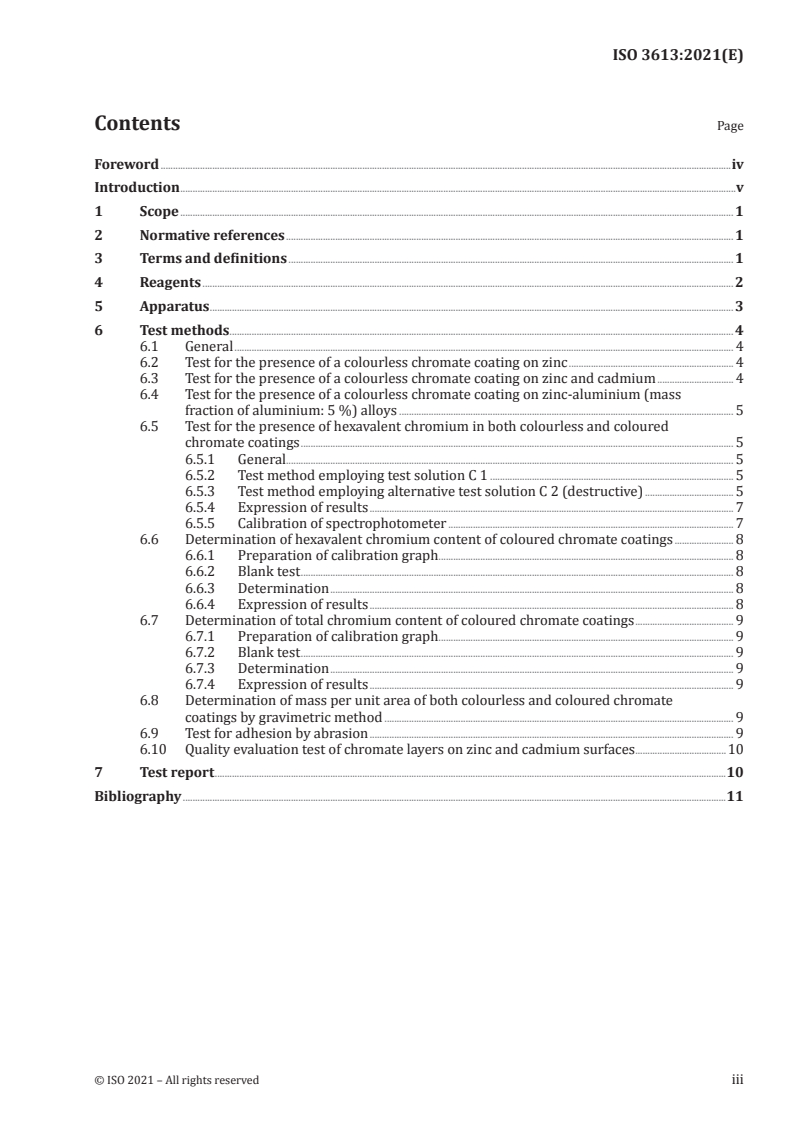
Contents Page
Foreword .iv
Introduction .v
1 Scope . 1
2 Normative references . 1
3 Terms and definitions . 1
4 Reagents . 2
5 Apparatus . 3
6 Test methods . 4
6.1 General . 4
6.2 Test for the presence of a colourless chromate coating on zinc . 4
6.3 Test for the presence of a colourless chromate coating on zinc and cadmium . 4
6.4 Test for the presence of a colourless chromate coating on zinc-aluminium (mass
fraction of aluminium: 5 %) alloys . 5
6.5 Test for the presence of hexavalent chromium in both colourless and coloured
chromate coatings . 5
6.5.1 General. 5
6.5.2 Test method employing test solution C 1 . 5
6.5.3 Test method employing alternative test solution C 2 (destructive) . 5
6.5.4 Expression of results . 7
6.5.5 Calibration of spectrophotometer . 7
6.6 Determination of hexavalent chromium content of coloured chromate coatings . 8
6.6.1 Preparation of calibration graph . 8
6.6.2 Blank test . 8
6.6.3 Determination . 8
6.6.4 Expression of results . 8
6.7 Determination of total chromium content of coloured chromate coatings . 9
6.7.1 Preparation of calibration graph . 9
6.7.2 Blank test . 9
6.7.3 Determination . 9
6.7.4 Expression of results . 9
6.8 Determination of mass per unit area of both colourless and coloured chromate
coatings by gravimetric method . 9
6.9 Test for adhesion by abrasion . 9
6.10 Quality evaluation test of chromate layers on zinc and cadmium surfaces .10
7 Test report .10
Bibliography .11
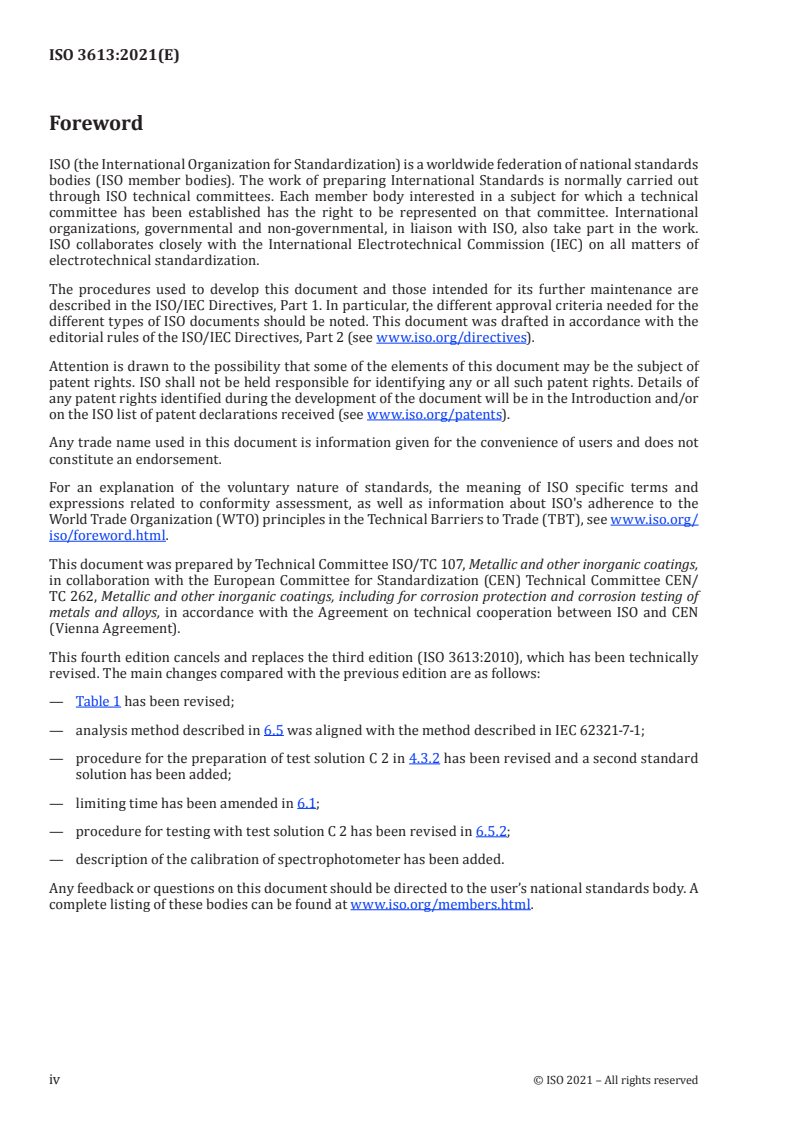
Foreword
ISO (the International Organization for Standardization) is a worldwide federation of national standards
bodies (ISO member bodies). The work of preparing International Standards is normally carried out
through ISO technical committees. Each member body interested in a subject for which a technical
committee has been established has the right to be represented on that committee. International
organizations, governmental and non-governmental, in liaison with ISO, also take part in the work.
ISO collaborates closely with the International Electrotechnical Commission (IEC) on all matters of
electrotechnical standardization.
The procedures used to develop this document and those intended for its further maintenance are
described in the ISO/IEC Directives, Part 1. In particular, the different approval criteria needed for the
different types of ISO documents should be noted. This document was drafted in accordance with the
editorial rules of the ISO/IEC Directives, Part 2 (see www .iso .org/ directives).
Attention is drawn to the possibility that some of the elements of this document may be the subject of
patent rights. ISO shall not be held responsible for identifying any or all such patent rights. Details of
any patent rights identified during the development of the document will be in the Introduction and/or
on the ISO list of patent declarations received (see www .iso .org/ patents).
Any trade name used in this document is information given for the convenience of users and does not
constitute an endorsement.
For an explanation of the voluntary nature of standards, the meaning of ISO specific terms and
expressions related to conformity assessment, as well as information about ISO's adherence to the
World Trade Organization (WTO) principles in the Technical Barriers to Trade (TBT), see www .iso .org/
iso/ foreword .html.
This document was prepared by Technical Committee ISO/TC 107, Metallic and other inorganic coatings,
in collaboration with the European Committee for Standardization (CEN) Technical Committee CEN/
TC 262, Metallic and other inorganic coatings, including for corrosion protection and corrosion testing of
metals and alloys, in accordance with the Agreement on technical cooperation between ISO and CEN
(Vienna Agreement).
This fourth edition cancels and replaces the third edition (ISO 3613:2010), which has been technically
revised. The main changes compared with the previous edition are as follows:
— Table 1 has been revised;
— analysis method described in 6.5 was aligned with the method described in IEC 62321-7-1;
— procedure for the preparation of test solution C 2 in 4.3.2 has been revised and a second standard
solution has been added;
— limiting time has been amended in 6.1;
— procedure for testing with test solution C 2 has been revised in 6.5.2;
— description of the calibration of spectrophotometer has been added.
Any feedback or questions on this document should be directed to the user’s national standards body. A
complete listing of these bodies can be found at www .iso .org/ members .html.
iv © ISO 2021 – All rights reserved
Introduction
This document specifies methods for the qualitative determination of the presence of chromate
conversion coatings as well as the total chromium content of chromate conversion coatings.
The application of very thin, colourless, practically invisible chromate conversion coatings is frequently
called “passivation”, while the application of thicker, coloured chromate conversion coatings is called
“chromating”. The term “passivation” is not correct, as it does not conform to the ISO 2080 designation,
and is therefore deprecated.
Chromate conversion coatings are based on a solution containing Cr(VI). Both the process solution and
the coating contain hexavalent chromium. The term passivation is nowadays often used for Cr(VI)-free
coatings replacing chromate conversion coatings. Products containing Cr(VI) are not allowed within
EU and processes using Cr(VI) are strictly regulated.
INTERNATIONAL STANDARD ISO 3613:2021(E)
Metallic and other inorganic coatings — Chromate
conversion coatings on zinc, cadmium, aluminium-zinc
alloys and zinc-aluminium alloys — Test methods
WARNING — This document calls for the use of substances and/or procedures that can be injurious
to health if adequate safety measures are not taken. This document does not address any health
hazards, safety or environmental matters associated with its use. It is the responsibility of the
user of this document to establish appropriate health, safety and environmentally acceptable
practices and take suitable actions for any national and international regulations.
1 Scope
This document specifies methods for the determination of
— the presence of colourless chromate conversion coatings,
— the presence of hexavalent chromium in colourless and coloured coatings on zinc or cadmium or
aluminium-zinc (mass fraction of aluminium: 55 %, within a range of 54 % to 56 % mass fraction)
and zinc-aluminium (mass fraction of aluminium: 5 %) alloys,
— the total chromium content per unit area on zinc and cadmium,
— the mass per unit area of both colourless and coloured coatings,
— the satisfactory adhesion of chromate conversion coatings, and
— the quality of chromate coatings.
These methods are applicable to
— colourless and coloured chromate conversion coatings containing trivalent and hexavalent
chromium in varying proportions and produced by either chemical or electrochemical processes,
and
— chromate coatings that are free from any supplementary coatings, such as oil, water or solvent-
based polymers or wax.
2 Normative references
The following documents are referred to in the text in such a way that some or all of their content
constitutes requirements of this document. For dated references, only the edition cited applies. For
undated references, the latest edition of the referenced document (including any amendments) applies.
ISO 3892, Conversion coatings on metallic materials — Determination of coating mass per unit area —
Gravimetric methods
ISO 4520, Chromate conversion coatings on electroplated zinc and cadmium coatings
IEC 60068-2-30, Environmental testing — Part 2-30: Tests — Test Db: Damp heat, cyclic (12 h + 12 h cycle)
3 Terms and definitions
No terms and definitions are listed in this document.
ISO and IEC maintain terminological databases for use in standardization at the following addresses:
— ISO Online browsing platform: available at https:// www .iso .org/ obp
— IEC Electropedia: available at http:// www .electropedia .org/
4 Reagents
Use only reagents of recognized analytical grade and distilled water or water of equivalent purity,
unless otherwise specified, for analysis.
4.1 Test solution A (see 6.2).
Dissolve 1 g of diphenylcarbazide in a mixture of 20 ml of acetone, 60 ml of glacial acetic acid and 40 ml
of distilled water contained in a beaker. Add 15 ml of concentrated hydrochloric acid (ρ = 1,18 g/cm ),
stir and add slowly 30 ml of sodium hypochlorite solution (10 % to 15 % available chlorine). Add 5 ml
of hydrogen peroxide (30 % volume fraction) slowly with continuous stirring. Leave the solution in the
open beaker for 24 h in a fume cupboard, to allow excess chlorine to escape, before use.
The solution does not deteriorate with age and can be kept in a bottle with a loosely fitted stopper.
However, there can be losses due to evaporation and the concentration can alter so it is discarded after
six months.
4.2 Test solution B (see 6.3).
Dissolve 50 g of lead acetate trihydrate [(CH COO) Pb⋅3H O] in 1 l of distilled water or water of
3 2 2
equivalent purity. Ensure that the pH of the solution is between 5,5 and 6,8 as prepared. If the pH of the
solution is outside this range, discard the solution and obtain a new supply of lead acetate.
Any white precipitate formed during the initial preparation of the solution may be dissolved by small
additions of glacial acetic acid, provided that the pH is not reduced to a value below 5,5. Discard the
stock solution if the white precipitate does not disappear.
4.3 Test solution C (see 6.5).
4.3.1 Test solution C 1.
Dissolve 0,4 g of diphenylcarbazide in a mixture of 20 ml of acetone and 20 ml of ethanol (96 %). After
dissolution, add 20 ml of 75 % orthophosphoric acid solution and 20 ml of distilled water. Prepare this
solution not more than 8 h prior to use.
4.3.2 Test solution C 2.
Add 700 ml of orthophosphoric acid, of specific gravity 1,7, to 250 ml of distilled water or water of
equivalent purity and make up to 1 000 ml.
Dissolve 0,5 g of 1,5-diphenylcarbazide of analytical reagent grade in 50 ml of acetone of analytical
reagent grade. Dilute slowly, while stirring, with 50 ml of distilled water or water of equivalent purity
(rapid mixing can result in precipitation of diphenylcarbazide). Keep the solution in a dark glass bottle in
the refrigerator. The solution shall be discarded after four weeks or earlier when the solution becomes
discoloured.
For the Cr(VI) stock solution, dissolve 0,113 g of K Cr O of analytical reagent grade (dried for 1 h at
2 2 7
100 °C before use) in distilled water or water of equivalent purity and make up to the mark in a 1 000 ml
volumetric flask. The solution shall be discarded after nine months.
From this stock solution, prepare two Cr(VI) standard solutions.
2 © ISO 2021 – All rights reserved
For 0,10 µg/ml Cr(VI): Measure 2,5 ml of this solution into a second 1 000 ml volumetric flask and make
up to the mark. 1 ml of this standard solution contains 0,10 µg of Cr(VI).
For 0,13 µg/ml Cr(VI): Measure 3,3 ml of this solution into a third 1 000 ml volumetric flask and make
up to the mark. 1 ml of this standard solution contains 0,13 µg of Cr(VI).
For the preparation of the comparison solution for 0,10 µg/cm Cr(VI), add 1 ml of orthophosphoric
acid and 1 ml of diphenylcarbazide solution to 50 ml of the standard Cr(VI) solution solution with
0,10 µg/ml Cr(VI) and mix thoroughly. Then add 2 ml of the diphenylcarbazide solution and mix. Allow
the solution to stand for 10 min for the colour reaction to be completed.
For the preparation of the comparison solution for 0,13 µg/cm Cr(VI), add 1 ml of orthophosphoric
acid to 50 ml of the standard Cr(VI) solution with 0,13 µg/ml Cr(VI) and mix thoroughly. Then add 2 ml
of the diphenylcarbazide solution and mix. Allow the solution to stand for 10 min for the colour reaction
to be completed.
4.4 Test solution D (see 6.6 and 6.7).
Dissolve 0,50 g of diphenylcarbazide in 50 ml of acetone. Dilute slowly, while stirring, with 50 ml of
water (rapid mixing can result in precipitation of diphenylcarbazide).
For maximum stability, store the solution under refrigeration in an amber-coloured glass bottle.
4.5 Sulfuric acid, diluted 1 + 3.
Slowly add one volume of concentrated sulfuric acid (ρ = 1,84 g/cm ) to three volumes of water.
4.6 Ammonium persulfate [(NH ) S O ].
4 2 2 8
4.7 Sodium hydroxide (NaOH), 240 g/l solution.
4.8 Silver nitrate (AgNO ), 17 g/l solution.
4.9 Potassium dichromate (K Cr O ), standard solution.
2 2 7
Dilute 2 ml of standard volumetric potassium dichromate solution (4,9 g/l) to 1 000 ml.
4.10 Phosphate buffer solution.
Dissolve 55 g of sodium dihydrogen orthophosphate monohydrate (NaH PO ·H O) in 100 ml of water.
2 4 2
5 Apparatus
Use normal laboratory apparatus and the following.
Glassware shall be of grade A. Pipettes shall be calibrated.
Clean all glassware thoroughly. It is recommended that cleaning be done by boiling the glassware with
nitric acid (HNO ) of 30 % mass fraction, and then rinsing thoroughly with distilled water or water of
equivalent purity. Adequate cleanliness should be demonstrated through the analysis of method blanks.
5.1 Photoelectric absorptiometer (colorimeter), with a filter having a mean transmission of 520 nm.
The absorptiometer shall be used with an absorption cell having an optical path length of 10 mm.
5.2 Spectrophotometer, with wavelength set at 540 nm. The spectrophotometer shall be used with
an absorption cell having an optical path length of 10 mm.
5.3 Analytical balance, with an accuracy of 0,10 mg.
6 Test methods
6.1 General
The test surface, prior to the following tests, shall be free of all contaminants, fingerprints and other
extraneous stains. If the surface is coated with a thin oil film, this shall be removed prior to the test
by degreasing using a suitable solvent at room temperature (not exceeding 35 °C). If it is necessary
to store samples, they shall be stored at temperatures not exceeding 40 °C and at a relative humidity
below 70 %. For test purposes, the samples shall not be subjected to forced drying at te
...
INTERNATIONAL ISO
STANDARD 3613
Fourth edition
2021-05
Metallic and other inorganic
coatings — Chromate conversion
coatings on zinc, cadmium,
aluminium-zinc alloys and zinc-
aluminium alloys — Test methods
Revêtements métalliques et autres revêtements inorganiques —
Couches de conversion au chromate sur zinc, cadmium et alliages
d'aluminium-zinc et de zinc-aluminium — Méthodes d'essai
Reference number
©
ISO 2021
© ISO 2021
All rights reserved. Unless otherwise specified, or required in the context of its implementation, no part of this publication may
be reproduced or utilized otherwise in any form or by any means, electronic or mechanical, including photocopying, or posting
on the internet or an intranet, without prior written permission. Permission can be requested from either ISO at the address
below or ISO’s member body in the country of the requester.
ISO copyright office
CP 401 • Ch. de Blandonnet 8
CH-1214 Vernier, Geneva
Phone: +41 22 749 01 11
Email: copyright@iso.org
Website: www.iso.org
Published in Switzerland
ii © ISO 2021 – All rights reserved
Contents Page
Foreword .iv
Introduction .v
1 Scope . 1
2 Normative references . 1
3 Terms and definitions . 1
4 Reagents . 2
5 Apparatus . 3
6 Test methods . 4
6.1 General . 4
6.2 Test for the presence of a colourless chromate coating on zinc . 4
6.3 Test for the presence of a colourless chromate coating on zinc and cadmium . 4
6.4 Test for the presence of a colourless chromate coating on zinc-aluminium (mass
fraction of aluminium: 5 %) alloys . 5
6.5 Test for the presence of hexavalent chromium in both colourless and coloured
chromate coatings . 5
6.5.1 General. 5
6.5.2 Test method employing test solution C 1 . 5
6.5.3 Test method employing alternative test solution C 2 (destructive) . 5
6.5.4 Expression of results . 7
6.5.5 Calibration of spectrophotometer . 7
6.6 Determination of hexavalent chromium content of coloured chromate coatings . 8
6.6.1 Preparation of calibration graph . 8
6.6.2 Blank test . 8
6.6.3 Determination . 8
6.6.4 Expression of results . 8
6.7 Determination of total chromium content of coloured chromate coatings . 9
6.7.1 Preparation of calibration graph . 9
6.7.2 Blank test . 9
6.7.3 Determination . 9
6.7.4 Expression of results . 9
6.8 Determination of mass per unit area of both colourless and coloured chromate
coatings by gravimetric method . 9
6.9 Test for adhesion by abrasion . 9
6.10 Quality evaluation test of chromate layers on zinc and cadmium surfaces .10
7 Test report .10
Bibliography .11
Foreword
ISO (the International Organization for Standardization) is a worldwide federation of national standards
bodies (ISO member bodies). The work of preparing International Standards is normally carried out
through ISO technical committees. Each member body interested in a subject for which a technical
committee has been established has the right to be represented on that committee. International
organizations, governmental and non-governmental, in liaison with ISO, also take part in the work.
ISO collaborates closely with the International Electrotechnical Commission (IEC) on all matters of
electrotechnical standardization.
The procedures used to develop this document and those intended for its further maintenance are
described in the ISO/IEC Directives, Part 1. In particular, the different approval criteria needed for the
different types of ISO documents should be noted. This document was drafted in accordance with the
editorial rules of the ISO/IEC Directives, Part 2 (see www .iso .org/ directives).
Attention is drawn to the possibility that some of the elements of this document may be the subject of
patent rights. ISO shall not be held responsible for identifying any or all such patent rights. Details of
any patent rights identified during the development of the document will be in the Introduction and/or
on the ISO list of patent declarations received (see www .iso .org/ patents).
Any trade name used in this document is information given for the convenience of users and does not
constitute an endorsement.
For an explanation of the voluntary nature of standards, the meaning of ISO specific terms and
expressions related to conformity assessment, as well as information about ISO's adherence to the
World Trade Organization (WTO) principles in the Technical Barriers to Trade (TBT), see www .iso .org/
iso/ foreword .html.
This document was prepared by Technical Committee ISO/TC 107, Metallic and other inorganic coatings,
in collaboration with the European Committee for Standardization (CEN) Technical Committee CEN/
TC 262, Metallic and other inorganic coatings, including for corrosion protection and corrosion testing of
metals and alloys, in accordance with the Agreement on technical cooperation between ISO and CEN
(Vienna Agreement).
This fourth edition cancels and replaces the third edition (ISO 3613:2010), which has been technically
revised. The main changes compared with the previous edition are as follows:
— Table 1 has been revised;
— analysis method described in 6.5 was aligned with the method described in IEC 62321-7-1;
— procedure for the preparation of test solution C 2 in 4.3.2 has been revised and a second standard
solution has been added;
— limiting time has been amended in 6.1;
— procedure for testing with test solution C 2 has been revised in 6.5.2;
— description of the calibration of spectrophotometer has been added.
Any feedback or questions on this document should be directed to the user’s national standards body. A
complete listing of these bodies can be found at www .iso .org/ members .html.
iv © ISO 2021 – All rights reserved
Introduction
This document specifies methods for the qualitative determination of the presence of chromate
conversion coatings as well as the total chromium content of chromate conversion coatings.
The application of very thin, colourless, practically invisible chromate conversion coatings is frequently
called “passivation”, while the application of thicker, coloured chromate conversion coatings is called
“chromating”. The term “passivation” is not correct, as it does not conform to the ISO 2080 designation,
and is therefore deprecated.
Chromate conversion coatings are based on a solution containing Cr(VI). Both the process solution and
the coating contain hexavalent chromium. The term passivation is nowadays often used for Cr(VI)-free
coatings replacing chromate conversion coatings. Products containing Cr(VI) are not allowed within
EU and processes using Cr(VI) are strictly regulated.
INTERNATIONAL STANDARD ISO 3613:2021(E)
Metallic and other inorganic coatings — Chromate
conversion coatings on zinc, cadmium, aluminium-zinc
alloys and zinc-aluminium alloys — Test methods
WARNING — This document calls for the use of substances and/or procedures that can be injurious
to health if adequate safety measures are not taken. This document does not address any health
hazards, safety or environmental matters associated with its use. It is the responsibility of the
user of this document to establish appropriate health, safety and environmentally acceptable
practices and take suitable actions for any national and international regulations.
1 Scope
This document specifies methods for the determination of
— the presence of colourless chromate conversion coatings,
— the presence of hexavalent chromium in colourless and coloured coatings on zinc or cadmium or
aluminium-zinc (mass fraction of aluminium: 55 %, within a range of 54 % to 56 % mass fraction)
and zinc-aluminium (mass fraction of aluminium: 5 %) alloys,
— the total chromium content per unit area on zinc and cadmium,
— the mass per unit area of both colourless and coloured coatings,
— the satisfactory adhesion of chromate conversion coatings, and
— the quality of chromate coatings.
These methods are applicable to
— colourless and coloured chromate conversion coatings containing trivalent and hexavalent
chromium in varying proportions and produced by either chemical or electrochemical processes,
and
— chromate coatings that are free from any supplementary coatings, such as oil, water or solvent-
based polymers or wax.
2 Normative references
The following documents are referred to in the text in such a way that some or all of their content
constitutes requirements of this document. For dated references, only the edition cited applies. For
undated references, the latest edition of the referenced document (including any amendments) applies.
ISO 3892, Conversion coatings on metallic materials — Determination of coating mass per unit area —
Gravimetric methods
ISO 4520, Chromate conversion coatings on electroplated zinc and cadmium coatings
IEC 60068-2-30, Environmental testing — Part 2-30: Tests — Test Db: Damp heat, cyclic (12 h + 12 h cycle)
3 Terms and definitions
No terms and definitions are listed in this document.
ISO and IEC maintain terminological databases for use in standardization at the following addresses:
— ISO Online browsing platform: available at https:// www .iso .org/ obp
— IEC Electropedia: available at http:// www .electropedia .org/
4 Reagents
Use only reagents of recognized analytical grade and distilled water or water of equivalent purity,
unless otherwise specified, for analysis.
4.1 Test solution A (see 6.2).
Dissolve 1 g of diphenylcarbazide in a mixture of 20 ml of acetone, 60 ml of glacial acetic acid and 40 ml
of distilled water contained in a beaker. Add 15 ml of concentrated hydrochloric acid (ρ = 1,18 g/cm ),
stir and add slowly 30 ml of sodium hypochlorite solution (10 % to 15 % available chlorine). Add 5 ml
of hydrogen peroxide (30 % volume fraction) slowly with continuous stirring. Leave the solution in the
open beaker for 24 h in a fume cupboard, to allow excess chlorine to escape, before use.
The solution does not deteriorate with age and can be kept in a bottle with a loosely fitted stopper.
However, there can be losses due to evaporation and the concentration can alter so it is discarded after
six months.
4.2 Test solution B (see 6.3).
Dissolve 50 g of lead acetate trihydrate [(CH COO) Pb⋅3H O] in 1 l of distilled water or water of
3 2 2
equivalent purity. Ensure that the pH of the solution is between 5,5 and 6,8 as prepared. If the pH of the
solution is outside this range, discard the solution and obtain a new supply of lead acetate.
Any white precipitate formed during the initial preparation of the solution may be dissolved by small
additions of glacial acetic acid, provided that the pH is not reduced to a value below 5,5. Discard the
stock solution if the white precipitate does not disappear.
4.3 Test solution C (see 6.5).
4.3.1 Test solution C 1.
Dissolve 0,4 g of diphenylcarbazide in a mixture of 20 ml of acetone and 20 ml of ethanol (96 %). After
dissolution, add 20 ml of 75 % orthophosphoric acid solution and 20 ml of distilled water. Prepare this
solution not more than 8 h prior to use.
4.3.2 Test solution C 2.
Add 700 ml of orthophosphoric acid, of specific gravity 1,7, to 250 ml of distilled water or water of
equivalent purity and make up to 1 000 ml.
Dissolve 0,5 g of 1,5-diphenylcarbazide of analytical reagent grade in 50 ml of acetone of analytical
reagent grade. Dilute slowly, while stirring, with 50 ml of distilled water or water of equivalent purity
(rapid mixing can result in precipitation of diphenylcarbazide). Keep the solution in a dark glass bottle in
the refrigerator. The solution shall be discarded after four weeks or earlier when the solution becomes
discoloured.
For the Cr(VI) stock solution, dissolve 0,113 g of K Cr O of analytical reagent grade (dried for 1 h at
2 2 7
100 °C before use) in distilled water or water of equivalent purity and make up to the mark in a 1 000 ml
volumetric flask. The solution shall be discarded after nine months.
From this stock solution, prepare two Cr(VI) standard solutions.
2 © ISO 2021 – All rights reserved
For 0,10 µg/ml Cr(VI): Measure 2,5 ml of this solution into a second 1 000 ml volumetric flask and make
up to the mark. 1 ml of this standard solution contains 0,10 µg of Cr(VI).
For 0,13 µg/ml Cr(VI): Measure 3,3 ml of this solution into a third 1 000 ml volumetric flask and make
up to the mark. 1 ml of this standard solution contains 0,13 µg of Cr(VI).
For the preparation of the comparison solution for 0,10 µg/cm Cr(VI), add 1 ml of orthophosphoric
acid and 1 ml of diphenylcarbazide solution to 50 ml of the standard Cr(VI) solution solution with
0,10 µg/ml Cr(VI) and mix thoroughly. Then add 2 ml of the diphenylcarbazide solution and mix. Allow
the solution to stand for 10 min for the colour reaction to be completed.
For the preparation of the comparison solution for 0,13 µg/cm Cr(VI), add 1 ml of orthophosphoric
acid to 50 ml of the standard Cr(VI) solution with 0,13 µg/ml Cr(VI) and mix thoroughly. Then add 2 ml
of the diphenylcarbazide solution and mix. Allow the solution to stand for 10 min for the colour reaction
to be completed.
4.4 Test solution D (see 6.6 and 6.7).
Dissolve 0,50 g of diphenylcarbazide in 50 ml of acetone. Dilute slowly, while stirring, with 50 ml of
water (rapid mixing can result in precipitation of diphenylcarbazide).
For maximum stability, store the solution under refrigeration in an amber-coloured glass bottle.
4.5 Sulfuric acid, diluted 1 + 3.
Slowly add one volume of concentrated sulfuric acid (ρ = 1,84 g/cm ) to three volumes of water.
4.6 Ammonium persulfate [(NH ) S O ].
4 2 2 8
4.7 Sodium hydroxide (NaOH), 240 g/l solution.
4.8 Silver nitrate (AgNO ), 17 g/l solution.
4.9 Potassium dichromate (K Cr O ), standard solution.
2 2 7
Dilute 2 ml of standard volumetric potassium dichromate solution (4,9 g/l) to 1 000 ml.
4.10 Phosphate buffer solution.
Dissolve 55 g of sodium dihydrogen orthophosphate monohydrate (NaH PO ·H O) in 100 ml of water.
2 4 2
5 Apparatus
Use normal laboratory apparatus and the following.
Glassware shall be of grade A. Pipettes shall be calibrated.
Clean all glassware thoroughly. It is recommended that cleaning be done by boiling the glassware with
nitric acid (HNO ) of 30 % mass fraction, and then rinsing thoroughly with distilled water or water of
equivalent purity. Adequate cleanliness should be demonstrated through the analysis of method blanks.
5.1 Photoelectric absorptiometer (colorimeter), with a filter having a mean transmission of 520 nm.
The absorptiometer shall be used with an absorption cell having an optical path length of 10 mm.
5.2 Spectrophotometer, with wavelength set at 540 nm. The spectrophotometer shall be used with
an absorption cell having an optical path length of 10 mm.
5.3 Analytical balance, with an accuracy of 0,10 mg.
6 Test methods
6.1 General
The test surface, prior to the following tests, shall be free of all contaminants, fingerprints and other
extraneous stains. If the surface is coated with a thin oil film, this shall be removed prior to the test
by degreasing using a suitable solvent at room temperature (not exceeding 35 °C). If it is necessary
to store samples, they shall be stored at temperatures not exceeding 40 °C and at a relative humidity
below 70 %. For test purposes, the samples shall not be subjected to forced drying at te
...
NORME ISO
INTERNATIONALE 3613
Quatrième édition
2021-05
Revêtements métalliques et autres
revêtements inorganiques — Couches
de conversion au chromate sur zinc,
cadmium et alliages d'aluminium-zinc
et de zinc-aluminium — Méthodes
d'essai
Metallic and other inorganic coatings — Chromate conversion
coatings on zinc, cadmium, aluminium-zinc alloys and zinc-
aluminium alloys — Test methods
Numéro de référence
©
ISO 2021
DOCUMENT PROTÉGÉ PAR COPYRIGHT
© ISO 2021
Tous droits réservés. Sauf prescription différente ou nécessité dans le contexte de sa mise en œuvre, aucune partie de cette
publication ne peut être reproduite ni utilisée sous quelque forme que ce soit et par aucun procédé, électronique ou mécanique,
y compris la photocopie, ou la diffusion sur l’internet ou sur un intranet, sans autorisation écrite préalable. Une autorisation peut
être demandée à l’ISO à l’adresse ci-après ou au comité membre de l’ISO dans le pays du demandeur.
ISO copyright office
Case postale 401 • Ch. de Blandonnet 8
CH-1214 Vernier, Genève
Tél.: +41 22 749 01 11
E-mail: copyright@iso.org
Web: www.iso.org
Publié en Suisse
ii © ISO 2021 – Tous droits réservés
Sommaire Page
Avant-propos .iv
Introduction .v
1 Domaine d’application . 1
2 Références normatives . 1
3 Termes et définitions . 2
4 Réactifs . 2
5 Appareillage . 3
6 Méthodes d’essai . 4
6.1 Généralités . 4
6.2 Essai de détection d’une couche de chromate incolore sur zinc . 5
6.3 Essai de détection d’une couche de chromate incolore sur zinc et cadmium . 5
6.4 Essai de détection d’une couche de chromate incolore sur des alliages de zinc-
aluminium (fraction massique d’aluminium de 5 %). 5
6.5 Essai de détection de chrome hexavalent dans les couches de chromate incolores
et colorées . 6
6.5.1 Généralités . 6
6.5.2 Méthode d’essai utilisant la solution d’essai C 1 . 6
6.5.3 Méthode d’essai utilisant l’autre solution d’essai C 2 (essai destructif) . 6
6.5.4 Expression des résultats . 7
6.5.5 Étalonnage du spectrophotomètre . 7
6.6 Détermination de la teneur en chrome hexavalent des couches de chromate colorées. 8
6.6.1 Préparation de la courbe d’étalonnage. 8
6.6.2 Essai à blanc . 8
6.6.3 Détermination . 8
6.6.4 Expression des résultats . 9
6.7 Détermination de la teneur totale en chrome des couches de chromate colorées . 9
6.7.1 Préparation de la courbe d’étalonnage. 9
6.7.2 Essai à blanc . 9
6.7.3 Détermination . 9
6.7.4 Expression des résultats .10
6.8 Détermination de la masse par unité de surface des couches de chromate, colorées
et incolores, par gravimétrie .10
6.9 Essai d’adhérence par abrasion .10
6.10 Essai d’évaluation qualitative des couches de chromate sur zinc et cadmium .10
7 Rapport d’essai .10
Bibliographie .11
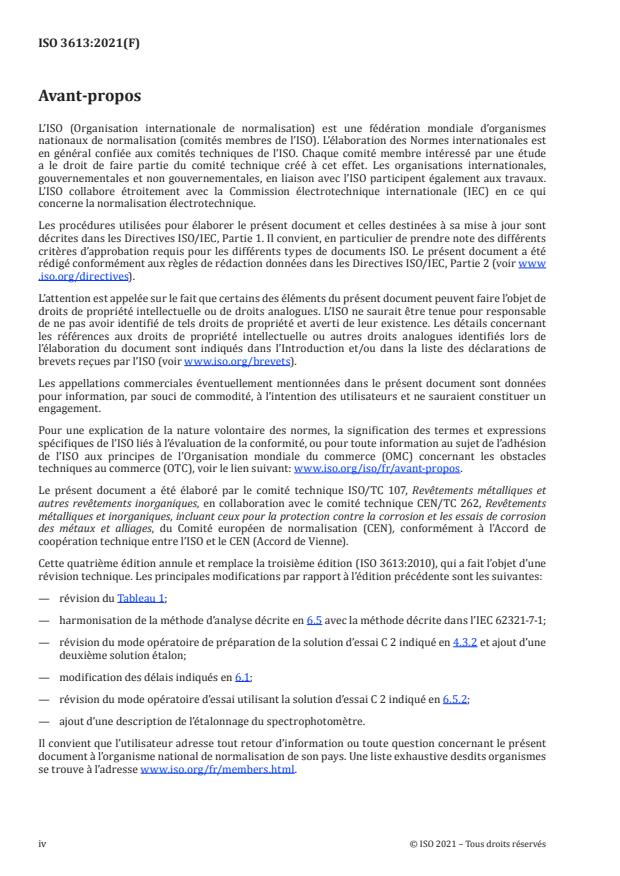
Avant-propos
L’ISO (Organisation internationale de normalisation) est une fédération mondiale d’organismes
nationaux de normalisation (comités membres de l’ISO). L’élaboration des Normes internationales est
en général confiée aux comités techniques de l’ISO. Chaque comité membre intéressé par une étude
a le droit de faire partie du comité technique créé à cet effet. Les organisations internationales,
gouvernementales et non gouvernementales, en liaison avec l’ISO participent également aux travaux.
L’ISO collabore étroitement avec la Commission électrotechnique internationale (IEC) en ce qui
concerne la normalisation électrotechnique.
Les procédures utilisées pour élaborer le présent document et celles destinées à sa mise à jour sont
décrites dans les Directives ISO/IEC, Partie 1. Il convient, en particulier de prendre note des différents
critères d’approbation requis pour les différents types de documents ISO. Le présent document a été
rédigé conformément aux règles de rédaction données dans les Directives ISO/IEC, Partie 2 (voir www
.iso .org/ directives).
L’attention est appelée sur le fait que certains des éléments du présent document peuvent faire l’objet de
droits de propriété intellectuelle ou de droits analogues. L’ISO ne saurait être tenue pour responsable
de ne pas avoir identifié de tels droits de propriété et averti de leur existence. Les détails concernant
les références aux droits de propriété intellectuelle ou autres droits analogues identifiés lors de
l’élaboration du document sont indiqués dans l’Introduction et/ou dans la liste des déclarations de
brevets reçues par l’ISO (voir www .iso .org/ brevets).
Les appellations commerciales éventuellement mentionnées dans le présent document sont données
pour information, par souci de commodité, à l’intention des utilisateurs et ne sauraient constituer un
engagement.
Pour une explication de la nature volontaire des normes, la signification des termes et expressions
spécifiques de l’ISO liés à l’évaluation de la conformité, ou pour toute information au sujet de l’adhésion
de l’ISO aux principes de l’Organisation mondiale du commerce (OMC) concernant les obstacles
techniques au commerce (OTC), voir le lien suivant: www .iso .org/ iso/ fr/ avant -propos.
Le présent document a été élaboré par le comité technique ISO/TC 107, Revêtements métalliques et
autres revêtements inorganiques, en collaboration avec le comité technique CEN/TC 262, Revêtements
métalliques et inorganiques, incluant ceux pour la protection contre la corrosion et les essais de corrosion
des métaux et alliages, du Comité européen de normalisation (CEN), conformément à l’Accord de
coopération technique entre l’ISO et le CEN (Accord de Vienne).
Cette quatrième édition annule et remplace la troisième édition (ISO 3613:2010), qui a fait l’objet d’une
révision technique. Les principales modifications par rapport à l’édition précédente sont les suivantes:
— révision du Tableau 1;
— harmonisation de la méthode d’analyse décrite en 6.5 avec la méthode décrite dans l’IEC 62321-7-1;
— révision du mode opératoire de préparation de la solution d’essai C 2 indiqué en 4.3.2 et ajout d’une
deuxième solution étalon;
— modification des délais indiqués en 6.1;
— révision du mode opératoire d’essai utilisant la solution d’essai C 2 indiqué en 6.5.2;
— ajout d’une description de l’étalonnage du spectrophotomètre.
Il convient que l’utilisateur adresse tout retour d’information ou toute question concernant le présent
document à l’organisme national de normalisation de son pays. Une liste exhaustive desdits organismes
se trouve à l’adresse www .iso .org/ fr/ members .html.
iv © ISO 2021 – Tous droits réservés
Introduction
Le présent document spécifie des méthodes permettant de déterminer la présence, d’un point de vue
qualitatif, de couches de conversion au chromate ainsi que leur teneur totale en chrome.
L’application de couches de conversion au chromate très minces, incolores, pratiquement invisibles, est
fréquemment appelée «passivation», tandis que l’application de couches de conversion au chromate
plus épaisses, colorées, est souvent appelée «chromatation». Le terme «passivation» est incorrect, car
non conforme à la désignation de l’ISO 2080, son emploi est donc déconseillé.
Les couches de conversion au chromate sont obtenues à partir d’une solution contenant du Cr(VI). Tant
la solution de traitement que le revêtement contiennent du chrome hexavalent. Désormais, le terme
«passivation» est fréquemment utilisé pour désigner les revêtements exempts de Cr(VI) qui remplacent
les couches de conversion au chromate. Les produits contenant du Cr(VI) ne sont pas autorisés au sein
de l’UE et les procédés impliquant cette substance sont rigoureusement réglementés.
NORME INTERNATIONALE ISO 3613:2021(F)
Revêtements métalliques et autres revêtements
inorganiques — Couches de conversion au chromate sur
zinc, cadmium et alliages d'aluminium-zinc et de zinc-
aluminium — Méthodes d'essai
AVERTISSEMENT — Le présent document nécessite l’utilisation de substances et/ou de modes
opératoires pouvant s’avérer préjudiciables à la santé si des mesures de sécurité adéquates ne
sont pas prises. Le présent document ne traite ni des dangers pour la santé ni des questions
de sécurité ou d’environnement associées à son utilisation. Il incombe à l’utilisateur du présent
document d’établir des pratiques appropriées acceptables en matière de santé, de sécurité et
d’environnement et de prendre des mesures adéquates pour satisfaire aux réglementations
nationales et internationales.
1 Domaine d’application
Le présent document spécifie des méthodes permettant de déterminer:
— la présence de couches de conversion au chromate incolores;
— la présence de chrome hexavalent dans les couches incolores ou colorées sur zinc, cadmium ou
alliages d’aluminium-zinc (fraction massique d’aluminium de 55 %, dans une plage de 54 % à 56 %)
et de zinc-aluminium (fraction massique d’aluminium de 5 %);
— la teneur totale en chrome par unité de surface sur zinc et cadmium;
— la masse par unité de surface des couches incolores et colorées;
— le degré d’adhérence des couches de conversion au chromate;
— la qualité des couches de chromate.
Ces méthodes s’appliquent:
— aux couches de conversion au chromate incolores et colorées contenant du chrome trivalent et
hexavalent en diverses proportions et produites par un procédé chimique ou électrochimique;
— aux couches de chromate exemptes de tout revêtement supplémentaire tel que huile, polymère à
base d’eau ou de solvant, ou cire.
2 Références normatives
Les documents suivants sont cités dans le texte de sorte qu’ils constituent, pour tout ou partie de leur
contenu, des exigences du présent document. Pour les références datées, seule l’édition citée s’applique.
Pour les références non datées, la dernière édition du document de référence s’applique (y compris les
éventuels amendements).
ISO 3892, Couches de conversion sur matériaux métalliques — Détermination de la masse de revêtement
par unité de surface — Méthodes gravimétriques
ISO 4520, Couches de conversion au chromate sur les dépôts électrolytiques de zinc et de cadmium
IEC 60068-2-30, Essais d’environnement — Partie 2-30: Essais — Essai Db: Essai cyclique de chaleur humide
(cycle de 12 h + 12 h)
3 Termes et définitions
Aucun terme n’est défini dans le présent document.
L’ISO et l’IEC tiennent à jour des bases de données terminologiques destinées à être utilisées en
normalisation, consultables aux adresses suivantes:
— ISO Online browsing platform: disponible à l’adresse https:// www .iso .org/ obp
— IEC Electropedia: disponible à l’adresse http:// www .electropedia .org/
4 Réactifs
Sauf indication contraire, utiliser uniquement des réactifs de qualité analytique reconnue et de l’eau
distillée, ou de l’eau de pureté équivalente, pour l’analyse.
4.1 Solution d’essai A (voir 6.2).
Dissoudre 1 g de diphénylcarbazide dans un bécher contenant un mélange de 20 ml d’acétone, 60 ml
d’acide acétique glacial et 40 ml d’eau distillée. Ajouter 15 ml d’acide chlorhydrique concentré (ρ = 1,18 g/
cm ), agiter et ajouter lentement 30 ml d’une solution d’hypochlorite de sodium (10 % à 15 % de chlore
disponible). Ajouter lentement 5 ml de peroxyde d’hydrogène (30 % en volume) en continuant à remuer.
Avant d’utiliser la solution, la laisser reposer pendant 24 h dans le bécher ouvert sous hotte fermée afin
de laisser s’échapper les vapeurs de chlore.
La solution ne se détériore pas avec le temps et peut être conservée dans un flacon muni d’un bouchon
qui n’est pas nécessairement fermé hermétiquement. Cependant, des pertes par évaporation pouvant se
produire et la concentration pouvant changer, la solution ne se conserve pas plus de six mois.
4.2 Solution d’essai B (voir 6.3).
Dissoudre 50 g d’acétate de plomb trihydraté [(CH COO) Pb⋅3H O] dans 1 l d’eau distillée ou eau de
3 2 2
pureté équivalente. Veiller à ce que le pH de la solution ainsi préparée soit compris entre 5,5 et 6,8. Si
le pH de la solution est hors des limites fixées, mettre la solution au rebut et se procurer une nouvelle
quantité d’acétate de plomb.
Le précipité blanc éventuellement formé au cours de la préparation initiale de la solution peut être
dissous à l’aide de quelques gouttes d’acide acétique glacial, sous réserve que le pH ne descende pas en
dessous de 5,5. Mettre la solution mère au rebut si le précipité blanc ne disparaît pas.
4.3 Solution d’essai C (voir 6.5).
4.3.1 Solution d’essai C 1.
Dissoudre 0,4 g de diphénylcarbazide dans un mélange de 20 ml d’acétone et de 20 ml d’éthanol (96 %).
Après dissolution, ajouter 20 ml d’une solution d’acide orthophosphorique à 75 % et 20 ml d’eau distillée.
Préparer cette solution moins de 8 h avant l’emploi.
4.3.2 Solution d’essai C 2.
Ajouter 700 ml d’acide orthophosphorique (masse volumique de 1,7) à 250 ml d’eau distillée ou eau de
pureté équivalente et compléter à 1 000 ml.
Dissoudre 0,5 g de 1,5-diphénylcarbazide de qualité analytique dans 50 ml d’acétone, également
de qualité analytique. Tout en agitant, diluer lentement avec 50 ml d’eau distillée ou eau de pureté
équivalente (un mélange rapide peut entraîner la précipitation de la diphénylcarbazide). Conserver la
solution dans un flacon en verre sombre au réfrigérateur. La solution doit être mise au rebut au bout de
quatre semaines, ou avant si elle perd sa coloration.
2 © ISO 2021 – Tous droits réservés
Pour la solution mère de chrome hexavalent, Cr(VI): dans une fiole jaugée de 1 000 ml, dissoudre 0,113 g
de K Cr O , réactif de qualité analytique (séché pendant 1 h à 100 °C avant utilisation), dans de l’eau
2 2 7
distillée ou eau de pureté équivalente; compléter au trait de jauge. La solution doit être mise au rebut au
bout de neuf mois.
Utiliser cette solution mère pour préparer deux solutions étalons de chrome hexavalent.
Pour une teneur en chrome hexavalent de 0,10 µg/ml: transférer 2,5 ml de cette solution dans
une deuxième fiole jaugée de 1 000 ml et compléter au trait de jauge. 1 ml de cette solution étalon
contient 0,10 µg de Cr(VI).
Pour une teneur en chrome hexavalent de 0,13 µg/ml: transférer 3,3 ml de cette solution dans
une troisième fiole jaugée de 1 000 ml et compléter au trait de jauge. 1 ml de cette solution étalon
contient 0,13 µg de Cr(VI).
Préparation de la solution de comparaison correspondant à une teneur en chrome hexavalent, Cr(VI),
de 0,10 µg/cm : ajouter 1 ml d’acide orthophosphorique et 1 ml de solution de diphénylcarbazide à 50 ml
de la solution étalon de Cr(VI) à 0,10 µg/ml; mélanger vigoureusement. Ajouter ensuite 2 ml de solution
de diphénylcarbazide et mélanger. Laisser reposer la solution pendant 10 min pour laisser s’achever la
réaction colorée.
Préparation de la solution de comparaison correspondant à une teneur en chrome hexavalent, Cr(VI),
de 0,13 µg/cm : ajouter 1 ml d’acide orthophosphorique à 50 ml de la solution étalon de Cr(VI) à 0,13 µg/
ml; mélanger vigoureusement. Ajouter ensuite 2 ml de solution de diphénylcarbazide et mélanger.
Laisser reposer la solution pendant 10 min pour laisser s’achever la réaction colorée.
4.4 Solution d’essai D (voir 6.6 et 6.7).
Dissoudre 0,50 g de diphénylcarbazide dans 50 ml d’acétone. Tout en agitant, diluer lentement
avec 50 ml d’eau (un mélange rapide peut entraîner la précipitation de la diphénylcarbazide).
Pour une stabilité maximale, conserver la solution au réfrigérateur dans un flacon en verre coloré brun.
4.5 Acide sulfurique, dilué à 1:3.
Ajouter lentement un volume d’acide sulfurique concentré (ρ = 1,84 g/cm ) à trois volumes d’eau.
4.6 Persulfate d’ammonium [(NH ) S O ].
4 2 2 8
4.7 Hydroxyde de sodium (NaOH), solution à 240 g/l.
4.8 Nitrate d’argent (AgNO ), solution à 17 g/l.
4.9 Dichromate de potassium (K Cr O ), solution étalon.
2 2 7
Diluer 2 ml de solution titrée de dichromate de potassium (4,9 g/l) à 1 000 ml.
4.10 Solution tampon de phosphate.
Dissoudre 55 g de dihydrogéno-orthophosphate de sodium monohydraté (NaH PO ·H O) dans 100 ml
2 4 2
d’eau.
5 Appareillage
Utiliser du matériel courant de laboratoire ainsi que ce qui suit.
La verrerie doit être de classe A. Les pipettes doivent être étalonnées.
Nettoyer soigneusement toute la verrerie. Il est recommandé de nettoyer la verrerie en la faisant
bouillir dans une solution de fraction massique en acide nitrique (HNO ) de 30 %, et en la rinçant
ensuite abondamment avec de l’eau distillée ou eau de pureté équivalente. Il convient de démontrer que
son degré de propreté est satisfaisant par l’analyse de blancs de méthode.
5.1 Absorptiomètre photoélectrique (colorimètre), muni d’un filtre ayant une transmission
moyenne de 520 nm. L’absorptiomètre doit être utilisé avec une cuve d’absorption de 10 mm de trajet
optique.
5.2 Spectrophotomètre, réglé sur une longueur d’onde de 540 nm. Le spectrophotomètre doit être
utilisé avec une cuve d’absorption de 10 mm de trajet optique.
5.3 Balance analytique, pouvant peser à 0,10 mg près.
6 Méthodes d’essai
6.1 Généralités
Avant d’effectuer les essais suivants, la surface d’essai doit être débarrassée de tout contaminant,
empreintes digitales ou autres taches indésirables. Si la surface est recouverte d’une fine pellicule
huileuse, elle doit être dégraissée, avant de procéder à l’essai, à l’aide d’un solvant approprié à
température ambiante (ne dépassant pas 35 °C). Si nécessaire, les échantillons doivent être stockés à
des températures ne dépassant pas 40 °C et une humidité relative inférieure à 70 %. Pour les besoins
des essais, les échantillons ne doivent pas être soumis à un séchage forcé à des températures dépassant
35 °C. Aucun traitement à base de solutions alcalines ne doit être effectué, les couches de conversion
au chromate se décomposant au contact des substances alcalines. Les essais à la goutte ne sont pas
toujours des moyens précis pour déterminer la présence de couches de chromate.
Les méthodes d’essai pour les éléments suivants sont données de 6.2 à 6.7:
a) détection d’une couche de chromate incolore sur zinc, cadmium et alliages aluminium-zinc;
b) détection de chrome hexavalent dans les couches de chromate colorées et incolores;
c) détermination de la teneur en chrome hexavalent;
d) détermination de la teneur totale en chrome.
Les méthodes d’essai pour les éléments suivants sont données respectivement en 6.8, 6.9 et 6.10:
e) détermination de la masse par unité de surface des couches de conversion au chromate;
f) adhérence par abrasion;
g) évaluation de la qualité de la couche au chromate.
Les essais
...
NORME ISO
INTERNATIONALE 3613
Quatrième édition
2021-05
Revêtements métalliques et autres
revêtements inorganiques — Couches
de conversion au chromate sur zinc,
cadmium et alliages d'aluminium-zinc
et de zinc-aluminium — Méthodes
d'essai
Metallic and other inorganic coatings — Chromate conversion
coatings on zinc, cadmium, aluminium-zinc alloys and zinc-
aluminium alloys — Test methods
Numéro de référence
©
ISO 2021
DOCUMENT PROTÉGÉ PAR COPYRIGHT
© ISO 2021
Tous droits réservés. Sauf prescription différente ou nécessité dans le contexte de sa mise en œuvre, aucune partie de cette
publication ne peut être reproduite ni utilisée sous quelque forme que ce soit et par aucun procédé, électronique ou mécanique,
y compris la photocopie, ou la diffusion sur l’internet ou sur un intranet, sans autorisation écrite préalable. Une autorisation peut
être demandée à l’ISO à l’adresse ci-après ou au comité membre de l’ISO dans le pays du demandeur.
ISO copyright office
Case postale 401 • Ch. de Blandonnet 8
CH-1214 Vernier, Genève
Tél.: +41 22 749 01 11
E-mail: copyright@iso.org
Web: www.iso.org
Publié en Suisse
ii © ISO 2021 – Tous droits réservés
Sommaire Page
Avant-propos .iv
Introduction .v
1 Domaine d’application . 1
2 Références normatives . 1
3 Termes et définitions . 2
4 Réactifs . 2
5 Appareillage . 3
6 Méthodes d’essai . 4
6.1 Généralités . 4
6.2 Essai de détection d’une couche de chromate incolore sur zinc . 5
6.3 Essai de détection d’une couche de chromate incolore sur zinc et cadmium . 5
6.4 Essai de détection d’une couche de chromate incolore sur des alliages de zinc-
aluminium (fraction massique d’aluminium de 5 %). 5
6.5 Essai de détection de chrome hexavalent dans les couches de chromate incolores
et colorées . 6
6.5.1 Généralités . 6
6.5.2 Méthode d’essai utilisant la solution d’essai C 1 . 6
6.5.3 Méthode d’essai utilisant l’autre solution d’essai C 2 (essai destructif) . 6
6.5.4 Expression des résultats . 7
6.5.5 Étalonnage du spectrophotomètre . 7
6.6 Détermination de la teneur en chrome hexavalent des couches de chromate colorées. 8
6.6.1 Préparation de la courbe d’étalonnage. 8
6.6.2 Essai à blanc . 8
6.6.3 Détermination . 8
6.6.4 Expression des résultats . 9
6.7 Détermination de la teneur totale en chrome des couches de chromate colorées . 9
6.7.1 Préparation de la courbe d’étalonnage. 9
6.7.2 Essai à blanc . 9
6.7.3 Détermination . 9
6.7.4 Expression des résultats .10
6.8 Détermination de la masse par unité de surface des couches de chromate, colorées
et incolores, par gravimétrie .10
6.9 Essai d’adhérence par abrasion .10
6.10 Essai d’évaluation qualitative des couches de chromate sur zinc et cadmium .10
7 Rapport d’essai .10
Bibliographie .11
Avant-propos
L’ISO (Organisation internationale de normalisation) est une fédération mondiale d’organismes
nationaux de normalisation (comités membres de l’ISO). L’élaboration des Normes internationales est
en général confiée aux comités techniques de l’ISO. Chaque comité membre intéressé par une étude
a le droit de faire partie du comité technique créé à cet effet. Les organisations internationales,
gouvernementales et non gouvernementales, en liaison avec l’ISO participent également aux travaux.
L’ISO collabore étroitement avec la Commission électrotechnique internationale (IEC) en ce qui
concerne la normalisation électrotechnique.
Les procédures utilisées pour élaborer le présent document et celles destinées à sa mise à jour sont
décrites dans les Directives ISO/IEC, Partie 1. Il convient, en particulier de prendre note des différents
critères d’approbation requis pour les différents types de documents ISO. Le présent document a été
rédigé conformément aux règles de rédaction données dans les Directives ISO/IEC, Partie 2 (voir www
.iso .org/ directives).
L’attention est appelée sur le fait que certains des éléments du présent document peuvent faire l’objet de
droits de propriété intellectuelle ou de droits analogues. L’ISO ne saurait être tenue pour responsable
de ne pas avoir identifié de tels droits de propriété et averti de leur existence. Les détails concernant
les références aux droits de propriété intellectuelle ou autres droits analogues identifiés lors de
l’élaboration du document sont indiqués dans l’Introduction et/ou dans la liste des déclarations de
brevets reçues par l’ISO (voir www .iso .org/ brevets).
Les appellations commerciales éventuellement mentionnées dans le présent document sont données
pour information, par souci de commodité, à l’intention des utilisateurs et ne sauraient constituer un
engagement.
Pour une explication de la nature volontaire des normes, la signification des termes et expressions
spécifiques de l’ISO liés à l’évaluation de la conformité, ou pour toute information au sujet de l’adhésion
de l’ISO aux principes de l’Organisation mondiale du commerce (OMC) concernant les obstacles
techniques au commerce (OTC), voir le lien suivant: www .iso .org/ iso/ fr/ avant -propos.
Le présent document a été élaboré par le comité technique ISO/TC 107, Revêtements métalliques et
autres revêtements inorganiques, en collaboration avec le comité technique CEN/TC 262, Revêtements
métalliques et inorganiques, incluant ceux pour la protection contre la corrosion et les essais de corrosion
des métaux et alliages, du Comité européen de normalisation (CEN), conformément à l’Accord de
coopération technique entre l’ISO et le CEN (Accord de Vienne).
Cette quatrième édition annule et remplace la troisième édition (ISO 3613:2010), qui a fait l’objet d’une
révision technique. Les principales modifications par rapport à l’édition précédente sont les suivantes:
— révision du Tableau 1;
— harmonisation de la méthode d’analyse décrite en 6.5 avec la méthode décrite dans l’IEC 62321-7-1;
— révision du mode opératoire de préparation de la solution d’essai C 2 indiqué en 4.3.2 et ajout d’une
deuxième solution étalon;
— modification des délais indiqués en 6.1;
— révision du mode opératoire d’essai utilisant la solution d’essai C 2 indiqué en 6.5.2;
— ajout d’une description de l’étalonnage du spectrophotomètre.
Il convient que l’utilisateur adresse tout retour d’information ou toute question concernant le présent
document à l’organisme national de normalisation de son pays. Une liste exhaustive desdits organismes
se trouve à l’adresse www .iso .org/ fr/ members .html.
iv © ISO 2021 – Tous droits réservés
Introduction
Le présent document spécifie des méthodes permettant de déterminer la présence, d’un point de vue
qualitatif, de couches de conversion au chromate ainsi que leur teneur totale en chrome.
L’application de couches de conversion au chromate très minces, incolores, pratiquement invisibles, est
fréquemment appelée «passivation», tandis que l’application de couches de conversion au chromate
plus épaisses, colorées, est souvent appelée «chromatation». Le terme «passivation» est incorrect, car
non conforme à la désignation de l’ISO 2080, son emploi est donc déconseillé.
Les couches de conversion au chromate sont obtenues à partir d’une solution contenant du Cr(VI). Tant
la solution de traitement que le revêtement contiennent du chrome hexavalent. Désormais, le terme
«passivation» est fréquemment utilisé pour désigner les revêtements exempts de Cr(VI) qui remplacent
les couches de conversion au chromate. Les produits contenant du Cr(VI) ne sont pas autorisés au sein
de l’UE et les procédés impliquant cette substance sont rigoureusement réglementés.
NORME INTERNATIONALE ISO 3613:2021(F)
Revêtements métalliques et autres revêtements
inorganiques — Couches de conversion au chromate sur
zinc, cadmium et alliages d'aluminium-zinc et de zinc-
aluminium — Méthodes d'essai
AVERTISSEMENT — Le présent document nécessite l’utilisation de substances et/ou de modes
opératoires pouvant s’avérer préjudiciables à la santé si des mesures de sécurité adéquates ne
sont pas prises. Le présent document ne traite ni des dangers pour la santé ni des questions
de sécurité ou d’environnement associées à son utilisation. Il incombe à l’utilisateur du présent
document d’établir des pratiques appropriées acceptables en matière de santé, de sécurité et
d’environnement et de prendre des mesures adéquates pour satisfaire aux réglementations
nationales et internationales.
1 Domaine d’application
Le présent document spécifie des méthodes permettant de déterminer:
— la présence de couches de conversion au chromate incolores;
— la présence de chrome hexavalent dans les couches incolores ou colorées sur zinc, cadmium ou
alliages d’aluminium-zinc (fraction massique d’aluminium de 55 %, dans une plage de 54 % à 56 %)
et de zinc-aluminium (fraction massique d’aluminium de 5 %);
— la teneur totale en chrome par unité de surface sur zinc et cadmium;
— la masse par unité de surface des couches incolores et colorées;
— le degré d’adhérence des couches de conversion au chromate;
— la qualité des couches de chromate.
Ces méthodes s’appliquent:
— aux couches de conversion au chromate incolores et colorées contenant du chrome trivalent et
hexavalent en diverses proportions et produites par un procédé chimique ou électrochimique;
— aux couches de chromate exemptes de tout revêtement supplémentaire tel que huile, polymère à
base d’eau ou de solvant, ou cire.
2 Références normatives
Les documents suivants sont cités dans le texte de sorte qu’ils constituent, pour tout ou partie de leur
contenu, des exigences du présent document. Pour les références datées, seule l’édition citée s’applique.
Pour les références non datées, la dernière édition du document de référence s’applique (y compris les
éventuels amendements).
ISO 3892, Couches de conversion sur matériaux métalliques — Détermination de la masse de revêtement
par unité de surface — Méthodes gravimétriques
ISO 4520, Couches de conversion au chromate sur les dépôts électrolytiques de zinc et de cadmium
IEC 60068-2-30, Essais d’environnement — Partie 2-30: Essais — Essai Db: Essai cyclique de chaleur humide
(cycle de 12 h + 12 h)
3 Termes et définitions
Aucun terme n’est défini dans le présent document.
L’ISO et l’IEC tiennent à jour des bases de données terminologiques destinées à être utilisées en
normalisation, consultables aux adresses suivantes:
— ISO Online browsing platform: disponible à l’adresse https:// www .iso .org/ obp
— IEC Electropedia: disponible à l’adresse http:// www .electropedia .org/
4 Réactifs
Sauf indication contraire, utiliser uniquement des réactifs de qualité analytique reconnue et de l’eau
distillée, ou de l’eau de pureté équivalente, pour l’analyse.
4.1 Solution d’essai A (voir 6.2).
Dissoudre 1 g de diphénylcarbazide dans un bécher contenant un mélange de 20 ml d’acétone, 60 ml
d’acide acétique glacial et 40 ml d’eau distillée. Ajouter 15 ml d’acide chlorhydrique concentré (ρ = 1,18 g/
cm ), agiter et ajouter lentement 30 ml d’une solution d’hypochlorite de sodium (10 % à 15 % de chlore
disponible). Ajouter lentement 5 ml de peroxyde d’hydrogène (30 % en volume) en continuant à remuer.
Avant d’utiliser la solution, la laisser reposer pendant 24 h dans le bécher ouvert sous hotte fermée afin
de laisser s’échapper les vapeurs de chlore.
La solution ne se détériore pas avec le temps et peut être conservée dans un flacon muni d’un bouchon
qui n’est pas nécessairement fermé hermétiquement. Cependant, des pertes par évaporation pouvant se
produire et la concentration pouvant changer, la solution ne se conserve pas plus de six mois.
4.2 Solution d’essai B (voir 6.3).
Dissoudre 50 g d’acétate de plomb trihydraté [(CH COO) Pb⋅3H O] dans 1 l d’eau distillée ou eau de
3 2 2
pureté équivalente. Veiller à ce que le pH de la solution ainsi préparée soit compris entre 5,5 et 6,8. Si
le pH de la solution est hors des limites fixées, mettre la solution au rebut et se procurer une nouvelle
quantité d’acétate de plomb.
Le précipité blanc éventuellement formé au cours de la préparation initiale de la solution peut être
dissous à l’aide de quelques gouttes d’acide acétique glacial, sous réserve que le pH ne descende pas en
dessous de 5,5. Mettre la solution mère au rebut si le précipité blanc ne disparaît pas.
4.3 Solution d’essai C (voir 6.5).
4.3.1 Solution d’essai C 1.
Dissoudre 0,4 g de diphénylcarbazide dans un mélange de 20 ml d’acétone et de 20 ml d’éthanol (96 %).
Après dissolution, ajouter 20 ml d’une solution d’acide orthophosphorique à 75 % et 20 ml d’eau distillée.
Préparer cette solution moins de 8 h avant l’emploi.
4.3.2 Solution d’essai C 2.
Ajouter 700 ml d’acide orthophosphorique (masse volumique de 1,7) à 250 ml d’eau distillée ou eau de
pureté équivalente et compléter à 1 000 ml.
Dissoudre 0,5 g de 1,5-diphénylcarbazide de qualité analytique dans 50 ml d’acétone, également
de qualité analytique. Tout en agitant, diluer lentement avec 50 ml d’eau distillée ou eau de pureté
équivalente (un mélange rapide peut entraîner la précipitation de la diphénylcarbazide). Conserver la
solution dans un flacon en verre sombre au réfrigérateur. La solution doit être mise au rebut au bout de
quatre semaines, ou avant si elle perd sa coloration.
2 © ISO 2021 – Tous droits réservés
Pour la solution mère de chrome hexavalent, Cr(VI): dans une fiole jaugée de 1 000 ml, dissoudre 0,113 g
de K Cr O , réactif de qualité analytique (séché pendant 1 h à 100 °C avant utilisation), dans de l’eau
2 2 7
distillée ou eau de pureté équivalente; compléter au trait de jauge. La solution doit être mise au rebut au
bout de neuf mois.
Utiliser cette solution mère pour préparer deux solutions étalons de chrome hexavalent.
Pour une teneur en chrome hexavalent de 0,10 µg/ml: transférer 2,5 ml de cette solution dans
une deuxième fiole jaugée de 1 000 ml et compléter au trait de jauge. 1 ml de cette solution étalon
contient 0,10 µg de Cr(VI).
Pour une teneur en chrome hexavalent de 0,13 µg/ml: transférer 3,3 ml de cette solution dans
une troisième fiole jaugée de 1 000 ml et compléter au trait de jauge. 1 ml de cette solution étalon
contient 0,13 µg de Cr(VI).
Préparation de la solution de comparaison correspondant à une teneur en chrome hexavalent, Cr(VI),
de 0,10 µg/cm : ajouter 1 ml d’acide orthophosphorique et 1 ml de solution de diphénylcarbazide à 50 ml
de la solution étalon de Cr(VI) à 0,10 µg/ml; mélanger vigoureusement. Ajouter ensuite 2 ml de solution
de diphénylcarbazide et mélanger. Laisser reposer la solution pendant 10 min pour laisser s’achever la
réaction colorée.
Préparation de la solution de comparaison correspondant à une teneur en chrome hexavalent, Cr(VI),
de 0,13 µg/cm : ajouter 1 ml d’acide orthophosphorique à 50 ml de la solution étalon de Cr(VI) à 0,13 µg/
ml; mélanger vigoureusement. Ajouter ensuite 2 ml de solution de diphénylcarbazide et mélanger.
Laisser reposer la solution pendant 10 min pour laisser s’achever la réaction colorée.
4.4 Solution d’essai D (voir 6.6 et 6.7).
Dissoudre 0,50 g de diphénylcarbazide dans 50 ml d’acétone. Tout en agitant, diluer lentement
avec 50 ml d’eau (un mélange rapide peut entraîner la précipitation de la diphénylcarbazide).
Pour une stabilité maximale, conserver la solution au réfrigérateur dans un flacon en verre coloré brun.
4.5 Acide sulfurique, dilué à 1:3.
Ajouter lentement un volume d’acide sulfurique concentré (ρ = 1,84 g/cm ) à trois volumes d’eau.
4.6 Persulfate d’ammonium [(NH ) S O ].
4 2 2 8
4.7 Hydroxyde de sodium (NaOH), solution à 240 g/l.
4.8 Nitrate d’argent (AgNO ), solution à 17 g/l.
4.9 Dichromate de potassium (K Cr O ), solution étalon.
2 2 7
Diluer 2 ml de solution titrée de dichromate de potassium (4,9 g/l) à 1 000 ml.
4.10 Solution tampon de phosphate.
Dissoudre 55 g de dihydrogéno-orthophosphate de sodium monohydraté (NaH PO ·H O) dans 100 ml
2 4 2
d’eau.
5 Appareillage
Utiliser du matériel courant de laboratoire ainsi que ce qui suit.
La verrerie doit être de classe A. Les pipettes doivent être étalonnées.
Nettoyer soigneusement toute la verrerie. Il est recommandé de nettoyer la verrerie en la faisant
bouillir dans une solution de fraction massique en acide nitrique (HNO ) de 30 %, et en la rinçant
ensuite abondamment avec de l’eau distillée ou eau de pureté équivalente. Il convient de démontrer que
son degré de propreté est satisfaisant par l’analyse de blancs de méthode.
5.1 Absorptiomètre photoélectrique (colorimètre), muni d’un filtre ayant une transmission
moyenne de 520 nm. L’absorptiomètre doit être utilisé avec une cuve d’absorption de 10 mm de trajet
optique.
5.2 Spectrophotomètre, réglé sur une longueur d’onde de 540 nm. Le spectrophotomètre doit être
utilisé avec une cuve d’absorption de 10 mm de trajet optique.
5.3 Balance analytique, pouvant peser à 0,10 mg près.
6 Méthodes d’essai
6.1 Généralités
Avant d’effectuer les essais suivants, la surface d’essai doit être débarrassée de tout contaminant,
empreintes digitales ou autres taches indésirables. Si la surface est recouverte d’une fine pellicule
huileuse, elle doit être dégraissée, avant de procéder à l’essai, à l’aide d’un solvant approprié à
température ambiante (ne dépassant pas 35 °C). Si nécessaire, les échantillons doivent être stockés à
des températures ne dépassant pas 40 °C et une humidité relative inférieure à 70 %. Pour les besoins
des essais, les échantillons ne doivent pas être soumis à un séchage forcé à des températures dépassant
35 °C. Aucun traitement à base de solutions alcalines ne doit être effectué, les couches de conversion
au chromate se décomposant au contact des substances alcalines. Les essais à la goutte ne sont pas
toujours des moyens précis pour déterminer la présence de couches de chromate.
Les méthodes d’essai pour les éléments suivants sont données de 6.2 à 6.7:
a) détection d’une couche de chromate incolore sur zinc, cadmium et alliages aluminium-zinc;
b) détection de chrome hexavalent dans les couches de chromate colorées et incolores;
c) détermination de la teneur en chrome hexavalent;
d) détermination de la teneur totale en chrome.
Les méthodes d’essai pour les éléments suivants sont données respectivement en 6.8, 6.9 et 6.10:
e) détermination de la masse par unité de surface des couches de conversion au chromate;
f) adhérence par abrasion;
g) évaluation de la qualité de la couche au chromate.
Les essais
...