


ISO 9542:1988
(Main)Information processing systems — Telecommunications and information exchange between systems — End system to Intermediate system routeing exchange protocol for use in conjunction with the Protocol for providing the connectionless-mode network service (ISO 8473)
Information processing systems — Telecommunications and information exchange between systems — End system to Intermediate system routeing exchange protocol for use in conjunction with the Protocol for providing the connectionless-mode network service (ISO 8473)
Specifies a protocol used by Network Layer entities in End Systems (ES) and Intermediate Systems (IS) to maintain routing information. Defines: transmission procedures for configuration and routing information between ES and IS; the encoding of protocol data units; procedures for protocol control information interpretation; functional requirements for implementations conforming with this standard. References: ISO 7498; 7498 Add. 1 and 4; 8208; 8348 Add. 1 and 2; ISO 8473; 8648; 8802; CCITT X.25.
Systèmes de traitement de l'information — Téléinformatique — Protocole de routage d'un système d'extrémité à un système intermédiaire à utiliser conjointement avec le protocole fournissant le service de réseau en mode sans connexion (ISO 8473)
General Information
- Status
- Published
- Publication Date
- 10-Aug-1988
- Drafting Committee
- ISO/IEC JTC 1/SC 6/WG 7 - Network, transport and future network
- Current Stage
- 9093 - International Standard confirmed
- Start Date
- 23-Feb-1999
- Completion Date
- 12-Feb-2026
Overview
ISO 9542:1988 specifies the End System to Intermediate System routeing exchange protocol for use with ISO 8473 (the connectionless-mode Network Service). It defines how Network Layer entities in End Systems (ES) and Intermediate Systems (IS) exchange configuration and routing information on a shared subnetwork. The protocol is connectionless and intended to minimize the amount of a priori state, memory and computational complexity required by End Systems while enabling dynamic discovery of reachable IS/ES peers.
Key topics and technical requirements
- Scope and purpose: Procedures for exchanging configuration and routing data between ES and IS entities to support forwarding of NPDUs (Network Protocol Data Units).
- Protocol functions: Mechanisms for ES discovery of ISs, IS discovery of ESs, and route redirection to indicate better forwarding paths.
- PDU structure and encoding: Definition of Protocol Data Units (PDUs) and field encodings used for messages such as End System Hello (ESH), Intermediate System Hello (ISH) and Redirect (RD) PDUs.
- Underlying service assumptions: Designed to operate over a connectionless subnetwork service (see ISO 8473); supports broadcast, multicast or multi-destination addressing where available.
- Subnetwork types: Clarifies behavior on point-to-point, broadcast (e.g., LAN), and general-topology subnetworks and how multi-destination addresses are handled.
- Protocol control and timers: Rules for interpreting control information and parameters (e.g., holding times, suggested configuration timers) and for conformance testing.
- Conformance and testing: Functional requirements for implementations, PICS proformas and informative annexes (supporting technical material and state tables).
Practical applications and users
ISO 9542 is relevant when implementing OSI Network Layer routing between end hosts and local routers (Intermediate Systems). Typical users include:
- Network protocol engineers implementing OSI/CLNS (Connectionless-mode Network Service) stacks
- Network equipment vendors designing routers, gateways and LAN interface firmware
- Systems integrators and testers validating conformance to OSI Network Layer routing behavior
- Network architects who need to support ES discovery, local redirection and efficient route selection on LANs or other subnetworks
- Academic and standards researchers working on legacy OSI protocol suites
Related standards
- ISO 8473 - Protocol for providing the connectionless-mode Network Service (required companion)
- ISO 7498 and addenda - OSI Basic Reference Model
- ISO 8348 and addenda - Network Service Definition and addressing
- ISO 8802 - Local Area Networks (used for broadcast subnetworks)
- ISO 8208, ISO 8648, and CCITT X.25 - referenced for subnetwork and packet service assumptions
Keywords: ISO 9542:1988, End System to Intermediate System, routing exchange protocol, ISO 8473, connectionless-mode network service, ES/IS routing, PDUs, OSI Network Layer.


ISO 9542:1988 - Information processing systems -- Telecommunications and information exchange between systems -- End system to Intermediate system routeing exchange protocol for use in conjunction with the Protocol for providing the connectionless-mode network service (ISO 8473)
Get Certified
Connect with accredited certification bodies for this standard

BSI Group
BSI (British Standards Institution) is the business standards company that helps organizations make excellence a habit.

NYCE
Mexican standards and certification body.
Sponsored listings
Frequently Asked Questions
ISO 9542:1988 is a standard published by the International Organization for Standardization (ISO). Its full title is "Information processing systems — Telecommunications and information exchange between systems — End system to Intermediate system routeing exchange protocol for use in conjunction with the Protocol for providing the connectionless-mode network service (ISO 8473)". This standard covers: Specifies a protocol used by Network Layer entities in End Systems (ES) and Intermediate Systems (IS) to maintain routing information. Defines: transmission procedures for configuration and routing information between ES and IS; the encoding of protocol data units; procedures for protocol control information interpretation; functional requirements for implementations conforming with this standard. References: ISO 7498; 7498 Add. 1 and 4; 8208; 8348 Add. 1 and 2; ISO 8473; 8648; 8802; CCITT X.25.
Specifies a protocol used by Network Layer entities in End Systems (ES) and Intermediate Systems (IS) to maintain routing information. Defines: transmission procedures for configuration and routing information between ES and IS; the encoding of protocol data units; procedures for protocol control information interpretation; functional requirements for implementations conforming with this standard. References: ISO 7498; 7498 Add. 1 and 4; 8208; 8348 Add. 1 and 2; ISO 8473; 8648; 8802; CCITT X.25.
ISO 9542:1988 is classified under the following ICS (International Classification for Standards) categories: 35.100.30 - Network layer. The ICS classification helps identify the subject area and facilitates finding related standards.
ISO 9542:1988 is available in PDF format for immediate download after purchase. The document can be added to your cart and obtained through the secure checkout process. Digital delivery ensures instant access to the complete standard document.
Standards Content (Sample)
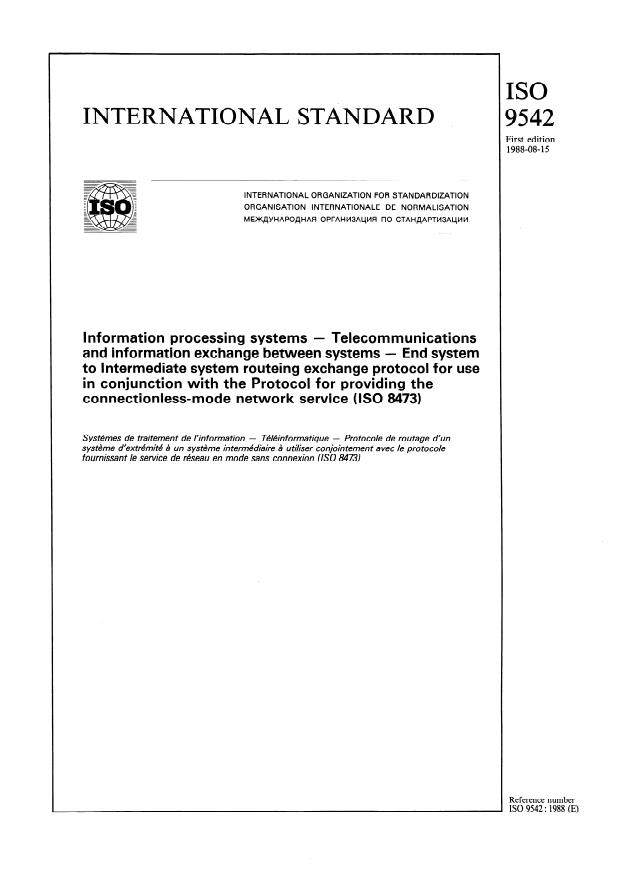
IS0
INTERNATIONAL STANDARD
First edition
1988-08-15
INTERNATIONAL ORGANIZATION FOR STANDARDIZATION
ORGANISATION INTERNATIONALE DE NORMALISATION
MEX,4YHAPOAHAR OPTAHM3AL(MR IlO CTAH~APTM3A~MM
Information processing systems - Telecommunications
and information exchange between systems - End system
to Intermediate system routeing exchange protocol for use
in conjunction with the Protocol for providing the
connectionless-mode network service (IS0 8473)
S yst&mes de traitement de l’information - TkWn formatique - Protocole de routage d’un
syst&me d’extrhmitd ~9 un syst&me intermbdiaire ;i utilker conjointement avec le protocole
fournissant le service de rbseau en mode sans connexion (IS0 8473)
Reference number
IS0 9542 : 1988 (E)
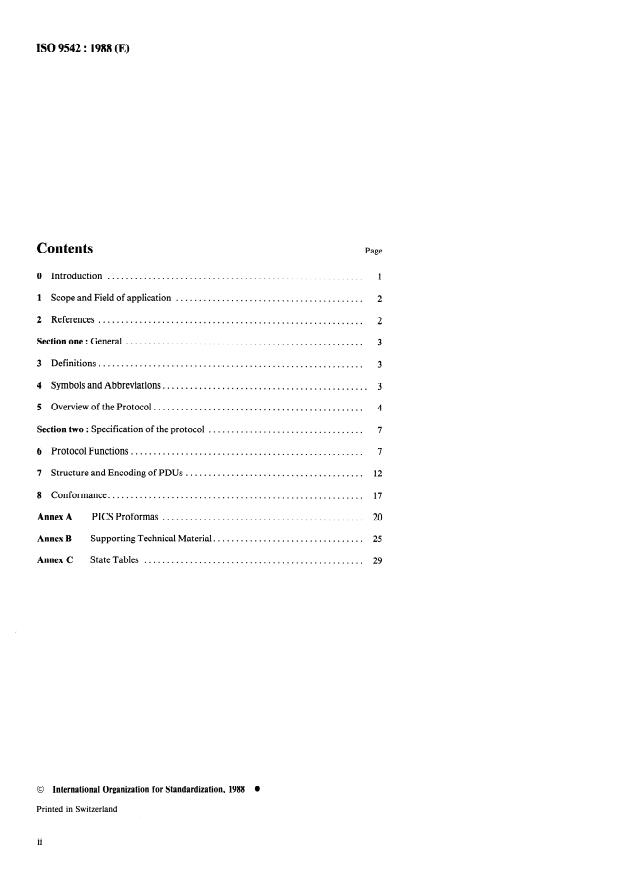
IS0 9542 : 1988 (E)
Page
Contents
0 Introduction .
1 Scope and Field of application .
2 References. .
Section one : General . 3
.......................................................... 3
3 Definitions
4 Symbols and Abbreviations. . 3
5 Overview of the Protocol .
Section two : Specification of the protocol . 7
6 Protocol Functions .
7 Structure and Encoding of PDUs .
8 Conformance .
PICS Proformas .
Annex A
Annex B Supporting Technical Material. .
StateTables .
Annex C
0 International Organization for Standardization, 1988 l
Printed in Switzerland
ii
IS0 9542 : 1988 (E)
Foreword
IS0 (the International Organization for Standardization) is a worldwide federation of
national standards bodies (IS0 member bodies). The work of preparing International
Standards is normally carried out through IS0 technical committees. Each member
body interested in a subject for which a technical committee has been established has
the right to be represented on that committee. International organizations, governmen-
tal and non-governmental, in liaison with ISO, also take part in the work. IS0
collaborates closely with the International Electrotechnical Commission (IEC) on all
matters of electrotechnical standardization.
Draft International Standards adopted by the technical committees are circulated to the
member bodies for approval before their acceptance as International Standards by the
IS0 Council. They are approved in accordance with IS0 procedures requiring at least
75 o/o approval by the member bodies voting.
International Standard IS0 9542 was prepared by Technical Committee ISO/TC 97,
Information processing systems.
Users should note that all International Standards undergo revision from time to time
and that any reference made herein to any other International Standard implies its
latest edition, unless otherwise stated.
Annex A forms an integral part of this International Standard. Annexes B and C are
for information only.
. . .
This page intentionally left blank
INTERNATIONAL STANDARD IS0 9542 : 1988 (E)
Information processing systems - Telecommunications
and information exchange between systems - End system
to Intermediate system routeing exchange protocol for use
in conjunction with the Protocol for providing the
connectionless-mode network service (IS0 8473)
0 Introduction the one(s) to which the End Svstem is directlv con-
5 i
netted?
This International Standard is one of a set of Interna-
How do End Svstems discover the existence and
tional Standards produced to facilitate the interconnec-
reachability of dther End Systems on the same sub-
Con of open svstems. The set of standards covers the
network (when direct examination of the destina-
services and p;otocols required to achieve such intercon-
tion NSAP address does not provide information
nection.
about the destination subnetwork address)?
This International Standard is positioned with re-
How do Intermediate Svstems discover t’he exis-
spect to other related standards by the layers defined in
tence and reachabilitv oi End Systems on each of
IS0 7498 and bv the structure defined in IS0 8648. In
the subnetworks to &hich they: are directly con-
% 5
particular, it is‘a protocol of the Network Laver. This
-a
netted?
International Standard permits End Systems and Inter-
mediat,e Systems to exchange config&tion and routeing
How do End Systems decide which Int*ermediate
information to facilitate the operation of the routeing
System to use lo forward NPDUs to a particular
and relaying functions of the Network Layer.
dkstination when more than one Intermediate SVS-
c
The aspects of Network Layer routeing that are con- tern is accessible?
”
cerned with communication between End Systems and
The protocol assumes that:
Intermediate Systems on the same subnetwork are to a
great extent separable from the aspects that are con-
a) routeing to a specified subnetwork point of attach-
cerned with communication among the Intermediate
ment address (S N PA) on the same subnetwork is
%-stems that connect multiple subnetworks. This pro-
carried out satisfactorily by the subnetwork itself,
thcol addresses only the former aspects. It will be sig-
but
nificantly enhanced by the cooperative operation of an
additional protocol that provides for the exchange of
bj the subnetwork is not, however, capable of route-
routeing information among Intermediate Systems, but
ing on a global basis using the NSAP address
is useful whether or not such an additional protocol is alone to achieve communication wit.h a requested
available. destination. ‘)
This International Standard is designed to operate in
In addition, certain protocol functions assume t,hat:
close conjunction with IS0 8473 and its addenda.
This International Standard provides solutions for the c) the subnetwork supports broadcast, mnlt,icast , or
following practical problems. other forms of multi-destination addressing for ?‘G-
way transmission.
a ) How do End Systems discover the existence and
l)Consequently, it is not possible to use Application Layer
reachability of Intermediate Systems that can route
cornmunica.tion to carry out the functions of this International
Standard.
NPDUs to destinations on subnetworks other than
IS0 9542 : 1988 (E)
The protocol is connectionless, and is designed to: This International Standard does not specify any pro-
tocol elements or algorithms for facilitating routeing and
l
minimize the amount of a priori state information relaying among Intermediate Systems. Such functions
needed by End Systems before they can begin to are intent,ionally beyond the scope of this International
communicate with other End Systems; Standard.
0 minimize the amount of memory needed to store
routeing information in end systems; and
2 References
minimize the computational complexity of End Sys-
tem routeing algorithms.
IS0 7498, Information processing systems - Open
systems interconnection - Basic reference model.
Scope and Field of Application
IS0 7498/Add. 1, Information processing s yst.ems -
Open systems interconnection - Basic reference model.
This International Standard specifies a protocol which
ADDENDUM 1: Connectionless-mode transmission.
is used bv Network Layer entities operating IS0 8473
IS0 7498iAdd.4, Information processing systems -
in End S&tems and Iniermediate Systems (referred to
Open systems interconnection - Basic reference model.
herein as ES and IS respectivelv) to maintain route-
ADDENDUM 4: OSI Management Framework.
ing information. The Protocol herein described relies
upon the provision of a connectionless-mode underlying
IS0 8208, Information processing systems - Data.
service. l)
communications - dy.25 Packet Level Protocol for Data
This International Standard specifies: Terminal Equipment.
IS0 8348, Information processing systems - Data.
(‘I ) procedures for the transmission of configuration
commu.nications - Network Service Definition.
and routeing information between Network entities
residing in End Systems and Network entities re-
IS0 8348/Add.l, Information processing system.s -
siding in Intermediate Systems;
Data communications - Network Seruice Defirtition.
ADDENDUM 1: Connectionbess-mode ‘Transmission.
b) the encoding of the protocol data units used for
the transmission of the configuration and routeing IS0 8348lAdd.2, Information processing system.s -
information; Data communications - Network Service Definition,.
ADDENDUM 2: Network Layer Addressing.
interpretation of protocol
procedures for the correct
IS0 8473, Information processing system.s - Dab
control information; and
commu.nications - Protocol for providing t.h.e connec-
tionless-mode Network Service.
d) the functional requirements for implementations
claiming conformance to this International Stan-
IS0 8648, Informa.tion processing syst.ems - Open
dard.
Systems Interconnection - Internal organization. of th.e
Network layer.
The procedures are defined in terms of:
IS0 8802, Inform&ion processing systems - Data.
a) the interactions between End System and Inter-
communications - Loca.1 Area Networks.
mediate System Network entitiei through the ex-
CCITT x.25, Interface Between Data Terminal Equ.ip-
change of protocol data units; and
ment (D TE) and Data Circuit Terminating Equipment
(DCE) for Terminals Operating in the Packet Mode and
b) the interactions between a Network entity and an
Connected to Pu.blic Data Networks by Dedicated Cir-
underlying service provider through the exchange
cuit, 1985.
of subnetwork service primitives.
1) See Clause 8 of IS0 84 73 for the mechanisms necessary to re-
alize this service on subnet works based on IS0 8208 and IS0 8802.
IS0 9542 : 1988 (E)
Section one: General
The collection of End and In-
3.5.1 Configuration:
3 Definitions
termediate Systems attached to a single subnetxvork,
defined in te;ms of the system tvpes, NSAP addresses
s
3.1 Reference Model Definitions
present, Network Entities present, and the correspon-
dence between systems and SNPA addresses.
c
IS0 9542 makes use of the following terms defined in
IS0 7498.
4 Symbols and Abbreviations
a Network layer
Network service access point
b)
Network service access point address
4.1 Data Units
Network entity
3,
d)
PDU Protocol Data Unit
routeing
e)
SNSDU Subnetwork Service Data Unit
Net,work protocol
f )
NPDU Network Protocol Data Unit.
Network relay
SNPDU Subnetwork Protocol Data Unit
1 Network pro;ocol data unit
1)
4.2 Protocol Data Units
Network Layer Architecture Defini-
3.2
tions
ESH PDU End System Hello Protocol Data Unit
ISH PDU Interkediate Svstem Hello Protocol Data
IS0 9542 makes use of the following terms defined in
Unit
IS0 8648.
RD PDU Redirect Protocol Dat.a Unit’
(1. Subnetwork
>
End Svst,em 4.3 Protocol Data Unit Fields
b)
Mern;ediate System
NPID Network Layer Protocol Identifier
Subnetwork Se;vice
d)
LI Length Indicator
Subnetwork Dependent Convergence Function
e)
Version/Protocol Identifier Extension
v/p
TP
Type
cs Checksum
Network Layer Addressing Defini-
3.3
Network Entitv Tit!le Length Indicator
NETL
tions
Network Entit; Title
NET
Destination Address Length Indicator
DAL
9542 makes use of the following terms defined in
IS0
DA Destination Address
IS0 8348,‘Add.2.
SAL Source Address Length Indicator
SA Source Address
Subnetwork address
a
)
BSNPAL SN Address Length Indicator of bett,er
Subnetwork point of attachment
b)
route to destination
Network Protocol Address Information
BSNPA SN Address of better route to destination
Network Entity Title
c
HT Holding Time
3.4 Local Area Network Definitions
4.4 Parameters
IS0 9542 makes use of the following terms defined in
CT Configuration Timer
IS0 8802.
RT Redirect Timer
ESCT Suggested End Svstem Configuration Ti-
a) multicast address
mer
b) broadcast medium
4.5 Addresses
3.5 Additional Definitions
NSAP Network Service Access Point,
SNPA Subnetwork Point of Attachment
For the purposes of this International Standard, the fol-
NPAI Network Protocol Address Information
lowing definition applies.
IS0 9542 : 1988 (E)
4.6 Miscellaneous 5.2 Addressing
End system
ES
The Source Address and Destination Address pa-
IS Intermediate system
rameters referred to in this International Standard are
LAN Local area netivork
OS1 Network Service Access Point1 Addresses. The syn-
PIGS Protocol Implementation Conformance
tax and semantics of an OS1 Network Service Acckss
Statement
Point Address are described in IS0 8348lAdd.2.
Quality of service
QOS
SN Subnetwork
5.3 Underlying Service Assumed by the
Protocol
5 Overview of the Protocol
The underlving service required to support this Int.er-
national Standard is defined by the primitives in table
1.
5.1 Information Provided by the Proto-
col
NOTE -
These service primitives are used to de-
scribe the a.bstra.ct interfa.ce which exists between
This International Standard provides two types of infor-
.
the protocol machine a.nd an underlying real sub-
mation to Network entities which support its operation:
network or a. Subnetwork Dependent Convergence
Function which opera.tes over a. real subnetwork or
l Configuration information, and
real data link to provide the required underlying
1)
service.
l Route redirection information
5.3.1 Subnetwork Addresses
Configuration ,information permits End Systems
to discover the existence and reachability of Inteimedi-
The source and destination addresses specifv the points
ate Systems and permits Intermediate &stems to dis-
of attachment to a public or private subneiwork(s) in-
.
cover the existence and reachability of End Systems. volved in the transmission (known as Subnet.work Points
This information allow ESs and ISs attached to the of Attachment, or SNPAs). Subnetwork addresses are
same subnetwork t!o dynamically discover each other’s defined in the service definition of each individual sub-
existence and availability, thus eliminating the need for network.
n~~~ual intervention at ESs and ISs to establish the
This International Standard is designed t,o t,ake ad-
identity of Network entities that can be used to route
va.ntage of subnetworks which support broadca.st., mdf.t-
NPDUs.
cad, or other forms of multi-destination addressing for
n-w-y transmission. It is assumed that the SN-Destina-
Configuration information also permits End Systems
c
tion-Address parameter may take on one of the following
t*o obtain information about each other in the absence
multi-destination addresses in addition to a normal sin-
of an available Intermediate System.
gle destination address:
NOTE - The term “configuration informa.tion”
l All End System Network entities
is not intended in the broad sense of configura.-
tion as used in the context of OS1 system nmn-
l All Intermediate System Network entities
agement. Rather, onlv the functions specifically
”
defined herein are intended.
Where a real subnetwork does not inhere+- sup-
port broadcast or other forms of transmission to multi-
Route redirect ion informat ion allows Intermedi-
destination addresses, a convergence function mw be
i
ate Systems tDo inform End Systems of (potentially) bet-
used to provide n-way transmission to these multi-
her pat#hs to use when forwarding NPDUs to a par&c&r
destination addresses.
dest4ination. A better path could either be another IS on
When the SN-Destination-Address on the SN-UNIT-
the same subnetwork as the ES, or the destination ES
DATA. Request is a multi-destination address, the
itself, if it is on the same subnetwork as the source ES.
SN-Destination-Address parameter in the corresponding
Allowing t,he ISs to inform the ESs of routes minimizes
SNJJNITDATA.Indication shall be the same multi-des-
the complexitv of routeing decisions in End Systems and
tination address.
improves perfirmance because the ESs may make use of
the better IS or local subnetwork access for subsequent
1)See Cla.use 8 of IS0 8473 for the mechanisms necessary to re-
alize this service on subnetworks based on IS0 8208 and IS0 8802.
transmissions.
IS0 9542 : 1988 (E)
Table 1 - Service Primitives fop Underlying Service
SN-UNITDATA .Request SN -Destination-Address,
.Indication SN -Source -Address,
SN -Quality-of-Service,
SN-Userdata
b) one of the two systems is an Intermediat,e Syst*em.
The svntax and semantics of subnetwork addresses,
except for the properties described above, are not de-
On a point-to-point subnetwork, if
fined in this International Standard. NOTE -
both systems a.re Intermedia.te Systems, then this
c
International Standard is inapplicable to the situa-
5.3.2 Subnetwork User Data
tion, since an IS-to-IS protocol should be employed
instea.d. However, there is no reason why the con-
SNJJserdata is an ordered multiple of octets, and is
The
figuration infornla.tion could not be enlploved in
c
transferred transparentlv between the specified subnet-
% am IS-to-IS environment to ascertain the topology
work points of attachment. and initia.te opera.tion of an IS-to-IS protocol.
The underlving service is required to support a ser-
The Intermediate System is informed of the NSAP -
vice data unii size of at least that required to operate
address supported- by the Network entity in the
IS0 84X.
End System. This permits reachability information and
5 %
routeing metrics concerning these NSAPs to be dissemi-
5.4 Subnetwork Types
nated to other Intermediate Systems for the purpose of
calculating routes to/from this End System.
In order t’o evaluat!e the applicability of this Inter-
national Standard in particular configLrations of End
5.4.1.2 Route redirection information on a
Syst,ems! Intermediabe Systems and subnetworks, three
point-to-point Subnetwork.
generic types of subnetu-ork are identified. These are:
z
Redirection information is not employed on point-to-
%
a) the point-to-point subnetwork,
point subnetworks because there are never any alternate
i
routes.
b) the broadcast subnetwork, and
c) the general topology subnetwork
5.4.2 Broadcast Subnetworks
A broadcast subnetwork supports an arbitrary number
These subnetwork types are discussed in the following
of End Systems and Intermediate Systems, Hnd addi-
clauses.
tionallv is capable of transmitting a single SNPDU to
-.
all or a subset of these systems in response to a sin-
5.4.1 Point-to-Point Subnetworks
gle SNJJNITDATA.Request. An example of a broadcast
subnetwork is a LAN (local area network) conforming to
A point-to-point subnetwork supports exactly two svs-
IS0 8802-2, type 1 operation.
*-
tems. The t.wo systems may be either two Enh Systems,
or an End Syst.em and a single Intermediate System. A
single poinMo-point data link connecting two Network
5.4.2.1 Configuration information on a hroad-
entities is an example of a point-to-point subnetwork.
cast Subnetwork
On a broadcast subnetwork the configurat4ion informa-
5.4.1.1 Configuration information on a point-
tion of this International Standard is employed to inform
to-point Subnetwork
the communicating Network entities of the following:
On a point.-t-o-point subnetwork the configuration infor-
a) End Systems are informed of the reachability, Net-
mation of this International Standard informs the com-
work Entity Title, and SNPA address of each
municating Network entities of the following:
active Intermediate System on the subnet,work.
b) Intermediate Systems are informed of the NSAP
a) whether the topologv consists only of two End Svs-
5 .
addresses suppbrted by each End System and the
terns, or
IS0 9542 : 1988 (E)
SNPA address of the ES. Once the Intermedi-
5.4.3.1 Configuration information on a general
ate System obtains this information, reachability
topology Subnetwork.
inforilation and routeing metrics concerning these
On a general tOopologv subnetwork the configuration in-
NSAPs mav be disseminated to other ISs for the
purpose of’calculating routes to/from each ES on formation is generalliv not employed because the proto-
the subnetwork. col can be very costly in the utilization (and charging
for) subnetwork resources.
c) In the absence of an available Intermediate Sys-
tem, End Svstems mav query over a broadcast sub-
network to‘discover dhethe; a particular NSAP is
5.4.3.2 Route redirection information on a gen-
reachable on the subnetwork, and if so, what SNPA
eral topology Subnetwork.
address to use to reach that NSAP.
Redirection information mav be employed on general
topology subnetworks to peimit Intermhdiate Svstems
5.4.2.2 Route redirection information on
to inform End Systems of superior routes to a dkstina-
c
broadcast Subnetworks.
tion NSAP. The superior routle might be another IS on
the same subnetwork as the ES, or it might4 be the des-
Redirection information mav be emploved on broadcast
5 .,
tination ES itself, if it is directlv reachable on the same
s
subnetworks to permit Intermediate Systems to inform
subnetwork as the source ES.
End Systems of superior routes to a destination NSAP.
The shperior route might be another IS on the same
subnetwork as the ES, or it might be the destination ES
itself, if it is directly reachable on the same subnetwork
as the source ES.
5.4.3 General Topology Subnetworks
A general topology subnetwork supports an arbitrary
number of End Systems and Intermediate Systems, but
does notI support a convenient multi-destination connec-
tionless transmission facility as does a broadcast subnet-
work. An example of a general topology subnetwork is
a subnetwork emploving X.25 or IS0 8208.
i
NOTE - The crucial distinguishing cha.ra.cter-
i&c between the broadcast subnetwork a.nd the
general t.opology subnetwork is the “cost” of an
‘n-way trammission to a. potentially la.rge subset
of the systems on the subnetwork. On a. general
t.opology subnetwork, the cost is assumed to be
close to the cost of sending an individua.1 PDU to
each SNPA on the subnetwork. Conversely, on a.
broadcast subnetwork the cost is assumed to be
close to the cost of sending a. single PDU to me
SNPA on the subnetwork. Intermediate situations
between these extremes are of course possible. In
such cases it. would be possible to treat the subnet-
work as in eit.her the broadcast or general topology
category.
IS0 9542 : 1988 (E)
Section two: SDecification of the protocol
A A
6 Protocol Functions 6.2 Report Configuration Function
The Report Configuration Funct,ion is used bv End Svs-
This section describes the functions performed as part
terns and Intermediate Systems to inform each ot’her- of
of the protocol.
their reachability and current subnetwork address(
Implementations are not required to perform all of
This function is invoked every time the local Configura-
the functions: Clause 8.1 specifies which functions are
tion Timer (CT) expires in an’ ES or IS. The function mav
t.
mandatory and which are optional.
optionally be invoked on other occasions. For example,
when one of the system’s SNPAs becomes operational,
this function may be executed more frequentlv than on
6.1 Protocol Timers
Configuration Timer expiry. This enables o&r svstems
b
to notice the change in coifiguration quicklv.
i
RIanv of t,he protocol functions are timer based. This
meaL that’ they are executed upon expiration of a timer
6.2.1 Report Configuration by End Systems
rather than upon receipt of a PDU or invocation of a
service primitive. The two types of timer employed bv
An End System Network entitv constructs and trans-
the protocol are the Configu;ation Timer (CT) iid thk
mits ESH s PDUs to inform other s@ems about the
Holding Timer (HT).
NSAPs it serves. This rnav be done bv constructing one
ESH PDU for each NSAP.‘Alternativeiv, ESH PDUs may
It is recomnlended that the timer val-
NOTE -
be constructed which convey inform&ion about more
ues be implenleuted with a resolution uot worse
than one NSAP at a time, up to the limits imposed bj
._
thau oue second.
the permitted SNSDU size and the maximum header
size of the ESH PDU. Each ESH PDU is transmit,ted
by issuing an SN-UNITDATA.Request with the following
6.1.1 Configuration Timer
parameters:
The Configuration Timer is a local timer (i.e. main-
SNJJserdata (SNSDU) +-- ESH PDU
tained independently bv each system) which assists in
address
SN-Destination-Address +- multi-dest,inat.ion
performing the Report bonfigur&,ion function (see 6.2).
that indicates ‘WI Mernlediate Swtelzl Network
The timer determines how often a svstem reports its
c
Entities”.
availabilitly 00 the other systems on Ihe same subnet-
work. The shorter the Configuration Timer, the more
Where an End Svstem supports more than one SNPA!
quicklv other systems on the subnetwork will become
b
the information ibout each NSAP served by the End
aware when thd reporting system becomes available or
System shall be transmitted on each SNPA. 1;. is not re-
unavailable. There is a trade off between increased re-
qLred that the distribution of NSAPs among ESH PDUs
sponsiveness and increased use of resources in the sub-
be the same on each SNPA.
network and in the recipient systems.
NOTE - The necessity to iuforin other sys-
t.ems about individual NSAPs served by the Net-
6.1.2 Holding Timer
work entity a.rises from the lack of a formalized re-
latiouship between Network entitv Gtles and NSAP
The Holding Timer applies to both configuration infor- &
a.ddresses. If this relationship could be constrained
mat.ion and route redirection information. The value of
to require that all NSAP addresses be assigned as
a Holding Timer is set bv the source of the informa-
1ea.f subdomains of a domain represented bv the
L
tion and transmitted in t‘he Holding Time field of the
local Network entity’s Network entity title, then a
appropriate PDU. The recipient of the information is
single ESH PDU could be transmitted cont5aiuiug
expectled t,o retain the information no longer than the
the ES’s Network entity title. The Network en-
Holding Timer. Old configuration or redirection infor-
tity title would then imply which NSAPs might be
m&ion shall be discarded after the Holding Timer ex-
present at tl1a.t End System.
pires to ensure the correct operation of the protocol.
Further discussion of the rationale for these timers The Holding Time (HT) field is set to approximatel>
and guidelines for their use may be found in Annex B.
twice the ES’s Configuration Timer (CT) parameter.
IS0 9542 : 1988 (E)
The value shall be large enough so that even if every dates the information in the local Network entitv’s
<
other ESH PDU is discarded (due to lack of resource& routeing information base.
or otherwise lost in the subnetwork, the configuration
- If an ES so desires, it may decide to
NOTE
information will still be maintained. The value should
enable the a.ppropria.te multi-destination address,
be set small enough so that Intermediate Svstems can
thus permitting it to process ESH PDUs multicast
respond in a timely fashion to End System; becoming
by other End Systems. There is potentially some
available or unavailable.
performance improvement to be gained by doing
this, at the expense of extra, memory, a.nd possibly
NOTE - The actual value of the SN -Des-
extra. processing cycles in the End System. The
tination-Address used to mean “AI1 Intermediate
ES, bv recording other ESs’ configuration informa-
c
Svstem Netlvork Entities” is subnetwork depen-
\
tion, ma.y be a.ble to route NPDUs directly to ESs
dent and will most likelv va.ry from subnetwork to
on the local subnetwork without first being redi-
subnetwork. It is of course desira.ble on widely-
rected by an Intermedia.te System.
used subnetwork types (such a.s those based on
Similarly, Intermedia.te Systems may choose to re-
c
IS0 8802) that this value, and the value of the “AU
ceive the ISH PDUs of othkr ISs, allowing this Inter-
End Systenl Netlvork Entities” multi-destination
na.tiona.1 Standard to be used as the initialization
address, be standardized.
a.nd topology maintenance portion of a full IS-to-IS
routeing protocol.
6.2.2 Report Configuration by Intermediate
Systems
The receiving system is not required to process anj
option fields in a deceived ESH or ISH PDU.
An Intermediate System constructs a single ISH PDU
-.
cont,aining the IS’s Network entity title and issues one NOTE - When a system chooses to process
these optional fields, the precise actions are not.
SNJJNITDATA.Request on each SNPA to which it is at-
specified by this International Standard.
tached with the following parameters:
SN-Userdata (SNSDU) +- ISH PDU
6.3.1 Record Configuration by Intermediate
SN-Destination-Address + multi-destination address
Systems
that indicates Wl EId Svs tern Net work Entities”.
L
On receipt of an ESH PDU an IS extracts t.he configura-
The Holding Time (HT) field is set to approximately
tion information and stores the {NSAP,SNPA} pairs in
twice the Intermediate Svstem’s Configuration Time;
its local routeing information base replacing any other
(CT) parameter. This va-liable shall be set to a value
information for the same {NSAPJNPA} pair. If insuf-
large enough so that, even if everv other ISH PDU is ficient space is available to store t-he new configuration
discarded (due to lack of resources), or otherwise lost in information the PDU is discarded.
t.he subnetwork, t.he configuration information will still
be maintained. The value should be set small enough so
6.3.2 Record Configuration by End Systems
that End Svstems will quicklv cease to use ISs that have
“blaci holes” in the network.
failed, thus preventing
On receipt of an ISH PDU an ES extracts the configu-
ration information and stores the { NET,SNPA} pairs in
An IS mav optionallv suggest a value for End Systems
*< c
its local routeing information base replacing any other
on the local subnetwork to use as their Configuration
(CT) bv including the ESCT option in the trans- information for the same {NET,SNPA} pair. If insuffi-
Timers
mitted ISH PDU. Setting this option permits an IS to cient space is available to store the new configuration
influence the frequencv with which ESs transmit ESH information the PDU is discarded.
-*
PDUs.
In addition, an ES mav also recompute it’s Configura-
.L
tion Timer based on receipt of an ISH PDU containing
NOTE - An IS mav wish to so influence End
l the Su.ggested ES Configuradion Timer (ESCT) optional
Systems in order t,o trade off the subnetwork re-
field. If an End System chooses to use a computed CT
sources consumed by the transmission of ESH
rather than a local value supplied by System RIanage-
PDUs against the length of time it is willing to
ment, it performs the operations described below.
tolerate obsolete configuration information about
an ES.
l It examines its local routeing information base and
ascertains whether any IS for which t.he ES is main-
taining configuration information has supplied an
6.3 Record Configuration Function
ESCT. If no IS has suggested an ES configuration
timer, the ES uses the value supplied bv i t,s local
The Record Configuration function receives ESH or ISH
-_
Svstem Management.
PEWS, estr;wts the configuration information, and up-
IS0 9542 : 1988 (E)
l If one or more ISs suggested an ESCT, the minimum SN-Destination-Address +- multi-destination address
of the suggested values replaces the current value of that indicates “AI1 End S&en1 Network Entities”.
c
the ES’s CT.
Subsequentlv an ESH PDU may be received containing
the NSAP address along with the corresponding SNPA
G.4 Flush Old Configuration Function
a ddress (see 6.6). In such a case the End System exe-
cutes the Record Configuration function for the NSAP,
The Flush Old Configuration function is executed to re-
and therefore will be able to route subsequent PDUs ti
move configuration entries in the routeing information
that destination using the specified SNPA. If no ESH
base whose Holding Timer has expired. When the Hold-
PDU is received, the End System may declare the desti-
ing Timer for an ES or IS expires, this function removes
nation NSAP not reachable. The length of time to wait
the corresponding entry from the routeing information
for a response before indicating a failure or the possi-
base of the local Net&k entitv.
bilitv of repeating the process some number of times
The Flush Old Configuration-function is also executed
before returning a failure are local matters and are not
whenever a subnetwork service provider reinitializes a
specified in this International Standard.
local SN PA. When the SN PA is either disabled or reini-
tialized, all configuration information for both ESs and
ISs associated wit.1~ that SNPA is removed.
6.6 Configuration Response Function
The Configuration Response function is performed
6.5 Query Configuration Function
when an End System attached to a broadcast1 sub-
network receives an NPDU addressed t,o one of its
The Querv Configuration function is performed under
i
NSAPs, with the SN-Destination-Address from the
the following circumstances:
SNUNITDATA.Indication set to the multi-dest.ination
address “AI1 End Systenr Network Entities”. This oc-
(1 the End Svstem is attached to a broadcast subnet-
-_
>
curs as a result of& another ES having performed the
work,
Query Configuration function described in 6.5.
there is no Intermediate Svstem currently reachable
b)
The End System constructs an ESH PDU containing
%
on the subnetwork (i.e. no ISH PDUs hive been re-
information for at least that NSAP to which the re-
ceived since the last information was removed by
ceived NPDU was addressed. It then transmits the ESH
the Flush Old Configuration function),
PDU to the source of the original NPDU bv issuing an
c
SNUN1TDATA.R equest with the following paramet.ers:
the Network Layer’s Route PDU function needs to
obtain the SNPA address to which to forward a PDU
SNUserdata + ESH PDU
destined for a certain NSAP,
SN-Destination-Address +- SNSource-Address parame-
the SNPA address cannot be obtained either bv a
d)
ter value from the SNUNITDATA.Indication con-
local transformation or a local table lookup, and
taining the original NPDU as its SNUserdata.
QoS constraints would permit the broadcasting of
e)
the PDU.
6.7 Configuration Notification Function
NOTE - Despite appearances, this is actually a.
The Configuration Notification function is used bv End
i
quite comn~on case, since it is likely tl1a.t there will
Systems and Intermediate Systems in order to transmit
--
be numerous isolated Local Area. Networks without
configuration information quickly to a system which has
Intermediate Syst3ems t,o rely upon for obtaining
newlv become available, in order t,o allm- that s&em
rout eing information (e.g. via the Request Redi-
to build up its routeing information base as soon as pos-
rect Function of this Interna.tiona.1 Standaxd). Fur-
ther, if the Internlediate System(s) are tenlporar- sible.
ily unavailable, without this capa.bility comnwni-
A system which chooses to implement this function
cation on the local subnetwork would suffer unless
executes it on detect,ing, by receiving an ESH or ISH
manually-entered tables were present in each End
PDU, that another svstem has just become available.
System or all NSAPs of the subnetwork 1la.d the
It then constructs an ISH or ESH PDU respectivelv.
subnetwork SNPA address embedded in them.
as described in 6.2.2 or 6.2.1, but transmits it specif:
ically addressed to the newly operational system using
The End Svstem, when needing to route an NPDU to
an SNUN1TDATA.R equest with the following parame-
a destination NSAP whose SNPA is unknown, issues an
ters:
SNUNITDATA.Request with the following parameters:
SN Jserdata +- ESH or ISH PDU
SNJserdata +- NPDU
IS0 9542 : 1988 (E)
SN,Destination-Address + SNSource-Address parame- a) The next hop is to the destination system, and the
ter value from the SNJJNITDATAhdication con- destination is directlv reachable (at subnetwork ad-
t aining t.he original ESH or ISH PDU as its dress BSNPA) on the source ESs subnetwork, or
SN-Userdata.
b) The next hop is to an Intermediate Syst.em which
is connected to the same subnet%work as the ES.
It is recommended that svstems which choose to im-
plement t.his function should invoke it only when they
If the better path exists, the IS first, completes nor-
can ascertain definitely that a system has recently bd-
mal processing of the received NPDU and forwards it. It
come available and not, for example, simply because
then constructs a Redirect PDU (RD PDU) containing
room for it, has just become available in the routeing
the Destination Address of the original NPDU, the sub-
information base.
network address of the better next) hop (BSNPA), the
Network entity title of the IS to which the ES is being
6.8 Request Redirect Function
redirected (unless the redirect is to the destination ES),
a Holding Time (HT), QoS Maintenance, Priority, and
The Request Redirect, Function is present only in Inter-
Securitv options that were present in the Data NPDU
mediate Syst*ems and is closely coupled with the Route-
(these ire simplv copied from the Data PDU). The HT
ing and Relaying Functions of Intermediate Systems.
is set to the val;e of the local Redirect Timer (RT). See
The Request0 Redirect Function is coupled with the
Annex B for a discussion of how to choose the value of
Route PDU FuncGon described in IS0 8473. The Re-
RT. If there are insufficient resources to both forward the
quest Redirect Function is performed after the Route
original NPDU and to generate and send an RD PDU:
PDU function has calculated the next hop of the Data
the original NPDU shall be given preference.
NPDU’s path.
The Request Redirect function mav also be invoked
When an NPDU is t.o be forwarded bv an Intermediate
s
bv an IS when it receives a PDU addrkssed t,o an NSAP
%-stem, t,he Request Redirect Function first examines
i
&at is not reachable from this IS but to which the IS
the output of the IS’s Routeing and Relaying function
c
knows the first hop of a route from the source to t.he des-
for this NPDU.
tination NSAP. In this case the IS shall first! follow the
procedures defined in IS0 8473 clauses 6.9 and G.l@ for
NOTE - As an optimization, the Request
discarding the PDU and generation of an error report.
Redirect Function nlav examine the SNSource--
.
On completion of this procedure it shall inform t.he orig-
Address associated with the SN-UNITDATAhdica-
inating system of a route to the destination NSAP b\
tion which received the SNSDU (containing this
sending an RD PDU.
NPDU). If it can be determined (for exanlple by
examining the configuration information obtained
Optionallv, the IS mav include inform&on in the
through the Record Configuration function) that
RD PDU indicating a laiger population of NSAP ad-
the SNSource-Address is not from a.n End System
dresses to which the same redirection information ap-
on the local subnetwork, then a. Redirect PDU need
plies. There are two optional fields for this purpose:
not be sent.
the Addlress Mask option and the SNPA MaA option.
Their usage depends on the fact that NSAP addresses
This output will contain, among other things, the fol-
are represented using the preferred binary encoding, as
lowing pieces of information:
specified in 7.3.2.
There are three permitted cases for including or ex-
a) a local identifier for the subnetwork over which to
cluding the masks. In the first case, both masks are
forward the NPDU, plus either
absent. In this case, the RD PDU conveys information
b) the Network entitv title and subnetwork address of
about, one NSAP address only. The information reveals
the IS to which to forward the NPDU, or
the system to which the IS is routeing t,he NPDU that
provoked the RD PDU. That svstem could be another
c) the subnetwork address of the destination End Sys-
IS, or it could be the destination ES itself.
In the second case, the RD PDU contains an Address
Mask but no SNPA Mask. In this case, the RD PDU
The Request, Redirect function now determines if the
convevs information about an equivalence class of NSAP
L
source ES could have sent, t(he NPDU directly to the Net-
addresses. The information reveals the system to which
work entit’y t#he Intermediate System is about to forward
the IS sends NPDUs addressed to members of the class.
the PDU to. Providing that QoS and other constraints
If an ES receiving such an RD PDU decides to heed the
permit NPDUs to by-pass this IS, then if any of the fol-
mask, it may forward PDUs destined for members of the
lowing conditions hbld, the IS informs the sbllrce ES of
class to the system indicated in the RD PDU.
the “better” path (bv sending an RD PDU to the origi-
c
nating ES): In the third case, the RD PDU contains both masks.
IS0 9542 : 1988 (E)
As in the second case, the RD PDU conveys informa- corresponding entry is found, the previous hop of the
tion about an equivalence class of NSAP addresses. But PDU is obtained from the SN-Source-Address paramet’er
in this case, the information reveals that the SNPAs for of the SN-Unitdata.Indication primit,ive by which it was
that equivalence class of NSAPs are embedded in the received. If this address matches the next hop address
NSAP. In particular, the SNPA Mask indicates the loca- stored with the redirection information, the remaining
tion of the SNPA in the NSAP. If an ES receiving such Holding Tmer for the redirection is reset to t.he original
an RD PDU decides to heed the masks, it may route value that was obt,ained from the Holding Time field
PDUs dest’ined for members of the class directly to the of the RD PDU. If the redirection information cont.ains
c
SNPA extracted from the NSAP address. equivalence class masks, a separate Holding Timer is as-
sociated with this equivalence class information and is
The Intermediate Svstem (assuming it has sufficient
not reset.
resources) then sends-the RD PDU to the source End
S\-stem bv issuing an SNJJNlTDATA.Reqeust with the
NOTE - The purpose of this function is to avoid
fOllowing parameters:
timing out redirection entries when the Network
entity is receiving return traffic from the destina-
SNJserdata - RD PDU
tion via the same pa.th over which it is currently
SN-Destination-Address - SNSource-Address parame-
sending tra.ffic. This is particularlv useful when
c
ter value from t*he SNJJNITDATA.lndication con-
the destina.tion system is on the same subnetwork
taining the original NPDU as its SN-Userdata.
as the source, since after one redirect. no IS need
be involved in the ES-to-ES traffic.
6.9 Record Redirect Function This function shall operate in a very conservative
fashion however, to prevent the forniation of black
The Record Redirect Function is present only in End
holes. Th e remaining holding timer shall be re-
%&ems. (ISs mav receive RD PDUs, but do-not pro- freshed only under the exact conditions specified
-.
above. For a. discussion of the issues surrounding
cess them). This &nction is invoked whenever a11 RD
the refresh of redirection information, see clause
PDU is received. It, extracts the redirect information and
B.2 of Annex B.
adds or replaces t’he corresponding redirection informa-
tion in the local Network
...
Questions, Comments and Discussion
Ask us and Technical Secretary will try to provide an answer. You can facilitate discussion about the standard in here.
Loading comments...