

ISO/TS 20388:2021
(Main)Biotechnology — Biobanking — Requirements for animal biological material
General Information
- Abstract
This document specifies requirements for the collection, reception, preparation, preservation, transport, storage, distribution, destruction and disposal of biological materials obtained from animals, excluding humans. Such resources include solid tissues, fluid samples and associated cells, excretory products and associated data. This document is applicable to biological material or associated data, or both, that can be used for research and development and to biomolecules derived from the biological material, e.g. nucleic acids, proteins and metabolites. This document is applicable to all organizations performing biobanking for research and development. This document does not apply to biological material intended for food or feed production, laboratories undertaking analysis for food or feed production, or therapeutic use, or multiple of them. This document does not apply to the establishment of cell lines derived from animal biological material. NOTE International, national or regional regulations or requirements, or multiple of them, can also apply to specific topics covered in this document.
- Status
- Published
- Publication Date
- 02-Dec-2021
- Technical Committee
- ISO/TC 276 - Biotechnology
- Drafting Committee
- ISO/TC 276/WG 2 - Biobanks and bioresources
- Current Stage
- 9093 - International Standard confirmed
- Start Date
- 05-Mar-2025
- Completion Date
- 29-Aug-2026
Buy Documents


ISO/TS 20388:2021 - Biotechnology -- Biobanking -- Requirements for animal biological material
ISO/TS 20388:2021 - Biotechnology — Biobanking — Requirements for animal biological material/3/2021
Overview
ISO/TS 20388:2021 - "Biotechnology - Biobanking - Requirements for animal biological material" provides technical specifications for the responsible handling of biological material obtained from animals (excluding humans). It defines requirements across the biobanking life cycle including collection, reception, preparation, preservation, transport, storage, distribution, destruction and disposal of animal-derived samples and associated data. Covered resources include solid tissues, fluid samples, cells, excretory products and derived biomolecules (e.g., nucleic acids, proteins, metabolites).
The document is intended for organizations performing biobanking for research and development and is anchored in ethical principles such as the three Rs (Replace, Reduce, Refine). It explicitly excludes material intended for food/feed production, routine food/feed testing laboratories, therapeutic use, and establishment of cell lines derived from animal material.
Key topics and requirements
- Lifecycle management: Requirements for each stage from pre-acquisition planning through distribution and final disposal or destruction.
- Collection practices: Guidance on pre-collection information, collection plans, preparation of containers/consumables, invasive vs non-invasive collection, and specimen-specific methods (blood, tissues, faeces, urine, milk, germplasm).
- Preservation and storage: Principles and conditions for preserving biological integrity of samples and derived biomolecules for research use.
- Transport and reception: Requirements for secure and compliant transport, including associated data handling and chain-of-custody considerations.
- Biosafety and health/safety: Controls to reduce unintentional exposure or release, zoonosis risk management and chemical safety measures.
- Data and documentation: Capture of associated data/metadata, use of material transfer agreements (MTA), and record-keeping to support reproducibility and legal/regulatory compliance.
- Distribution, disposal, destruction: Secure transfer to recipients and irreversible destruction/deletion procedures for both material and associated data.
- Normative and informative annexes: Practical tools such as exemplary data collection tables, collection methods for different animal types and an MTA information checklist; Annex D contains collection/preparation/preservation methods.
Applications and users
Who benefits from ISO/TS 20388:2021:
- Biobanks and sample repositories handling animal material for R&D
- Research institutions and universities that collect and store animal-derived samples
- Veterinary research groups and wildlife/biodiversity biobanks
- Laboratory managers and QA personnel implementing sample lifecycle controls
- Regulatory and compliance teams ensuring ethical, biosafety and legal adherence (including CBD/Nagoya considerations)
Adopting this technical specification helps ensure sample quality, traceability and biosafety, improving reproducibility and facilitating compliant material sharing.
Related standards
- ISO 20387:2018 - Biotechnology - Biobanking - General requirements for biobanking (referenced; implementation basis)
- WHO Laboratory Biosafety Manual, 4th edition (biosafety guidance)
- Relevant national/regional regulations and international agreements (e.g., CBD, Nagoya Protocol)
Buy Documents
ISO/TS 20388:2021 - Biotechnology -- Biobanking -- Requirements for animal biological material
ISO/TS 20388:2021 - Biotechnology — Biobanking — Requirements for animal biological material/3/2021
Frequently Asked Questions
ISO/TS 20388:2021 is a technical specification published by the International Organization for Standardization (ISO). Its full title is "Biotechnology — Biobanking — Requirements for animal biological material". This standard covers: This document specifies requirements for the collection, reception, preparation, preservation, transport, storage, distribution, destruction and disposal of biological materials obtained from animals, excluding humans. Such resources include solid tissues, fluid samples and associated cells, excretory products and associated data. This document is applicable to biological material or associated data, or both, that can be used for research and development and to biomolecules derived from the biological material, e.g. nucleic acids, proteins and metabolites. This document is applicable to all organizations performing biobanking for research and development. This document does not apply to biological material intended for food or feed production, laboratories undertaking analysis for food or feed production, or therapeutic use, or multiple of them. This document does not apply to the establishment of cell lines derived from animal biological material. NOTE International, national or regional regulations or requirements, or multiple of them, can also apply to specific topics covered in this document.
This document specifies requirements for the collection, reception, preparation, preservation, transport, storage, distribution, destruction and disposal of biological materials obtained from animals, excluding humans. Such resources include solid tissues, fluid samples and associated cells, excretory products and associated data. This document is applicable to biological material or associated data, or both, that can be used for research and development and to biomolecules derived from the biological material, e.g. nucleic acids, proteins and metabolites. This document is applicable to all organizations performing biobanking for research and development. This document does not apply to biological material intended for food or feed production, laboratories undertaking analysis for food or feed production, or therapeutic use, or multiple of them. This document does not apply to the establishment of cell lines derived from animal biological material. NOTE International, national or regional regulations or requirements, or multiple of them, can also apply to specific topics covered in this document.
ISO/TS 20388:2021 is classified under the following ICS (International Classification for Standards) categories: 07.080 - Biology. Botany. Zoology. The ICS classification helps identify the subject area and facilitates finding related standards.
ISO/TS 20388:2021 is available in PDF format for immediate download after purchase. The document can be added to your cart and obtained through the secure checkout process. Digital delivery ensures instant access to the complete standard document.
Standards Content (Sample)
TECHNICAL ISO/TS
SPECIFICATION 20388
First edition
2021-12
Biotechnology — Biobanking —
Requirements for animal biological
material
Biotechnologie — Banques biologiques — Exigences relatives au
matériel biologique animal
Reference number
© ISO 2021
All rights reserved. Unless otherwise specified, or required in the context of its implementation, no part of this publication may
be reproduced or utilized otherwise in any form or by any means, electronic or mechanical, including photocopying, or posting on
the internet or an intranet, without prior written permission. Permission can be requested from either ISO at the address below
or ISO’s member body in the country of the requester.
ISO copyright office
CP 401 • Ch. de Blandonnet 8
CH-1214 Vernier, Geneva
Phone: +41 22 749 01 11
Email: copyright@iso.org
Website: www.iso.org
Published in Switzerland
ii
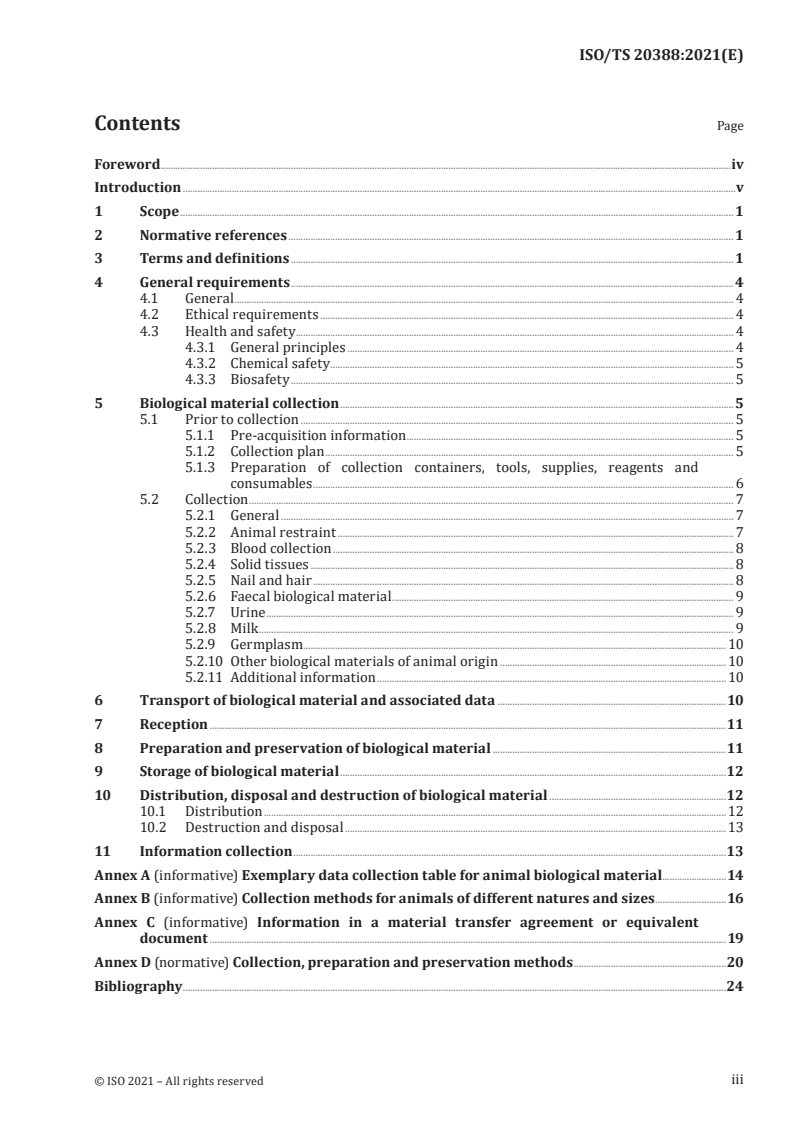
Contents Page
Foreword .iv
Introduction .v
1 Scope . 1
2 Normative references . 1
3 Terms and definitions . 1
4 General requirements . 4
4.1 General . 4
4.2 Ethical requirements . 4
4.3 Health and safety . . 4
4.3.1 General principles . 4
4.3.2 Chemical safety . . 5
4.3.3 Biosafety . 5
5 Biological material collection .5
5.1 Prior to collection . 5
5.1.1 Pre-acquisition information . 5
5.1.2 Collection plan . 5
5.1.3 Preparation of collection containers, tools, supplies, reagents and
consumables . 6
5.2 Collection . 7
5.2.1 General . 7
5.2.2 Animal restraint . 7
5.2.3 Blood collection . 8
5.2.4 Solid tissues . 8
5.2.5 Nail and hair . 8
5.2.6 Faecal biological material . 9
5.2.7 Urine . 9
5.2.8 Milk . 9
5.2.9 Germplasm . 10
5.2.10 Other biological materials of animal origin . 10
5.2.11 Additional information . 10
6 Transport of biological material and associated data .10
7 Reception .11
8 Preparation and preservation of biological material .11
9 Storage of biological material .12
10 Distribution, disposal and destruction of biological material .12
10.1 Distribution .12
10.2 Destruction and disposal . 13
11 Information collection .13
Annex A (informative) Exemplary data collection table for animal biological material .14
Annex B (informative) Collection methods for animals of different natures and sizes .16
Annex C (informative) Information in a material transfer agreement or equivalent
document .19
Annex D (normative) Collection, preparation and preservation methods .20
Bibliography .24
iii
Foreword
ISO (the International Organization for Standardization) is a worldwide federation of national standards
bodies (ISO member bodies). The work of preparing International Standards is normally carried out
through ISO technical committees. Each member body interested in a subject for which a technical
committee has been established has the right to be represented on that committee. International
organizations, governmental and non-governmental, in liaison with ISO, also take part in the work.
ISO collaborates closely with the International Electrotechnical Commission (IEC) on all matters of
electrotechnical standardization.
The procedures used to develop this document and those intended for its further maintenance are
described in the ISO/IEC Directives, Part 1. In particular, the different approval criteria needed for the
different types of ISO documents should be noted. This document was drafted in accordance with the
editorial rules of the ISO/IEC Directives, Part 2 (see www.iso.org/directives).
Attention is drawn to the possibility that some of the elements of this document may be the subject of
patent rights. ISO shall not be held responsible for identifying any or all such patent rights. Details of
any patent rights identified during the development of the document will be in the Introduction and/or
on the ISO list of patent declarations received (see www.iso.org/patents).
Any trade name used in this document is information given for the convenience of users and does not
constitute an endorsement.
For an explanation of the voluntary nature of standards, the meaning of ISO specific terms and
expressions related to conformity assessment, as well as information about ISO's adherence to
the World Trade Organization (WTO) principles in the Technical Barriers to Trade (TBT), see
www.iso.org/iso/foreword.html.
This document was prepared by Technical Committee ISO/TC 276, Biotechnology.
Any feedback or questions on this document should be directed to the user’s national standards body. A
complete listing of these bodies can be found at www.iso.org/members.html.
iv
Introduction
This document contains requirements and recommendations to enable biobanks handling animal
material to demonstrate competent biobank operation and the ability to provide animal biological
material and associated data of appropriate quality for research and development.
This document supports processes that maintain animal welfare, as it is anchored in the principle of the
[18]
three Rs: to “Replace, Reduce and Refine the use of animals” .
The use of this document helps to ensure the quality of animal biological material and the reliability of
research results under the application of ISO 20387.
In this document, the following verbal forms are used:
— “shall” indicates a requirement;
— “should” indicates a recommendation;
— “may” indicates a permission;
— “can” indicates a possibility or a capability.
v
TECHNICAL SPECIFICATION ISO/TS 20388:2021(E)
Biotechnology — Biobanking — Requirements for animal
biological material
1 Scope
This document specifies requirements for the collection, reception, preparation, preservation,
transport, storage, distribution, destruction and disposal of biological materials obtained from animals,
excluding humans. Such resources include solid tissues, fluid samples and associated cells, excretory
products and associated data.
This document is applicable to biological material or associated data, or both, that can be used for
research and development and to biomolecules derived from the biological material, e.g. nucleic acids,
proteins and metabolites.
This document is applicable to all organizations performing biobanking for research and development.
This document does not apply to biological material intended for food or feed production, laboratories
undertaking analysis for food or feed production, or therapeutic use, or multiple of them.
This document does not apply to the establishment of cell lines derived from animal biological material.
NOTE International, national or regional regulations or requirements, or multiple of them, can also apply to
specific topics covered in this document.
2 Normative references
The following documents are referred to in the text in such a way that some or all of their content
constitutes requirements of this document. For dated references, only the edition cited applies. For
undated references, the latest edition of the referenced document (including any amendments) applies.
ISO 20387:2018, Biotechnology — Biobanking — General requirements for biobanking
WHO. Laboratory biosafety manual. World Health Organization, 4th edition, 2020
3 Terms and definitions
For the purposes of this document, the terms and definitions given in ISO 20387:2018 and the following
apply.
ISO and IEC maintain terminology databases for use in standardization at the following addresses:
— ISO Online browsing platform: available at https:// www .iso .org/ obp
— IEC Electropedia: available at https:// www .electropedia .org/
3.1
animal
multicellular, heterotrophic organism, that has sensation and the power of voluntary movement, and
whose cells differ from those of most plants by the absence of cell walls
3.2
associated data
any information affiliated with biological material (3.5) including but not limited to research,
phenotypic, clinical, epidemiologic, genetic, taxonomic, systematic and procedural data
Note 1 to entry: Associated data can include metadata.
[SOURCE: ISO 20387:2018, 3.3, modified — “genetic, taxonomic, systematic” and Note 1 to entry have
been added.]
3.3
biobank
legal entity or part of a legal entity that performs biobanking (3.4)
[SOURCE: ISO 20387:2018, 3.5]
3.4
biobanking
process of acquisitioning and storing, together with some or all of the activities related to collection,
preparation, preservation (3.15), testing, analysing and distributing defined biological material (3.5) as
well as related information and data
[SOURCE: ISO 20387:2018, 3.6]
3.5
biological material
any substance derived or part obtained from an organic entity such as a human, animal (3.1), plant,
microorganism(s) or multicellular organism(s) that is(are) neither animal nor plant (e.g. brown
seaweed, fungi)
Note 1 to entry: For this document, biological material applies only to animals and derivatives thereof.
Note 2 to entry: For this document, biological material can refer to the whole animal.
[SOURCE: ISO 20387:2018, 3.7, modified — Notes 1 and 2 to entry have been added.]
3.7
biosafety
practices and controls that reduce the risk of unintentional exposure or release of biological materials
(3.5)
Note 1 to entry: The release of biological material can refer to live animals (3.1).
Note 2 to entry: This definition includes unintentional exposure, for example, to pathogens and toxins, or their
accidental release as a biosafety risk.
[SOURCE: ISO 35001:2019, 3.22, modified — Notes 1 and 2 to entry have been added.]
3.8
clean technique
non-sterile practice involving strategies used to reduce the overall contamination or to prevent or
reduce the risk of transmission of contaminants
Note 1 to entry: A clean technique can involve meticulous handwashing, preparing and maintaining an
uncontaminated environment by using uncontaminated consumables and sterile instruments, and preventing
direct contamination of materials and supplies.
3.9
destruction
process of eliminating biological material (3.5) and/or deleting associated data (3.2), beyond any
possible reconstruction
[SOURCE: ISO 20387:2018, 3.18]
3.10
germplasm
biological material (3.5) derived from germ cells, somatic cells or stem cells used in sexual reproduction
or assisted reproductive technologies
3.11
invasive collection
any collection procedure that requires the animal (3.1) to be handled
Note 1 to entry: Most clinically acceptable sample (3.17) collection procedures are minimally invasive (e.g. buccal
swab).
3.12
life cycle
consecutive and interlinked processes applied to biological material (3.5) and associated data (3.2) from
collection, if applicable, acquisition or reception to distribution, disposal or destruction (3.9)
Note 1 to entry: This term refers to the biobanking (3.4) life cycle only.
[SOURCE: ISO 20387:2018, 3.29]
3.13
material transfer agreement
MTA
documented agreement governing the transfer of biological material (3.5) and associated data (3.2)
between a biobank (3.3) and a recipient
Note 1 to entry: An MTA document contains information about the in situ origin or the source of the biological
material and associated data, information about the provider and recipient, and information that defines the
limits of the use of the biological material and associated data.
Note 2 to entry: An MTA can also be associated with a biological material being deposited to meet the need of
its depositor country/country of origin, particularly those that are the parties of the Convention of Biological
Diversity (CBD) and Nagoya Protocol (NP).
3.14
non-invasive collection
collection procedure performed without handling the animal (3.1)
3.15
preservation
act to prevent or retard biological or physical deterioration of biological material (3.5)
[SOURCE: ISO 20387:2018, 3.34]
3.16
processing
performing any activity on biological material (3.5) and associated data (3.2) during all stages of the life
cycle (3.12)
[SOURCE: ISO 20387:2018, 3.36]
3.17
sample
portion of or the entire whole
[SOURCE: ISO 20387:2018, 3.45, modified — “or the entire” has replaced “a”.]
3.18
storage
maintenance of biological material (3.5) under specified conditions for future use
[SOURCE: ISO 20387:2018, 3.47]
3.19
zoonosis
disease or infection that is naturally transmissible from vertebrate animals (3.1) to humans
[SOURCE: Reference [19]]
4 General requirements
4.1 General
The biobank shall follow ISO 20387.
NOTE 1 Information for the implementation of ISO 20387 is provided in ISO/TR 22758.
The biobank shall ensure the legitimate acquisition of biological material and its associated data and
retention of any relevant documentation.
NOTE 2 Legitimate acquisition can refer to purchases, regulations, permits or authorizations.
NOTE 3 Relevant documentation can include sales receipts, import/export certificates, international treaties
and agreements, and animal health certificates or passports.
If legitimate acquisition cannot be demonstrated, the biological material and associated data shall be
disposed of according to documented procedures, and this shall be documented.
4.2 Ethical requirements
The collection of biological material from live animals shall comply with recognized animal welfare
practice. The biobank shall be aware of and able to demonstrate compliance with applicable animal
welfare requirements.
NOTE Additional guidance can be found in References [20] and [21].
The biobank shall identify and document the situations where approval by an ethics committee is
needed. ISO 20387:2018, 4.1.6, shall be followed. The biobank shall retain appropriate documents as
evidence of the approval.
The biological material or associated data, or both, should not be either accepted or distributed, or both,
if any of these is found to be non-compliant with applicable regulations.
4.3 Health and safety
4.3.1 General principles
The biobank or the legal entity of which it is a part shall ensure that health and safety requirements
conform to ISO 20387:2018, 6.2.1.5, 6.3.4 and 6.3.5.
The bio-risk management of the biobank shall be in accordance with the WHO’s Laboratory Biosafety
Manual or equivalent (e.g. ISO 35001). The biobank facility should be designed in accordance with the
WHO’s Laboratory Biosafety Manual or equivalent.
Health and safety policies shall be established, implemented, documented and reviewed with the
appropriate health and safety advisory group and fully outlined in the standard operating procedures
(SOPs) of the related processes. All factors that can have an influence on health and safety (e.g. facilities,
potential pathogens, chemicals, sharps, liquid nitrogen, dry ice, explosives, fire hazards) should be
taken into account.
Appropriate personal protective equipment (PPE) shall be used when handling biological material of
animal origin to prevent injury or infection, or both.
NOTE Zoonosis can occur through any route such as via the respiratory passage (e.g. SARS, bird flu) or by
direct contact (e.g. rabies, yellow fever, tick borne encephalitis, West Nile virus infection).
Biobank personnel shall be under medical surveillance according to exposure and risk, as required.
All biobanking procedures in accordance with ISO 20387:2018, 4.1.1, that are used shall include
measures for prevention of unintended release of materials that are potentially harmful to human and
animal health or the environment, or both.
4.3.2 Chemical safety
The biobank shall maintain documentation of all hazardous substances used (e.g. for sample fixation
or preservation), together with the corresponding safety data sheets (SDSs) providing information on
potential hazards.
The biobank shall ensure that all handling of chemicals is undertaken in such a way as to safeguard
human health and the environment. This includes all chemicals, natural and manufactured, and the full
range of exposure situations.
4.3.3 Biosafety
The biobank should adhere to the WHO’s Laboratory Biosafety Manual or equivalent when handling
biological material contaminated with pathogens.
Personnel at risk of exposure to vaccine-preventable infectious diseases shall have appropriate
immunizations made available to them, when possible.
5 Biological material collection
5.1 Prior to collection
5.1.1 Pre-acquisition information
For pre-acquisition information, ISO 20387:2018, 7.2.2, shall be followed.
NOTE The data to be acquired depend on the different types of animal sources (e.g. livestock, laboratory,
domestic or wild animals), shown in Annex A, and the intended use, which can be described in the relevant MTA
(see Annex C).
See Clause 11 for more information, recommendations and requirements.
5.1.2 Collection plan
The biobank shall adhere to ISO 20387:2018, 7.2.3, for collection procedures and ISO 20387:2018,
7.3.2.5, for documentation.
The biobank or the recipient/user, or both, shall develop, implement and document collection procedures
for each type of biological material or associated data, or both, to maintain the quality of the biological
material(s) and to meet the fitness for the intended purpose. These procedures shall address at least
the following factors:
a) intended purpose, where known, including the criteria needed in order to meet the potential
analytical objective(s) (e.g. required viability, integrity and functionality of the animal biological
material);
b) processing method;
c) preservation method;
d) donor identity (e.g. taxonomic level of the donor);
e) geographical or physical location, or both, of the source (e.g. donor animal, body part, excreted
material) for collection of biological material;
f) biological material or sample type and associated data;
g) body part and accessibility for collection;
h) biological material quantity or size or both (e.g. blood, urine, tissue);
i) container and suitability for storage;
j) collection tools, consumables, and equipment;
k) the date and time of collection (in a standard format, preferably in accordance with ISO 8601-1);
l) duration of collection procedure for each individual donor, if relevant;
m) collection frequency for a given donor (in cases of multiple collections);
n) sequential order of collection (e.g. if multiple organs are collected);
o) quality criteria (e.g. macroscopic aspect, colour, texture) and pre-analytical workflows in
accordance with ISO 20387:2018, 7.2.3.2;
p) competence required to undertake the procedure.
The collection procedure(s) should minimize adverse effects for the donor animal.
The targeted biological material can be obtained from a large variety of tissues (e.g. skin, nail, hair
or feather follicles, fins, scales, foot pads, fat deposits, muscle, brain, heart, lung, liver, kidney, gonads,
glands, bone, shell, placenta), biological fluids (e.g. blood, urine, milk, egg albumen, semen, cerebrospinal
fluid) or other biological materials (e.g. buccal swabs, embryos, faeces).
The biological material shall be of sufficient yield, purity, integrity and viability in order to ensure
fitness for the intended purpose.
5.1.3 Preparation of collection containers, tools, supplies, reagents and consumables
The collection procedure shall include the preparation of collection containers, tools and other supplies
required for each biological material collection. When practicable, this shall include but not be limited
to the following:
a) collection container(s) and seal(s);
b) contamination prevention through appropriate care, cleaning or sterilization, or both, of collection
tools such as cutting devices, instruments, containers and reagents;
NOTE When needed, containers, instruments and consumables can be sterilized prior to collection.
c) ink, labels or tags, when not integral to the container(s);
d) collection instruments;
e) collection consumables;
f) PPE;
g) information recording tools;
h) reminder systems (e.g. checklists).
The tools for collection (e.g. instruments, consumables, PPE) should be prepared and checked prior to
collection. Preparing a checklist before collection can help to ensure an uninterrupted and efficient
procedure.
Leak-proof cryotubes with secure screw top lids or straws with seals can be used for samples that
will be stored in liquid nitrogen or in freezers. Plastic bags should be avoided when storing biological
material at temperatures below −20 °C.
Single-use consumables shall not be re-used, whenever possible, and shall be appropriately disposed of.
Whenever single-use consumables are re-used this shall be documented.
Documented procedures to clean and, when necessary, disinfect non-disposable instruments used in
collection (e.g. skin sampler, ear puncher, scissors, scalpel) and the relevant work area between uses
shall be implemented to avoid cross-contamination or infection, or both.
Measures shall be taken to avoid contamination by RNase in the environment, if the analytical objective
is RNA extraction or use. The same precaution shall be applied for other analytical objectives.
The biological material shall be appropriately tagged at collection in accordance with ISO 20387:2018,
7.5.1, a).
5.2 Collection
5.2.1 General
Unnecessary destructive or lethal injury to the animal during collection from live animals shall
be avoided, where possible. If accidental or unnecessary destructive or lethal injury occurs during
collection, it shall be documented.
Where collection is lethal, the biobank shall use a documented procedure that:
a) minimizes fear and distress;
b) achieves rapid unconsciousness or death;
c) is suitable for the age, species and health condition of the donor;
d) is reliable and simple to administer;
e) is safe for biobank personnel.
For road-kill or field-acquired dead donors, the biobank can consider alternative collection techniques
including freezing (of the whole donor or a part) for downstream research purposes.
5.2.2 Animal restraint
The biobank shall establish, document and implement an animal restraint procedure to avoid or
minimize discomfort, distress and pain to the animal during restraint including the following:
a) The duration of the hold or restraint should be as short as feasible for the collection, in order to
minimize donor distress.
b) For each species, a method suitable for pick up, transportation or restraint should be chosen. During
restraint, the donor should be held firmly and securely, but not too tightly as to cause discomfort,
breathing compromises or bruising.
NOTE 1 Restraint can be physical or achieved by suitable sedation or anaesthesia. See Table B.1 for more
information.
c) During handling and restraint, the donor’s response should be observed and the restraint should
be adjusted, when required, to ensure the donor’s wellbeing.
NOTE 2 Donor observation, including post-restraint, can provide insight for improvements on the
restraint procedure.
5.2.3 Blood collection
A blood collection method suitable for the donor species shall be used.
The safe blood collection volume shall be evaluated and documented according to:
a) the donor species;
b) the donor’s body mass;
c) the donor’s individual health status.
For non-lethal collections, a blood draw in a single collection shall be limited to an amount that does not
affect the homoeostasis of the donor.
When blood volumes taken in a single collection can affect the homoeostasis of the donor, the biobank
shall facilitate appropriate donor recovery intervals (e.g. over weeks or months) prior to any additional
collection.
NOTE 1 For a single non-lethal collection of blood exceeding the recommended maximum blood draw volume,
isotonic fluid replacement can be used.
Blood biological material should be collected from veins; however, collection from arteries or heart
chambers can also be performed for large volumes.
Embryonic blood can be collected for harvesting circulating primordial germ cells.
Catheters can be used to enable long-term collection or repeated collection over a relatively short time
period, in order to reduce stress and discomfort, provided that there is close observation of the donor
for thrombosis or infection or both.
NOTE 2 The blood collection route can vary depending on the species, see Table B.3 as reference.
For live animals, the skin shall be aseptically prepared prior to blood collection.
NOTE 3 For post-mortem blood collection, aseptic preparation depends on the procedure.
Any requirement for using an anti-clotting agent [e.g. ethylene diamine tetraacetic acid (EDTA),
heparin] shall be identified before collection according to the intended use. When using anti-clotting
agents, appropriate containers shall be chosen and an appropriate collection method shall be applied,
e.g. as described in Annex B.
5.2.4 Solid tissues
A tissue collection method suitable for the donor species shall be used. For examples of methods for
collecting solid tissues, see Table B.2.
Collecting tissue from internal organs can require a specific dissection method depending on the
donor’s anatomy.
5.2.5 Nail and hair
A nail or hair collection method suitable for the donor species shall be used.
Appropriate instruments (e.g. surgical scissors) for nail, claw and hair collection shall be used.
A method for hair collection fit for the intended purpose shall be used (e.g. plucking sufficient hair to
allow adequate DNA yield from follicle cells, use of a comb to collect hair from the back, abdomen, neck,
and tail for metabolomics).
For the non-invasive collection of hair (e.g. from free and semi-free herds in winter), the hair can be
collected directly from the habitat. Such hair should be collected carefully to avoid damaging the bulbs.
Cross-contamination from other sources should be prevented.
5.2.6 Faecal biological material
A faecal material collection method suitable for the donor species shall be used.
Faeces can be:
a) used fresh for immediate analysis; or
b) frozen for later use.
A preservation solution can be used, if required, to maintain integrity of the biological material.
The habitat of wild animals can be surveyed in order to find and collect faecal biological material, where
required.
When a pure sample of faecal biological material (i.e. containing no urine) is needed from an avian
species donor, it shall be collected from the lower digestive system (e.g. colon) after death.
5.2.7 Urine
A urine collection method suitable for the donor species shall be used.
Minimally invasive collection techniques for the collection of urine shall be used, where possible (e.g.
metabolic-cages).
Where minimally invasive collection techniques are not possible, invasive techniques can be used (e.g.
catheterization or cystocentesis).
NOTE Table B.4 gives more details on urine collection methods.
5.2.8 Milk
A milk collection method suitable for the donor species shall be used.
Where possible, the following shall be documented for milk collection:
a) litter size;
b) optimum time for milking post-parturition;
c) separation time of the dam from the litter prior to milking;
d) method of stimulating milk production;
e) method of milk collection, and whether an anaesthetic is used;
f) optimal time to return the dam to the litter after milking.
NOTE For an example of the milk collection procedure for ruminants and small mammals, see Table B.5.
Milk can be processed as soon as possible (i.e. within 4 h) after collection or frozen immediately, either
pure or with a preservative. The biological material can be held at cool temperatures until initial
processing.
5.2.9 Germplasm
A germplasm collection method suitable for the biological material type, species and intended purpose
shall be used (e.g. collection methods for livestock as outlined in Clause 8 of “Cryoconservation of
[22]
animal genetic resources” ).
Gonads shall be collected in an appropriate environment (e.g. laboratory biosafety cabinet, isolation
area, surgical room).
Semen or oocyte cells shall be collected using a clean technique, or under aseptic conditions. Oocytes
can be collected by harvesting from ovaries that have been removed from a donor or by ultrasound-
guided aspiration from a living donor. Germ cells can be frozen in sealed ampoules, bottles or straws
after collection.
In the case of spermatozoa, volume, motility score and concentration shall be documented, unless the
biobank has documented valid reasons for not doing so.
5.2.10 Other biological materials of animal origin
5.2.10.1 A collection method suitable for the biological material and donor species shall be used.
5.2.10.2 Growing feathers shall be collected directly from the donor, if the intended purpose is to
extract genetic material from feather pulp. Moulted feathers can be collected, when required. Cross-
contamination shall be avoided, where possible.
5.2.10.3 For fin collection, the fish donor shall be anesthetized before fin collection from the distal
end of the target fin. The fin (e.g. pelvic, anal or caudal fin) and quantity of fin tissue shall be selected
in a way that preserves viability of the donor animal. Fin biological material can be preserved in an
appropriate container and with preservative (e.g. 95 % non-denatured ethanol), when required.
5.2.10.4 For live fish scale collection, an appropriate quantity of scales shall be collected (e.g. by
scraping) from an area located behind the dorsal fin and just above the lateral line. The scale material
can be placed on filter paper in pre-tagged appropriate containers.
5.2.10.5 For reptiles, scutes of the tail or ventral scales can be collected, see Table B.6.
5.2.10.6 Mucosal biological material can be collected from rectal, genital, nasal, oral, conjunctival and
other mucosa with clean cytological brushes or swabs. Precautions shall be taken to avoid excessive
injury to the donor animal when collecting mucosal biological material.
5.2.10.7 For egg biological material, material such as albumen can be collected using a syringe and can
be stored in appropriate containers with dry ice.
5.2.11 Additional information
Additional collection-relevant information and requirements for the biological materials listed in 5.2
can be found in Table D.1. The relevant parts of Annex D shall be applied.
6 Transport of biological material and associated data
Where biological material and associated data are transported, ISO 20387:2018, 7.4, shall be followed.
An appropriate method for shipment shall be selected to maintain biological material integrity.
When shipping cold or frozen biological material, methods to maintain the temperature throughout the
transport shall be used, including an allowance for prolonged shipping duration. For transport:
a) at room temperature (15 °C to 25 °C), insulated packaging to reduce the potential of temperature
fluctuations and maintain the biological material integrity can be used;
b) at refrigerated temperature (2 °C to 8 °C), refrigerants such as ice bags, gel packs or others can be
used;
c) at frozen temperatures (≤ –20 °C), coolants such as gel packs, dry ice pellets, blocks or sheets
(e.g. use of dry ice for biological material intended for RNA isolation), or alternative solutions that
deliver equivalent temperature protection, can be used;
d) at ultra-low temperatures (≤ –80 °C), appropriate technical solutions (e.g. cooling boxes) can be
used, taking into account the requirement for physical freezers during stop-overs in shipment;
e) at cryogenic temperatures (≤ –140 °C), liquid nitrogen (with adequate ventilation), or alternative
solutions that deliver equivalent temperature protection, can be used.
Prior to the transport of rare biological material, the biobank should perform a risk assessment. For
example, the biobank can simulate the conditions of transport prior to biological material transport
to identify potential risks. Any resulting solution shall appropriately mitigate damage to the biological
material and shall be used as deemed necessary.
The temperature of the biological material should be monitored throughout transport, where necessary
and possible.
7 Reception
For reception of biological material and associated data, ISO 20387:2018, 7.3.2, shall be followed.
Transport information (e.g. transport batch number, specifications, relevant dates and responsible
transport personnel) should be documented.
The biobank should communicate effectively with the provider or shipper for details of the shipment,
including the anticipated arrival date and time and any preparation required for the biological material
reception.
The transport status shall be tracked, where possible. The biobank shall address nonconformities that
impact the fitness for the intended purpose of the biological material.
When receiving a shipment, the biobank shall follow the established procedures for reception, including
documenting the shipment arrival date and time, and determining the condition of the biological
material, at least by verifying:
a) package integrity;
b) the temperature of the biological material;
c) the refrigerant condition;
d) the integrity of the biological material container(s) (e.g. tube, cryovial, sealed bag).
The recipient should verify that requested information related to the biological material is provided,
including the appropriate permits and MTA.
8 Preparation and preservation of biological material
8.1 To ensure fitness for the intended purpose, collected biological material shall be prepared or
preserved in a timely manner.
8.2 Subdividing biological material (e.g. aliquoting) shall be performed, if appropriate, to avoid
repetitive thawing and freezing, and to preserve the quality of the biological material. The biobank shall
establish, implement and document processing and preservation procedures to include, as necessary:
a) the optimal processing temperature;
b) critical timing(s) (e.g. pre-centrifugation delay, time delay between steps such as centrifugation
and freezing, duration of fixation);
c) the selection of the preservatives and additives, and preservation methods (including equipment);
d) the criteria for subdividing biological material (e.g. representativeness, number of aliquots or
volume).
NOTE Heterogeneity can result from subdivision of biological material (e.g. solid tissue).
8.3 During processing, measures to protect biological material from unintended changes in
composition shall be implemented (e.g. use of multiple aliquots to avoid refreezing after thawing).
8.4 Nonconformities during processing and preservation shall be identified and documented in
accordance with ISO 20387:2018, 7.11 and 8.7.
8.5 Quality control (QC) procedures shall be performed, whenever appropriate, to verify the critical
characteristics of the biological material relating to fitness for the intended purpose, for example:
a) histological examination to verify tissue morphology and tissue integrity or validate a given
pathological finding, or both;
b) determination of the integrity of targeted molecules (e.g. DNA, RNA, proteins and other small
molecules);
c) physiological assays (e.g. hormonal levels and antibody titres).
8.6 In accordance with ISO 20387:2018, 7.9, the preparation and preservation methods for critical
activities shall be validated or verified, or both, where possible, to ensure that the methods are
reproducible and robust. For preparation and preservation recommendations and requirements of
specific biological materials, see and apply Table D.1, where relevant.
9 Storage of biological material
Storage requirements in accordance with ISO 20387:2018, 7.7, shall be followed.
Critical environmental conditions necessary for safe biological material storage (e.g. adequate
ventilation, use of oxygen sensors, pressure-relief devices for cryogenic vessels) should be identified,
documented, monitored, recorded and controlled.
10 Distribution, disposal and destruction of biological material
10.1 Distribution
The biobank shall work in accordance with the requirements for distribution included in ISO 20387:2018,
7.3.3.
The biobank shall develop and implement written policies and procedures governing the access, sharing
and distribution of biological material and associated data, including:
a) principles governing access to the biological material and associated data in accordance with
ISO 20387:2018, 7.3.1.1;
NOTE 1 Limitations on use can be included in an MTA or equivalent documents (see Annex C).
b) procedure for submitting requests;
c) authorization process and responsible personnel for reviewing requests;
d) crit
...
TECHNICAL ISO/TS
SPECIFICATION 20388
First edition
2021-12
Biotechnology — Biobanking —
Requirements for animal biological
material
Biotechnologie — Banques biologiques — Exigences relatives au
matériel biologique animal
Reference number
© ISO 2021
All rights reserved. Unless otherwise specified, or required in the context of its implementation, no part of this publication may
be reproduced or utilized otherwise in any form or by any means, electronic or mechanical, including photocopying, or posting on
the internet or an intranet, without prior written permission. Permission can be requested from either ISO at the address below
or ISO’s member body in the country of the requester.
ISO copyright office
CP 401 • Ch. de Blandonnet 8
CH-1214 Vernier, Geneva
Phone: +41 22 749 01 11
Email: copyright@iso.org
Website: www.iso.org
Published in Switzerland
ii
Contents Page
Foreword .iv
Introduction .v
1 Scope . 1
2 Normative references . 1
3 Terms and definitions . 1
4 General requirements . 4
4.1 General . 4
4.2 Ethical requirements . 4
4.3 Health and safety . . 4
4.3.1 General principles . 4
4.3.2 Chemical safety . . 5
4.3.3 Biosafety . 5
5 Biological material collection .5
5.1 Prior to collection . 5
5.1.1 Pre-acquisition information . 5
5.1.2 Collection plan . 5
5.1.3 Preparation of collection containers, tools, supplies, reagents and
consumables . 6
5.2 Collection . 7
5.2.1 General . 7
5.2.2 Animal restraint . 7
5.2.3 Blood collection . 8
5.2.4 Solid tissues . 8
5.2.5 Nail and hair . 8
5.2.6 Faecal biological material . 9
5.2.7 Urine . 9
5.2.8 Milk . 9
5.2.9 Germplasm . 10
5.2.10 Other biological materials of animal origin . 10
5.2.11 Additional information . 10
6 Transport of biological material and associated data .10
7 Reception .11
8 Preparation and preservation of biological material .11
9 Storage of biological material .12
10 Distribution, disposal and destruction of biological material .12
10.1 Distribution .12
10.2 Destruction and disposal . 13
11 Information collection .13
Annex A (informative) Exemplary data collection table for animal biological material .14
Annex B (informative) Collection methods for animals of different natures and sizes .16
Annex C (informative) Information in a material transfer agreement or equivalent
document .19
Annex D (normative) Collection, preparation and preservation methods .20
Bibliography .24
iii
Foreword
ISO (the International Organization for Standardization) is a worldwide federation of national standards
bodies (ISO member bodies). The work of preparing International Standards is normally carried out
through ISO technical committees. Each member body interested in a subject for which a technical
committee has been established has the right to be represented on that committee. International
organizations, governmental and non-governmental, in liaison with ISO, also take part in the work.
ISO collaborates closely with the International Electrotechnical Commission (IEC) on all matters of
electrotechnical standardization.
The procedures used to develop this document and those intended for its further maintenance are
described in the ISO/IEC Directives, Part 1. In particular, the different approval criteria needed for the
different types of ISO documents should be noted. This document was drafted in accordance with the
editorial rules of the ISO/IEC Directives, Part 2 (see www.iso.org/directives).
Attention is drawn to the possibility that some of the elements of this document may be the subject of
patent rights. ISO shall not be held responsible for identifying any or all such patent rights. Details of
any patent rights identified during the development of the document will be in the Introduction and/or
on the ISO list of patent declarations received (see www.iso.org/patents).
Any trade name used in this document is information given for the convenience of users and does not
constitute an endorsement.
For an explanation of the voluntary nature of standards, the meaning of ISO specific terms and
expressions related to conformity assessment, as well as information about ISO's adherence to
the World Trade Organization (WTO) principles in the Technical Barriers to Trade (TBT), see
www.iso.org/iso/foreword.html.
This document was prepared by Technical Committee ISO/TC 276, Biotechnology.
Any feedback or questions on this document should be directed to the user’s national standards body. A
complete listing of these bodies can be found at www.iso.org/members.html.
iv
Introduction
This document contains requirements and recommendations to enable biobanks handling animal
material to demonstrate competent biobank operation and the ability to provide animal biological
material and associated data of appropriate quality for research and development.
This document supports processes that maintain animal welfare, as it is anchored in the principle of the
[18]
three Rs: to “Replace, Reduce and Refine the use of animals” .
The use of this document helps to ensure the quality of animal biological material and the reliability of
research results under the application of ISO 20387.
In this document, the following verbal forms are used:
— “shall” indicates a requirement;
— “should” indicates a recommendation;
— “may” indicates a permission;
— “can” indicates a possibility or a capability.
v
TECHNICAL SPECIFICATION ISO/TS 20388:2021(E)
Biotechnology — Biobanking — Requirements for animal
biological material
1 Scope
This document specifies requirements for the collection, reception, preparation, preservation,
transport, storage, distribution, destruction and disposal of biological materials obtained from animals,
excluding humans. Such resources include solid tissues, fluid samples and associated cells, excretory
products and associated data.
This document is applicable to biological material or associated data, or both, that can be used for
research and development and to biomolecules derived from the biological material, e.g. nucleic acids,
proteins and metabolites.
This document is applicable to all organizations performing biobanking for research and development.
This document does not apply to biological material intended for food or feed production, laboratories
undertaking analysis for food or feed production, or therapeutic use, or multiple of them.
This document does not apply to the establishment of cell lines derived from animal biological material.
NOTE International, national or regional regulations or requirements, or multiple of them, can also apply to
specific topics covered in this document.
2 Normative references
The following documents are referred to in the text in such a way that some or all of their content
constitutes requirements of this document. For dated references, only the edition cited applies. For
undated references, the latest edition of the referenced document (including any amendments) applies.
ISO 20387:2018, Biotechnology — Biobanking — General requirements for biobanking
WHO. Laboratory biosafety manual. World Health Organization, 4th edition, 2020
3 Terms and definitions
For the purposes of this document, the terms and definitions given in ISO 20387:2018 and the following
apply.
ISO and IEC maintain terminology databases for use in standardization at the following addresses:
— ISO Online browsing platform: available at https:// www .iso .org/ obp
— IEC Electropedia: available at https:// www .electropedia .org/
3.1
animal
multicellular, heterotrophic organism, that has sensation and the power of voluntary movement, and
whose cells differ from those of most plants by the absence of cell walls
3.2
associated data
any information affiliated with biological material (3.5) including but not limited to research,
phenotypic, clinical, epidemiologic, genetic, taxonomic, systematic and procedural data
Note 1 to entry: Associated data can include metadata.
[SOURCE: ISO 20387:2018, 3.3, modified — “genetic, taxonomic, systematic” and Note 1 to entry have
been added.]
3.3
biobank
legal entity or part of a legal entity that performs biobanking (3.4)
[SOURCE: ISO 20387:2018, 3.5]
3.4
biobanking
process of acquisitioning and storing, together with some or all of the activities related to collection,
preparation, preservation (3.15), testing, analysing and distributing defined biological material (3.5) as
well as related information and data
[SOURCE: ISO 20387:2018, 3.6]
3.5
biological material
any substance derived or part obtained from an organic entity such as a human, animal (3.1), plant,
microorganism(s) or multicellular organism(s) that is(are) neither animal nor plant (e.g. brown
seaweed, fungi)
Note 1 to entry: For this document, biological material applies only to animals and derivatives thereof.
Note 2 to entry: For this document, biological material can refer to the whole animal.
[SOURCE: ISO 20387:2018, 3.7, modified — Notes 1 and 2 to entry have been added.]
3.7
biosafety
practices and controls that reduce the risk of unintentional exposure or release of biological materials
(3.5)
Note 1 to entry: The release of biological material can refer to live animals (3.1).
Note 2 to entry: This definition includes unintentional exposure, for example, to pathogens and toxins, or their
accidental release as a biosafety risk.
[SOURCE: ISO 35001:2019, 3.22, modified — Notes 1 and 2 to entry have been added.]
3.8
clean technique
non-sterile practice involving strategies used to reduce the overall contamination or to prevent or
reduce the risk of transmission of contaminants
Note 1 to entry: A clean technique can involve meticulous handwashing, preparing and maintaining an
uncontaminated environment by using uncontaminated consumables and sterile instruments, and preventing
direct contamination of materials and supplies.
3.9
destruction
process of eliminating biological material (3.5) and/or deleting associated data (3.2), beyond any
possible reconstruction
[SOURCE: ISO 20387:2018, 3.18]
3.10
germplasm
biological material (3.5) derived from germ cells, somatic cells or stem cells used in sexual reproduction
or assisted reproductive technologies
3.11
invasive collection
any collection procedure that requires the animal (3.1) to be handled
Note 1 to entry: Most clinically acceptable sample (3.17) collection procedures are minimally invasive (e.g. buccal
swab).
3.12
life cycle
consecutive and interlinked processes applied to biological material (3.5) and associated data (3.2) from
collection, if applicable, acquisition or reception to distribution, disposal or destruction (3.9)
Note 1 to entry: This term refers to the biobanking (3.4) life cycle only.
[SOURCE: ISO 20387:2018, 3.29]
3.13
material transfer agreement
MTA
documented agreement governing the transfer of biological material (3.5) and associated data (3.2)
between a biobank (3.3) and a recipient
Note 1 to entry: An MTA document contains information about the in situ origin or the source of the biological
material and associated data, information about the provider and recipient, and information that defines the
limits of the use of the biological material and associated data.
Note 2 to entry: An MTA can also be associated with a biological material being deposited to meet the need of
its depositor country/country of origin, particularly those that are the parties of the Convention of Biological
Diversity (CBD) and Nagoya Protocol (NP).
3.14
non-invasive collection
collection procedure performed without handling the animal (3.1)
3.15
preservation
act to prevent or retard biological or physical deterioration of biological material (3.5)
[SOURCE: ISO 20387:2018, 3.34]
3.16
processing
performing any activity on biological material (3.5) and associated data (3.2) during all stages of the life
cycle (3.12)
[SOURCE: ISO 20387:2018, 3.36]
3.17
sample
portion of or the entire whole
[SOURCE: ISO 20387:2018, 3.45, modified — “or the entire” has replaced “a”.]
3.18
storage
maintenance of biological material (3.5) under specified conditions for future use
[SOURCE: ISO 20387:2018, 3.47]
3.19
zoonosis
disease or infection that is naturally transmissible from vertebrate animals (3.1) to humans
[SOURCE: Reference [19]]
4 General requirements
4.1 General
The biobank shall follow ISO 20387.
NOTE 1 Information for the implementation of ISO 20387 is provided in ISO/TR 22758.
The biobank shall ensure the legitimate acquisition of biological material and its associated data and
retention of any relevant documentation.
NOTE 2 Legitimate acquisition can refer to purchases, regulations, permits or authorizations.
NOTE 3 Relevant documentation can include sales receipts, import/export certificates, international treaties
and agreements, and animal health certificates or passports.
If legitimate acquisition cannot be demonstrated, the biological material and associated data shall be
disposed of according to documented procedures, and this shall be documented.
4.2 Ethical requirements
The collection of biological material from live animals shall comply with recognized animal welfare
practice. The biobank shall be aware of and able to demonstrate compliance with applicable animal
welfare requirements.
NOTE Additional guidance can be found in References [20] and [21].
The biobank shall identify and document the situations where approval by an ethics committee is
needed. ISO 20387:2018, 4.1.6, shall be followed. The biobank shall retain appropriate documents as
evidence of the approval.
The biological material or associated data, or both, should not be either accepted or distributed, or both,
if any of these is found to be non-compliant with applicable regulations.
4.3 Health and safety
4.3.1 General principles
The biobank or the legal entity of which it is a part shall ensure that health and safety requirements
conform to ISO 20387:2018, 6.2.1.5, 6.3.4 and 6.3.5.
The bio-risk management of the biobank shall be in accordance with the WHO’s Laboratory Biosafety
Manual or equivalent (e.g. ISO 35001). The biobank facility should be designed in accordance with the
WHO’s Laboratory Biosafety Manual or equivalent.
Health and safety policies shall be established, implemented, documented and reviewed with the
appropriate health and safety advisory group and fully outlined in the standard operating procedures
(SOPs) of the related processes. All factors that can have an influence on health and safety (e.g. facilities,
potential pathogens, chemicals, sharps, liquid nitrogen, dry ice, explosives, fire hazards) should be
taken into account.
Appropriate personal protective equipment (PPE) shall be used when handling biological material of
animal origin to prevent injury or infection, or both.
NOTE Zoonosis can occur through any route such as via the respiratory passage (e.g. SARS, bird flu) or by
direct contact (e.g. rabies, yellow fever, tick borne encephalitis, West Nile virus infection).
Biobank personnel shall be under medical surveillance according to exposure and risk, as required.
All biobanking procedures in accordance with ISO 20387:2018, 4.1.1, that are used shall include
measures for prevention of unintended release of materials that are potentially harmful to human and
animal health or the environment, or both.
4.3.2 Chemical safety
The biobank shall maintain documentation of all hazardous substances used (e.g. for sample fixation
or preservation), together with the corresponding safety data sheets (SDSs) providing information on
potential hazards.
The biobank shall ensure that all handling of chemicals is undertaken in such a way as to safeguard
human health and the environment. This includes all chemicals, natural and manufactured, and the full
range of exposure situations.
4.3.3 Biosafety
The biobank should adhere to the WHO’s Laboratory Biosafety Manual or equivalent when handling
biological material contaminated with pathogens.
Personnel at risk of exposure to vaccine-preventable infectious diseases shall have appropriate
immunizations made available to them, when possible.
5 Biological material collection
5.1 Prior to collection
5.1.1 Pre-acquisition information
For pre-acquisition information, ISO 20387:2018, 7.2.2, shall be followed.
NOTE The data to be acquired depend on the different types of animal sources (e.g. livestock, laboratory,
domestic or wild animals), shown in Annex A, and the intended use, which can be described in the relevant MTA
(see Annex C).
See Clause 11 for more information, recommendations and requirements.
5.1.2 Collection plan
The biobank shall adhere to ISO 20387:2018, 7.2.3, for collection procedures and ISO 20387:2018,
7.3.2.5, for documentation.
The biobank or the recipient/user, or both, shall develop, implement and document collection procedures
for each type of biological material or associated data, or both, to maintain the quality of the biological
material(s) and to meet the fitness for the intended purpose. These procedures shall address at least
the following factors:
a) intended purpose, where known, including the criteria needed in order to meet the potential
analytical objective(s) (e.g. required viability, integrity and functionality of the animal biological
material);
b) processing method;
c) preservation method;
d) donor identity (e.g. taxonomic level of the donor);
e) geographical or physical location, or both, of the source (e.g. donor animal, body part, excreted
material) for collection of biological material;
f) biological material or sample type and associated data;
g) body part and accessibility for collection;
h) biological material quantity or size or both (e.g. blood, urine, tissue);
i) container and suitability for storage;
j) collection tools, consumables, and equipment;
k) the date and time of collection (in a standard format, preferably in accordance with ISO 8601-1);
l) duration of collection procedure for each individual donor, if relevant;
m) collection frequency for a given donor (in cases of multiple collections);
n) sequential order of collection (e.g. if multiple organs are collected);
o) quality criteria (e.g. macroscopic aspect, colour, texture) and pre-analytical workflows in
accordance with ISO 20387:2018, 7.2.3.2;
p) competence required to undertake the procedure.
The collection procedure(s) should minimize adverse effects for the donor animal.
The targeted biological material can be obtained from a large variety of tissues (e.g. skin, nail, hair
or feather follicles, fins, scales, foot pads, fat deposits, muscle, brain, heart, lung, liver, kidney, gonads,
glands, bone, shell, placenta), biological fluids (e.g. blood, urine, milk, egg albumen, semen, cerebrospinal
fluid) or other biological materials (e.g. buccal swabs, embryos, faeces).
The biological material shall be of sufficient yield, purity, integrity and viability in order to ensure
fitness for the intended purpose.
5.1.3 Preparation of collection containers, tools, supplies, reagents and consumables
The collection procedure shall include the preparation of collection containers, tools and other supplies
required for each biological material collection. When practicable, this shall include but not be limited
to the following:
a) collection container(s) and seal(s);
b) contamination prevention through appropriate care, cleaning or sterilization, or both, of collection
tools such as cutting devices, instruments, containers and reagents;
NOTE When needed, containers, instruments and consumables can be sterilized prior to collection.
c) ink, labels or tags, when not integral to the container(s);
d) collection instruments;
e) collection consumables;
f) PPE;
g) information recording tools;
h) reminder systems (e.g. checklists).
The tools for collection (e.g. instruments, consumables, PPE) should be prepared and checked prior to
collection. Preparing a checklist before collection can help to ensure an uninterrupted and efficient
procedure.
Leak-proof cryotubes with secure screw top lids or straws with seals can be used for samples that
will be stored in liquid nitrogen or in freezers. Plastic bags should be avoided when storing biological
material at temperatures below −20 °C.
Single-use consumables shall not be re-used, whenever possible, and shall be appropriately disposed of.
Whenever single-use consumables are re-used this shall be documented.
Documented procedures to clean and, when necessary, disinfect non-disposable instruments used in
collection (e.g. skin sampler, ear puncher, scissors, scalpel) and the relevant work area between uses
shall be implemented to avoid cross-contamination or infection, or both.
Measures shall be taken to avoid contamination by RNase in the environment, if the analytical objective
is RNA extraction or use. The same precaution shall be applied for other analytical objectives.
The biological material shall be appropriately tagged at collection in accordance with ISO 20387:2018,
7.5.1, a).
5.2 Collection
5.2.1 General
Unnecessary destructive or lethal injury to the animal during collection from live animals shall
be avoided, where possible. If accidental or unnecessary destructive or lethal injury occurs during
collection, it shall be documented.
Where collection is lethal, the biobank shall use a documented procedure that:
a) minimizes fear and distress;
b) achieves rapid unconsciousness or death;
c) is suitable for the age, species and health condition of the donor;
d) is reliable and simple to administer;
e) is safe for biobank personnel.
For road-kill or field-acquired dead donors, the biobank can consider alternative collection techniques
including freezing (of the whole donor or a part) for downstream research purposes.
5.2.2 Animal restraint
The biobank shall establish, document and implement an animal restraint procedure to avoid or
minimize discomfort, distress and pain to the animal during restraint including the following:
a) The duration of the hold or restraint should be as short as feasible for the collection, in order to
minimize donor distress.
b) For each species, a method suitable for pick up, transportation or restraint should be chosen. During
restraint, the donor should be held firmly and securely, but not too tightly as to cause discomfort,
breathing compromises or bruising.
NOTE 1 Restraint can be physical or achieved by suitable sedation or anaesthesia. See Table B.1 for more
information.
c) During handling and restraint, the donor’s response should be observed and the restraint should
be adjusted, when required, to ensure the donor’s wellbeing.
NOTE 2 Donor observation, including post-restraint, can provide insight for improvements on the
restraint procedure.
5.2.3 Blood collection
A blood collection method suitable for the donor species shall be used.
The safe blood collection volume shall be evaluated and documented according to:
a) the donor species;
b) the donor’s body mass;
c) the donor’s individual health status.
For non-lethal collections, a blood draw in a single collection shall be limited to an amount that does not
affect the homoeostasis of the donor.
When blood volumes taken in a single collection can affect the homoeostasis of the donor, the biobank
shall facilitate appropriate donor recovery intervals (e.g. over weeks or months) prior to any additional
collection.
NOTE 1 For a single non-lethal collection of blood exceeding the recommended maximum blood draw volume,
isotonic fluid replacement can be used.
Blood biological material should be collected from veins; however, collection from arteries or heart
chambers can also be performed for large volumes.
Embryonic blood can be collected for harvesting circulating primordial germ cells.
Catheters can be used to enable long-term collection or repeated collection over a relatively short time
period, in order to reduce stress and discomfort, provided that there is close observation of the donor
for thrombosis or infection or both.
NOTE 2 The blood collection route can vary depending on the species, see Table B.3 as reference.
For live animals, the skin shall be aseptically prepared prior to blood collection.
NOTE 3 For post-mortem blood collection, aseptic preparation depends on the procedure.
Any requirement for using an anti-clotting agent [e.g. ethylene diamine tetraacetic acid (EDTA),
heparin] shall be identified before collection according to the intended use. When using anti-clotting
agents, appropriate containers shall be chosen and an appropriate collection method shall be applied,
e.g. as described in Annex B.
5.2.4 Solid tissues
A tissue collection method suitable for the donor species shall be used. For examples of methods for
collecting solid tissues, see Table B.2.
Collecting tissue from internal organs can require a specific dissection method depending on the
donor’s anatomy.
5.2.5 Nail and hair
A nail or hair collection method suitable for the donor species shall be used.
Appropriate instruments (e.g. surgical scissors) for nail, claw and hair collection shall be used.
A method for hair collection fit for the intended purpose shall be used (e.g. plucking sufficient hair to
allow adequate DNA yield from follicle cells, use of a comb to collect hair from the back, abdomen, neck,
and tail for metabolomics).
For the non-invasive collection of hair (e.g. from free and semi-free herds in winter), the hair can be
collected directly from the habitat. Such hair should be collected carefully to avoid damaging the bulbs.
Cross-contamination from other sources should be prevented.
5.2.6 Faecal biological material
A faecal material collection method suitable for the donor species shall be used.
Faeces can be:
a) used fresh for immediate analysis; or
b) frozen for later use.
A preservation solution can be used, if required, to maintain integrity of the biological material.
The habitat of wild animals can be surveyed in order to find and collect faecal biological material, where
required.
When a pure sample of faecal biological material (i.e. containing no urine) is needed from an avian
species donor, it shall be collected from the lower digestive system (e.g. colon) after death.
5.2.7 Urine
A urine collection method suitable for the donor species shall be used.
Minimally invasive collection techniques for the collection of urine shall be used, where possible (e.g.
metabolic-cages).
Where minimally invasive collection techniques are not possible, invasive techniques can be used (e.g.
catheterization or cystocentesis).
NOTE Table B.4 gives more details on urine collection methods.
5.2.8 Milk
A milk collection method suitable for the donor species shall be used.
Where possible, the following shall be documented for milk collection:
a) litter size;
b) optimum time for milking post-parturition;
c) separation time of the dam from the litter prior to milking;
d) method of stimulating milk production;
e) method of milk collection, and whether an anaesthetic is used;
f) optimal time to return the dam to the litter after milking.
NOTE For an example of the milk collection procedure for ruminants and small mammals, see Table B.5.
Milk can be processed as soon as possible (i.e. within 4 h) after collection or frozen immediately, either
pure or with a preservative. The biological material can be held at cool temperatures until initial
processing.
5.2.9 Germplasm
A germplasm collection method suitable for the biological material type, species and intended purpose
shall be used (e.g. collection methods for livestock as outlined in Clause 8 of “Cryoconservation of
[22]
animal genetic resources” ).
Gonads shall be collected in an appropriate environment (e.g. laboratory biosafety cabinet, isolation
area, surgical room).
Semen or oocyte cells shall be collected using a clean technique, or under aseptic conditions. Oocytes
can be collected by harvesting from ovaries that have been removed from a donor or by ultrasound-
guided aspiration from a living donor. Germ cells can be frozen in sealed ampoules, bottles or straws
after collection.
In the case of spermatozoa, volume, motility score and concentration shall be documented, unless the
biobank has documented valid reasons for not doing so.
5.2.10 Other biological materials of animal origin
5.2.10.1 A collection method suitable for the biological material and donor species shall be used.
5.2.10.2 Growing feathers shall be collected directly from the donor, if the intended purpose is to
extract genetic material from feather pulp. Moulted feathers can be collected, when required. Cross-
contamination shall be avoided, where possible.
5.2.10.3 For fin collection, the fish donor shall be anesthetized before fin collection from the distal
end of the target fin. The fin (e.g. pelvic, anal or caudal fin) and quantity of fin tissue shall be selected
in a way that preserves viability of the donor animal. Fin biological material can be preserved in an
appropriate container and with preservative (e.g. 95 % non-denatured ethanol), when required.
5.2.10.4 For live fish scale collection, an appropriate quantity of scales shall be collected (e.g. by
scraping) from an area located behind the dorsal fin and just above the lateral line. The scale material
can be placed on filter paper in pre-tagged appropriate containers.
5.2.10.5 For reptiles, scutes of the tail or ventral scales can be collected, see Table B.6.
5.2.10.6 Mucosal biological material can be collected from rectal, genital, nasal, oral, conjunctival and
other mucosa with clean cytological brushes or swabs. Precautions shall be taken to avoid excessive
injury to the donor animal when collecting mucosal biological material.
5.2.10.7 For egg biological material, material such as albumen can be collected using a syringe and can
be stored in appropriate containers with dry ice.
5.2.11 Additional information
Additional collection-relevant information and requirements for the biological materials listed in 5.2
can be found in Table D.1. The relevant parts of Annex D shall be applied.
6 Transport of biological material and associated data
Where biological material and associated data are transported, ISO 20387:2018, 7.4, shall be followed.
An appropriate method for shipment shall be selected to maintain biological material integrity.
When shipping cold or frozen biological material, methods to maintain the temperature throughout the
transport shall be used, including an allowance for prolonged shipping duration. For transport:
a) at room temperature (15 °C to 25 °C), insulated packaging to reduce the potential of temperature
fluctuations and maintain the biological material integrity can be used;
b) at refrigerated temperature (2 °C to 8 °C), refrigerants such as ice bags, gel packs or others can be
used;
c) at frozen temperatures (≤ –20 °C), coolants such as gel packs, dry ice pellets, blocks or sheets
(e.g. use of dry ice for biological material intended for RNA isolation), or alternative solutions that
deliver equivalent temperature protection, can be used;
d) at ultra-low temperatures (≤ –80 °C), appropriate technical solutions (e.g. cooling boxes) can be
used, taking into account the requirement for physical freezers during stop-overs in shipment;
e) at cryogenic temperatures (≤ –140 °C), liquid nitrogen (with adequate ventilation), or alternative
solutions that deliver equivalent temperature protection, can be used.
Prior to the transport of rare biological material, the biobank should perform a risk assessment. For
example, the biobank can simulate the conditions of transport prior to biological material transport
to identify potential risks. Any resulting solution shall appropriately mitigate damage to the biological
material and shall be used as deemed necessary.
The temperature of the biological material should be monitored throughout transport, where necessary
and possible.
7 Reception
For reception of biological material and associated data, ISO 20387:2018, 7.3.2, shall be followed.
Transport information (e.g. transport batch number, specifications, relevant dates and responsible
transport personnel) should be documented.
The biobank should communicate effectively with the provider or shipper for details of the shipment,
including the anticipated arrival date and time and any preparation required for the biological material
reception.
The transport status shall be tracked, where possible. The biobank shall address nonconformities that
impact the fitness for the intended purpose of the biological material.
When receiving a shipment, the biobank shall follow the established procedures for reception, including
documenting the shipment arrival date and time, and determining the condition of the biological
material, at least by verifying:
a) package integrity;
b) the temperature of the biological material;
c) the refrigerant condition;
d) the integrity of the biological material container(s) (e.g. tube, cryovial, sealed bag).
The recipient should verify that requested information related to the biological material is provided,
including the appropriate permits and MTA.
8 Preparation and preservation of biological material
8.1 To ensure fitness for the intended purpose, collected biological material shall be prepared or
preserved in a timely manner.
8.2 Subdividing biological material (e.g. aliquoting) shall be performed, if appropriate, to avoid
repetitive thawing and freezing, and to preserve the quality of the biological material. The biobank shall
establish, implement and document processing and preservation procedures to include, as necessary:
a) the optimal processing temperature;
b) critical timing(s) (e.g. pre-centrifugation delay, time delay between steps such as centrifugation
and freezing, duration of fixation);
c) the selection of the preservatives and additives, and preservation methods (including equipment);
d) the criteria for subdividing biological material (e.g. representativeness, number of aliquots or
volume).
NOTE Heterogeneity can result from subdivision of biological material (e.g. solid tissue).
8.3 During processing, measures to protect biological material from unintended changes in
composition shall be implemented (e.g. use of multiple aliquots to avoid refreezing after thawing).
8.4 Nonconformities during processing and preservation shall be identified and documented in
accordance with ISO 20387:2018, 7.11 and 8.7.
8.5 Quality control (QC) procedures shall be performed, whenever appropriate, to verify the critical
characteristics of the biological material relating to fitness for the intended purpose, for example:
a) histological examination to verify tissue morphology and tissue integrity or validate a given
pathological finding, or both;
b) determination of the integrity of targeted molecules (e.g. DNA, RNA, proteins and other small
molecules);
c) physiological assays (e.g. hormonal levels and antibody titres).
8.6 In accordance with ISO 20387:2018, 7.9, the preparation and preservation methods for critical
activities shall be validated or verified, or both, where possible, to ensure that the methods are
reproducible and robust. For preparation and preservation recommendations and requirements of
specific biological materials, see and apply Table D.1, where relevant.
9 Storage of biological material
Storage requirements in accordance with ISO 20387:2018, 7.7, shall be followed.
Critical environmental conditions necessary for safe biological material storage (e.g. adequate
ventilation, use of oxygen sensors, pressure-relief devices for cryogenic vessels) should be identified,
documented, monitored, recorded and controlled.
10 Distribution, disposal and destruction of biological material
10.1 Distribution
The biobank shall work in accordance with the requirements for distribution included in ISO 20387:2018,
7.3.3.
The biobank shall develop and implement written policies and procedures governing the access, sharing
and distribution of biological material and associated data, including:
a) principles governing access to the biological material and associated data in accordance with
ISO 20387:2018, 7.3.1.1;
NOTE 1 Limitations on use can be included in an MTA or equivalent documents (see Annex C).
b) procedure for submitting requests;
c) authorization process and responsible personnel for reviewing requests;
d) crit
...