

ISO 21795-2:2021
(Main)Mine closure and reclamation planning — Part 2: Guidance
General Information
- Abstract
This document provides guidance related to the necessary mine closure and reclamation planning activities for new and operating mines. Recommendations are provided on: — closure and reclamation of a mine site; — land reclamation and water management; — stakeholder engagement; — decision and analysis tools. The following aspects of closure and reclamation are not addressed in this document: — infrastructure such as rail lines, ports, off-site ore loaders, power stations, etc. that are associated with the mine operation, but which are not located at the mine site; — detailed survey, testing or monitoring methods, detailed engineering procedures, detailed product requirements, or detailed construction and operational procedures; occupational health and safety management related to closure and reclamation, construction and exploration activities; — relinquishment of a closed and reclaimed mine site, or portions thereof, to a party (governmental or private entity) not related to the mine operator; — specific requirements for dealing with the radiological aspects of mine closure and reclamation, such as those that occur at uranium mining and processing facilities and other mines at which naturally occurring radioactive materials are present; however, the other aspects associated with closure and reclamation of these mines are included in this document; and — closure and reclamation of abandoned mines.
- Status
- Published
- Publication Date
- 05-Oct-2021
- Technical Committee
- ISO/TC 82/SC 7 - Mine closure and reclamation management
- Drafting Committee
- ISO/TC 82/SC 7 - Mine closure and reclamation management
- Current Stage
- 6060 - International Standard published
- Start Date
- 06-Oct-2021
- Due Date
- 07-Jan-2022
- Completion Date
- 06-Oct-2021
Buy Documents

ISO 21795-2:2021 - Mine closure and reclamation planning

ISO 21795-2:2021 - Mine closure and reclamation planning — Part 2: Guidance/6/2021
Overview
ISO 21795-2:2021 - "Mine closure and reclamation planning - Part 2: Guidance" provides practical guidance for planning and executing closure and reclamation of new and operating mine sites. The standard focuses on a structured, risk‑based approach to mine closure planning, covering tailings storage facilities, water storage, waste rock dumps, heap leach pads, open pits, underground workings, mine infrastructure and temporary closure scenarios. It also addresses land reclamation, water management, vegetation reestablishment, water treatment and engineered covers. The document explicitly excludes off‑site infrastructure, highly detailed engineering/test methods, occupational health & safety, relinquishment processes, radiological specifics (e.g., uranium) and closure of abandoned mines.
Key topics and technical requirements
- Closure planning framework: Guidance on developing closure and reclamation plans that are iterative, documented and integrated with mine life‑cycle management.
- Risk and status assessments: Requirements for assessing facility condition, environmental risks and potential failure modes for tailings, waste rock, open pits and underground workings.
- Alternatives analysis and decision tools: Guidance on evaluating closure options, cost/benefit, and selecting practicable reclamation strategies.
- Landform and revegetation: Principles for designing stable landforms, surface preparation, soil management and vegetation establishment with monitoring and adaptive management.
- Water management and treatment: Guidance for designing water management systems, water treatment processes and long‑term monitoring to meet environmental objectives.
- Stakeholder engagement: Emphasis on meaningful engagement with regulators, communities and other stakeholders throughout planning and closure implementation.
- Scope boundaries: Clarifies excluded topics (e.g., off‑site infrastructure, detailed testing methods, radiological-specific requirements).
Applications and who uses this standard
ISO 21795-2 is intended for professionals involved in mine closure and environmental management, including:
- Mine operators and closure planners developing lifecycle closure strategies and closure cost estimates.
- Environmental and geotechnical consultants preparing closure plans, risk assessments and reclamation designs.
- Regulators and permitting authorities reviewing closure plans and compliance demonstrations.
- Investors and lenders assessing closure liabilities and mine rehabilitation risk.
- Community stakeholders and NGOs seeking clarity on closure commitments and stakeholder engagement expectations.
Practical uses include preparing closure and reclamation plans, designing water treatment and revegetation programs, conducting risk‑based assessments for tailings and waste rock, and structuring stakeholder engagement during closure.
Related standards
- ISO 14001 (environmental management systems) and national regulations for mine closure are commonly used alongside ISO 21795‑2 to ensure regulatory compliance and integrated environmental management.
Buy Documents
ISO 21795-2:2021 - Mine closure and reclamation planning
ISO 21795-2:2021 - Mine closure and reclamation planning — Part 2: Guidance/6/2021
Get Certified
Connect with accredited certification bodies for this standard

Bureau Veritas Chile
Bureau Veritas certification services in Chile.
Bureau Veritas Peru
Bureau Veritas certification services in Peru.
BVQI Peru
Bureau Veritas certification in Peru.
Sponsored listings
Frequently Asked Questions
ISO 21795-2:2021 is a standard published by the International Organization for Standardization (ISO). Its full title is "Mine closure and reclamation planning — Part 2: Guidance". This standard covers: This document provides guidance related to the necessary mine closure and reclamation planning activities for new and operating mines. Recommendations are provided on: — closure and reclamation of a mine site; — land reclamation and water management; — stakeholder engagement; — decision and analysis tools. The following aspects of closure and reclamation are not addressed in this document: — infrastructure such as rail lines, ports, off-site ore loaders, power stations, etc. that are associated with the mine operation, but which are not located at the mine site; — detailed survey, testing or monitoring methods, detailed engineering procedures, detailed product requirements, or detailed construction and operational procedures; occupational health and safety management related to closure and reclamation, construction and exploration activities; — relinquishment of a closed and reclaimed mine site, or portions thereof, to a party (governmental or private entity) not related to the mine operator; — specific requirements for dealing with the radiological aspects of mine closure and reclamation, such as those that occur at uranium mining and processing facilities and other mines at which naturally occurring radioactive materials are present; however, the other aspects associated with closure and reclamation of these mines are included in this document; and — closure and reclamation of abandoned mines.
This document provides guidance related to the necessary mine closure and reclamation planning activities for new and operating mines. Recommendations are provided on: — closure and reclamation of a mine site; — land reclamation and water management; — stakeholder engagement; — decision and analysis tools. The following aspects of closure and reclamation are not addressed in this document: — infrastructure such as rail lines, ports, off-site ore loaders, power stations, etc. that are associated with the mine operation, but which are not located at the mine site; — detailed survey, testing or monitoring methods, detailed engineering procedures, detailed product requirements, or detailed construction and operational procedures; occupational health and safety management related to closure and reclamation, construction and exploration activities; — relinquishment of a closed and reclaimed mine site, or portions thereof, to a party (governmental or private entity) not related to the mine operator; — specific requirements for dealing with the radiological aspects of mine closure and reclamation, such as those that occur at uranium mining and processing facilities and other mines at which naturally occurring radioactive materials are present; however, the other aspects associated with closure and reclamation of these mines are included in this document; and — closure and reclamation of abandoned mines.
ISO 21795-2:2021 is classified under the following ICS (International Classification for Standards) categories: 73.020 - Mining and quarrying. The ICS classification helps identify the subject area and facilitates finding related standards.
ISO 21795-2:2021 is available in PDF format for immediate download after purchase. The document can be added to your cart and obtained through the secure checkout process. Digital delivery ensures instant access to the complete standard document.
Standards Content (Sample)
INTERNATIONAL ISO
STANDARD 21795-2
First edition
2021-10
Mine closure and reclamation
planning —
Part 2:
Guidance
Planification de la fermeture et de la restauration des mines —
Partie 2: Recommandations
Reference number
© ISO 2021
All rights reserved. Unless otherwise specified, or required in the context of its implementation, no part of this publication may
be reproduced or utilized otherwise in any form or by any means, electronic or mechanical, including photocopying, or posting on
the internet or an intranet, without prior written permission. Permission can be requested from either ISO at the address below
or ISO’s member body in the country of the requester.
ISO copyright office
CP 401 • Ch. de Blandonnet 8
CH-1214 Vernier, Geneva
Phone: +41 22 749 01 11
Email: copyright@iso.org
Website: www.iso.org
Published in Switzerland
ii
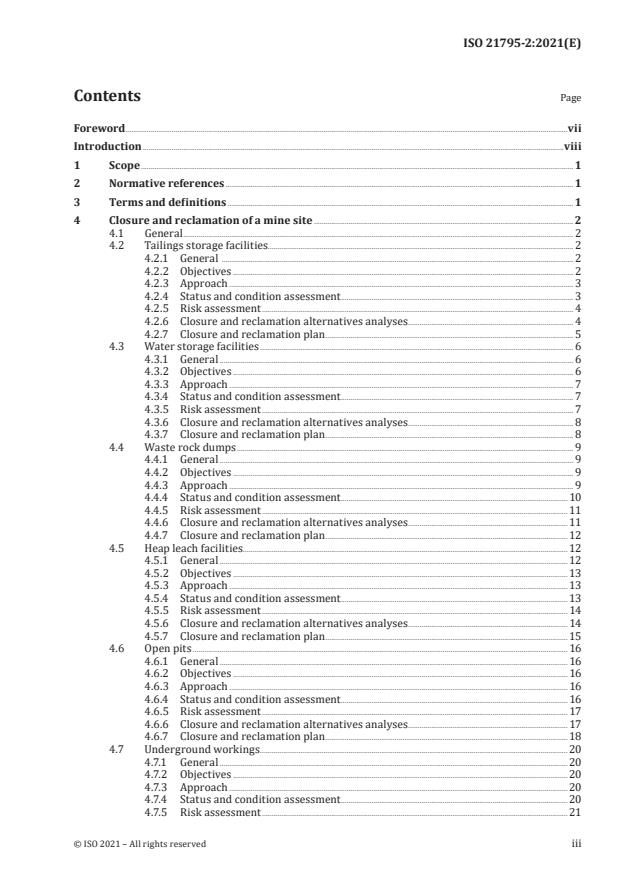
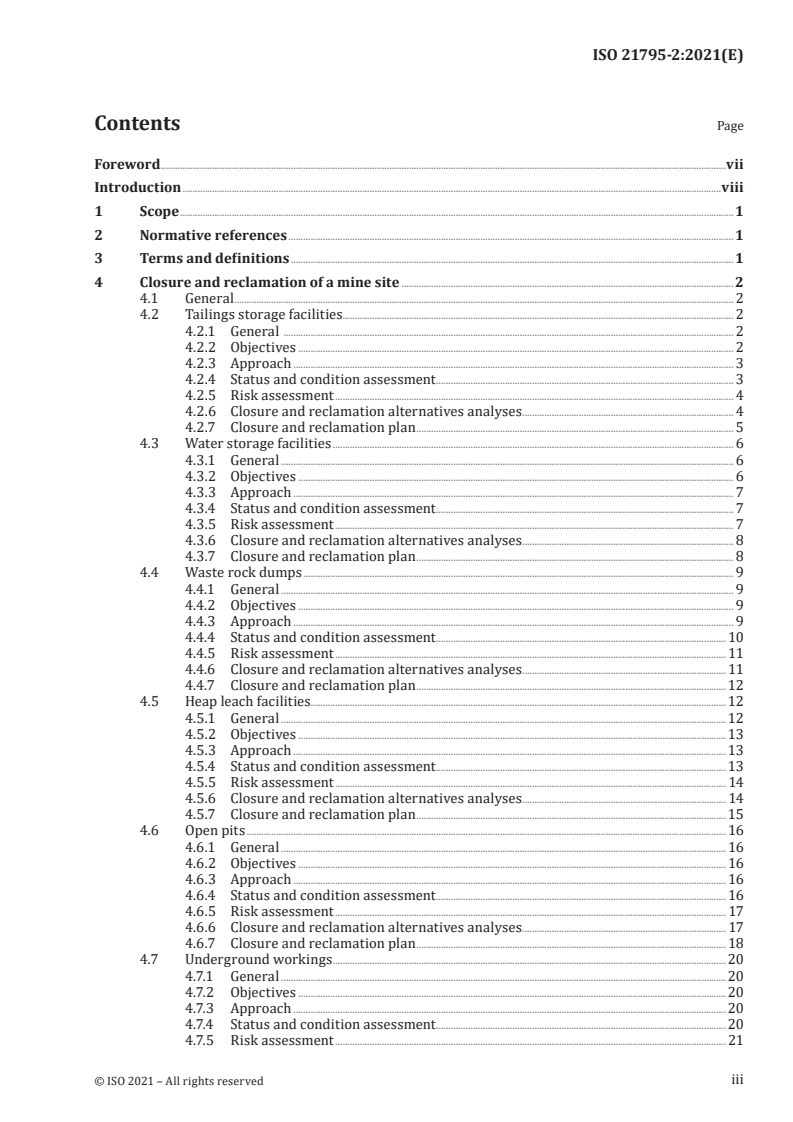
Contents Page
Foreword .vii
Introduction .viii
1 Scope . 1
2 Normative references . 1
3 Terms and definitions . 1
4 Closure and reclamation of a mine site . 2
4.1 General . 2
4.2 Tailings storage facilities. 2
4.2.1 General . 2
4.2.2 Objectives . 2
4.2.3 Approach . 3
4.2.4 Status and condition assessment . 3
4.2.5 Risk assessment . 4
4.2.6 Closure and reclamation alternatives analyses . 4
4.2.7 Closure and reclamation plan . 5
4.3 Water storage facilities . 6
4.3.1 General . 6
4.3.2 Objectives . 6
4.3.3 Approach . 7
4.3.4 Status and condition assessment . 7
4.3.5 Risk assessment . 7
4.3.6 Closure and reclamation alternatives analyses . 8
4.3.7 Closure and reclamation plan . 8
4.4 Waste rock dumps . 9
4.4.1 General . 9
4.4.2 Objectives . 9
4.4.3 Approach . 9
4.4.4 Status and condition assessment . 10
4.4.5 Risk assessment . 11
4.4.6 Closure and reclamation alternatives analyses . 11
4.4.7 Closure and reclamation plan .12
4.5 Heap leach facilities. 12
4.5.1 General .12
4.5.2 Objectives .13
4.5.3 Approach . 13
4.5.4 Status and condition assessment . 13
4.5.5 Risk assessment . 14
4.5.6 Closure and reclamation alternatives analyses . 14
4.5.7 Closure and reclamation plan . 15
4.6 Open pits . 16
4.6.1 General . 16
4.6.2 Objectives . 16
4.6.3 Approach . 16
4.6.4 Status and condition assessment . 16
4.6.5 Risk assessment . 17
4.6.6 Closure and reclamation alternatives analyses . 17
4.6.7 Closure and reclamation plan . 18
4.7 Underground workings . 20
4.7.1 General .20
4.7.2 Objectives .20
4.7.3 Approach . 20
4.7.4 Status and condition assessment . 20
4.7.5 Risk assessment . 21
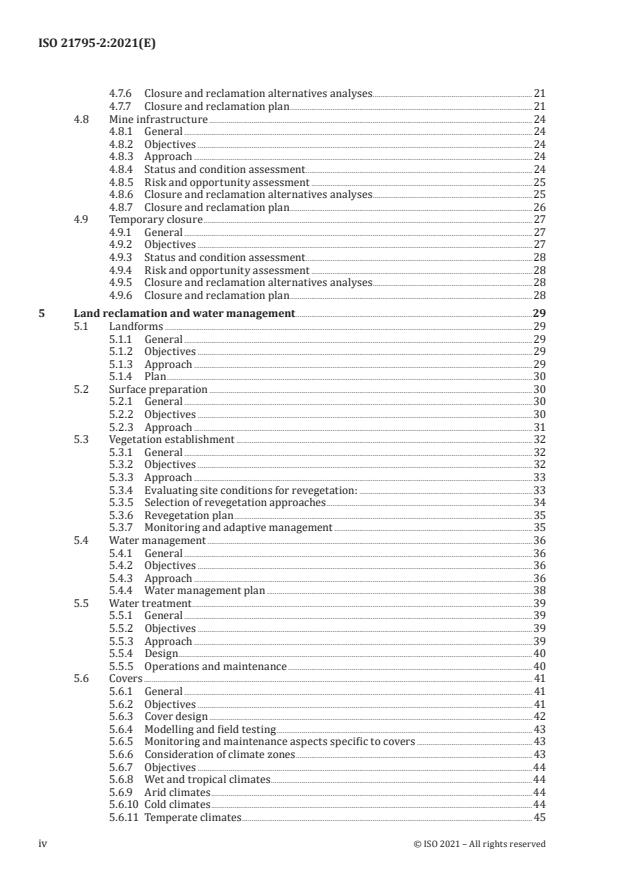
iii
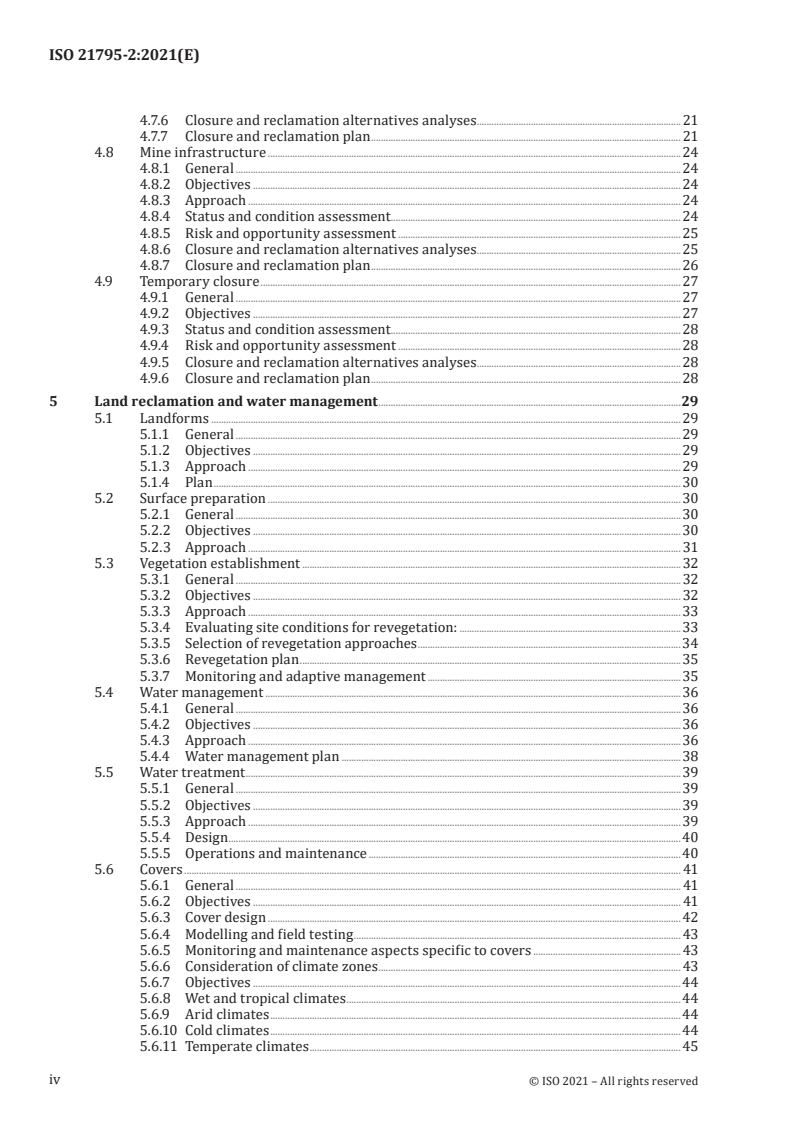
4.7.6 Closure and reclamation alternatives analyses . 21
4.7.7 Closure and reclamation plan . 21
4.8 Mine infrastructure . 24
4.8.1 General . 24
4.8.2 Objectives . 24
4.8.3 Approach . 24
4.8.4 Status and condition assessment . 24
4.8.5 Risk and opportunity assessment . 25
4.8.6 Closure and reclamation alternatives analyses . 25
4.8.7 Closure and reclamation plan . 26
4.9 Temporary closure . 27
4.9.1 General . 27
4.9.2 Objectives . 27
4.9.3 Status and condition assessment .28
4.9.4 Risk and opportunity assessment .28
4.9.5 Closure and reclamation alternatives analyses .28
4.9.6 Closure and reclamation plan .28
5 Land reclamation and water management .29
5.1 Landforms .29
5.1.1 General .29
5.1.2 Objectives .29
5.1.3 Approach .29
5.1.4 Plan .30
5.2 Surface preparation . 30
5.2.1 General .30
5.2.2 Objectives .30
5.2.3 Approach . 31
5.3 Vegetation establishment . 32
5.3.1 General . 32
5.3.2 Objectives . 32
5.3.3 Approach . 33
5.3.4 Evaluating site conditions for revegetation: . 33
5.3.5 Selection of revegetation approaches .34
5.3.6 Revegetation plan . 35
5.3.7 Monitoring and adaptive management . 35
5.4 Water management .36
5.4.1 General .36
5.4.2 Objectives . 36
5.4.3 Approach . 36
5.4.4 Water management plan .38
5.5 Water treatment .39
5.5.1 General .39
5.5.2 Objectives . 39
5.5.3 Approach . 39
5.5.4 Design .40
5.5.5 Operations and maintenance .40
5.6 Covers . 41
5.6.1 General . 41
5.6.2 Objectives . 41
5.6.3 Cover design . 42
5.6.4 Modelling and field testing . 43
5.6.5 Monitoring and maintenance aspects specific to covers . 43
5.6.6 Consideration of climate zones . 43
5.6.7 Objectives .44
5.6.8 Wet and tropical climates .44
5.6.9 Arid climates .44
5.6.10 Cold climates .44
5.6.11 Temperate climates . 45
iv
5.7 Climate change effects . 45
5.7.1 General . 45
6 Stakeholder engagement .46
6.1 General .46
6.2 Objectives . 47
6.3 Approach . 47
6.3.1 General . 47
6.3.2 Stakeholders identification .48
6.3.3 Special rights holders .48
6.3.4 Indigenous peoples .49
6.3.5 Stakeholder mapping .49
6.3.6 Engagement methods .49
6.3.7 Response program .49
6.3.8 Social transition — Post-closure and reclamation stakeholder agreements .49
6.3.9 Engagement plan . 50
6.3.10 Engagement and reporting frequency .50
7 Decision and analysis tools.50
7.1 Design levels .50
7.1.1 General .50
7.1.2 Objectives .50
7.1.3 Approach .50
7.1.4 Conceptual design level . 51
7.1.5 Pre-feasibility design level . 51
7.1.6 Feasibility design level . 51
7.1.7 Detailed design level . 52
7.1.8 As-built documentation. 52
7.1.9 Application of design levels to mine closure and reclamation planning . 52
7.2 Alternatives identification and analysis . 53
7.2.1 General .53
7.2.2 Objectives .53
7.2.3 Approach . 53
7.2.4 Technology screening .54
7.2.5 Options screening .54
7.2.6 Options analysis . 55
7.2.7 Stakeholder engagement .56
7.2.8 Documentation.56
7.3 Designing and operating for closure and reclamation. 57
7.3.1 General . 57
7.3.2 Objectives . 57
7.3.3 Approach . 57
7.3.4 Design criteria .58
7.3.5 Documentation.58
7.4 Risk assessment and management . 59
7.4.1 General . 59
7.4.2 Objectives . 59
7.4.3 Approach . 59
7.4.4 Corporate role in risk management and resilience engineering .60
7.4.5 Management of change .60
7.4.6 Assessing the risk of design or operational failure in meeting design
objectives .60
7.4.7 Resilience requirements .60
7.4.8 Plan . 61
7.5 Cost estimating . 61
7.5.1 General . 61
7.5.2 Objectives . 61
7.5.3 Approach . 62
7.5.4 Level of cost estimates . 62
v
7.5.5 Cost estimating methodology .63
7.5.6 Guidance for the purposes of cost analysis .63
7.5.7 Cash flow costs .63
7.5.8 Financial plan .64
7.6 Performance monitoring and reporting .64
7.6.1 General .64
7.6.2 Objectives .65
7.6.3 Approach .65
7.6.4 Scope .66
7.6.5 Media.66
7.6.6 Parameters .66
7.6.7 Compliance and action trigger levels . 67
7.6.8 Monitoring plan . 67
7.6.9 Corrective action plan .68
7.6.10 Peer review.68
7.6.11 Revisions .68
7.6.12 Data collection and reporting . 69
7.7 Adaptive management .69
7.7.1 General .69
7.7.2 Objectives . 69
7.7.3 Approach . 69
7.7.4 Adaptive management plan . 70
7.8 Application to the long-term care phase . 70
Bibliography .71
vi
Foreword
ISO (the International Organization for Standardization) is a worldwide federation of national standards
bodies (ISO member bodies). The work of preparing International Standards is normally carried out
through ISO technical committees. Each member body interested in a subject for which a technical
committee has been established has the right to be represented on that committee. International
organizations, governmental and non-governmental, in liaison with ISO, also take part in the work.
ISO collaborates closely with the International Electrotechnical Commission (IEC) on all matters of
electrotechnical standardization.
The procedures used to develop this document and those intended for its further maintenance are
described in the ISO/IEC Directives, Part 1. In particular the different approval criteria needed for the
different types of ISO documents shall be noted. This document was drafted in accordance with the
editorial rules of the ISO/IEC Directives, Part 2(see www.iso.org/directives).
Attention is drawn to the possibility that some of the elements of this document may be the subject of
patent rights. ISO shall not be held responsible for identifying any or all such patent rights. Details of
any patent rights identified during the development of the document will be in the Introduction and/or
on the ISO list of patent declarations received (see www.iso.org/patents).
Any trade name used in this document is information given for the convenience of users and does not
constitute an endorsement.
For an explanation of the voluntary nature of standards, the meaning of ISO specific terms and
expressions related to conformity assessment, as well as information about ISO's adherence to
the World Trade Organization (WTO) principles in the Technical Barriers to Trade (TBT), see
www.iso.org/iso/foreword.html.
This document was prepared by Technical Committee ISO/TC 82, Mining, Subcommittee SC 7, Mine
closure and reclamation management.
A list of all parts in the ISO 21785 series can be found on the ISO website.
Any feedback or questions on this document should be directed to the user’s national standards body. A
complete listing of these bodies can be found at www.iso.org/members.html.
vii
Introduction
This document provides guidance for mine closure and reclamation planning applicable to both new and
operating mines. The overarching objective is to promote consistency and quality in planning for mine
closure and reclamation internationally. ISO 21795-1 provides requirements for the same material.
The intended audience are those with responsibility for, or an interest in, planning for mine closure and
reclamation. This includes mine planners and designers, mine operators, regulators, environmental
assessors, communities, indigenous peoples, and financial stakeholders, amongst others.
Mine planning, design and operations must be fully integrated with the closure and reclamation
process. Early, continual and comprehensive mine closure and reclamation planning is essential for all
new and operating mines because it:
— leads to the highest degree of environmental and social success, usually at a lower cost than if mine
closure and reclamation planning is not done from the beginning of the mining project;
— reduces risks and liabilities throughout the mine’s operational life and on closure;
— allows for stakeholder involvement throughout, so that relevant knowledge and understanding are
brought into the planning process;
— allows for devoting more attention to sustainable development activities identifying socio-economic
opportunities for the various closure phases;
— helps build trust with governments, stakeholders and international communities;
— provides additional planning time to understand the complexity of the biophysical characteristics
and socio-economic context of each mine site;
— provides for continual improvement and updating of closure and reclamation plans;
— allows companies to better integrate closure and reclamation activities with operations;
— provides time to identify, research and develop new technologies for mine closure strategies and
mine closure treatments that increase robustness and resilience of mine closure and reclamation;
and
— allows companies to better provision for and schedule closure and reclamation funding.
There are many leading practices and guidance documents related to mine closure and reclamation
planning available in various jurisdictions and used by many mining companies and stakeholders. This
document captures the intent of such guidance documents so that it can be applied globally.
viii
INTERNATIONAL STANDARD ISO 21795-2:2021(E)
Mine closure and reclamation planning —
Part 2:
Guidance
1 Scope
This document provides guidance related to the necessary mine closure and reclamation planning
activities for new and operating mines. Recommendations are provided on:
— closure and reclamation of a mine site;
— land reclamation and water management;
— stakeholder engagement;
— decision and analysis tools.
The following aspects of closure and reclamation are not addressed in this document:
— infrastructure such as rail lines, ports, off-site ore loaders, power stations, etc. that are associated
with the mine operation, but which are not located at the mine site;
— detailed survey, testing or monitoring methods, detailed engineering procedures, detailed product
requirements, or detailed construction and operational procedures; occupational health and safety
management related to closure and reclamation, construction and exploration activities;
— relinquishment of a closed and reclaimed mine site, or portions thereof, to a party (governmental or
private entity) not related to the mine operator;
— specific requirements for dealing with the radiological aspects of mine closure and reclamation,
such as those that occur at uranium mining and processing facilities and other mines at which
naturally occurring radioactive materials are present; however, the other aspects associated with
closure and reclamation of these mines are included in this document; and
— closure and reclamation of abandoned mines.
2 Normative references
The following documents are referred to in the text in such a way that some or all of their content
constitutes requirements of this document. For dated references, only the edition cited applies. For
undated references, the latest edition of the referenced document (including any amendments) applies.
ISO 20305, Mine closure and reclamation — Vocabulary
3 Terms and definitions
For the purposes of this document, the terms and definitions given in ISO 20305 apply.
ISO and IEC maintain terminological databases for use in standardization at the following addresses:
— ISO Online browsing platform: available at https:// www .iso .org/ obp
— IEC Electropedia: available at https:// www .electropedia .org/
4 Closure and reclamation of a mine site
4.1 General
During the mine closure and reclamation planning and design process, a significant amount of
knowledge from a range of internal and external sources, including government agencies, consultants,
indigenous peoples and other landowners/users, downstream water users, as well as from field
investigations, laboratory testing and field trials and research, is collected. This data collection process
should be initiated early in the mine life cycle in order to produce a more comprehensive and precise
database. The collected data should be summarized in reports, maps and electronic information in
a form that can be used in geographical information systems (GIS) and, if necessary, be provided to
stakeholders. Digitizing and geo-referencing old maps found in various archives should be avoided or
undertaken with care, since their quality can be quite poor.
4.2 Tailings storage facilities
4.2.1 General
Tailings storage facilities (TSFs) are frequently a
...
INTERNATIONAL ISO
STANDARD 21795-2
First edition
2021-10
Mine closure and reclamation
planning —
Part 2:
Guidance
Planification de la fermeture et de la restauration des mines —
Partie 2: Recommandations
Reference number
© ISO 2021
All rights reserved. Unless otherwise specified, or required in the context of its implementation, no part of this publication may
be reproduced or utilized otherwise in any form or by any means, electronic or mechanical, including photocopying, or posting on
the internet or an intranet, without prior written permission. Permission can be requested from either ISO at the address below
or ISO’s member body in the country of the requester.
ISO copyright office
CP 401 • Ch. de Blandonnet 8
CH-1214 Vernier, Geneva
Phone: +41 22 749 01 11
Email: copyright@iso.org
Website: www.iso.org
Published in Switzerland
ii
Contents Page
Foreword .vii
Introduction .viii
1 Scope . 1
2 Normative references . 1
3 Terms and definitions . 1
4 Closure and reclamation of a mine site . 2
4.1 General . 2
4.2 Tailings storage facilities. 2
4.2.1 General . 2
4.2.2 Objectives . 2
4.2.3 Approach . 3
4.2.4 Status and condition assessment . 3
4.2.5 Risk assessment . 4
4.2.6 Closure and reclamation alternatives analyses . 4
4.2.7 Closure and reclamation plan . 5
4.3 Water storage facilities . 6
4.3.1 General . 6
4.3.2 Objectives . 6
4.3.3 Approach . 7
4.3.4 Status and condition assessment . 7
4.3.5 Risk assessment . 7
4.3.6 Closure and reclamation alternatives analyses . 8
4.3.7 Closure and reclamation plan . 8
4.4 Waste rock dumps . 9
4.4.1 General . 9
4.4.2 Objectives . 9
4.4.3 Approach . 9
4.4.4 Status and condition assessment . 10
4.4.5 Risk assessment . 11
4.4.6 Closure and reclamation alternatives analyses . 11
4.4.7 Closure and reclamation plan .12
4.5 Heap leach facilities. 12
4.5.1 General .12
4.5.2 Objectives .13
4.5.3 Approach . 13
4.5.4 Status and condition assessment . 13
4.5.5 Risk assessment . 14
4.5.6 Closure and reclamation alternatives analyses . 14
4.5.7 Closure and reclamation plan . 15
4.6 Open pits . 16
4.6.1 General . 16
4.6.2 Objectives . 16
4.6.3 Approach . 16
4.6.4 Status and condition assessment . 16
4.6.5 Risk assessment . 17
4.6.6 Closure and reclamation alternatives analyses . 17
4.6.7 Closure and reclamation plan . 18
4.7 Underground workings . 20
4.7.1 General .20
4.7.2 Objectives .20
4.7.3 Approach . 20
4.7.4 Status and condition assessment . 20
4.7.5 Risk assessment . 21
iii
4.7.6 Closure and reclamation alternatives analyses . 21
4.7.7 Closure and reclamation plan . 21
4.8 Mine infrastructure . 24
4.8.1 General . 24
4.8.2 Objectives . 24
4.8.3 Approach . 24
4.8.4 Status and condition assessment . 24
4.8.5 Risk and opportunity assessment . 25
4.8.6 Closure and reclamation alternatives analyses . 25
4.8.7 Closure and reclamation plan . 26
4.9 Temporary closure . 27
4.9.1 General . 27
4.9.2 Objectives . 27
4.9.3 Status and condition assessment .28
4.9.4 Risk and opportunity assessment .28
4.9.5 Closure and reclamation alternatives analyses .28
4.9.6 Closure and reclamation plan .28
5 Land reclamation and water management .29
5.1 Landforms .29
5.1.1 General .29
5.1.2 Objectives .29
5.1.3 Approach .29
5.1.4 Plan .30
5.2 Surface preparation . 30
5.2.1 General .30
5.2.2 Objectives .30
5.2.3 Approach . 31
5.3 Vegetation establishment . 32
5.3.1 General . 32
5.3.2 Objectives . 32
5.3.3 Approach . 33
5.3.4 Evaluating site conditions for revegetation: . 33
5.3.5 Selection of revegetation approaches .34
5.3.6 Revegetation plan . 35
5.3.7 Monitoring and adaptive management . 35
5.4 Water management .36
5.4.1 General .36
5.4.2 Objectives . 36
5.4.3 Approach . 36
5.4.4 Water management plan .38
5.5 Water treatment .39
5.5.1 General .39
5.5.2 Objectives . 39
5.5.3 Approach . 39
5.5.4 Design .40
5.5.5 Operations and maintenance .40
5.6 Covers . 41
5.6.1 General . 41
5.6.2 Objectives . 41
5.6.3 Cover design . 42
5.6.4 Modelling and field testing . 43
5.6.5 Monitoring and maintenance aspects specific to covers . 43
5.6.6 Consideration of climate zones . 43
5.6.7 Objectives .44
5.6.8 Wet and tropical climates .44
5.6.9 Arid climates .44
5.6.10 Cold climates .44
5.6.11 Temperate climates . 45
iv
5.7 Climate change effects . 45
5.7.1 General . 45
6 Stakeholder engagement .46
6.1 General .46
6.2 Objectives . 47
6.3 Approach . 47
6.3.1 General . 47
6.3.2 Stakeholders identification .48
6.3.3 Special rights holders .48
6.3.4 Indigenous peoples .49
6.3.5 Stakeholder mapping .49
6.3.6 Engagement methods .49
6.3.7 Response program .49
6.3.8 Social transition — Post-closure and reclamation stakeholder agreements .49
6.3.9 Engagement plan . 50
6.3.10 Engagement and reporting frequency .50
7 Decision and analysis tools.50
7.1 Design levels .50
7.1.1 General .50
7.1.2 Objectives .50
7.1.3 Approach .50
7.1.4 Conceptual design level . 51
7.1.5 Pre-feasibility design level . 51
7.1.6 Feasibility design level . 51
7.1.7 Detailed design level . 52
7.1.8 As-built documentation. 52
7.1.9 Application of design levels to mine closure and reclamation planning . 52
7.2 Alternatives identification and analysis . 53
7.2.1 General .53
7.2.2 Objectives .53
7.2.3 Approach . 53
7.2.4 Technology screening .54
7.2.5 Options screening .54
7.2.6 Options analysis . 55
7.2.7 Stakeholder engagement .56
7.2.8 Documentation.56
7.3 Designing and operating for closure and reclamation. 57
7.3.1 General . 57
7.3.2 Objectives . 57
7.3.3 Approach . 57
7.3.4 Design criteria .58
7.3.5 Documentation.58
7.4 Risk assessment and management . 59
7.4.1 General . 59
7.4.2 Objectives . 59
7.4.3 Approach . 59
7.4.4 Corporate role in risk management and resilience engineering .60
7.4.5 Management of change .60
7.4.6 Assessing the risk of design or operational failure in meeting design
objectives .60
7.4.7 Resilience requirements .60
7.4.8 Plan . 61
7.5 Cost estimating . 61
7.5.1 General . 61
7.5.2 Objectives . 61
7.5.3 Approach . 62
7.5.4 Level of cost estimates . 62
v
7.5.5 Cost estimating methodology .63
7.5.6 Guidance for the purposes of cost analysis .63
7.5.7 Cash flow costs .63
7.5.8 Financial plan .64
7.6 Performance monitoring and reporting .64
7.6.1 General .64
7.6.2 Objectives .65
7.6.3 Approach .65
7.6.4 Scope .66
7.6.5 Media.66
7.6.6 Parameters .66
7.6.7 Compliance and action trigger levels . 67
7.6.8 Monitoring plan . 67
7.6.9 Corrective action plan .68
7.6.10 Peer review.68
7.6.11 Revisions .68
7.6.12 Data collection and reporting . 69
7.7 Adaptive management .69
7.7.1 General .69
7.7.2 Objectives . 69
7.7.3 Approach . 69
7.7.4 Adaptive management plan . 70
7.8 Application to the long-term care phase . 70
Bibliography .71
vi
Foreword
ISO (the International Organization for Standardization) is a worldwide federation of national standards
bodies (ISO member bodies). The work of preparing International Standards is normally carried out
through ISO technical committees. Each member body interested in a subject for which a technical
committee has been established has the right to be represented on that committee. International
organizations, governmental and non-governmental, in liaison with ISO, also take part in the work.
ISO collaborates closely with the International Electrotechnical Commission (IEC) on all matters of
electrotechnical standardization.
The procedures used to develop this document and those intended for its further maintenance are
described in the ISO/IEC Directives, Part 1. In particular the different approval criteria needed for the
different types of ISO documents shall be noted. This document was drafted in accordance with the
editorial rules of the ISO/IEC Directives, Part 2(see www.iso.org/directives).
Attention is drawn to the possibility that some of the elements of this document may be the subject of
patent rights. ISO shall not be held responsible for identifying any or all such patent rights. Details of
any patent rights identified during the development of the document will be in the Introduction and/or
on the ISO list of patent declarations received (see www.iso.org/patents).
Any trade name used in this document is information given for the convenience of users and does not
constitute an endorsement.
For an explanation of the voluntary nature of standards, the meaning of ISO specific terms and
expressions related to conformity assessment, as well as information about ISO's adherence to
the World Trade Organization (WTO) principles in the Technical Barriers to Trade (TBT), see
www.iso.org/iso/foreword.html.
This document was prepared by Technical Committee ISO/TC 82, Mining, Subcommittee SC 7, Mine
closure and reclamation management.
A list of all parts in the ISO 21785 series can be found on the ISO website.
Any feedback or questions on this document should be directed to the user’s national standards body. A
complete listing of these bodies can be found at www.iso.org/members.html.
vii
Introduction
This document provides guidance for mine closure and reclamation planning applicable to both new and
operating mines. The overarching objective is to promote consistency and quality in planning for mine
closure and reclamation internationally. ISO 21795-1 provides requirements for the same material.
The intended audience are those with responsibility for, or an interest in, planning for mine closure and
reclamation. This includes mine planners and designers, mine operators, regulators, environmental
assessors, communities, indigenous peoples, and financial stakeholders, amongst others.
Mine planning, design and operations must be fully integrated with the closure and reclamation
process. Early, continual and comprehensive mine closure and reclamation planning is essential for all
new and operating mines because it:
— leads to the highest degree of environmental and social success, usually at a lower cost than if mine
closure and reclamation planning is not done from the beginning of the mining project;
— reduces risks and liabilities throughout the mine’s operational life and on closure;
— allows for stakeholder involvement throughout, so that relevant knowledge and understanding are
brought into the planning process;
— allows for devoting more attention to sustainable development activities identifying socio-economic
opportunities for the various closure phases;
— helps build trust with governments, stakeholders and international communities;
— provides additional planning time to understand the complexity of the biophysical characteristics
and socio-economic context of each mine site;
— provides for continual improvement and updating of closure and reclamation plans;
— allows companies to better integrate closure and reclamation activities with operations;
— provides time to identify, research and develop new technologies for mine closure strategies and
mine closure treatments that increase robustness and resilience of mine closure and reclamation;
and
— allows companies to better provision for and schedule closure and reclamation funding.
There are many leading practices and guidance documents related to mine closure and reclamation
planning available in various jurisdictions and used by many mining companies and stakeholders. This
document captures the intent of such guidance documents so that it can be applied globally.
viii
INTERNATIONAL STANDARD ISO 21795-2:2021(E)
Mine closure and reclamation planning —
Part 2:
Guidance
1 Scope
This document provides guidance related to the necessary mine closure and reclamation planning
activities for new and operating mines. Recommendations are provided on:
— closure and reclamation of a mine site;
— land reclamation and water management;
— stakeholder engagement;
— decision and analysis tools.
The following aspects of closure and reclamation are not addressed in this document:
— infrastructure such as rail lines, ports, off-site ore loaders, power stations, etc. that are associated
with the mine operation, but which are not located at the mine site;
— detailed survey, testing or monitoring methods, detailed engineering procedures, detailed product
requirements, or detailed construction and operational procedures; occupational health and safety
management related to closure and reclamation, construction and exploration activities;
— relinquishment of a closed and reclaimed mine site, or portions thereof, to a party (governmental or
private entity) not related to the mine operator;
— specific requirements for dealing with the radiological aspects of mine closure and reclamation,
such as those that occur at uranium mining and processing facilities and other mines at which
naturally occurring radioactive materials are present; however, the other aspects associated with
closure and reclamation of these mines are included in this document; and
— closure and reclamation of abandoned mines.
2 Normative references
The following documents are referred to in the text in such a way that some or all of their content
constitutes requirements of this document. For dated references, only the edition cited applies. For
undated references, the latest edition of the referenced document (including any amendments) applies.
ISO 20305, Mine closure and reclamation — Vocabulary
3 Terms and definitions
For the purposes of this document, the terms and definitions given in ISO 20305 apply.
ISO and IEC maintain terminological databases for use in standardization at the following addresses:
— ISO Online browsing platform: available at https:// www .iso .org/ obp
— IEC Electropedia: available at https:// www .electropedia .org/
4 Closure and reclamation of a mine site
4.1 General
During the mine closure and reclamation planning and design process, a significant amount of
knowledge from a range of internal and external sources, including government agencies, consultants,
indigenous peoples and other landowners/users, downstream water users, as well as from field
investigations, laboratory testing and field trials and research, is collected. This data collection process
should be initiated early in the mine life cycle in order to produce a more comprehensive and precise
database. The collected data should be summarized in reports, maps and electronic information in
a form that can be used in geographical information systems (GIS) and, if necessary, be provided to
stakeholders. Digitizing and geo-referencing old maps found in various archives should be avoided or
undertaken with care, since their quality can be quite poor.
4.2 Tailings storage facilities
4.2.1 General
Tailings storage facilities (TSFs) are frequently a
...