

ISO/IEC FDIS 29128-3
(Main)Information security, cybersecurity and privacy protection — Verification of cryptographic protocols — Part 3: Evaluation methods and activities for protocol implementation verification
- Abstract
This document gives guidance on evaluating the implementation of a cryptographic protocol based on the framework provided in ISO/IEC 15408-4. This document specifies the required methods and activities to assess the conformance of a cryptographic protocol implementation to its ISO/IEC 29128-2 based formally verified protocol model. This document specifies assurance metrics for the integrated evaluation of both the cryptographic protocol and its implementation.
- Status
- Not Published
- Current Stage
- 5020 - Proof sent to secretariat or FDIS ballot initiated: 8 weeks - 50 Approval
- Start Date
- 19-Nov-2026
- Due Date
- 19-Nov-2026
- Completion Date
- 19-Nov-2026
Buy Documents


ISO/IEC FDIS 29128-3 - Information security, cybersecurity and privacy protection — Verification of cryptographic protocols — Part 3: Evaluation methods and activities for protocol implementation verification
REDLINE ISO/IEC FDIS 29128-3 - Information security, cybersecurity and privacy protection — Verification of cryptographic protocols — Part 3: Evaluation methods and activities for protocol implementation verification
ISO/IEC FDIS 29128-3 is an ISO/IEC document for evaluating the implementation of a cryptographic protocol. It specifies methods and activities to check whether a protocol implementation conforms to its ISO/IEC 29128-2 based formally verified protocol model, and it defines assurance metrics for combined evaluation of the protocol and its implementation.
What does ISO/IEC FDIS 29128-3 specify?
ISO/IEC FDIS 29128-3 specifies how to evaluate a cryptographic protocol implementation using the framework from ISO/IEC 15408-4. It is aimed at measuring implementation assurance by combining formal proof results for the protocol with vulnerability assessment of the implementation.
The document is organized into:
- Clause 1 Scope
- Clause 2 Normative references
- Clause 3 Terms and definitions
- Clause 4 Overview
- Clause 5 Formal evaluation methods and activities for cryptographic protocol implementation
- Clause 6 Implementation Assurance Levels
- Clause 7 Vulnerability assessment
- Informative annexes A to C
| Annex | What it covers |
|---|---|
| Annex A | Example of known attacks |
| Annex B | Example evaluation based on ISO/IEC 18045 |
| Annex C | Example of testing tools |
What are the key requirements of ISO/IEC FDIS 29128-3?
ISO/IEC FDIS 29128-3 ties evaluation to both the formally verified protocol and the implemented system. In practice, this means the evaluator needs a matched set of protocol evidence, implementation evidence, and vulnerability evidence before assigning an Implementation Assurance Level (IAL).
Evaluation assumptions and required inputs
Clause 5.2.1 sets the evaluation assumptions. The implementation is expected to match the original protocol’s functional and security properties, operate within a defined cryptographic boundary, and preserve the protocol’s communication capabilities. The implementation model also needs to be aligned with the model used in ISO/IEC 29128-2.
Clause 5.2.2 lists the required submission package. It includes the implementation model, design description with architecture, internal interfaces, technical specification, usage guidance, supporting firmware and software, API commands, memory and storage details, and a functional mapping between the formal protocol specification, the finite state model (FSM), and the source code. In practice, this is the evidence package the evaluator uses to trace the design from specification to code.
Adversary model and attack analysis
Clause 5.2.4 treats the evaluator as an adversary with full access to the implementation and its construction details. The adversary can use side-channel analysis, fault injection, and other means to probe attack surfaces, extract sensitive parameters, alter execution, or bypass security mechanisms. The clause also expects at least three unique parties to be available in the evaluation scenario, reflecting initiator, responder, and attacker roles.
Clause 5.2.8 requires identification of attack surfaces, protected assets, attack scenarios, attack paths, and attack potential ranking using ISO/IEC 18045 metrics. Clause 5.2.9 then uses the resulting attack paths and the expected assurance coverage to judge attack feasibility. Clause 5.2.10 requires a rationale that shows the attack analysis covers all applicable threat scenarios. In practice, the evaluator has to show where the implementation can be attacked and why the chosen tests are representative.
Pass/fail rules
Clause 5.2.6 says the theoretical proof must reach at least Prover Assurance Level 1 and Prover Confidence Level 1 under ISO/IEC 29128-2, and all security-property evaluation activities for that proof must pass. Clause 5.2.7 says the vulnerability analysis fails if any adversarial test succeeds in violating security. That means the evaluation only passes when both the formal proof side and the practical attack side are successful.
Evaluation activities and source-code traceability
Clause 5.3.2 requires the evaluator to check the submitted model, the availability of required evidence, the absence of platform faults that could distort the evaluation, the identified vulnerabilities and threats, and the completeness of the functional mapping. Clause 5.3.5 adds direct source-code review under the common evaluation methodology (CEM). In practice, the evaluator must be able to trace the documented protocol behavior all the way to the code that implements it.
Implementation Assurance Levels
Clause 6 defines seven IALs. Each IAL combines an AVA_VAN level with a Prover Assurance Level and Prover Confidence Level.
- IAL 1 - AVA_VAN.1 with Prover Assurance Level 1 and Prover Confidence Level 1
- IAL 2 - AVA_VAN.2 with Prover Assurance Level 1 and Prover Confidence Level 1
- IAL 3 - AVA_VAN.2 with Prover Assurance Level 1 and Prover Confidence Level 2
- IAL 4 - AVA_VAN.3 with Prover Assurance Level 2 and Prover Confidence Level 3
- IAL 5 - AVA_VAN.4 with Prover Assurance Level 3 and Prover Confidence Level 3
- IAL 6 - AVA_VAN.5 with Prover Assurance Level 3 and Prover Confidence Level 3
- IAL 7 - AVA_VAN.5 with Prover Assurance Level 4 and Prover Confidence Level 3
Clause 6.9 explains the relationship between theoretical proof and robustness assessment. In practice, higher IALs increase both the strength of the formal evidence and the depth of practical vulnerability checking.
Vulnerability assessment method
Clause 7 bases vulnerability assessment on attack potential metrics from ISO/IEC 18045. The metrics are elapsed time, knowledge of the Target of Evaluation (TOE), window of opportunity, equipment, and expertise. These metrics are used to estimate how feasible an attack path is and how likely it is to expose an asset or break a security property.
What terms does ISO/IEC FDIS 29128-3 define?
- Attack scenario - An adversarial setting in which an evaluator identifies a way to exploit an underlying asset.
- Attack feasibility - The degree of complexity of carrying out an attack path for a given attack scenario.
- Cryptographic protocol implementation under test - The protocol implementation model submitted for security evaluation.
- Cryptographic protocol implementation submission package - The package that combines the formally verified protocol specification, the FSM representation, the implementation, evaluator capabilities, and the security properties to be tested.
- Common evaluation methodology (CEM) - The evaluation methodology framework from ISO/IEC 18045.
- Implementation Assurance Level (IAL) - The assurance metric that combines protocol proof evidence and implementation evaluation evidence.
- Security coverage - The rationale showing that all applicable threat or attack scenarios have been covered.
- Vulnerability assessment - Security verification performed to measure the robustness of the implementation model through evaluation of vulnerabilities.
Who uses ISO/IEC FDIS 29128-3?
ISO/IEC FDIS 29128-3 is used by developers and implementers of cryptographic protocols who need a structured way to assess implementation security. It is also used by evaluators who perform vulnerability assessment, check functional mappings, and review source code under the common evaluation methodology.
The document is relevant for teams working on cryptographic protocol implementations, their security assessment, and their assurance claims. The annex examples refer to TLS, HSM, and secure boot, so the document is also useful where cryptographic protocols are implemented in network security products, hardware security modules, or boot chains.
Which standards are used with ISO/IEC FDIS 29128-3?
- ISO/IEC 29128-2 - Provides the formally verified cryptographic protocol evaluation framework that supplies the protocol-level proof evidence used by this document.
- ISO/IEC 15408-4 - Provides the framework for specifying evaluation methods and activities, which this document follows.
- ISO/IEC 15408-5 - Is referenced for pre-defined packages of security requirements and for the ADV_IMP mapping mentioned in the implementation submission.
- ISO/IEC 18045:2026 - Provides the common evaluation methodology and the attack potential metrics used for vulnerability assessment.
- ISO/IEC 19790 - Provides the cryptographic boundary definitions referenced for implementation boundary assumptions.
- ISO/IEC 29128-1 - Appears in the bibliography as the framework part of the series.
What does the ISO/IEC FDIS 29128-3 document contain?
The document includes a figure showing the relationship between the parts of the ISO/IEC 29128 series and another figure showing the flow from attack scenario to attack path, evaluation activity, and rationale. Clause 5 lays out the evaluation method, required inputs, adversarial model, pass/fail rules, attack analysis, and required evaluator activities.
Clause 6 contains the IAL structure and a table that links Prover Assurance Levels, Prover Confidence Levels, and AVA_VAN levels. Clause 7 explains attack potential calculation using ISO/IEC 18045 metrics. Annex A gives examples of known attacks, Annex B walks through an example attack-potential evaluation, and Annex C points to an example testing tool, CRYScanner, for supporting the evaluation work.
Buy Documents
ISO/IEC FDIS 29128-3 - Information security, cybersecurity and privacy protection — Verification of cryptographic protocols — Part 3: Evaluation methods and activities for protocol implementation verification
REDLINE ISO/IEC FDIS 29128-3 - Information security, cybersecurity and privacy protection — Verification of cryptographic protocols — Part 3: Evaluation methods and activities for protocol implementation verification
Get Certified
Connect with accredited certification bodies for this standard

BSI Group
BSI (British Standards Institution) is the business standards company that helps organizations make excellence a habit.

Bureau Veritas
Bureau Veritas is a world leader in laboratory testing, inspection and certification services.

DNV
DNV is an independent assurance and risk management provider.
Sponsored listings
Frequently Asked Questions
ISO/IEC FDIS 29128-3 is a draft published by the International Organization for Standardization (ISO). Its full title is "Information security, cybersecurity and privacy protection — Verification of cryptographic protocols — Part 3: Evaluation methods and activities for protocol implementation verification". This standard covers: This document gives guidance on evaluating the implementation of a cryptographic protocol based on the framework provided in ISO/IEC 15408-4. This document specifies the required methods and activities to assess the conformance of a cryptographic protocol implementation to its ISO/IEC 29128-2 based formally verified protocol model. This document specifies assurance metrics for the integrated evaluation of both the cryptographic protocol and its implementation.
This document gives guidance on evaluating the implementation of a cryptographic protocol based on the framework provided in ISO/IEC 15408-4. This document specifies the required methods and activities to assess the conformance of a cryptographic protocol implementation to its ISO/IEC 29128-2 based formally verified protocol model. This document specifies assurance metrics for the integrated evaluation of both the cryptographic protocol and its implementation.
ISO/IEC FDIS 29128-3 is classified under the following ICS (International Classification for Standards) categories: 35.030 - IT Security. The ICS classification helps identify the subject area and facilitates finding related standards.
ISO/IEC FDIS 29128-3 is available in PDF format for immediate download after purchase. The document can be added to your cart and obtained through the secure checkout process. Digital delivery ensures instant access to the complete standard document.
Standards Content (Sample)
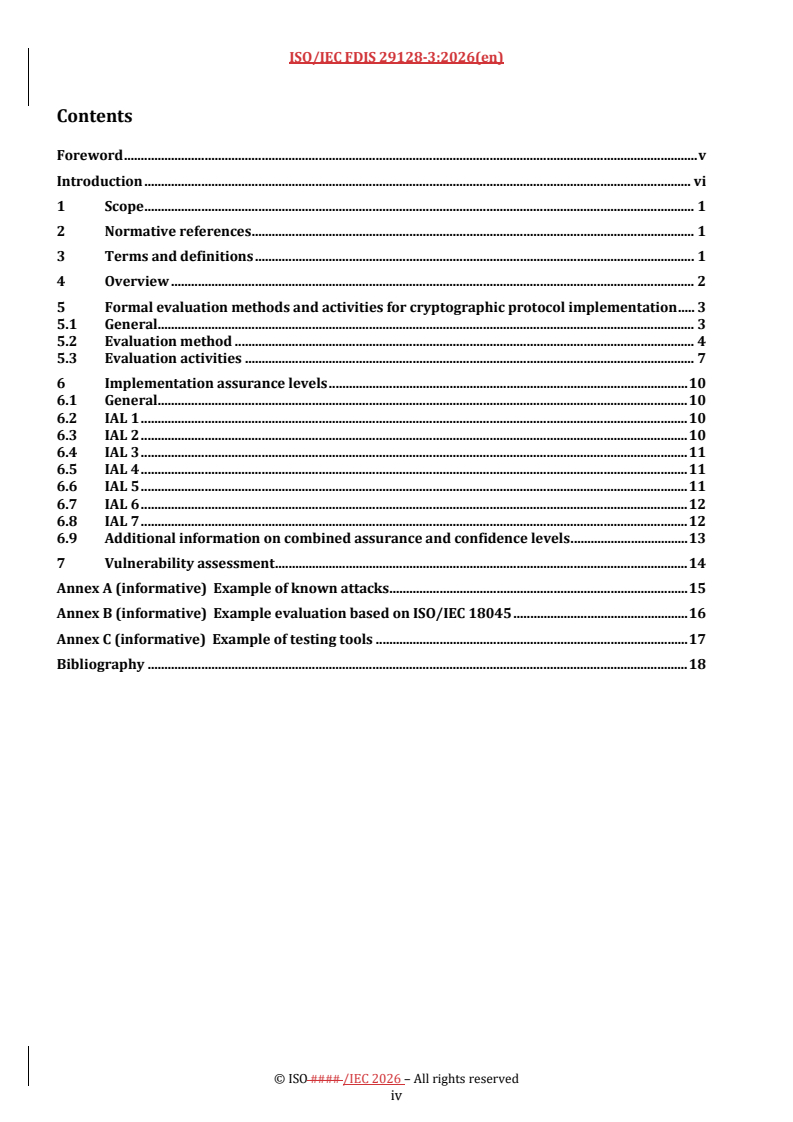
Contents
- Introduction
- 1 Scope
- 2 Normative references
- 3 Terms and definitions
- 3.1 attack scenario
- 3.2 attack feasibility
- 3.3 cryptographic protocol implementation under test
- 3.4 cryptographic protocol implementation submission package
- 3.5 common evaluation methodology
- 3.6 implementation assurance level
- 3.7 security coverage
- 3.8 security evaluation
- 3.9 vulnerability assessment
- 4 Overview
- 5 Formal evaluation methods and activities for cryptographic protocol
- 5.1 General
- 5.2 Evaluation method
- 5.3 Evaluation activities
- 6 Implementation assurance levels
- 6.1 General
- 0 Basic None
- 6.9 Additional information on combined assurance and confidence levels
- 7 Vulnerability assessment
- Annex A
- Annex B
- Annex C
- Bibliography
Introduction
The assurance in a cryptographic protocol implementation is key to a secure cryptographic application. This assurance requires a thorough evaluation to ensure correct functionality and security principles. ISO/IEC 29128-1 highlights the importance of the formal verification of cryptographic protocols. In ISO/IEC 29128-2, a framework of evaluation methods and evaluation activities for verifying cryptographic protocols derived from ISO/IEC 15408-4 is presented, which contain four different assurance levels and three different confidence levels in a two-dimensional score matrix. These levels are based on the theoretical proof obtained from evaluations using automated provers.
In this document, the next step in cryptographic protocol evaluation is provided, working at the implementation level. The provided methods and activities can be utilized to evaluate any cryptographic protocol implementation at a hardware level, and determine its associated assurance level, which is defined as an implementation assurance level (IAL) in this document. The IAL is based on the combination of the theoretical proof obtained when the method or activity as specified in ISO/IEC 29128-2 is applied to the cryptographic protocol, and the vulnerability analysis in terms of security is obtained by performing AVA_ VAN evaluation of the implementation.
This document aims to provide developers and implementers of a cryptographic protocol with a framework to estimate the security capabilities of the cryptographic protocol and its implementation in a generic manner and therefore provide a basis for improvement in terms of security. Additionally, it provides a means to generalize the security evaluation process of different cryptographic protocols and their implementations with an implementation assurance level framework.
FINAL DRAFT International Standard ISO/IEC FDIS 29128-3:2026(en) Information security, cybersecurity and privacy protection — Verification of cryptographic protocols — Part 3:
Evaluation methods and activities for protocol implementation verification
1 Scope
This document explains how to conduct an evaluation of a cryptographic protocol implementation based on the method framework provided in ISO/IEC 15408-4.
2 Normative references
The following documents are referred to in the text in such a way that some or all of their content constitutes requirements of this document. For dated references, only the edition cited applies. For undated references, the latest edition of the referenced document (including any amendments) applies. ISO/IEC 29128-2:2026, Information security, cybersecurity and privacy protection — Verification of cryptographic protocols — Part 2: Evaluation methods and activities for cryptographic protocols ISO/IEC 15408-5, Information security, cybersecurity and privacy protection — Evaluation criteria for IT security — Part 5: Pre-defined packages of security requirements ISO/IEC 18045:2026, Information security, cybersecurity and privacy protection — Evaluation criteria for IT security — Requirements and methodology for IT security evaluation ISO/IEC 19790, Information security, cybersecurity and privacy protection — Security requirements for cryptographic modules
3 Terms and definitions
For the purposes of this document, the following terms and definitions apply. ISO and IEC maintain terminology databases for use in standardization at the following addresses:
- ISO Online browsing platform: available at https:// www .iso .org/ obp
- IEC Electropedia: available at https:// www .electropedia .org/
3.1 attack scenario
adversarial setting that an evaluator identifies, in which an underlying asset can be exploited by performing an attack
3.2 attack feasibility
degree of complexity of performing an attack with respect to an identified attack path pertaining to an attack scenario (3.1)
ISO/IEC FDIS 29128-3:2026(en)
3.3 cryptographic protocol implementation under test
cryptographic protocol implementation model in a cryptographic protocol implementation submission package (3.4) provided by a submitter to the evaluator to perform security evaluation (3.8) based on the evaluation method provided in this document
3.4 cryptographic protocol implementation submission package
formally verified cryptographic protocol specification from ISO/IEC 29128-2 and finite state model (FSM) representation of the cryptographic protocol implementation, and implementation of the cryptographic protocol combined with the evaluator capabilities (following the common evaluation methodology (3.5)) and a set of security properties that the evaluator tests the implementation for
3.5 common evaluation methodology
CEM evaluation methodology framework provided by Common Criteria standard scheme as ISO/IEC 18045:2026
3.6 implementation assurance level
IAL assurance metric denoting the security of the cryptographic protocol implementation under test (3.3) by the combination of the prover assurance level evaluated of the cryptographic protocol from the evaluation activity based on ISO/IEC 29128-2 and the prover assurance achieved by performing the evaluation activity based on this document
3.7 security coverage
rationale indicating full coverage of the evaluation activity performed by the evaluator describing how all threat/attack scenarios applicable to the cryptographic protocol implementation under test (3.3) are covered
3.8 security evaluation
evaluation of the security strength and robustness of a cryptographic protocol implementation model by performing vulnerability assessment (3.9)
3.9 vulnerability assessment
security verification performed to measure the security robustness of a cryptographic protocol implementation model following the common evaluation methodology (3.5) within the scope of this document to prove the correctness of the cryptographic protocol implementation under test (3.3) and the security robustness of the design and implementation
4 Overview
The fundamental relationship between the three parts of the ISO/IEC 29128 series is shown in Figure 1. This document provides evaluation methods and activities dedicated to evaluating the cryptographic protocol implementation. Combining the theoretical proof obtained by applying the framework specified in ISO/IEC 29128-2 with the result of applying the methods described in this document will lead to the determination of the implementation assurance level (IAL) of the cryptographic protocol as described in Clause 6.
ISO/IEC FDIS 29128-3:2026(en) Figure 1 — Evaluation relationship between different parts of the ISO/IEC 29128 series
5 Formal evaluation methods and activities for cryptographic protocol
implementation
5.1 General
Evaluator actions provided in this clause are based on the framework contained in ISO/IEC 15408-4.
5.2 Evaluation method
5.2.1 General
The evaluation method for a cryptographic protocol implementation depends on the type of implementation and model available. Before initiating the evaluation, certain assumptions about the cryptographic protocol implementation shall be established, including the following.
- The functional specifications of the cryptographic protocol implementation shall satisfy the same as the original cryptographic protocol specifications.
- The protocol is implemented on generic testable system within a defined cryptographic boundary. The cryptographic boundary definitions shall follow the definitions from ISO/IEC 19790.
- The cryptographic protocol implementation model shall satisfy the same security properties as in the original protocol specification.
- The cryptographic protocol implementation model shall not have any more or less capabilities than specified in the original cryptographic protocol or included in the model prepared for the evaluation specified in ISO/IEC 29128-2.
- The cryptographic protocol implementation model shall meet all the network communication capabilities as specified in the original cryptographic protocol specification.
- All the underlying functions for the operation of the protocol shall exist in the cryptographic protocol implementation model akin to the cryptographic protocol model prepared for the automated prover tool in the ISO/IEC 29128-2 evaluation.
ISO/IEC FDIS 29128-3:2026(en) - The cryptographic protocol associated with the implementation is considered to have qualified at least one qualitative analysis based on the evaluation method in ISO/IEC 29128-2, for instance, to have at least prover confidence level 1 and prover assurance level 1.
Similar to the scope of evaluation of symbolic cryptographic protocol models, it is also assumed that all underlying cryptographic algorithm implementations do not possess any inherent security flaws i.e. there are no security threats originating from the implementation of the cryptographic algorithms.
5.2.2 Required inputs
The following information shall be formally presented for evaluation adhering to the assumptions provided in 5.2.1:
- the cryptographic protocol implementation model for evaluation;
- design description of the cryptographic protocol implementation under test with an architectural diagram;
- interconnection and interface description of all internal modules participating in the cryptographic protocol;
- technical specification of the cryptographic protocol implementation along with all security mechanisms implemented in the design to mitigate active and passive threats;
- a guidance document detailing the standard usage of the cryptographic protocol implementation;
- the associated firmware and software necessary to operate the cryptographic protocol implementation;
- a list of all API commands or similar details used for interfacing with other logic within the system internally on the chip or externally via the network;
- description with respect to storage, execution and transfer, within or external to the protocol implementation boundary (the cryptographic boundary of the cryptographic protocol implementation as described in 5.2.1), of the memory and storage capabilities of the protocol implementation with associated mechanisms for handling the stored data or sensitive security parameters;
- cryptographic protocol implementation submission package with a comprehensive functional mapping demonstrating clear correspondence between:
- the formally verified cryptographic protocol specification from ISO/IEC 29128-2;
- the finite state model (FSM) representation of the implementation;
- the source code of the protocol implementation.
Specifically, mapping within cryptographic protocol implementation submission shall explicitly indicate alignment for all functions, security properties, message exchanges and capabilities between the FSM and the source code of the protocol implementation, following the ADV_IMP component of the Assurance Development Class as described in ISO/IEC 15408-5. Detailed mapping information shall be provided, clearly linking FSM elements and clauses such as ISO/IEC 29128-2:2026, 4.3.3, Formal protocol specification, to ensure unambiguous correspondence between protocol specification and implementation.
5.2.3 Cryptographic protocol implementation model
The cryptographic protocol implementation model shall follow all the assumptions presented in 5.2.1 and shall be accompanied by elements as listed in 5.2.2.
In addition, the cryptographic protocol implementation model shall be robust to any fault or perturbation in the system by providing sufficient protection mechanisms to ensure no leakage or violation of any security properties and provide error signals by reaching an error state upon identification of any manipulation activity. This can be achieved by introducing security mechanisms such as internal self-checks and memory protection and correction mechanisms.
ISO/IEC FDIS 29128-3:2026(en)
...
Contents
- Introduction
- 1 Scope
- 2 Normative references
- 3 Terms and definitions
- 4 Overview
- 5 Formal evaluation methods and activities for cryptographic protocol
- 5.1 General
- 5.2 Evaluation method
- 5.3 Evaluation activities
- 6 Implementation Assurance Levelsassurance levels
- 6.1 General
- 0 Basic None
- 6.9 Additional information on combined assurance and confidence levels
- 7 Vulnerability assessment
- Annex A
- Annex B
- Annex C
- Bibliography
Introduction
The assurance in a cryptographic protocol implementation is key to a secure cryptographic application. This assurance requires a thorough evaluation to ensure correct functionality and security principles. ISO/IEC 29128-1 highlights the importance of the formal verification of cryptographic protocols. In ISO/IEC 29128-2, a framework of evaluation methods and evaluation activities for verifying cryptographic protocols derived from ISO/IEC 15408-4 is presented, which contain four different assurance levels and three different confidence levels in a two-dimensional score matrix. These levels are based on the theoretical proof obtained from evaluations using automated provers.
In this document, the next step in cryptographic protocol evaluation is provided, working at the implementation level. The provided methods and activities can be utilized to evaluate any cryptographic protocol implementation at a hardware level, and determine its associated assurance level, which is defined as an Implementation Assurance Levelimplementation assurance level (IAL) in this document. The IAL is based on the combination of the theoretical proof obtained when the method or activity as specified in ISO/IEC 29128-2 is applied to the cryptographic protocol, and the vulnerability analysis in terms of security is obtained by performing AVA_VAN evaluation of the implementation.
This document aims to provide developers and implementers of a cryptographic protocol with a framework to estimate the security capabilities of the cryptographic protocol and its implementation in a generic manner and therefore provide a basis for improvement in terms of security. Additionally, it provides a means to generalize the security evaluation process of different cryptographic protocols and their implementations with an implementation assurance level framework.
DRAFT International Standard ISO/IEC DIS 29128-3:2026(en)
Information security, cybersecurity and privacy protection — Verification of cryptographic protocols — — Part 3:
Evaluation methods and activities for protocol implementation verification
1 Scope
This document explains how to conduct an evaluation of a cryptographic protocol implementation based on the method framework provided in ISO/IEC 15408-4.
2 Normative references
The following documents are referred to in the text in such a way that some or all of their content constitutes requirements of this document. For dated references, only the edition cited applies. For undated references, the latest edition of the referenced document (including any amendments) applies. ISO/IEC 29128-2,-2:2026, Information security, cybersecurity and privacy protection — Verification of cryptographic protocols — Part 2: Evaluation methods and activities for cryptographic protocols ISO/IEC 15408-4, Information security, cybersecurity and privacy protection — Evaluation criteria for IT security — Part 4: Framework for the specification of evaluation methods and activities ISO/IEC 15408--5, Information security, cybersecurity and privacy protection — Evaluation criteria for IT security — Part 5: Pre-defined packages of security requirements ISO/IEC 18045:2026, Information security, cybersecurity and privacy protection — Evaluation criteria for IT security — MethodologyRequirements and methodology for IT security evaluation ISO/IEC 19790, Information security, cybersecurity and privacy protection — Security requirements for cryptographic modules
3 Terms and definitions
For the purposes of this document, the following terms and definitions apply. ISO and IEC maintain terminology databases for use in standardization at the following addresses:
- — ISO Online browsing platform: available at https://www.iso.org/obp
- — IEC Electropedia: available at https://www.electropedia.org/ 3.1 3.1 attack scenario adversarial setting that an evaluator identifies, in which an underlying asset can be exploited by performing an attack
ISO/IEC FDIS 29128-3:2026(en) 3.2 3.2 attack feasibility degree of complexity of performing an attack with respect to an identified attack path pertaining to an attack scenario (3.1(3.1)) 3.3 3.3 cryptographic protocol implementation under test cryptographic protocol implementation model in a cryptographic protocol implementation submission package (3.4(3.4)) provided by a submitter to the evaluator to perform security evaluation (3.8(3.8)) based on the evaluation method provided in this document 3.4 3.4 cryptographic protocol implementation submission package formally verified cryptographic protocol specification from ISO/IEC 29128-2 and finite state model (FSM) representation of the cryptographic protocol implementation, and implementation of the cryptographic protocol combined with the evaluator capabilities ([(following the common evaluation methodology (3.5(3.5)]))) and a set of security properties that the evaluator tests the implementation for 3.5 3.5 common evaluation methodology CEM evaluation methodology framework provided by Common Criteria standard scheme as ISO/IEC 18045:20222026 3.6 3.6 implementation assurance level IAL assurance metric denoting the security of the cryptographic protocol implementation under test (3.3(3.3)) by the combination of the prover assurance level evaluated of the cryptographic protocol from the evaluation activity based on ISO/IEC 29128-2 and the prover assurance achieved by performing the evaluation activity based on this document 3.7 3.7 security coverage rationale indicating full coverage of the evaluation activity performed by the evaluator describing how all threat/attack scenarios applicable to the cryptographic protocol implementation under test (3.3(3.3)) are covered 3.8 3.8 security evaluation evaluation of the security strength and robustness of a cryptographic protocol implementation model by performing vulnerability assessment (3.9(3.9)) 3.9 3.9 vulnerability assessment security verification performed to measure the security robustness of a cryptographic protocol implementation model (3.4) following the common evaluation methodology (3.5(3.5)) within the scope of this document to prove the correctness of the cryptographic protocol implementation under test (3.3(3.3)) and the security robustness of the design and implementation
4 Overview
The fundamental relationship between the three parts of the ISO/IEC 29128 series is shown in Figure 1Figure 1.. This document provides evaluation methods and activities dedicated to evaluating the cryptographic protocol implementation. Combining the theoretical proof obtained by applying the framework
ISO/IEC DISFDIS 29128-3:2026(en) specified in ISO/IEC 29128-2 framework with the result of applying the methods described in this document will lead to the determination of the Implementation Assurance Levelimplementation assurance level (IAL) of the cryptographic protocol as described in Clause 6Clause 6..
Figure 1 — Evaluation relationship between different parts of the ISO/IEC 29128 series
5 Formal evaluation methods and activities for cryptographic protocol
implementation
5.1 General
Evaluator actions provided in this clause are based on the framework contained in ISO/IEC 15408-4.
ISO/IEC FDIS 29128-3:2026(en)
5.2 Evaluation method
5.2.1 General
The evaluation method for a cryptographic protocol implementation depends on the type of implementation and model available. Before initiating the evaluation, certain assumptions about the cryptographic protocol implementation shall be established, including the following.
- — The functional specifications of the cryptographic protocol implementation shall satisfy the same as the original cryptographic protocol specifications.
- — The protocol is implemented on generic testable system within a defined cryptographic boundary. The [6] cryptographic boundary definitions shall follow the definitions from ISO/IEC 19790 ..
- — The cryptographic protocol implementation model shall satisfy the same security properties as in the original protocol specification.
- — The cryptographic protocol implementation model shall not have any more or less capabilities than specified in the original cryptographic protocol or included in the model prepared for the evaluation specified in ISO/IEC 29128-2.
- — The cryptographic protocol implementation model shall meet all the network communication capabilities as specified in the original cryptographic protocol specification.
- — All the underlying functions for the operation of the protocol shall exist in the cryptographic protocol implementation model akin to the cryptographic protocol model prepared for the automated prover tool in the ISO/IEC 29128-2 evaluation.
- — The cryptographic protocol associated with the implementation is considered to have qualified at least one qualitative analysis based on the evaluation method in ISO/IEC 29128-2, for instance, to have at least Prover Confidence Levelprover confidence level 1 and Prover Assurance Levelprover assurance level 1. Similar to the scope of evaluation of symbolic cryptographic protocol models, it is also assumed that all the underlying cryptographic algorithm implementation(s)implementations do not possess any inherent security flaws i.e. there are no security threats originating from the implementation of the cryptographic algorithms.
5.2.2 Required inputs
The following information shall be formally presented for evaluation adhering to the assumptions provided in 5.2.15.2.1::
- — the cryptographic protocol implementation model for evaluation,;
- — design description of the cryptographic protocol implementation under test with an architectural diagram,;
- — interconnection and interface description of all internal modules participating in the cryptographic protocol,;
- — technical specification of the cryptographic protocol implementation along with all security mechanisms implemented in the design to mitigate active and passive threats,;
- — a guidance document detailing the standard usage of the cryptographic protocol implementation,;
- — the associated firmware and software necessary to operate the cryptographic protocol implementation,;
ISO/IEC DISFDIS 29128-3:2026(en) - — a list of all API commands or similar details used for interfacing with other logic within the system internally on the chip or externally via the network,; - — description with respect to storage, execution and transfer, within or external to the protocol implementation boundary (the cryptographic boundary of the cryptographic protocol implementation as described in 5.2.15.2.1),), of the memory and storage capabilities of the protocol implementation with associated mechanisms for handling the stored data or sensitive security parameters,; - — cryptographic protocol implementation submission package with a comprehensive functional mapping demonstrating clear correspondence between:
- — the formally verified cryptographic protocol specification from ISO/IEC 29128-2;
- — the finite state model (FSM) representation of the implementation;
- — the source code of the protocol implementation.
Specifically, mapping within cryptographic protocol implementation submission shall explicitly indicate alignment for all functions, security properties, message exchanges, and capabilities between the FSM and the source code of the protocol implementation, following the ADV_IMP component of the Assurance Development Class as described in ISO/IEC 15408-5. Detailed mapping information shall be provided, clearly
linking FSM elements and clauses such as ISO/IEC 29128-2:—, :2026, 4.3.3, Formal protocol specification, to ensure unambiguous correspondence between protocol specification and implementation.
5.2.3 Cryptographic protocol implementation model
The cryptographic protocol implementation model shall follow all the assumptions presented in 5.2.15.2.1 and shall be accompanied by elements as listed in 5.2.25.2.2.. In addition, the cryptographic protocol implementation model shall be robust to any fault or perturbation in the system by providing sufficient protection mechanisms to ensure no leakage or violation of any security properties and provide error signals by reaching an error state upon identification of any manipulation activity. This can be achieved by introducing security mechanisms such as internal self-checks and memory protection and correction mechanisms.
5.2.4 Adversarial model
The adversary or evaluator in this document is a user who has full access to the cryptographic protocol implementation with all the additional information about its construction and usage. An adversary is therefore:
...