


ISO/IEC 19510:2013
(Main)Information technology — Object Management Group Business Process Model and Notation
Information technology — Object Management Group Business Process Model and Notation
The primary goal of ISO/IEC 19510:2013 is to provide a notation that is readily understandable by all business users, from the business analysts that create the initial drafts of the processes, to the technical developers responsible for implementing the technology that will perform those processes, and finally, to the business people who will manage and monitor those processes. Thus, ISO/IEC 19510:2013 creates a standardized bridge for the gap between the business process design and process implementation. ISO/IEC 19510:2013 represents the amalgamation of best practices within the business modelling community to define the notation and semantics of Collaboration diagrams, Process diagrams, and Choreography diagrams. The intent of ISO/IEC 19510:2013 is to standardize a business process model and notation in the face of many different modelling notations and viewpoints. In doing so, ISO/IEC 19510:2013 will provide a simple means of communicating process information to other business users, process implementers, customers, and suppliers. ISO/IEC 19510:2013 is identical to OMG BPMN 2.0.1.
Technologies de l'information — Modèle de procédé d'affaire et notation de l'OMG
General Information
- Status
- Published
- Publication Date
- 14-Jul-2013
- Technical Committee
- ISO/IEC JTC 1 - Information technology
- Drafting Committee
- ISO/IEC JTC 1 - Information technology
- Current Stage
- 9093 - International Standard confirmed
- Start Date
- 25-Jan-2022
- Completion Date
- 12-Feb-2026
Overview
ISO/IEC 19510:2013 - Information technology - Object Management Group Business Process Model and Notation - standardizes a visual notation and semantic model for business process modeling. Identical to OMG BPMN 2.0.1, this international standard provides a common, readily understandable language that bridges the gap between business analysts who design processes and technical teams who implement and monitor them. The result is a consistent way to represent Collaboration diagrams, Process diagrams, and Choreography diagrams so stakeholders across the organization and supply chain can communicate process intent clearly.
Key Topics and Requirements
- Standardized notation and semantics: Defines a consistent visual vocabulary and precise meaning for diagram elements to reduce ambiguity between business and IT.
- Process, Collaboration, and Choreography diagrams: Specifies the notation and semantics for different modeling viewpoints-single-process flows, interactions between participants, and multi-party choreographies.
- Readability for diverse audiences: Emphasizes understandability by business users, developers, implementers, and operational managers.
- Interoperability focus: Enables consistent exchange of process models between tools and teams by prescribing a common modeling approach.
- Best-practice consolidation: Represents an amalgamation of business modeling best practices intended to standardize modeling across industries.
Practical Applications
- Process design and documentation: Create clear, standardized diagrams for process maps, SOPs, and governance artifacts.
- Process automation and implementation: Provide unambiguous models that guide developers and workflow engines during implementation.
- Process analysis and improvement: Use consistent notation to analyze bottlenecks, simulate flows, and drive continuous improvement initiatives.
- Cross-organizational collaboration: Communicate process roles and handoffs with customers, suppliers, and partners using a shared language.
- Training and compliance: Produce standardized process documentation for onboarding, audits, and regulatory evidence.
Who Would Use ISO/IEC 19510:2013
- Business analysts and process architects modeling and validating business workflows.
- Software developers and integrators implementing process-aware applications and automation.
- Operations and process owners monitoring and optimizing day-to-day processes.
- Enterprise architects and solution designers ensuring alignment between business models and IT systems.
- Consultants, auditors, and suppliers requiring consistent process artifacts for collaboration and compliance.
Related Standards
- OMG BPMN 2.0.1 - ISO/IEC 19510:2013 is identical to this specification and aligns with industry BPMN adoption.
- For enterprise architecture and process integration contexts, organizations often reference complementary ISO/IEC and industry standards when combining process models with technical specifications.
Keywords: ISO/IEC 19510:2013, BPMN, BPMN 2.0.1, business process model and notation, process modeling standard, Collaboration diagrams, Choreography diagrams, process automation.


ISO/IEC 19510:2013 - Information technology -- Object Management Group Business Process Model and Notation

ISO/IEC 19510:2013 - Information technology -- Object Management Group Business Process Model and Notation
Get Certified
Connect with accredited certification bodies for this standard

BSI Group
BSI (British Standards Institution) is the business standards company that helps organizations make excellence a habit.

NYCE
Mexican standards and certification body.
Sponsored listings
Frequently Asked Questions
ISO/IEC 19510:2013 is a standard published by the International Organization for Standardization (ISO). Its full title is "Information technology — Object Management Group Business Process Model and Notation". This standard covers: The primary goal of ISO/IEC 19510:2013 is to provide a notation that is readily understandable by all business users, from the business analysts that create the initial drafts of the processes, to the technical developers responsible for implementing the technology that will perform those processes, and finally, to the business people who will manage and monitor those processes. Thus, ISO/IEC 19510:2013 creates a standardized bridge for the gap between the business process design and process implementation. ISO/IEC 19510:2013 represents the amalgamation of best practices within the business modelling community to define the notation and semantics of Collaboration diagrams, Process diagrams, and Choreography diagrams. The intent of ISO/IEC 19510:2013 is to standardize a business process model and notation in the face of many different modelling notations and viewpoints. In doing so, ISO/IEC 19510:2013 will provide a simple means of communicating process information to other business users, process implementers, customers, and suppliers. ISO/IEC 19510:2013 is identical to OMG BPMN 2.0.1.
The primary goal of ISO/IEC 19510:2013 is to provide a notation that is readily understandable by all business users, from the business analysts that create the initial drafts of the processes, to the technical developers responsible for implementing the technology that will perform those processes, and finally, to the business people who will manage and monitor those processes. Thus, ISO/IEC 19510:2013 creates a standardized bridge for the gap between the business process design and process implementation. ISO/IEC 19510:2013 represents the amalgamation of best practices within the business modelling community to define the notation and semantics of Collaboration diagrams, Process diagrams, and Choreography diagrams. The intent of ISO/IEC 19510:2013 is to standardize a business process model and notation in the face of many different modelling notations and viewpoints. In doing so, ISO/IEC 19510:2013 will provide a simple means of communicating process information to other business users, process implementers, customers, and suppliers. ISO/IEC 19510:2013 is identical to OMG BPMN 2.0.1.
ISO/IEC 19510:2013 is classified under the following ICS (International Classification for Standards) categories: 35.020 - Information technology (IT) in general. The ICS classification helps identify the subject area and facilitates finding related standards.
ISO/IEC 19510:2013 is available in PDF format for immediate download after purchase. The document can be added to your cart and obtained through the secure checkout process. Digital delivery ensures instant access to the complete standard document.
Standards Content (Sample)
INTERNATIONAL ISO/IEC
STANDARD 19510
First edition
2013-07-01
Information technology — Object
Management Group Business Process
Model and Notation
Technologies de l'information — Modèle de procédé d'affaire et notation
de l'OMG
Reference number
©
ISO/IEC 2013
This CD-ROM contains the publication ISO/IEC 19510:2013 in portable document format (PDF), which can be
viewed using Adobe® Acrobat® Reader.
Adobe and Acrobat are trademarks of Adobe Systems Incorporated.
© ISO/IEC 2013
All rights reserved. Unless otherwise specified, no part of this publication may be reproduced or utilized otherwise in any form or by any
means, electronic or mechanical, including photocopying, or posting on the internet or an intranet, without prior written permission.
Permission can be requested from either ISO at the address below or ISO’s member body in the country of the requester.
ISO copyright office
Case postale 56 CH-1211 Geneva 20
Tel. + 41 22 749 01 11
Fax + 41 22 749 09 47
E-mail copyright@iso.org
Web www.iso.org
Published in Switzerland
ii © ISO/IEC 2013 – All rights reserved
Installation
If this publication has been packaged as a zipped file, do NOT open the file from the CD-ROM, but copy it to
the desired location in your local environment. Once the file has be
...
INTERNATIONAL ISO/IEC
STANDARD 19510
First edition
2013-07-01
Information technology — Object
Management Group Business Process
Model and Notation
Technologies de l'information — Modèle de procédé d'affaire et notation
de l'OMG
Reference number
©
ISO/IEC 2013
© ISO/IEC 2013
All rights reserved. Unless otherwise specified, no part of this publication may be reproduced or utilized otherwise in any form or by any
means, electronic or mechanical, including photocopying, or posting on the internet or an intranet, without prior written permission.
Permission can be requested from either ISO at the address below or ISO’s member body in the country of the requester.
ISO copyright office
Case postale 56 CH-1211 Geneva 20
Tel. + 41 22 749 01 11
Fax + 41 22 749 09 47
E-mail copyright@iso.org
Web www.iso.org
Published in Switzerland
ii © ISO/IEC 2013 – All rights reserved
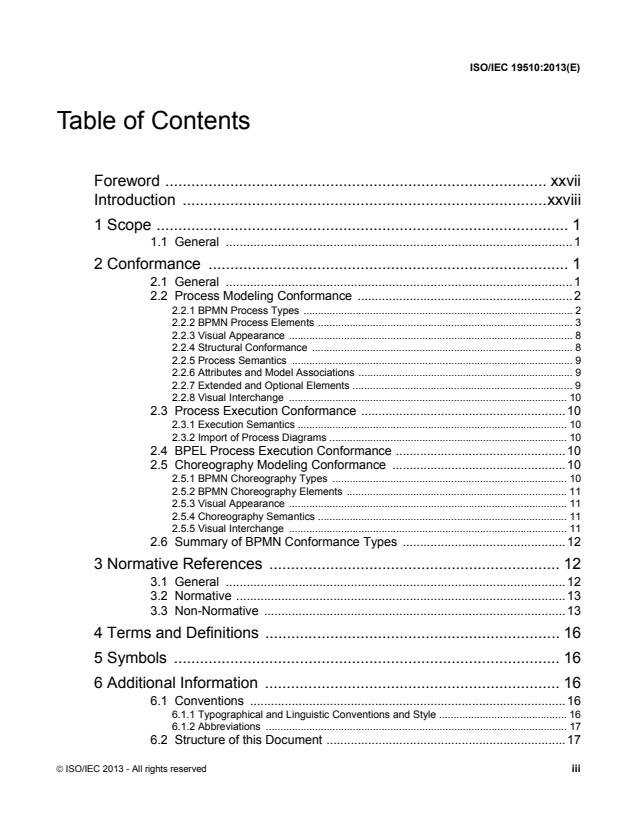
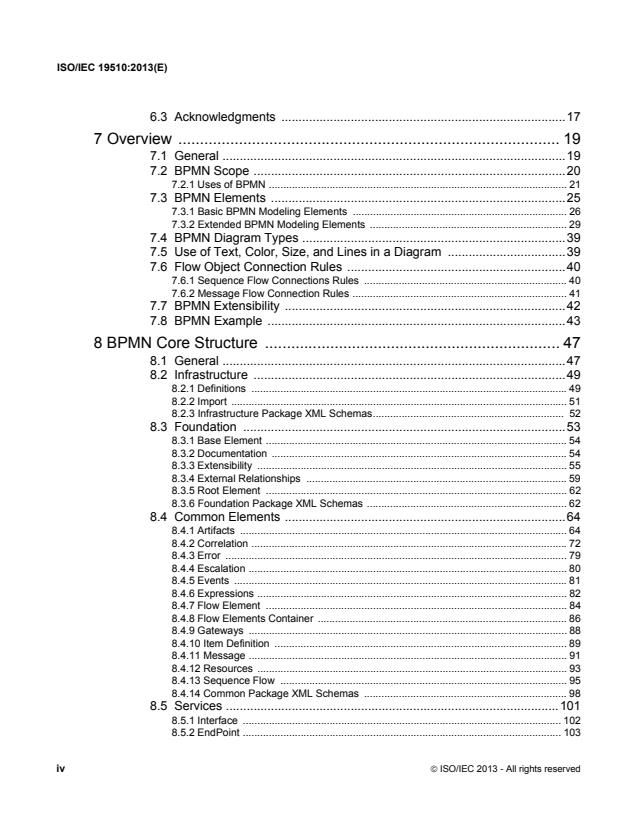
Table of Contents
Foreword . xxvii
Introduction .xxviii
1 Scope . 1
1.1 General .1
2 Conformance . 1
2.1 General .1
2.2 Process Modeling Conformance .2
2.2.1 BPMN Process Types . 2
2.2.2 BPMN Process Elements . 3
2.2.3 Visual Appearance . 8
2.2.4 Structural Conformance . 8
2.2.5 Process Semantics . 9
2.2.6 Attributes and Model Associations . 9
2.2.7 Extended and Optional Elements . 9
2.2.8 Visual Interchange . 10
2.3 Process Execution Conformance .10
2.3.1 Execution Semantics . 10
2.3.2 Import of Process Diagrams . 10
2.4 BPEL Process Execution Conformance .10
2.5 Choreography Modeling Conformance .10
2.5.1 BPMN Choreography Types . 10
2.5.2 BPMN Choreography Elements . 11
2.5.3 Visual Appearance . 11
2.5.4 Choreography Semantics . 11
2.5.5 Visual Interchange . 11
2.6 Summary of BPMN Conformance Types .12
3 Normative References . 12
3.1 General .12
3.2 Normative .13
3.3 Non-Normative .13
4 Terms and Definitions . 16
5 Symbols . 16
6 Additional Information . 16
6.1 Conventions .16
6.1.1 Typographical and Linguistic Conventions and Style . 16
6.1.2 Abbreviations . 17
6.2 Structure of this Document .17
© ISO/IEC 2013 - All rights reserved iii
6.3 Acknowledgments .17
7 Overview . 19
7.1 General .19
7.2 BPMN Scope .20
7.2.1 Uses of BPMN . 21
7.3 BPMN Elements .25
7.3.1 Basic BPMN Modeling Elements . 26
7.3.2 Extended BPMN Modeling Elements . 29
7.4 BPMN Diagram Types .39
7.5 Use of Text, Color, Size, and Lines in a Diagram .39
7.6 Flow Object Connection Rules .40
7.6.1 Sequence Flow Connections Rules . 40
7.6.2 Message Flow Connection Rules . 41
7.7 BPMN Extensibility .42
7.8 BPMN Example .43
8 BPMN Core Structure . 47
8.1 General .47
8.2 Infrastructure .49
8.2.1 Definitions .49
8.2.2 Import . 51
8.2.3 Infrastructure Package XML Schemas. 52
8.3 Foundation .53
8.3.1 Base Element . 54
8.3.2 Documentation . 54
8.3.3 Extensibility .55
8.3.4 External Relationships . 59
8.3.5 Root Element . 62
8.3.6 Foundation Package XML Schemas . 62
8.4 Common Elements .64
8.4.1 Artifacts . 64
8.4.2 Correlation .72
8.4.3 Error . 79
8.4.4 Escalation .80
8.4.5 Events . 81
8.4.6 Expressions . 82
8.4.7 Flow Element . 84
8.4.8 Flow Elements Container . 86
8.4.9 Gateways . 88
8.4.10 Item Definition . 89
8.4.11 Message . 91
8.4.12 Resources . 93
8.4.13 Sequence Flow . 95
8.4.14 Common Package XML Schemas . 98
8.5 Services .101
8.5.1 Interface . 102
8.5.2 EndPoint . 103
iv © ISO/IEC 2013 - All rights reserved
8.5.3 Operation . 103
8.5.4 Service Package XML Schemas . 104
9 Collaboration . 107
9.1 General .107
9.2 Basic Collaboration Concepts .110
9.2.1 Use of BPMN Common Elements . 110
9.3 Pool and Participant .111
9.3.1 Participants . 113
9.3.2 Lanes . 119
9.4 Message Flow .119
9.4.1 Interaction Node . 122
9.4.2 Message Flow Associations . 122
9.5 Conversations .123
9.5.1 Conversation Node . 127
9.5.2 Conversation . 129
9.5.3 Sub-Conversation . 129
9.5.4 Call Conversation . 130
9.5.5 Global Conversation . 131
9.5.6 Conversation Link . 131
9.5.7 Conversation Association . 134
9.5.8 Correlations . 135
9.6 Process within Collaboration .136
9.7 Choreography within Collaboration .136
9.8 Collaboration Package XML Schemas .138
10 Process . 143
10.1 General .143
10.2 Basic Process Concepts .147
10.2.1 Types of BPMN Processes . 147
10.2.2 Use of BPMN Common Elements . 148
10.3 Activities .149
10.3.1 Resource Assignment . 152
10.3.2 Performer . 154
10.3.3 Tasks . 154
10.3.4 Human Interactions . 163
10.3.5 Sub-Processes . 171
10.3.6 Call Activity . 182
10.3.7 Global Task . 186
10.3.8 Loop Characteristics . 188
10.3.9 XML Schema for Activities . 194
10.4 Items and Data .202
10.4.1 Data Modeling . 202
10.4.2 Execution Semantics for Data . 224
10.4.3 Usage of Data in XPath Expressions . 225
10.4.4 XML Schema for Data . 228
10.5 Events .232
10.5.1 Concepts . 233
10.5.2 Start Event . 237
© ISO/IEC 2013 - All rights reserved v
10.5.3 End Event . 245
10.5.4 Intermediate Event . 248
10.5.5 Event Definitions . 259
10.5.6 Handling Events . 274
10.5.7 Scopes . 280
10.5.8 Events Package XML Schemas . 281
10.6 Gateways .286
10.6.1 Sequence Flow Considerations . 288
10.6.2 Exclusive Gateway . 289
10.6.3 Inclusive Gateway . 291
10.6.4 Parallel Gateway . 292
10.6.5 Complex Gateway . 294
10.6.6 Event-Based Gateway . 296
10.6.7 Gateway Package XML Schemas . 300
10.7 Compensation .301
10.7.1 Compensation Handler . 302
10.7.2 Compensation Triggering . 303
10.7.3 Relationship between Error Handling and Compensation . 304
10.8 Lanes .304
10.9 Process Instances, Unmodeled Activities, and Public Processes .308
10.10 Auditing . 310
10.11 Monitoring .310
10.12 Process Package XML Schemas .311
11 Choreography . 315
11.1 General .315
11.2 Basic Choreography Concepts .317
11.3 Data .319
11.4 Use of BPMN Common Elements .319
11.4.1 Sequence Flow . 320
11.4.2 Artifacts . 321
11.5 Choreography Activities .321
11.5.1 Choreography Task . 323
11.5.2 Sub-Choreography . 328
11.5.3 Call Choreography . 333
11.5.4 Global Choreography Task . 335
11.5.5 Looping Activities . 335
11.5.6 The Sequencing of Activities . 335
11.6 Events .339
11.6.1 Start Events . 339
11.6.2 Intermediate Events . 340
11.6.3 End Events . 343
11.7 Gateways .344
11.7.1 Exclusive Gateway . 344
11.7.2 Event-Based Gateway . 349
11.7.3 Inclusive Gateway . 351
11.7.4 Parallel Gateway . 358
11.7.5 Complex Gateway . 360
vi © ISO/IEC 2013 - All rights reserved
11.7.6 Chaining Gateways . 361
11.8 Choreography within Collaboration .361
11.8.1 Participants . 361
11.8.2 Swimlanes . 362
11.9 XML Schema for Choreography .363
12 BPMN Notation and Diagrams . 367
12.1 BPMN Diagram Interchange (BPMN DI) .367
12.1.1 Scope . 367
12.1.2 Diagram Definition and Interchange . 367
12.1.3 How to Read this Clause . 368
12.2 BPMN Diagram Interchange (DI) Meta-model .368
12.2.1 Overview . 368
12.2.2 Abstract Syntax . 368
12.2.3 Classifier Descriptions . 370
12.2.4 Complete BPMN DI XML Schema . 378
12.3 Notational Depiction Library and Abstract Element Resolutions .380
12.3.1 Labels . 381
12.3.2 BPMNShape . 381
12.3.3 BPMNEdge . 410
12.4 Example(s) .412
12.4.1 Depicting Content in a Sub-Process . 412
12.4.2 Multiple Lanes and Nested Lanes . 417
12.4.3 Vertical Collaboration . 418
12.4.4 Conversation . 419
12.4.5 Choreography . 421
13 BPMN Execution Semantics . 425
13.1 General .425
13.2 Process Instantiation and Termination .426
13.3 Activities .426
13.3.1 Sequence Flow Considerations . 427
13.3.2 Activity .428
13.3.3 Task . 430
13.3.4 Sub-Process/Call Activity . 430
13.3.5 Ad-Hoc Sub-Process . 431
13.3.6 Loop Activity . 432
13.3.7 Multiple Instances Activity . 432
13.4 Gateways .434
13.4.1 Parallel Gateway (Fork and Join) . 434
13.4.2 Exclusive Gateway (Exclusive Decision (data-based) and Exclusive Merge) . 434
13.4.3 Inclusive Gateway (Inclusive Decision and Inclusive Merge) . 435
13.4.4 Event-based Gateway (Exclusive Decision (event-based)) . 437
13.4.5 Complex Gateway (related to Complex Condition and Complex Merge) . 437
13.5 Events .439
13.5.1 Start Events . 439
13.5.2 Intermediate Events . 440
13.5.3 Intermediate Boundary Events . 440
13.5.4 Event Sub-Processes . 440
© ISO/IEC 2013 - All rights reserved vii
13.5.5 Compensation . 441
13.5.6 End Events . 443
14 Mapping BPMN Models to WS-BPEL . 445
14.1 General .445
14.2 Basic BPMN-BPEL Mapping .446
14.2.1 Process . 447
14.2.2 Activities . 448
14.2.3 Events . 455
14.2.4 Gateways and Sequence Flows . 461
14.2.5 Handling Data . 465
14.3 Extended BPMN-BPEL Mapping .469
14.3.1 End Events . 469
14.3.2 Loop/Switch Combinations From a Gateway . 469
14.3.3 Interleaved Loops . 470
14.3.4 Infinite Loops . 473
14.3.5 BPMN Elements that Span Multiple WSBPEL Sub-Elements . 473
15 Exchange Formats . 475
15.1 Interchanging Incomplete Models .475
15.2 Machine Readable Files .475
15.3 XSD .475
15.3.1 Document Structure . 475
15.3.2 References within the BPMN XSD . 476
15.4 XMI .477
15.5 XSLT Transformation between XSD and XMI .477
Annex A - Changes from v1.2. 479
Annex B - Diagram Interchange. 481
Annex C - Glossary. 499
Annex D - Legal Information . 505
viii © ISO/IEC 2013 - All rights reserved
List of Figures
Figure 7.1 – Example of a private Business Process 21
Figure 7.2 – Example of a public Process 22
Figure 7.3 – An example of a Collaborative Process 23
Figure 7.4 – An example of a Choreography 23
Figure 7.5 – An example of a Conversation diagram 24
Figure 7.6 – An example of a Collaboration diagram with black-box Pools 43
Figure 7.7 – An example of a stand-alone Choreography diagram 44
Figure 7.8 – An example of a stand-alone Process (Orchestration) diagram 45
Figure 8.1 – A representation of the BPMN Core and Layer Structure 47
Figure 8.2 – Class diagram showing the core packages 48
Figure 8.3 – Class diagram showing the organization of the core BPMN elements 49
Figure 8.4 – Definitions class diagram 50
Figure 8.5 – Classes in the Foundation package 53
Figure 8.6 – Extension class diagram 55
Figure 8.7 – External Relationship Metamodel 60
Figure 8.8 – Artifacts Metamodel 64
Figure 8.9 – An Association 65
Figure 8.10 – The Association Class Diagram 65
Figure 8.11 – A Directional Association 66
Figure 8.12 – An Association of Text Annotation 66
Figure 8.13 – A Group Artifact 67
Figure 8.14 – A Group around Activities in different Pools 67
Figure 8.15 – The Group class diagram 68
Figure 8.16 – A Text Annotation 69
Figure 8.17 – The Correlation Class Diagram 74
Figure 8.18 – Error class diagram 79
Figure 8.19 – Escalation class diagram 80
Figure 8.20 – Event class diagram 82
Figure 8.21 – Expression class diagram 83
Figure 8.22 – FlowElement class diagram 85
Figure 8.23 – FlowElementContainers class diagram 87
Figure 8.24 – Gateway class diagram 88
Figure 8.25 – ItemDefinition class diagram 90
Figure 8.26 – A Message 91
Figure 8.27 – A non-initiating Message 91
Figure 8.28 – Messages Association overlapping Message Flows 92
Figure 8.29 – Messages shown Associated with a Choreography Task 92
Figure 8.30 – The Message class diagram 93
Figure 8.31 – Resource class diagram 94
Figure 8.32 – A Sequence Flow 95
Figure 8.33 – A Conditional Sequence Flow 95
Figure 8.34 – A Default Sequence Flow 96
© ISO/IEC 2013 - All rights reserved ix
Figure 8.35 – SequenceFlow class diagram 96
Figure 8.36 – The Service class diagram 102
Figure 9.1 – Classes in the Collaboration package 108
Figure 9.2 – A Pool 111
Figure 9.3 – Message Flows connecting to the boundaries of two Pools 112
Figure 9.4 – Message Flows connecting to Flow Objects within two Pools 112
Figure 9.5 – Main (Internal) Pool without boundaries 113
Figure 9.6 – Pools with a Multi-Instance Participant Markers 113
Figure 9.7 – The Participant Class Diagram 114
Figure 9.8 – A Pool with a Multiple Participant 116
Figure 9.9 – The Participant Multiplicity class diagram 116
Figure 9.10 – ParticipantAssociation class diagram 118
Figure 9.11 – A Message Flow 119
Figure 9.12 – A Message Flow with an Attached Message 120
Figure 9.13 – A Message Flow passing through a Choreography Task 120
Figure 9.14 – The Message Flow Class Diagram 121
Figure 9.15 – MessageFlowAssociation class diagram 123
Figure 9.16 – A Conversation diagram 124
Figure 9.17 – A Conversation diagram where the Conversation is expanded into Message Flows 124
Figure 9.18 – Conversation diagram depicting several conversations between Participants in a related domain 125
Figure 9.19 – An example of a Sub-Conversation 126
Figure 9.20 – An example of a Sub-Conversation expanded to a Conversation and Message Flow 126
Figure 9.21 – An example of a Sub-Conversation that is fully expanded 127
Figure 9.22 – Metamodel of ConversationNode Related Elements 128
Figure 9.23 – A Communication element 129
Figure 9.24 – A compound Conversation element 130
Figure 9.25 – A Call Conversation calling a GlobalConversation 130
Figure 9.26 – A Call Conversation calling a Collaboration 130
Figure 9.27 – A Conversation Link element 131
Figure 9.28 – Conversation links to Activities and Events 132
Figure 9.29 – Metamodel of Conversation Links related elements 133
Figure 9.30 – Call Conversation Links 134
Figure 9.31 – The ConversationAssociation class diagram 135
Figure 9.32 – An example of a Choreography within a Collaboration 137
Figure 9.33– Choreography within Collaboration class diagram 138
Figure 10.1 – An Example of a Process 143
Figure 10.2 – Process class diagram 144
Figure 10.3 – Process Details class diagram 145
Figure 10.4 – Example of a private Business Process 148
Figure 10.5 – Example of a public Process 148
Figure 10.6 – Activity class diagram 149
Figure 10.7 – The class diagram for assigning Resources 152
Figure 10.8 – A Task object 154
Figure 10.9 – Task markers 155
Figure 10.10 – The Task class diagram 155
Figure 10.11 – A Service Task Object 156
Figure 10.12 – The Service Task class diagram 157
x © ISO/IEC 2013 - All rights reserved
Figure 10.13 – A Send Task Object 158
Figure 10.14 – The Send Task and Receive Task class diagram 158
Figure 10.15 – A Receive Task Object 159
Figure 10.16 – A Receive Task Object that instantiates a Process 160
Figure 10.17 – A User Task Object 161
Figure 10.18 – A Manual Task Object 161
Figure 10.19 – A Business Rule Task Object 162
Figure 10.20 – A Script Task Object 162
Figure 10.21 – Manual Task class diagram 163
Figure 10.22 – User Task class diagram 164
Figure 10.23 – HumanPerformer class diagram 165
Figure 10.24 – Procurement Process Example 168
Figure 10.25 – A Sub-Process object (collapsed) 171
Figure 10.26 – A Sub-Process object (expanded) 172
Figure 10.27 – Expanded Sub-Process used as a “Parallel Box” 172
Figure 10.28 – Collapsed Sub-Process Markers 173
Figure 10.29– The Sub-Process class diagram 173
Figure 10.30 – An Event Sub-Process object (Collapsed) 175
Figure 10.31 – An Event Sub-Process object (expanded) 175
Figure 10.32 – An example that includes Event Sub-Processes 176
Figure 10.33 – A Transaction Sub-Process 177
Figure 10.34 – A Collapsed Transaction Sub-Process 177
Figure 10.35 – A collapsed Ad-Hoc Sub-Process 179
Figure 10.36 – An expanded Ad-Hoc Sub-Process 179
Figure 10.37 – An Ad-Hoc Sub-Process for writing a book chapter 181
Figure 10.38 – An Ad-Hoc Sub-Process with data and sequence dependencies 182
Figure 10.39– A Call Activity object calling a Global Task 183
Figure 10.40 – A Call Activity object calling a Process (Collapsed) 183
Figure 10.41 – A Call Activity object calling a Process (Expanded) 183
Figure 10.42 –The Call Activity class diagram 184
Figure 10.43 – CallableElement class diagram 185
Figure 10.44 – Global Tasks class diagram 187
Figure 10.45 – LoopCharacteristics class diagram 188
Figure 10.46 – A Task object with a Standard Loop Marker 189
Figure 10.47 – A Sub-Process object with a Standard Loop Marker 189
Figure 10.48 – Activity Multi-Instance marker for parallel instances 190
Figure 10.49 – Activity Multi-Instance marker for sequential instances 190
Figure 10.50 - ItemAware class diagram 203
Figure 10.51 – DataObject class diagram 204
Figure 10.52 – A DataObject 206
Figure 10.53 – A DataObject that is a collection 206
Figure 10.54 – A Data Store 207
Figure 10.55 – DataStore class diagram 207
Figure 10.56 – Property class diagram 209
Figure 10.57 – InputOutputSpecification class diagram 211
Figure 10.58 – A DataInput 213
Figure 10.59 – Data Input class diagram 213
© ISO/IEC 2013 - All rights reserved xi
Figure 10.60 – A Data Output 215
Figure 10.61 – Data Output class diagram 215
Figure 10.62 – InputSet class diagram 218
Figure 10.63 – OutputSet class diagram 219
Figure 10.64 – DataAssociation class diagram 221
Figure 10.65 – A Data Association 221
Figure 10.66 – A Data Association used for an Outputs and Inputs into an Activities 221
Figure 10.67 – A Data Object shown as an output and an inputs 223
Figure 10.68 – A Data Object associated with a Sequence Flow 224
Figure 10.69 – The Event Class Diagram 233
Figure 10.70 – Start Event 238
Figure 10.71 – End Event 245
Figure 10.72 – Intermediate Event 249
Figure 10.73 – EventDefinition Class Diagram 261
Figure 10.74 – Cancel Events 262
Figure 10.75 – Compensation Events 262
Figure 10.76 – CompensationEventDefinition Class Diagram 262
Figure 10.77 – Conditional Events 263
Figure 10.78 – ConditionalEventDefinition Class Diagram 264
Figure 10.79 – Error Events 264
Figure 10.80 – ErrorEventDefinition Class Diagram 265
Figure 10.81 – Escalation Events 265
Figure 10.82 – EscalationEventDefinition Class Diagram 266
Figure 10.83 – Link Events 266
Figure 10.84 – Link Events Used as Off-Page Connector 267
Figure 10.85 – A Process with a long Sequence Flow 268
Figure 10.86 – A Process with Link Intermediate Events used as Go To Objects 268
Figure 10.87 – Link Events Used for looping 269
Figure 10.88 – Message Events 269
Figure 10.89 – MessageEventDefinition Class Diagram 270
Figure 10.90 – Multiple Events 271
Figure 10.91 – None Events 271
Figure 10.92 – Multiple Events 272
Figure 10.93 – SignalEventDefinition Class Diagram 272
Figure 10.94 – Signal Events 272
Figure 10.95 – Terminate Event 273
Figure 10.96 – Timer Events 273
Figure 10.97 – Exclusive start of a Process 274
Figure 10.98 – A Process initiated by an Event-Based Gateway 275
Figure 10.99 – Event synchronization at Process start 275
Figure 10.100 – Example of inline Event Handling via Event Sub-Processes 277
Figure 10.101 – Example of boundary Event Handling 278
Figure 10.102 – A Gateway 286
Figure 10.103 – The Different types of Gateways 287
Figure 10.104 – Gateway class diagram 288
Figure 10.105 – An Exclusive Data-Based Decision (Gateway) Example without the Internal Indicator 289
Figure 10.106 – A Data-Based Exclusive Decision (Gateway) Example with the Internal Indicator 290
xii © ISO/IEC 2013 - All rights reserved
Figure 10.107 – Exclusive Gateway class diagram 290
Figure 10.108 – An example using an Inclusive Gateway 291
Figure 10.109 – Inclusive Gateway class diagram 292
Figure 10.110 – An example using an Parallel Gateway 293
Figure 10.111 – An example of a synchronizing Parallel Gateway 293
Figure 10.112 – Parallel Gateway class diagram 294
Figure 10.113 – An example using a Complex Gateway 294
Figure 10.114 – Complex Gateway class diagram 295
Figure 10.115 – Event-Based Gateway 296
Figure 10.116 – An Event-Based Gateway example using Message Intermediate Events 297
Figure 10.117 – An Event-Based Gateway example using Receive Tasks 297
Figure 10.118 – Exclusive Event-Based Gateway to start a Process 298
Figure 10.119 – Parallel Event-Based Gateway to start a Process 298
Figure 10.120 – Event-Based Gateway class diagram 299
Figure 10.121– Compensation through a boundary Event 302
Figure 10.122 – Monitoring Class Diagram 303
Figure 10.123 – Two Lanes in a Vertical Pool 305
Figure 10.124 – Two Lanes in a horizontal Pool 305
Figure 10.125 – An Example of Nested Lanes 306
Figure 10.126 – The Lane class diagram 307
Figure 10.127 – One Process supporting to another 309
Figure 10.128 – Auditing Class Diagram 310
Figure 10.129 – Monitoring Class Diagram 311
Figure 11.1 – The Choreography metamodel 316
Figure 11.2 – An example of a Choreography 317
Figure 11.3 – A Collaboration diagram logistics example 318
Figure 11.4 – The corresponding Choreography diagram logistics example 319
Figure 11.5 – The use of Sequence Flows in a Choreography 320
Figure 11.6 – The metamodel segment for a Choreography Activity 322
Figure 11.7 – A Collaboration view of Choreography Task elements 323
Figure 11.8 – A Choreography Task 323
Figure 11.9 – A Collaboration view of a Choreography Task 324
Figure 11.10 – A two-way Choreography Task 324
Figure 11.11 – A Collaboration view of a two-way Choreography Task 325
Figure 11.12 – Choreography Task Markers 326
Figure 11.13 – The Collaboration view of a looping Choreography Task 326
Figure 11.14 – The Collaboration view of a Parallel Multi-Instance Choreography Task 327
Figure 11.15 – A Choreography Task with a multiple Participant 327
Figure 11.16 – A Collaboration view of a Choreography Task with a multiple Participant 328
Figure 11.17– A Sub-Choreography 329
Figure 11.18 – A Collaboration view of a Sub-Choreography 329
Figure 11.19 – An expanded Sub-Choreography 330
Figure 11.20 – A Collaboration view of an expanded Sub-Choreography 330
Figure 11.21 – Sub-Choreography (Collapsed) with More than Two Participants 331
Figure 11.22 – Sub-Choreography Markers 332
Figure 11.23 – Sub-Choreography Markers with a multi-instance Participant 332
Figure 11.24 – A Call Choreography calling a Global Choreography Task 333
© ISO/IEC 2013 - All rights reserved xiii
Figure 11.25 – A Call Choreography calling a Choreography (Collapsed) 333
Figure 11.26 – A Call Choreography calling a Choreography (expanded) 334
Figure 11.27– The Call Choreography class diagram 334
Figure 11.28 – A valid sequence of Choreography Activities 336
Figure 11.29 – The corresponding Collaboration for a valid Choreography sequence 337
Figure 11.30 – A valid sequence of Choreography Activities with a two-way Activity 337
Figure 11.31 – The corresponding Collaboration for a valid Choreography sequence with a two-way Activity 338
Figure 11.32 – An invalid sequence of Choreography Activities 338
Figure 11.33 – The corresponding Collaboration for an invalid Choreography sequence 339
Figure 11.34 – An example of the Exclusive Gateway 345
Figure 11.35 – The relationship of Choreography Activity Participants across the sides
of the Exclusive Gateway shown through a Collaboration 346
Figure 11.36 – Different Receiving Choreography Activity Participants
on the output sides of the Exclusive Gateway 347
Figure 11.37 – The corresponding Collaboration view of the above
Choreography Exclusive Gateway configuration 348
Figure 11.38 – An example of an Event Gateway 349
Figure 11.39 – The corresponding Collaboration view of t
...
Questions, Comments and Discussion
Ask us and Technical Secretary will try to provide an answer. You can facilitate discussion about the standard in here.
Loading comments...