


ISO/IEC 15429:1999
(Main)Information technology — Telecommunications and information exchange between systems — Private Integrated Services Network — Inter-exchange signalling protocol — Wireless Terminal Location Registration supplementary service and Wireless Terminal Information exchange additional network feature
Information technology — Telecommunications and information exchange between systems — Private Integrated Services Network — Inter-exchange signalling protocol — Wireless Terminal Location Registration supplementary service and Wireless Terminal Information exchange additional network feature
Technologies de l'information — Télécommunications et échange d'information entre systèmes — Réseau privé à intégration de services — Protocole de signalement d'interéchange — Service supplémentaire d'enregistrement de localisation de terminal sans fil et caractéristiques de réseau additionnelles pour l'échange d'information de terminal sans fil
General Information
- Status
- Withdrawn
- Publication Date
- 25-Aug-1999
- Withdrawal Date
- 25-Aug-1999
- Current Stage
- 9599 - Withdrawal of International Standard
- Start Date
- 08-Apr-2003
- Completion Date
- 12-Feb-2026
Relations
- Effective Date
- 15-Apr-2008
ISO/IEC 15429:1999 - Information technology -- Telecommunications and information exchange between systems -- Private Integrated Services Network -- Inter-exchange signalling protocol -- Wireless Terminal Location Registration supplementary service and Wireless Terminal Information exchange additional network feature
Get Certified
Connect with accredited certification bodies for this standard

TL 9000 QuEST Forum
Telecommunications quality management system.

ANCE
Mexican certification and testing association.

Intertek Slovenia
Intertek testing, inspection, and certification services in Slovenia.
Sponsored listings
Frequently Asked Questions
ISO/IEC 15429:1999 is a standard published by the International Organization for Standardization (ISO). Its full title is "Information technology — Telecommunications and information exchange between systems — Private Integrated Services Network — Inter-exchange signalling protocol — Wireless Terminal Location Registration supplementary service and Wireless Terminal Information exchange additional network feature". This standard covers: Information technology — Telecommunications and information exchange between systems — Private Integrated Services Network — Inter-exchange signalling protocol — Wireless Terminal Location Registration supplementary service and Wireless Terminal Information exchange additional network feature
Information technology — Telecommunications and information exchange between systems — Private Integrated Services Network — Inter-exchange signalling protocol — Wireless Terminal Location Registration supplementary service and Wireless Terminal Information exchange additional network feature
ISO/IEC 15429:1999 is classified under the following ICS (International Classification for Standards) categories: 33.040.35 - Telephone networks. The ICS classification helps identify the subject area and facilitates finding related standards.
ISO/IEC 15429:1999 has the following relationships with other standards: It is inter standard links to ISO/IEC 15429:2003. Understanding these relationships helps ensure you are using the most current and applicable version of the standard.
ISO/IEC 15429:1999 is available in PDF format for immediate download after purchase. The document can be added to your cart and obtained through the secure checkout process. Digital delivery ensures instant access to the complete standard document.
Standards Content (Sample)
INTERNATIONAL ISO/IEC
STANDARD 15429
First edition
1999-09-01
Information technology —
Telecommunications and information
exchange between systems —
Private Integrated Services Network —
Inter-exchange signalling protocol —
Wireless Terminal Location Registration
supplementary service and Wireless
Terminal Information exchange additional
network feature
Technologies de l'information — Télécommunications et échange
d'information entre systèmes — Réseau privé à intégration de services —
Protocole de signalement d'interéchange — Service supplémentaire
d'enregistrement de localisation de terminal sans fil et caractéristiques de
réseau additionnelles pour l'échange d'information de terminal sans fil
Reference number
bc
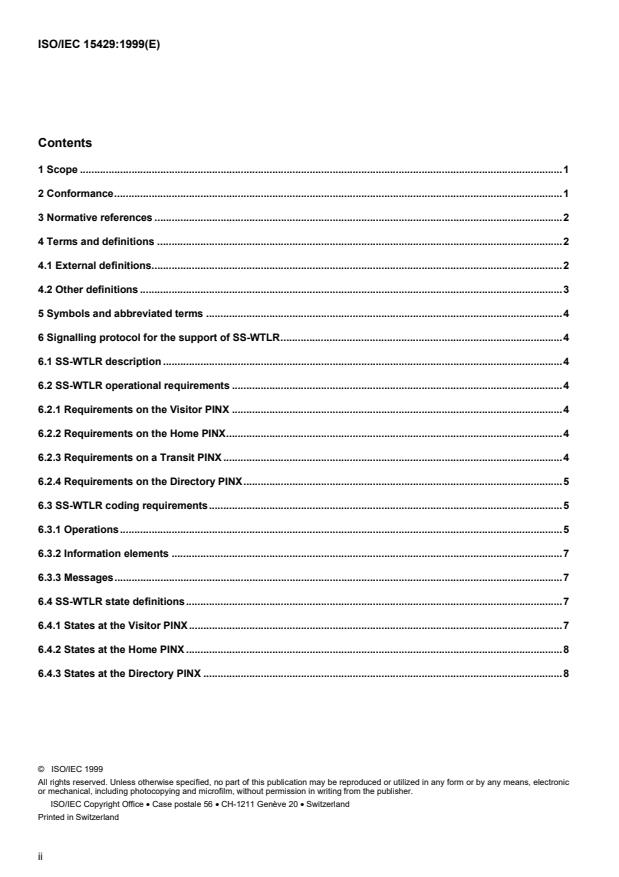
Contents
1 Scope .1
2 Conformance.1
3 Normative references .2
4 Terms and definitions .2
4.1 External definitions.2
4.2 Other definitions .3
5 Symbols and abbreviated terms .4
6 Signalling protocol for the support of SS-WTLR.4
6.1 SS-WTLR description .4
6.2 SS-WTLR operational requirements .4
6.2.1 Requirements on the Visitor PINX .4
6.2.2 Requirements on the Home PINX.4
6.2.3 Requirements on a Transit PINX .4
6.2.4 Requirements on the Directory PINX.5
6.3 SS-WTLR coding requirements.5
6.3.1 Operations.5
6.3.2 Information elements .7
6.3.3 Messages.7
6.4 SS-WTLR state definitions.7
6.4.1 States at the Visitor PINX.7
6.4.2 States at the Home PINX .8
6.4.3 States at the Directory PINX .8
© ISO/IEC 1999
All rights reserved. Unless otherwise specified, no part of this publication may be reproduced or utilized in any form or by any means, electronic
or mechanical, including photocopying and microfilm, without permission in writing from the publisher.
ISO/IEC Copyright Office • Case postale 56 • CH-1211 Genève 20 • Switzerland
Printed in Switzerland
ii
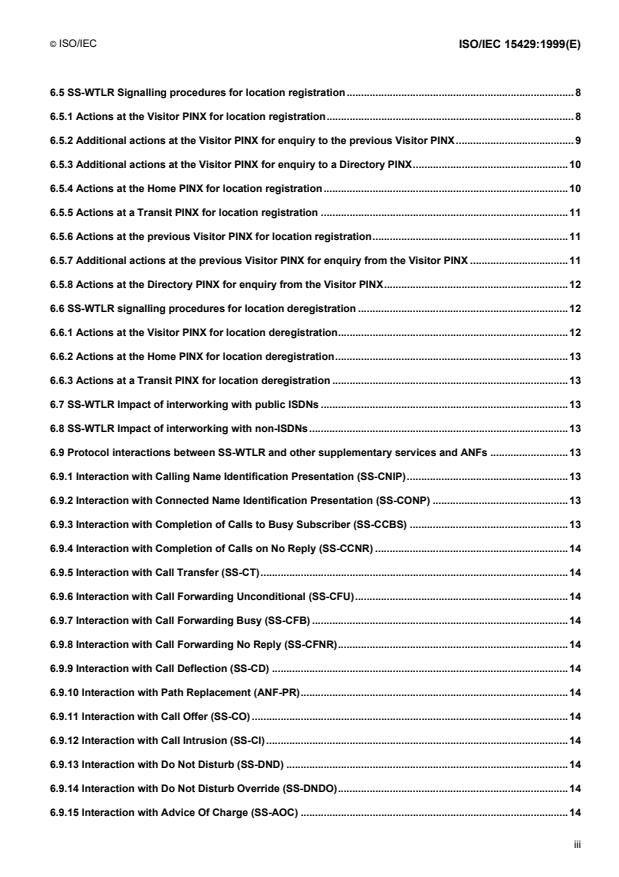
© ISO/IEC
6.5 SS-WTLR Signalling procedures for location registration. 8
6.5.1 Actions at the Visitor PINX for location registration. 8
6.5.2 Additional actions at the Visitor PINX for enquiry to the previous Visitor PINX. 9
6.5.3 Additional actions at the Visitor PINX for enquiry to a Directory PINX. 10
6.5.4 Actions at the Home PINX for location registration. 10
6.5.5 Actions at a Transit PINX for location registration . 11
6.5.6 Actions at the previous Visitor PINX for location registration. 11
6.5.7 Additional actions at the previous Visitor PINX for enquiry from the Visitor PINX . 11
6.5.8 Actions at the Directory PINX for enquiry from the Visitor PINX. 12
6.6 SS-WTLR signalling procedures for location deregistration . 12
6.6.1 Actions at the Visitor PINX for location deregistration. 12
6.6.2 Actions at the Home PINX for location deregistration. 13
6.6.3 Actions at a Transit PINX for location deregistration . 13
6.7 SS-WTLR Impact of interworking with public ISDNs . 13
6.8 SS-WTLR Impact of interworking with non-ISDNs. 13
6.9 Protocol interactions between SS-WTLR and other supplementary services and ANFs . 13
6.9.1 Interaction with Calling Name Identification Presentation (SS-CNIP). 13
6.9.2 Interaction with Connected Name Identification Presentation (SS-CONP) . 13
6.9.3 Interaction with Completion of Calls to Busy Subscriber (SS-CCBS) . 13
6.9.4 Interaction with Completion of Calls on No Reply (SS-CCNR) . 14
6.9.5 Interaction with Call Transfer (SS-CT). 14
6.9.6 Interaction with Call Forwarding Unconditional (SS-CFU). 14
6.9.7 Interaction with Call Forwarding Busy (SS-CFB) . 14
6.9.8 Interaction with Call Forwarding No Reply (SS-CFNR). 14
6.9.9 Interaction with Call Deflection (SS-CD) . 14
6.9.10 Interaction with Path Replacement (ANF-PR). 14
6.9.11 Interaction with Call Offer (SS-CO) . 14
6.9.12 Interaction with Call Intrusion (SS-CI) . 14
6.9.13 Interaction with Do Not Disturb (SS-DND) . 14
6.9.14 Interaction with Do Not Disturb Override (SS-DNDO). 14
6.9.15 Interaction with Advice Of Charge (SS-AOC) . 14
iii
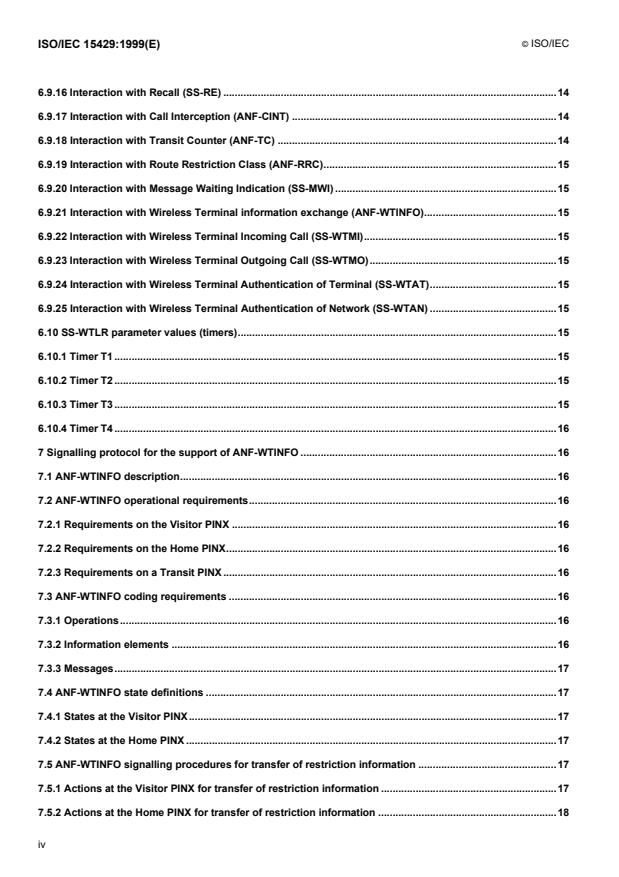
© ISO/IEC
6.9.16 Interaction with Recall (SS-RE) .14
6.9.17 Interaction with Call Interception (ANF-CINT) .14
6.9.18 Interaction with Transit Counter (ANF-TC) .14
6.9.19 Interaction with Route Restriction Class (ANF-RRC).15
6.9.20 Interaction with Message Waiting Indication (SS-MWI) .15
6.9.21 Interaction with Wireless Terminal information exchange (ANF-WTINFO).15
6.9.22 Interaction with Wireless Terminal Incoming Call (SS-WTMI).15
6.9.23 Interaction with Wireless Terminal Outgoing Call (SS-WTMO).15
6.9.24 Interaction with Wireless Terminal Authentication of Terminal (SS-WTAT).15
6.9.25 Interaction with Wireless Terminal Authentication of Network (SS-WTAN) .15
6.10 SS-WTLR parameter values (timers).15
6.10.1 Timer T1.15
6.10.2 Timer T2.15
6.10.3 Timer T3.15
6.10.4 Timer T4.16
7 Signalling protocol for the support of ANF-WTINFO .16
7.1 ANF-WTINFO description.16
7.2 ANF-WTINFO operational requirements.16
7.2.1 Requirements on the Visitor PINX .16
7.2.2 Requirements on the Home PINX.16
7.2.3 Requirements on a Transit PINX .16
7.3 ANF-WTINFO coding requirements .16
7.3.1 Operations.16
7.3.2 Information elements .16
7.3.3 Messages.17
7.4 ANF-WTINFO state definitions .17
7.4.1 States at the Visitor PINX.17
7.4.2 States at the Home PINX .17
7.5 ANF-WTINFO signalling procedures for transfer of restriction information .17
7.5.1 Actions at the Visitor PINX for transfer of restriction information .17
7.5.2 Actions at the Home PINX for transfer of restriction information .18
iv
© ISO/IEC
7.6 ANF-WTINFO signalling procedures for check of location data. 18
7.6.1 Actions at the Visitor PINX for check of location data. 18
7.6.2 Actions at the Home PINX for check of location data. 19
7.6.3 Actions at a Transit PINX for support of ANF-WTINFO . 19
7.7 ANF-WTINFO Impact of interworking with public ISDNs. 20
7.8 ANF-WTINFO Impact of interworking with non-ISDNs . 20
7.9 Protocol interactions between ANF-WTINFO and other supplementary services and ANFs. 20
7.9.1 Interaction with Calling Name Identification Presentation (SS-CNIP). 20
7.9.2 Interaction with Connected Name Identification Presentation (SS-CONP) . 20
7.9.3 Interaction with Completion of Calls to Busy Subscriber (SS-CCBS) . 20
7.9.4 Interaction with Completion of Calls on No Reply (SS-CCNR) . 20
7.9.5 Interaction with Call Transfer (SS-CT). 20
7.9.6 Interaction with Call Forwarding Unconditional (SS-CFU). 20
7.9.7 Interaction with Call Forwarding Busy (SS-CFB) . 20
7.9.8 Interaction with Call Forwarding No Reply (SS-CFNR). 20
7.9.9 Interaction with Call Deflection (SS-CD) . 20
7.9.10 Interaction with Path Replacement (ANF-PR). 20
7.9.11 Interaction with Call Offer (SS-CO) . 21
7.9.12 Interaction with Call Intrusion (SS-CI) . 21
7.9.13 Interaction with Do Not Disturb (SS-DND) . 21
7.9.14 Interaction with Do Not Disturb Override (SS-DNDO). 21
7.9.15 Interaction with Advice Of Charge (SS-AOC) . 21
7.9.16 Interaction with Recall (SS-RE) . 21
7.9.17 Interaction with Call Interception (ANF-CINT) . 21
7.9.18 Interaction with Transit Counter (ANF-TC) . 21
7.9.19 Interaction with Route Restriction Class (ANF-RRC). 21
7.9.20 Interaction with Message Waiting Indication (SS-MWI). 21
7.9.21 Interaction with Wireless Terminal Location Registration (SS-WTLR) . 21
7.9.22 Interaction with Wireless Terminal Incoming Call (SS-WTMI). 21
7.9.23 Interaction with Wireless Terminal Outgoing Call (SS-WTMO). 21
7.9.24 Interaction with Wireless Terminal Authentication of Terminal (SS-WTAT). 21
v
© ISO/IEC
7.9.25 Interaction with Wireless Terminal Authentication of Network (SS-WTAN) .22
7.10 ANF-WTINFO parameter values (timers) .22
7.10.1 Timer T5.22
7.10.2 Timer T6.22
Annex A (normative) Protocol Implementation Conformance Statement (PICS) proforma .23
Annex B (informative) Imported ASN.1 definitions.32
Annex C (informative) Examples of message sequences.33
Annex D (informative) Specification and Description Language (SDL) representation of procedures.39
vi
© ISO/IEC
Foreword
ISO (the International Organization for Standardization) and IEC (the International Electrotechnical Commission)
form the specialized system for worldwide standardization. National bodies that are members of ISO or IEC
participate in the development of International Standards through technical committees established by the
respective organization to deal with particular fields of technical activity. ISO and IEC technical committees
collaborate in fields of mutual interest. Other international organizations, governmental and non-governmental, in
liaison with ISO and IEC, also take part in the work.
International Standards are drafted in accordance with the rules given in the ISO/IEC Directives, Part 3.
In the field of information technology, ISO and IEC have established a joint technical committee, ISO/IEC JTC 1.
Draft International Standards adopted by the joint technical committee are circulated to national bodies for voting.
Publication as an International Standard requires approval by at least 75 % of the national bodies casting a vote.
International Standard ISO/IEC 15429 was prepared by Joint Technical Committee ISO/IEC JTC 1, Information
technology, Subcommittee SC 6, Telecommunications and information exchange between systems.
Annex A forms a normative part of this International Standard. Annexes B to D are for information only.
vii
© ISO/IEC
Introduction
This International Standard is one of a series of International Standards defining services and signalling protocols
applicable to Private Integrated Services Networks (PISNs). The series uses ISDN concepts as developed by ITU-T
and conforms to the framework of International Standards for Open Systems Interconnection as defined by
ISO/IEC.
This particular International Standard is one of a series of signalling protocol standards that together specify Private
Signalling System Number 1 (PSS1) (informally known as QSIG) for use at the Q reference point between Private
Integrated Services Network Exchanges (PINXs). This International Standard supports the Wireless Terminal
Location Registration supplementary service and the Wireless Terminal Information exchange additional network
feature.
viii
INTERNATIONAL STANDARD © ISO/IEC ISO/IEC 15429:1999(E)
Information technology — Telecommunications and information
exchange between systems — Private Integrated Services
Network — Inter-exchange signalling protocol — Wireless Terminal
Location Registration supplementary service and Wireless
Terminal Information exchange additional network feature
1 Scope
This International Standard specifies the signalling protocol for the support of the Wireless Terminal Location
Registration supplementary service (SS-WTLR) and the Wireless Terminal Information exchange additional network
feature (ANF-WTINFO) at the Q reference point between Private Integrated Services Network Exchanges (PINXs)
connected together within a Private Integrated Services Network (PISN).
SS-WTLR is a supplementary service which enables a WTM user to register at, or deregister from, the current
location within the PISN. The ability to register at different locations in the PISN at different times enables the WTM
user to maintain the provided services (including the ability to make and receive calls) at different access points.
Deregistration is used to inform the PISN that the WTM user is temporarily unable to make use of the provided
services (including the receipt of calls).
ANF-WTINFO is an additional network feature which enables transfer of restriction information between Home PINX
and Visitor PINX. ANF-WTINFO also enables the Visitor PINX or Home PINX to initiate a check of the current
location information.
The Q reference point is defined in ISO/IEC 11579-1.
Supplementary Service specifications and Additional Network Feature specifications are produced in three stages
and according to the method specified in CCITT Recommendation I.130. This International Standard contains the
stage 3 specification for the Q reference point and satisfies the requirements identified by the stage 1 and stage 2
specifications in ISO/IEC 15428.
The signalling protocol for SS-WTLR and ANF-WTINFO uses certain aspects of the generic procedures for the
control of supplementary services specified in ISO/IEC 11582.
This International Standard also specifies additional signalling protocol requirements for the support of interactions
at the Q reference point between SS-WTLR and other supplementary services and ANFs.
This International Standard is applicable to PINXs which can interconnect to form a PISN.
2 Conformance
In order to conform to this International Standard, a PINX shall satisfy the requirements identified in the Protocol
Implementation Conformance Statement (PICS) proforma in annex A.
© ISO/IEC
3 Normative references
The following normative documents contain provisions which, through reference in this text, constitute provisions of
this International Standard. For dated references, subsequent amendments to, or revisions of, any of these
publications do not apply. However, parties to agreements based on this International Standard are encouraged to
investigate the possibility of applying the most recent editions of the normative documents indicated below. For
undated references, the latest edition of the normative document referred to applies. Members of ISO and IEC
maintain registers of currently valid International Standards.
ISO/IEC 11571:1994, Information technology - Telecommunications and information exchange between systems -
Numbering and sub-addressing in private integrated services networks.
ISO/IEC 11574:1994, Information technology - Telecommunications and information exchange between systems -
Private Integrated Services Network - Circuit-mode 64 kbit/s bearer services - Service description, functional
capabilities and information flows.
ISO/IEC 11579-1:1994, Information technology - Telecommunications and information exchange between systems -
Private integrated services network - Part 1: Reference configuration for PISN Exchanges (PINX).
ISO/IEC 11582:1995, Information technology - Telecommunications and information exchange between systems -
Private Integrated Services Network - Generic functional protocol for the support of supplementary services - Inter-
exchange signalling procedures and protocol.
ISO/IEC 13873:1995, Information technology - Telecommunications and information exchange between systems -
Private Integrated Services Network - Inter-exchange signalling protocol - Call diversion supplementary services.
ISO/IEC 15428:1999, Information technology - Telecommunications and information exchange between systems -
Private Integrated Services Network - Specification, functional model and information flows - Wireless Terminal
Location Registration supplementary service and Wireless Terminal Information Exchange additional network
feature.
ISO/IEC 15433:1999, Information technology - Telecommunications and information exchange between systems -
Private Integrated Services Network - Inter-exchange signalling protocol - Wireless Terminal Authentication
supplementary services.
ISO/IEC 15506:1997, Information technology - Telecommunications and information exchange between systems -
Private Integrated Services Network - Inter-exchange signalling protocol - Message waiting indication
supplementary service.
ITU-T Rec. I.112:1993, Vocabulary of terms for ISDNs.
CCITT Rec. I.130:1988, Method for the characterization of telecommunication services supported by an ISDN and
network capabilities of an ISDN (Blue Book).
ITU-T Rec. I.210:1993, Principles of telecommunication services supported by an ISDN and the means to describe
them.
ITU-T Rec. Z.100:1993, Specification and Description Language.
ITU-T Rec. Q.950:1993, Digital Subscriber Signalling System No. 1 (DSS1) - Supplementary services protocols,
structure and general principles.
4 Terms and definitions
For the purposes of this International Standard, the following definitions apply.
4.1 External definitions
This International Standard uses the following terms defined in other documents:
© ISO/IEC
– Application Protocol Data Unit (APDU) (ISO/IEC 11582)
– Basic Service (ITU-T Rec. I.210)
– Call, Basic Call (ISO/IEC 11582)
– Complete Number (ISO/IEC 11571)
– Co-ordination Function (ISO/IEC 11582)
– Directory PINX (ISO/IEC 15428)
– End PINX (ISO/IEC 11582)
– Home PINX (ISO/IEC 15428)
– Home data base (HDB) (ISO/IEC 15428)
– Interpretation APDU (ISO/IEC 11582)
– Location Area (LA) (ISO/IEC 15428)
– Network Facility Extension (NFE) (ISO/IEC 11582)
– Originating PINX (ISO/IEC 11582)
– PISN Number (ISO/IEC 11571)
– Private Integrated Services Network (PISN) (ISO/IEC 11579-1)
– Private Integrated Services Network Exchange (PINX) (ISO/IEC 11579-1)
– Signalling (ITU-T Rec. I.112)
– Supplementary Service (ITU-T Rec. I.210)
– Supplementary Services Control Entity (ISO/IEC 11582)
– Terminating PINX (ISO/IEC 11582)
– Transit PINX (ISO/IEC 11582)
– User (ISO/IEC 11574)
– Visitor area (ISO/IEC 15428)
– Visitor data base (VDB) (ISO/IEC 15428)
– Visitor PINX (ISO/IEC 15428)
– Wireless Terminal Mobility (WTM) (ISO/IEC 15428)
– WTM user’s identity (ISO/IEC 15428)
4.2 Other definitions
4.2.1
WTM user
The user of SS-WTLR or other WTM services.
© ISO/IEC
5 Symbols and abbreviated terms
ANF Additional Network Feature
ANF-WTINFO Wireless Terminal Information exchange
APDU Application Protocol Data Unit
ASN.1 Abstract Syntax Notation no. 1
HDB Home Data Base
ISDN Integrated Services Digital Network
NFE Network Facility Extension
PICS Protocol Implementation Conformance Statement
PINX Private Integrated Services Network Exchange
PISN Private Integrated Services Network
SDL Specification and Description Language
SS-MWI Message Waiting Indication supplementary service
SS-WTLR Wireless Terminal Location Registration supplementary service
VDB Visitor Data Base
WTM Wireless Terminal Mobility
6 Signalling protocol for the support of SS-WTLR
6.1 SS-WTLR description
SS-WTLR is a supplementary service which makes the location of a WTM user known to the PISN. By updating
location information in the PISN, incoming calls can be routed to a WTM user, and the WTM user can access the
PISN services from the current location area. SS-WTLR also enables a WTM user to inform the PISN that the
current location area is no longer to be used to make and receive calls.
6.2 SS-WTLR operational requirements
6.2.1 Requirements on the Visitor PINX
Generic procedures for the call independent control (connection oriented) of supplementary services, as specified in
ISO/IEC 11582 for an Originating and Terminating PINX, shall apply.
6.2.2 Requirements on the Home PINX
Generic procedures for the call independent control (connection oriented) of supplementary services, as specified in
ISO/IEC 11582 for a Terminating and an Originating PINX, shall apply.
6.2.3 Requirements on a Transit PINX
Generic procedures for the call independent control (connection oriented) of supplementary services, as specified in
ISO/IEC 11582 for a Transit PINX, shall apply.
© ISO/IEC
6.2.4 Requirements on the Directory PINX
Generic procedures for the call independent control (connection oriented) of supplementary services, as specified in
ISO/IEC 11582 for a Terminating PINX, shall apply.
6.3 SS-WTLR coding requirements
6.3.1 Operations
The operations LocUpdate, LocDelete, LocDeReg and PisnEnquiry defined in Abstract Syntax Notation number 1
(ASN.1) in Table 1 shall apply.
Table 1 — Operations in support of SS-WTLR and ANF-WTINFO
WTM-Location-Registration-Operations
{iso standard pss1-location-registration (15429) wtlr-operations (0)}
DEFINITIONS EXPLICIT TAGS ::=
BEGIN
IMPORTS OPERATION, ERROR FROM Remote-Operation-Notation
{joint-iso-ccitt(2) remote-operations(4) notation (0)}
Extension FROM Manufacturer-specific-service-extension-definition
{iso standard
pss1-generic-procedures (11582) msi-definition (0)}
notAvailable, invalidServedUserNumber
FROM General-Errors-List
{ccitt recommendation q 950 general-error-list (1)}
PartyNumber FROM Addressing-Data-Elements
{iso(1) standard(0) pss1-generic-procedures(11582)
addressing-data-elements(9)}
BasicService FROM Call-Diversion-Operations
{ iso (1) standard (0) pss1-call-diversion (13873)
call-diversion-operations (0) };
LocUpdate ::= OPERATION
-- Sent from the Visitor PINX to the Home PINX.
ARGUMENT LocUpdArg
RESULT DummyRes
ERRORS { invalidServedUserNumber, notAuthorized, unspecified }
LocDelete ::= OPERATION
-- Sent from the Home PINX to the previous Visitor PINX.
ARGUMENT LocDelArg
RESULT DummyRes
ERRORS { temporarilyUnavailable, unspecified }
LocDeReg ::= OPERATION
-- Sent from the Visitor PINX to the Home PINX.
ARGUMENT LocDeRegArg
RESULT DummyRes
ERRORS { notAvailable, unspecified }
PisnEnquiry ::= OPERATION
-- Sent from the Visitor PINX to the previous Visitor PINX or a Directory PINX.
ARGUMENT PisnEnqArg
© ISO/IEC
RESULT PisnEnqRes
ERRORS { invalidServedUserNumber, unspecified}
GetRRCInf ::= OPERATION
-- Sent from the Visitor PINX to the Home PINX.
ARGUMENT GetRRCInfArg
RESULT GetRRCInfRes
ERRORS { notAvailable, unspecified }
LocInfoCheck ::= OPERATION
-- Sent from the Visitor PINX to the Home PINX or vice versa.
ARGUMENT LocInfoCheckArg
RESULT LocInfoCheckRes
ERRORS { notAvailable, unspecified }
LocUpdArg ::= SEQUENCE { wtmUserId WtmUserId,
basicService BasicService allServices,
DEFAULT
visitPINX PartyNumber,
-- The pisnNumber of the Visitor PINX,
-- always a Complete Number.
argExtension LrExtension OPTIONAL }
DummyRes ::= CHOICE { null NULL,
extension [ 1 ] IMPLICIT Extension,
sequOfExtn [ 2 ] IMPLICIT SEQUENCE OF Extension }
LocDelArg ::= SEQUENCE { wtmUserId WtmUserId,
basicService BasicService allServices,
DEFAULT
argExtension LrExtension OPTIONAL }
LocDeRegArg ::= SEQUENCE { wtmUserId WtmUserId,
basicService BasicService DEFAULT allServices,
argExtension LrExtension OPTIONAL }
PisnEnqArg ::= SEQUENCE { alternativeId AlternativeId,
-- Can be a temporary identifier, e.g. Network Assigned
-- Identity structure, or a fixed handset identifier.
argExtension LrExtension OPTIONAL }
PisnEnqRes ::= SEQUENCE { wtmUserId WtmUserId,
resExtension LrExtension OPTIONAL }
GetRRCInfArg ::= SEQUENCE { wtmUserId WtmUserId,
basicService BasicService DEFAULT allServices,
argExtension LrExtension OPTIONAL }
GetRRCInfRes ::= SEQUENCE { alternativeId AlternativeId OPTIONAL,
rrClass RRClass OPTIONAL,
argExtension LrExtension OPTIONAL }
LocInfoCheckArg ::= SEQUENCE { wtmUserId WtmUserId,
basicService BasicService DEFAULT allServices,
visitPINX PartyNumber,
-- The PISN number of the Visitor PINX,
-- always a Complete Number.
argExtension LrExtension OPTIONAL }
LocInfoCheckRes ::= SEQUENCE { checkResult CheckResult,
argExtension LrExtension OPTIONAL }
© ISO/IEC
WtmUserId ::= CHOICE { pisnNumber PartyNumber,
-- The PISN number of the WTM user,
-- always a Complete Number.
alternativeId AlternativeId }
AlternativeId ::= OCTET STRING(SIZE(1.20))
LrExtension ::= CHOICE { extension [ 1 ] IMPLICIT Extension,
sequOfExtn [ 2 ] IMPLICIT SEQUENCE OF Extension }
RRClass ::= INTEGER (0.99)
CheckResult ::= ENUMERATED { locInfChk-correct (0),
locInfChk-incorrect (1) }
locUpdate LocUpdate ::= localValue 50
locDelete LocDelete ::= localValue 51
locDeReg LocDeReg ::= localValue 52
pisnEnquiry PisnEnquiry ::= localValue 53
getRRCInf GetRRCInf::= localValue 97
locInfoCheck LocInfoCheck ::= localValue 98
notAuthorized ERROR ::= localValue 1007
temporarilyUnavailable ERROR ::= localValue 1000
unspecified Unspecified ::= localValue 1008
Unspecified ::= ERROR PARAMETER Extension
END -- of WTM-Location-Registration -Operations
Editorial Note: Element visitPINX in LocUpdArg can either be a roaming number for the individual WTLR user or a
single number for all WTLR users currently registered in this PINX. In the latter case the individual WTLR users are
distinguished by their own WtmUserId.
6.3.2 Information elements
6.3.2.1 Facility information element
APDUs of the operations defined in 6.3.1 shall be coded in the Facility information element in accordance with
ISO/IEC 11582.
When conveying the invoke APDU of operations defined in 6.3.1, the destinationEntity data element of the NFE
shall contain value endPINX.
When conveying the invoke APDU of operations defined in 6.3.1, the Interpretation APDU shall either be omitted or
be included with value rejectAnyUnrecognisedInvokePdu.
6.3.2.2 Other information elements
Any other information elements (e.g. Calling party number, Called party number) shall be coded in accordance with
the rules of ISO/IEC 11582.
6.3.3 Messages
The Facility information element shall be conveyed in the messages as specified in clause 10 of ISO/IEC 11582.
6.4 SS-WTLR state definitions
6.4.1 States at the Visitor PINX
The procedures for the Visitor PINX are written in terms of the following conceptual states existing within the SS-
WTLR Supplementary Service Control entity in that PINX in association with a particular location handling request.
© ISO/IEC
6.4.1.1 State VisitIdle
SS-WTLR is not operating.
6.4.1.2 State VisitUpdate
A locUpdate invoke APDU has been sent.
6.4.1.3 State VisitEnquiry
A pisnEnquiry invoke APDU has been sent.
6.4.1.4 State VisitDeReg
A locDeReg invoke APDU has been sent.
6.4.2 States at the Home PINX
The procedures for the Home PINX are written in terms of the following conceptual states existing within the SS-
WTLR Supplementary Service Control entity in that PINX in association with a particular location handling request.
6.4.2.1 State HomeIdle
Ready for receipt of a locUpdate or locDeReg APDU.
6.4.2.2 State HomeDelete
A locDelete invoke APDU has been sent.
6.4.3 States at the Directory PINX
The procedures for the Directory PINX are written in terms of the following conceptual states existing within the SS-
WTLR Supplementary Service Control entity in that PINX in association with a particular location handling request.
6.4.3.1 State DirectoryIdle
Ready for receipt of a pisnEnquiry APDU.
6.5 SS-WTLR Signalling procedures for location registration
Examples of message sequences are shown in annex C.
6.5.1 Actions at the Visitor PINX for location registration
The SDL representation of procedures at the Visitor PINX is shown in D.1 of annex D.
6.5.1.1 Normal procedures
On receipt of a valid location registration request from a WTM user that is not already registered in the Visitor area,
and if the Visitor PINX possesses sufficient addressing information to make a location registration request to the
Home PINX, the Visitor PINX shall send a locUpdate invoke APDU to the Home PINX using the call reference of a
call independent signalling connection. The call independent signalling connection shall be established (or used, if
an appropriate connection is already available) in accordance with the procedures specified in 7.3 of ISO/IEC
11582. Within the argument of the invoke APDU, the WTM user’s identity shall be included in element wtmUserId,
the basic service for which the WTM user is to be registered may be included in element basicService, and a PISN
number identifying the Visitor PINX shall be included in element visitPINX. This PISN number shall be suitable for
use in the Called party number information element of a call or call independent signalling connection that is to be
routed to the Visitor PINX. The Visitor PINX shall enter state VisitUpdate and start timer T1.
NOTE 1 Validation of the registration request can involve authentication of the WTM user.
© ISO/IEC
NOTE 2 In the absence of sufficient addressing information, the Visitor PINX can, before sending a locUpdate invoke APDU,
use the procedures of 6.5.2 to make an enquiry to the previous Visitor PINX or the procedures of 6.5.3 to make an enquiry to a
Directory PINX in order to translate an identifier provided by the WTM user in the registration request into a PISN number.
NOTE 3 The number to be used in the Called party number information element when establishing the call independent
signalling connection to the Home PINX is outside the scope of this International Standard. It can, for example, be a PISN
number provided by the WTM user in the location registration request or optionally the PISN number provided by the previous
Visitor PINX or Directory PINX.
On receipt of the locUpdate return result APDU, the Visitor PINX shall stop timer T1, update the information in the
VDB, revert to state VisitIdle and indicate acceptance to the WTM user.
The Visitor PINX is responsible for clearing the call independent signalling connection towards the Home PINX. This
may occur on receipt of a return result APDU. Alternatively, the signalling connection may be retained for other
applications, if appropriate.
6.5.1.2 Exceptional procedures
On receipt of a locUpdate return error or reject APDU from the Home PINX, the Visitor PINX shall stop timer T1,
revert to state VisitIdle and indicate rejection to the WTM user.
If timer T1 expires (i.e. the locUpdate invoke APDU is not answered by the Home PINX), the Visitor PINX shall
indicate rejection to the WTM user and enter state VisitIdle.
The Visitor PINX is responsible for clearing the call independent signalling connection towards the Home PINX. This
may occur on receipt of a return error or reject APDU or on expiry of timer T1. Alternatively, the signalling
connection may be retained for other applications, if appropriate.
6.5.2 Additional actions at the Visitor PINX for enquiry to the previous Visitor PINX
The SDL representation of procedures at the Visitor PINX is shown in D.1 of annex D.
6.5.2.1 Normal procedures
In order to make an enquiry to the previous Visitor PINX to translate an identifier provided by the WTM user in the
location registration request into a WTM user’s identity, the Visitor PINX may send a pisnEnquiry invoke APDU to
the previous Visitor PINX using the call reference of a call independent signalling connection. The call independent
signalling connection shall be established (or used, if an appropriate connection is already available) in accordance
with the procedures specified in 7.3 of ISO/IEC 11582. Within the argument of the invoke APDU, element
alternativeId shall contain the identifier provided by the WTM user. The Visitor PINX shall enter state VisitEnquiry
and start timer T2.
NOTE 4 The number to be used in the Called party number information element when establishing the call independent
signalling connection to the previous Visitor PINX is outside the scope of this International Standard. It can, for example, be
derived from the identifier provided by the WTM user.
On receipt of the pisnEnquiry return result APDU, the Visitor PINX shall stop timer T2. The WTM user’s identity
received in the pisnEnquiry return result APDU can be used for location registration.
The Visitor PINX is responsible for clearing the call independent signalling connection towards the previous Visitor
PINX. This may occur on receipt of a return result APDU. Alternatively, the signalling connection may be retained
for other applications, if appropriate.
6.5.2.2 Exceptional procedures
On receipt of a pisnEnquiry return error or reject APDU from the previous Visitor PINX, the Visitor PINX shall stop
timer T2 and enter state VisitIdle. If timer T2 expires, the Visitor PINX shall enter state VisitIdle.
NOTE 5 In any of these situations the Visitor PINX will be unable to proceed with location registration and should indicate
rejection to the WTM user, unless there is another means available for obtaining the WTM user’s identity of the WTM user.
© ISO/IEC
The Visitor PINX is responsible for clearing the call independent signalling connection towards the previous Visitor
PINX. This may occur on receipt of a return error or reject APDU or on expiry of timer T2. Alternatively, the
signalling connection may be retained for other applications, if appropriate.
6.5.3 Additional actions at the Visitor PINX for enquiry to a Directory PINX
The SDL representation of procedures at the Visitor PINX is shown in D.1 of annex D.
6.5.3.1 Normal procedures
In order to make an enquiry to a Directory PINX to translate an identifier provided by the WTM user in the location
registration request into a WTM user’s identity, the Visitor PINX may send a pisnEnquiry invoke APDU to the
Directory PINX using the call r
...
Questions, Comments and Discussion
Ask us and Technical Secretary will try to provide an answer. You can facilitate discussion about the standard in here.
Loading comments...