

ISO 13019:2018
(Main)Tissue-engineered medical products — Quantification of sulfated glycosaminoglycans (sGAG) for evaluation of chondrogenesis
General Information
- Abstract
This document specifies test methods for the quantification of sulfated glycosaminoglycans (sGAG), one of the major extracellular matrix components in articular, meniscal, and elastic cartilages, and tissue-engineered cartilage constructs.
- Status
- Published
- Publication Date
- 04-Jun-2018
- Technical Committee
- ISO/TC 150/SC 7 - Tissue-engineered medical products
- Current Stage
- 9093 - International Standard confirmed
- Start Date
- 27-Nov-2023
- Completion Date
- 29-Aug-2026
Buy Documents
ISO 13019:2018 - Tissue-engineered medical products -- Quantification of sulfated glycosaminoglycans (sGAG) for evaluation of chondrogenesis
ISO 13019:2018 - Tissue-engineered medical products — Quantification of sulfated glycosaminoglycans (sGAG) for evaluation of chondrogenesis/5/2018
Overview
ISO 13019:2018 specifies validated test methods for the quantification of sulfated glycosaminoglycans (sGAG) in articular, meniscal and elastic cartilage and in tissue‑engineered cartilage constructs. sGAG measurement is a primary assay for assessing chondrogenesis because sGAGs (e.g., chondroitin sulfate, keratan sulfate) are major extracellular matrix components of cartilage. The standard defines sample handling, extraction, the widely used DMMB (1,9‑dimethylmethylene blue) assay for sGAG measurement, and normalization approaches.
Key topics and technical requirements
- Sample preparation
- Use of sterile technique and handling precautions (tissue may be infectious; refer to ISO 13022).
- Division of each test sample into three parallel test samples for replicate measurement.
- Pre‑treatment by dissection (mincing ≈1 mm) or optional alternatives (pulverization, lyophilization - Annex C).
- Extraction
- Recommended papain digestion (papain in PBS with cysteine/EDTA), typical conditions provided (e.g., ~125 µg/ml papain, 60 °C for 6 h or overnight; extract volume ≈9× sample).
- Alternative extraction methods for scaffold-dependent matrices (collagenase, guanidine extraction, pepsin/elastase) described in Annex D.
- Measurement
- DMMB dye binds sGAGs; quantification is by absorbance against a chondroitin‑6‑sulfate standard curve.
- Dynamic range cited: 3 µg/ml to 100 µg/ml; minimum measurable per sample noted (cuvette 0.3 µg; microplate 0.06 µg).
- Advice to match the standard curve matrix to sample extraction solution to reduce interference.
- Normalization
- sGAG results normalized to wet or dry weight or to DNA content (DNA can be measured from the same digests).
- Quality & reporting
- Critical control points: accurate weighing, pipetting, and standard‑curve fitting.
- Annex E provides an example test report format.
Applications and who uses it
ISO 13019:2018 is used by:
- Tissue‑engineering researchers assessing chondrogenic differentiation and matrix production.
- Medical device and regenerative medicine manufacturers performing product development and lot release testing.
- Analytical and preclinical labs conducting comparability, stability, or quality control assays on cartilage constructs.
- Regulatory and conformity assessment teams preparing documentation for implants or tissue‑engineered medical products.
Practical uses include benchmarking scaffold formulations, comparing cell sources or differentiation protocols, and providing standardized quantitative data for regulatory submissions.
Related standards
- ISO 13022 - biosafety considerations for medical products containing viable human cells (referenced for handling).
- ISO 20391‑1 - methods for cell counting (referenced for applicable apparatus and procedures).
Keywords: ISO 13019:2018, sGAG quantification, DMMB assay, papain digestion, chondrogenesis evaluation, tissue‑engineered cartilage, chondroitin 6‑sulfate.
Buy Documents
ISO 13019:2018 - Tissue-engineered medical products -- Quantification of sulfated glycosaminoglycans (sGAG) for evaluation of chondrogenesis
ISO 13019:2018 - Tissue-engineered medical products — Quantification of sulfated glycosaminoglycans (sGAG) for evaluation of chondrogenesis/5/2018
Get Certified
Connect with accredited certification bodies for this standard

BSI Group
BSI (British Standards Institution) is the business standards company that helps organizations make excellence a habit.

TÜV Rheinland
TÜV Rheinland is a leading international provider of technical services.

TÜV SÜD
TÜV SÜD is a trusted partner of choice for safety, security and sustainability solutions.
Sponsored listings
Frequently Asked Questions
ISO 13019:2018 is a standard published by the International Organization for Standardization (ISO). Its full title is "Tissue-engineered medical products — Quantification of sulfated glycosaminoglycans (sGAG) for evaluation of chondrogenesis". This standard covers: This document specifies test methods for the quantification of sulfated glycosaminoglycans (sGAG), one of the major extracellular matrix components in articular, meniscal, and elastic cartilages, and tissue-engineered cartilage constructs.
This document specifies test methods for the quantification of sulfated glycosaminoglycans (sGAG), one of the major extracellular matrix components in articular, meniscal, and elastic cartilages, and tissue-engineered cartilage constructs.
ISO 13019:2018 is classified under the following ICS (International Classification for Standards) categories: 11.040.40 - Implants for surgery, prosthetics and orthotics. The ICS classification helps identify the subject area and facilitates finding related standards.
ISO 13019:2018 is available in PDF format for immediate download after purchase. The document can be added to your cart and obtained through the secure checkout process. Digital delivery ensures instant access to the complete standard document.
Standards Content (Sample)
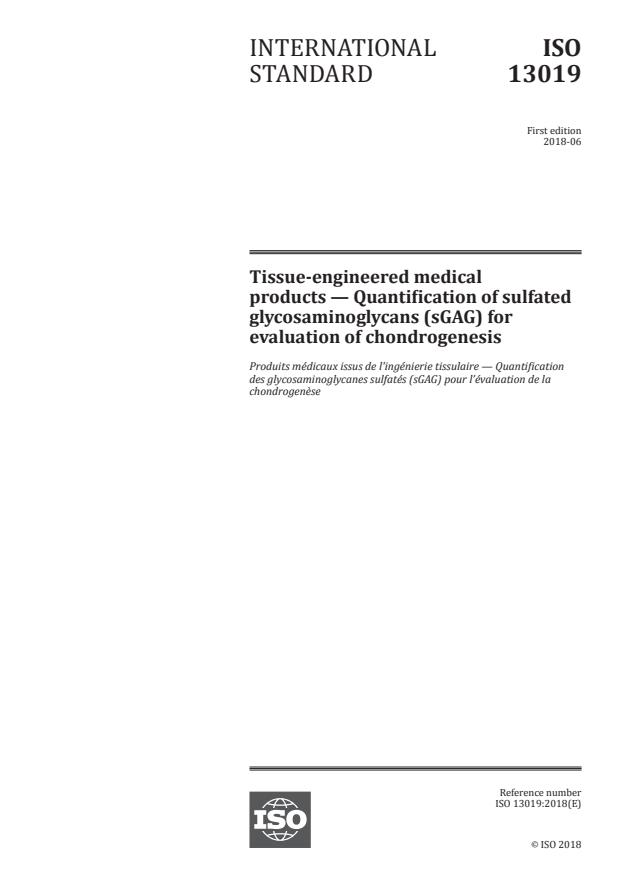
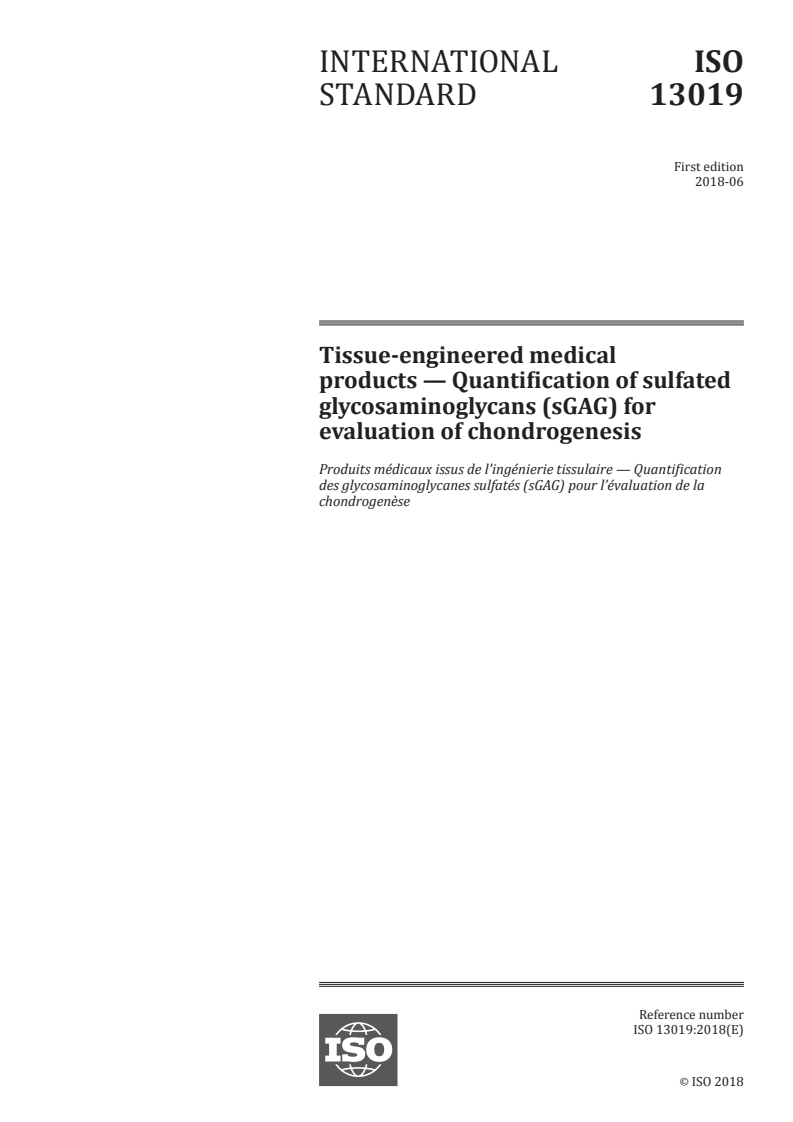
INTERNATIONAL ISO
STANDARD 13019
First edition
2018-06
Tissue-engineered medical
products — Quantification of sulfated
glycosaminoglycans (sGAG) for
evaluation of chondrogenesis
Produits médicaux issus de l'ingénierie tissulaire — Quantification
des glycosaminoglycanes sulfatés (sGAG) pour l’évaluation de la
chondrogenèse
Reference number
©
ISO 2018
© ISO 2018
All rights reserved. Unless otherwise specified, or required in the context of its implementation, no part of this publication may
be reproduced or utilized otherwise in any form or by any means, electronic or mechanical, including photocopying, or posting
on the internet or an intranet, without prior written permission. Permission can be requested from either ISO at the address
below or ISO’s member body in the country of the requester.
ISO copyright office
CP 401 • Ch. de Blandonnet 8
CH-1214 Vernier, Geneva
Phone: +41 22 749 01 11
Fax: +41 22 749 09 47
Email: copyright@iso.org
Website: www.iso.org
Published in Switzerland
ii © ISO 2018 – All rights reserved
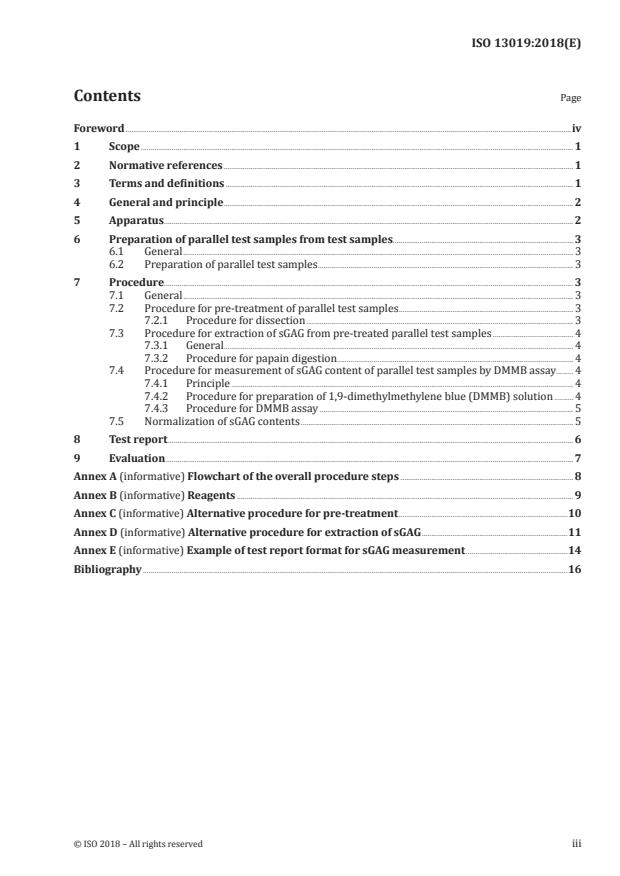
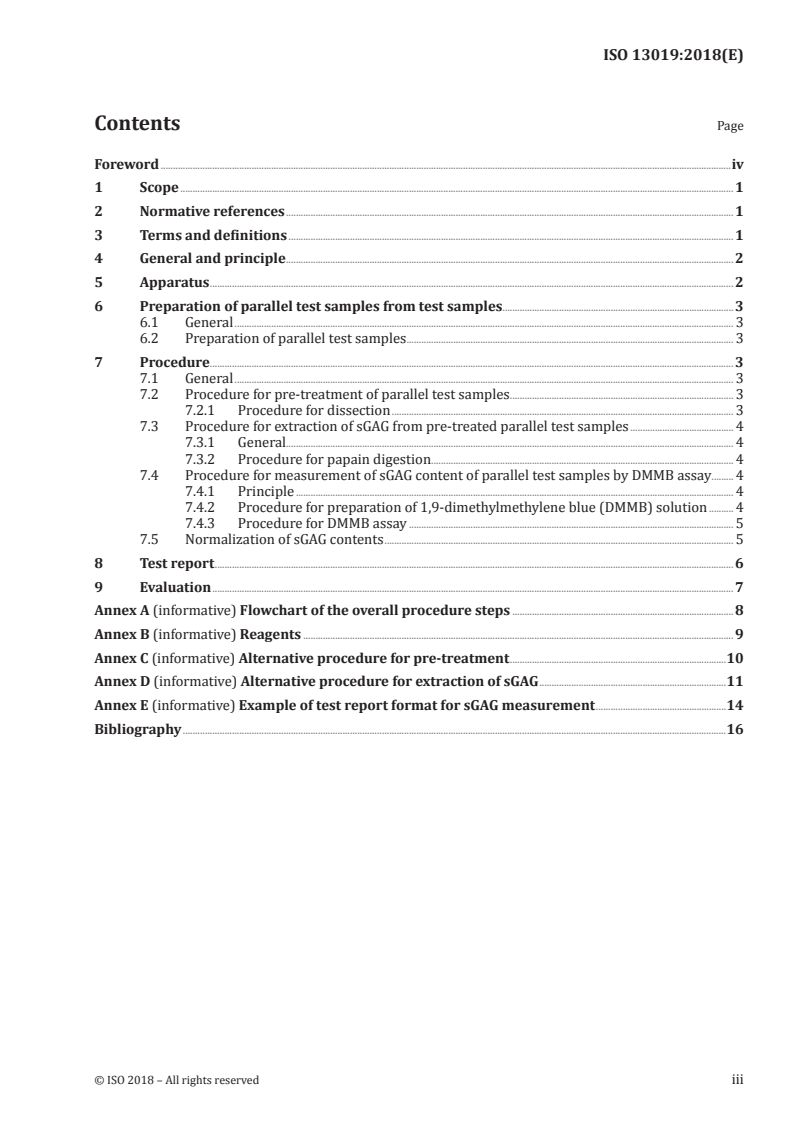
Contents Page
Foreword .iv
1 Scope . 1
2 Normative references . 1
3 Terms and definitions . 1
4 General and principle . 2
5 Apparatus . 2
6 Preparation of parallel test samples from test samples. 3
6.1 General . 3
6.2 Preparation of parallel test samples . 3
7 Procedure. 3
7.1 General . 3
7.2 Procedure for pre-treatment of parallel test samples . 3
7.2.1 Procedure for dissection . 3
7.3 Procedure for extraction of sGAG from pre-treated parallel test samples . 4
7.3.1 General. 4
7.3.2 Procedure for papain digestion . 4
7.4 Procedure for measurement of sGAG content of parallel test samples by DMMB assay . 4
7.4.1 Principle . 4
7.4.2 Procedure for preparation of 1,9-dimethylmethylene blue (DMMB) solution . 4
7.4.3 Procedure for DMMB assay . 5
7.5 Normalization of sGAG contents . 5
8 Test report . 6
9 Evaluation . 7
Annex A (informative) Flowchart of the overall procedure steps . 8
Annex B (informative) Reagents . 9
Annex C (informative) Alternative procedure for pre-treatment .10
Annex D (informative) Alternative procedure for extraction of sGAG .11
Annex E (informative) Example of test report format for sGAG measurement .14
Bibliography .16
Foreword
ISO (the International Organization for Standardization) is a worldwide federation of national standards
bodies (ISO member bodies). The work of preparing International Standards is normally carried out
through ISO technical committees. Each member body interested in a subject for which a technical
committee has been established has the right to be represented on that committee. International
organizations, governmental and non-governmental, in liaison with ISO, also take part in the work.
ISO collaborates closely with the International Electrotechnical Commission (IEC) on all matters of
electrotechnical standardization.
The procedures used to develop this document and those intended for its further maintenance are
described in the ISO/IEC Directives, Part 1. In particular the different approval criteria needed for the
different types of ISO documents should be noted. This document was drafted in accordance with the
editorial rules of the ISO/IEC Directives, Part 2 (see www .iso .org/directives).
Attention is drawn to the possibility that some of the elements of this document may be the subject of
patent rights. ISO shall not be held responsible for identifying any or all such patent rights. Details of
any patent rights identified during the development of the document will be in the Introduction and/or
on the ISO list of patent declarations received (see www .iso .org/patents).
Any trade name used in this document is information given for the convenience of users and does not
constitute an endorsement.
For an explanation on the voluntary nature of standards, the meaning of ISO specific terms and
expressions related to conformity assessment, as well as information about ISO's adherence to the
World Trade Organization (WTO) principles in the Technical Barriers to Trade (TBT) see the following
URL: www .iso .org/iso/foreword .html.
This document was prepared by Technical Committee ISO/TC 150, Implants for surgery, Subcommittee
SC 7, Tissue-engineered medical products.
iv © ISO 2018 – All rights reserved
INTERNATIONAL STANDARD ISO 13019:2018(E)
Tissue-engineered medical products — Quantification
of sulfated glycosaminoglycans (sGAG) for evaluation of
chondrogenesis
1 Scope
This document specifies test methods for the quantification of sulfated glycosaminoglycans (sGAG), one
of the major extracellular matrix components in articular, meniscal, and elastic cartilages, and tissue-
engineered cartilage constructs.
2 Normative references
There are no normative references in this document.
3 Terms and definitions
For the purpose of this document, the following definitions apply.
ISO and IEC maintain terminological databases for use in standardization at the following addresses:
— ISO Online browsing platform: available at https: //www .iso .org/obp
— IEC Electropedia: available at https: //www .electropedia .org/
3.1
tissue-engineered cartilage
cultured construct obtained by combining living cells such as chondrocytes, or stem cells with or
without scaffolds, or other types of biomaterials
3.2
sulfated glycosaminoglycans
long unbranched chains of repeating disacchararide units, which are sulfated at variable positions
EXAMPLE Chondroitin sulfate, keratan sulfate, dermatan sulfate.
3.3
test sample
piece of tissue-engineered cartilage (3.1) construct
3.4
parallel test sample
one of three samples divided from a test sample (3.3)
Note 1 to entry: The protocol provides a sGAG value from each corresponding parallel test sample.
3.5
cysteine
non-essential and sulfur containing amino acid, used for preparing digestion solutions
3.6
papain
cysteine protease enzyme, used for digesting extracellular matrices of diverse tissues
[SOURCE: Enzyme Commission (EC) Number 3.4.22.2]
3.7
1,9-dimethylmethylene blue
dye that specifically binds to a range of sulfated glyocosaminoglycans (3.2), whose absorbance after
binding correlates linearly with the amount of bound sGAG
3.8
chondroitin 6-sulfate
one of the sulfated glycosaminoglycans (sGAG), an important structural component of cartilage and
connective tissues
4 General and principle
The quantification of sulfated glycosaminoglycans (sGAG) is ranked as one of the first steps in evaluating
chondrogenesis of tissue-engineered constructs, since they are one of the primary extracellular matrix
consituents of native cartilage.
sGAG can be quantified by digesting test samples with enzymes to release sGAG into solution, incubating
with a sGAG-binding dye, measuring the absorbance, and normalizing to the weight (wet or dry) or DNA
content of the test sample.
This document applies to tissue-engineered cartilage constructs even if the amount of sGAG content
might be low and offers a dynamic range of 3 µg/ml to 100 µg/ml using a standard curve.
[21][22][29]
Binding of 1,9-dimethylmethylene blue (DMMB) dye is widely-accepted for quantifying sGAG ,
and therefore was selected for this document.
The procedure to quantify sGAG in constructs comprises the following steps:
1) Pre-treatment;
2) Extraction of sGAG;
3) Measurement of sGAG content by the DMMB assay;
4) Normalization of sGAG content.
In order to realize the accurate quantification, careful attention should be paid to critical steps, such as
measuring of weights and volumes, pipette manipulations, and drawing of standard curves. During the
analysis, unless otherwise stated, use only reagents of recognized analytical grade and distilled water
or water of equivalent purity (See Annex B). An example of a test report format for sGAG measurement
is shown in Annex E.
5 Apparatus
5.1 Clean bench.
5.2 Sterilizer, e.g. autoclave.
5.3 Phase contrast microscope.
5.4 Cell culture incubator, capable of maintaining a humidified atmosphere containing 5 % CO
at 37 °C.
5.5 Cell counting apparatus, e.g. hematocytometer.
NOTE If applicable, refer to ISO 20391-1.
5.6 Centrifuge.
2 © ISO 2018 – All rights reserved
5.7 Scales.
5.8 Heating apparatus, capable of maintaining 60 °C. An incubator is preferable so that solutions in
tubes can be surrounded with the temperature.
5.9 Spectrophotometer or microtitre plate reader.
5.10 Sterile cutting knife.
5.11 Sterile tubes.
5.12 Sterile tissue culture dish.
6 Preparation of parallel test samples from test samples
6.1 General
Tissue-engineered cartilage and parallel test samples should be assumed to be potentially infectious,
and corresponding precautions should be taken according to ISO 13022, where the term “medical
products containing viable human cells” should be read as “tissue-engineered cartilage”.
6.2 Preparation of parallel test samples
Tissue-engineered cartilage and parallel test samples shall be handled with care to prevent
contamination. Tools used for cutting tissue-engineered cartilage shall be sterile to prevent
contamination.
a) Prepare phosphate buffered saline (PBS) solution (NaCl 8,00 g/l, KCl 0,20 g/l, Na HPO 1,44 g/l,
2 4
KH PO 0,24 g/l, pH 7,4) containing 5 mM cysteine-HCl and 5 mM EDTA-2Na; adjust pH to 6,0 with
2 4
HCl; sterilize the solution by filtration through a 0,2 µm filter; store the reagent at 4 °C.
b) Cut a full thickness piece of test sample from the tissue-engineered cartilage construct in a bio-
safety cabinet.
c) Divide the test sample into three fragments in a morphologically equal manner, measure their wet
weights, and transfer the parallel test samples directly into PBS solution.
NOTE 1 The minimum measurable sGAG content in parallel test sample is 0,3 µg (cuvette assay) or 0,06 µg
(microtitre plate assay).
NOTE 2 Keep liquid free when weighing the sample.
7 Procedure
7.1 General
Sulfated glycosaminoglycans in tissue-engineered cartilage are quantified by the following four steps:
pre-treatment, extraction of sGAG, measurement of sGAG content, and normalization of sGAG content. A
flowchart of the overall procedure is shown in Annex A.
7.2 Procedure for pre-treatment of parallel test samples
7.2.1 Procedure for dissection
a) Pick up each parallel test sample from the PBS solution.
b) Using an appropriate blade, mince the parallel test samples into pieces small enough (approximately
1 mm) to be extracted in digestion solutions.
NOTE An alternative procedure (pulverization or lyophilisation; see Annex C) might be used as an option.
c) Put the dissected parallel test samples into tared 1,5 ml tubes, centrifuge and remove the liquid.
d) Calculate the weight of each dissected parallel test sample by subtracting the weights of the empty
tubes from the weights of the tubes containing dissected parallel test samples. Prevent parallel test
samples from drying in order to weigh precisely.
e) Proceed to the extraction steps.
7.3 Procedure for extraction of sGAG from pre-treated parallel test samples
7.3.1 General
The dissected parallel test samples should be dissociated for extraction of sGAG. For that purpose,
papain digestion is recommended because it is an adequate method for digesting diverse cartilage
matrices. Depending on the type of scaffold used if any, an alternative procedure (Collagenase digestion,
Guanidine salt extraction, or guanidine extraction/pepsin digestion/elastase digestion; see Annex D)
might be used as an option. The collagenase digestion might be adopted in cases where scaffolds are
composed of collagen gel. Guanidine salt extraction might be adopted in cases that those enzymatic
procedures cannot be used. The guanidine extraction/pepsin digestion/elastase digestion is applicable
only when neither enzymatic extraction nor guanidine salt extraction is succeeded.
7.3.2 Procedure for papain digestion
a) Prepare extraction solution [prepare PBS solution containing papain (lyophilized powder,
comparative activity value: >10 units/mg protein, 125 µg/ml) just before use].
b) Set a heating apparatus to 60 °C before digestion so that the temperature of the solution reaches
60 °C quickly.
c) Digest pre-treated parallel test samples with the papain solution, so that the volume of the solution
is 9 times larger than that of the sample, at 60 °C for 6 h or overnight (the volume of each test
sample is calculated based on the density being 1 g/ml). An appropriate apparatus such as a shaker
(20 r/min to 60 r/min) or a rotator (2 r/min to 10 r/min) shall be used to fully immerse the parallel
test samples.
d) Centrifuge the parallel test samples at 5 000 g for 3 min, and transfer each supernatant to a tube of
the same type with digestion step.
7.4 Procedure for measurement of sGAG content of parallel test samples by DMMB assay
7.4.1 Principle
sGAG content is measured by using DMMB, a dye that binds to sGAG and which is the most commonly-
used reagent for this purpose. The sGAG concentration is determined using a chondroitin 6-sulfate
standard curve. The digested parallel test samples might also serve as solutions for measuring DNA
amounts, which could be used as an alternative to the wet weights of the samples for normalization.
The procedure for measurement of sGAG content is composed of the following two steps: preparation of
1,9-dimethylmethylene blue (DMMB) reagent and the DMMB assay.
7.4.2 Procedure for preparation of 1,9-dimethylmethylene blue (DMMB) solution
a) Add 16 mg DMMB to 5 ml ethanol, and stir the reagent in a clean dry beaker wrapped with
aluminium foil.
4 © ISO 2018 – All rights reserved
b) Add 3,04 g of glycine, 2,37 g of NaCl and 95 ml of 0,1 N HCl.
c) Add 800 ml distilled water and adjust pH to 3,0 with 0,1 N HCl.
d) Bring the volume to 1 000 ml with distilled water.
e) Stir the reagent with a magnetic bar at room temperature for 2 h to 16 h. Protect from light.
f) Filter the reagent with adequate filter paper (e.g. grade 4 qualitative filter paper with pore size of
20 µm to 25 µm) for removing the debris.
g) Store the reagent in a brown bottle at room temperature, and prepare the reagent freshly every
three months.
7.4.3 Procedure for DMMB assay
a) Prepare a 0,5 mg/ml chondroitin 6-sulfate solution by dissolving 10,0 mg chondroitin 6-sulfate
(shark, purity > 95 %) with 2
...
INTERNATIONAL ISO
STANDARD 13019
First edition
2018-06
Tissue-engineered medical
products — Quantification of sulfated
glycosaminoglycans (sGAG) for
evaluation of chondrogenesis
Produits médicaux issus de l'ingénierie tissulaire — Quantification
des glycosaminoglycanes sulfatés (sGAG) pour l’évaluation de la
chondrogenèse
Reference number
©
ISO 2018
© ISO 2018
All rights reserved. Unless otherwise specified, or required in the context of its implementation, no part of this publication may
be reproduced or utilized otherwise in any form or by any means, electronic or mechanical, including photocopying, or posting
on the internet or an intranet, without prior written permission. Permission can be requested from either ISO at the address
below or ISO’s member body in the country of the requester.
ISO copyright office
CP 401 • Ch. de Blandonnet 8
CH-1214 Vernier, Geneva
Phone: +41 22 749 01 11
Fax: +41 22 749 09 47
Email: copyright@iso.org
Website: www.iso.org
Published in Switzerland
ii © ISO 2018 – All rights reserved
Contents Page
Foreword .iv
1 Scope . 1
2 Normative references . 1
3 Terms and definitions . 1
4 General and principle . 2
5 Apparatus . 2
6 Preparation of parallel test samples from test samples. 3
6.1 General . 3
6.2 Preparation of parallel test samples . 3
7 Procedure. 3
7.1 General . 3
7.2 Procedure for pre-treatment of parallel test samples . 3
7.2.1 Procedure for dissection . 3
7.3 Procedure for extraction of sGAG from pre-treated parallel test samples . 4
7.3.1 General. 4
7.3.2 Procedure for papain digestion . 4
7.4 Procedure for measurement of sGAG content of parallel test samples by DMMB assay . 4
7.4.1 Principle . 4
7.4.2 Procedure for preparation of 1,9-dimethylmethylene blue (DMMB) solution . 4
7.4.3 Procedure for DMMB assay . 5
7.5 Normalization of sGAG contents . 5
8 Test report . 6
9 Evaluation . 7
Annex A (informative) Flowchart of the overall procedure steps . 8
Annex B (informative) Reagents . 9
Annex C (informative) Alternative procedure for pre-treatment .10
Annex D (informative) Alternative procedure for extraction of sGAG .11
Annex E (informative) Example of test report format for sGAG measurement .14
Bibliography .16
Foreword
ISO (the International Organization for Standardization) is a worldwide federation of national standards
bodies (ISO member bodies). The work of preparing International Standards is normally carried out
through ISO technical committees. Each member body interested in a subject for which a technical
committee has been established has the right to be represented on that committee. International
organizations, governmental and non-governmental, in liaison with ISO, also take part in the work.
ISO collaborates closely with the International Electrotechnical Commission (IEC) on all matters of
electrotechnical standardization.
The procedures used to develop this document and those intended for its further maintenance are
described in the ISO/IEC Directives, Part 1. In particular the different approval criteria needed for the
different types of ISO documents should be noted. This document was drafted in accordance with the
editorial rules of the ISO/IEC Directives, Part 2 (see www .iso .org/directives).
Attention is drawn to the possibility that some of the elements of this document may be the subject of
patent rights. ISO shall not be held responsible for identifying any or all such patent rights. Details of
any patent rights identified during the development of the document will be in the Introduction and/or
on the ISO list of patent declarations received (see www .iso .org/patents).
Any trade name used in this document is information given for the convenience of users and does not
constitute an endorsement.
For an explanation on the voluntary nature of standards, the meaning of ISO specific terms and
expressions related to conformity assessment, as well as information about ISO's adherence to the
World Trade Organization (WTO) principles in the Technical Barriers to Trade (TBT) see the following
URL: www .iso .org/iso/foreword .html.
This document was prepared by Technical Committee ISO/TC 150, Implants for surgery, Subcommittee
SC 7, Tissue-engineered medical products.
iv © ISO 2018 – All rights reserved
INTERNATIONAL STANDARD ISO 13019:2018(E)
Tissue-engineered medical products — Quantification
of sulfated glycosaminoglycans (sGAG) for evaluation of
chondrogenesis
1 Scope
This document specifies test methods for the quantification of sulfated glycosaminoglycans (sGAG), one
of the major extracellular matrix components in articular, meniscal, and elastic cartilages, and tissue-
engineered cartilage constructs.
2 Normative references
There are no normative references in this document.
3 Terms and definitions
For the purpose of this document, the following definitions apply.
ISO and IEC maintain terminological databases for use in standardization at the following addresses:
— ISO Online browsing platform: available at https: //www .iso .org/obp
— IEC Electropedia: available at https: //www .electropedia .org/
3.1
tissue-engineered cartilage
cultured construct obtained by combining living cells such as chondrocytes, or stem cells with or
without scaffolds, or other types of biomaterials
3.2
sulfated glycosaminoglycans
long unbranched chains of repeating disacchararide units, which are sulfated at variable positions
EXAMPLE Chondroitin sulfate, keratan sulfate, dermatan sulfate.
3.3
test sample
piece of tissue-engineered cartilage (3.1) construct
3.4
parallel test sample
one of three samples divided from a test sample (3.3)
Note 1 to entry: The protocol provides a sGAG value from each corresponding parallel test sample.
3.5
cysteine
non-essential and sulfur containing amino acid, used for preparing digestion solutions
3.6
papain
cysteine protease enzyme, used for digesting extracellular matrices of diverse tissues
[SOURCE: Enzyme Commission (EC) Number 3.4.22.2]
3.7
1,9-dimethylmethylene blue
dye that specifically binds to a range of sulfated glyocosaminoglycans (3.2), whose absorbance after
binding correlates linearly with the amount of bound sGAG
3.8
chondroitin 6-sulfate
one of the sulfated glycosaminoglycans (sGAG), an important structural component of cartilage and
connective tissues
4 General and principle
The quantification of sulfated glycosaminoglycans (sGAG) is ranked as one of the first steps in evaluating
chondrogenesis of tissue-engineered constructs, since they are one of the primary extracellular matrix
consituents of native cartilage.
sGAG can be quantified by digesting test samples with enzymes to release sGAG into solution, incubating
with a sGAG-binding dye, measuring the absorbance, and normalizing to the weight (wet or dry) or DNA
content of the test sample.
This document applies to tissue-engineered cartilage constructs even if the amount of sGAG content
might be low and offers a dynamic range of 3 µg/ml to 100 µg/ml using a standard curve.
[21][22][29]
Binding of 1,9-dimethylmethylene blue (DMMB) dye is widely-accepted for quantifying sGAG ,
and therefore was selected for this document.
The procedure to quantify sGAG in constructs comprises the following steps:
1) Pre-treatment;
2) Extraction of sGAG;
3) Measurement of sGAG content by the DMMB assay;
4) Normalization of sGAG content.
In order to realize the accurate quantification, careful attention should be paid to critical steps, such as
measuring of weights and volumes, pipette manipulations, and drawing of standard curves. During the
analysis, unless otherwise stated, use only reagents of recognized analytical grade and distilled water
or water of equivalent purity (See Annex B). An example of a test report format for sGAG measurement
is shown in Annex E.
5 Apparatus
5.1 Clean bench.
5.2 Sterilizer, e.g. autoclave.
5.3 Phase contrast microscope.
5.4 Cell culture incubator, capable of maintaining a humidified atmosphere containing 5 % CO
at 37 °C.
5.5 Cell counting apparatus, e.g. hematocytometer.
NOTE If applicable, refer to ISO 20391-1.
5.6 Centrifuge.
2 © ISO 2018 – All rights reserved
5.7 Scales.
5.8 Heating apparatus, capable of maintaining 60 °C. An incubator is preferable so that solutions in
tubes can be surrounded with the temperature.
5.9 Spectrophotometer or microtitre plate reader.
5.10 Sterile cutting knife.
5.11 Sterile tubes.
5.12 Sterile tissue culture dish.
6 Preparation of parallel test samples from test samples
6.1 General
Tissue-engineered cartilage and parallel test samples should be assumed to be potentially infectious,
and corresponding precautions should be taken according to ISO 13022, where the term “medical
products containing viable human cells” should be read as “tissue-engineered cartilage”.
6.2 Preparation of parallel test samples
Tissue-engineered cartilage and parallel test samples shall be handled with care to prevent
contamination. Tools used for cutting tissue-engineered cartilage shall be sterile to prevent
contamination.
a) Prepare phosphate buffered saline (PBS) solution (NaCl 8,00 g/l, KCl 0,20 g/l, Na HPO 1,44 g/l,
2 4
KH PO 0,24 g/l, pH 7,4) containing 5 mM cysteine-HCl and 5 mM EDTA-2Na; adjust pH to 6,0 with
2 4
HCl; sterilize the solution by filtration through a 0,2 µm filter; store the reagent at 4 °C.
b) Cut a full thickness piece of test sample from the tissue-engineered cartilage construct in a bio-
safety cabinet.
c) Divide the test sample into three fragments in a morphologically equal manner, measure their wet
weights, and transfer the parallel test samples directly into PBS solution.
NOTE 1 The minimum measurable sGAG content in parallel test sample is 0,3 µg (cuvette assay) or 0,06 µg
(microtitre plate assay).
NOTE 2 Keep liquid free when weighing the sample.
7 Procedure
7.1 General
Sulfated glycosaminoglycans in tissue-engineered cartilage are quantified by the following four steps:
pre-treatment, extraction of sGAG, measurement of sGAG content, and normalization of sGAG content. A
flowchart of the overall procedure is shown in Annex A.
7.2 Procedure for pre-treatment of parallel test samples
7.2.1 Procedure for dissection
a) Pick up each parallel test sample from the PBS solution.
b) Using an appropriate blade, mince the parallel test samples into pieces small enough (approximately
1 mm) to be extracted in digestion solutions.
NOTE An alternative procedure (pulverization or lyophilisation; see Annex C) might be used as an option.
c) Put the dissected parallel test samples into tared 1,5 ml tubes, centrifuge and remove the liquid.
d) Calculate the weight of each dissected parallel test sample by subtracting the weights of the empty
tubes from the weights of the tubes containing dissected parallel test samples. Prevent parallel test
samples from drying in order to weigh precisely.
e) Proceed to the extraction steps.
7.3 Procedure for extraction of sGAG from pre-treated parallel test samples
7.3.1 General
The dissected parallel test samples should be dissociated for extraction of sGAG. For that purpose,
papain digestion is recommended because it is an adequate method for digesting diverse cartilage
matrices. Depending on the type of scaffold used if any, an alternative procedure (Collagenase digestion,
Guanidine salt extraction, or guanidine extraction/pepsin digestion/elastase digestion; see Annex D)
might be used as an option. The collagenase digestion might be adopted in cases where scaffolds are
composed of collagen gel. Guanidine salt extraction might be adopted in cases that those enzymatic
procedures cannot be used. The guanidine extraction/pepsin digestion/elastase digestion is applicable
only when neither enzymatic extraction nor guanidine salt extraction is succeeded.
7.3.2 Procedure for papain digestion
a) Prepare extraction solution [prepare PBS solution containing papain (lyophilized powder,
comparative activity value: >10 units/mg protein, 125 µg/ml) just before use].
b) Set a heating apparatus to 60 °C before digestion so that the temperature of the solution reaches
60 °C quickly.
c) Digest pre-treated parallel test samples with the papain solution, so that the volume of the solution
is 9 times larger than that of the sample, at 60 °C for 6 h or overnight (the volume of each test
sample is calculated based on the density being 1 g/ml). An appropriate apparatus such as a shaker
(20 r/min to 60 r/min) or a rotator (2 r/min to 10 r/min) shall be used to fully immerse the parallel
test samples.
d) Centrifuge the parallel test samples at 5 000 g for 3 min, and transfer each supernatant to a tube of
the same type with digestion step.
7.4 Procedure for measurement of sGAG content of parallel test samples by DMMB assay
7.4.1 Principle
sGAG content is measured by using DMMB, a dye that binds to sGAG and which is the most commonly-
used reagent for this purpose. The sGAG concentration is determined using a chondroitin 6-sulfate
standard curve. The digested parallel test samples might also serve as solutions for measuring DNA
amounts, which could be used as an alternative to the wet weights of the samples for normalization.
The procedure for measurement of sGAG content is composed of the following two steps: preparation of
1,9-dimethylmethylene blue (DMMB) reagent and the DMMB assay.
7.4.2 Procedure for preparation of 1,9-dimethylmethylene blue (DMMB) solution
a) Add 16 mg DMMB to 5 ml ethanol, and stir the reagent in a clean dry beaker wrapped with
aluminium foil.
4 © ISO 2018 – All rights reserved
b) Add 3,04 g of glycine, 2,37 g of NaCl and 95 ml of 0,1 N HCl.
c) Add 800 ml distilled water and adjust pH to 3,0 with 0,1 N HCl.
d) Bring the volume to 1 000 ml with distilled water.
e) Stir the reagent with a magnetic bar at room temperature for 2 h to 16 h. Protect from light.
f) Filter the reagent with adequate filter paper (e.g. grade 4 qualitative filter paper with pore size of
20 µm to 25 µm) for removing the debris.
g) Store the reagent in a brown bottle at room temperature, and prepare the reagent freshly every
three months.
7.4.3 Procedure for DMMB assay
a) Prepare a 0,5 mg/ml chondroitin 6-sulfate solution by dissolving 10,0 mg chondroitin 6-sulfate
(shark, purity > 95 %) with 2
...