


ISO/TR 21784:2018
(Main)Plain bearings — Spray nozzle type directed lubrication for tilting pad bearings
Plain bearings — Spray nozzle type directed lubrication for tilting pad bearings
Directed lubrication is an advanced technology that is capable of reducing the power loss and improving the performance of tilting pad type bearings. Unlike flooded lubrication, where the bearing components remain permanently submerged in an oil filled housing, with directed lubrication the components are not submerged and the oil is delivered from an external source directly to the working surfaces of the tilting pads after which it falls freely away to be drained from the bottom of the housing. There are several alternative methods of realising the benefits of directed lubrication in tilting pad bearing designs. As an example, this document specifies a spray nozzle type directed lubrication system where lubricant is supplied to each pad through nozzles mounted between the pads in tilting pad thrust and journal bearings. The design concept of this type of lubrication is described.
Titre manque
General Information
- Status
- Published
- Publication Date
- 12-Sep-2018
- Technical Committee
- ISO/TC 123/SC 7 - Special types of plain bearings
- Drafting Committee
- ISO/TC 123/SC 7 - Special types of plain bearings
- Current Stage
- 6060 - International Standard published
- Start Date
- 13-Sep-2018
- Completion Date
- 12-Feb-2026
Overview
ISO/TR 21784:2018 - Plain bearings - Spray nozzle type directed lubrication for tilting pad bearings - describes the design concept and practical implementation of spray nozzle directed lubrication for tilting pad thrust and journal bearings. The technical report explains how directed lubrication differs from traditional flooded lubrication: oil is injected directly to pad working surfaces via nozzles between pads, the bearing housing is not filled, and excess oil is drained. The goal is to reduce power loss, minimize churning losses and improve overall performance and energy efficiency in rotating machinery (turbines, generators, compressors, pumps).
Key topics and requirements
- Lubrication concept: Spray nozzle type directed lubrication supplies lubricant to each pad through nozzles mounted between pads; nozzles can also act as pad stops and aid assembly/disassembly.
- Power-loss reduction: Directed lubrication reduces churning losses inherent to flooded systems, especially at high speeds, resulting in significant energy savings.
- Oil flow and cooling: The report recommends limiting oil temperature rise through the bearing to about 15–20 °C. Required oil flow rate is calculated from estimated power loss using the relationship between power, oil heat capacity, density and allowable temperature rise.
- Nozzle sizing and arrangement: ISO/TR 21784 provides formulae and guidance linking nozzle hole diameter, number of holes, nozzle count per bearing and a flow coefficient (K) to achieve the required oil flow and spray distribution. Specific nozzle types (A, B, C, D) and selection guidance (e.g., Type C for pad axial width < ~130 mm) are described.
- Oil supply pressure and velocities: Typical oil supply pressures are 0.10–0.15 MPa. Design of inlet passages should limit oil velocity to ≤ 3 m/s to avoid pressure losses; discharge geometry should allow free drainage, keeping discharge velocity low (example: < 0.15 m/s by sizing discharge hole diameter relative to collar width).
- Seal and drainage options: For journal bearings, seal rings are normally removed to permit axial drainage; where used, seal clearances are increased to allow oil discharge.
Applications and users
Who benefits from ISO/TR 21784:
- Bearing designers and OEMs developing tilting pad thrust and journal bearings with directed lubrication
- Rotating machinery engineers and plant reliability teams seeking energy-efficient bearing solutions
- Maintenance engineers specifying retrofit or new bearing lubrication systems for turbines, compressors, pumps and generators
- Consultants and specification writers preparing procurement or performance criteria for bearings and lubrication systems
Practical benefits include reduced bearing power loss, smaller cooling systems, simplified housing designs and improved plant efficiency.
Related standards
- Prepared by ISO/TC 123 (Plain bearings). For complete implementation consider other ISO standards and technical reports on plain bearing design, lubrication and bearing testing published by ISO/TC 123.
Frequently Asked Questions
ISO/TR 21784:2018 is a technical report published by the International Organization for Standardization (ISO). Its full title is "Plain bearings — Spray nozzle type directed lubrication for tilting pad bearings". This standard covers: Directed lubrication is an advanced technology that is capable of reducing the power loss and improving the performance of tilting pad type bearings. Unlike flooded lubrication, where the bearing components remain permanently submerged in an oil filled housing, with directed lubrication the components are not submerged and the oil is delivered from an external source directly to the working surfaces of the tilting pads after which it falls freely away to be drained from the bottom of the housing. There are several alternative methods of realising the benefits of directed lubrication in tilting pad bearing designs. As an example, this document specifies a spray nozzle type directed lubrication system where lubricant is supplied to each pad through nozzles mounted between the pads in tilting pad thrust and journal bearings. The design concept of this type of lubrication is described.
Directed lubrication is an advanced technology that is capable of reducing the power loss and improving the performance of tilting pad type bearings. Unlike flooded lubrication, where the bearing components remain permanently submerged in an oil filled housing, with directed lubrication the components are not submerged and the oil is delivered from an external source directly to the working surfaces of the tilting pads after which it falls freely away to be drained from the bottom of the housing. There are several alternative methods of realising the benefits of directed lubrication in tilting pad bearing designs. As an example, this document specifies a spray nozzle type directed lubrication system where lubricant is supplied to each pad through nozzles mounted between the pads in tilting pad thrust and journal bearings. The design concept of this type of lubrication is described.
ISO/TR 21784:2018 is classified under the following ICS (International Classification for Standards) categories: 21.100.10 - Plain bearings. The ICS classification helps identify the subject area and facilitates finding related standards.
ISO/TR 21784:2018 is available in PDF format for immediate download after purchase. The document can be added to your cart and obtained through the secure checkout process. Digital delivery ensures instant access to the complete standard document.
Standards Content (Sample)
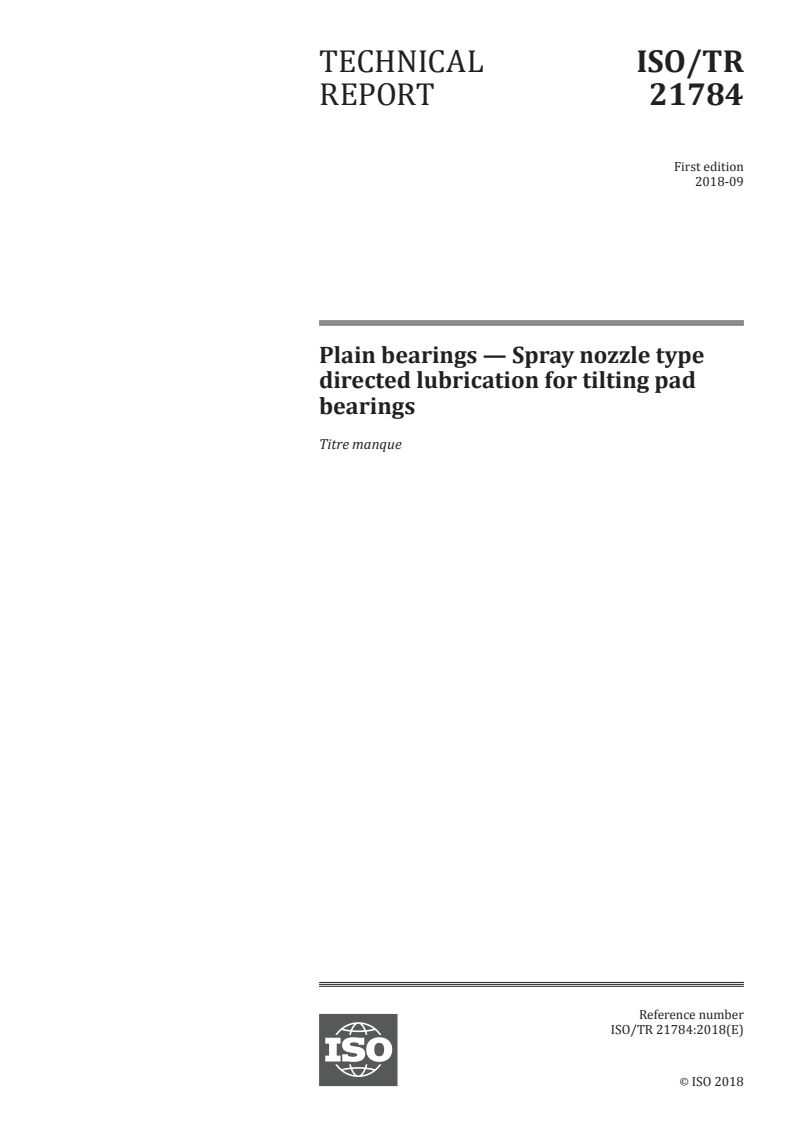
TECHNICAL ISO/TR
REPORT 21784
First edition
2018-09
Plain bearings — Spray nozzle type
directed lubrication for tilting pad
bearings
Titre manque
Reference number
©
ISO 2018
© ISO 2018
All rights reserved. Unless otherwise specified, or required in the context of its implementation, no part of this publication may
be reproduced or utilized otherwise in any form or by any means, electronic or mechanical, including photocopying, or posting
on the internet or an intranet, without prior written permission. Permission can be requested from either ISO at the address
below or ISO’s member body in the country of the requester.
ISO copyright office
CP 401 • Ch. de Blandonnet 8
CH-1214 Vernier, Geneva
Phone: +41 22 749 01 11
Fax: +41 22 749 09 47
Email: copyright@iso.org
Website: www.iso.org
Published in Switzerland
ii © ISO 2018 – All rights reserved
Contents Page
Foreword .iv
Introduction .v
1 Scope . 1
2 Normative references . 1
3 Terms and definitions . 1
4 Symbols and abbreviated terms . 1
5 Reduction effect of power loss by spray nozzle type directed lubrication systems.2
6 Lubrication system . 4
6.1 Tilting pad thrust bearing . 4
6.2 Tilting pad journal bearing . 5
7 Oil supply system of spray nozzle type directed lubrication . 6
7.1 General . 6
7.2 Tilting pad thrust bearing . 6
7.3 Tilting pad journal bearing . 7
7.4 Oil flow . 7
7.5 Oil supply pressure . 8
8 Structure of oil inlet and outlet (drainage) on nozzle type directed lubrication .8
8.1 Tilting pad thrust bearing . 8
8.2 Tilting pad journal bearing .10
Bibliography .12
Foreword
ISO (the International Organization for Standardization) is a worldwide federation of national standards
bodies (ISO member bodies). The work of preparing International Standards is normally carried out
through ISO technical committees. Each member body interested in a subject for which a technical
committee has been established has the right to be represented on that committee. International
organizations, governmental and non-governmental, in liaison with ISO, also take part in the work.
ISO collaborates closely with the International Electrotechnical Commission (IEC) on all matters of
electrotechnical standardization.
The procedures used to develop this document and those intended for its further maintenance are
described in the ISO/IEC Directives, Part 1. In particular the different approval criteria needed for the
different types of ISO documents should be noted. This document was drafted in accordance with the
editorial rules of the ISO/IEC Directives, Part 2 (see www .iso .org/directives).
Attention is drawn to the possibility that some of the elements of this document may be the subject of
patent rights. ISO shall not be held responsible for identifying any or all such patent rights. Details of
any patent rights identified during the development of the document will be in the Introduction and/or
on the ISO list of patent declarations received (see www .iso .org/patents).
Any trade name used in this document is information given for the convenience of users and does not
constitute an endorsement.
For an explanation on the voluntary nature of standards, the meaning of ISO specific terms and
expressions related to conformity assessment, as well as information about ISO's adherence to the
World Trade Organization (WTO) principles in the Technical Barriers to Trade (TBT) see the following
URL: www .iso .org/iso/foreword .html.
This document was prepared by Technical Committee ISO/TC 123, Plain bearings, Subcommittee SC 7,
Special types of plain bearings.
Any feedback or questions on this document should be directed to the user’s national standards body. A
complete listing of these bodies can be found at www .iso .org/members .html.
iv © ISO 2018 – All rights reserved
Introduction
These days, rotating machines such as turbines, generators, compressors, pumps, etc. tend to be
increasing in speed and reducing in size. Bearings used in such machines can cause large power losses,
which not only degrades machine performance but also results in the associated cooling system being
larger in size. Directed lubrication type bearings can reduce the power loss significantly. They are
energy-saving bearings that can simplify facilities and improve plant efficiency.
TECHNICAL REPORT ISO/TR 21784:2018(E)
Plain bearings — Spray nozzle type directed lubrication for
tilting pad bearings
1 Scope
Directed lubrication is an advanced technology that is capable of reducing the power loss and improving
the performance of tilting pad type bearings. Unlike flooded lubrication, where the bearing components
remain permanently submerged in an oil filled housing, with directed lubrication the components are
not submerged and the oil is delivered from an external source directly to the working surfaces of
the tilting pads after which it falls freely away to be drained from the bottom of the housing. There
are several alternative methods of realising the benefits of directed lubrication in tilting pad bearing
designs. As an example, this document specifies a spray nozzle type directed lubrication system where
lubricant is supplied to each pad through nozzles mounted between the pads in tilting pad thrust and
journal bearings. The design concept of this type of lubrication is described.
2 Normative references
There are no normative references in this document.
3 Terms and definitions
No terms and definitions are listed in this document.
ISO and IEC maintain terminological databases for use in standardization at the following addresses:
— ISO Online browsing platform: available at https: //www .iso .org/obp
— IEC Electropedia: available at http: //www .electropedia .org/
4 Symbols and abbreviated terms
For the purposes of this document, the following symbols apply.
Table 1 — Symbols and units
Symbol Explanation Unit
B Thrust collar width m
tc
c Specific heat capacity of lubricant J/(kg·K)
p
D Diameter of discharge oil hole m
d
d Hole diameter of nozzle m
h
K Coefficient of oil flow rate 1
Q
n Number of holes per nozzle 1
h
n Number of nozzles per bearing 1
n
P Power loss W
p Oil supply pressure Pa
en
Q Total oil flow rate m /s
Q Oil flow rate per nozzle m /s
n
ΔT Oil temperature rise K
ρ Density of lubricant kg/m
5 Reduction effect of power loss by spray nozzle type directed lubrication systems
The effect of power loss reduction by the spray nozzle type directed lubrication system is shown with
regard to tilting pad thrust bearings. The power loss of tilting pad thrust bearings arranged for floo
...
Questions, Comments and Discussion
Ask us and Technical Secretary will try to provide an answer. You can facilitate discussion about the standard in here.
Loading comments...