

ISO/IEC 14776-411:1999
(Main)Information technology — Small Computer System Interface-3 — Part 411: SCSI-3 Architecture Model (SCSI-3 SAM)
General Information
- Abstract
This International Standard describes a reference model for the coordination of standards applicable to SCSI-3 I/O systems and a set of common behavioral requirements that are essential for the development of host software and device firmware that can interoperate with any SCSI-3 interconnect or protocol.
- Status
- Published
- Publication Date
- 31-Aug-1999
- Technical Committee
- ISO/IEC JTC 1/SC 25 - Interconnection of information technology equipment
- Current Stage
- 9093 - International Standard confirmed
- Start Date
- 13-Jul-2018
- Completion Date
- 29-Aug-2026
Overview
ISO/IEC 14776-411:1999 - SCSI-3 Architecture Model (SCSI-3 SAM) defines a reference architecture and set of common behavioral requirements for SCSI-3 I/O systems. The standard provides a client–server, distributed service and structural model that drives consistent implementation of host software, device firmware and protocol stacks so that devices and hosts interoperate across any SCSI-3 interconnect or protocol. Key deliverables include object definitions (Domain, Device, Initiator, Target, Logical Unit, Task), protocol service models, and command/task management semantics.
Key Topics and Requirements
- Architecture model: Distributed service model, client–server relationships, and SCSI domain structure that govern coordination across SCSI-3 documents.
- Device models: Formal definitions for Initiator, Target, Logical Unit and Task objects to ensure consistent behavior.
- SCSI command model: Remote procedure semantics for command execution, Command Descriptor Block (CDB) fields (operation code, control), status reporting and sense data.
- Protocol services: Data-In/Data-Out transfer models, buffered transfer models and request/response ordering requirements.
- Task and task-set management: Task lifetimes, task attributes (SIMPLE, ORDERED, HEAD OF QUEUE, ACA), task management functions (ABORT TASK, ABORT TASK SET, CLEAR ACA, TARGET RESET, etc.), and examples for overlapped/linked command processing.
- Error and exception handling: Unit attention, autosense, auto contingent allegiance, hard reset and associated clearing semantics.
- State and notation conventions: Object notation, state diagrams and hierarchy representations used throughout the SCSI-3 family.
Applications - Who Uses It and Why
- Storage device firmware engineers use the SAM to implement target/ logical unit behavior and task management that interoperates across initiators and transports.
- Operating system and host adapter developers implement host-side SCSI stacks (initiators) consistent with CDB semantics, status and sense handling.
- Storage system architects and designers use the model to design multi-protocol storage arrays and ensure consistent command ordering and recovery behavior.
- Test labs and conformance teams rely on the SAM as a baseline for interoperability tests, compliance suites and certification.
- Protocol and transport implementers reference SAM when mapping SCSI semantics over Fibre Channel, iSCSI, SAS or other physical layers.
Related Standards
- ISO/IEC 14776-411 is part of the broader SCSI-3 family. Implementers should consult associated SCSI transport and physical-layer specifications and the normative references listed in the SAM for complete interoperability requirements.
Keywords: ISO/IEC 14776-411, SCSI-3 SAM, SCSI architecture model, Command Descriptor Block, task management, logical unit, initiator, target, device firmware, host software, interoperability.
Get Certified
Connect with accredited certification bodies for this standard

BSI Group
BSI (British Standards Institution) is the business standards company that helps organizations make excellence a habit.

NYCE
Mexican standards and certification body.
Sponsored listings
Frequently Asked Questions
ISO/IEC 14776-411:1999 is a standard published by the International Organization for Standardization (ISO). Its full title is "Information technology — Small Computer System Interface-3 — Part 411: SCSI-3 Architecture Model (SCSI-3 SAM)". This standard covers: This International Standard describes a reference model for the coordination of standards applicable to SCSI-3 I/O systems and a set of common behavioral requirements that are essential for the development of host software and device firmware that can interoperate with any SCSI-3 interconnect or protocol.
This International Standard describes a reference model for the coordination of standards applicable to SCSI-3 I/O systems and a set of common behavioral requirements that are essential for the development of host software and device firmware that can interoperate with any SCSI-3 interconnect or protocol.
ISO/IEC 14776-411:1999 is classified under the following ICS (International Classification for Standards) categories: 35.200 - Interface and interconnection equipment. The ICS classification helps identify the subject area and facilitates finding related standards.
ISO/IEC 14776-411:1999 is available in PDF format for immediate download after purchase. The document can be added to your cart and obtained through the secure checkout process. Digital delivery ensures instant access to the complete standard document.
Standards Content (Sample)
INTERNATIONAL ISO/IEC
STANDARD
14776-411
First edition
1999-09
Information technology –
SCSI-3 Architecture Model
(SCSI-3 SAM)
Technologies de l'information –
Modèle d'architecture SCSI-3 (SCSI-3 SAM)
Reference number
Numéros des publications Numbering
Depuis le 1er janvier 1997, les publications de la CEI As from 1 January 1997 all IEC publications are
sont numérotées à partir de 60000. issued with a designation in the 60000 series.
Publications consolidées Consolidated publications
Les versions consolidées de certaines publications de Consolidated versions of some IEC publications
la CEI incorporant les amendements sont disponibles. including amendments are available. For example,
Par exemple, les numéros d’édition 1.0, 1.1 et 1.2 edition numbers 1.0, 1.1 and 1.2 refer, respectively, to
indiquent respectivement la publication de base, la the base publication, the base publication
publication de base incorporant l’amendement 1, et la incorporating amendment 1 and the base publication
publication de base incorporant les amendements 1 incorporating amendments 1 and 2.
et 2.
Validité de la présente publication Validity of this publication
Le contenu technique des publications de la CEI est The technical content of IEC publications is kept under
constamment revu par la CEI afin qu'il reflète l'état constant review by the IEC, thus ensuring that the
actuel de la technique. content reflects current technology.
Des renseignements relatifs à la date de Information relating to the date of the reconfirmation of
reconfirmation de la publication sont disponibles dans the publication is available in the IEC catalogue.
le Catalogue de la CEI.
Les renseignements relatifs à des questions à l’étude et Information on the subjects under consideration and
des travaux en cours entrepris par le comité technique work in progress undertaken by the technical
qui a établi cette publication, ainsi que la liste des committee which has prepared this publication, as well
publications établies, se trouvent dans les documents ci- as the list of publications issued, is to be found at the
dessous: following IEC sources:
• «Site web» de la CEI* • IEC web site*
• Catalogue des publications de la CEI • Catalogue of IEC publications
Publié annuellement et mis à jour régulièrement Published yearly with regular updates
(Catalogue en ligne)* (On-line catalogue)*
• Bulletin de la CEI • IEC Bulletin
Disponible à la fois au «site web» de la CEI* et Available both at the IEC web site* and as a
comme périodique imprimé printed periodical
Terminologie, symboles graphiques Terminology, graphical and letter
et littéraux symbols
En ce qui concerne la terminologie générale, le lecteur For general terminology, readers are referred to
se reportera à la CEI 60050: Vocabulaire Electro- IEC 60050: International Electrotechnical Vocabulary
technique International (VEI). (IEV).
Pour les symboles graphiques, les symboles littéraux For graphical symbols, and letter symbols and signs
et les signes d'usage général approuvés par la CEI, le approved by the IEC for general use, readers are
lecteur consultera la CEI 60027: Symboles littéraux à referred to publications IEC 60027: Letter symbols to
utiliser en électrotechnique, la CEI 60417: Symboles be used in electrical technology, IEC 60417: Graphical
graphiques utilisables sur le matériel. Index, relevé et symbols for use on equipment. Index, survey and
compilation des feuilles individuelles, et la CEI 60617: compilation of the single sheets and IEC 60617:
Symboles graphiques pour schémas. Graphical symbols for diagrams.
* Voir adresse «site web» sur la page de titre. * See web site address on title page.
INTERNATIONAL ISO/IEC
STANDARD
14776-411
First edition
1999-09
Information technology –
SCSI-3 Architecture Model
(SCSI-3 SAM)
Technologies de l'information –
Modèle d'architecture SCSI-3 (SCSI-3 SAM)
ISO/IEC 1999
All rights reserved. Unless otherwise specified, no part of this publication may be reproduced or utilized in any form or by any
means, electronic or mechanical, including photocopying and microfilm, without permission in writing from the publisher.
ISO/IEC Copyright Office Case postale 56 CH-1211 Genève 20 Switzerland
• • •
PRICE CODE
W
For price, see current catalogue
– ii – 14776-411 © ISO/IEC:1999(E)
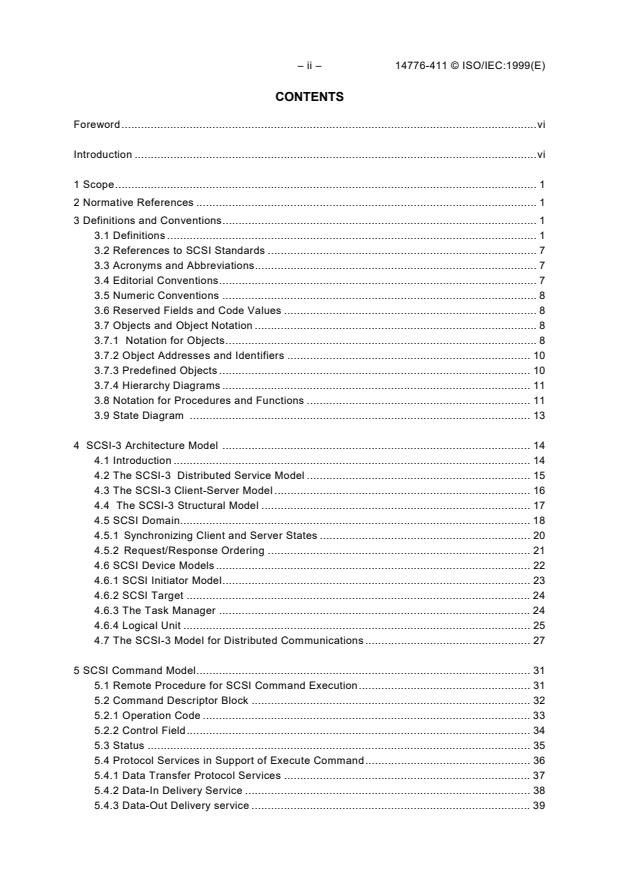
CONTENTS
Foreword.vi
Introduction .vi
1 Scope. 1
2 Normative References . 1
3 Definitions and Conventions. 1
3.1 Definitions . 1
3.2 References to SCSI Standards . 7
3.3 Acronyms and Abbreviations. 7
3.4 Editorial Conventions. 7
3.5 Numeric Conventions . 8
3.6 Reserved Fields and Code Values . 8
3.7 Objects and Object Notation . 8
3.7.1 Notation for Objects. 8
3.7.2 Object Addresses and Identifiers . 10
3.7.3 Predefined Objects . 10
3.7.4 Hierarchy Diagrams . 11
3.8 Notation for Procedures and Functions . 11
3.9 State Diagram . 13
4 SCSI-3 Architecture Model . 14
4.1 Introduction . 14
4.2 The SCSI-3 Distributed Service Model . 15
4.3 The SCSI-3 Client-Server Model . 16
4.4 The SCSI-3 Structural Model . 17
4.5 SCSI Domain. 18
4.5.1 Synchronizing Client and Server States . 20
4.5.2 Request/Response Ordering . 21
4.6 SCSI Device Models. 22
4.6.1 SCSI Initiator Model. 23
4.6.2 SCSI Target . 24
4.6.3 The Task Manager . 24
4.6.4 Logical Unit . 25
4.7 The SCSI-3 Model for Distributed Communications . 27
5 SCSI Command Model. 31
5.1 Remote Procedure for SCSI Command Execution. 31
5.2 Command Descriptor Block . 32
5.2.1 Operation Code . 33
5.2.2 Control Field. 34
5.3 Status .35
5.4 Protocol Services in Support of Execute Command. 36
5.4.1 Data Transfer Protocol Services . 37
5.4.2 Data-In Delivery Service . 38
5.4.3 Data-Out Delivery service . 39
14776-411 © ISO/IEC:1999(E) – iii –
5.5 Task and Command Lifetimes . 39
5.6 Command Processing Examples. 40
5.6.1 Unlinked Command Example . 40
5.6.2 Linked Command Example . 41
5.7 Command Processing Considerations and Exception Conditions. 43
5.7.1 Auto Contingent Allegiance. 43
5.7.1.1 Logical Unit Response to Auto Contingent Allegiance. 43
5.7.1.2 Clearing an Auto Contingent Allegiance Condition . 44
5.7.2 Overlapped Commands . 44
5.7.3 Incorrect Logical Unit Selection. 45
5.7.4 Sense Data . 45
5.7.4.1 Asynchronous Event Reporting . 46
5.7.4.2 Autosense . 47
5.7.5 Unit Attention Condition . 47
5.7.6 Hard Reset . 48
6 Task Management Functions . 49
6.1 Remote Procedure for Task Management Functions . 49
6.2 ABORT TASK. 50
6.3 ABORT TASK SET . 51
6.4 CLEAR ACA . 51
6.5 CLEAR TASK SET. 51
6.6 TARGET RESET . 52
6.7 TERMINATE TASK. 52
6.8 Task Management Protocol Services . 53
6.9 Task Management Function Example . 54
7 Task Set Management . 55
7.1 Terminology . 55
7.2 Task Management Events . 55
7.3 Task Abort Events . 56
7.4 Task States . 56
7.4.1 Enabled. 56
7.4.2 Blocked . 57
7.4.3 Dormant . 57
7.4.4 Ended . 57
7.5 Task Attributes . 57
7.5.1 SIMPLE Task . 58
7.5.2 ORDERED Task . 58
7.5.3 HEAD OF QUEUE Task. 58
7.5.4 ACA Task . 58
7.6 Task State Transitions. 58
7.7 Task Set Management Examples. 59
7.7.1 Blocking Boundaries . 60
7.7.2 HEAD OF QUEUE Tasks . 60
7.7.3 Ordered Tasks . 62
7.7.4 ACA Task . 63
7.7.5 Deferred Task Completion . 65
– iv – 14776-411 © ISO/IEC:1999(E)
Object Definitions
Object Definition 1: SCSI Domain (figure 9) . 19
Object Definition 2: Service Delivery Subsystem (figure 10) . 20
Object Definition 3: SCSI Device (figure 12). 23
Object Definition 4: Initiator . 23
Object Definition 5: Target (figure 13) . 24
Object Definition 6: Logical Unit (figure 14) . 25
Object Definition 7: Task . 26
Figures
Figure 1 – Requirements Precedence. vi
Figure 2 – Example of Hierarchy Diagram . 11
Figure 3 – State Diagram . 13
Figure 4 – Client-Server Model. 15
Figure 5 – SCSI Client-Server Model. 16
Figure 6 – SCSI I/O System and Domain Model. 17
Figure 7 – SCSI Hierarchy. 18
Figure 8 – Domain Functional Model . 18
Figure 9 – Domain Hierarchy. 19
Figure 10 – Service Delivery Subsystem Hierarchy. 20
Figure 11 – SCSI Device Functional Models . 22
Figure 12 – SCSI Device Hierarchy Diagram . 22
Figure 13 – Target Object Hierarchy. 24
Figure 14 – Logical Unit Object Hierarchy. 25
Figure 15 – Protocol Service Reference Model . 28
Figure 16 – Protocol Service Model. 29
Figure 17 – Request-Response ULP Transaction and Related LLP Services. 30
Figure 18 – Model for buffered data transfers . 37
Figure 19 – Command processing events. 41
Figure 20 – Linked Command Processing Events . 42
Figure 21 – Task Management Request Processing . 54
Figure 22 – Example of Dormant Task Behavior. 57
Figure 23 – Task States . 58
Figure 24 – HEAD OF QUEUE Tasks . 61
Figure 25 – HEAD OF QUEUE Tasks and Blocking Boundaries . 62
Figure 26 – Ordered Tasks and Blocking Boundaries . 63
Figure 27 – ACA Task Example . 64
Figure 28 – Example of Deferred Task Completion. 65
14776-411 © ISO/IEC:1999(E) – v –
Tables
Table 1 – SCSI-3 Document Roadmap . vii
Table 2 – Format of Command Descriptor Block . 33
Table 3 – Operation Code . 33
Table 4 – Control Field . 34
Table 5 – Status Codes . 35
– vi – 14776-411 © ISO/IEC:1999(E)
INFORMATION TECHNOLOGY –
SCSI-3 Architecture Model (SCSI-3 SAM)
Foreword
ISO (the International Organization for Standardization) and IEC (the International Electrotechnical
Commission) form the specialized system for worldwide standardization. National bodies that are
members of ISO or IEC participate in the development of International Standards through technical
committees established by the respective organization to deal with particular fields of technical activity. ISO
and IEC technical committees collaborate in fields of mutual interest. Other international organizations,
governmental and non-governmental, in liaison with ISO and IEC, also take part in the work.
In the field of information technology, ISO and IEC have established a joint technical committee, ISO/IEC
JTC 1. Draft International Standards adopted by the joint technical committee are circulated to national
bodies for voting. Publication as an International Standard requires approval by at least 75 % of the
national bodies casting a vote.
International Standard ISO/IEC 14776-411 was prepared by Joint Technical Committee ISO/IEC JTC 1,
Subcommittee SC 25, Interconnection of information technology equipment.
Introduction
This International Standard defines generic requirements, which govern SCSI-3 implementation standards,
and implementation requirements that apply to all SCSI-3 devices. Implementation requirements specify
behavior in terms of measurable or observable parameters pertaining to an implementation. Generic
requirements are transformed to implementation requirements by an implementation standard.
Figure 1 – Requirements Precedence
As shown in figure 1, all SCSI-3 implementation standards shall reflect the generic requirements defined
herein. In addition, an implementation claiming SCSI-3 compliance shall conform to the applicable
implementation requirements defined in this standard and the appropriate SCSI-3 implementation
standards. In the event of a conflict between this document and other SCSI-3 standards the requirements
of this standard shall apply.
14776-411 © ISO/IEC:1999(E) – vii –
Table 1 lists the set of ISO/IEC SCSI-3 standards and draft standards in existence at the time of
publication. The SCSI-3 implementation standards governed by this standard are those in the Physical
I/O, Protocol and Commands categories.
Table 1 – SCSI-3 Document Roadmap
Document Categories
Document
Title
General Physical I/O Protocol Commands
SCSI Common 9316-421
Access Method
Standard (CAM)
SCSI Primary 14776-311
Commands Standard
(SPC)
SCSI Interlocked 14776-211
Protocol Standard
(SIP)
SCSI Parallel 14776-111
Interconnect Standard
(SPI)
SCSI Serial Bus 14776-231
Protocol Standard
(SBP)
SCSI Architecture 14776-411
Model (SAM)
SCSI Common 14776-423
Access Method -3
Standard (CAM -3)
SCSI Block 14776-321
Commands Standard
(SBC)
SCSI Stream 14776-331
Commands Standard
(SSC)
SCSI Graphics 14776-391
Command
Standard(SGC)
SCSI Medium 14776-351
Changer Commands
Standard (SMC)
SCSI Fast 20 14776-121
SCSI Controller 14776-341
Commands Standard
(SCC)
SCSI Optical Memory 14776-381
Card Reader/Writer
(SOMC R/W)
SCSI Fibre Channel 14776-221
Protocol (FCP)
SCSI Multi Media 14776-361
Commands Standard
(MMC)
SCSI Fibre Channel 14776-222
Protocol -2 (FCP -2)
SCSI Parallel 14776-112
Interface -2 (SP I-2)
– viii – 14776-411 © ISO/IEC:1999(E)
This document consists of the following seven clauses:
Clause 1 describes the scope of this International Standard.
Clause 2 lists the normative references that apply to this International Standard.
Clause 3 specifies the definitions and notational conventions used by this International Standard.
Clause 4 defines the reference model for an SCSI-3 device.
Clause 5 specifies the model for processing SCSI-3 commands
Clause 6 specifies the task management functions supported by an SCSI-3 device.
Clause 7 specifies the rules for task set management.
14776-411 © ISO/IEC:1999(E) – 1 –
INFORMATION TECHNOLOGY –
SCSI-3 Architecture Model (SCSI-3 SAM)
1 Scope
This International Standard describes a reference model for the coordination of standards applicable to
SCSI-3 I/O systems and a set of common behavioral requirements that are essential for the development
of host software and device firmware that can interoperate with any SCSI-3 interconnect or protocol.
2 Normative References
The following standard contains provisions which, through reference in this text, constitute provisions of
this International Standard. At the time of publication, the edition indicated was valid. All standards are
subject to revision, and parties to agreements based on this International Standard are encouraged to
investigate the possibility of applying the most recent edition of the standard indicated below. Members
of IEC and ISO maintain registers of currently valid standards.
ISO/IEC 9316:1995, Information technology – Small Computer System Interface-2.
3 Definitions and Conventions
For purposes of this standard, the following definitions apply.
3.1 Definitions
3.1.1 aborted command: An SCSI command that has been ended by aborting the task created to execute
it.
3.1.2 ACA command: A command performed by a task with the ACA attribute (see 3.3 and object
definition 6).
3.1.3 application client: An object that is the source of SCSI commands.
3.1.4 auto contingent allegiance: The condition of a task set following the return of a CHECK CONDITION
or COMMAND TERMINATED status.
3.1.5 blocked (task state): The state of a task that is prevented from completing due to an ACA condition.
3.1.6 blocking boundary: A task set boundary denoting a set of conditions that inhibit tasks outside the
boundary from entering the Enabled state.
3.1.7 byte: An 8-bit construct.
3.1.8 call: The act of invoking a procedure.
3.1.9 client-server: A relationship established between a pair of distributed objects where one (the client)
requests the other (the server) to perform some operation or unit of work on the client's behalf.
3.1.10 client: An object that requests a service from a server.
3.1.11 command: A request describing a unit of work to be performed by a device server.
– 2 – 14776-411 © ISO/IEC:1999(E)
3.1.12 command descriptor block: A structure up to 16 bytes in length used to communicate a command
from an application client to a device server.
3.1.13 completed command: A command that has ended by returning a status and service response of
TASK COMPLETE, LINKED COMMAND COMPLETE, or LINKED COMMAND COMPLETE (WITH FLAG).
TASK
3.1.14 completed task: A task that has ended by returning a status and service response of
COMPLETE. The actual events comprising the Task Complete response are protocol specific.
3.1.15 confirmation: A response returned to an object, which signals the completion of a service request.
3.1.16 confirmed protocol service: A service available at the protocol service interface, which requires
confirmation of completion.
3.1.17 current task: A task that is in the process of sending status or transferring command data to or from
the initiator.
3.1.18 destination device: The SCSI device to which a service delivery transaction is addressed. See
source device.
3.1.19 device server: An object, within the logical unit, that executes SCSI tasks according to the rules
for task set management described in clause 7.
3.1.20 device service request: A request, submitted by an application client, conveying an SCSI command
to a device server.
3.1.21 device service response: The response returned to an application client by a device server on
completion of an SCSI command.
3.1.22 domain: An I/O system consisting of a set of SCSI devices that interact with one another by means
of a service delivery subsystem.
3.1.23 dormant (task state): The state of a task that is prevented from starting execution due to the
presence of certain other tasks in the task set.
3.1.24 enabled (task state): The state of a task that may complete at any time. Alternatively, the state of
a task that is waiting to receive the next command in a series of linked commands.
3.1.25 ended command: A command that has completed or aborted.
3.1.26 faulted initiator: The initiator to which a COMMAND TERMINATED or CHECK CONDITION status
was returned.
3.1.27 faulted task set: A task set that contains a faulting task.
3.1.28 faulting command: A command that completed with a status of CHECK CONDITION or
COMMAND TERMINATED.
3.1.29 faulting task: A task that has completed with a status of CHECK CONDITION or
COMMAND TERMINATED.
3.1.30 function complete: A logical unit response indicating that a task management function has finished.
The actual events comprising this response are protocol specific.
3.1.31 hard reset: A target response to a reset event or a TARGET RESET in which the target performs
the operations described in subclause 5.7.6.
14776-411 © ISO/IEC:1999(E) – 3 –
3.1.32 I/O operation: An operation defined by an unlinked SCSI command, a series of linked SCSI
commands or a task management function.
3.1.33 implementation: The physical realization of an object.
3.1.34 implementation-specific: A requirement or feature that is defined in an SCSI-3 standard but whose
implementation may be specified by the system integrator or vendor.
3.1.35 implementation option: An option whose actualization within an implementation is at the discretion
of the implementor.
3.1.36 initiator: An SCSI device containing application clients which originate device service and task
management requests to be processed by a target SCSI device.
3.1.37 interconnect subsystem: One or more physical interconnects which appear as a single path for
the transfer of information between SCSI devices in a domain.
3.1.38 in transit: Information that has been sent to a remote object but not yet received.
3.1.39 layer: A subdivision of the architecture constituted by subsystems of the same rank.
3.1.40 linked CDB: A CDB with the link bit in the control byte set to one.
3.1.41 linked command: One in a series of SCSI commands executed by a single task, which collectively
make up a discrete I/O operation. In such a series, each command has the same task identifier, and all,
except the last, have the link bit in the CDB control byte set to one.
3.1.42 logical unit: A target-resident entity which implements a device model and executes SCSI
commands sent by an application client.
3.1.43 logical unit number: A 64-bit identifier for a logical unit.
3.1.44 logical unit option: An option pertaining to a logical unit, whose actualization is at the discretion of
the logical unit implementor.
3.1.45 lower level protocol: A protocol used to carry the information representing upper level protocol
transactions.
3.1.46 mandatory: Implementation of the referenced item is required to claim compliance with a standard.
3.1.47 media information: Information stored within an SCSI device, which is non-volatile (retained through
a power cycle) and accessible to an initiator through the execution of SCSI commands.
3.1.48 object: An architectural abstraction or "container" that encapsulates data types, services, or other
objects that are related in some way.
3.1.49 option, optional: Implementation of the referenced item is not required to claim compliance with
an SCSI-3 standard. The implementation of an optional item shall comply with the standard.
3.1.50 peer-to-peer protocol service: A service used by an upper level protocol implementation to
exchange information with its peer.
3.1.51 peer entities: Entities within the same layer.
– 4 – 14776-411 © ISO/IEC:1999(E)
3.1.52 pending task: A task that is not a current task.
3.1.53 physical interconnect: A single physical pathway for the transfer of information between SCSI
devices in a domain.
3.1.54 port: Synonymous with "service delivery port".
3.1.55 procedure: An operation that can be invoked through an external calling interface.
3.1.56 protocol-specific: Implementation of the referenced item is defined by an SCSI-3 protocol standard
( see 4.8).
3.1.57 protocol: The rules governing the content and exchange of information passed between distributed
objects through the service delivery subsystem.
3.1.58 protocol option: An option whose definition within an SCSI-3 protocol standard is discretionary.
3.1.59 protocol service confirmation: A signal from the lower level protocol service layer notifying the upper
layer that a protocol service request has completed.
3.1.60 protocol service indication: A signal from the lower level protocol service layer notifying the upper
level that a protocol transaction has occurred.
3.1.61 protocol service request: A call to the lower level protocol service layer to begin a protocol service
transaction.
3.1.62 protocol service response: A reply from the upper level protocol layer in response to a protocol
service indication.
3.1.63 queue: The arrangement of tasks within a task set, usually according to the temporal order in which
they were created. See "task set".
3.1.64 receiver: A client or server that is the recipient of a service delivery transaction.
3.1.65 reference model: A standard model used to specify system requirements in an implementation-
independent manner.
3.1.66 request: A transaction invoking a service.
3.1.67 request-response transaction: An interaction between a pair of distributed, cooperating objects,
consisting of a request for service submitted to an object followed by a response conveying the result.
3.1.68 request-confirmation transaction: An interaction between a pair of cooperating objects, consisting
of a request for service submitted to an object followed by a response from the object confirming request
completion.
3.1.69 reserved: The term used for bits, fields, signals, and code values that are set aside for future
standardization.
3.1.70 reset event: A protocol-specific event which may trigger a hard reset response from an SCSI device
as described in subclause 5.7.6.
3.1.71 response: A transaction conveying the result of a request.
14776-411 © ISO/IEC:1999(E) – 5 –
3.1.72 SCSI application layer: The protocols and procedures that implement SCSI commands and task
management functions by invoking services provided by an SCSI protocol layer.
3.1.73 SCSI Device: A device that is connected to a service delivery subsystem and supports an SCSI
application protocol.
3.1.74 SCSI device identifier: An address by which an SCSI device is referenced within a domain.
3.1.75 SCSI I/O system: An I/O system, consisting of two or more SCSI devices, an SCSI interconnect
and an SCSI protocol, which collectively interact to perform SCSI I/O operations.
3.1.76 SCSI protocol layer: The protocol and services used by an SCSI application layer to transport data
representing an SCSI application protocol transaction.
3.1.77 sender: A client or server that originates a service delivery transaction.
3.1.78 server: An SCSI object that performs a service on behalf of a client.
3.1.79 service: Any operation or function performed by an SCSI-3 object, which can be invoked by other
SCSI-3 objects.
3.1.80 service delivery failure: Any non-recoverable error causing the corruption or loss of one or more
service delivery transactions while in transit.
3.1.81 service delivery port: a device-resident interface used by the application client, device server or
task manager to enter and retrieve requests and responses from the service delivery subsystem.
Synonymous with "port".
3.1.82 service delivery subsystem: That part of an SCSI I/O system which transmits service requests to
a logical unit or target and returns logical unit or target responses to an initiator.
3.1.83 service delivery transaction: A request or response sent through the service delivery subsystem.
3.1.84 signal: When used as a noun, denotes a detectable asynchronous event possibly accompanied
by descriptive data and parameters. When used as a verb, denotes the act of generating such an event.
3.1.85 source device: The SCSI device from which a service delivery transaction originates. See
destination device.
3.1.86 subsystem: An element in a hierarchically partitioned system which interacts directly only with
elements in the next higher division or the next lower division of that system.
3.1.87 suspended information: Information stored within a logical unit that is not available to any pending
tasks.
3.1.88 target: An SCSI device which receives SCSI commands and directs such commands to one or
more logical units for execution.
3.1.89 task: An object within the logical unit representing the work associated with a command or group
of linked commands.
3.1.90 task abort event: An event or condition indicating that the task has been aborted by means of a
task management function.
– 6 – 14776-411 © ISO/IEC:1999(E)
3.1.91 task completion event: An event or condition indicating that the task has ended with a service
response of TASK COMPLETE.
3.1.92 task ended event: An event or condition indicating that the task has completed or aborted.
3.1.93 task management function: A task manager service which can be invoked by an application client
to effect the execution of one or more tasks.
3.1.94 task management request: A request submitted by an application client, invoking a task
management function to be executed by a task manager.
3.1.95 task management response: The response returned to an application client by a task manager on
completion of a task management request.
3.1.96 task manager: A server within the target which executes task management functions.
3.1.97 task set: A group of tasks within a target device, whose interaction is dependent on the queuing
and auto contingent allegiance rules of clause 7.
3.1.98 task slot: Resources within the logical unit that may be used to contain a task.
3.1.99 third-party command: An SCSI command which requires a logical unit within the target device to
assume the initiator role and send an SCSI command to a target device.
3.1.100 transaction: A cooperative interaction between two objects, involving the exchange of information
or the execution of some service by one object on behalf of the other.
3.1.101 unconfirmed protocol service: A service available at the protocol service interface, which does
not result in a completion confirmation.
3.1.102 unlinked command: An SCSI-3 command having the link bit set to zero in the CDB control byte.
3.1.103 upper level protocol: An application-specific protocol executed through services provided by a
lower level protocol.
3.1.104 vendor-specific: Specification of the referenced item is determined by the device vendor.
14776-411 © ISO/IEC:1999(E) – 7 –
3.2 References to SCSI Standards
The original Small Computer System Interface Standard (ISO 9316:1989), is referred to herein as SCSI-1.
SCSI-1 was revised resulting in the Small Computer System Interface -2 (ISO/IEC 9316:1995), referred
to herein as SCSI-2. The set of SCSI-3 standards are collectively referred to as SCSI-3. The term SCSI
is used wherever it is not necessary to distinguish between the versions of SCSI.
References within this document to individual SCSI-3 standards use one of the document acronyms given
in table 1.
3.3 Acronyms and Abbreviations
ACA: Auto contingent allegiance.
AER: Asynchronous event report.
CAM: Common Access Method.
CDB: Command descriptor block.
LLP: Lower level protocol.
LUN: Logical unit number.
SDP: Service delivery port.
SDS: Service Delivery Subsystem.
ULP: Upper level protocol.
3.4 Editorial Conventions
Certain words and terms used in this standard have a specific meaning beyond the normal English
meaning. These words and terms are defined either in the glossary or in the text where they first appear.
Named quantities having a numeric value defined in an SCSI-3 standard are specified using upper case.
For example, CHECK CONDITION refers to the status value specified in table 5.
Callable procedures are identified by a name in bold type, such as Execute Command (see 5.1). Names
of procedural arguments are denoted by capitalizing each word in the name. For instance, Task Identifer
is the name of an argument in the Execute Command procedure call.
Quantities having a discrete but unspecified value are identified using small capital letters. As an example,
LINKED COMMAND COMPLETE (WITH FLAG), indicates a quantity returned by the Execute Command procedure
call. Such quantities are usually associated with an event or indication whose observable behavior is
specific to a given implementation standard.
– 8 – 14776-411 © ISO/IEC:1999(E)
3.5 Numeric Conventions
Digits 0 to 9 in the text of this standard that are not immediately followed by lower-case "b" or "h" are
decimal values. Digits 0 and 1 immediately followed by lower case "b" are binary values. Digits 0 to 9 and
the upper case letters "A" to "F" immediately followed by lower-case "h" are hexadecimal values.
Large numbers are not separated by commas or spaces (e.g., 12345; not 12,345 or 12 345).
3.6 Reserved Fields and Code Values
Reserved fields and code values within a data structure specified by this or any other SCSI-3 standard are
set aside for future standardization. Their use and interpretation may be specified by future extensions
to these standards. A reserved field shall be set to zero, or in accordance with a future extension to any
SCSI-3 standard.
3.7 Objects and Object Notation
The SCSI architecture is defined in terms of objects. As specified in this standard, objects are
abstractions encapsulating a set of related functions, data types and other objects. Certain objects, such
as an interconnect, may correspond to a physical entity while others, such as a task, may only exist
conceptually. That is, although such objects exhibit a well-defined, observable set of behaviors, they do
not exist as separate physical elements.
An object is a container that may enclose single entities and other objects. For example, an SCSI device
may contain logical units. A logical unit may have tasks, a task set and so forth. The following clauses
describe notational and graphical conventions for specifying objects.
3.7.1 Notation for Objects
The following symbols are used to define the composition of an object.
= "is composed of" This symbol indicates that the object named on the left is
composed of the objects named of the right.
+ "together with" This symbol collects objects into a group. No ordering is implied.
In the expression:
A = B + C
object A is composed of B together with C.
[ | ] "select one of" This is equivalent to an "exclusive or" operation. In the
expression:
A = [B|C|D]
object A is composed of one object selected from B, C or D.
14776-411 © ISO/IEC:1999(E) – 9 –
() "optional" The objects enclosed in parenthesis are optional. In the expression:
A = B + (C)
object A includes B and, optionally, C.
{ } "instances of" A set of objects enclosed within curly brackets may occur any
number of times in a given instance. No physical ordering is
implied. The brackets may be indexed. For example, M{.}N
indicates any number of instances from M to N. Thus:
{.}3 implies 0, 1, 2 or 3 instances.
3{.} implies 3 or more instances. The upper limit is
implementation or protocol specific.
3{.}3 implies exactly 3 instances.
3{.}5 implies from 3 to 5 instances.
"xxx" ASCII character Object consists of the ASCII encodings for the characters enclosed
string in quotation marks.
nn binary encoded Object consists of the binary encoding representing the specified
value value. For example
A = 54
defines object A as the binary encoding of the decimal value 54.
... range Denotes a sequential set of discrete values. Thus:
[1|.|100] implies one out of
...