


ISO/TR 13763:1994
(Main)Safety and performance criteria for seamless gas cylinders
Safety and performance criteria for seamless gas cylinders
Offers guidance towards the preparation of future gas cylinder standards, revisions to existing gas cylinder standards, and identifies aspects of design criteria and tests which are recognized as providing information relevant to the safety and performance in service of seamless gas cylinders of water capacities between 0,5 l and 150 l. These principles shall also be applied, where possible, to cylinders with water capacities outside of the limits stated. Where applicable guidance is given on recommended procedures and limiting requirements.
Critères de performance et de sécurité pour les bouteilles à gaz sans soudures
General Information
- Status
- Withdrawn
- Publication Date
- 20-Jul-1994
- Withdrawal Date
- 20-Jul-1994
- Technical Committee
- ISO/TC 58/SC 3 - Cylinder design
- Drafting Committee
- ISO/TC 58/SC 3 - Cylinder design
- Current Stage
- 9599 - Withdrawal of International Standard
- Start Date
- 26-Oct-2007
- Completion Date
- 12-Feb-2026
Get Certified
Connect with accredited certification bodies for this standard

Institut za varilstvo d.o.o. (Welding Institute)
Slovenia's leading welding institute since 1952. ISO 3834, EN 1090, pressure equipment certification, NDT personnel, welder qualification. Only IIW Au
Sponsored listings
Frequently Asked Questions
ISO/TR 13763:1994 is a technical report published by the International Organization for Standardization (ISO). Its full title is "Safety and performance criteria for seamless gas cylinders". This standard covers: Offers guidance towards the preparation of future gas cylinder standards, revisions to existing gas cylinder standards, and identifies aspects of design criteria and tests which are recognized as providing information relevant to the safety and performance in service of seamless gas cylinders of water capacities between 0,5 l and 150 l. These principles shall also be applied, where possible, to cylinders with water capacities outside of the limits stated. Where applicable guidance is given on recommended procedures and limiting requirements.
Offers guidance towards the preparation of future gas cylinder standards, revisions to existing gas cylinder standards, and identifies aspects of design criteria and tests which are recognized as providing information relevant to the safety and performance in service of seamless gas cylinders of water capacities between 0,5 l and 150 l. These principles shall also be applied, where possible, to cylinders with water capacities outside of the limits stated. Where applicable guidance is given on recommended procedures and limiting requirements.
ISO/TR 13763:1994 is classified under the following ICS (International Classification for Standards) categories: 23.020.30 - Pressure vessels, gas cylinders; 23.020.35 - Gas cylinders. The ICS classification helps identify the subject area and facilitates finding related standards.
ISO/TR 13763:1994 is available in PDF format for immediate download after purchase. The document can be added to your cart and obtained through the secure checkout process. Digital delivery ensures instant access to the complete standard document.
Standards Content (Sample)
ISO
TECHNICAL
TR 13763
REPORT
First edition
1994-08-01
Safety and Performance criteria for
seamless gas cylinders
Crithres de Performance et de s&urit& pour /es bouteilles 6 gaz sans
soudures
Reference number
ISO/TR 13763: 1994(E)
Page
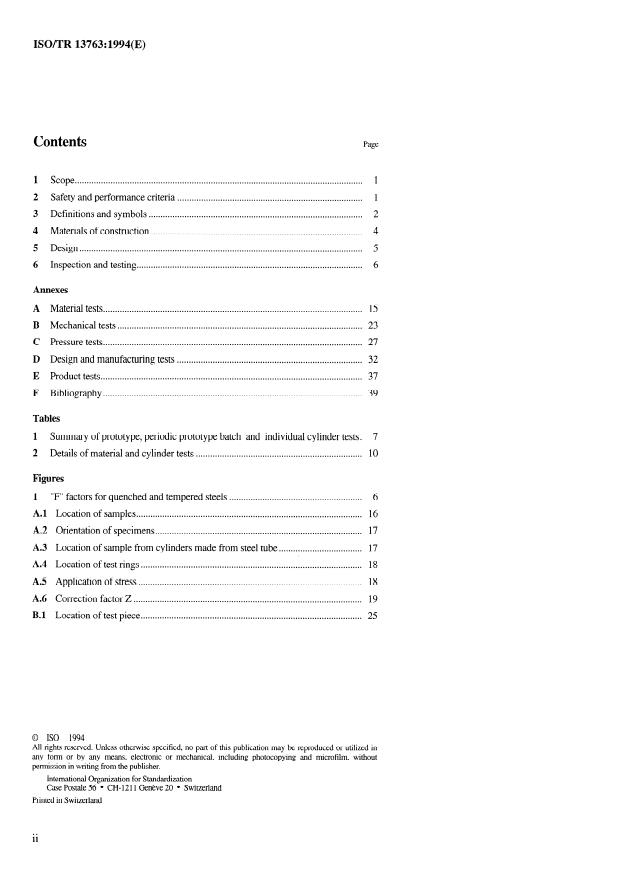
Contents
1 Scope .
Safety and performante criteria .
..........................................................................................
3 Definitions and Symbols
.........................................................................................
4 Materials of construction
5 Design .
Inspection and testing .
Annexes
A Material tests . . . . . . . . . . . . . . . . . . . . . . . . . . . . . . . . . . . . . . . . . . . . . . . . . . . . . . . . . . . . . . . . . . . . . . . . . . . . . . . . . . . . . . . . . . . . . . . . . . . . . . . . . . . . .
. . . . . . . . . . . . . . . . . . . . . . . . . . . . . . . . . . . . . . . . . . . . . . . . . . . . . . . . . . . . . . . . . . . . . . . . . . . . . . . . . . . . . . . . . . . . . . . . . . . . . . .
B Mechanical tests
C Pressure tests . . . . . . . . . . . . . . . . . . . . . . . . . . . . . . . . . . . . . . . . . . . . . . . . . . . . . . . . . . . . . . . . . . . . . . . . . . . . . . . . . . . . . . . . . . . . . . . .*.
. . . . . . . . . . . . . . . . . . . . . . . . . . . . . . . . . . . . . . . . . . . . . . . . . . . . . . . . . . . . . . . . . . . . . . . . . . . . . .
D Design and manufacturing tests
E Product tests . . . . . . . . . . . . . . . . . . . . . . . . . . . . . . . . . . . . . . . . . . . . . . . . . . . . . . . . . . . . . . . . . . . . . . . . . . . . . . . . . . . . . . . . . . . . . . . . . . . . . . . . . . . . . .
F Bibliography . . . . . . . . . . . . . . . . . . . . . . . . . . . . . . . . . . . . . . . . . . . . . . . . . . . . . . . . . . . . . . . . . . . . . . . . . . . . . . . . . . . . . .~.
Tables
1 Summary of prototype, periodic prototype batch and individual cylinder tests.
. . . . . . . . . . . . . . . . . . . . . . . . . . . . . . . . . . . . . . . . . . . . . . . . . . . . . . . . . . . . . . . . . . . . . .
Details of material and cylinder tests
Figures
........................................................
1 “F” factors for quenched and tempered steels
A.l Location of samples .
A.2 Orientation of specimens .
................................... 17
A.3 Location of Sample from cylinders made from steel tube
.............................................................................................
A.4 Location of test rings
AS Application of stress .
................................................................................................
A.6 Correction factor 2
B.l Location of test piece .
0 ISO 1994
All rights reserved. Unless otherwise specified, no part of this publication may be reproduced or utilized in
any form or by any means, electronie or mechanical, including photocopying and microfilm, without
permission in writing from the publisher.
International Organkation for Standardkation
Case Postale 56 l CH- 1211 Geneve 20 l Switzerland
Printed in Switzerland
ii
ISO/TR 13763: 1994(E)
0 ISO
Foreword
ISO (the International Organization for Standardization) is a worldwide federation of
national Standards bodies (ISO member bodies). The work of preparing International
Standards is normally carried out through ISO technical committees. Esch member
body interested in a subject for which a technical committee has been established has
the right to be represented on that committee. International organizations,
govemmental and non-govemmental, in liaison with ISO, also take part in the work.
ISO collaborates closely with the International Electrotechnical Commission (IEC) on
all matters of electrotechnical standardization.
The main task of technical committees is to prepare International Standards, but in
exceptional circumstances a technical committee may propose the publication of a
Technical Report of one of the following types:
- type 1, when the required support cannot be obtained for the publication of an
International Standard, despite repeated efforts;
- type 2, when the subject is still under technical development or where for any
other reason there is the future but not immediate possibility of an agreement on an
International Standard;
- type 3, when a technical committee has collected data of a different kind from that
which is normally published as an International Standard (“state of the art”, for
example).
Technical Reports of types 1 and 2 are subject to review within three years of
publication, to decide whether they tan be transformed into International Standards.
Technical Reports of type 3 do not necessarily have to be reviewed until the data they
provide are considered to be no longer valid or useful.
ISO/TR 13763, which is a Technical Report of type 3, was prepared by Technical
Committee ISOflC 58, Gas cylinders, Subcommittee SC 3, Cylinder design.
. . .
ISO/TR 13763: 1994(E) 0 ISO
Introduction
Current International Standards for the design, inspection and testing of gas cylinders
are based on good contemporary practice and experience in several ISO member
countries. Revisions to these Standards should take into account developments in gas
cylinder technology so that cylinders may employ different metallic materials, design
criteria and methods of test appropriate to the higher Stresses and the environmental
conditions they may encounter in Service.
1v
TECHNICAL REPORT 0 ISO
Safety and Performance criteria for seamless gas
cylinders
1 Scope
This document offers guidance towards the preparation of Mure gas cylinder standards,
revisions to existing gas cylinder standards, and identifies aspects of design criteria and tests
which arc recognized as providing tiormation relevant to the safety and performante in
Service of seamless gas cylinders of water capacities between 0,5 1 and 150 1. These principles
shall also be applied, where possible, to cylinders with water capacities outside of the limits
stated.
Where applicable guidance is given on recommended procedures and limiting requirements.
2 Safety and Performance criteria
During their life, cylinders tan be subjected to rough handling, varying temperatures and
corrosive environments.
Under these circumstances it is important to make available products which are able to
I
withstand the most arduous Service Conditions envisaged.
It is essential that the gas cylinder will:
a) withstand severe impact;
b) in the event of accidental rupture, fail in a ductil e manner;
c) withstand successive pressurizations and depressl tizations;
d) withstand the extremes of normal environmental conditions;
e) withstand pressure up to the test pressure;
ISO/TR 13763: 1994(E) 0 ISO
f) remain gas-tight;
g) be compatible with the gas it contains.
Tables 1 and 2 list factors which ensure compliance with the above criteria, tests for each
factor, and acceptable quantitative values where applicable.
3 Defmitions and symbols
The following defnitions and Symbols apply to this specification:
3.1 application safety factor: The ratio of the test pressure to the maximum developed
pressure.
3.2 burst safety factor: The ratio of the minimum bursting pressure to the test pressure.
3.3 total safety factor: The product of the application safety factor and the burst safety factor
(i.e. the ratio of the minimum bursting pressure to the maximum developed pressure).
3.4 yield factor (design safety factor): The ratio of the pressure at the onset of plastic
deformation to the test pressure.
3.5 design stress factor (IT) (variable): The ratio of equivalent Wall stress at test pressure to
guaranteed minimum yield stress R.
0,65
Where generally F =
WRg
Except that F 5 0,85
Re/Rg I 0,90
P@ 2 46 shall be satisfied by test.
and the burst ratio h
3.6 yield strength: The resistance of a makrial to plastic deformation.
3.7 tensile strength: The resistance of a material to rupture.
3.8 hardness: Resistance to indentation.
3.9 hardenability: The ability of a material to harden throughout its mass.
3.10 toughness: The ability of a material to resist crack propagation.
0 ISO
3.U ductility: The ability of the material to deform in a plastic manner.
3.12 ductile fracture: Fracture with apparent plastic deformation.
3.13 brittle fracture: Fracture without apparent plastic deformation.
3.14 resistance to impact: The ability to withstand impact without rupture.
3.15 impact transition temperature: The tempemture at which the fiacture mode changes
P
frorn ductile to brittle.
3.16 permanent gas: A gas whose critical temperature is lower than -10 OC.
3.17 liquefiable gas: A gas whose critical temperame is above -10 OC.
3.18 fatigue failure: Failure caused by cyclic stressing.
3.19 new design: A cylinder is considered to be of a new design compared with an existing
approved design when:
a) it is manufactured in a different factory;
b) it is manufactured by a different process;
c) it is manufactured Flom a material of different nominal Chemical composition;
d) it is given a different heat treatment;
e) the base Profile and base thickness have changed relative to the cylinder diameter
and calculated minimum Wall thickness;
f) the guaranteed minimum yield stress has changed by more than 50 N/mm2;
g) the length of the cylinder has increased by more than 50 %;
NOTE - Cylinders with an UD ratio less than 3 shall not be used as reference
cylinders for any new design with an LID ratio greater than 3.
h) the diameter has changed by more than 5 %;
j) an increase in hydraulic test pressure requires a Change in design Wall thickness.
NOTE - Where a cylinder is to be used at a lower pressure duty than that for which
design approval has been given, it shall not be deemed to be of a new design.
0 ISO
ISO/TR 13763: 1994(E)
3.20 Symbols
a Calculakd minimum thickness, in millimetres, of the cylindrical Shell.
A Percentage elongation.
b Calculated minimum thickness, in millimetres, of the dished end.
C Shape factor.
D Outside diameter of the cylinder, in millimetres.
F Design stress factor (variable) see 3.5.
h
Height, in millimetres, of the cylindrical part sf the dished end.
H
Outside height, in millimetres, of the domed part of the dished end.
J
Stress reduction factor.
L
Length, in millimetres, of the cylinder.
L
Original gauge length, in millimetres, according to ISO 6892.
n
Ratio of diameter of bend test former to the thickness of the test piece.
P Mäximum pressure, in bars, attained during the burst test.
b
P Charged pressure at 15 “C, in bar.
C
P Maximum developed pressure in Service at reference pressure, in bar.
d
P Test pressure in bars, above atmospheric pressure.
h
r Inside knuckle radius, in millimetres, of the dished end.
R Inside dishing radius, in millimetres, of the dished end.
Minimum value of yield stress (apparent), in newtons per Square millimetre,
R,
guaranteed by the cylinder manufacturer for the ftished cylinder.
NOTE - The term yield stress means the upper yield stress R&, or (for materials that
do not exhibit a defined yield) the 0,2 % proof stress (non-proportioned elongation)
&o
Minimum value of tensile strength in newtons per Square rnillimetre, guaranteed by
R
b
the cylinder manufacturer for the finished cylinder.
Actual value of tensile strength, in newtons per Square millimetre, determined by the
R, n
tensile test.
S 0riginal Cross-sectional area., in Square millimetres, of tensile test piece according to
ISO 6892.
4 Miterials of construction
Materials used for the construction of gas cylinders shall be manufactured by processes that
guarantee acceptable material cleanliness. They shall be suitable for manufacture into
cylinders by the Chosen process and provide the proper& required, where necessary by hat
treatment, to prevent failure in service. The materials shall not degrade by natura1 ageing.
0 ISO ISO/TR 13763:1994(E)
5 Design
5.1 Design Parameters
Design stress is the equivalent Wall stress at test pressure (Pb. Design stress is rated as a
f?action of guaranteed minimum yield (or 0,2 % proof) stress of the makrial of construction.
ISO cylinder design and construction specifications shall use a design stress equal to a design
stress factor F x guaranteed minimum yield stress R, of the material of construction. Values
for F are given in figure 1 for a range of materials.
5.2 Developed pressure in Service
The maximum developed pressure in Service shall be the pressure developed in the cylinder
at the National refrence temperame. Cylinders intended for worldwide usage shall be
designed using a reference temperature of 65 OC at which the maximum developed pressure
in Service shall not exceed the test pressure.
NOTE - The reference temperame adopted nationally shall be determined by the
National Authority.
5.3 Test pressure
The test pressure is used to calculate the minimum cylinder Wall thickness and to prove the
cylinder. For calculation purposes it shall be 1,5 x the settled filling pressure at 15 OC for
permanent gases.
5.4 Burst pressure
The burst pressure is the pressure at which the cylinder fails under pressure.
It shall be not less than the calculated value Pb r 1,6 Ph.
@ISO
5.5 Design formula
The cylinder Wall thickness design formula shall be:
D
a =
except that the Wall thickness shall also satisfy the formula
D
a>- + 1 mm for steel cylinders,
or
D
a>- + 1 mm for aluminium cylinders
with an absolute minimum of a = 1,5 mm.
1 0,85 max.
T
T
0,90 max.
(076)
- RJR
-
Figure 1 - “F” factors for quenched and tempered steels
6 Inspection and testing
The number, type and fkquency of tests arc intended to Show that the cylinder is fke Biom
harmfL1 defects that may cause failure, and to ensure consistency and cotiormity to its design.
2 detail the tests and the annexes provide information on the procedures to be
Talks 1 and
undertaken with some of the lesser known tests.
Table 1 - Summary of prototype, periodic prototype batch and individual cylinder tests
I I I I I
T 5” and ‘W” Aluminium 6351 cylinders Table 2
Natur-e of tests T “Super H and Type “M” cylinders
Stage of tests
l
cy Y Inders refs.
F ’ cylinders
Check that design calculations and drawings are in 3
Prototype - Design approval
accordance with the design specifications and appropriate regulations.
initial test on new
design
Material Chemical analysis Check cast (heat) anal sis with Mill’s certificate and
product analysis ~ for cr eviation.
Check given size of billet.
Finished cylinder Micro/macro Carry out metallurgical examination with considering conditions of heat
material
Corrosion Confirm compatibility with cylinder corrosive content 8
Check yield stress, tensile strength, elongation and if required reduction of Check hardness. 5and6
Tensile
area
Check impact values in longitudinal and transverse directions as practicable. - 7
Impact
Impact transition Check new material and/or heat treatment to establish whether the transition - 7
point meets the requirements
BendMattening Check ductility and tonfirm defect-fiee. 6
Check physical dimension, such as wall thickness, 3
Qlinder Design check
base thrckness, end ferm, threads, diameter and
circularity, length and straightness etc.
Check surface defects, such as cracks, folds, 2
Defects inspection
laminations, seams, gou es, bulges, etc., by visual
inspection or other suit iz le means.
I
Ver-@ and record heat treatment temperature(s) and quenching conditions. Check te rature and 1
Heat treatment
duration T o heat treatment
Check hardness and its distribution on the cylinder.
Hardness
Hydraulic volumetric out hydraulic volumetric expansion test and
T chec the total expansion and permanent expansion.
expansion
This may be carried out at the sarne time as the burst
test-
ressures, nature of fiacture and 5
Hydraulic burst Check yield and burst
if necessary, shape of Ra cture. The volumetric expansion
characteristrcs may also be measured during this test.
Table 1 - Summary of prototype, periodic prototype batch and individual cylinder tests (continued)
T “Super H” and Type ‘VI” cylinders T “S” and “N” Aluminium 6351 cylinders Table 2
Stage of tests Nature of tests
fl
3F ’ cylinders cy yp” Inders
refs.
As an alternative to the hydraulic volumetric expansion
Hydraulic proof 5
pressure test the hydraulic proof pressure test may be carried out.
Pressure cycle fatigue Confirm that the cylinder tan withstand the specified 9
number of cycles of pressurization.
,
Stress corrosion Confirm compatibility Not required to carry out Carry out stress corrosion test.
Special
with environmental
conditions.
Bonfire Carry out only when required. (It is better to carry out when unapproved safety devices are fitted).
Hydro-pneumatic Check nature of test results.
Ballistic Caq out 0nIy at request. Not required to carry Carry out if requested
out.
Fracture toughness Re uired for cylinders Not required to carry out Charpy impact at ambient if
r-rd e fiom new requested
materials and/or heat
treatment
Per-iodic prototype Zylinder Pressure cycle fatigue Carry out at specified times during protection
-
Chemical analysis Check deviation between cast (heat) and product analysis if required.
Batch Material
,
200 + 2 test cylinders 200 + 2 test cylinders except when
Batch size
cylinders are heat treated in a
continuous fumace and following
production of 20 000 cylinders, and
subject to the inspection authority being
satisfied with uality control procedures,
the batch may Xe increased to
500 + 2 cylinders.
Carry out on one cylinder frorn each batch to determine yield stress, Esch heat test batch
Cylinder material Tensile Sand6
tensile strength, elongation and if required reduction of area.
Impact Carry out on one cylinder fiom each batch at a temperature of -50 OC. 7
-
BendMattening Carry out either a bend or flattening test on one cylinder fi-om each batch. 6
End thickness Sample Checks on tut sections from each end of a test Container. 3
Table 1 - Summary of prototype, batch and individual cylinder tests (concluded)
T “Super H” and Type “M” cylinders “S” and Aluminium 6351 cylinders
Stage of tests Natur-e of tests Table 2
TY
‘1 t
r ’ cylinders ?up” ’ cylinders
refs.
Verify heat treatment records on each batch.
Cylinder Heat treatment Periodic check 1
Carry out on one cylinder from each batch.
Btl& 5
Shape Sample check on formed shape. 7
Dimension etc. Wall thickness Check of cylindrical wall by ultrasonic, radiation or mechanical means. Sample Checks shall be rnade on 3
Individual
the ends
cylinder
Threads Full check by calibrated gauge
Check on diameter-, circularity, straightness,
Dimensional 3
permanent markings, etc.
Full check by visual inspection and other suitable means.
Defects Surface and intemal 2
defects
Hardness measurement Full check by suitable Sample check only when controlled
means contlnuous heat treatment is
employed
Hydraulic When a hardness check has been carried out on each
cylinder then each cylinder shall be subjected to a
hydraulic proof pressure test. When a hardness check
has not been carried out on each cylinder then each
cylinder shall be subjected to a hydraulic volumetric
expansion test.
Leakage The manufacturer shall apply such tests as will demonstrate to the satisfaction of the inspecting authority that the
cylinders do not leak
.
Table 2 - Details of material and cylinder tests
Ref Characteristic Description Annex Type of, and justification for test(s) Quantitative Prototype” Batch Individual
Ref values initial test on new cylinders
desirns
Chemical pt3 Chemical analysis As specified for each material X
1 Material X
composition
Type of quenchant and associated
heat treatment and
metallurgical Heat treatment temperatures and cooling rate
quenching conditions
examination X X
Microstructural examination
A.l These tests ensure that both starting As appropriate
stock and ftished cylinder meet X
required specification.
2 Defects Inclusions, cracks, A4 Visual Rejection if defect size exceeds X
X
folds or other ultrasonic stipulated requirement X
X
imperfections in D.2 Defects may exist in starting stock
starting stock or or finished cylinder
cylinder
D.1 Metrology
3 Dimensions Confommnce of As re uired by drawing and’or
ultrasonlc P
c linder% physical speci ication
cf rmensions to those
shown on drawing Wall thickness X
X
or by specification Base thickness X
X X
Base shape
X X
Intemal and extemal neck threads X
X
Shoulder form X
X
Circularity*) X
X
Straightness X X
Diameter X X
Length
X X
I-
4 Gas tightness Retention of gas C.6 Leak test No leakage permitted X
under pressure. Capabili of cylinders to hold
containe !gas at required pressure
c
’ 1
‘) Repeat tests every 2 y ears or 20 000 cylinders, whichever is the longer perroo
I
*) Circularity. The differente between the maximum and minimum extemal diameters at any Cross-section of the cylindrical part of the completed Container shall not exceed 2 % of the specified intemal
I diameter.
Table 2 - Details of material and cylinder tests (continued)
Quantitative values
Ref Characteristic Description Annex Type of, and justification for test(s) Prototype” Batch Individual
ref initial test on new cylinders
designs
Strength Resistance of B.6 Hardness As specified for each alloy X X
material in finished C.5 Hydraulic volumetric expansion X X
c linder to plastic Tensile
cy eformation at slow B. 1 x ’ X
i”” (in
draulic burst
H
c.3 I-J ydraulic proof X X
notchers).
c.4 X
X
10 % of total expansion
The hardness test on individual
c linder-s gives an indication that
x ey have the required proper-Ges,
i.e. they have received the specified As required by specification
treatment.
Burst pressure shall be
The hydraulic volumetric expansion
test on individual cylinders
h 2 136 p,,
establishes that the permanent
expansion after the test is within a Zylinder shall remain in one
piece
specified limit. Where a hydraulic
volumetric expansion test is carried
out a hardness test is not required. No indication of failure or leak
The tensile test provides values of
yield strength (or 0,2 % proof
stress), tensile strength and ductility
of the material, since specimens are
taken f?om cylinder wall.
Hydraulic burst test indicates if
cylinder testes has specified tensile
properties and if the specified or
uired total safety factor has been
r
ac “911 ‘eved. Examination of fiacture
gives indication of ductility.
Hydraulic roof pressure test
indicates t.i at the cylinder will
withstand the marked test pressure.
l) Repeat tests every 2 years or 20 Ooo cylinders, whichever is the langer period.
Table 2 - Details of material and cylinder tests (continued)
Annex Type of, and justification for test(s) Quantitative Prototype”
Ref Characteristic Description Batch Individual
values
ref initial test on new cylinders
,
designs
A measure of the B. 1 Tensile As specified X X
6 Ductility
ability of the B.1 Reduction X X
material to defonn B.2 Bend X X
in a plastic manner. B.3 Flattening X
X
Tensile test indicates that material
meets required specification with
respect to ductihty
Reduction of area test is considered
equivalent to a tensile test.
Bend test indicates that specimens
tut @om cylinder wall comply with
requirements for ap ropriately
ee material.
treated and defect- R
The flauer-ring test is considered
equivalent to a bend test but is
carried out on a complete cylinder or
ring.
Ability of the B.3 Impact As specified X
7 Toughness X
matenal to resist B.4 Fracture toughness X X
Crack propagation c.2 Imact transition temperature X X
Hydro-pneumatic X X
hurst
The impact test on notched
specimens tut fi-om cylinder wall in
longitudinal and transverse
directions measures energy
absorption, but not the f?acture
toughness.
The f?acture toughness test rovides
information requrred to pr ecf ict
actual performances of any cylinder
in presence of defects or growing
cmcks.
l) Repeat tests every 2 years or 20 000 cylinders, whichever is the longer period.
. -.
Table 2 - Details of materials and cylinder tests (continued)
Quantitative Prototype” Batch Individual
Description Annex Type of, and justification for test(s)
Ref Characteristic
values initial test on new cylinders
ref
designs
Fixed by particular material
Tl-ie i act transition temperature
7 Toughness
characteristics
establis T es whether or not a material
cont.
stier-s a temperature dependant
ductile/brittle Change in fiacture
behaviour.
The hydro-pneumatic test establishes Cylinders shall not rupture into
the mocle of failure if pressure rises more than two pieces. Burst
pressure shall
sticiently to burst the c linder. It
is a measure of the “tou ess” of
&
of material Pb 2 1,6 p,,
the cylinder in ten-ns
proper-Ges and cylinder shape.
Tests: Corrosion) As specified X
8 Compatibility with Resistance to
X
pt2 Stress corrosion)
environment and with corrosive roducts,
P E. 1 Bonfire
possible adverse compatibi ity with
X
Ballistic+ No explosion
conditions cylinder contents,
X
ex Sure to fire, Some materials are susceptible to No fragrnentation
listic attack corrosion and/or stress corrosion.
bar
These may be rendered Safe by
correct treatment. Therefore tests on
rototype cylinders only are needed
F or some materials, whrle others
need repeat or sample Checks.
+ Required for cylinders having
_ 1 special applications. ,
_ _
i) Repeat tests every 2 years or 20 000 cylinders, whichever is the longer period.
Table 2 - Details of material and cylinder tests (concluded)
Ref Characteristic Description Annex Type of, and justification for test(s) Quantitative Prototypel’
Batch Individual
ref. values initial te.st on new
cylinders
designs
8 Compatibility with A bonfire test Shows if
environment and with c linder/s&ety device configuration
possible adverse 3 lows pressure release before
conditions cont. pressure rise in the cylinder or
reduction in cylinder properties
Causes burst.
Ex Sure to ballistic attack when
fulPoestablishes mode of failure
The ability to c.1 Tests: Pressure cycle fatigue
9 Fatigue petiormance 12 000 cycles at test pressure X
withstand repeated
80 000 cycles at 2/3 test
cyclic stresses. The fatigue test establishes that the
ressure.
cylinder with withstand the quoted B ,95 Pb min
number of cycles.
If no leakage or rupture occurs
before completion of test, the
cylinder tan be burst and the
residual strength measured, to
ether
with any effect of cracks whic
fl may
have started during the fatigue test
but did not propagate to leak.
Altematively, a fatigue test tan be
carried out at the maximum in-
Service pressure and the test
continucd until failure occurs.
The specified requirements do not
re resent what happens in practice.
Tl! e test tan however Show which
parts of the cylinder are least able to
withstand cyclic loading
l) Repeat tests every 2 years or 20 000 cylinders, whichever is the longer period.
0 ISO ISO/TR 13763:1994(E)
Annex A
Mderial tests
AS Mderial microstructure
Al.1 General
The metallographic examination verifies:
a) the heat tratment of the cylinders is in accordance with the requirements specified;
b) the metallographic structure as being correct for the material and heat treatment;
c) that surface defects, non-metallic inclusions and, for steel, any decarburization is
at an acceptable level.
The judgement of the microstructure and the level of non-metallic inclusions shall be carried
out by a competent person.
Al.2 Sektion of specimens
Spetimens for metallographic examination, see figures A.l to A.3, shall be taken from the
test cylinders as follows:
a) Longitudinal section (A) through the Wall of the head at the Position of greatest
Wall thickness.
b) Longitudinal and transverse sections (B and C) through the Wall at mid cylindrical
Position.
c) Longitudinal section (D) through the Position of Change of Wall thickness from
cylindrical part to base.
d) For cylinders manufactured Flom tube only, a longitudinal section (E) through the
centre of the base.
Al.3 Preparation of specimens
The specimens shall be prepared for metallographic examination using normal polishing
methods and except for non-metallic inclusions the polished surfkes shall be etched using
a suitable etching reagent.
0 ISO
Al.4 Microscopic examination
Visual examination at a magnification within the range of 100 x - 500 x shall be made, in
addition Photographs may be taken for record purposes.
A 1.4.1 Non-metallic inclusions
The number, size and morphology of the inclusions are observed and assessed., taking account
of the Chemical composition and mechanical treatment of the material.
Al.4.2 Microstructure
The structure of the material is observed and assessed as to its suitability taking account of
the Chemical composition, beat-treatment and section size.
For steel cylinders the degree of decarburktion on the surfkes, presence of mill scale and
stiace defects shall be observed and assessed.
Examination of specimen E shall place special emphasis on the presence or cracks and
inclusions.
Al.5 Final assessment
The observations and findings shall be summarized and recorded and a conclusion reached
which shall also be recorded.
B and C
Figure A.1 - Location of samples
0 ISO
Transverse
section
C
Figure A.2 - Orientation of specimens
Longitudinal
section
E
Figure A.3 - Location of Sample from cylinders made from steel tube
A2 Stress corrosion
A2.1 General
This test requires the subjection
to stress of rings tut from the cylindrical Portion of the
cylinder whilst being subjected to a cycle of immersions in brine followed by exposure to air.
A2.2 Preparation of specimens
whichever is the greater, shall be tut from the cylindrical
Six rings of width 4 a or 25 mm
Portion of the cylinder, sec figure A.4. A sector of each ring, representing approximately 60*
of arc shall be removed f?om the ring and Provision made for a threaded rod to pass
diagonally through the specimen, see fig
...
Questions, Comments and Discussion
Ask us and Technical Secretary will try to provide an answer. You can facilitate discussion about the standard in here.
Loading comments...