

ISO 24165-1:2025
(Main)Digital token identifier (DTI) — Registration, assignment and structure — Part 1: Method for registration and assignment
General Information
- Abstract
This document defines the assignment and generation of a random, unique, fixed-length identifier for digital tokens in response to a request for registration that conforms to specified application guidelines (see also ISO 24165-2).
- Status
- Published
- Publication Date
- 04-May-2025
- Technical Committee
- ISO/TC 68/SC 8 - Reference data for financial services
- Drafting Committee
- ISO/TC 68/SC 8 - Reference data for financial services
- Current Stage
- 6060 - International Standard published
- Start Date
- 05-May-2025
- Due Date
- 26-Aug-2025
- Completion Date
- 05-May-2025
Overview
ISO 24165-1:2025 specifies the method for the registration, assignment, and structure of the Digital Token Identifier (DTI), a unique identifier assigned to digital tokens that use distributed ledger technology (DLT). This International Standard is essential for the efficient and standardized identification of digital tokens, including non-fungible tokens (NFTs), improving transparency, interoperability, and data integrity in the global digital asset ecosystem. Organizations or individuals seeking to register digital tokens will benefit from clear eligibility criteria and a robust assignment process, leading to increased trust within digital finance and blockchain environments.
Key Topics
Registration and Assignment Process
- Defines the method for generating and assigning random, unique, fixed-length DTI codes.
- Opens eligibility to any organization, individual, or group meeting the specified criteria.
- Standardizes application requirements for both digital token and digital ledger identifiers (DTI/DLI).
Eligibility Criteria
- Digital tokens must meet definitions per the ISO 24165 series.
- NFTs are now included, with clear policies for their group and individual assignment.
- Currency tokens as defined by ISO 4217 are outside this scope.
- Ledgers storing tokens are eligible for digital ledger identifiers (DLI).
DTI and DLI Structure
- Fixed-length, 8-character alphanumeric basic number excluding vowels, 'Y,' and with no leading zero.
- Random, semantically meaningless identifiers checked for uniqueness.
- Includes a check character as per ISO/IEC 7064:2003 to enhance error detection.
Registry Management
- Public, freely accessible, and regularly updated DTI/DLI registry.
- Provides assigned identifiers, verified technical data, and optional descriptive information.
- The registry includes clear notations and disclaimers regarding legal or investment status.
Applications
Market Transparency and Efficiency
- Facilitates clear and unambiguous referencing of digital tokens across exchanges, wallets, custodians, and regulatory authorities.
- Enables streamlined trading, settlement, and reporting processes by providing a universally recognized identifier.
Regulatory Compliance
- Assists regulators and supervisory bodies in monitoring, tracking, and auditing digital tokens with greater accuracy.
- Reduces confusion caused by similar or duplicative token names and ticker symbols.
Ecosystem Interoperability
- Supports cross-platform and international interoperability in digital finance, decentralized applications (dApps), and token marketplaces.
- Helps ensure accurate mapping and data integration between systems using different token references.
Risk Management
- Enhances ability for custodians, service providers, and investors to manage digital asset portfolios, reduce operational risks, and improve due diligence processes.
Related Standards
- ISO 24165-2: Data elements required for registration and display on the DTI/DLI registry.
- ISO 4217: Codes for the representation of currencies - relevant for distinguishing eligible digital tokens from currency tokens.
- ISO 6166: International securities identification number (ISIN) standard for tokenized traditional assets.
- ISO 22739: Vocabulary for blockchain and distributed ledger technologies, supporting clarity in term usage.
- ISO/IEC 7064:2003: Method for calculating the DTI check character, ensuring reliable validation.
ISO 24165-1:2025 reinforces global best practices in digital token identification and contributes to safer, more robust digital asset infrastructure. For more information, refer to the registration authority details and guidelines available at iso.org/maintenance_agencies.html.
Relations
- Effective Date
- 27-Aug-2022
Get Certified
Connect with accredited certification bodies for this standard

Great Wall Tianjin Quality Assurance Center
Established 1993, first batch to receive national accreditation with IAF recognition.
Hong Kong Quality Assurance Agency (HKQAA)
Hong Kong's leading certification body.

Innovative Quality Certifications Pvt. Ltd. (IQCPL)
Known for integrity, providing ethical & impartial Assessment & Certification. CMMI Institute Partner.
Sponsored listings
Frequently Asked Questions
ISO 24165-1:2025 is a standard published by the International Organization for Standardization (ISO). Its full title is "Digital token identifier (DTI) — Registration, assignment and structure — Part 1: Method for registration and assignment". This standard covers: This document defines the assignment and generation of a random, unique, fixed-length identifier for digital tokens in response to a request for registration that conforms to specified application guidelines (see also ISO 24165-2).
This document defines the assignment and generation of a random, unique, fixed-length identifier for digital tokens in response to a request for registration that conforms to specified application guidelines (see also ISO 24165-2).
ISO 24165-1:2025 is classified under the following ICS (International Classification for Standards) categories: 03.060 - Finances. Banking. Monetary systems. Insurance. The ICS classification helps identify the subject area and facilitates finding related standards.
ISO 24165-1:2025 has the following relationships with other standards: It is inter standard links to ISO 24165-1:2021. Understanding these relationships helps ensure you are using the most current and applicable version of the standard.
ISO 24165-1:2025 is available in PDF format for immediate download after purchase. The document can be added to your cart and obtained through the secure checkout process. Digital delivery ensures instant access to the complete standard document.
Standards Content (Sample)
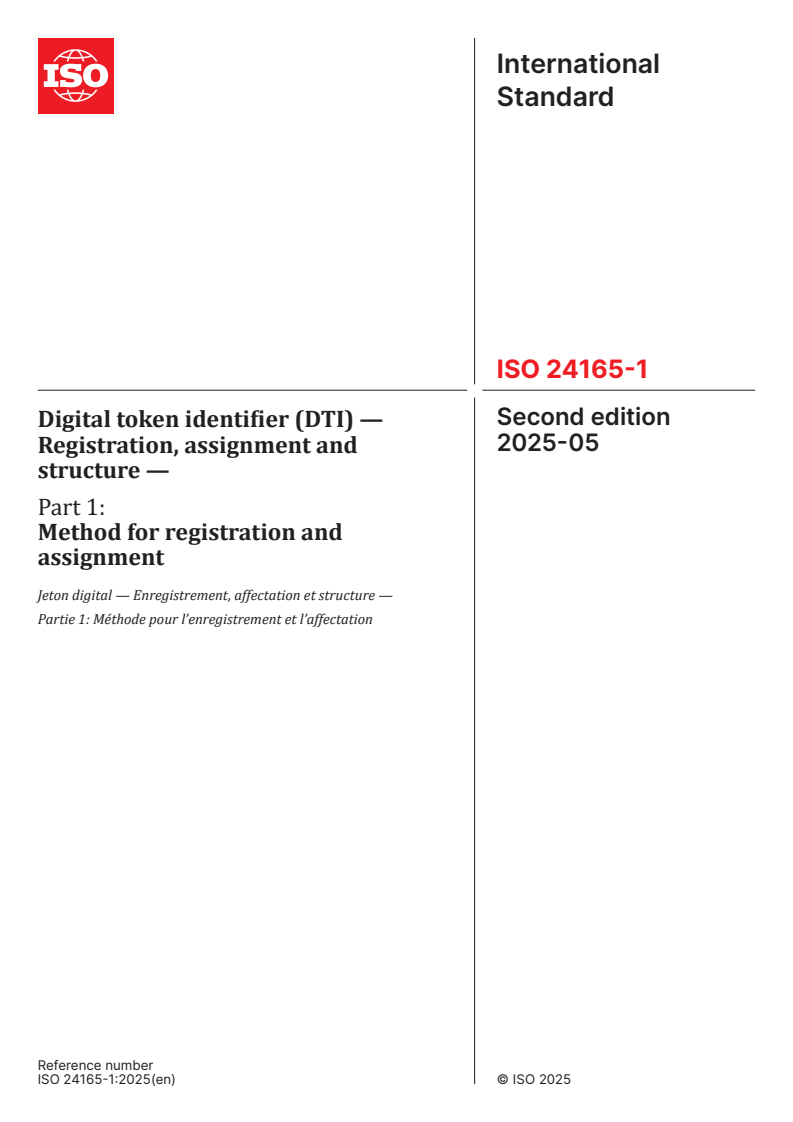
International
Standard
ISO 24165-1
Second edition
Digital token identifier (DTI) —
2025-05
Registration, assignment and
structure —
Part 1:
Method for registration and
assignment
Jeton digital — Enregistrement, affectation et structure —
Partie 1: Méthode pour l’enregistrement et l’affectation
Reference number
© ISO 2025
All rights reserved. Unless otherwise specified, or required in the context of its implementation, no part of this publication may
be reproduced or utilized otherwise in any form or by any means, electronic or mechanical, including photocopying, or posting on
the internet or an intranet, without prior written permission. Permission can be requested from either ISO at the address below
or ISO’s member body in the country of the requester.
ISO copyright office
CP 401 • Ch. de Blandonnet 8
CH-1214 Vernier, Geneva
Phone: +41 22 749 01 11
Email: copyright@iso.org
Website: www.iso.org
Published in Switzerland
ii
Contents Page
Foreword .iv
Introduction .v
1 Scope . 1
2 Normative references . 1
3 Terms and definitions . 1
4 Eligibility criteria for application . 2
4.1 Applicant eligibility requirements . .2
4.2 Digital token eligibility requirement .3
4.3 Digital token identifier issuance for non-fungible digital tokens (NFTs).3
4.4 Digital ledger eligibility requirement .3
4.5 Provisional issuance provision .3
5 Application information . 3
5.1 General .3
5.2 Applicant information .3
5.3 Digital token technical information .4
5.4 Descriptive information .4
6 DLI and DTI code structure . 4
6.1 Constituents .4
6.2 Uniqueness .4
6.3 Display.4
7 Registry components . 4
8 Assignment . 5
9 Registration authority . 5
9.1 Name and contact details of the Registration authority .5
9.2 Service provision for the RA .5
Annex A (normative) Check character calculation . 6
Bibliography . 8
iii
Foreword
ISO (the International Organization for Standardization) is a worldwide federation of national standards
bodies (ISO member bodies). The work of preparing International Standards is normally carried out through
ISO technical committees. Each member body interested in a subject for which a technical committee
has been established has the right to be represented on that committee. International organizations,
governmental and non-governmental, in liaison with ISO, also take part in the work. ISO collaborates closely
with the International Electrotechnical Commission (IEC) on all matters of electrotechnical standardization.
The procedures used to develop this document and those intended for its further maintenance are described
in the ISO/IEC Directives, Part 1. In particular, the different approval criteria needed for the different types
of ISO document should be noted. This document was drafted in accordance with the editorial rules of the
ISO/IEC Directives, Part 2 (see www.iso.org/directives).
ISO draws attention to the possibility that the implementation of this document may involve the use of (a)
patent(s). ISO takes no position concerning the evidence, validity or applicability of any claimed patent
rights in respect thereof. As of the date of publication of this document, ISO had not received notice of (a)
patent(s) which may be required to implement this document. However, implementers are cautioned that
this may not represent the latest information, which may be obtained from the patent database available at
www.iso.org/patents. ISO shall not be held responsible for identifying any or all such patent rights.
Any trade name used in this document is information given for the convenience of users and does not
constitute an endorsement.
For an explanation of the voluntary nature of standards, the meaning of ISO specific terms and expressions
related to conformity assessment, as well as information about ISO's adherence to the World Trade
Organization (WTO) principles in the Technical Barriers to Trade (TBT), see www.iso.org/iso/foreword.html.
This document was prepared by Technical Committee ISO/TC 68, Financial services, Subcommittee SC 8,
Reference data for financial services.
This second edition cancels and replaces the first edition (ISO 24165-1:2021), which has been technically
revised.
The main changes are as follows:
— The scope for digital token identifiers (DTIs) has been extended to include non-fungible tokens (NFTs).
— The standard now separates DTIs to identify tokens and digital ledger identifiers (DLIs) to identify
ledgers (only ledgers that have one or more DTIs linked to them are in scope).
— Anchor block information has been added where genesis block is either not known/lost.
— Functionally Fungible Group has been renamed Equivalent Group.
— Addition of Issuer and Maintainer as informative, optional fields.
— Native token has been renamed protocol token.
A list of all parts in the ISO 24165 series can be found on the ISO website.
Any feedback or questions on this document should be directed to the user’s national standards body. A
complete listing of these bodies can be found at www.iso.org/members.html.
iv
Introduction
With the rise in popularity of peer-to-peer payment systems, these systems rely less on centralized
authorities. Instead, they depend on aspects of cryptography, decentralized processing, and a distributed
network. This network maintains a shared record of transaction activity.
As a result, the need to identify the digital tokens issued, traded, transacted, or stored on these networks
has grown. Stakeholders in the trading community, service providers, custodians and regulatory bodies
have identified numerous use cases where a standard identifier for accounting, research, tracking and
management of these digital tokens would improve efficiency and eliminate confusion in the marketplace.
However, the nature of these new types of digital asset means they do not fit within the structure of existing
ISO identifiers, in part because they can lack clear reference to an issuing authority and will therefore not
be considered the liability of an issuing authority or corporate governing body. These digital assets, in many
cases extend across various regions and monetary governance jurisdictions.
Though these digital assets are sometimes referred to as cryptocurrencies, virtual currencies or digital
currencies, the term "currency" has a specific meaning as defined by ISO 4217. This definition is in conflict
with the nature of the digital tokens identified in this document due to the reasons described above; namely,
the lack of monetary authority and geographic location.
Where traditional financial instruments or currencies are tokenized for electronic exchange and issued by
a legal entity or a monetary authority responsible for it, other International Standards, such as ISO 6166
or ISO 4217, can apply. To eliminate confusion for users of this document, care has been taken to provide a
clear definition and eligibility criteria for assignment of a digital token identifier (DTI) and digital ledger
identifier (DLI).
This document is addressed to applicants seeking to identify digital tokens conforming to the definition
provided in this document. The data elements described in this document are used to distinguish one set
of digital tokens and ledgers from another and are, wherever possible, objective and publicly available.
Inclusion in the registry and the issuance of an identifier signifies only the existence of the token and/or
ledger and its 1:1 relationship to its identifier.
The standard scope has been expanded to include DTI issuance for non-fungible tokens (NFTs), which were
excluded in the 2021 edition of this document.
The ISO 24165 series is organized into the following parts:
— ISO 24165-1 describes the method of registration and assignment of a DTI and a DLI;
— ISO 24165-2 describes the data elements required for registration and display on the DTI & DLI registry.
v
International Standard ISO 24165-1:2025(en)
Digital token identifier (DTI) — Registration, assignment and
structure —
Part 1:
Method for registration and assignment
1 Scope
This document defines the assignment and generation of a random, unique, fixed-length identifier for digital
tokens in response to a request for registration that conforms to specified application guidelines (see also
ISO 24165-2).
2 Normative references
The following documents are referred to in the text in such a way that some or all of their content constitutes
requirements of this document. For dated references, only the edition cited applies. For undated references,
the latest edition of the referenced document (including any amendments) applies.
ISO 24165-2, Digital token identifier (DTI) — Registration, assignment and structure — Part 2: Data elements
for registration
ISO/IEC 7064:2003, Information technology — Security techniques — Check character systems
3 Te
...