

ISO 5009:2022
(Main)Financial services — Official organizational roles — Scheme for official organizational roles
General Information
- Abstract
This document specifies an unambiguous scheme to list official organizational roles by jurisdiction in a standard way. It is not the purpose of this document to compare or align official organizational roles across different countries or jurisdictions, so as not to limit the usage or relevance of this document. To understand the powers associated with each official organizational role, users of this document can consult applicable regulation or legislation, documents of the legal entity in which the official organizational role exists and procedures specific to each organizational entity.
- Status
- Published
- Publication Date
- 07-Feb-2022
- Technical Committee
- ISO/TC 68/SC 8 - Reference data for financial services
- Drafting Committee
- ISO/TC 68/SC 8/WG 9 - Official organizanional roles (OOR)
- Current Stage
- 6060 - International Standard published
- Start Date
- 08-Feb-2022
- Due Date
- 29-Oct-2021
- Completion Date
- 08-Feb-2022

Overview
ISO 5009:2022, titled "Financial services – Official organizational roles – Scheme for official organizational roles," is an international standard published by ISO (International Organization for Standardization) that specifies a clear and unambiguous scheme for listing official organizational roles by jurisdiction in a standardized manner. This standard focuses on providing a structured, standardized list of official roles within organizations and legal entities, especially relevant to financial services. It is designed to support clarity and interoperability for commercial, regulatory, and digital identity management contexts, without attempting to compare or align roles across different countries or jurisdictions.
ISO 5009:2022 facilitates consistent identification and recording of official organizational roles, enhancing transparency and enabling more efficient digital business interactions worldwide.
Key Topics
- Scope: Defines a universal coding and data recording scheme for official organizational roles by jurisdiction, without aligning roles internationally.
- Official Organizational Role Code Structure: Uses a six-character alphanumeric code (A-Z, 0-9) with no embedded intelligence or comparison between jurisdictions.
- Role Data Attributes:
- Local language names and abbreviations
- Transliterated names and abbreviations per ISO 01-140-10
- Jurisdiction identifiers based on ISO 3166-1 and ISO 3166-2 codes
- Entity legal form (ELF) codes from ISO 20275
- Role status (active/inactive), date of creation, and modification history
- Applicable regulations or legislation references
- Maintenance: A designated ISO maintenance agency manages updates, publications, and additions to ensure current and accurate records.
- Integration: Supports modern digital standards by enabling the use of official role codes in X.509 digital certificates (ISO/IEC 9594-8) and Verifiable Credentials (W3C standards).
- Practical Use: Assists in regulatory compliance, legal clarity, digital identity management, and interoperability in global financial services.
Applications
ISO 5009:2022 has practical value across multiple domains, including:
- Financial Services: Streamlines identification and verification of official roles within financial institutions for regulatory compliance and operational transparency.
- Digital Identity and Security: Integrates with digital certificates and cryptographically verifiable credentials, enhancing secure digital interactions and identity management.
- Regulatory and Legal Compliance: Provides an authoritative reference scheme for official roles as documented in jurisdictional legislation and organizational records.
- Data Standardization: Offers consistent coding and terminology for official roles, reducing ambiguity in cross-border business and governmental reporting.
- Legal Entity Identification (LEI): Complements ISO 17442-2 by associating official roles with entities using LEIs, crucial for global business ecosystems.
- Information Systems: Enables software systems and databases to standardize role data for better interoperability between financial and governmental systems.
Related Standards
ISO 5009:2022 is part of a comprehensive ecosystem of standards supporting financial data and digital identity management:
- ISO/IEC 9594-8 (X.509): Defines public key and attribute certificate frameworks used in digital security protocols.
- ISO 17442-2: Specifies legal entity identifiers (LEI) and their application within digital certificates.
- W3C Verifiable Credentials Data Model 1.0: Establishes formats for interoperable, cryptographically verifiable digital credentials.
- ISO 3166-1 and ISO 3166-2: Country and subdivision codes used to specify jurisdictions.
- ISO 20275: Codes and standards for legal entity forms (ELF).
- ISO 8601: Standard for representing dates and times, used for recording creation and modification dates within role data.
- ISO 639-1: Codes for the representation of language names, critical for multilingual role names and transliterations.
Through adherence to these interconnected standards, ISO 5009:2022 supports harmonized, reliable data exchange and identification processes critical to the evolving global digital economy.
ISO 5009:2022 represents a key step forward in standardizing official organizational roles within financial and legal environments - enabling clarity, efficiency, and security in digital and regulatory operations worldwide. For organizations and developers looking to implement standardized role identification, this document offers a vital, practical framework aligned with leading global standards.
Get Certified
Connect with accredited certification bodies for this standard

Great Wall Tianjin Quality Assurance Center
Established 1993, first batch to receive national accreditation with IAF recognition.
Hong Kong Quality Assurance Agency (HKQAA)
Hong Kong's leading certification body.

Innovative Quality Certifications Pvt. Ltd. (IQCPL)
Known for integrity, providing ethical & impartial Assessment & Certification. CMMI Institute Partner.
Sponsored listings
Frequently Asked Questions
ISO 5009:2022 is a standard published by the International Organization for Standardization (ISO). Its full title is "Financial services — Official organizational roles — Scheme for official organizational roles". This standard covers: This document specifies an unambiguous scheme to list official organizational roles by jurisdiction in a standard way. It is not the purpose of this document to compare or align official organizational roles across different countries or jurisdictions, so as not to limit the usage or relevance of this document. To understand the powers associated with each official organizational role, users of this document can consult applicable regulation or legislation, documents of the legal entity in which the official organizational role exists and procedures specific to each organizational entity.
This document specifies an unambiguous scheme to list official organizational roles by jurisdiction in a standard way. It is not the purpose of this document to compare or align official organizational roles across different countries or jurisdictions, so as not to limit the usage or relevance of this document. To understand the powers associated with each official organizational role, users of this document can consult applicable regulation or legislation, documents of the legal entity in which the official organizational role exists and procedures specific to each organizational entity.
ISO 5009:2022 is classified under the following ICS (International Classification for Standards) categories: 03.060 - Finances. Banking. Monetary systems. Insurance. The ICS classification helps identify the subject area and facilitates finding related standards.
ISO 5009:2022 is available in PDF format for immediate download after purchase. The document can be added to your cart and obtained through the secure checkout process. Digital delivery ensures instant access to the complete standard document.
Standards Content (Sample)
INTERNATIONAL ISO
STANDARD 5009
First edition
2022-02
Financial services — Official
organizational roles — Scheme for
official organizational roles
Services financiers — Rôles organisationnels officiels — Système de
rôles organisationnels officiels
Reference number
© ISO 2022
All rights reserved. Unless otherwise specified, or required in the context of its implementation, no part of this publication may
be reproduced or utilized otherwise in any form or by any means, electronic or mechanical, including photocopying, or posting on
the internet or an intranet, without prior written permission. Permission can be requested from either ISO at the address below
or ISO’s member body in the country of the requester.
ISO copyright office
CP 401 • Ch. de Blandonnet 8
CH-1214 Vernier, Geneva
Phone: +41 22 749 01 11
Email: copyright@iso.org
Website: www.iso.org
Published in Switzerland
ii
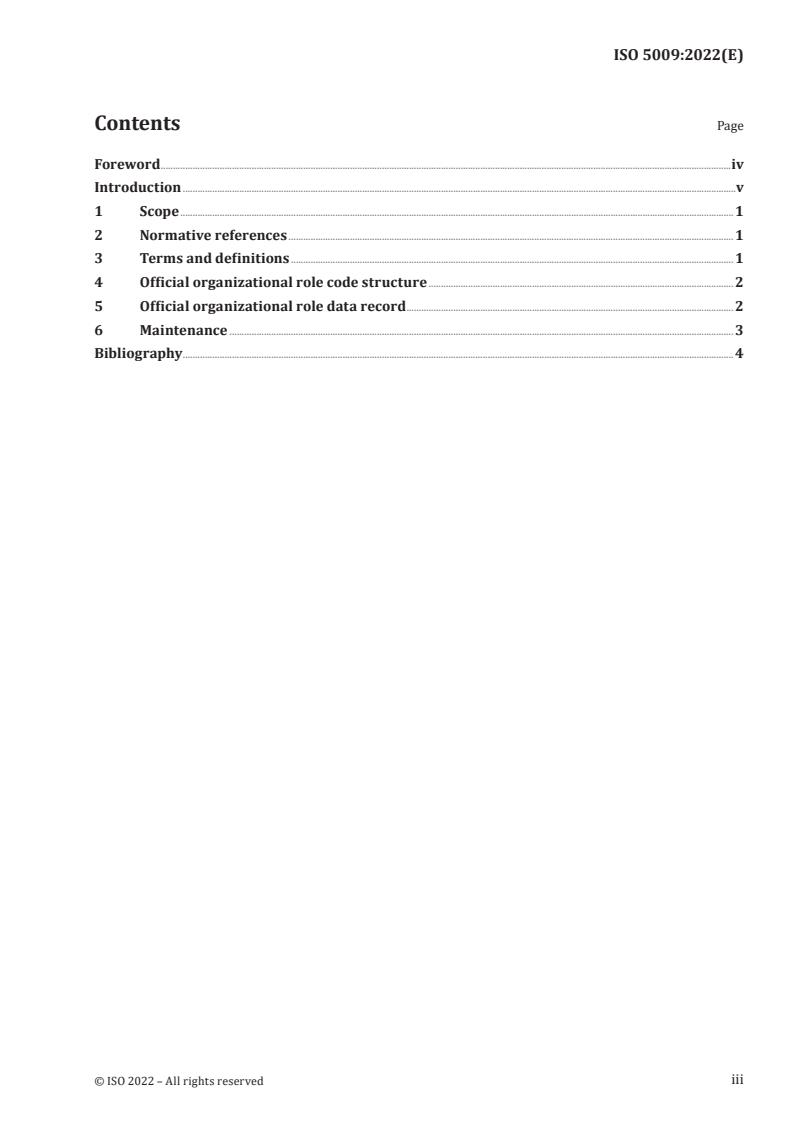
Contents Page
Foreword .iv
Introduction .v
1 Scope . 1
2 Normative references . 1
3 Terms and definitions . 1
4 Official organizational role code structure . 2
5 Official organizational role data record . 2
6 Maintenance . 3
Bibliography . 4
iii
Foreword
ISO (the International Organization for Standardization) is a worldwide federation of national standards
bodies (ISO member bodies). The work of preparing International Standards is normally carried out
through ISO technical committees. Each member body interested in a subject for which a technical
committee has been established has the right to be represented on that committee. International
organizations, governmental and non-governmental, in liaison with ISO, also take part in the work.
ISO collaborates closely with the International Electrotechnical Commission (IEC) on all matters of
electrotechnical standardization.
The procedures used to develop this document and those intended for its further maintenance are
described in the ISO/IEC Directives, Part 1. In particular, the different approval criteria needed for the
different types of ISO documents should be noted. This document was drafted in accordance with the
editorial rules of the ISO/IEC Directives, Part 2 (see www.iso.org/directives).
Attention is drawn to the possibility that some of the elements of this document may be the subject of
patent rights. ISO shall not be held responsible for identifying any or all such patent rights. Details of
any patent rights identified during the development of the document will be in the Introduction and/or
on the ISO list of patent declarations received (see www.iso.org/patents).
Any trade name used in this document is information given for the convenience of users and does not
constitute an endorsement.
For an explanation of the voluntary nature of standards, the meaning of ISO specific terms and
expressions related to conformity assessment, as well as information about ISO's adherence to
the World Trade Organization (WTO) principles in the Technical Barriers to Trade (TBT), see
www.iso.org/iso/foreword.html.
This document was prepared by Technical Committee/TC 68, Financial services, Subcommittee SC 8,
Reference data for financial services.
Any feedback or questions on this document should be directed to the user’s national standards body. A
complete listing of these bodies can be found at www.iso.org/members.html.
iv
Introduction
Understanding the official roles of persons acting on behalf of organizations is an important
consideration in fulfilling both commercial business and regulatory interactions and obligations. This
is especially true for engagements and interactions in the digital world, and in financial services in
particular, as we move towards creating and sustaining a global digital economy.
This document addresses the need for listing official organizational roles in a structured way in order
to to specify the roles of persons acting officially on behalf of an organization or legal entity.
Key provisions of this document include:
— providing lists of official organizational roles;
— leveraging the experience of ISO/TC 68 in defining and maintaining reference data standards;
— defining an official organizational role scheme that is extensible and free from limitation on use and
redistribution.
ISO/TC 68 sees that this document can be used to specify in a standard way the optional role extension
contained in X.509 (ISO/IEC 9594-8) public key certificates with embedded LEIs, as outlined in
ISO 17442-2.
This document can also be used to indicate roles in a standard way in digital verifiable credentials,
the format for interoperable, cryptographically verifiable digital credentials being defined by the W3C
standards organization.
Combining LEIs with official organizational roles can become a key enabler for digital identity
management.
v
INTERNATIONAL STANDARD ISO 5009:2022(E)
Financial services — Official organizational roles —
Scheme for official organizational roles
1 Scope
This document specifies an unambiguous scheme to list official organizational roles by jurisdiction in a
standard way.
It is not the purpose of this document to compare or align official organizational roles across different
countries or jurisdictions, so as not to limit the usage or relevance of this document. To understand the
powers associated with each official organizational role, users of this document can consult applicable
regulation or legislation, documents of the legal entity in which the official organizational role exists
and procedures specific to each organizational entity.
2 Normative references
The following documents
...