


ISO/IEC 23008-12:2017
(Main)Information technology — High efficiency coding and media delivery in heterogeneous environments — Part 12: Image File Format
Information technology — High efficiency coding and media delivery in heterogeneous environments — Part 12: Image File Format
The formats defined in ISO/IEC 23008-12:2017 enable the interchange, editing, and display of images, as well as the carriage of metadata associated with those images. The Image File Format builds on tools defined in ISO/IEC 14496-12 to define an interoperable storage format for a single image, a collection of images, and sequences of images. ISO/IEC 23008-12:2017 specifies brands for the storage of images and image sequences conforming to High Efficiency Video Coding (HEVC). NOTE The storage of HEVC video sequences is out of scope and is handled by ISO/IEC 14496‑15. This format defines normative structures used to contain metadata, how to link that metadata to the images, and defines how metadata of certain forms is carried.
Technologies de l'information — Codage à haute efficacité et livraison des medias dans des environnements hétérogènes — Partie 12: Format de fichier d'image
General Information
- Status
- Withdrawn
- Publication Date
- 11-Dec-2017
- Current Stage
- 9599 - Withdrawal of International Standard
- Start Date
- 29-Sep-2022
- Completion Date
- 12-Feb-2026
Relations
- Effective Date
- 01-Jan-2022
- Effective Date
- 06-Jun-2022


Get Certified
Connect with accredited certification bodies for this standard

BSI Group
BSI (British Standards Institution) is the business standards company that helps organizations make excellence a habit.

NYCE
Mexican standards and certification body.
Sponsored listings
Frequently Asked Questions
ISO/IEC 23008-12:2017 is a standard published by the International Organization for Standardization (ISO). Its full title is "Information technology — High efficiency coding and media delivery in heterogeneous environments — Part 12: Image File Format". This standard covers: The formats defined in ISO/IEC 23008-12:2017 enable the interchange, editing, and display of images, as well as the carriage of metadata associated with those images. The Image File Format builds on tools defined in ISO/IEC 14496-12 to define an interoperable storage format for a single image, a collection of images, and sequences of images. ISO/IEC 23008-12:2017 specifies brands for the storage of images and image sequences conforming to High Efficiency Video Coding (HEVC). NOTE The storage of HEVC video sequences is out of scope and is handled by ISO/IEC 14496‑15. This format defines normative structures used to contain metadata, how to link that metadata to the images, and defines how metadata of certain forms is carried.
The formats defined in ISO/IEC 23008-12:2017 enable the interchange, editing, and display of images, as well as the carriage of metadata associated with those images. The Image File Format builds on tools defined in ISO/IEC 14496-12 to define an interoperable storage format for a single image, a collection of images, and sequences of images. ISO/IEC 23008-12:2017 specifies brands for the storage of images and image sequences conforming to High Efficiency Video Coding (HEVC). NOTE The storage of HEVC video sequences is out of scope and is handled by ISO/IEC 14496‑15. This format defines normative structures used to contain metadata, how to link that metadata to the images, and defines how metadata of certain forms is carried.
ISO/IEC 23008-12:2017 is classified under the following ICS (International Classification for Standards) categories: 35.040 - Information coding; 35.040.40 - Coding of audio, video, multimedia and hypermedia information. The ICS classification helps identify the subject area and facilitates finding related standards.
ISO/IEC 23008-12:2017 has the following relationships with other standards: It is inter standard links to ISO/IEC 23008-12:2017/Amd 1:2020, ISO/IEC 23008-12:2022. Understanding these relationships helps ensure you are using the most current and applicable version of the standard.
ISO/IEC 23008-12:2017 is available in PDF format for immediate download after purchase. The document can be added to your cart and obtained through the secure checkout process. Digital delivery ensures instant access to the complete standard document.
Standards Content (Sample)
INTERNATIONAL ISO/IEC
STANDARD 23008-12
First edition
2017-12
Information technology — High
efficiency coding and media delivery
in heterogeneous environments —
Part 12:
Image File Format
Technologies de l'information — Codage à haute efficacité et livraison
des medias dans des environnements hétérogènes —
Partie 12: Format de fichier d'image
Reference number
©
ISO/IEC 2017
© ISO/IEC 2017, Published in Switzerland
All rights reserved. Unless otherwise specified, no part of this publication may be reproduced or utilized otherwise in any form
or by any means, electronic or mechanical, including photocopying, or posting on the internet or an intranet, without prior
written permission. Permission can be requested from either ISO at the address below or ISO’s member body in the country of
the requester.
ISO copyright office
Ch. de Blandonnet 8 • CP 401
CH-1214 Vernier, Geneva, Switzerland
Tel. +41 22 749 01 11
Fax +41 22 749 09 47
copyright@iso.org
www.iso.org
ii © ISO/IEC 2017 – All rights reserved
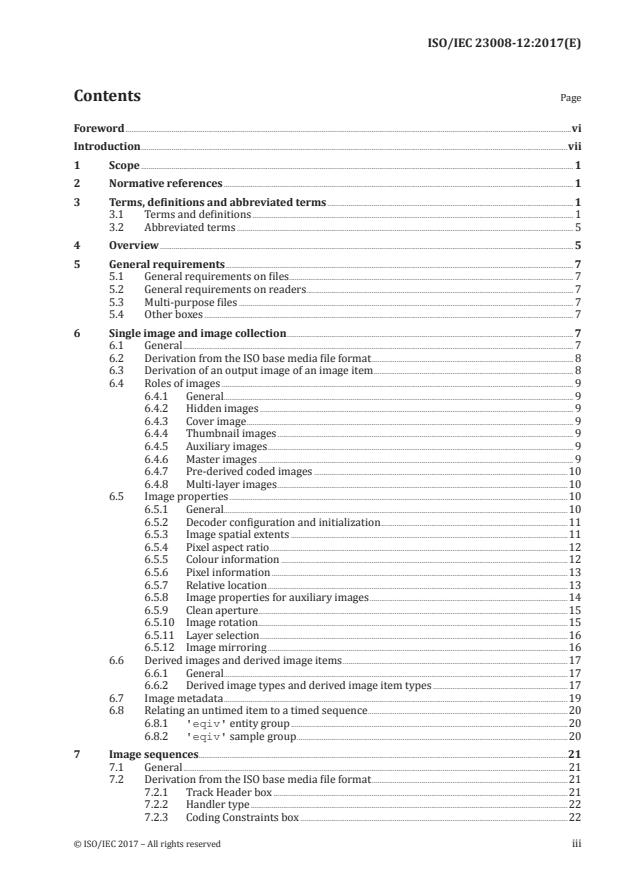
Contents Page
Foreword .vi
Introduction .vii
1 Scope . 1
2 Normative references . 1
3 Terms, definitions and abbreviated terms . 1
3.1 Terms and definitions . 1
3.2 Abbreviated terms . 5
4 Overview . 5
5 General requirements . 7
5.1 General requirements on files. 7
5.2 General requirements on readers . 7
5.3 Multi-purpose files . 7
5.4 Other boxes . 7
6 Single image and image collection . 7
6.1 General . 7
6.2 Derivation from the ISO base media file format . 8
6.3 Derivation of an output image of an image item . 8
6.4 Roles of images . 9
6.4.1 General. 9
6.4.2 Hidden images . 9
6.4.3 Cover image . 9
6.4.4 Thumbnail images . 9
6.4.5 Auxiliary images . 9
6.4.6 Master images . 9
6.4.7 Pre-derived coded images .10
6.4.8 Multi-layer images .10
6.5 Image properties .10
6.5.1 General.10
6.5.2 Decoder configuration and initialization .11
6.5.3 Image spatial extents .11
6.5.4 Pixel aspect ratio .12
6.5.5 Colour information .12
6.5.6 Pixel information .13
6.5.7 Relative location .13
6.5.8 Image properties for auxiliary images .14
6.5.9 Clean aperture . .15
6.5.10 Image rotation .15
6.5.11 Layer selection .16
6.5.12 Image mirroring .16
6.6 Derived images and derived image items .17
6.6.1 General.17
6.6.2 Derived image types and derived image item types .17
6.7 Image metadata .19
6.8 Relating an untimed item to a timed sequence .20
6.8.1 'eqiv' entity group .20
6.8.2 'eqiv' sample group .20
7 Image sequences .21
7.1 General .21
7.2 Derivation from the ISO base media file format .21
7.2.1 Track Header box .21
7.2.2 Handler type .22
7.2.3 Coding Constraints box .22
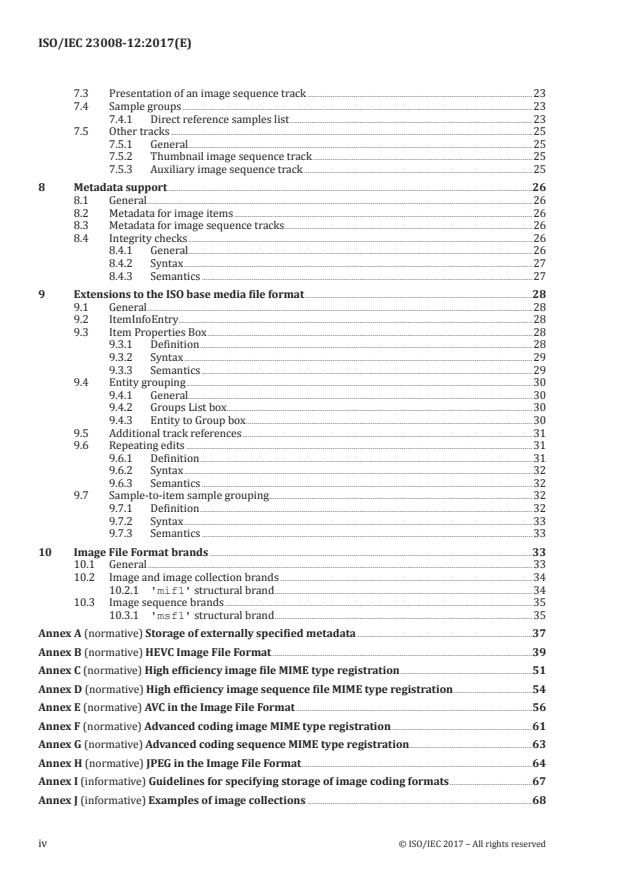
© ISO/IEC 2017 – All rights reserved iii
7.3 Presentation of an image sequence track .23
7.4 Sample groups .23
7.4.1 Direct reference samples list .23
7.5 Other tracks .25
7.5.1 General.25
7.5.2 Thumbnail image sequence track .25
7.5.3 Auxiliary image sequence track .25
8 Metadata support .26
8.1 General .26
8.2 Metadata for image items .26
8.3 Metadata for image sequence tracks.26
8.4 Integrity checks .26
8.4.1 General.26
8.4.2 Syntax .27
8.4.3 Semantics .27
9 Extensions to the ISO base media file format .28
9.1 General .28
9.2 ItemInfoEntry.28
9.3 Item Properties Box .28
9.3.1 Definition .28
9.3.2 Syntax .29
9.3.3 Semantics .29
9.4 Entity grouping .30
9.4.1 General.30
9.4.2 Groups List box . .30
9.4.3 Entity to Group box .30
9.5 Additional track references .31
9.6 Repeating edits .31
9.6.1 Definition .31
9.6.2 Syntax .32
9.6.3 Semantics .32
9.7 Sample-to-item sample grouping.32
9.7.1 Definition .32
9.7.2 Syntax .33
9.7.3 Semantics .33
10 Image File Format brands .33
10.1 General .33
10.2 Image and image collection brands .34
10.2.1 'mif1' structural brand .34
10.3 Image sequence brands .35
10.3.1 'msf1' structural brand .35
Annex A (normative) Storage of externally specified metadata .37
Annex B (normative) HEVC Image File Format .39
Annex C (normative) High efficiency image file MIME type registration.51
Annex D (normative) High efficiency image sequence file MIME type registration .54
Annex E (normative) AVC in the Image File Format .56
Annex F (normative) Advanced coding image MIME type registration .61
Annex G (normative) Advanced coding sequence MIME type registration.63
Annex H (normative) JPEG in the Image File Format .64
Annex I (informative) Guidelines for specifying storage of image coding formats .67
Annex J (informative) Examples of image collections .68
iv © ISO/IEC 2017 – All rights reserved
Annex K (informative) Guidelines for progressive refinement .70
Bibliography .72
© ISO/IEC 2017 – All rights reserved v
Foreword
ISO (the International Organization for Standardization) and IEC (the International Electrotechnical
Commission) form the specialized system for worldwide standardization. National bodies that are
members of ISO or IEC participate in the development of International Standards through technical
committees established by the respective organization to deal with particular fields of technical
activity. ISO and IEC technical committees collaborate in fields of mutual interest. Other international
organizations, governmental and non-governmental, in liaison with ISO and IEC, also take part in the
work. In the field of information technology, ISO and IEC have established a joint technical committee,
ISO/IEC JTC 1.
The procedures used to develop this document and those intended for its further maintenance are
described in the ISO/IEC Directives, Part 1. In particular the different approval criteria needed for the
different types of ISO documents should be noted. This document was drafted in accordance with the
editorial rules of the ISO/IEC Directives, Part 2 (see www.iso.org/directives).
Attention is drawn to the possibility that some of the elements of this document may be the subject of
patent rights. ISO shall not be held responsible for identifying any or all such patent rights. Details of
any patent rights identified during the development of the document will be in the Introduction and/or
on the ISO list of patent declarations received (see www.iso.org/patents).
Any trade name used in this document is information given for the convenience of users and does not
constitute an endorsement.
For an explanation on the voluntary nature of standards, the meaning of ISO specific terms and
expressions related to conformity assessment, as well as information about ISO's adherence to the
World Trade Organization (WTO) principles in the Technical Barriers to Trade (TBT) see the following
URL: www.iso.org/iso/foreword.html.
The committee responsible for this document is ISO/IEC JTC 1, Information technology, SC 29, Coding of
audio, picture, multimedia and hypermedia information.
A list of all parts in the ISO/IEC 23008 series can be found on the ISO website.
vi © ISO/IEC 2017 – All rights reserved
Introduction
The Image File Format is designed to enable the interchange of images and image sequences, as well as
their associated metadata. It forms part of a family of specifications that are box-structured and is built
using tools defined in the ISO base media file format. This document specifies both structural brands
that can be used with any codec and brands specific to High Efficiency Video Coding (HEVC). The file
format specified in this document is referred to as the High Efficiency Image File Format (HEIF). When
the requirements of the HEVC-specific brands are obeyed, the file format can be referred to as the HEVC
Image File Format.
© ISO/IEC 2017 – All rights reserved vii
INTERNATIONAL STANDARD ISO/IEC 23008-12:2017(E)
Information technology — High efficiency coding and
media delivery in heterogeneous environments —
Part 12:
Image File Format
1 Scope
The formats defined in this document enable the interchange, editing, and display of images, as well as
the carriage of metadata associated with those images.
The Image File Format builds on tools defined in ISO/IEC 14496-12 to define an interoperable storage
format for a single image, a collection of images, and sequences of images.
This document specifies brands for the storage of images and image sequences conforming to High
Efficiency Video Coding (HEVC).
NOTE The storage of HEVC video sequences is out of scope and is handled by ISO/IEC 14496-15.
This format defines normative structures used to contain metadata, how to link that metadata to the
images, and defines how metadata of certain forms is carried.
2 Normative references
The following documents are referred to in the text in such a way that some or all of their content
constitutes requirements of this document. For dated references, only the edition cited applies. For
undated references, the latest edition of the referenced document (including any amendments) applies.
ISO/IEC 10918-1:1994, Information technology Digital compression and coding of continuous-tone still
images — Part 1: Requirements and guidelines
ISO/IEC 14496-10, Information technology — Coding of audio-visual objects — Part 10: Advanced
Video Coding
ISO/IEC 14496-12:2015, Information technology — Coding of audio-visual objects — Part 12: ISO base
media file format
ISO/IEC 14496-15, Information technology — Coding of audio-visual objects — Part 15: Carriage of
network abstraction layer (NAL) unit structured video in the ISO base media file format
ISO/IEC 23008-2:2015, Information technology — High efficiency coding and media delivery in
heterogeneous environments — Part 2: High efficiency video coding
3 Terms, definitions and abbreviated terms
3.1 Terms and definitions
For the purposes of this document, the terms and definitions given in ISO/IEC 14496-12 and the
following apply.
For the purposes of Annex B and Annex E, the terms, definitions, and abbreviated terms specified in
ISO/IEC 14496-15 apply.
© ISO/IEC 2017 – All rights reserved 1
ISO and IEC maintain terminological databases for use in standardization at the following addresses:
— IEC Electropedia: available at http://www.electropedia.org/
— ISO Online browsing platform: available at http://www.iso.org/obp
3.1.1
alternate group
group of entities (3.1.10) that are alternatives to each other and out of which only one should be selected
for processing
3.1.2
associated image item
image item (3.1.17) that is associated with the item property (3.1.26) through the ItemPropertiesBox
3.1.3
auxiliary image
image (3.1.15) that may not be intended to be displayed but provides supplemental information, such as
transparency data, complementing a respective master image (3.1.27)
3.1.4
coded image
coded representation of an image (3.1.15)
3.1.5
coded image item
item (3.1.25) whose data is a coded image (3.1.4)
3.1.6
crop-rotate-mirror derived image item
derived image item (3.1.8) of type 'iden' that is not associated with any other types of essential item
properties (3.1.11) than 'irot', 'clap', and 'imir'
3.1.7
derived image
representation of an image (3.1.15) as an operation (3.1.31) on other images
3.1.8
derived image item
item (3.1.25) whose data is a derived image (3.1.7)
3.1.9
descriptive item property
item property (3.1.26) that describes rather than transforms the associated item
3.1.10
entity
item or track
3.1.11
essential item property
item property (3.1.26) that readers are required to process
3.1.12
HEVC image item
image item (3.1.17) of type 'hvc1' or 'lhv1'
3.1.13
hidden image
image (3.1.15) that is not intended to be displayed
2 © ISO/IEC 2017 – All rights reserved
3.1.14
hidden sample
sample that is not intended to be displayed
3.1.15
image
one or more arrays of pixels of different colour components described by an image item (3.1.17) or a sample
3.1.16
image collection
set of images (3.1.15) stored as items (3.1.25) of a single file according to this specification
3.1.17
image item
coded image item (3.1.5) or derived image item (3.1.8)
3.1.18
image property
item property (3.1.26) for an image item (3.1.17)
3.1.19
image sequence
sequence of coded images (3.1.4) which may be associated with advisory timing and in which images
may use inter prediction (3.1.22)
3.1.20
image sequence track
track that contains an image sequence (3.1.19)
3.1.21
input image
image (3.1.15) that is used as an input for the operation (3.1.31) of the derived image item (3.1.8)
3.1.22
inter prediction
prediction derived in a manner that is dependent on data elements (e.g. sample values or motion
vectors) of images (3.1.15) other than the current image
3.1.23
intra coding
coding of an image (3.1.15) that may use intra prediction (3.1.24) and does not use inter prediction
(3.1.22)
3.1.24
intra prediction
prediction derived from only data elements (e.g. sample values) of the same decoded image
3.1.25
item
data that does not require timed processing, as opposed to sample data, and is described by the boxes
contained in a MetaBox
3.1.26
item property
descriptive or transformative information about an item (3.1.25) as stored in the item properties array
3.1.27
master image
image that is stored as an item (3.1.25) and is not an auxiliary image (3.1.3) or a thumbnail image (3.1.37)
© ISO/IEC 2017 – All rights reserved 3
3.1.28
master image sequence
sequence of images that is stored as an image sequence track (3.1.20) and is not an auxiliary image (3.1.3)
sequence or a thumbnail image sequence (3.1.19)
3.1.29
metadata item
item (3.1.25) containing metadata that may for example describe an image item (3.1.17)
Note 1 to entry: ISO/IEC 14496-12 uses the terms item and metadata item interchangeably to refer to an item of
any type. This document overrides the metadata item definition of the ISO base media file format.
3.1.30
non-essential item property
item property (3.1.26) that readers are allowed to ignore
3.1.31
operation
for a derived image item (3.1.8), manipulation, identified by the item type, that produces a reconstructed
image (3.1.34) from a set of input images (3.1.21)
3.1.32
output image
image (3.1.15) that results when the reconstructed image (3.1.34) of the image item (3.1.17) is
transformed according to the transformative item properties (3.1.39) of the image item (3.1.17)
3.1.33
pre-derived coded image
coded image (3.1.4) that has been derived from one or more other images
3.1.34
reconstructed image
image (3.1.15) that results when the coded image item (3.1.5) is decoded or when the operation (3.1.31)
of the derived image item (3.1.8), if any, is applied
3.1.35
reference image
image (3.1.15) that may be used as a reference for inter prediction (3.1.22) of another image
3.1.36
source image item
image item (3.1.17) referred to by the 'dimg' item reference from the derived image item (3.1.8) or
from another derived image item that is a source image item for the derived image item
Note 1 to entry: In other words, an image item is a source image item for a derived image item when it is required
for deriving the output image of the derived image item.
Note 2 to entry: The definition of the source image item is recursive: an image item is a source image item for a
particular derived image item, when the output image of the image item is used as an input image for any derived
image item in the 'dimg'-item-reference-linked chain of derived image items ending at that particular derived
image item, inclusive.
3.1.37
thumbnail image
smaller-resolution representation of an image (3.1.15)
3.1.38
time-parallel sample
sample in the reference track that has the same or, when a sample with the same decoding time is
not available, the closest preceding decoding time relative to that of the particular sample in the
particular track
4 © ISO/IEC 2017 – All rights reserved
3.1.39
transformative item property
item property (3.1.26) that transforms the reconstructed representation of the item content
Note 1 to entry: A transformative item property may, for example, specify rotation by 90°, 180°, or 270° of a
reconstructed image of an image item.
3.2 Abbreviated terms
ASCII American Standard Code for Information Interchange
AVC Advanced Video Coding
DCF Design rule for Camera File system
Exif Exchangeable Image File Format
HDR High Dynamic Range
HEIF High Efficiency Image File Format
HEVC High Efficiency Video Coding
MD5 Message Digest algorithm 5
MIME Multi-purpose Internet Mail Extensions
NAL Network Abstraction Layer
PPS Picture Parameter Set
RBSP Raw Byte Sequence Payload
SEI Supplemental Enhancement Information
SPS Sequence Parameter Set
TIFF Tagged Image File Format
URN Uniform Resource Name
UTF-8 Universal Character Set Transformation Format — 8-bit
VCL Video Coding Layer
VPS Video Parameter Set
XML Extensible Markup Language
XMP Extensible Metadata Platform
4 Overview
The Image File Format specifies the following two forms of storage:
a) the storage of a single coded image or a collection of independently coded images, possibly with
derived images;
b) the storage of image sequences, which can be indicated to be displayed as a timed sequence or by
other means, such as a gallery of images, and in which the coded images may be dependent on other
coded images in the same sequence.
© ISO/IEC 2017 – All rights reserved 5
A file may use both structures and may also use the structures of the ISO base media file format,
enabling a single file to be constructed to meet a variety of needs (e.g. a single image for printing and a
record of the image burst that was used to synthesize that image).
In general, the single image support is used for simpler cases, particularly when neither timing nor
coding dependency is required. If advisory timing or other tools from the ISO base media file format
available for tracks are needed (e.g. sample grouping), or images have been coded with inter prediction,
then the second approach is needed.
Brands are defined in order to specify what is required to be present in the file, and what reader support
is required to decode under that brand (including support for features that are optional for writers).
External specifications may also define brands, which may impose additional constraints on the files or
the readers. The brands with which a file is compatible are recorded in the file in the usual way using
the FileTypeBox ('ftyp').
This document is organized as follows.
Clause 5 specifies general requirements on files and file readers conforming to the Image File Format.
Clause 6 specifies the file structures for the storage of a single image and an image collection.
Additionally, general requirements that shall be supported in all files using the Image File Format for
the storage of a single image or an image collection are specified.
Clause 7 specifies the file structures for the storage of image sequences. Additionally, general
requirements that shall be supported in all files using the Image File Format for the storage of image
sequences are specified.
Clause 8 specifies the metadata structures for a single image, an image collection, and image sequences.
Clause 9 specifies enhancements to the ISO base media file format (ISO/IEC 14496-12) and may be
moved into that specification in the future. Clauses 6, 7 and 8 include particular subclauses of Clause 9
by reference into their specifications.
Clause 10 specifies structural brands for a single image and an image collection, as well as image
sequences. Requirements on both files and file readers are specified.
Annex A specifies the format for storing Exif, XMP, and MPEG-7 metadata in files conforming to the
Image File Format. Storage of Exif, XMP, or MPEG-7 metadata in files conforming to the Image File
Format shall conform to the specifications of Annex A.
Annex B specifies the format for encapsulating HEVC-coded images, image collections, and image
sequences according to the Image File Format. Annex B also specifies HEVC-specific brands for a
single image and an image collection as well as image sequences. Requirements on both files and file
readers are specified. Storage of HEVC-coded images, image collections, and image sequences in files
conforming to the Image File Format shall conform to the specifications of Annex B.
Annex C and Annex D specify the MIME type registration for a single image or an image collection, and
image sequences, respectively, for the structural and HEVC-specific brands. When MIME types are used
for files conforming to the HEVC-specific Image File Format brands, the MIME types shall conform the
specifications of Annex C and Annex D for a single image or an image collection, and image sequences,
respectively.
Annex E specifies the format for encapsulating AVC-coded images, image collections, and image
sequences according to the Image File Format. Storage of AVC-coded images, image collections, and
image sequences in files conforming to the Image File Format shall conform to the specifications of
Annex E. Annex F and Annex G specify the MIME type registration for a single image or an image
collection, and image sequences, respectively, for the AVC-specific brands. When MIME types are used
for files conforming to the AVC-specific Image File Format brands, the MIME types shall conform the
specifications of Annex F and Annex G for a single image or an image collection, and image sequences,
respectively.
6 © ISO/IEC 2017 – All rights reserved
Annex H specifies the format for encapsulating JPEG-coded images, image collections, and image
sequences according to the Image File Format. Storage of JPEG-coded images, image collections, and
image sequences in files conforming to the Image File Format shall conform to the specifications of
Annex H.
Annex I contains guidelines on defining new image formats and brands.
Annex J contains informative examples of single image and image collection file structures conforming
to the Image File Format.
Annex K provides guidelines for a player operation for progressive refinement and file structures
enabling progressive refinement.
Throughout this document, statements appearing with the preamble "NOTE" are informative and are
not an integral part of this specification.
5 General requirements
5.1 General requirements on files
All files shall conform to the definitions for an object-structured file as defined in ISO/IEC 14496-
12:2015, Clause 4.
5.2 General requirements on readers
The following are the requirements for all readers conforming to this document.
1) They shall be able to parse object-structured files formatted according to the definitions for an
object-structured file as defined in Clause 4 of the ISO base media file format.
2) They shall parse the FileTypeBox and confirm that one or more brands that they support are
included in the list of compatible brands. If there are no such brands, the reader should terminate
parsing of the file.
3) They shall be able to recognize and discard boxes that are not required to be supported under the
specification identified by the brand(s) under which they are operating.
5.3 Multi-purpose files
Files may be identified as compatible with other standards (using brands) than those defined in this
document.
NOTE A file identified as compatible with other standards (using brands) contains the boxes specified by
those standards.
5.4 Other boxes
In addition to the required boxes (and their required content), other boxes from the ISO base media file
format, or other box-structured specifications, may be included as needed.
6 Single image and image collection
6.1 General
Images can be stored as items using the support for untimed data storage, called the MetaBox for
historical reasons, in the ISO base media file format. A file may contain any number of image items.
© ISO/IEC 2017 – All rights reserved 7
Clause 6 specifies requirements for all files using the Image File Format for the storage of a single image
or image collection. In other words, when a brand specified in 10.2 is among the compatible brands of a
file, the requirements specified in Clause 6 shall be obeyed.
6.2 Derivation from the ISO base media file format
A MetaBox ('meta'), as specified in ISO/IEC 14496-12, is required at file level. That MetaBox
shall contain the boxes specified to be mandatorily present by ISO/IEC 14496-12. Additional
requirements for the boxes contained in the file-level MetaBox are specified in this document. The
MetaBox containing image items and the metadata items related to the image items for the brands
specified in this document shall be included in the file-level MetaBox and shall not be included in any
AdditionalMetadataContainerBox. The file-level MetaBox shall identify as its primary item an
item that is a coded image or a derived image item. The primary item should be displayed when no other
information is available on the preferred displaying method of the image collection. It is recommended
not to have a thumbnail image or an auxiliary image as a primary item.
The handler type for the MetaBox shall be 'pict'.
All three construction methods specified for the ItemLocationBox (by file offset, by offset into the
local ItemDataBox, and by offset into the data of another item) are permitted by this document, but
brands may restrict this. Similarly, the DataReferenceBox may indicate the same or another file, but
derived specifications may restrict this also. The location for storing the items is specified in the ISO
base media file format. For example, a MediaDataBox ('mdat') may be used as a general container
for the items referenced from the ItemLocationBox.
NOTE By using extents, images can be interleaved with each other or other data, and progressive display
may be possible.
9.2, 9.3, and 9.4 are included in Clause 6 by reference.
6.3 Derivation of an output image of an image item
The reconstructed image of an image item is derived as follows:
— if the image item contains a coded image, the coded image is decoded and the reconstructed image
is the output of the decoding process;
— otherwise (the image item is a derived image item), the operation of the derived image item is
applied to the input images of the derived image item to form the reconstructed image.
The output image of an image item is derived from the reconstructed image of the image item as follows:
— if the image item has no transformative item properties, the output image is identical to the
reconstructed image;
— otherwise (the image item has transformative item properties), the following applies: A sequence
of transformative item properties is formed from all essential transformative item properties of
the image item and any set of the non-essential transformative item properties of the image item.
That sequence of transformative item properties is applied, in the order of their appearance in
the ItemPropertyAssociation for the image item, to the reconstructed image to obtain the
output image.
NOTE When an image item has non-essential transformative item properties, the pixel values of the output
image might depend on the reader's capability and/or choice of applying the non-essential transformative item
properties.
8 © ISO/IEC 2017 – All rights reserved
6.4 Roles of images
6.4.1 General
Images may be assigned different roles or purposes as specified in the following subclauses. The role or
the purpose is independent of whether the image is represented by a coded image or a derived image, or
how the image is coded or transformed (by a transformative item property).
In this document, the role of an image can be indicated with a qualifier, such as hidden, or thumbnail,
in front of the term image, e.g. hidden image, or thumbnail image. When referring to an image item that
contains an image with a specific role, the role qualifier can precede the term image item, e.g. hidden
image i
...
Questions, Comments and Discussion
Ask us and Technical Secretary will try to provide an answer. You can facilitate discussion about the standard in here.
Loading comments...