


ISO 16328:2014
(Main)Ships and marine technology — Gyro-compasses for high-speed craft
Ships and marine technology — Gyro-compasses for high-speed craft
ISO 16328:2014 specifies the construction, performance, and type testing for gyro-compass for high-speed craft required by chapter X, SOLAS 1974 (as amended).
Navires et technologie maritime — Compas gyroscopiques pour navires à grande vitesse
General Information
Relations
Standards Content (Sample)
INTERNATIONAL ISO
STANDARD 16328
Second edition
2014-03-01
Ships and marine technology — Gyro-
compasses for high-speed craft
Navires et technologie maritime — Compas gyroscopiques pour
navires à grande vitesse
Reference number
©
ISO 2014
© ISO 2014
All rights reserved. Unless otherwise specified, no part of this publication may be reproduced or utilized otherwise in any form
or by any means, electronic or mechanical, including photocopying, or posting on the internet or an intranet, without prior
written permission. Permission can be requested from either ISO at the address below or ISO’s member body in the country of
the requester.
ISO copyright office
Case postale 56 • CH-1211 Geneva 20
Tel. + 41 22 749 01 11
Fax + 41 22 749 09 47
E-mail copyright@iso.org
Web www.iso.org
Published in Switzerland
ii © ISO 2014 – All rights reserved
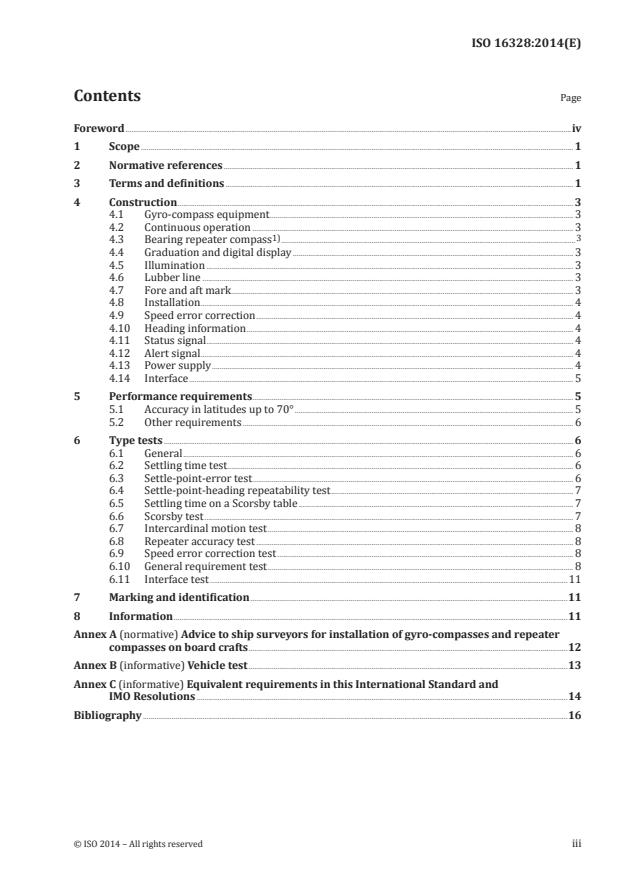
Contents Page
Foreword .iv
1 Scope . 1
2 Normative references . 1
3 Terms and definitions . 1
4 Construction . 3
4.1 Gyro-compass equipment . 3
4.2 Continuous operation . 3
1) 3
4.3 Bearing repeater compass .
4.4 Graduation and digital display . 3
4.5 Illumination . 3
4.6 Lubber line . 3
4.7 Fore and aft mark . 3
4.8 Installation . 4
4.9 Speed error correction . 4
4.10 Heading information . 4
4.11 Status signal . 4
4.12 Alert signal . 4
4.13 Power supply . 4
4.14 Interface . 5
5 Performance requirements . 5
5.1 Accuracy in latitudes up to 70° . 5
5.2 Other requirements . 6
6 Type tests . 6
6.1 General . 6
6.2 Settling time test . 6
6.3 Settle-point-error test . 6
6.4 Settle-point-heading repeatability test . 7
6.5 Settling time on a Scorsby table . 7
6.6 Scorsby test . 7
6.7 Intercardinal motion test . 8
6.8 Repeater accuracy test . 8
6.9 Speed error correction test . 8
6.10 General requirement test . 8
6.11 Interface test .11
7 Marking and identification .11
8 Information .11
Annex A (normative) Advice to ship surveyors for installation of gyro-compasses and repeater
compasses on board crafts .12
Annex B (informative) Vehicle test .13
Annex C (informative) Equivalent requirements in this International Standard and
IMO Resolutions .14
Bibliography .16
Foreword
ISO (the International Organization for Standardization) is a worldwide federation of national standards
bodies (ISO member bodies). The work of preparing International Standards is normally carried out
through ISO technical committees. Each member body interested in a subject for which a technical
committee has been established has the right to be represented on that committee. International
organizations, governmental and non-governmental, in liaison with ISO, also take part in the work.
ISO collaborates closely with the International Electrotechnical Commission (IEC) on all matters of
electrotechnical standardization.
The procedures used to develop this document and those intended for its further maintenance are
described in the ISO/IEC Directives, Part 1. In particular the different approval criteria needed for the
different types of ISO documents should be noted. This document was drafted in accordance with the
editorial rules of the ISO/IEC Directives, Part 2 (see www.iso.org/directives).
Attention is drawn to the possibility that some of the elements of this document may be the subject of
patent rights. ISO shall not be held responsible for identifying any or all such patent rights. Details of
any patent rights identified during the development of the document will be in the Introduction and/or
on the ISO list of patent declarations received (see www.iso.org/patents).
Any trade name used in this document is information given for the convenience of users and does not
constitute an endorsement.
For an explanation on the meaning of ISO specific terms and expressions related to conformity
assessment, as well as information about ISO’s adherence to the WTO principles in the Technical Barriers
to Trade (TBT) see the following URL: Foreword - Supplementary information
The committee responsible for this document is ISO/TC 8, Ships and marine technology, Subcommittee
SC 6, Navigation and ship operations.
This second edition cancels and replaces the first edition (ISO 16328:2001), of which has been technically
revised.
Annex A forms a normative part of this International Standard. Annexes B and C are for information
only.
iv © ISO 2014 – All rights reserved
INTERNATIONAL STANDARD ISO 16328:2014(E)
Ships and marine technology — Gyro-compasses for high-
speed craft
1 Scope
This International Standard specifies the construction, performance, and type testing for gyro-compass
for high-speed craft required by chapter X, SOLAS 1974 (as amended).
NOTE All requirements that are extracted from the recommendations of IMO Resolutions [Resolution
A.821(19) on performance standards for gyro-compasses for high-speed craft and A.694(17)] are printed in
italics.
2 Normative references
The following documents, in whole or in part, are normatively referenced in this document and are
indispensable for its application. For dated references, only the edition cited applies. For undated
references, the latest edition of the referenced document (including any amendments) applies.
ISO 25862, Ships and marine technology — Marine magnetic compasses, binnacles and azimuth reading
devices
IEC 60945, Maritime navigation and radiocommunication equipment and systems — General requirements
— Methods of testing and required test results
IEC 61162-1, Marine navigation and radiocommunication equipment and systems — Digital interfaces —
Part 1: Single talker and multiple listeners
IEC 61162-2, Maritime navigation and radiocommunication equipment and systems — Digital interfaces —
Part 2: Single talker and multiple listeners, high-speed transmission
IEC 61924-2, Maritime navigation and radiocommunication equipment and systems — Integrated
Navigation Systems (INS) — Part 2: Modular structure for INS-Operational and performance requirements,
methods of testing and required test results
IMO Resolution A.424 (XI), Performance standards for gyro-compasses
IMO Resolution A.694 (17), General requirements for shipborne radio equipment forming part of the global
maritime distress and safety system (GMDSS) and for electronic navigational aids
IMO Resolution MSC.252(83), Adoption of the revised performance standards for alert communications
with an Integrated Navigation System
IMO Resolution MSC.302(87), Adoption of performance standards for bridge alert management
IMO Resolution A.821(19), Performance standards for gyro-compasses for high-speed craft
3 Terms and definitions
For the purposes of this document, the following terms and definitions apply.
3.1
gyro-compass
complete equipment including all essential elements of the complete design, including both the gyro-
compass as heading sensor and the associated heading transmission system
3.2
true heading
horizontal angle between the vertical plane passing through the true meridian and the vertical plane passing
through the craft’s fore and aft datum line
Note 1 to entry: It is measured from true north (000°) clockwise through 360°.
Note 2 to entry: When the gyro-compass equipment is tested on the test stand, this “true heading” is regarded as
the true heading of the lubber line. Where a gyro-compass has the facility of introducing a correction by moving
the lubber line, the correction is set for the local latitude.
3.3
settled
stable situation when any three readings taken at intervals of 30 min are within a band of 0,7°, with the
compass level and stationary
Note 1 to entry: The settling time is the elapsed time between the time of switch-on at the initial heading error
and the third recording of the settle.
3.4
settle point heading
mean value of ten readings taken at 20 min intervals after the compass has settled (3.3)
3.5
settle point error
difference between the settle point heading (3.4)and the true heading
3.6
error
difference between the observed value and the settle point heading (3.4)
3.7
repeater compass
device that reproduces the master compass card at a remote location
3.8
bearing repeater compass
device that reproduces the master compass card for the purpose of taking bearings
3.9
compass card
graduated dial of the compass which indicates the measured direction of the meridian
3.10
latitude error
error to which some gyro-compasses are subject, the magnitude and sign of which depend upon the
local latitude
3.11
speed error
error to which gyro-compasses are subject, the magnitude and sign of which depend upon the speed,
course, and latitude of the craft
3.12
lubber line
index line situated on the body of gyro-compass or repeater compass against which the compass card
is read
3.13
master compass
main compass unit which supplies the heading information to the repeaters and other navigational aids
2 © ISO 2014 – All rights reserved
3.14
scorsby table
test machine which independently oscillates a platform about three axes, and is used to simulate the
motion of a craft
4 Construction
Requirements for gyro-compass units.
1)
4.1 Gyro-compass equipment
Gyro-compass equipment shall include the provision of a compass card or analogue repeater for steering
purposes and equipment for the purpose of taking a bearing.
4.2 Continuous operation
The equipment shall be capable of continuous operation under conditions of vibration, humidity, change
of temperature, and variations of the power supply, as specified in 6.10.
1)
4.3 Bearing repeater compass
For those crafts which are required to carry a bearing repeater compass, the construction of these shall
be as follows.
a) The bearing repeater compass shall be designed to be fitted with an azimuth-reading device.
b) A gimbal mechanism shall be provided to enable the bearing repeater compass card to be held
horizontally against the craft’s motion.
4.4 Graduation and digital display
The compass card shall be graduated at equal intervals of 1° or a fraction thereof. The graduation error
shall be less than ±0,2°. A numerical indication shall be provided at least at every 10°, starting from 000°
clockwise through 360°.
A digital display may be provided. When a digital display is provided, the course shall be displayed as three
digits plus, optionally, a fourth digit indicating tenths of a degree. When a gyro-compass with digital display
is used, it shall incorporate a turning direction indicator.
4.5 Illumination
Adequate illumination shall be provided to enable the reading of all compass cards at all times. Facilities
for dimming shall be provided.
4.6 Lubber line
Devices using a compass card shall be provided with a lubber line to indicate the craft’s heading.
4.7 Fore and aft mark
If technically necessary, the compass shall be marked in a way to facilitate installation so that the lubber
line lies in a vertical fore and aft plane of the craft or parallel. Where a gyro-compass has the facility of
introducing a correction by moving the lubber line, the correction during installation shall be set to zero.
1) Advice to ship surveyors for installation on board craft is given in normative annex A.
If such marks or identifications are not in the same vertical plane as the uncorrected lubber line, then
the horizontal angular relationship between them shall be clearly indicated in the manufacturer’s
installation instruction.
4.8 Installation
The master compass shall be installed or adjusted in a craft with the fore and aft datum lines parallel to
the craft’s fore and aft datum line to within ±0,5°. The lubber line shall be in the same vertical plane passing
through the centre of the card of the compass and shall be aligned accurately.
4.9 Speed error correction
Means shall be provided for correcting the errors induced by speed and latitude. An approved accurate
speed source shall be used for automatic speed error corrections.
4.10 Heading information
The gyro-compass shall be designed to enable heading information to be provided to other navigational
2)
aids such as radar, ARPA, radio direction-finder, and heading control system . The accuracy of the other
navigational aids shall not be degraded, and shall continue to comply with the standards specified for such
aids.
4.11 Status signal
A status signal shall be provided to indicate that the gyro-compass is ready for use.
4.12 Alert signal
3)
An alert signal shall be provided to indicate that the gyro-compass has suffered an external power supply
failure or an internal system functional failure which would invalidate the heading information. The alert
shall conform to the presentation and handling requirements of Bridge Alert Management [(IMO Res.
MSC.302(87)]. A suitable interface shall be provided for alert communications with an Integrated
Navigation System [IMO Res. MSC.252(83) and IEC 61924-2].
The following sentences shall be provided for the alert communications interface.
Sentences transmitted by the gyro-compass:
— ALR, HBT: See IEC 61162-1;
— ALC, ALF, ARC: See IEC 61924-2.
Sentences received by the gyro-compass:
— ACK, HBT: See IEC 61162-1;
— ACN: See IEC 61924-2.
4.13 Power supply
The gyro-compass shall be provided with or connected to an uninterruptable power supply.
2) The term of “automatic pilots” was replaced by “heading control system” in accordance with the new IMO
resolution. [Draft amendment to resolution A.342(IX) on performance standards for automatic pilots, MSC Res.
64(67) , annex 3].
3) The term of “Alarm” was replaced by “Alert” in accordance with IMO Resolution MSC.252(83) and IMO
Resolution MSC.302(87).
4 © ISO 2014 – All rights reserved
4.14 Interface
4.14.1 The gyro-compasses equipment shall provide with an output of heading information with an
accuracy as defined in 5.1.6 when interfaced by other equipment.
4.14.2 The compass shall provide interface facilities which meet the relevant International Standards
IEC 61162-1 and/or IEC 61162-2 as amended.
4.14.3 The gyro-compass equipment shall provide an appropriate data source and at least one output
of heading information, which is able to comply with the IEC 61162-2. The IEC 61162-2 heading output
shall be updated at a rate of once per 20 ms. The THS sentence detailed in IEC 61162-1 shall be provided
for heading information.
5 Performance requirements
5.1 Accuracy in latitudes up to 70°
5.1.1 Settling time
When switched on in accordance with the manufacturer’s instructions, the compass shall settle within 6 h.
5.1.2 Settle point error
5.1.2.1 The settle point error (3.5) at any heading shall not exceed ±0,75° × secant latitude, and the
RMS value of the differences between individual heading indications and the mean value shall be less
than ±0,25° × secant latitude.
5.1.2.2 The repeatability of settle point error from one run-up to another shall be within 0,25° × secant
latitude.
5.1.3 Settling time under operational conditions
When switched on in accordance with the manufacturer’s instructions, the compass shall settle within 6
h when rolling and pitching with simple harmonic motion of any period between 6 s and 15 s, a
...
Questions, Comments and Discussion
Ask us and Technical Secretary will try to provide an answer. You can facilitate discussion about the standard in here.
Loading comments...