


ISO/FDIS 4823
(Main)Dentistry — Elastomeric impression and bite registration materials
Dentistry — Elastomeric impression and bite registration materials
This document specifies the requirements and their test methods for elastomeric impression and bite registration materials. NOTE This document does not address possible biological hazards associated with the materials. Assessment of these hazards is addressed in ISO 7405 and the ISO 10993 series.
Médecine bucco-dentaire — Produits pour empreintes et matériaux pour enregistrement des rapports intermaxillaires à base d’élastomères
Le présent document spécifie les exigences relatives aux produits pour empreintes et aux matériaux pour enregistrement des rapports intermaxillaires à base d'élastomères ainsi que les méthodes d'essai correspondantes. NOTE Le présent document ne traite pas des dangers biologiques éventuellement associés aux matériaux. L'évaluation de ces dangers est traitée dans l'ISO 7405 et dans la série de normes ISO 10993.
General Information
Relations
Buy Standard
Standards Content (Sample)
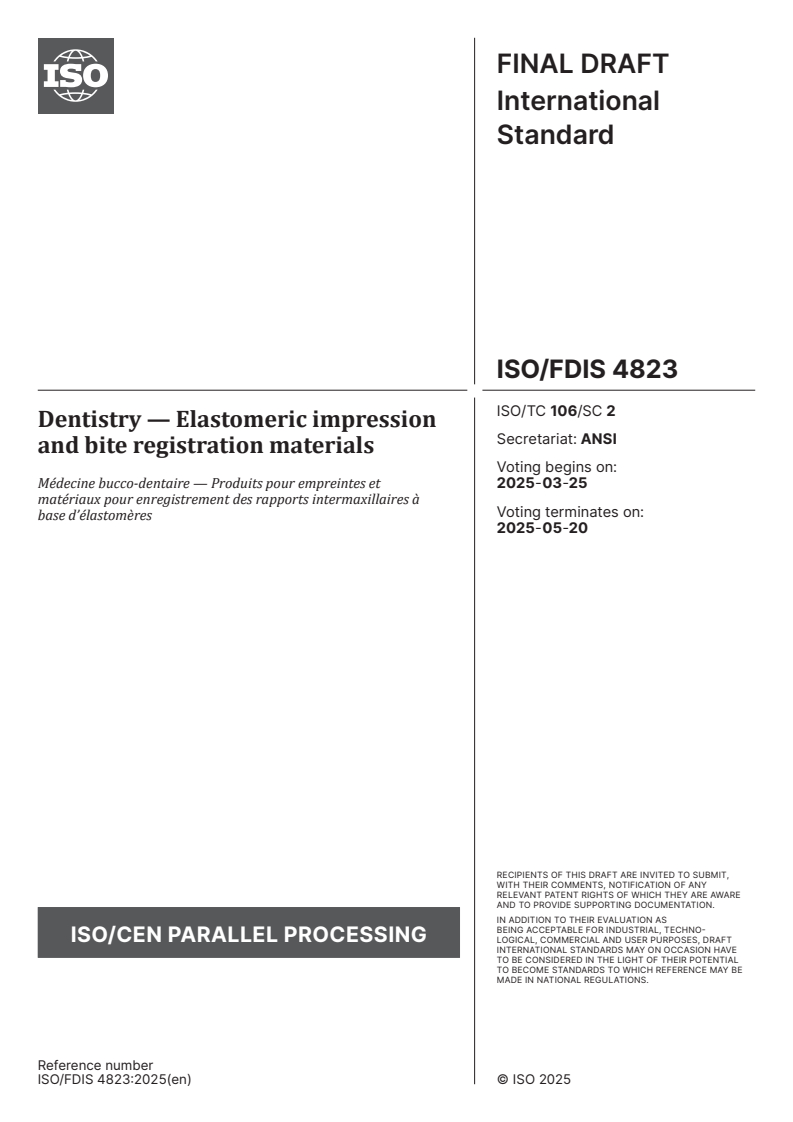
FINAL DRAFT
International
Standard
ISO/TC 106/SC 2
Dentistry — Elastomeric impression
Secretariat: ANSI
and bite registration materials
Voting begins on:
Médecine bucco-dentaire — Produits pour empreintes et 2025-03-25
matériaux pour enregistrement des rapports intermaxillaires à
Voting terminates on:
base d’élastomères
2025-05-20
RECIPIENTS OF THIS DRAFT ARE INVITED TO SUBMIT,
WITH THEIR COMMENTS, NOTIFICATION OF ANY
RELEVANT PATENT RIGHTS OF WHICH THEY ARE AWARE
AND TO PROVIDE SUPPOR TING DOCUMENTATION.
IN ADDITION TO THEIR EVALUATION AS
BEING ACCEPTABLE FOR INDUSTRIAL, TECHNO
ISO/CEN PARALLEL PROCESSING LOGICAL, COMMERCIAL AND USER PURPOSES, DRAFT
INTERNATIONAL STANDARDS MAY ON OCCASION HAVE
TO BE CONSIDERED IN THE LIGHT OF THEIR POTENTIAL
TO BECOME STAN DARDS TO WHICH REFERENCE MAY BE
MADE IN NATIONAL REGULATIONS.
Reference number
FINAL DRAFT
International
Standard
ISO/TC 106/SC 2
Dentistry — Elastomeric impression
Secretariat: ANSI
and bite registration materials
Voting begins on:
Médecine bucco-dentaire — Produits pour empreintes et
matériaux pour enregistrement des rapports intermaxillaires à
Voting terminates on:
base d’élastomères
RECIPIENTS OF THIS DRAFT ARE INVITED TO SUBMIT,
WITH THEIR COMMENTS, NOTIFICATION OF ANY
RELEVANT PATENT RIGHTS OF WHICH THEY ARE AWARE
AND TO PROVIDE SUPPOR TING DOCUMENTATION.
© ISO 2025
IN ADDITION TO THEIR EVALUATION AS
All rights reserved. Unless otherwise specified, or required in the context of its implementation, no part of this publication may
BEING ACCEPTABLE FOR INDUSTRIAL, TECHNO
ISO/CEN PARALLEL PROCESSING
LOGICAL, COMMERCIAL AND USER PURPOSES, DRAFT
be reproduced or utilized otherwise in any form or by any means, electronic or mechanical, including photocopying, or posting on
INTERNATIONAL STANDARDS MAY ON OCCASION HAVE
the internet or an intranet, without prior written permission. Permission can be requested from either ISO at the address below
TO BE CONSIDERED IN THE LIGHT OF THEIR POTENTIAL
or ISO’s member body in the country of the requester.
TO BECOME STAN DARDS TO WHICH REFERENCE MAY BE
MADE IN NATIONAL REGULATIONS.
ISO copyright office
CP 401 • Ch. de Blandonnet 8
CH-1214 Vernier, Geneva
Phone: +41 22 749 01 11
Email: copyright@iso.org
Website: www.iso.org
Published in Switzerland Reference number
ii
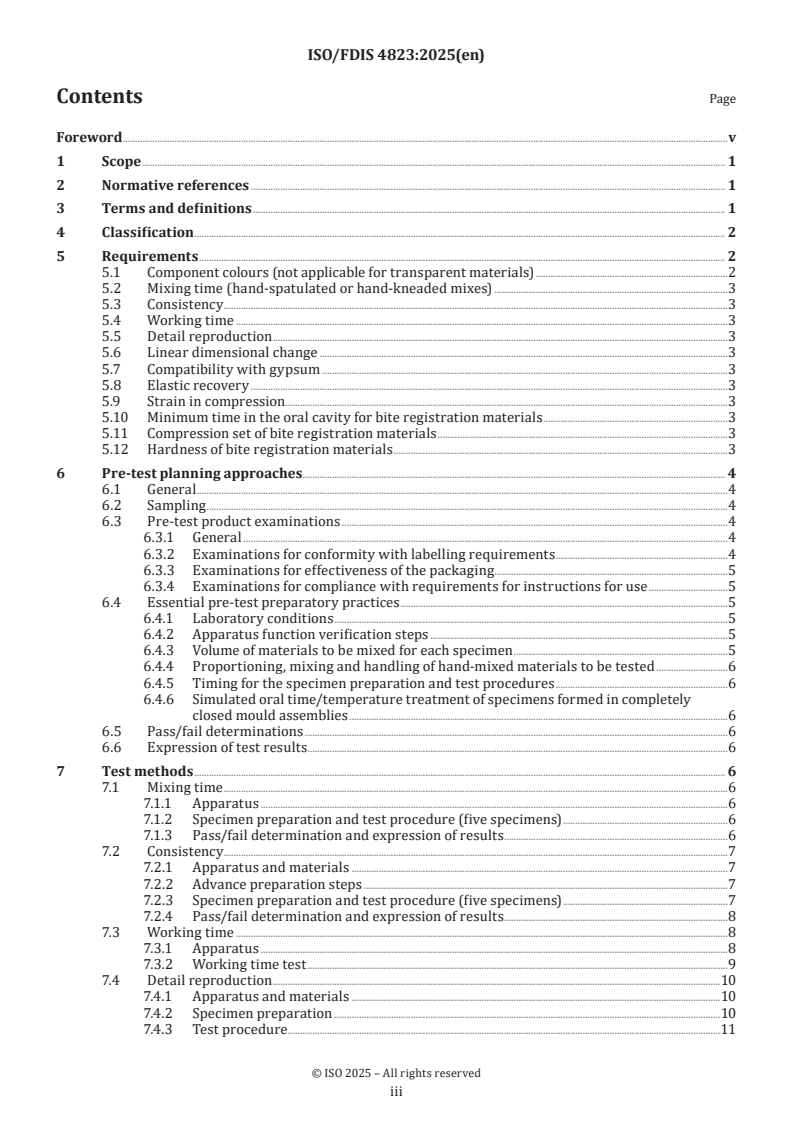
Contents Page
Foreword .v
1 Scope . 1
2 Normative references . 1
3 Terms and definitions . 1
4 Classification . 2
5 Requirements . 2
5.1 Component colours (not applicable for transparent materials) .2
5.2 Mixing time (hand-spatulated or hand-kneaded mixes) .3
5.3 Consistency .3
5.4 Working time .3
5.5 Detail reproduction .3
5.6 Linear dimensional change .3
5.7 Compatibility with gypsum .3
5.8 Elastic recovery .3
5.9 Strain in compression .3
5.10 Minimum time in the oral cavity for bite registration materials .3
5.11 Compression set of bite registration materials .3
5.12 Hardness of bite registration materials .3
6 Pre-test planning approaches . . 4
6.1 General .4
6.2 Sampling .4
6.3 Pre-test product examinations .4
6.3.1 General .4
6.3.2 Examinations for conformity with labelling requirements .4
6.3.3 Examinations for effectiveness of the packaging . .5
6.3.4 Examinations for compliance with requirements for instructions for use .5
6.4 Essential pre-test preparatory practices .5
6.4.1 Laboratory conditions .5
6.4.2 Apparatus function verification steps .5
6.4.3 Volume of materials to be mixed for each specimen .5
6.4.4 Proportioning, mixing and handling of hand-mixed materials to be tested .6
6.4.5 Timing for the specimen preparation and test procedures .6
6.4.6 Simulated oral time/temperature treatment of specimens formed in completely
closed mould assemblies .6
6.5 Pass/fail determinations .6
6.6 Expression of test results.6
7 Test methods . 6
7.1 Mixing time .6
7.1.1 Apparatus .6
7.1.2 Specimen preparation and test procedure (five specimens) .6
7.1.3 Pass/fail determination and expression of results .6
7.2 Consistency .7
7.2.1 Apparatus and materials .7
7.2.2 Advance preparation steps .7
7.2.3 Specimen preparation and test procedure (five specimens) .7
7.2.4 Pass/fail determination and expression of results .8
7.3 Working time .8
7.3.1 Apparatus .8
7.3.2 Working time test .9
7.4 Detail reproduction .10
7.4.1 Apparatus and materials .10
7.4.2 Specimen preparation .10
7.4.3 Test procedure.11
iii
7.4.4 Pass/fail determination and expression of results .11
7.5 Linear dimensional change .11
7.5.1 Apparatus and materials .11
7.5.2 Test block line-length measurement procedure .11
7.5.3 Specimen preparation . 12
7.5.4 Test specimen measurement . 12
7.6 Compatibility with gypsum . 13
7.6.1 Apparatus and materials . 13
7.6.2 Specimen preparation .14
7.6.3 Test procedure.14
7.6.4 Pass/fail determination and expression of results .14
7.7 Elastic recovery .14
7.7.1 Apparatus and materials .
...
2024-12-16
ISO /TC 106/SC 2
Secretariat: ANSI
Date: 2025-03-10
Dentistry — Elastomeric impression and bite registration materials
Médecine bucco-dentaire — Produits pour empreintes et matériaux pour enregistrement des rapports
intermaxillaires à base d’élastomères
FDIS stage
ISO /FDIS 4823:20232025(en)
All rights reserved. Unless otherwise specified, or required in the context of its implementation, no part of this publication
may be reproduced or utilized otherwise in any form or by any means, electronic or mechanical, including photocopying,
or posting on the internet or an intranet, without prior written permission. Permission can be requested from either ISO
at the address below or ISO’s member body in the country of the requester.
ISO copyright office
CP 401 • Ch. de Blandonnet 8
CH-1214 Vernier, Geneva
Phone: + 41 22 749 01 11
E-mail: copyright@iso.org
Website: www.iso.org
Published in Switzerland
iii
ISO/FDIS #####-#:2020(E 4823:2025(en)
Contents
Foreword . v
1 Scope . 1
2 Normative references . 1
3 Terms and definitions . 1
4 Classification. 3
5 Requirements . 3
5.1 Component colours (not applicable for transparent materials) . 3
5.2 Mixing time (hand-spatulated or hand-kneaded mixes) . 3
5.3 Consistency . 3
5.4 Working time . 3
5.5 Detail reproduction . 3
5.6 Linear dimensional change . 3
5.7 Compatibility with gypsum . 4
5.8 Elastic recovery . 4
5.9 Strain in compression . 4
5.10 Minimum time in the oral cavity for bite registration materials . 4
5.11 Compression set of bite registration materials . 4
5.12 Hardness of bite registration materials . 4
6 Pre-test planning approaches . 5
6.1 General . 5
6.2 Sampling . 5
6.3 Pre-test product examinations . 5
6.4 Essential pre-test preparatory practices . 6
6.5 Pass/fail determinations. 7
6.6 Expression of test results . 8
7 Test methods . 8
7.1 Mixing time . 8
7.2 Consistency . 8
7.3 Working time . 10
7.4 Detail reproduction . 12
7.5 Linear dimensional change . 13
7.6 Compatibility with gypsum . 16
7.7 Elastic recovery . 17
7.8 Strain in compression . 20
7.9 Minimum time in the oral cavity and compression set for bite registration materials . 21
7.10 Hardness of bite registration materials . 21
8 Requirements for labelling and instructions supplied by the manufacturer . 23
8.1 Labelling requirements . 23
8.2 Instructions for use . 24
Annex A (normative) Figures . 26
Annex B (normative) Standardized hand mixing methods . 45
Bibliography . 49
iv
ISO /FDIS 4823:20232025(en)
Foreword
ISO (the International Organization for Standardization) is a worldwide federation of national standards
bodies (ISO member bodies). The work of preparing International Standards is normally carried out through
ISO technical committees. Each member body interested in a subject for which a technical committee has been
established has the right to be represented on that committee. International organizations, governmental and
non-governmental, in liaison with ISO, also take part in the work. ISO collaborates closely with the
International Electrotechnical Commission (IEC) on all matters of electrotechnical standardization.
The procedures used to develop this document and those intended for its further maintenance are described
in the ISO/IEC Directives, Part 1. In particular, the different approval criteria needed for the different types of
ISO document should be noted. This document was drafted in accordance with the editorial rules of the
ISO/IEC Directives, Part 2 (see www.iso.org/directives).
ISO draws attention to the possibility that the implementation of this document may involve the use of (a)
patent(s). ISO takes no position concerning the evidence, validity or applicability of any claimed patent rights
in respect thereof. As of the date of publication of this document, ISO had not received notice of (a) patent(s)
which may be required to implement this document. However, implementers are cautioned that this may not
represent the latest information, which may be obtained from the patent database available at
www.iso.org/patents.www.iso.org/patents. ISO shall not be held responsible for identifying any or all such
patent rights.
Any trade name used in this document is information given for the convenience of users and does not
constitute an endorsement.
For an explanation of the voluntary nature of standards, the meaning of ISO specific terms and expressions
related to conformity assessment, as well as information about ISO's adherence to the World Trade
Organization (WTO) principles in the Technical Barriers to Trade (TBT), see
www.iso.org/iso/foreword.htmlwww.iso.org/iso/foreword.html.
This document was prepared by Technical Committee ISO/ISO/TC 106, Dentistry, Subcommittee SC 2,
Prosthodontic materials, in collaboration with the European Committee for Standardization (CEN) Technical
Committee CEN/TC 55, Dentistry, in accordance with the Agreement on technical cooperation between ISO
and CEN (Vienna Agreement).
This sixth edition cancels and replaces the fifth edition (ISO 4823:2021), which has been technically revised.
The main changes are as follows:
— — packaging and instructions for use requirements have been updated;
— — editorial corrections have been made.
Any feedback or questions on this document should be directed to the user’s national standards body. A
complete listing of these bodies can be found at www.iso.org/members.htmlwww.iso.org/members.html.
v
ISO/FDIS #####-#:2020(E 4823:2025(en)
Contents Page
Foreword . v
1 Scope . 1
2 Normative references . 1
3 Terms and definitions . 1
4 Classification . 2
5 Requirements . 3
5.1 Component colours (not applicable for transparent materials) . 3
Mixing time (hand-spatulated or hand-kneaded mixes) . 3
5.2 Consistency . 3
5.2 Working time . 3
5.2 Detail reproduction . 3
5.2 Linear dimensional change . 3
5.2 Compatibility with gypsum . 3
5.2 Elastic recovery . 3
5.2 Strain in compression . 3
5.2 Minimum time in the oral cavity. 3
5.2 Compression set of bite registration materials . 3
5.2 Hardness of bite registration materials . 4
5 Pre-test planning approaches . 4
5.0 General
5.0 Sampling . 4
5.0 Pre-test product examinations . 5
5.0.0 General
5.0.0 Examinations for conformity with labelling requirements . 5
5.0.0 Examinations for effectiveness of the packaging . 5
5.0.0 Examinations for conformity with requirements for instructions
...
PROJET FINAL
Norme
internationale
ISO/TC 106/SC 2
Médecine bucco-dentaire —
Secrétariat: ANSI
Produits pour empreintes et
Début de vote:
matériaux pour enregistrement des
2025-03-25
rapports intermaxillaires à base
Vote clos le:
d’élastomères
2025-05-20
Dentistry — Elastomeric impression and bite registration
materials
LES DESTINATAIRES DU PRÉSENT PROJET SONT
INVITÉS À PRÉSENTER, AVEC LEURS OBSERVATIONS,
NOTIFICATION DES DROITS DE PROPRIÉTÉ DONT ILS
AURAIENT ÉVENTUELLEMENT CONNAISSANCE ET À
FOURNIR UNE DOCUMENTATION EXPLICATIVE.
OUTRE LE FAIT D’ÊTRE EXAMINÉS POUR
ÉTABLIR S’ILS SONT ACCEPTABLES À DES FINS
INDUSTRIELLES, TECHNOLOGIQUES ET COM-MERCIALES,
AINSI QUE DU POINT DE VUE DES UTILISATEURS, LES
PROJETS DE NORMES
TRAITEMENT PARALLÈLE ISO/CEN
INTERNATIONALES DOIVENT PARFOIS ÊTRE CONSIDÉRÉS
DU POINT DE VUE DE LEUR POSSI BILITÉ DE DEVENIR DES
NORMES POUVANT
SERVIR DE RÉFÉRENCE DANS LA RÉGLEMENTATION
NATIONALE.
Numéro de référence
PROJET FINAL
Norme
internationale
ISO/TC 106/SC 2
Médecine bucco-dentaire —
Secrétariat: ANSI
Produits pour empreintes et
Début de vote:
matériaux pour enregistrement des
2025-03-25
rapports intermaxillaires à base
Vote clos le:
d’élastomères
2025-05-20
Dentistry — Elastomeric impression and bite registration
materials
LES DESTINATAIRES DU PRÉSENT PROJET SONT
INVITÉS À PRÉSENTER, AVEC LEURS OBSERVATIONS,
NOTIFICATION DES DROITS DE PROPRIÉTÉ DONT ILS
AURAIENT ÉVENTUELLEMENT CONNAISSANCE ET À
FOURNIR UNE DOCUMENTATION EXPLICATIVE.
DOCUMENT PROTÉGÉ PAR COPYRIGHT
OUTRE LE FAIT D’ÊTRE EXAMINÉS POUR
ÉTABLIR S’ILS SONT ACCEPTABLES À DES FINS
© ISO 2025 INDUSTRIELLES, TECHNOLOGIQUES ET COM-MERCIALES,
AINSI QUE DU POINT DE VUE DES UTILISATEURS, LES
Tous droits réservés. Sauf prescription différente ou nécessité dans le contexte de sa mise en œuvre, aucune partie de cette
PROJETS DE NORMES
TRAITEMENT PARALLÈLE ISO/CEN
INTERNATIONALES DOIVENT PARFOIS ÊTRE CONSIDÉRÉS
publication ne peut être reproduite ni utilisée sous quelque forme que ce soit et par aucun procédé, électronique ou mécanique,
DU POINT DE VUE DE LEUR POSSI BILITÉ DE DEVENIR DES
y compris la photocopie, ou la diffusion sur l’internet ou sur un intranet, sans autorisation écrite préalable. Une autorisation peut
NORMES POUVANT
être demandée à l’ISO à l’adresse ci-après ou au comité membre de l’ISO dans le pays du demandeur.
SERVIR DE RÉFÉRENCE DANS LA RÉGLEMENTATION
NATIONALE.
ISO copyright office
Case postale 401 • Ch. de Blandonnet 8
CH-1214 Vernier, Genève
Tél.: +41 22 749 01 11
E-mail: copyright@iso.org
Web: www.iso.org
Publié en Suisse Numéro de référence
ii
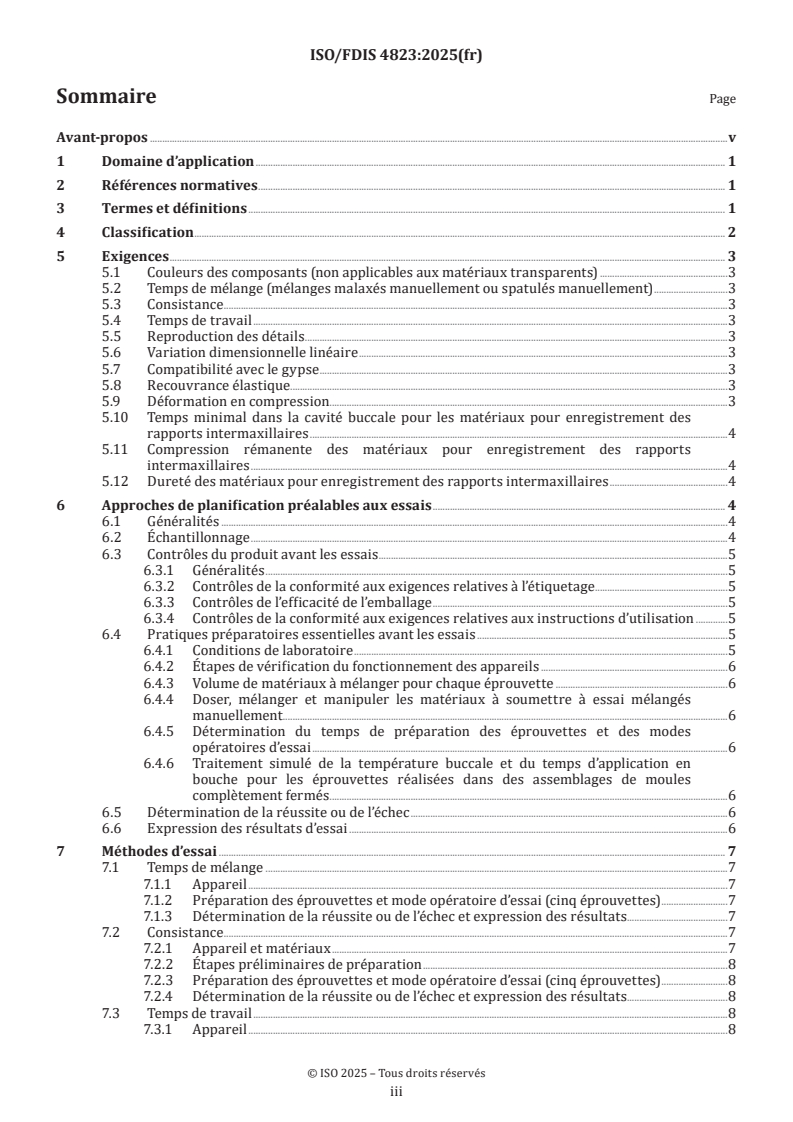
Sommaire Page
Avant-propos .v
1 Domaine d’application . 1
2 Références normatives . 1
3 Termes et définitions . 1
4 Classification . 2
5 Exigences . 3
5.1 Couleurs des composants (non applicables aux matériaux transparents) .3
5.2 Temps de mélange (mélanges malaxés manuellement ou spatulés manuellement) .3
5.3 Consistance .3
5.4 Temps de travail .3
5.5 Reproduction des détails .3
5.6 Variation dimensionnelle linéaire .3
5.7 Compatibilité avec le gypse .3
5.8 Recouvrance élastique.3
5.9 Déformation en compression .3
5.10 Temps minimal dans la cavité buccale pour les matériaux pour enregistrement des
rapports intermaxillaires .4
5.11 Compression rémanente des matériaux pour enregistrement des rapports
intermaxillaires .4
5.12 Dureté des matériaux pour enregistrement des rapports intermaxillaires .4
6 Approches de planification préalables aux essais . 4
6.1 Généralités .4
6.2 Échantillonnage .4
6.3 Contrôles du produit avant les essais .5
6.3.1 Généralités .5
6.3.2 Contrôles de la conformité aux exigences relatives à l’étiquetage .5
6.3.3 Contrôles de l’efficacité de l’emballage .5
6.3.4 Contrôles de la conformité aux exigences relatives aux instructions d’utilisation .5
6.4 Pratiques préparatoires essentielles avant les essais .5
6.4.1 Conditions de laboratoire .5
6.4.2 Étapes de vérification du fonctionnement des appareils .6
6.4.3 Volume de matériaux à mélanger pour chaque éprouvette .6
6.4.4 Doser, mélanger et manipuler les matériaux à soumettre à essai mélangés
manuellement .6
6.4.5 Détermination du temps de préparation des éprouvettes et des modes
opératoires d’essai .6
6.4.6 Traitement simulé de la température buccale et du temps d’application en
bouche pour les éprouvettes réalisées dans des assemblages de moules
complètement fermés .6
6.5 Détermination de la réussite ou de l’échec .6
6.6 Expression des résultats d’essai .6
7 Méthodes d’essai . 7
7.1 Temps de mélange .7
7.1.1 Appareil .7
7.1.2 Préparation des éprouvettes et mode opératoire d’essai (cinq éprouvettes) .7
7.1.3 Détermination de la réussite ou de l’échec et expression des résultats.7
7.2 Consistance .7
7.2.1 Appareil et matériaux .7
7.2.2 Étapes préliminaires de préparation .8
7.2.3 Préparation des éprouvettes et mode opératoire d’essai (cinq éprouvettes) .8
7.2.4 Détermination de la réussite ou de l’échec et expression des résultats.8
7.3 Temps de travail .8
7.3.1 Appareil .8
iii
7.3.2 Essai du temps de travail .9
7.4 Reproduction des détails .10
7.4.1 Appareil et matériaux .10
7.4.2 Préparation des éprouvettes .11
7.4.3 Procédure d’essai .11
7.4.4 Détermination de la réussite ou de l’échec et expression des résultats. 12
7.5 Variation dimensionnelle linéaire . 12
7.5.1 Appareil et matériaux . 12
7.5.2 Mode opératoire de mesurage de la longueur des lignes du bloc d’essai . 12
7.5.3 Préparation des éprouvettes . 13
7.5.4 Mesurage des éprouvettes . 13
7.6 Compatibilité avec le gypse . 13
7.6.1 Appareil et matériaux . 13
7.6.2 Préparation des éprouvettes .14
7.6.3 Procédure d’essai . 15
7.6.4 Détermination de la réussite ou de l’échec et expression des résultats.
...
Questions, Comments and Discussion
Ask us and Technical Secretary will try to provide an answer. You can facilitate discussion about the standard in here.