

ISO/TR 8547:2024
(Main)Corrosion of metals and alloys — Exposure test results in the Asian Monsoon region
General Information
- Abstract
This document provides the data of exposure test results for carbon steel and galvanized steel sheets in three countries, Japan, Vietnam and Thailand, under the “e-Asia Project” as valuable information on the corrosivity of atmospheres in the world.
- Status
- Published
- Publication Date
- 01-Apr-2024
- Technical Committee
- ISO/TC 156 - Corrosion of metals and alloys
- Drafting Committee
- ISO/TC 156 - Corrosion of metals and alloys
- Current Stage
- 6060 - International Standard published
- Start Date
- 02-Apr-2024
- Completion Date
- 02-Apr-2024

Overview
ISO/TR 8547:2024 - Corrosion of metals and alloys: Exposure test results in the Asian Monsoon region - is a technical report that compiles measured corrosion and environmental data from exposure tests conducted under the “e-Asia Project.” The document presents results for carbon steel and galvanized steel sheet at 36+ test sites across Japan, Vietnam and Thailand, providing practical information on atmospheric corrosivity in monsoon-affected climates.
Key topics
- Scope and test programme
- Outdoor exposure of carbon steel (3 mm thick, 70 × 150 mm, both sides exposed) and galvanized steel sheet (1 mm thick, 70 × 150 mm, one side exposed with back/edges protected).
- 16 sites in Japan, 13 in Vietnam and 7 in Thailand with skyward/groundward orientations.
- Test and measurement methods
- Corrosion products removed and weight loss measured following ISO 8407 to determine corrosion rates.
- Environmental monitoring: airborne salinity (Cl) by “Dry gauze”, SO2 by “PbO cylinder” per JIS Z 2382, and meteorological logging (temperature, relative humidity, rainfall, ACM sensor outputs).
- Conversion of JIS-derived Cl (S) and SO (P) deposition to ISO 9225:2012 equivalents (S = 2.4·S(JIS), P = 0.67·P(JIS)).
- Corrosion behaviour findings
- Carbon steel corrosion rates (CR[CS]) mostly fall into ISO 9223 corrosivity categories C2–C3 (≈10–400 g/m²·y), with some coastal sites (Miyakojima, Phangnga) reaching C4 (≈400–650 g/m²·y).
- CR[CS] shows a peak around ~20 °C in this dataset, increases with rainfall and Cl deposition, but is not strongly correlated with relative humidity or SO deposition in these sites.
- Zinc (CR[Zn]) corrosion rates are generally <1/10 of carbon steel and align with prior published studies for similar climates.
- Additional content
- Corrosion mapping, climatic/environmental plots and data source annex (Annex A) for further analysis.
Applications and users
ISO/TR 8547:2024 is useful for:
- Corrosion engineers and materials scientists selecting steels, zinc coatings or protective systems for Asia‑Pacific climates.
- Infrastructure owners and asset managers planning maintenance cycles for coastal and monsoon-exposed structures.
- Coatings manufacturers and specifiers validating performance expectations under high rainfall, high Cl deposition environments.
- Researchers and standards committees (linking to ISO 9223, ISO 9225) seeking empirical exposure data for corrosivity classification in monsoon regions.
Related standards
- ISO 9223:2012 - Corrosivity of atmospheres - Classification
- ISO 9225:2012 - Measurement of environmental parameters affecting corrosivity
- ISO 8407 - Removal of corrosion products (reference method)
- JIS Z 2382 - Local measurement methods used in this study
Keywords: ISO TR 8547:2024, corrosion, Asian Monsoon region, exposure tests, carbon steel, galvanized steel, Cl deposition, SO deposition, ISO 9223, ISO 9225.
Get Certified
Connect with accredited certification bodies for this standard

Element Materials Technology
Materials testing and product certification.

Inštitut za kovinske materiale in tehnologije
Institute of Metals and Technology. Materials testing, metallurgical analysis, NDT.
Sponsored listings
Frequently Asked Questions
ISO/TR 8547:2024 is a technical report published by the International Organization for Standardization (ISO). Its full title is "Corrosion of metals and alloys — Exposure test results in the Asian Monsoon region". This standard covers: This document provides the data of exposure test results for carbon steel and galvanized steel sheets in three countries, Japan, Vietnam and Thailand, under the “e-Asia Project” as valuable information on the corrosivity of atmospheres in the world.
This document provides the data of exposure test results for carbon steel and galvanized steel sheets in three countries, Japan, Vietnam and Thailand, under the “e-Asia Project” as valuable information on the corrosivity of atmospheres in the world.
ISO/TR 8547:2024 is classified under the following ICS (International Classification for Standards) categories: 77.060 - Corrosion of metals. The ICS classification helps identify the subject area and facilitates finding related standards.
ISO/TR 8547:2024 is available in PDF format for immediate download after purchase. The document can be added to your cart and obtained through the secure checkout process. Digital delivery ensures instant access to the complete standard document.
Standards Content (Sample)
Technical
Report
ISO/TR 8547
First edition
Corrosion of metals and alloys —
2024-04
Exposure test results in the Asian
Monsoon region
Corrosion des métaux et alliages — Résultats des essais
d'exposition dans la région de la mousson asiatique
Reference number
© ISO 2024
All rights reserved. Unless otherwise specified, or required in the context of its implementation, no part of this publication may
be reproduced or utilized otherwise in any form or by any means, electronic or mechanical, including photocopying, or posting on
the internet or an intranet, without prior written permission. Permission can be requested from either ISO at the address below
or ISO’s member body in the country of the requester.
ISO copyright office
CP 401 • Ch. de Blandonnet 8
CH-1214 Vernier, Geneva
Phone: +41 22 749 01 11
Email: copyright@iso.org
Website: www.iso.org
Published in Switzerland
ii
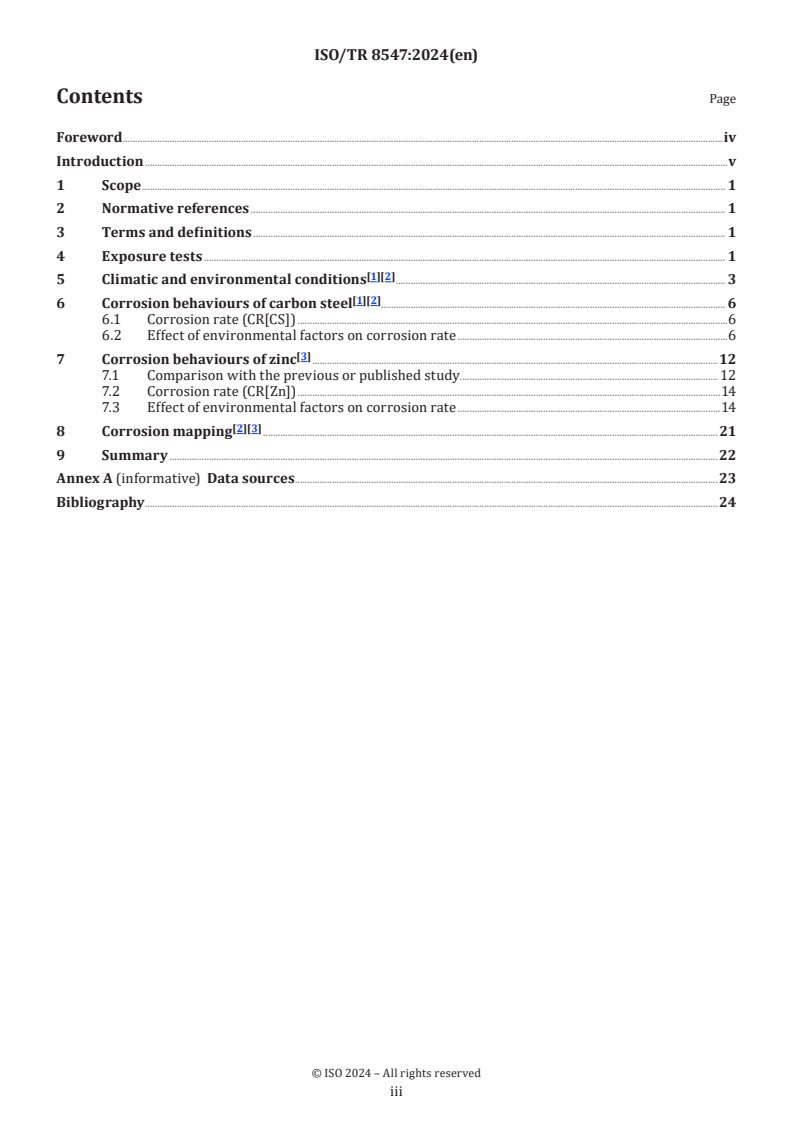
Contents Page
Foreword .iv
Introduction .v
1 Scope . 1
2 Normative references . 1
3 Terms and definitions . 1
4 Exposure tests . 1
[1][2]
5 Climatic and environmental conditions . 3
[1][2]
6 Corrosion behaviours of carbon steel . 6
6.1 Corrosion rate (CR[CS]) .6
6.2 Effect of environmental factors on corrosion rate .6
[3]
7 Corrosion behaviours of zinc .12
7.1 Comparison with the previous or published study. 12
7.2 Corrosion rate (CR[Zn]) .14
7.3 Effect of environmental factors on corrosion rate .14
[2][3]
8 Corrosion mapping .21
9 Summary .22
Annex A (informative) Data sources .23
Bibliography .24
iii
Foreword
ISO (the International Organization for Standardization) is a worldwide federation of national standards
bodies (ISO member bodies). The work of preparing International Standards is normally carried out through
ISO technical committees. Each member body interested in a subject for which a technical committee
has been established has the right to be represented on that committee. International organizations,
governmental and non-governmental, in liaison with ISO, also take part in the work. ISO collaborates closely
with the International Electrotechnical Commission (IEC) on all matters of electrotechnical standardization.
The procedures used to develop this document and those intended for its further maintenance are described
in the ISO/IEC Directives, Part 1. In particular, the different approval criteria needed for the different types
of ISO document should be noted. This document was drafted in accordance with the editorial rules of the
ISO/IEC Directives, Part 2 (see www.iso.org/directives).
ISO draws attention to the possibility that the implementation of this document may involve the use of (a)
patent(s). ISO takes no position concerning the evidence, validity or applicability of any claimed patent
rights in respect thereof. As of the date of publication of this document, ISO had not received notice of (a)
patent(s) which may be required to implement this document. However, implementers are cautioned that
this may not represent the latest information, which may be obtained from the patent database available at
www.iso.org/patents. ISO shall not be held responsible for identifying any or all such patent rights.
Any trade name used in this document is information given for the convenience of users and does not
constitute an endorsement.
For an explanation of the voluntary nature of standards, the meaning of ISO specific terms and expressions
related to conformity assessment, as well as information about ISO's adherence to the World Trade
Organization (WTO) principles in the Technical Barriers to Trade (TBT), see www.iso.org/iso/foreword.html.
This document was prepared by Technical Committee ISO/TC 156, Corrosion of metals and alloys.
Any feedback or questions on this document should be directed to the user’s national standards body. A
complete listing of these bodies can be found at www.iso.org/members.html.
iv
Introduction
At the time of publication, the mainstream method of classifying environmental corrosion is that specified in
ISO 9223. This is a method in which the corrosion rates of various metals are classified in six levels based on
the results of direct exposure tests conducted around the world. However, the exposure sites were located
only in Japan for the exposure tests in Asian Monsoon region, in which East-Asia, South-Asia and East-
South Asia are included and the climates are affected by monsoons. Thus, standardization of an evaluation/
classification method suited to the Asian Monsoon region has been strongly desired. Therefore, exposure
tests were conducted in three counties including Japan, Vietnam and Thailand, under the “e-Asia Project”.
This document summarizes the exposure test results for carbon steel and galvanized steel sheet.
v
Technical Report ISO/TR 8547:2024(en)
Corrosion of metals and alloys — Exposure test results in the
Asian Monsoon region
1 Scope
This document provides the data of exposure test results for carbon steel and galvanized steel sheets in
three countries, Japan, Vietnam and Thailand, under the “e-Asia Project” as valuable information on the
corrosivity of atmospheres in the world.
2 Normative references
The following documents are referred to in the text in such a way that some or all of their content constitutes
requirements of this document. For dated references, only the edition cited applies. For undated references,
the latest edition of the referenced document (including any amendments) applies.
ISO 9223:2012, Corrosion of metals and alloys — Corrosivity of atmospheres — Classification, determination
and estimation
ISO 9225:2012, Corrosion of metals and alloys — Corrosivity of atmospheres — Measurement of environmental
parameters affecting corrosivity of atmospheres
3 Terms and definitions
For the purposes of this document, the terms and definitions given in ISO 9223 and ISO 9225 apply.
ISO and IEC maintain terminology databases for use in standardization at the following addresses:
— ISO Online browsing platform: available at https:// www .iso .org/ obp
— IEC Electropedia: available at https:// www .electropedia .org/
4 Exposure tests
The coupons of carbon steel and galvanized steel sheet were exposed in outdoor environments at 16
exposure test sites in Japan, 13 sites in Vietnam and 7 sites in Thailand as shown in Figure 1. Specimens of
3 mm thickness and 70 mm × 150 mm of carbon steel and specimens of 1 mm thickness and 70 mm × 150 mm
of galvanized steel sheet were used for exposure tests. The specimens of carbon steel were exposed both
sides. For the specimens of galvanized steel sheet, the backside and cut edge of the coupons were covered
by polyethylene sheet after degreasing the specimen in acetone. The exposed surfaces of specimens
were exposed to skyward and groundward as shown in Figure 2. The corrosion products on the exposed
specimens were removed by using chemical solutions according to ISO 8407, and the weight losses were
measured to determine the corrosion rate.
For the environmental factors, monthly amounts of airborne salinity and SO were measured by “Dry gauze”
and “PbO cylinder”, respectively, based on JIS Z 2382. The temperature, relative humidity, and ACM sensor
output, I, were recorded in a microcomputer every 10 min.
-
For the annual average values of Cl deposition, S, and SO deposition, P, those values based on JIS Z 2382,
S(JIS) and P(JIS), respectively, were converted to S and P based on ISO 9225:2012, Annex F:
S = 2,4 S(JIS)
P = 0,67P(JIS)
NOTE Some of numerical data are available from data sources given in Annex A.
Key
J1 Asahikawa J14 Nishihara V1 Sơn La T1 Chiang Rai
J2 Akkeshi J15 Uruma V2 Yên Bai T2 Khon Kaen
J3 Sapporo J16 Miyakojima V3 Cua Ong T3 Pathum Thani
J4 Niigata V4 Hà Nội T4 Bangkok
J5 Fukui V5 Con Vanh T5 Chon Buri
J6 Sendai V6 Đong Hoi T6 Rayong
J7 Tsukuba V7 Dung Quat T7 Phangnga
J8 Choshi V8 Pleiku
J9 Yamanakako V9 Phan Rang
J10 Shimizu V10 Bien Hoa
J11 Fukuyama V11 Can Tho
J12 Fukuoka V12 Rach Gia
J13 Kagoshima V13 Ca Mau
Figure 1 — Exposure test sites in Japan, Vietnam and Thailand
Key
1 skyward
2 groundward
Figure 2 — Example of exposure test for galvanized steel at Miyakojima
[1][2]
5 Climatic and environmental conditions
The average temperature, T, at each site is shown in Figure 3. T value increases in the order
Japan
seen at the test sites in Northern area or in the mountain (Asahikawa, Akkeshi, Sapporo and Yamanakako),
the remain test sites have T of about 13 °C to 24 °C. In Vietnam, the average air temperatures are rather high,
and almost all Vietnam test sites have T in range of 22 °C to 27 °C. Different from Japan and Vietnam, the air
temperature of Thailand is very high with the annual average values of about 28 °C to 30 °C, except one site
in the North (Chiang Rai) where T is lower (25 °C).
The average relative humidity, RH, at each site is shown in Figure 4. RH of all test sites are rather high,
almost all of them have RH ≥ 70 %, except several sites with RH < 70 % (as Kagoshima and Miyakojima –
Japan, Khon Kaen – Thailand), among them, there are many test sites with RH ≥ 80 %, especially in some
areas, RH values reach approximately 85 % to 90 %.
The total of rainfalls in Asian area are very great as shown in Figure 5. Almost all test sites show the amount
of rainfall in the range of approximately 1 000 mm/y to 2 500 mm/y, in particular, there are test sites with
very high total of rainfall, approximately 2 500 mm/y to 3 000 mm/y.
-
Figure 6 shows the annual Cl deposition rate, S, at each site during the exposure period. The inland sites
have low S values (< 1 mmd), and the coastal sites have higher S values (> 1 mmd). Depending on the location
of the test sites as well as the topography and wind regime, S values at coastal sites have different values
in the range of about 1 mmd to 60 mmd. The high S values are observed at Miyakojima and Uruma (which
belong to Okinawa islands, Japan) and Phangnga (which is located near Phuket, Thailand).
Figure 7 shows the annual SO deposition rate, P, at each site during the exposure period. P values at almost all
...